Water and Water Quality

Site: Young Education
Cursus: Environmental Chemistry
Boek: Water and Water Quality
Afgedrukt door: Invitado
Datum: dinsdag, 24 november 2026, 00:42

1. The Water Cycle

Learning outcomes
  • I can describe the major stages of the water cycle.
  • I can explain how water moves through Earth's systems.
  • I can identify processes such as evaporation, condensation, and precipitation.
  • I can explain the importance of the water cycle for ecosystems.
  • I can analyze factors that influence water movement.

The Water Cycle

The water cycle, also called the hydrologic cycle, is the continuous movement of water between Earth's atmosphere, land, oceans, surface water, groundwater, and living organisms.

Water does not simply travel around Earth in one neat circle. It can follow many different pathways and may remain stored in one location for very different lengths of time.

For example, water may:

  • evaporate from an ocean
  • condense into clouds
  • fall as rain
  • soak into the ground
  • enter groundwater
  • flow into a river
  • return to the ocean

Or it may be absorbed by a plant and return to the atmosphere through transpiration.

The Sun provides much of the energy that drives this movement, while gravity causes water to fall as precipitation and move downhill through rivers and groundwater.

https://images.openai.com/static-rsc-4/amf_k9xjWnssKI0nq66YN-VzQ-Fcz0IHs8UUMs2Tgg2jVoYsV4hkJLy1VGDSJE8DK5vc8JBvloDi805bdzVC8u1sByY5kzIVZGYhj81ezEHlBVF3RoRAxlLaOcyMDmbxjfMqcdh3kHKmAwp4o2iEy-jzPRLmHYV9xrpZmttiqShvqAkWJleV70FLxGNNKY2A?purpose=fullsize
 
https://images.openai.com/static-rsc-4/2YXRHxYtJ9dLm_KqdS4yeyVFAnwyDjeq44gU7xF6fGJQH6e38bjdrf9tWixzcKs8EgsRXIyc8DGOGIgKYShYeZovnLAgJ9gwO3mWCYSFEIvgmtUSq2IcoK0G0Ks_4BQeDerP30LrXxwgv0_BN_sal_9huYfMbJ3kq6RMoTJ8i5-l9Dl6RiVeBYV_UPugFmai?purpose=fullsize
 
https://images.openai.com/static-rsc-4/KyLAB-UxQ16ujwxlaLAiuIitRbRcfhEPjTuQG_AohadB1qp1ytpSeUc_2WuMoGbLoXM0nsyHE40PpWOEPvBXTPUHsPjrg_9_UeoSokL9mseiZBFOuEBu3FJZdVHHGVRA2p8Rhft2wrAM-vf1QkbCvY62TmFRZlVrK7zXjooQGAyC8ge4TixdtWHKCIbTjuHm?purpose=fullsize
 
6

Water Moves Through Earth's Systems

The water cycle connects all of Earth's major systems.

Atmosphere — contains water vapor, clouds, and precipitation.

Hydrosphere — includes oceans, lakes, rivers, groundwater, glaciers, and other water.

Geosphere — includes soil and rock through which water infiltrates and moves.

Biosphere — includes living organisms that take in, use, and release water.

Water constantly moves between these systems.

For example:

ocean → atmosphere → land → groundwater → river → ocean

Because these systems interact, a change in one part of the water cycle can affect many others.


The Water Cycle Is Not a Simple Circle

Diagrams often show the water cycle as:

evaporation → condensation → precipitation → collection → evaporation

This is useful as a starting point, but the real water cycle is much more complex.

After precipitation reaches land, water could:

  • flow into a river
  • soak into soil
  • enter groundwater
  • freeze
  • collect in a lake
  • be absorbed by plants
  • evaporate directly
  • eventually return to the ocean

So it is better to think of the water cycle as a network of connected pathways and reservoirs.

This interactive model shows how the main processes connect:
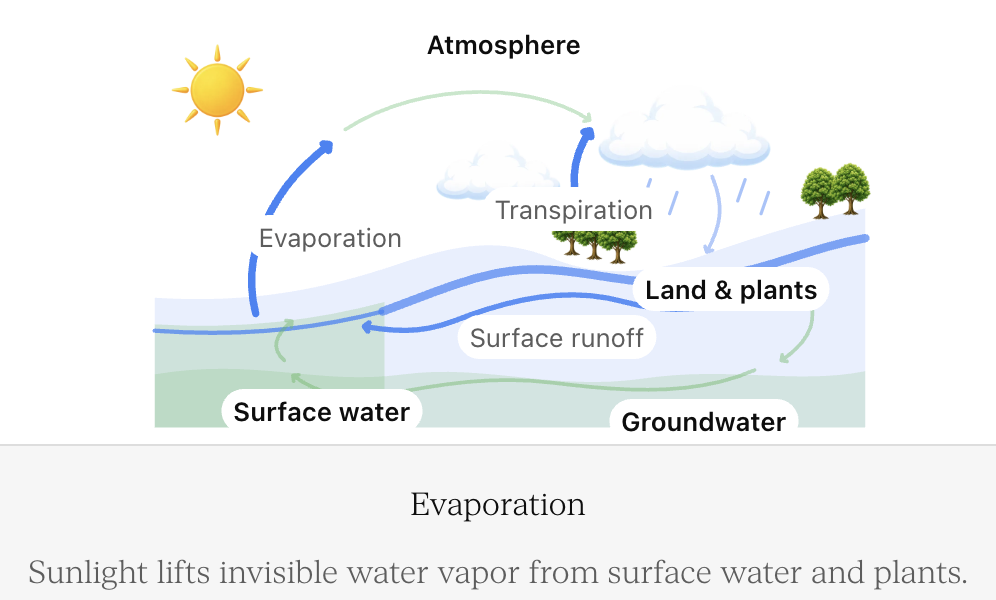
Evaporation

Evaporation is the process by which liquid water changes into water vapor.

Most evaporation occurs from:

  • oceans
  • lakes
  • rivers
  • wetlands
  • moist soil

Energy from the Sun heats liquid water.

Some water molecules gain enough kinetic energy to escape from the liquid surface and enter the atmosphere as gas.

liquid water → water vapor

Evaporation is generally faster when:

  • temperature is higher
  • wind speed is greater
  • humidity is lower
  • more water surface is exposed

This is why wet clothing usually dries faster on a warm, windy, dry day.

https://images.openai.com/static-rsc-4/jSKKsi493YoDlDYV0H_Ic5U1vpoqitlWKJdXDrHZh0B13398ac1bLNdofKFALu3jzv00ZhkvUj4Ktgb1tQqRejqyrvuXrxTiK1bsOp-GGs5Ba1KkGOTEuGzRSnJ5QP3eiJJaXivNusVLHgnotjaEzqAiLentFJ1eqV7UtxNwFXcVS3lQyZXJmmLqwqJkhwdB?purpose=fullsize
 
https://images.openai.com/static-rsc-4/G_RoXLU4t71ToEb3sWEvhSz8I7LNZbcrNen0DPzYXlFq7Ji150DAVtE90nqpfgz2w04Ig-MnNSVxHQSVXRNErbnMukDjC_ltLUv_0GiJE1FYO-ESZTvhpner4TT_0nQzo7LIj1CJGF4IUoYTkMqAAG7hsEZWkHlWGVmbVBtRksKqn9jZe0BpRs3mvhP2Jos1?purpose=fullsize
 
https://images.openai.com/static-rsc-4/z3ISCPtcJ9DVpwCkJhhOAGg5x1F04JIeLeVbIFBQWhmS4jIK7p63QpUweW3GSesULowJI4opzZyG-T4yRcrJdz43ABqJV9T0baryrSPkoIDlB2gLSuGU7YL2Epr6S2lZYZJvm8r_i0aXmKFIQA5O_927czBF2hXOdrmPV1nuVzeW0Ew3G06Xbg18LQiL0mck?purpose=fullsize
 
6

Transpiration

Plants also transfer large amounts of water to the atmosphere.

Roots absorb water from the soil. Water travels through the plant and eventually escapes mainly through tiny openings called stomata in the leaves.

This process is called transpiration.

The combined transfer of water to the atmosphere through evaporation and transpiration is sometimes called:

evapotranspiration

A simplified pathway is:

soil → roots → plant → leaves → atmosphere

Forests can therefore play an important role in regional water cycles.

https://images.openai.com/static-rsc-4/VATNttDIci3gfAtyO4akqjKTFaxv0jwot1sbxx8Hg2DLXqOo28GpqVGCfdkHCZoMiWBOqzUq9wN2OLFXwRD2LR7vnRbAwTJO6PQbZlzdP5Jea3WMcqtnbYD07J_WebAHUYJbDsIp4AO9Sl7HPrQHbjnnvhB6e8axrJsN0H0vwZm5I7KkPb3TaHz4zVfaDN5T?purpose=fullsize
 
https://images.openai.com/static-rsc-4/0wS_b4hI0tAY-8Td1NjxVokwu411HnbZJGtuFp6Q4qcvubYZHzvM0U7AdPazD6z9FujOzHE5bGc1VwCrmgv7CiwKSMUMQDQT3AIh71JcTq2wr1ApoMlPsODegL3poewrBz2MdOrHDxilvZ1twrhis_kqJvdVIk7Grf6gWjzatHJ6yBn4xd7vozwQ_9rYnUJL?purpose=fullsize
 
https://images.openai.com/static-rsc-4/JYzxlK8HmStMDvzbUV7UbltRyEC2XTfOYCOcN8WWFewSA72AN4xP_BHmZyq88aZTG-ICDGjQxqvKaI7FMd4UWuJADbq6LuDT4XKxWw0ocCp5N8OcgwUV9UBhfLiRxRFyaHxvzH28pNFIlCY5MEXI_yBTYV1Zrx9pwjUqVZ2J04NnjOmBXLEDm5mnqMYLcKAs?purpose=fullsize
 
5

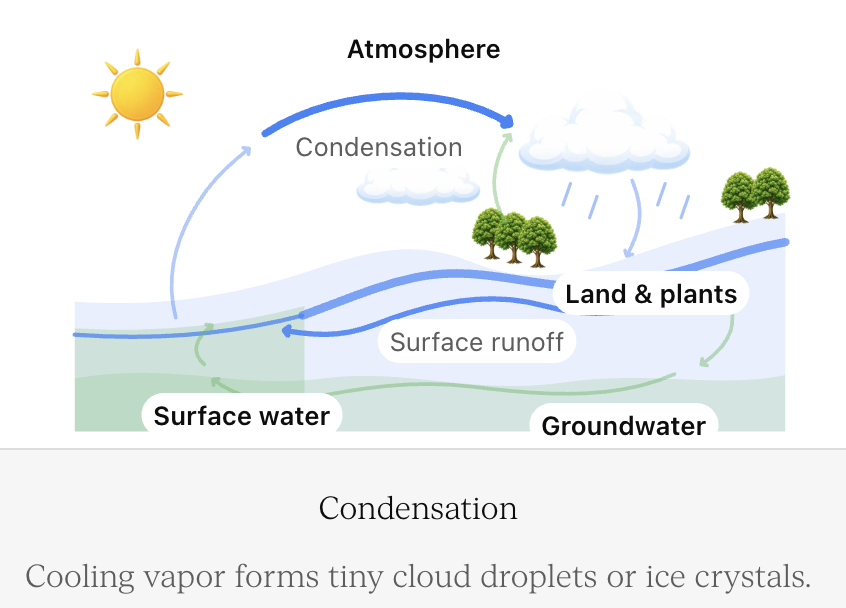
Condensation

As moist air rises, it often cools.

Cooler air can reach conditions where water vapor begins changing into tiny liquid water droplets or ice crystals.

This process is called condensation.

water vapor → liquid water

Clouds form when huge numbers of tiny droplets or ice crystals develop in the atmosphere, usually around tiny airborne particles.

Condensation also explains everyday observations such as:

  • dew forming on grass
  • droplets appearing on the outside of a cold drink
  • a bathroom mirror becoming covered with water droplets

The water on a cold glass does not pass through the glass. Water vapor from the surrounding air condenses on its cold surface.

https://images.openai.com/static-rsc-4/B5bOIh0mO8sjuUubB8StLqkV2HkkX4YEgOefHcBAn39CTLnntS4SVQBZkJVE9M0pZj3laQY9Y4QU5-r-8uy9M8HMKSNp1Sn9BJI3FU45DHRN8NylKbjEpk7IiXza0zCfAHfcuMRMU_4XvK3il7ouDStIohVpI2so2e_sb7ppCq18jHef0DSSrx7iUu9aR7Eh?purpose=fullsize
 
https://images.openai.com/static-rsc-4/IpuEcbhWAa6GWW4LFbzbXpz1ldw7llE35OnCQ_z9kDhv6B9jQTAIyeoh1upcIadwvAMumnBD2Vum8Jj-W5cAeFWVNNmTk5OfEp8vpDq8vMJOL0MNw9nZrdKRMVmUdk5RSXtms_2RkmmXxjADNwv2gVPlUftN9iNDCXLQ5RGmENVLx4cR4qcufqqCtwsaksYc?purpose=fullsize
 
https://images.openai.com/static-rsc-4/va6-dlxFzRjBmGLqjUSlAQxdoO4UQM5S_n5HJI7Gk-qamKtb_bWup93dfXPeCO7c9FrA3KzNp-H03_QL9dozW21dGoEB8xtPhkX2AZ7dqB_9L7fKk4P8Mxqw5h1MmJQpN1Q__ybWtDw0C_pMe-WQDT39-Kk7kybTFSFwuH3qm1bp8sATY2hPZNJL7_rH5ZS9?purpose=fullsize
 
5

Clouds and Atmospheric Transport

Water does not necessarily fall back to Earth where it evaporated.

Winds can transport water vapor and clouds over enormous distances.

For example, water may:

  1. evaporate from an ocean
  2. enter the atmosphere
  3. be transported inland
  4. condense into clouds
  5. fall over mountains as precipitation

This atmospheric transport is one reason oceans can supply water to ecosystems far inland.


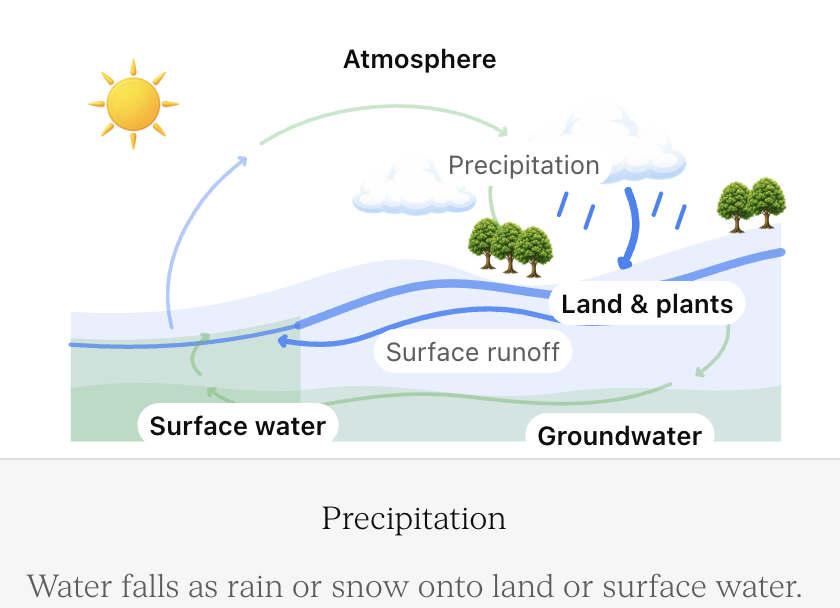
Precipitation

Precipitation occurs when water falls from the atmosphere to Earth's surface.

Forms of precipitation include:

  • rain
  • snow
  • sleet
  • hail

Cloud droplets and ice crystals can grow until they become too large to remain suspended.

Gravity then causes them to fall.

The form of precipitation depends strongly on atmospheric temperature and conditions.

https://images.openai.com/static-rsc-4/9sr8HipzuaPXZPE876qK80KGkEIHUAg3lKvxXd2Jau825dAq0IOH2g0Ppws8RgDy24ocjbGO0tzAo2tpvfCyeJyovU-gnZtQr9GhaPMHHlOy4RWd_i9dx9XCATOTPWuD1JJgVOM3C4mt6sn2zoACRtVxfUAnz4Uu-WrbK4a32Y7GgJiJRh7zdVx2rTVA9y2L?purpose=fullsize
 
https://images.openai.com/static-rsc-4/Cm7TJC_Igkpy7uFiB9Soy0qGNnyFbXuksJBwWODLp3rpYgXvdlEqaSO_A4LDnhIa-_QkgnAOIr9qRsSNGES0P5wZfdAokyNKUOI5e5PAmyjUCR2Ay70r9QJjJaYLgXfNkp89vnvvbj6fokrvZe610QEHeWr4VP06MjY4PlmITlNIRTNFANLCqyhsyqqEnXMY?purpose=fullsize
 
https://images.openai.com/static-rsc-4/lfJ3zRwyv2HVzx_2Y6R3fZUya2LKYnjpgu3pIf7PG2T2Yf_pYtqVXhEn7XURa_YacRS1VaLqFAARXGSq4bt04iH6nv7xk6TSRLFdaB1idEjSq7XmxJG62Yg7c5pMYkYFNHPTQxq9q_W4eys14knKbezPBgq13mGVdbUXKBmC_liTQDYArcZA9Kq-iS2cvf8W?purpose=fullsize
 
6

Collection and Storage

After precipitation reaches Earth's surface, water can be stored in many places.

Major water reservoirs include:

  • oceans
  • lakes
  • rivers
  • glaciers
  • snow
  • groundwater
  • soil
  • atmosphere
  • living organisms

The oceans are by far Earth's largest reservoir of water.

Water may remain in some reservoirs for much longer than others.

For example, a water molecule might remain in the atmosphere for a relatively short time but remain stored in deep groundwater or glacial ice for much longer.


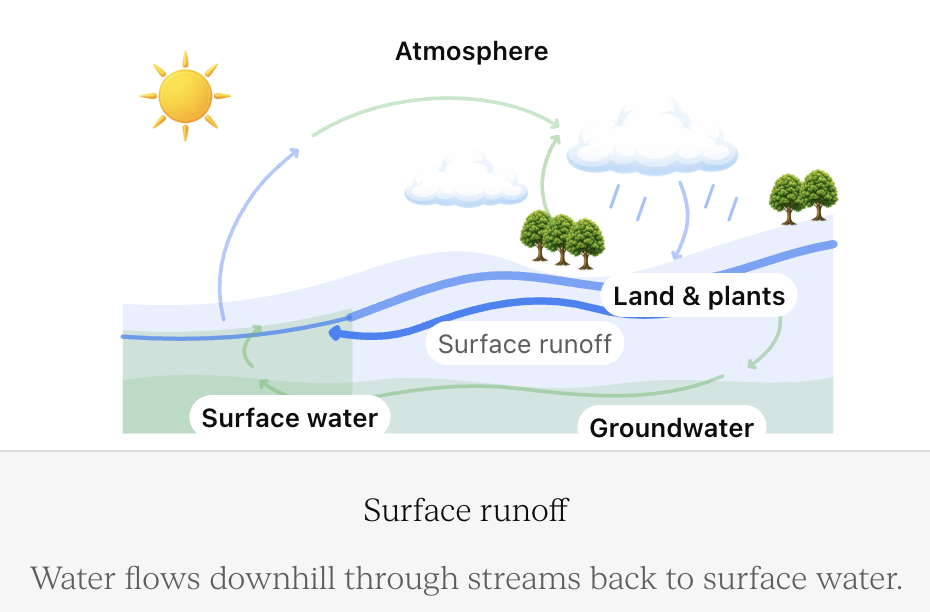
Surface Runoff

When water reaches the ground, some flows across the surface.

This is called surface runoff.

Runoff can enter:

  • streams
  • rivers
  • lakes
  • wetlands
  • reservoirs
  • oceans

Gravity causes surface water to move from higher elevations toward lower elevations.

A typical pathway might be:

rain → hillside → stream → river → ocean

https://images.openai.com/static-rsc-4/BWXks0dOYRsnIspA9TH-hsO7Oa763WcG8NqSL5t-v4E3WAridsM_lUZ3IlqnKAtHrOiiVSoEyhm_iYNDvYlqvGi3WvMLzPwK4k52Dp3TiC-f4jRzoFDyF2YI2ubxj4gZMOwSCR9zidaB3vpO0-mXA6q9j2i0YVv6kRYLA3YFZI0IVBFmuHtor_xTTRyZSKPp?purpose=fullsize
 
https://images.openai.com/static-rsc-4/596rKAGzPJYHYdld6qdG-KtdDTpkuGkrRiqzQVAjGW05DS7nD_qX69QG16kUo1Vu5252XgFFNt_PSwYjKSRTNLbLVdSnZmaAuoMCrU4VHXOojvBbcCJHc647HOjV3_sDtS3bHutkbKw-8_qF2T3lSefqDNBR9JzAv1_QcHrbRwZoyFnQUJcXMRJ9ZFhLNz2f?purpose=fullsize
 
https://images.openai.com/static-rsc-4/TMW8rPTflDF1rorNDoO8IFo36NqsZtJKKNmcpHrTSs0OtnEj2vvSEciOgr_V1wpPB5cWUMyT93xUfo5XJa4GBKgn2Cw9QSrjyDhIvmfkjTF5gP3hZuusbtIOpBfM_Ev-bG3ni1Hsdq7iWAJ9YmlsqasOCyZ4Gz5XPlhVAu1uzUiqO1_SzVsKtfr5oCsIhoa5?purpose=fullsize
 
6

What Affects Runoff?

The amount of runoff depends on several factors.

Rainfall intensity

Heavy rain can fall faster than the soil can absorb it.

This increases runoff.

Soil type

Some soils allow water to infiltrate rapidly, while others absorb it more slowly.

Vegetation

Plant roots and soil organic matter can increase water infiltration and slow surface flow.

Slope

Water generally runs off steep slopes more rapidly.

Previous conditions

Already-saturated soil cannot absorb as much additional water.

Human surfaces

Concrete, asphalt, roofs, and roads allow very little infiltration.

Urban areas can therefore produce large amounts of rapid runoff.


Infiltration

Infiltration is the movement of water from Earth's surface into the soil.

Once water enters the ground, several things can happen.

It may:

  • remain as soil moisture
  • be absorbed by plant roots
  • evaporate from the soil
  • move deeper underground

The rate of infiltration depends on factors such as:

  • soil texture
  • soil structure
  • vegetation
  • soil saturation
  • land use
  • rainfall intensity

Percolation

Water that infiltrates into soil may continue moving downward through soil and permeable rock.

This deeper movement is called percolation.

A simplified sequence is:

precipitation → infiltration → percolation → groundwater

Infiltration and percolation are related but not identical.

Infiltration describes water entering the ground.

Percolation describes water moving downward through soil and rock.


Groundwater

Water stored beneath Earth's surface is called groundwater.

Groundwater occupies spaces and cracks within soil and rock.

A body of permeable rock or sediment that stores and transmits useful quantities of groundwater is called an aquifer.

Groundwater is an extremely important freshwater resource.

People obtain groundwater through:

  • wells
  • springs
  • pumping systems

Groundwater also interacts with surface water.

It can slowly flow into:

  • streams
  • rivers
  • lakes
  • wetlands
  • oceans
https://images.openai.com/static-rsc-4/oEcxH5HrFq9fKzN5XQo_t1eR0E_79kRsaUcZ0RxBkZlXCPY37OnWn7-fZp1_4YWpWkbWQPZeiGMmCNu-liM-42Vbpy29OnYMPVJjWhVvNkCFjgkHg76lNTRdRveqHYK_VET1fmltZRzfTg9SR4SmGGao-1mMM7Dm7WG99Z-3x5AkL91-viIb7TshYEDQ8CLK?purpose=fullsize
 
https://images.openai.com/static-rsc-4/--tcc19C1WvZfS9mdBC9jNOswyzwtmBC14IVGKzd-0nMMXT1UeWqJ7lojq2adWvj9IqtqwpHXK5HCLNq10emYy_tzq6H8Bgzx10TMHyJgQVBbaPHiHwzNq0aGObvhMiGqMBc-MLfR1QIRMWAXW5YY6td8ap3b9Vgn4dqL6bIbWa50SyV5XKr2ZX8dDwycXHx?purpose=fullsize
 
https://images.openai.com/static-rsc-4/Opt6XBcqg-vimF3n9gwwZ8lat9qSPjEf4C63I2JCL2_DaQOQ2S_JUBQZXw6Sp_oMOTRk22B0-knEQkr1uqAf2z-zA2R_t-nxoJoYIPHPfJ18DAEXQor-nhB5-cu2HTafSgeuLLn56OUGGUOpR7INcrkauoRJWIjd-f23TpdVIlmdWTKjmzd9_qw0QUPVjrTg?purpose=fullsize
 
5

The Water Table

The water table is approximately the upper boundary of the zone underground where spaces in soil and rock are saturated with water.

Its depth can change.

After prolonged rainfall, the water table may rise.

During:

  • drought
  • prolonged dry conditions
  • heavy groundwater pumping

the water table may fall.

This illustrates how different parts of the water cycle influence one another.


Groundwater and Rivers

Groundwater and rivers should not be thought of as completely separate systems.

Groundwater can feed rivers and streams, helping maintain their flow during periods without rainfall.

In other situations, water from a river can infiltrate into surrounding ground.

This exchange is important for aquatic ecosystems and freshwater supplies.


Snow and Ice

Water can also be stored as:

  • snow
  • glaciers
  • ice sheets
  • frozen ground

This temporarily removes liquid water from other parts of the cycle.

When temperatures increase, melting returns frozen water to liquid form.

The resulting water can:

  • infiltrate into soil
  • enter rivers
  • replenish lakes
  • contribute to runoff

Seasonal snowmelt is an important source of freshwater in many regions.

https://images.openai.com/static-rsc-4/a7UxvhdighpcCm3GQ81zgPPLZSJC_z8HkXBpyAn67-rj4iWm74wSUmRZRv747ZG7acIHMddxOLpr6vkt9Cyx_jHeH0gS_qV7IMkFhvjwX8J5fD5a4G4hj_kniwBmeZrcrme2sXux3sSjBSeweRB8UKRB5Kzle4-AKKg6h0-dy3aEOwUbYLrQI3zv0m4qMK3W?purpose=fullsize
 
https://images.openai.com/static-rsc-4/UKuO1eQG_rNOpG7NNCLBDUL2upSiAIBzV59IcinsLp_0u8rhudbfPJy1n1cxgpINaUqJFtG8RNE9Uja9reaF5zkSY96Bq5yMNnaK_dBbjv_umrRX1xcWg8i8x0NwbX2pmXV2HtIYSGhJ24AoEVkCQ7JsxJmTbmN_nLkr__20M3t9izRbVf19tKeGUWCo3Ou7?purpose=fullsize
 
https://images.openai.com/static-rsc-4/kysVQHuBW0o4MCwMDrI6Yaeilf-z2p-SHk--zZmHyc4k7cnknPP8c0sFen6_kVScw9aLSn1bG7IQMAPUfzHSMztDWlaDVS88WmRTmBzY_PglHP08q3tEVDwAQX9IREBxswklfvdbtH68DkGKqKApaoHwsgRyZJIzl_dooIPmq7KVY2bhhkQYIEnpbbcTyWKx?purpose=fullsize
 
5

Sublimation

Water does not always need to melt before entering the atmosphere.

Sublimation occurs when solid water changes directly into water vapor:

ice → water vapor

This can occur from:

  • snow
  • glaciers
  • ice

especially under cold, dry, windy conditions.

The reverse process is called deposition:

water vapor → ice

Frost can form through deposition.


Gravity and the Water Cycle

The Sun supplies much of the energy driving evaporation, but gravity is another major driver of the water cycle.

Gravity causes:

  • precipitation to fall
  • rivers to flow downhill
  • runoff to move toward lower elevations
  • water to infiltrate and percolate downward
  • groundwater to move through geological materials

A useful generalization is:

Solar energy moves water into the atmosphere.

Gravity helps return and move water across and beneath Earth's surface.


Watersheds

A watershed, or drainage basin, is an area of land where water drains toward the same river, lake, or other body of water.

Rain falling within a watershed may eventually travel through:

small streams → larger streams → rivers

Watersheds are important because activities occurring upstream can affect water quality downstream.

For example:

  • fertilizers
  • sediment
  • oil
  • litter
  • pesticides

can be transported by runoff.

https://images.openai.com/static-rsc-4/DRTKtAdmBHWZM4msI4A89Ibx_7Tl2vK-4KhKidsr03qThDdGF-ZAOB8QP0cSUbMxM-YtXLfSrnxVgwzCayS0_IhPMvKE_5JCg47BTfKXOJJZ_GEAObs_2Y7jq2F-disqWOuY1EKU64np9S0dM7qKDzE8xZCff0ki75J4QBO8tS88kT3I-SbtzKEkhAq2fg8L?purpose=fullsize
 
https://images.openai.com/static-rsc-4/uvYE-51aODT6vumKJ3266QHAPSoTDJ-t4oivcXgW7YkLwQuikb-PQ-Hwov3e_3D_UrIFu6VyAugZDzKJY54z0cJCtjoEJVtq874x5yDnkCfxLEKulKjLAcDYTdvuwGz9y8sANs3tDEDA_rTm01Dnz-ccJwP_4VgP1d0Ysw2-s8qDoNEQMs3PV0mUEiIh_6xZ?purpose=fullsize
 
https://images.openai.com/static-rsc-4/navmIMvq_Yv3GoT4Nzxuc71xtfV9eUXEU3XLdz4N-Y0_8OjafWcAo7Y5H8xcVgQJAdKKQnml1yDUCga5TomDKVGgxNoHTJ9z4zz0aTuFPpa9u7mPjvs86aOP7b8_DTzNS77wTTsNlck1ruSWDQxidO--Bgz5Ppq1paJN05lJNNAYfeA5jtgFWCZHwjf32D3q?purpose=fullsize
 
6

The Water Cycle and Ecosystems

Living organisms depend on the water cycle.

Plants require water for:

  • photosynthesis
  • transporting substances
  • maintaining cell structure
  • growth

Animals depend on water directly and indirectly through food webs.

Aquatic ecosystems depend on:

  • water availability
  • water depth
  • temperature
  • flow
  • water quality

The water cycle also transports:

  • nutrients
  • minerals
  • sediments
  • dissolved gases

through ecosystems.


Water and Plant Growth

Consider a forest after rainfall.

Some water:

  • remains on leaves
  • evaporates
  • enters the soil
  • is absorbed by roots
  • moves through plant tissues
  • leaves through transpiration
  • enters groundwater
  • runs into streams

The same rainfall event can therefore send water along several pathways simultaneously.

This is another reason the water cycle is better understood as a network rather than a simple loop.


Weather and the Water Cycle

The water cycle is closely connected to weather.

Evaporation adds water vapor to the atmosphere.

Condensation produces clouds.

Atmospheric circulation transports moisture.

Precipitation returns water to the surface.

Changes in:

  • temperature
  • humidity
  • wind
  • air pressure

can therefore influence water movement.


Temperature

Temperature strongly influences evaporation.

Generally:

higher temperature → faster evaporation

Warmer conditions can also affect:

  • snowmelt
  • ice melt
  • atmospheric water vapor
  • precipitation patterns
  • transpiration

Temperature changes can therefore alter several pathways in the water cycle simultaneously.


Humidity

Humidity describes the amount of water vapor in the air.

When the surrounding air is already very humid, evaporation tends to occur more slowly.

When the air is dry, evaporation can occur more rapidly.

This is why perspiration often evaporates less effectively in very humid weather.


Wind

Wind can increase evaporation by carrying humid air away from a wet surface and replacing it with drier air.

Wind also transports:

  • water vapor
  • clouds
  • storms

between regions.

Water that evaporates in one location may therefore become precipitation hundreds or thousands of kilometres away.


Vegetation

Vegetation can influence the water cycle in several ways.

Plants:

  • intercept rainfall
  • absorb water
  • release water through transpiration
  • slow surface runoff
  • help water infiltrate soil
  • reduce soil erosion

Removing vegetation can therefore alter local water movement.

In some environments, deforestation can increase:

  • runoff
  • erosion
  • sediment entering rivers

while reducing interception and transpiration.


Urbanization

Cities significantly change natural water movement.

Natural ground is often replaced by:

  • roads
  • parking lots
  • buildings
  • concrete
  • pavement

These surfaces are impermeable, meaning water cannot easily infiltrate through them.

As a result:

less infiltration → more surface runoff

Rapid runoff can increase the risk of:

  • flash flooding
  • stream erosion
  • polluted waterways
https://images.openai.com/static-rsc-4/vlPPr681d_qFj4Pcuxd0KQmDJTrRbthO_VDnO4uDmB1-Vtlaj_3E0A84FQ1VRT6U-4IWJvGNn6geex-u0KtXAHph7tjADPc5N9K3Fnj8WdXa0nXnd8XvzCEIlAcJDziYPueOKi5DtmGvU6jkZX14RmeyWOEb62hRffXIO5BVObgGY7PY0gYCNrIFXJUBH3c3?purpose=fullsize
 
https://images.openai.com/static-rsc-4/oOmYXgna_RNUZdaKWrADnvHaJ_Ht-826q4_KDsDoyqfupDDqN70EVq7oFZJt2yJOEgQTKVDFHmSl0rsJayAMm34aEoAlsSa7AEgpHidofMSSzBMscL95NFo--BxmiYVzQpaJ6a9v77qVFFFb3eaXblED_Q449QWMsPN9fF6wzTIBmZm1qc9Uj3gaM0iMGW1e?purpose=fullsize
 
https://images.openai.com/static-rsc-4/GXCz_1rc6eACkYCtxA3wQB6s2Wd8k0Jy3g_Nh0LVc6tqxchE7qH6Ybr5fzWsV2h4wJ8RIIuDGioAw5_9_Pj1EpZwILIt0s7N-17iyTUwlJA8oz3nyQLIPRy1cbFstE4deaOOOjHW3HiEQ1tHoXvUbddCpOkjjjKZNDAI2x1X703WY1sGQn7YFZn54IyeU6XI?purpose=fullsize
 
6

Reducing Urban Runoff

Cities can use designs that allow more water to infiltrate.

Examples include:

  • permeable pavement
  • rain gardens
  • green roofs
  • retention ponds
  • wetlands
  • planted areas

These approaches can slow water movement and reduce pressure on stormwater systems.


Human Use of Groundwater

Humans withdraw groundwater for:

  • drinking water
  • agriculture
  • industry
  • irrigation

If groundwater is removed faster than it is naturally replenished, the water table can fall.

Possible consequences include:

  • wells drying up
  • reduced stream flow
  • damage to wetlands
  • land subsidence in some areas

Groundwater is renewable only when recharge occurs quickly enough relative to its use.


Drought

A drought is an extended period of unusually low water availability.

During drought:

  • precipitation decreases
  • soil moisture may decrease
  • rivers and reservoirs may fall
  • groundwater recharge may decrease
  • plant stress may increase
  • wildfire risk may increase

Drought demonstrates how changes in one part of the water cycle can affect ecosystems and human societies.


Flooding

Flooding can occur when water arrives faster than it can:

  • infiltrate
  • drain away
  • move through rivers
  • be stored

Factors increasing flood risk can include:

  • intense rainfall
  • saturated soil
  • rapid snowmelt
  • impermeable urban surfaces
  • loss of vegetation
  • certain landscape characteristics

Flooding is therefore influenced by interactions among weather, geology, vegetation, and human land use.


Climate and the Water Cycle

Climate strongly influences the movement and storage of water.

Changes in climate can alter:

  • evaporation rates
  • precipitation patterns
  • snow accumulation
  • timing of snowmelt
  • glacier storage
  • soil moisture
  • drought frequency or intensity
  • heavy rainfall patterns

Because the water cycle connects Earth's major systems, changes can have effects far beyond the atmosphere alone.


Example: A Drop of Water

Imagine a water molecule in the ocean.

It might:

  1. evaporate from the ocean
  2. enter the atmosphere as water vapor
  3. be transported by wind
  4. condense into a cloud
  5. fall as rain over land
  6. infiltrate into soil
  7. enter groundwater
  8. emerge into a stream
  9. travel through a river
  10. return to the ocean

But another molecule from the same cloud might be absorbed by a tree and return to the atmosphere through transpiration.

There is no single pathway that every water molecule follows.


Water Cycle Reservoirs and Processes

It is useful to distinguish between reservoirs and processes.

Reservoirs store water

Examples:

  • oceans
  • lakes
  • glaciers
  • groundwater
  • atmosphere
  • soil

Processes move water

Examples:

  • evaporation
  • transpiration
  • condensation
  • precipitation
  • runoff
  • infiltration
  • percolation
  • melting
  • freezing
  • sublimation

This distinction makes complex water-cycle diagrams easier to interpret.


Common Mistakes

Thinking the Water Cycle Is a Simple Loop

Water can follow many different pathways.

It does not always move:

ocean → cloud → rain → ocean


Confusing Evaporation and Condensation

Evaporation: liquid → gas

Condensation: gas → liquid


Thinking Clouds Are Water Vapor

Clouds are visible because they contain tiny liquid droplets and/or ice crystals.

Water vapor itself is invisible.


Confusing Infiltration and Runoff

Infiltration means water enters the ground.

Runoff means water flows across the surface.


Confusing Infiltration and Percolation

Infiltration: surface → soil

Percolation: movement deeper through soil and rock


Forgetting Transpiration

Plants are active parts of the water cycle.

They absorb water and return some of it to the atmosphere.


Assuming Groundwater Does Not Move

Groundwater can move slowly through permeable rock and sediment and can interact with rivers, lakes, and oceans.


Thinking the Sun Is the Only Driver

Solar energy is extremely important, but gravity also drives precipitation, runoff, river flow, infiltration, and groundwater movement.


Assuming Human Activity Is Separate from the Water Cycle

Humans alter water movement through:

  • urbanization
  • agriculture
  • groundwater pumping
  • dams
  • deforestation
  • irrigation

Human activities are now important influences on many water systems.


Key Terms

Water cycle — The continuous movement and storage of water through Earth's atmosphere, hydrosphere, geosphere, and biosphere.

Hydrologic cycle — Another name for the water cycle.

Evaporation — The change of liquid water into water vapor.

Condensation — The change of water vapor into liquid water.

Precipitation — Water falling from the atmosphere as rain, snow, sleet, or hail.

Transpiration — The release of water vapor from plants, mainly through stomata.

Evapotranspiration — The combined movement of water to the atmosphere through evaporation and transpiration.

Runoff — Water flowing across Earth's surface.

Infiltration — Water entering soil from the surface.

Percolation — Water moving downward through soil and permeable rock.

Groundwater — Water stored beneath Earth's surface.

Aquifer — Permeable rock or sediment capable of storing and transmitting groundwater.

Water table — The approximate upper boundary of the saturated groundwater zone.

Watershed — An area of land that drains toward a common body of water.

Reservoir — A location where water is stored within the water cycle.

Sublimation — The direct change from solid water to water vapor.

Deposition — The direct change from water vapor to solid ice.

Humidity — The amount of water vapor present in the air.

Impermeable surface — A surface through which water cannot easily infiltrate.

Groundwater recharge — The addition of water to groundwater stores through infiltration and percolation.


Key Takeaways

  • The water cycle is the continuous movement of water through Earth's major systems.
  • Water is constantly exchanged among the atmosphere, hydrosphere, geosphere, and biosphere.
  • The water cycle is not a simple circular pathway; it is a network with many possible routes.
  • Solar energy drives much of the evaporation that transfers water into the atmosphere.
  • Gravity drives precipitation, runoff, river flow, and much underground water movement.
  • Evaporation changes liquid water into water vapor.
  • Transpiration releases water from plants into the atmosphere.
  • Condensation changes water vapor into liquid droplets.
  • Precipitation returns atmospheric water to Earth's surface.
  • Water can move across land as runoff or enter the ground through infiltration.
  • Percolation can move infiltrated water deeper into groundwater.
  • Water can be stored in oceans, lakes, rivers, soil, groundwater, glaciers, the atmosphere, and organisms.
  • Groundwater and surface water are interconnected.
  • Vegetation, soil, slope, temperature, wind, and rainfall influence water movement.
  • Human activities such as urbanization, deforestation, irrigation, and groundwater pumping can alter the water cycle.
  • The water cycle supplies freshwater and helps sustain ecosystems.
  • Changes in the water cycle can contribute to droughts, floods, and changes in water availability.

A useful way to summarize the system is:

WATER IS STORED → WATER MOVES → WATER CHANGES STATE → WATER IS STORED AGAIN


Check Your Understanding

Basic Concepts

1. Define the water cycle.

2. Name four Earth systems connected by the water cycle.

3. Explain why the water cycle should not be thought of as one simple circular pathway.

4. Identify the two major forces or energy sources that drive much of the water cycle.

5. Give four examples of places where water can be stored.


Processes

6. Define evaporation.

7. Define condensation.

8. Define precipitation.

9. Define transpiration.

10. Explain the difference between evaporation and transpiration.

11. Explain the difference between infiltration and runoff.

12. Explain the difference between infiltration and percolation.

13. What is sublimation?

14. Give four forms of precipitation.


Applying the Water Cycle

15. Explain how water from an ocean could eventually enter a river hundreds of kilometres inland.

16. Describe a possible pathway by which rainwater could eventually return to the atmosphere through a plant.

17. Describe a possible pathway by which rainwater could enter groundwater.

18. Explain how groundwater can eventually return to the ocean.

19. Why might a river continue flowing even several days after rainfall has stopped?


Factors Affecting Water Movement

20. Explain how higher temperatures can affect evaporation.

21. Explain how wind can affect evaporation.

22. Explain how humidity can affect evaporation.

23. Why does saturated soil usually produce more runoff than dry soil?

24. Explain how steep slopes can influence runoff.

25. Explain how vegetation can affect infiltration and runoff.


Human Impacts

26. Explain why replacing soil with concrete can increase runoff.

27. Why can urbanization increase flash-flood risk?

28. Give three ways cities can increase infiltration or reduce rapid runoff.

29. Explain how excessive groundwater pumping can affect the water table.

30. Describe two ways deforestation could alter the local water cycle.


Ecosystems

31. Explain why the water cycle is essential for terrestrial ecosystems.

32. Explain how plants participate in the water cycle.

33. How can runoff transport substances through an ecosystem?

34. Explain why changes in river flow can affect aquatic organisms.


Analysis

35. A region experiences several weeks of unusually high temperatures and little rainfall. Predict three changes that might occur in its water cycle.

36. Two areas receive the same heavy rainfall. Area A is covered by forest and Area B is covered by roads and buildings. Compare the likely infiltration and runoff in the two areas.

37. A groundwater aquifer is being pumped faster than precipitation can recharge it. Predict what may happen over time.

38. Explain how water that falls as snow on a mountain could eventually reach the ocean.

39. A student says, "All precipitation eventually flows directly into rivers." Explain why this statement is incorrect.

40. Trace one possible journey of a water molecule through at least six different processes or reservoirs in the water cycle.


2. Sources of Water Pollution

Learning outcomes
  • I can identify major sources of water pollution.
  • I can distinguish between point-source and non-point-source pollution.
  • I can explain how pollutants enter water systems.
  • I can describe the impacts of water pollution on organisms and ecosystems.
  • I can evaluate methods for reducing water contamination.

Sources of Water Pollution

Water pollution occurs when harmful substances, organisms, or forms of energy enter water and reduce its quality or make it harmful to organisms and ecosystems.

Water pollution can affect:

  • rivers
  • lakes
  • wetlands
  • groundwater
  • estuaries
  • oceans
  • drinking-water supplies

Pollutants can enter water directly, or they can be transported by runoff, drainage systems, groundwater, rivers, or the atmosphere.

Common water pollutants include:

  • sewage
  • fertilizers
  • pesticides
  • oil
  • plastics
  • sediments
  • industrial chemicals
  • heavy metals
  • disease-causing microorganisms
  • excess nutrients
  • heated water

Understanding where pollution comes from and how it travels is important because preventing pollution at its source is often easier than removing it after it has spread through an ecosystem.

https://images.openai.com/static-rsc-4/e4cUHlUwmhYrE8LD2hJ6V458REbbdDYNkDRxqE8782T2a4Gw17DyUlj6nAe-EE80VfzxzVJgXCFA-3cDVEbG7-0oTNMMgH5t_2RZ7cwMHnJH6xwXRUFRvyA1mpNtBxCVLRb2jlOi_4DeZZTT91mXV2GpJMeYBYy2X6lEXOE5Dzz_Nl_7mBEvXknrwvRlLqbv?purpose=fullsize
 
https://images.openai.com/static-rsc-4/vUTX2SEVEYN1wAQubZaWn9HFPB1PejhAgKo8VxQNL_MlTvp_4eKv-bGzNFdrmVeezC_wXUO1hvCZ2Hcu4hWOBiZuTFcrLFT_6WqIt072jXxMha5qFQmvR1pLGtxmBe2QJaAWVTQPxBA4R8TixDxlRhcbo2GpH0ULDTARYJ362r_M0UTtWwtOKLOdyX4pTGtp?purpose=fullsize
 
https://images.openai.com/static-rsc-4/1ncmb03eUfvlb_fJtuSlNSQy-7wIK6Nlx8Zf96nxCJJqTcBrmA58Qc36N11erx3ky3MkfwpaFXx1ljp3y2gjLxiE_wWNinN3p6_B0XlROU-fdztEPbYttPWa9C1Qt_fIGWLJukkrJFsmRfPsyARlXkAUdnod00xPnoFhTemOo5R4h6kn4_8WfmBAL1-77QOG?purpose=fullsize
 
6

Pollutants Move Through the Water Cycle

Water pollution is closely connected to the water cycle.

Rainwater can collect pollutants from:

  • farms
  • roads
  • cities
  • construction sites
  • industrial areas

Surface runoff then carries these substances into streams, rivers, lakes, and oceans.

Some pollutants infiltrate into soil and eventually enter groundwater.

A pollutant released in one location can therefore travel far from its original source.

For example:

fertilizer on field → rainfall → runoff → stream → river → lake

or:

chemical spill → soil → infiltration → groundwater → well


Point-Source Pollution

Point-source pollution comes from a single, identifiable source.

Examples include:

  • a discharge pipe from a factory
  • a wastewater treatment outlet
  • a leaking storage tank
  • a mine drainage pipe
  • a sewage pipe
  • an oil spill from a specific facility or vessel

Because the source can often be identified, point-source pollution may be easier to:

  • monitor
  • measure
  • regulate
  • treat

For example, if polluted water is being discharged from a factory pipe, samples can be collected directly from that outlet.

https://images.openai.com/static-rsc-4/HekVyZ_yibKtyBCYUb4mtmayIJWz6LZOR3J5FJ9UYjJBTgtcDF5_o84wleHvqkoZa-OzaVH18wWN3sqzaQmrmzPJYviQuFOATuujqyKZQvW3OGQNo0AuDQBBMln3VFMRGVMheV7vueZmSOqDLLoNqc_RqTUc3uXcBxExjKkAAxMcYxbmzJwyn7pE1rbMZjj7?purpose=fullsize
 
https://images.openai.com/static-rsc-4/ZmnVoddlqJv2F0KbS5_nimsDi-wnmjP-LG_oM2myZR9E8_UkeHpaBcS80QF8YpDe92xoxgDhYMX9JQGydq6BXBql8YRCcAYAVwPgDc2tuExbdOeRY0mDX-XcMuLNjKSIXZ4aT3bdwaGJb7H242eY1sdywMYoklIHE3gWbDNS-mtjpn9KR2VEbGHmfiRTeTKf?purpose=fullsize
 
https://images.openai.com/static-rsc-4/CcqVmOJcGhRyHGmulRaWwWkRxd0--s-bus4ncQBRHOAV3IQNv4-S7D7iGyo8lnywHgmjGaxStnOvWRWrp-zSLxEB7xLlbtLWZISl7qMMdQMFL1fhvidbvQCOvRR_6EK-KHKYxg7txfS-kqZZgrzwNv_TJG9jopoQCyOXJevfbGlfgnrDLoX4ufkMljgoQZis?purpose=fullsize
 
6

Non-Point-Source Pollution

Non-point-source pollution comes from many scattered sources rather than one easily identifiable location.

Examples include:

  • fertilizer washing from many farms
  • pesticides carried from fields
  • oil and fuel washed from roads
  • sediment from construction areas
  • pollutants carried by urban stormwater
  • animal waste washed from agricultural land

Rainfall and runoff often transport these pollutants into waterways.

Because there is no single discharge point, non-point-source pollution can be much more difficult to control.


Comparing Point and Non-Point Sources

Point-Source Pollution Non-Point-Source Pollution
Comes from an identifiable location Comes from many scattered locations
Often enters through a pipe or outlet Often transported by runoff
Usually easier to monitor Often difficult to monitor
Source may be easier to regulate Requires management across a larger area
Example: factory discharge pipe Example: fertilizer runoff from farmland

A useful question is:

Can you identify one specific location where the pollutant enters the water?

If yes, it is likely a point source.

If pollution comes from many locations across a landscape, it is more likely non-point-source pollution.


Agricultural Pollution

Agriculture can introduce several types of pollutants into water.

These include:

  • fertilizers
  • pesticides
  • herbicides
  • animal waste
  • sediment
  • microorganisms

Rainfall can wash these substances from fields into nearby waterways.

A simplified pathway is:

farm → rainfall → runoff → stream → river

https://images.openai.com/static-rsc-4/xioZYf3uW-B4BlDbdacZP_nykawKKA5pfuUIHmXuS7YLFsec4hS0ewIo97MeDzxOwhhq9CR6sxwTcwOIu2tQYaqoJhN0HhhjfZfHfZIvlRwK0JXJtUSIHxzkp6gNaHv1QFyki5rF3lcsRF7XDdutLcRAlbdMP55-umLND1MXFZ4tiBz3k3SZ_Bekei6SFPED?purpose=fullsize
 
https://images.openai.com/static-rsc-4/ur5fTEEWIc2LlaTadoED65MFGr8OkTRnC2eTQf2swYguNAS5uuwxCVdz4UWdFreu4-pfj60Ze7j4iRcYqK2u6m0KXIBZPilKGZhnoiGvUtP-8R-EJPce_tBin5rSTLMrq7lo71V9vTc5II-JBvhMzo3BFal9Qc9k-3c49EIV7tJ_mPUww9iTH_OnKm0lJkZp?purpose=fullsize
 
https://images.openai.com/static-rsc-4/bN1UqyLX4ZLU_6oIIWcT_k_xqCQfbk9jMTAuBhWgtwud7ve8eqA8-S6P_4wYSu6SdjgwZT92BD7QOX0f0agQvF5jsFWspo7wHHvY_tXGjhRLR5UzBLFlUufCe8DNSrK_ehx5ZEK--O5yTGMiG1IQZ8lPrE3Of3voslqM0EP68NxXlkyD3fgPtlqQt0kmoys-?purpose=fullsize
 
6

Fertilizer Pollution

Fertilizers contain nutrients that help crops grow.

Two especially important nutrients are:

  • nitrogen
  • phosphorus

When too much fertilizer is applied, plants may not absorb all of it.

Rainfall can then transport nutrients into:

  • streams
  • rivers
  • lakes
  • groundwater

These nutrients can cause excessive growth of algae and aquatic plants.

This process can lead to eutrophication.


Eutrophication

Eutrophication occurs when excessive nutrients enter a body of water and stimulate unusually rapid growth of algae and aquatic plants.

A common sequence is:

excess fertilizer → nutrient runoff → algal growth → algae die → decomposition increases → dissolved oxygen decreases → aquatic organisms suffer

Bacteria and other decomposers use oxygen while breaking down dead organic material.

If dissolved oxygen falls too low, fish and other organisms may die.

https://images.openai.com/static-rsc-4/a8zFSZNTrQUT-tUGSwuks-i0umFnlapXHnSDjnIBfWfjR1n10mvDk5DiRBBXYRyjJHk0a3B5DlG-zCOlvZTfLTd18lnxL0d1SDzkHXMRcNDEE6zTinum1kTclehE_GuLoXJ2aWAEJi5Zrg9D1-53g5yiQdBfX5y7k1CH63JWTW_6xdxd31rFOL3vHsWPMUK-?purpose=fullsize
 
https://images.openai.com/static-rsc-4/-SlRvP0Ddk0McsnomDqFuSi1PoCLWxRweMOKLKhbDZSAbhGIKzgWUwCmDqZPYcqz_XZYAfIbrlKjKvZwtAwXboaoa-UhtBhnDJ6Irw3ZHyv1SxwSb7dKCx4GqCwDuM1ROp-PRJJiyE2fLS-A8ZY_8e-ZT0FriO6KoVi6mIVfNNafBqZcp6EzGtSjTWWJGkXW?purpose=fullsize
 
https://images.openai.com/static-rsc-4/q-U-VqSNIQOW7zO5TuG7MxamBdcjBrynkJ0MplWvZwXhh2g6pJM7Jqx5jU-EFlB6rpkz6bb-cVPxPV7mmWB_dfhv6dBUd2SvT3lmRfZln-easvq1HKblgW-FEWUHTJ_r4mDIZiLCaKzOQLXOYRx9S1vLL1PaV0MG2ENYkqP2R6_g_Y0Q_W9wJXa-6XiXQTBJ?purpose=fullsize
 
6

Algal Blooms

An algal bloom is a rapid increase in algae or cyanobacteria in water.

Blooms may:

  • reduce light penetration
  • disrupt aquatic food webs
  • reduce oxygen levels when organisms die and decompose
  • alter water quality

Some blooms can also produce toxins.

However, not every algal bloom is toxic.

The ecological effects depend on the organisms involved and environmental conditions.


Pesticides

Pesticides are chemicals used to control organisms considered harmful to crops or other human activities.

They can include:

  • insecticides
  • herbicides
  • fungicides

Pesticides may enter waterways through:

  • runoff
  • spray drift
  • spills
  • infiltration

Once present, some pesticides can affect organisms that were not the intended targets.

Possible impacts include:

  • reduced reproduction
  • changes in growth
  • poisoning
  • disruption of food webs

Sewage and Wastewater

Sewage contains human waste and other materials carried through wastewater systems.

Untreated or poorly treated sewage can contain:

  • harmful microorganisms
  • organic matter
  • nutrients
  • household chemicals
  • suspended solids

Sewage can enter waterways through:

  • leaking systems
  • untreated discharge
  • overflowing sewers
  • damaged infrastructure

This can create both ecological and human-health problems.

https://images.openai.com/static-rsc-4/8EN4vOgPoredKTIpXiaxawObNrzNsGSbo1A6IKjBRwJKztVGSfKvBII_TdiSNu_TUwU9ak0FZykTW1hLqnksVoOzFxYS8BE04qIWvTIGvnv4cy2XJbVNlzGcj1yIkWqgewu3K4rYfeAB_-R7H3NWzHDPAOg7XZ_a-x5Z00k5HtIkcz7hrxzLi0jK0Nw54azH?purpose=fullsize
 
https://images.openai.com/static-rsc-4/leNxBWhYh5r-ElWyEgefYmzgn3KemP-bd2EOSoTEFtb8ryiFgB8Iqzvhz1sxPuwoUYHGlJe17mdaHLdNTcKNaU07yaprGkDNUILIAdDioH10m7k6QcVEKaHvi8wPKbxLO0CsEWQ5UtsI95Ac9B7qvNzFahWCx3y6ko_XaX2pTdcmaXrVI5lkTdhLfBQHqvcr?purpose=fullsize
 
https://images.openai.com/static-rsc-4/KsoktFRDCULx6wdq-16R0eKu47Q5fu-h7nrqnkduawVRIK3Pi7vXbXs3Bgo1-mxeWMVr4fGcRhXSPaiSpxZbako4wKak1uZTU2OdwWAl16OkzPPU0YE4k_3FXcYNUPevAhmHbcue3WXBgj3Vw_DXsxvYipVa99YchEdOxoJXayN0Rl5AwoNrU2eHxxLHrOxn?purpose=fullsize
 
6

Pathogens

A pathogen is a microorganism or other biological agent capable of causing disease.

Contaminated water may contain:

  • bacteria
  • viruses
  • protozoa
  • other disease-causing organisms

Sources can include:

  • untreated sewage
  • animal waste
  • poorly maintained sanitation systems

Contaminated drinking water can therefore create serious health risks.

Treating sewage and protecting drinking-water sources are important ways to reduce these risks.


Organic Waste and Oxygen

Organic material in sewage can affect oxygen levels.

Microorganisms decompose organic matter.

During decomposition, many microorganisms consume dissolved oxygen.

Therefore:

more biodegradable organic waste → more decomposition → greater oxygen demand

If oxygen consumption becomes too high:

dissolved oxygen decreases

Aquatic organisms such as fish may then struggle to survive.


Industrial Pollution

Industrial activities can release many types of contaminants.

Depending on the industry, these may include:

  • acids
  • alkalis
  • solvents
  • oils
  • heavy metals
  • other chemicals
  • heated water

Industrial pollution may result from:

  • normal discharges
  • equipment failures
  • spills
  • improper waste disposal
  • leaking storage facilities

Some industrial pollutants can persist in ecosystems for long periods.


Heavy Metals

Certain metals can become harmful pollutants when present at elevated concentrations.

Examples include:

  • mercury
  • lead
  • cadmium

Possible sources include:

  • mining
  • industrial processes
  • contaminated waste
  • improper disposal

Heavy metals can be particularly concerning because some can accumulate in organisms and move through food webs.


Bioaccumulation

Bioaccumulation occurs when a substance builds up inside an organism over time because it is absorbed faster than it is removed.

For example, an aquatic organism may repeatedly absorb a persistent pollutant from:

  • water
  • sediment
  • food

Its internal concentration may gradually increase.


Biomagnification

Biomagnification occurs when the concentration of certain persistent pollutants increases at higher levels of a food chain.

A simplified example is:

water → plankton → small fish → large fish → predator

Predators consume many contaminated prey organisms.

As a result, organisms near the top of a food chain can sometimes contain relatively high concentrations of certain pollutants.

Bioaccumulation and biomagnification are related but different:

bioaccumulation = buildup within one organism

biomagnification = increasing concentration through trophic levels


Oil Pollution

Oil can enter aquatic environments through:

  • spills
  • leaking pipelines
  • ships
  • industrial facilities
  • road runoff
  • machinery

Large spills are highly visible, but smaller releases can also contribute to pollution over time.

Oil can:

  • coat feathers and fur
  • damage habitats
  • expose organisms to harmful chemicals
  • contaminate shorelines
  • interfere with feeding and reproduction
https://images.openai.com/static-rsc-4/rIF-42KuL2E3FD7EtYhSX57kDCyiMTqzfMM0gjeOS9I-1hC7Agc2dL9SgE6UU3mhRu16L_fuSdIXlwAW4F110i7ErxZkF3yCsPX6jG7ODtf8uZuTGiIsCGXiz8r8vohcmeZgD5wElNsFB5c006ujTMyaxxm4Je78s41XjY4MLWWDTCxzoHXDDuokN4Et4R1b?purpose=fullsize
 
https://images.openai.com/static-rsc-4/_Ej7dtWikYWkGrgaIMjdmQ2-YhSErFBI960zn_SHpNYc-GAFD81hjfVTjHZZHH7VkpzI_29dAicBWEk1mxnAnxlSFQVAwRmVmedHCcgu9ZEuLshGqIqn6hUnqSZAKZNvZoT225rGQxqy4VEp4Va16Vfi-AYnW3ozI5KkOHKzgQ9Ad599RhimDx8iV4I9njXQ?purpose=fullsize
 
https://images.openai.com/static-rsc-4/ouuzp0VWu8aSYPi-cKqyWGJ-nPBHYHc7TfKrJBryxoMG3cSHkKBZBtFocyaebP8yr5ynz4iOO53G1QuavFths_x1d7LAQOmS2SNKXnUHsd_xO6Ama_ZJKveIwRIkzeucl2-FwcizHdlM7Yl6VTzewPNS_gasNk0lNxDM_VNcTzfvbEaVwoapqHfVLwwaf6Yu?purpose=fullsize
 
5

Plastics

Plastic pollution is now found in many aquatic environments.

Sources include:

  • litter
  • poorly managed waste
  • lost fishing equipment
  • industrial plastic materials
  • stormwater
  • wastewater

Large plastic items can injure animals through:

  • entanglement
  • ingestion

Plastic also gradually breaks into smaller pieces.


Microplastics

Microplastics are very small pieces of plastic.

They can originate from the breakdown of larger plastic objects or enter the environment already small.

Sources can include:

  • fragmented packaging
  • synthetic fibres
  • tyre wear particles
  • industrial materials

Microplastics can enter:

  • rivers
  • lakes
  • oceans
  • sediments
  • food webs

Scientists continue to investigate their environmental and biological effects.

https://images.openai.com/static-rsc-4/nQuYUBFjAyq1iEElJ_jCFhOPXarPZ1x_Dsh3zbvAKHIuumsAhjIQBgh0clZNpSyT2TKA7-bWR7LXjrtXdeDnC5OfCPyXhYVEL4DgedZgZLdzkBGdzEFyu_k2aROD_Ev1lrHwJo9acQCYsYZltc_L7NGwmW0GwSyGPd9XpczfJMZvTAQyG3HKIejEZgqUuW1n?purpose=fullsize
 
https://images.openai.com/static-rsc-4/SsW5Qj07figROMGcpZUn9XQFeDM6tjjUx0Cxi10lWBRGP6XXIqv53BgDqcUk4MxQwG3Pb_CitC2Wav6L5ceM60AMWFib5NOINUKVn53GBgNFIqVEIOYYagI5isjIGzYC-omofOeT1Bum5IPjD4VnQjHy7TVtUT7qpN2eRqTy-OqyVjXxwsSWXONu-TnbSr5H?purpose=fullsize
 
https://images.openai.com/static-rsc-4/C0LGLh3mz4VDcgTGraWm74b1X5dwVxFQE5-NhsLpKx_Aeu5NqTbpuK6puSw92x1gM1TO1vL9fV32uSbQ972OBBS-7fouNk9sVjm0ZHqro82ezSD_14rtROXTzV47f1EZSaRqbN6_4MoQzNQibxa2dJX0A_8lKXiKoUiS_TpNSTfHFvWL-3HP0OTc_RbXbJ6l?purpose=fullsize
 
6

Sediment Pollution

Soil particles naturally enter rivers, but human activities can greatly increase erosion.

Sources include:

  • construction
  • agriculture
  • deforestation
  • mining
  • damaged riverbanks

Excess sediment can make water cloudy or turbid.

High turbidity can:

  • reduce light penetration
  • reduce photosynthesis
  • cover fish spawning areas
  • bury bottom-dwelling organisms
  • transport other pollutants attached to sediment particles

Urban Runoff

Cities contain many impermeable surfaces such as:

  • roads
  • parking lots
  • roofs
  • sidewalks

Rainwater flows rapidly across these surfaces.

Along the way, it can collect:

  • oil
  • fuel
  • metals
  • litter
  • sediment
  • animal waste
  • chemicals

Stormwater systems may transport this mixture into nearby waterways.

A simplified pathway is:

road pollutants → rainfall → storm drain → stream


Household Pollution

Everyday activities can also contribute to water pollution.

Potential contaminants include:

  • cleaning products
  • paints
  • solvents
  • oils
  • medicines
  • garden chemicals

Improper disposal can allow these substances to enter sewage systems, storm drains, soil, or groundwater.

Correct disposal reduces the chance of contamination.


Mining

Mining can expose rocks and minerals that were previously underground.

Water moving through mining areas can sometimes carry:

  • metals
  • acidic drainage
  • sediment
  • processing chemicals

Pollution may then enter surface water or groundwater.

Careful management of mine waste and drainage is therefore important.


Thermal Pollution

Not all water pollution involves adding a chemical.

Thermal pollution occurs when human activities significantly change water temperature.

For example, some industrial facilities use water for cooling.

If warmer water is returned to a river or lake, it can alter aquatic conditions.

Temperature affects:

  • dissolved oxygen
  • metabolism
  • reproduction
  • species distributions

Generally, warmer water can hold less dissolved oxygen than colder water.


Groundwater Pollution

Groundwater can become contaminated when pollutants infiltrate through soil.

Possible sources include:

  • leaking fuel tanks
  • landfills
  • fertilizers
  • pesticides
  • industrial spills
  • poorly managed waste
  • leaking sewage systems

Groundwater pollution can be particularly difficult to manage because underground contamination may:

  • move slowly
  • spread through aquifers
  • remain unnoticed for long periods
  • be difficult and expensive to remove
https://images.openai.com/static-rsc-4/oZ-EXtF4yD0JDRlFhZCcBDkg6QzNVefUdun-ub5e0UAszUPmNJlvC88ceKJf7TKnNRB_yszwODbL_gvO2nDcydug7HzfXjSpHLeBzQYxHGx2lwA5CgdWfwtf6NAGPsgeD1sdrxO_ilHsS-Vz9P-7nvya_chXeDN5jg_o2CstCgIdDtRq_uIwijrjEr15LXBM?purpose=fullsize
 
https://images.openai.com/static-rsc-4/LRHIDJQ8B8V1O4Sg-_BICAy13pKif09sQlf_hsHZeU6go189o67Fn9M35pqhJs2CGyL8pznPUw9A1ac---f0ObTZJtUYJ7BpYyg7dFabQPMHP8BFdZ-XV1vOvX2IwA9GKHOHMiWuTOTwHsQAlZLg1wOdfpubQhimrMyOoioZduTwgQUkt2h_xHMnCfm70dEM?purpose=fullsize
 
https://images.openai.com/static-rsc-4/wnFqwBBXsH9viRDrqRHsel__bq0jGqtmNx0Gpds94lvoSQyG0kLdewOCnLNVbwAwRNCLz9AZ7-03Zh7ksDIz61WaZpcoZeBVw5jjRxSu7IAihBGf4CEicHNayeZ8mvX-WRwUCeApqVx5oDgXSi9RtA48TBHkHrUNNbTBQwgNg5C9Tt5Ytp015qERPVbhm235?purpose=fullsize
 
6

Effects on Aquatic Ecosystems

Water pollution can affect ecosystems in many ways.

Possible consequences include:

  • reduced dissolved oxygen
  • fish deaths
  • reduced biodiversity
  • reproductive problems
  • habitat degradation
  • excessive algal growth
  • altered food webs
  • toxic effects
  • reduced photosynthesis
  • changes in species populations

Different pollutants produce different effects.

The concentration, duration of exposure, and sensitivity of the organisms also matter.


Dissolved Oxygen

Aquatic animals require dissolved oxygen.

Low dissolved oxygen can occur when large quantities of organic material are decomposed.

A simplified chain is:

organic pollution increases

↓

decomposer activity increases

↓

oxygen consumption increases

↓

dissolved oxygen decreases

↓

aquatic organisms experience stress

Severe oxygen depletion can produce areas where relatively few oxygen-dependent organisms survive.


Water Pollution and Food Webs

Pollution can affect organisms indirectly as well as directly.

Suppose a pollutant reduces a population of aquatic insects.

Fish that depend on those insects may then have less food.

Predators that depend on those fish may also be affected.

Therefore, pollution can spread ecological effects through an entire food web.


Water Pollution and Humans

Humans depend on clean water for:

  • drinking
  • agriculture
  • food production
  • recreation
  • sanitation
  • industry

Polluted water can:

  • increase water-treatment costs
  • damage fisheries
  • affect recreation
  • contaminate food
  • reduce freshwater availability
  • create health risks

Protecting water quality therefore has ecological, social, and economic importance.


Preventing Agricultural Pollution

Agricultural pollution can be reduced through methods such as:

  • applying fertilizers at appropriate amounts and times
  • reducing unnecessary pesticide use
  • preventing animal waste from entering waterways
  • reducing soil erosion
  • maintaining vegetation near streams
  • using cover crops
  • managing irrigation carefully

A riparian buffer is an area of vegetation beside a waterway.

Vegetation can help:

  • slow runoff
  • trap sediment
  • absorb some nutrients
  • stabilize streambanks

Treating Wastewater

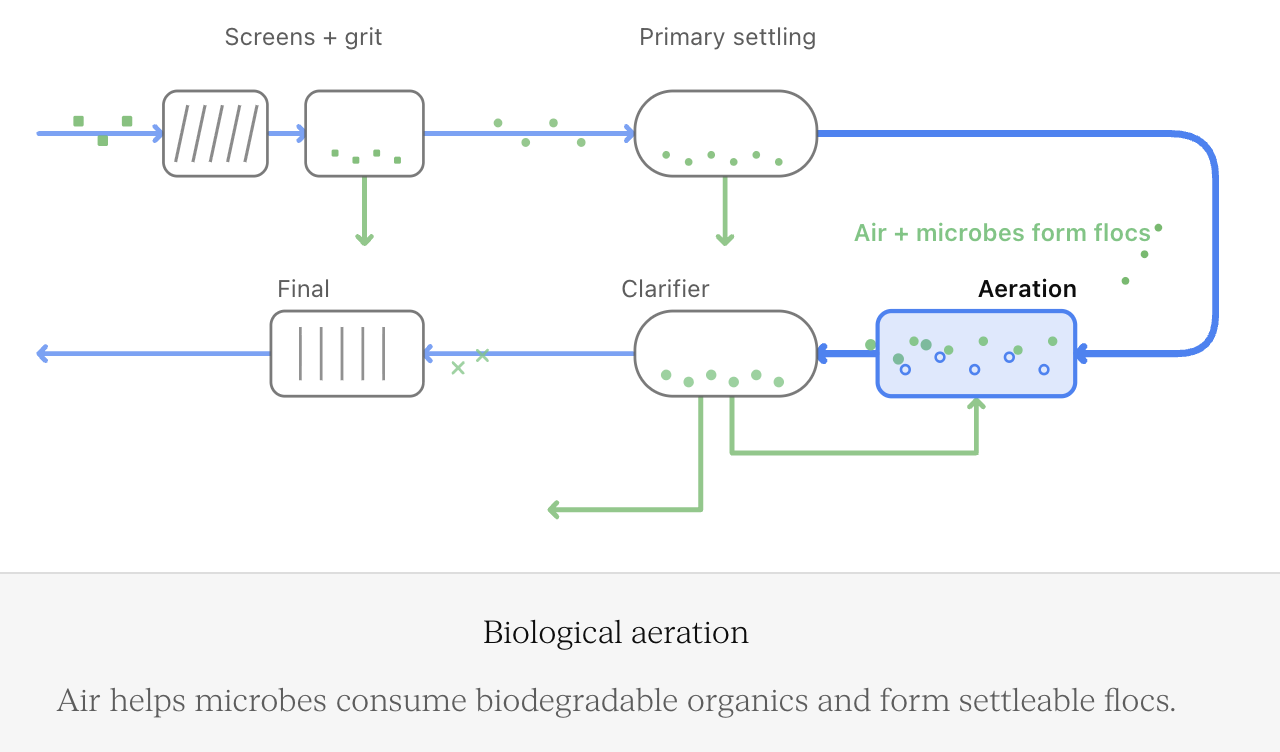
Wastewater treatment can remove or reduce many contaminants before water is released.

Treatment may involve:

  • screening large debris
  • allowing solids to settle
  • biological decomposition of organic material
  • nutrient removal
  • disinfection

More advanced treatment may be needed for certain contaminants.

The basic principle is:

remove pollutants before the water returns to the environment.

https://images.openai.com/static-rsc-4/YAr3S_ViNgOIt0g3RZZ3Zq2WDIumoKfGckqjoNBSkDXHpmrtK9CgdxczUVIDcoqdL6Xmsun9UZOSkEF6HvC0ZrJ2mBKOSyD_qzWe3-3OAELNRr6-kQ1smD-cPE-BInZ7YeHmtKaWHxfDx4bZMLx32auqJ95hle6TvxIlna5nUQ5H2MJPrxxIqwa-CevhRVB7?purpose=fullsize
 
https://images.openai.com/static-rsc-4/demkR8WG4rrIMB3PVpzXg4dS8S8mmpDuhbCM7hW2MDIysXRkDfDaPuim5G0v6tDkkM4RlAdeaj3pmlAKQJ7P_iUBzuS8bTlFMjioEBuV2Vr_I4aRTRnL4EzIQMNwvJbKXR9g3Um968aEUs_X8LnmJzRikiEtTVFoZwk5ZM6JUkCf68S8fow7Zekjsty_a8AR?purpose=fullsize
 
https://images.openai.com/static-rsc-4/2DI0epOA6otiaokGd4hXxjnArqpkapCvzPsLFIp4kMB_LxaimdxwhcLuB5-qsX9HuitSMa_vv7P72mWDZzwX0gAs1l-fsE6iKgXBnpZv2mgL4asPKPuk3-JAEMZJJWfwAgdNCOH7kWptkk90u-eNyPzatgq277LYKEbyzI8h3N1LS7vO8QSiJzxqGUFdajVb?purpose=fullsize
 
6

Industrial Pollution Control

Industries can reduce water contamination by:

  • treating wastewater
  • containing hazardous chemicals
  • monitoring discharge
  • preventing leaks
  • recycling process water
  • safely storing waste
  • responding rapidly to spills

Preventing pollution is often preferable to trying to remove contamination after it enters a river or aquifer.


Reducing Plastic Pollution

Possible strategies include:

  • reducing unnecessary single-use plastics
  • improving waste collection
  • preventing litter
  • improving recycling where appropriate
  • capturing waste before it enters waterways
  • improving stormwater management
  • designing products that create less persistent waste

No single strategy solves the entire problem.

Effective solutions usually involve several approaches.


Cleaning Up Oil Spills

Oil-spill responses may use methods such as:

  • floating barriers called booms
  • skimmers
  • absorbent materials
  • controlled recovery techniques

The appropriate response depends on:

  • type of oil
  • spill size
  • weather
  • location
  • ecosystem sensitivity

Cleanup can reduce damage, but preventing spills remains extremely important.


Reducing Urban Runoff

Cities can reduce polluted runoff using:

  • rain gardens
  • retention ponds
  • wetlands
  • permeable pavement
  • vegetated areas
  • improved stormwater treatment

These approaches can slow runoff and allow some pollutants to be trapped or treated before water reaches natural waterways.


Source Control vs Cleanup

There are two broad approaches to water pollution.

Source control

Prevent pollutants from entering the environment.

Examples:

  • reducing fertilizer overuse
  • treating industrial wastewater
  • preventing oil leaks
  • disposing of chemicals correctly

Cleanup

Remove pollution after contamination occurs.

Examples:

  • removing spilled oil
  • cleaning contaminated sediments
  • treating polluted groundwater

In many cases:

prevention is easier and less expensive than large-scale cleanup.


Evaluating Pollution-Control Methods

A good solution should be evaluated using several factors.

Ask:

  • How effectively does it remove or prevent pollution?
  • How much does it cost?
  • Can it operate over a large area?
  • Does it create another type of waste?
  • Does it require continuous maintenance?
  • Does it protect ecosystems?
  • Is it practical for the community or industry involved?

There is rarely one perfect solution for every situation.


Example: Fertilizer Runoff

Suppose farmers near a lake use large amounts of fertilizer.

After heavy rain:

fertilizer → runoff → river → lake

Nutrient levels increase.

This may cause:

nutrients → algal bloom → decomposition → oxygen depletion → fish stress or death

Possible solutions include:

  • reducing unnecessary fertilizer use
  • applying fertilizer at appropriate times
  • planting buffer vegetation
  • reducing erosion
  • monitoring nutrient concentrations

This example shows why understanding the source, pathway, impact, and solution is important.


Example: Urban Pollution

Imagine rain falling on a large parking lot.

The water collects:

  • oil
  • tyre particles
  • litter
  • sediment

The runoff enters a storm drain and then flows into a nearby stream.

This is primarily:

non-point-source pollution

because pollutants are being collected across a broad urban area.

Possible controls include:

  • permeable surfaces
  • stormwater ponds
  • filters
  • rain gardens
  • improved waste management

Example: Factory Discharge

A factory releases contaminated water from one pipe into a river.

This is:

point-source pollution

Because the entry point is known, authorities can potentially:

  • sample the discharge
  • measure pollutant concentrations
  • require treatment
  • establish discharge limits
  • monitor compliance

This illustrates why point sources are often easier to identify and regulate.


Common Mistakes

Thinking All Water Pollution Is Visible

Polluted water does not always look dirty.

Some pollutants are:

  • dissolved
  • colorless
  • microscopic

Clear-looking water is not necessarily safe.


Confusing Point and Non-Point Sources

Point source = identifiable discharge location

Non-point source = diffuse pollution from many locations


Assuming Fertilizer Is Always Beneficial

Fertilizer supports plant growth on land, but excessive nutrients entering water can disrupt aquatic ecosystems.


Thinking Algae Directly Remove All the Oxygen

A major oxygen decrease often occurs when dead algae and other organic matter are decomposed by microorganisms.


Confusing Bioaccumulation and Biomagnification

Bioaccumulation = buildup within an organism

Biomagnification = increasing concentration through a food chain


Thinking All Plastics Immediately Become Microplastics

Larger plastic materials may gradually fragment into smaller pieces over time. Microplastics can also enter the environment already very small.


Assuming Groundwater Cannot Be Polluted

Pollutants can infiltrate through soil and reach groundwater.

Once groundwater becomes contaminated, cleanup can be difficult.


Thinking Pollution Is Only Chemical

Pollution can also involve:

  • microorganisms
  • sediments
  • heat
  • excess nutrients
  • solid waste

Assuming Cleanup Is Always the Best Solution

Once pollutants spread through an ecosystem or aquifer, removing them may be difficult and expensive.

Prevention is often more effective.


Key Terms

Water pollution — Contamination or alteration of water that reduces its quality or harms organisms or human uses.

Pollutant — A substance, organism, or form of energy that causes harmful environmental effects.

Point-source pollution — Pollution originating from a specific identifiable location.

Non-point-source pollution — Pollution originating from many diffuse sources across an area.

Runoff — Water flowing across the land surface, potentially carrying pollutants.

Wastewater — Used water containing waste materials from homes, industries, or other activities.

Sewage — Wastewater containing human waste and associated contaminants.

Pathogen — A biological agent capable of causing disease.

Nutrient pollution — Excessive addition of nutrients such as nitrogen and phosphorus to water.

Eutrophication — Nutrient enrichment of water that can cause excessive biological growth and oxygen depletion.

Algal bloom — Rapid growth of algae or cyanobacteria in a body of water.

Dissolved oxygen — Oxygen dissolved in water and available to aquatic organisms.

Turbidity — Cloudiness of water caused by suspended particles.

Bioaccumulation — Buildup of a substance inside an organism over time.

Biomagnification — Increase in concentration of certain persistent substances at higher trophic levels.

Microplastics — Very small pieces of plastic present in the environment.

Thermal pollution — Harmful alteration of water temperature caused by human activity.

Riparian buffer — Vegetated land beside a waterway that can help reduce runoff, erosion, and pollution.

Groundwater contamination — Pollution of underground water stores.


Key Takeaways

  • Water pollution occurs when contaminants reduce water quality or harm organisms and ecosystems.
  • Pollutants can enter surface water through direct discharge or runoff.
  • Pollutants can also infiltrate into groundwater.
  • Point-source pollution comes from an identifiable source such as a discharge pipe.
  • Non-point-source pollution comes from many diffuse sources such as farms and urban areas.
  • Agriculture can introduce fertilizers, pesticides, sediment, and animal waste.
  • Excess nitrogen and phosphorus can contribute to eutrophication.
  • Eutrophication can lead to algal growth, decomposition, and reduced dissolved oxygen.
  • Sewage can introduce pathogens, nutrients, and organic material.
  • Industrial activities can introduce chemicals, oils, and metals.
  • Plastic pollution can affect aquatic organisms and produce microplastics.
  • Sediment pollution can increase turbidity and damage habitats.
  • Pollution can move through food webs.
  • Bioaccumulation and biomagnification describe different ways pollutants can become concentrated in organisms.
  • Groundwater pollution can be especially difficult to detect and clean up.
  • Water pollution can reduce biodiversity and disrupt ecosystem processes.
  • Pollution can also threaten drinking water, food supplies, recreation, and human health.
  • Wastewater treatment, better agricultural practices, industrial controls, and improved stormwater management can reduce contamination.
  • Preventing pollutants from entering water is often more effective than trying to remove them later.

A useful framework for analyzing water pollution is:

SOURCE → POLLUTANT → PATHWAY → IMPACT → SOLUTION


Check Your Understanding

Basic Concepts

1. Define water pollution.

2. What is a pollutant?

3. Explain the difference between point-source and non-point-source pollution.

4. Give three examples of point-source pollution.

5. Give three examples of non-point-source pollution.


Pollution Pathways

6. Explain how rainfall can transport pollutants into a river.

7. Describe how a chemical spilled on land could eventually contaminate groundwater.

8. Explain why pollutants released far upstream can affect ecosystems downstream.

9. How can urban storm drains contribute to water pollution?

10. Explain how pollutants can move through the water cycle.


Agriculture

11. Identify three agricultural pollutants.

12. Explain how fertilizer can reach a lake.

13. What nutrients commonly contribute to eutrophication?

14. Explain how a riparian buffer can reduce agricultural pollution.

15. Why can excessive pesticide use affect organisms other than agricultural pests?


Eutrophication

16. Define eutrophication.

17. Put the following events into a logical sequence:

  • oxygen decreases
  • nutrients enter water
  • decomposition increases
  • algae grow rapidly

18. Explain why decomposition can reduce dissolved oxygen.

19. Describe one possible effect of low dissolved oxygen on aquatic organisms.

20. Explain why reducing nutrient runoff can help prevent eutrophication.


Other Pollution Sources

21. Describe two ways sewage can harm water quality.

22. Explain why heavy metals can be particularly harmful in aquatic ecosystems.

23. Distinguish between bioaccumulation and biomagnification.

24. Describe two ecological effects of oil pollution.

25. What are microplastics?

26. Explain how sediment can damage an aquatic ecosystem.

27. Define thermal pollution and describe one possible effect.


Pollution Control

28. Give three ways agricultural runoff can be reduced.

29. Explain how wastewater treatment reduces pollution.

30. Give three methods industries can use to reduce water contamination.

31. Describe two methods for reducing polluted urban runoff.

32. Explain why preventing pollution is often preferable to cleaning it up later.


Application and Analysis

33. Fertilizer from many farms enters a river after heavy rainfall. Is this mainly point-source or non-point-source pollution? Explain.

34. Wastewater containing a pollutant leaves a factory through one identifiable pipe. Classify the pollution source and explain your reasoning.

35. A lake experiences a large algal bloom shortly after heavy rain washes fertilizer from surrounding farmland. Explain the likely connection.

36. Fish begin dying several days after a large algal bloom. Explain one mechanism that could cause the fish deaths.

37. A groundwater aquifer has been contaminated by a leaking underground chemical tank. Explain why this pollution may be difficult to manage.

38. Compare the likely effectiveness of cleaning pollution from a river with preventing the pollutant from entering the river in the first place.

39. A city wants to reduce pollutants entering streams after storms. Propose three strategies and explain how each would help.

40. Choose one example of water pollution and analyze it using:

SOURCE → POLLUTANT → PATHWAY → IMPACT → SOLUTION.

3. Water Treatment

Learning outcomes
  • I can describe the stages of water treatment.
  • I can explain how contaminants are removed from water.
  • I can compare drinking-water treatment and wastewater treatment.
  • I can identify common treatment technologies.
  • I can explain the importance of water treatment for public health.

Water Treatment

Water treatment is the process of removing unwanted substances, harmful microorganisms, and other contaminants from water so that it is suitable for a particular use.

Water may be treated so that it is safe for:

  • drinking
  • cooking
  • washing
  • agriculture
  • industry
  • release back into the environment

Two major types of treatment are:

Drinking-water treatment — treats water from sources such as rivers, lakes, reservoirs, or groundwater so that it is safe for people to use.

Wastewater treatment — treats used water from homes, businesses, and industries before it is released into the environment or reused.

Although both processes involve cleaning water, they begin with very different types of water and have different goals.

https://images.openai.com/static-rsc-4/9x_vNlk18Pt9sNK2s-QGW-RoOGDVyzQHMBqO89NvEzvgPG5gSLSZ-4oKgZuK2jKV8AQ4-fqiAn3cMKUWYDhzXOsCn_8OaF8IcdVwm_3WlJYlMMfzOxtWAvh89isvNAI8BkOh2K4XSNIautXUuI0Cd2yKUOgqWk_4FNvubvE5eiMe-RHO8xdFwb5Fn4SmMns5?purpose=fullsize
 
https://images.openai.com/static-rsc-4/A5sQ2heChUB45smLFJCXl_doD7iMqDdizFg2-CzCXAJBK7UOmjwDI1cOTGLFwanDLRiXn8DytILritG2VQ5r1r-Ur6lA8Xznl9EZLKXPCriBg_BEWBRiDEaxJ-AQCTUw2WUNwo8AQW3XpGHduywSbo4yLlde43ek6_zMLCZu71uW7ScotKboDYrVfT0zU7H7?purpose=fullsize
 
https://images.openai.com/static-rsc-4/h4W3rNwxpYVFS3MyvL1-FETuAAaWSBRyvR2zqxMd6mfagENWmDCPUI18BX6q9SNh-IoTB33DImhw6hdLKMFuDHE5DMGATtcVg1bYM1y8GXjWGz459V-0-rTevXw2eq48q-QwggIx6fId2TfwJZ5mOYbwXJsMhJw4_g8u8PddPeJmao1gXptdeS_r4_eqMh0Y?purpose=fullsize
 
5

Why Water Must Be Treated

Natural water is not necessarily safe to drink.

Water from a river, lake, or groundwater source may contain:

  • soil and sediment
  • microorganisms
  • organic matter
  • dissolved minerals
  • chemicals
  • agricultural pollutants
  • industrial contaminants

Some contaminants affect the appearance, smell, or taste of water.

Others can cause disease or long-term health problems.

Water treatment therefore protects public health by reducing contaminants to safe levels.


Drinking-Water Treatment

A typical drinking-water treatment process may involve:

SOURCE → SCREENING → COAGULATION → FLOCCULATION → SEDIMENTATION → FILTRATION → DISINFECTION → STORAGE → DISTRIBUTION

The exact process varies depending on the water source and local treatment system.

Groundwater, for example, may require less treatment than highly turbid river water but may contain dissolved minerals requiring additional treatment.


Water Sources

Drinking water may come from:

  • rivers
  • lakes
  • reservoirs
  • springs
  • groundwater
  • desalinated seawater

The untreated water entering a treatment plant is often called raw water.

Before treatment begins, the water source is usually monitored for characteristics such as:

  • turbidity
  • microorganisms
  • pH
  • dissolved substances
  • chemical contaminants

Understanding the source helps determine which treatment methods are required.

https://images.openai.com/static-rsc-4/rSOoW4BbImy4t_rMqV1cl9vNYzBIWlCrsPaDSUyQ8X-Iojv0L_XRV2Z13QsBM_ExLt2fGvY3orLxbn3zj5-tJFSjyE2tmdc67o8XnhdOoYYyDnclzBuxrADAt_PaDJfCEO1tlN-CRu2tB3Lb9IPg0k3KMuc--5n4ZXeclQWGlNpwNFxto8VHxB_ZGKkVkrgK?purpose=fullsize
 
https://images.openai.com/static-rsc-4/3nidBT3xsWMUm_OL-y4lJtpWtCoh1B8xFWGThuZSfVkCDejJ6cAECOmE1P6S7gihdljCvsbNMHr5V2-6DscwVzf4prXoLML66yJka4vXjv8e7PKIMdUI16-lJK3--aQAuDjksGTgC1tDUg5TX6THBE2yZEUMfu4JOWSYBEm881PPTK5WP3Kw8Zyu0n6RB32V?purpose=fullsize
 
https://images.openai.com/static-rsc-4/v2YgsnGUfKrEg_uDU6Y_f80lCpTL3ABgTtzbR7SWvA5AwmjHUfqz4koQnDjyQ60dqTRpTibK3XaKdpGP9Jt8BdqbmpficDZryjUz6Tip--A2JmnsiCO88fF_QEHsVplS9OZ1Wppl8NtCWY7_unM6LKJpjkB9ezoGTjD_58zLZ0M5J7ldjtg7WRgS6KDNIfoX?purpose=fullsize
 
6

Screening

The first stage often removes large objects from the water.

Screens may capture:

  • sticks
  • leaves
  • plastic
  • rubbish
  • other large debris

Screening protects pumps and other equipment later in the treatment process.

It does not make the water safe to drink.

It simply removes relatively large materials.


Coagulation

Very small particles can remain suspended in water and may not settle easily.

During coagulation, treatment chemicals called coagulants are added.

These chemicals help neutralize electrical charges that keep tiny particles separated.

The particles can then begin sticking together.

Common suspended materials may include:

  • clay
  • fine sediment
  • organic particles
  • microorganisms

Coagulation prepares these small particles for removal.


Flocculation

After coagulation, the water is mixed slowly.

Small particles collide and combine to form larger clusters called flocs.

This process is called flocculation.

The sequence is:

tiny suspended particles → coagulation → collisions → larger flocs

The flocs are large enough to be removed more easily during later stages.

https://images.openai.com/static-rsc-4/Uy3vGYb7OCU3mwmDm-Y2ZcAFOAKC2D7_c6oPDHS1rwD6hw4qs2hm6mLhL2fnhLpzKa2jjW7wgkvLQ2ARsVPrrKCeIkZTDi8l_Br-oeMwuL3fRVFcg66KGWb0mfN080ule6q2dv5eCc-q_Hq6GMjOQyOX8RRIU9XhLkisFTyTDJEdBFpfHZQwrfrputhU26Tb?purpose=fullsize
 
https://images.openai.com/static-rsc-4/9R3HZVNIQHkuZHI3teBeWF-KIApmGKhVkSp37cC9BMcjDCawn9Yo0fKm6_vNYPiT48J8I-JybV-0Mg1oU1D8bm2XfcAi7P0-IfLvUrX5gYyLjoSvjB3_MRySW6jCqE2kv70bMH87OXmp9uMPy39O8fZJZHXdbMFdKTuZWH-Gf3tyOA3jcyJdkFIR0XGzic-F?purpose=fullsize
 
https://images.openai.com/static-rsc-4/5zQuOvtgeWd4auju1wVLazPQVUv2A4Q9HbicfrQR_CK5BeBy4zzuajz3DucZ853RH8j9HgYKFEqC6CfxBk9Wm7eBbg7F0olvKm_7IicBcxvGS91mZT0bCkWyrtspZkY-d5ggmUrdR6gKMyiaL6KstMk5fLu7jbenvlQVyr_f9qBIaAMjcYCDBkNo-6lxby2W?purpose=fullsize
 
6

Sedimentation

Water then enters a settling tank or basin.

Because the flocs are denser than the surrounding water, gravity causes many of them to sink.

This process is called sedimentation.

The settled material forms a layer of sludge at the bottom.

Clearer water remains above it.

Sedimentation removes a large amount of suspended material before filtration.


Filtration

After sedimentation, water usually passes through filters.

Filters may contain materials such as:

  • sand
  • gravel
  • activated carbon
  • specialized filter media

Filtration can remove smaller particles that remain suspended.

Depending on the technology, filtration can also help remove:

  • microorganisms
  • organic compounds
  • unpleasant tastes
  • odors
https://images.openai.com/static-rsc-4/3OyKn99cNM2zZWNcOu-rPAMJdlHrafa0MamPrnf_8_6N_-gskjhOCX9QbVzFhTfWdb2kuX78Rv91tcIIT9Mj1hKoV7Vc4mxUiIjIwBXVSAPoQaKDsM4aIi62uDDbuHoMEOWHfDpuhpX7Dvc5wqM0JTxydQLzGbfehXlFrzv5CbtC4zLUf-NHTtRbkvwqhSiM?purpose=fullsize
 
https://images.openai.com/static-rsc-4/Qb18pqrwv3BXJKVFsFcPnsD_nScl0WTy-wp3659BqrSbjNUx5NICAForSz7v2uViuvDErMnOKkTf-lvyg4XKjrqWzR_HTu8t75921sKSJPcwvR8vlnjGELEnHggvwJFgW-VfuywIgBW7g5OzkN-BJoneKj4oPue3rd_3tbmlWka3LlwLtIDvP58TDeKqkmEp?purpose=fullsize
 
https://images.openai.com/static-rsc-4/Y58YwSuz6wWdJmnc7qau5Fnf-u3WuKiMb2auXD59q-pmuKaDiT1nxluCyz5qnU0O1fxrsR1Rz70ehc-8Ev44cS90PqrDgbeQqGTyXzSfL7AqQHWoVEHPJFxJNtZU8zxPyojVxrInH7RVA0r6blAFZVtvu8RHFoL0wMTAChyN1gbRP6PXUYolc3dbP8FxYWw1?purpose=fullsize
 
6

How Sand Filtration Works

A sand filter is more sophisticated than simply pouring dirty water through beach sand.

Water moves through carefully designed layers of filtering material.

Particles can be removed through:

  • physical trapping
  • attachment to filter grains
  • settling within spaces in the filter

Over time, filters accumulate material and must be cleaned or replaced.

Large treatment plants may clean filters using backwashing, where water is moved through the filter in the opposite direction to remove trapped material.


Activated Carbon

Activated carbon has a very large internal surface area.

Many dissolved substances can attach to its surface through a process called adsorption.

Activated carbon can help remove:

  • some organic chemicals
  • compounds causing unpleasant tastes
  • compounds causing odors

Notice the word:

adsorption

This means substances attach to a surface.

It is different from absorption, in which a substance enters the interior of another material.


Disinfection

Even after filtration, harmful microorganisms may remain.

Disinfection reduces or destroys disease-causing microorganisms.

Common disinfection methods include:

  • chlorine
  • ozone
  • ultraviolet (UV) radiation

Disinfection is one of the most important stages for protecting public health.

https://images.openai.com/static-rsc-4/NEyCZvil9wT7Gox0fcLuH8qqK520IhhF8TQSL39oaKIkm0207WjBAT04YQahQZ8fJdGXeeIM01qMF7vYuTEAQrXXYi2rV66LPlk_BhwkuFAcLyurqTLZDZJhRZiEx_H4GyNmkv6fU_omaFcS3lKfCIrWYqiRoSBU0_gCbaT8S2t3LN5ZL28VSVeJNvhnoTeX?purpose=fullsize
 
https://images.openai.com/static-rsc-4/ZryjCriRZAoOlqgeGerM2Jxzvk96buveWpS4xiFXUhFUdJGilthWYFm8ZvzFKtj2oAX64nwt493FAf05RSUrXKFTkFEdjeB2pKD5nm6MCeZxJdGb0Jgng5Thlh3dFquf4r--99qFFchu14IqERPV9jQ1d6IE9lDLUPfzD1AM11vPtLY4WFFUEX93tyDYXT6z?purpose=fullsize
 
https://images.openai.com/static-rsc-4/vcroUq8LHyGDfopLRkV0-qlN-XlCjXGcSX9H1mDeF6mRDyyjfkap37KLHeiA4ZfHvldwStAR9D1T9014zqsINJ1ev2YQklH3GA3VZarQimqPKlcabgFSeL8_lzaYxOT4ehasjFJCASuoQyvYPJ7hVfDm4eNKYHQSfyJ9codcyIL8M-5CyqiXpQ3fa5UDMLYX?purpose=fullsize
 
7

Chlorination

Chlorine is widely used to disinfect drinking water.

It can kill or deactivate many harmful microorganisms.

One important advantage is that a small amount of chlorine can remain in the water as it travels through distribution pipes.

This residual disinfectant can help protect the water from microbial contamination after it leaves the treatment plant.

However, the amount added must be carefully controlled.


UV Disinfection

Ultraviolet radiation can damage microorganisms so that they can no longer reproduce effectively.

Advantages include:

  • effective microorganism control
  • no need to add a persistent disinfectant chemical
  • rapid treatment

However, UV treatment does not provide the same type of lasting disinfectant residual in the distribution system as chlorination.

Water also needs sufficient clarity for UV treatment to work effectively.


Ozone

Ozone is another strong disinfectant and oxidizing agent.

It can:

  • destroy many microorganisms
  • oxidize certain contaminants
  • improve some taste and odor problems

However, ozone must generally be produced at the treatment plant and does not provide a long-lasting disinfectant residual in pipes.


Storage and Distribution

After treatment, drinking water may be stored in:

  • reservoirs
  • tanks
  • water towers

It then travels through a network of pipes to:

  • homes
  • schools
  • hospitals
  • businesses
  • industries

Treatment does not end with producing clean water at the plant.

The distribution system must also prevent contamination before the water reaches consumers.


Monitoring Drinking Water

Water quality is tested throughout the treatment process.

Tests may monitor:

  • microorganisms
  • turbidity
  • pH
  • disinfectant levels
  • dissolved chemicals
  • metals
  • other contaminants

Monitoring helps operators determine whether treatment is working properly.

Water treatment therefore combines:

physical processes + chemical processes + biological monitoring + engineering


Wastewater

After people use water, it becomes wastewater.

Wastewater can come from:

  • toilets
  • showers
  • sinks
  • washing machines
  • restaurants
  • hospitals
  • businesses
  • industries

Wastewater may contain:

  • human waste
  • food particles
  • oils and grease
  • microorganisms
  • nutrients
  • detergents
  • suspended solids
  • organic matter
  • chemicals

It must usually be treated before being returned to the environment.

https://images.openai.com/static-rsc-4/5nXvp8XD4C2uzXRw8nK5zGhPpAO9rz7vJufq7Va3r_Ap7OMHwMbxtov-zscWpR-7TmJ8gaVqjc9Jp9rJrITkG20uqX1AxsrHZ0xdewaMG_UQ2t0ITGjRLEZz8mdMQRyyNbNJtpEj-BsyWwAGTb-db5Nhujo1Sl--7SqJ-cwt8MfS71aqhPI3Vy64YoDig8JR?purpose=fullsize
 
https://images.openai.com/static-rsc-4/demkR8WG4rrIMB3PVpzXg4dS8S8mmpDuhbCM7hW2MDIysXRkDfDaPuim5G0v6tDkkM4RlAdeaj3pmlAKQJ7P_iUBzuS8bTlFMjioEBuV2Vr_I4aRTRnL4EzIQMNwvJbKXR9g3Um968aEUs_X8LnmJzRikiEtTVFoZwk5ZM6JUkCf68S8fow7Zekjsty_a8AR?purpose=fullsize
 
https://images.openai.com/static-rsc-4/ga7NSoYh-Eb374n96hWxsCyUzoSNCvl18CIxJeYBtgTu2pqmC4lkZVQAwei009AxRWbK8Qda7kgKQe1E5B02EYfGf0Bn3akIsIBAPvH2guxtE_L-D0X5jWA9HwHhChAS7yPybmzH3nb1W-nLhbRLEGPU8olglZ1KqcWpPDJScpJ7aLtwq-8Fl7MfEvI1iUtJ?purpose=fullsize
 
6

Wastewater Treatment

A conventional municipal wastewater treatment process often includes:

SCREENING → GRIT REMOVAL → PRIMARY TREATMENT → SECONDARY TREATMENT → CLARIFICATION → DISINFECTION

Additional advanced treatment may also be used.

The following model lets you trace the main wastewater-treatment stages and see where water and sludge move through the system:
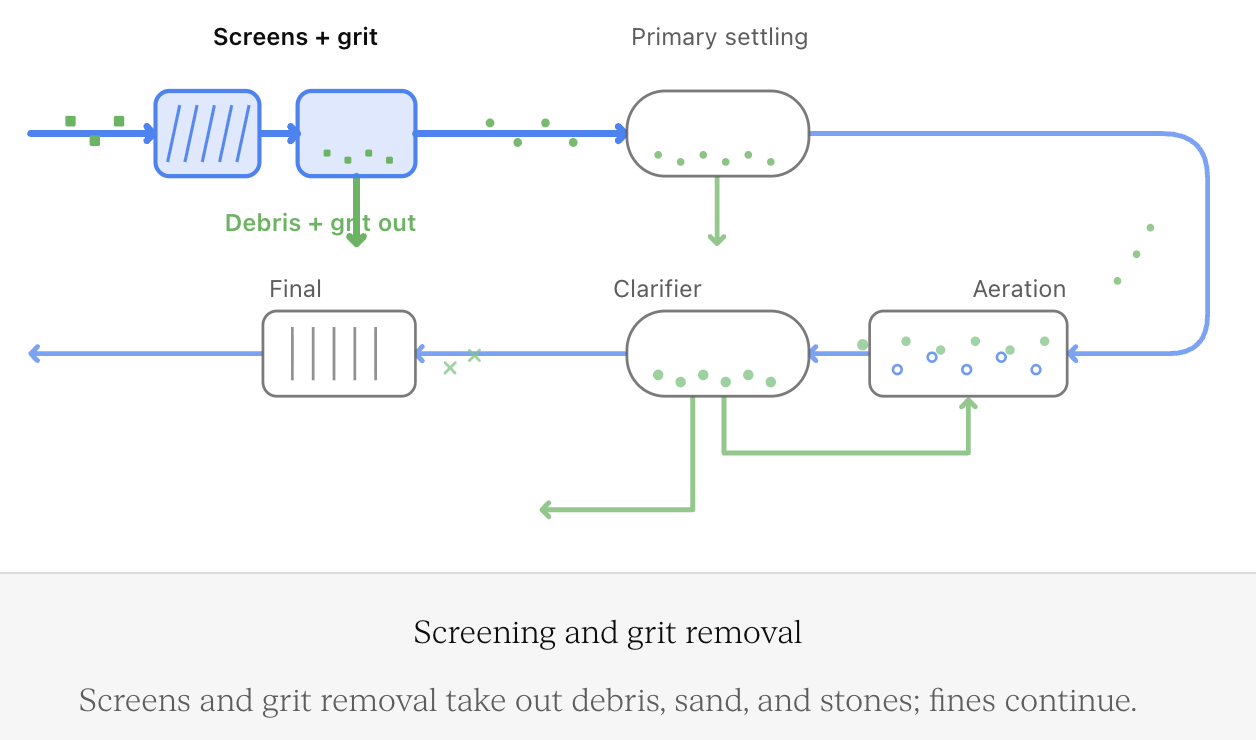
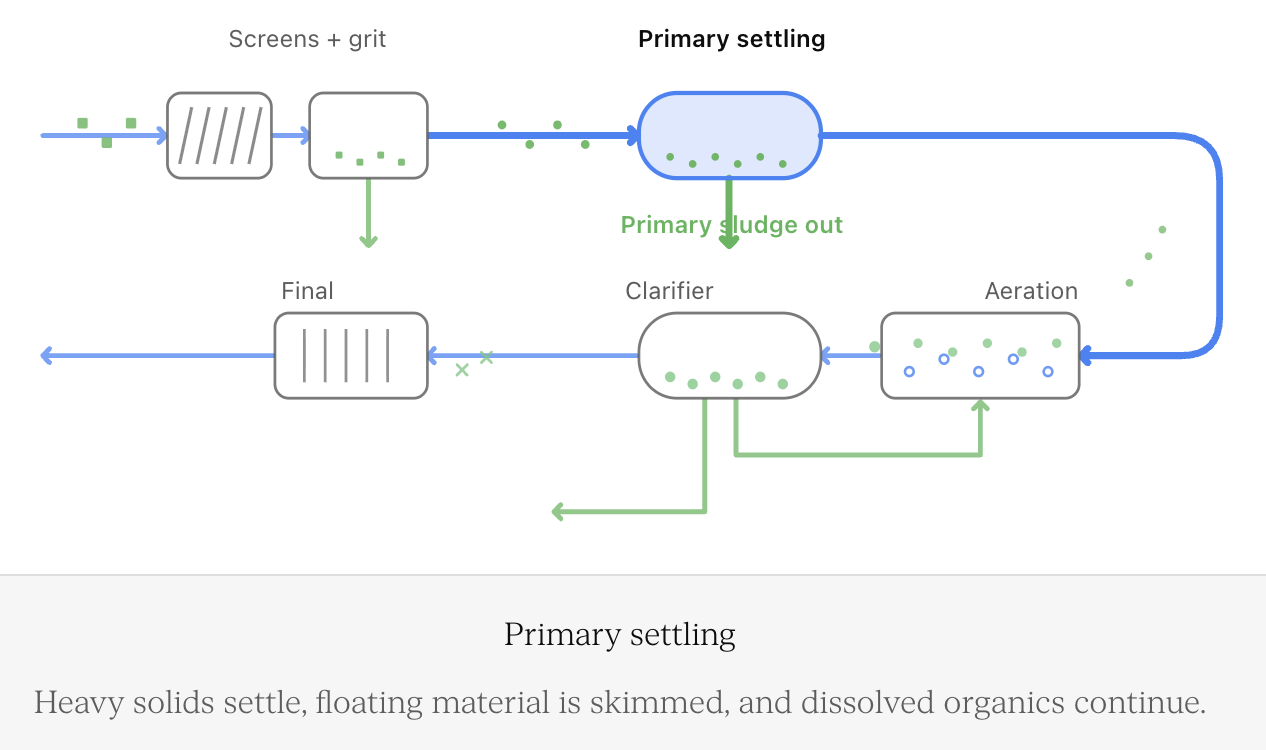
Preliminary Treatment

The first stages remove materials that could damage equipment or interfere with later treatment.

Screening

Screens remove larger objects such as:

  • wipes
  • plastics
  • sticks
  • rags
  • other debris

Grit Removal

Sand, gravel, and other dense particles can be removed in grit chambers.

Removing these materials helps protect pumps and equipment from abrasion and blockages.


Primary Treatment

During primary treatment, wastewater is allowed to settle in large tanks.

Gravity separates materials according to density.

Heavier solids settle to the bottom.

These solids contribute to sludge.

Oils, grease, and other floating materials may rise to the surface and be removed.

Primary treatment therefore relies mainly on physical separation.


Secondary Treatment

Primary treatment cannot remove all dissolved and suspended organic material.

Secondary treatment uses microorganisms to break down biodegradable organic matter.

This is a biological process.

One common method is the activated-sludge process.


Activated Sludge

In an activated-sludge system, wastewater enters an aeration tank containing microorganisms.

Air or oxygen is supplied.

The microorganisms consume biodegradable organic matter.

A simplified relationship is:

organic waste + oxygen → microbial activity → simpler substances + more microbial biomass

The microorganisms effectively help clean the water.

https://images.openai.com/static-rsc-4/PgeFH8201S7jtR8a5hLuatt3-jP3BSCHEcHBwTcUkbEMQqfxA2AGSR-2XYTne2uAyt-KeW6Q0Oujx_KlwCBtkO1HEltVAAX6eZ8AVOrIT_FuwwZav0bNBEYnp0zj9eN8DCdEFujg7QR_c-qrq5b4Yrda2ig8v5QCqyapAJu5CxTmm5LygHf0QslY1k8dMpdO?purpose=fullsize
 
https://images.openai.com/static-rsc-4/EHmW5X5obggSNCFuVtThLxCJRdj4wHul6pvq5mslSyZktQHFkwxna1ZBE83rotv31PDBRYTYYTez_bBGDHZeF5kjzW4weBACBmjj4-yiwNEIEOy4bD0o_B2HMksnX_8liTl09CAXJBgBH1zJQboeWmWeL7HDAF5g88Gv61igF0p3fY3XibTWUe9UR5Di96Rb?purpose=fullsize
 
https://images.openai.com/static-rsc-4/GoNhJv5fDRqRdOp85-DIgbFxgbnCmG2ZvGZgBjuEBZloF49ry_-imJ1a8Sd7PIKJvNiyOkt8GqfxlY2iT2f4Bd97nioAzocQt4rPjSJwVI137eKzf_EoKic0bzP3UD-FpC-ioVgwHIYrBKgBQMD7uGbw6-FwGtOPbGUfuTHkfvnreVwmvZTWHidfuGxqpWai?purpose=fullsize
 
5

Why Oxygen Is Added

Many microorganisms involved in wastewater treatment require oxygen for aerobic respiration.

Aeration:

  • supplies oxygen
  • keeps wastewater mixed
  • supports microbial activity

Without sufficient oxygen, the biological treatment process would become much less effective.


Secondary Clarification

After biological treatment, the water enters a secondary clarifier.

Microbial biomass and other solids settle.

Some settled microorganisms may be returned to the aeration tank.

This is called return activated sludge.

Other sludge is removed for further treatment.

The clarified water continues to later treatment stages.


Tertiary and Advanced Treatment

Some wastewater requires additional treatment beyond primary and secondary stages.

This may be called:

  • tertiary treatment
  • advanced treatment

Processes can remove additional:

  • nitrogen
  • phosphorus
  • suspended solids
  • microorganisms
  • specific chemicals

Technologies may include:

  • filtration
  • nutrient removal
  • activated carbon
  • membrane filtration
  • advanced oxidation
  • additional disinfection

The required level depends on how the treated water will be used or where it will be released.


Removing Nitrogen and Phosphorus

Nitrogen and phosphorus are important nutrients, but excessive amounts entering natural water can contribute to eutrophication.

Advanced wastewater treatment may therefore remove nutrients before discharge.

This can help reduce:

  • algal blooms
  • oxygen depletion
  • ecosystem disruption

Water treatment and pollution prevention are therefore closely connected.


Wastewater Disinfection

Before treated wastewater is released, it may be disinfected.

Possible methods include:

  • chlorine
  • UV radiation
  • ozone

This reduces the number of potentially harmful microorganisms entering natural water systems.

The treated water leaving the plant is called effluent.


Sludge Treatment

Wastewater treatment does not make contaminants simply disappear.

Many removed materials become concentrated in sludge.

Sludge may contain:

  • organic matter
  • microorganisms
  • nutrients
  • water
  • contaminants

It therefore requires additional management.

Treatment may involve:

  • thickening
  • digestion
  • dewatering
  • drying

Proper sludge management is an important part of wastewater treatment.


Anaerobic Digestion

Some treatment plants use anaerobic digestion to treat sludge.

Anaerobic microorganisms break down organic matter in the absence of oxygen.

This can produce biogas, which contains methane.

Biogas can sometimes be used as an energy source.

This allows some wastewater-treatment facilities to recover useful energy from waste.


Drinking Water vs Wastewater Treatment

Although the two systems share some technologies, their purposes are different.

Drinking-Water Treatment Wastewater Treatment
Begins with natural source water Begins with used water
Produces water suitable for drinking Produces water suitable for discharge or reuse
Often uses coagulation and flocculation Often relies heavily on biological treatment
Uses sedimentation and filtration Uses primary and secondary clarification
Disinfection is essential Disinfection may occur before discharge or reuse
Protects consumers Protects people and receiving ecosystems

Both systems may use:

  • screening
  • settling
  • filtration
  • disinfection
  • chemical treatment

But the treatment sequence and technologies depend on the contaminants present.


Physical Treatment

Physical treatment removes contaminants without fundamentally changing their chemical identity.

Examples include:

  • screening
  • sedimentation
  • filtration
  • flotation

These methods separate materials according to properties such as:

  • size
  • density
  • physical state

Chemical Treatment

Chemical treatment uses chemical reactions or chemical interactions.

Examples include:

  • coagulation
  • pH adjustment
  • chlorination
  • oxidation
  • precipitation

Chemical treatment can:

  • destabilize suspended particles
  • destroy microorganisms
  • convert contaminants into removable forms
  • change water chemistry

Biological Treatment

Biological treatment uses living organisms, especially microorganisms.

It is particularly important in wastewater treatment.

Microorganisms can break down biodegradable organic matter and help remove certain nutrients.

This makes wastewater treatment partly an engineered ecosystem.


Membrane Filtration

Some treatment systems use specialized membranes.

Depending on the membrane, extremely small particles and dissolved substances can be separated from water.

Types include:

  • microfiltration
  • ultrafiltration
  • nanofiltration
  • reverse osmosis

The smaller the membrane openings or effective separation scale, the smaller the substances that can be removed.


Reverse Osmosis

Reverse osmosis, often abbreviated RO, uses pressure to force water through a membrane that blocks many dissolved substances.

RO can remove:

  • salts
  • many dissolved ions
  • some organic contaminants
  • microorganisms

It is particularly important in:

  • desalination
  • advanced water treatment
  • water reuse
https://images.openai.com/static-rsc-4/FcRIrrq2HktgNUbLhQFcWvbJJq8iCDvtSxEUe3oXjX69U5A94PoMPMA-vXAbfDuWbGkXXMS83-BB51Y5YnoPn7A2psNm3G6YS4deGMIBtQiXPl-CiOZKQ0IYi5XubsxigwcDvw4Dr2RNq5XhFkv9LKCHt1D9USrb610O5IAlDOh1e-R7Acp3Go8w9KQ1I3oW?purpose=fullsize
 
https://images.openai.com/static-rsc-4/mLQvppxTywxo49kU9ek_t9UrIHzz6GyppdVnU7tIRbA35VhS-Rd9k-QOAp1EB38Ig4-cAsofD_N1DNconOM45xb-6oC8p90yj8FvyNGk3ylPyrC3tZQ77VNH7Mg9cd0szBmSumjNlPUECjir_ue1XBjK8Cv3l57bFK-cDPAK6uejpTw2RCtZz_8-1Wq1X3fU?purpose=fullsize
 
https://images.openai.com/static-rsc-4/PpbxRzBzBrH8akRja0qMpA4jDl_jnDL8XOKdDS7IHtFRoMgGKqj-iQUgHox7HMp_zbcZK-2naeLmoUw_NDuPZILsOX4Mlq0qLdzTQch6lKMutATTibZNYAyhFNzPhcL9yqLaOCXYjmRqZYKBgkjKa0bBqLmcRPeUWPu4VeQU4I9Iw8thF0_m-OAvgx3fzbls?purpose=fullsize
 
6

Desalination

Desalination removes dissolved salts from seawater or salty groundwater.

One major technology is reverse osmosis.

A simplified process is:

seawater → pretreatment → reverse osmosis → freshwater + concentrated brine

Desalination can provide freshwater in regions where conventional freshwater supplies are limited.

However, it has challenges, including:

  • energy requirements
  • cost
  • management of concentrated brine

Water Reuse

Treated wastewater does not always have to be discharged and forgotten.

It can sometimes be treated to a high standard and reused.

Possible uses include:

  • irrigation
  • industrial processes
  • landscaping
  • groundwater recharge
  • other municipal uses

With sufficiently advanced treatment and appropriate safeguards, water reuse can reduce pressure on freshwater supplies.


Natural Treatment Systems

Some treatment systems use natural or engineered ecosystems.

Constructed wetlands, for example, can use:

  • plants
  • microorganisms
  • soil
  • sedimentation

to help remove pollutants.

Wetlands can slow water movement, trap particles, and support biological processes that remove or transform contaminants.

https://images.openai.com/static-rsc-4/lndKnCQ3mt8UoRKRp0ELgyv-gT8D9WzggpF5Th4VAqjX4PKAQa0TjCsTvksh-IR9azfveTvMqm2O11W8evN2Rzl06Iz4Btv28sapv-joMuVjUGwtBa-6uLPqNsLCXgyDDOal04YPRtNd9YXvQsklvq0Ji4RDBbUuh_EZ4ljFAA_Zipo4NVVJm1qR-CimL04d?purpose=fullsize
 
https://images.openai.com/static-rsc-4/4KOgL0593hVPeN9anHeNNnYJWTU3tvvbmT891zk3_zn1REWdfkXx-QY9oORDLQhnUR3cN5Alip4huNbphyYwshGFwuK6eJfGDekL7wLNsErAqsiGi0uXyM2S5WsNNxINSyaPF-9oRwvT30QmRk_XPnQbOcJEK_Dxxf0KshyXwWymfE0Y5GAf9Md2zeN2oiUd?purpose=fullsize
 
https://images.openai.com/static-rsc-4/agibXozZHl1wRshezbDUDXq1qi3Sf4JJ7pRNUm7o-GuD5pghSa9qIalcoBIKF83JdiJZtFrC7DymXat4_8Iyp2Z7mQ1-bIS-RIWnzeiyEeNiAnemZAWCy3FNhYvpa6jMPIzU0T5FPt7JIpqrvPkS7uf3HE04koyVJ3oJwTp04u3mfDVrXLyLmM7eSA9SEUmS?purpose=fullsize
 
6

Why One Treatment Method Is Not Enough

Water can contain contaminants with very different properties.

For example:

  • screens remove large debris
  • sedimentation removes settleable solids
  • filters remove smaller particles
  • activated carbon can remove certain dissolved compounds
  • microorganisms break down biodegradable waste
  • membranes can remove very small particles and dissolved substances
  • disinfectants control pathogens

Therefore, treatment plants use a treatment train — several processes operating one after another.

Each stage targets different contaminants.


Example: Treating Muddy River Water

Imagine water entering a drinking-water plant from a muddy river.

It contains:

  • leaves
  • clay particles
  • microorganisms
  • organic matter

Possible treatment:

Screening

removes leaves and large debris.

↓

Coagulation and flocculation

combine tiny suspended particles.

↓

Sedimentation

allows flocs to settle.

↓

Filtration

removes smaller remaining particles.

↓

Disinfection

reduces harmful microorganisms.

↓

Storage and distribution

deliver treated water to consumers.

No single step performs every job.


Example: Treating Sewage

Imagine wastewater entering a treatment plant from a city.

It contains:

  • human waste
  • food waste
  • microorganisms
  • suspended solids
  • organic material
  • nutrients

Possible treatment:

screening → grit removal → primary settling → biological treatment → secondary clarification → advanced treatment if required → disinfection

The resulting effluent may then be released or reused, depending on its quality and local requirements.


Water Treatment and Public Health

One of the greatest benefits of water treatment is the prevention of waterborne disease.

Contaminated water can transmit disease-causing organisms.

Safe water systems reduce exposure through:

  • treatment
  • disinfection
  • monitoring
  • protected storage
  • safe distribution

Water treatment therefore supports:

  • public health
  • sanitation
  • hospitals
  • food production
  • schools
  • communities
  • economic development

Protecting the Source

Water treatment is important, but protecting the original water source is also valuable.

Preventing contamination can:

  • reduce treatment requirements
  • lower costs
  • protect ecosystems
  • reduce health risks

Examples include:

  • controlling agricultural runoff
  • treating industrial discharges
  • protecting watersheds
  • preventing sewage leaks
  • reducing litter
  • protecting groundwater recharge areas

A useful principle is:

Protect the source first, then treat what remains.


Monitoring After Treatment

Water that looks clear is not necessarily safe.

Treated water must be tested.

Monitoring can detect problems involving:

  • microorganisms
  • chemical contamination
  • treatment failure
  • excessive turbidity
  • incorrect disinfectant levels

Safe water treatment therefore depends on both treatment technology and continuous monitoring.


Common Mistakes

Thinking Clear Water Is Automatically Safe

Clear water may still contain:

  • microorganisms
  • dissolved chemicals
  • metals
  • other invisible contaminants

Appearance alone cannot determine water safety.


Thinking Filtration Removes Everything

Filters remove many contaminants, but ordinary filtration does not necessarily remove all:

  • dissolved substances
  • microorganisms
  • salts
  • chemicals

Other treatment stages are required.


Confusing Coagulation and Flocculation

Coagulation destabilizes tiny suspended particles.

Flocculation brings those particles together into larger flocs.


Thinking Sedimentation and Filtration Are the Same

Sedimentation uses gravity to allow particles to settle.

Filtration passes water through material that removes particles.


Thinking Chlorine Removes Dirt

Chlorine is primarily used for disinfection.

It does not replace screening, sedimentation, or filtration.


Thinking Wastewater Is Simply Filtered

Modern wastewater treatment often depends heavily on microorganisms that break down organic waste.

Biological treatment is a major part of the process.


Assuming Removed Pollutants Disappear

Treatment transfers many pollutants into:

  • sludge
  • concentrated waste
  • filter material
  • brine

These materials still require proper management.


Thinking Drinking-Water and Wastewater Treatment Are Identical

They share some processes, but their:

  • starting water
  • treatment goals
  • technologies
  • final requirements

are different.


Key Terms

Water treatment — Processes used to remove contaminants and make water suitable for a particular use.

Raw water — Untreated water entering a drinking-water treatment system.

Screening — Removal of large debris using screens.

Coagulation — Chemical treatment that destabilizes small suspended particles.

Flocculation — Gentle mixing that causes small particles to form larger flocs.

Floc — A cluster of suspended particles formed during treatment.

Sedimentation — Removal of particles by allowing them to settle under gravity.

Filtration — Removal of particles by passing water through filtering material.

Activated carbon — Highly porous carbon used to adsorb certain contaminants.

Adsorption — Attachment of substances to a surface.

Disinfection — Reduction or destruction of disease-causing microorganisms.

Wastewater — Water that has been used and contains waste materials.

Primary treatment — Mainly physical removal of settleable solids from wastewater.

Secondary treatment — Mainly biological treatment used to remove biodegradable organic matter.

Activated sludge — A wastewater-treatment process using aerated microorganisms to break down organic waste.

Clarifier — A settling tank used to separate solids from water.

Effluent — Treated water leaving a wastewater treatment system.

Sludge — Concentrated solids removed during wastewater treatment.

Tertiary treatment — Additional treatment used to remove remaining contaminants after secondary treatment.

Reverse osmosis — A pressure-driven membrane process that removes many dissolved substances.

Desalination — Removal of dissolved salts from saline water.

Water reuse — Using treated wastewater again for beneficial purposes.


Key Takeaways

  • Water treatment removes contaminants and makes water suitable for a particular purpose.
  • Drinking-water treatment protects people from contaminants and disease-causing microorganisms.
  • A typical drinking-water process may include screening, coagulation, flocculation, sedimentation, filtration, and disinfection.
  • Coagulation and flocculation help small suspended particles form larger flocs.
  • Sedimentation removes many flocs using gravity.
  • Filtration removes smaller remaining particles.
  • Activated carbon can adsorb certain dissolved contaminants.
  • Chlorine, UV radiation, and ozone can be used for disinfection.
  • Wastewater treatment cleans used water before release or reuse.
  • Primary wastewater treatment mainly uses physical separation.
  • Secondary treatment uses microorganisms to break down biodegradable organic matter.
  • Advanced treatment can remove nutrients and other remaining contaminants.
  • Sludge must be treated and managed separately.
  • Reverse osmosis can remove many dissolved substances and is widely used in desalination and advanced treatment.
  • Drinking-water and wastewater treatment share some technologies but have different purposes.
  • Water treatment combines physical, chemical, and biological processes.
  • Multiple treatment stages are necessary because different contaminants require different removal methods.
  • Treatment and monitoring are both essential for maintaining safe water.
  • Preventing pollution at the source can reduce the amount of treatment required.
  • Reliable water treatment is essential for public health and healthy ecosystems.

A useful summary is:

SOURCE → REMOVE LARGE MATERIAL → REMOVE PARTICLES → REMOVE DISSOLVED/ORGANIC CONTAMINANTS → DISINFECT → MONITOR


Check Your Understanding

Basic Concepts

1. Define water treatment.

2. Explain why natural water is not automatically safe to drink.

3. What is raw water?

4. Give four examples of contaminants that may be present in untreated water.

5. Explain why several treatment stages are normally required instead of one.


Drinking-Water Treatment

6. What is removed during screening?

7. Explain the purpose of coagulation.

8. What happens during flocculation?

9. Explain how sedimentation removes contaminants.

10. What is the purpose of filtration?

11. Explain how activated carbon can improve water quality.

12. Why is disinfection necessary even after filtration?

13. Name three methods of disinfecting water.

14. Give one advantage of chlorination.

15. Give one limitation of UV disinfection compared with chlorination.


Wastewater Treatment

16. Define wastewater.

17. Give four substances commonly found in wastewater.

18. What is the purpose of grit removal?

19. Describe what happens during primary treatment.

20. Explain how secondary treatment differs from primary treatment.

21. What role do microorganisms play in wastewater treatment?

22. Why is oxygen supplied during activated-sludge treatment?

23. What happens in a secondary clarifier?

24. What is effluent?

25. What is sludge?


Comparing Treatment Systems

26. State the main goal of drinking-water treatment.

27. State the main goal of wastewater treatment.

28. Identify two processes that may be used in both systems.

29. Explain why biological treatment is particularly important in wastewater treatment.

30. Explain why drinking-water and wastewater treatment cannot simply use identical treatment processes.


Treatment Technologies

31. Explain how reverse osmosis works.

32. Give two situations in which reverse osmosis may be useful.

33. What is desalination?

34. Give one advantage and one challenge of desalination.

35. Explain how constructed wetlands can help treat water.


Application and Analysis

36. A river supplying a town becomes very muddy after heavy rainfall. Which treatment stages would be especially important for removing the suspended particles? Explain.

37. Water leaving a filter appears perfectly clear. Explain why it may still require disinfection.

38. A wastewater treatment plant releases water containing high concentrations of nitrogen and phosphorus. Explain why additional treatment may be necessary.

39. Compare treating a polluted water source with preventing the pollution from entering the source in the first place.

40. Trace water through either a drinking-water or wastewater treatment plant and explain the purpose of each major stage.

4. Water Testing and Monitoring

Learning outcomes
  • I can identify indicators of water quality.
  • I can explain how water samples are tested and analyzed.
  • I can interpret simple water-quality data.
  • I can describe the importance of water monitoring.
  • I can evaluate the health of a water system using evidence.

Water Testing and Monitoring

Water quality describes the physical, chemical, and biological characteristics of water and whether the water is suitable for a particular purpose.

Water that is suitable for one purpose may not be suitable for another. For example, water quality requirements can differ for:

  • drinking water
  • swimming
  • irrigation
  • industrial use
  • fish and other aquatic organisms

Scientists monitor water because appearance alone cannot tell us whether water is healthy or safe. Clear water can still contain dissolved chemicals or harmful microorganisms.

Water-quality monitoring usually involves:

COLLECT SAMPLE → MEASURE INDICATORS → RECORD DATA → COMPARE RESULTS → IDENTIFY PATTERNS → EVALUATE WATER HEALTH

https://images.openai.com/static-rsc-4/g-PltAMWgJD27DEDLO-VKAnJ5nPn2nFvpsMFR_4YaCw1PJVAe6rmSnF8KttVx1xJg3PCZnjMxeszg2LcturPbtQyHHTPM-21MeXpCJxaeb6ENRX-e4F6O0Vxfl0DATezMCVljeAomPjR8W_PZb6ttKioGZVUt7OpCMq0AIVB43_2Yk9BrKwcRiBxARlSVPIA?purpose=fullsize
 
https://images.openai.com/static-rsc-4/w9wnHUe1br6Xr6xTqf_kerzkEEmo_kAWsr7G0mXMR23wRP9RqtqdShbWaaHzp13Tv5yRuyRef0kDYuUKRhexKqizr21uiIbe3tls4oWoH2ozzoHYwnQ3eib7_cwgxzLE7MlGKqPw-0xo25qleR2JP0vG2KaUO9EobEAmBOcXLyJUu-aRtRkxV50SUOMaKqoH?purpose=fullsize
 
https://images.openai.com/static-rsc-4/1RMudYzoSy5Kpi1MrQzGiI507qUM6VHiGOTJHr2ijWhYNFenMoi9A4sdnYPjoyyXp0yxujHVtNp00mzuk2Tf5ay8NK_1arN1KAIoEZM3qLt8-L2O5QQL0ABnGemQo_oFPvGMP1eiyO76Achcm_g1SH86OPL2eSQWIrdiz_H4FDy5sa689n-Taz9K06DF7XxY?purpose=fullsize
 
6

Indicators of Water Quality

Scientists cannot usually measure "water quality" with one test.

Instead, they measure several indicators.

Important indicators include:

  • temperature
  • pH
  • dissolved oxygen
  • turbidity
  • conductivity
  • nitrate concentration
  • phosphate concentration
  • microorganisms
  • biological indicators

Together, these measurements provide evidence about the condition of a water system.


Physical, Chemical, and Biological Indicators

Water-quality indicators can be grouped into three broad categories.

Physical indicators

These describe observable or measurable physical properties.

Examples include:

  • temperature
  • turbidity
  • color
  • odor
  • suspended solids

Chemical indicators

These describe substances or chemical conditions in the water.

Examples include:

  • pH
  • dissolved oxygen
  • nitrates
  • phosphates
  • dissolved salts
  • metals

Biological indicators

These involve living organisms.

Examples include:

  • bacteria
  • algae
  • aquatic invertebrates
  • fish populations

Using indicators from all three categories provides a more complete picture than relying on only one measurement.


Temperature

Water temperature is an important environmental measurement.

Temperature affects:

  • dissolved oxygen
  • metabolic rates
  • growth
  • reproduction
  • chemical reaction rates
  • species distribution

Different aquatic organisms are adapted to different temperature ranges.

A major temperature change can therefore alter an aquatic ecosystem.

https://images.openai.com/static-rsc-4/c65AABMwAs0SCLwqiq9WewZAQmR1NVzPneDnlVsjzGgbFmS6gUbl2V-gLmMrkzAVi4Tjq8iCvJScyfn4L0s4jWQWJNu7dHPeWK2o35E-4M94Y5yL9f0KU4lzcXyXE2x7Yrn_uDCHtg0OBqy0LKTSmU_K235j9aKHsUX7_h9r8uuLki5VWT-y98W83_0Au77C?purpose=fullsize
 
https://images.openai.com/static-rsc-4/YKVCaqqpSTaWw9Xcf5o-uqEW5LfLYu99iiuVamdBZFgSswq2M6QUqR3RpAjLQcQATv3nkI6hCMLHWgIjZXM7ljwXw7RpgaUqeZRkhcqBROxOwvAa4ymoR0JDCrcMIf1SvZ8X_GjICrYI63uY9mFrw1PPC_j1vt79af1oAx3JG8KdK50KVlqCqjncCFjycUbX?purpose=fullsize
 
https://images.openai.com/static-rsc-4/rIC3NjJn1RbPz2XmgZ4DNXsgT0eEeSF3NgUfJIl9BO_6XpDYAWSmRsXGMWVh31WUxjWw81Sb59LZX6mnSCdVG8HHbZWuOKczUIlcInbU0MeaN-_YlAJ84ysSqy_lfS0mSQ3_9QODDGwIWI3W5z5-T9zCk3wQu30zkCf3ISpj2UizHM0DoGQCCkrbrpkIv44u?purpose=fullsize
 
6

Temperature and Dissolved Oxygen

Temperature influences how much oxygen can remain dissolved in water.

In general:

colder water can hold more dissolved oxygen than warmer water

Therefore, unusually warm water can sometimes create problems for organisms that require high oxygen concentrations.

This is one reason thermal pollution can affect aquatic ecosystems.


pH

pH measures how acidic or alkaline a solution is.

A simplified pH scale runs from:

0 to 14

with:

pH 7 = neutral

pH below 7 = acidic

pH above 7 = alkaline

Aquatic organisms are generally adapted to particular pH ranges.

Large changes in pH can:

  • stress organisms
  • interfere with reproduction
  • affect chemical reactions
  • change the availability or toxicity of some substances

Measuring pH

pH can be measured using:

  • indicator paper
  • indicator solutions
  • electronic pH meters or probes

Electronic probes can provide more precise numerical measurements.

For example:

pH = 7.2

provides more information than simply describing the water as "approximately neutral."

https://images.openai.com/static-rsc-4/homLmkYDy_DIxdBBDXlLXzNmTJq4jGc8NbesVkJzZYfRGIOCh9aNjcvcTCCL6DGUOWJopIkteSqJAis5yZfkLG2y4u3RySwtst0VyxYHZDX7U9YFvSIMc6vMB0tk5_XzU7AYm3Z50JKS5nyz3ND9jxrqkEynJ_B66_24ZDyenLfqbBqimSPuPzAT62efnCZP?purpose=fullsize
 
https://images.openai.com/static-rsc-4/214fnTMmcQYlVlb986xvD5Zo1n-2nkDDNu3oa0VvbBMzR0gzg-sGutC5-dczY6326zsdJQOrWH1CHTSlqn5UTg3YehJqA441U-zQWar_PRx5wZr307e-lyMlNtiJ08tFPoMz1pvlHWmv5hTIFzbtrA2FGjwDOSkuZ7jr9SIPJyfpIAtKFejk_pd80nNjqkdD?purpose=fullsize
 
https://images.openai.com/static-rsc-4/e8sbOoJS-kLGKB_URfu7-8sJBOC7hszZPNY7jTZwr4QyCii2UF7DjSi-FAV8TPQgC6adOsAObpxCr57W_Nj5GVsCBmZc9sM7rmQLBJkAHvIEivYH_3lH9OohhI_XQkQe9DayAcSyC8p3SNOOm1MKxubPT354_cDvolzjH20WvvTlcGGLkI9mjVH0kmT8XBOo?purpose=fullsize
 
7

Dissolved Oxygen

Dissolved oxygen, often abbreviated DO, is oxygen gas dissolved in water.

Aquatic organisms such as:

  • fish
  • insects
  • crustaceans
  • aerobic microorganisms

depend on dissolved oxygen.

DO is therefore one of the most important indicators of aquatic ecosystem health.

It is commonly measured in:

mg/L


What Affects Dissolved Oxygen?

Dissolved oxygen can be influenced by:

  • temperature
  • water movement
  • photosynthesis
  • respiration
  • decomposition
  • pollution

Fast-moving streams often gain oxygen as water mixes with air.

Aquatic plants and algae can add oxygen through photosynthesis during daylight.

However, respiration and decomposition consume oxygen.


Organic Pollution and Oxygen

Suppose sewage or another source adds large quantities of biodegradable organic material to a river.

Microorganisms begin decomposing this material.

Their respiration consumes oxygen.

The sequence can be:

organic pollution increases

↓

decomposer activity increases

↓

oxygen consumption increases

↓

dissolved oxygen decreases

↓

aquatic organisms experience stress

Severe oxygen depletion can cause fish and other organisms to die.


Biological Oxygen Demand

Biochemical oxygen demand, often called BOD, is a measure related to how much oxygen microorganisms use while decomposing biodegradable organic matter.

Generally:

high BOD → high oxygen demand

A high BOD can indicate substantial organic pollution.

If microorganisms consume large amounts of oxygen:

BOD increases → DO may decrease

BOD and DO therefore provide related but different information.


Turbidity

Turbidity describes how cloudy water is because of suspended particles.

Particles may include:

  • clay
  • soil
  • silt
  • organic matter
  • microorganisms
  • algae

High turbidity can reduce the amount of light passing through water.

https://images.openai.com/static-rsc-4/dnGWjUMkY9gNT4F_MrcKtfvPjKtdhjVgOBHTZMeoj4hrKAu9A9WEVE5ONH9SocGYfYMBUaAc_rCRBn1Aki2VFsqeLyw6Lb9k1jmp5dAnhedDxYycKRo0vBHIuFMpXU5vPxRKFJkMBHxVOziLZJyJ8qAGxezxM3xxASn9zur0-efmpXgoc6pY5cQZ9JVM3itK?purpose=fullsize
 
https://images.openai.com/static-rsc-4/xjh1fp_-e3lJf3oUdi3c9bDXwxSbQ0Dwc6CFknRxnPNSyhAc8wWJM6ehBYahbVB2P214PbqwIZwMsvKcplFqsn16T6ScVt8KgeXSERGy_GtpHY-_ve1gvCtMUQz5e_BFznpFMx4a1Iv1FqQ3O6HTvw90sCo6X-_17JnulNK1s-q1M4WY6jwhQwyPZXp609ol?purpose=fullsize
 
https://images.openai.com/static-rsc-4/pXkGYZo7qtfyW7zCtgsjFQV8qRObPIrzvhS7O54pmGs51hJjUEouVoyRNDkMsrFdGDBtUz5aVEMQKcoYg-M2Zwkkmtfr10BQvKp01nXG6fGtIRG9vVSKvRFaGp39MFUdlyLJyC_gKksJp8oX5Em-jsr_GbdojenR28p2Hf-573-p1M6ERXIeKipDl-USasMy?purpose=fullsize
 
6

Why Turbidity Matters

High turbidity can:

  • reduce light penetration
  • reduce underwater photosynthesis
  • interfere with feeding by some organisms
  • cover aquatic habitats with sediment
  • damage fish gills
  • transport pollutants attached to particles

High turbidity may result from:

  • erosion
  • construction
  • agricultural runoff
  • storms
  • algal growth

A sudden increase can therefore indicate that conditions in the watershed have changed.


Conductivity

Electrical conductivity measures how easily water conducts an electric current.

Pure water conducts electricity poorly.

Water containing dissolved ions conducts electricity more easily.

Therefore:

more dissolved ions → generally higher conductivity

Conductivity can provide information about the amount of dissolved material in water.

It does not identify exactly which substances are present.


What Can Increase Conductivity?

Conductivity can increase because of:

  • dissolved salts
  • minerals
  • wastewater
  • agricultural runoff
  • industrial discharge

Natural geology can also affect conductivity.

Therefore, high conductivity does not automatically prove pollution.

Scientists need to consider the normal conditions of the particular water system.


Nitrates

Nitrates contain nitrogen and are important nutrients for plant growth.

Small amounts occur naturally.

Elevated nitrate concentrations may result from:

  • fertilizers
  • animal waste
  • sewage
  • wastewater

Excess nutrients can contribute to eutrophication.


Phosphates

Phosphates are another important nutrient.

Sources can include:

  • fertilizers
  • sewage
  • animal waste
  • soil erosion
  • some human activities

Excess phosphorus can stimulate excessive algae and aquatic plant growth.

In many freshwater ecosystems, phosphorus availability strongly influences algal growth.


Nutrients and Eutrophication

Suppose monitoring detects increasing nitrate and phosphate concentrations.

Scientists might predict:

nutrients increase

↓

algal growth increases

↓

more organic material eventually dies

↓

decomposition increases

↓

oxygen consumption increases

↓

dissolved oxygen may decrease

This illustrates why several indicators should be considered together.

A nutrient measurement by itself tells only part of the story.


Microorganisms

Water may contain microorganisms such as:

  • bacteria
  • viruses
  • protozoa
  • algae

Many microorganisms are harmless or beneficial.

Others can indicate contamination or cause disease.

Testing every possible pathogen individually would be difficult, so scientists sometimes test for indicator organisms associated with fecal contamination.


Indicator Bacteria

Certain bacteria can indicate that water has been contaminated by fecal material.

Their presence suggests that disease-causing microorganisms may also be present.

Possible sources include:

  • sewage
  • leaking sanitation systems
  • livestock
  • wildlife
  • stormwater runoff

Microbiological testing is especially important when evaluating water intended for human contact or consumption.

https://images.openai.com/static-rsc-4/9Uf-FD_4Di_ijZ0PYW4eASxQ_yUlDHfYaFxjMBqozoYfSjxBM-eITAecJ1gWh_i9XcQPSEOxfFGcn1K7knrViAR1HXDLU-IRdO01a6pNK-8moo0vs61y3YV2gWZran1ikVY4jiFcDi7hlhapWHmT1g4OOZ5-Ih5uBI_nSMNDhLWBT0DrLqtFj68q2P0C7mR2?purpose=fullsize
 
https://images.openai.com/static-rsc-4/M0i9iyqfyPO7YyGiGm5cuBr3mduDwFfW1JA6skHj4kpFIq2AD5iUwmXFS6nYkk8JJUTQk--xfoRGttXQGf4MF_UM64x0bHbpWZ1xWkEKAKvZrp_4Ahq85jZQh8sHBPBNYP-iGFRIy_bIILeQbafoRGc4G6uMCLbmPjh3qvsyb2C7RpobY95ZOG445iaGQKkw?purpose=fullsize
 
https://images.openai.com/static-rsc-4/zQBAizgCC7BQVRGfkydT0fQgwkJmnXBQnE7SzBb7OGjw8m8ylPmNQrbQFdwdyZAE6DRlCTnj5uCQ1XLG0_tul3RPi2yZbHquEMVXFrrApa8NQWgSPDeHcoKvExpP_HBZKwk2SrY3ECq_yLXU5DWXwGHDyE6MsvEXmpYU_yuTbEgFaysXOq8x08Ez6-vjNewM?purpose=fullsize
 
6

Biological Indicators

Scientists can also examine organisms living in the water.

Some organisms tolerate pollution better than others.

The types and diversity of organisms present can therefore provide evidence about long-term water quality.

Examples include aquatic:

  • insect larvae
  • snails
  • worms
  • crustaceans

These organisms are often called macroinvertebrates when they are large enough to see without a microscope and lack a backbone.


Macroinvertebrates as Indicators

Different macroinvertebrates have different tolerances to pollution.

If a stream contains a diverse community including several pollution-sensitive organisms, this can suggest relatively good conditions.

If only a few pollution-tolerant organisms are present, this may indicate environmental stress.

Biological monitoring is useful because organisms experience the water conditions continuously.

A chemical test provides information mainly about conditions at the time the sample was collected.

https://images.openai.com/static-rsc-4/5J-dWb9OPaHPFWQr5miN2LXdXJXkoJ0HZCMIrLWcOwSaNQayIbg1EMNahcdrDS20lD0B6m7KKJr3cr1klG9Bi7ZfXG69o_wqXXjb9kXOy9EM01T7nVfjp9FXk0-CS5wncJfM0PSoNu9jzuBI-scqVxLaKu_3oyN855fFGhUaW-Pf2PfymlRTlNFhXxNUO-eW?purpose=fullsize
 
https://images.openai.com/static-rsc-4/qhPMZs6JwPms2TmFF5Fhqbsotk3ypOxGHW38VPDFCG2L8_VYz6nmCJsbfJAikrxbfJbe_6r8IUu4ISD3uW9PPjw0OGMDI8t4VVjqF8GJDxgn5I8j883U056v99RSpk8jjIiGxJ20as7j7xL1vHokKGl7qr3J0iCuqSx3HL3gFuGMcnC5gw2Cm4O1pVM6MWy0?purpose=fullsize
 
https://images.openai.com/static-rsc-4/SY5QJOTZkEQaNPQXHILnSdh6-U5K_tVt3VT2qO0Jz0aii3m6q3HNPGZIiwCzj11s-0HoYgY-05MnFqm1RPRXsUwXqE2fcXQ5lBuFdgkRhh_Cyl65ayiuhoBSdSITzHGuiMmTh2W7hT5vQ5IAMNJs9enreEBxBiI7bB2vq55pxf3nSUr1Vghl4B3KOQcezNxf?purpose=fullsize
 
6

Chemical Tests vs Biological Monitoring

Chemical measurements and biological monitoring provide different kinds of evidence.

Chemical measurements

Can identify current conditions such as:

  • pH
  • nitrate concentration
  • dissolved oxygen
  • conductivity

Biological monitoring

Can reveal how conditions have affected organisms over longer periods.

For example, a pollution event might have occurred several days before sampling.

The pollutant may no longer be present at a high concentration, but changes in the biological community may remain.

The strongest assessments often combine both approaches.


Collecting a Water Sample

Good water-quality data begin with good sampling.

A sample should be collected carefully so that it represents the water being studied.

Scientists may need to consider:

  • sampling location
  • sampling depth
  • time of day
  • weather
  • recent rainfall
  • water flow
  • clean equipment
  • contamination from the sampler

Poor sampling can produce misleading results even if laboratory testing is accurate.


Avoiding Sample Contamination

Suppose a student collects a river sample in a bottle containing detergent residue.

The detergent could alter:

  • chemical measurements
  • biological measurements
  • conductivity

The sample would no longer accurately represent the river.

Good practice includes:

  • using clean containers
  • avoiding contact with the inside of sample bottles
  • labeling samples clearly
  • following consistent procedures

Sample Labels

A useful water-sample label might include:

  • location
  • date
  • time
  • sample number
  • collector
  • relevant environmental conditions

For example:

Site B – downstream of bridge

5 October, 10:30

Sample B3

Good records allow results to be connected to the correct sampling location and conditions.


Field Testing

Some measurements are best taken directly at the sampling site.

Examples include:

  • temperature
  • pH
  • dissolved oxygen
  • conductivity

Portable electronic probes can measure several indicators quickly.

Field measurements are useful because some water characteristics can change during storage and transportation.


Laboratory Testing

Other analyses may require laboratory equipment.

Examples include:

  • nutrient concentrations
  • bacterial testing
  • metals
  • chemical contaminants
  • suspended solids

Laboratory methods may provide greater sensitivity or precision than simple field tests.

https://images.openai.com/static-rsc-4/aV0jBhoI62TiSTiaLWb0rDfTTEBgr-THXmVKmoOj0AD_FpoYlvfn0iku1SgyYWhGalqJYZj_knUGqRO8EKwEH1jCsNlSd3KSLSl0yRppltYT1phFyVqR1PfoTF6EShx9zbPlEKXiTnvjwnqtHHo-p7Y3fMVE4bRFJapxFqk-arKK9Exc_TFeQtTd59t-iNlJ?purpose=fullsize
 
https://images.openai.com/static-rsc-4/ckFR7G5BJBX4ghazYUbC54MpzyFl_hT14qrAeVivTa0YnC8LbcE2nhqjLnkr3booPIheZ3wmuHpQuxKrbHFe_zdLFg30kcYty3_gyzWhy7id_OpZy42jKCSsPsb0xNxN-8TxLcj5un6q_DOVOO8_R49NgHHrPWdeW_PH0G_bovSdgup0JucZczA_U3kvqXYO?purpose=fullsize
 
https://images.openai.com/static-rsc-4/U8Wa2k-dprNIAsFN41ReLYrRHRkVzocmP4hDkP4-Jjoos3xDHFX_Z6D-QDIfo59yKkpeuHBOwodl1ddRayR7GqInIsEnp586Q1MUL1VUZi3YVfj3MUeJYW8CawEvw-ik-3yOM7ARcjp5oxXwRL4A3L1Il41P4hVA1IsqlXhIq7h9nvlkRTRFIt5zjpfnOAlT?purpose=fullsize
 
6

Calibration

Scientific instruments need to provide reliable measurements.

Calibration involves checking or adjusting an instrument using known standards.

For example, a pH meter may be calibrated using solutions with known pH values.

Without proper calibration, an instrument could consistently report values that are too high or too low.

This creates a systematic error.


Repeated Measurements

One measurement may be affected by random variation.

Scientists can improve confidence by taking repeated measurements.

For example:

DO measurements:

6.8 mg/L

6.9 mg/L

6.7 mg/L

Mean:

(6.8 + 6.9 + 6.7) / 3 = 6.8 mg/L

Repeated measurements can help identify unusual results and improve reliability.


Monitoring Over Time

A single sample provides a snapshot.

Monitoring means collecting measurements repeatedly over time.

For example, a river could be tested:

  • weekly
  • monthly
  • seasonally
  • before and after storms

This can reveal patterns that one sample would miss.


Why Long-Term Monitoring Matters

Imagine nitrate concentrations are measured once:

4.2 mg/L

That value alone provides limited information.

Now imagine measurements over several months:

Month Nitrate
January 2.1 mg/L
February 2.3 mg/L
March 2.4 mg/L
April 4.2 mg/L
May 6.8 mg/L
June 7.1 mg/L

Now a clear upward pattern appears.

Scientists could investigate possible causes such as:

  • seasonal fertilizer use
  • increased runoff
  • sewage contamination
  • changes in land use

Monitoring allows scientists to detect trends.


Sampling Upstream and Downstream

One useful investigation compares water quality:

upstream of a possible pollution source

with:

downstream of the source

Suppose a wastewater discharge enters a river.

Scientists could collect samples:

Site A → upstream

Site B → near discharge

Site C → downstream

Differences between the sites can provide evidence about the effect of the discharge.


Example Water-Quality Data

Consider the following simplified results:

Indicator Site A Site B
Temperature 18°C 24°C
pH 7.2 7.0
Dissolved oxygen 8.5 mg/L 4.2 mg/L
Nitrate 1.2 mg/L 6.8 mg/L
Turbidity Low High

Which site appears healthier?

Site A appears healthier based on these measurements.

Evidence includes:

  • higher dissolved oxygen
  • lower nitrate
  • lower turbidity
  • cooler water

Site B shows several indicators of possible environmental stress.

The conclusion should be based on the combined evidence, not just one measurement.


Looking for Relationships

Water-quality indicators can influence one another.

For example:

temperature rises → oxygen solubility decreases

or:

nutrients increase → algal growth may increase → decomposition may increase → dissolved oxygen may decrease

or:

erosion increases → turbidity increases → light penetration decreases

Recognizing these relationships helps scientists interpret data rather than simply recording numbers.


Interpreting Trends

Consider:

Location Nitrate Dissolved Oxygen
Upstream 1.0 mg/L 8.4 mg/L
Farm Drain 7.5 mg/L 6.2 mg/L
Downstream 5.8 mg/L 5.1 mg/L

A reasonable interpretation is that nutrient pollution may be entering near the farm drain.

Evidence includes:

  • nitrate rises sharply
  • nitrate remains elevated downstream
  • dissolved oxygen decreases

However, this evidence does not automatically prove the exact cause.

Additional measurements and repeated sampling would strengthen the conclusion.


Correlation Is Not Always Causation

Suppose nitrate rises while dissolved oxygen decreases.

The two changes may be related, but scientists should not immediately conclude that nitrate directly caused the oxygen decrease.

Other factors could include:

  • temperature
  • sewage
  • water flow
  • algal growth
  • organic matter

Good scientific reasoning distinguishes between:

evidence of a relationship

and:

proof of a cause


Establishing Baseline Conditions

To recognize unusual changes, scientists need to know what conditions are normally like.

A baseline is a set of measurements representing typical conditions.

For example, if a stream normally has:

pH ≈ 7.3

and monitoring suddenly records:

pH = 4.5

this would be a major change worth investigating.

Without baseline data, it can be difficult to determine whether a measurement is unusual.


Seasonal Changes

Not every change indicates pollution.

Water quality can naturally vary with:

  • season
  • rainfall
  • temperature
  • stream flow
  • plant growth
  • snowmelt

For example, a stream may naturally be:

  • colder in winter
  • warmer in summer
  • more turbid after heavy rain

Scientists therefore compare measurements with appropriate historical and seasonal data.


Rainfall and Water Quality

Heavy rain can cause rapid changes.

Rainfall may increase:

  • runoff
  • sediment
  • nutrients
  • bacteria
  • urban pollutants

Therefore, a river tested immediately after a storm may have very different conditions from the same river during dry weather.

Recording weather conditions is important when interpreting results.


Evaluating the Health of a Water System

A good evaluation uses several pieces of evidence.

Consider:

  • dissolved oxygen
  • pH
  • temperature
  • nutrients
  • turbidity
  • conductivity
  • microorganisms
  • biological diversity
  • changes over time

Instead of saying:

"The river is polluted."

a stronger scientific statement would be:

"The downstream site shows evidence of reduced water quality because dissolved oxygen is lower, nitrate concentration and turbidity are higher, and pollution-sensitive macroinvertebrates are less abundant than at the upstream site."

This is an evidence-based conclusion.


Designing a Water-Quality Investigation

Suppose students want to investigate whether a stream changes as it passes through an urban area.

They could choose three sampling sites:

Site A — upstream of the city

Site B — within the city

Site C — downstream of the city

At each site they could measure:

  • temperature
  • pH
  • dissolved oxygen
  • turbidity
  • conductivity
  • nitrate

They could also sample macroinvertebrates.

For a fair comparison, they should try to keep procedures consistent.


Variables in a Water-Quality Investigation

For the previous investigation:

Independent variable:

sampling location

Dependent variables:

water-quality measurements

Examples:

  • pH
  • DO
  • nitrate
  • turbidity

Important controlled factors could include:

  • sampling method
  • sampling depth
  • equipment
  • measurement procedure
  • approximate sampling time

Environmental investigations cannot control every variable, but consistent methods improve comparisons.


Sources of Error

Possible errors include:

  • contaminated sample bottles
  • poorly calibrated probes
  • incorrect reagent amounts
  • misreading instruments
  • sampling different depths
  • testing samples after excessive storage
  • incorrectly labeling samples

A good evaluation identifies specific sources of error and explains how they could affect the results.


Monitoring Drinking Water

Water monitoring is not limited to natural ecosystems.

Drinking-water systems must also be monitored.

Testing can check for:

  • harmful microorganisms
  • disinfectant levels
  • turbidity
  • metals
  • chemical contaminants
  • pH

Monitoring helps determine whether treatment is working and whether water remains safe as it moves through the distribution system.


Monitoring Wastewater

Wastewater treatment plants also test water.

Samples may be collected:

  • before treatment
  • during treatment
  • after treatment

Comparing these measurements shows how effectively contaminants are being removed.

For example:

Influent BOD = high

Effluent BOD = much lower

This provides evidence that biological treatment has removed biodegradable organic material.


Citizen Science

Water monitoring can also involve:

  • schools
  • community organizations
  • environmental groups
  • volunteers

Citizen-science programs may collect information about:

  • stream temperature
  • pH
  • turbidity
  • aquatic organisms
  • litter

When standardized procedures are used, these projects can contribute useful environmental information while helping communities understand their local water systems.


Common Mistakes

Assuming Clear Water Is Healthy Water

Many contaminants are invisible.

Water quality must be measured.


Using Only One Indicator

A single measurement rarely provides enough evidence to evaluate an entire ecosystem.

Use multiple indicators.


Assuming High Turbidity Always Means Chemical Pollution

Turbidity may result from natural sediment, erosion, storms, or algal growth.

Further evidence is required.


Assuming High Conductivity Automatically Means Pollution

Natural minerals can also increase conductivity.

Compare results with baseline conditions.


Thinking High Nitrate Directly Kills All Fish

Nutrients often affect aquatic systems indirectly through processes such as eutrophication and oxygen depletion.


Confusing DO and BOD

DO = oxygen currently dissolved in water

BOD = oxygen demand associated with microbial decomposition

Generally:

high BOD can contribute to low DO


Ignoring Temperature

Temperature affects both organisms and dissolved oxygen.

It should often be considered when interpreting DO results.


Drawing Conclusions from One Sample

A single sample represents one location at one moment.

Repeated monitoring provides stronger evidence.


Ignoring Natural Variation

Water quality naturally changes with:

  • weather
  • season
  • flow
  • geology

Not every difference indicates pollution.


Claiming Causation Without Enough Evidence

A pattern may suggest a possible cause, but additional testing may be needed to demonstrate it.


Key Terms

Water quality — The physical, chemical, and biological characteristics of water in relation to its suitability for a particular use.

Water-quality indicator — A measurable characteristic used to assess water conditions.

Monitoring — Repeated measurement of environmental conditions over time.

pH — A measure of how acidic or alkaline a solution is.

Dissolved oxygen (DO) — Oxygen gas dissolved in water and available to aquatic organisms.

Biochemical oxygen demand (BOD) — A measure related to the oxygen microorganisms use while decomposing biodegradable organic matter.

Turbidity — Cloudiness caused by suspended particles.

Conductivity — A measure of how easily water conducts electricity, influenced by dissolved ions.

Nitrate — A nitrogen-containing nutrient that can contribute to nutrient pollution at elevated concentrations.

Phosphate — A phosphorus-containing nutrient that can contribute to eutrophication.

Indicator organism — An organism whose presence, absence, or abundance provides information about environmental conditions.

Macroinvertebrate — An animal without a backbone that is large enough to see without a microscope; many aquatic species are useful biological indicators.

Calibration — Checking or adjusting an instrument using known standards.

Baseline — Measurements representing normal or typical environmental conditions.

Sample — A portion of water collected for testing.

Reliability — The degree to which repeated measurements produce consistent results.

Systematic error — An error that consistently shifts measurements in the same direction.

Waterborne disease — Disease transmitted through contaminated water.


Key Takeaways

  • Water quality cannot be evaluated from appearance alone.
  • Scientists use physical, chemical, and biological indicators.
  • Important indicators include temperature, pH, dissolved oxygen, turbidity, conductivity, nutrients, microorganisms, and aquatic organisms.
  • Dissolved oxygen is particularly important for many aquatic organisms.
  • Warmer water generally holds less dissolved oxygen than colder water.
  • High BOD can contribute to reduced dissolved oxygen.
  • Turbidity measures the cloudiness caused by suspended particles.
  • Conductivity provides information about dissolved ions but does not identify individual pollutants.
  • Elevated nitrates and phosphates can contribute to eutrophication.
  • Microorganisms can provide evidence of sewage or fecal contamination.
  • Macroinvertebrates can provide information about longer-term ecosystem conditions.
  • Good sampling procedures are essential for reliable data.
  • Instruments should be properly calibrated.
  • Repeated measurements improve confidence in results.
  • Long-term monitoring can reveal trends that individual samples cannot.
  • Upstream and downstream comparisons can help identify possible pollution impacts.
  • Natural seasonal and weather-related changes must be considered.
  • Several indicators should be evaluated together before judging the health of a water system.
  • Strong scientific conclusions explicitly connect claims to evidence.

A useful approach is:

MEASURE → COMPARE → LOOK FOR PATTERNS → CONNECT THE EVIDENCE → DRAW A CONCLUSION


Check Your Understanding

Water-Quality Indicators

1. Define water quality.

2. Give three physical indicators of water quality.

3. Give three chemical indicators.

4. Give two biological indicators.

5. Explain why clear water is not necessarily safe or healthy.


Temperature and Oxygen

6. Explain how temperature affects dissolved oxygen.

7. Why is dissolved oxygen important to aquatic ecosystems?

8. Give three processes that can affect dissolved oxygen.

9. Explain how organic pollution can cause dissolved oxygen to decrease.

10. Explain the difference between DO and BOD.


pH and Turbidity

11. What does pH measure?

12. Classify water with pH 5.5 as acidic, neutral, or alkaline.

13. Classify water with pH 8.2.

14. Define turbidity.

15. Give three possible causes of increased turbidity.

16. Explain how high turbidity can affect aquatic plants.


Nutrients and Conductivity

17. What does conductivity indicate about water?

18. Why does high conductivity not automatically prove that water is polluted?

19. Give two possible sources of elevated nitrate.

20. Explain how high nutrient concentrations can eventually contribute to low dissolved oxygen.


Biological Monitoring

21. What is an indicator organism?

22. Explain why macroinvertebrates can be useful indicators of water quality.

23. Why might biological monitoring reveal information that a single chemical test misses?

24. Distinguish between testing for pathogens and testing for indicator organisms.


Sampling and Monitoring

25. Give four pieces of information that should be recorded when collecting a water sample.

26. Explain why clean sample containers are important.

27. What is calibration?

28. Why are repeated measurements useful?

29. Explain the difference between taking one sample and conducting long-term monitoring.

30. Why should rainfall and weather conditions be recorded during water-quality investigations?


Data Interpretation

Use the following results:

Indicator Site A Site B Site C
Temperature 17°C 19°C 23°C
pH 7.3 7.2 7.1
DO 9.0 mg/L 7.2 mg/L 4.6 mg/L
Nitrate 1.1 mg/L 2.4 mg/L 7.3 mg/L
Turbidity Low Medium High

31. Which site appears to have the best water quality? Support your answer with at least three pieces of evidence.

32. Which site appears most environmentally stressed?

33. Describe the pattern in dissolved oxygen from Site A to Site C.

34. Describe the pattern in nitrate concentration.

35. Suggest one possible relationship between nitrate and dissolved oxygen that scientists might investigate.


Analysis and Evaluation

36. Why would the data above not be enough to prove exactly what caused the changes?

37. Suggest three additional measurements that could strengthen the investigation.

38. A stream has high dissolved oxygen, low turbidity, neutral pH, low nutrient concentrations, and a diverse population of pollution-sensitive macroinvertebrates. Evaluate the likely health of the stream using this evidence.

39. A river normally has a pH of approximately 7.2, but a measurement of 4.8 is recorded downstream from an industrial area. Explain what scientists should do before concluding that industrial pollution caused the change.

40. Design a simple investigation comparing water quality upstream and downstream from a possible pollution source. Identify the measurements you would take and explain how you would use the evidence to evaluate the health of the water system.


5. Sustainable Water Management

Learning outcomes
  • I can identify indicators of water quality.
  • I can explain how water samples are tested and analyzed.
  • I can interpret simple water-quality data.
  • I can describe the importance of water monitoring.
  • I can evaluate the health of a water system using evidence.

Sustainable Water Management

Sustainable water management means using, protecting, and managing water so that people and ecosystems have access to sufficient clean water now and in the future.

Water is renewable because it continuously moves through the water cycle, but usable freshwater is limited. Water may be unavailable because it is:

  • frozen in glaciers and ice sheets
  • deep underground
  • polluted
  • located far from populations
  • available only during certain seasons

Sustainable management therefore involves more than simply finding more water. It requires balancing:

WATER SUPPLY + WATER QUALITY + HUMAN NEEDS + ECOSYSTEM HEALTH + FUTURE NEEDS

Good water management aims to prevent shortages, reduce pollution, use water efficiently, and maintain healthy aquatic ecosystems.

https://images.openai.com/static-rsc-4/Ud-wDrMNQ-9x9taT3WrKejjGZKQ40Y_RwUsmDZVP6atLQI5hF5Cjyl7KoVAP01Ppo6suRdnwg1O-H056eF3G4IPOM5pHP1OKfxzXGLzXF3XQUuTx3XJa4nfcis6gSZXFnEm6pLgCVk9wcoKorVqQSzAlfhjohDCYhjzmD_oYvpngHJmmiihRKOFI-8QS3ey6?purpose=fullsize
 
https://images.openai.com/static-rsc-4/LiSYbHcNJE-fi-KRwNBai7PN_9wFKIyi52BEwd41xz6o5lmis3FhHYrYA-6YckWGtur6uBTHRqL3evGZTcSfVf_CQPUpvrkRvhXjCGzywUuWOajhXo7G6oW04X7gC8KAT_r9iPgx2dz7-wuJExx114vkJgCAfmYsai5qQOYTHtaJUk31FNzxwd4VjmqOH1AG?purpose=fullsize
 
https://images.openai.com/static-rsc-4/oYPiafpauE_D6s6BQho9taeRLOhlm4PVDvIK29ExBM7xhwjGlWoo--VDtuBtzxA5gKTR1c-sIsoKXSSXMkHl1VB95w0_jcUpF0DQX8TjxmSRXWhI_9_Ce6C_tBtDxcUiqtFAb5WqRirA9YFucg3j-AgBFftgW7sanPWT-jYVgWujhpOvcRY8P0QmIEON81tI?purpose=fullsize
 
6

Why Water Management Matters

People depend on freshwater for:

  • drinking
  • sanitation
  • agriculture
  • food production
  • industry
  • electricity generation
  • transportation
  • recreation

Natural ecosystems also require water.

Rivers, wetlands, lakes, groundwater, and estuaries provide habitats for enormous numbers of organisms.

The challenge is therefore not simply:

How much water can humans take?

A better question is:

How can water be used while maintaining the water system that supplies it?


Water Supply and Water Demand

Water supply is the amount of water available for use.

Water demand is the amount of water people want or need.

Problems occur when:

demand > sustainable supply

Demand may increase because of:

  • population growth
  • agriculture
  • industrial development
  • higher standards of living
  • urbanization

Supply may decrease because of:

  • drought
  • pollution
  • groundwater depletion
  • changes in precipitation
  • damaged watersheds

Sustainable management tries to keep demand within realistic limits.


Where Freshwater Comes From

Human freshwater supplies commonly come from:

  • rivers
  • lakes
  • reservoirs
  • groundwater
  • rainfall collection
  • desalination
  • treated wastewater

Different locations rely on different combinations of these sources.

A region with little rainfall may depend heavily on:

  • reservoirs
  • groundwater
  • desalination
  • water reuse

while a wetter region may rely more heavily on rivers and lakes.

https://images.openai.com/static-rsc-4/uNn_jPbCIoKyql-N6lQH7e53nb2fJwq_IWMP8D7Yg6z_CZrhte3wVd2YM9G23VnWecRHwhE18Ad4UtwBI3LqA2vl63jBibK8O7HYjAGwbgmPvXrZibEU2OlUjdRhZyUiMyTKQzQ4feFrAtxWmXnbqY_dKBqN8JxQEzWCJWA3W2ZBt404-CFJargIqBhGjWLa?purpose=fullsize
 
https://images.openai.com/static-rsc-4/UjswVGuLSFbCnTw6yqPwdfN2ULmlfd-H4e-ighw0oRPPb5HDOEEvG_YSfGSsXmUGycOItx3bGgyoza_pgW4Md9PTNs8AA5BC3Jz5RfWT2nNKGoqqTkROtVr3AphfZ24bHojv541rDw0RMoKvCVXrEOecEZA7U9l7pZxMM66tH6bw7_5YDopzqPVtFv_GN4Lt?purpose=fullsize
 
https://images.openai.com/static-rsc-4/XFG1lbowkFly8aSFKa02QjcgFxUFXskFBHQo44tSBn8o4Svg3e5tWVkyGVqPIT1ZSmzfRPmrF-6aZyoG8i9GJ7pkAhn1Ssi3uqfeZbalWbpl3cG7ssZhTMjF9gptneWaAJNzeEJodWq1a2bthlwUMb0ELrdiTHerSlVfYNEK6Aez0EgdzyL3s61dvXXOY7uH?purpose=fullsize
 
7

Water Conservation

Water conservation means reducing unnecessary water use and improving the efficiency with which water is used.

Conservation can:

  • reduce pressure on rivers
  • reduce groundwater pumping
  • delay the need for new water infrastructure
  • reduce energy used for treatment and pumping
  • improve drought resilience

Conservation does not necessarily mean going without water.

Often it means obtaining the same benefit while using less.


Household Water Conservation

Households can reduce water use through:

  • repairing leaks
  • using efficient toilets
  • installing low-flow fixtures
  • taking shorter showers
  • running washing machines with full loads
  • using water-efficient appliances
  • reducing unnecessary lawn watering
  • collecting rainwater where appropriate

Small savings across thousands or millions of households can become significant.


Water Loss from Leaks

Not all treated drinking water reaches consumers.

Water can be lost through:

  • leaking pipes
  • broken infrastructure
  • damaged connections
  • overflowing storage systems

Suppose a city produces:

100 million L/day

but loses:

15%

through leaks.

Water lost:

100 × 0.15 = 15 million L/day

Water reaching useful destinations:

100 − 15 = 85 million L/day

Repairing leaks can therefore effectively create additional usable supply without finding a new water source.


Agriculture and Water

Agriculture is a major user of freshwater because crops require water for growth.

Water may be supplied through:

  • rainfall
  • rivers
  • reservoirs
  • groundwater
  • irrigation systems

Poorly managed irrigation can waste water through:

  • evaporation
  • runoff
  • leakage
  • overwatering

Improving irrigation efficiency can greatly reduce water demand.

https://images.openai.com/static-rsc-4/OU218argOeMDTWo7W-MYkLTLzFJjI9xwMa9NCpbJsHZRbn3U5hsRc1VTmuCJqJzprMzKtkTnP23s1DR-kbefhhrcAex3MxGGo9OtNBnhV7w1z4Gy2KMI-m--dn_Jj4yGvCf85k_Ek8SShnEX835fwl83h70Anmz0Pp0J1jYQq_Wffnh3RBv5Fm0-fL2bQw85?purpose=fullsize
 
https://images.openai.com/static-rsc-4/ELnLpgXnfSQY_dII46wui53J3dLHj1TsPS9v_4lhpVq7GwwkS37_klPSmdj3nvw6SysdfGu5PhadNYSHpIkGvsOc8QqqfdZiRF44rDewWKxg84bItsTuB5_6CcSWzmEJB4OCfQyRmSkR7qeFjxkqukPGSng23o-fpw3Vsiiqz0c_1tYamuaMmlGX_E29hHN8?purpose=fullsize
 
https://images.openai.com/static-rsc-4/710w4C-9BLWKEkaFDqxaDd6QsFUhvL6bOd0-F8Wc70gJCzyBpONynHdpZN4T1fNYhoHhem6G9HwBj4-NZR5e4S08Wlie25GQkLVAj6ZV0pNgqt1gpBysR35YUw5AQy-BfNPIcJF2fncTHDHwlH0b0IDIIECKympRchDuMw1hwZAjYKfE5E3WW2neb2nJdtnX?purpose=fullsize
 
6

Drip Irrigation

Drip irrigation supplies water slowly and directly near plant roots.

Compared with some traditional irrigation methods, it can reduce water loss through:

  • evaporation
  • runoff
  • watering areas where crops are not growing

A simplified comparison is:

flood irrigation → large area becomes wet

drip irrigation → water delivered close to roots

Drip irrigation can improve water-use efficiency, although installation and maintenance can require investment.


Choosing Appropriate Crops

Another approach is selecting crops suited to local conditions.

Growing crops with very high water requirements in dry regions can place heavy pressure on:

  • rivers
  • reservoirs
  • groundwater

Farmers may reduce demand by using:

  • drought-tolerant crops
  • appropriate planting seasons
  • soil-moisture monitoring
  • efficient irrigation scheduling

Sustainable agriculture considers both food production and long-term water availability.


Groundwater Management

Groundwater is an important source of freshwater.

Water enters groundwater systems through:

precipitation → infiltration → percolation → aquifer

This process is called recharge.

Groundwater becomes unsustainable when:

withdrawal > recharge over long periods

If pumping continues faster than recharge, the water table can fall.

https://images.openai.com/static-rsc-4/PYyZDdC0AOn9guGgGBnCsZgmQjB52e7-LciV94MDlyj8dSOT9lVHrV_n-dFvPCcyRwNMKLLI965ZVy-Jq6Os6k5dz-Gvk9zMrWnllBARiojfpD-8r-Aqo8xb4yZuU4zFWwfdxu18eMX86Lxq38trIHmvJBdJ6LZFsx7ulofShJ2YQK8s04-oYaUFHKarB535?purpose=fullsize
 
https://images.openai.com/static-rsc-4/mVgYnZqjzXBCKeY6U3GRq6l8UZGabpC7buvNQB4fqHi83TQlwHg7Q7PVQeGXIRunuaEPyDSa9GTfKvMGZov2gNGIFYfip22qdtwl6RXKZy7ERr9giDuJGq5551kH1PCDsGxKOEvbKXAg2IT2aKjVVJ6-ArQrilCeAoeXg0XBMVmzYVAJtJ3LrOb4m3megOIa?purpose=fullsize
 
https://images.openai.com/static-rsc-4/16GRGeXmOVyWpw3LcgsZvGV1fHm6S3nEd7gcVAprP6MQdl_D_y3L8ZNM-zTrpM4_5kw8Sb2yQzqvb1-GHEanFhO67hsSa65yxxHJi3gvPApdNMkXiS5UjNfxhDi2KgqpsNs3JIzEStEO1rt9Jk1UDi95fri8YZQyuPxQ_o_KC9V8y2jsNf3Z9Ia8TK2P8u3o?purpose=fullsize
 
6

Groundwater Depletion

Excessive groundwater pumping can cause:

  • falling water tables
  • wells drying up
  • increased pumping costs
  • reduced spring flow
  • reduced river flow
  • damage to wetlands
  • land subsidence in some areas

Groundwater can therefore behave like a slowly replenished bank account.

If withdrawals continually exceed deposits, the stored supply decreases.


Sustainable Groundwater Use

Strategies can include:

  • monitoring groundwater levels
  • limiting excessive extraction
  • improving irrigation efficiency
  • protecting recharge areas
  • increasing infiltration
  • using alternative water sources
  • managed aquifer recharge

Managed aquifer recharge intentionally directs water underground so that it can replenish groundwater stores.


Protecting Water Quality

A large water supply is not useful if it becomes badly polluted.

Sustainable management therefore includes preventing contamination.

Important strategies include:

  • treating sewage
  • controlling industrial discharges
  • reducing agricultural runoff
  • protecting groundwater
  • managing stormwater
  • reducing plastic waste
  • protecting wetlands
  • maintaining vegetation near waterways

Preventing contamination is often less expensive than treating heavily polluted water later.


Watershed Management

A watershed is an area of land that drains toward a common body of water.

Managing a river sustainably therefore requires thinking about the entire watershed.

Activities far upstream can affect water quality downstream.

For example:

fertilizer applied upstream → runoff → stream → river → reservoir

Sustainable management may therefore involve:

  • farms
  • towns
  • industries
  • forests
  • wetlands
  • rivers

across an entire region.

https://images.openai.com/static-rsc-4/pTCi1GKNkvgCjKRrrdLvMWrNFs9QNhb_nNoYq3mYHDWXTgaXXdhU1t2QJ_gOBdCcSdE5oYHWP8FdjbylYneUK8JsuSAMbekJoT3L5ooX13WJ2BjPH_uokbPPqRNFEVo4Z5K5tzjR-dfmK3DzEbtUUco1b3A-Nfb5uhqSw_VHegg0I8F3RKC4V_K773oukaQU?purpose=fullsize
 
https://images.openai.com/static-rsc-4/3moHIHcXYO3p1CL13nYDPnmKgcGNg3M1K9mvF8tYwSJi23ne7vJge03zx3l5CmmgEAEDXXcbiyltrofTWEBT-b56GhGC9qSAGQexII6Ik5aaRhfXENfimg3llzGY3ntGCjIrA2Vjhvpr4nEPnPrGDLV5oNjr_M5J91x_YSYnTw-Gzy6U6PKPUNvDOWlPKkHO?purpose=fullsize
 
https://images.openai.com/static-rsc-4/shJu1EkCA3IRq94LiGcGjCelKw_KVPSLoFHewoa3rMlYe_QDcyx1S9KOUemHQrgDJohvhXiwxiCO52UGpYP7HukrYS54IvXXa0Ty1axQYM3h1uQQZgeWHhVdIluz2_y_stHpr-FLZoREbLrszkZkRkM6LyOr9re-d30gT3T5A0RkwDBxvR3naQxCK21V8Bow?purpose=fullsize
 
7

Protecting Wetlands

Wetlands include environments such as:

  • marshes
  • swamps
  • floodplain wetlands

They can provide valuable water-management services.

Wetlands may:

  • store floodwater
  • slow runoff
  • trap sediment
  • remove some nutrients
  • provide wildlife habitat
  • support groundwater interactions

Destroying wetlands can therefore reduce natural water-storage and filtration capacity.


Riparian Buffers

A riparian buffer is an area of vegetation beside a river or stream.

Vegetation can:

  • slow runoff
  • trap sediment
  • absorb some nutrients
  • stabilize streambanks
  • provide shade
  • support wildlife

Buffers can therefore improve both water quality and ecosystem health.


Urban Water Management

Cities create special challenges because large areas are covered by impermeable surfaces such as:

  • roads
  • parking lots
  • buildings
  • sidewalks

These surfaces reduce infiltration.

As a result:

more impermeable surface → less infiltration → more rapid runoff

This can increase:

  • flooding
  • stream erosion
  • pollution entering waterways

Sustainable Urban Drainage

Cities can manage stormwater using systems that slow, store, absorb, or treat runoff.

Examples include:

  • rain gardens
  • permeable pavement
  • green roofs
  • retention ponds
  • constructed wetlands
  • planted drainage channels

These approaches are sometimes described as green infrastructure.

https://images.openai.com/static-rsc-4/j9j0Yfz3RjwIVAgcuV9pFpSI3XoLMH_gxIpVXlxWfSTBY8emJ3jwuc-7yTUXx6GtS6cEVIagF0dd5LF_Zapv6xtsTEy-jLH9enfwLjO8ZO1SDQ_1IvwvCovjrxTI-eDs27nP3IceZUoxMIaHiGfz5xGDU8ZU4HRevCa1U7bpAD2KGdTwTRFkogj1eLfzTJeu?purpose=fullsize
 
https://images.openai.com/static-rsc-4/pDwVmXVvHj1OcNjfuo0JzMdVlnHGY7pAQpwS33sU4XqIUWwCrUSy6nGKUV8IPKptLAwp2XdcPUZynAOFBPns6oCrF9pN9v4Y5RUqBdvsWW-VEMn2CgLwa9HrbYZCiwC_y9cvIIN-GTz5VOU5a-INGOMAVDBN_4BU_-Q8vytUJOMrbZemmyNbkvpN4wrG80oc?purpose=fullsize
 
https://images.openai.com/static-rsc-4/VTxveeqNIEn1GZMhLz4XU4gEIgtn5To75Dnbxz_WKnlKNXpLobNJINSKVy4PAjC2GrYBEOnJAZxaWsznvy0crA5X7nAXxha1mxcE3Q7-oxKbY4DcyP_xhss9SS7YCPz5z2rKku0rAWom9aLNVAHt_ZM1FVmF6Cz_K0IYx0ZzvN_ufahs8e8kb1HC1qD3j2Cz?purpose=fullsize
 
7

Permeable Pavement

Traditional pavement prevents most water from infiltrating.

Permeable pavement allows water to move through openings or porous material.

This can:

  • reduce surface runoff
  • increase infiltration
  • reduce pressure on storm drains
  • reduce some flood risk

However, it must be appropriately designed and maintained.


Rain Gardens

A rain garden is a planted depression designed to temporarily collect stormwater.

Water can:

  • collect
  • slow down
  • infiltrate into soil
  • be used by plants

Rain gardens can reduce the amount of runoff flowing immediately into storm drains.

They can also help trap some pollutants.


Green Roofs

A green roof contains vegetation and growing material on a building roof.

Green roofs can:

  • absorb some rainfall
  • delay runoff
  • reduce peak stormwater flow
  • provide habitat
  • reduce building heat gain in some conditions

They illustrate how urban infrastructure can imitate some functions of natural ecosystems.


Rainwater Harvesting

Rainwater harvesting involves collecting rainfall for later use.

Rainwater may be collected from:

  • roofs
  • paved collection areas
  • other suitable surfaces

Stored rainwater may be used for purposes such as:

  • irrigation
  • cleaning
  • toilet flushing

depending on treatment and local regulations.

Rainwater harvesting can reduce demand for treated drinking water.

https://images.openai.com/static-rsc-4/QJ13s28Xxea7U4zBq6RLBKuawNZa-Nxb_bw8uM-t0PUckabXHUmXirOo3c2XopcGTcQyTl_Xl51cQudP2OHJHggNNZ7jm0dPrGPsm6JOmiLgKPzdAC24p808PsLhCZnXr3z7OXNJYQNWU1_AxBzT99yUtvre5sXiMeVt--jzOsPPahT5fEDqr8Y4zdpxUScS?purpose=fullsize
 
https://images.openai.com/static-rsc-4/wo21bqOMaVtnIpsWV4ypgW_T3U7svmPNn9Q5mPPf3rAsfqCcASaBpUYS3oynsDZXJwf9VNWbsTJbLPs_CPsOnufukRXaYl39nMkzXs2LoMhjHS5QgeuIdeEd-6OwULX0dsg-m_oQi2ihLEC3EQrBlfVP1n9n-rSebQl8vcdegFTjVmCiKzmSbroqnltqjN7u?purpose=fullsize
 
https://images.openai.com/static-rsc-4/jeLTToSN6Ga2oTwKnXlQgXZnHYT3SUx9dfd4M99tC2xZRna59cS-2T-fT2Cf7ZMIKDAWYKI3hnVUZoA955B8BZd9jQ2I65MTZNJpU8ispKaPXJ0oy8NS9m8zdFgzEe3YT11Rjx7yJ-omtCvVpfXCAxB2fWe64BSzmhj6dkejeaQYP1AUwtCPZxTBn7as335J?purpose=fullsize
 
6

Water Reuse

Water does not always need to be used only once.

Water reuse involves treating wastewater so that it can be used again.

Possible uses include:

  • irrigation
  • industrial processes
  • landscaping
  • toilet flushing
  • groundwater recharge

With sufficiently advanced treatment and appropriate safeguards, reclaimed water can also contribute to drinking-water supplies in some water-management systems.


Why Reuse Water?

Water reuse can:

  • reduce freshwater withdrawals
  • reduce wastewater discharge
  • improve drought resilience
  • provide a dependable local water source

Instead of thinking:

use water → discard water

a more sustainable approach is:

use → treat → reuse

This makes water management more circular.


Desalination

Desalination removes salts from seawater or salty groundwater.

One major technology is reverse osmosis.

A simplified pathway is:

seawater → pretreatment → reverse osmosis → freshwater + concentrated brine

Desalination can provide freshwater in areas where conventional supplies are limited.

https://images.openai.com/static-rsc-4/PpbxRzBzBrH8akRja0qMpA4jDl_jnDL8XOKdDS7IHtFRoMgGKqj-iQUgHox7HMp_zbcZK-2naeLmoUw_NDuPZILsOX4Mlq0qLdzTQch6lKMutATTibZNYAyhFNzPhcL9yqLaOCXYjmRqZYKBgkjKa0bBqLmcRPeUWPu4VeQU4I9Iw8thF0_m-OAvgx3fzbls?purpose=fullsize
 
https://images.openai.com/static-rsc-4/s-W5IwATOe4V1ZlzMtiOKdtNUuKT_84s_bUffH_CwmDrKJBWF9r-N0Hy3ocg1S_oRrWXs7ssnwPjHDHSE_yGW62ZH_lnMdb0y7Kv6PbtJYMraQD46XpzUlhwdLkQ1S-9DvoKLl1qy19tG7o6DrBE2_bVDegL4xrsXbU80M5R2to8SfjI3rjf3C5V0IUYs8KE?purpose=fullsize
 
https://images.openai.com/static-rsc-4/1kAbn533PRM6KbuetoejaKRrYb4Q3cXlbRsG1LnaOnnUHyecUaoz0v-o7Ck6E57bvrtbLX7g86CUCHP2vXn-1Z05ZgdNYOpJvYCOR_Ey84TkMiGSvOTwL65zCq_NEOxQZ0vaamxwt6QtoiDkOpEDvAEbEKfJt-6WkKVoXhEFk2cTDKbbGkCfP2u5QrVYXDTx?purpose=fullsize
 
6

Advantages of Desalination

Possible advantages include:

  • access to a very large seawater supply
  • reduced dependence on rainfall
  • increased water security
  • reliable production during drought

Coastal regions may therefore use desalination as part of a diversified water supply.


Challenges of Desalination

Desalination also has disadvantages.

These can include:

  • high energy requirements
  • high construction costs
  • operating costs
  • concentrated brine production
  • environmental impacts from water intake and discharge

Therefore, desalination is not automatically the best solution everywhere.

Sustainable management requires evaluating both benefits and costs.


Reservoirs and Dams

Reservoirs can store water for:

  • drinking
  • irrigation
  • industry
  • hydroelectric generation
  • drought protection
  • flood management

Storage allows water from wet periods to be used during drier periods.

However, dams can also change river ecosystems.

Possible effects include:

  • altered river flow
  • blocked fish movement
  • flooded habitats
  • changes in sediment movement
  • changes in downstream ecosystems

Reservoirs therefore involve trade-offs.


Environmental Flows

Humans cannot sustainably remove all the water from a river.

Aquatic ecosystems require sufficient water to maintain:

  • habitats
  • water quality
  • fish populations
  • sediment movement
  • wetlands
  • estuaries

An environmental flow is the amount, timing, and pattern of water flow needed to help maintain healthy aquatic ecosystems.

Sustainable water management considers environmental water requirements alongside human demand.


Drought Management

During drought, water supplies may decline while demand remains high.

Possible strategies include:

  • temporary water-use restrictions
  • leak reduction
  • efficient irrigation
  • water reuse
  • groundwater management
  • reservoir management
  • public conservation programs
  • diversified water sources

Planning before a drought occurs improves resilience.


Flood Management

Sustainable water management must also deal with too much water.

Flood-management strategies may include:

  • protecting wetlands
  • restoring floodplains
  • retention ponds
  • improved drainage
  • flood-warning systems
  • appropriate land-use planning

Traditional approaches sometimes try to move water away as quickly as possible.

Modern approaches may also provide space for water to spread and be temporarily stored safely.


Climate Change and Water Management

Climate change can alter:

  • rainfall patterns
  • evaporation
  • drought conditions
  • snow accumulation
  • snowmelt
  • extreme rainfall
  • water demand

This means future water availability may not always match historical patterns.

Sustainable systems therefore need to be resilient.

A resilient water system can continue functioning despite disturbances such as:

  • drought
  • floods
  • population growth
  • pollution events
  • infrastructure failures

Integrated Water Resources Management

Water systems are connected.

Managing:

  • drinking water
  • wastewater
  • rivers
  • groundwater
  • agriculture
  • stormwater

as completely separate problems can lead to poor decisions.

Integrated water resources management considers the entire system.

It recognizes connections such as:

groundwater pumping → reduced river flow

urban development → increased runoff

agriculture → nutrient pollution

wastewater reuse → reduced freshwater demand

A decision in one part of the system can affect many others.


Water Quality Monitoring

Sustainable management depends on reliable evidence.

Scientists may monitor:

  • pH
  • dissolved oxygen
  • turbidity
  • temperature
  • conductivity
  • nitrate
  • phosphate
  • microorganisms
  • biological indicators

Monitoring can show whether:

  • pollution controls are working
  • water quality is improving
  • ecosystems are becoming stressed
  • treatment systems are effective

Management decisions should be based on evidence rather than assumptions.


Using Data to Make Decisions

Consider two sections of a river:

Indicator Site A Site B
Dissolved oxygen 8.4 mg/L 4.1 mg/L
Nitrate 1.2 mg/L 7.0 mg/L
Turbidity Low High
Sensitive aquatic organisms Many Few

Site B shows several signs of environmental stress.

A sustainable management plan might investigate:

  • fertilizer runoff
  • wastewater
  • erosion
  • stormwater

and then target the most important sources.

The key principle is:

measure first → identify problem → choose action → monitor results


Evaluating Water-Management Strategies

A water-management solution should not be judged using only one factor.

Scientists, engineers, governments, and communities may consider:

Water quantity

How much water does the strategy provide or save?

Water quality

Does it provide water of suitable quality?

Cost

Can the system be built, operated, and maintained economically?

Energy use

How much energy does it require?

Environmental impact

How does it affect ecosystems?

Reliability

Can it provide water during drought or emergencies?

Social impact

How does it affect communities?

Long-term sustainability

Can it continue without exhausting resources?


Example: Building a Desalination Plant

Suppose a coastal city is considering a new desalination plant.

Potential benefits:

  • reliable freshwater
  • reduced dependence on rainfall
  • increased drought resilience

Potential disadvantages:

  • energy consumption
  • high cost
  • brine disposal
  • possible marine impacts

A sustainable decision requires weighing these factors rather than considering only the amount of water produced.


Example: Groundwater vs Water Reuse

A city needs more water.

Option A: Pump more groundwater

This may be relatively convenient but could:

  • lower the water table
  • reduce river flow
  • damage wetlands

Option B: Treat and reuse wastewater

This requires treatment infrastructure and energy but could:

  • reduce freshwater demand
  • reduce wastewater discharge
  • provide a dependable local supply

The most sustainable choice depends on local conditions.


Example: Agricultural Water Management

A farm currently uses large amounts of irrigation water.

Possible improvements include:

  • drip irrigation
  • soil-moisture sensors
  • watering at appropriate times
  • repairing leaks
  • choosing suitable crops
  • capturing rainwater

These strategies may allow the farm to maintain production while using less freshwater.


Singapore and Integrated Water Management

Singapore provides a useful example of a location where limited land and natural freshwater resources make careful water management especially important.

Its broader approach demonstrates the value of combining multiple strategies such as:

  • rainfall collection
  • reservoirs
  • imported water
  • highly treated reclaimed water
  • desalination
  • conservation

The general lesson is that water security is often strongest when a region does not depend on only one source.

https://images.openai.com/static-rsc-4/Z908oQVn24edpfBuIc8epCHc8XtR5Ybpkr16jH5yBMO2xEi6eS0gMaEvnWSGvrXKj7yO952mCM_25Nk5K0AdBkibJ_9AygK_6rM2RVkUFbtP1VuM26x72aZLW9OWZnYUq5ZGnGWQvmeKSOW1tgZAlwRB1f16BTmGfnRmNI4Sbn1Cu5JvoN8HNRfOs7Zm3pXf?purpose=fullsize
 
https://images.openai.com/static-rsc-4/l22iMxQJvQqhope7BDfmGveFEOjPiGM8GcB5UqaT4PwmtGQ2sPmREcSoJzTW99SnthLhKL8DXCV1ZMxBKLShhi6ptWqBycEDk9u5h8zvQVHh_K9w2IAeiE7k8H9S1g-ew3oH6_wpiw63ukqZDwKqEUVJoy74IBXwzZHUuGmoLSV6M9RXuS6Y815QwNzOirRD?purpose=fullsize
 
https://images.openai.com/static-rsc-4/1loHbOMg8BFR02CIHt9nQ5QvuM2WWMuK-BrX558w-iNODfNDE6MDYKu_TtBifh72N0LCXH9x6TZ-oI8j8MQIn0uS53exWNZ9G6WXrWhiy4c6vV_CM2QsdQIQEaet3t9TAYWMuD1c1paAJEImImsKdGqB2cNKDqGOTJp4kvFHj_N48TzvLZMOOH5NZ_reJ2gL?purpose=fullsize
 
7

Sustainable Water Management and Ecosystems

A successful water-management system should not simply maximize human water extraction.

Healthy ecosystems provide valuable services including:

  • natural water filtration
  • flood storage
  • groundwater recharge
  • erosion control
  • wildlife habitat
  • nutrient cycling

Protecting ecosystems can therefore be part of water infrastructure rather than something separate from it.


The Water-Energy Connection

Treating and moving water requires energy.

Energy may be required for:

  • pumping groundwater
  • transporting water
  • treating drinking water
  • treating wastewater
  • desalination
  • heating water

Reducing unnecessary water use can therefore also reduce energy use.

This connection is sometimes called part of the water-energy nexus.


The Water-Food Connection

Agriculture requires water.

Producing food therefore creates indirect water demand.

Different foods and farming systems require different amounts of water.

Sustainable water planning must therefore consider:

water + agriculture + food security

Reducing water waste in agriculture can improve both water security and food security.


Common Mistakes

Thinking Renewable Means Unlimited

Water is renewed through the water cycle, but usable freshwater can still be depleted locally or polluted.


Assuming Groundwater Is an Endless Supply

Groundwater can be depleted if pumping exceeds recharge.


Thinking Conservation Means Not Using Water

Conservation usually means using water efficiently and avoiding unnecessary waste.


Assuming Desalination Solves Every Water Problem

Desalination provides freshwater but requires energy, infrastructure, and management of concentrated brine.


Thinking Wastewater Is Always Waste

Properly treated wastewater can become a valuable water resource.


Assuming Dams Have Only Benefits

Reservoirs provide useful storage, but dams can also alter ecosystems and river processes.


Ignoring Water Quality

A large quantity of polluted water does not provide the same benefits as clean water.

Sustainable management must consider both:

quantity + quality


Ignoring Ecosystems

Leaving enough water to support rivers, wetlands, and other ecosystems is an important part of sustainability.


Assuming One Solution Works Everywhere

Different locations have different:

  • climates
  • populations
  • economies
  • water sources
  • ecosystems

Successful management strategies must fit local conditions.


Key Terms

Sustainable water management — Managing water to meet present needs without damaging the ability of future generations and ecosystems to meet their needs.

Water supply — Water available for human or environmental use.

Water demand — The amount of water required or requested by users.

Water conservation — Reducing unnecessary water use and improving efficiency.

Water-use efficiency — Obtaining useful benefits while using less water.

Groundwater recharge — Addition of water to underground water stores.

Groundwater depletion — Long-term reduction in groundwater caused when withdrawal exceeds recharge.

Managed aquifer recharge — Intentionally adding water to groundwater stores.

Watershed management — Coordinated management of land and water within a drainage basin.

Riparian buffer — Vegetated land beside a waterway that helps reduce runoff and erosion.

Green infrastructure — Systems using vegetation, soil, or permeable surfaces to manage water and provide environmental benefits.

Rainwater harvesting — Collection and storage of rainfall for later use.

Water reuse — Treating and using wastewater again.

Reclaimed water — Wastewater that has been treated for beneficial reuse.

Desalination — Removal of dissolved salts from seawater or salty groundwater.

Reverse osmosis — A membrane process commonly used for desalination and advanced water treatment.

Environmental flow — Water flow needed to help maintain healthy river and aquatic ecosystems.

Resilience — The ability of a system to continue functioning or recover after disturbances.

Integrated water resources management — Coordinated management of connected water resources, land uses, ecosystems, and human needs.

Water security — Reliable access to sufficient quantities of water of suitable quality.


Key Takeaways

  • Sustainable water management balances human needs with ecosystem health and future water availability.
  • Freshwater is renewable but not unlimited.
  • Both water quantity and water quality matter.
  • Conservation can reduce pressure on rivers, reservoirs, and groundwater.
  • Repairing leaks can save large quantities of treated water.
  • Efficient irrigation can significantly reduce agricultural water demand.
  • Groundwater use becomes unsustainable when withdrawal consistently exceeds recharge.
  • Watershed protection can improve both water quality and water supply.
  • Wetlands and riparian vegetation can provide valuable natural water-management services.
  • Green infrastructure can reduce urban runoff and flooding.
  • Rainwater harvesting can reduce demand on conventional water supplies.
  • Treated wastewater can be reused rather than discarded.
  • Desalination can improve water security but has energy, cost, and environmental challenges.
  • Reservoirs provide water storage but can alter river ecosystems.
  • Environmental flows help protect aquatic ecosystems.
  • Climate change increases the importance of resilient water systems.
  • Water-quality monitoring provides evidence for management decisions.
  • Diversifying water sources can improve water security.
  • Sustainable management considers environmental, economic, technological, and social factors together.

A useful summary is:

CONSERVE → PROTECT → TREAT → REUSE → MONITOR → ADAPT

The goal is not simply to obtain as much water as possible. It is to maintain a reliable supply of clean water while keeping the entire water system healthy for the future.