Water and Water Quality
1. The Water Cycle
Learning outcomes
- I can describe the major stages of the water cycle.
- I can explain how water moves through Earth's systems.
- I can identify processes such as evaporation, condensation, and precipitation.
- I can explain the importance of the water cycle for ecosystems.
- I can analyze factors that influence water movement.
The Water Cycle
The water cycle, also called the hydrologic cycle, is the continuous movement of water between Earth's atmosphere, land, oceans, surface water, groundwater, and living organisms.
Water does not simply travel around Earth in one neat circle. It can follow many different pathways and may remain stored in one location for very different lengths of time.
For example, water may:
- evaporate from an ocean
- condense into clouds
- fall as rain
- soak into the ground
- enter groundwater
- flow into a river
- return to the ocean
Or it may be absorbed by a plant and return to the atmosphere through transpiration.
The Sun provides much of the energy that drives this movement, while gravity causes water to fall as precipitation and move downhill through rivers and groundwater.


Water Moves Through Earth's Systems
The water cycle connects all of Earth's major systems.
Atmosphere — contains water vapor, clouds, and precipitation.
Hydrosphere — includes oceans, lakes, rivers, groundwater, glaciers, and other water.
Geosphere — includes soil and rock through which water infiltrates and moves.
Biosphere — includes living organisms that take in, use, and release water.
Water constantly moves between these systems.
For example:
ocean → atmosphere → land → groundwater → river → ocean
Because these systems interact, a change in one part of the water cycle can affect many others.
The Water Cycle Is Not a Simple Circle
Diagrams often show the water cycle as:
evaporation → condensation → precipitation → collection → evaporation
This is useful as a starting point, but the real water cycle is much more complex.
After precipitation reaches land, water could:
- flow into a river
- soak into soil
- enter groundwater
- freeze
- collect in a lake
- be absorbed by plants
- evaporate directly
- eventually return to the ocean
So it is better to think of the water cycle as a network of connected pathways and reservoirs.
This interactive model shows how the main processes connect:
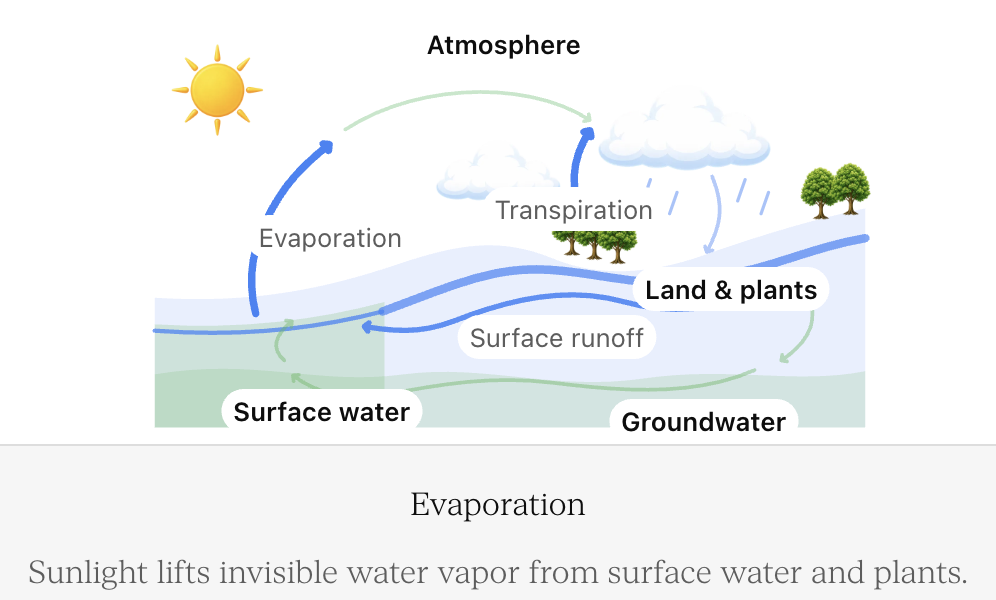
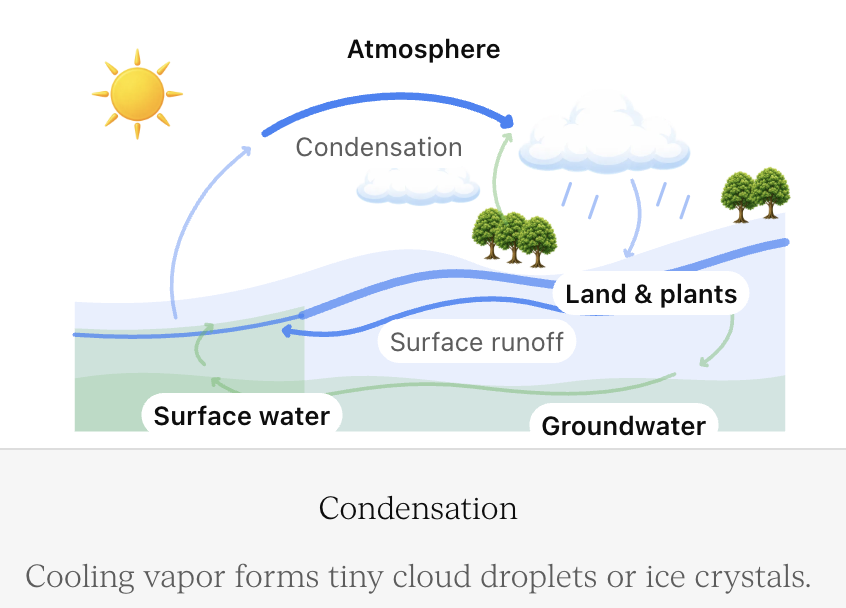
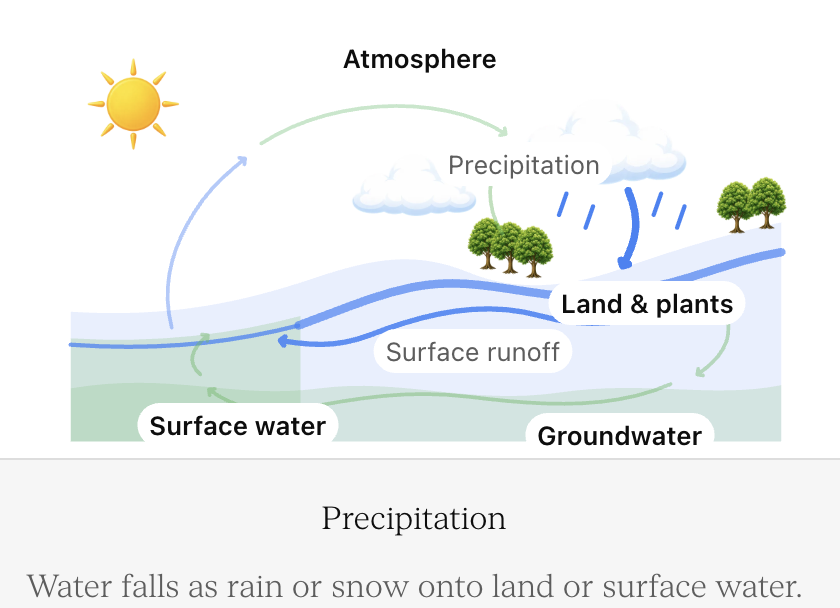
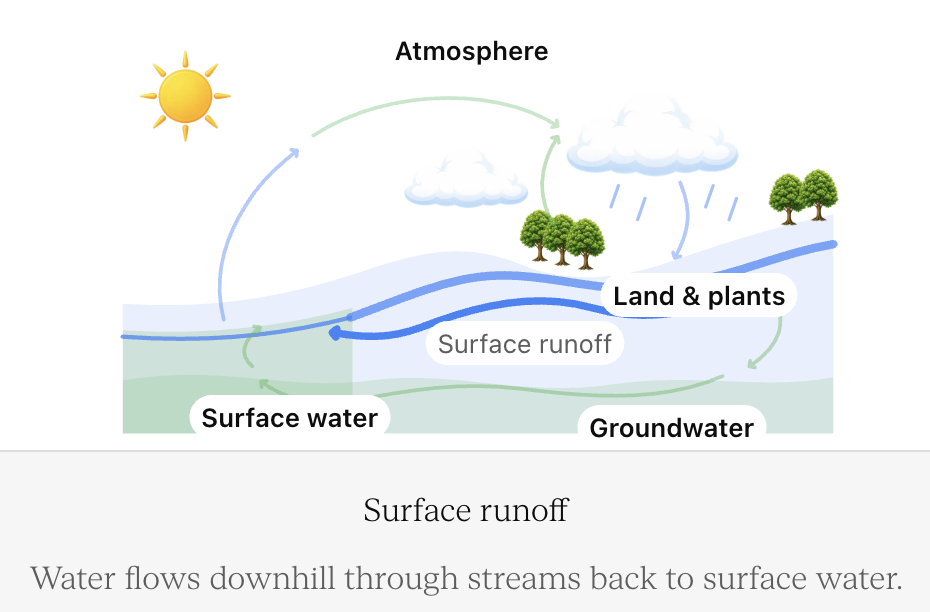
Evaporation
Evaporation is the process by which liquid water changes into water vapor.
Most evaporation occurs from:
- oceans
- lakes
- rivers
- wetlands
- moist soil
Energy from the Sun heats liquid water.
Some water molecules gain enough kinetic energy to escape from the liquid surface and enter the atmosphere as gas.
liquid water → water vapor
Evaporation is generally faster when:
- temperature is higher
- wind speed is greater
- humidity is lower
- more water surface is exposed
This is why wet clothing usually dries faster on a warm, windy, dry day.


Transpiration
Plants also transfer large amounts of water to the atmosphere.
Roots absorb water from the soil. Water travels through the plant and eventually escapes mainly through tiny openings called stomata in the leaves.
This process is called transpiration.
The combined transfer of water to the atmosphere through evaporation and transpiration is sometimes called:
evapotranspiration
A simplified pathway is:
soil → roots → plant → leaves → atmosphere
Forests can therefore play an important role in regional water cycles.


Condensation
As moist air rises, it often cools.
Cooler air can reach conditions where water vapor begins changing into tiny liquid water droplets or ice crystals.
This process is called condensation.
water vapor → liquid water
Clouds form when huge numbers of tiny droplets or ice crystals develop in the atmosphere, usually around tiny airborne particles.
Condensation also explains everyday observations such as:
- dew forming on grass
- droplets appearing on the outside of a cold drink
- a bathroom mirror becoming covered with water droplets
The water on a cold glass does not pass through the glass. Water vapor from the surrounding air condenses on its cold surface.


Clouds and Atmospheric Transport
Water does not necessarily fall back to Earth where it evaporated.
Winds can transport water vapor and clouds over enormous distances.
For example, water may:
- evaporate from an ocean
- enter the atmosphere
- be transported inland
- condense into clouds
- fall over mountains as precipitation
This atmospheric transport is one reason oceans can supply water to ecosystems far inland.
Precipitation
Precipitation occurs when water falls from the atmosphere to Earth's surface.
Forms of precipitation include:
- rain
- snow
- sleet
- hail
Cloud droplets and ice crystals can grow until they become too large to remain suspended.
Gravity then causes them to fall.
The form of precipitation depends strongly on atmospheric temperature and conditions.


Collection and Storage
After precipitation reaches Earth's surface, water can be stored in many places.
Major water reservoirs include:
- oceans
- lakes
- rivers
- glaciers
- snow
- groundwater
- soil
- atmosphere
- living organisms
The oceans are by far Earth's largest reservoir of water.
Water may remain in some reservoirs for much longer than others.
For example, a water molecule might remain in the atmosphere for a relatively short time but remain stored in deep groundwater or glacial ice for much longer.
Surface Runoff
When water reaches the ground, some flows across the surface.
This is called surface runoff.
Runoff can enter:
- streams
- rivers
- lakes
- wetlands
- reservoirs
- oceans
Gravity causes surface water to move from higher elevations toward lower elevations.
A typical pathway might be:
rain → hillside → stream → river → ocean


What Affects Runoff?
The amount of runoff depends on several factors.
Rainfall intensity
Heavy rain can fall faster than the soil can absorb it.
This increases runoff.
Soil type
Some soils allow water to infiltrate rapidly, while others absorb it more slowly.
Vegetation
Plant roots and soil organic matter can increase water infiltration and slow surface flow.
Slope
Water generally runs off steep slopes more rapidly.
Previous conditions
Already-saturated soil cannot absorb as much additional water.
Human surfaces
Concrete, asphalt, roofs, and roads allow very little infiltration.
Urban areas can therefore produce large amounts of rapid runoff.
Infiltration
Infiltration is the movement of water from Earth's surface into the soil.
Once water enters the ground, several things can happen.
It may:
- remain as soil moisture
- be absorbed by plant roots
- evaporate from the soil
- move deeper underground
The rate of infiltration depends on factors such as:
- soil texture
- soil structure
- vegetation
- soil saturation
- land use
- rainfall intensity
Percolation
Water that infiltrates into soil may continue moving downward through soil and permeable rock.
This deeper movement is called percolation.
A simplified sequence is:
precipitation → infiltration → percolation → groundwater
Infiltration and percolation are related but not identical.
Infiltration describes water entering the ground.
Percolation describes water moving downward through soil and rock.
Groundwater
Water stored beneath Earth's surface is called groundwater.
Groundwater occupies spaces and cracks within soil and rock.
A body of permeable rock or sediment that stores and transmits useful quantities of groundwater is called an aquifer.
Groundwater is an extremely important freshwater resource.
People obtain groundwater through:
- wells
- springs
- pumping systems
Groundwater also interacts with surface water.
It can slowly flow into:
- streams
- rivers
- lakes
- wetlands
- oceans


The Water Table
The water table is approximately the upper boundary of the zone underground where spaces in soil and rock are saturated with water.
Its depth can change.
After prolonged rainfall, the water table may rise.
During:
- drought
- prolonged dry conditions
- heavy groundwater pumping
the water table may fall.
This illustrates how different parts of the water cycle influence one another.
Groundwater and Rivers
Groundwater and rivers should not be thought of as completely separate systems.
Groundwater can feed rivers and streams, helping maintain their flow during periods without rainfall.
In other situations, water from a river can infiltrate into surrounding ground.
This exchange is important for aquatic ecosystems and freshwater supplies.
Snow and Ice
Water can also be stored as:
- snow
- glaciers
- ice sheets
- frozen ground
This temporarily removes liquid water from other parts of the cycle.
When temperatures increase, melting returns frozen water to liquid form.
The resulting water can:
- infiltrate into soil
- enter rivers
- replenish lakes
- contribute to runoff
Seasonal snowmelt is an important source of freshwater in many regions.


Sublimation
Water does not always need to melt before entering the atmosphere.
Sublimation occurs when solid water changes directly into water vapor:
ice → water vapor
This can occur from:
- snow
- glaciers
- ice
especially under cold, dry, windy conditions.
The reverse process is called deposition:
water vapor → ice
Frost can form through deposition.
Gravity and the Water Cycle
The Sun supplies much of the energy driving evaporation, but gravity is another major driver of the water cycle.
Gravity causes:
- precipitation to fall
- rivers to flow downhill
- runoff to move toward lower elevations
- water to infiltrate and percolate downward
- groundwater to move through geological materials
A useful generalization is:
Solar energy moves water into the atmosphere.
Gravity helps return and move water across and beneath Earth's surface.
Watersheds
A watershed, or drainage basin, is an area of land where water drains toward the same river, lake, or other body of water.
Rain falling within a watershed may eventually travel through:
small streams → larger streams → rivers
Watersheds are important because activities occurring upstream can affect water quality downstream.
For example:
- fertilizers
- sediment
- oil
- litter
- pesticides
can be transported by runoff.


The Water Cycle and Ecosystems
Living organisms depend on the water cycle.
Plants require water for:
- photosynthesis
- transporting substances
- maintaining cell structure
- growth
Animals depend on water directly and indirectly through food webs.
Aquatic ecosystems depend on:
- water availability
- water depth
- temperature
- flow
- water quality
The water cycle also transports:
- nutrients
- minerals
- sediments
- dissolved gases
through ecosystems.
Water and Plant Growth
Consider a forest after rainfall.
Some water:
- remains on leaves
- evaporates
- enters the soil
- is absorbed by roots
- moves through plant tissues
- leaves through transpiration
- enters groundwater
- runs into streams
The same rainfall event can therefore send water along several pathways simultaneously.
This is another reason the water cycle is better understood as a network rather than a simple loop.
Weather and the Water Cycle
The water cycle is closely connected to weather.
Evaporation adds water vapor to the atmosphere.
Condensation produces clouds.
Atmospheric circulation transports moisture.
Precipitation returns water to the surface.
Changes in:
- temperature
- humidity
- wind
- air pressure
can therefore influence water movement.
Temperature
Temperature strongly influences evaporation.
Generally:
higher temperature → faster evaporation
Warmer conditions can also affect:
- snowmelt
- ice melt
- atmospheric water vapor
- precipitation patterns
- transpiration
Temperature changes can therefore alter several pathways in the water cycle simultaneously.
Humidity
Humidity describes the amount of water vapor in the air.
When the surrounding air is already very humid, evaporation tends to occur more slowly.
When the air is dry, evaporation can occur more rapidly.
This is why perspiration often evaporates less effectively in very humid weather.
Wind
Wind can increase evaporation by carrying humid air away from a wet surface and replacing it with drier air.
Wind also transports:
- water vapor
- clouds
- storms
between regions.
Water that evaporates in one location may therefore become precipitation hundreds or thousands of kilometres away.
Vegetation
Vegetation can influence the water cycle in several ways.
Plants:
- intercept rainfall
- absorb water
- release water through transpiration
- slow surface runoff
- help water infiltrate soil
- reduce soil erosion
Removing vegetation can therefore alter local water movement.
In some environments, deforestation can increase:
- runoff
- erosion
- sediment entering rivers
while reducing interception and transpiration.
Urbanization
Cities significantly change natural water movement.
Natural ground is often replaced by:
- roads
- parking lots
- buildings
- concrete
- pavement
These surfaces are impermeable, meaning water cannot easily infiltrate through them.
As a result:
less infiltration → more surface runoff
Rapid runoff can increase the risk of:
- flash flooding
- stream erosion
- polluted waterways


Reducing Urban Runoff
Cities can use designs that allow more water to infiltrate.
Examples include:
- permeable pavement
- rain gardens
- green roofs
- retention ponds
- wetlands
- planted areas
These approaches can slow water movement and reduce pressure on stormwater systems.
Human Use of Groundwater
Humans withdraw groundwater for:
- drinking water
- agriculture
- industry
- irrigation
If groundwater is removed faster than it is naturally replenished, the water table can fall.
Possible consequences include:
- wells drying up
- reduced stream flow
- damage to wetlands
- land subsidence in some areas
Groundwater is renewable only when recharge occurs quickly enough relative to its use.
Drought
A drought is an extended period of unusually low water availability.
During drought:
- precipitation decreases
- soil moisture may decrease
- rivers and reservoirs may fall
- groundwater recharge may decrease
- plant stress may increase
- wildfire risk may increase
Drought demonstrates how changes in one part of the water cycle can affect ecosystems and human societies.
Flooding
Flooding can occur when water arrives faster than it can:
- infiltrate
- drain away
- move through rivers
- be stored
Factors increasing flood risk can include:
- intense rainfall
- saturated soil
- rapid snowmelt
- impermeable urban surfaces
- loss of vegetation
- certain landscape characteristics
Flooding is therefore influenced by interactions among weather, geology, vegetation, and human land use.
Climate and the Water Cycle
Climate strongly influences the movement and storage of water.
Changes in climate can alter:
- evaporation rates
- precipitation patterns
- snow accumulation
- timing of snowmelt
- glacier storage
- soil moisture
- drought frequency or intensity
- heavy rainfall patterns
Because the water cycle connects Earth's major systems, changes can have effects far beyond the atmosphere alone.
Example: A Drop of Water
Imagine a water molecule in the ocean.
It might:
- evaporate from the ocean
- enter the atmosphere as water vapor
- be transported by wind
- condense into a cloud
- fall as rain over land
- infiltrate into soil
- enter groundwater
- emerge into a stream
- travel through a river
- return to the ocean
But another molecule from the same cloud might be absorbed by a tree and return to the atmosphere through transpiration.
There is no single pathway that every water molecule follows.
Water Cycle Reservoirs and Processes
It is useful to distinguish between reservoirs and processes.
Reservoirs store water
Examples:
- oceans
- lakes
- glaciers
- groundwater
- atmosphere
- soil
Processes move water
Examples:
- evaporation
- transpiration
- condensation
- precipitation
- runoff
- infiltration
- percolation
- melting
- freezing
- sublimation
This distinction makes complex water-cycle diagrams easier to interpret.
Common Mistakes
Thinking the Water Cycle Is a Simple Loop
Water can follow many different pathways.
It does not always move:
ocean → cloud → rain → ocean
Confusing Evaporation and Condensation
Evaporation: liquid → gas
Condensation: gas → liquid
Thinking Clouds Are Water Vapor
Clouds are visible because they contain tiny liquid droplets and/or ice crystals.
Water vapor itself is invisible.
Confusing Infiltration and Runoff
Infiltration means water enters the ground.
Runoff means water flows across the surface.
Confusing Infiltration and Percolation
Infiltration: surface → soil
Percolation: movement deeper through soil and rock
Forgetting Transpiration
Plants are active parts of the water cycle.
They absorb water and return some of it to the atmosphere.
Assuming Groundwater Does Not Move
Groundwater can move slowly through permeable rock and sediment and can interact with rivers, lakes, and oceans.
Thinking the Sun Is the Only Driver
Solar energy is extremely important, but gravity also drives precipitation, runoff, river flow, infiltration, and groundwater movement.
Assuming Human Activity Is Separate from the Water Cycle
Humans alter water movement through:
- urbanization
- agriculture
- groundwater pumping
- dams
- deforestation
- irrigation
Human activities are now important influences on many water systems.
Key Terms
Water cycle — The continuous movement and storage of water through Earth's atmosphere, hydrosphere, geosphere, and biosphere.
Hydrologic cycle — Another name for the water cycle.
Evaporation — The change of liquid water into water vapor.
Condensation — The change of water vapor into liquid water.
Precipitation — Water falling from the atmosphere as rain, snow, sleet, or hail.
Transpiration — The release of water vapor from plants, mainly through stomata.
Evapotranspiration — The combined movement of water to the atmosphere through evaporation and transpiration.
Runoff — Water flowing across Earth's surface.
Infiltration — Water entering soil from the surface.
Percolation — Water moving downward through soil and permeable rock.
Groundwater — Water stored beneath Earth's surface.
Aquifer — Permeable rock or sediment capable of storing and transmitting groundwater.
Water table — The approximate upper boundary of the saturated groundwater zone.
Watershed — An area of land that drains toward a common body of water.
Reservoir — A location where water is stored within the water cycle.
Sublimation — The direct change from solid water to water vapor.
Deposition — The direct change from water vapor to solid ice.
Humidity — The amount of water vapor present in the air.
Impermeable surface — A surface through which water cannot easily infiltrate.
Groundwater recharge — The addition of water to groundwater stores through infiltration and percolation.
Key Takeaways
- The water cycle is the continuous movement of water through Earth's major systems.
- Water is constantly exchanged among the atmosphere, hydrosphere, geosphere, and biosphere.
- The water cycle is not a simple circular pathway; it is a network with many possible routes.
- Solar energy drives much of the evaporation that transfers water into the atmosphere.
- Gravity drives precipitation, runoff, river flow, and much underground water movement.
- Evaporation changes liquid water into water vapor.
- Transpiration releases water from plants into the atmosphere.
- Condensation changes water vapor into liquid droplets.
- Precipitation returns atmospheric water to Earth's surface.
- Water can move across land as runoff or enter the ground through infiltration.
- Percolation can move infiltrated water deeper into groundwater.
- Water can be stored in oceans, lakes, rivers, soil, groundwater, glaciers, the atmosphere, and organisms.
- Groundwater and surface water are interconnected.
- Vegetation, soil, slope, temperature, wind, and rainfall influence water movement.
- Human activities such as urbanization, deforestation, irrigation, and groundwater pumping can alter the water cycle.
- The water cycle supplies freshwater and helps sustain ecosystems.
- Changes in the water cycle can contribute to droughts, floods, and changes in water availability.
A useful way to summarize the system is:
WATER IS STORED → WATER MOVES → WATER CHANGES STATE → WATER IS STORED AGAIN
Check Your Understanding
Basic Concepts
1. Define the water cycle.
2. Name four Earth systems connected by the water cycle.
3. Explain why the water cycle should not be thought of as one simple circular pathway.
4. Identify the two major forces or energy sources that drive much of the water cycle.
5. Give four examples of places where water can be stored.
Processes
6. Define evaporation.
7. Define condensation.
8. Define precipitation.
9. Define transpiration.
10. Explain the difference between evaporation and transpiration.
11. Explain the difference between infiltration and runoff.
12. Explain the difference between infiltration and percolation.
13. What is sublimation?
14. Give four forms of precipitation.
Applying the Water Cycle
15. Explain how water from an ocean could eventually enter a river hundreds of kilometres inland.
16. Describe a possible pathway by which rainwater could eventually return to the atmosphere through a plant.
17. Describe a possible pathway by which rainwater could enter groundwater.
18. Explain how groundwater can eventually return to the ocean.
19. Why might a river continue flowing even several days after rainfall has stopped?
Factors Affecting Water Movement
20. Explain how higher temperatures can affect evaporation.
21. Explain how wind can affect evaporation.
22. Explain how humidity can affect evaporation.
23. Why does saturated soil usually produce more runoff than dry soil?
24. Explain how steep slopes can influence runoff.
25. Explain how vegetation can affect infiltration and runoff.
Human Impacts
26. Explain why replacing soil with concrete can increase runoff.
27. Why can urbanization increase flash-flood risk?
28. Give three ways cities can increase infiltration or reduce rapid runoff.
29. Explain how excessive groundwater pumping can affect the water table.
30. Describe two ways deforestation could alter the local water cycle.
Ecosystems
31. Explain why the water cycle is essential for terrestrial ecosystems.
32. Explain how plants participate in the water cycle.
33. How can runoff transport substances through an ecosystem?
34. Explain why changes in river flow can affect aquatic organisms.
Analysis
35. A region experiences several weeks of unusually high temperatures and little rainfall. Predict three changes that might occur in its water cycle.
36. Two areas receive the same heavy rainfall. Area A is covered by forest and Area B is covered by roads and buildings. Compare the likely infiltration and runoff in the two areas.
37. A groundwater aquifer is being pumped faster than precipitation can recharge it. Predict what may happen over time.
38. Explain how water that falls as snow on a mountain could eventually reach the ocean.
39. A student says, "All precipitation eventually flows directly into rivers." Explain why this statement is incorrect.
40. Trace one possible journey of a water molecule through at least six different processes or reservoirs in the water cycle.