Alkenes and Polymers
4. Polymerization
Learning outcomes
- I can define a polymer and a monomer.
- I can explain how addition polymerization occurs.
- I can describe how alkene monomers join together to form polymers.
- I can draw simple polymer structures from alkene monomers.
- I can identify common examples of synthetic polymers.
Polymerization
Many of the plastics and synthetic materials we use every day are made from polymers. Polymers are extremely large molecules formed when many small molecules called monomers join together.
For example, thousands of ethene molecules can join to form poly(ethene):
ethene → poly(ethene)
Ethene is the monomer.
Poly(ethene) is the polymer.
Because ethene contains a carbon-carbon double bond, C=C, it can undergo addition polymerization. During this process, the double bonds are involved in forming new bonds between neighbouring monomers, producing a long carbon chain.


What Is a Monomer?
A monomer is a relatively small molecule that can join with many other monomer molecules to form a polymer.
The word can be remembered as:
mono = one
A single ethene molecule:
CH₂=CH₂
is a monomer.
Many ethene molecules can react together:
ethene + ethene + ethene + ethene + ...
to produce one very large molecule.
Alkenes make useful monomers because they contain the reactive:
C=C
double bond.
What Is a Polymer?
A polymer is a very large molecule made from many repeating units joined together.
The word can be remembered as:
poly = many
A polymer molecule may contain:
- hundreds
- thousands
- or even tens of thousands
of repeating units.
For example, poly(ethene) contains a long chain based on:
–CH₂–CH₂–CH₂–CH₂–CH₂–CH₂–
The chain may continue for thousands of carbon atoms.


Monomers and Polymers
A useful analogy is a chain made from many individual links.
Each link represents a:
monomer
The complete chain represents a:
polymer
Chemically, however, the monomers are not simply placed beside one another. New covalent bonds form between them.
For addition polymers made from alkenes, the carbon-carbon double bonds allow these new connections to form.
What Is Addition Polymerization?
Addition polymerization is a reaction in which many unsaturated monomer molecules join together to form a polymer.
The monomers usually contain:
C=C
During polymerization:
- the C=C bonds are involved in the reaction
- each double bond becomes a single bond within the polymer backbone
- new C–C bonds form between neighbouring monomer units
- a long carbon chain is produced
No small molecule such as water is eliminated in simple addition polymerization.
The atoms of the monomers become incorporated into the polymer.
Watching Addition Polymerization Happen
This interactive model lets you change the alkene monomer and see how its C=C bonds become part of a continuous polymer chain.
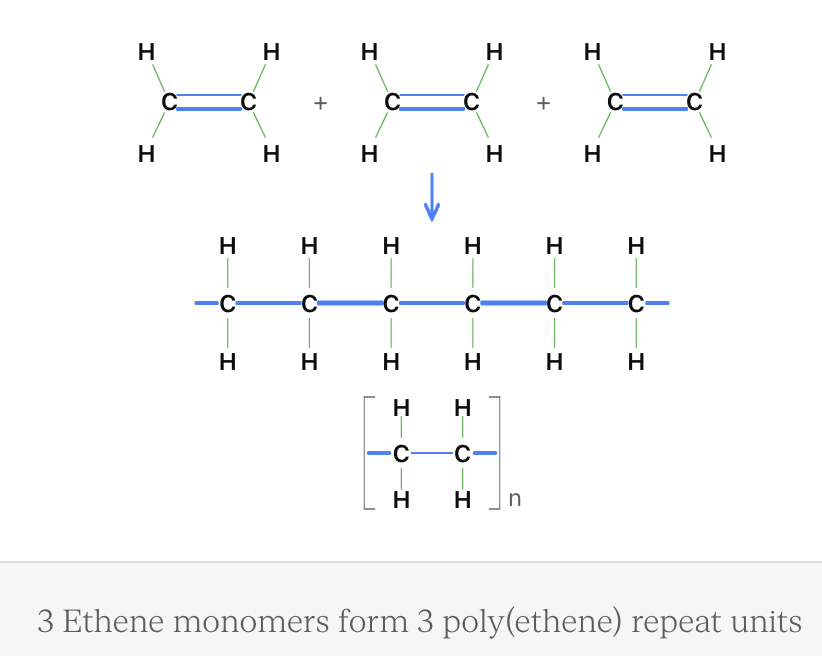
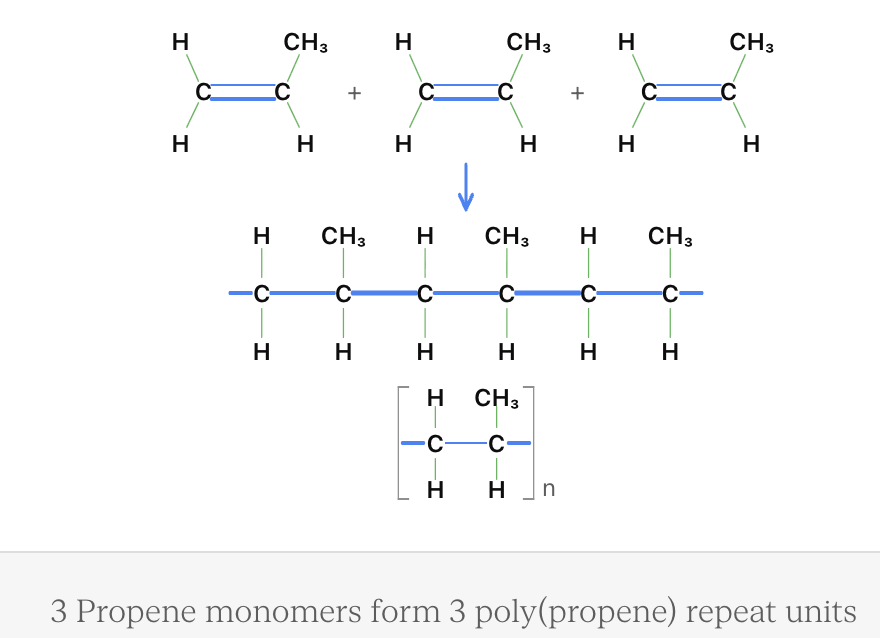
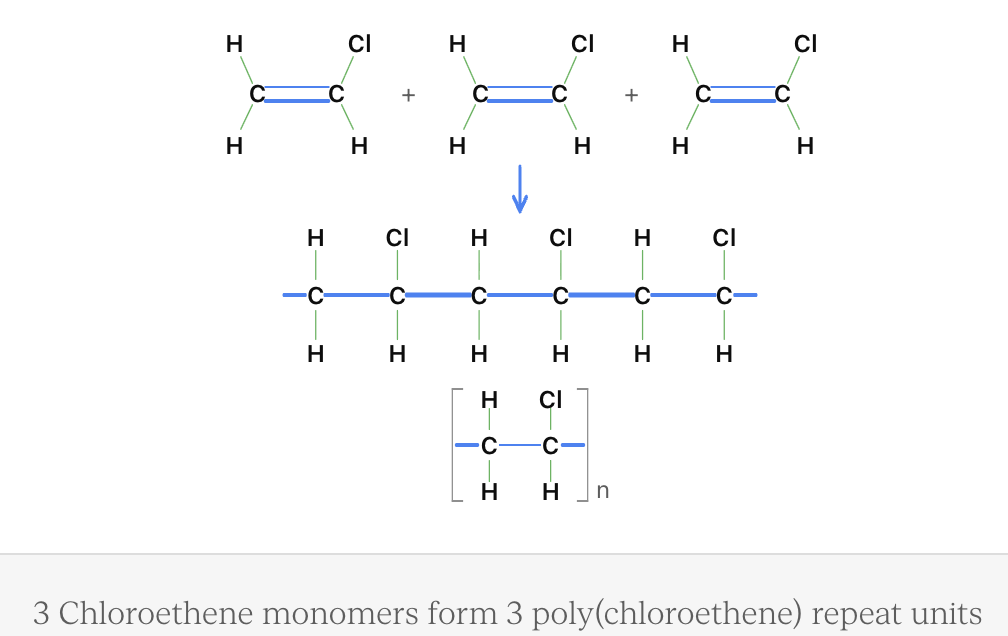
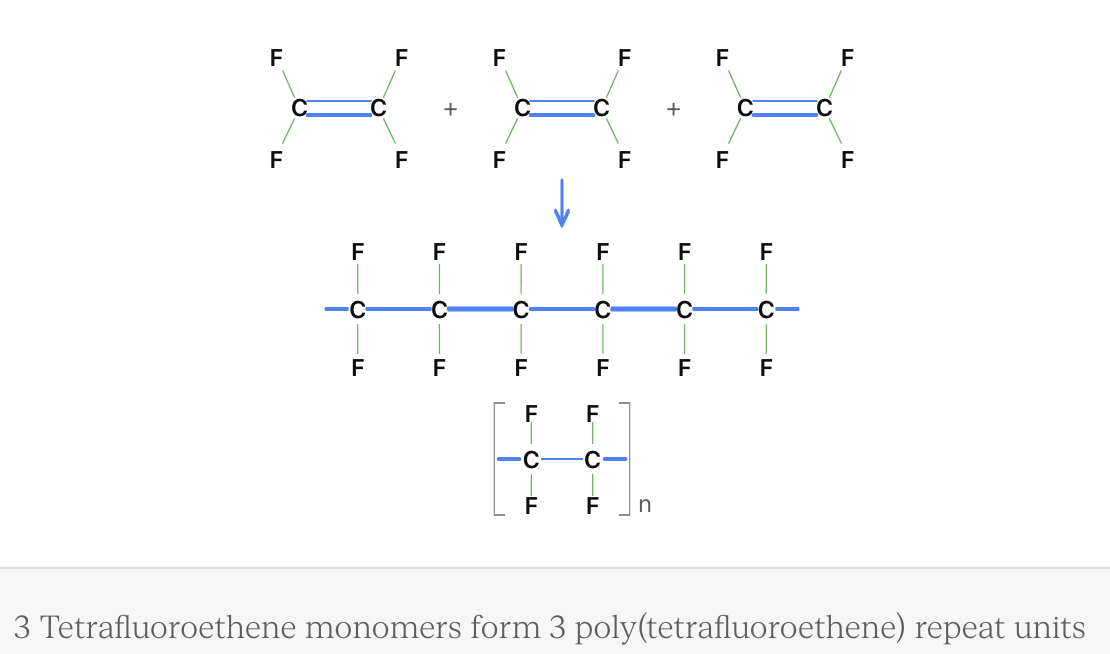
The key pattern is:
alkene monomers → long saturated carbon chain
The substituents attached to the original alkene carbons remain attached to those carbons in the polymer.
Polymerization of Ethene
Ethene is one of the simplest examples.
Monomer:
CH₂=CH₂
During polymerization, many ethene molecules join:
CH₂=CH₂ + CH₂=CH₂ + CH₂=CH₂ + ...
The resulting polymer contains the repeating pattern:
–CH₂–CH₂–CH₂–CH₂–CH₂–CH₂–
The polymer is called:
poly(ethene)
It is also commonly called:
polyethylene

Representing Poly(ethene)
Writing thousands of atoms would obviously be impractical.
Instead, chemists show the repeating unit inside brackets.
For poly(ethene), we can represent the repeating unit in plain text as:
[–CH₂–CH₂–]ₙ
The n means that the unit repeats many times.
So:
CH₂=CH₂ → [–CH₂–CH₂–]ₙ
The exact value of n can be very large.
What Happens to the Double Bond?
This is the most important structural change to understand.
Before polymerization, the monomer contains:
C=C
After polymerization, the polymer backbone contains:
C–C–C–C–C–C
The carbon atoms that were originally connected by double bonds become part of a long chain of single carbon-carbon bonds.
It is important not to imagine that the carbon atoms disappear or that the double bond simply vanishes without consequence.
The bonding changes allow the monomers to connect to neighbouring molecules.
From Monomer to Repeating Unit
Consider ethene:
CH₂=CH₂
Step 1: Identify the double bond.
C=C
Step 2: Change the double bond to a single bond.
C–C
Step 3: Show bonds extending from both sides because the unit connects to neighbouring units.
Repeating unit:
–CH₂–CH₂–
Step 4: Put the repeating unit in brackets:
[–CH₂–CH₂–]ₙ
This represents poly(ethene).
Polymerization Is an Addition Reaction
Addition polymerization is related to the addition reactions of alkenes.
In both cases, the:
C=C
double bond participates in the reaction.
However, instead of a small molecule such as H₂ or Br₂ being added, many alkene molecules become connected together.
A useful comparison is:
Hydrogenation:
alkene + H₂ → alkane
Bromination:
alkene + Br₂ → dibromoalkane
Polymerization:
many alkene molecules → polymer
All involve reactions at the C=C bond.
Polymerization of Propene
Propene has the structure:
CH₂=CH–CH₃
The CH₃ group remains attached to the carbon chain during polymerization.
Repeating unit:
[–CH₂–CH(CH₃)–]ₙ
The polymer is:
poly(propene)
also called:
polypropylene


Keeping Side Groups in the Polymer
One common mistake is to lose the groups attached to the original double bond.
Consider propene:
CH₂=CH–CH₃
The CH₃ group does not disappear.
It remains attached:
[–CH₂–CH(CH₃)–]ₙ
The same principle applies to other substituted alkenes.
Whatever groups are attached to the double-bonded carbons must be accounted for in the polymer repeating unit.
Polymerization of Chloroethene
Chloroethene has the structure:
CH₂=CHCl
During polymerization:
CH₂=CHCl → [–CH₂–CHCl–]ₙ
The polymer is:
poly(chloroethene)
It is commonly known as:
PVC — polyvinyl chloride
The chlorine atoms remain attached to the polymer chain.


Polymerization of Tetrafluoroethene
Another important alkene monomer is tetrafluoroethene:
CF₂=CF₂
During polymerization:
CF₂=CF₂ → [–CF₂–CF₂–]ₙ
The polymer is:
poly(tetrafluoroethene)
often abbreviated:
PTFE
PTFE is well known for properties such as:
- low friction
- chemical resistance
- heat resistance
- electrical insulation
Drawing a Polymer from Its Monomer
Suppose you are given:
CH₂=CHX
where X represents another atom or group.
Use this procedure.
Identify C=C
Find the two double-bonded carbon atoms.
Change C=C to C–C
The double bond becomes a single bond.
Keep All Attached Groups
Do not remove X.
Add Extension Bonds
Show that the repeating unit connects to other units.
Add Brackets and n
The result is:
[–CH₂–CHX–]ₙ
This method works for many simple alkene monomers.
Worked Example: Ethene
Monomer:
CH₂=CH₂
Remove the double-bond representation:
CH₂–CH₂
Add connections:
–CH₂–CH₂–
Add brackets:
[–CH₂–CH₂–]ₙ
Polymer:
poly(ethene)
Worked Example: Propene
Monomer:
CH₂=CH–CH₃
Change C=C to C–C:
CH₂–CH(CH₃)
Add continuation bonds:
–CH₂–CH(CH₃)–
Repeating unit:
[–CH₂–CH(CH₃)–]ₙ
Polymer:
poly(propene)
Worked Example: Chloroethene
Monomer:
CH₂=CHCl
Change:
C=C → C–C
Keep Cl attached:
–CH₂–CHCl–
Polymer:
[–CH₂–CHCl–]ₙ
Name:
poly(chloroethene)
Worked Example: Tetrafluoroethene
Monomer:
CF₂=CF₂
Change:
C=C → C–C
Keep all fluorine atoms attached.
Repeating unit:
[–CF₂–CF₂–]ₙ
Polymer:
poly(tetrafluoroethene)
Working Backwards: Polymer to Monomer
You may also be given a polymer repeating unit and asked to determine the monomer.
Suppose the repeating unit is:
[–CH₂–CHCl–]ₙ
Step 1: Identify the two carbon atoms in the repeating unit.
Step 2: Remove the continuation bonds.
Step 3: place a double bond between the two carbon atoms.
Result:
CH₂=CHCl
Therefore, the monomer is:
chloroethene
Another Polymer-to-Monomer Example
Polymer:
[–CH₂–CH(CH₃)–]ₙ
Convert the C–C between the two repeating-unit carbons into:
C=C
Monomer:
CH₂=CH–CH₃
This is:
propene
Common Synthetic Polymers
Synthetic polymers are manufactured for an enormous range of applications.
| Polymer | Monomer | Common Uses |
|---|---|---|
| Poly(ethene) | Ethene | Bags, bottles, packaging, pipes |
| Poly(propene) | Propene | Containers, fibres, ropes, automotive parts |
| PVC | Chloroethene | Pipes, flooring, cable insulation |
| PTFE | Tetrafluoroethene | Low-friction coatings, seals, electrical insulation |
| Polystyrene | Styrene | Packaging, insulation, containers |
Different monomers produce polymers with different structures and properties.


Poly(ethene) in Everyday Life
Poly(ethene) is one of the world's most widely used plastics.
Different forms can have different properties.
Applications include:
- shopping and packaging bags
- plastic films
- bottles
- toys
- containers
- pipes
- electrical insulation
The properties depend partly on factors such as polymer chain length and how the chains are arranged.
Poly(propene) in Everyday Life
Poly(propene) is relatively tough and chemically resistant.
It is used for:
- food containers
- reusable containers
- ropes
- carpets
- fibres
- laboratory equipment
- automotive components
- packaging
Its CH₃ side groups help give it properties different from poly(ethene).
PVC
PVC stands for:
polyvinyl chloride
Its systematic polymer name is:
poly(chloroethene)
PVC can be manufactured with different properties depending on additives and processing.
Applications include:
- water pipes
- window frames
- flooring
- electrical cable insulation
- medical tubing
- construction materials
The chlorine-containing side groups contribute to its distinctive properties.
PTFE
PTFE stands for:
polytetrafluoroethylene
It is produced from tetrafluoroethene.
PTFE has useful properties including:
- very low friction
- strong chemical resistance
- good thermal stability
- good electrical insulating properties
It can be used in:
- seals
- bearings
- chemical equipment
- electrical insulation
- low-friction coatings
Polystyrene
Polystyrene is another common synthetic addition polymer.
Its monomer contains a C=C bond and a benzene-containing side group.
Polystyrene can be produced as:
- rigid plastic
- expanded foam
Applications include:
- protective packaging
- insulation
- laboratory containers
- disposable packaging
This demonstrates how changing the groups attached to the original alkene can dramatically change the properties of the resulting polymer.
Why Different Polymers Have Different Properties
All addition polymers are not identical.
Their properties depend on factors such as:
- monomer structure
- side groups
- polymer chain length
- branching
- arrangement of chains
- forces between polymer chains
- degree of crystallinity
- additives
For example, replacing a hydrogen atom with chlorine changes:
poly(ethene)
into a very different material:
PVC
Small differences in monomer structure can therefore produce major differences in material properties.
Why Polymer Molecules Are So Large
During polymerization, the process repeats many times.
Instead of:
monomer + monomer → dimer
and stopping, the chain continues growing.
It may contain thousands of repeating units.
This gives polymers very high relative molecular masses compared with their monomers.
A polymer is therefore often called a:
macromolecule
meaning a very large molecule.
Polymer Chains and Material Properties
Long polymer molecules can become:
- tangled
- aligned
- packed closely together
- branched
- connected to other chains
These structural differences influence properties such as:
- strength
- flexibility
- density
- hardness
- melting behaviour
Therefore, even polymers made from similar monomers can behave differently depending on their molecular structure.


Thermoplastics
Many common addition polymers are thermoplastics.
Thermoplastics soften when heated and harden again when cooled.
Examples include many forms of:
- poly(ethene)
- poly(propene)
- PVC
- polystyrene
This property allows many thermoplastics to be shaped during manufacturing.
Some can also be mechanically recycled by melting and reshaping, although contamination and changes in material quality can make recycling more complicated.
Why Plastics Are So Useful
Synthetic polymers have become widespread because they can be designed to have useful properties.
Depending on the polymer, plastics can be:
- lightweight
- strong
- flexible
- rigid
- waterproof
- chemically resistant
- electrically insulating
- inexpensive to manufacture
- easily shaped
This makes polymers valuable in:
- medicine
- transportation
- construction
- electronics
- packaging
- clothing
- sports equipment
- food storage
Environmental Challenges
Many properties that make synthetic polymers useful can also create environmental problems.
For example, many plastics are:
- durable
- chemically resistant
- slow to decompose
If discarded improperly, they can remain in the environment for long periods.
Problems can include:
- litter
- harm to wildlife
- accumulation in oceans
- microplastic formation
- consumption of fossil resources
- greenhouse gas emissions during production and disposal
Recycling Polymers
Recycling can reduce the need for new raw materials and reduce waste.
However, polymer recycling can be challenging because:
- different plastics have different properties
- plastics may be mixed together
- products may contain additives
- food or chemicals may contaminate materials
- repeated processing can reduce material quality
This is why many plastic products are sorted according to polymer type.
Addition Polymerization and Atom Economy
Addition polymerization can have high atom economy.
In simple addition polymerization, the atoms in the monomers become part of the polymer.
For example:
ethene → poly(ethene)
No small molecule such as water is produced as a by-product.
This distinguishes addition polymerization from condensation polymerization, where small molecules may be eliminated when monomers join.
Natural and Synthetic Polymers
Not all polymers are plastics.
Nature contains many important polymers.
Examples include:
- proteins
- DNA
- starch
- cellulose
These are natural polymers.
Synthetic polymers include:
- poly(ethene)
- poly(propene)
- PVC
- PTFE
- polystyrene
Therefore:
polymer does not automatically mean plastic.
A polymer is defined by its molecular structure: a large molecule constructed from repeating units.
Monomer, Repeating Unit and Polymer
These three ideas should be distinguished carefully.
Monomer
The small starting molecule.
Example:
CH₂=CH₂
Repeating Unit
The structural pattern repeated throughout the polymer.
Example:
–CH₂–CH₂–
Polymer
The complete macromolecule containing many repeating units.
Represented as:
[–CH₂–CH₂–]ₙ
These terms are related but do not mean exactly the same thing.
Common Mistakes
Saying a Polymer Is Just "Lots of Molecules"
A polymer is a large molecule containing many repeating units connected by covalent bonds.
Confusing Monomer and Polymer
monomer → small starting molecule
polymer → large product molecule
Leaving the C=C Bond in the Polymer
During addition polymerization:
C=C → C–C
The repeating unit should not normally contain the original alkene double bond.
Removing Side Groups
Groups such as CH₃, Cl or F remain attached.
Forgetting the Extension Bonds
The repeating unit must connect to neighbouring units on both sides.
Forgetting the Brackets
Polymer structures are normally represented with the repeating unit inside brackets.
Forgetting n
The n indicates that the unit repeats many times.
Drawing Thousands of Units
Only the repeating unit needs to be shown.
Thinking n Is a Specific Number
Unless given, n simply means a large number of repeating units.
Confusing Polymerization with Hydrogenation
Hydrogenation adds H₂ to an alkene.
Polymerization joins many monomers together.
Thinking All Polymers Are Plastics
Proteins, DNA, cellulose and starch are also polymers.
Thinking All Plastics Have the Same Properties
Different monomers and polymer structures produce different material properties.
Key Terms
Monomer — A relatively small molecule capable of joining with other monomers to form a polymer.
Polymer — A very large molecule formed from many repeating units.
Macromolecule — A molecule with a very large molecular structure.
Polymerization — The chemical process through which monomers join to form polymers.
Addition polymerization — Polymerization in which unsaturated monomers join without eliminating a small molecule.
Alkene — An unsaturated hydrocarbon containing a C=C bond.
Unsaturated — Containing a carbon-carbon multiple bond.
Carbon-carbon double bond — The C=C bond that provides the reactive site in an alkene.
Repeating unit — The structural pattern that occurs repeatedly along a polymer chain.
Polymer chain — The long covalently bonded molecular backbone of a polymer.
Side group — An atom or group attached to the main polymer backbone.
Poly(ethene) — An addition polymer made from ethene monomers.
Poly(ethene)/polyethylene — Two names commonly used for the polymer formed from ethene.
Poly(propene) — An addition polymer formed from propene.
PVC — Poly(chloroethene), a chlorine-containing synthetic polymer.
PTFE — Poly(tetrafluoroethene), a fluorine-containing synthetic polymer.
Polystyrene — A synthetic addition polymer made from styrene monomers.
Synthetic polymer — A polymer manufactured through chemical processes.
Natural polymer — A polymer produced by living organisms or occurring naturally.
Thermoplastic — A polymer material that can soften when heated and harden when cooled.
Atom economy — A measure of how much of the reactant material becomes part of the desired product.
Plastic — A material, commonly polymer-based, that can be shaped or moulded.
Crystallinity — The degree to which polymer chains are arranged in ordered regions.
Branching — The presence of side chains connected to the main polymer chain.
Key Takeaways
- A monomer is a small molecule capable of joining with other monomers.
- A polymer is a very large molecule made from repeating units.
- Polymers are also called macromolecules.
- Addition polymerization commonly involves alkene monomers.
- Alkenes are suitable monomers because they contain C=C.
- During addition polymerization, the carbon-carbon double bonds participate in forming new bonds between monomers.
- The polymer backbone contains carbon-carbon single bonds.
- The atoms of the monomers are retained in the polymer.
- No small molecule is eliminated in simple addition polymerization.
- Ethene forms poly(ethene).
- Propene forms poly(propene).
- Chloroethene forms PVC.
- Tetrafluoroethene forms PTFE.
- Styrene forms polystyrene.
- The repeating unit is not the same thing as the original monomer.
- To draw a polymer from an alkene, locate C=C and convert it into part of a continuous C–C chain.
- Groups attached to the double-bonded carbons must remain attached.
- Polymer repeating units are shown in brackets.
- The symbol n shows that the unit repeats many times.
- A polymer structure can also be used to determine its original monomer.
- Different monomers produce polymers with different properties.
- Polymer properties also depend on chain length, branching, packing and intermolecular forces.
- Synthetic polymers have applications in packaging, construction, medicine, electronics, clothing and transportation.
- Their durability also creates environmental challenges.
- Recycling can reduce polymer waste but is complicated by mixtures, contamination and different polymer types.
- Not all polymers are synthetic.
- DNA, proteins, cellulose and starch are examples of natural polymers.
- Not all polymers should simply be described as "plastics."
- Addition polymerization often has high atom economy because the monomer atoms become incorporated into the polymer.
The central structural idea is:
C=C in the monomer → C–C connections in the polymer chain
And the basic relationship is:
many monomers → one polymer
Check Your Understanding
1. Define a monomer.
2. Define a polymer.
3. What is a macromolecule?
4. What is addition polymerization?
5. Why are alkenes suitable monomers for addition polymerization?
6. What happens to the C=C bonds during polymerization?
7. What new bonds form between neighbouring monomer units?
8. What is a repeating unit?
9. What does the n in a polymer formula represent?
10. What polymer forms from ethene?
11. Write the ethene monomer.
12. Write the repeating unit of poly(ethene).
13. What polymer forms from propene?
14. Write the repeating unit of poly(propene).
15. What happens to the CH₃ group of propene during polymerization?
16. What polymer forms from chloroethene?
17. What does PVC stand for?
18. Write the repeating unit of PVC.
19. What polymer forms from tetrafluoroethene?
20. Give two useful properties of PTFE.
21. Describe the steps for drawing a polymer repeating unit from an alkene monomer.
22. Why must extension bonds be shown on a repeating unit?
23. Why are brackets used around the repeating unit?
24. Explain how you could work backwards from a repeating unit to identify an alkene monomer.
25. Give four examples of synthetic polymers.
26. Give three examples of natural polymers.
27. Why can two different polymers have very different properties?
28. Give three advantages of synthetic polymer materials.
29. Give three environmental problems associated with widespread plastic use.
30. Challenge: Consider the monomer:
CH₂=CHCl
a. Is this molecule saturated or unsaturated?
b. Identify the bond that allows polymerization.
c. Explain what happens to this bond during addition polymerization.
d. Write the polymer repeating unit.
e. Name the polymer.
f. Give its common abbreviation.
g. Does the chlorine atom disappear during polymerization? Explain.
h. Explain why the repeating unit requires extension bonds on both sides.
i. Explain the meaning of n in the polymer structure.
j. Describe how you could determine CH₂=CHCl from the polymer repeating unit.
k. Explain why this reaction is called addition polymerization.
l. Compare the monomer with the polymer in terms of molecular size.
m. Give two common applications of the resulting polymer.
n. Explain why the polymer can have properties very different from its monomer.
o. Explain one environmental challenge associated with widespread use of synthetic polymers.