Alkenes and Polymers

サイト: Young Education
コース: Organic Chemistry
ブック: Alkenes and Polymers
印刷者: Guest user
日付: 2026年 10月 5日(月曜日) 04:04

1. The Alkene Family

Learning outcomes
  • I can define alkenes as unsaturated hydrocarbons.
  • I can identify the carbon-carbon double bond as the characteristic feature of alkenes.
  • I can distinguish between alkanes and alkenes.
  • I can recognize the general formula of alkenes.
  • I can identify simple alkenes from their structures and formulas.

The Alkene Family

Alkenes are a family of hydrocarbons that contain at least one carbon-carbon double bond (C=C).

A hydrocarbon is a compound made only from:

  • carbon
  • hydrogen

Alkenes are described as unsaturated hydrocarbons because their molecules contain a carbon-carbon double bond. This double bond is the characteristic feature that distinguishes the simplest alkenes from the corresponding alkanes.

Examples of simple alkenes include:

ethene — C₂H₄

propene — C₃H₆

butene — C₄H₈

pentene — C₅H₁₀

https://images.openai.com/static-rsc-4/5DbGtY9t253JcTljCxUthAXRKaFXULhyUawZ5xaJ-AfylZJkuY8VCnJLxKMYdF9CTP_3G4Uz_waeKOXgNfuBo5zc1kkaQnm45N_tKCnfvzCHYdBTs4fnsEyC349El-BGrP85D3NnfPNAt7-xP5qy3QJoVZEK-TYUQRv73tOfjdy0Q0TFaf1BqRBaaJcO7Gw4?purpose=fullsize
 
https://images.openai.com/static-rsc-4/ZAGbwpYzsuGaCxnxHuZyxzSy4YFaLcxwaiS2W68dl3F5K0E974T55PtQp33IYdEVWFpYMu82hVRWRLnYhw4XzOTM_dv7MhDpSLT2PrwUwgPerRviZzguDhBITzqydZmiKjfYpP9rpOdebILnqRk3vCd9pJbwp0R_-Zs3wq3oY9e9cEhHqV6ABhKIvRwNv4R9?purpose=fullsize
 
https://images.openai.com/static-rsc-4/Pr3FrE8xrcEV1YumTTbEujrlQZIdy22AbNhNUEhkH21H4LsvjRZbw4H8TwOzS2UW610DZDTm5UFm3S79mhwitTuQNTh8AL5iAjjZvhMewq1oES_3l0u9XSExG6S5qlkX3FeAPRAvEEAjE79yRTGdPKS1yRXXICRK8U7vz_U-dD7OBJcfrtsP1Ybd9jJCJbdL?purpose=fullsize
 
5

What Is an Alkene?

An alkene is an unsaturated hydrocarbon containing at least one carbon-carbon double bond.

The simplest alkene is ethene:

C₂H₄

Its structural formula can be represented as:

CH₂=CH₂

The = represents the double bond between the two carbon atoms.

Compare this with ethane:

CH₃–CH₃

Ethane contains only a single carbon-carbon bond.

Ethene contains:

C=C

This small structural difference gives alkenes different chemical properties from alkanes.


The Carbon-Carbon Double Bond

The most important feature of an alkene is the:

carbon-carbon double bond

written:

C=C

A single carbon-carbon bond can be represented:

C–C

A double carbon-carbon bond is:

C=C

The double bond consists of two shared pairs of electrons between the carbon atoms.

The presence of this double bond affects:

  • molecular structure
  • chemical reactivity
  • reactions with other substances
  • naming
  • physical properties
https://images.openai.com/static-rsc-4/p-krcfur67drN-WLXTwA36FEZvi5C3pMvlXh6XAe9ijVN_YLMnxUoJ0jAsqsXpLb4b-Oql1iLiY2OW_92oj4W0xTjII-rcmoMcW8dvlCJuSOy8XDm8rJzCpjjHwuOgv2t-9TWxyWrvMJsSnombj5OqT-Q-796djiyYr_1eBGR0aKVbzL5twCWLwu7tVmnEdj?purpose=fullsize
 
https://images.openai.com/static-rsc-4/Pr3FrE8xrcEV1YumTTbEujrlQZIdy22AbNhNUEhkH21H4LsvjRZbw4H8TwOzS2UW610DZDTm5UFm3S79mhwitTuQNTh8AL5iAjjZvhMewq1oES_3l0u9XSExG6S5qlkX3FeAPRAvEEAjE79yRTGdPKS1yRXXICRK8U7vz_U-dD7OBJcfrtsP1Ybd9jJCJbdL?purpose=fullsize
 
https://images.openai.com/static-rsc-4/ljRCykF71YOzMJuvQZgg8GldM1nRlKiFd5IagViyn__7TgP7f9BNS3nlj0qmrKLDP40C2Q2crXSNwWDyWCLK8dVqLZjJuVxkk9SGEJFabb1oKK97BfcZ4H4XUN6Cx7YwuWnf7Le3_Y--BrIQAQ6PyDAc6agn6ER9p63JHAvhTbciKB4zH3382wHtUpSl4psi?purpose=fullsize
 
5

Why Are Alkenes Unsaturated?

Alkenes are called unsaturated because they do not contain the maximum possible number of hydrogen atoms for their carbon skeleton.

Consider ethane:

C₂H₆

Structure:

CH₃–CH₃

Now compare ethene:

C₂H₄

Structure:

CH₂=CH₂

Ethene has two fewer hydrogen atoms because the carbon atoms are joined by a double bond.

The molecule can undergo reactions in which atoms are added across this double bond.

This is why we describe ethene as unsaturated.


Saturated and Unsaturated Hydrocarbons

A saturated hydrocarbon contains only single carbon-carbon bonds.

An unsaturated hydrocarbon contains one or more carbon-carbon multiple bonds.

For the families studied here:

Alkanes

Contain only:

C–C

bonds.

They are saturated.

Alkenes

Contain:

C=C

They are unsaturated.

This distinction is one of the most important differences between the two families.


Comparing Ethane and Ethene

Consider these two compounds.

Ethane

Molecular formula:

C₂H₆

Structural formula:

CH₃–CH₃

Family:

alkane

Bond between carbon atoms:

single

Type:

saturated

Ethene

Molecular formula:

C₂H₄

Structural formula:

CH₂=CH₂

Family:

alkene

Bond between carbon atoms:

double

Type:

unsaturated

https://images.openai.com/static-rsc-4/SebUCDNm0FuWX74IdkFwQZHmag_kd6teElskU60cXl9B4TBcU4JwwIICMpSH3MnzkX25dX6u-FHLr-IPeFsowGR8CoCIHr5cIgawlmZmrGZIsDCnRpRjk9iMVF3lPpQSCgI_enHRIo3N0JeWqeaYa5kLC-Vz6GWCWik0K5Oo90e7jPGftM5KiWGRxlB7UZ5T?purpose=fullsize
 
https://images.openai.com/static-rsc-4/E0EfdtDkX5yeEhpXwMXXArDnjtWBoD_Jnn6ZCM6dum8wY0WjYPwb4TXwCrgzm1qR84cYgr8Eo10XQXJPMybVzlqet5tq87TvPAxaH490CjdTR0SkPaaJoXf7JKwgYKZnj4Q74SxdlZUX2l1ZPbvfjb-XIzlsFhDp4QD3eBEZVEjxamAydhrc5YJ5BTRXEY7I?purpose=fullsize
 
https://images.openai.com/static-rsc-4/flSsvfoGFrF9QEXWQLdecjRSt5IJlk9yPOeVpjaTi8iR1laZ6rHUI9Se2N41bew7U-45OGE5T8DN4h7zkGxt-9khRlhspeN24bC3y6cx6pKvJ59EN7zF6nO4VPZxrrY_ArRMqiiwOQWbO0D6ikNE77edhsMjts3k1tUVkrdWUUOxs6JqjSHcSkgJJulDU5Rx?purpose=fullsize
 
4

The Alkene Homologous Series

Alkenes form a homologous series.

A homologous series is a family of organic compounds that:

  • have the same functional group
  • have the same general formula
  • have similar chemical properties
  • show gradual changes in physical properties
  • differ from neighbouring members by CH₂

For simple alkenes containing one double bond, the general formula is:

CₙH₂ₙ

where n represents the number of carbon atoms.


The General Formula

The general formula for the simple alkene homologous series is:

CₙH₂ₙ

This allows us to predict molecular formulas.

For example, suppose an alkene contains 5 carbon atoms.

n = 5

Number of hydrogen atoms:

2n = 2 × 5 = 10

Therefore:

C₅H₁₀

This is a molecular formula for a pentene.


First Members of the Alkene Family

Alkene Number of C Atoms Molecular Formula
Ethene 2 C₂H₄
Propene 3 C₃H₆
Butene 4 C₄H₈
Pentene 5 C₅H₁₀
Hexene 6 C₆H₁₂
Heptene 7 C₇H₁₄
Octene 8 C₈H₁₆

Notice the pattern:

number of H atoms = twice the number of C atoms

This follows:

CₙH₂ₙ


Why Is There No "Methene"?

The first alkene is ethene, not methene.

Why?

A carbon-carbon double bond requires two carbon atoms.

A molecule containing only one carbon atom cannot contain:

C=C

Therefore, there is no simple alkene called methene.

The alkene homologous series begins with:

ethene — C₂H₄


Recognizing Ethene

Ethene contains two carbon atoms.

Molecular formula:

C₂H₄

Structural formula:

CH₂=CH₂

Each carbon forms four bonds in total.

Each carbon:

  • forms a double bond with the other carbon
  • forms two single bonds with hydrogen atoms

Therefore, each carbon still has four bonds altogether.

https://images.openai.com/static-rsc-4/HNMFgTD05XwIHdVoo1bjp01FnhGnEP041IdLMS4J_DBN-2bfh6CpArq2y2nZzm7nG156FQ8ZHuRdWnb9HPi84HpG4MZb67rlLUj9DF0YndPGJRWCTGsxOsdukLvJRDUHC9MSF4OT_0J0SZkCEHMg2raDSN-Y4Kg_GwvEDn1hoSutlUHm9EEsvyreODMFRkHM?purpose=fullsize
 
https://images.openai.com/static-rsc-4/WwgYqJug9u7pyCK7373rmC_IvwNpu4iiRSraZ1pSzQVgd4GNrbdw8bH86Cd4bpP_GDQAWH0dIr_qpVUtdBHF6xm2R0feOg2AFCft1iO7s4B_1GYaFO3qO-Fy7KfmVJ3hyzj_L19-YG4o84AMdAQGqqhEEjYkvnNhfYMpQv5si7MADg5Z_w72DujEJ8IUJa0N?purpose=fullsize
 
https://images.openai.com/static-rsc-4/tKt-E4FY-01jnvyfrG2pWOxzYefDv8oNBUw8QVe976QCj6ON0vTGik4nA915m5zUSGVfREeHjNPum2wzgpYF2Erp1GdDr52ac0D-9A6iQUOOeoVuddtP_-WHtJq5-T_HvamEEt8WGT8ik-6cdJODtj_X9lqWKjYySdC0W-TAZZ6-1ohECl3rzlO6GUBq4dPg?purpose=fullsize
 
4

Recognizing Propene

Propene contains three carbon atoms.

Molecular formula:

C₃H₆

One possible structural representation is:

CH₂=CH–CH₃

Count the atoms:

Carbon:

3

Hydrogen:

2 + 1 + 3 = 6

Therefore:

C₃H₆

This agrees with the general formula:

CₙH₂ₙ

For n = 3:

C₃H₆


Recognizing Butene

Butene contains four carbon atoms.

Molecular formula:

C₄H₈

One possible structure is:

CH₂=CH–CH₂–CH₃

This is but-1-ene.

Another possible structure is:

CH₃–CH=CH–CH₃

This is but-2-ene.

Both molecules:

  • contain four carbon atoms
  • contain eight hydrogen atoms
  • contain a C=C bond
  • are alkenes

But the double bond occurs in a different position.

https://images.openai.com/static-rsc-4/b720GJR6BHfsJm_t9Pzq-u9ZL1lDFm8yUDusWvMfmppyksBJZfx5pM7vYQ9-O6IRyD0cWUKuBzB5goEz5TrsO7zZdVGk0abMFWdPXkthgOal-Pfd7p5_qK37VWW5h8QARtPpKYZRRc4AnJU5DV5n0RfA4jbFDJRh4ANA7uNC99xO9QiuOdhim7vkiTxmU0Yv?purpose=fullsize
 
https://images.openai.com/static-rsc-4/kTebWQUpD_w_gL6wQ6m6g2abSZ1rARIBZDbYYi1tgY50tQI4WNoaKbMF8s6VDl3NIeH-_L1FgstylXIpNPZwFkhUQqXDfZqhbZIB0ObtWfLSSBKo1PxM3N5HR4B3kXTYjjEkUPZoN-GZOKBE4Sfie2hMIbTxKvJeG8ENxEVbfliqcRCUyhjlgT66kDgSm8-D?purpose=fullsize
 
https://images.openai.com/static-rsc-4/DoSPUwy_I9yXJ3Ap1_0piNkbnUJByb9lPt2dPhufvU50H5B6jY8M6C7hTuc_ch5eQb4Xk7FjpSLdgfKpqhmWD6ZKJjf199b1ew9R1w-putaI12uNPHHoS4vbtNXDf7Ljdnqmj1t_C60vMg2VFRO6up7fsRhb_tKKX-QADpjCIyO7hf734fzNDeBNxHz9IkI_?purpose=fullsize
 
4

Naming Simple Alkenes

Alkene names usually end in:

-ene

The beginning of the name indicates the number of carbon atoms.

Carbon Atoms Prefix Alkene Example
2 eth- ethene
3 prop- propene
4 but- butene
5 pent- pentene
6 hex- hexene
7 hept- heptene
8 oct- octene

The ending:

-ene

indicates the presence of a carbon-carbon double bond.


Locating the Double Bond

For larger alkenes, the position of the double bond may need to be identified.

Consider:

CH₂=CH–CH₂–CH₃

The double bond begins at carbon 1.

Therefore:

but-1-ene

Now consider:

CH₃–CH=CH–CH₃

The double bond begins at carbon 2.

Therefore:

but-2-ene

The carbon chain is numbered from the end that gives the double bond the lowest possible number.


Alkane Names vs Alkene Names

The endings provide an important clue.

Alkane

Ends in:

-ane

Examples:

ethane
propane
butane
pentane

Alkene

Ends in:

-ene

Examples:

ethene
propene
butene
pentene

So:

-ane → alkane

-ene → alkene


Comparing the General Formulas

Simple alkanes have the general formula:

CₙH₂ₙ₊₂

Simple alkenes with one C=C bond have:

CₙH₂ₙ

For example:

Carbon Atoms Alkane Alkene
2 C₂H₆ C₂H₄
3 C₃H₈ C₃H₆
4 C₄H₁₀ C₄H₈
5 C₅H₁₂ C₅H₁₀
6 C₆H₁₄ C₆H₁₂

For the same number of carbon atoms, the simple alkene has two fewer hydrogen atoms than the corresponding alkane.


Worked Example: Identifying the Family

Consider:

C₆H₁₂

Could this be a simple alkene?

Use:

CₙH₂ₙ

n = 6

2n = 12

So:

C₆H₁₂

fits the general formula.

Therefore, it could be an alkene.

However, an important caution is needed: molecular formula alone does not always prove that a compound is an alkene. Some other structures, such as cycloalkanes, can also have the formula CₙH₂ₙ.

To confirm that a structure is an alkene, look for:

C=C


Worked Example: C₇H₁₄

Question:

Does C₇H₁₄ fit the simple alkene general formula?

For n = 7:

2n = 14

Therefore:

C₇H₁₄

fits:

CₙH₂ₙ

So it could represent an alkene.


Worked Example: C₅H₁₂

Question:

Is C₅H₁₂ a simple alkene?

For an alkene with five carbons:

CₙH₂ₙ = C₅H₁₀

But the given formula is:

C₅H₁₂

Therefore, C₅H₁₂ does not fit the alkene general formula.

It fits the alkane formula:

CₙH₂ₙ₊₂

and is pentane.


Molecular, Structural and Displayed Formulas

Organic molecules can be represented in different ways.

Molecular Formula

Shows the number of each type of atom.

Ethene:

C₂H₄

Propene:

C₃H₆

Condensed Structural Formula

Shows more information about how atoms are connected.

Ethene:

CH₂=CH₂

Propene:

CH₂=CH–CH₃

Displayed Formula

Shows individual bonds between atoms.

Displayed formulas are particularly useful because the C=C double bond is clearly visible.

https://images.openai.com/static-rsc-4/XRoDi8d3Jr9q3wvHppudKnXBIgHU9JDebOo3q4h4J6DsHTATf8JuTaE3gBebHg8G0zkVRMlsCNEbkMzSCfUkJW6PgzTPw3e5tuHvFLHofF785PC96ZUHF1nvXM_bsBpBdV6SM2heo5c6Cs2lvl5PEgXrEvmOQzho8x5uLBPu1XFTADmwJijOYzT0l4hYuhhr?purpose=fullsize
 
https://images.openai.com/static-rsc-4/uiiHEpCzOdw0453_nQ5IQm_SMzh78n6d7EPi0RhHkiTqm5xnd-V4ioQaoV9pQoCUvzLPj3MsKhu2wbQ9aVP0V8P6KANb8kYlb6fIejYlkv5l4wOQ1Z-bWRhDQCj3wRdf4yoNnQQ2yjLKZVDZntXeVKJTxhV2XHyDGvaU5EmUEKTHnuGl3KFk7J0bn78FJV4K?purpose=fullsize
 
https://images.openai.com/static-rsc-4/nra_1P5RiS4cZVKg_R252xystfWJLPmyYsXQaomm6KY3KqerRxOIjE6pCAefgUigEB41yE0ibSstL8zl6T0EfZPzkEuSjrbuTu6JdmIIc_mfN_mJ625mFP3LjpM1LiMxyXKb6gbwq42gP8BvZouM7wLsH0VdY683KI4k3A-UhL5tUlRxBTQv8-p3La8P2-t0?purpose=fullsize
 
4

Carbon Forms Four Bonds

Carbon normally forms four covalent bonds.

This rule helps us check whether an alkene structure is reasonable.

In ethene:

CH₂=CH₂

Each carbon has:

  • two bonds to hydrogen
  • two bonds represented by the C=C double bond

Total:

4 bonds

If a proposed structure gives carbon five bonds, or only three without another explanation, something is wrong with the structure.


The Double Bond and Reactivity

The carbon-carbon double bond makes alkenes generally more chemically reactive than corresponding alkanes.

The double bond can participate in reactions in which new atoms are added to the molecule.

These are called addition reactions.

For example, ethene can react with bromine.

The double bond is replaced as atoms become attached to the carbon atoms.

This behaviour provides a useful chemical test for unsaturation.

https://images.openai.com/static-rsc-4/OuseVYIMSoFeB6wrDryLKtgaolmqa13zz_xY6o13fNNRWbZQNDdKUBBBqpT9JawvYjEQ0OKT6bXpXuNHQqAN6nfih7ihit-qmVLOdKNO6y_PgKLEy8zsmlLCZrCISO8hpGnca1I6tJz2PdO1QN__Uon1efRHWqv_C6uIw0vSRX16vKXzwEhkR0UAcKMBJLx-?purpose=fullsize
 
https://images.openai.com/static-rsc-4/CcjLE7mPZpCHyj0z16p8IKL-zMSgJr7AjuXLAkKxCmnJJxaHtFCrTVzO4jegWojeAEhTg26CSwO16wNrZDPbSr7p5F9qoPBUfT6bbIL9c8tP82L6FmFbSD1dIbsZ-lAHP5RIlqkhwWDs73XriiX35rap7kInh-wZqoCZWsOZF94S-1gA9kbMUwBHjz2kx1Ua?purpose=fullsize
 
https://images.openai.com/static-rsc-4/-AXlRAalYdgqyDtJNeprC82jjLavUQ4Azt67c8xoBrLVG3d_AXTkhTjj7gT2RbzbJHvWcAj2z77o1NIUKwTYYWPDkvBkgQOR9NQQOmpqFNYFVeFzdC-ubWXWC8zvlqb_VASLO6vZJLZSICh4uLYPBNDmxVuz8JZl77S_u3aaF-r-1iYBDE-C-NodNO_bvube?purpose=fullsize
 
5

Testing for an Alkene

Bromine water can be used to distinguish many alkenes from alkanes.

Bromine water has an orange-brown colour.

When an alkene reacts with bromine under appropriate test conditions, the bromine colour disappears.

Observation:

orange-brown → colourless

This is described as decolourisation.

The test works because bromine reacts with the C=C double bond.

An alkane does not normally decolourise bromine water under the same simple test conditions.


Addition Reactions

The characteristic reactions of alkenes are often addition reactions.

An addition reaction occurs when atoms are added across the double bond.

For example:

ethene + bromine → dibromoethane

Simplified structural representation:

CH₂=CH₂ + Br₂ → CH₂Br–CH₂Br

Notice what has happened:

Before:

C=C

After:

C–C

The double bond has been involved in forming new bonds to bromine atoms.


Alkenes and Hydrogen

Alkenes can also react with hydrogen under suitable conditions.

For example:

ethene + hydrogen → ethane

Symbolically:

C₂H₄ + H₂ → C₂H₆

Structural representation:

CH₂=CH₂ + H₂ → CH₃–CH₃

The unsaturated alkene becomes a saturated alkane.

This process is called hydrogenation.


Why "Unsaturated" Makes Sense

Think about ethene:

CH₂=CH₂

If hydrogen is added:

CH₂=CH₂ + H₂ → CH₃–CH₃

The product is ethane.

Ethene was able to accept additional hydrogen atoms because of its double bond.

That is the chemical meaning behind the term:

unsaturated


Physical Properties of Alkenes

Alkenes share several general physical properties.

They are generally:

  • non-polar
  • insoluble or only very slightly soluble in water
  • soluble in many non-polar organic solvents
  • combustible

As molecular size increases, boiling points generally increase.

The smaller alkenes are gases at room temperature, while larger members eventually become liquids and then solids as molecular size increases.


Alkenes and Combustion

Like other hydrocarbons, alkenes can burn in oxygen.

Complete combustion produces:

carbon dioxide + water

For ethene:

ethene + oxygen → carbon dioxide + water

Balanced:

C₂H₄ + 3O₂ → 2CO₂ + 2H₂O

If oxygen is limited, incomplete combustion can produce carbon monoxide and/or carbon particles.


Where Do Alkenes Come From?

Alkenes are important in the petrochemical industry.

Long hydrocarbon molecules can be broken into smaller molecules by a process called cracking.

Cracking can produce:

  • shorter alkanes
  • alkenes

For example, a large hydrocarbon can be split to produce smaller molecules, including ethene or propene.

These alkenes are extremely useful chemical raw materials.

https://images.openai.com/static-rsc-4/3q-FYaecdmTo31XlUg1LQ-Z-DrouNBOMXTTxkGvtvNnQMNRdwGEGHN6N50AFRo6rbt7-sf9tio5U2JBkFk9nYLsGyPoQDZEKqB2izxVboymhSYPgXG2FQM2xSHaDtya4iIqnZaftMG4hCs3OVXfiWzkRCOuKG1WN0iUr79PjB4Vt7y3T9LQ9ykeaS_cKtnhH?purpose=fullsize
 
https://images.openai.com/static-rsc-4/Hj383m0lztUEVf8GE8iw7_QiLiAqOOjbgq-n45Qiordz_698pN03XfyRDF2lfzYQa6ZWaeup-Bse9HS5i7XCIg9hT1bP0wf6E35zNzNQVUMt_HboO2D0VVrp9b9fzZM9XLpxgA9K9Zm46aDpUV_FWliLVtPw6pXqd4C_nMiR9Bc1d-adaZif5m_J4o3NJDUp?purpose=fullsize
 
https://images.openai.com/static-rsc-4/a04ME9w96vy8zMnQoYdf8eVQVkJCsZ7sAj6bz7znKJO_EXOVODsx_mQP5WvIVyJGPA_szjPS7xS-aiQLM3U-eQTiR5Ryeq-VogceSC4T_Kx_-SGnM9cQ2eVHKD6HdSQalHGJrr9lQnzYMPB1d75VGjvxQyfUEryu3TyXqv4KnJSaBlTz_2Sx63QSqZXFC8C7?purpose=fullsize
 
5

Alkenes and Plastics

One major use of alkenes is producing polymers.

For example, many ethene molecules can join together to form poly(ethene), also called polyethylene.

Ethene is the monomer.

Poly(ethene) is the polymer.

Similarly:

propene → poly(propene)

These materials are used in an enormous range of everyday products.

The C=C double bond is what allows alkene molecules to join together during addition polymerization.


Homologous Series Patterns

Members of the alkene homologous series share:

The Same Functional Group

C=C

The Same General Formula

CₙH₂ₙ

for simple acyclic alkenes containing one double bond.

Similar Chemical Properties

They undergo reactions involving the double bond.

Gradual Changes in Physical Properties

For example, boiling points generally increase as molecular size increases.

A CH₂ Difference Between Neighbouring Members

Compare:

Ethene:

C₂H₄

Propene:

C₃H₆

Difference:

CH₂

Propene to butene:

C₃H₆ → C₄H₈

Again:

CH₂


Identifying Alkenes from Structures

Look for the characteristic:

C=C

Consider:

CH₃–CH₂–CH₃

No C=C bond.

Therefore:

alkane

Now:

CH₂=CH–CH₃

Contains C=C.

Therefore:

alkene

Now:

CH₃–CH=CH–CH₃

Contains C=C.

Therefore:

alkene

The double bond is the clearest structural evidence.


Worked Identification Problems

Compound A

CH₃–CH₃

Only single carbon-carbon bonds.

Alkane

Compound B

CH₂=CH₂

Contains C=C.

Alkene

Compound C

CH₂=CH–CH₂–CH₃

Contains C=C.

Alkene

Compound D

CH₃–CH₂–CH₂–CH₃

Only C–C single bonds.

Alkane


Predicting Molecular Formulas

Suppose an alkene has eight carbon atoms.

General formula:

CₙH₂ₙ

n = 8

Hydrogen:

2 × 8 = 16

Formula:

C₈H₁₆

Now suppose an alkene has ten carbon atoms.

n = 10

Hydrogen:

2 × 10 = 20

Formula:

C₁₀H₂₀


Finding the Number of Carbon Atoms

Suppose an alkene has the formula:

C₉H₁₈

The carbon subscript tells us directly:

9 carbon atoms

Check:

2 × 9 = 18

Therefore, the formula fits:

CₙH₂ₙ


Comparing Alkanes and Alkenes

Property Alkanes Alkenes
Hydrocarbon? Yes Yes
Carbon-carbon bonds Single only At least one C=C
Saturation Saturated Unsaturated
Simple general formula CₙH₂ₙ₊₂ CₙH₂ₙ
Typical name ending -ane -ene
Bromine water No rapid decolourisation under normal test conditions Decolourises
Typical reactivity Lower Higher
Addition reactions Not characteristic Characteristic

Common Mistakes

Thinking Alkenes Contain Oxygen

Alkenes are hydrocarbons.

They contain only carbon and hydrogen.

Confusing -ane and -ene

-ane → alkane

-ene → alkene

Forgetting the Double Bond

An alkene must contain:

C=C

Calling Alkenes Saturated

Alkenes are unsaturated.

Using the Wrong General Formula

Simple alkanes:

CₙH₂ₙ₊₂

Simple alkenes:

CₙH₂ₙ

Thinking Ethene Is CH₃–CH₃

That structure is ethane.

Ethene is:

CH₂=CH₂

Inventing Methene

A carbon-carbon double bond requires at least two carbon atoms, so the simplest alkene is ethene.

Assuming CₙH₂ₙ Always Proves a Compound Is an Alkene

Some other structures, particularly cycloalkanes, can also have this molecular formula.

Look for the C=C bond when structural information is available.

Forgetting Carbon's Valency

Each carbon normally forms four covalent bonds.

Thinking the Double Bond Means Two Carbon Atoms

The double bond means two shared pairs of electrons, not two carbon atoms.

Thinking All Butenes Have the Same Structure

The double bond can occur in different positions, giving compounds such as but-1-ene and but-2-ene.


Key Terms

Hydrocarbon — A compound containing only carbon and hydrogen.

Alkene — An unsaturated hydrocarbon containing at least one carbon-carbon double bond.

Unsaturated — Describes a molecule containing a carbon-carbon multiple bond and capable of undergoing addition reactions.

Saturated — Describes a hydrocarbon containing only single carbon-carbon bonds.

Carbon-carbon double bond — A C=C bond consisting of two shared pairs of electrons between carbon atoms.

Covalent bond — A chemical bond formed by sharing electron pairs.

Functional group — An atom or group of atoms responsible for characteristic chemical reactions; for alkenes, the key functional group is C=C.

Homologous series — A family of organic compounds with the same functional group, general formula and similar chemical properties.

General formula — A formula representing the pattern shared by members of a homologous series.

Molecular formula — A formula showing the number of each type of atom in a molecule.

Structural formula — A representation showing how atoms are connected within a molecule.

Displayed formula — A representation showing individual atoms and bonds.

Ethene — The simplest alkene, C₂H₄.

Propene — A three-carbon alkene, C₃H₆.

Butene — A four-carbon alkene, C₄H₈.

Isomer — A compound with the same molecular formula as another compound but a different arrangement of atoms.

Addition reaction — A reaction in which atoms are added across a multiple bond.

Hydrogenation — Addition of hydrogen across a carbon-carbon double bond.

Bromine water — A reagent commonly used to test for carbon-carbon unsaturation.

Decolourisation — Loss of colour during a chemical reaction.

Monomer — A small molecule that can join with many similar molecules to form a polymer.

Polymer — A large molecule made from many repeating monomer units.

Addition polymerization — Formation of a polymer by joining unsaturated monomers without eliminating a small molecule.

Cracking — Breaking larger hydrocarbon molecules into smaller hydrocarbons, often producing alkenes.


Key Takeaways

  • Alkenes are hydrocarbons.
  • They contain only carbon and hydrogen.
  • Alkenes are unsaturated hydrocarbons.
  • The characteristic feature of an alkene is the C=C carbon-carbon double bond.
  • The double bond consists of two shared pairs of electrons.
  • Alkanes contain only carbon-carbon single bonds.
  • Alkanes are saturated; alkenes are unsaturated.
  • Simple acyclic alkenes containing one double bond follow:

CₙH₂ₙ

  • Simple alkanes follow:

CₙH₂ₙ₊₂

  • The first alkene is ethene because at least two carbon atoms are needed to form C=C.
  • Ethene has the formula C₂H₄.
  • Propene has the formula C₃H₆.
  • Butene has the formula C₄H₈.
  • Pentene has the formula C₅H₁₀.
  • Alkene names normally end in -ene.
  • The position of the double bond may need to be specified in larger molecules.
  • But-1-ene and but-2-ene have the same molecular formula but different structures.
  • Carbon normally forms four covalent bonds.
  • Molecular formulas show numbers of atoms but do not always reveal their arrangement.
  • Structural formulas make the C=C bond easier to identify.
  • A molecular formula fitting CₙH₂ₙ could also belong to another type of compound, such as a cycloalkane.
  • Alkenes are generally more reactive than corresponding alkanes because of the C=C bond.
  • Alkenes undergo characteristic addition reactions.
  • Bromine water can be used to test for carbon-carbon unsaturation.
  • Alkenes decolourise bromine water under appropriate test conditions.
  • Hydrogen can be added to an alkene to produce an alkane.
  • Alkenes are important raw materials for producing polymers.
  • Ethene can form poly(ethene).
  • Propene can form poly(propene).
  • Alkenes can be produced during the cracking of larger hydrocarbons.

The most important identification rule is:

Look for C=C → alkene

And the key general formula is:

CₙH₂ₙ


Check Your Understanding

1. What is an alkene?

2. Why are alkenes described as hydrocarbons?

3. Why are alkenes described as unsaturated?

4. What is the characteristic bond found in an alkene?

5. Write the structural formula of ethene.

6. What is the molecular formula of ethene?

7. Why is there no simple alkene called methene?

8. State the general formula of the simple alkene homologous series.

9. Predict the formula of an alkene containing five carbon atoms.

10. Predict the formula of an alkene containing eight carbon atoms.

11. Does C₆H₁₂ fit the general formula for a simple alkene?

12. Does C₆H₁₄ fit the general formula for an alkene?

13. Explain the difference between a saturated and an unsaturated hydrocarbon.

14. State the general formula for simple alkanes.

15. Explain why an alkene with four carbon atoms has two fewer hydrogen atoms than the corresponding alkane.

16. Identify the family of:

CH₃–CH₂–CH₃

17. Identify the family of:

CH₂=CH–CH₃

18. Identify the family of:

CH₃–CH=CH–CH₃

19. What does the ending -ene tell you about a hydrocarbon?

20. What is the difference between but-1-ene and but-2-ene?

21. Why can molecular formula alone sometimes be insufficient to prove that a compound is an alkene?

22. How many covalent bonds does carbon normally form?

23. What happens when an alkene reacts with bromine water under appropriate conditions?

24. Why can bromine water be used to distinguish an alkene from an alkane?

25. What type of reaction commonly occurs at an alkene's double bond?

26. What product forms when ethene reacts with hydrogen?

27. What is hydrogenation?

28. Explain why alkenes are useful in polymer production.

29. What is cracking, and why is it important for producing alkenes?

30. Challenge: Consider the following compounds:

A: C₂H₆
B: C₃H₆
C: C₄H₈
D: C₅H₁₂
E: CH₂=CH–CH₂–CH₃
F: CH₃–CH₂–CH₂–CH₃

a. Which molecular formulas fit CₙH₂ₙ?
b. Which molecular formulas fit CₙH₂ₙ₊₂?
c. Which displayed structural example definitely contains an alkene functional group?
d. Identify E by name.
e. Identify F by name.
f. Which compounds are definitely saturated based on the structural information given?
g. Which are definitely unsaturated based on the structural information given?
h. Explain why B and C cannot be proven to be alkenes from their molecular formulas alone.
i. Predict what would happen if E were tested with bromine water.
j. Explain your prediction in terms of the carbon-carbon double bond.
k. Predict the molecular formula of an alkene containing nine carbon atoms.
l. Predict the corresponding alkane formula with nine carbon atoms.
m. Explain why these two formulas differ by two hydrogen atoms.


2. Unsaturated Hydrocarbons

Learning outcomes
  • I can explain the meaning of saturation and unsaturation in organic molecules.
  • I can identify compounds that contain carbon-carbon double bonds.
  • I can describe how double bonds affect the properties of hydrocarbons.
  • I can explain why alkenes are generally more reactive than alkanes.
  • I can use chemical tests to distinguish between saturated and unsaturated compounds.

Unsaturated Hydrocarbons

Hydrocarbons are organic compounds made entirely from carbon and hydrogen. One important way of classifying hydrocarbons is according to whether they are saturated or unsaturated.

A saturated hydrocarbon contains only single bonds between its carbon atoms.

An unsaturated hydrocarbon contains at least one carbon-carbon multiple bond. In the alkenes, this is a carbon-carbon double bond, C=C.

This structural difference is extremely important because the double bond changes the chemical behaviour of the molecule. In particular, alkenes are generally more reactive than alkanes and can undergo characteristic addition reactions.

https://images.openai.com/static-rsc-4/3zseP0uVEXZ7hrsDEHKgjCyELniiVpEtBHQHFA3cC_tHR0h70ptA77qP_Cr68zXQaMLQpX9JMo249GIOze8EWCEWwspfhEOno2hhqzAKzTFwHTtvoUlPrHKV05S0yHEsaOnnSanRnkbIZUoSCphHQCdHh0eGESQQsA9-iuJUR6DZTUKmRwmqK8kobyO9JSCG?purpose=fullsize
 
https://images.openai.com/static-rsc-4/bK_dWjd-dSRDKbO3qnacGlEwZyOGoqUL7ErELG-QnFEc-rNHvOvE_1zDwablLJJze9KPzlMApRNDLKgWDfQE_olfAfUSC0zkR1GKs23Mkk2_dr93yi-ZBid44LQPS7XmsF6iiryaNW8M-3pwOpLek92NybioFz70FJ1LJoUczha-P4sUjqG-o3YL2pmw62fD?purpose=fullsize
 
https://images.openai.com/static-rsc-4/TtCNGXh7E223ZMdHm8mGTaPChV75bQdxDtQUE-ZjFszOdc33JSa6jP9piBY1vUc-Kr5cu48kNZsNsfhpmSKvPCTd157LKYz4b2H8zXaTT19islpIM7-sevWj4gK7INab_eeiU-j6VpMnpSRYb8Puf4cKOXFo78uvohDwQbNfNBDBQg36oUHB3aHGgdYoa2Nz?purpose=fullsize
 
6

What Does Saturated Mean?

A saturated hydrocarbon contains the maximum number of hydrogen atoms possible for a carbon chain containing only carbon-carbon single bonds.

Alkanes are saturated hydrocarbons.

For example, ethane has the molecular formula:

C₂H₆

Its condensed structural formula is:

CH₃–CH₃

The two carbon atoms are joined by a single bond:

C–C

Each carbon forms four covalent bonds, and there is no carbon-carbon double bond.

Other saturated hydrocarbons include:

  • methane — CH₄
  • ethane — C₂H₆
  • propane — C₃H₈
  • butane — C₄H₁₀
  • pentane — C₅H₁₂

For simple alkanes, the general formula is:

CₙH₂ₙ₊₂


What Does Unsaturated Mean?

An unsaturated hydrocarbon contains a carbon-carbon multiple bond.

For the alkenes studied here, this means a:

carbon-carbon double bond

or:

C=C

For example, ethene has the formula:

C₂H₄

Its condensed structural formula is:

CH₂=CH₂

Because it contains a C=C bond, ethene is unsaturated.

Other examples include:

propene: CH₂=CH–CH₃

but-1-ene: CH₂=CH–CH₂–CH₃

but-2-ene: CH₃–CH=CH–CH₃

https://images.openai.com/static-rsc-4/ZAGbwpYzsuGaCxnxHuZyxzSy4YFaLcxwaiS2W68dl3F5K0E974T55PtQp33IYdEVWFpYMu82hVRWRLnYhw4XzOTM_dv7MhDpSLT2PrwUwgPerRviZzguDhBITzqydZmiKjfYpP9rpOdebILnqRk3vCd9pJbwp0R_-Zs3wq3oY9e9cEhHqV6ABhKIvRwNv4R9?purpose=fullsize
 
https://images.openai.com/static-rsc-4/gTsiOqPRroCg3HpvMiNtLcWbSWJisBJae5DYx5h0RGVE_pTNOLTLJsA3Xe9W41k_CyNgeVPomj2M-eYMSK94bN2vKKTAVKPQB4LwTrSR3pwqEJpSljgf3n81Pg9CyM4d49KGuxTL1V4B2y-9ZA0oQQMmYMVF9Dep1dvuRaxksSi5dpWe0pVMdg0lOpcZE9tJ?purpose=fullsize
 
https://images.openai.com/static-rsc-4/UIKavcVL-HyFwiFfkm7IpTEAofpyBXyffQ_L6_wMazwkRtDINyOeWF9I6_gumsR8ryISUQ0xZY-XWHALIEe0HhNkAQrWGLMOBPo0w-3FAjBcTL5qIfaYAynu2X2bapJ9v31pwDI3Ibd0h30mXg1bWLrp6z9a9JqjwKMQbFfy29Lay5vCEqJC9vid-nN4tx2D?purpose=fullsize
 
5

Saturation Does Not Mean "Full of Liquid"

The words saturated and unsaturated have different meanings in different areas of chemistry.

For hydrocarbons, saturation refers specifically to bonding between carbon atoms.

A saturated hydrocarbon has only:

C–C

An alkene contains:

C=C

Therefore, saturation in organic chemistry is about molecular structure, not whether something has absorbed or dissolved as much material as possible.


Comparing Ethane and Ethene

Ethane and ethene provide a useful comparison.

Property Ethane Ethene
Formula C₂H₆ C₂H₄
Family Alkane Alkene
C–C bonding Single bond Double bond
Saturated? Yes No
Simple general formula CₙH₂ₙ₊₂ CₙH₂ₙ
Typical reactivity Lower Higher
Addition reactions Not characteristic Characteristic

Ethene contains two fewer hydrogen atoms than ethane.

This difference results from the carbon-carbon double bond.


Why Alkenes Have Fewer Hydrogen Atoms

Carbon normally forms four covalent bonds.

Consider ethane:

CH₃–CH₃

Each carbon forms:

  • three C–H bonds
  • one C–C bond

Now consider ethene:

CH₂=CH₂

Each carbon forms:

  • two C–H bonds
  • a double bond to the other carbon

The double bond means that fewer bonds are available for hydrogen atoms.

Therefore:

ethane = C₂H₆

but:

ethene = C₂H₄


General Formulas

Simple alkanes follow:

CₙH₂ₙ₊₂

Simple acyclic alkenes containing one double bond follow:

CₙH₂ₙ

Compare:

Carbon Atoms Alkane Alkene
2 C₂H₆ C₂H₄
3 C₃H₈ C₃H₆
4 C₄H₁₀ C₄H₈
5 C₅H₁₂ C₅H₁₀
6 C₆H₁₄ C₆H₁₂

For the same number of carbon atoms:

alkene = alkane minus H₂


Identifying Unsaturated Compounds from Structures

The most reliable way to identify an alkene from a structural formula is to look for:

C=C

Consider:

CH₃–CH₂–CH₃

There are only single carbon-carbon bonds.

Therefore, this compound is saturated.

Now consider:

CH₂=CH–CH₃

It contains C=C.

Therefore, it is unsaturated.

Now consider:

CH₃–CH=CH–CH₃

Again, it contains C=C.

Therefore, it is unsaturated.

https://images.openai.com/static-rsc-4/qzcUO0U_lB0pHS6euM_M8w27Q9cZgA7DqmUT6VqTzAou330MvlxC2hRBYrpOd81g_dqG4ItD3i7tj04-1HPTrGJd8Znn7rBTzoOqU9xrv1BQoSND9__pZZZfS58ZXnhGc_YjwMOljIgld8Q7UIWC3HE4C9aZVFpm7YE7boMpp4ImCgEnRseIiNJ4KF0zxYFr?purpose=fullsize
 
https://images.openai.com/static-rsc-4/k5STKRXH_1YUlpw0UvLtYyhqlTeMUg0IcHrsHoMDb1XCCZ8WaZGWbdnsCqmj0u5k4PzPJhNyxwm15X2r_0AhAhFKieX9UqHCcgZaAP_T7KcoxQnaadRWdpmgZfPUnVLN1YqScgbEPajdo2R_t0LBjkgTp-InANytThiO-r3MvFDKJ0ZMPHurHDw6BxpCh6yg?purpose=fullsize
 
https://images.openai.com/static-rsc-4/hP3En90WO91YGtZKDvztjMiuaLf1ep7dyHTD8fku-TVvMj5oTegL1e2iZAMtXHbxUG6tHJEQArWzj1eDz_w-H7LopmE7g0B7qJutsbVqXWvW976PVD4x7esrUqqoPT94s2zzFMcUeSVeO4eOwXIxY2w1lSs37P_rDc4_FDaBByx_ik6rWinPmRQgKPVoBbWf?purpose=fullsize
 
4

Identifying Unsaturation from Molecular Formulas

The general formulas can provide useful clues.

Suppose a compound has the formula:

C₅H₁₀

For a simple alkene:

CₙH₂ₙ

If n = 5:

H = 2 × 5 = 10

Therefore, C₅H₁₀ fits the general formula for a simple alkene.

Now consider:

C₅H₁₂

For a simple alkane:

CₙH₂ₙ₊₂

If n = 5:

H = 2(5) + 2 = 12

Therefore, C₅H₁₂ fits the alkane formula.


An Important Limitation of Molecular Formulas

A molecular formula alone does not always prove whether a compound contains a C=C bond.

For example:

C₄H₈

could represent an alkene such as but-1-ene.

But C₄H₈ can also represent a cycloalkane, such as cyclobutane, which contains no carbon-carbon double bond.

Therefore:

CₙH₂ₙ suggests possible unsaturation, but structural information or chemical testing may be needed to confirm it.


The Carbon-Carbon Double Bond

The C=C bond contains two shared pairs of electrons between the carbon atoms.

A double bond is not simply a "stronger version" of a single bond. Its bonding arrangement gives the molecule different geometry and different chemical behaviour.

The C=C bond consists of:

  • one sigma (σ) bond
  • one pi (π) bond

The π bond is more exposed and easier to disrupt during many chemical reactions.

This is one reason the double bond acts as a reactive region within an alkene molecule.

https://images.openai.com/static-rsc-4/wnRyOktjbCzgab5DGt7Yq3tXXX23RVIFN4idW6SsQQuEMPCPTUBU6JR47VBJmvl71-OR-7MHRqszp-ux-PYw7B_inFRM1FDL4znC3fTsNjXGAG79g0C2NWkVITzm_6RXE-UlNb2hs5Q8bcKCDNCelLdHRNTbeYnlMXyA6Y1VnOuov9GFJ_TUQE1baWL5yOvh?purpose=fullsize
 
https://images.openai.com/static-rsc-4/duJStu6NwI_c6oksJb2ngDzk0X6niVZelaWLI2I29rmAsUfagTc4RmeEzG7o3g_DhhUJJlVMdOWZbcfuoytyiz87HeSwAW87kuuEk6min7dw0husafmIuNSqRmoeYG1Nzss2ZACKGzlZ_kvvLugicIlPGO0rqGMBeAzuwkHhvzTWQk9GWvBX3zuLBSvzYH3v?purpose=fullsize
 
https://images.openai.com/static-rsc-4/pZxU8Vy54Yk9v1OOnbqaXY3UeeaUtcNcVWFOS49CTXzrr3J9Flk7YFvQlFmnbrJKmQfs3EinqHhZc0LVqvhI4qkdjx0iNcU7gHAZL03xQEuZcLzUp4r35P4ah-4_1unriWDYbgDa8WFTpm0z89k3RnPUcp5ID8999L__jkKhm6DBKjBj6tVkzcMG3sHmqE53?purpose=fullsize
 
4

Why Are Alkenes More Reactive?

Alkenes are generally more reactive than corresponding alkanes because of their C=C double bond.

During many reactions, the π portion of the double bond can be broken and replaced by new bonds to other atoms.

This allows substances to be added across the double bond.

For example:

CH₂=CH₂ + Br₂ → CH₂Br–CH₂Br

Before the reaction:

C=C

After the reaction:

C–C

and bromine atoms have become attached to the two carbon atoms.

This type of reaction is called an addition reaction.


Addition Reactions

An addition reaction occurs when atoms are added to an unsaturated molecule.

A simple pattern is:

alkene + another substance → one larger product

The C=C bond provides the site where the reaction occurs.

Important addition reactions of alkenes include reactions with:

  • bromine
  • hydrogen
  • steam
  • other alkene molecules during polymerization

These reactions are characteristic of unsaturated hydrocarbons.


Addition of Hydrogen

Ethene can react with hydrogen:

ethene + hydrogen → ethane

Symbol equation:

C₂H₄ + H₂ → C₂H₆

Structural representation:

CH₂=CH₂ + H₂ → CH₃–CH₃

Notice the change:

unsaturated → saturated

The process of adding hydrogen is called hydrogenation.


Saturation Through Hydrogenation

Hydrogenation provides a useful way to understand the meaning of saturation.

Before hydrogenation:

CH₂=CH₂

The molecule is unsaturated.

After hydrogenation:

CH₃–CH₃

The molecule is saturated.

The alkene has gained hydrogen atoms and the carbon-carbon double bond has become a single bond.

https://images.openai.com/static-rsc-4/iJ5NjijFMRs9O3XZGmjYM4BGLnaupXqotTGa1QCORtyqo8S6ydtObyPf2BuTPwkiQyRFGrBwrvfV2_iXkj5AMBy7lcjJtMU27XtWAdWWyvaBzelIsKCsLxRynnqzsYi6NlTJITTKHhb9IJRG35wy-OCm5AlGJxVyoP2BfstK7iG0kSB2igj8gq93LiO-fvkH?purpose=fullsize
 
https://images.openai.com/static-rsc-4/9RzfzMCIsUbnAuxqcWF7-V2iS24UG4lPaMi5SdCtnGIdUjp6ecGcXoqzgPDXpRjTPD8S_z5u-hzkpgizkMbJ0l4SwXHKf43-5UMeX9Fruaxn6UZ4iffLYPQ21oeqMxBjT4id5YVKuPNkKaDCGVsHA78EbKN3j0Hv0GyRL2Qy_XPvuFAorgigqpHD2xnnBgu_?purpose=fullsize
 
https://images.openai.com/static-rsc-4/N_dG3GVgVF_O4fRREmWU4uWDfC9-BzQK1wwUk0XA1lLz8i_W8rIOk5K88TE9iTTNqPMS1e0wBxBKIU6r32cha4fCxtXdooP1mPZMX9JDIFywpsyJPzA9dIK_HraNFUzaZmZjnFtCwe7HBwcLKTlqaHNy1TYldkBtAjOhnBKtetXjCqoDsllFCORKVfOVDQLj?purpose=fullsize
 
5

Chemical Tests for Unsaturation

Because alkenes react readily at the C=C bond, their chemical behaviour can be used to distinguish them from saturated hydrocarbons.

A commonly taught test uses bromine water.

Bromine water has an:

orange-brown colour

An alkene reacts with bromine and causes the colour to disappear.

Observation:

orange-brown → colourless

This is called decolourisation.


The Bromine Water Test

Suppose you have two unknown hydrocarbons.

Sample A is an alkane.

Sample B is an alkene.

When bromine water is added under appropriate test conditions:

Sample A

Bromine colour remains.

Sample B

Bromine water is decolourised.

Therefore, Sample B contains carbon-carbon unsaturation.

https://images.openai.com/static-rsc-4/GXIm5SWtMGgFdtP5XMD0ajvFB2zLAsuzuaHYHvqG1oa5zHyf4w28u_5Vh51CkSWOinK5E8AgYMG613hjYaWjOH-F4KBcYGRxBx3b7Y9M-Fc_8ijKJ2_kNoLjjKcqDkcUQ6KhOstCgVMjAElzhTePFSvvlUEUwC4sqx3VZn27jNY78l8v9PYtRbXRkxYN-uJu?purpose=fullsize
 
https://images.openai.com/static-rsc-4/nTZW5ABvXgRWuKA8UTxwcFITwNW_61tb2V8YSqqrBMJD5OgmtEfa38dOGF378uu4uocKHOsixR1Nuwo4RY4GclV9_RcJgMV_hvM8ajVeg9xPVG3dXqBJ-n2nELLYP1aTZRgggCPQQgr4kJzI7FgJkCzLvSvFPvynBjazZMK1yrYkJjIupO4QpjsyfIPGlfgs?purpose=fullsize
 
https://images.openai.com/static-rsc-4/9iAiDMjUrSN-ORBGAjzK8cskB75wJGkScI1MRmXtqUHw95etioUEYdM8Op254VKLETaOJtZN7N-Jrtx7kDfiTGXPFFeQ0g43VKwJRP4UWb-5kioYtNgW8UDhH1Cj9L1KUJAmz5u31DqZ61AonQdY_y4hxDfvigA68MjaDfuHIhJMhqIAivqsYfM-Pulygjle?purpose=fullsize
 
5

What Happens During the Bromine Test?

Ethene reacts with bromine.

Word equation:

ethene + bromine → dibromoethane

Structural representation:

CH₂=CH₂ + Br₂ → CH₂Br–CH₂Br

The C=C double bond becomes a C–C single bond.

One bromine atom becomes attached to each carbon.

Because bromine is consumed during the reaction, its characteristic colour disappears.


Why Doesn't an Alkane Give the Same Result?

Alkanes contain only:

C–C

single bonds.

They do not contain the reactive C=C site characteristic of alkenes.

Therefore, under the usual bromine-water test conditions, an alkane does not rapidly undergo the same addition reaction.

The bromine colour therefore remains.

This gives us a practical method for distinguishing:

saturated hydrocarbon vs unsaturated hydrocarbon


Interpreting Experimental Results

Suppose three unknown hydrocarbons are tested.

Sample Initial Bromine Colour Final Observation
A Orange-brown Colour disappears
B Orange-brown Colour remains
C Orange-brown Colour disappears

We can conclude:

A shows evidence of unsaturation

B shows no evidence of C=C under the test conditions

C shows evidence of unsaturation

The chemical test provides stronger evidence than simply looking at the substances.


A Test Is Evidence, Not Just a Colour Change

Good scientific reasoning separates:

observation

from:

conclusion

For example:

Observation:

The orange-brown bromine colour disappeared.

Conclusion:

The sample contains a group that reacts with bromine, consistent with carbon-carbon unsaturation.

This is stronger scientific language than simply saying:

"The substance is an alkene because it changed colour."


Double Bonds Affect Molecular Shape

The C=C double bond also affects the shape and movement of molecules.

Carbon-carbon single bonds generally allow relatively free rotation.

A carbon-carbon double bond restricts rotation.

This means groups attached to the double-bonded carbon atoms can be held in different spatial arrangements.

This becomes important when studying geometric isomerism, including cis/trans or E/Z isomers.

For example, but-2-ene can exist in different geometric arrangements because rotation around C=C is restricted.

https://images.openai.com/static-rsc-4/QJpavQZC0FtF40KxOK-QBOWs4TgWBAS9Wgk9nbgPEMp0mLUuOmnICHzYMN9nIMlhQrntx4CQhLwRZ4vbn0KEOG2_BdzAavBiARHj0_aKelgMzCsXox-ooCOT51CKnNYCVW2E6fSIJ0XVkzC9Qx5L5ZV3ebEnbOIoF4xX_TqnaLDrqdhgBgU73Fo63q1eHmr9?purpose=fullsize
 
https://images.openai.com/static-rsc-4/IwDu_GIQ8WlxdscAXgXIu5B3SHU_8Nw9l5O4zq0DS62xgT_MUi8JulCs_xaIRxuvvIRPtR_GzqRroWw5CIYk_mpNvH3ezWz7CQPr2iLXlH0bJYS_aA_qIPvPpmxCYGXcSnkhTZmvr-f3SsHmcHNS2YkkQs6o_lK1NVnUctn4GbEA2cToI8ecM3cP7JbbhUzC?purpose=fullsize
 
https://images.openai.com/static-rsc-4/ine0qP6Qpx8MGRxBYlXX4ArR6xMPtpwPgA0eJDbPajBJKL2L9wkJPZpFeYSBJ-k4maNn7DaRR9_-Z6xATckx4ofqMhmqRanujzGrDhae7m5kd_ADZGC_A59M10DUx3Wm5w0Jli1R55aUDOgt3fucMgRUW6Fu04WsfyCffvM0qBSrgBZwwwnRxUV5QK7SNyC_?purpose=fullsize
 
5

Double Bonds Affect Chemical Properties

The double bond strongly affects how alkenes react.

Alkenes can undergo:

  • bromination
  • hydrogenation
  • hydration
  • polymerization

Alkanes generally do not undergo these same addition reactions because they lack C=C bonds.

Therefore, even compounds containing similar numbers of carbon atoms can have very different chemical properties.


Double Bonds and Physical Properties

The C=C bond changes molecular shape and bonding, but many of the overall physical properties of alkenes remain similar to those of comparable alkanes.

Alkenes are generally:

  • non-polar
  • poorly soluble in water
  • combustible
  • soluble in many non-polar organic solvents

As molecular size increases, boiling points generally increase because intermolecular forces become stronger overall.

The largest difference between alkanes and alkenes is often seen in their chemical reactivity, rather than dramatic differences in basic physical appearance.


Unsaturated Hydrocarbons and Combustion

Unsaturated hydrocarbons can burn in oxygen.

Complete combustion produces:

carbon dioxide + water

For ethene:

C₂H₄ + 3O₂ → 2CO₂ + 2H₂O

When oxygen is limited, incomplete combustion can produce:

  • carbon monoxide
  • carbon particles (soot)
  • water

Like other hydrocarbons, alkenes are therefore combustible.


Unsaturation and Polymerization

The double bond makes alkenes extremely important industrial chemicals.

Alkene molecules can join together through addition polymerization.

For example:

ethene → poly(ethene)

Many ethene molecules join as their C=C bonds participate in forming a long carbon chain.

Ethene is the:

monomer

The large molecule produced is the:

polymer

https://images.openai.com/static-rsc-4/BqzQqd2RjmAtQDaQZvdFB0vPGQ_GkGtKHfg8HBbq4OjqmGPC1bPHfJfbN8kByD7gI5HJYUPupHOJrIDVQgKLgvYFf94eruSng3FNpjBnoxLjC43XPn3IHdGOwRjpLn9PVXwp243rK-j3Q4xNRqyhLvg1HYxpT3Xjw3h5niMqfPS7ny0b2pzWiA2nNhcsD_Gf?purpose=fullsize
 
https://images.openai.com/static-rsc-4/-2TgLZsLNI1tV5AIOwPzIs_avAvr3ln8_AlSzCuLWgLMikrC_6PUN5Oe1ZmJCwdgbrcyssOpZsIFBnkGbKXnFdr-sOyRfXCWdj_p_FSh7Iyv7IIhQZOatqgNHiQ-udzoxHrUFiZOgjJpnd1KZ5RSezH00zgpYjZwC2QPY--RGcE_BvneLYKDju32RD8Lb1b7?purpose=fullsize
 
https://images.openai.com/static-rsc-4/iCVY7Sz2VGhZw50e1nD2LOywocrBEa_zEYd3zf0uVbXbAirGGphzOeB5Fk3Xz1UKVeyWHprckvktlSV4qDraQ1rt5WAQu_JvIrSMxEqo5C6d9_jfkBUHR3Ox74N9Kkdl7zIVYb7qYHWdN9fISQUURySnwJuPrJq5lZp74T4d0gfpt0DcvlHe4Cu7KeUccHr2?purpose=fullsize
 
4

Why Unsaturation Is Industrially Important

Unsaturated hydrocarbons are valuable because the double bond can be used to build new molecules.

Alkenes are used to manufacture:

  • plastics
  • alcohols
  • detergents
  • solvents
  • other organic chemicals

Ethene and propene are particularly important industrial feedstocks.

Their usefulness comes largely from the chemical possibilities created by the C=C bond.


Saturated and Unsaturated Fats

The terms saturated and unsaturated are also commonly used when discussing fats and oils.

Fat molecules contain long hydrocarbon portions.

A saturated fat contains carbon chains without C=C bonds in those portions.

An unsaturated fat contains one or more C=C bonds.

A fat containing one such double bond is often described as monounsaturated.

A fat containing several is polyunsaturated.

The presence of C=C bonds affects molecular shape and therefore how molecules pack together.

This helps explain why many saturated fats are solids at room temperature while many unsaturated oils are liquids.

https://images.openai.com/static-rsc-4/A9X-NjzdvPoD1VpN3YdpSNMjdLFfhsI9KFjSsPLCQi5z5Z0hICMVW5y7i5DGProyiX_Mq1iFqUcMzalndWjs-C6KexNrgE11KE1-Tz-k8U0e8oEAPdNJtA9AJlkAa4dG6Ls5Hy0DpsyaNMBRNh2yHL_4ome-XB2NYMZD3OwRGQe9BETzXfb72aLKmmJxPOP7?purpose=fullsize
 
https://images.openai.com/static-rsc-4/4qKa6PZetXWlpz0LqzMt8XOfcBWLX6U4WLkRHPWWjLt9wF_iXmnerRfrj54HHLOPNwrtP90KsPryCtHhgJw5P_NPXjaSlxl2YbJheZZyXjR_97LMBewGFOFZMMWyNzckROPiOlDUhT04AC174PVBzYFweEoIActYc0CBMwFWMZC_lX6RxvDeR7cVke7t90cX?purpose=fullsize
 
https://images.openai.com/static-rsc-4/soa-bg4qnYMG0D0ePmxc7rJh2TIqRWic7U46HH4EzNqVRkyGrKJ5UbpTzdrMxsq88oOjxcDwwIMjKyQinzwoa_fgdhGOkK-palbc0GhgPJsuL0wTZ6Sg3ouF3JJLaTXB7kieHMvRm1Nt4b60DT0BKDM6M659Rr8so87KlzzORUeyzMeBDBVH-i3BkhDakMzj?purpose=fullsize
 
5

A More Detailed Look at Molecular Shape

Many naturally occurring unsaturated fatty acids contain cis C=C bonds.

These can introduce bends or "kinks" into hydrocarbon chains.

Straighter saturated chains can often pack together more closely.

Bent unsaturated chains generally pack less efficiently.

This changes intermolecular interactions and can affect melting point.

This is a useful real-world example of how a small difference in chemical bonding can influence the properties of a substance.


Worked Example: Saturated or Unsaturated?

Consider:

CH₃–CH₂–CH₂–CH₃

Look for C=C.

There is none.

Conclusion:

saturated

This compound is butane.


Worked Example: Propene

Consider:

CH₂=CH–CH₃

There is a:

C=C

Therefore:

unsaturated

This compound is propene.


Worked Example: But-2-ene

Consider:

CH₃–CH=CH–CH₃

Again, there is a:

C=C

Therefore:

unsaturated

The double bond begins at carbon 2, so the compound is but-2-ene.


Worked Example: Using a Chemical Test

An unknown hydrocarbon is shaken with bromine water under appropriate conditions.

Observation:

The orange-brown colour disappears.

What can we conclude?

The compound reacts with bromine in a way consistent with carbon-carbon unsaturation.

If the unknown is known to be either an alkane or an alkene, the evidence supports:

alkene


Worked Example: Molecular Formula

Compound X has the formula:

C₇H₁₄

Does it fit the general formula of a simple alkene?

General formula:

CₙH₂ₙ

n = 7

2n = 14

Therefore:

C₇H₁₄

fits the alkene formula.

However, the molecular formula alone does not prove the presence of C=C.

Structural evidence or a chemical test would provide stronger confirmation.


Common Mistakes

Thinking Unsaturated Means "Contains Less Carbon"

Unsaturation refers to carbon-carbon multiple bonds, not simply the number of carbon atoms.

Thinking Saturated Means "Contains Lots of Hydrogen"

More precisely, a saturated hydrocarbon contains only single carbon-carbon bonds and therefore has the maximum hydrogen content for that carbon framework.

Looking Only at the Molecular Formula

A formula such as C₄H₈ can represent different structures.

Look for C=C when structural information is available.

Confusing C=C with C–C

C–C → single bond

C=C → double bond

Calling Alkenes Saturated

Alkenes containing C=C are unsaturated.

Thinking Double Bonds Make Alkenes Less Reactive

The opposite is generally true.

The C=C bond provides a reactive site.

Saying Bromine Water "Turns Clear"

A better description is:

orange-brown bromine water is decolourised

Saying Bromine Water Proves Every Unknown Is an Alkene

The test provides evidence of unsaturation. Other functional groups can also react with bromine under some conditions.

Confusing Addition and Combustion

Addition reactions involve adding atoms across the double bond.

Combustion involves reaction with oxygen and releases energy.

Forgetting What Happens to C=C During Addition

The carbon-carbon double bond becomes a carbon-carbon single bond as new bonds form.


Key Terms

Hydrocarbon — A compound containing only carbon and hydrogen.

Saturated hydrocarbon — A hydrocarbon containing only single carbon-carbon bonds.

Unsaturated hydrocarbon — A hydrocarbon containing at least one carbon-carbon multiple bond.

Alkane — A saturated hydrocarbon containing only C–C single bonds.

Alkene — An unsaturated hydrocarbon containing at least one C=C bond.

Carbon-carbon single bond — A covalent bond involving one shared electron pair between carbon atoms.

Carbon-carbon double bond — A bond involving two shared electron pairs between carbon atoms.

Covalent bond — A chemical bond formed through the sharing of electrons.

Sigma bond (σ bond) — The first bond formed directly between two bonded atoms.

Pi bond (π bond) — The additional bond present in a double bond; its bonding arrangement contributes to alkene reactivity.

Functional group — An atom or group of atoms responsible for characteristic reactions of an organic compound.

General formula — A formula describing the common composition pattern of a homologous series.

Homologous series — A family of compounds sharing a functional group and general formula.

Addition reaction — A reaction in which atoms are added across a multiple bond.

Hydrogenation — Addition of hydrogen across a carbon-carbon multiple bond.

Bromine water — A bromine-containing solution commonly used as a test for carbon-carbon unsaturation.

Decolourisation — The disappearance of a substance's colour during a reaction.

Chemical test — A reaction used to obtain evidence about the identity or properties of a substance.

Monomer — A small molecule capable of joining with others to form a polymer.

Polymer — A large molecule consisting of repeating structural units.

Addition polymerization — Formation of polymers by addition reactions involving unsaturated monomers.

Geometric isomerism — Isomerism caused by restricted rotation, often around a C=C bond.

Monounsaturated — Containing one carbon-carbon double bond in the relevant carbon chain.

Polyunsaturated — Containing more than one carbon-carbon double bond in the relevant carbon chain.


Key Takeaways

  • Hydrocarbons contain only carbon and hydrogen.
  • Hydrocarbons can be classified as saturated or unsaturated.
  • Saturated hydrocarbons contain only carbon-carbon single bonds.
  • Alkanes are saturated hydrocarbons.
  • Unsaturated hydrocarbons contain carbon-carbon multiple bonds.
  • Alkenes contain at least one C=C double bond.
  • The C=C bond is the characteristic functional group of alkenes.
  • Simple alkanes follow CₙH₂ₙ₊₂.
  • Simple acyclic alkenes containing one double bond follow CₙH₂ₙ.
  • An alkene generally contains two fewer hydrogen atoms than the corresponding alkane with the same number of carbons.
  • Structural formulas provide stronger evidence of unsaturation than molecular formulas alone.
  • A formula such as C₄H₈ does not by itself prove that a compound is an alkene.
  • The C=C double bond contains a sigma bond and a pi bond.
  • The double bond creates an important reactive region in an alkene.
  • Alkenes are generally more reactive than corresponding alkanes.
  • Alkenes undergo characteristic addition reactions.
  • During many addition reactions, C=C becomes C–C as new bonds form.
  • Hydrogenation converts an unsaturated alkene into a saturated alkane.
  • Bromine water can be used as a chemical test for carbon-carbon unsaturation.
  • Unsaturated compounds such as alkenes decolourise bromine water under appropriate conditions.
  • Saturated alkanes do not rapidly decolourise bromine water under the same simple test conditions.
  • A chemical test provides evidence that should be interpreted alongside other information.
  • Double bonds restrict rotation and can affect molecular shape.
  • The presence of double bonds can therefore affect physical as well as chemical properties.
  • Alkenes can undergo addition polymerization.
  • Their reactivity makes alkenes valuable industrial starting materials.
  • Saturated and unsaturated structures are also important when discussing fats and oils.

The most important structural comparison is:

C–C → saturated

C=C → unsaturated

And the most useful chemical test at this level is:

bromine water remains orange-brown → no evidence of C=C

bromine water decolourises → evidence of carbon-carbon unsaturation


Check Your Understanding

1. Define a hydrocarbon.

2. What does saturated mean when describing a hydrocarbon?

3. What does unsaturated mean?

4. Which hydrocarbon family contains C=C bonds?

5. Are alkanes saturated or unsaturated?

6. Explain why ethane is saturated.

7. Explain why ethene is unsaturated.

8. Write the molecular formula of ethane.

9. Write the molecular formula of ethene.

10. Why does ethene contain fewer hydrogen atoms than ethane?

11. State the general formula for simple alkanes.

12. State the general formula for simple acyclic alkenes containing one double bond.

13. Is CH₃–CH₂–CH₃ saturated or unsaturated? Explain.

14. Is CH₂=CH–CH₃ saturated or unsaturated? Explain.

15. Is CH₃–CH=CH–CH₃ saturated or unsaturated? Explain.

16. Why does C₄H₈ not necessarily prove that a compound is an alkene?

17. Explain why alkenes are generally more reactive than alkanes.

18. What is an addition reaction?

19. What happens to C=C during a typical addition reaction?

20. Write the equation for hydrogen reacting with ethene.

21. What is hydrogenation?

22. Describe the appearance of bromine water before testing an alkene.

23. What happens to bromine water when it reacts with an alkene?

24. Why does the bromine colour disappear?

25. What would normally happen if an alkane were tested with bromine water under the same conditions?

26. Explain why bromine water can distinguish an alkane from an alkene.

27. How does a double bond affect rotation within a molecule?

28. Why can double bonds affect molecular shape?

29. Explain how unsaturation makes alkenes useful for polymer production.

30. Challenge: Two unknown hydrocarbons, X and Y, have the following properties:

X has the molecular formula C₆H₁₄.

Y has the molecular formula C₆H₁₂.

When bromine water is added:

  • X leaves the orange-brown colour unchanged.
  • Y decolourises the bromine water.

a. Which compound fits the alkane general formula?
b. Which compound fits the alkene general formula?
c. Which compound shows experimental evidence of unsaturation?
d. What observation provides this evidence?
e. What structural feature is likely present in Y?
f. Explain why Y is generally more reactive than X.
g. What type of reaction occurs between Y and bromine?
h. What happens to the C=C bond during this reaction?
i. Explain why the molecular formula C₆H₁₂ alone would not have been enough to prove that Y was an alkene.
j. Explain how the bromine test strengthens the conclusion.
k. Predict what would happen if Y reacted with hydrogen under suitable conditions.
l. Predict the molecular formula of the product.
m. Would the product be saturated or unsaturated? Explain.


3. Addition Reactions

Learning outcomes
  • I can define an addition reaction.
  • I can explain why alkenes undergo addition reactions.
  • I can write equations for the addition of hydrogen, halogens, and water to alkenes.
  • I can predict the products of simple addition reactions.
  • I can describe the industrial importance of addition reactions.

Addition Reactions

An addition reaction is a reaction in which atoms or groups of atoms are added across a carbon-carbon multiple bond, producing a larger product.

Addition reactions are characteristic reactions of alkenes because alkenes contain a carbon-carbon double bond, C=C.

A simplified pattern is:

alkene + reactant → addition product

During the reaction, the C=C double bond becomes a C–C single bond while new atoms or groups become attached to the two carbon atoms.

For example:

CH₂=CH₂ + H₂ → CH₃–CH₃

Ethene has become ethane.

https://images.openai.com/static-rsc-4/0AaBkvwsIrrbivSPfJPaVtVPKUgQTA5IVBMWwGH5lQtpvx4PLHmZuDyQTJNPl6CORFjm59XlzP7JMvEW6gS513wSknfkdf9nvYM8fjNfn_8jmAVpklLAFTrJCPsnttTph8WSqpToxhpNLyEhY0p2vV972IxzNCf_StJ1e6w4jBiq6GBmEgnaIu7Ogp6dPRG9?purpose=fullsize
 
https://images.openai.com/static-rsc-4/-AXlRAalYdgqyDtJNeprC82jjLavUQ4Azt67c8xoBrLVG3d_AXTkhTjj7gT2RbzbJHvWcAj2z77o1NIUKwTYYWPDkvBkgQOR9NQQOmpqFNYFVeFzdC-ubWXWC8zvlqb_VASLO6vZJLZSICh4uLYPBNDmxVuz8JZl77S_u3aaF-r-1iYBDE-C-NodNO_bvube?purpose=fullsize
 
https://images.openai.com/static-rsc-4/S8IGUfqW5BtNcrIRbn0shJ3ErnxMv69_ckJbr5Iexzwq7OAGxZma2EadBpgsrXWKEJdkxpOhCODzheTwQ-yJVoIfk7sNHw7ktH1grej1f7EvVaKI_papyGbQ8sQuE8cRvek222rlOjfDv0M1OknrpODvVak0Il6SwQ1KsIcq2FDvgv4PHdzIwuGiWV_rjGSS?purpose=fullsize
 
6

Why Do Alkenes Undergo Addition Reactions?

Alkenes contain the functional group:

C=C

The double bond consists of:

  • one sigma (σ) bond
  • one pi (π) bond

The π bond has electron density above and below the line between the carbon nuclei and is more exposed than the σ bond.

During an addition reaction, the π portion of the double bond is disrupted and new covalent bonds form.

The carbon atoms remain joined by:

C–C

but each carbon can now form an additional bond to an incoming atom or group.

This is why the C=C bond acts as an important reaction site.

https://images.openai.com/static-rsc-4/rwj_CGDuVd1gR12mfOzQ8OqYmcQxKQ7n5mfIqB420xoUq52abwprv344pk_Mt4PNIGKml4KpTplCQP-WyjweRTRV-LdZsYJIDbAIKezVBCV3QO2G2JS5r7aovV5A--WhWcHALg4K3Ph72OL7WZOTiCmt2uZeJXBzh2MJ0zfo7OOEkScjQlwxZlPppS307Hs3?purpose=fullsize
 
https://images.openai.com/static-rsc-4/T0Kn_ATGnbWV0-lmWnvEJ1-76xwu8KKcjdl2YoMT9Bpu1VY7P6aAYNeRw5bnN8qPHXdO9CP17jHpuT0NzwldAB6cm7lkvT9mT6Ev3Egyv9r1_lDru_7Js98AX-MJhPxFA5RtmxxKID2RtO75iy4g55gg-5-tjiqcC3D560dDGEmVMipEUCLbb3ByvMsQeLwR?purpose=fullsize
 
https://images.openai.com/static-rsc-4/owaZPkYOROwme8NX3Z_jdXWukbtrVi8dp6sD76wKQt4HSfjpvVW3FYCPs4L_aOOrB9EyyI3pmNq7FiJyX_f2rpD5gHk2ej2zWQibAkMvz7BBJX3JcGvpnUdcgpuA9BnaOr9u6DzbgqjgTjjUbJ4LoZRQDVPV0BazryS1zyHtHpuKBR9WZFoiIRlORbeN854O?purpose=fullsize
 
5

What Happens to the Double Bond?

Consider ethene:

CH₂=CH₂

During an addition reaction, the double bond changes:

C=C → C–C

At the same time, new atoms become bonded to the carbon atoms.

For example:

CH₂=CH₂ + Br₂ → CH₂Br–CH₂Br

Before:

C=C

After:

C–C

One bromine atom has been added to each carbon.

Importantly, the two carbon atoms do not separate from one another.


Addition vs Substitution

Addition reactions should not be confused with substitution reactions.

Addition

Atoms are added to the molecule.

Typical of:

alkenes

Example:

C₂H₄ + H₂ → C₂H₆

Substitution

One atom or group is replaced by another.

Substitution reactions are characteristic of alkanes reacting with halogens under suitable conditions.

The key distinction is:

addition → atoms are added

substitution → one atom/group replaces another


Hydrogenation

The addition of hydrogen to an alkene is called hydrogenation.

General pattern:

alkene + hydrogen → alkane

For example:

ethene + hydrogen → ethane

Symbol equation:

C₂H₄ + H₂ → C₂H₆

Structural equation:

CH₂=CH₂ + H₂ → CH₃–CH₃

The unsaturated alkene becomes a saturated alkane.

https://images.openai.com/static-rsc-4/9RzfzMCIsUbnAuxqcWF7-V2iS24UG4lPaMi5SdCtnGIdUjp6ecGcXoqzgPDXpRjTPD8S_z5u-hzkpgizkMbJ0l4SwXHKf43-5UMeX9Fruaxn6UZ4iffLYPQ21oeqMxBjT4id5YVKuPNkKaDCGVsHA78EbKN3j0Hv0GyRL2Qy_XPvuFAorgigqpHD2xnnBgu_?purpose=fullsize
 
https://images.openai.com/static-rsc-4/i62eXv4XjHbaUbf_i4HIXz986rFPZi5tq4oIxB9nomah3PrKkLTI661W1Ye7lA_gjwmPWewRKWDScqQ7im3POmXv6N9sVlv36RyS5fNPndau0NZ2YvZ04VicMxS4_kyaSs71lLAMmxvOHE7XAhx-SxChZ08se4R4zx0HYewwaoX2jMeE_p-6aRMlWn9CPv8l?purpose=fullsize
 
https://images.openai.com/static-rsc-4/N_dG3GVgVF_O4fRREmWU4uWDfC9-BzQK1wwUk0XA1lLz8i_W8rIOk5K88TE9iTTNqPMS1e0wBxBKIU6r32cha4fCxtXdooP1mPZMX9JDIFywpsyJPzA9dIK_HraNFUzaZmZjnFtCwe7HBwcLKTlqaHNy1TYldkBtAjOhnBKtetXjCqoDsllFCORKVfOVDQLj?purpose=fullsize
 
4

Hydrogenation of Propene

Propene has the structure:

CH₂=CH–CH₃

When hydrogen is added:

CH₂=CH–CH₃ + H₂ → CH₃–CH₂–CH₃

The product is:

propane

Molecular equation:

C₃H₆ + H₂ → C₃H₈

Again:

C=C → C–C

and one hydrogen becomes attached to each carbon that was originally part of the double bond.


Catalysts in Hydrogenation

Hydrogenation often requires a catalyst.

A catalyst increases reaction rate without being permanently consumed.

Common industrial hydrogenation catalysts include metals such as:

  • nickel
  • platinum
  • palladium

For introductory chemistry, nickel is often used as the standard example.

The catalyst provides a surface on which the reacting particles can interact more effectively.


Hydrogenation and Saturation

Hydrogenation demonstrates the meaning of unsaturated particularly clearly.

Before:

CH₂=CH₂

Ethene is unsaturated.

Add H₂:

CH₂=CH₂ + H₂ → CH₃–CH₃

After:

CH₃–CH₃

Ethane is saturated.

The molecule has gained additional hydrogen atoms.


Hydrogenation of Oils

Hydrogenation also has industrial importance in food chemistry.

Many vegetable oils contain molecules with carbon-carbon double bonds in their fatty acid portions.

Hydrogenation can reduce the number of these double bonds.

This can change properties such as:

  • melting point
  • hardness
  • texture

Historically, partial hydrogenation was used extensively to modify oils. However, partial hydrogenation can produce trans fats, which is why their use in foods has been heavily restricted in many places.

The chemistry remains an important example of addition reactions in industry.

https://images.openai.com/static-rsc-4/CfeiN4L2CzjxeGqVrnnIAD14sNDn88xm22GddXvwEFHo-yLDWo6t8KJE8z_bNqmTZfU5N5KtRvHYKJG7hN6mBNLxMXxvwTiziV5QbSxrYna39eb9uSP1fRLBaCOY3EL-KisStyn9z3ycLWW2ZTs1KcAiwVBHj69X53RXkynrys4nF7c7l-8WtG93_0y_8oOH?purpose=fullsize
 
https://images.openai.com/static-rsc-4/5MYxyrSDIS433-nRH9FDgvHnz3y5F_uxGyoImO4a4E-jwpUhtBiDbZCmVfuhJ4HrB-JbnMyf6sLWcr1XxP1X25VFIpIT_PuuA0ZBtf46tw-NYnpYjywKqnDwC0gpn0T1eHV9AfFe_qIl8zr0RTtnRzswBVa-7BZLOWR3NrVIztIMTRSY0JsXRLOpIiDdZvyL?purpose=fullsize
 
https://images.openai.com/static-rsc-4/DyI7ECdrCX7yRjVeAIr_Dq63XLik8izEQ9f4QjE3hqiWKYVQD0Fx3Un4j--CPCnvgCUdud7VP6FUAGIHH9ScE93Gx5xAMcNC9-Y-e90ifxGtYzyLKd_sX546NrLobejtemNBn4-f7-YNk7_e8DdSGczdy2588QvkuRYRLxy1NpHW59uQ6edsQ32PgRAErq1x?purpose=fullsize
 
5

Addition of Halogens

Alkenes also undergo addition reactions with halogens.

Halogens include:

  • fluorine
  • chlorine
  • bromine
  • iodine

Bromine is particularly useful in introductory chemistry because its reaction with alkenes forms the basis of a test for unsaturation.

General pattern:

alkene + halogen → dihaloalkane


Ethene and Bromine

Ethene reacts with bromine:

ethene + bromine → 1,2-dibromoethane

Structural equation:

CH₂=CH₂ + Br₂ → CH₂Br–CH₂Br

Molecular equation:

C₂H₄ + Br₂ → C₂H₄Br₂

One bromine atom becomes attached to each of the carbon atoms that formed the original double bond.

https://images.openai.com/static-rsc-4/-AXlRAalYdgqyDtJNeprC82jjLavUQ4Azt67c8xoBrLVG3d_AXTkhTjj7gT2RbzbJHvWcAj2z77o1NIUKwTYYWPDkvBkgQOR9NQQOmpqFNYFVeFzdC-ubWXWC8zvlqb_VASLO6vZJLZSICh4uLYPBNDmxVuz8JZl77S_u3aaF-r-1iYBDE-C-NodNO_bvube?purpose=fullsize
 
https://images.openai.com/static-rsc-4/F_E9QiBB_mj8n8DRsqmRmseIy3_5uFGILMDPUA9YVEGbpcOggKCzoI2PsBa8pXSluS3DQTwy_1gm4zh7YB5SoUdJeLUiAvSSD7GWwb1jrEVyL5SMiUN8YRRur47gyKxQ9S3x1E3vWzP5EsVLoHBm8fE18IUw4j4qnpbnvCcNBcq1YcjxDfC0YQnDe8XAt3v8?purpose=fullsize
 
https://images.openai.com/static-rsc-4/7kW3orN_WOa6wrwyfikGIbkCXIzpbnkNc3Mkoi9wgkCznwJuSasXegl_w0WvMXl79WGLjdMFswIGmOLclI1OBHPiDCqYGTsieR-LgsNDwpQ9NkSt-qK1pB1lUuXzZRiO0-EXDmcrcEQPNW0_beEx_E7flI3P9s9jFNfPkI96CHyRxKGKvkH-WrLzt6Nal5Dn?purpose=fullsize
 
5

Propene and Bromine

Propene:

CH₂=CH–CH₃

Add Br₂:

CH₂=CH–CH₃ + Br₂ → CH₂Br–CHBr–CH₃

The product is:

1,2-dibromopropane

Again, the bromine atoms become attached across the original C=C bond.


The Bromine Water Test

The bromine addition reaction provides a useful test for carbon-carbon unsaturation.

Bromine water has an orange-brown colour.

When an alkene reacts with bromine under the usual test conditions:

orange-brown → colourless

The bromine is consumed in an addition reaction.

An alkane does not normally decolourise bromine water rapidly under the same conditions.

Therefore:

decolourisation of bromine water → evidence of C=C unsaturation

https://images.openai.com/static-rsc-4/nTZW5ABvXgRWuKA8UTxwcFITwNW_61tb2V8YSqqrBMJD5OgmtEfa38dOGF378uu4uocKHOsixR1Nuwo4RY4GclV9_RcJgMV_hvM8ajVeg9xPVG3dXqBJ-n2nELLYP1aTZRgggCPQQgr4kJzI7FgJkCzLvSvFPvynBjazZMK1yrYkJjIupO4QpjsyfIPGlfgs?purpose=fullsize
 
https://images.openai.com/static-rsc-4/ww4ngUy4VL3H-5b54RWRp69KFlCj_mHRGb1EwcKmabGKTfiRvb8fISNKNtonqyYXTFK8Z5H541pdgtN7lVin1OvN4ix5kyIRVS7iR744LOgGIlE26WlnXMV1-3D3k5UQKP7Xuh8PoKs1QEbDQQRbFj4HIt-FYZGjw6SV9803G0ZEeNj-2uYQlymbzSqSIzc9?purpose=fullsize
 
https://images.openai.com/static-rsc-4/X7KavhqUTMAsOz-Hrn4g8StrIJz4fM6Y3INq8D3O45UcfY65zqS-v06JOti0jvVpcmsSkYlgIM4qIt4KgtqymwiOHSJHaB8leyVlMGPvLhyHwwvPKUhpXwDkY6HCd-TNYV3CiQ9FWU5hav_bha4wARdVO3uCY64v6VkCePS8S6vuxCAP8gxTMKRnf6O2W4nD?purpose=fullsize
 
5

Why Does Bromine Water Lose Its Colour?

Bromine molecules are responsible for the characteristic colour.

During the reaction:

CH₂=CH₂ + Br₂ → CH₂Br–CH₂Br

Br₂ is consumed.

The product does not have the same bromine colour.

Therefore, the solution becomes decolourised.

This is chemical evidence that the original substance contained a reactive carbon-carbon double bond.


Addition of Chlorine

Chlorine can also add across a carbon-carbon double bond.

For ethene:

CH₂=CH₂ + Cl₂ → CH₂Cl–CH₂Cl

The product is:

1,2-dichloroethane

Again:

C=C → C–C

and one chlorine atom becomes attached to each carbon.


Addition of Water

Water can also be added across an alkene double bond.

This reaction is called hydration.

General pattern:

alkene + water → alcohol

Industrially, the reaction commonly uses steam rather than liquid water.

For ethene:

ethene + steam → ethanol

Molecular equation:

C₂H₄ + H₂O → C₂H₅OH

Structural representation:

CH₂=CH₂ + H–OH → CH₃–CH₂OH

The product is ethanol.

https://images.openai.com/static-rsc-4/wRsdsKjINZvTqaGktvZXnjIPGT7eKsCRlax3GrawIaWVpkDOmsOf-tFgtamlYrCo5vYomf7I3VQ1B0KoXwsf8V2iTRwWG-tWCfq_oMilokWQsPVJwZMzuimEjieMDHvrLiD6rfaxE56YW8AlipU-ltQcmMzATu2xmdJGYTiNh1S4Vr4g-wgZv1h9H7zi2otA?purpose=fullsize
 
https://images.openai.com/static-rsc-4/54wUI1VOas3kWKTVoWuGnxhGey4e1lQVYSp_91IgfimhioCPKF8gZUe9lSJdZpwogbmAas98dPO-npzIEj64bkreK_0qy-pBHbIyDp9xvfRon11zm2PBVYO7OmY-oSM1s4EVhmuDmF_c66UyUPcswZ4ydITsxAOE0nanyPpS7qcEWWMoAtbDPy4d9B3pXl3M?purpose=fullsize
 
https://images.openai.com/static-rsc-4/C0ZOkx6HOi-bj7vJCnsK7aiG2CCCWlgMiPObODtUPq7qttpXdBK7P6XvYuI2T_A1oOsoismUceri8PDafYEJ88mmfrer8AtNJErCkNHpBUhKIpHb7xvBlcsDiQbzrh5syH73M98K2ZKqCm7UYNyaRU3GpmwuibGyYF5LUuS81015qz2OgpBTZDGQE8GBoAej?purpose=fullsize
 
5

What Is Added During Hydration?

Water can be thought of as:

H–OH

During the addition:

  • H becomes attached to one carbon
  • OH becomes attached to the other carbon

The original:

C=C

becomes:

C–C

For ethene:

CH₂=CH₂

becomes:

CH₃–CH₂OH

The product belongs to the alcohol family.


Hydration of Propene

Propene can also react with water under suitable conditions.

Propene:

CH₂=CH–CH₃

The major product under typical acid-catalyzed conditions is:

CH₃–CH(OH)–CH₃

This is:

propan-2-ol

At a more advanced level, the position where H and OH are added can matter when the alkene is not symmetrical.

For ethene, this issue does not arise because the two carbon atoms of the double bond are equivalent.


Industrial Production of Ethanol

Hydration of ethene is an important industrial method of manufacturing ethanol.

Overall reaction:

C₂H₄ + H₂O ⇌ C₂H₅OH

The process uses:

  • ethene
  • steam
  • a catalyst
  • controlled temperature and pressure

The reaction is reversible, which means ethanol can also form ethene and water under appropriate conditions.

This process allows ethanol to be produced from ethene obtained from petrochemical feedstocks.


Addition of Hydrogen Halides

Alkenes can also undergo addition with hydrogen halides such as:

  • HCl
  • HBr
  • HI

For example:

ethene + hydrogen bromide → bromoethane

Structural equation:

CH₂=CH₂ + HBr → CH₃–CH₂Br

One carbon gains H.

The other gains Br.

Again, the reaction occurs across the C=C bond.


Recognizing an Addition Reaction

Look for three clues.

A Carbon-Carbon Multiple Bond Is Present Initially

Usually:

C=C

Atoms Are Added

Atoms or groups become attached to the carbon atoms.

One Main Product Is Formed

The reactants combine into a larger molecule.

For example:

CH₂=CH₂ + Br₂ → CH₂Br–CH₂Br

Two reactants become one product.

This is characteristic of addition.


Predicting Products

A useful strategy is:

Step 1: Find the C=C bond.

Step 2: Change C=C to C–C.

Step 3: Identify what is being added.

Step 4: Attach one part to each carbon of the original double bond.

Step 5: Check that each carbon has four bonds.

This method works well for simple addition reactions.


Worked Example: Adding Hydrogen

Question:

Predict the product:

CH₂=CH–CH₃ + H₂ → ?

Start:

CH₂=CH–CH₃

Change:

C=C → C–C

Add one H to each carbon.

Product:

CH₃–CH₂–CH₃

Therefore:

propene + hydrogen → propane


Worked Example: Adding Bromine

Question:

Predict:

CH₂=CH–CH₃ + Br₂ → ?

Change C=C to C–C.

Add Br to each carbon.

Product:

CH₂Br–CHBr–CH₃

Therefore:

propene + bromine → 1,2-dibromopropane


Worked Example: Adding Water

Question:

What forms when ethene reacts with steam?

Start:

CH₂=CH₂

Add:

H–OH

Product:

CH₃–CH₂OH

Therefore:

ethene + steam → ethanol


Worked Example: Adding Chlorine

Question:

Predict:

CH₂=CH₂ + Cl₂ → ?

Change:

C=C → C–C

Add one chlorine to each carbon.

Product:

CH₂Cl–CH₂Cl

Name:

1,2-dichloroethane


Checking Carbon's Four Bonds

When predicting an addition product, always remember:

carbon forms four covalent bonds

For example:

CH₂Br–CH₂Br

Each carbon has:

  • one C–C bond
  • two C–H bonds
  • one C–Br bond

Total:

4 bonds

This provides a quick way to check whether your proposed product is reasonable.


Addition Polymerization

One of the most economically important uses of alkene addition chemistry is addition polymerization.

Many alkene molecules can join together to form a long-chain polymer.

For example:

ethene → poly(ethene)

Ethene is the:

monomer

Poly(ethene) is the:

polymer

During polymerization, the C=C bonds participate in forming new C–C bonds linking many molecules together.

https://images.openai.com/static-rsc-4/X7gkwb6Ei0UKukxT4nu66CNeHSELV0e3WWPGZbIGEG2bQsoohy4XYTbEcNEAtwZgxj9hBKmpERA3nzuNRM1wq3v76tsJa-uCahXwS7nSUUxr7qga3LTXHfRUroVqb0a327LRSsE1GT4cQRKMIlFvPka_W1C-iUdwZiAS3aAXJLsuH1aS2Aw0TEP92t3SF088?purpose=fullsize
 
https://images.openai.com/static-rsc-4/90bjRi5Mhxd1HOEBe-DdMC0CxaOb4h3S-KF8UTw8SRBJXAVtzcQAiy1FG3MGH1af1FND5z1p3TDVrbov5wioBNfuxUQ8kQtYHWM4UUsXeh6xhMQdJby-UOgYhNT-7C7Vxe6tj1SqynVEWR-wuIJtoZ9VFD6sBWdOkwfJCiWKvAiVmQBuDWkZioUlspEqlbiR?purpose=fullsize
 
https://images.openai.com/static-rsc-4/L-qkdYTgaapRiuSe_5_u9F6KL1Cq7UMtu80Np3rpcGsiL0eMJnnUeh_JPe4um99hDHkbwpFTEN1J9VE7LwDiVwWHucpo09RmAx9BfZw04xgeYftAuki2h35CLTRrAbECXBb4d6okubS0scmfl7h2EQd3rOeLMfSGKxJl45mLulyYwkoy2hO8lAKO9zt1rvWM?purpose=fullsize
 
5

Poly(ethene)

Ethene:

CH₂=CH₂

can form long chains containing repeating units based on:

–CH₂–CH₂–

Poly(ethene), also called polyethylene, is used in products such as:

  • packaging
  • plastic bags
  • containers
  • bottles
  • electrical insulation
  • pipes

Different manufacturing conditions can produce poly(ethene) with different properties.


Poly(propene)

Propene can also undergo addition polymerization.

Propene:

CH₂=CH–CH₃

forms poly(propene).

Poly(propene), also called polypropylene, is used in:

  • food containers
  • fibres
  • ropes
  • automotive components
  • reusable plastic products
  • laboratory equipment

The starting alkene determines the structure and properties of the polymer.


Why Addition Reactions Matter Industrially

Alkenes are among the most important starting materials in the chemical industry because the C=C bond allows them to be converted into many other compounds.

Addition reactions can be used to produce:

  • alkanes
  • alcohols
  • halogen-containing compounds
  • polymers
  • chemical intermediates

Ethene and propene are particularly important industrial feedstocks.

Their value comes largely from the chemical reactivity of their carbon-carbon double bonds.

https://images.openai.com/static-rsc-4/UY51-OK1pxsKRyXhO8Awl2tKWlIzC-j0D1TqSYHVgWR0bukKSpWJST1DqmXtVMo6FvlMgGj9Es8AWbdfxt1Hy-0zf_B_rjBvRdxXC27n0j_K8jWmCZUYsezIpOB5PgXwmTaPWEaWw9-bldsMYZvcqMrNPQa8SufxMN0fqaYS8eNNNOG3ZET96Z-qSJ54kYYA?purpose=fullsize
 
https://images.openai.com/static-rsc-4/u35-S6tAOOdi6yopRE8BTWUF-pBKjWExTC1SrrpjgOQykccQi-k80rWSe7NODlRGpD0p3R5XbovXYOG82aCh0fR0h4-grkNAKUqbtHyqn3Nd69r6Q4v2mFENRPhhhUUKuPcZqPEJQVaYzxaB19rayxJwZBQBhylqjsiZMhzijW5w_3mWmElKpOuXTEKLcegv?purpose=fullsize
 
https://images.openai.com/static-rsc-4/K9r6zt03Z644hNZ7qfJlWDJKBr_5osgrI0K_KKpmhWLaj8kpzZm_QGNAMqIl7MxXMsBYREJkPLUQ1eU66lVKScsZPPST-9cjHCb1CdLMMDFyQ4_SkHsq8yIt76R2sF4eOMFosRMrRXmlzXC7W5Q7MGA4wBSsLyS-yRV3TaPSSmuMMcTNC53FxqtN3qcREQpY?purpose=fullsize
 
5

From Crude Oil to Useful Products

Large hydrocarbons obtained from petroleum can undergo cracking.

Cracking produces:

  • smaller alkanes
  • alkenes

Alkenes such as ethene and propene can then undergo addition reactions to produce many useful materials.

A simplified industrial pathway is:

crude oil hydrocarbons → cracking → alkenes → addition reactions → useful products

This is one reason alkene chemistry is so economically important.


Addition Reactions and Reaction Conditions

Different addition reactions require different conditions.

For example:

Hydrogenation

Often requires:

  • H₂
  • metal catalyst
  • suitable temperature

Hydration

Industrial hydration of ethene uses:

  • steam
  • catalyst
  • controlled temperature
  • controlled pressure

Halogen Addition

Bromine reacts readily with many alkenes and provides a convenient chemical test for unsaturation.

Reaction conditions are therefore an important part of industrial chemistry.


Addition Reactions and Atom Economy

Addition reactions often have good atom economy because atoms from the reactants become incorporated into the product.

For example:

C₂H₄ + H₂ → C₂H₆

All atoms from both reactants appear in the desired product.

Similarly:

C₂H₄ + Br₂ → C₂H₄Br₂

Again, all reactant atoms are incorporated into the product.

High atom economy is desirable because it can reduce waste.


Environmental Considerations

Addition chemistry creates many useful materials, but its industrial use also raises environmental considerations.

For example:

  • many alkene feedstocks originate from fossil fuels
  • polymer products can persist in the environment
  • industrial processes require energy
  • catalysts and reaction conditions must be managed efficiently
  • plastic waste requires appropriate reuse, recycling or disposal strategies

Chemists therefore investigate ways to make industrial reactions:

  • more energy efficient
  • less wasteful
  • safer
  • less dependent on fossil resources

Comparing Major Addition Reactions

Reactant Added Example Product Type
Hydrogen, H₂ Ethene + H₂ Alkane
Bromine, Br₂ Ethene + Br₂ Dibromoalkane
Chlorine, Cl₂ Ethene + Cl₂ Dichloroalkane
Water/steam, H₂O Ethene + H₂O Alcohol
Hydrogen halide, e.g. HBr Ethene + HBr Haloalkane
More alkene molecules Ethene polymerization Polymer

The common feature is:

reaction at C=C


Common Mistakes

Thinking the Carbon-Carbon Bond Completely Breaks

The carbon atoms remain bonded.

C=C becomes C–C.

Forgetting to Add Atoms to Both Carbon Atoms

In many simple addition reactions, components are added across the two carbons of the original double bond.

Confusing Addition with Substitution

Addition adds atoms across a multiple bond.

Substitution replaces an atom or group.

Thinking Alkanes Commonly Undergo Addition

Addition is characteristic of unsaturated compounds such as alkenes.

Forgetting Hydrogenation Produces an Alkane

alkene + H₂ → alkane

Confusing Hydrogenation and Hydration

hydrogenation → add H₂

hydration → add H₂O

Saying Bromine Water "Turns Clear"

Better scientific language is:

bromine water is decolourised

Forgetting the Alcohol Product

Adding water to an alkene produces an alcohol.

Breaking Carbon's Valency

Each carbon should normally have four covalent bonds.

Forgetting the Catalyst

Some addition reactions, particularly industrial hydrogenation and hydration, require catalysts.

Confusing Polymerization with Simple Addition

Addition polymerization involves many alkene molecules joining repeatedly rather than one small molecule simply adding to one alkene.


Key Terms

Addition reaction — A reaction in which atoms or groups are added across a multiple bond.

Alkene — An unsaturated hydrocarbon containing at least one C=C bond.

Unsaturated — Containing a carbon-carbon multiple bond.

Saturated — Containing only carbon-carbon single bonds in the hydrocarbon structure.

Carbon-carbon double bond — A C=C bond consisting of a sigma bond and a pi bond.

Sigma bond (σ) — The bond formed directly between two bonded atoms.

Pi bond (π) — The additional bond present in a double bond that contributes strongly to alkene reactivity.

Functional group — The part of a molecule responsible for its characteristic reactions.

Hydrogenation — Addition of hydrogen across a multiple bond.

Hydration — Addition of water across a multiple bond.

Halogen — An element in Group 17, such as chlorine or bromine.

Halogenation — Addition of a halogen to an unsaturated molecule.

Hydrogen halide — A compound such as HCl or HBr containing hydrogen and a halogen.

Bromine water — A bromine-containing solution commonly used to test for carbon-carbon unsaturation.

Decolourisation — Loss of colour as a coloured reactant is consumed.

Catalyst — A substance that increases reaction rate without being permanently consumed.

Alcohol — An organic compound containing a hydroxyl, –OH, functional group.

Haloalkane — An organic compound containing a halogen bonded to an alkane-type carbon framework.

Monomer — A small molecule capable of joining with others to form a polymer.

Polymer — A large molecule made from many repeating units.

Addition polymerization — Polymer formation involving repeated addition of unsaturated monomers.

Cracking — Breaking larger hydrocarbons into smaller hydrocarbons, including alkenes.

Atom economy — A measure of how much of the reactants becomes part of the desired product.

Industrial feedstock — A starting material used to manufacture other chemicals.


Key Takeaways

  • Addition reactions are characteristic reactions of alkenes.
  • Alkenes undergo addition because they contain a reactive C=C double bond.
  • During addition:

C=C → C–C

  • New atoms or groups become attached to the carbon atoms of the original double bond.
  • Addition reactions usually produce one larger product from two reactants.
  • Hydrogenation is the addition of H₂.
  • Hydrogenation converts an alkene into an alkane.
  • Ethene + hydrogen produces ethane.
  • Propene + hydrogen produces propane.
  • Hydrogenation commonly uses a metal catalyst.
  • Halogens such as bromine can add across C=C.
  • Ethene + bromine produces 1,2-dibromoethane.
  • Bromine water is decolourised by alkenes under appropriate conditions.
  • This provides a useful test for carbon-carbon unsaturation.
  • Chlorine can also undergo addition with alkenes.
  • Hydration is the addition of water.
  • Alkene + water produces an alcohol.
  • Ethene + steam produces ethanol.
  • Hydrogen halides such as HBr can also add across C=C.
  • Addition reactions can be predicted by locating the C=C bond and adding atoms across it.
  • Carbon should have four bonds in the completed product.
  • Addition polymerization uses the reactivity of C=C to join many alkene molecules.
  • Ethene forms poly(ethene).
  • Propene forms poly(propene).
  • Addition reactions are extremely important in the petrochemical and polymer industries.
  • Hydrogenation has applications in food and chemical manufacturing.
  • Hydration of ethene provides an industrial route to ethanol.
  • Addition reactions often have high atom economy because most or all reactant atoms enter the desired product.

The central pattern to remember is:

Find C=C → change it to C–C → add the incoming atoms across the two carbon atoms.


Check Your Understanding

1. Define an addition reaction.

2. Why do alkenes undergo addition reactions?

3. What happens to C=C during an addition reaction?

4. Why are alkanes less likely to undergo addition reactions?

5. Define hydrogenation.

6. Complete:

ethene + hydrogen → ______

7. Write the symbol equation for hydrogenation of ethene.

8. Predict the product:

CH₂=CH–CH₃ + H₂ → ?

9. What type of hydrocarbon forms after complete hydrogenation of an alkene?

10. What is the role of a catalyst during hydrogenation?

11. Define halogenation.

12. Complete:

ethene + bromine → ______

13. Write the structural equation for ethene reacting with Br₂.

14. Predict:

CH₂=CH–CH₃ + Br₂ → ?

15. What happens to bromine water when an alkene is present?

16. Why does this colour change occur?

17. Predict the product:

CH₂=CH₂ + Cl₂ → ?

18. Define hydration.

19. Complete:

ethene + steam → ______

20. Write the molecular equation for hydration of ethene.

21. What functional group is found in the product of alkene hydration?

22. What forms when ethene reacts with HBr?

23. Explain the difference between hydrogenation and hydration.

24. Explain the difference between addition and substitution.

25. Describe a systematic method for predicting a simple addition product.

26. Why should you check that every carbon has four bonds?

27. What is addition polymerization?

28. Explain why alkenes are useful monomers.

29. Give three industrially important products or product types that can be made using alkene addition reactions.

30. Challenge: Consider propene:

CH₂=CH–CH₃

a. Identify the C=C bond as the reaction site.
b. Draw or write the product when H₂ is added.
c. Name the product.
d. Write its molecular formula.
e. Predict the product when Br₂ is added.
f. Name this product.
g. Predict what happens to bromine water during this reaction.
h. Explain the observation.
i. Predict the product formed by adding HBr.
j. Explain what happens to the C=C bond in each reaction.
k. State which reactions convert the molecule from unsaturated to saturated.
l. Explain why these reactions are classified as addition rather than substitution.
m. Explain how propene can also be used in addition polymerization.
n. Name the polymer produced.
o. Explain why addition reactions make alkenes valuable industrial feedstocks.

4. Polymerization

Learning outcomes
  • I can define a polymer and a monomer.
  • I can explain how addition polymerization occurs.
  • I can describe how alkene monomers join together to form polymers.
  • I can draw simple polymer structures from alkene monomers.
  • I can identify common examples of synthetic polymers.

Polymerization

Many of the plastics and synthetic materials we use every day are made from polymers. Polymers are extremely large molecules formed when many small molecules called monomers join together.

For example, thousands of ethene molecules can join to form poly(ethene):

ethene → poly(ethene)

Ethene is the monomer.

Poly(ethene) is the polymer.

Because ethene contains a carbon-carbon double bond, C=C, it can undergo addition polymerization. During this process, the double bonds are involved in forming new bonds between neighbouring monomers, producing a long carbon chain.

https://images.openai.com/static-rsc-4/eydjcrtQUWnvUM_9s69P8BPRae_6OEeOAb6xw-IimXyUoHvk-wE8dXIlqho_GZBNWMtCmYs__uwDeF5v3oniGahsFa6j2TPhR7k3SzWhMboLkyWmFZEy-84Qwi6pVon6a-_imHqdgmYiAA5JVmUXk8TD70kAHiXUvFEz86qX33vkBVTr9h4d_FRErO6t1gZL?purpose=fullsize
 
https://images.openai.com/static-rsc-4/BqzQqd2RjmAtQDaQZvdFB0vPGQ_GkGtKHfg8HBbq4OjqmGPC1bPHfJfbN8kByD7gI5HJYUPupHOJrIDVQgKLgvYFf94eruSng3FNpjBnoxLjC43XPn3IHdGOwRjpLn9PVXwp243rK-j3Q4xNRqyhLvg1HYxpT3Xjw3h5niMqfPS7ny0b2pzWiA2nNhcsD_Gf?purpose=fullsize
 
https://images.openai.com/static-rsc-4/wT-i0E0W3Na3ZTahnlvbUFXzykwgjW_5OFRkcgym-M3kqNPPnebd088GT1GgiV8Be_YfbJjoPfbZFbWUdiJTQWoXLKirz1gzzh6dSw2cWDLY_ImpDC5s4bvzy8UvaqBfdBQvytQmhbGuvNhy6FHUfTeYvY8ujfyY40EmxB0uvs2zq_oKTqVlnIaO3dY91xI7?purpose=fullsize
 
5

What Is a Monomer?

A monomer is a relatively small molecule that can join with many other monomer molecules to form a polymer.

The word can be remembered as:

mono = one

A single ethene molecule:

CH₂=CH₂

is a monomer.

Many ethene molecules can react together:

ethene + ethene + ethene + ethene + ...

to produce one very large molecule.

Alkenes make useful monomers because they contain the reactive:

C=C

double bond.


What Is a Polymer?

A polymer is a very large molecule made from many repeating units joined together.

The word can be remembered as:

poly = many

A polymer molecule may contain:

  • hundreds
  • thousands
  • or even tens of thousands

of repeating units.

For example, poly(ethene) contains a long chain based on:

–CH₂–CH₂–CH₂–CH₂–CH₂–CH₂–

The chain may continue for thousands of carbon atoms.

https://images.openai.com/static-rsc-4/9du0PDWt72As-Vx7hPd12gx_ttg2qPrKLxRBeiIVDEqW7AU8qdAxU0I3q4kAIxyJ7ULz8EhyydKJlhIKAWx7a-cbY2NxY8dEsLOxcopolkF8tTt1TAiszm8UODrmU8VJFa0DXoyPtK3i3FvZfDnjw1uIXcH-UKDXOt5e1p47sgDRIq8w6u4v7whWib_aIpSJ?purpose=fullsize
 
https://images.openai.com/static-rsc-4/wdAk2LPFUWexM8b-rMKFvr3fUmfRnWIfYKSVPXYjdlB6NNaZ3Eb6FxbWHPs4im5EAZkz-OTdzzXbpEPuDuf9vQ7TKY_3pu71BcrxX7VQwwimYzmxHqsuY4ZXa-rx4g69_BTdEN5rpA9RN-3iGbM_ke_7r9TqoP3iwbLZ4Na26WO9g28sDLbto4331ZRJmpC7?purpose=fullsize
 
https://images.openai.com/static-rsc-4/2PmnAUKwNATzCH7xvllHO1ddwG0jKzpkDMv2Diylf-95Kdl_MIyaHU7jYtUXTTdu4iQKAIzcYT0VULYg0I1Lb689oKchE6Grzc53uHOoc4vnFMgQNSCnxaYL7i9FylAwqJ71KY6DvFyy4X44j6pdi22XO_mWkpUIZEDiOkblVWjLUpXGoS9YXczmtGvCxJ4J?purpose=fullsize
 
5

Monomers and Polymers

A useful analogy is a chain made from many individual links.

Each link represents a:

monomer

The complete chain represents a:

polymer

Chemically, however, the monomers are not simply placed beside one another. New covalent bonds form between them.

For addition polymers made from alkenes, the carbon-carbon double bonds allow these new connections to form.


What Is Addition Polymerization?

Addition polymerization is a reaction in which many unsaturated monomer molecules join together to form a polymer.

The monomers usually contain:

C=C

During polymerization:

  1. the C=C bonds are involved in the reaction
  2. each double bond becomes a single bond within the polymer backbone
  3. new C–C bonds form between neighbouring monomer units
  4. a long carbon chain is produced

No small molecule such as water is eliminated in simple addition polymerization.

The atoms of the monomers become incorporated into the polymer.


Watching Addition Polymerization Happen

This interactive model lets you change the alkene monomer and see how its C=C bonds become part of a continuous polymer chain.
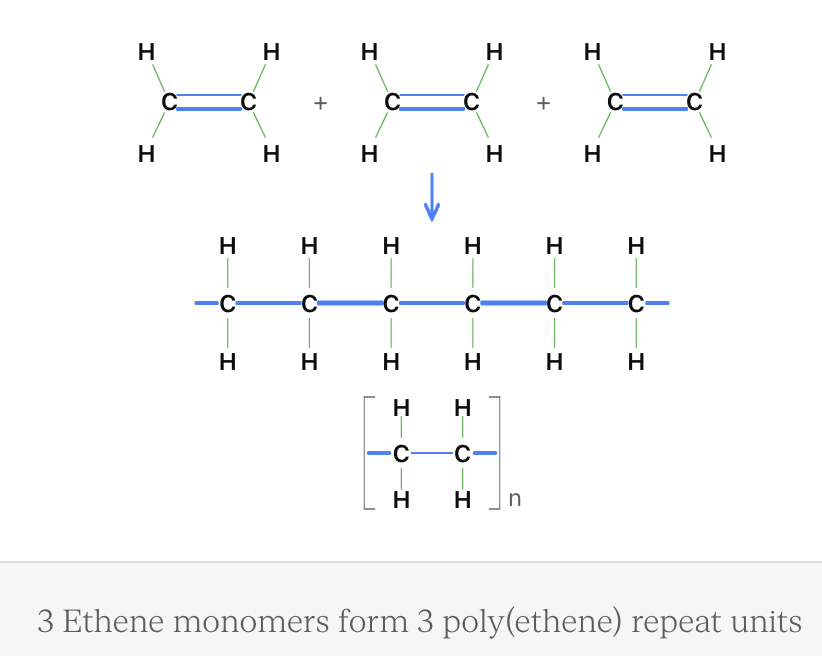
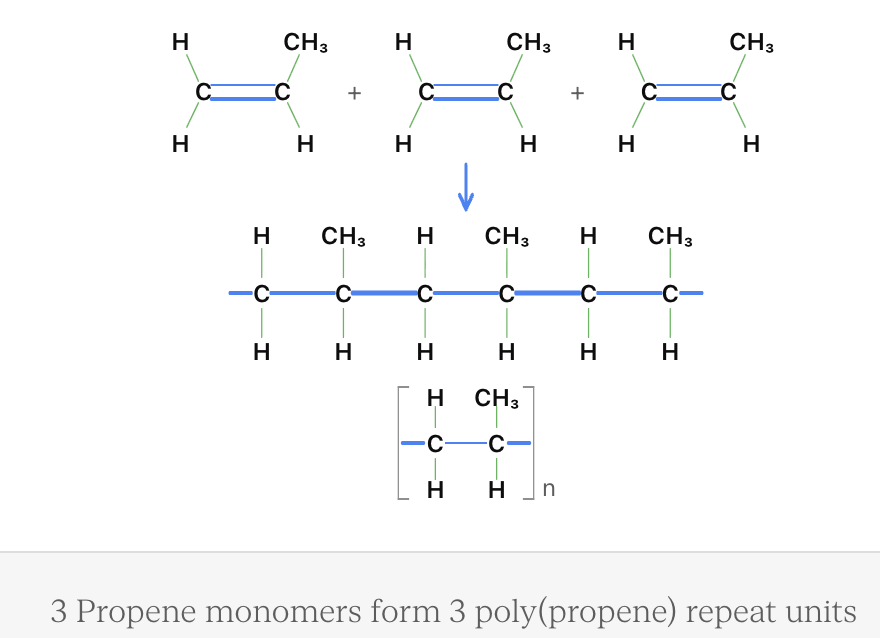
The key pattern is:

alkene monomers → long saturated carbon chain

The substituents attached to the original alkene carbons remain attached to those carbons in the polymer.


Polymerization of Ethene

Ethene is one of the simplest examples.

Monomer:

CH₂=CH₂

During polymerization, many ethene molecules join:

CH₂=CH₂ + CH₂=CH₂ + CH₂=CH₂ + ...

The resulting polymer contains the repeating pattern:

–CH₂–CH₂–CH₂–CH₂–CH₂–CH₂–

The polymer is called:

poly(ethene)

It is also commonly called:

polyethylene

https://images.openai.com/static-rsc-4/X7gkwb6Ei0UKukxT4nu66CNeHSELV0e3WWPGZbIGEG2bQsoohy4XYTbEcNEAtwZgxj9hBKmpERA3nzuNRM1wq3v76tsJa-uCahXwS7nSUUxr7qga3LTXHfRUroVqb0a327LRSsE1GT4cQRKMIlFvPka_W1C-iUdwZiAS3aAXJLsuH1aS2Aw0TEP92t3SF088?purpose=fullsize
 
https://images.openai.com/static-rsc-4/BqzQqd2RjmAtQDaQZvdFB0vPGQ_GkGtKHfg8HBbq4OjqmGPC1bPHfJfbN8kByD7gI5HJYUPupHOJrIDVQgKLgvYFf94eruSng3FNpjBnoxLjC43XPn3IHdGOwRjpLn9PVXwp243rK-j3Q4xNRqyhLvg1HYxpT3Xjw3h5niMqfPS7ny0b2pzWiA2nNhcsD_Gf?purpose=fullsize
 
https://images.openai.com/static-rsc-4/2PmnAUKwNATzCH7xvllHO1ddwG0jKzpkDMv2Diylf-95Kdl_MIyaHU7jYtUXTTdu4iQKAIzcYT0VULYg0I1Lb689oKchE6Grzc53uHOoc4vnFMgQNSCnxaYL7i9FylAwqJ71KY6DvFyy4X44j6pdi22XO_mWkpUIZEDiOkblVWjLUpXGoS9YXczmtGvCxJ4J?purpose=fullsize
 
6

Representing Poly(ethene)

Writing thousands of atoms would obviously be impractical.

Instead, chemists show the repeating unit inside brackets.

For poly(ethene), we can represent the repeating unit in plain text as:

[–CH₂–CH₂–]ₙ

The n means that the unit repeats many times.

So:

CH₂=CH₂ → [–CH₂–CH₂–]ₙ

The exact value of n can be very large.


What Happens to the Double Bond?

This is the most important structural change to understand.

Before polymerization, the monomer contains:

C=C

After polymerization, the polymer backbone contains:

C–C–C–C–C–C

The carbon atoms that were originally connected by double bonds become part of a long chain of single carbon-carbon bonds.

It is important not to imagine that the carbon atoms disappear or that the double bond simply vanishes without consequence.

The bonding changes allow the monomers to connect to neighbouring molecules.


From Monomer to Repeating Unit

Consider ethene:

CH₂=CH₂

Step 1: Identify the double bond.

C=C

Step 2: Change the double bond to a single bond.

C–C

Step 3: Show bonds extending from both sides because the unit connects to neighbouring units.

Repeating unit:

–CH₂–CH₂–

Step 4: Put the repeating unit in brackets:

[–CH₂–CH₂–]ₙ

This represents poly(ethene).


Polymerization Is an Addition Reaction

Addition polymerization is related to the addition reactions of alkenes.

In both cases, the:

C=C

double bond participates in the reaction.

However, instead of a small molecule such as H₂ or Br₂ being added, many alkene molecules become connected together.

A useful comparison is:

Hydrogenation:

alkene + H₂ → alkane

Bromination:

alkene + Br₂ → dibromoalkane

Polymerization:

many alkene molecules → polymer

All involve reactions at the C=C bond.


Polymerization of Propene

Propene has the structure:

CH₂=CH–CH₃

The CH₃ group remains attached to the carbon chain during polymerization.

Repeating unit:

[–CH₂–CH(CH₃)–]ₙ

The polymer is:

poly(propene)

also called:

polypropylene

https://images.openai.com/static-rsc-4/o6BSW95kIo8xq2WoUyEVENgMs1gCfOqwv0CdBw2iQoNeYpC1JI05KVOjo3CQ1S9D6dWsdTve8HvqoIPPpRHtinS424PG18jcftLolZKFbR3gKlfftsRDDoGbCjwE3VinLBlRLVx8ckTbtsLip4lQM-jioT8cNagH-xbucD-Bpp4KyV7tvTHK96YbGWuD6ZvK?purpose=fullsize
 
https://images.openai.com/static-rsc-4/UmZol-BZJMkhuBsXJyxugKZQfDZMQ5LL6SGHRJ4r8nRqSxbU9kfhZvWI0PXImZrtBhlD-lkd83ZVZOq8l8zYLyR3rDPgj7NRVecSeMyVizHO_UXKFkIlvmpA19fV8q1E3aXvEzVJ5zlT1KZD8rRiJGcCTQKOKutCyBTPGNinjXiabLN9ERYANXnQQH0BN_xG?purpose=fullsize
 
https://images.openai.com/static-rsc-4/MTS779dgepNHC_S4-WjhB5wRlFghdclIFKpqDYiw_kSHOMmGMEZuIU83xEYl4Iy89hx1iQU81jLiq6Bf20fSCnqeM7HFfG0pCMLo9lpy3smRDISUhgejK4fKMuveG7a3MrtC9E8IH9U18jAi4WSkYSUxvMhLfvz77vwFvQSYBgubrW9cX1GjLdmMPlLIAoxh?purpose=fullsize
 
5

Keeping Side Groups in the Polymer

One common mistake is to lose the groups attached to the original double bond.

Consider propene:

CH₂=CH–CH₃

The CH₃ group does not disappear.

It remains attached:

[–CH₂–CH(CH₃)–]ₙ

The same principle applies to other substituted alkenes.

Whatever groups are attached to the double-bonded carbons must be accounted for in the polymer repeating unit.


Polymerization of Chloroethene

Chloroethene has the structure:

CH₂=CHCl

During polymerization:

CH₂=CHCl → [–CH₂–CHCl–]ₙ

The polymer is:

poly(chloroethene)

It is commonly known as:

PVC — polyvinyl chloride

The chlorine atoms remain attached to the polymer chain.

https://images.openai.com/static-rsc-4/d__qm4dHtXCD5xJOEU8Temd2oifT2G9nZGRwfbE_0hcV9hafUGIAj7mcADVWboVOGESJ5XHTQlnzm4Jqg98x3SXqtiSDYOXg4JX32AAUmGXl5JlBR46H2Y2xqw_53I-U6dHvPVA_vW1t8qXLIDBlxCXnwfGlGyjka8U9J_ENtX7ifqIMWYbywiuEBDyKwM5l?purpose=fullsize
 
https://images.openai.com/static-rsc-4/r00ABxGGDdZE6faQssPRPYG7EZub5MAdiD8gDti_9pGDJt9CbVxF-MozG8qUQtrRN6eOCuX45hfoBj-AzQu63dBdAvVzMe1iBwKJdSdORhbjsDt0XXmQxeqtL2MjMEYOr6W4p-ZEcAWIdmtNVUbVu-8zfGWLq0vGWi-UOHVA7WM7IffK2kmlQqF0XXr1L79i?purpose=fullsize
 
https://images.openai.com/static-rsc-4/GW3QS_IVD098yGrp57x1xMZgczzRnl7WOOAbsNQyluo2IaxTZVGz3PE2pfx635ADzk_8FolDJ9JBHs0ZjBF7lW7dHVsOZ0_qXVPkvsF7JvzTdzmSI59TGD3OaR-NoOjneU7UcxbwjJjT2woYBsjuq91njysWfWRlskJk-xQEnurIL5849b5MuPfLS3uwRzm5?purpose=fullsize
 
5

Polymerization of Tetrafluoroethene

Another important alkene monomer is tetrafluoroethene:

CF₂=CF₂

During polymerization:

CF₂=CF₂ → [–CF₂–CF₂–]ₙ

The polymer is:

poly(tetrafluoroethene)

often abbreviated:

PTFE

PTFE is well known for properties such as:

  • low friction
  • chemical resistance
  • heat resistance
  • electrical insulation

Drawing a Polymer from Its Monomer

Suppose you are given:

CH₂=CHX

where X represents another atom or group.

Use this procedure.

Identify C=C

Find the two double-bonded carbon atoms.

Change C=C to C–C

The double bond becomes a single bond.

Keep All Attached Groups

Do not remove X.

Add Extension Bonds

Show that the repeating unit connects to other units.

Add Brackets and n

The result is:

[–CH₂–CHX–]ₙ

This method works for many simple alkene monomers.


Worked Example: Ethene

Monomer:

CH₂=CH₂

Remove the double-bond representation:

CH₂–CH₂

Add connections:

–CH₂–CH₂–

Add brackets:

[–CH₂–CH₂–]ₙ

Polymer:

poly(ethene)


Worked Example: Propene

Monomer:

CH₂=CH–CH₃

Change C=C to C–C:

CH₂–CH(CH₃)

Add continuation bonds:

–CH₂–CH(CH₃)–

Repeating unit:

[–CH₂–CH(CH₃)–]ₙ

Polymer:

poly(propene)


Worked Example: Chloroethene

Monomer:

CH₂=CHCl

Change:

C=C → C–C

Keep Cl attached:

–CH₂–CHCl–

Polymer:

[–CH₂–CHCl–]ₙ

Name:

poly(chloroethene)


Worked Example: Tetrafluoroethene

Monomer:

CF₂=CF₂

Change:

C=C → C–C

Keep all fluorine atoms attached.

Repeating unit:

[–CF₂–CF₂–]ₙ

Polymer:

poly(tetrafluoroethene)


Working Backwards: Polymer to Monomer

You may also be given a polymer repeating unit and asked to determine the monomer.

Suppose the repeating unit is:

[–CH₂–CHCl–]ₙ

Step 1: Identify the two carbon atoms in the repeating unit.

Step 2: Remove the continuation bonds.

Step 3: place a double bond between the two carbon atoms.

Result:

CH₂=CHCl

Therefore, the monomer is:

chloroethene


Another Polymer-to-Monomer Example

Polymer:

[–CH₂–CH(CH₃)–]ₙ

Convert the C–C between the two repeating-unit carbons into:

C=C

Monomer:

CH₂=CH–CH₃

This is:

propene


Common Synthetic Polymers

Synthetic polymers are manufactured for an enormous range of applications.

Polymer Monomer Common Uses
Poly(ethene) Ethene Bags, bottles, packaging, pipes
Poly(propene) Propene Containers, fibres, ropes, automotive parts
PVC Chloroethene Pipes, flooring, cable insulation
PTFE Tetrafluoroethene Low-friction coatings, seals, electrical insulation
Polystyrene Styrene Packaging, insulation, containers

Different monomers produce polymers with different structures and properties.

https://images.openai.com/static-rsc-4/B98YHS-VeYAd9BJqqaqtLXcn2Iaaxe5gaQVF-0FbKgsNbYhmlsIGY3Sg8Xz3b-dtf0dfyJ-b4NQHM4AYRo3j8W3lWBtzJSekyueNJt4gp9ITwtyKgTNBYgbdlLWaLjw4L7ampdxZ5CuH-Lt5gdTqxuZJAedRq2trA4PCKrlQNnOivU2Fvadg2OWOiX3k5ojc?purpose=fullsize
 
https://images.openai.com/static-rsc-4/Ky5r8QaheiZ-RQEu-ZpnDQAyJmzyI-WI_GLjhySzzIcur5vBMtK6-A7sUlBFIr4zSQtqNSBz3N3QavdZ_0KSWZrWWF75hfJ6rC0vZhgu6afwXrZ7DcssExY0VsspmOa7KDFRFfWNO-GGmA4n9-upRp3lsrk7JOHaOfRVGe-6XEKCFgXT9NhgXTFTMp4Q5w1g?purpose=fullsize
 
https://images.openai.com/static-rsc-4/Uywgjm3ja5-TZmODSjwIqjgVzJ5rHhts6FYXtdd8Zsnu5838dOGANmpxBhQOfIf4eO3r26sx9HIsmdWJvEBxUWqCORYPtJJZzUhOKqm7EKltq5JaY-rZyDPZeHdCfcGj0fOka2KOumqRF0uQ5hCxo9RrpY_eYYedOiLuNpvCPQBGvXs8fHdLegJi4MIC3lmE?purpose=fullsize
 
6

Poly(ethene) in Everyday Life

Poly(ethene) is one of the world's most widely used plastics.

Different forms can have different properties.

Applications include:

  • shopping and packaging bags
  • plastic films
  • bottles
  • toys
  • containers
  • pipes
  • electrical insulation

The properties depend partly on factors such as polymer chain length and how the chains are arranged.


Poly(propene) in Everyday Life

Poly(propene) is relatively tough and chemically resistant.

It is used for:

  • food containers
  • reusable containers
  • ropes
  • carpets
  • fibres
  • laboratory equipment
  • automotive components
  • packaging

Its CH₃ side groups help give it properties different from poly(ethene).


PVC

PVC stands for:

polyvinyl chloride

Its systematic polymer name is:

poly(chloroethene)

PVC can be manufactured with different properties depending on additives and processing.

Applications include:

  • water pipes
  • window frames
  • flooring
  • electrical cable insulation
  • medical tubing
  • construction materials

The chlorine-containing side groups contribute to its distinctive properties.


PTFE

PTFE stands for:

polytetrafluoroethylene

It is produced from tetrafluoroethene.

PTFE has useful properties including:

  • very low friction
  • strong chemical resistance
  • good thermal stability
  • good electrical insulating properties

It can be used in:

  • seals
  • bearings
  • chemical equipment
  • electrical insulation
  • low-friction coatings

Polystyrene

Polystyrene is another common synthetic addition polymer.

Its monomer contains a C=C bond and a benzene-containing side group.

Polystyrene can be produced as:

  • rigid plastic
  • expanded foam

Applications include:

  • protective packaging
  • insulation
  • laboratory containers
  • disposable packaging

This demonstrates how changing the groups attached to the original alkene can dramatically change the properties of the resulting polymer.


Why Different Polymers Have Different Properties

All addition polymers are not identical.

Their properties depend on factors such as:

  • monomer structure
  • side groups
  • polymer chain length
  • branching
  • arrangement of chains
  • forces between polymer chains
  • degree of crystallinity
  • additives

For example, replacing a hydrogen atom with chlorine changes:

poly(ethene)

into a very different material:

PVC

Small differences in monomer structure can therefore produce major differences in material properties.


Why Polymer Molecules Are So Large

During polymerization, the process repeats many times.

Instead of:

monomer + monomer → dimer

and stopping, the chain continues growing.

It may contain thousands of repeating units.

This gives polymers very high relative molecular masses compared with their monomers.

A polymer is therefore often called a:

macromolecule

meaning a very large molecule.


Polymer Chains and Material Properties

Long polymer molecules can become:

  • tangled
  • aligned
  • packed closely together
  • branched
  • connected to other chains

These structural differences influence properties such as:

  • strength
  • flexibility
  • density
  • hardness
  • melting behaviour

Therefore, even polymers made from similar monomers can behave differently depending on their molecular structure.

https://images.openai.com/static-rsc-4/ZHVkFGcBC66EzZON9ewMXqJt32hvedw9qETzHqY-Z4wWeAvJXRNkc9r9SvcFFGSV4oOVUekRPVw2ZIwOkhFGGqd4FL1IYpkS4W93UmFD5wEsSgwtRi_TC9JWsf9qPmlqWe_hp1qP8_wCJYkIUT1sJmb6Lo1EyvqlipLxsu7vaL39oc5a-EJKOgtJ2ALn1O7l?purpose=fullsize
 
https://images.openai.com/static-rsc-4/N9sFJ2tU3Vyqm_f9KUB7_FDznKlNEzcFStduFdiCOYtQ5dG1wqdad6BsqJIVfOVH2aEFQVf4L4PcDmSl8RGUYnBAxoJ_TiA3X64gUTvsXubs5TxWLCw2n2vAt5nsMZVPjlw1fTWlUz9gCDUIeEj0ov3gKz-MaTIGz8nqHXkgW3t2UW_tvpEip0ZDJv-_Kqit?purpose=fullsize
 
https://images.openai.com/static-rsc-4/6eD0Bu_RXjHxKbPQ_YC4wgbPR3vYHKyysSXSAhfBaegHEsDe6v7p58xWfYMP3AXOteyjWU-Al3LuB6kblD2dFkXu0_W2wEc-wEN6ItIH1r_MM7QqT0ZsVC-idAc0GPSNY73CL_AekPSW4xcd5MjQBIPhHtHpbcz-ULCnwjUoiQEHZxevSGFxxvTwPOEvRTYh?purpose=fullsize
 
5

Thermoplastics

Many common addition polymers are thermoplastics.

Thermoplastics soften when heated and harden again when cooled.

Examples include many forms of:

  • poly(ethene)
  • poly(propene)
  • PVC
  • polystyrene

This property allows many thermoplastics to be shaped during manufacturing.

Some can also be mechanically recycled by melting and reshaping, although contamination and changes in material quality can make recycling more complicated.


Why Plastics Are So Useful

Synthetic polymers have become widespread because they can be designed to have useful properties.

Depending on the polymer, plastics can be:

  • lightweight
  • strong
  • flexible
  • rigid
  • waterproof
  • chemically resistant
  • electrically insulating
  • inexpensive to manufacture
  • easily shaped

This makes polymers valuable in:

  • medicine
  • transportation
  • construction
  • electronics
  • packaging
  • clothing
  • sports equipment
  • food storage

Environmental Challenges

Many properties that make synthetic polymers useful can also create environmental problems.

For example, many plastics are:

  • durable
  • chemically resistant
  • slow to decompose

If discarded improperly, they can remain in the environment for long periods.

Problems can include:

  • litter
  • harm to wildlife
  • accumulation in oceans
  • microplastic formation
  • consumption of fossil resources
  • greenhouse gas emissions during production and disposal

Recycling Polymers

Recycling can reduce the need for new raw materials and reduce waste.

However, polymer recycling can be challenging because:

  • different plastics have different properties
  • plastics may be mixed together
  • products may contain additives
  • food or chemicals may contaminate materials
  • repeated processing can reduce material quality

This is why many plastic products are sorted according to polymer type.


Addition Polymerization and Atom Economy

Addition polymerization can have high atom economy.

In simple addition polymerization, the atoms in the monomers become part of the polymer.

For example:

ethene → poly(ethene)

No small molecule such as water is produced as a by-product.

This distinguishes addition polymerization from condensation polymerization, where small molecules may be eliminated when monomers join.


Natural and Synthetic Polymers

Not all polymers are plastics.

Nature contains many important polymers.

Examples include:

  • proteins
  • DNA
  • starch
  • cellulose

These are natural polymers.

Synthetic polymers include:

  • poly(ethene)
  • poly(propene)
  • PVC
  • PTFE
  • polystyrene

Therefore:

polymer does not automatically mean plastic.

A polymer is defined by its molecular structure: a large molecule constructed from repeating units.


Monomer, Repeating Unit and Polymer

These three ideas should be distinguished carefully.

Monomer

The small starting molecule.

Example:

CH₂=CH₂

Repeating Unit

The structural pattern repeated throughout the polymer.

Example:

–CH₂–CH₂–

Polymer

The complete macromolecule containing many repeating units.

Represented as:

[–CH₂–CH₂–]ₙ

These terms are related but do not mean exactly the same thing.


Common Mistakes

Saying a Polymer Is Just "Lots of Molecules"

A polymer is a large molecule containing many repeating units connected by covalent bonds.

Confusing Monomer and Polymer

monomer → small starting molecule

polymer → large product molecule

Leaving the C=C Bond in the Polymer

During addition polymerization:

C=C → C–C

The repeating unit should not normally contain the original alkene double bond.

Removing Side Groups

Groups such as CH₃, Cl or F remain attached.

Forgetting the Extension Bonds

The repeating unit must connect to neighbouring units on both sides.

Forgetting the Brackets

Polymer structures are normally represented with the repeating unit inside brackets.

Forgetting n

The n indicates that the unit repeats many times.

Drawing Thousands of Units

Only the repeating unit needs to be shown.

Thinking n Is a Specific Number

Unless given, n simply means a large number of repeating units.

Confusing Polymerization with Hydrogenation

Hydrogenation adds H₂ to an alkene.

Polymerization joins many monomers together.

Thinking All Polymers Are Plastics

Proteins, DNA, cellulose and starch are also polymers.

Thinking All Plastics Have the Same Properties

Different monomers and polymer structures produce different material properties.


Key Terms

Monomer — A relatively small molecule capable of joining with other monomers to form a polymer.

Polymer — A very large molecule formed from many repeating units.

Macromolecule — A molecule with a very large molecular structure.

Polymerization — The chemical process through which monomers join to form polymers.

Addition polymerization — Polymerization in which unsaturated monomers join without eliminating a small molecule.

Alkene — An unsaturated hydrocarbon containing a C=C bond.

Unsaturated — Containing a carbon-carbon multiple bond.

Carbon-carbon double bond — The C=C bond that provides the reactive site in an alkene.

Repeating unit — The structural pattern that occurs repeatedly along a polymer chain.

Polymer chain — The long covalently bonded molecular backbone of a polymer.

Side group — An atom or group attached to the main polymer backbone.

Poly(ethene) — An addition polymer made from ethene monomers.

Poly(ethene)/polyethylene — Two names commonly used for the polymer formed from ethene.

Poly(propene) — An addition polymer formed from propene.

PVC — Poly(chloroethene), a chlorine-containing synthetic polymer.

PTFE — Poly(tetrafluoroethene), a fluorine-containing synthetic polymer.

Polystyrene — A synthetic addition polymer made from styrene monomers.

Synthetic polymer — A polymer manufactured through chemical processes.

Natural polymer — A polymer produced by living organisms or occurring naturally.

Thermoplastic — A polymer material that can soften when heated and harden when cooled.

Atom economy — A measure of how much of the reactant material becomes part of the desired product.

Plastic — A material, commonly polymer-based, that can be shaped or moulded.

Crystallinity — The degree to which polymer chains are arranged in ordered regions.

Branching — The presence of side chains connected to the main polymer chain.


Key Takeaways

  • A monomer is a small molecule capable of joining with other monomers.
  • A polymer is a very large molecule made from repeating units.
  • Polymers are also called macromolecules.
  • Addition polymerization commonly involves alkene monomers.
  • Alkenes are suitable monomers because they contain C=C.
  • During addition polymerization, the carbon-carbon double bonds participate in forming new bonds between monomers.
  • The polymer backbone contains carbon-carbon single bonds.
  • The atoms of the monomers are retained in the polymer.
  • No small molecule is eliminated in simple addition polymerization.
  • Ethene forms poly(ethene).
  • Propene forms poly(propene).
  • Chloroethene forms PVC.
  • Tetrafluoroethene forms PTFE.
  • Styrene forms polystyrene.
  • The repeating unit is not the same thing as the original monomer.
  • To draw a polymer from an alkene, locate C=C and convert it into part of a continuous C–C chain.
  • Groups attached to the double-bonded carbons must remain attached.
  • Polymer repeating units are shown in brackets.
  • The symbol n shows that the unit repeats many times.
  • A polymer structure can also be used to determine its original monomer.
  • Different monomers produce polymers with different properties.
  • Polymer properties also depend on chain length, branching, packing and intermolecular forces.
  • Synthetic polymers have applications in packaging, construction, medicine, electronics, clothing and transportation.
  • Their durability also creates environmental challenges.
  • Recycling can reduce polymer waste but is complicated by mixtures, contamination and different polymer types.
  • Not all polymers are synthetic.
  • DNA, proteins, cellulose and starch are examples of natural polymers.
  • Not all polymers should simply be described as "plastics."
  • Addition polymerization often has high atom economy because the monomer atoms become incorporated into the polymer.

The central structural idea is:

C=C in the monomer → C–C connections in the polymer chain

And the basic relationship is:

many monomers → one polymer


Check Your Understanding

1. Define a monomer.

2. Define a polymer.

3. What is a macromolecule?

4. What is addition polymerization?

5. Why are alkenes suitable monomers for addition polymerization?

6. What happens to the C=C bonds during polymerization?

7. What new bonds form between neighbouring monomer units?

8. What is a repeating unit?

9. What does the n in a polymer formula represent?

10. What polymer forms from ethene?

11. Write the ethene monomer.

12. Write the repeating unit of poly(ethene).

13. What polymer forms from propene?

14. Write the repeating unit of poly(propene).

15. What happens to the CH₃ group of propene during polymerization?

16. What polymer forms from chloroethene?

17. What does PVC stand for?

18. Write the repeating unit of PVC.

19. What polymer forms from tetrafluoroethene?

20. Give two useful properties of PTFE.

21. Describe the steps for drawing a polymer repeating unit from an alkene monomer.

22. Why must extension bonds be shown on a repeating unit?

23. Why are brackets used around the repeating unit?

24. Explain how you could work backwards from a repeating unit to identify an alkene monomer.

25. Give four examples of synthetic polymers.

26. Give three examples of natural polymers.

27. Why can two different polymers have very different properties?

28. Give three advantages of synthetic polymer materials.

29. Give three environmental problems associated with widespread plastic use.

30. Challenge: Consider the monomer:

CH₂=CHCl

a. Is this molecule saturated or unsaturated?
b. Identify the bond that allows polymerization.
c. Explain what happens to this bond during addition polymerization.
d. Write the polymer repeating unit.
e. Name the polymer.
f. Give its common abbreviation.
g. Does the chlorine atom disappear during polymerization? Explain.
h. Explain why the repeating unit requires extension bonds on both sides.
i. Explain the meaning of n in the polymer structure.
j. Describe how you could determine CH₂=CHCl from the polymer repeating unit.
k. Explain why this reaction is called addition polymerization.
l. Compare the monomer with the polymer in terms of molecular size.
m. Give two common applications of the resulting polymer.
n. Explain why the polymer can have properties very different from its monomer.
o. Explain one environmental challenge associated with widespread use of synthetic polymers.

5. Uses and Environmental Issues of Plastics

Learning outcomes
  • I can identify common uses of plastics in everyday life.
  • I can explain why plastics are useful materials.
  • I can describe environmental problems associated with plastic waste.
  • I can compare biodegradable and non-biodegradable materials.
  • I can evaluate strategies for reducing the environmental impact of plastics.

Uses and Environmental Issues of Plastics

Plastics are among the most widely used materials in modern society. They are found in packaging, clothing, electronics, transportation, medicine, construction, sports equipment, household products, and thousands of other applications.

Most plastics are made primarily from synthetic polymers. Their usefulness comes from the fact that chemists and engineers can produce polymers with a wide range of properties.

Depending on their structure, plastics can be:

  • strong
  • lightweight
  • flexible or rigid
  • waterproof
  • transparent or opaque
  • chemically resistant
  • electrically insulating
  • easily moulded
  • relatively inexpensive

However, many of the properties that make plastics useful also create environmental problems. In particular, their durability and resistance to decomposition mean that plastic waste can remain in the environment for long periods.

https://images.openai.com/static-rsc-4/v4NyyVYHl1sBRnuSU6wQFF9wC5iQt74Q2adY7GweF20TSg91NxK_zQxwNMcsr0FreMC3JG6bQx-g6q6bENiXFRNBgj5p6ZfLPtsm7IWIJGJdjzKZ32Nztj2Cr3E6FZz16gCc2ybzeib4ptngFAlTs0kODVh7dB8bD9B_A0MVH3orYYPf4sOta3QxFRqWs_3e?purpose=fullsize
 
https://images.openai.com/static-rsc-4/jDykPnd41lgGJsnEXyCT0yVCm8K7zxZVmYodBSV5lufL9g1y4fbnzRa5ZlkFgJk66t46S8jsmH4MNbYCKHRzs-7VV3cymXErsVZXeUzeIKi-ypAvx0VGlG8JDtcp2avqAwyMK5GtA8rvvQuqkg9EqlLG98wEtNVLiNRUmQrVpDbCwiyThKV4b_EbXLFSBem_?purpose=fullsize
 
https://images.openai.com/static-rsc-4/72aXRML3AWTZ-mG5LJxstUV3cZRstgyfCLPyD2nLFjF0F94P060Cxql6XCgqd6g6-p1sDeq1tv8B8-qX51qrKjZgKNAKxNk-v3EYGpb3d71WQFuMy-StrnHj_vI6o4s2GD51m4GggHmBLE3f8Fg4ofa7qTYSLAz9HlnyLIagfjXU_r9sj7B_3ZbHcZ4cSWx3?purpose=fullsize
 
6

What Are Plastics?

A plastic is a material that usually contains one or more polymers as its main component.

A polymer is a very large molecule consisting of repeating structural units.

Common plastics include:

  • poly(ethene), or polyethylene
  • poly(propene), or polypropylene
  • PVC
  • polystyrene
  • PET
  • nylon
  • acrylic
  • polycarbonate

Different polymers have different molecular structures, which gives them different physical and chemical properties.

Manufacturers can also add substances such as:

  • pigments
  • plasticizers
  • stabilizers
  • flame retardants
  • fillers

to modify the properties of a plastic.


Why Are Plastics So Useful?

There is no single property that explains the success of plastics.

Instead, plastics combine several useful properties.

Many plastics have a high strength-to-mass ratio. This means they can provide useful strength without being very heavy.

Many are also:

  • resistant to water
  • resistant to corrosion
  • good electrical insulators
  • poor thermal conductors
  • easy to manufacture into complicated shapes
  • inexpensive to produce in large quantities

Different polymers can also be designed for very different purposes.

A flexible shopping bag and a rigid construction pipe may both be made from polymer-based materials, but their structures and properties are very different.


Plastics in Packaging

Packaging is one of the most familiar uses of plastic.

Examples include:

  • bottles
  • food containers
  • plastic films
  • bags
  • protective packaging
  • bottle caps
  • wrappers

Plastic packaging can be useful because it is:

  • lightweight
  • waterproof
  • easily shaped
  • inexpensive
  • resistant to breaking
  • capable of protecting food from contamination

Packaging can also reduce food spoilage, which itself has environmental and economic costs.

https://images.openai.com/static-rsc-4/dsrPrDX5ybhgvOWBff2Z_Pai7hPuw4YfKZKEmb7aPmDhIRuvZMWLpGppynIOwNo8qziALIcN6voXIt5j1UmQfno1M6UQgz5GX97dN7FyCvz7dBnmIazDgb1jqw2od_y4Tb8mjxLhtHaJDI7NQX_njYLjCoDiQ4KaFLvWpacq7AdHuJ2q9I8GF7gjaGjJG_2k?purpose=fullsize
 
https://images.openai.com/static-rsc-4/ASqyZolQtWUJt8eicN8eOimb0RMJSszMzVXrxQ8aBdbVp6mWU0qN3O3GZehYSXen7jvvFezdQmb7QYNAfkupwWU-uxrw15tCv-CpHwyw7f-DoE7p4KvTlU10w-0Zl-WsV-UtbYtq3GLcUHSa_cJY_dEZBk1u9TY6sz5tKchZ3ATqBz0-ansxzerUGmBGdo3b?purpose=fullsize
 
https://images.openai.com/static-rsc-4/feLLKWWM5Oa3kQMgqFc0BcBf9F8ffGZs_bP8YPKGbAUNOIgt2eKdWB0-ZGwuDogfvgOgA_MbSix-c2CaRBUuNIfe2eeewTyBG4wCgGm7Kwv5oa1bvQIaXP56PH2iyk2pLMRc8-2ekFOmCgEp7AHUn6qyb-rgMg8FnhoJy_pGl56A5GGlwcDANmmbW47cHdeS?purpose=fullsize
 
6

Plastics in Medicine

Plastics are extremely important in modern healthcare.

Examples include:

  • syringes
  • IV bags and tubing
  • gloves
  • medicine containers
  • laboratory equipment
  • protective equipment
  • artificial joints
  • medical implants
  • sterile packaging

For many medical applications, plastics are useful because they can be:

  • lightweight
  • transparent
  • flexible
  • chemically resistant
  • manufactured in sterile forms
  • inexpensive enough for certain single-use applications

In these situations, simply saying "all single-use plastic is bad" would ignore important health and safety considerations.

The challenge is to reduce unnecessary waste while maintaining safe medical care.


Plastics in Transportation

Cars, trains and aircraft contain many polymer materials.

Plastics can be used in:

  • dashboards
  • seats
  • insulation
  • electrical systems
  • bumpers
  • interior panels
  • fuel-system components
  • composite materials

Replacing heavier materials with lighter polymers can reduce vehicle mass.

Lower mass can reduce the energy needed to move the vehicle.

Therefore, evaluating the environmental impact of plastic requires considering the whole life cycle, not only what happens when the product is discarded.

https://images.openai.com/static-rsc-4/eYa411BEtGzyHESkwqfUTGAvJjAdop5tNUpH7d376E3BKFoCRbWUopHeXpotWBXNPDf_WKbg8DKycGQhasEcvM5lVZNEZD5I9w-wwjyJQju9nu2I61mkh1-vXApmSCpaQxwJyoX6ce6Q-Zf6JdoAMkWzesYmhshTprYmcFcxwKhca7y8aCg6lwm8pdM-CdFO?purpose=fullsize
 
https://images.openai.com/static-rsc-4/1eGXY4MbqRDEza1CTLtpCBe-nLuvVAQjQ2GXT-S5QVSXLUu276vYOAmfhknfKyz-fcJcnSwiV7pTmJvLwsVeyrGMtAFGpwKgGlbwj7-dNQK4tAqUcy4urs3gZr1ZvuHkbZO5mHU7XUHnk82mFzcg-DpixXIKo0Wu9LMR8_NPO56rkUStSaf7vjuQl4jq2fU5?purpose=fullsize
 
https://images.openai.com/static-rsc-4/2RRlBdPvcpZH_gMXJ0RLKqn2RRpSm0WnlNddELvHMOSlfU8OLyj9aPfcWHRoIIa9VNDBxlxurf2qmi8Zh7CglRMUMNdVo5ycZWNeAIuYU6gUq23IncCVNORdwZnr3gj-Y8jL32aYYySYyJoutyRSPbQaTh3-iamyFEOejDvs0kanNqdohImhRvuBd2FcZW34?purpose=fullsize
 
6

Plastics in Construction

Plastics are used in buildings for:

  • water pipes
  • insulation
  • flooring
  • window frames
  • electrical insulation
  • roofing materials
  • sealants
  • protective coatings

PVC, for example, is widely used for pipes.

Polymers can resist corrosion that might damage some metals.

Some polymer insulation materials can also reduce heat transfer through buildings, lowering energy use for heating or cooling.


Plastics in Electronics

Plastics are important in electrical and electronic devices because many are excellent electrical insulators.

They are used in:

  • cable coverings
  • plugs
  • switches
  • computer cases
  • phone components
  • circuit-board materials
  • appliance housings

Using an insulating material around an electrical conductor helps prevent unwanted current flow and protects users.


Plastics in Clothing

Many fabrics contain synthetic polymers.

Examples include:

  • polyester
  • nylon
  • acrylic
  • elastane

Synthetic fibres can be:

  • strong
  • lightweight
  • elastic
  • quick-drying
  • resistant to wrinkling

However, washing synthetic clothing can release tiny fibres into wastewater.

These fibres can contribute to microplastic pollution.

https://images.openai.com/static-rsc-4/3S_CibEpp__F6ENP-3ywe5YMhCOnPYr4RdkDnWdGjqKu_sJqI5jAVKOFTfd1A3WV4_i2VYGQQtUn7SPdkJLkL6OI1Ue0Gsn_Wpe9_HDq-lnIVGlc53nQ2JFoiZ2USWvY8feNsfUL3lL791Bdde0fmkSt0ESUWYjJF9R1aV4zsMezITLP-WBS6dishiXoRL6n?purpose=fullsize
 
https://images.openai.com/static-rsc-4/Tb0qid3Bj5vImS_k2UUqMA5p2JsYxnVSylKhUzgzewX4uCImGwSQ9X-uGxTIrBScw7j4synTbZlTldBh7dbEFAgHKcNZe1ns5te--3uXEcZuKLUqpYFXBRvQFSmygly2tg-WzQb2rBfwEg_rxlLrSfPI3VMXLdSZuh1Mp9yL5k4liECdMv6DzHp_yEo828tX?purpose=fullsize
 
https://images.openai.com/static-rsc-4/aY6XnQgWGnz0AGvM5Ndiv3LhBTNQiuLqsP5MylU997fImo__qWz0eQf3JsPrVpfwiDzBwby37XbpUYtCpLhAbiPSZNqNSzJ8ijeNAxNrot4KKUTB6PHsiXZJDettRZMAW_BWQbjDEyQzPunxfpt4f84v9y_n4YnUFlcNxrXUVOBDGBkkCWv-ZVOwjs6gfZsZ?purpose=fullsize
 
5

The Main Environmental Problem: Persistence

Many conventional plastics are non-biodegradable, or biodegrade extremely slowly under ordinary environmental conditions.

This means microorganisms cannot rapidly break them down into simpler substances.

As a result, discarded plastics can persist for long periods.

Plastic waste can accumulate in:

  • landfills
  • rivers
  • beaches
  • oceans
  • soils
  • urban environments

This persistence is closely related to the same chemical stability that makes plastics useful.


Durable: An Advantage and a Disadvantage

Consider a plastic water pipe.

We want it to:

  • resist water
  • resist corrosion
  • remain strong
  • last for decades

Durability is extremely useful.

Now consider a plastic wrapper used for several minutes and then discarded.

If that wrapper remains in the environment for a very long time, the same durability becomes a disadvantage.

Therefore, whether durability is beneficial depends partly on the application and lifetime of the product.

A long-lasting material makes more sense for a long-lasting product than for many short-lived applications.


Plastic Pollution in Oceans

Plastic waste can enter waterways through:

  • littering
  • poorly managed waste
  • storm drains
  • rivers
  • fishing activities
  • shipping
  • loss of industrial materials

Once plastic enters the ocean, currents can transport it over enormous distances.

Larger objects may gradually fragment into smaller pieces rather than disappearing completely.

https://images.openai.com/static-rsc-4/XI0DGhLsWyYEmOEMAHqIrITI0Qz3ChtzoX48ABWv6KykkGq3KnK0iKobd1knelHFc2mdlwvnvDgKMsnjE_0bLz_iTmaDjM34pGBvFdsFURapMPg992bb6DL_-X8UtKwfSzS5EWQXcIjsnv8hMzSHeAAumFzMeuZYgQi7bX3Quy2f4eOtsjYUvgizNnwAow2G?purpose=fullsize
 
https://images.openai.com/static-rsc-4/ucybZnAmJdyHYcDHsYTJKgGPYM7XnaCnlIW8sBrHICcDjm_bOuMOVoCfyFXWYIQwJeayn6LRTFVSVuuMEeVtVLt1RvGQ_PmwSEFkVStn04BfLISAhjz2K6gQuZDO8EUfBZ_7jxvnJKwyTLBrSZmiLoQZJW40Gw7TLFy5Mxa_j68l2boAGSoW5DEg8WRHoMug?purpose=fullsize
 
https://images.openai.com/static-rsc-4/aQsbm7A75otCEqWglzF-4idgODZalgdT7edlL-FYxh8Oh-JCLy2t4f1b2ydNAvYIQD4_4vVzaY53TzS2GKTUyDbHOGuFhpvZSUd2nZa97Ffxu_Ik6hEbk-i7jKILP-DhFUaHPElNH1O3uf8LN755nrf14-ZyqarZRaorcdC9LVvQDRypnFa4mQQyLzHYB9xX?purpose=fullsize
 
5

Effects on Wildlife

Plastic waste can harm animals through ingestion and entanglement.

Animals may mistake plastic for food.

Possible consequences include:

  • blocked digestive systems
  • reduced feeding
  • internal injuries
  • exposure to associated chemicals
  • reduced survival

Animals can also become trapped in:

  • fishing line
  • nets
  • plastic rings
  • packaging materials

Marine animals, birds and terrestrial wildlife can all be affected.


What Are Microplastics?

Microplastics are very small plastic particles, commonly defined as particles smaller than 5 mm.

Some are manufactured at small sizes.

Others form when larger plastic objects break apart.

Sources can include:

  • degraded packaging
  • synthetic textile fibres
  • tyre wear
  • industrial plastic pellets
  • paints and coatings
  • larger plastic litter

Microplastics have been detected in oceans, rivers, soils and other environments.

https://images.openai.com/static-rsc-4/HGF4XmbKJYDaLuOyKq0sUqxI41LH8yjDuqrsgZ-BoMD957BUuW_bUULf6vhbPKuCFFcuy-2hCCIiAkwXEWiH2shYVnUbcCrxESVLsVha5xWqx4COqr4R5UpeMt3EWldH7BlLeeRX7PDyiK-RTqcVhKH-Kshs0Q-pW4zjgT1FNS6AgIDrSn6fiwic8GTAfAor?purpose=fullsize
 
https://images.openai.com/static-rsc-4/8thUPOzMFwzRhZ3ndgLpGySoczaMbq608HihSvLf7xvQNKFrqXzDTFjWMOmAzZANNveUDq8Rk_dCqcGHTcYp6-Pzsho1rBLggibLD3JDUIwwTQs18LvNe9N1hc6HJfwKWAbFLMg_JqgVgKL5xXCvkwoIIG9KpShrvqZjrHo8oKF7GDiQz25hsz507U5UjhLw?purpose=fullsize
 
https://images.openai.com/static-rsc-4/xDCoHrMWUG1-9hhX4WFr0T0qeqQ6pxfdZafXV6U-aZ72CTD5oSfnVcKaW2memYaMgwLiZPKet5s5hgdnFeiHEBsSavZ5F2PdccxQ6VU8hlE6g7ZlHk3GqzD_T3qmgcwC9bYOfNv0k1R55FrAJ10pkpGHUWca3cbzFlgc6qe-5hI4CJ0QMP-cWb0zUsD-Yl7r?purpose=fullsize
 
5

Primary and Secondary Microplastics

Microplastics can be classified by how they enter the environment.

Primary Microplastics

These are released at very small sizes.

Examples can include:

  • industrial pellets
  • some intentionally manufactured particles
  • fibres shed from textiles

Secondary Microplastics

These form when larger plastic objects fragment.

For example:

plastic bottle → fragments → increasingly smaller plastic particles

Sunlight, abrasion, waves and temperature changes can contribute to fragmentation.


Plastics Do Not Necessarily "Disappear"

When a plastic object breaks into smaller pieces, its mass has not simply vanished.

For example:

one large plastic object → many smaller fragments

Further fragmentation can produce microplastics.

Therefore, an object becoming difficult to see does not necessarily mean it has chemically decomposed.

This distinction is important:

fragmentation ≠ biodegradation


Biodegradable Materials

A biodegradable material can be broken down by biological processes involving organisms such as microorganisms.

Under appropriate conditions, biodegradable materials can eventually be converted into simpler substances.

Examples of naturally biodegradable materials include:

  • food waste
  • paper
  • untreated wood
  • many plant materials

Some plastics are also designed to be biodegradable.

However, "biodegradable" does not necessarily mean that a material disappears quickly under all environmental conditions.


Biodegradable Plastics

Some polymers are designed to break down biologically under particular conditions.

Potential advantages include:

  • reduced persistence in suitable waste systems
  • usefulness for certain short-life products
  • possible compatibility with industrial composting

However, there are limitations.

Some biodegradable plastics require specific conditions involving:

  • temperature
  • moisture
  • oxygen
  • microorganisms

A material designed for industrial composting may not rapidly biodegrade:

  • in the ocean
  • on a roadside
  • in ordinary soil
  • in a landfill

Therefore, disposal conditions matter.


Biodegradable vs Compostable

These terms should not automatically be treated as identical.

Biodegradable means biological processes can break the material down under appropriate conditions.

Compostable generally means a material can break down under specified composting conditions while meeting particular requirements.

Some materials require industrial composting facilities.

Therefore, a label such as "compostable" should be interpreted according to the conditions for which the material was designed.


Non-Biodegradable Materials

A non-biodegradable material is not readily broken down by biological processes.

Many conventional plastics fall into this category.

Examples include many forms of:

  • poly(ethene)
  • poly(propene)
  • PVC
  • polystyrene

Their resistance to biological decomposition contributes to their long useful lifetimes.

But improper disposal can lead to long-term environmental accumulation.


Comparing Biodegradable and Non-Biodegradable Materials

Property Biodegradable Non-Biodegradable
Broken down biologically Yes, under suitable conditions Very slowly or not readily
Environmental persistence Usually lower under correct conditions Often high
Waste-management requirements May require composting conditions Recycling, reuse, recovery or disposal
Examples Food waste, paper, some bioplastics Many conventional plastics
Main advantage Potentially reduced long-term persistence High durability
Main limitation May require specific conditions Can accumulate as persistent waste

Neither category is automatically environmentally perfect.

The environmental impact depends on the whole life cycle.


What Is a Life Cycle?

A product's life cycle includes stages such as:

raw materials → manufacturing → transportation → use → reuse → disposal or recycling

Environmental impacts can occur at every stage.

For plastics, these may include:

  • resource extraction
  • energy use
  • greenhouse gas emissions
  • manufacturing waste
  • transportation
  • product lifetime
  • litter
  • recycling
  • disposal

A proper environmental comparison should consider more than simply whether a material is plastic.


Fossil Fuels and Plastic Production

Many conventional plastics are manufactured using chemicals originally obtained from:

  • crude oil
  • natural gas

For example, hydrocarbons can undergo cracking to produce alkenes such as ethene and propene.

These can then undergo polymerization.

Simplified pathway:

fossil feedstock → hydrocarbons → alkenes → polymers → plastic products

Using fossil resources contributes to concerns about resource use and greenhouse gas emissions.


The Waste Hierarchy

A useful approach to plastic waste is to prioritize actions.

A simplified hierarchy is:

Refuse → Reduce → Reuse → Repair → Recycle → Recover → Dispose

The exact hierarchy can vary, but the central idea is that preventing unnecessary waste is usually preferable to dealing with waste after it has been produced.


Reduce

Reducing means using less material in the first place.

Examples include:

  • avoiding unnecessary packaging
  • designing thinner packaging where safe
  • using refill systems
  • choosing durable products
  • avoiding unnecessary disposable items

Reduction can lower:

  • raw material use
  • manufacturing demand
  • transportation mass
  • waste production

It addresses the problem before waste exists.


Reuse

Reuse means using a product repeatedly rather than discarding it after one use.

Examples include:

  • reusable bottles
  • reusable food containers
  • refillable packaging
  • durable shopping bags
  • reusable transport crates

However, reusable products also require resources to manufacture and clean.

Their environmental benefit generally improves when they are actually reused enough times.


Recycling

Recycling converts waste materials into materials that can be used again.

A simplified process might involve:

collection → sorting → cleaning → processing → new products

Potential benefits include:

  • reduced demand for virgin raw materials
  • reduced waste sent to disposal
  • recovery of useful material
  • potentially lower environmental impacts for some products
https://images.openai.com/static-rsc-4/dWndstSR7HVBb7_PbN6kDP3hW0lzmV6aIAGyNWjEoqCBFvYYmNCq6kfmXj8bXbaJOvFMJWL_EDB3r9IEU1Moa1OfNTA0JhxtR81F99tb01cxtmcvIBpnO4rSG25fkVJxPRak5WbNSdN0lHsJrZ3stCA5e39fwHc46KEbo96qialJKYspWtVsTXX51DdslwJ8?purpose=fullsize
 
https://images.openai.com/static-rsc-4/7ZftGoKZnw0AjieapKbVd3sERI6Xpo3TDsazj1lBtw0PFW-WbLwpbMeI9VScd2QymAZ9HpDz_3BqB6Rs8PDDK_LavnZu5pK1fDANvgVzSYdcMlZpilWETxa8cF3B6wQw7tn0a5Z-acw7LJucgdi27K2pbJ9IDsq-BA8jrsIAdPnS29cm8Lkh8y6Q11FgttSK?purpose=fullsize
 
https://images.openai.com/static-rsc-4/6zRZgaOlO8p6xJW0d7SHYauEx1-eeQt7tpyZj52HBIym7Ci_GUdHyImxxROo0QeP9QTf5ZkDIRB4Ggd26vPOgl_yU7mVrFEWxA4zpQqjSYqSB6b9h9fxoQpMBNh-1WjVeGYKWVZRWs4NI2gXYhxW5LTKeXcvwiFL4xX5SnvxyfCkBbyXoNoofxKTAVWqoPIK?purpose=fullsize
 
5

Why Isn't All Plastic Recycled?

Plastic recycling is more difficult than simply collecting everything and melting it together.

Problems include:

Different Polymer Types

Different plastics have different:

  • melting temperatures
  • chemical properties
  • processing requirements

Contamination

Food, dirt and other materials can interfere with recycling.

Mixed Materials

A package may contain:

  • several polymers
  • metal
  • paper
  • adhesives
  • dyes

Separating these can be difficult.

Additives

Different products may contain different additives.

Material Degradation

Some polymers lose quality after repeated processing.

Economics

Collecting and processing some waste may cost more than the recovered material is worth.


Recycling Symbols

Plastic products may contain identification codes that help indicate the type of polymer used.

These can help with:

  • sorting
  • collection
  • recycling systems

However, an identification symbol does not automatically mean that an item will be recycled locally.

Whether recycling occurs depends on:

  • local collection systems
  • sorting technology
  • contamination
  • market demand
  • available processing facilities

Mechanical Recycling

Mechanical recycling usually involves physically processing plastic.

Typical stages include:

  • sorting
  • washing
  • shredding
  • melting
  • reforming

The polymer molecules are generally retained rather than deliberately broken down into their original monomers.

Mechanical recycling works well for some relatively clean and well-separated plastic waste streams.


Chemical Recycling

Some technologies use chemical processes to break plastic materials into smaller molecules.

These products may then be used to manufacture new chemicals or materials.

Potential advantages include processing some wastes that are difficult to recycle mechanically.

However, chemical recycling can require substantial:

  • energy
  • equipment
  • chemical processing

Its environmental value therefore depends on the specific process.


Energy Recovery

Plastic waste contains chemical energy.

Some waste systems burn plastics to generate heat or electricity.

Potential advantage:

  • energy can be recovered
  • waste volume is reduced

Potential disadvantages:

  • carbon dioxide is released
  • air pollution must be carefully controlled
  • valuable material is destroyed rather than reused

Energy recovery is therefore generally considered less desirable than preventing, reusing or successfully recycling suitable material.


Landfill

Plastic waste may also be placed in landfill.

Advantages can include:

  • controlled containment
  • relatively simple waste management

However:

  • materials are not recovered
  • landfill space is required
  • plastics may persist for very long periods
  • poorly managed sites can create environmental problems

Landfill does not solve the underlying issue of continued material consumption.


Litter Prevention

One of the most direct ways to reduce environmental plastic pollution is to prevent waste from escaping into the environment.

Strategies include:

  • reliable waste collection
  • covered bins
  • street cleaning
  • improved landfill management
  • river litter barriers
  • public education
  • enforcement against illegal dumping
  • better management of fishing equipment

Once plastics are widely dispersed through oceans or soils, collection becomes much more difficult.


Product Design

Engineers can reduce environmental impact by designing products differently.

Strategies include:

  • using fewer different materials
  • reducing unnecessary packaging
  • making products easier to disassemble
  • avoiding difficult-to-separate layers
  • using recycled material
  • designing for reuse
  • designing for repair
  • clearly identifying materials

This approach is sometimes called design for circularity.


The Circular Economy

A traditional linear model can be represented as:

extract → manufacture → use → discard

A more circular model attempts to keep materials in use:

design → manufacture → use → reuse/repair → recycle → manufacture again

The goal is to reduce:

  • extraction of new resources
  • waste
  • pollution

Perfect circularity is difficult because materials and energy can be lost during processing, but the approach can substantially improve resource efficiency.


Are Paper Bags Always Better Than Plastic Bags?

Not necessarily.

A fair comparison should consider:

  • amount of material required
  • manufacturing energy
  • transportation
  • durability
  • number of uses
  • recycling
  • disposal
  • litter risk

A heavier reusable product may require more resources initially but become advantageous if used many times.

Therefore, environmental decisions should be based on evidence and life-cycle thinking, not simply whether a product is labelled "plastic" or "natural."


Are Bioplastics Always Better?

Again, not necessarily.

The word bioplastic can refer to materials that are:

  • made partly from biological resources
  • biodegradable
  • or sometimes both

These are different characteristics.

A bio-based plastic might still be non-biodegradable.

A biodegradable plastic might require industrial composting.

Other considerations include:

  • land use
  • agricultural resources
  • energy consumption
  • manufacturing
  • transportation
  • disposal infrastructure

The complete life cycle matters.


Evaluating Strategies

No single strategy will solve plastic pollution.

An effective approach usually combines several methods.

Reduce unnecessary use

Prevents waste from being created.

Reuse suitable products

Extends product lifetime.

Improve product design

Makes products easier to repair, reuse or recycle.

Improve collection systems

Prevents plastics from entering the environment.

Increase recycling

Keeps useful material in circulation.

Use biodegradable materials where appropriate

Can reduce persistence for suitable applications when correct disposal systems exist.

Improve public behaviour and education

Can reduce litter and contamination.

Develop better materials

Chemists can design polymers with improved environmental performance.


Choosing the Best Strategy

The best strategy depends on the product.

Consider a sterile medical syringe.

Reuse may create serious safety problems.

Now consider a water bottle.

Repeated reuse may be practical.

Consider food packaging.

Packaging may prevent food waste, but unnecessary layers could potentially be removed.

Therefore:

environmental decisions should consider the purpose of the product, its entire life cycle and realistic alternatives.


Worked Example: Disposable Bottle

Imagine a disposable plastic drink bottle.

Possible environmental impacts include:

  • raw material extraction
  • polymer production
  • bottle manufacturing
  • transportation
  • waste collection
  • litter
  • recycling or disposal

Possible improvements include:

  • reducing bottle mass
  • using recycled plastic
  • improving collection
  • deposit-return systems
  • recycling
  • reusable alternatives where appropriate

A strong evaluation considers both advantages and disadvantages rather than recommending one solution automatically.


Worked Example: Plastic Food Packaging

Plastic packaging creates waste.

However, it can also:

  • protect food
  • reduce contamination
  • extend shelf life
  • reduce food waste

An evaluation should therefore ask:

Does the environmental benefit of protecting the food outweigh the environmental cost of the packaging?

If the same protection can be achieved with less material, reducing packaging may be preferable.


Worked Example: Biodegradable Fork

Suppose a disposable fork is advertised as biodegradable.

Before concluding that it is environmentally harmless, ask:

  • Under what conditions does it biodegrade?
  • How long does degradation take?
  • Does it require industrial composting?
  • Will local waste systems actually compost it?
  • What happens if it enters the ocean?
  • What resources were required to manufacture it?
  • Could a reusable fork be used instead?

The label alone does not provide enough information for a complete environmental evaluation.


Common Mistakes

Thinking All Plastics Are the Same

There are many polymers with very different structures and properties.

Thinking Plastics Have No Benefits

Plastics provide important advantages in medicine, transportation, food protection, construction and many other areas.

Thinking "Biodegradable" Means Instant Decomposition

Biodegradation requires appropriate conditions and takes time.

Thinking Biodegradable Means It Is Acceptable to Litter

No material should be deliberately discarded into the environment.

Confusing Fragmentation with Biodegradation

Breaking into tiny pieces does not mean a polymer has chemically decomposed.

Thinking All Plastic Gets Recycled

Recycling depends on polymer type, contamination, collection systems and processing facilities.

Thinking a Recycling Symbol Guarantees Recycling

Local infrastructure determines whether an item is actually recycled.

Assuming Recycling Is the Only Solution

Reduction and reuse can prevent waste before recycling becomes necessary.

Assuming Plastic Is Always Worse Than Alternatives

Environmental comparisons require life-cycle evidence.

Thinking Microplastics Come Only from Bottles and Bags

Synthetic textiles, tyre wear and other sources can also contribute.

Thinking "Bio-Based" and "Biodegradable" Mean the Same Thing

They describe different characteristics.

Ignoring the Purpose of the Product

A disposable medical product and unnecessary disposable packaging should not automatically be evaluated in the same way.


Key Terms

Plastic — A material usually containing polymers as its major structural component.

Polymer — A very large molecule containing repeating structural units.

Synthetic polymer — A polymer manufactured through chemical processes.

Durability — The ability of a material to resist damage or degradation over time.

Biodegradable — Capable of being broken down biologically under suitable conditions.

Non-biodegradable — Not readily broken down by biological processes.

Compostable — Capable of breaking down under specified composting conditions.

Bioplastic — A broad term for plastics that may be bio-based, biodegradable, or both, depending on the material.

Bio-based — Made partly or completely from biological resources rather than only fossil resources.

Plastic pollution — Accumulation of plastic materials in the environment.

Marine debris — Human-produced material that enters oceans or other aquatic environments.

Microplastic — A small plastic particle, commonly defined as less than 5 mm in size.

Primary microplastic — Plastic released into the environment already at a very small size.

Secondary microplastic — Small plastic particles formed by fragmentation of larger plastic objects.

Fragmentation — Physical breaking of a material into smaller pieces.

Life cycle — The stages of a product from raw-material production through manufacture, use and end-of-life treatment.

Life-cycle assessment — Systematic evaluation of environmental impacts across a product's life cycle.

Reduce — Decrease the amount of material or products used.

Reuse — Use a product repeatedly rather than discarding it.

Recycling — Processing waste materials so they can be used again.

Mechanical recycling — Recycling involving physical processes such as sorting, shredding, melting and reforming.

Chemical recycling — Processing plastics chemically to produce smaller molecules or useful chemical feedstocks.

Energy recovery — Recovering energy by controlled combustion or other treatment of waste.

Landfill — A managed site where waste is deposited.

Circular economy — An approach aimed at keeping products and materials in use for as long as practical.

Single-use plastic — A plastic product designed primarily for one use before disposal.

Virgin plastic — Plastic manufactured from new raw material rather than recycled plastic.

Recycled content — Material recovered from previous products and incorporated into new ones.

Fossil feedstock — Raw material derived from fossil resources such as crude oil or natural gas.


Key Takeaways

  • Plastics are usually materials based on synthetic polymers.
  • Different polymers have different structures and properties.
  • Plastics can be lightweight, strong, flexible, rigid, waterproof and chemically resistant.
  • Many plastics are excellent electrical insulators.
  • Plastics are widely used in packaging, medicine, transportation, construction, electronics and clothing.
  • Plastic packaging can protect food and reduce spoilage.
  • Plastics are important for many sterile medical applications.
  • Lightweight plastics can reduce the mass of vehicles.
  • The durability of plastics can be both an advantage and an environmental problem.
  • Many conventional plastics are non-biodegradable or degrade extremely slowly.
  • Plastic waste can accumulate on land and in aquatic environments.
  • Wildlife can be harmed through ingestion and entanglement.
  • Microplastics are plastic particles commonly defined as smaller than 5 mm.
  • Microplastics can originate from larger plastic waste, textiles, tyre wear and other sources.
  • Fragmentation is not the same as biodegradation.
  • Biodegradable materials can be broken down biologically under suitable conditions.
  • Biodegradable plastics do not necessarily decompose rapidly everywhere.
  • Some compostable plastics require industrial composting conditions.
  • Bio-based and biodegradable do not mean the same thing.
  • Environmental impacts should be evaluated across a product's whole life cycle.
  • Reduction prevents waste before it is created.
  • Reuse can extend product lifetimes.
  • Recycling can recover useful materials but has practical limitations.
  • Different polymer types often need to be separated for effective recycling.
  • Contamination and mixed materials make recycling more difficult.
  • Mechanical and chemical recycling are different approaches.
  • Energy recovery can recover useful energy but destroys the material and can release carbon dioxide.
  • Good waste collection is essential for preventing environmental pollution.
  • Product design can make reuse and recycling easier.
  • A circular economy attempts to keep materials in use rather than continually extracting and discarding them.
  • No single strategy can solve plastic pollution.
  • The best solution depends on the product, its purpose, available infrastructure and realistic alternatives.
  • Environmental claims should be evaluated using evidence rather than simple labels.

A useful hierarchy is:

Refuse → Reduce → Reuse → Repair → Recycle → Recover → Dispose

And the most important evaluation principle is:

Consider the entire life cycle, not just the material at the moment it becomes waste.


Check Your Understanding

1. What is a plastic?

2. Why are polymers useful for manufacturing plastics?

3. Give five useful properties of plastics.

4. Give four common uses of plastics.

5. Explain why plastics are useful in electrical equipment.

6. Explain why plastics are useful in medicine.

7. How can lightweight plastics reduce energy use in transportation?

8. Explain why durability can be both an advantage and a disadvantage.

9. What does biodegradable mean?

10. What does non-biodegradable mean?

11. Why do many conventional plastics persist in the environment?

12. Give three ways plastic waste can harm wildlife.

13. Define a microplastic.

14. Explain the difference between primary and secondary microplastics.

15. Why is fragmentation not the same as biodegradation?

16. Explain why a biodegradable plastic might not quickly decompose in the ocean.

17. Explain the difference between biodegradable and compostable.

18. Why does "bio-based" not necessarily mean "biodegradable"?

19. What is meant by a product's life cycle?

20. Why should environmental impacts be considered across the whole life cycle?

21. Explain the difference between reducing and reusing.

22. Give three examples of how plastic use could be reduced.

23. Give three examples of plastic products that could potentially be reused.

24. Describe the basic stages of mechanical recycling.

25. Give three reasons why recycling plastics can be difficult.

26. Explain why a recycling symbol does not guarantee that a product will actually be recycled.

27. What is meant by a circular economy?

28. Why might a reusable product need to be used many times before it provides an environmental advantage?

29. Explain why replacing every plastic product with another material would not automatically reduce environmental impacts.

30. Challenge: A school currently sells drinks in single-use plastic bottles and wants to reduce its environmental impact. Four proposals are suggested:

A. Continue using the same bottles but provide more recycling bins.
B. Change to biodegradable bottles.
C. Install refill stations and encourage reusable bottles.
D. Replace the plastic bottles with another single-use material.

Evaluate the four options.

In your answer:

a. identify advantages of each proposal
b. identify limitations of each proposal
c. explain why recycling alone may not solve the problem
d. explain why biodegradable bottles still require appropriate disposal
e. explain why reusable bottles must actually be reused repeatedly
f. discuss possible environmental impacts of manufacturing alternatives
g. explain why life-cycle evidence would be useful
h. consider cost and practicality
i. consider student behaviour
j. decide which strategy, or combination of strategies, you would recommend
k. justify your recommendation using scientific and environmental reasoning.