Applications of Electrochemistry and Bioelectricity
3. Corrosion and Cathodic Protection
Learning outcomes
- I can explain corrosion as an electrochemical process.
- I can identify factors that contribute to corrosion.
- I can describe how cathodic protection prevents corrosion.
- I can compare different corrosion-prevention methods.
- I can evaluate the importance of corrosion control in engineering.


What Is Corrosion?
Corrosion is the gradual deterioration of a material through chemical or electrochemical reactions with its environment.
For metals, corrosion usually involves the metal being:
oxidized.
Metal atoms lose electrons and form positive ions:
M → Mⁿ⁺ + ne⁻
A familiar example is the corrosion of:
iron.
The corrosion products formed on iron are commonly called:
rust.
Corrosion Is an Electrochemical Process
Corrosion is not simply a metal "wearing away."
It involves:
oxidation and reduction reactions.
Different regions of a metal surface can behave like tiny:
anodes and cathodes.
Electrons move through the metal, while ions move through moisture or another electrolyte.
This creates a small:
electrochemical cell.
What Is Needed for Iron to Rust?
Rusting generally requires:
oxygen
and:
water.
Water on the metal surface acts as part of the:
electrolyte.
Dissolved ions in the water can increase its conductivity and often make corrosion:
faster.


The Anodic Reaction
At anodic regions of an iron surface, iron atoms lose electrons:
Fe → Fe²⁺ + 2e⁻
This is:
oxidation.
The iron is being converted into ions.
Therefore the metal is gradually:
lost from the structure.
Where Do the Electrons Go?
The electrons produced at the anodic region travel through the:
metal.
They move to a cathodic region where a:
reduction reaction
occurs.
In aerated neutral water, dissolved oxygen can be reduced:
O₂ + 2H₂O + 4e⁻ → 4OH⁻
Therefore:
Anode → oxidation of iron
Cathode → reduction of oxygen
Formation of Rust
The Fe²⁺ ions produced by oxidation can undergo further reactions with oxygen, water, and hydroxide ions.
A series of reactions eventually forms hydrated iron(III) oxides and related compounds that we collectively call:
rust.
Rust is often represented approximately as:
Fe₂O₃·xH₂O
The exact composition of rust can vary.
Why Rusting Can Continue
Some metal oxide layers form dense, protective barriers.
Rust on ordinary iron and steel is generally:
porous and poorly protective.
Water and oxygen can continue reaching the underlying metal.
Therefore corrosion can continue:
beneath the rust layer.


Factors That Affect Corrosion
The rate of corrosion depends on environmental and material conditions.
Important factors include:
- water
- oxygen
- dissolved salts
- acidity
- temperature
- contact with other metals
- surface damage
- pollutants
- properties of the metal
Some environments are therefore much more corrosive than:
others.
Water and Moisture
Water allows ions to move and helps create an:
electrolyte.
Metal structures exposed to persistent moisture are generally at greater risk of corrosion than similar structures kept:
dry.
This is why moisture control is an important corrosion-prevention strategy.
Oxygen
Oxygen participates in the cathodic reaction during common forms of iron corrosion.
More importantly, differences in oxygen concentration across a metal surface can establish different anodic and cathodic regions.
This can lead to:
localized corrosion.
Salt and Corrosion
Salt water usually accelerates corrosion because dissolved ions make the water a better:
electrolyte.
This allows charge to move more readily through the solution.
For this reason, corrosion is a major concern for:
- ships
- offshore platforms
- coastal bridges
- marine pipelines
- vehicles exposed to road salt


Acidity
Acidic conditions can accelerate corrosion of many metals.
Hydrogen ions can participate in reduction reactions such as:
2H⁺ + 2e⁻ → H₂
Acids may also dissolve protective oxide layers.
Therefore industrial equipment exposed to acidic chemicals often requires:
special corrosion protection.
Temperature
Higher temperatures often increase the rates of:
chemical and electrochemical reactions.
However, real corrosion systems can be complex because temperature can also affect:
- oxygen solubility
- protective films
- electrolyte properties
- reaction mechanisms
Therefore temperature effects depend on the:
specific system.
Contact Between Different Metals
When two different metals are electrically connected in the presence of an electrolyte, they can form a:
galvanic couple.
One metal may become the anode and corrode more rapidly.
The other becomes the:
cathode.
This process is called:
galvanic corrosion.


Galvanic Corrosion
Suppose two different metals are connected and exposed to salt water.
The more easily oxidized metal tends to act as the:
anode.
At that metal:
M → Mⁿ⁺ + ne⁻
The more noble metal acts as the:
cathode.
This can greatly increase corrosion of the anodic metal.
Surface Damage
A protective coating may work well until it becomes:
scratched or damaged.
If the underlying metal becomes exposed, corrosion may begin at the damaged area.
This is particularly important when the coating metal and underlying metal form a:
galvanic couple.
Preventing Corrosion
Engineers can control corrosion using several approaches.
These include:
- painting
- polymer coatings
- oiling and greasing
- electroplating
- galvanizing
- alloying
- corrosion inhibitors
- sacrificial-anode protection
- impressed-current cathodic protection
The best method depends on the:
application and environment.
Barrier Protection
The simplest strategy is to prevent the metal from contacting:
water and oxygen.
Barrier methods include:
- paint
- plastic coatings
- grease
- oil
The barrier separates the metal from its:
environment.
Painting
Paint can provide an effective protective barrier.
It is widely used on:
- bridges
- vehicles
- buildings
- ships
- industrial equipment
Advantages include relatively low cost and ease of:
application.
However, paint can:
- crack
- peel
- scratch
- degrade over time
Therefore painted structures require:
inspection and maintenance.
Oiling and Greasing
Oil and grease can prevent water and oxygen from reaching metal surfaces.
They are particularly useful for:
- moving machine parts
- tools
- chains
- mechanical components
However, the coating may need to be:
regularly renewed.
Electroplating
Electroplating uses electrolysis to deposit a thin metal layer onto another:
material.
A suitable coating can improve:
- corrosion resistance
- appearance
- hardness
- wear resistance
Nickel and other metals can be used for corrosion-resistant surface coatings.
The effectiveness depends on the coating remaining sufficiently:
intact.
Galvanizing
Galvanizing involves coating iron or steel with:
zinc.
A major advantage is that zinc provides more than just a physical barrier.
Zinc is more readily oxidized than iron.
Therefore zinc can provide:
sacrificial protection.


Why Zinc Protects Iron
Zinc can oxidize:
Zn → Zn²⁺ + 2e⁻
Because zinc oxidizes preferentially, it can protect nearby iron from oxidation.
This means galvanized steel may remain protected even when a small part of the coating is:
scratched.
This is different from a coating that acts only as a:
barrier.
Cathodic Protection
Another important corrosion-control technique is:
cathodic protection.
The basic idea is simple:
Make the metal structure we want to protect behave as the:
cathode.
If the structure remains cathodic, its metal atoms are prevented from undergoing the anodic oxidation reaction responsible for:
corrosion.
There are two major approaches:
sacrificial-anode protection
and:
impressed-current cathodic protection.
Sacrificial-Anode Protection
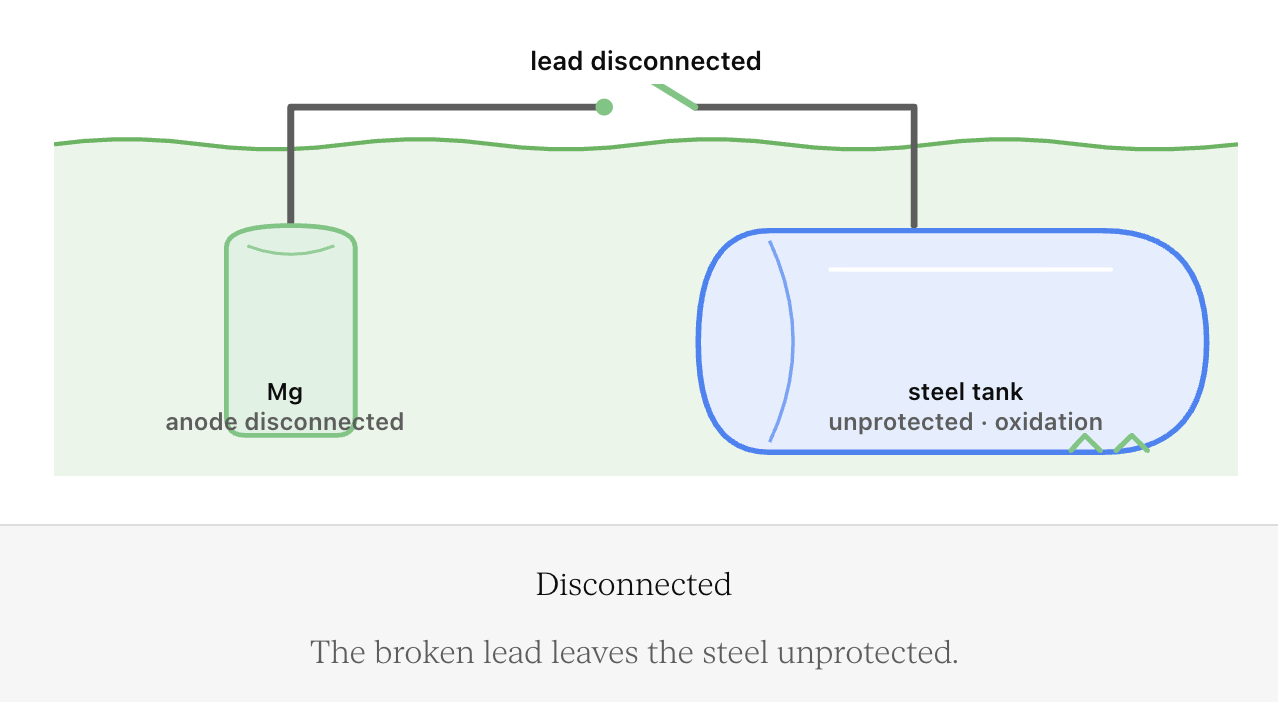
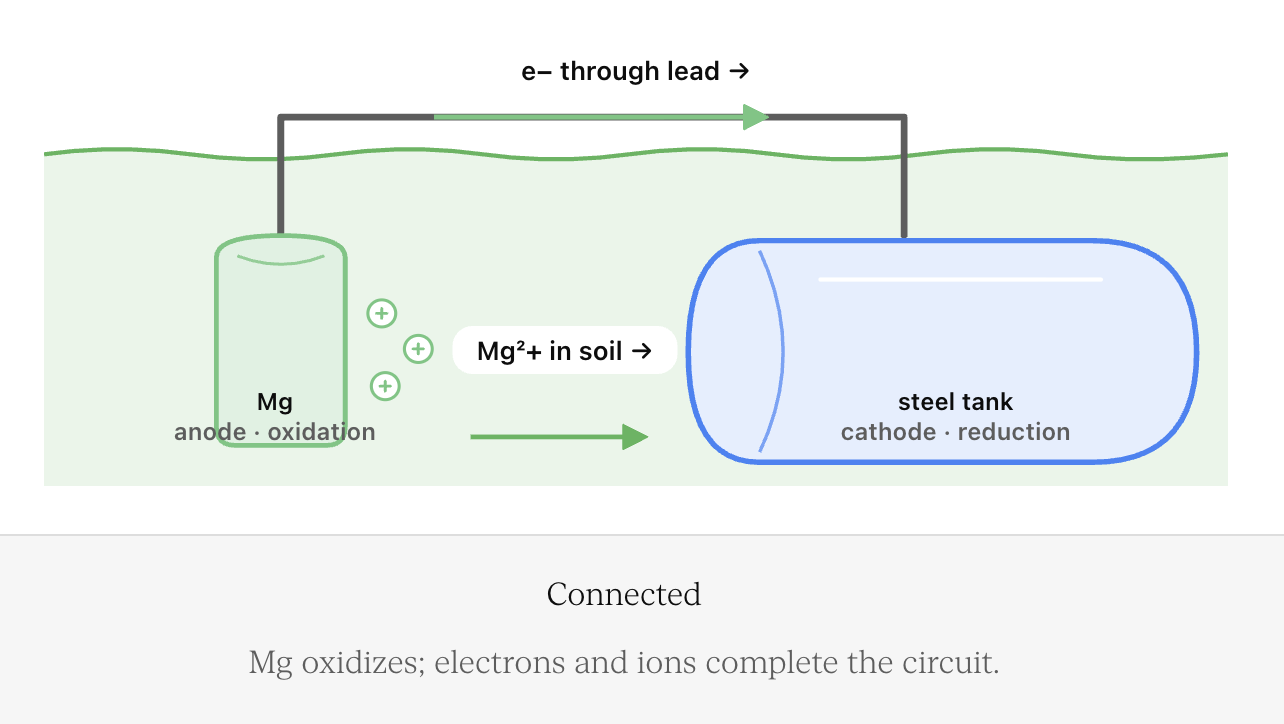
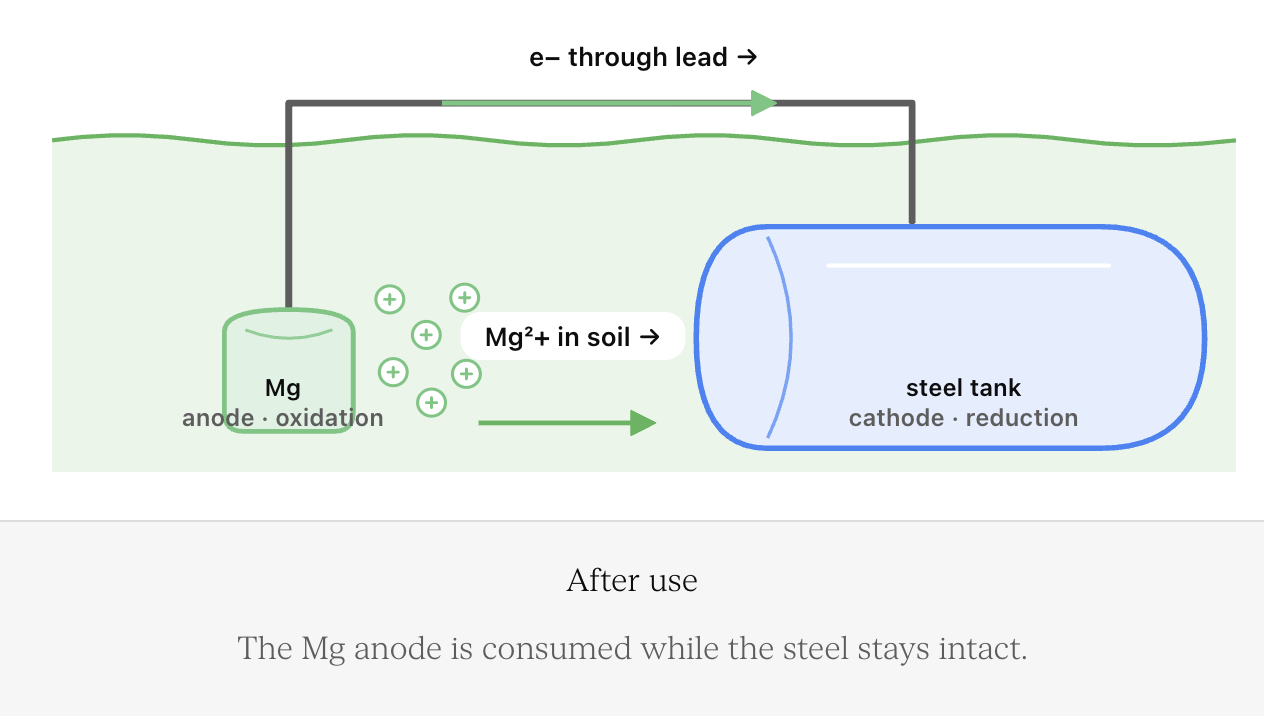
A more reactive metal is electrically connected to the structure being protected.
Common sacrificial-anode materials include:
- magnesium
- zinc
- aluminum alloys
The attached metal becomes the:
anode.
It oxidizes instead of the protected structure.
For example:
Mg → Mg²⁺ + 2e⁻