Applications of Electrochemistry and Bioelectricity
| Site: | Young Education |
| Course: | Electrochemistry |
| Book: | Applications of Electrochemistry and Bioelectricity |
| Printed by: | Guest user |
| Date: | Monday, 5 October 2026, 4:04 AM |
1. Electroplating
Learning outcomes
- I can explain the purpose of electroplating.
- I can describe how electroplating uses electrolysis.
- I can identify the roles of the anode, cathode, and electrolyte.
- I can explain how electroplating improves material properties.
- I can evaluate applications of electroplating in industry.


What Is Electroplating?
Electroplating is the process of using electricity to deposit a thin layer of one metal onto the surface of another object.
It is a practical application of:
During electroplating, metal ions in an electrolyte gain electrons and form solid metal on the surface of the object being coated.
In simple terms:
metal ions in solution → solid metal coating
Electroplating is widely used to:
- improve appearance
- prevent corrosion
- increase resistance to wear
- improve electrical conductivity
- reduce friction
- improve surface hardness
- produce specialized surface properties
The Basic Electroplating Cell
A typical electroplating system contains:
- a DC power supply
- an anode
- a cathode
- an electrolyte
- the object being plated
- ions of the coating metal
The object that will receive the coating is connected as the:
cathode.
The metal being deposited is present as:
positive metal ions in the electrolyte.
In many systems, the anode is made from the same metal that is being deposited.
The Cathode
The object being electroplated is normally the:
cathode.
During electrolysis, the cathode is connected to the:
negative terminal.
Positive metal ions are attracted toward it.
At the cathode, the metal ions:
gain electrons.
Remember:
Reduction = gain of electrons
and:
Reduction occurs at the cathode.
Metal Deposition at the Cathode
Suppose an object is being plated with copper.
The electrolyte contains:
Cu²⁺ ions.
The Cu²⁺ ions move toward the cathode and gain electrons:
Cu²⁺ + 2e⁻ → Cu
The copper ions become neutral copper atoms.
These atoms form a layer of:
solid copper
on the object's surface.


Why Is the Object the Cathode?
Metal ions are:
positively charged.
To form metal atoms, they must:
gain electrons.
Electrons are supplied at the cathode.
Therefore:
Metal ions → cathode → gain electrons → metal coating
This is why the object being electroplated must normally be connected as the:
cathode.
The Anode
The other electrode is the:
anode.
During electrolysis, the anode is connected to the:
positive terminal.
Oxidation occurs at the anode.
Remember:
AnOx
ANode = OXidation
In many electroplating systems, the anode is made from the metal being:
deposited.
A Reactive Metal Anode
Suppose copper is being used to coat an object.
A copper anode can be used.
At the anode:
Cu → Cu²⁺ + 2e⁻
Copper atoms lose electrons and enter the electrolyte as:
Cu²⁺ ions.
The copper anode gradually:
loses mass.
What Happens at Both Electrodes?
In copper electroplating:
At the anode:
Cu → Cu²⁺ + 2e⁻
At the cathode:
Cu²⁺ + 2e⁻ → Cu
Copper leaves the anode and copper is deposited onto the:
cathode.
In an idealized system, copper is effectively transferred from:
anode → electrolyte → cathode.
The Electrolyte
The electrolyte contains mobile ions and allows electrical charge to move through the solution.
For copper electroplating, the electrolyte must provide:
Cu²⁺ ions.
A suitable copper-containing solution might contain a dissolved copper salt.
The electrolyte has two important functions:
- allows ions to move through the cell
- supplies metal ions for deposition
The Three Main Components
A simple way to remember an electroplating setup is:
Cathode → object being coated
Electrolyte → contains ions of coating metal
Anode → often made from coating metal
For example, copper plating:
Cathode → object
Electrolyte → contains Cu²⁺
Anode → copper
Ion and Electron Movement
During electroplating, metal ions move through the:
electrolyte.
Electrons move through the:
external electrical circuit.
These are different types of charge movement.
For copper plating:
Cu²⁺ ions → toward cathode
At the cathode:
Cu²⁺ + 2e⁻ → Cu
The metal becomes part of the object's:
surface coating.
Example: Copper Plating
Suppose we want to coat a steel object with copper.
The steel object becomes the:
cathode.
A copper electrode can become the:
anode.
The electrolyte contains:
Cu²⁺ ions.


At the cathode:
Cu²⁺ + 2e⁻ → Cu
Copper forms on the steel.
At the anode:
Cu → Cu²⁺ + 2e⁻
Copper enters the electrolyte.
Over time:
cathode mass increases
and:
anode mass decreases.
Example: Silver Plating
Silver plating uses the same basic principle.
Silver ions move toward the cathode.
At the cathode:
Ag⁺ + e⁻ → Ag
Silver metal is deposited onto the object.
Silver plating can be used for:
- decorative objects
- jewelry
- electrical components
- specialized industrial surfaces
The exact electrolytes used industrially are carefully selected for safety and coating quality.
Example: Nickel Plating
Nickel can also be deposited electrochemically.
At the cathode:
Ni²⁺ + 2e⁻ → Ni
Nickel coatings can provide:
- corrosion resistance
- wear resistance
- improved appearance
- a suitable surface for further coatings
Nickel plating is widely used in:
manufacturing and engineering.
Example: Chromium Plating
Chromium-based coatings are used on many manufactured components.
They can provide:
- a shiny appearance
- increased surface hardness
- improved wear resistance
- improved corrosion resistance
Chromium coatings can be decorative or:
functional.
Industrial chromium-plating chemistry requires careful environmental and safety controls because some chromium compounds used in traditional processes are:
hazardous.


Decorative Electroplating
Sometimes the main purpose of electroplating is:
appearance.
A cheaper material can be covered with a thin layer of a more attractive metal.
Examples include:
- gold-plated jewelry
- silver-plated objects
- decorative nickel coatings
- chromium-finished components
Only a thin layer of the expensive metal may be required.
This can make the product:
less expensive than making it entirely from that metal.
Corrosion Protection
Electroplating can protect an underlying material from:
corrosion.
The coating creates a barrier between the base material and substances in the environment such as:
- water
- oxygen
- salts
- chemicals
If the coating remains intact, it can reduce the exposure of the underlying metal to:
corrosive conditions.
What Is Corrosion?
Corrosion is the gradual deterioration of a material through chemical or electrochemical reactions with its environment.
Rusting of iron is a familiar example.
Iron reacts in the presence of oxygen and water to eventually form hydrated iron oxides commonly called:
rust.
A suitable protective coating can reduce contact between iron and its environment.
Electroplating and Wear Resistance
Machine parts may experience:
- rubbing
- scratching
- abrasion
- repeated contact
A suitable electroplated coating can make the surface more resistant to:
wear.
This can increase the useful lifetime of a component.
Surface Hardness
The interior of a component and its surface do not always need the same properties.
A manufacturer may want:
a tough, inexpensive core
but:
a hard, wear-resistant surface.
Electroplating can sometimes provide this combination by changing the properties of the:
surface.
Electrical Conductivity
Electroplating is extremely important in:
electronics.
A component may be coated with a metal that provides:
- good electrical conductivity
- reliable electrical contact
- corrosion resistance
- reduced contact resistance
Metals such as:
gold, silver, copper, nickel, and tin
are used in different electronic applications.


Gold-Plated Electrical Contacts
Gold is an excellent material for some electrical contacts because it:
- conducts electricity
- resists oxidation
- provides reliable contact surfaces
However, gold is:
expensive.
Instead of making an entire connector from gold, manufacturers can apply a very thin gold coating to the:
important contact surface.
Electroplating Can Save Material
One important advantage of electroplating is that the whole object does not need to be made from the coating material.
For example, an object can have:
inexpensive structural material inside
and:
specialized metal coating outside.
This can reduce the amount of expensive or scarce material required.
Preparing the Surface
Successful electroplating requires a:
clean surface.
Dirt, grease, oxide layers, and other contamination can prevent the metal coating from attaching properly.
Industrial preparation may involve:
- cleaning
- degreasing
- rinsing
- surface activation
- removal of oxide layers
Poor surface preparation can produce a coating that is:
- uneven
- weakly attached
- rough
- patchy
Why Surface Preparation Matters
Imagine trying to paint a surface covered in:
oil and dirt.
The paint would not attach properly.
Electroplating has a similar problem.
The deposited metal must form good contact with the:
underlying surface.
Proper cleaning is therefore a critical part of the electroplating process.
Current and Coating Rate
The amount of metal deposited depends partly on the amount of electrical charge passing through the cell.
Greater current means more charge passes per second.
Under suitable conditions, increasing the current can increase the:
rate of metal deposition.
However, simply using a very large current does not necessarily produce a better coating.
Current Density
An important industrial quantity is:
current density.
Current density describes the current passing through a particular electrode area.
If current density is too high, the coating may become:
- rough
- uneven
- poorly attached
- less desirable
Manufacturers therefore carefully control:
electrical conditions.
Time and Coating Thickness
Electroplating for a longer time generally allows more metal to be:
deposited.
Therefore coating thickness can be controlled partly by adjusting:
- current
- plating time
- surface area
This makes electroplating useful when a specific coating thickness is required.
Faraday's Laws and Electroplating
The amount of material deposited during electrolysis is related to the quantity of:
electric charge transferred.
Electric charge can be calculated using:
Q = It
where:
Q = charge in coulombs (C)
I = current in amperes (A)
t = time in seconds (s)
This provides a quantitative connection between electricity and the amount of:
metal deposited.
Worked Example: Calculating Charge
An electroplating cell operates at:
2.0 A
for:
10 minutes.
First convert the time:
10 min × 60 = 600 s
Use:
Q = It
Q = 2.0 × 600
Q = 1200 C
Therefore:
1200 C of charge
passes through the circuit.
Factors Affecting Electroplating Quality
Several factors affect the quality of a plated surface:
- current density
- plating time
- ion concentration
- temperature
- electrode spacing
- surface cleanliness
- electrolyte composition
- movement of the electrolyte
Industrial electroplating requires careful control of these variables to produce:
consistent coatings.
Uneven Coatings
Electric fields are not always distributed evenly around an object.
Edges and projections may experience different current densities from flat or recessed areas.
As a result, metal may deposit:
unevenly.
Manufacturers can adjust:
- electrode shape
- electrode position
- current
- solution movement
to improve coating uniformity.
Electroplating in the Automotive Industry
Electroplating is used extensively in:
vehicles.
Applications can include:
- decorative trim
- fasteners
- electrical connectors
- engine components
- wear-resistant parts
- corrosion-resistant surfaces
Different coatings are selected according to the required:
properties.
Electroplating in Electronics
Electronic equipment contains many electroplated components.
Applications include:
- connectors
- switches
- contacts
- circuit-board features
- semiconductor manufacturing components
Electroplating can provide extremely thin and precisely controlled:
metal layers.
Electroplating in Jewelry
Jewelry is one of the most familiar applications.
A less expensive metal can be coated with:
- gold
- silver
- rhodium
- other decorative metals
This can provide the desired:
appearance and surface properties
while reducing the amount of expensive metal required.


Electroplating in Aerospace
Aircraft and spacecraft components may require surfaces with carefully controlled properties.
Electroplated coatings can be used for:
- corrosion protection
- wear resistance
- electrical performance
- specialized engineering surfaces
In these applications, coating thickness and quality must be:
carefully controlled.
Electroplating in Manufacturing
Electroplating can be used on:
- tools
- machine components
- fasteners
- bearings
- molds
- electrical equipment
- decorative products
The purpose depends on the application.
The same underlying electrochemical process can create surfaces with very different:
properties.
Advantages of Electroplating
Electroplating can provide several advantages.
It can:
- improve appearance
- protect against corrosion
- increase wear resistance
- improve electrical properties
- modify surface hardness
- reduce the amount of expensive metal required
- extend product lifetime
- restore dimensions on some worn components
Limitations of Electroplating
Electroplating also has disadvantages.
These can include:
- energy consumption
- chemical waste
- wastewater treatment requirements
- potentially hazardous chemicals
- equipment costs
- difficulty coating complex shapes uniformly
- coating failure if surfaces are poorly prepared
Therefore electroplating must be evaluated based on both:
benefits and costs.
Environmental Considerations
Some electroplating processes use solutions containing metal ions or other chemicals that can be harmful if released into the:
environment.
Wastewater may require treatment to remove:
- metal ions
- acids
- alkalis
- other processing chemicals
Modern facilities must carefully manage:
chemical waste and wastewater.
Worker Safety
Industrial electroplating may involve:
- corrosive solutions
- toxic substances
- electrical equipment
- gases
- heated solutions
Proper industrial systems therefore require:
- ventilation
- protective equipment
- chemical handling procedures
- wastewater controls
- monitoring
These measures help reduce risks to workers and the:
environment.
Electroplating vs Painting
Both electroplating and painting can modify an object's surface.
However:
Painting
adds a layer of paint or polymer.
Electroplating
deposits a layer of metal using electrolysis.
Electroplating can therefore provide metallic properties such as:
- electrical conductivity
- metallic appearance
- wear resistance
- specialized corrosion resistance
that ordinary paint may not provide.
Electroplating vs Galvanizing
These processes should not be confused.
Electroplating
uses electrolysis to deposit a metal coating.
Galvanizing
commonly refers to coating iron or steel with zinc, often by dipping it into molten zinc.
Zinc provides additional protection because it is more reactive than iron and can act as a:
sacrificial metal.
Electroplating can also be used to apply zinc, but not all galvanizing is performed by electrolysis.
Electroplating vs Electrorefining
Both processes use electrolysis, but they have different purposes.
Electroplating
Purpose:
coat an object with metal.
Electrorefining
Purpose:
purify a metal.
In copper electrorefining, copper moves from an impure anode to a pure:
cathode.
Evaluating an Electroplating Application
When evaluating whether electroplating is suitable, ask:
What property needs improvement?
For example:
- appearance?
- corrosion resistance?
- conductivity?
- hardness?
- wear resistance?
Then consider:
What metal provides that property?
Finally consider:
- cost
- durability
- environmental impact
- safety
- coating thickness
- maintenance
- alternatives
This allows an evidence-based evaluation rather than simply deciding that electroplating is always:
better.
Worked Example 1
A steel key is being copper plated.
Which electrode should the key be?
The key needs to receive copper atoms.
Copper ions must gain electrons:
Cu²⁺ + 2e⁻ → Cu
Reduction occurs at the cathode.
Therefore:
the key must be the cathode.
Worked Example 2
What could be used as the anode during copper plating?
A:
copper electrode.
At the anode:
Cu → Cu²⁺ + 2e⁻
This supplies additional Cu²⁺ ions to the electrolyte.
Worked Example 3
What must the electrolyte contain during copper plating?
It must contain:
Cu²⁺ ions.
These ions move toward the cathode and are reduced:
Cu²⁺ + 2e⁻ → Cu.
Worked Example 4
Why does the cathode gain mass?
Metal ions from the electrolyte are converted into:
solid metal atoms.
These atoms remain on the object's surface.
Therefore the object's:
mass increases.
Worked Example 5
Why can a reactive anode lose mass?
Metal atoms from the anode can lose electrons.
For copper:
Cu → Cu²⁺ + 2e⁻
The atoms leave the solid electrode and enter the:
solution.
Worked Example 6
Why might an electrical connector be gold plated rather than made entirely from gold?
Gold has useful surface properties, including:
high corrosion resistance and good electrical conductivity.
However, it is expensive.
A thin coating can provide useful surface properties while using much less:
gold.
Worked Example 7
A plated object has a patchy coating.
Give two possible causes.
Possible causes include:
- poor surface cleaning
- uneven current density
- unsuitable electrode positioning
- incorrect current
- unsuitable electrolyte concentration
Any of these can affect the:
quality of deposition.
Worked Example 8
An electroplating cell operates at 3.0 A for 5 minutes.
Calculate the charge transferred.
Convert time:
5 × 60 = 300 s
Use:
Q = It
Q = 3.0 × 300
Q = 900 C
Therefore:
900 C
of charge passes through the circuit.
Worked Example 9
Why might electroplating extend the life of a machine component?
A suitable coating can improve:
wear resistance or corrosion resistance.
This reduces damage to the underlying material and may allow the component to remain useful:
for longer.
Worked Example 10
Why must electroplating waste be treated carefully?
Waste solutions may contain:
metal ions and other potentially harmful chemicals.
If released untreated, these substances could contaminate:
water and soil.
Appropriate treatment reduces environmental impact.
Common Mistake: The Object Is the Anode
The object being plated must receive metal.
Metal ions gain electrons at the:
cathode.
Therefore:
object being plated = cathode.
Common Mistake: The Metal Coating Comes Directly Through the Wire
Metal does not travel through the wire.
Electrons travel through the:
external circuit.
Metal ions move through the:
electrolyte.
The ions gain electrons at the cathode and become solid metal.
Common Mistake: The Anode Always Has to Be the Coating Metal
A soluble anode made from the coating metal is common in many electroplating systems.
However, some industrial processes use:
inert or dimensionally stable anodes.
The metal ions are then supplied and maintained through the electrolyte chemistry.
Common Mistake: Electroplating Changes the Entire Object
Electroplating mainly modifies the:
surface.
The object's interior usually remains made from the original material.
This is one of the major advantages of the process.
Common Mistake: A Thicker Coating Is Always Better
A thicker coating uses more:
material, time, and energy.
The ideal thickness depends on the required performance.
Manufacturers aim for a coating that provides the necessary properties without unnecessary:
cost and material use.
Check Your Understanding
- Define electroplating.
- What chemical process is used in electroplating?
- What is the purpose of the cathode?
- What is the purpose of the anode?
- What is the purpose of the electrolyte?
- Which electrode is the object being plated?
- Why must the object be the cathode?
- What type of reaction occurs at the cathode?
- What type of reaction occurs at the anode?
- What happens to metal ions at the cathode?
- Write the half-equation for copper deposition.
- Write the half-equation for silver deposition.
- Write the half-equation for nickel deposition.
- What happens to a copper anode during copper electroplating?
- Write the half-equation for a copper anode.
- Why does a copper anode lose mass?
- Why does the cathode gain mass?
- What must a copper-plating electrolyte contain?
- Describe the movement of Cu²⁺ ions during electroplating.
- Where do electrons move in an electroplating system?
- Explain how copper can effectively be transferred from anode to cathode.
- Why must an object be cleaned before electroplating?
- What might happen if grease remains on the surface?
- Give three reasons why manufacturers electroplate products.
- How can electroplating reduce corrosion?
- How can electroplating increase wear resistance?
- How can electroplating improve electrical components?
- Why are some electrical contacts gold plated?
- Why not make the entire component from gold?
- Give two uses of nickel plating.
- Give two uses of decorative electroplating.
- How can electroplating change surface hardness?
- Explain why electroplating can reduce material costs.
- What is current density?
- How can current affect the rate of deposition?
- How can plating time affect coating thickness?
- State the equation relating charge, current, and time.
- Calculate the charge transferred by a 2 A current operating for 300 s.
- Name three factors affecting coating quality.
- Why might complex objects develop uneven coatings?
- Give two environmental concerns associated with electroplating.
- Why must electroplating wastewater be treated?
- Compare electroplating and painting.
- Compare electroplating and galvanizing.
- Compare electroplating and electrorefining.
- Explain how electroplating is used in electronics.
- Explain how electroplating is used in jewelry.
- Explain one application of electroplating in the automotive industry.
- Give one advantage and one limitation of electroplating.
- Describe the complete process of electroplating an object with copper.
Key Terms
Electroplating: Use of electrolysis to deposit a thin metal coating onto an object.
Cathode: Electrode where reduction occurs; normally the object being electroplated.
Anode: Electrode where oxidation occurs.
Electrolyte: Conducting liquid containing mobile ions required for electroplating.
Reduction: Gain of electrons.
Oxidation: Loss of electrons.
Metal deposition: Formation of solid metal from metal ions at an electrode.
Coating: Thin layer of material covering another material.
Corrosion: Gradual deterioration of a material through chemical or electrochemical reactions with its environment.
Current density: Electrical current per unit electrode area.
Electrorefining: Use of electrolysis to purify a metal.
Galvanizing: Application of a zinc coating to iron or steel, commonly by hot-dip treatment.
Key Takeaways
- Electroplating uses electrolysis to deposit a thin layer of metal onto an object.
- The object being plated is normally the cathode.
- Metal ions move through the electrolyte toward the cathode.
- At the cathode, metal ions gain electrons and form solid metal.
- Reduction always occurs at the cathode.
- In many systems, the anode is made from the coating metal.
- A reactive metal anode can dissolve and replace metal ions in the electrolyte.
- During copper plating, Cu²⁺ + 2e⁻ → Cu occurs at the cathode.
- Electroplating can improve appearance, corrosion resistance, wear resistance, hardness, and electrical properties.
- Thin coatings allow expensive materials to be used only where their surface properties are needed.
- Surface preparation is essential for a strong and uniform coating.
- Current, time, temperature, concentration, and current density can affect coating quality.
- Electroplating is widely used in electronics, jewelry, automotive manufacturing, aerospace, and engineering.
- Electroplating can generate chemical waste and therefore requires careful environmental and safety management.
- Choosing an electroplating process requires balancing the desired surface properties against cost, durability, safety, and environmental impact.
2. Industrial Electrochemistry
Learning outcomes
- I can identify industrial processes that use electrochemistry.
- I can explain how electrolysis is used in manufacturing.
- I can describe electrochemical methods of metal extraction and purification.
- I can evaluate the economic importance of industrial electrochemistry.
- I can analyze the benefits and challenges of electrochemical technologies.


What Is Industrial Electrochemistry?
Industrial electrochemistry is the large-scale use of chemical reactions involving the transfer of electrons to manufacture useful materials, extract and purify metals, produce chemicals, protect surfaces, and store or convert energy.
Electrochemistry connects:
chemical reactions ↔ electrical energy
Some electrochemical processes produce electrical energy from chemical reactions.
Others use electrical energy to force chemical reactions to occur.
Industrial electrochemistry is used to produce enormous quantities of materials that modern society depends on.
Important applications include:
- aluminum production
- chlorine production
- sodium hydroxide production
- hydrogen production
- metal purification
- electroplating
- battery manufacturing
- fuel cells
- metal recovery
- corrosion protection
Two Major Types of Electrochemical Cells
Industrial electrochemistry uses two important types of cells.
convert:
chemical energy → electrical energy
Batteries are an important example.
Electrolytic cells
convert:
electrical energy → chemical energy
Industrial electrolysis is an important example.
Both involve:
oxidation and reduction reactions.
Oxidation and Reduction
All electrochemical processes involve the transfer of:
electrons.
Oxidation means:
loss of electrons.
Reduction means:
gain of electrons.
Remember:
OIL RIG
Oxidation Is Loss
Reduction Is Gain
At the:
anode → oxidation
At the:
cathode → reduction
These definitions apply to both galvanic and electrolytic cells.
Industrial Electrolysis
Electrolysis uses electrical energy to drive a chemical reaction that would not occur spontaneously under the operating conditions.
Industrial electrolysis can be used to:
- extract metals
- purify metals
- produce gases
- manufacture chemicals
- coat surfaces
- produce hydrogen
- recover valuable materials
Industrial electrolytic cells may operate continuously and process very large quantities of:
materials.


Metal Extraction
Many metals occur naturally as:
compounds in ores.
To obtain the metal, its positive ions must be:
reduced.
For example:
Al³⁺ + 3e⁻ → Al
Some metals can be extracted chemically using reducing agents such as carbon.
However, highly reactive metals form very stable compounds and are difficult to extract this way.
Electrolysis is therefore particularly important for extracting metals such as:
- aluminum
- sodium
- magnesium
Why Electrolysis Can Extract Metals
Metal ions are positively charged.
During electrolysis, they move toward the:
cathode.
At the cathode they gain electrons:
Mⁿ⁺ + ne⁻ → M
The metal ions are therefore:
reduced to metal atoms.
This provides a general method for producing reactive metals.
Aluminum Production
One of the most important examples of industrial electrochemistry is the production of:
aluminum.
Aluminum is used in:
- aircraft
- vehicles
- buildings
- electrical cables
- packaging
- electronics
- machinery
Its combination of low density, corrosion resistance, and useful mechanical properties makes it an important:
engineering material.


The Hall-Héroult Process
Aluminum is produced industrially using the:
Hall-Héroult process.
Aluminum oxide is obtained from aluminum-containing ores such as bauxite and dissolved in a molten cryolite-based electrolyte.
The electrolyte is kept at a high temperature so that ions can:
move freely.
A large electric current passes through the cell.
Aluminum at the Cathode
Aluminum ions move toward the cathode.
They gain electrons:
Al³⁺ + 3e⁻ → Al
This is:
reduction.
Molten aluminum forms and collects in the lower part of the cell.
It can then be:
removed for processing.
The Anode in Aluminum Production
The Hall-Héroult process commonly uses:
carbon anodes.
At the anode, oxide-containing species are oxidized.
The oxygen produced reacts with the carbon anode, producing mainly:
carbon dioxide.
As a result, the carbon anodes are gradually:
consumed.
They must therefore be replaced periodically.
Why Cryolite Is Important
Pure aluminum oxide has a very high melting point.
Operating with pure molten aluminum oxide would require:
extremely high temperatures.
Dissolving aluminum oxide in a molten cryolite-based electrolyte allows the cell to operate at a substantially lower temperature.
This helps reduce:
energy requirements and operating difficulties.
Energy Use in Aluminum Production
Primary aluminum production requires a large amount of:
electrical energy.
Electricity is therefore a major factor in:
- production cost
- location of smelters
- environmental impact
Aluminum smelters are often located where large supplies of reliable electricity are available.
Recycling Aluminum
Recycling aluminum requires much less energy than producing primary aluminum from ore.
Recycling also reduces:
- demand for mining
- processing of new ore
- waste
- some associated environmental impacts
This makes aluminum recycling economically and environmentally:
important.
Sodium Production
Sodium is a highly reactive metal.
It cannot be produced from aqueous sodium chloride because water would be reduced instead.
Industrial sodium can be produced by electrolysis of:
molten sodium chloride.
At the cathode:
Na⁺ + e⁻ → Na
At the anode:
2Cl⁻ → Cl₂ + 2e⁻
The products are:
sodium and chlorine.
Magnesium Production
Magnesium can also be produced using electrolysis.
Molten magnesium chloride contains:
Mg²⁺ and Cl⁻ ions.
At the cathode:
Mg²⁺ + 2e⁻ → Mg
At the anode:
2Cl⁻ → Cl₂ + 2e⁻
Magnesium is valued because it is:
lightweight.
It is used in alloys and specialized engineering applications.
The Chlor-Alkali Industry
One of the world's major electrochemical manufacturing processes is the electrolysis of concentrated sodium chloride solution:
brine.
This process is called the:
chlor-alkali process.
It produces three important chemicals:
chlorine
hydrogen
and:
sodium hydroxide.


Reactions in the Chlor-Alkali Process
At the cathode, water is reduced:
2H₂O + 2e⁻ → H₂ + 2OH⁻
Hydrogen gas is produced.
At the anode:
2Cl⁻ → Cl₂ + 2e⁻
Chlorine gas is produced.
Na⁺ ions remain in solution with OH⁻ ions, producing:
sodium hydroxide solution.
Why Chlorine Is Important
Chlorine is an important industrial chemical.
It is used in:
- water treatment
- disinfectant manufacture
- production of many chemicals
- manufacture of some plastics
- chemical synthesis
The large-scale production of chlorine therefore supports many other:
industries.
Why Sodium Hydroxide Is Important
Sodium hydroxide is also an important industrial chemical.
It is used in:
- paper production
- soap and detergent manufacturing
- chemical processing
- textile processing
- cleaning
- petroleum processing
It is sometimes called:
caustic soda.
Hydrogen from the Chlor-Alkali Process
Hydrogen is another useful product.
It can be used in:
- chemical manufacturing
- fuel applications
- hydrogenation reactions
- production of other industrial chemicals
Rather than treating hydrogen as waste, industrial facilities can use or sell it as a:
valuable co-product.
Membrane Cells
Modern chlor-alkali plants commonly use:
membrane cells.
A specialized membrane allows selected ions to pass while helping keep products:
separated.
This is important because chlorine, hydrogen, and sodium hydroxide must not simply mix together.
Separation improves:
- product purity
- efficiency
- safety
Metal Purification
Electrochemistry can also be used to:
purify metals.
This process is called:
electrorefining.
Copper is one of the most important examples.
High-purity copper is essential for:
- electrical wiring
- electronics
- motors
- generators
- transformers
- telecommunications


Copper Electrorefining
In copper electrorefining:
Impure copper → anode
Pure copper sheet → cathode
The electrolyte contains:
Cu²⁺ ions.
At the anode:
Cu → Cu²⁺ + 2e⁻
Copper atoms enter the electrolyte.
At the cathode:
Cu²⁺ + 2e⁻ → Cu
Pure copper is deposited.
What Happens to the Impurities?
Not all impurities behave like copper.
Some may remain in solution.
Others can collect below the anode as:
anode sludge or anode slime.
This material can contain valuable metals such as:
- silver
- gold
- other precious or valuable elements
These materials may be recovered and processed separately.
Therefore electrorefining can produce both:
high-purity copper and valuable by-products.
Why Copper Must Be Pure
Electrical applications require copper with very high:
electrical conductivity.
Impurities can reduce its performance.
Electrorefining produces copper suitable for demanding applications such as:
electrical wiring and electronics.
Electroplating
Another major industrial electrochemical process is:
electroplating.
Electroplating uses electrolysis to deposit a thin metal coating onto an object.
The object being coated is normally the:
cathode.
Metal ions gain electrons and form a solid coating:
Mⁿ⁺ + ne⁻ → M
Industrial Uses of Electroplating
Electroplating can improve:
- appearance
- corrosion resistance
- wear resistance
- electrical conductivity
- surface hardness
- contact reliability
It is used in:
- automotive manufacturing
- electronics
- jewelry
- aerospace
- tools
- machinery


Electrowinning
Electrowinning is an electrochemical process used to recover metals from solutions containing metal ions.
Metal ions are reduced at the cathode:
Mⁿ⁺ + ne⁻ → M
The solid metal can then be collected.
Electrowinning is used in the production or recovery of metals such as:
- copper
- zinc
- nickel
- cobalt
Electrorefining vs Electrowinning
These processes are related but have different purposes.
Electrorefining
starts with an impure metal and uses electrochemistry to produce a:
purer metal.
Electrowinning
starts with metal ions in a solution and uses electrochemistry to recover:
solid metal.
Both rely on reduction at the:
cathode.
Hydrogen Production by Electrolysis
Water electrolysis can produce:
hydrogen gas.
At the cathode, hydrogen-containing species are reduced.
At the anode, oxygen is produced.
Overall:
2H₂O → 2H₂ + O₂
Electrical energy is converted into:
chemical energy stored in hydrogen.


Hydrogen and Renewable Electricity
Hydrogen production by electrolysis can be combined with electricity generated from:
- solar power
- wind power
- hydroelectric power
- other low-carbon sources
The hydrogen can then be:
- stored
- transported
- used in chemical production
- used as a fuel
- converted back into electricity in a fuel cell
This creates a connection between electrochemistry and:
energy storage.
What Is "Green Hydrogen"?
The term green hydrogen is commonly used for hydrogen produced by water electrolysis using electricity from:
renewable energy sources.
The electrolysis itself does not release carbon dioxide as a direct product.
However, the overall environmental impact depends on factors such as:
- electricity source
- equipment manufacture
- water supply
- compression
- storage
- transportation
Therefore the full production system must be considered when evaluating:
environmental impact.
Batteries as Industrial Electrochemistry
Battery production is another major electrochemical industry.
Batteries convert:
chemical energy → electrical energy
during discharge.
Rechargeable batteries can also convert electrical energy back into:
stored chemical energy.
Examples include:
- lead-acid batteries
- nickel-metal hydride batteries
- lithium-ion batteries
- sodium-ion batteries
Lithium-Ion Batteries
Lithium-ion batteries are widely used in:
- smartphones
- laptops
- electric vehicles
- power tools
- grid energy storage
During operation, lithium ions move through the electrolyte while electrons move through the:
external circuit.
Large-scale battery manufacturing therefore depends heavily on:
electrochemical science and engineering.


Fuel Cells
Fuel cells convert chemical energy directly into:
electrical energy.
Unlike a battery that stores reactants internally, a fuel cell can continue operating while fuel and oxidant are continuously:
supplied.
Hydrogen fuel cells are one example.
They produce electricity through electrochemical reactions involving:
hydrogen and oxygen.
Electrochemical Corrosion Protection
Electrochemical principles can also be used to prevent:
corrosion.
One technique is:
cathodic protection.
The metal structure being protected is forced to behave as the:
cathode.
This reduces its tendency to oxidize.
Sacrificial Protection
A more reactive metal can be attached to a structure.
The more reactive metal oxidizes preferentially.
It is called the:
sacrificial anode.
Metals such as:
- zinc
- magnesium
- aluminum alloys
can be used in suitable applications.
This technique can protect:
- pipelines
- ships
- storage tanks
- offshore structures


Electrochemical Manufacturing
Electrochemical methods can sometimes replace manufacturing processes that require large quantities of chemical reagents.
Instead of adding a chemical oxidizing or reducing agent, an industrial process may use:
electrical current.
Electrons effectively become a controllable:
chemical reagent.
This can offer important manufacturing advantages.
Precise Control
Electrochemical processes can often be controlled by adjusting:
- voltage
- current
- current density
- temperature
- electrolyte concentration
- electrode area
- reaction time
- electrode material
This gives engineers precise control over:
reaction rates and product formation.
Faraday's Laws in Industry
The amount of material produced during electrolysis is related to the quantity of:
electric charge.
Charge is calculated using:
Q = It
where:
Q = charge in coulombs
I = current in amperes
t = time in seconds
This allows manufacturers to calculate how much electrical charge is needed to produce a particular amount of:
material.
Example: Industrial Charge
An electrolytic cell operates at:
5000 A
for:
1 hour.
Convert time:
1 hour = 3600 s
Use:
Q = It
Q = 5000 × 3600
Q = 18,000,000 C
A huge quantity of electrical charge passes through the cell.
This illustrates why industrial electrolysis commonly uses:
very large electric currents.
Why Industrial Electrochemistry Is Economically Important
Industrial electrochemistry provides materials needed throughout modern economies.
It supports industries such as:
- construction
- transportation
- electronics
- energy
- telecommunications
- chemical manufacturing
- mining
- medicine
- consumer products
Many products depend directly or indirectly on:
electrochemical manufacturing.
High-Purity Materials
One major advantage of electrochemical processing is the ability to produce:
high-purity materials.
Electrorefining can separate metals from many impurities.
This is particularly important when the material will be used in:
- electronics
- electrical systems
- specialized alloys
- advanced manufacturing
Valuable Co-Products
Industrial electrochemical processes can produce several useful products simultaneously.
The chlor-alkali process produces:
- chlorine
- hydrogen
- sodium hydroxide
Copper electrorefining can also allow recovery of valuable metals from:
anode residues.
Using and selling co-products can improve the economics of an:
industrial process.
Energy Costs
A major challenge of industrial electrochemistry is:
electricity consumption.
Processes such as aluminum production require very large amounts of electrical energy.
Electricity prices can therefore strongly affect:
production costs.
Improving electrical efficiency can have major economic benefits.
Energy Efficiency
Not all electrical energy supplied to an industrial cell becomes useful chemical energy.
Energy can be lost through:
- electrical resistance
- heating
- unwanted reactions
- overpotential
- equipment inefficiencies
Engineers try to minimize these losses to improve:
energy efficiency.
Current Efficiency
Another important concept is:
current efficiency.
Ideally, all electrical charge would produce the desired chemical reaction.
In reality, some charge may drive:
side reactions.
Higher current efficiency means a greater fraction of the supplied charge produces the:
desired product.
Raw Material Costs
Industrial electrochemical processes also require:
- ores
- electrolytes
- electrodes
- water
- membranes
- catalysts
- replacement components
The cost and availability of these materials influence the:
economics of production.
Electrode Consumption
Some industrial electrodes are consumed during operation.
For example, carbon anodes in conventional aluminum production gradually react and must be:
replaced.
This increases:
- material costs
- maintenance requirements
- waste
- associated emissions
Developing more durable electrode technologies is therefore an important area of:
research.
Environmental Challenges
Industrial electrochemistry can create environmental impacts through:
- electricity generation
- mining
- chemical waste
- wastewater
- greenhouse gas emissions
- hazardous substances
- spent electrodes
- end-of-life equipment
The scale of the impact depends strongly on the:
specific process and energy source.
Electricity Source Matters
Two electrolysis plants performing the same reaction can have different overall environmental impacts if their electricity comes from different:
energy sources.
Electricity generated mainly from fossil fuels may have greater associated greenhouse gas emissions than electricity generated from lower-carbon sources.
Therefore evaluating electrolysis requires considering both:
the chemical process and the electricity supply.
Benefits of Industrial Electrochemistry
Industrial electrochemical processes can offer several advantages.
They can:
- produce highly reactive metals
- produce high-purity materials
- allow precise process control
- manufacture important chemicals
- recover valuable metals
- create specialized surface coatings
- support energy storage
- integrate with renewable electricity
- reduce the need for some chemical reducing or oxidizing agents
Challenges of Industrial Electrochemistry
Challenges can include:
- high electricity demand
- high equipment costs
- electrode degradation
- corrosion
- hazardous chemicals
- wastewater management
- raw-material requirements
- side reactions
- heat management
- maintaining product purity
Industrial engineers must balance these factors against the:
value of the products.
Comparing Major Industrial Processes
| Process | Main Purpose | Important Product |
|---|---|---|
| Hall-Héroult process | Metal extraction | Aluminum |
| Chlor-alkali process | Chemical manufacturing | Cl₂, H₂, NaOH |
| Copper electrorefining | Metal purification | High-purity copper |
| Electrowinning | Metal recovery | Cu, Zn, Ni and others |
| Electroplating | Surface modification | Metal coating |
| Water electrolysis | Chemical/energy production | Hydrogen and oxygen |
| Battery manufacturing | Energy storage | Electrochemical cells |
| Cathodic protection | Corrosion control | Protected metal structures |
Evaluating an Industrial Process
When evaluating an electrochemical technology, consider more than whether:
the chemistry works.
Ask:
What does it produce?
How much energy does it require?
How expensive is the electricity?
What raw materials are required?
Are valuable co-products produced?
Does the process create hazardous waste?
Can materials be recycled?
What is the source of the electricity?
How long does the equipment last?
Are there safer or more efficient alternatives?
This provides a more complete evaluation of the:
technology.
Worked Example 1
Why is electrolysis used to extract aluminum?
Aluminum is highly reactive and forms very stable compounds.
Al³⁺ ions can be reduced at the cathode:
Al³⁺ + 3e⁻ → Al
Electrolysis therefore allows aluminum metal to be:
produced industrially.
Worked Example 2
Why is aluminum production expensive?
One major reason is the large amount of:
electrical energy required.
The process also requires high-temperature equipment, raw materials, electrodes, and continuous industrial operation.
Worked Example 3
Why is copper electrorefined?
Many electrical applications require:
very pure copper.
Electrorefining transfers copper from an impure anode to a high-purity cathode.
Worked Example 4
A copper electrorefining cathode gains mass.
Explain why.
Cu²⁺ ions gain electrons:
Cu²⁺ + 2e⁻ → Cu
Solid copper is deposited on the cathode.
Therefore its:
mass increases.
Worked Example 5
Why is the chlor-alkali process economically important?
It produces several widely used industrial chemicals:
chlorine, hydrogen, and sodium hydroxide.
These products are used as inputs in many other manufacturing processes.
Worked Example 6
Why might a hydrogen electrolyzer be located near a renewable electricity source?
Electrolysis requires:
electricity.
Locating production near suitable renewable generation can provide low-carbon electricity and may reduce some transmission or infrastructure requirements.
Worked Example 7
Why can recycling metals reduce energy use?
Producing metals from ores may require:
- mining
- ore processing
- high temperatures
- electrolysis
Recycling can avoid some of these energy-intensive stages.
Worked Example 8
What is the difference between electrorefining and electrowinning?
Electrorefining:
purifies an existing impure metal.
Electrowinning:
recovers metal from ions in solution.
Both deposit metal through reduction at the:
cathode.
Worked Example 9
Why is electroplating economically useful?
A thin coating can provide valuable surface properties without making the entire object from an:
expensive material.
This can reduce material costs while improving product performance.
Worked Example 10
An industrial electrolysis cell uses 20,000 A for 30 minutes.
Calculate the charge transferred.
Convert time:
30 min × 60 = 1800 s
Use:
Q = It
Q = 20,000 × 1800
Q = 36,000,000 C
Therefore:
36 million coulombs
of charge pass through the cell.
Future Industrial Electrochemistry
Electrochemistry is increasingly important in developing technologies related to:
- renewable energy storage
- hydrogen production
- carbon dioxide conversion
- battery recycling
- metal recovery
- low-carbon manufacturing
- advanced batteries
- new electrode materials
The ability to use electricity to drive chemical reactions creates opportunities to connect industrial manufacturing with:
low-carbon electricity.


Common Mistake: Electrochemistry Is Only About Batteries
Batteries are one application.
Industrial electrochemistry also includes:
- metal extraction
- metal purification
- electroplating
- chemical production
- hydrogen production
- corrosion protection
Its industrial applications are:
much broader.
Common Mistake: Electrolysis Only Produces Metals
Electrolysis can produce many different substances.
Examples include:
- metals
- hydrogen
- oxygen
- chlorine
- sodium hydroxide
- specialized chemical products
The products depend on the:
electrolyte and operating conditions.
Common Mistake: The Cheapest Process Uses the Least Electricity
Electricity is only one part of industrial cost.
Manufacturers must also consider:
- raw materials
- labor
- equipment
- maintenance
- product value
- waste treatment
- transport
- co-products
Economic evaluation requires considering the:
whole process.
Common Mistake: Electrolysis Is Automatically Environmentally Friendly
Electrolysis can support lower-carbon technologies, but its environmental impact depends on:
- electricity source
- energy efficiency
- raw materials
- waste
- equipment manufacture
- product handling
The entire system must therefore be:
evaluated.
Check Your Understanding
- Define industrial electrochemistry.
- Give five examples of industrial electrochemical processes.
- What energy transformation occurs during electrolysis?
- What energy transformation occurs in a galvanic cell?
- Where does oxidation occur?
- Where does reduction occur?
- Why is electrolysis useful for extracting reactive metals?
- Write the reduction half-equation for Al³⁺.
- Name the industrial process used to produce aluminum.
- Why is cryolite used in aluminum production?
- What happens to carbon anodes during conventional aluminum production?
- Why does aluminum production require large amounts of electricity?
- Why is recycling aluminum important?
- Write the cathode half-equation for sodium production.
- Write the cathode half-equation for magnesium production.
- What is the chlor-alkali process?
- Name its three major products.
- Write the cathode half-equation for the chlor-alkali process.
- Write the anode half-equation.
- Give two industrial uses of chlorine.
- Give two industrial uses of sodium hydroxide.
- What is electrorefining?
- Describe the arrangement used in copper electrorefining.
- Write the reaction at the copper anode.
- Write the reaction at the copper cathode.
- Why is highly pure copper economically important?
- What can happen to impurities during copper electrorefining?
- What is electrowinning?
- How does electrowinning differ from electrorefining?
- What is electroplating?
- Give three industrial reasons for electroplating.
- Explain how water electrolysis produces hydrogen.
- What is commonly meant by green hydrogen?
- Why does the electricity source matter when evaluating hydrogen production?
- Explain how batteries use electrochemistry.
- What is cathodic protection?
- What is a sacrificial anode?
- Give two structures that can use cathodic protection.
- State the equation Q = It.
- Calculate the charge transferred by a 1000 A current for 600 s.
- Why are large currents often used in industrial electrolysis?
- What is current efficiency?
- Give three causes of energy loss in industrial electrolysis.
- Give three economic benefits of industrial electrochemistry.
- Give three challenges associated with industrial electrochemistry.
- Explain why electroplating can reduce manufacturing costs.
- Explain why electrorefining can increase the economic value of a metal.
- Explain why renewable electricity could affect the environmental impact of electrolysis.
- Compare the purposes of metal extraction, electrorefining, and electrowinning.
- Evaluate one industrial electrochemical process by considering its products, benefits, energy requirements, costs, and environmental impacts.
Key Terms
Industrial electrochemistry: Large-scale application of electrochemical reactions to manufacturing, energy, metal processing, and other industrial processes.
Electrolysis: Use of electrical energy to drive a non-spontaneous chemical reaction.
Electrorefining: Electrochemical purification of an impure metal.
Electrowinning: Electrochemical recovery of a metal from ions in solution.
Electroplating: Electrochemical deposition of a metal coating onto an object.
Hall-Héroult process: Industrial electrolytic process used to produce aluminum.
Chlor-alkali process: Electrolysis of brine to produce chlorine, hydrogen, and sodium hydroxide.
Brine: Concentrated sodium chloride solution.
Cathodic protection: Technique that reduces corrosion by making the protected structure act as a cathode.
Sacrificial anode: More reactive metal deliberately oxidized to protect another metal.
Current efficiency: Fraction of electrical charge that produces the desired electrochemical reaction.
Energy efficiency: Fraction of supplied energy converted into useful output.
Co-product: Useful secondary product produced alongside the main product.
Green hydrogen: Common term for hydrogen produced by electrolysis using renewable electricity.
Key Takeaways
- Industrial electrochemistry uses electron-transfer reactions on a large scale.
- Electrolysis converts electrical energy into chemical change.
- Electrochemistry is used for metal extraction, purification, electroplating, chemical manufacture, hydrogen production, batteries, and corrosion protection.
- Highly reactive metals such as aluminum, sodium, and magnesium can be produced using electrolysis.
- Aluminum is produced industrially using the Hall-Héroult process.
- The chlor-alkali process produces chlorine, hydrogen, and sodium hydroxide from brine.
- Electrorefining produces high-purity metals such as copper.
- Electrowinning recovers metals from solutions containing their ions.
- Electroplating modifies surfaces without requiring the entire object to be made from the coating material.
- Water electrolysis can convert electrical energy into chemical energy stored in hydrogen.
- Batteries and fuel cells are also major applications of industrial electrochemistry.
- Electrochemical technologies can provide precise control and high-purity products.
- Major challenges include electricity demand, cost, electrode degradation, waste, raw materials, and environmental impacts.
- The environmental impact of electrolysis depends strongly on the source of the electricity and the efficiency of the process.
- Industrial electrochemistry is economically important because it supplies essential materials and chemicals to many other industries.
3. Corrosion and Cathodic Protection
Learning outcomes
- I can explain corrosion as an electrochemical process.
- I can identify factors that contribute to corrosion.
- I can describe how cathodic protection prevents corrosion.
- I can compare different corrosion-prevention methods.
- I can evaluate the importance of corrosion control in engineering.


What Is Corrosion?
Corrosion is the gradual deterioration of a material through chemical or electrochemical reactions with its environment.
For metals, corrosion usually involves the metal being:
oxidized.
Metal atoms lose electrons and form positive ions:
M → Mⁿ⁺ + ne⁻
A familiar example is the corrosion of:
iron.
The corrosion products formed on iron are commonly called:
rust.
Corrosion Is an Electrochemical Process
Corrosion is not simply a metal "wearing away."
It involves:
oxidation and reduction reactions.
Different regions of a metal surface can behave like tiny:
anodes and cathodes.
Electrons move through the metal, while ions move through moisture or another electrolyte.
This creates a small:
electrochemical cell.
What Is Needed for Iron to Rust?
Rusting generally requires:
oxygen
and:
water.
Water on the metal surface acts as part of the:
electrolyte.
Dissolved ions in the water can increase its conductivity and often make corrosion:
faster.


The Anodic Reaction
At anodic regions of an iron surface, iron atoms lose electrons:
Fe → Fe²⁺ + 2e⁻
This is:
oxidation.
The iron is being converted into ions.
Therefore the metal is gradually:
lost from the structure.
Where Do the Electrons Go?
The electrons produced at the anodic region travel through the:
metal.
They move to a cathodic region where a:
reduction reaction
occurs.
In aerated neutral water, dissolved oxygen can be reduced:
O₂ + 2H₂O + 4e⁻ → 4OH⁻
Therefore:
Anode → oxidation of iron
Cathode → reduction of oxygen
Formation of Rust
The Fe²⁺ ions produced by oxidation can undergo further reactions with oxygen, water, and hydroxide ions.
A series of reactions eventually forms hydrated iron(III) oxides and related compounds that we collectively call:
rust.
Rust is often represented approximately as:
Fe₂O₃·xH₂O
The exact composition of rust can vary.
Why Rusting Can Continue
Some metal oxide layers form dense, protective barriers.
Rust on ordinary iron and steel is generally:
porous and poorly protective.
Water and oxygen can continue reaching the underlying metal.
Therefore corrosion can continue:
beneath the rust layer.


Factors That Affect Corrosion
The rate of corrosion depends on environmental and material conditions.
Important factors include:
- water
- oxygen
- dissolved salts
- acidity
- temperature
- contact with other metals
- surface damage
- pollutants
- properties of the metal
Some environments are therefore much more corrosive than:
others.
Water and Moisture
Water allows ions to move and helps create an:
electrolyte.
Metal structures exposed to persistent moisture are generally at greater risk of corrosion than similar structures kept:
dry.
This is why moisture control is an important corrosion-prevention strategy.
Oxygen
Oxygen participates in the cathodic reaction during common forms of iron corrosion.
More importantly, differences in oxygen concentration across a metal surface can establish different anodic and cathodic regions.
This can lead to:
localized corrosion.
Salt and Corrosion
Salt water usually accelerates corrosion because dissolved ions make the water a better:
electrolyte.
This allows charge to move more readily through the solution.
For this reason, corrosion is a major concern for:
- ships
- offshore platforms
- coastal bridges
- marine pipelines
- vehicles exposed to road salt


Acidity
Acidic conditions can accelerate corrosion of many metals.
Hydrogen ions can participate in reduction reactions such as:
2H⁺ + 2e⁻ → H₂
Acids may also dissolve protective oxide layers.
Therefore industrial equipment exposed to acidic chemicals often requires:
special corrosion protection.
Temperature
Higher temperatures often increase the rates of:
chemical and electrochemical reactions.
However, real corrosion systems can be complex because temperature can also affect:
- oxygen solubility
- protective films
- electrolyte properties
- reaction mechanisms
Therefore temperature effects depend on the:
specific system.
Contact Between Different Metals
When two different metals are electrically connected in the presence of an electrolyte, they can form a:
galvanic couple.
One metal may become the anode and corrode more rapidly.
The other becomes the:
cathode.
This process is called:
galvanic corrosion.


Galvanic Corrosion
Suppose two different metals are connected and exposed to salt water.
The more easily oxidized metal tends to act as the:
anode.
At that metal:
M → Mⁿ⁺ + ne⁻
The more noble metal acts as the:
cathode.
This can greatly increase corrosion of the anodic metal.
Surface Damage
A protective coating may work well until it becomes:
scratched or damaged.
If the underlying metal becomes exposed, corrosion may begin at the damaged area.
This is particularly important when the coating metal and underlying metal form a:
galvanic couple.
Preventing Corrosion
Engineers can control corrosion using several approaches.
These include:
- painting
- polymer coatings
- oiling and greasing
- electroplating
- galvanizing
- alloying
- corrosion inhibitors
- sacrificial-anode protection
- impressed-current cathodic protection
The best method depends on the:
application and environment.
Barrier Protection
The simplest strategy is to prevent the metal from contacting:
water and oxygen.
Barrier methods include:
- paint
- plastic coatings
- grease
- oil
The barrier separates the metal from its:
environment.
Painting
Paint can provide an effective protective barrier.
It is widely used on:
- bridges
- vehicles
- buildings
- ships
- industrial equipment
Advantages include relatively low cost and ease of:
application.
However, paint can:
- crack
- peel
- scratch
- degrade over time
Therefore painted structures require:
inspection and maintenance.
Oiling and Greasing
Oil and grease can prevent water and oxygen from reaching metal surfaces.
They are particularly useful for:
- moving machine parts
- tools
- chains
- mechanical components
However, the coating may need to be:
regularly renewed.
Electroplating
Electroplating uses electrolysis to deposit a thin metal layer onto another:
material.
A suitable coating can improve:
- corrosion resistance
- appearance
- hardness
- wear resistance
Nickel and other metals can be used for corrosion-resistant surface coatings.
The effectiveness depends on the coating remaining sufficiently:
intact.
Galvanizing
Galvanizing involves coating iron or steel with:
zinc.
A major advantage is that zinc provides more than just a physical barrier.
Zinc is more readily oxidized than iron.
Therefore zinc can provide:
sacrificial protection.


Why Zinc Protects Iron
Zinc can oxidize:
Zn → Zn²⁺ + 2e⁻
Because zinc oxidizes preferentially, it can protect nearby iron from oxidation.
This means galvanized steel may remain protected even when a small part of the coating is:
scratched.
This is different from a coating that acts only as a:
barrier.
Cathodic Protection
Another important corrosion-control technique is:
cathodic protection.
The basic idea is simple:
Make the metal structure we want to protect behave as the:
cathode.
If the structure remains cathodic, its metal atoms are prevented from undergoing the anodic oxidation reaction responsible for:
corrosion.
There are two major approaches:
sacrificial-anode protection
and:
impressed-current cathodic protection.
Sacrificial-Anode Protection
A more reactive metal is electrically connected to the structure being protected.
Common sacrificial-anode materials include:
- magnesium
- zinc
- aluminum alloys
The attached metal becomes the:
anode.
It oxidizes instead of the protected structure.
For example:
Mg → Mg²⁺ + 2e⁻
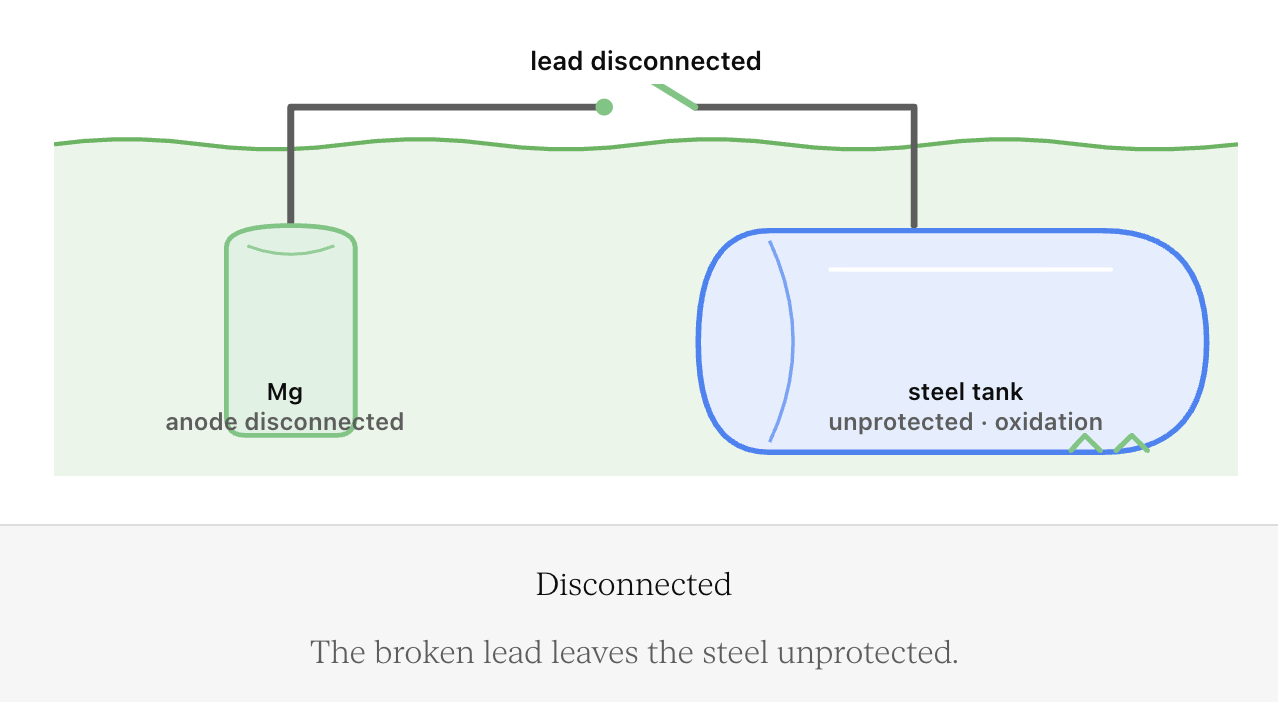
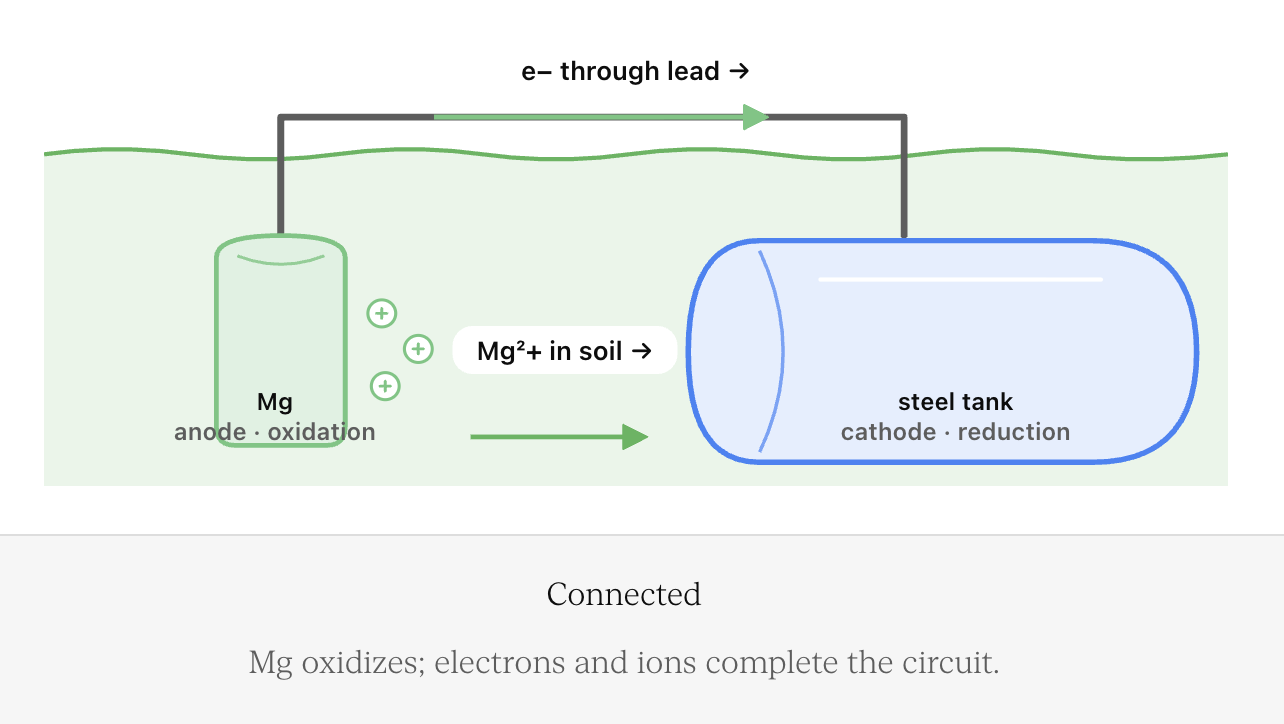
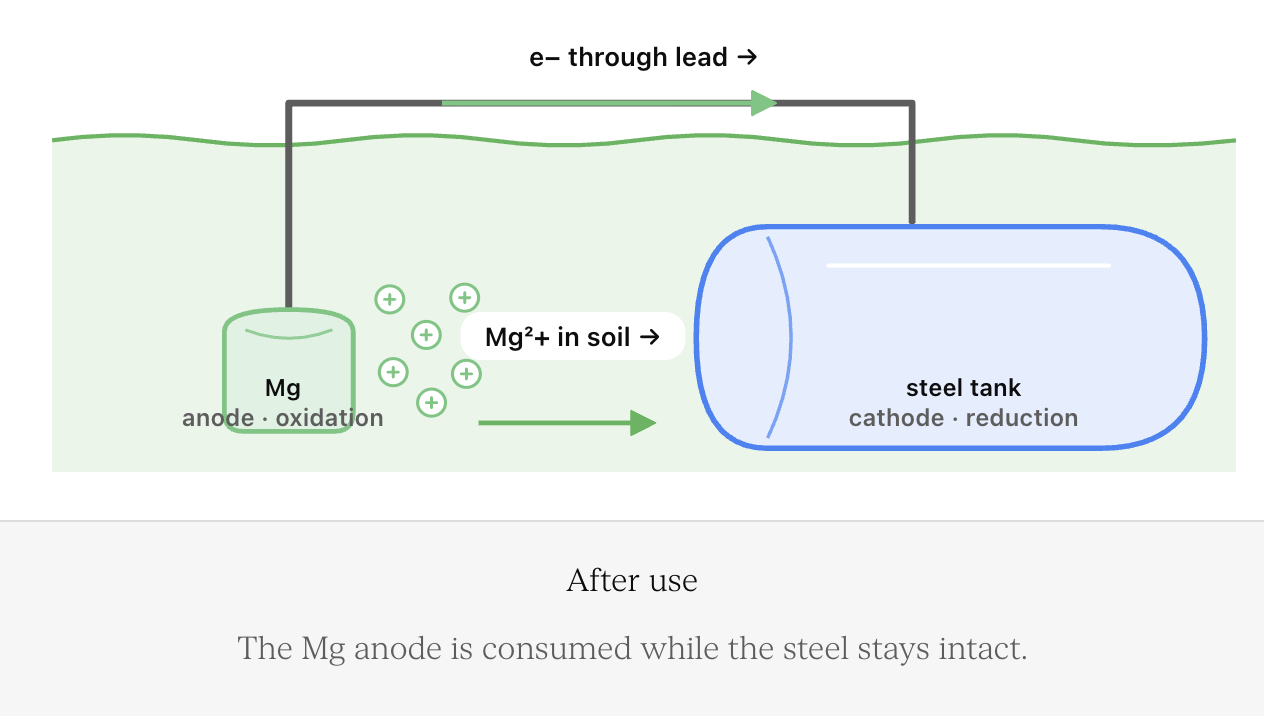
The interactive model shows the key idea: the sacrificial metal is oxidized while the steel structure is maintained as the cathode.
Why Is It Called a Sacrificial Anode?
The anode is deliberately allowed to:
corrode.
It is sacrificed to protect the more valuable structure.
Over time, the sacrificial anode becomes smaller and eventually needs to be:
replaced.
This is much easier and cheaper than replacing an entire ship, pipeline, or storage tank.
Electron Flow in Sacrificial Protection
Consider magnesium connected to steel.
Magnesium oxidizes:
Mg → Mg²⁺ + 2e⁻
The released electrons travel through the metallic connection toward the:
steel.
The steel receives electrons and is maintained as a:
cathodic surface.
This suppresses oxidation of iron:
Fe → Fe²⁺ + 2e⁻
and therefore reduces corrosion.
Where Is Sacrificial Protection Used?
Sacrificial anodes can protect:
- ship hulls
- boat engines
- underground tanks
- water heaters
- pipelines
- offshore structures
- marine equipment
The sacrificial metal is selected according to the structure and:
environment.


Sacrificial Anodes on Ships
A ship's steel hull spends long periods in:
seawater.
Seawater is a good electrolyte because it contains many dissolved ions.
Pieces of suitable sacrificial metal can be attached to the hull.
These anodes corrode preferentially, helping protect the:
steel hull.
Sacrificial Anodes in Water Heaters
Many water heaters contain a sacrificial:
anode rod.
The rod is often made from magnesium, aluminum-based material, or another suitable alloy.
The rod corrodes preferentially and helps protect the steel tank.
Eventually the rod may need to be:
replaced.
Impressed-Current Cathodic Protection
Large structures may use another system called:
impressed-current cathodic protection, or ICCP.
Instead of relying only on the natural potential difference between metals, an external DC power source supplies electrons to the structure.
The structure is maintained as the:
cathode.
Separate anodes are installed in the surrounding electrolyte.
Where Is Impressed-Current Protection Used?
ICCP can be used for large structures such as:
- long pipelines
- large storage tanks
- ship hulls
- offshore structures
- buried steel infrastructure
It is particularly useful when a large amount of metal must be:
protected.


Sacrificial vs Impressed-Current Protection
| Feature | Sacrificial Anode | Impressed Current |
|---|---|---|
| Energy source | Natural potential difference | External DC supply |
| Anode | Reactive sacrificial metal | Usually durable specialized anode |
| Maintenance | Anodes replaced as consumed | Electrical system monitored |
| Complexity | Relatively simple | More complex |
| Typical use | Smaller/local systems | Large structures and pipelines |
| Control | Limited | Can be adjusted |
Neither method is universally best.
The appropriate system depends on:
size, environment, cost, and engineering requirements.
Coatings and Cathodic Protection Together
Engineering systems often use more than one corrosion-control method.
For example, a buried pipeline may have:
a protective coating + cathodic protection.
The coating reduces the amount of metal exposed to the environment.
Cathodic protection protects areas where the coating has:
defects or damage.
Combining methods can provide much better protection than relying on only:
one system.
Stainless Steel and Alloying
Another strategy is to change the:
material itself.
Stainless steels contain chromium.
Chromium helps form a thin, adherent, protective oxide layer on the surface.
This layer is called a:
passive film.
It greatly reduces further corrosion under many conditions.


Passivation
Passivation occurs when a metal forms a thin surface layer that slows further reaction.
Metals that can show useful passivation include:
- aluminum
- chromium
- stainless steel
- titanium
Unlike porous rust, a good passive layer can strongly limit contact between the underlying metal and:
the environment.
Aluminum and Corrosion
Aluminum is reactive, but it often appears highly corrosion resistant.
This is because aluminum rapidly develops a thin layer of:
aluminum oxide.
The oxide layer adheres strongly to the surface and helps prevent further:
oxidation.
This demonstrates that a reactive metal is not necessarily a metal that corrodes rapidly under all:
conditions.
Corrosion Inhibitors
A corrosion inhibitor is a chemical added in relatively small amounts to an environment to reduce:
corrosion rate.
Inhibitors may work by:
- forming protective surface films
- slowing oxidation
- slowing reduction reactions
- changing solution chemistry
They can be used in systems such as:
- cooling systems
- boilers
- industrial equipment
- closed water systems
Comparing Corrosion-Prevention Methods
Different methods solve different problems.
| Method | How It Works | Main Advantage | Limitation |
|---|---|---|---|
| Paint | Blocks environment | Simple and inexpensive | Damage exposes metal |
| Oil/grease | Blocks water and oxygen | Good for moving parts | Must be reapplied |
| Electroplating | Adds protective metal surface | Improves several properties | Coating can be damaged |
| Galvanizing | Zinc coating + sacrificial action | Protects steel even at small scratches | Zinc is gradually consumed |
| Alloying | Changes material composition | Protection throughout material | Often more expensive |
| Sacrificial anode | More reactive metal oxidizes | Simple electrochemical protection | Anode must be replaced |
| Impressed current | External supply keeps structure cathodic | Effective for large structures | Requires equipment and monitoring |
| Inhibitors | Slow corrosion reactions | Useful in fluid systems | Requires chemical control |
Why Corrosion Control Matters
Corrosion is much more than an appearance problem.
It can weaken:
structures and equipment.
If enough material is lost, a component can eventually:
fail.
This makes corrosion control important for:
- safety
- reliability
- economics
- environmental protection
- infrastructure lifetime
Bridges
Steel bridges are exposed to:
- rain
- humidity
- oxygen
- pollutants
- sometimes road salt
Corrosion can reduce the thickness and strength of steel components.
Engineers therefore use:
- protective coatings
- corrosion-resistant materials
- drainage
- inspections
- maintenance


Pipelines
Pipelines may be buried underground or exposed to water and soil.
These environments can create conditions for:
electrochemical corrosion.
Pipeline protection commonly combines:
coatings and cathodic protection.
Regular monitoring allows engineers to determine whether the protection system is:
working correctly.
Ships and Offshore Structures
Marine environments are particularly challenging because seawater is an effective:
electrolyte.
Ships and offshore structures may use combinations of:
- protective coatings
- sacrificial anodes
- impressed-current systems
- corrosion-resistant materials
Without corrosion control, their service lives could be significantly:
reduced.
Storage Tanks
Corrosion in storage tanks can potentially lead to:
leaks.
Depending on what the tank contains, this could cause:
- loss of product
- contamination
- environmental damage
- fire hazards
- expensive repairs
Corrosion prevention is therefore an important part of:
engineering risk management.
Reinforced Concrete
Concrete structures often contain:
steel reinforcement bars.
Normally, the concrete environment helps protect the steel.
However, chloride ions or other environmental changes can damage the protective conditions.
The steel may then corrode.
Rust products occupy more volume than the original iron, which can create pressure and cause:
cracking and spalling of concrete.


Economic Importance of Corrosion Control
Replacing damaged infrastructure can be extremely:
expensive.
Corrosion control can extend the useful life of:
- bridges
- pipelines
- vehicles
- buildings
- ships
- industrial equipment
Preventive maintenance can therefore reduce:
long-term costs.
Safety Importance
Corrosion can reduce the strength of a component without immediately being:
obvious.
Serious corrosion can contribute to failures involving:
- pressure vessels
- pipelines
- structural supports
- transportation equipment
Engineers therefore inspect critical systems and monitor corrosion as part of:
safe operation.
Environmental Importance
Corrosion can cause leaks from:
- pipelines
- storage tanks
- industrial equipment
A leak can release chemicals, fuels, or other substances into the:
environment.
Preventing corrosion therefore helps prevent some forms of:
pollution.
Choosing a Corrosion-Control Method
Engineers must consider several factors.
These include:
- type of metal
- environment
- expected lifetime
- structure size
- accessibility
- maintenance requirements
- safety consequences
- cost
- possibility of coating damage
- availability of electrical power
The best solution may combine:
several methods.
Worked Example 1
Iron is exposed to moist air.
Write the oxidation half-equation.
Fe → Fe²⁺ + 2e⁻
Iron loses electrons.
Therefore iron is:
oxidized.
Worked Example 2
Where does corrosion occur in an electrochemical corrosion cell?
Metal loss occurs primarily at:
anodic regions.
This is where metal atoms lose electrons and enter the electrolyte as:
ions.
Worked Example 3
Why does salt water often increase corrosion?
Salt water contains mobile ions.
These increase the electrical conductivity of the electrolyte, allowing electrochemical corrosion reactions to proceed more readily.
Worked Example 4
A steel pipeline is connected to blocks of magnesium.
Which metal is the sacrificial anode?
Magnesium.
Magnesium oxidizes:
Mg → Mg²⁺ + 2e⁻
The steel is maintained as the:
cathode.
Worked Example 5
Why must magnesium anodes eventually be replaced?
Magnesium atoms are continuously oxidized and leave the anode as:
Mg²⁺ ions.
The magnesium block therefore gradually:
loses mass.
Worked Example 6
Why can galvanizing protect scratched steel?
Zinc is more readily oxidized than iron.
If electrical contact remains, nearby zinc can act sacrificially:
Zn → Zn²⁺ + 2e⁻
This helps suppress oxidation of the exposed:
iron.
Worked Example 7
Why might paint alone be insufficient for a buried pipeline?
Paint or another coating can develop:
defects or damage.
Exposed steel could then corrode.
Combining the coating with cathodic protection provides protection at some exposed areas.
Worked Example 8
Why is stainless steel corrosion resistant?
Chromium in stainless steel promotes formation of a thin, adherent:
passive oxide layer.
This layer reduces further reaction between the metal and its:
environment.
Worked Example 9
Why might impressed-current protection be selected for a long pipeline?
A long pipeline has a large surface area and may require substantial, controllable protection.
An impressed-current system allows engineers to adjust the protective:
current.
Worked Example 10
A ship uses sacrificial zinc anodes.
After several years the zinc blocks are much smaller.
Is the system failing?
Not necessarily.
The loss of zinc is evidence that the sacrificial anodes have been:
oxidized as intended.
They must be inspected and replaced before they become too depleted to provide adequate protection.
Common Mistake: Rust Is the Same as Corrosion
Corrosion is the broader process of material deterioration.
Rust refers specifically to corrosion products associated with:
iron and steel.
Other metals corrode but do not:
rust.
Common Mistake: Corrosion Is Not a Redox Reaction
Corrosion involves:
Metal oxidation occurs at anodic regions, while another species is reduced at cathodic regions.
Therefore corrosion is fundamentally:
electrochemical.
Common Mistake: The Cathode Corrodes
Metal dissolution occurs at the:
anode.
Cathodic protection works precisely because the valuable structure is maintained as the:
cathode.
Common Mistake: Sacrificial Anodes Stop Reacting
Sacrificial anodes protect a structure because they:
do react.
They are deliberately oxidized.
Their consumption is part of the:
protection mechanism.
Common Mistake: Paint and Cathodic Protection Work the Same Way
They use different mechanisms.
Paint provides:
barrier protection.
Cathodic protection controls:
electrochemical reactions.
They can therefore be particularly effective when:
used together.
Common Mistake: Stainless Steel Cannot Corrode
Stainless steel is highly corrosion resistant under many conditions, but it is not:
completely immune.
Its passive layer can break down in certain environments, particularly under some chloride-rich conditions.
Check Your Understanding
- Define corrosion.
- Why is corrosion considered an electrochemical process?
- What happens to metal atoms during corrosion?
- What two substances are normally required for iron to rust?
- Write the oxidation half-equation for iron.
- Where does oxidation occur in a corrosion cell?
- Where does reduction occur?
- How do electrons move during corrosion?
- How do ions move during corrosion?
- Write a possible oxygen-reduction half-equation in neutral water.
- What is rust?
- Why does rust not usually provide effective protection to iron?
- Explain how water contributes to corrosion.
- Explain how oxygen contributes to corrosion.
- Why does salt water often increase corrosion?
- How can acidic conditions affect corrosion?
- What is galvanic corrosion?
- Why can contact between different metals accelerate corrosion?
- What is barrier protection?
- Give three examples of barrier protection.
- Explain how painting prevents corrosion.
- State one limitation of paint.
- Explain how oil or grease prevents corrosion.
- What is galvanizing?
- Why is zinc used to protect steel?
- Write the oxidation half-equation for zinc.
- Why can galvanized steel remain protected after a small scratch?
- Define cathodic protection.
- Why does making a structure the cathode reduce its corrosion?
- What is a sacrificial anode?
- Name three metals or metal systems commonly used as sacrificial anodes.
- Write the oxidation half-equation for magnesium.
- Describe how magnesium can protect steel.
- Why must sacrificial anodes be replaced?
- Give three applications of sacrificial-anode protection.
- What is impressed-current cathodic protection?
- How does it differ from sacrificial-anode protection?
- Why might impressed current be suitable for a long pipeline?
- Why are coatings and cathodic protection often used together?
- What is passivation?
- Why is stainless steel corrosion resistant?
- Why does aluminum often resist corrosion despite being reactive?
- What is a corrosion inhibitor?
- Compare painting and galvanizing.
- Compare galvanizing and sacrificial-anode cathodic protection.
- Compare sacrificial-anode and impressed-current systems.
- Explain why corrosion control is important for bridges.
- Explain why corrosion control is important for pipelines.
- Explain one environmental consequence of uncontrolled corrosion.
- Evaluate which corrosion-control methods might be appropriate for a steel structure exposed to seawater.
Key Terms
Corrosion: Gradual deterioration of a material through chemical or electrochemical reactions with its environment.
Rust: Mixture of hydrated iron oxides and related corrosion products formed when iron or steel corrodes.
Anode: Region where oxidation occurs.
Cathode: Region where reduction occurs.
Oxidation: Loss of electrons.
Reduction: Gain of electrons.
Electrolyte: Medium containing mobile ions that can carry electrical charge.
Galvanic corrosion: Corrosion caused or accelerated when dissimilar metals are electrically connected in an electrolyte.
Barrier protection: Prevention of corrosion by physically separating a metal from its environment.
Galvanizing: Coating iron or steel with zinc for corrosion protection.
Cathodic protection: Corrosion-control method in which the structure being protected is maintained as a cathode.
Sacrificial anode: More reactive metal deliberately oxidized to protect another metal.
Impressed-current cathodic protection: Cathodic protection using an external electrical power source.
Passivation: Formation of a protective surface layer that slows further corrosion.
Corrosion inhibitor: Chemical used to reduce the rate of corrosion.
Key Takeaways
- Corrosion is fundamentally an electrochemical redox process.
- During metal corrosion, oxidation occurs at anodic regions.
- For iron, the anodic reaction can be written as Fe → Fe²⁺ + 2e⁻.
- Water and oxygen are important in ordinary rusting.
- Salt often accelerates corrosion by increasing the conductivity of the electrolyte.
- Contact between different metals can cause galvanic corrosion.
- Barrier coatings protect metals by separating them from the environment.
- Galvanizing protects steel using both a zinc barrier and sacrificial action.
- Cathodic protection prevents corrosion by making the valuable structure behave as the cathode.
- Sacrificial anodes made from suitable reactive metals corrode instead of the protected structure.
- Impressed-current systems use an external electrical supply and are useful for large structures.
- Passivation allows metals such as stainless steel and aluminum to resist corrosion under many conditions.
- Engineers often combine coatings and cathodic protection for improved reliability.
- Corrosion control is critical for safety, infrastructure lifetime, environmental protection, and economic efficiency.
- Effective corrosion management requires selecting a protection system appropriate to the material, environment, cost, and engineering risk.
4. Bioelectricity in Living Systems
Learning outcomes
- I can explain how electrical signals occur in living organisms.
- I can describe the role of ions in bioelectric processes.
- I can explain how cells maintain electrical potentials.
- I can identify examples of bioelectricity in nature.
- I can relate electrochemistry concepts to biological systems.


What Is Bioelectricity?
Bioelectricity refers to electrical phenomena produced by living cells and organisms.
Your nervous system, muscles, heart, and many other tissues depend on electrical signals.
These signals allow organisms to:
- detect changes in their surroundings
- transmit information
- control muscles
- coordinate organs
- maintain internal conditions
- respond rapidly to stimuli
Bioelectricity is closely connected to electrochemistry because it depends on the movement and separation of:
charged ions.
Electricity in Living Organisms
Electricity involves the movement or separation of:
electric charge.
In a metal wire, electrical charge is mainly carried by:
electrons.
Inside biological fluids, electrical charge is mainly carried by:
ions.
Important biological ions include:
- sodium ions, Na⁺
- potassium ions, K⁺
- calcium ions, Ca²⁺
- chloride ions, Cl⁻
- hydrogen ions, H⁺
The movement of these charged particles produces many of the electrical effects found in:
living systems.
Biological Systems Are Electrochemical
Bioelectricity combines two ideas:
electrical forces
and:
chemical concentration differences.
Ions are affected by both.
An ion may move because:
- it is attracted or repelled by electrical charge
- it moves down a concentration gradient
Together these influences create an:
electrochemical gradient.
This is one of the most important links between electrochemistry and biology.
The Cell Membrane
Every cell is surrounded by a:
cell membrane.
The membrane separates the inside of the cell from the surrounding extracellular fluid.
Importantly, the membrane does not allow every substance to cross equally easily.
It is:
selectively permeable.
This allows cells to maintain different ion concentrations on opposite sides of the membrane.


Unequal Ion Distribution
Living cells maintain different concentrations of ions inside and outside their membranes.
For a typical animal cell:
Na⁺ concentration is higher outside the cell.
K⁺ concentration is higher inside the cell.
Other ions also contribute to the overall charge distribution.
Because ions carry electrical charge, separating them across a membrane creates an electrical:
potential difference.
Membrane Potential
The difference in electrical potential between the inside and outside of a cell is called the:
membrane potential.
Voltage is another name for:
electrical potential difference.
Therefore a cell membrane behaves in some ways like a tiny electrical system with different electrical conditions on its two sides.
The membrane potential is measured in:
millivolts (mV).
One millivolt is:
0.001 V.
Resting Membrane Potential
When an excitable cell such as a neuron is not actively sending a signal, it maintains a:
resting membrane potential.
For many neurons, the inside of the cell is approximately:
−70 mV
relative to the outside, although the exact value varies among cells.
The negative sign means that the inside is electrically more negative than the:
outside.
How Is the Resting Potential Created?
The resting membrane potential develops because of several interacting factors:
- unequal ion concentrations
- selective membrane permeability
- ion channels
- active transport
- negatively charged molecules inside the cell
The membrane is especially permeable to K⁺ through certain:
leak channels.
As K⁺ moves, charge becomes separated across the membrane.
Ion Channels
Ion channels are proteins that allow particular ions to cross the cell membrane.
Different channels may be selective for:
- Na⁺
- K⁺
- Ca²⁺
- Cl⁻
Some channels remain open much of the time.
Others open or close in response to:
- voltage changes
- chemical signals
- mechanical forces
Ion channels allow cells to control the movement of:
electrical charge.


The Sodium-Potassium Pump
Cells also use an important membrane protein called the:
sodium-potassium pump.
The pump uses energy from ATP to transport ions against their concentration gradients.
For each cycle, it typically moves:
3 Na⁺ out of the cell
and:
2 K⁺ into the cell.
This helps maintain the Na⁺ and K⁺ concentration gradients needed for:
electrical signaling.
Active Transport Requires Energy
Moving ions against their concentration gradients requires:
energy.
The sodium-potassium pump obtains this energy from:
ATP.
Therefore maintaining the ion gradients needed for bioelectricity ultimately depends on the cell's:
metabolism.
Cells continuously use energy to maintain the conditions required for electrical activity.
An Electrochemical Battery?
A useful analogy is to think of a cell membrane as part of a tiny:
electrochemical energy-storage system.
There are different concentrations of ions on opposite sides of the membrane.
The membrane controls when those ions can:
move.
When ion channels open, ions move according to their electrochemical gradients.
However, a living membrane is much more complex and actively regulated than an ordinary:
battery.
Neurons
A neuron is a specialized cell that transmits information through the nervous system.
Neurons communicate using:
electrical and chemical signals.
Major parts of a neuron include:
- dendrites
- cell body
- axon
- axon terminals
Electrical signals can travel along the:
axon.


Action Potentials
A rapid electrical signal traveling along a neuron is called an:
action potential.
An action potential involves a temporary change in the:
membrane potential.
This occurs because specific ion channels open and close in a carefully controlled sequence.
The major ions involved are:
Na⁺ and K⁺.
Starting an Action Potential
A stimulus can change the membrane potential.
If the change reaches a sufficient:
threshold,
voltage-gated sodium channels open.
Na⁺ ions move rapidly:
into the neuron.
This makes the inside of the membrane less negative and eventually positive relative to the outside.
This process is called:
depolarization.
Depolarization
During depolarization:
Na⁺ channels open
and:
Na⁺ moves into the cell.
Why?
Na⁺ is influenced by its:
electrochemical gradient.
Its concentration is higher outside the cell, and the electrical conditions also favor inward movement during the early part of the action potential.
The membrane potential rapidly:
increases.
Repolarization
After a short time, sodium channels become inactivated and voltage-gated potassium channels open.
K⁺ moves:
out of the cell.
This causes the membrane potential to become negative again.
This stage is called:
repolarization.
Hyperpolarization
Potassium channels may remain open slightly longer than required to return directly to the resting potential.
The membrane can temporarily become more negative than its normal resting value.
This is called:
hyperpolarization.
The membrane then returns toward its normal resting state.


The Action Potential Sequence
The basic sequence is:
Resting state
↓
Threshold reached
↓
Na⁺ channels open
↓
Na⁺ enters
↓
Depolarization
↓
Na⁺ channels inactivate and K⁺ channels open
↓
K⁺ leaves
↓
Repolarization
↓
Brief hyperpolarization
↓
Return toward resting conditions
This sequence allows neurons to transmit information rapidly over relatively long distances within the:
body.
Does Electricity Travel Along a Neuron Like a Wire?
Not exactly.
In a metal wire, electrons move through the:
metal.
In neurons, electrical signaling depends mainly on movements of ions across the cell membrane and electrical effects spreading along the:
membrane.
An action potential is repeatedly regenerated as it travels.
Therefore a nerve impulse is an:
electrochemical signal.
Propagation Along the Axon
When one region of an axon depolarizes, it affects the electrical conditions in the:
adjacent region.
This can cause nearby voltage-gated channels to open.
A new action potential is generated there.
The process repeats along the:
axon.
This allows the electrical signal to propagate without simply fading away.
Myelin
Many neurons are surrounded by an insulating material called:
myelin.
Myelin reduces ion movement across most of the covered membrane.
Action potentials are regenerated mainly at gaps called:
nodes of Ranvier.
The signal effectively jumps from node to node.
This is called:
saltatory conduction.


Communication Between Neurons
Neurons usually do not physically touch each other.
The small junction between neurons is called a:
synapse.
When an action potential reaches an axon terminal, it can trigger Ca²⁺ channels to open.
Calcium ions enter the terminal and help trigger the release of:
neurotransmitters.
Chemical and Electrical Communication
At many synapses:
electrical signal → chemical signal → electrical response
The neurotransmitter crosses the synaptic gap and binds to receptors on the next cell.
This can cause ion channels to:
open or close.
The resulting ion movement changes the membrane potential of the next cell.


Bioelectricity and Muscles
Muscle cells also use changes in membrane potential.
A motor neuron sends a signal to a muscle.
This triggers electrical activity in the muscle cell membrane.
The electrical signal helps cause the release of:
Ca²⁺ ions inside the muscle cell.
Calcium then helps initiate the interactions between proteins that produce:
muscle contraction.
Your Heart Is Electrical
The heart depends on coordinated electrical activity.
Specialized cells generate and conduct electrical signals that cause the heart muscle to contract in an organized pattern.
The natural pacemaker of the heart is the:
sinoatrial (SA) node.
Electrical signals spread through the heart and coordinate contraction of the:
atria and ventricles.


The Electrocardiogram
Electrical activity in the heart produces voltage changes that can be detected at the skin.
An:
electrocardiogram (ECG or EKG)
records these electrical changes.
An ECG does not directly measure the force of the heartbeat.
It records patterns associated with the heart's:
electrical activity.
The Brain Is Electrical Too
The brain contains billions of neurons whose activity depends on:
electrochemical signaling.
The combined electrical activity of populations of brain cells can produce voltage changes detectable at the scalp.
An:
electroencephalogram (EEG)
records patterns of this electrical activity.
Sensory Systems
Bioelectricity is also essential for our senses.
Sensory cells convert environmental stimuli into electrical signals.
Examples include:
light → electrical signals in the retina
sound vibrations → electrical signals in the inner ear
pressure → electrical signals in touch receptors
chemicals → electrical signals in taste and smell systems
This conversion of a stimulus into a biological signal is called:
sensory transduction.
Electric Fish
Some organisms produce much stronger electrical effects than humans.
Electric eels and certain other fish contain specialized cells called:
electrocytes.
Electrocytes generate electrical potential differences using ion gradients across their membranes.
Large numbers of these cells can work together to produce a substantial:
electric discharge.


Electrocytes
Electrocytes are modified cells specialized for producing electrical potentials.
One electrocyte produces only a relatively small voltage.
However, many electrocytes can be arranged so that their voltages:
add together.
This is conceptually similar to connecting electrical cells:
in series.
The resulting electric organ can produce much larger potential differences.
Why Do Electric Fish Produce Electricity?
Different electric fish use electrical signals for different purposes.
These can include:
- sensing their surroundings
- communication
- navigation
- defense
- capturing prey
This provides a dramatic example of how evolution has adapted biological ion movement for specialized:
functions.
Electroreception
Some animals can detect weak electric fields.
This ability is called:
electroreception.
It occurs in several groups of aquatic animals.
Electroreception can help animals:
- locate prey
- navigate
- detect nearby organisms
- communicate


Sharks and Electroreception
Sharks possess specialized sensory structures called:
ampullae of Lorenzini.
These organs can detect weak electric fields in the surrounding water.
Because muscle and nerve activity in animals produces electrical signals, electroreception can help a shark detect:
nearby organisms.
Plants Also Use Electrical Signals
Bioelectricity is not limited to animals.
Plants maintain ion gradients across cell membranes and can produce changes in membrane potential.
Electrical signals contribute to responses involving:
- injury
- environmental stimuli
- movement
- communication between plant tissues
Some plants show particularly noticeable electrical responses.
The Venus Flytrap
The Venus flytrap provides a striking example.
Touching sensitive trigger hairs can initiate electrical signals.
If appropriate stimulation occurs within a short period, the trap can:
close rapidly.
Ion movement and electrical signaling therefore contribute to a plant response that is easily:
observed.


Bioelectricity and Electrochemistry
The same fundamental principles studied in electrochemistry also appear in biological systems.
Both involve:
- charged particles
- potential differences
- movement of charge
- concentration gradients
- selective pathways for charge movement
- energy transformations
However, biological systems primarily move:
ions through membranes
rather than electrons through metallic wires.
Concentration Gradients as Stored Energy
Creating an ion concentration gradient requires:
energy.
Once established, the gradient stores potential energy.
When channels open, ions can move down their:
electrochemical gradients.
Cells use this stored energy for:
- electrical signaling
- transport
- muscle activity
- ATP production
- maintaining cellular conditions
Electrical Gradient vs Concentration Gradient
Consider a positive ion such as K⁺.
A concentration gradient tends to move K⁺ from an area of high concentration toward an area of:
lower concentration.
An electrical gradient may attract K⁺ toward a negatively charged region.
Sometimes these forces act in the:
same direction.
Sometimes they oppose each other.
Their combined effect is the:
electrochemical gradient.
Electrochemical Equilibrium
Eventually, the chemical tendency for an ion to diffuse can be balanced by the electrical force acting on that ion.
At this point there may be no net movement of that particular ion.
The voltage associated with this balance is called its:
equilibrium potential.
Different ions have different equilibrium potentials because their concentration gradients are:
different.
Membranes and Batteries: A Useful Comparison
A biological membrane and an electrochemical cell have some useful similarities.
| Electrochemical Cell | Biological Cell |
|---|---|
| Electrolyte contains ions | Cellular fluids contain ions |
| Charge separation creates voltage | Ion separation creates membrane potential |
| Chemical reactions can move charge | Membrane proteins control ion movement |
| Chemical energy can produce electrical energy | Ion gradients can produce electrical signals |
| Voltage depends on chemical conditions | Membrane potential depends on ion concentrations and permeability |
The comparison is useful, but biological membranes are highly dynamic and actively:
regulated.
Measuring Bioelectricity
Bioelectric signals can be measured using:
electrodes.
Electrodes detect differences in electrical potential.
Examples include:
- ECG — heart activity
- EEG — brain activity
- EMG — muscle activity
An electromyogram (EMG) measures electrical activity associated with:
muscles.
Why Electrolytes Matter in the Body
In biology, the term electrolyte refers to substances that produce ions when dissolved in body fluids.
Important electrolytes include ions such as:
- Na⁺
- K⁺
- Ca²⁺
- Cl⁻
These ions are essential for:
- nerve signaling
- muscle contraction
- membrane potentials
- fluid balance
- many cellular processes
The word electrolyte therefore has a direct connection to:
electrochemistry.
Worked Example 1
A neuron has a high Na⁺ concentration outside and a lower Na⁺ concentration inside.
A sodium channel opens.
What tends to happen?
Na⁺ tends to move:
into the neuron.
This movement contributes to:
depolarization.
Worked Example 2
During an action potential, voltage-gated potassium channels open.
What happens?
K⁺ moves primarily:
out of the neuron.
This helps return the membrane potential toward a negative value.
This process contributes to:
repolarization.
Worked Example 3
What does the sodium-potassium pump do?
It uses ATP to move:
3 Na⁺ out
and:
2 K⁺ in
during each cycle.
This helps maintain the ion concentration gradients required for:
membrane potentials.
Worked Example 4
Why is a membrane potential measured in volts?
A membrane potential represents a difference in:
electrical potential
between two locations.
Voltage is the measurement of electrical potential difference.
Worked Example 5
Why is an action potential described as electrochemical?
Its behavior depends on both:
electrical forces
and:
chemical concentration gradients.
Charged ions move across the membrane according to their electrochemical gradients.
Worked Example 6
How is a neuron different from a copper wire?
A copper wire primarily carries electrical charge through the movement of:
electrons.
A neuron generates electrical signals primarily through controlled movement of:
ions across its membrane.
Worked Example 7
Why does the sodium-potassium pump require ATP?
It moves ions against their:
concentration gradients.
This is active transport and therefore requires an input of:
energy.
Worked Example 8
How can an electric eel generate a much larger voltage than a single biological cell?
Its electric organs contain many:
electrocytes.
Their electrical potentials can combine, producing a much larger overall:
potential difference.
Worked Example 9
Why can an ECG detect heart activity from the skin?
Coordinated electrical activity in the heart produces changing electrical potentials that spread through body tissues.
Electrodes placed on the skin can detect these:
potential differences.
Worked Example 10
How does bioelectricity demonstrate electrochemistry?
Biological systems use:
ions, concentration gradients, potential differences, membranes, and controlled charge movement.
These are fundamental electrochemical concepts operating inside:
living organisms.
Common Mistake: Nerves Carry Electrons Like Wires
Nerve signals are not streams of electrons moving along the axon like electrons through a copper wire.
Neuronal signaling primarily depends on:
ions moving across cell membranes.
Common Mistake: The Sodium-Potassium Pump Creates Each Action Potential
The sodium-potassium pump is essential for maintaining long-term ion gradients.
However, the rapid changes during an individual action potential are mainly produced by ions moving through:
voltage-gated channels.
Common Mistake: The Inside of a Neuron Is Always Negative
At rest, the inside is normally negative relative to the outside.
During an action potential, the membrane potential can temporarily become:
positive.
Common Mistake: Only Animals Use Bioelectricity
Plants, fungi, microorganisms, and animals all use ion gradients and membrane potentials.
Bioelectric phenomena are therefore widespread throughout:
living systems.
Common Mistake: Electricity and Chemistry Are Separate in Biology
In biological systems, they are closely connected.
The distribution of chemical ions creates electrical potentials, while electrical forces affect how those ions:
move.
That is why the term:
electrochemical gradient
is so important.
Check Your Understanding
- Define bioelectricity.
- What particles mainly carry electrical charge in biological fluids?
- Name four important biological ions.
- What is an electrochemical gradient?
- Why is the cell membrane important for bioelectricity?
- What does selectively permeable mean?
- Which ion is generally more concentrated outside a typical neuron: Na⁺ or K⁺?
- Which is generally more concentrated inside?
- Define membrane potential.
- What unit is commonly used for membrane potential?
- What is a resting membrane potential?
- What is an approximate resting potential for many neurons?
- What is an ion channel?
- What does the sodium-potassium pump do?
- How many Na⁺ ions are transported during one pump cycle?
- How many K⁺ ions are transported?
- Why does the sodium-potassium pump require ATP?
- Define an action potential.
- What causes depolarization during a typical neuronal action potential?
- Which ion moves into the neuron during depolarization?
- What causes repolarization?
- Which ion moves out of the neuron during repolarization?
- What is hyperpolarization?
- What is threshold?
- How does an action potential propagate along an axon?
- What is myelin?
- What are nodes of Ranvier?
- Explain saltatory conduction.
- What is a synapse?
- What role does Ca²⁺ play at many chemical synapses?
- How are electrical and chemical signals connected at a synapse?
- Explain how bioelectricity contributes to muscle contraction.
- What is the SA node?
- What does an ECG measure?
- What does an EEG measure?
- What does an EMG measure?
- What is sensory transduction?
- What are electrocytes?
- How can electric fish generate relatively large voltages?
- Give three uses of electrical signals by electric fish.
- Define electroreception.
- Give an example of an animal that uses electroreception.
- Give an example of electrical signaling in a plant.
- Explain how a concentration gradient can store potential energy.
- Distinguish between an electrical gradient and a concentration gradient.
- Explain why biological electrical signals are described as electrochemical.
- Compare electrical conduction in a metal wire with signaling in a neuron.
- Compare an electrochemical cell with a biological membrane.
- Explain why maintaining ion gradients requires cellular energy.
- Explain how the principles of electrochemistry help us understand nerve signals, muscle activity, and other biological processes.
Key Terms
Bioelectricity: Electrical phenomena produced by living cells and organisms.
Ion: Electrically charged atom or group of atoms.
Membrane potential: Electrical potential difference across a cell membrane.
Resting membrane potential: Membrane potential of an excitable cell when it is not actively producing an electrical signal.
Electrochemical gradient: Combined effect of concentration and electrical gradients on an ion.
Ion channel: Membrane protein that allows particular ions to cross a cell membrane.
Sodium-potassium pump: Membrane protein that uses ATP to transport Na⁺ out of cells and K⁺ into cells.
Action potential: Rapid, temporary change in membrane potential used for electrical signaling.
Depolarization: Change in membrane potential that makes the inside of a cell less negative or more positive.
Repolarization: Return of membrane potential toward its resting negative value following depolarization.
Hyperpolarization: Temporary change making the membrane potential more negative than its resting level.
Synapse: Junction where a neuron communicates with another cell.
Electrocyte: Specialized cell used by electric fish to generate electrical potentials.
Electroreception: Ability to detect electric fields.
ECG: Recording of electrical activity associated with the heart.
EEG: Recording of electrical activity associated with the brain.
EMG: Recording of electrical activity associated with muscles.
Key Takeaways
- Bioelectricity depends primarily on the movement and separation of ions.
- Important biological ions include Na⁺, K⁺, Ca²⁺, and Cl⁻.
- Cell membranes maintain different ion concentrations inside and outside cells.
- Separation of charge across a membrane creates a membrane potential.
- The sodium-potassium pump helps maintain Na⁺ and K⁺ concentration gradients using energy from ATP.
- Ion channels allow controlled movement of ions across membranes.
- Neurons transmit information using rapid changes in membrane potential called action potentials.
- Na⁺ movement is important in depolarization, while K⁺ movement is important in repolarization.
- Nervous-system electricity is not simply electrons flowing through neurons like a metal wire.
- Muscle contraction and heartbeat coordination depend on electrical signaling.
- ECGs, EEGs, and EMGs can detect electrical activity produced by living tissues.
- Electric fish can produce strong electrical discharges using specialized electrocytes.
- Some animals use electroreception to detect weak electric fields.
- Plants also use electrical signals to coordinate responses.
- Bioelectricity demonstrates a direct connection between chemistry, electricity, and biology.
- The concept of an electrochemical gradient is central to understanding how living cells use electrical energy.
5. Nerve Impulses and Medical Applications
Learning outcomes
- I can explain how nerve impulses are generated and transmitted.
- I can describe the role of ion movement in nerve signaling.
- I can identify medical technologies that use bioelectric principles.
- I can explain how electrochemistry contributes to healthcare.
- I can evaluate the impact of bioelectrical technologies on modern medicine.


What Is a Nerve Impulse?
The nervous system allows information to travel rapidly throughout the body.
A nerve impulse is an electrical signal transmitted along a neuron.
More precisely, neurons transmit signals using rapid changes in the electrical potential across their cell membranes called:
action potentials.
These signals depend on the controlled movement of charged particles called:
ions.
The main ions involved include:
- sodium, Na⁺
- potassium, K⁺
- calcium, Ca²⁺
- chloride, Cl⁻
Nerve signaling is therefore an excellent example of:
bioelectrochemistry.
The Structure of a Neuron
A neuron is a specialized cell that receives and transmits information.
The major parts are:
Dendrites — receive signals from other cells.
Cell body — contains the nucleus and much of the cell's machinery.
Axon — carries electrical signals away from the cell body.
Axon terminals — communicate with other neurons, muscles, or glands.


The Resting Neuron
A neuron that is not currently producing an action potential still has an electrical potential difference across its membrane.
This is called the:
resting membrane potential.
For many neurons, it is approximately:
−70 mV.
This means that the inside of the neuron is electrically negative relative to the:
outside.
Why Is There a Resting Potential?
The resting potential results from an unequal distribution of ions across the:
cell membrane.
Typically:
Na⁺ concentration is higher outside the neuron.
K⁺ concentration is higher inside the neuron.
The membrane is selectively permeable, meaning some ions can cross more easily than:
others.
Together, ion concentration differences and membrane permeability create the resting membrane potential.
The Sodium-Potassium Pump
The sodium-potassium pump helps maintain the concentration gradients needed for nerve signaling.
It uses energy from:
ATP.
During each cycle it moves:
3 Na⁺ out
and:
2 K⁺ in.
This is a form of:
active transport.


Ion Channels
The neuron membrane contains specialized proteins called:
ion channels.
These allow specific ions to move across the membrane.
Some channels respond to changes in membrane voltage and are called:
voltage-gated ion channels.
Two especially important types are:
voltage-gated Na⁺ channels
and:
voltage-gated K⁺ channels.
Opening and closing these channels produces the rapid voltage changes of an:
action potential.
Generating a Nerve Impulse
A stimulus can cause the membrane potential to become less negative.
If the membrane reaches a critical value called the:
threshold,
an action potential begins.
For many neurons, threshold is around:
−55 mV, although this varies.
Once threshold is reached, voltage-gated Na⁺ channels rapidly:
open.
Depolarization
When voltage-gated Na⁺ channels open:
Na⁺ rushes into the neuron.
The inside becomes progressively less negative.
It can eventually become temporarily:
positive.
This stage is called:
depolarization.
The membrane potential may reach approximately:
+30 mV.


Why Does Sodium Move In?
Na⁺ is influenced by its:
electrochemical gradient.
There is a concentration gradient because Na⁺ concentration is higher outside the neuron.
There is also an electrical attraction between positively charged Na⁺ and the relatively negative cell interior.
When Na⁺ channels open, these effects favor movement:
into the neuron.
Repolarization
Near the peak of the action potential, Na⁺ channels become inactivated while voltage-gated K⁺ channels open.
K⁺ moves:
out of the neuron.
Positive charge therefore leaves the cell.
The membrane potential becomes negative again.
This process is called:
repolarization.
Hyperpolarization
K⁺ channels may remain open for slightly longer than needed.
Extra K⁺ leaves the cell.
The membrane potential temporarily becomes more negative than its normal resting value.
This is:
hyperpolarization.
The neuron then returns toward its resting electrical conditions.
The Complete Action Potential
The basic sequence is:
Resting potential
↓
Stimulus
↓
Threshold
↓
Na⁺ channels open
↓
Na⁺ enters
↓
Depolarization
↓
Na⁺ channels inactivate
↓
K⁺ channels open
↓
K⁺ leaves
↓
Repolarization
↓
Hyperpolarization
↓
Return toward resting potential
This sequence happens extremely:
quickly.
The All-or-None Principle
An action potential follows the:
all-or-none principle.
If threshold is not reached:
no action potential occurs.
If threshold is reached:
a full action potential occurs.
A stronger stimulus does not normally create a taller individual action potential.
Instead, stimulus intensity can often be represented by changes in the:
frequency of action potentials.
The Refractory Period
Immediately after an action potential begins, the neuron temporarily becomes unable, or less able, to produce another action potential.
This is called the:
refractory period.
It occurs partly because voltage-gated Na⁺ channels require time to recover from:
inactivation.
The refractory period helps ensure that action potentials normally travel along an axon in:
one direction.
Propagation of the Nerve Impulse
An action potential at one part of the axon creates electrical changes in nearby membrane.
These changes can bring the neighboring region to:
threshold.
Voltage-gated Na⁺ channels then open in that region.
A new action potential is generated.
The process repeats along the:
axon.


The Signal Is Regenerated
An action potential does not simply drift down an axon and gradually disappear.
Instead, each region of membrane triggers an action potential in the:
next region.
The signal is therefore repeatedly:
regenerated.
This allows information to travel considerable distances without the action potential becoming progressively smaller.
Myelin and Faster Transmission
Many axons are covered by an insulating layer called the:
myelin sheath.
Myelin reduces ion movement across most of the covered membrane.
Small gaps in the myelin are called:
nodes of Ranvier.
Action potentials are regenerated mainly at these:
nodes.


Saltatory Conduction
In a myelinated axon, electrical activity spreads rapidly beneath the myelin and action potentials are regenerated at successive nodes.
The signal therefore appears to jump from:
node to node.
This is called:
saltatory conduction.
It allows nerve impulses to travel much faster than they would along a comparable unmyelinated axon.
What Happens at the End of the Neuron?
Eventually the action potential reaches the:
axon terminal.
Most neurons communicate with the next cell across a tiny junction called a:
synapse.
At many synapses, the electrical signal is converted temporarily into a:
chemical signal.
Calcium and Neurotransmitter Release
When the action potential reaches the axon terminal, voltage-gated Ca²⁺ channels open.
Ca²⁺ enters the terminal.
This triggers vesicles containing:
neurotransmitters
to release their contents into the synaptic cleft.


Crossing the Synapse
The neurotransmitter diffuses across the synaptic cleft and binds to receptors on the next cell.
These receptors can affect:
ion channels.
This changes the membrane potential of the receiving cell.
The sequence can therefore be summarized as:
electrical signal
↓
chemical signal
↓
electrical response
Nerves and Muscles
Motor neurons transmit signals to:
muscle cells.
At the neuromuscular junction, neurotransmitter release causes electrical changes in the muscle membrane.
This eventually causes Ca²⁺ to become available inside the muscle cell.
Calcium helps trigger:
muscle contraction.
Therefore every deliberate movement you make depends on carefully controlled:
bioelectrical signaling.
Bioelectricity in Medicine
The body's electrical activity can be:
measured, interpreted, and modified.
This has led to many important medical technologies.
Examples include:
- ECG
- EEG
- EMG
- pacemakers
- defibrillators
- cochlear implants
- deep brain stimulation
- nerve stimulation
- brain-computer interfaces
These technologies apply principles of:
electricity, electrochemistry, and biology.
Electrocardiography
An electrocardiogram (ECG or EKG) records electrical activity associated with the:
heart.
Electrodes are placed on the skin.
They detect changing electrical potential differences produced as electrical activity spreads through heart tissue.


The ECG Trace
A typical ECG contains several recognizable features.
These include:
P wave
QRS complex
T wave
These correspond to patterns of electrical activation and recovery in different parts of the heart.
Doctors can use ECG information as one part of evaluating:
heart rhythm and electrical activity.
Electroencephalography
An electroencephalogram (EEG) records electrical activity associated with populations of neurons in the:
brain.
Electrodes placed on the scalp detect small voltage changes.
EEGs can provide useful information in areas such as:
- seizure evaluation
- sleep studies
- monitoring brain activity in certain clinical situations


Electromyography
Electromyography (EMG) measures electrical activity associated with:
muscles.
EMG testing can help investigate how muscles and the nerves controlling them are functioning.
It may involve:
- surface electrodes
- needle electrodes
depending on the type of examination.
Measuring Nerve Conduction
Electrical stimulation can also be used to investigate how effectively signals travel through:
peripheral nerves.
In a nerve conduction study, a nerve is stimulated and the resulting electrical response is measured.
Measurements such as conduction speed and response size can provide information about:
nerve function.
Pacemakers
The heart normally generates its own electrical rhythm.
In some situations, this rhythm can become too slow or otherwise require electrical support.
A pacemaker is an implanted medical device that can deliver carefully controlled electrical impulses to help regulate the:
heartbeat.


How a Pacemaker Uses Bioelectricity
A pacemaker can:
- monitor electrical activity
- detect when pacing is needed
- deliver electrical impulses
- stimulate heart muscle
The electrical impulse changes membrane potentials in cardiac cells and can initiate electrical activation of the:
heart tissue.
The device therefore interacts directly with the body's natural:
bioelectrical system.
Defibrillators
A defibrillator delivers a controlled electrical shock in certain dangerous abnormal heart rhythms.
The purpose is not simply to "restart" a completely stopped heart.
For shockable rhythms such as ventricular fibrillation, the shock can depolarize a large amount of cardiac tissue at once.
This may allow the heart's normal electrical control system to:
re-establish an organized rhythm.


Automated External Defibrillators
An AED is designed to analyze the heart's electrical rhythm and determine whether a shock is appropriate.
AEDs can be found in places such as:
- airports
- schools
- sports facilities
- shopping centers
- workplaces
Their design allows trained responders—and in many settings members of the public following device instructions—to provide rapid assistance during certain cardiac emergencies.
Pacemaker vs Defibrillator
These technologies both use electrical stimulation but serve different purposes.
| Pacemaker | Defibrillator |
|---|---|
| Delivers relatively small pacing impulses | Can deliver a much larger therapeutic shock |
| Helps regulate certain abnormal rhythms | Treats certain dangerous arrhythmias |
| Often works repeatedly as needed | Shock delivered when specific rhythm conditions occur |
| Interacts with cardiac electrical activity | Interacts with cardiac electrical activity |
Some implanted devices can provide both pacing and:
defibrillation functions.
Cochlear Implants
A cochlear implant is an electronic medical device that can provide auditory information to some people with severe hearing loss.
It converts sound into electrical signals that stimulate the:
auditory nerve.


How a Cochlear Implant Works
A simplified sequence is:
Sound enters microphone
↓
Processor analyzes sound
↓
Signals sent to implant
↓
Electrode array stimulates different regions of the cochlea
↓
Auditory nerve carries signals toward the brain
The device therefore uses controlled electrical stimulation to interact with:
nerve cells.
Deep Brain Stimulation
Deep brain stimulation (DBS) uses implanted electrodes to deliver electrical stimulation to selected areas of the:
brain.
It is used clinically for certain neurological conditions, including some movement disorders.
The electrical stimulation modifies activity within particular:
neural circuits.


Peripheral Nerve Stimulation
Electrical stimulation can also target nerves outside the brain and spinal cord.
Depending on the medical application, stimulation may be used to modify:
- nerve activity
- muscle activation
- some pain signals
The basic principle is that an applied electrical field can influence membrane potential and therefore affect whether neurons produce:
action potentials.
Functional Electrical Stimulation
Functional electrical stimulation (FES) uses electrical impulses to activate nerves controlling muscles.
In suitable clinical and rehabilitation contexts, it can assist actions such as:
- muscle contraction
- cycling movements
- hand movements
- foot movement
FES demonstrates how an artificial electrical signal can interact with natural:
neuromuscular pathways.
Brain-Computer Interfaces
A brain-computer interface (BCI) detects patterns of neural activity and uses them to control an external system.
A BCI may involve signals measured:
- from the scalp
- from the brain surface
- using implanted electrodes
Computer systems analyze the electrical patterns and translate them into:
commands.


Possible BCI Applications
Research and clinical applications can include helping some people interact with:
- computers
- communication systems
- robotic devices
- assistive technologies
BCIs combine:
neuroscience + electrical engineering + computing + medicine.
They also demonstrate how understanding biological electrical signals can lead to entirely new forms of:
technology.
Electrochemical Sensors in Healthcare
Electrochemistry contributes to healthcare in ways beyond nerve stimulation.
Many medical sensors use electrochemical reactions to detect:
biological molecules.
A familiar example is a:
glucose sensor.
Some glucose sensors use enzymes and electrodes to generate an electrical signal related to glucose concentration.
Biosensors
A biosensor combines a biological recognition system with a device that converts the biological interaction into a measurable signal.
Electrochemical biosensors can be designed to measure substances such as:
- glucose
- lactate
- certain metabolites
- selected biomarkers
The chemical information is converted into an:
electrical measurement.


 AkRrL-4L-HKjZfa6q2?purpose=fullsize">
Electrodes Connect Biology and Electronics
Electrodes are crucial in many medical technologies because they create an interface between:
ionic conduction in the body
and:
electronic conduction in a device.
Inside the body, charge is often transported by:
ions.
Inside wires and electronic circuits, charge is primarily transported by:
electrons.
Electrode interfaces allow these two electrical systems to:
interact.
Why Electrode Materials Matter
Medical electrodes must be carefully designed.
Important properties can include:
- electrical conductivity
- chemical stability
- biocompatibility
- corrosion resistance
- low electrical impedance
- mechanical durability
Implanted electrodes must function in an environment containing:
water, salts, proteins, and cells.
This makes electrode design an important application of:
electrochemistry and materials science.
Benefits of Bioelectrical Technologies
Bioelectrical technologies have transformed many areas of healthcare.
Potential benefits include:
- rapid monitoring
- non-invasive measurements
- continuous monitoring
- restoration of some lost functions
- control of abnormal electrical activity
- targeted stimulation
- improved rehabilitation
- greater independence through assistive technologies
Some devices can interact directly with the body's:
electrical signaling systems.
Limitations and Challenges
Bioelectrical technologies also have limitations.
Depending on the technology, challenges can include:
- surgery for implanted devices
- infection risk
- battery replacement or charging
- electrode degradation
- scar tissue around implants
- signal interference
- cost
- device maintenance
- differences between individual patients
Therefore a technology's usefulness must be considered alongside its:
risks and limitations.
Signal Noise
Biological electrical signals can be extremely:
small.
Electrical activity from muscles, nearby devices, movement, and the environment can interfere with measurements.
This unwanted signal is called:
noise.
Medical instruments therefore use techniques such as amplification and signal processing to separate useful information from:
interference.
Biocompatibility
An implanted device must interact safely with:
living tissue.
A material suitable for ordinary electronics may not necessarily be suitable for implantation.
Implanted materials must be selected to reduce harmful reactions while maintaining their required:
electrical and mechanical properties.
Powering Implanted Devices
Implanted medical electronics require:
energy.
Depending on the device, power may come from:
- internal batteries
- rechargeable batteries
- external power transfer
- other specialized systems
Battery chemistry is therefore another direct connection between:
electrochemistry and medicine.
Evaluating Medical Bioelectrical Technology
When evaluating a technology, consider both benefits and limitations.
Questions might include:
What medical problem does it address?
Does it measure or stimulate electrical activity?
How reliable is it?
Does it require surgery?
How long does it operate?
What are the risks?
How much does it cost?
How much does it improve function or quality of life?
Are there alternative treatments?
Good evaluation requires considering:
evidence, benefits, risks, and practical limitations.
Comparing Bioelectrical Technologies
| Technology | Main Function | Bioelectrical Principle |
|---|---|---|
| ECG | Records heart activity | Measures voltage differences |
| EEG | Records brain activity | Measures voltage changes from neural activity |
| EMG | Measures muscle activity | Detects electrical activity associated with muscles |
| Pacemaker | Regulates heart rhythm | Electrical stimulation |
| Defibrillator | Treats certain dangerous rhythms | Controlled electrical shock |
| Cochlear implant | Provides auditory information | Electrical stimulation of auditory nerve |
| DBS | Modifies neural circuits | Electrical brain stimulation |
| FES | Activates muscles | Electrical stimulation of motor nerves |
| BCI | Interprets neural activity | Electrical signal detection and processing |
| Electrochemical biosensor | Detects chemicals | Converts chemical information into electrical signals |
Worked Example 1
A neuron is at −70 mV and receives a sufficient stimulus.
What happens first?
The membrane reaches:
threshold.
Voltage-gated Na⁺ channels then open.
Na⁺ moves:
into the neuron.
The membrane begins to:
depolarize.
Worked Example 2
Why does the membrane repolarize?
Voltage-gated K⁺ channels open.
K⁺ moves:
out of the neuron.
Positive charge leaves the cell, causing the membrane potential to become more negative again.
Worked Example 3
Why does myelin increase nerve conduction speed?
Myelin electrically insulates much of the axon.
Action potentials are regenerated primarily at:
nodes of Ranvier.
The electrical signal therefore travels rapidly between nodes through:
saltatory conduction.
Worked Example 4
Why is Ca²⁺ important at many synapses?
When an action potential reaches the axon terminal, Ca²⁺ enters through voltage-gated channels.
This triggers the release of:
neurotransmitters.
Worked Example 5
A doctor places electrodes on a patient's chest.
What technology might be used?
An:
ECG.
The electrodes detect potential differences associated with the heart's electrical activity.
Worked Example 6
How does a pacemaker interact with heart cells?
It delivers controlled electrical impulses.
These alter membrane potentials and can trigger electrical activation of:
cardiac cells.
Worked Example 7
How does a cochlear implant use nerve signaling?
Its electrodes provide controlled electrical stimulation to portions of the auditory system.
The auditory nerve then transmits information toward the:
brain.
Worked Example 8
Why is an implanted electrode an electrochemical system?
The electronic device carries charge mainly using electrons, while body fluids carry charge mainly using ions.
The electrode forms an interface where these two forms of electrical conduction:
interact.
Worked Example 9
Why are medical electrical signals amplified?
Signals such as those measured in ECGs, EEGs, and some neural recordings can be:
very small.
Amplification makes them easier to measure and analyze.
Worked Example 10
Give one benefit and one challenge of implanted bioelectrical devices.
Possible benefit:
They can restore, support, or modify important biological functions.
Possible challenge:
They may require surgery and long-term device maintenance.
A complete evaluation considers:
both.
Common Mistake: Nerve Impulses Are Electrons Flowing Down Nerves
They are not.
Nerve impulses depend primarily on controlled movements of:
ions across cell membranes.
Common Mistake: The Sodium-Potassium Pump Causes Rapid Depolarization
The pump helps maintain ion gradients over time.
Rapid depolarization occurs mainly because:
voltage-gated Na⁺ channels open.
Common Mistake: Stronger Stimulus Means a Larger Action Potential
Once threshold is reached, an action potential follows the:
all-or-none principle.
A stronger stimulus can instead influence how frequently action potentials are:
generated.
Common Mistake: A Defibrillator Simply Restarts a Stopped Heart
Defibrillation is primarily used for certain dangerous electrical rhythms such as:
ventricular fibrillation.
Its purpose is to interrupt disorganized electrical activity so organized electrical control may resume.
Common Mistake: ECG Measures Heart Contraction Directly
An ECG measures:
electrical activity.
Mechanical contraction is related to that electrical activity, but the ECG does not directly measure the force of:
contraction.
Common Mistake: Bioelectric Medical Devices Are Purely Electronic
They operate at the interface between:
electronics and living electrochemical systems.
Understanding ions, electrodes, potentials, and chemical reactions is therefore essential to many medical technologies.
Check Your Understanding
- Define a nerve impulse.
- What is an action potential?
- Name four ions involved in bioelectrical signaling.
- What is the approximate resting potential of many neurons?
- Why is the inside of a resting neuron negative relative to the outside?
- What does the sodium-potassium pump do?
- Why does the pump require ATP?
- What is an ion channel?
- What is a voltage-gated ion channel?
- Define threshold.
- What happens when threshold is reached?
- Which ion moves into the neuron during depolarization?
- Why does Na⁺ move inward?
- Define depolarization.
- Which ion moves out during repolarization?
- Define repolarization.
- What is hyperpolarization?
- Explain the all-or-none principle.
- What is the refractory period?
- How does the refractory period help nerve signals travel in one direction?
- Explain how an action potential propagates along an axon.
- What is myelin?
- What is a node of Ranvier?
- Define saltatory conduction.
- Why does myelin increase conduction speed?
- What happens when an action potential reaches an axon terminal?
- What role does Ca²⁺ play at a synapse?
- What is a neurotransmitter?
- Describe the sequence of communication across a chemical synapse.
- Explain how nerve impulses cause muscle contraction.
- What does an ECG measure?
- What does an EEG measure?
- What does an EMG measure?
- What information can a nerve conduction study provide?
- Explain how a pacemaker uses bioelectricity.
- Explain how a defibrillator uses bioelectricity.
- Compare a pacemaker with a defibrillator.
- Explain how a cochlear implant uses electrical stimulation.
- What is deep brain stimulation?
- What is functional electrical stimulation?
- What is a brain-computer interface?
- Give two possible applications of BCIs.
- What is an electrochemical biosensor?
- Explain how electrochemistry can be used in glucose sensing.
- Why are electrodes important in medical technology?
- Why is biocompatibility important for implanted electrodes?
- Give three benefits of bioelectrical medical technologies.
- Give three challenges associated with implanted bioelectrical devices.
- Explain how electrochemistry connects nerve impulses, batteries, electrodes, and medical devices.
- Evaluate the impact of one bioelectrical technology on modern healthcare by considering its benefits, limitations, and applications.
Key Terms
Nerve impulse: Electrical signal transmitted by a neuron.
Action potential: Rapid, temporary change in membrane potential used for cellular signaling.
Resting membrane potential: Electrical potential difference across the membrane of a resting excitable cell.
Threshold: Membrane potential that must be reached to trigger an action potential.
Depolarization: Change that makes the membrane potential less negative or more positive.
Repolarization: Return of the membrane potential toward its resting negative value.
Hyperpolarization: Temporary increase in membrane negativity beyond the resting level.
Refractory period: Period following initiation of an action potential when another action potential cannot easily occur.
Voltage-gated channel: Ion channel controlled by changes in membrane potential.
Myelin: Insulating material surrounding many axons.
Node of Ranvier: Gap between sections of myelin where action potentials are regenerated.
Saltatory conduction: Rapid propagation of an action potential between nodes of Ranvier.
Synapse: Junction through which a neuron communicates with another cell.
Neurotransmitter: Chemical messenger released by neurons.
ECG: Recording of electrical activity associated with the heart.
EEG: Recording of electrical activity associated with the brain.
EMG: Measurement of electrical activity associated with muscles.
Pacemaker: Device that provides electrical impulses to help regulate certain abnormal heart rhythms.
Defibrillator: Device capable of delivering an electrical shock to treat certain dangerous cardiac rhythms.
Cochlear implant: Device that electrically stimulates the auditory system to provide auditory information.
Deep brain stimulation: Electrical stimulation of selected brain regions using implanted electrodes.
Biosensor: Device that converts biological or chemical information into a measurable signal.
Key Takeaways
- Nerve impulses are electrochemical signals produced by controlled ion movement across neuron membranes.
- The resting membrane potential depends on unequal ion distributions and selective membrane permeability.
- The sodium-potassium pump helps maintain the Na⁺ and K⁺ gradients needed for signaling.
- Na⁺ entering the neuron produces depolarization, while K⁺ leaving contributes to repolarization.
- Action potentials follow the all-or-none principle.
- Action potentials are regenerated as they travel along an axon.
- Myelin and nodes of Ranvier allow rapid saltatory conduction.
- Ca²⁺ movement at many synapses helps trigger neurotransmitter release.
- Bioelectrical signals can be measured using technologies such as ECG, EEG, and EMG.
- Medical devices can also modify bioelectrical activity.
- Pacemakers, defibrillators, cochlear implants, DBS, and FES use controlled electrical stimulation for different purposes.
- Electrochemical biosensors convert chemical information into measurable electrical signals.
- Medical electrodes connect the body's ionic electrical system with electronic devices that primarily conduct using electrons.
- Electrochemistry contributes to healthcare through diagnosis, monitoring, stimulation, sensing, implants, and energy storage.
- Bioelectrical technologies have had a major impact on modern medicine, but their benefits must be considered alongside factors such as risk, reliability, cost, maintenance, and biocompatibility.