Electrolysis
4. Electrolysis of Molten Compounds
Learning outcomes
- I can describe the electrolysis of molten ionic compounds.
- I can predict the products formed at each electrode.
- I can write half-equations for electrode reactions.
- I can explain why molten compounds conduct electricity.
- I can apply electrolysis concepts to metal extraction.


What Is a Molten Ionic Compound?
An ionic compound is made from positively and negatively charged ions held together by strong electrostatic attractions.
Examples include:
- sodium chloride, NaCl
- magnesium chloride, MgCl₂
- lead(II) bromide, PbBr₂
- aluminum oxide, Al₂O₃
- calcium chloride, CaCl₂
When an ionic compound is molten, it has been heated until it melts and becomes a liquid.
The important change is that its ions become:
free to move.
This allows the molten compound to conduct electricity and undergo:
electrolysis.
Why Do Molten Ionic Compounds Conduct Electricity?
Electrical current requires the movement of:
charged particles.
In a solid ionic compound, the ions are held in fixed positions within a:
giant ionic lattice.
The ions cannot move from place to place.
Therefore, solid ionic compounds generally do not conduct electricity through ionic movement.
When the compound melts, the lattice breaks apart.
The ions become:
mobile.
These mobile ions can carry electrical charge through the liquid.
Therefore:
solid ionic compound → ions fixed → does not conduct ionically
molten ionic compound → ions mobile → conducts electricity


What Happens During Electrolysis?
Electrolysis uses electrical energy to drive a:
non-spontaneous chemical reaction.
Two electrodes are placed in the molten ionic compound and connected to a:
DC power supply.
During electrolysis:
Cathode = negative
Anode = positive
The ions move toward electrodes with the:
opposite charge.
Ion Movement
Positive ions are called:
cations.
Cations move toward the:
negative cathode.
Negative ions are called:
anions.
Anions move toward the:
positive anode.
Therefore:
Cations (+) → Cathode (−)
Anions (−) → Anode (+)
What Happens at the Cathode?
The cathode is the electrode where:
reduction occurs.
Reduction means:
gain of electrons.
Positive metal ions move toward the cathode and gain electrons.
General form:
Mⁿ⁺ + ne⁻ → M
The metal ion becomes a:
neutral metal atom.
Therefore, during electrolysis of a simple molten ionic compound, the:
metal is normally produced at the cathode.
What Happens at the Anode?
The anode is the electrode where:
oxidation occurs.
Oxidation means:
loss of electrons.
Negative ions move toward the anode and lose electrons.
For example:
2Cl⁻ → Cl₂ + 2e⁻
Chloride ions form:
chlorine gas.
Therefore, in a molten metal halide:
metal → cathode
halogen → anode.
Remember the Electrode Rules
A useful set of memory aids is:
RedCat
Reduction at Cathode.
AnOx
Anode = Oxidation.
OIL RIG
Oxidation Is Loss of electrons.
Reduction Is Gain of electrons.
Visualizing Molten Electrolysis
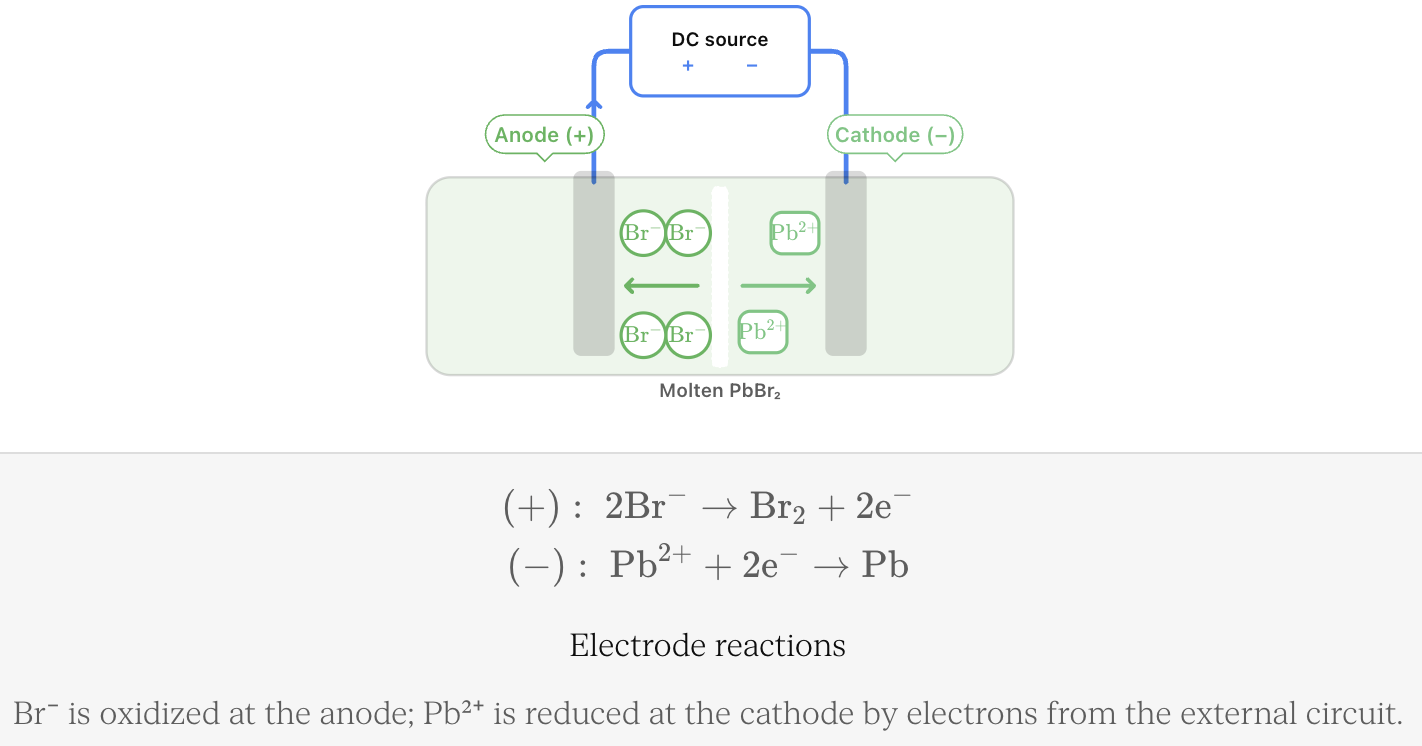
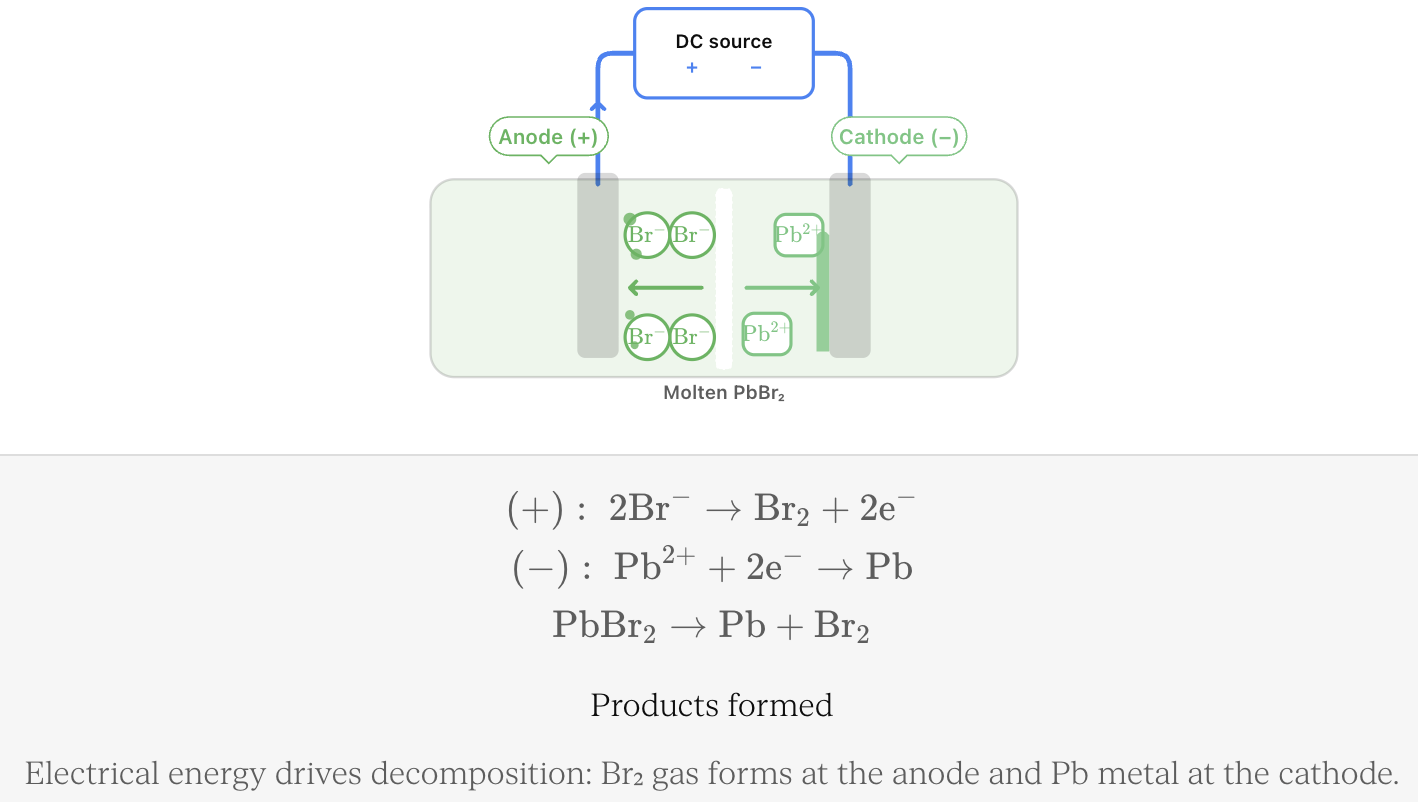
The complete process can be followed from ion movement to electron transfer and product formation.
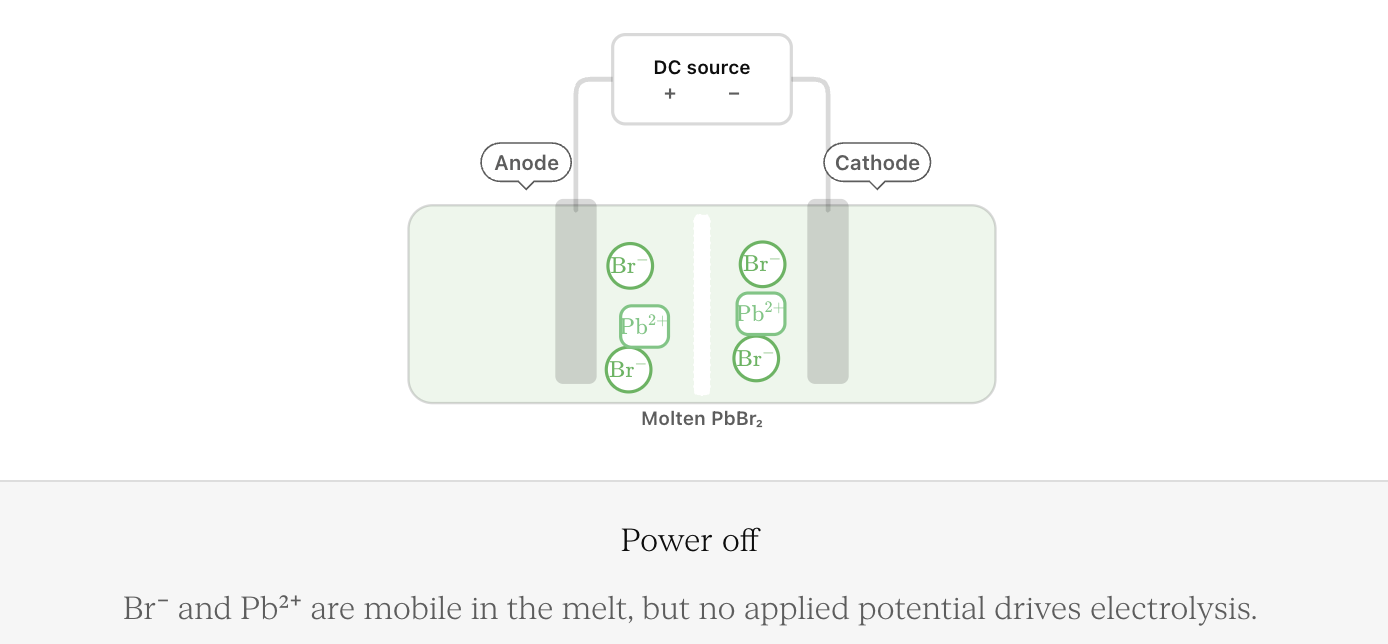
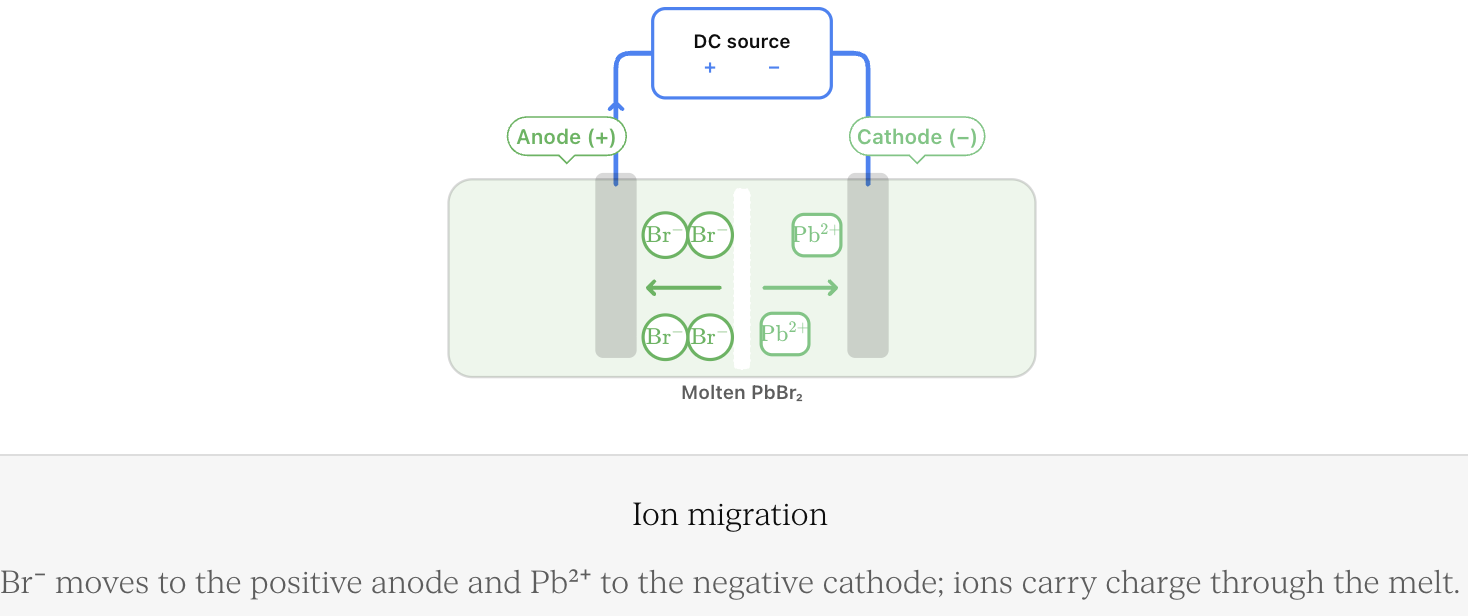
Notice that Na⁺ and Cl⁻ move in opposite directions because they have:
opposite electrical charges.
Example 1: Molten Sodium Chloride
Sodium chloride has the formula:
NaCl
When molten, it contains:
Na⁺ ions
and:
Cl⁻ ions.
These ions are free to move through the liquid.
Sodium at the Cathode
Na⁺ ions are positively charged.
They move toward the:
negative cathode.
Each sodium ion gains one electron:
Na⁺ + e⁻ → Na
This is:
reduction.
The product at the cathode is:
sodium metal.
Chlorine at the Anode
Cl⁻ ions are negatively charged.
They move toward the:
positive anode.
Two chloride ions each lose an electron:
2Cl⁻ → Cl₂ + 2e⁻
This is:
oxidation.
The product at the anode is:
chlorine gas.


Overall Reaction for Molten Sodium Chloride
Cathode:
2Na⁺ + 2e⁻ → 2Na
Anode:
2Cl⁻ → Cl₂ + 2e⁻
The electrons cancel when the half-equations are combined.
Overall:
2NaCl(l) → 2Na(l) + Cl₂(g)
Electrical energy is used to decompose sodium chloride into:
sodium and chlorine.
State Symbols
State symbols are especially useful when discussing electrolysis.
(s) = solid
(l) = liquid
(g) = gas
(aq) = dissolved in water
For molten sodium chloride:
NaCl(l)
The symbol (l) tells us the compound is:
liquid because it has been melted.
It does not mean the substance is dissolved in water.
Molten Is Not the Same as Aqueous
This distinction is extremely important.
Molten
means:
melted by heating.
Aqueous
means:
dissolved in water.
Molten NaCl contains only:
Na⁺ and Cl⁻ ions.
Aqueous NaCl contains:
- Na⁺ ions
- Cl⁻ ions
- water molecules
The presence of water can introduce additional possible electrode reactions.
Therefore, electrolysis of a molten compound is often:
simpler to predict.
Predicting Products of a Molten Binary Compound
For a simple molten ionic compound containing only two types of ions:
Step 1: Identify the ions.
Step 2: Identify their charges.
Step 3: Send the cation to the cathode.
Step 4: Send the anion to the anode.
Step 5: Reduce the cation.
Step 6: Oxidize the anion.
Step 7: Write balanced half-equations.
Example 2: Molten Lead(II) Bromide
Lead(II) bromide has the formula:
PbBr₂
When molten, it contains:
Pb²⁺ ions
and:
Br⁻ ions.


Lead at the Cathode
Pb²⁺ is positive.
Therefore it moves toward the:
negative cathode.
It gains two electrons:
Pb²⁺ + 2e⁻ → Pb
This is:
reduction.
The cathode product is:
lead.
Bromine at the Anode
Br⁻ is negative.
Therefore it moves toward the:
positive anode.
At the anode:
2Br⁻ → Br₂ + 2e⁻
This is:
oxidation.
The anode product is:
bromine.
Visualizing Lead(II) Bromide Electrolysis
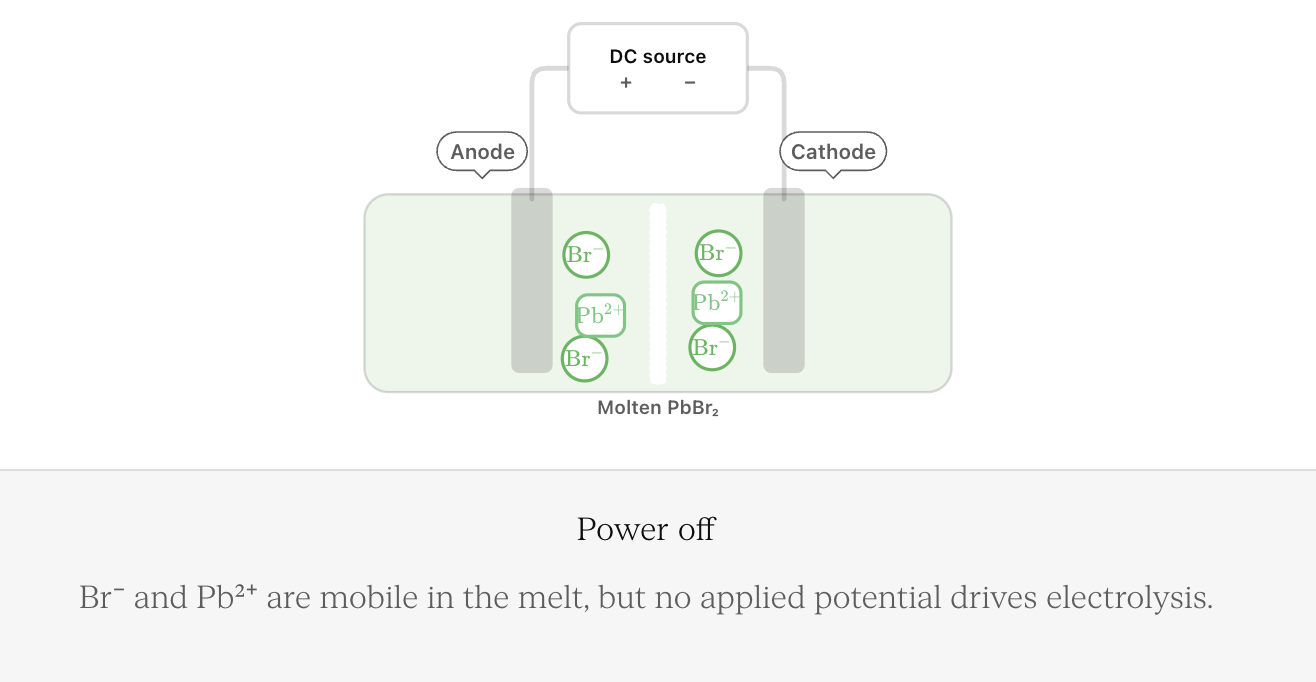
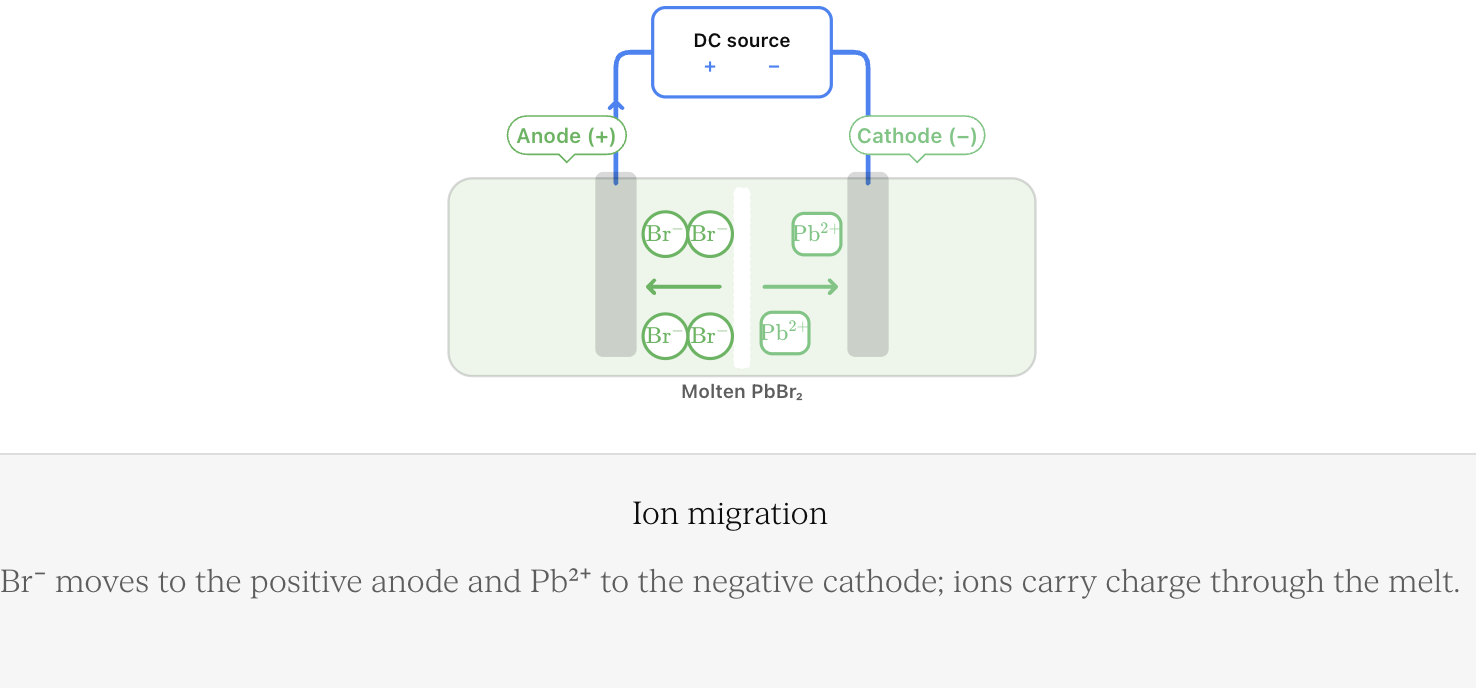
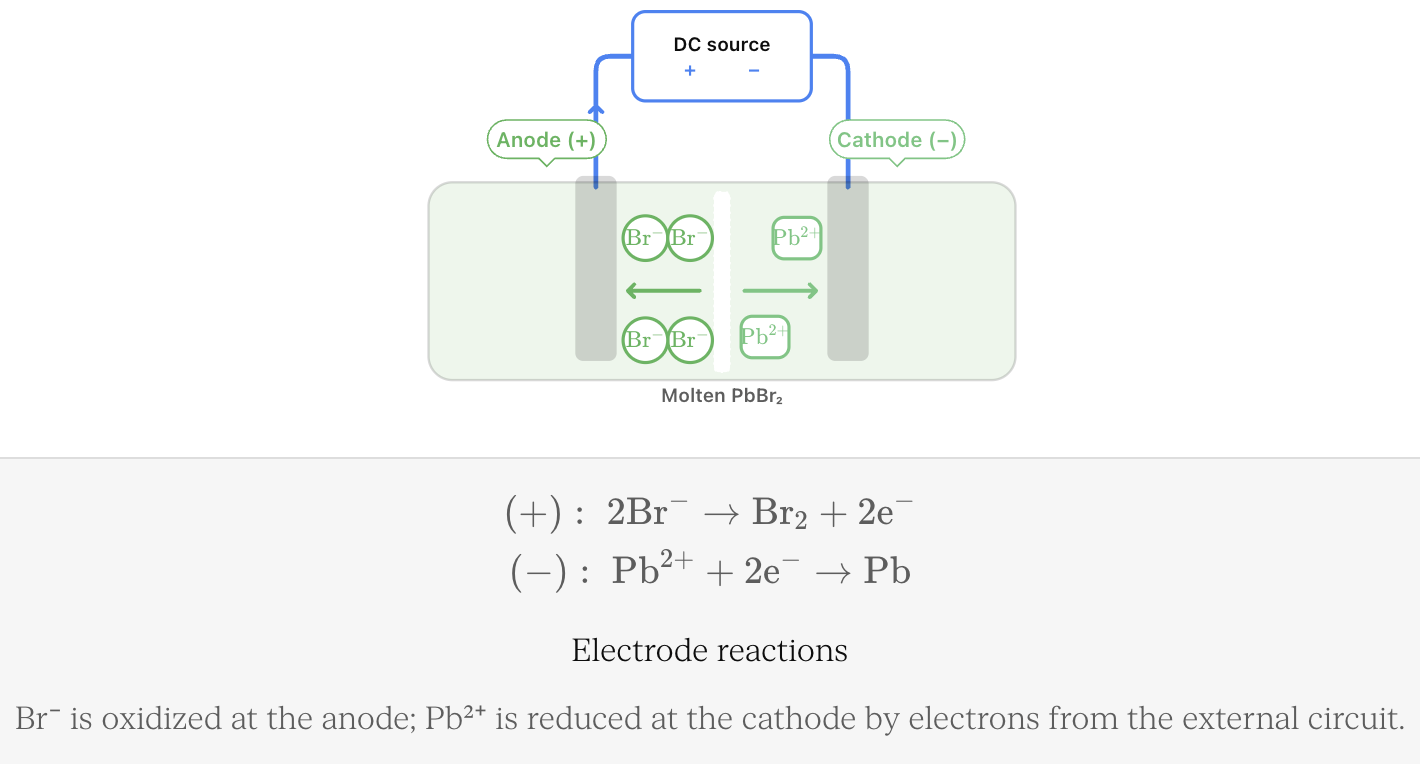
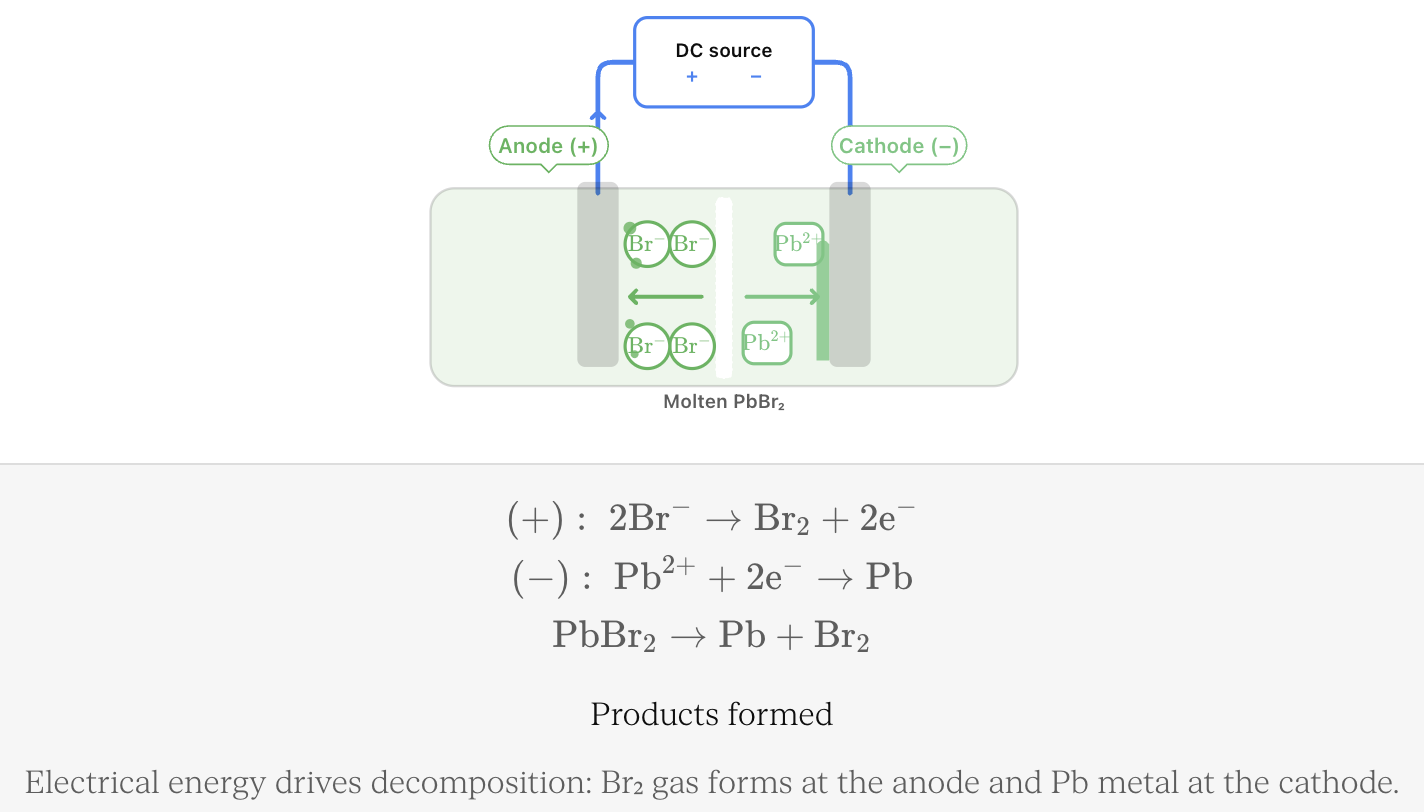
The ions and products are different from sodium chloride, but the electrode rules remain exactly the same.
Example 3: Molten Magnesium Chloride
Magnesium chloride has the formula:
MgCl₂
The ions present are:
Mg²⁺
and:
Cl⁻.
At the cathode:
Mg²⁺ + 2e⁻ → Mg
At the anode:
2Cl⁻ → Cl₂ + 2e⁻
Therefore:
Cathode product = magnesium
Anode product = chlorine
Overall:
MgCl₂(l) → Mg(l) + Cl₂(g)
Example 4: Molten Calcium Chloride
Calcium chloride has the formula:
CaCl₂
The ions are:
Ca²⁺
and:
Cl⁻.
At the cathode:
Ca²⁺ + 2e⁻ → Ca
At the anode:
2Cl⁻ → Cl₂ + 2e⁻
Products:
Cathode → calcium
Anode → chlorine
Example 5: Molten Lithium Bromide
Lithium bromide has the formula:
LiBr
The ions are:
Li⁺
and:
Br⁻.
Cathode:
Li⁺ + e⁻ → Li
Anode:
2Br⁻ → Br₂ + 2e⁻
Products:
Cathode → lithium
Anode → bromine
Example 6: Molten Potassium Iodide
Potassium iodide contains:
K⁺
and:
I⁻.
Cathode:
K⁺ + e⁻ → K
Anode:
2I⁻ → I₂ + 2e⁻
Products:
Cathode → potassium
Anode → iodine
Halogens at the Anode
Molten metal halides contain halide ions.
These include:
Cl⁻ → chloride
Br⁻ → bromide
I⁻ → iodide
At the anode, they are oxidized.
Chloride:
2Cl⁻ → Cl₂ + 2e⁻
Bromide:
2Br⁻ → Br₂ + 2e⁻
Iodide:
2I⁻ → I₂ + 2e⁻
Notice that the halogens are produced as:
diatomic molecules.
Why Are Halogens Written as Cl₂, Br₂ and I₂?
Elemental halogens normally exist as molecules containing:
two atoms.
Therefore:
chlorine = Cl₂
bromine = Br₂
iodine = I₂
This must be considered when balancing:
anode half-equations.
Writing Cathode Half-Equations
The basic pattern is:
metal ion + electrons → metal
The number of electrons must equal the:
positive charge on the ion.
For example:
Na⁺ + e⁻ → Na
Mg²⁺ + 2e⁻ → Mg
Al³⁺ + 3e⁻ → Al
Writing Anode Half-Equations
For halide ions, the basic pattern is:
halide ions → halogen + electrons
For example:
2Cl⁻ → Cl₂ + 2e⁻
2Br⁻ → Br₂ + 2e⁻
2I⁻ → I₂ + 2e⁻
Electrons appear on the right because oxidation involves:
loss of electrons.
Checking a Half-Equation
A correct half-equation must balance:
atoms
and:
electrical charge.
Consider:
Mg²⁺ + 2e⁻ → Mg
Atoms:
1 Mg on each side.
Charge:
Left = +2 − 2 = 0
Right = 0
Therefore the half-equation is:
balanced.
Another Half-Equation Check
Consider:
2Br⁻ → Br₂ + 2e⁻
Atoms:
2 Br on each side.
Charge:
Left = −2
Right = −2 from the two electrons.
Therefore both atoms and charge are:
balanced.
Combining Half-Equations
Half-equations can be combined to produce an:
overall equation.
The number of electrons lost must equal the number:
gained.
Consider MgCl₂.
Cathode:
Mg²⁺ + 2e⁻ → Mg
Anode:
2Cl⁻ → Cl₂ + 2e⁻
The two electrons cancel.
Overall:
MgCl₂ → Mg + Cl₂
What If the Electron Numbers Do Not Match?
Consider aluminum ions and chloride ions.
Cathode:
Al³⁺ + 3e⁻ → Al
Anode:
2Cl⁻ → Cl₂ + 2e⁻
Three electrons and two electrons do not match.
The lowest common multiple is:
6.
Multiply the cathode equation by 2:
2Al³⁺ + 6e⁻ → 2Al
Multiply the anode equation by 3:
6Cl⁻ → 3Cl₂ + 6e⁻
Now the electrons cancel.
Overall:
2AlCl₃ → 2Al + 3Cl₂
Electrolysis and Metal Extraction
One of the most important applications of electrolysis is:
extracting reactive metals from their compounds.
Some metals are so reactive that they cannot easily be extracted by reduction using:
carbon.
These metals include:
- potassium
- sodium
- calcium
- magnesium
- aluminum
Electrolysis can be used to obtain these metals.


Why Are Reactive Metals Difficult to Extract?
A metal in an ionic compound exists as:
positive ions.
To produce the metal, these ions must:
gain electrons.
For example:
Mg²⁺ + 2e⁻ → Mg
This is reduction.
Highly reactive metals form very stable compounds.
For many such metals, ordinary chemical reduction methods are not suitable.
Electrolysis provides the electrical energy needed to:
force the reduction.
Extracting Sodium
Sodium can be produced industrially by electrolysis of molten sodium chloride.
At the cathode:
Na⁺ + e⁻ → Na
At the anode:
2Cl⁻ → Cl₂ + 2e⁻
The products are:
sodium metal
and:
chlorine gas.
Why Not Use Aqueous Sodium Chloride to Produce Sodium?
If sodium chloride is dissolved in water, additional reactions involving water become possible.
Under normal aqueous electrolysis conditions, sodium metal is not deposited from Na⁺ because water is reduced preferentially, producing:
hydrogen.
Therefore sodium is produced using:
molten sodium chloride, not ordinary salt water.
Extracting Magnesium
Magnesium can be produced from molten magnesium chloride.
Cathode:
Mg²⁺ + 2e⁻ → Mg
Anode:
2Cl⁻ → Cl₂ + 2e⁻
Overall:
MgCl₂ → Mg + Cl₂
This is another example of using electrolysis to extract a:
reactive metal.
Extracting Aluminum
Aluminum is also extracted using:
electrolysis.
Its main ore is:
bauxite.
Bauxite is processed to obtain aluminum oxide:
Al₂O₃.
The aluminum-containing material is electrolyzed in the molten state as part of the industrial:
Hall-Héroult process.


Aluminum at the Cathode
Aluminum ions are:
Al³⁺.
At the cathode:
Al³⁺ + 3e⁻ → Al
The aluminum ions gain electrons.
Therefore they are:
reduced.
Molten aluminum forms and can be collected from the cell.
Why Is Aluminum Oxide Not Simply Melted by Itself?
Pure aluminum oxide has a very high melting point.
Heating it to its melting point would require:
a great deal of energy.
Industrially, aluminum oxide is dissolved in molten:
cryolite-based electrolyte.
This allows electrolysis to occur at a lower operating temperature than would be required for pure molten aluminum oxide.
Aluminum Production Is Energy Intensive
Electrolysis requires a large supply of:
electrical energy.
Producing aluminum therefore uses substantial amounts of electricity.
This means the environmental impact depends partly on:
how that electricity is generated.
Using lower-carbon electricity can reduce the emissions associated with the electrical energy used in production.
Recycling Aluminum
Recycling aluminum generally requires much less energy than producing aluminum from its ore.
This is because recycling does not require the full sequence of:
ore processing and electrolytic extraction.
Therefore aluminum recycling can:
- reduce energy demand
- reduce demand for new ore
- reduce waste
- reduce some environmental impacts associated with primary production
Energy Changes During Molten Electrolysis
Electrolysis requires an external electrical supply.
The overall energy transformation is primarily:
electrical energy → chemical energy
The electrical energy drives reactions that would not occur spontaneously under those conditions.
Some energy is also transferred as:
thermal energy.
This is particularly important because many industrial electrolytes must be kept:
molten.
Predicting Products: A Simple Strategy
For a simple molten binary ionic compound, use this method.
Suppose you are given:
MgBr₂
First identify the ions:
Mg²⁺ and Br⁻
Then:
Mg²⁺ → cathode → reduction → Mg
Br⁻ → anode → oxidation → Br₂
Therefore:
Cathode product = Mg
Anode product = Br₂
Worked Example 1
Predict the products of molten KCl.
Ions:
K⁺ and Cl⁻
Cathode:
K⁺ + e⁻ → K
Anode:
2Cl⁻ → Cl₂ + 2e⁻
Products:
potassium and chlorine.
Worked Example 2
Predict the products of molten CaBr₂.
Ions:
Ca²⁺ and Br⁻
Cathode:
Ca²⁺ + 2e⁻ → Ca
Anode:
2Br⁻ → Br₂ + 2e⁻
Products:
calcium and bromine.
Worked Example 3
Predict the products of molten LiI.
Ions:
Li⁺ and I⁻
Cathode:
Li⁺ + e⁻ → Li
Anode:
2I⁻ → I₂ + 2e⁻
Products:
lithium and iodine.
Worked Example 4
Predict the products of molten MgCl₂.
Ions:
Mg²⁺ and Cl⁻
Cathode:
Mg²⁺ + 2e⁻ → Mg
Anode:
2Cl⁻ → Cl₂ + 2e⁻
Products:
magnesium and chlorine.
Worked Example 5
Write the cathode half-equation for Al³⁺.
Al³⁺ must gain three electrons:
Al³⁺ + 3e⁻ → Al
This is:
reduction.
Worked Example 6
Write the anode half-equation for iodide ions.
Two iodide ions form one iodine molecule:
2I⁻ → I₂ + 2e⁻
This is:
oxidation.
Worked Example 7
Why does solid MgCl₂ not undergo electrolysis in the same way as molten MgCl₂?
In solid MgCl₂, the ions are:
fixed in a lattice.
They cannot move toward the electrodes.
When MgCl₂ melts, the ions become:
mobile.
They can then carry charge through the electrolyte.
Worked Example 8
A student observes metal forming at the negative electrode.
What process is occurring?
The negative electrode in an electrolytic cell is the:
cathode.
Metal ions gain electrons there.
Therefore:
reduction is occurring.
Worked Example 9
A gas forms at the positive electrode during electrolysis of molten NaCl.
Identify the gas.
The negative ion present is:
Cl⁻.
At the anode:
2Cl⁻ → Cl₂ + 2e⁻
Therefore the gas is:
chlorine.
Worked Example 10
Why is electrolysis useful for extracting highly reactive metals?
Highly reactive metals form stable ionic compounds and are difficult to obtain using simpler chemical reduction methods.
Electrolysis supplies electrical energy that forces the metal ions to:
gain electrons.
At the cathode:
metal ions → metal atoms.
Comparing Solid, Molten and Aqueous Compounds
| State | Are ions mobile? | Conducts ionically? | Suitable for simple molten electrolysis? |
|---|---|---|---|
| Solid ionic compound | No | No | No |
| Molten ionic compound | Yes | Yes | Yes |
| Aqueous ionic solution | Yes | Yes | Electrolysis occurs, but water can affect the products |
This explains why:
molten electrolysis is particularly useful when extracting reactive metals.
Common Mistake: Molten Means Dissolved in Water
It does not.
Molten = melted
Aqueous = dissolved in water
This distinction can completely change the predicted:
electrolysis products.
Common Mistake: Electrons Move Through the Molten Electrolyte
The main moving charge carriers in the molten ionic compound are:
ions.
Electrons move through the:
external circuit and electrodes.
Common Mistake: Positive Ions Move to the Positive Electrode
Opposite charges attract.
Therefore:
positive ions → negative cathode
and:
negative ions → positive anode.
Common Mistake: Oxidation Occurs at the Cathode
Remember:
AnOx
Anode = Oxidation.
RedCat
Reduction = Cathode.
These rules apply regardless of which molten ionic compound is being electrolyzed.
Common Mistake: The Metal Forms at the Anode
Metal ions are positive.
They move toward the:
negative cathode.
They gain electrons and form metal atoms.
Therefore, in simple molten salts:
metal forms at the cathode.
Common Mistake: Chloride Forms Cl at the Anode
Elemental chlorine exists as:
Cl₂.
Therefore the balanced half-equation is:
2Cl⁻ → Cl₂ + 2e⁻
The same idea applies to:
Br₂ and I₂.
Common Mistake: Half-Equations Only Need Balanced Atoms
Half-equations must balance both:
atoms
and:
electrical charge.
Electrons are added to balance the charge.
Common Mistake: Electrolysis Is Always an Economical Extraction Method
Electrolysis can require large amounts of:
electricity.
It is especially useful when chemical reduction is unsuitable, but energy consumption and cost are important considerations.
Check Your Understanding
- What does molten mean?
- Why do solid ionic compounds generally not conduct electricity through ion movement?
- Why do molten ionic compounds conduct electricity?
- What particles carry charge through a molten ionic compound?
- What is the charge of the cathode during electrolysis?
- What is the charge of the anode?
- Which ions move toward the cathode?
- Which ions move toward the anode?
- What process occurs at the cathode?
- What process occurs at the anode?
- Explain RedCat.
- Explain AnOx.
- What does OIL RIG mean?
- Why is the metal normally formed at the cathode during electrolysis of a simple molten salt?
- Why is a halogen produced at the anode when a molten metal halide is electrolyzed?
- Identify the ions in molten NaCl.
- Write the cathode half-equation for molten NaCl.
- Write the anode half-equation for molten NaCl.
- Name the products of molten NaCl electrolysis.
- Write the overall equation for molten NaCl electrolysis.
- Identify the ions in molten PbBr₂.
- Write the cathode half-equation for PbBr₂.
- Write the anode half-equation for PbBr₂.
- Name the products.
- Predict the products of molten MgCl₂.
- Write both half-equations for molten MgCl₂.
- Predict the products of molten CaBr₂.
- Write both half-equations for molten CaBr₂.
- Predict the products of molten LiI.
- Write both half-equations for molten LiI.
- Explain the difference between molten and aqueous.
- Why can aqueous and molten electrolysis produce different products?
- Write a balanced half-equation for the reduction of Al³⁺.
- Write a balanced half-equation for the reduction of Ca²⁺.
- Write a balanced half-equation for the oxidation of Cl⁻.
- Write a balanced half-equation for the oxidation of I⁻.
- Why must both atoms and charge balance in a half-equation?
- Explain why Cl₂ rather than Cl is formed.
- Why is electrolysis useful for extracting reactive metals?
- Give three reactive metals that can be extracted using electrolysis.
- Explain how sodium can be extracted from molten sodium chloride.
- Why is sodium not normally produced by electrolysis of aqueous NaCl?
- Explain how magnesium can be produced from molten MgCl₂.
- Write the cathode reaction involved in aluminum extraction.
- Why is aluminum oxide used with a molten electrolyte such as cryolite in industrial aluminum production?
- Why does aluminum extraction require large amounts of energy?
- What is the main energy transformation during electrolysis?
- Explain why recycling aluminum generally requires less energy than extracting new aluminum.
- Describe a step-by-step method for predicting the products of a simple molten ionic compound.
- A molten compound contains M²⁺ and Br⁻ ions. Predict the products at both electrodes and write general half-equations.
Key Terms
Molten: Melted into the liquid state by heating.
Ionic compound: Compound made from oppositely charged ions held together by electrostatic attraction.
Electrolysis: Use of electrical energy to drive a non-spontaneous chemical reaction.
Electrolyte: Substance containing mobile ions that can transport electrical charge.
Cathode: Electrode where reduction occurs.
Anode: Electrode where oxidation occurs.
Cation: Positively charged ion that moves toward the cathode.
Anion: Negatively charged ion that moves toward the anode.
Reduction: Gain of electrons.
Oxidation: Loss of electrons.
Half-equation: Equation showing electron transfer during oxidation or reduction.
Metal extraction: Process of obtaining a metal from a compound containing that metal.
Aqueous: Dissolved in water.
Diatomic molecule: Molecule containing two atoms, such as Cl₂, Br₂ or I₂.
Cryolite: Material used in aluminum production to provide a molten electrolyte in which aluminum oxide can dissolve and to permit operation below the melting point of pure aluminum oxide.
Key Takeaways
- Molten ionic compounds conduct electricity because their ions are free to move.
- Solid ionic compounds do not conduct ionically because their ions are fixed in a lattice.
- During electrolysis, cations move to the cathode and anions move to the anode.
- The cathode is negative and the anode is positive in an electrolytic cell.
- Reduction occurs at the cathode.
- Oxidation occurs at the anode.
- In a simple molten metal halide, the metal forms at the cathode and the halogen forms at the anode.
- Half-equations must balance both atoms and electrical charge.
- Molten and aqueous electrolysis are different because aqueous solutions contain water, which can participate in electrode reactions.
- Electrolysis is especially important for extracting highly reactive metals that are difficult to obtain using chemical reduction.
- Sodium can be produced from molten NaCl, magnesium from molten MgCl₂, and aluminum through electrolysis of aluminum-containing molten electrolyte.
- Electrolytic metal extraction requires substantial electrical energy.
- Understanding ion movement, electrode reactions, and half-equations allows the products of molten electrolysis to be predicted systematically.