Electrolysis
| Sitio: | Young Education |
| Curso: | Electrochemistry |
| Libro: | Electrolysis |
| Impreso por: | ゲストユーザ |
| Fecha: | lunes, 5 de octubre de 2026, 03:04 |
1. Principles of Electrolysis
Learning outcomes
- I can explain the purpose of electrolysis.
- I can describe how electrical energy drives chemical change.
- I can distinguish between electrolysis and galvanic cells.
- I can identify oxidation and reduction during electrolysis.
- I can explain the energy transformations involved.


What Is Electrolysis?
Electrolysis is the use of electrical energy to drive a chemical reaction that would not normally occur spontaneously.
The word can be thought of as:
electro = electricity
lysis = splitting or breaking apart
During electrolysis, an external source of electricity forces chemical changes to occur.
The overall energy transformation is:
electrical energy → chemical energy
Some energy is also transferred to the surroundings as:
thermal energy.
Why Is Electrolysis Needed?
Some chemical reactions occur spontaneously.
Others do not.
A non-spontaneous reaction requires an external energy supply before it can proceed.
Electrolysis provides this energy using:
electricity.
For example, electrical energy can be used to:
- decompose compounds
- produce elements
- extract reactive metals
- purify metals
- electroplate objects
- produce industrial chemicals
- generate hydrogen from water
The Electrolytic Cell
Electrolysis takes place in an:
electrolytic cell.
A simple electrolytic cell contains:
- an external power supply
- two electrodes
- an electrolyte
- connecting wires
The power supply provides the electrical energy needed to drive the:
non-spontaneous chemical reaction.


The Electrolyte
The electrolyte is a substance containing mobile ions.
These ions must be able to move.
Therefore electrolysis generally requires an ionic substance that is:
molten
or:
dissolved in water.
In these states, the ions are free to move toward the electrodes.
Why Solid Ionic Compounds Do Not Conduct
In a solid ionic compound, positive and negative ions are held in a:
fixed crystal lattice.
The ions cannot move freely.
Therefore the solid cannot normally conduct electricity through ionic movement.
When the substance is melted or dissolved:
the ions become mobile.
The electrolyte can then conduct electricity.
The Electrodes
The two conductors placed in the electrolyte are called:
electrodes.
They are:
anode
and
cathode.
During electrolysis:
Anode = positive electrode
Cathode = negative electrode
This is important because the electrode signs are different from those in a spontaneous galvanic cell.
The Cathode
In an electrolytic cell, the cathode is connected to the:
negative terminal of the power supply.
Electrons are supplied to the cathode.
Positive ions are attracted toward it.
Positive ions are called:
cations.
At the cathode, cations can:
gain electrons.
Gaining electrons is:
reduction.
Therefore:
Cathode = Reduction
The Anode
In an electrolytic cell, the anode is connected to the:
positive terminal of the power supply.
Negative ions are attracted toward it.
Negative ions are called:
anions.
At the anode, particles can:
lose electrons.
Losing electrons is:
oxidation.
Therefore:
Anode = Oxidation.
Remember: AnOx and RedCat
A useful memory aid is:
AnOx
Anode = Oxidation
and:
RedCat
Reduction = Cathode
These rules apply to both:
electrolytic cells and galvanic cells.
What changes between the two types of cells is the sign of each electrode.
Ion Movement During Electrolysis
Opposite charges attract.
Therefore:
Cations (+) → Cathode (−)
and:
Anions (−) → Anode (+)
This movement of ions through the electrolyte allows charge to be transported through the:
solution or molten substance.


Electrons and Ions Follow Different Paths
It is important to distinguish between:
electron movement
and:
ion movement.
Electrons move through:
- wires
- electrodes
- the external electrical circuit
Ions move through:
- molten electrolytes
- electrolyte solutions
Therefore:
electrons move through conductors
while:
ions move through the electrolyte.
Oxidation and Reduction
Electrolysis always involves:
redox reactions.
Remember:
Oxidation = loss of electrons
Reduction = gain of electrons
Another useful memory aid is:
OIL RIG
Oxidation Is Loss
Reduction Is Gain
The "loss" and "gain" refer to:
electrons.
Reduction at the Cathode
Suppose copper ions are present:
Cu²⁺
At the cathode, a copper ion can gain two electrons:
Cu²⁺ + 2e⁻ → Cu
The copper ion has gained electrons.
Therefore it has been:
reduced.
Solid copper is deposited at the cathode.
Oxidation at the Anode
Suppose chloride ions are present:
Cl⁻
At the anode:
2Cl⁻ → Cl₂ + 2e⁻
The chloride ions lose electrons.
Therefore they have been:
oxidized.
Chlorine gas is produced.
Electron Transfer
Electrolysis therefore involves electron transfer.
At the cathode:
particles gain electrons
At the anode:
particles lose electrons
The external power supply drives this movement of charge and forces the chemical reaction to:
continue.
Example: Molten Sodium Chloride
Consider molten sodium chloride:
NaCl
When molten, it contains mobile:
Na⁺ ions
and:
Cl⁻ ions.
The ions move toward oppositely charged electrodes.


At the Cathode: Sodium
Sodium ions move toward the:
negative cathode.
Each sodium ion gains an electron:
Na⁺ + e⁻ → Na
This is:
reduction.
Sodium metal is produced.
At the Anode: Chlorine
Chloride ions move toward the:
positive anode.
Chloride ions lose electrons:
2Cl⁻ → Cl₂ + 2e⁻
This is:
oxidation.
Chlorine gas is produced.
Overall Electrolysis of Molten Sodium Chloride
The two half-equations are:
Cathode:
2Na⁺ + 2e⁻ → 2Na
Anode:
2Cl⁻ → Cl₂ + 2e⁻
Combining them gives:
2NaCl → 2Na + Cl₂
Electrical energy is required to drive this:
non-spontaneous decomposition reaction.
Why Must Sodium Chloride Be Molten?
Solid sodium chloride contains ions, but they are locked into a:
crystal lattice.
They cannot move to the electrodes.
When sodium chloride melts:
Na⁺ and Cl⁻ ions become mobile.
The molten compound can therefore conduct electricity and undergo:
electrolysis.
Example: Electrolysis of Water
Electricity can also be used to decompose water.
The overall reaction can be represented as:
2H₂O → 2H₂ + O₂
Electrical energy is supplied to produce:
hydrogen gas and oxygen gas.


Products of Water Electrolysis
During water electrolysis:
hydrogen gas forms at the cathode.
oxygen gas forms at the anode.
The volume of hydrogen produced is approximately:
twice the volume of oxygen.
This matches the overall equation:
2H₂O → 2H₂ + O₂
Electrolysis and Hydrogen Production
Electrolysis can be used to produce hydrogen as an:
energy carrier.
The energy transformation is:
electrical energy → chemical energy stored in hydrogen
Later, hydrogen can be used in a fuel cell:
chemical energy → electrical energy.
This creates a possible energy-storage pathway.
Electrolysis and Galvanic Cells
Electrolytic cells and galvanic cells both involve:
- electrodes
- electrolytes
- electron transfer
- oxidation
- reduction
- redox reactions
However, they differ in a fundamental way.
A galvanic cell uses a spontaneous chemical reaction to:
produce electrical energy.
An electrolytic cell uses electrical energy to:
force a non-spontaneous chemical reaction.
Comparing Electrolytic and Galvanic Cells
| Feature | Electrolytic Cell | Galvanic Cell |
|---|---|---|
| Reaction | Non-spontaneous | Spontaneous |
| Main purpose | Use electricity to cause chemical change | Produce electricity from chemical change |
| Energy conversion | Electrical → chemical | Chemical → electrical |
| External power source | Required | Not required to drive the reaction |
| Anode reaction | Oxidation | Oxidation |
| Cathode reaction | Reduction | Reduction |
| Anode sign | Positive | Negative |
| Cathode sign | Negative | Positive |
The most important rule to remember is:
oxidation always occurs at the anode
and:
reduction always occurs at the cathode.
Why Do the Electrode Signs Change?
In a galvanic cell, the chemical reaction itself releases electrons at the anode.
Therefore the anode acts as the:
negative electrode.
In an electrolytic cell, an external power supply pulls electrons away from the anode and pushes electrons toward the cathode.
Therefore:
electrolytic anode = positive
electrolytic cathode = negative.
Energy Transformations
Energy transformation is one of the most important differences between the two systems.
Galvanic Cell
Chemical energy → electrical energy
The spontaneous reaction releases energy.
Electrolytic Cell
Electrical energy → chemical energy
Electrical energy forces the non-spontaneous reaction.
Some energy is also transferred into:
thermal energy.
Electrolysis Does Not Create Energy
Electrolysis does not create energy.
The electrical energy supplied by the power source is transformed.
Some becomes:
chemical potential energy
stored in the products.
Some is transferred as:
heat.
This follows the:
law of conservation of energy.
Electrolysis as Energy Storage
Consider water electrolysis.
Electricity is supplied:
electrical energy
↓
Water is decomposed
↓
Hydrogen is produced
↓
Energy is stored chemically in hydrogen.
The hydrogen can later be used in a fuel cell:
chemical energy → electrical energy.
This means electrolysis can be part of an:
energy-storage system.
Electroplating
One important application of electrolysis is:
electroplating.
Electroplating uses electricity to deposit a thin layer of one metal onto another object.
Examples include:
- silver plating
- gold plating
- nickel plating
- chromium plating
- copper plating


How Electroplating Works
The object being coated is usually connected as the:
cathode.
Metal ions in the electrolyte move toward the cathode.
At the cathode they gain electrons:
Mⁿ⁺ + ne⁻ → M
Metal atoms are deposited onto the surface.
This forms a thin:
metal coating.
Why Electroplate Objects?
Electroplating can be used to:
- improve appearance
- reduce corrosion
- improve wear resistance
- provide useful surface properties
- reduce the amount of expensive metal required
For example, an object can receive a thin layer of gold without being made entirely from:
gold.
Metal Purification
Electrolysis can also be used to purify metals.
Copper is an important example.
Impure copper can be used as the:
anode.
Pure copper is deposited onto the:
cathode.
This process is called:
electrorefining.
Why Is Pure Copper Important?
Copper is widely used for:
electrical wiring.
Impurities can affect its electrical conductivity.
Electrolytic purification can produce very pure copper suitable for:
- electrical cables
- electronics
- electrical equipment
Extracting Reactive Metals
Some metals are too reactive to be extracted easily by chemical reduction with carbon.
These include metals such as:
- aluminum
- sodium
- magnesium
Electrolysis can be used to extract these metals from:
molten ionic compounds.
Aluminum Production
Aluminum is produced industrially using electrolysis of aluminum-containing compounds.
Electrical energy is required to reduce aluminum ions:
Al³⁺ + 3e⁻ → Al
Because aluminum production requires large amounts of electricity, the cost and environmental impact of the electricity supply are:
important considerations.


Electrolysis in Industry
Electrolysis is used on a very large scale.
Important applications include:
- aluminum production
- chlorine production
- hydrogen production
- sodium hydroxide production
- copper purification
- electroplating
Therefore electrolysis is an important connection between:
chemistry, electricity, and industry.
Predicting Ion Movement
To predict where an ion will move, first identify its:
charge.
Positive ion:
cation → cathode
Negative ion:
anion → anode
For example:
Cu²⁺ → cathode
Na⁺ → cathode
Cl⁻ → anode
Br⁻ → anode
O²⁻ → anode
Predicting the Reaction
Once the electrode is identified, determine whether the particle must gain or lose electrons.
At the cathode:
gain electrons → reduction
At the anode:
lose electrons → oxidation
This gives a useful sequence:
Identify charge → identify electrode → identify electron transfer → identify oxidation or reduction.
Worked Example 1
Where will Mg²⁺ ions move?
Mg²⁺ is:
positively charged.
Therefore it moves toward the:
negative cathode.
At the cathode:
Mg²⁺ + 2e⁻ → Mg
This is:
reduction.
Worked Example 2
Where will Br⁻ ions move?
Br⁻ is:
negatively charged.
Therefore it moves toward the:
positive anode.
At the anode:
2Br⁻ → Br₂ + 2e⁻
This is:
oxidation.
Worked Example 3
Consider molten magnesium chloride:
MgCl₂
The ions present are:
Mg²⁺ and Cl⁻.
At the cathode:
Mg²⁺ + 2e⁻ → Mg
At the anode:
2Cl⁻ → Cl₂ + 2e⁻
Overall:
MgCl₂ → Mg + Cl₂
Worked Example 4
A student says:
"Reduction occurs at the negative electrode."
Is this always correct?
No.
Reduction always occurs at the:
cathode.
In an electrolytic cell the cathode is negative.
In a galvanic cell the cathode is positive.
Therefore it is safer to remember:
RedCat: Reduction at Cathode.
Worked Example 5
A student says:
"The anode is always positive."
Is this correct?
No.
The anode is positive in an:
electrolytic cell.
The anode is negative in a:
galvanic cell.
However:
oxidation always occurs at the anode.
Worked Example 6
Why does molten sodium chloride conduct electricity while solid sodium chloride does not?
Both contain ions.
However, in solid sodium chloride the ions are:
fixed in position.
When molten, the ions can:
move freely.
Moving ions transport charge through the electrolyte.
Worked Example 7
What energy transformation occurs when hydrogen is produced from water by electrolysis?
Electrical energy → chemical energy
The chemical energy is stored in the products, including:
hydrogen.
Worked Example 8
A renewable-energy system uses excess solar electricity to electrolyze water.
During the day:
solar energy → electrical energy → chemical energy in hydrogen
Later, a fuel cell can convert:
chemical energy → electrical energy.
Electrolysis therefore provides a way of converting electrical energy into a:
storable chemical form.
Common Mistake: Electrolysis Produces Electricity
Electrolysis does not primarily produce electricity.
It:
uses electricity.
The external power supply drives a chemical reaction.
A galvanic cell does the opposite:
it produces electrical energy from a spontaneous chemical reaction.
Common Mistake: The Anode Is Always Negative
The anode is not defined by its charge.
The anode is defined as the electrode where:
oxidation occurs.
In electrolysis:
anode = positive.
In a galvanic cell:
anode = negative.
Common Mistake: The Cathode Is Always Positive
The cathode is defined as the electrode where:
reduction occurs.
In electrolysis:
cathode = negative.
In a galvanic cell:
cathode = positive.
Common Mistake: Electrons Move Through the Electrolyte
Electrons mainly travel through the:
external electrical circuit.
Ions transport charge through the:
electrolyte.
Common Mistake: Solid Ionic Compounds Can Always Be Electrolyzed
The ions in a solid ionic compound cannot move freely.
The compound usually needs to be:
molten or dissolved
before its ions can move and participate effectively in electrolysis.
Common Mistake: Oxidation Means Adding Oxygen
Some oxidation reactions involve oxygen, but the more general definition is:
oxidation = loss of electrons.
Similarly:
reduction = gain of electrons.
These definitions are especially useful in:
electrochemistry.
Common Mistake: Electrolysis Destroys Energy
Energy is not destroyed.
Electrical energy is transformed into:
chemical energy and thermal energy.
The total amount of energy is conserved.
Check Your Understanding
- Define electrolysis.
- What is the main purpose of electrolysis?
- Why does electrolysis require an external power supply?
- What type of chemical reaction is driven by electrolysis?
- What are the main components of an electrolytic cell?
- What is an electrolyte?
- Why must ions in an electrolyte be able to move?
- Why does solid sodium chloride not conduct electricity through ionic movement?
- Why does molten sodium chloride conduct electricity?
- What is the cathode?
- What is the anode?
- What is the charge of the cathode in an electrolytic cell?
- What is the charge of the anode in an electrolytic cell?
- Where do cations move?
- Where do anions move?
- Where does reduction occur?
- Where does oxidation occur?
- What does OIL RIG mean?
- What does AnOx mean?
- What does RedCat mean?
- Write the half-equation for the reduction of Na⁺.
- Write the half-equation for the oxidation of Cl⁻.
- Describe the electrolysis of molten sodium chloride.
- What products are formed during the electrolysis of molten NaCl?
- What products can be formed during the electrolysis of water?
- Why is approximately twice as much hydrogen as oxygen produced from water?
- What is the overall energy transformation during electrolysis?
- Where is some of the supplied electrical energy stored?
- Compare electrolysis with a galvanic cell.
- Which type of cell involves a spontaneous reaction?
- Which type of cell requires an external electrical supply?
- What happens to energy in a galvanic cell?
- What happens to energy in an electrolytic cell?
- Why do the signs of the electrodes differ between electrolytic and galvanic cells?
- Explain why oxidation still occurs at the anode in both types of cells.
- Explain why reduction still occurs at the cathode in both types of cells.
- What is electroplating?
- Why is the object being electroplated usually the cathode?
- Give three reasons why objects are electroplated.
- How can electrolysis be used to purify copper?
- Why is electrolysis used to extract very reactive metals?
- Write the reduction half-equation for Al³⁺.
- Predict which electrode Mg²⁺ moves toward.
- Predict which electrode Br⁻ moves toward.
- Describe the difference between electron movement and ion movement in an electrolytic cell.
- Explain why electrolysis is an example of energy conversion.
- Explain how electrolysis can be used to store renewable energy as hydrogen.
- Compare an electrolytic cell and a galvanic cell in terms of energy, spontaneity, electrode signs, oxidation, and reduction.
- Explain why the statement "the anode is always positive" is incorrect.
- Describe the complete process of electrolysis from the electrical power supply to the formation of products at the electrodes.
Key Terms
Electrolysis: Use of electrical energy to drive a non-spontaneous chemical reaction.
Electrolytic cell: Electrochemical cell in which electrical energy drives chemical change.
Electrolyte: Substance containing mobile ions that can transport charge.
Electrode: Conductor through which electrons enter or leave an electrochemical system.
Anode: Electrode where oxidation occurs.
Cathode: Electrode where reduction occurs.
Cation: Positively charged ion attracted toward the cathode during electrolysis.
Anion: Negatively charged ion attracted toward the anode during electrolysis.
Oxidation: Loss of electrons.
Reduction: Gain of electrons.
Redox reaction: Reaction involving both oxidation and reduction.
Non-spontaneous reaction: Reaction that requires an external energy input to proceed.
Half-equation: Equation showing electron transfer during either oxidation or reduction.
Electroplating: Use of electrolysis to deposit a layer of material, usually a metal, onto an object.
Electrorefining: Use of electrolysis to purify a metal.
Electrolysis of water: Use of electrical energy to decompose water, producing hydrogen and oxygen.
Key Takeaways
- Electrolysis uses electrical energy to drive a non-spontaneous chemical reaction.
- The overall energy transformation is mainly electrical energy → chemical energy.
- An electrolytic cell requires an external power supply.
- The electrolyte must contain mobile ions.
- In an electrolytic cell, the anode is positive and the cathode is negative.
- Cations move toward the cathode.
- Anions move toward the anode.
- Oxidation always occurs at the anode.
- Reduction always occurs at the cathode.
- The rules AnOx and RedCat work for both electrolytic and galvanic cells.
- Electrons travel through the external circuit, while ions transport charge through the electrolyte.
- Electrolysis and galvanic cells involve opposite overall energy transformations.
- A galvanic cell converts chemical energy → electrical energy.
- An electrolytic cell converts electrical energy → chemical energy.
- Electrolysis can be used for metal extraction, electroplating, metal purification, chemical production, and hydrogen production.
- Electrolysis of water can convert electrical energy into chemical energy stored in hydrogen.
- Electrolysis is therefore important in chemistry, industry, materials processing, and emerging energy-storage systems.
2. Electrolytes
Learning outcomes
- I can define an electrolyte.
- I can explain why electrolytes conduct electricity.
- I can identify examples of electrolytes and non-electrolytes.
- I can describe the role of ions in electrolysis.
- I can relate electrolyte properties to practical applications.


3. Electrodes
Learning outcomes
- I can identify the anode and cathode in an electrolytic cell.
- I can explain the functions of electrodes during electrolysis.
- I can predict which ions move toward each electrode.
- I can distinguish between inert and reactive electrodes.
- I can analyze electrode reactions in simple systems.

What Is an Electrode?
An electrode is an electrical conductor that allows electrons to enter or leave an electrochemical system.
In an electrolytic cell, there are two electrodes:
Anode
and
Cathode
The electrodes are connected to an external power supply and placed in contact with an:
electrolyte.
Electrode surfaces are important because this is where:
oxidation and reduction reactions occur.
The Two Electrodes
During electrolysis:
Anode = positive electrode
Cathode = negative electrode
The external power supply creates this difference in electrical potential.
This causes ions in the electrolyte to move toward the:
oppositely charged electrode.
Therefore:
Cations (+) → Cathode (−)
Anions (−) → Anode (+)
The Cathode
The cathode is the electrode where:
reduction occurs.
Reduction means:
gain of electrons.
A useful memory aid is:
RedCat
REDuction at the CAThode
In an electrolytic cell, the cathode is connected to the:
negative terminal of the power supply.
What Happens at the Cathode?
The power supply pushes electrons toward the cathode.
As a result, the cathode provides electrons to particles in the:
electrolyte.
Positive ions are attracted toward the negative cathode.
These positive ions are called:
cations.
At the electrode surface, a cation may gain one or more electrons.
For example:
Cu²⁺ + 2e⁻ → Cu
The copper ion gains two electrons and becomes:
a neutral copper atom.
This is reduction.
The Anode
The anode is the electrode where:
oxidation occurs.
Oxidation means:
loss of electrons.
A useful memory aid is:
AnOx
ANode = OXidation
In an electrolytic cell, the anode is connected to the:
positive terminal of the power supply.
What Happens at the Anode?
Negative ions are attracted toward the positive anode.
These negative ions are called:
anions.
At the anode, particles may lose electrons.
For example:
2Cl⁻ → Cl₂ + 2e⁻
Chloride ions lose electrons and form:
chlorine gas.
This is oxidation.


The Essential Rules
These four rules are worth remembering:
Cathode = Reduction
Anode = Oxidation
Cations → Cathode
Anions → Anode
For an electrolytic cell:
Cathode = negative
Anode = positive
A Useful Memory System
There are several memory aids that can help.
RedCat
Reduction occurs at the Cathode.
AnOx
Oxidation occurs at the Anode.
OIL RIG
Oxidation Is Loss of electrons.
Reduction Is Gain of electrons.
Together:
Anode → Oxidation → Loss of electrons
Cathode → Reduction → Gain of electrons
Why Do Ions Move Toward the Electrodes?
Opposite electrical charges:
attract.
Therefore positive ions are attracted toward the:
negative cathode.
Negative ions are attracted toward the:
positive anode.
This movement of ions allows electrical charge to move through the:
electrolyte.
Cations
A cation is a positively charged ion.
Examples include:
- Na⁺
- Cu²⁺
- Mg²⁺
- Pb²⁺
- Ag⁺
During electrolysis:
cations move toward the cathode.
At the cathode, they may:
gain electrons.
Anions
An anion is a negatively charged ion.
Examples include:
- Cl⁻
- Br⁻
- I⁻
- OH⁻
- SO₄²⁻
During electrolysis:
anions move toward the anode.
At the anode, particles may:
lose electrons.
Electron Movement and Ion Movement
It is important not to confuse:
electrons
with:
ions.
Electrons move through:
- wires
- electrodes
- the external circuit
Ions move through:
- molten electrolytes
- electrolyte solutions
The two forms of charge movement work together to complete the:
electrical circuit.
Visualizing an Electrolytic Cell
The relationship between the electrodes, ion movement, electron flow, and electrode reactions is easier to understand when viewed together.
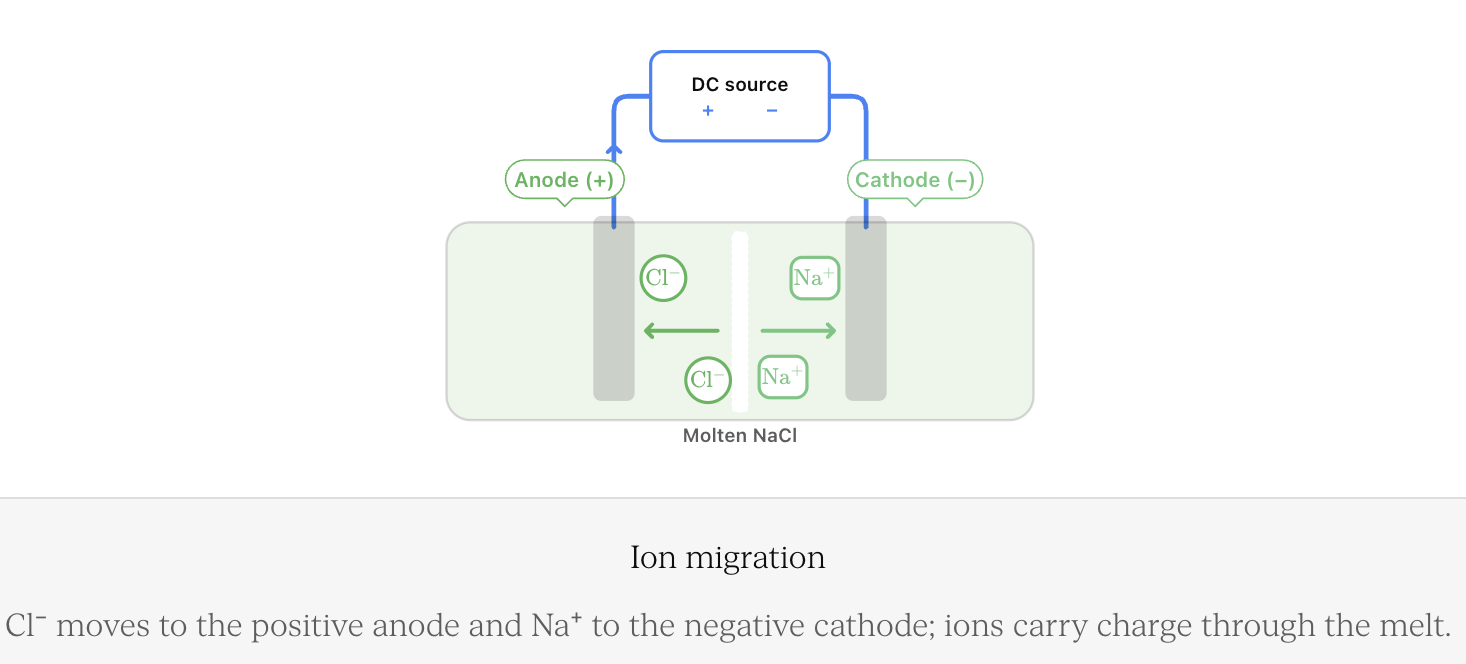
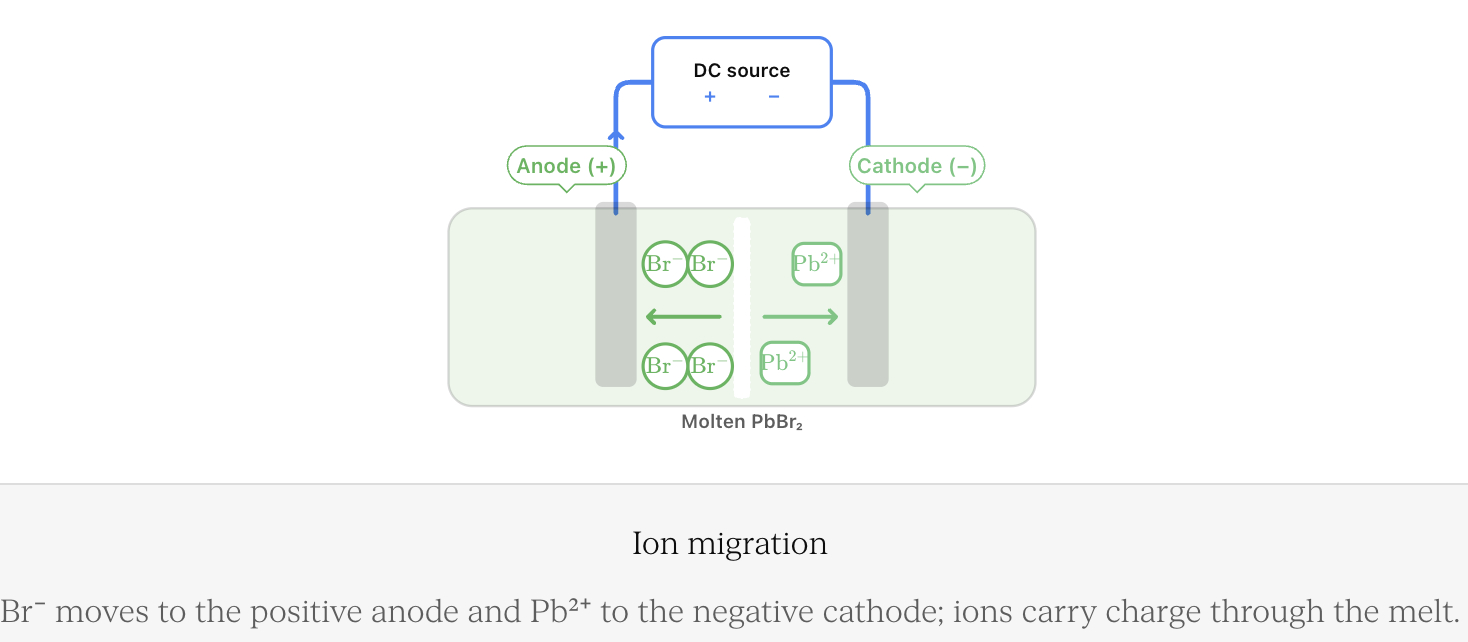
Notice the key relationships:
positive ions → cathode → reduction
negative ions → anode → oxidation
Electrodes Are Reaction Surfaces
Electrodes do more than simply attract ions.
They provide a surface where:
electron-transfer reactions
can occur.
At the cathode, electrons are available to particles in the electrolyte.
At the anode, electrons are removed from particles.
The electrode therefore connects the:
electronic circuit
with the:
ionic system.
Half-Equations
Electrode reactions are often represented using:
half-equations.
A half-equation shows either:
- oxidation
or:
- reduction
including the electrons involved.
Cathode Half-Equations
A cathode half-equation shows:
gain of electrons.
For example:
Na⁺ + e⁻ → Na
The electron appears on the:
left side.
Another example:
Cu²⁺ + 2e⁻ → Cu
Copper ions gain electrons.
Therefore:
reduction has occurred.
Anode Half-Equations
An anode half-equation shows:
loss of electrons.
For example:
2Cl⁻ → Cl₂ + 2e⁻
The electrons appear on the:
right side.
Another example:
2Br⁻ → Br₂ + 2e⁻
Bromide ions lose electrons.
Therefore:
oxidation has occurred.
Example: Molten Sodium Chloride
Molten sodium chloride contains:
Na⁺ ions
and:
Cl⁻ ions.
Because the substance is molten, these ions are free to:
move.


At the Cathode
Na⁺ ions move toward the:
negative cathode.
They gain electrons:
Na⁺ + e⁻ → Na
This is:
reduction.
The product is:
sodium metal.
At the Anode
Cl⁻ ions move toward the:
positive anode.
They lose electrons:
2Cl⁻ → Cl₂ + 2e⁻
This is:
oxidation.
The product is:
chlorine gas.
Overall Reaction
The two half-equations can be combined.
Cathode:
2Na⁺ + 2e⁻ → 2Na
Anode:
2Cl⁻ → Cl₂ + 2e⁻
The electrons cancel.
Overall:
2NaCl → 2Na + Cl₂
Electrical energy drives this:
non-spontaneous reaction.
Example: Molten Lead(II) Bromide
Consider molten lead(II) bromide:
PbBr₂
It contains:
Pb²⁺ ions
and:
Br⁻ ions.
The ions are mobile because the compound is:
molten.
At the Cathode
Pb²⁺ is positive.
Therefore:
Pb²⁺ → cathode
At the cathode:
Pb²⁺ + 2e⁻ → Pb
Lead ions gain electrons.
Therefore:
reduction occurs.
Lead metal is produced.
At the Anode
Br⁻ is negative.
Therefore:
Br⁻ → anode
At the anode:
2Br⁻ → Br₂ + 2e⁻
Bromide ions lose electrons.
Therefore:
oxidation occurs.
Bromine is produced.
Try the Second Electrolyte
The same electrode rules apply when the electrolyte changes.
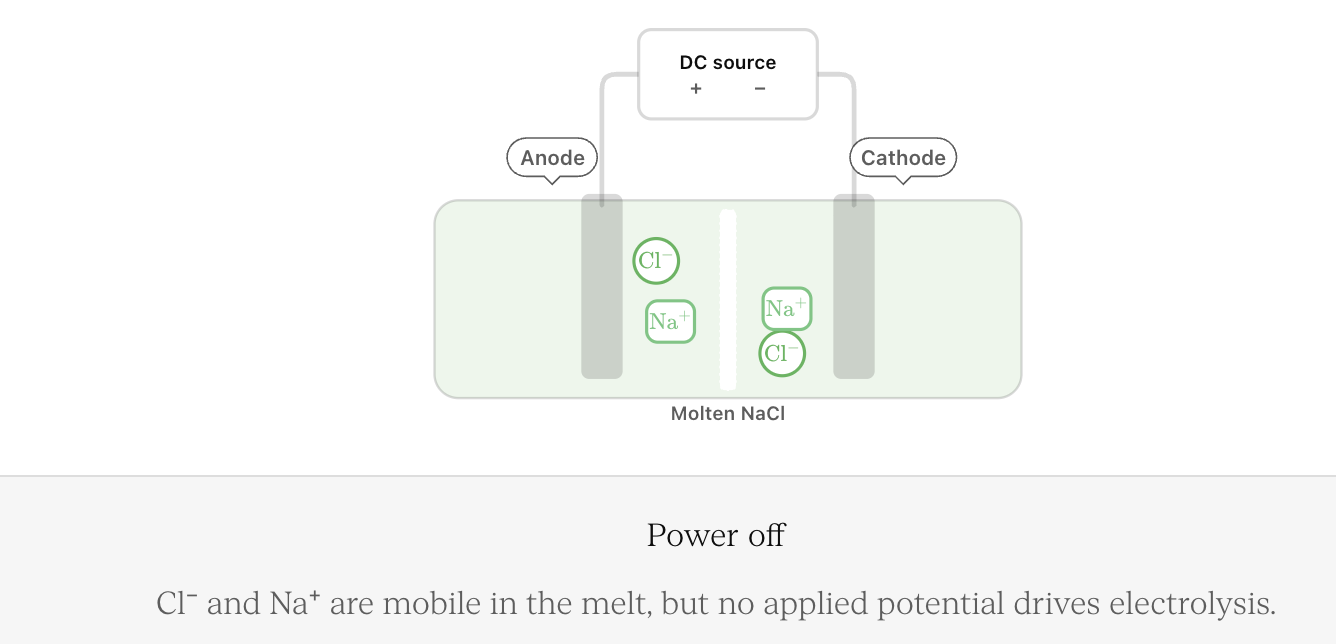
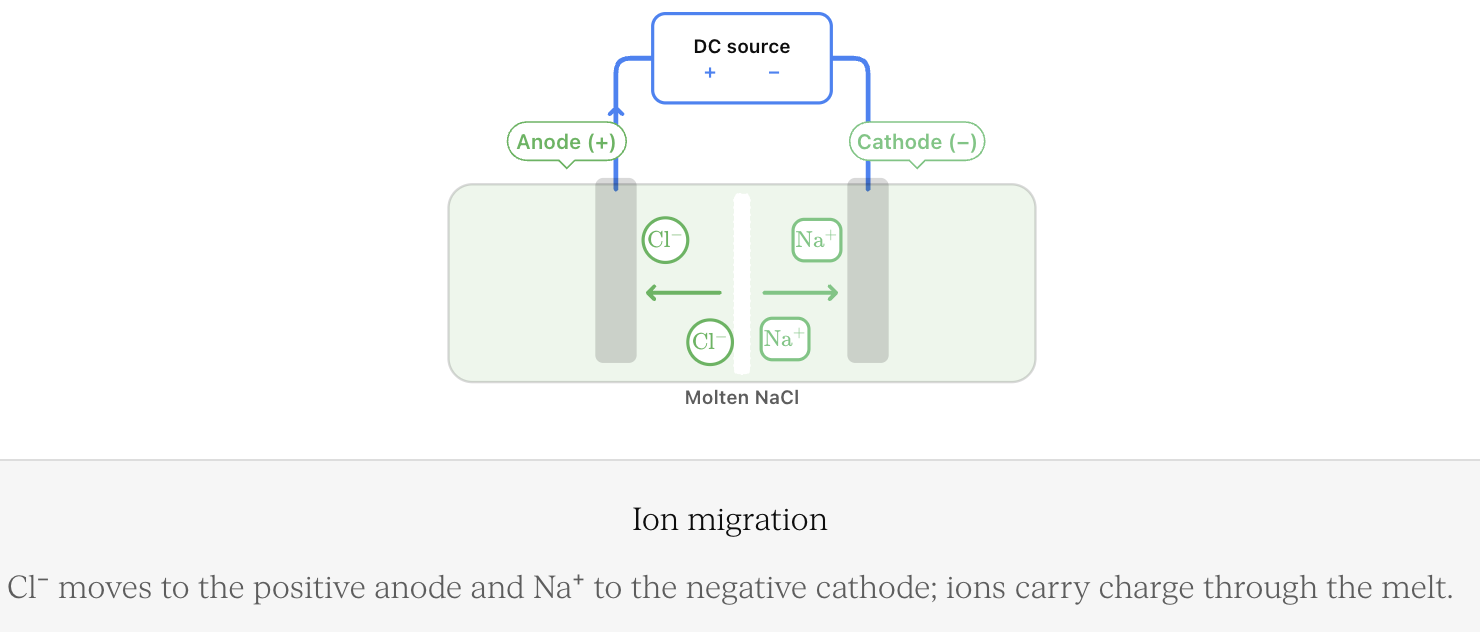
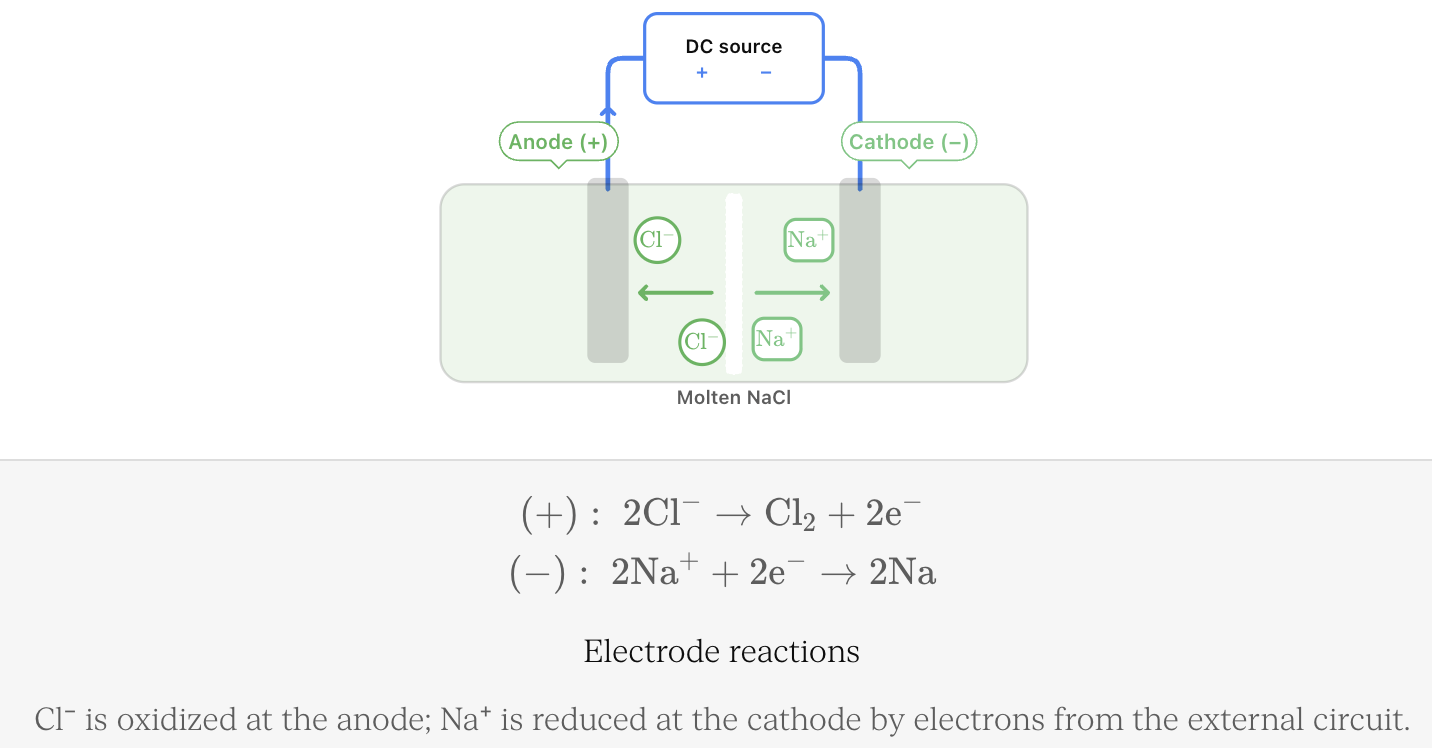
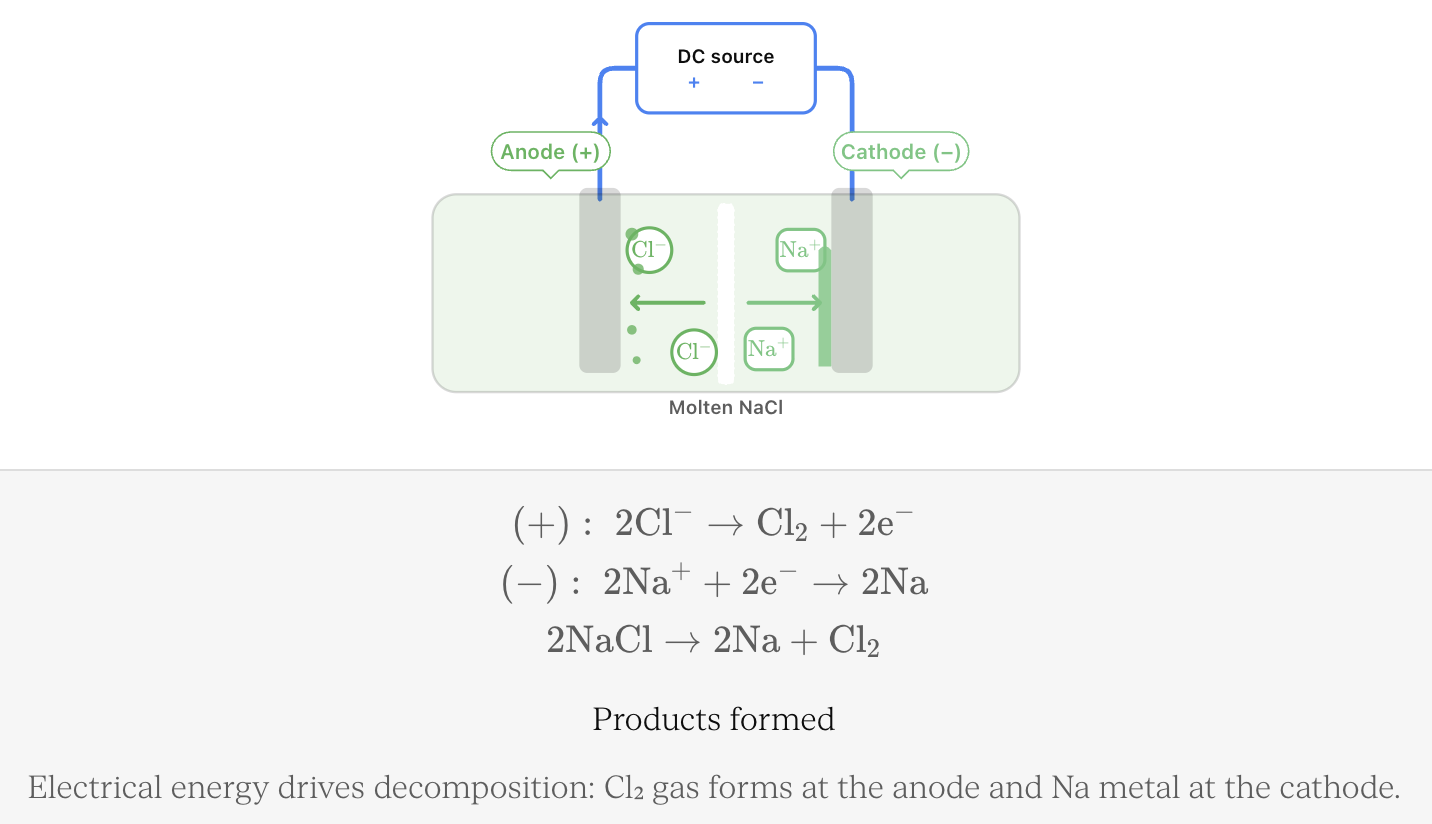
The identities of the products change, but the basic rules remain:
Anode = oxidation
Cathode = reduction
Inert and Reactive Electrodes
Electrodes can be classified as:
inert electrodes
or:
reactive electrodes.
This distinction is important because the electrode material can sometimes affect the products of:
electrolysis.
Inert Electrodes
An inert electrode provides a conducting surface but does not normally participate significantly in the chemical reaction under the conditions used.
Common examples include:
- graphite
- platinum
The electrode allows electrons to enter or leave the system while remaining largely:
chemically unchanged.


Why Use Inert Electrodes?
An inert electrode is useful when scientists want to study reactions involving the:
electrolyte itself.
The electrode provides:
- electrical contact
- a reaction surface
- electron transfer
without intentionally supplying another reactant.
Graphite Electrodes
Graphite is commonly used as an electrode because it:
- conducts electricity
- can withstand relatively high temperatures
- is comparatively inexpensive
- is relatively unreactive in many conditions
However, graphite is not perfectly inert under:
all conditions.
It can participate in some reactions, particularly under strongly oxidizing or high-temperature conditions.
Platinum Electrodes
Platinum is another common inert-electrode material.
It:
- conducts electricity well
- resists many chemical reactions
- provides an effective electrode surface
However, platinum is:
expensive.
Therefore graphite is often more practical in school laboratory experiments.
Reactive Electrodes
A reactive electrode participates in the chemical reaction.
Instead of simply providing a surface, the electrode material itself may:
- lose electrons
- dissolve into the electrolyte
- gain mass
- react with products
The electrode therefore becomes one of the:
reactants or products.
Copper as a Reactive Electrode
Copper electrodes provide an important example.
At a copper anode:
Cu → Cu²⁺ + 2e⁻
Copper atoms lose electrons.
The copper enters the solution as:
Cu²⁺ ions.
Therefore the copper anode can gradually:
lose mass.
Copper at the Cathode
Copper ions can move toward the cathode.
At the cathode:
Cu²⁺ + 2e⁻ → Cu
Copper ions gain electrons and become copper atoms.
Copper is deposited on the cathode.
The cathode therefore:
gains mass.


Electrolysis with Copper Electrodes
Consider copper electrodes placed in a solution containing Cu²⁺ ions.
At the anode:
Cu → Cu²⁺ + 2e⁻
At the cathode:
Cu²⁺ + 2e⁻ → Cu
Copper is effectively transferred from:
the anode to the cathode.
This principle is important in:
- copper purification
- electroplating
- industrial electrochemistry
Electrode Mass Changes
Electrode reactions can sometimes be detected by measuring:
mass changes.
If metal atoms leave an electrode:
electrode mass decreases.
If metal ions are deposited onto an electrode:
electrode mass increases.
For example, in a copper transfer system:
Anode → loses copper → mass decreases
Cathode → gains copper → mass increases
Inert vs Reactive Electrodes
| Feature | Inert Electrode | Reactive Electrode |
|---|---|---|
| Main function | Provides conducting surface | Provides surface and participates chemically |
| Usually consumed? | No | May be |
| May change mass? | Usually little | Often |
| Examples | Graphite, platinum | Copper, silver |
| Can affect products? | Usually less directly | Yes |
| Role in reaction | Mainly electron transfer | Electron transfer + chemical reaction |
Why Electrode Material Matters
Suppose the same electrolyte is electrolyzed using:
different electrode materials.
The products may not always be the same.
With inert electrodes, reactions generally involve species from the:
electrolyte.
With reactive electrodes, the electrode itself may participate.
Therefore, when analyzing electrolysis, always ask:
What is the electrode made from?
Electrodes in Electroplating
Electroplating uses electrolysis to coat an object with a thin layer of material, usually a:
metal.
The object being coated is normally the:
cathode.
Metal ions gain electrons at its surface:
Mⁿ⁺ + ne⁻ → M
The metal forms a coating on the object.


Example: Copper Electroplating
Suppose an object is being coated with copper.
The object is connected as the:
cathode.
At its surface:
Cu²⁺ + 2e⁻ → Cu
Copper atoms form a layer on the object.
A copper anode may also be used.
At the copper anode:
Cu → Cu²⁺ + 2e⁻
This helps replace Cu²⁺ ions removed from the solution.
Electrodes in Metal Purification
Reactive electrodes are important in:
electrorefining.
Copper purification is a common example.
The impure copper is used as the:
anode.
A sheet of pure copper is used as the:
cathode.
Copper is transferred electrochemically from the impure anode toward the pure cathode.
The Impure Copper Anode
At the anode:
Cu → Cu²⁺ + 2e⁻
Copper atoms become ions and enter the:
electrolyte.
The anode gradually becomes:
smaller.
Some impurities behave differently and may collect below the anode or remain in solution, depending on their chemical properties.
The Pure Copper Cathode
At the cathode:
Cu²⁺ + 2e⁻ → Cu
Copper ions are deposited as:
solid copper.
The cathode therefore becomes:
larger and heavier.
Analyzing an Electrode Reaction
When given an electrolysis problem, use a systematic method.
Step 1: Identify the ions present.
Step 2: Determine whether each ion is positive or negative.
Step 3: Move cations toward the cathode.
Step 4: Move anions toward the anode.
Step 5: Remember reduction occurs at the cathode.
Step 6: Remember oxidation occurs at the anode.
Step 7: Determine whether the electrodes are inert or reactive.
Step 8: Write balanced half-equations.
Balancing Cathode Half-Equations
Suppose:
Al³⁺ → Al
The aluminum ion must gain three electrons to become neutral.
Therefore:
Al³⁺ + 3e⁻ → Al
Check the charge:
Left side:
+3 + (−3) = 0
Right side:
0
The equation is balanced.
Balancing Anode Half-Equations
Suppose chloride ions form chlorine gas.
Start with:
Cl⁻ → Cl₂
Because chlorine gas contains two chlorine atoms:
2Cl⁻ → Cl₂
Now balance the charge.
Left side has charge:
−2
Therefore two electrons must appear on the right:
2Cl⁻ → Cl₂ + 2e⁻
Worked Example 1
An electrolyte contains Mg²⁺ ions.
Which electrode will they move toward?
Mg²⁺ is:
positive.
Therefore:
Mg²⁺ → negative cathode.
At the cathode:
Mg²⁺ + 2e⁻ → Mg
This is:
reduction.
Worked Example 2
An electrolyte contains I⁻ ions.
Which electrode will they move toward?
I⁻ is:
negative.
Therefore:
I⁻ → positive anode.
At the anode:
2I⁻ → I₂ + 2e⁻
This is:
oxidation.
Worked Example 3
Write the cathode reaction for Ag⁺.
Ag⁺ must gain one electron:
Ag⁺ + e⁻ → Ag
This is reduction because the silver ion:
gains an electron.
Worked Example 4
Write the cathode reaction for Al³⁺.
Al³⁺ needs three electrons:
Al³⁺ + 3e⁻ → Al
The aluminum ion is:
reduced.
Worked Example 5
Write the anode reaction for Br⁻.
Bromine exists as Br₂.
Therefore:
2Br⁻ → Br₂ + 2e⁻
Bromide ions lose electrons.
This is:
oxidation.
Worked Example 6
A copper electrode loses mass during electrolysis.
Which electrode is it likely to be if copper atoms are forming Cu²⁺ ions?
The reaction is:
Cu → Cu²⁺ + 2e⁻
Electrons are lost.
Therefore this is oxidation.
Oxidation occurs at the:
anode.
Worked Example 7
A metal coating appears on an electrode.
Metal ions are gaining electrons:
Mⁿ⁺ + ne⁻ → M
This is reduction.
Therefore the coating forms at the:
cathode.
Worked Example 8
A student says:
"The positive electrode is always the anode."
Is this correct?
Not for every electrochemical cell.
In an electrolytic cell:
anode = positive
In a galvanic cell:
anode = negative
The definition that always works is:
anode = oxidation.
Worked Example 9
A student says:
"The cathode attracts electrons because it is negative."
This is incorrect reasoning.
Electrons are supplied to the cathode through the:
external circuit.
The negative cathode attracts:
positive ions.
Those cations can then receive electrons at the electrode surface.
Worked Example 10
Why might changing from graphite electrodes to copper electrodes change an electrolysis experiment?
Graphite is relatively inert in many conditions.
Copper can be:
reactive.
Copper atoms at the anode may oxidize:
Cu → Cu²⁺ + 2e⁻
Therefore changing electrode material can change the reactions and:
products.
Predicting Changes at Electrodes
Observations can provide clues about electrode reactions.
You might observe:
Gas bubbles
A gaseous product is forming.
Metal coating
Metal ions are being reduced at the cathode.
Electrode gets smaller
The electrode material may be oxidized.
Electrode gets heavier
Material may be deposited onto it.
Colour changes
The concentration of coloured ions may be changing.
These observations can help identify the:
chemical reactions occurring.
Gas Formation at Electrodes
Some electrolysis reactions produce gases.
Examples include:
- hydrogen
- oxygen
- chlorine
- bromine vapour under suitable conditions
Gas production may be observed as:
bubbles at an electrode.
The identity of the gas depends on:
- electrolyte
- ions present
- electrode material
- operating conditions
Why Electrode Reactions Matter
Electrode reactions are central to many technologies.
They are used in:
- electroplating
- metal extraction
- metal purification
- chlorine production
- hydrogen production
- battery technology
- industrial chemical manufacturing
Understanding electrodes therefore helps explain many practical applications of:
electrochemistry.


Common Mistake: Anode Means Positive
The anode is defined by the reaction occurring there:
oxidation.
In an electrolytic cell the anode is positive.
But in a galvanic cell the anode is:
negative.
Remember:
AnOx.
Common Mistake: Cathode Means Negative
The cathode is defined as the electrode where:
reduction occurs.
It is negative during electrolysis but positive in a:
galvanic cell.
Remember:
RedCat.
Common Mistake: Cations Move to the Positive Electrode
Cations are positively charged.
They are attracted toward the:
negative cathode.
Therefore:
Cations → Cathode.
Common Mistake: Electrons Move Through the Electrolyte
Electrons move through the:
external circuit and electrodes.
Ions move through the:
electrolyte.
Common Mistake: Electrodes Never React
Some electrodes are designed to be relatively:
inert.
Others are deliberately:
reactive.
Reactive electrodes can participate directly in the electrochemical reaction.
Common Mistake: Graphite Is Always Completely Inert
Graphite is often treated as an inert electrode in introductory electrochemistry.
However, it can react under certain:
conditions.
"Inert" therefore means relatively unreactive in the particular electrochemical system, not chemically incapable of reacting under all circumstances.
Common Mistake: Metal Is Always Produced at the Cathode
Reduction always occurs at the cathode.
However, the substance actually produced depends on:
- ions present
- electrolyte
- concentration
- electrode material
- other possible reactions
In aqueous solutions, for example, hydrogen may sometimes be produced instead of a:
metal.
Check Your Understanding
- Define an electrode.
- Name the two electrodes in an electrolytic cell.
- Which electrode is positive during electrolysis?
- Which electrode is negative during electrolysis?
- Where does oxidation occur?
- Where does reduction occur?
- What does AnOx mean?
- What does RedCat mean?
- What does OIL RIG mean?
- What is a cation?
- Which electrode attracts cations?
- What is an anion?
- Which electrode attracts anions?
- Why do ions move toward particular electrodes?
- Where do electrons move in an electrolysis system?
- Where do ions move?
- What happens to electrons at the cathode?
- What happens to electrons at the anode reaction?
- Write the cathode half-equation for Na⁺.
- Write the cathode half-equation for Cu²⁺.
- Write the cathode half-equation for Al³⁺.
- Write the anode half-equation for Cl⁻.
- Write the anode half-equation for Br⁻.
- What products form during electrolysis of molten sodium chloride?
- Describe the electrode reactions during electrolysis of molten PbBr₂.
- What is an inert electrode?
- Give two examples of materials commonly used as inert electrodes.
- Why is graphite commonly used as an electrode?
- Why is platinum useful as an electrode?
- What is a reactive electrode?
- How does a reactive electrode differ from an inert electrode?
- Write the oxidation reaction for a copper anode.
- Write the reduction reaction for Cu²⁺ at a cathode.
- Why does a copper anode lose mass?
- Why does a copper cathode gain mass?
- What is electroplating?
- Why is the object being electroplated connected as the cathode?
- Explain how copper can be electroplated onto an object.
- Explain how reactive copper electrodes can maintain Cu²⁺ ions in an electrolyte.
- What is electrorefining?
- Which electrode contains impure copper during copper purification?
- Which electrode gains pure copper?
- Why can changing electrode material change the products of electrolysis?
- What might bubbles at an electrode indicate?
- What might an increase in electrode mass indicate?
- What might a decrease in electrode mass indicate?
- Explain why "the anode is always positive" is incorrect.
- Compare inert and reactive electrodes.
- Explain how ions and electrons move through an electrolytic cell.
- Describe a systematic method for predicting the reactions at the electrodes during electrolysis.
Key Terms
Electrode: Electrical conductor where electron-transfer reactions occur in an electrochemical system.
Anode: Electrode where oxidation occurs.
Cathode: Electrode where reduction occurs.
Cation: Positively charged ion that moves toward the cathode during electrolysis.
Anion: Negatively charged ion that moves toward the anode during electrolysis.
Oxidation: Loss of electrons.
Reduction: Gain of electrons.
Half-equation: Equation representing oxidation or reduction and showing electrons explicitly.
Inert electrode: Electrode that provides a conducting reaction surface without normally participating significantly in the reaction.
Reactive electrode: Electrode whose material participates in the electrochemical reaction.
Graphite: Conducting form of carbon commonly used as a relatively inert electrode.
Platinum: Conductive and highly corrosion-resistant metal often used as an inert electrode.
Electroplating: Use of electrolysis to deposit a thin layer of material onto an object.
Electrorefining: Use of electrolysis to purify a metal.
Electrodeposition: Formation of a material on an electrode through an electrochemical reaction.
Key Takeaways
- An electrolytic cell contains an anode and a cathode.
- During electrolysis, the anode is positive and the cathode is negative.
- The anode is defined as the electrode where oxidation occurs.
- The cathode is defined as the electrode where reduction occurs.
- AnOx means anode = oxidation.
- RedCat means reduction = cathode.
- Cations move toward the cathode.
- Anions move toward the anode.
- Electrons move through the external circuit while ions move through the electrolyte.
- Electrode reactions can be represented using half-equations.
- At the cathode, particles gain electrons.
- At the anode, particles lose electrons.
- Inert electrodes mainly provide a conducting surface for electron transfer.
- Graphite and platinum are commonly used as relatively inert electrodes.
- Reactive electrodes participate directly in the chemical reaction.
- A reactive metal anode may dissolve and lose mass.
- A metal deposited at the cathode can cause the cathode to gain mass.
- Electrode material can affect the products of electrolysis.
- Electrodes are central to practical processes such as electroplating, electrorefining, metal extraction, and industrial electrolysis.
- When solving electrolysis problems, identify the ions, their charges, the electrode type, and whether oxidation or reduction occurs before writing the half-equations.
4. Electrolysis of Molten Compounds
Learning outcomes
- I can describe the electrolysis of molten ionic compounds.
- I can predict the products formed at each electrode.
- I can write half-equations for electrode reactions.
- I can explain why molten compounds conduct electricity.
- I can apply electrolysis concepts to metal extraction.


What Is a Molten Ionic Compound?
An ionic compound is made from positively and negatively charged ions held together by strong electrostatic attractions.
Examples include:
- sodium chloride, NaCl
- magnesium chloride, MgCl₂
- lead(II) bromide, PbBr₂
- aluminum oxide, Al₂O₃
- calcium chloride, CaCl₂
When an ionic compound is molten, it has been heated until it melts and becomes a liquid.
The important change is that its ions become:
free to move.
This allows the molten compound to conduct electricity and undergo:
electrolysis.
Why Do Molten Ionic Compounds Conduct Electricity?
Electrical current requires the movement of:
charged particles.
In a solid ionic compound, the ions are held in fixed positions within a:
giant ionic lattice.
The ions cannot move from place to place.
Therefore, solid ionic compounds generally do not conduct electricity through ionic movement.
When the compound melts, the lattice breaks apart.
The ions become:
mobile.
These mobile ions can carry electrical charge through the liquid.
Therefore:
solid ionic compound → ions fixed → does not conduct ionically
molten ionic compound → ions mobile → conducts electricity


What Happens During Electrolysis?
Electrolysis uses electrical energy to drive a:
non-spontaneous chemical reaction.
Two electrodes are placed in the molten ionic compound and connected to a:
DC power supply.
During electrolysis:
Cathode = negative
Anode = positive
The ions move toward electrodes with the:
opposite charge.
Ion Movement
Positive ions are called:
cations.
Cations move toward the:
negative cathode.
Negative ions are called:
anions.
Anions move toward the:
positive anode.
Therefore:
Cations (+) → Cathode (−)
Anions (−) → Anode (+)
What Happens at the Cathode?
The cathode is the electrode where:
reduction occurs.
Reduction means:
gain of electrons.
Positive metal ions move toward the cathode and gain electrons.
General form:
Mⁿ⁺ + ne⁻ → M
The metal ion becomes a:
neutral metal atom.
Therefore, during electrolysis of a simple molten ionic compound, the:
metal is normally produced at the cathode.
What Happens at the Anode?
The anode is the electrode where:
oxidation occurs.
Oxidation means:
loss of electrons.
Negative ions move toward the anode and lose electrons.
For example:
2Cl⁻ → Cl₂ + 2e⁻
Chloride ions form:
chlorine gas.
Therefore, in a molten metal halide:
metal → cathode
halogen → anode.
Remember the Electrode Rules
A useful set of memory aids is:
RedCat
Reduction at Cathode.
AnOx
Anode = Oxidation.
OIL RIG
Oxidation Is Loss of electrons.
Reduction Is Gain of electrons.
Visualizing Molten Electrolysis
The complete process can be followed from ion movement to electron transfer and product formation.
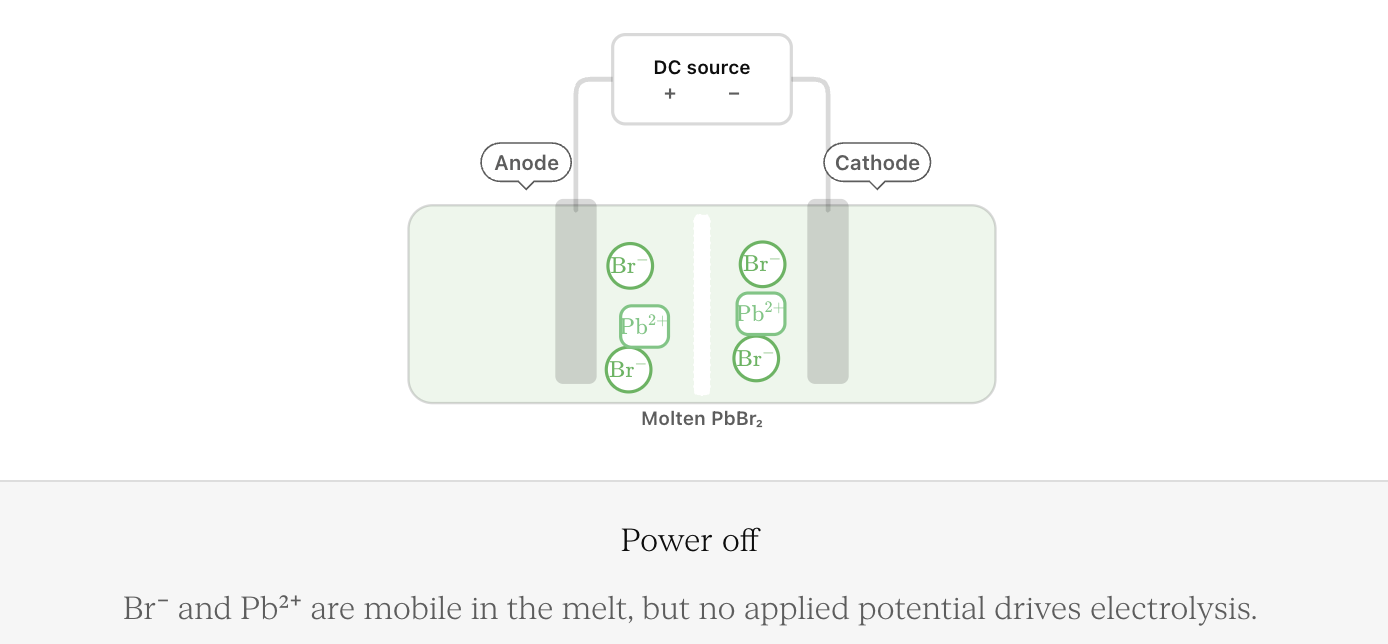
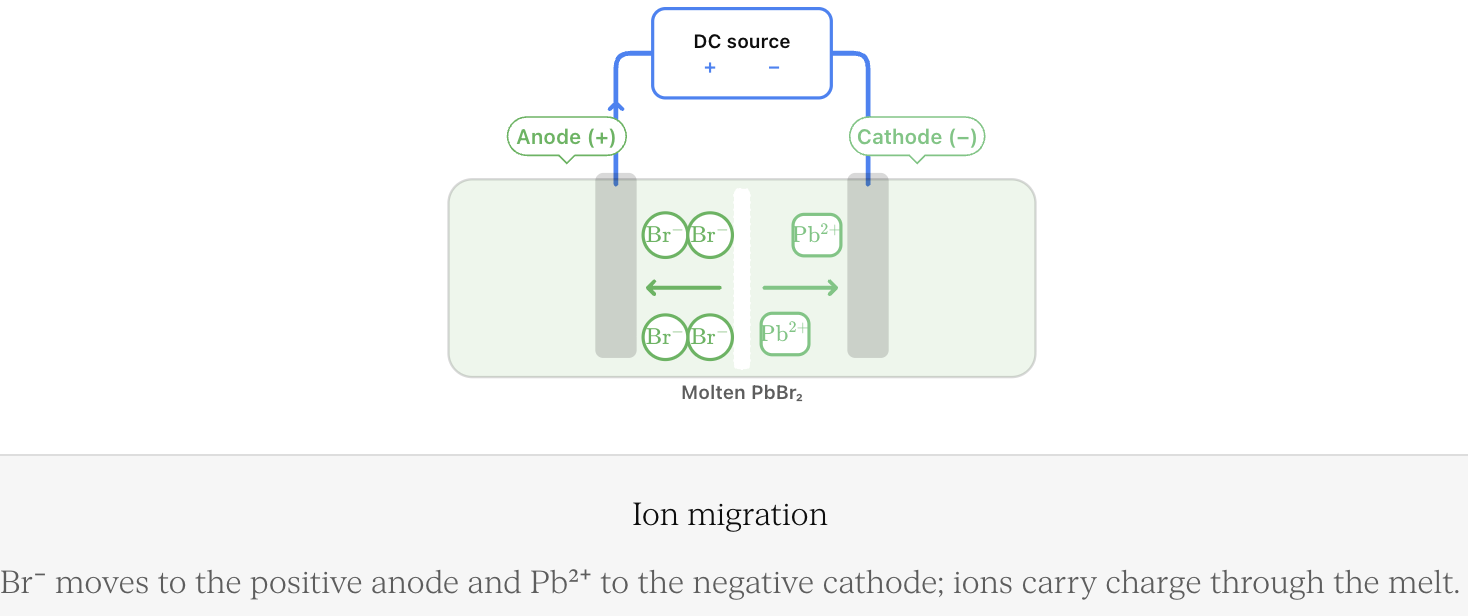
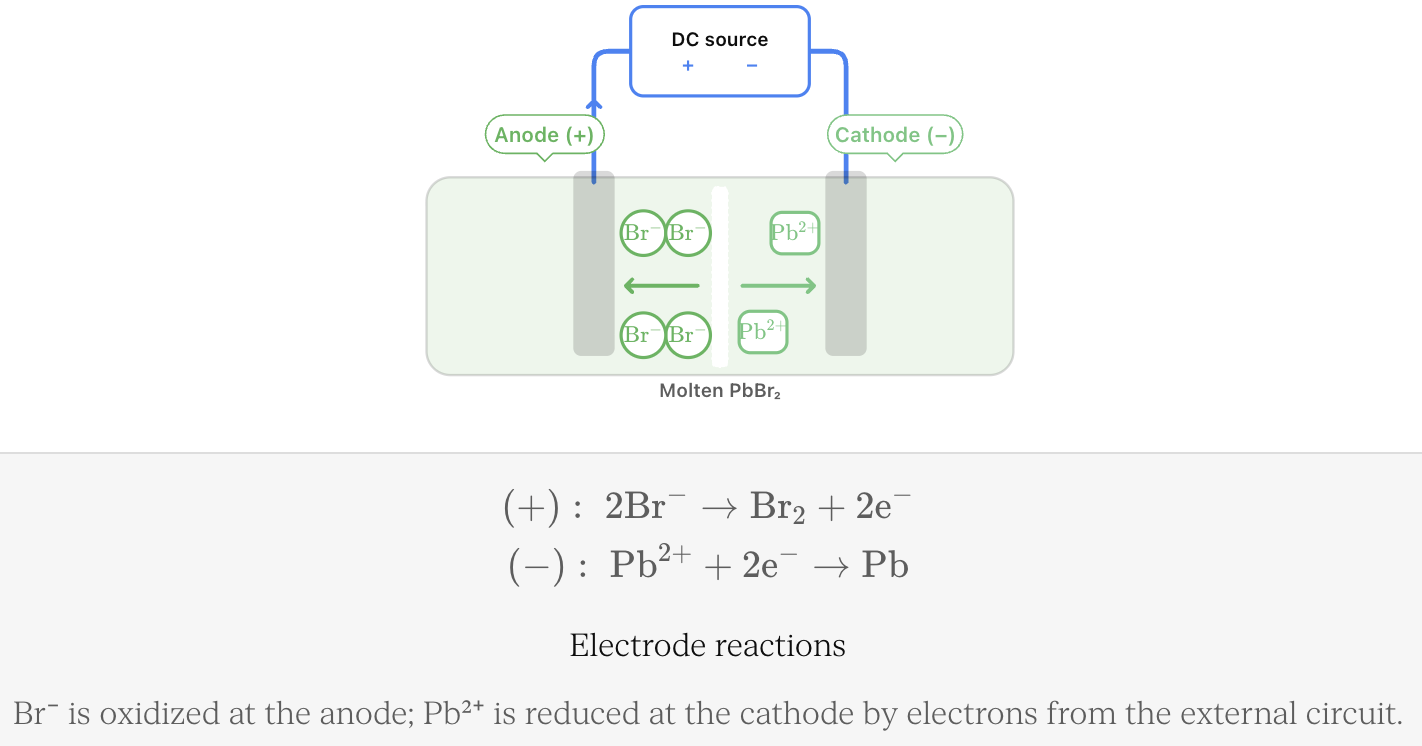
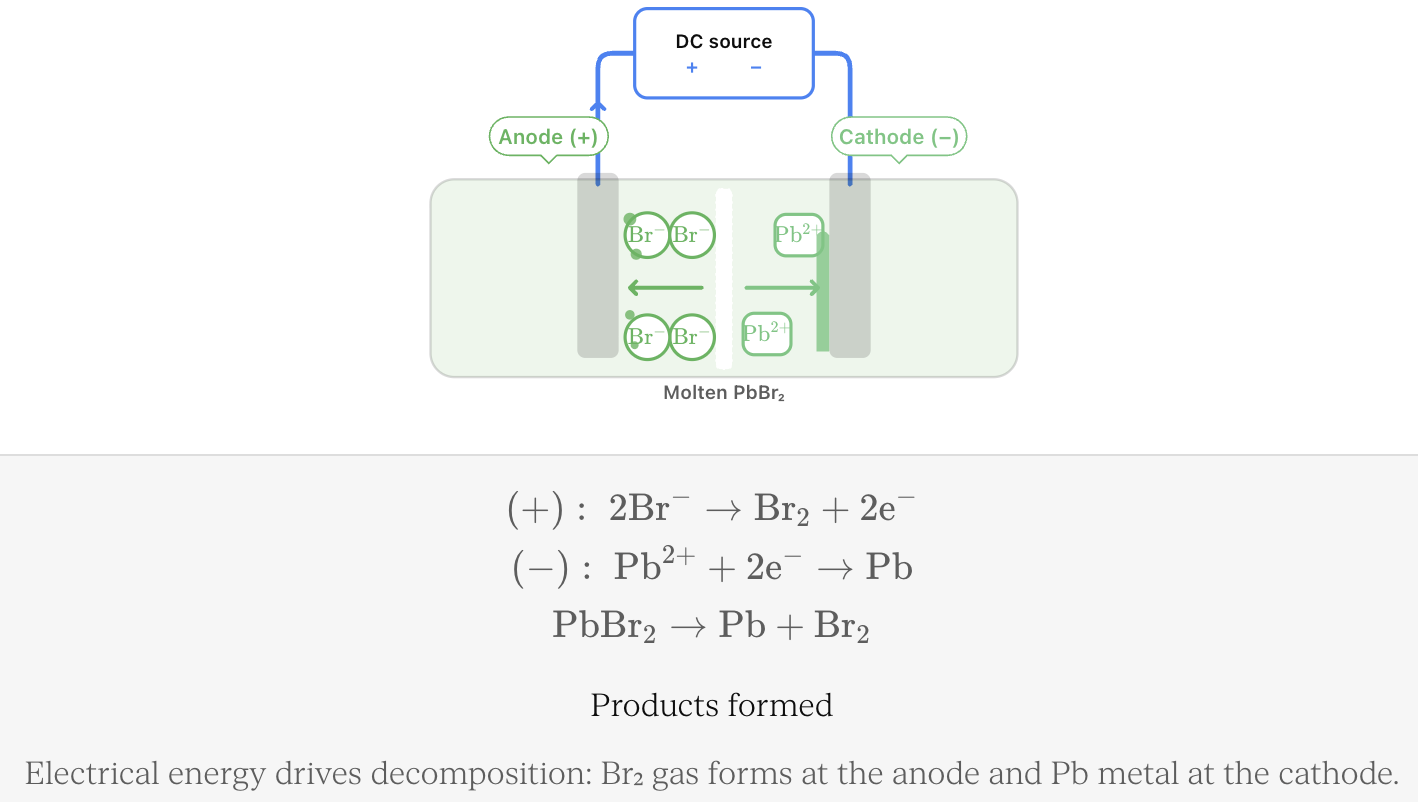
Notice that Na⁺ and Cl⁻ move in opposite directions because they have:
opposite electrical charges.
Example 1: Molten Sodium Chloride
Sodium chloride has the formula:
NaCl
When molten, it contains:
Na⁺ ions
and:
Cl⁻ ions.
These ions are free to move through the liquid.
Sodium at the Cathode
Na⁺ ions are positively charged.
They move toward the:
negative cathode.
Each sodium ion gains one electron:
Na⁺ + e⁻ → Na
This is:
reduction.
The product at the cathode is:
sodium metal.
Chlorine at the Anode
Cl⁻ ions are negatively charged.
They move toward the:
positive anode.
Two chloride ions each lose an electron:
2Cl⁻ → Cl₂ + 2e⁻
This is:
oxidation.
The product at the anode is:
chlorine gas.

Overall Reaction for Molten Sodium Chloride
Cathode:
2Na⁺ + 2e⁻ → 2Na
Anode:
2Cl⁻ → Cl₂ + 2e⁻
The electrons cancel when the half-equations are combined.
Overall:
2NaCl(l) → 2Na(l) + Cl₂(g)
Electrical energy is used to decompose sodium chloride into:
sodium and chlorine.
State Symbols
State symbols are especially useful when discussing electrolysis.
(s) = solid
(l) = liquid
(g) = gas
(aq) = dissolved in water
For molten sodium chloride:
NaCl(l)
The symbol (l) tells us the compound is:
liquid because it has been melted.
It does not mean the substance is dissolved in water.
Molten Is Not the Same as Aqueous
This distinction is extremely important.
Molten
means:
melted by heating.
Aqueous
means:
dissolved in water.
Molten NaCl contains only:
Na⁺ and Cl⁻ ions.
Aqueous NaCl contains:
- Na⁺ ions
- Cl⁻ ions
- water molecules
The presence of water can introduce additional possible electrode reactions.
Therefore, electrolysis of a molten compound is often:
simpler to predict.
Predicting Products of a Molten Binary Compound
For a simple molten ionic compound containing only two types of ions:
Step 1: Identify the ions.
Step 2: Identify their charges.
Step 3: Send the cation to the cathode.
Step 4: Send the anion to the anode.
Step 5: Reduce the cation.
Step 6: Oxidize the anion.
Step 7: Write balanced half-equations.
Example 2: Molten Lead(II) Bromide
Lead(II) bromide has the formula:
PbBr₂
When molten, it contains:
Pb²⁺ ions
and:
Br⁻ ions.


Lead at the Cathode
Pb²⁺ is positive.
Therefore it moves toward the:
negative cathode.
It gains two electrons:
Pb²⁺ + 2e⁻ → Pb
This is:
reduction.
The cathode product is:
lead.
Bromine at the Anode
Br⁻ is negative.
Therefore it moves toward the:
positive anode.
At the anode:
2Br⁻ → Br₂ + 2e⁻
This is:
oxidation.
The anode product is:
bromine.
Visualizing Lead(II) Bromide Electrolysis
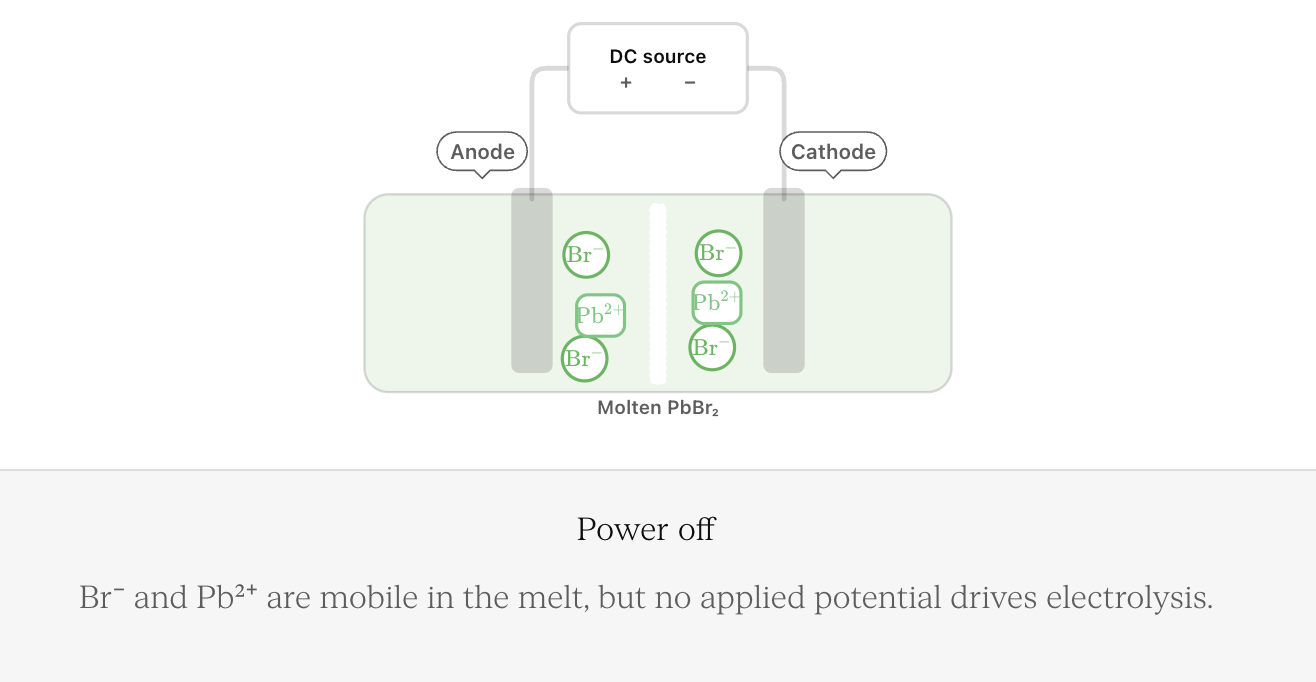
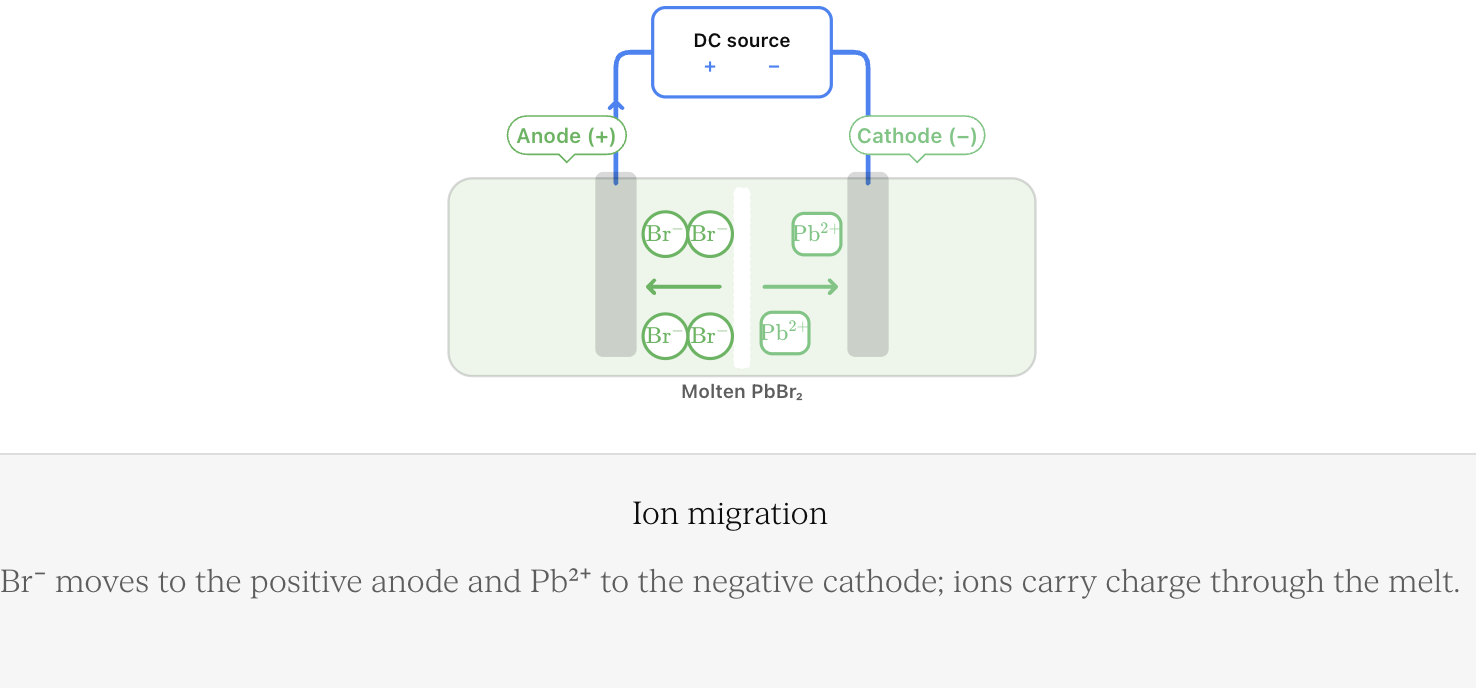
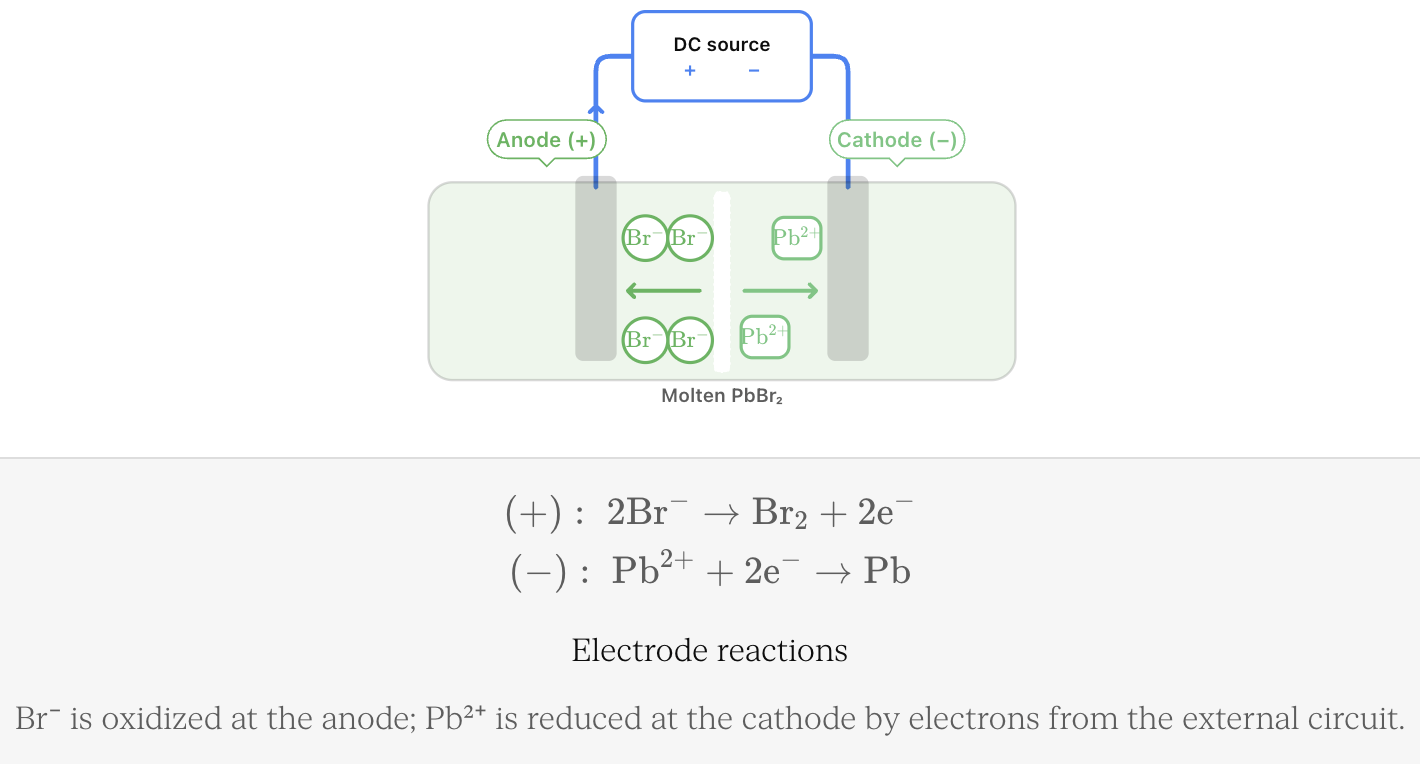
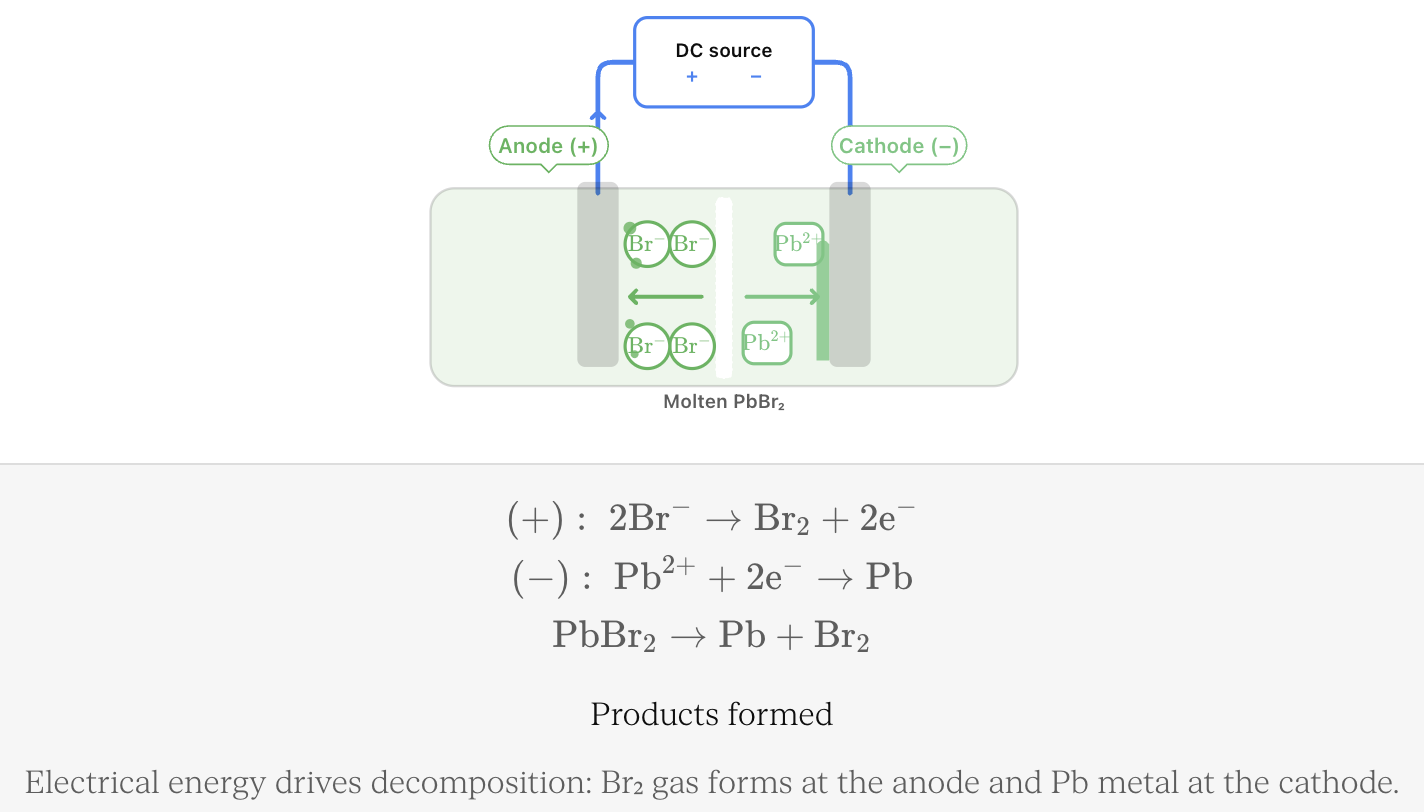
The ions and products are different from sodium chloride, but the electrode rules remain exactly the same.
Example 3: Molten Magnesium Chloride
Magnesium chloride has the formula:
MgCl₂
The ions present are:
Mg²⁺
and:
Cl⁻.
At the cathode:
Mg²⁺ + 2e⁻ → Mg
At the anode:
2Cl⁻ → Cl₂ + 2e⁻
Therefore:
Cathode product = magnesium
Anode product = chlorine
Overall:
MgCl₂(l) → Mg(l) + Cl₂(g)
Example 4: Molten Calcium Chloride
Calcium chloride has the formula:
CaCl₂
The ions are:
Ca²⁺
and:
Cl⁻.
At the cathode:
Ca²⁺ + 2e⁻ → Ca
At the anode:
2Cl⁻ → Cl₂ + 2e⁻
Products:
Cathode → calcium
Anode → chlorine
Example 5: Molten Lithium Bromide
Lithium bromide has the formula:
LiBr
The ions are:
Li⁺
and:
Br⁻.
Cathode:
Li⁺ + e⁻ → Li
Anode:
2Br⁻ → Br₂ + 2e⁻
Products:
Cathode → lithium
Anode → bromine
Example 6: Molten Potassium Iodide
Potassium iodide contains:
K⁺
and:
I⁻.
Cathode:
K⁺ + e⁻ → K
Anode:
2I⁻ → I₂ + 2e⁻
Products:
Cathode → potassium
Anode → iodine
Halogens at the Anode
Molten metal halides contain halide ions.
These include:
Cl⁻ → chloride
Br⁻ → bromide
I⁻ → iodide
At the anode, they are oxidized.
Chloride:
2Cl⁻ → Cl₂ + 2e⁻
Bromide:
2Br⁻ → Br₂ + 2e⁻
Iodide:
2I⁻ → I₂ + 2e⁻
Notice that the halogens are produced as:
diatomic molecules.
Why Are Halogens Written as Cl₂, Br₂ and I₂?
Elemental halogens normally exist as molecules containing:
two atoms.
Therefore:
chlorine = Cl₂
bromine = Br₂
iodine = I₂
This must be considered when balancing:
anode half-equations.
Writing Cathode Half-Equations
The basic pattern is:
metal ion + electrons → metal
The number of electrons must equal the:
positive charge on the ion.
For example:
Na⁺ + e⁻ → Na
Mg²⁺ + 2e⁻ → Mg
Al³⁺ + 3e⁻ → Al
Writing Anode Half-Equations
For halide ions, the basic pattern is:
halide ions → halogen + electrons
For example:
2Cl⁻ → Cl₂ + 2e⁻
2Br⁻ → Br₂ + 2e⁻
2I⁻ → I₂ + 2e⁻
Electrons appear on the right because oxidation involves:
loss of electrons.
Checking a Half-Equation
A correct half-equation must balance:
atoms
and:
electrical charge.
Consider:
Mg²⁺ + 2e⁻ → Mg
Atoms:
1 Mg on each side.
Charge:
Left = +2 − 2 = 0
Right = 0
Therefore the half-equation is:
balanced.
Another Half-Equation Check
Consider:
2Br⁻ → Br₂ + 2e⁻
Atoms:
2 Br on each side.
Charge:
Left = −2
Right = −2 from the two electrons.
Therefore both atoms and charge are:
balanced.
Combining Half-Equations
Half-equations can be combined to produce an:
overall equation.
The number of electrons lost must equal the number:
gained.
Consider MgCl₂.
Cathode:
Mg²⁺ + 2e⁻ → Mg
Anode:
2Cl⁻ → Cl₂ + 2e⁻
The two electrons cancel.
Overall:
MgCl₂ → Mg + Cl₂
What If the Electron Numbers Do Not Match?
Consider aluminum ions and chloride ions.
Cathode:
Al³⁺ + 3e⁻ → Al
Anode:
2Cl⁻ → Cl₂ + 2e⁻
Three electrons and two electrons do not match.
The lowest common multiple is:
6.
Multiply the cathode equation by 2:
2Al³⁺ + 6e⁻ → 2Al
Multiply the anode equation by 3:
6Cl⁻ → 3Cl₂ + 6e⁻
Now the electrons cancel.
Overall:
2AlCl₃ → 2Al + 3Cl₂
Electrolysis and Metal Extraction
One of the most important applications of electrolysis is:
extracting reactive metals from their compounds.
Some metals are so reactive that they cannot easily be extracted by reduction using:
carbon.
These metals include:
- potassium
- sodium
- calcium
- magnesium
- aluminum
Electrolysis can be used to obtain these metals.


Why Are Reactive Metals Difficult to Extract?
A metal in an ionic compound exists as:
positive ions.
To produce the metal, these ions must:
gain electrons.
For example:
Mg²⁺ + 2e⁻ → Mg
This is reduction.
Highly reactive metals form very stable compounds.
For many such metals, ordinary chemical reduction methods are not suitable.
Electrolysis provides the electrical energy needed to:
force the reduction.
Extracting Sodium
Sodium can be produced industrially by electrolysis of molten sodium chloride.
At the cathode:
Na⁺ + e⁻ → Na
At the anode:
2Cl⁻ → Cl₂ + 2e⁻
The products are:
sodium metal
and:
chlorine gas.
Why Not Use Aqueous Sodium Chloride to Produce Sodium?
If sodium chloride is dissolved in water, additional reactions involving water become possible.
Under normal aqueous electrolysis conditions, sodium metal is not deposited from Na⁺ because water is reduced preferentially, producing:
hydrogen.
Therefore sodium is produced using:
molten sodium chloride, not ordinary salt water.
Extracting Magnesium
Magnesium can be produced from molten magnesium chloride.
Cathode:
Mg²⁺ + 2e⁻ → Mg
Anode:
2Cl⁻ → Cl₂ + 2e⁻
Overall:
MgCl₂ → Mg + Cl₂
This is another example of using electrolysis to extract a:
reactive metal.
Extracting Aluminum
Aluminum is also extracted using:
electrolysis.
Its main ore is:
bauxite.
Bauxite is processed to obtain aluminum oxide:
Al₂O₃.
The aluminum-containing material is electrolyzed in the molten state as part of the industrial:
Hall-Héroult process.


Aluminum at the Cathode
Aluminum ions are:
Al³⁺.
At the cathode:
Al³⁺ + 3e⁻ → Al
The aluminum ions gain electrons.
Therefore they are:
reduced.
Molten aluminum forms and can be collected from the cell.
Why Is Aluminum Oxide Not Simply Melted by Itself?
Pure aluminum oxide has a very high melting point.
Heating it to its melting point would require:
a great deal of energy.
Industrially, aluminum oxide is dissolved in molten:
cryolite-based electrolyte.
This allows electrolysis to occur at a lower operating temperature than would be required for pure molten aluminum oxide.
Aluminum Production Is Energy Intensive
Electrolysis requires a large supply of:
electrical energy.
Producing aluminum therefore uses substantial amounts of electricity.
This means the environmental impact depends partly on:
how that electricity is generated.
Using lower-carbon electricity can reduce the emissions associated with the electrical energy used in production.
Recycling Aluminum
Recycling aluminum generally requires much less energy than producing aluminum from its ore.
This is because recycling does not require the full sequence of:
ore processing and electrolytic extraction.
Therefore aluminum recycling can:
- reduce energy demand
- reduce demand for new ore
- reduce waste
- reduce some environmental impacts associated with primary production
Energy Changes During Molten Electrolysis
Electrolysis requires an external electrical supply.
The overall energy transformation is primarily:
electrical energy → chemical energy
The electrical energy drives reactions that would not occur spontaneously under those conditions.
Some energy is also transferred as:
thermal energy.
This is particularly important because many industrial electrolytes must be kept:
molten.
Predicting Products: A Simple Strategy
For a simple molten binary ionic compound, use this method.
Suppose you are given:
MgBr₂
First identify the ions:
Mg²⁺ and Br⁻
Then:
Mg²⁺ → cathode → reduction → Mg
Br⁻ → anode → oxidation → Br₂
Therefore:
Cathode product = Mg
Anode product = Br₂
Worked Example 1
Predict the products of molten KCl.
Ions:
K⁺ and Cl⁻
Cathode:
K⁺ + e⁻ → K
Anode:
2Cl⁻ → Cl₂ + 2e⁻
Products:
potassium and chlorine.
Worked Example 2
Predict the products of molten CaBr₂.
Ions:
Ca²⁺ and Br⁻
Cathode:
Ca²⁺ + 2e⁻ → Ca
Anode:
2Br⁻ → Br₂ + 2e⁻
Products:
calcium and bromine.
Worked Example 3
Predict the products of molten LiI.
Ions:
Li⁺ and I⁻
Cathode:
Li⁺ + e⁻ → Li
Anode:
2I⁻ → I₂ + 2e⁻
Products:
lithium and iodine.
Worked Example 4
Predict the products of molten MgCl₂.
Ions:
Mg²⁺ and Cl⁻
Cathode:
Mg²⁺ + 2e⁻ → Mg
Anode:
2Cl⁻ → Cl₂ + 2e⁻
Products:
magnesium and chlorine.
Worked Example 5
Write the cathode half-equation for Al³⁺.
Al³⁺ must gain three electrons:
Al³⁺ + 3e⁻ → Al
This is:
reduction.
Worked Example 6
Write the anode half-equation for iodide ions.
Two iodide ions form one iodine molecule:
2I⁻ → I₂ + 2e⁻
This is:
oxidation.
Worked Example 7
Why does solid MgCl₂ not undergo electrolysis in the same way as molten MgCl₂?
In solid MgCl₂, the ions are:
fixed in a lattice.
They cannot move toward the electrodes.
When MgCl₂ melts, the ions become:
mobile.
They can then carry charge through the electrolyte.
Worked Example 8
A student observes metal forming at the negative electrode.
What process is occurring?
The negative electrode in an electrolytic cell is the:
cathode.
Metal ions gain electrons there.
Therefore:
reduction is occurring.
Worked Example 9
A gas forms at the positive electrode during electrolysis of molten NaCl.
Identify the gas.
The negative ion present is:
Cl⁻.
At the anode:
2Cl⁻ → Cl₂ + 2e⁻
Therefore the gas is:
chlorine.
Worked Example 10
Why is electrolysis useful for extracting highly reactive metals?
Highly reactive metals form stable ionic compounds and are difficult to obtain using simpler chemical reduction methods.
Electrolysis supplies electrical energy that forces the metal ions to:
gain electrons.
At the cathode:
metal ions → metal atoms.
Comparing Solid, Molten and Aqueous Compounds
| State | Are ions mobile? | Conducts ionically? | Suitable for simple molten electrolysis? |
|---|---|---|---|
| Solid ionic compound | No | No | No |
| Molten ionic compound | Yes | Yes | Yes |
| Aqueous ionic solution | Yes | Yes | Electrolysis occurs, but water can affect the products |
This explains why:
molten electrolysis is particularly useful when extracting reactive metals.
Common Mistake: Molten Means Dissolved in Water
It does not.
Molten = melted
Aqueous = dissolved in water
This distinction can completely change the predicted:
electrolysis products.
Common Mistake: Electrons Move Through the Molten Electrolyte
The main moving charge carriers in the molten ionic compound are:
ions.
Electrons move through the:
external circuit and electrodes.
Common Mistake: Positive Ions Move to the Positive Electrode
Opposite charges attract.
Therefore:
positive ions → negative cathode
and:
negative ions → positive anode.
Common Mistake: Oxidation Occurs at the Cathode
Remember:
AnOx
Anode = Oxidation.
RedCat
Reduction = Cathode.
These rules apply regardless of which molten ionic compound is being electrolyzed.
Common Mistake: The Metal Forms at the Anode
Metal ions are positive.
They move toward the:
negative cathode.
They gain electrons and form metal atoms.
Therefore, in simple molten salts:
metal forms at the cathode.
Common Mistake: Chloride Forms Cl at the Anode
Elemental chlorine exists as:
Cl₂.
Therefore the balanced half-equation is:
2Cl⁻ → Cl₂ + 2e⁻
The same idea applies to:
Br₂ and I₂.
Common Mistake: Half-Equations Only Need Balanced Atoms
Half-equations must balance both:
atoms
and:
electrical charge.
Electrons are added to balance the charge.
Common Mistake: Electrolysis Is Always an Economical Extraction Method
Electrolysis can require large amounts of:
electricity.
It is especially useful when chemical reduction is unsuitable, but energy consumption and cost are important considerations.
Check Your Understanding
- What does molten mean?
- Why do solid ionic compounds generally not conduct electricity through ion movement?
- Why do molten ionic compounds conduct electricity?
- What particles carry charge through a molten ionic compound?
- What is the charge of the cathode during electrolysis?
- What is the charge of the anode?
- Which ions move toward the cathode?
- Which ions move toward the anode?
- What process occurs at the cathode?
- What process occurs at the anode?
- Explain RedCat.
- Explain AnOx.
- What does OIL RIG mean?
- Why is the metal normally formed at the cathode during electrolysis of a simple molten salt?
- Why is a halogen produced at the anode when a molten metal halide is electrolyzed?
- Identify the ions in molten NaCl.
- Write the cathode half-equation for molten NaCl.
- Write the anode half-equation for molten NaCl.
- Name the products of molten NaCl electrolysis.
- Write the overall equation for molten NaCl electrolysis.
- Identify the ions in molten PbBr₂.
- Write the cathode half-equation for PbBr₂.
- Write the anode half-equation for PbBr₂.
- Name the products.
- Predict the products of molten MgCl₂.
- Write both half-equations for molten MgCl₂.
- Predict the products of molten CaBr₂.
- Write both half-equations for molten CaBr₂.
- Predict the products of molten LiI.
- Write both half-equations for molten LiI.
- Explain the difference between molten and aqueous.
- Why can aqueous and molten electrolysis produce different products?
- Write a balanced half-equation for the reduction of Al³⁺.
- Write a balanced half-equation for the reduction of Ca²⁺.
- Write a balanced half-equation for the oxidation of Cl⁻.
- Write a balanced half-equation for the oxidation of I⁻.
- Why must both atoms and charge balance in a half-equation?
- Explain why Cl₂ rather than Cl is formed.
- Why is electrolysis useful for extracting reactive metals?
- Give three reactive metals that can be extracted using electrolysis.
- Explain how sodium can be extracted from molten sodium chloride.
- Why is sodium not normally produced by electrolysis of aqueous NaCl?
- Explain how magnesium can be produced from molten MgCl₂.
- Write the cathode reaction involved in aluminum extraction.
- Why is aluminum oxide used with a molten electrolyte such as cryolite in industrial aluminum production?
- Why does aluminum extraction require large amounts of energy?
- What is the main energy transformation during electrolysis?
- Explain why recycling aluminum generally requires less energy than extracting new aluminum.
- Describe a step-by-step method for predicting the products of a simple molten ionic compound.
- A molten compound contains M²⁺ and Br⁻ ions. Predict the products at both electrodes and write general half-equations.
Key Terms
Molten: Melted into the liquid state by heating.
Ionic compound: Compound made from oppositely charged ions held together by electrostatic attraction.
Electrolysis: Use of electrical energy to drive a non-spontaneous chemical reaction.
Electrolyte: Substance containing mobile ions that can transport electrical charge.
Cathode: Electrode where reduction occurs.
Anode: Electrode where oxidation occurs.
Cation: Positively charged ion that moves toward the cathode.
Anion: Negatively charged ion that moves toward the anode.
Reduction: Gain of electrons.
Oxidation: Loss of electrons.
Half-equation: Equation showing electron transfer during oxidation or reduction.
Metal extraction: Process of obtaining a metal from a compound containing that metal.
Aqueous: Dissolved in water.
Diatomic molecule: Molecule containing two atoms, such as Cl₂, Br₂ or I₂.
Cryolite: Material used in aluminum production to provide a molten electrolyte in which aluminum oxide can dissolve and to permit operation below the melting point of pure aluminum oxide.
Key Takeaways
- Molten ionic compounds conduct electricity because their ions are free to move.
- Solid ionic compounds do not conduct ionically because their ions are fixed in a lattice.
- During electrolysis, cations move to the cathode and anions move to the anode.
- The cathode is negative and the anode is positive in an electrolytic cell.
- Reduction occurs at the cathode.
- Oxidation occurs at the anode.
- In a simple molten metal halide, the metal forms at the cathode and the halogen forms at the anode.
- Half-equations must balance both atoms and electrical charge.
- Molten and aqueous electrolysis are different because aqueous solutions contain water, which can participate in electrode reactions.
- Electrolysis is especially important for extracting highly reactive metals that are difficult to obtain using chemical reduction.
- Sodium can be produced from molten NaCl, magnesium from molten MgCl₂, and aluminum through electrolysis of aluminum-containing molten electrolyte.
- Electrolytic metal extraction requires substantial electrical energy.
- Understanding ion movement, electrode reactions, and half-equations allows the products of molten electrolysis to be predicted systematically.
5. Electrolysis of Aqueous Solutions
Learning outcomes
- I can describe how electrolysis occurs in aqueous solutions.
- I can predict products formed from common aqueous electrolytes.
- I can compare aqueous and molten electrolysis.
- I can write half-equations for aqueous electrolysis reactions.
- I can analyze factors affecting product formation.


