Galvanic Cells
3. Electron Flow
Learning outcomes
- I can explain why electrons flow through an external circuit.
- I can identify the direction of electron movement in a galvanic cell.
- I can distinguish between electron flow and conventional current.
- I can relate electron flow to oxidation and reduction processes.
- I can analyze diagrams showing charge movement in cells.


Why Do Electrons Flow?
A galvanic cell uses a spontaneous redox reaction to convert:
chemical energy → electrical energy
During the reaction, one substance loses electrons while another substance gains electrons.
However, the two reactions occur in separate:
half cells.
The electrons therefore travel from one half cell to the other through an:
external circuit.
This controlled movement of electrons is what allows the cell to produce useful electrical energy.
The Basic Idea
A galvanic cell separates:
oxidation
from:
reduction.
At one electrode, electrons are:
produced by oxidation.
At the other electrode, electrons are:
consumed by reduction.
Connecting the electrodes with a conducting wire provides a pathway for electrons.
Therefore:
oxidation → electrons released → external circuit → electrons accepted → reduction
A Zinc-Copper Cell
A common example uses:
zinc and copper half cells.
The cell can be represented as:
Zn(s) | Zn²⁺(aq) || Cu²⁺(aq) | Cu(s)
Zinc acts as the:
anode.
Copper acts as the:
cathode.
Electrons travel through the external circuit from:
zinc → copper.
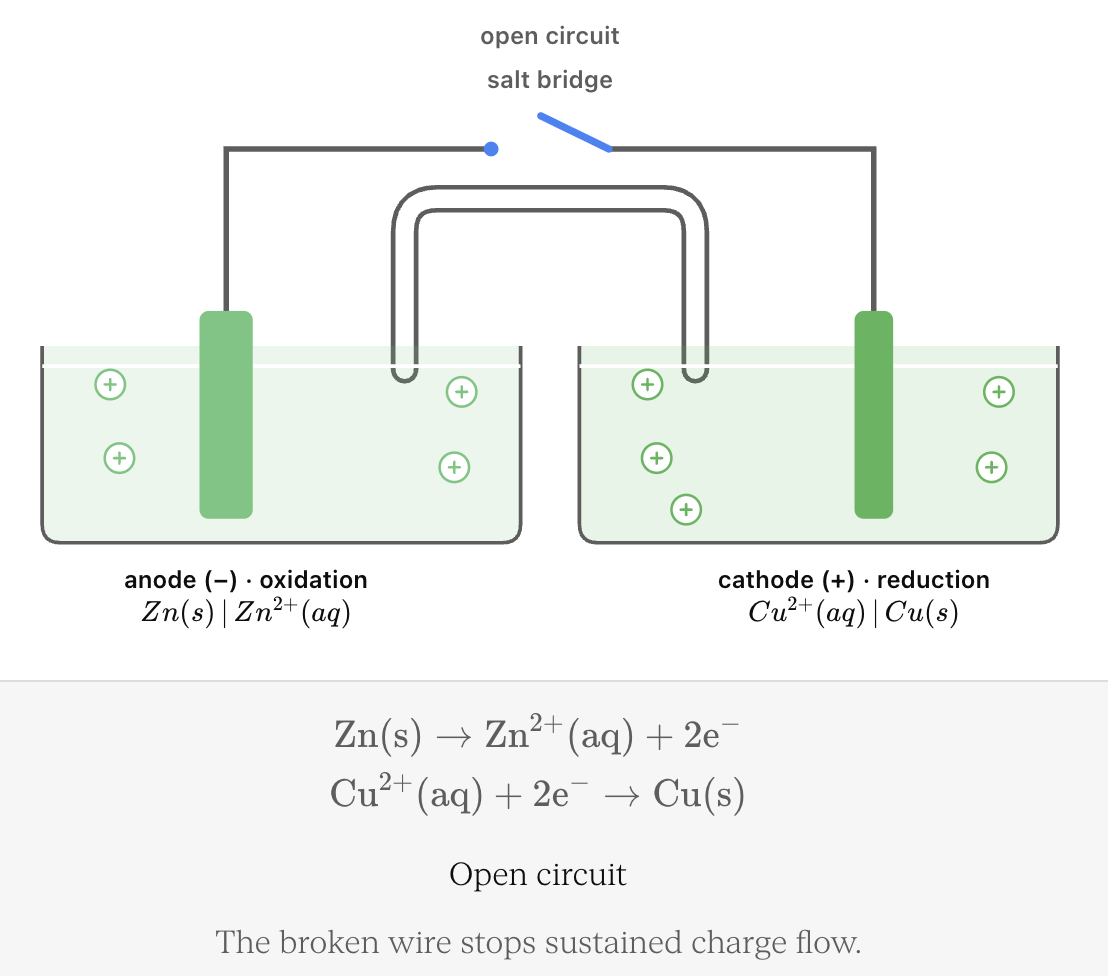
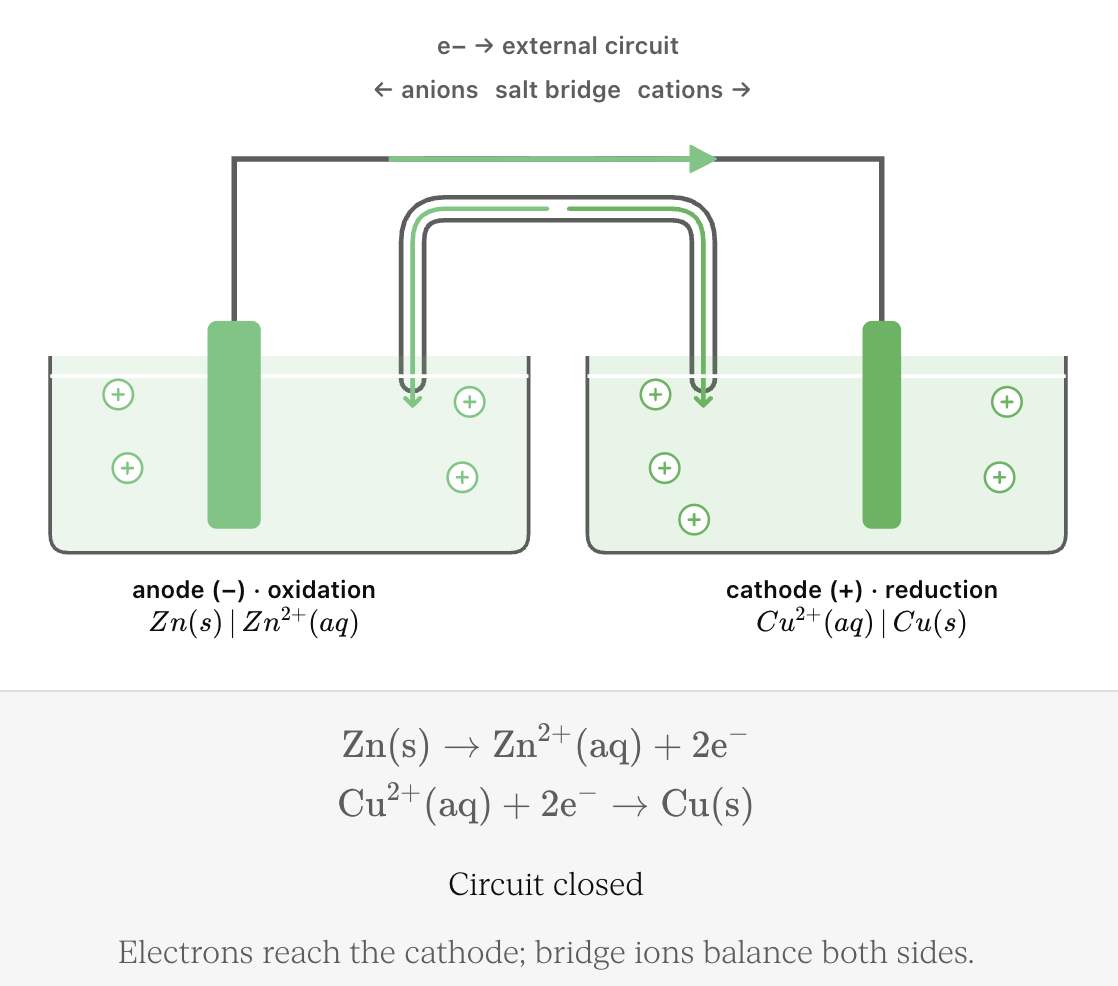
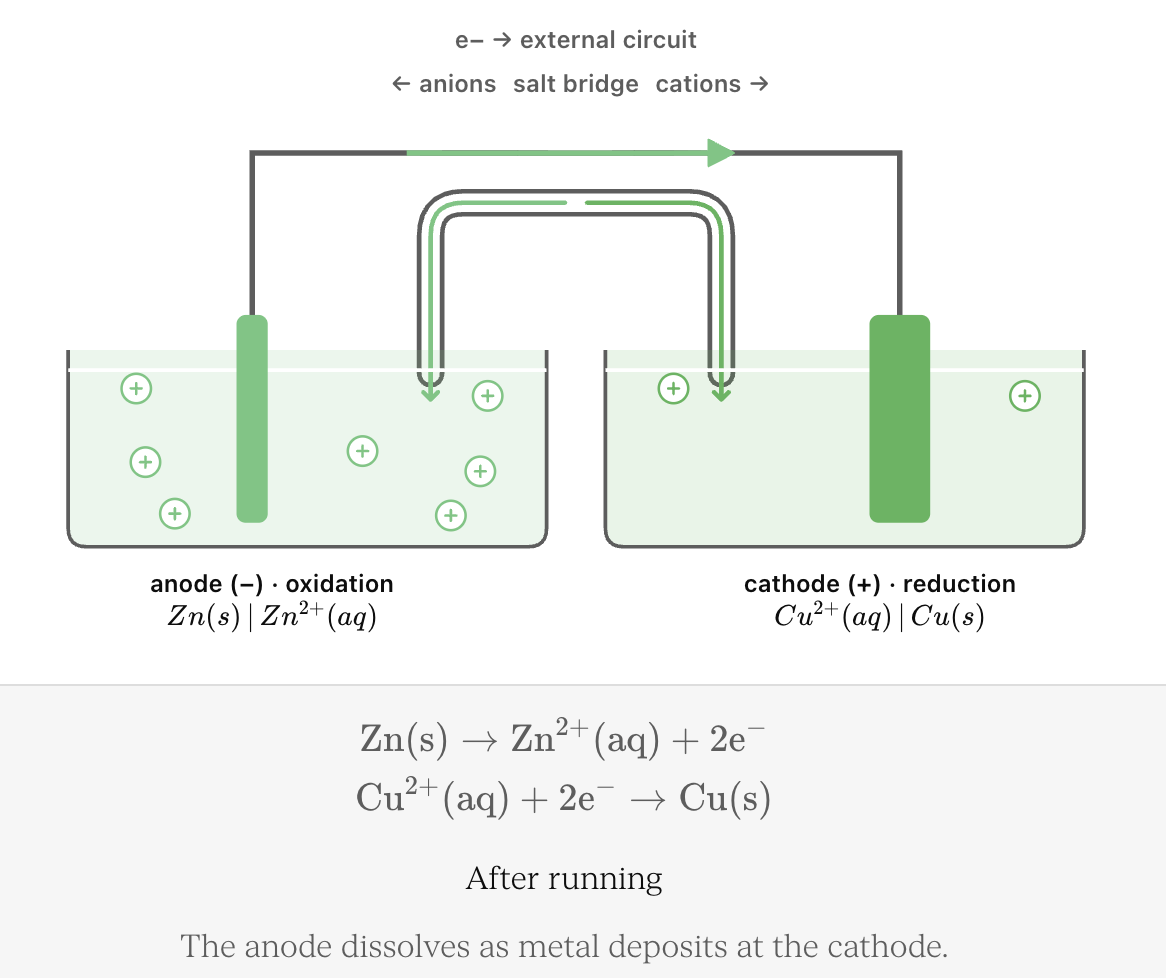
This interactive model lets you open and close the circuit and follow the electron and ion movement as the reaction proceeds.
Oxidation Produces Electrons
At the zinc electrode:
Zn(s) → Zn²⁺(aq) + 2e⁻
A zinc atom loses two:
electrons.
This is oxidation because:
Oxidation = loss of electrons
The electrons remain in the metal electrode and can move into the external wire.
Reduction Uses Electrons
At the copper electrode:
Cu²⁺(aq) + 2e⁻ → Cu(s)
Copper ions gain:
electrons.
This is reduction because:
Reduction = gain of electrons
The electrons arriving through the external circuit are transferred to Cu²⁺ ions.
Why Do Electrons Travel Through the Wire?
The oxidation and reduction reactions have been physically:
separated.
Zinc releases electrons in one half cell.
Cu²⁺ needs electrons in the other half cell.
The external conducting wire provides a pathway connecting the two electrodes.
Therefore, electrons move:
from the site of oxidation → through the external circuit → to the site of reduction.
Electron Flow
In any operating galvanic cell:
electrons flow from anode to cathode
because:
anode = oxidation
and:
cathode = reduction.
Therefore:
Anode → electrons → Cathode
This is one of the most important relationships in electrochemistry.
Remember: AN OX and RED CAT
A useful memory aid is:
AN OX
ANode = OXidation
and:
RED CAT
REDuction = CAThode
Once you know this, you can determine the direction of electron flow:
Anode → Cathode
The Anode
The anode is the electrode where oxidation occurs.
In a galvanic cell, the anode is:
negative.
Why?
Because oxidation releases electrons into the electrode.
For the zinc-copper cell:
Zn → Zn²⁺ + 2e⁻
Therefore:
Zn = anode = oxidation = negative electrode
The Cathode
The cathode is the electrode where reduction occurs.
In a galvanic cell, the cathode is:
positive.
Electrons arriving through the wire are consumed by the reduction reaction.
For the zinc-copper cell:
Cu²⁺ + 2e⁻ → Cu
Therefore:
Cu = cathode = reduction = positive electrode
A Useful Chain of Reasoning
For a galvanic cell:
Oxidation → anode → negative
Reduction → cathode → positive
Therefore:
electron flow: negative → positive
or:
anode → cathode
This relationship can help you interpret almost any basic galvanic-cell diagram.
Why Is There a Driving Force?
Different substances have different tendencies to:
lose or gain electrons.
When two suitable half cells are connected, their difference in electrode potential creates a:
potential difference (voltage).
This potential difference provides the energetic driving force for charge to move through the circuit while the spontaneous redox reaction proceeds.
Voltage and Electron Flow
Voltage is electrical potential difference.
It represents energy transferred per unit:
charge.
A galvanic cell develops a voltage because the two electrodes have different:
electrode potentials.
When the external circuit is closed, this potential difference can drive electron movement.
Open Circuit
Suppose the two half cells are connected through a salt bridge, but the external wire is:
disconnected.
There is no complete external pathway for sustained electron flow.
The cell may have a measurable:
voltage,
but there is essentially no continuous current through the external circuit.
Closed Circuit
Now connect the electrodes with a conducting:
wire.
A complete circuit is formed.
Electrons can move:
anode → wire → electrical device → cathode
The redox reaction can now continue while electrical energy is transferred through the circuit.
What Happens If We Put a Device in the Circuit?
Suppose a small electrical device is placed in the external circuit.
Electrons still move:
anode → device → cathode.
As charge moves through the device, electrical energy can be converted into another form.
For example:
chemical → electrical → light
or:
chemical → electrical → kinetic
or:
chemical → electrical → thermal.
Electron Flow and Electric Current
Students often confuse:
electron flow
with:
conventional current.
They are related, but their directions are opposite in a metallic wire.
Electron Flow
Electrons carry:
negative charge.
In the external metallic circuit of a galvanic cell, electrons move:
negative electrode → positive electrode
or:
anode → cathode.
For a zinc-copper cell:
Zn → Cu
Conventional Current
Conventional current is defined as the direction that positive charge would move.
It was established historically before scientists understood that electrons move through metallic wires.
Therefore, conventional current is defined in the opposite direction to electron movement.
In the external circuit:
conventional current: positive → negative
For a galvanic cell:
cathode → anode
Electron Flow vs Conventional Current
Electron flow
Direction:
negative → positive
In a galvanic cell:
anode → cathode
Conventional current
Direction:
positive → negative
In a galvanic cell:
cathode → anode
Therefore:
electron flow and conventional current point in opposite directions in the external metallic circuit.


Why Do We Still Use Conventional Current?
Conventional current was defined before the electron was:
discovered.
Scientists originally chose a direction for current without knowing which particles were actually moving in metals.
The convention remained in use.
Therefore, electrical diagrams commonly show:
current from + to −
even though electrons in metallic conductors move:
from − to +.
Current Is Not the Same as Electron Speed
Electric current measures the rate of flow of:
electric charge.
It does not simply mean that individual electrons race through a wire from the battery to the device.
Individual electrons in a metal have relatively slow net drift motion, while changes in the electric field propagate through the circuit much more rapidly.
This is why a device can respond almost immediately when a circuit is:
closed.
What Happens at the Zinc Electrode?
Consider the zinc anode.
The oxidation reaction is:
Zn → Zn²⁺ + 2e⁻
For every zinc atom oxidized:
two electrons are released.
The Zn²⁺ ion enters the electrolyte.
The electrons remain in the metal and can move through the:
external circuit.
What Happens at the Copper Electrode?
At the copper cathode:
Cu²⁺ + 2e⁻ → Cu
Cu²⁺ ions in solution approach the electrode and gain:
electrons.
They become copper atoms and are deposited on the:
electrode.
What Happens to Electrode Mass?
At the zinc anode:
Zn → Zn²⁺ + 2e⁻
Zinc atoms leave the electrode.
Therefore, the zinc electrode:
loses mass.
At the copper cathode:
Cu²⁺ + 2e⁻ → Cu
Copper atoms are deposited.
Therefore, the copper electrode:
gains mass.
Charge Movement Happens in Two Places
A working electrochemical cell involves charge movement through both:
the external circuit
and:
the internal cell.
But different particles carry the charge.
External circuit
Charge is carried mainly by:
electrons in the metal conductor.
Electrolytes and salt bridge
Charge is carried by:
ions.
This distinction is essential.
Electrons Do Not Travel Through the Salt Bridge
A common mistake is to imagine electrons flowing:
through the wire → through the solution → through the salt bridge.
That is not the correct model.
In the external metallic circuit:
electrons move.
Inside the electrolytes and salt bridge:
ions move.
Why Is Ion Movement Necessary?
Suppose zinc atoms are oxidized:
Zn → Zn²⁺ + 2e⁻
Positive Zn²⁺ ions accumulate in the zinc half cell.
Without compensating ion movement, this half cell would become increasingly:
positively charged.
That charge buildup would oppose further electron flow.
Ion Movement at the Anode
At the zinc anode:
positive ions are produced.
Therefore, negative ions from the salt bridge move toward the:
anode half cell.
These negative ions help maintain electrical neutrality.
Ion Movement at the Cathode
At the copper cathode:
positive Cu²⁺ ions are consumed.
Positive ions from the salt bridge move toward the:
cathode half cell.
Again, this helps maintain electrical neutrality.
Charge Movement in the Complete Cell
For a zinc-copper galvanic cell:
External circuit
electrons: Zn → Cu
Salt bridge
anions → anode half cell
cations → cathode half cell
The combined movement of electrons and ions allows the cell to operate continuously.


Why Doesn't Charge Keep Building Up?
If electrons continuously left the zinc electrode without any other charge movement, electrical imbalance would quickly develop.
Likewise, reduction at the cathode changes the ionic composition of that half cell.
The salt bridge prevents excessive charge buildup by allowing:
ions to redistribute.
Therefore, sustained electron flow requires both:
electron movement externally
and:
ion movement internally.
The Complete Circuit
A galvanic cell therefore contains two connected pathways:
External pathway: electrons
and:
Internal pathway: ions
Both are necessary for continuous:
current.
Remove either pathway and sustained operation stops.
Analyzing a Cell Diagram
When you see an electrochemical-cell diagram, use the following sequence.
Step 1: Identify the anode.
Look for the electrode where oxidation occurs.
Step 2: Identify the cathode.
Look for the electrode where reduction occurs.
Step 3: Draw electron flow.
Anode → Cathode
Step 4: Draw conventional current.
Opposite to electron flow in the external wire.
Step 5: Identify ion movement.
Anions generally move toward the anode compartment and cations toward the cathode compartment to maintain charge balance.
Example Diagram Analysis
Suppose a diagram shows:
Mg | Mg²⁺ || Cu²⁺ | Cu
and magnesium is undergoing oxidation.
At the magnesium electrode:
Mg → Mg²⁺ + 2e⁻
Therefore:
Mg = anode
Copper ions undergo reduction:
Cu²⁺ + 2e⁻ → Cu
Therefore:
Cu = cathode.
Electron flow is:
Mg → Cu.
Conventional current is:
Cu → Mg.
Another Example
Consider:
Zn | Zn²⁺ || Ag⁺ | Ag
At the zinc electrode:
Zn → Zn²⁺ + 2e⁻
At the silver electrode:
Ag⁺ + e⁻ → Ag
Therefore:
electron flow: Zn → Ag
and:
conventional current: Ag → Zn.
Balancing Electron Transfer
For the zinc-silver cell:
Oxidation:
Zn → Zn²⁺ + 2e⁻
Reduction:
Ag⁺ + e⁻ → Ag
Two Ag⁺ ions must gain the two electrons released by one zinc atom:
2Ag⁺ + 2e⁻ → 2Ag
Overall:
Zn + 2Ag⁺ → Zn²⁺ + 2Ag
The number of electrons lost must equal the number:
gained.
Electron Conservation
Electrons are not created or destroyed during the redox reaction.
They are:
transferred.
Therefore:
total electrons lost during oxidation = total electrons gained during reduction
This is why half-equations must balance for electrons.
Following One Electron
Imagine following an electron through a zinc-copper cell.
1. A zinc atom is oxidized.
2. The zinc atom becomes Zn²⁺.
3. Electrons remain in the zinc electrode.
4. An electron moves through the external wire.
5. It passes through any electrical device in the circuit.
6. It reaches the copper electrode.
7. A Cu²⁺ ion accepts electrons.
8. Copper metal is formed.
This connects:
chemical reaction → electron transfer → electrical current.
Why the Wire Matters
If the two reacting substances simply transfer electrons directly to one another, the chemical energy is not routed through an external electrical device.
By separating the oxidation and reduction reactions, we force electrons to travel through:
an external pathway.
That allows us to capture some of the chemical energy as useful:
electrical energy.
What Happens If the Wire Is Cut?
If the external wire is broken:
electron flow stops.
Without electrons reaching the cathode, sustained reduction cannot continue.
Without sustained reduction, sustained oxidation also cannot continue.
The cell still has a potential difference, but there is no continuous external:
current.
What Happens If the Salt Bridge Is Removed?
If the salt bridge is removed, electron flow may occur very briefly.
However, charge quickly builds up in the half cells.
This opposes further:
electron transfer.
Therefore, sustained current stops.
Why Both Connections Are Necessary
For continuous operation, a galvanic cell needs:
an external electron pathway
and:
an internal ion pathway.
External pathway:
wire
Internal pathway:
electrolytes + salt bridge
Together they form a complete electrochemical circuit.
Electron Flow in Batteries
The same basic principle applies to batteries.
During discharge:
oxidation occurs at the anode
and:
reduction occurs at the cathode.
Electrons move through the external circuit from:
anode → cathode.
A phone, flashlight, laptop, or other device can use the electrical energy transferred by this moving charge.


Electron Flow in a Flashlight
When a battery powers a flashlight:
1. Oxidation releases electrons at the battery's anode.
2. Electrons travel through the external circuit.
3. Electrical energy is transferred to the lamp or LED.
4. Electrons continue through the circuit to the cathode.
5. Reduction consumes electrons.
The overall energy transformation is approximately:
chemical → electrical → light + thermal
Electron Flow in an Electric Vehicle
An electric vehicle battery contains electrochemical cells.
During discharge:
chemical energy → electrical energy
Electrons travel through an external circuit to the electric:
motor.
The motor converts electrical energy primarily into:
kinetic energy.
The electrochemical principles are more complex than a simple Zn/Cu cell, but the same redox concept applies.
Electron Flow vs Ion Flow
These should not be confused.
Electron flow
Occurs mainly through:
metallic conductors
Particles:
electrons
Ion flow
Occurs through:
electrolytes
Particles:
cations and anions
Both contribute to the operation of an electrochemical cell.
Conventional Current in Circuit Diagrams
Circuit diagrams commonly show current arrows from:
positive → negative.
Do not automatically assume these arrows represent electron movement.
Ask:
Is the arrow showing conventional current or electron flow?
If it shows conventional current, electron movement in a metal conductor is:
opposite the arrow.
How to Read Arrows in Cell Diagrams
A diagram may contain several types of arrows.
Arrow through the wire
Could represent:
electron flow or conventional current.
Check the label.
Arrow in the salt bridge
Represents:
ion movement.
Arrow in a half-equation
Represents:
chemical change.
Do not assume every arrow represents the same process.
Worked Example 1
A galvanic cell has zinc as the anode and copper as the cathode.
What is the direction of electron flow?
Zn → Cu
because electrons move:
anode → cathode.
Worked Example 2
What is the direction of conventional current in the same external wire?
Cu → Zn
because conventional current is opposite to electron flow.
Worked Example 3
A student says electrons move from the cathode to the anode because the cathode is positive.
What is wrong?
Electrons are produced by oxidation at the:
anode.
They are consumed by reduction at the:
cathode.
Therefore, electron flow is:
anode → cathode.
Worked Example 4
A cell has magnesium as its anode.
Write the oxidation half-reaction.
Mg → Mg²⁺ + 2e⁻
Where do the electrons go?
Into the:
external circuit.
Worked Example 5
Silver ions are reduced at a cathode.
Write the half-reaction.
Ag⁺ + e⁻ → Ag
The electrons required for this reaction arrive through the:
external circuit.
Worked Example 6
A diagram shows electrons moving left to right through a wire.
What can you conclude?
The electrode on the left is the:
anode.
The electrode on the right is the:
cathode.
Therefore:
Left:
oxidation
Right:
reduction.
Worked Example 7
A diagram shows conventional current moving left to right.
Which way are electrons moving through the metallic wire?
Right to left.
Electron flow and conventional current are:
opposite.
Worked Example 8
A salt bridge contains positive and negative ions.
Which ions generally move toward the anode compartment?
Anions.
Which ions generally move toward the cathode compartment?
Cations.
This helps maintain electrical neutrality.
Common Mistake: Electrons Flow from Positive to Negative
That describes the direction of:
conventional current,
not electron movement in a metallic wire.
Electrons move:
negative → positive
in the external circuit of a galvanic cell.
Common Mistake: Current and Electron Flow Are the Same Direction
They are not.
In a metallic conductor:
electron flow: − → +
conventional current: + → −
They point in opposite directions.
Common Mistake: Electrons Are Produced by the Battery
The battery does not create electrons.
Electrons already exist in the materials.
The redox reaction creates an electrical potential difference and transfers electrons between chemical species, producing a net movement of electrons through the external circuit.
Common Mistake: Electrons Flow Through the Electrolyte
In the electrolyte, electrical charge is transported mainly by:
ions.
Electrons move through the:
external metallic circuit.
Common Mistake: The Salt Bridge Transfers Electrons
The salt bridge allows:
ions
to move.
It maintains electrical neutrality.
It does not act as the external pathway for electrons.
Common Mistake: Only Electrons Are Needed for a Complete Circuit
Electron flow through the external wire alone is not sufficient for sustained operation.
The cell also requires:
ion movement internally.
Without ion movement, charge imbalance develops and the reaction stops.
Common Mistake: The Positive Electrode Produces Electrons
In a galvanic cell, the positive electrode is the:
cathode.
It consumes electrons through:
reduction.
The negative anode produces electrons through:
oxidation.
Check Your Understanding
1. Why do electrons flow through an external circuit in a galvanic cell?
2. Where are electrons produced?
3. Where are electrons consumed?
4. Define oxidation.
5. Define reduction.
6. What is the anode?
7. What is the cathode?
8. Which electrode is negative in a galvanic cell?
9. Which electrode is positive?
10. State the direction of electron flow.
11. State the direction of conventional current.
12. Why are electron flow and conventional current opposite?
13. Write the oxidation half-reaction for zinc.
14. Write the reduction half-reaction for Cu²⁺.
15. In a Zn/Cu cell, which electrode releases electrons?
16. Which species accepts the electrons?
17. Why does the zinc electrode lose mass?
18. Why does the copper electrode gain mass?
19. What carries charge through the external wire?
20. What carries charge through the electrolyte?
21. What carries charge through the salt bridge?
22. Do electrons pass through the salt bridge?
23. Why is ion movement necessary?
24. Which type of ion generally moves toward the anode compartment?
25. Which type of ion generally moves toward the cathode compartment?
26. What happens if the external wire is broken?
27. What happens if the salt bridge is removed?
28. Explain why oxidation and reduction must occur together.
29. A diagram shows electrons moving from electrode A to electrode B. Which is the anode?
30. Which electrode is the cathode?
31. Where does oxidation occur in this diagram?
32. Where does reduction occur?
33. If electrons move from A to B, which way does conventional current move?
34. Why does a galvanic cell have a potential difference?
35. Explain how separating the two half-reactions allows useful electrical energy to be obtained.
36. Explain the difference between electron flow and ion flow.
37. Explain the relationship between electron flow and redox reactions.
38. Explain why a battery does not "create electrons."
39. Draw a Zn/Cu galvanic cell and label the anode, cathode, electron flow, conventional current, salt bridge, and ion movement.
40. Explain the complete movement of charge through both the external and internal parts of a galvanic cell.
Key Terms
- Electron flow: Net movement of electrons through a conducting pathway.
- External circuit: Conducting pathway connecting the electrodes outside an electrochemical cell.
- Electric current: Rate of flow of electric charge.
- Conventional current: Defined direction of positive charge flow; opposite to electron flow in metallic conductors.
- Oxidation: Loss of electrons.
- Reduction: Gain of electrons.
- Redox reaction: Reaction involving both oxidation and reduction.
- Anode: Electrode where oxidation occurs.
- Cathode: Electrode where reduction occurs.
- Galvanic cell: Electrochemical cell that converts chemical energy into electrical energy through a spontaneous redox reaction.
- Electrode: Conducting material where oxidation or reduction occurs.
- Electrolyte: Substance containing mobile ions that can carry charge.
- Salt bridge: Connection that allows ion movement between half cells.
- Cation: Positively charged ion.
- Anion: Negatively charged ion.
- Potential difference: Difference in electrical potential between two points.
- Voltage: Energy transferred per unit charge.
- Half-reaction: Equation representing either oxidation or reduction separately.
Key Takeaways
- A galvanic cell separates oxidation and reduction into different half cells.
- Oxidation releases electrons.
- Reduction consumes electrons.
- Electrons therefore travel from the site of oxidation to the site of reduction.
- Oxidation occurs at the anode.
- Reduction occurs at the cathode.
- In a galvanic cell, the anode is negative.
- In a galvanic cell, the cathode is positive.
- Electrons flow through the external circuit from anode → cathode.
- In a zinc-copper cell, electrons flow Zn → Cu.
- Conventional current is defined in the opposite direction to electron flow in a metallic conductor.
- Conventional current therefore travels cathode → anode through the external circuit.
- The difference between the half-cell potentials produces a voltage.
- The external wire provides a pathway for electrons.
- Electrical devices can use energy transferred by moving charge.
- The external circuit carries electrons.
- Electrolytes and the salt bridge carry charge through moving ions.
- Electrons do not travel through the salt bridge.
- Anions generally move toward the anode compartment.
- Cations generally move toward the cathode compartment.
- Ion movement prevents excessive charge buildup in the half cells.
- Both external electron flow and internal ion flow are required for sustained operation.
- If the external circuit is broken, continuous electron flow stops.
- If the salt bridge is removed, charge imbalance develops and sustained current stops.
- The number of electrons lost during oxidation equals the number gained during reduction.
- A galvanic cell does not create electrons.
- Redox reactions provide the driving force for electron transfer.
- Separating the two half-reactions forces electrons through an external pathway.
- This allows chemical energy to be converted into useful electrical energy.