Chemical Energy
Chemical energy is energy stored in the arrangement of atoms and electrons in substances.
During a chemical reaction, atoms are rearranged and electrons may be transferred.
Some chemical reactions can release stored chemical energy.
That energy can sometimes be converted into:
electrical energy.
This is the basic principle behind:
batteries and galvanic cells.
Chemical Energy to Electrical Energy
An electrochemical cell can convert:
chemical energy → electrical energy
The chemical reaction causes electrons to move through an external circuit.
The movement of electric charge through a circuit is an:
electric current.
So the basic idea is:
Chemical reaction → electron transfer → electron flow through a circuit → electrical energy
What Is an Electrochemical Cell?
An electrochemical cell is a system in which chemical reactions and electrical energy are connected.
There are two major types:
Galvanic cells produce electrical energy from spontaneous chemical reactions.
Electrolytic cells use electrical energy to drive chemical reactions that would not otherwise occur spontaneously.
In this topic, we will focus mainly on:
galvanic cells.
What Is a Galvanic Cell?
A galvanic cell, also called a voltaic cell, converts chemical energy into electrical energy using a spontaneous:
redox reaction.
Its purpose is to produce an electric current that can be used to do:
electrical work.
A battery is based on this general principle.
The Main Parts of a Galvanic Cell
A simple galvanic cell contains:
- two electrodes
- two half-cells
- electrolytes containing ions
- an external wire or circuit
- a salt bridge or another means of allowing ion movement
Each component has an important role.


A Zinc-Copper Galvanic Cell
A classic example uses:
zinc and copper.
One half-cell contains:
zinc metal in a solution containing Zn²⁺ ions.
The other contains:
copper metal in a solution containing Cu²⁺ ions.
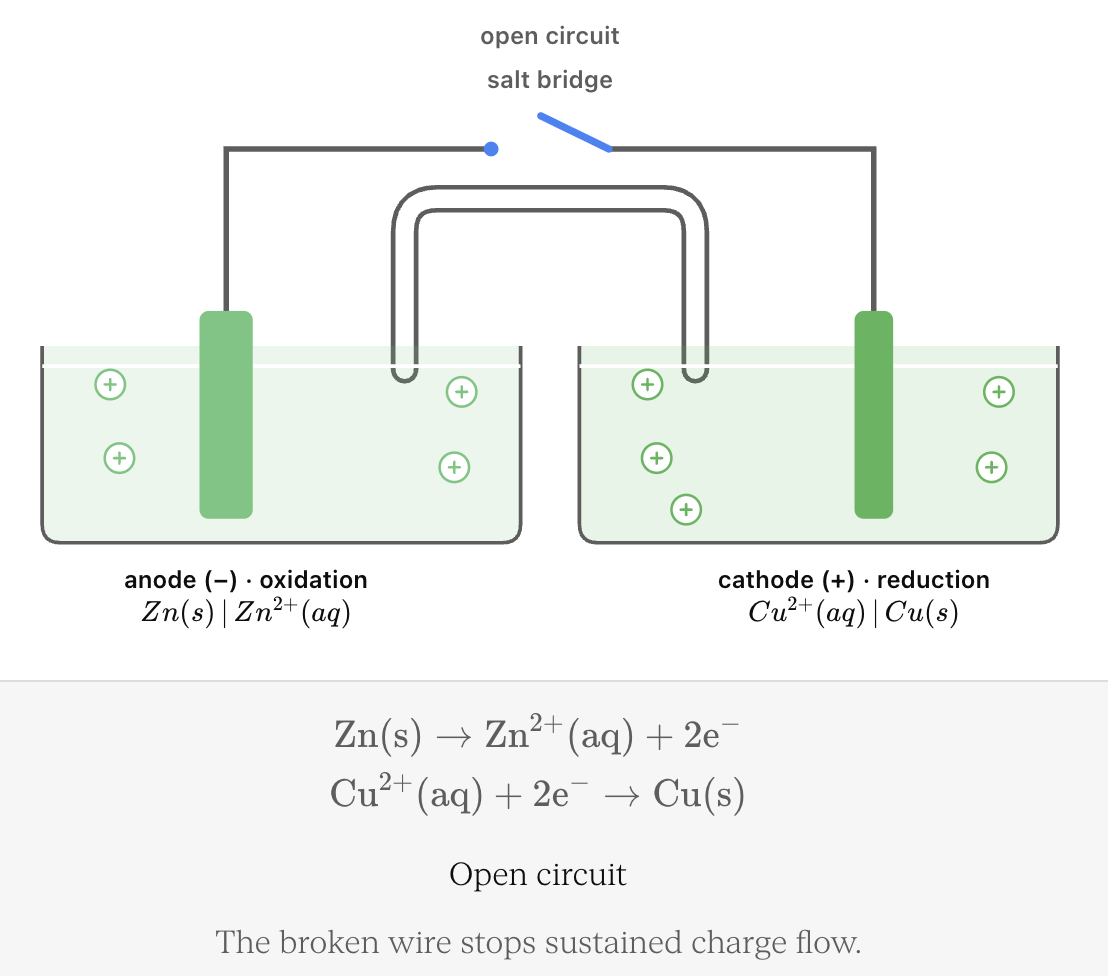
The electrodes are connected by a wire.
The solutions are connected through a:
salt bridge.
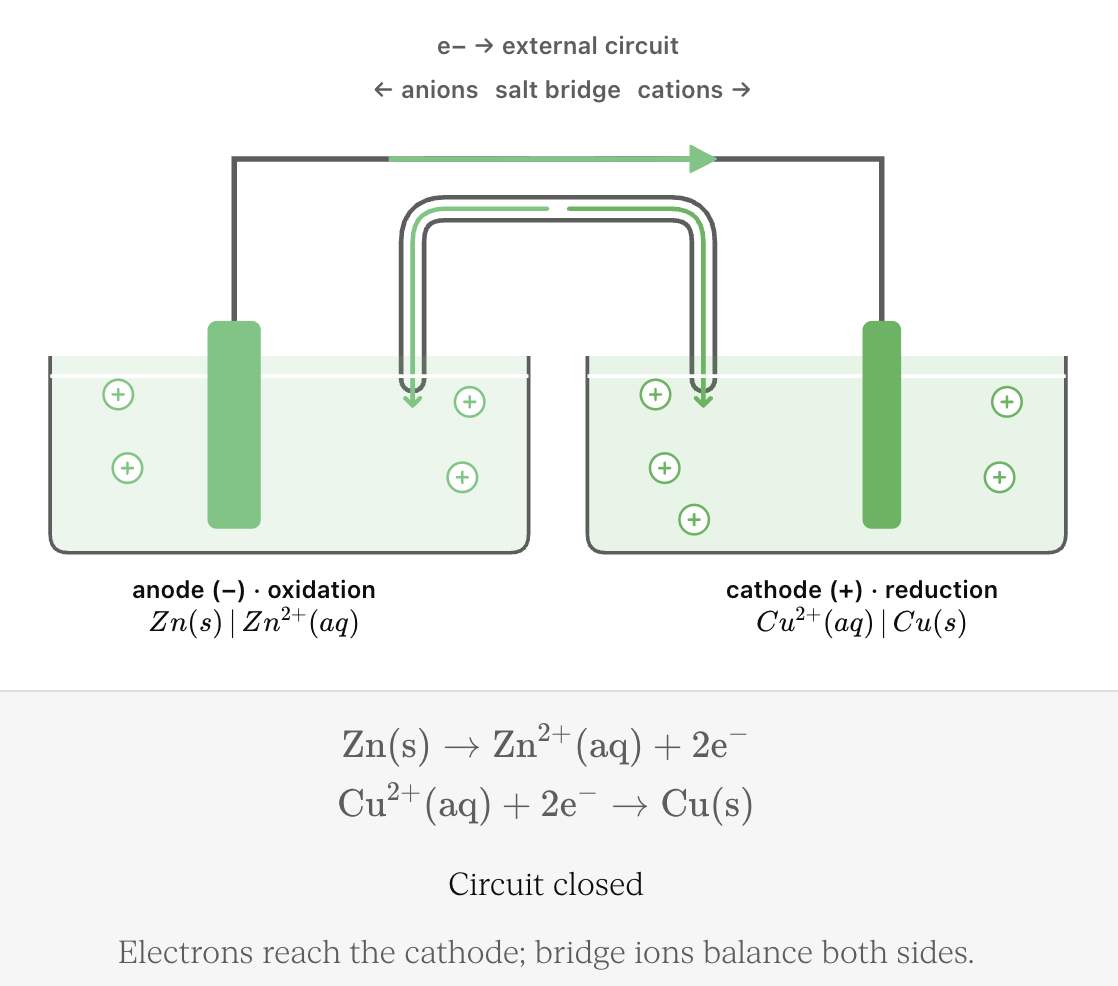
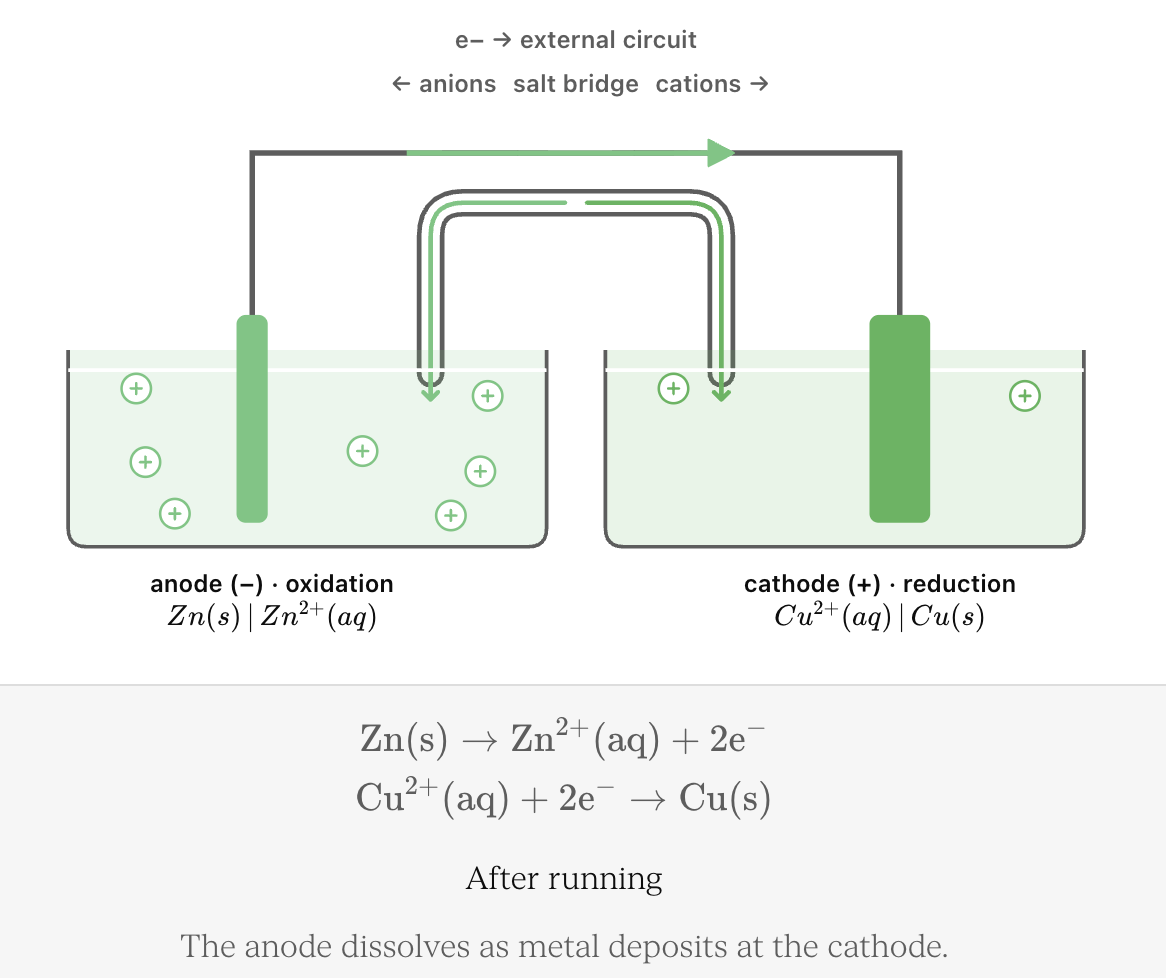
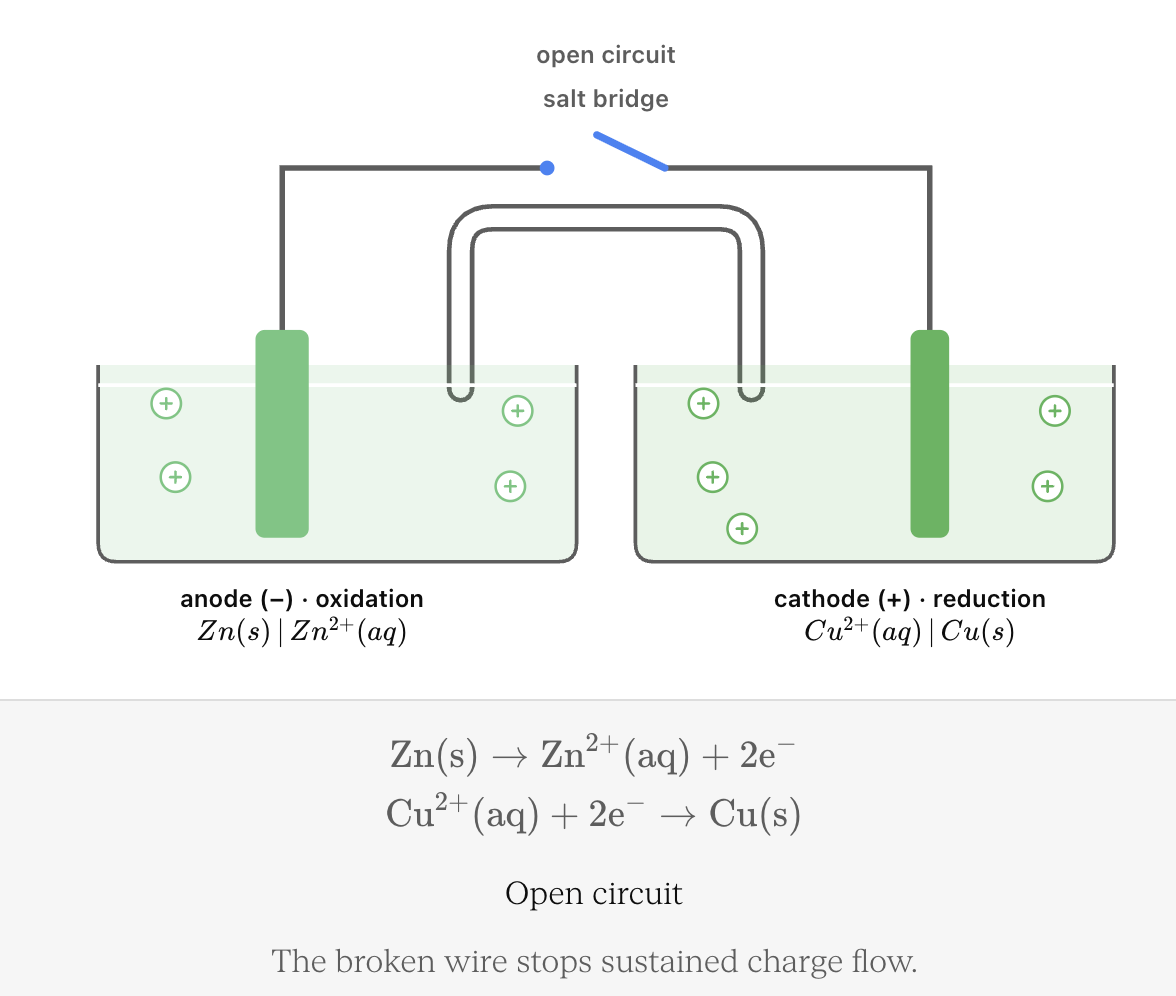
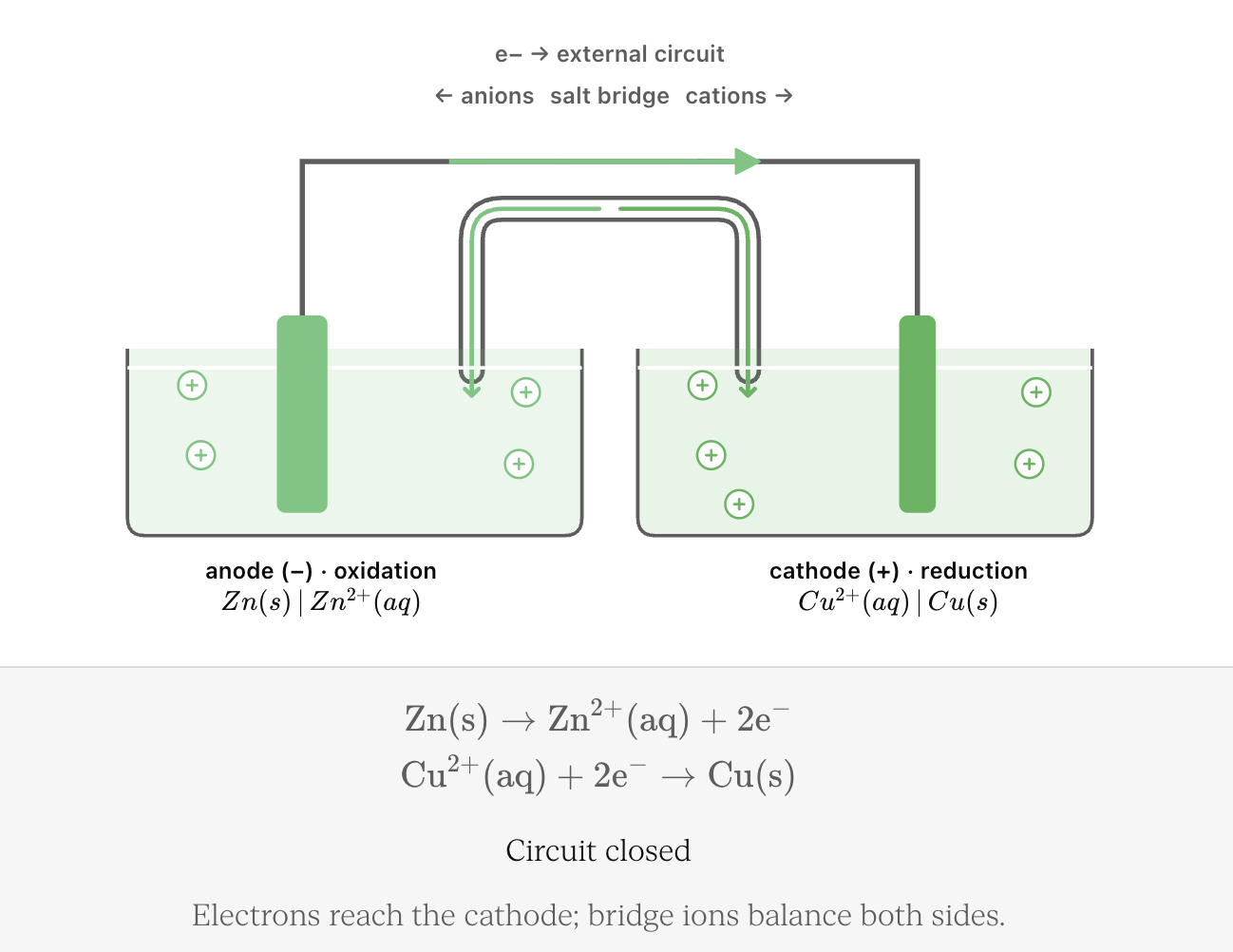
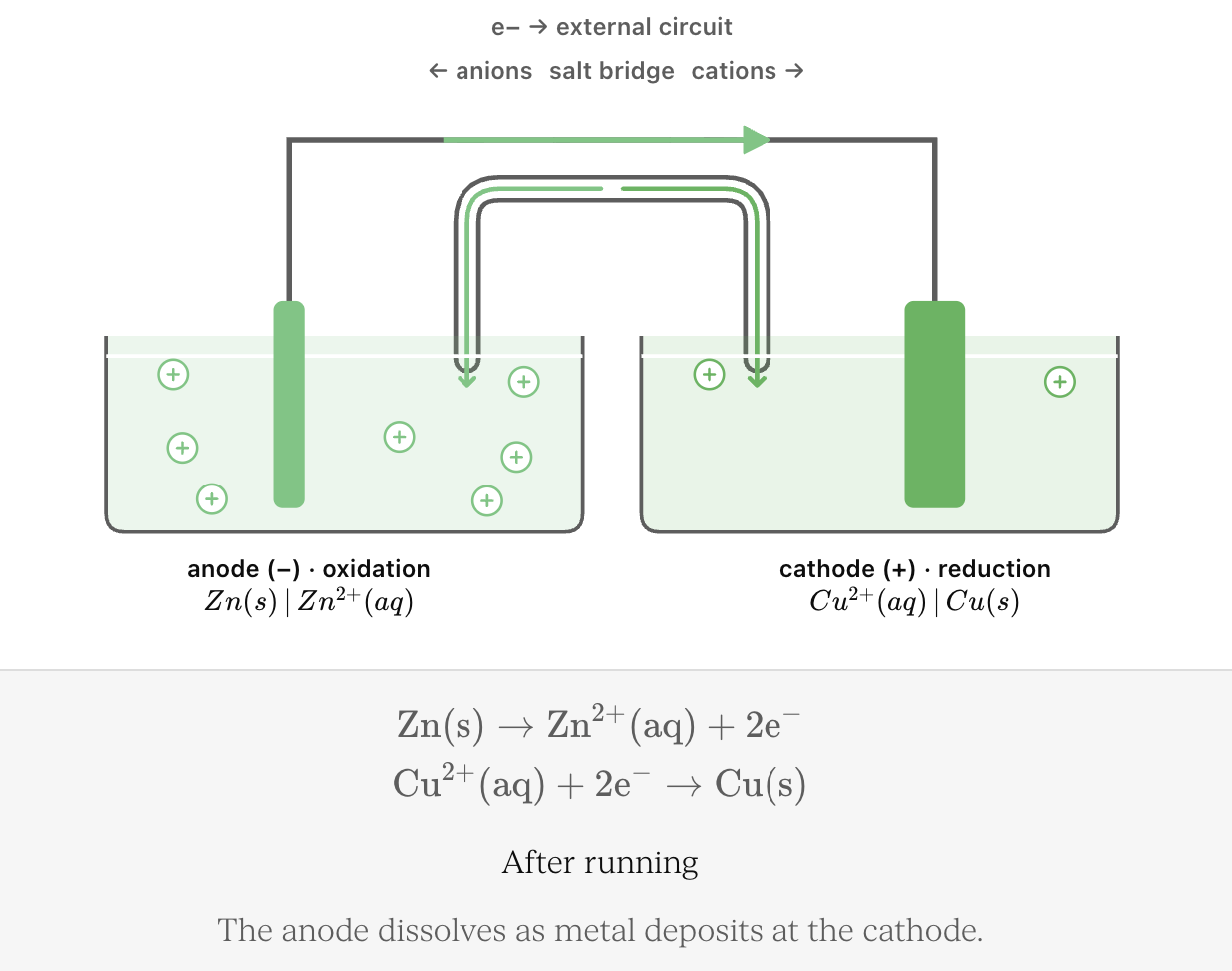
Here is an interactive model of this cell. Open and close the circuit and advance the reaction to see how electron flow, ion movement, and electrode mass are connected.
The Redox Reaction
The cell operates because a:
redox reaction
occurs.
Redox involves two processes:
oxidation
and:
reduction.
These always occur together because electrons lost by one substance must be gained by another.
Oxidation
Oxidation is the loss of electrons.
A useful memory aid is:
OIL = Oxidation Is Loss
In a zinc-copper cell, zinc atoms lose electrons:
Zn → Zn²⁺ + 2e⁻
The zinc atoms become zinc ions.
Because electrons are produced at the zinc electrode, they can move into the external:
circuit.
Reduction
Reduction is the gain of electrons.
A useful memory aid is:
RIG = Reduction Is Gain
Copper ions gain electrons:
Cu²⁺ + 2e⁻ → Cu
Copper ions in the solution become copper atoms.
The Overall Reaction
The two half-equations are:
Oxidation:
Zn → Zn²⁺ + 2e⁻
Reduction:
Cu²⁺ + 2e⁻ → Cu
When they are combined, the electrons cancel:
Zn + Cu²⁺ → Zn²⁺ + Cu
This is the overall redox reaction occurring in the cell.
Why Does This Produce Electricity?
If zinc were placed directly in contact with an appropriate copper-ion solution, electron transfer could occur directly between the reacting particles.
But in a galvanic cell, the oxidation and reduction reactions are:
separated.
Electrons released at one electrode must travel through the external circuit to reach the other electrode.
That controlled flow of electrons produces:
electric current.
Separating the Half-Reactions
This is the key idea behind a galvanic cell.
Instead of allowing:
electron donor → electron acceptor
to interact directly, the cell separates them.
The electrons are forced to travel:
through the wire.
That electron flow can be used to power a device.
The Anode
The electrode where oxidation occurs is called the:
anode.
Remember:
Anode = Oxidation
In the zinc-copper cell:
Zn → Zn²⁺ + 2e⁻
Therefore, the zinc electrode is the:
anode.
In a galvanic cell, the anode is the:
negative electrode.
The Cathode
The electrode where reduction occurs is called the:
cathode.
Remember:
Cathode = Reduction
In the zinc-copper cell:
Cu²⁺ + 2e⁻ → Cu
Therefore, the copper electrode is the:
cathode.
In a galvanic cell, the cathode is the:
positive electrode.
Remembering Anode and Cathode
A useful memory aid is:
AN OX
ANode = OXidation
and:
RED CAT
REDuction = CAThode
These relationships remain extremely important throughout electrochemistry.
Electron Flow
Electrons flow through the external circuit from:
anode → cathode
For the zinc-copper cell:
zinc electrode → wire → copper electrode
Therefore:
electrons flow from Zn to Cu.


What Happens to the Zinc Electrode?
At the zinc electrode:
Zn → Zn²⁺ + 2e⁻
Zinc atoms leave the metal electrode and enter the solution as:
Zn²⁺ ions.
Therefore, as the cell operates, the zinc electrode generally:
loses mass.
What Happens to the Copper Electrode?
At the copper electrode:
Cu²⁺ + 2e⁻ → Cu
Copper ions leave the solution and become:
copper atoms.
These atoms are deposited onto the copper electrode.
Therefore, the copper electrode generally:
gains mass.
What Is an Electrolyte?
An electrolyte is a substance containing mobile ions that can conduct:
electric charge.
In a galvanic cell, the electrolyte allows ions to move through the solution.
Electron movement occurs through the external wire.
Ion movement occurs through the:
electrolytes and salt bridge.
Both are needed to maintain continuous current.
The Salt Bridge
The two half-cells must remain electrically:
balanced.
As zinc atoms become Zn²⁺ ions, positive charge builds up in the zinc half-cell.
Meanwhile, Cu²⁺ ions are removed from the copper half-cell.
Without a way to balance these charges, the reaction would quickly:
stop.
The salt bridge solves this problem.
What Does the Salt Bridge Do?
The salt bridge contains mobile ions that can move between the half-cells.
Its main functions are to:
- complete the internal ionic circuit
- maintain electrical neutrality
- allow ions to move between half-cells
- prevent rapid charge buildup
- reduce direct mixing of the two solutions
The salt bridge carries:
ions, not electrons.
Ion Movement
In the zinc half-cell, Zn²⁺ ions are being produced.
This creates increasing:
positive charge.
Negative ions from the salt bridge move toward this half-cell.
In the copper half-cell, Cu²⁺ ions are being removed.
Positive ions from the salt bridge move toward this half-cell.
This maintains approximate electrical:
neutrality.
What Happens Without the Salt Bridge?
Suppose the salt bridge is removed.
Electrons initially begin to flow.
However, charge quickly builds up in the two half-cells.
This charge imbalance opposes further electron movement.
The current therefore rapidly:
stops.
The salt bridge is essential for sustained operation of this type of galvanic cell.
The Complete Circuit
A functioning galvanic cell therefore has two forms of charge movement.
External circuit
Electrons move through the wire.
Internal circuit
Ions move through the electrolytes and salt bridge.
Together, these movements complete the:
electrical circuit.
Energy Transformation
The main energy transformation in a galvanic cell is:
chemical potential energy → electrical energy
Some energy may also eventually become:
thermal energy
because real electrical systems have resistance.
If the cell powers a light:
chemical → electrical → light + thermal
If it powers a motor:
chemical → electrical → kinetic + thermal
Energy Is Not Created
A battery does not:
create energy.
It converts energy stored chemically into other forms.
This follows the principle of:
conservation of energy.
Energy changes form, but the total amount of energy is conserved.
What Is Voltage?
A galvanic cell produces a:
potential difference, or voltage.
Voltage represents the energy transferred per unit:
charge.
A greater potential difference provides a stronger driving force for charge movement through a circuit.
Voltage is measured in:
volts (V).
Why Does a Galvanic Cell Have a Voltage?
Different substances have different tendencies to:
lose or gain electrons.
When suitable oxidation and reduction half-reactions are combined, there is a difference in electrical potential between the two electrodes.
This creates the cell's:
voltage.
Spontaneous Reactions
A galvanic cell operates using a thermodynamically favorable:
redox reaction.
In an appropriately constructed cell, the reaction can proceed without an external electrical energy source.
This is why a galvanic cell can:
produce electrical energy.
Reducing Agent
A substance that loses electrons causes another substance to be:
reduced.
It is therefore called the:
reducing agent.
In the zinc-copper cell:
Zn → Zn²⁺ + 2e⁻
Zinc is oxidized.
Therefore, zinc acts as the:
reducing agent.
Oxidizing Agent
A substance that gains electrons causes another substance to be:
oxidized.
It is therefore called the:
oxidizing agent.
In the zinc-copper cell:
Cu²⁺ + 2e⁻ → Cu
Cu²⁺ is reduced.
Therefore, Cu²⁺ acts as the:
oxidizing agent.
Following the Electrons
A useful way to understand the entire cell is to follow an electron.
1. A zinc atom loses electrons.
2. The electrons enter the zinc electrode.
3. They travel through the wire.
4. They may pass through and power an electrical device.
5. They reach the copper electrode.
6. Cu²⁺ ions gain the electrons.
7. Copper atoms are produced.
The chemical reaction therefore drives an:
electric current.
Galvanic Cells and Batteries
A battery contains one or more electrochemical cells designed to provide electrical:
energy.
Different battery designs use different:
- electrode materials
- electrolytes
- redox reactions
But the central principle remains:
redox chemistry produces a controlled flow of electrons.


Everyday Batteries
Electrochemical cells are used in:
- watches
- calculators
- flashlights
- remote controls
- toys
- smartphones
- laptops
- cameras
- electric vehicles
- medical devices
These technologies depend on controlled:
redox reactions.
Primary Cells
A primary cell is designed mainly for:
single-use discharge.
Once the reactants have been substantially consumed, the cell is normally:
discarded.
Common examples include some:
alkaline batteries.
The redox reactions convert stored chemical energy into electrical energy.
Secondary Cells
A secondary cell can be:
recharged.
During discharge:
chemical energy → electrical energy
During charging:
electrical energy → stored chemical energy
Rechargeable batteries therefore involve reversible or partially reversible electrochemical processes.
Lithium-Ion Batteries
Lithium-ion batteries are widely used in:
- smartphones
- laptops
- tablets
- power tools
- electric vehicles
During discharge, lithium ions move internally through the cell while electrons travel through the external:
circuit.
The exact chemistry varies among different lithium-ion battery designs.


Battery Discharge
When a rechargeable battery powers a device, it is:
discharging.
During discharge:
chemical energy → electrical energy
Electrons travel through the external circuit and provide energy to the:
device.
Battery Charging
When a rechargeable battery is connected to a charger, electrical energy is supplied to drive chemical changes in the opposite:
direction.
The main energy transformation becomes:
electrical energy → chemical energy
The energy is stored chemically for later use.
Batteries and Electric Vehicles
Electric vehicles use large rechargeable battery packs.
During driving:
chemical energy → electrical energy → kinetic energy
The electrical energy powers motors that turn the:
wheels.
Some energy is also transferred to the surroundings as heat.
Regenerative Braking
Some electric vehicles can recover energy during:
braking.
Instead of converting all kinetic energy into heat through friction, the motor can operate as a generator.
A simplified energy pathway is:
kinetic energy → electrical energy → chemical energy
The recovered energy can be stored in the battery.
Fuel Cells
A fuel cell is another electrochemical device that converts chemical energy into:
electrical energy.
Unlike a typical battery, reactants can be continuously supplied to the fuel cell.
For example, hydrogen fuel cells use reactions involving:
hydrogen and oxygen.
The overall reaction produces:
water.
Hydrogen Fuel Cells
A simplified overall reaction is:
2H₂ + O₂ → 2H₂O
The oxidation and reduction reactions are separated so that electrons travel through an external:
circuit.
This produces electrical energy.


Batteries vs Fuel Cells
Both batteries and fuel cells convert:
chemical energy into electrical energy.
However:
A battery stores its reactants largely within the device.
A fuel cell is designed to receive reactants continuously from an external:
supply.
Both depend on redox reactions.
Electrochemical Cells in Medicine
Electrochemical cells are used in medical technologies such as:
- pacemakers
- hearing aids
- glucose-monitoring devices
- portable medical equipment
Reliable batteries are especially important when electrical devices must operate safely for long periods.
Electrochemical Cells and Renewable Energy
Solar and wind energy production can vary with:
weather and time.
Batteries can store energy when electricity production is high.
During charging:
electrical energy → chemical energy
Later, during discharge:
chemical energy → electrical energy
Energy storage can therefore help balance electrical supply and demand.
Comparing Galvanic and Electrolytic Cells
Galvanic Cell
Uses a spontaneous redox reaction.
Main transformation:
chemical → electrical
Electrolytic Cell
Uses electrical energy to drive a non-spontaneous chemical reaction.
Main transformation:
electrical → chemical
These processes are related but operate in opposite energetic directions.
Worked Example 1
A zinc atom loses two electrons.
Write the half-equation.
Zn → Zn²⁺ + 2e⁻
Has zinc been oxidized or reduced?
Oxidized, because it lost electrons.
Worked Example 2
Copper ions gain electrons:
Cu²⁺ + 2e⁻ → Cu
Has copper been oxidized or reduced?
Reduced, because Cu²⁺ gained electrons.
Worked Example 3
In a zinc-copper galvanic cell, which electrode is the anode?
The:
zinc electrode.
This is because oxidation occurs there.
Worked Example 4
In the same cell, which electrode is the cathode?
The:
copper electrode.
Reduction occurs there.
Worked Example 5
Which direction do electrons flow?
Zn → Cu
or more generally:
anode → cathode
through the external circuit.
Worked Example 6
A battery powers a flashlight.
Identify the main energy transformations.
Chemical energy → electrical energy → light energy + thermal energy
Worked Example 7
A rechargeable battery is connected to a charger.
What is the main energy transformation?
Electrical energy → chemical energy
Energy is being stored chemically.
Worked Example 8
A student removes the salt bridge from a zinc-copper cell.
What happens?
The cell may briefly produce current, but charge rapidly builds up in the half-cells.
Electron flow then:
stops.
The salt bridge is required to maintain charge balance.
Common Mistake: Electrons Travel Through the Salt Bridge
Electrons travel through the:
external wire.
The salt bridge allows:
ions
to move.
Remember:
wire → electrons
salt bridge → ions
Common Mistake: The Anode Is Always Positive
In a:
galvanic cell
the anode is negative and the cathode is positive.
The signs differ in an electrolytic cell.
However, the definitions remain:
oxidation always occurs at the anode
and:
reduction always occurs at the cathode.
Common Mistake: Batteries Create Energy
Batteries do not create:
energy.
They convert stored chemical energy into electrical energy.
Energy is:
transformed, not created.
Common Mistake: Electricity Is Stored as Electrons in a Battery
A battery stores:
chemical potential energy.
During discharge, chemical reactions create conditions that drive electrons through the external circuit.
The battery is not simply a container filled with stored electricity.
Common Mistake: Oxidation Requires Oxygen
Historically, oxidation was associated with reactions involving oxygen.
In modern redox chemistry:
oxidation means loss of electrons.
A reaction does not need to contain oxygen to be an oxidation reaction.
Common Mistake: Oxidation and Reduction Can Occur Separately
Electrons cannot simply disappear.
If one substance loses electrons, another substance must gain them.
Therefore:
oxidation and reduction always occur together.
That is why they are collectively called:
redox reactions.
Common Mistake: Current Stops Because the Battery Runs Out of Electrons
Electrons already exist throughout the conducting materials.
A battery eventually stops providing useful electrical energy because the chemical conditions driving the redox reaction change as reactants are consumed and products accumulate.
The battery does not simply:
run out of electrons.
Check Your Understanding
1. What is chemical energy?
2. What is electrical energy?
3. State the main energy transformation in a galvanic cell.
4. Define an electrochemical cell.
5. What is a galvanic cell?
6. What is another name for a galvanic cell?
7. List five components of a simple galvanic cell.
8. Define oxidation.
9. Define reduction.
10. What does OIL RIG mean?
11. Write the oxidation half-equation for zinc.
12. Write the reduction half-equation for Cu²⁺.
13. Write the overall reaction for a zinc-copper cell.
14. At which electrode does oxidation occur?
15. At which electrode does reduction occur?
16. Which electrode is negative in a galvanic cell?
17. Which electrode is positive in a galvanic cell?
18. In which direction do electrons flow through the external circuit?
19. Why does the zinc electrode lose mass?
20. Why does the copper electrode gain mass?
21. What is an electrolyte?
22. What is the purpose of the salt bridge?
23. Do electrons travel through the salt bridge?
24. What particles travel through the salt bridge?
25. Why would a galvanic cell stop working without a salt bridge?
26. What is voltage?
27. Why can a redox reaction generate an electric current?
28. Why must oxidation and reduction occur together?
29. What is a reducing agent?
30. What is an oxidizing agent?
31. Explain how a battery converts chemical energy into electrical energy.
32. What is the difference between a primary and secondary cell?
33. What happens to energy when a rechargeable battery is charging?
34. What happens to energy when a rechargeable battery is discharging?
35. Give three technologies that use electrochemical cells.
36. Explain how electrochemical cells are used in electric vehicles.
37. What is regenerative braking?
38. How does a fuel cell differ from a typical battery?
39. Compare the energy transformations in galvanic and electrolytic cells.
40. Explain why the statement "a battery creates electricity from nothing" is scientifically incorrect.
Key Terms
- Chemical energy: Energy associated with the chemical composition and arrangement of matter.
- Electrical energy: Energy associated with electric charges and their movement or position.
- Electrochemical cell: Device in which chemical reactions and electrical energy are connected.
- Galvanic cell: Electrochemical cell that uses a spontaneous redox reaction to produce electrical energy.
- Voltaic cell: Another name for a galvanic cell.
- Redox reaction: Reaction involving oxidation and reduction.
- Oxidation: Loss of electrons.
- Reduction: Gain of electrons.
- Anode: Electrode where oxidation occurs.
- Cathode: Electrode where reduction occurs.
- Electrode: Conducting material where an electrochemical half-reaction occurs.
- Electrolyte: Substance containing mobile ions that can conduct charge.
- Salt bridge: Connection that allows ion movement between half-cells while maintaining electrical neutrality.
- Half-cell: Part of an electrochemical cell containing an electrode and an electrolyte.
- Half-equation: Equation showing either the oxidation or reduction part of a redox reaction.
- Electron flow: Movement of electrons through the external circuit.
- Electric current: Rate of flow of electric charge.
- Voltage: Electrical potential difference; energy transferred per unit charge.
- Reducing agent: Substance that loses electrons and causes another substance to be reduced.
- Oxidizing agent: Substance that gains electrons and causes another substance to be oxidized.
- Primary cell: Cell mainly designed for single-use discharge.
- Secondary cell: Rechargeable electrochemical cell.
- Fuel cell: Electrochemical device supplied continuously with reactants to produce electrical energy.
- Discharge: Process in which a cell supplies electrical energy.
- Charging: Process in which electrical energy is used to restore chemical energy in a rechargeable cell.
Key Takeaways
- Chemical energy can be converted into electrical energy.
- A galvanic cell uses a spontaneous redox reaction to generate electrical energy.
- A galvanic cell is also called a voltaic cell.
- Redox reactions involve electron transfer.
- Oxidation is loss of electrons.
- Reduction is gain of electrons.
- Oxidation and reduction always occur together.
- The anode is where oxidation occurs.
- The cathode is where reduction occurs.
- In a galvanic cell, the anode is negative and the cathode is positive.
- Electrons travel through the external circuit from anode to cathode.
- In a zinc-copper cell, zinc is oxidized.
- Cu²⁺ ions are reduced.
- The zinc electrode loses mass as Zn atoms become Zn²⁺ ions.
- The copper electrode gains mass as Cu²⁺ ions become copper atoms.
- The salt bridge allows ions to move, not electrons.
- The salt bridge maintains electrical neutrality in the half-cells.
- Separating the oxidation and reduction reactions forces electrons through an external circuit.
- This controlled electron flow can power electrical devices.
- The main energy transformation during discharge is chemical energy → electrical energy.
- Batteries do not create energy; they transform energy.
- Rechargeable batteries convert electrical energy back into chemical energy during charging.
- Batteries are examples of electrochemical technology used in everyday life.
- Smartphones, laptops, electric vehicles, medical devices, and energy-storage systems all depend on electrochemistry.
- Fuel cells also convert chemical energy into electrical energy using redox reactions.
- Galvanic cells convert chemical → electrical energy, while electrolytic cells use electrical → chemical energy.
- Understanding electron transfer provides the link between redox chemistry and electricity.