Applications of Acids, Bases, and Salts
4. Environmental Applications
Learning outcomes
- I can explain the causes of acid rain.
- I can describe the effects of acid rain on ecosystems.
- I can explain how acids and bases are used in environmental management.
- I can investigate methods used to reduce environmental damage.
- I can evaluate the impact of chemical solutions on environmental problems.
Environmental Applications of Acids and Bases
Acid-base chemistry is important far beyond the laboratory. It helps scientists understand environmental problems and develop methods for treating polluted water, damaged soils, industrial emissions, and contaminated waste.
One important example is acid deposition, commonly discussed as acid rain.
Acid rain forms mainly when sulfur dioxide and nitrogen oxides released into the atmosphere undergo chemical changes that produce acidic substances. These acids can then return to Earth's surface in rain, snow, fog, gases, or particles.


What Is Acid Rain?
Normal rain is naturally slightly acidic because carbon dioxide dissolves in atmospheric water.
A simplified process is:
CO₂ + H₂O ⇌ H₂CO₃
This forms weak carbonic acid.
Acid rain, however, is precipitation that has become more acidic mainly because of pollutants containing sulfur and nitrogen.
The major pollutants involved are:
- sulfur dioxide, SO₂
- nitrogen oxides, often represented as NOₓ
These gases can be transformed in the atmosphere into substances including:
- sulfuric acid, H₂SO₄
- nitric acid, HNO₃
These acids increase the acidity of atmospheric moisture.
Sources of Sulfur Dioxide
Sulfur dioxide can be released when sulfur-containing fuels are burned.
Important sources can include:
- coal-burning power stations
- industrial facilities
- metal smelting
- some ships and other fuel-combustion sources
Sulfur present in fuel can be oxidized during combustion.
A simplified reaction is:
S + O₂ → SO₂
Sulfur dioxide can then undergo further atmospheric reactions that eventually contribute to sulfuric acid formation.
Sources of Nitrogen Oxides
Nitrogen oxides are produced during high-temperature combustion.
Important sources include:
- vehicle engines
- power stations
- industrial furnaces
- other combustion systems
At high temperatures, nitrogen and oxygen from the air can react.
A simplified representation is:
N₂ + O₂ → 2NO
Nitric oxide can undergo further reactions in the atmosphere, contributing to other nitrogen oxides and eventually nitric acid.
From Air Pollution to Acid Deposition
The overall process can be summarized as:
fossil-fuel combustion
↓
SO₂ and NOₓ released
↓
atmospheric transport and chemical reactions
↓
acidic substances form
↓
wet or dry deposition
↓
effects on soils, water, organisms, and structures
This interactive model shows the complete pathway:
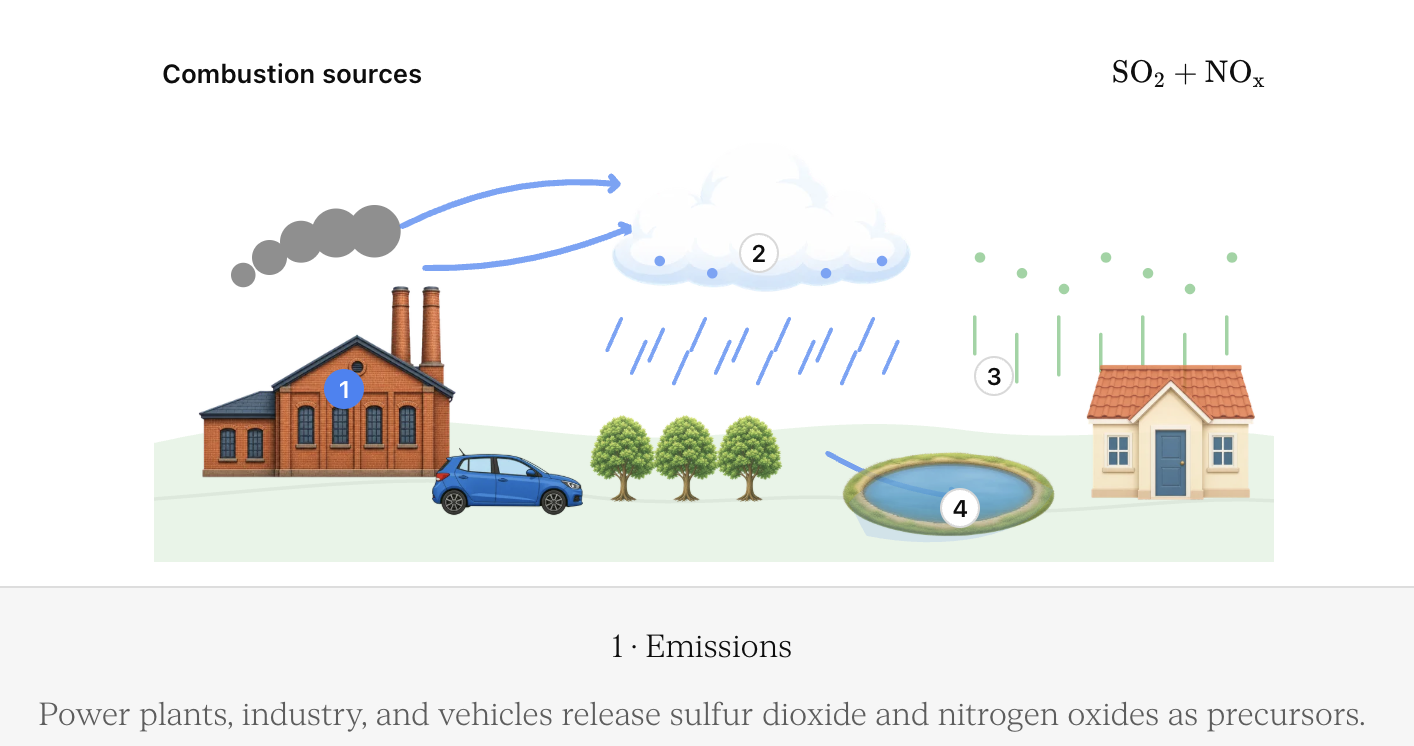
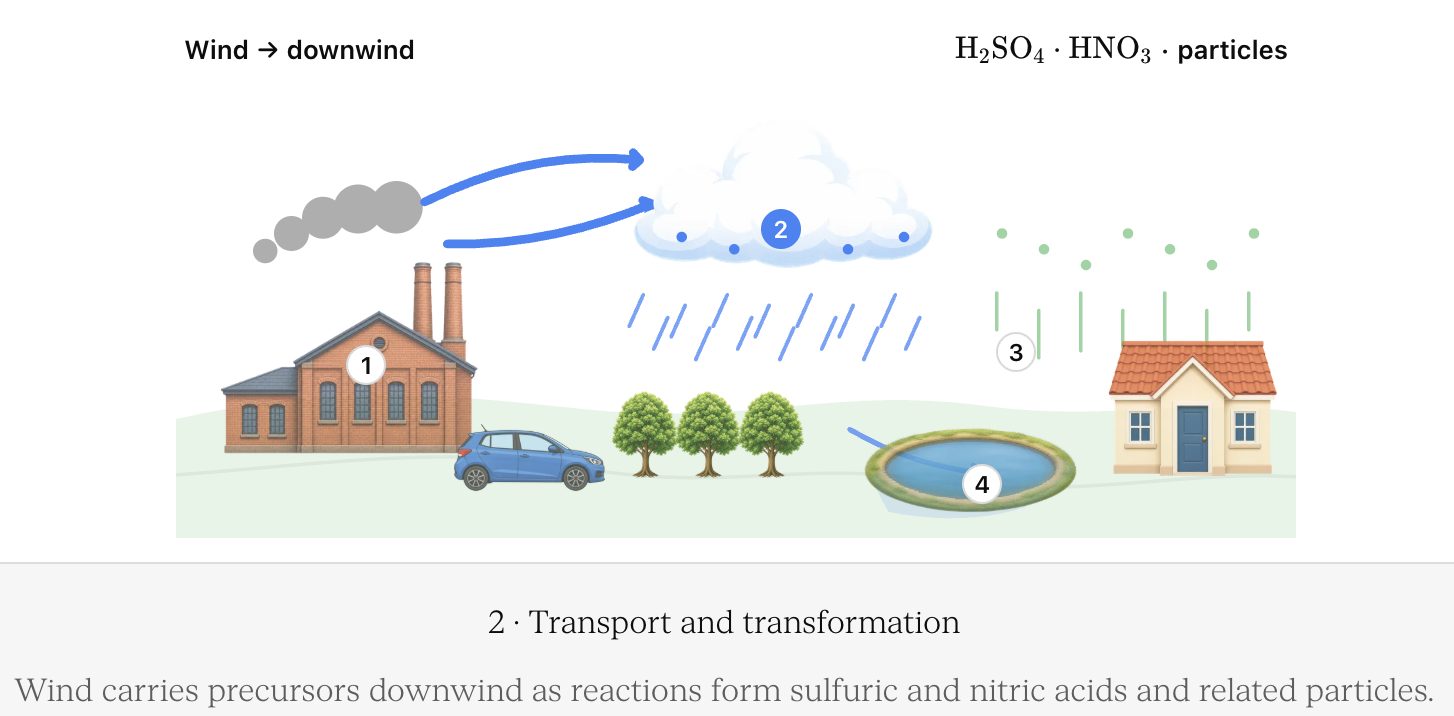
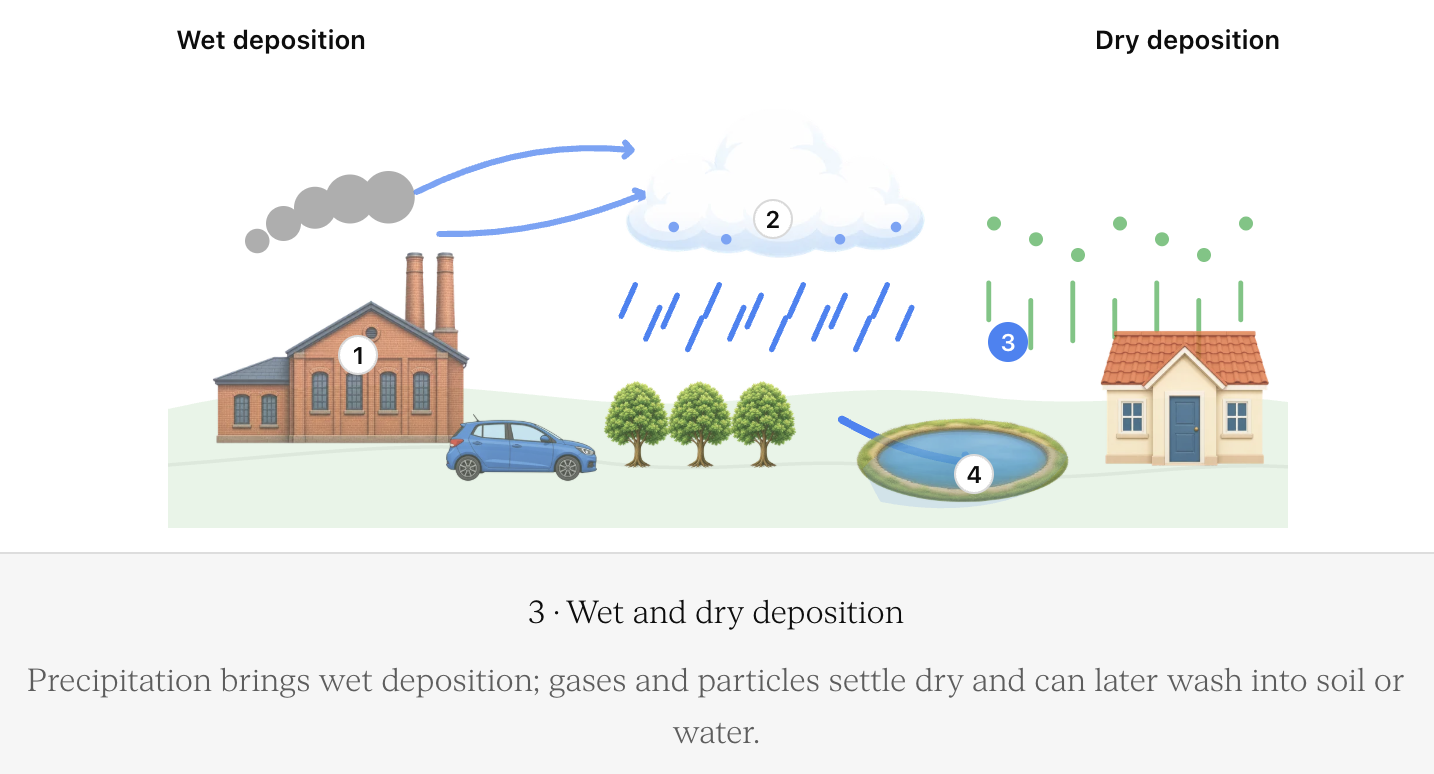
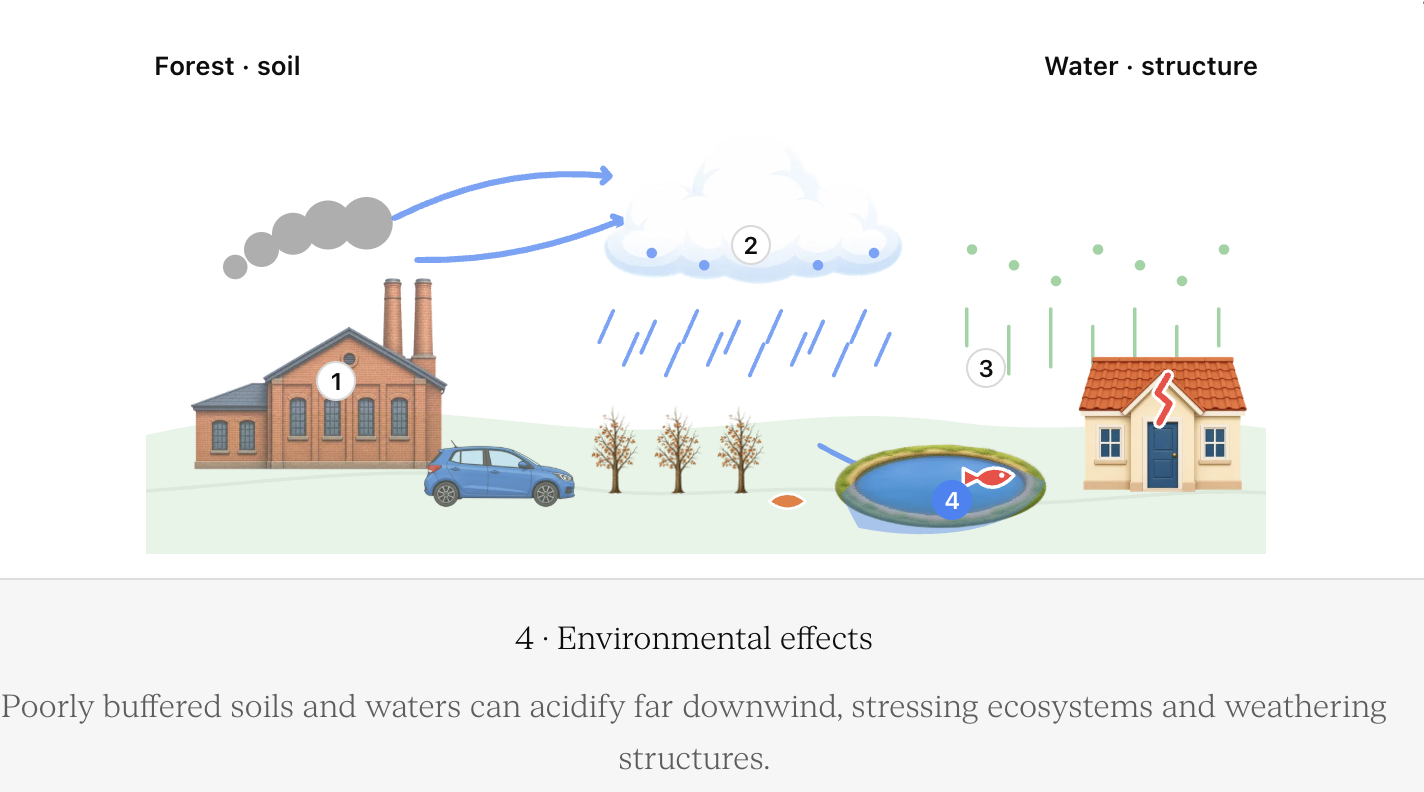
Acid Deposition
The term acid deposition is broader and more accurate than simply "acid rain."
Acidic substances can reach Earth's surface through:
Wet Deposition
Acidic material carried by:
- rain
- snow
- fog
- cloud water
Dry Deposition
Acidic gases and particles settle directly onto:
- plants
- soil
- water
- buildings
- other surfaces
Therefore:
acid rain is one form of acid deposition.
Acid Rain Can Travel Long Distances
Air pollutants do not necessarily remain near their source.
Wind can transport sulfur dioxide, nitrogen oxides, and their reaction products over long distances.
This means:
pollution produced in one region can contribute to environmental damage somewhere else.
Acid deposition can therefore become a regional or international environmental issue.
Effects on Lakes and Rivers
Acid deposition can lower the pH of freshwater ecosystems.
Many aquatic organisms survive only within particular pH ranges.
Increasing acidity can affect:
- fish
- amphibians
- aquatic insects
- plankton
- microorganisms
- aquatic plants
Different organisms have different levels of tolerance.


Effects on Fish
Increasing acidity can interfere with:
- egg development
- reproduction
- growth
- gill function
- ion balance
Young organisms may be especially sensitive.
As sensitive species disappear, food webs can also change.
Therefore, acidification can affect an entire ecosystem rather than only one species.
Aluminium and Acidified Water
Acidic conditions can increase the mobility of aluminium in some soils.
Aluminium can then move into streams and lakes.
Higher concentrations of dissolved aluminium can be harmful to aquatic organisms, particularly fish.
Therefore, acid deposition can damage freshwater systems in two related ways:
lower pH + increased metal mobility
Effects on Soil
Acid deposition can alter soil chemistry.
Possible effects include:
- lower soil pH
- leaching of important nutrients
- increased mobility of aluminium
- changes in microorganism communities
- changes in nutrient availability
Important nutrient ions such as calcium and magnesium may be washed deeper into the soil or lost from the system.
Nutrient Leaching
Leaching occurs when dissolved substances are carried through soil by water.
Acidic conditions can increase the loss of some nutrient ions.
This can reduce soil fertility.
Plants may then have greater difficulty obtaining the minerals required for healthy growth.
Effects on Forests
Acid deposition can place stress on trees and other vegetation.
Damage may occur through:
- altered soil chemistry
- nutrient loss
- aluminium toxicity
- damage to leaves or needles
- reduced root function
Acid deposition does not necessarily kill trees directly.
Instead, it may weaken them and make them more vulnerable to additional stresses such as:
- drought
- cold
- pests
- disease


Effects on Buildings and Monuments
Acid deposition can also damage human-made structures.
Materials containing calcium carbonate are particularly vulnerable.
Examples include:
- limestone
- marble
Calcium carbonate reacts with acids.
A simplified reaction is:
CaCO₃ + 2H⁺ → Ca²⁺ + H₂O + CO₂
Over long periods, this can contribute to surface erosion.
Damage to Cultural Heritage
Historic buildings, statues, and monuments may contain limestone or marble.
Repeated exposure to acidic conditions can:
- roughen surfaces
- remove fine details
- weaken material
- increase restoration costs
Acid deposition is therefore both an environmental and cultural problem.


Corrosion of Metals
Acidic conditions can also contribute to corrosion.
Structures that may be affected include:
- bridges
- vehicles
- roofs
- pipes
- outdoor equipment
Environmental chemistry therefore has economic consequences as well as ecological ones.
Reducing Sulfur Dioxide Emissions
One way to reduce acid deposition is to prevent sulfur dioxide from entering the atmosphere.
Strategies include:
- using fuels with lower sulfur content
- reducing coal combustion
- switching to cleaner energy sources
- removing sulfur from fuels
- treating exhaust gases
A particularly important industrial technique is flue-gas desulfurization.
Flue-Gas Desulfurization
Power stations and industrial facilities can treat exhaust gases before they enter the atmosphere.
Some systems use limestone or lime to react with sulfur dioxide.
For example, calcium carbonate can participate in reactions that remove sulfur compounds from the gas stream.
The important principle is:
acidic pollutant + alkaline material → less harmful products that can be collected
This is a large-scale environmental application of acid-base chemistry.
Scrubbers
Equipment used to remove pollutants from exhaust gases is often called a scrubber.
Scrubbers can bring polluted gases into contact with materials capable of removing specific pollutants.
For sulfur dioxide:
alkaline substances can help remove acidic sulfur compounds
This prevents some SO₂ from reaching the atmosphere.
Reducing Nitrogen Oxide Emissions
Nitrogen oxide emissions can also be reduced.
Strategies include:
- improving combustion technology
- reducing unnecessary fuel use
- using cleaner energy sources
- controlling industrial emissions
- using catalytic converters in vehicles
These approaches reduce the pollutants available to contribute to nitric acid formation.
Catalytic Converters
Vehicle exhaust can contain pollutants including:
- nitrogen oxides
- carbon monoxide
- unburned hydrocarbons
Catalytic converters encourage reactions that convert pollutants into less harmful substances.
For nitrogen oxides, the goal includes converting nitrogen-containing pollutants toward:
N₂
rather than releasing large quantities of NOₓ.
Catalytic converters therefore help reduce one important source of acid-deposition precursors.
Renewable Energy and Acid Deposition
Solar, wind, hydroelectric, and other low-combustion energy technologies can reduce dependence on fossil-fuel combustion.
Reducing combustion can decrease emissions of:
- sulfur dioxide
- nitrogen oxides
This addresses acid deposition at its source rather than treating pollution after it has already been produced.
Treating Acidified Lakes
In some situations, alkaline materials can be added to acidified lakes.
A common material is:
calcium carbonate, CaCO₃
This process is called liming.
The carbonate reacts with acidity and can increase water pH.
A simplified reaction is:
CaCO₃ + 2H⁺ → Ca²⁺ + H₂O + CO₂


Advantages of Liming Lakes
Liming can:
- raise pH
- reduce acidity
- improve conditions for aquatic organisms
- reduce some effects of toxic metals
However, it does not eliminate the original source of pollution.
If acid deposition continues, treatment may need to be repeated.
Treating Acidic Soil
Limestone can also be applied to acidic soils.
Agricultural lime commonly contains calcium carbonate.
The same general neutralization principle applies:
acidic soil + carbonate → reduced acidity
Benefits can include:
- increased soil pH
- improved nutrient availability
- reduced aluminium toxicity
- improved plant growth
Environmental Management with Bases
Bases and alkaline compounds are widely used to neutralize acidic environmental materials.
Examples include:
- treating acidic wastewater
- treating acidic mine drainage
- adjusting soil pH
- treating acidified lakes
- removing acidic gases from industrial emissions
Common materials may include:
- calcium carbonate
- calcium hydroxide
- sodium hydroxide
The appropriate substance depends on the application.
Acid Mine Drainage
Mining can expose sulfur-containing minerals to air and water.
Chemical reactions can produce acidic drainage.
This acidic water may dissolve metals from surrounding rock.
The resulting water can contain:
high acidity + dissolved metals
and can damage streams and aquatic ecosystems.
Treating Acid Mine Drainage
One treatment strategy is to add alkaline material.
For example:
limestone → neutralizes some acidity
As pH rises, some dissolved metals can also become less soluble and form solid precipitates.
These solids can then potentially be separated.
This combines two important chemical ideas:
neutralization + precipitation
Bases in Wastewater Treatment
Industrial wastewater may sometimes be too acidic.
A base can be added to increase its pH.
For example:
H⁺ + OH⁻ → H₂O
However, reaching an acceptable pH does not mean the water is automatically safe.
It may still contain:
- toxic metals
- organic pollutants
- nutrients
- suspended solids
- microorganisms
Environmental treatment usually involves several stages.
Acids in Environmental Management
Acids can also be useful.
For example, some industrial wastewater may be too alkaline.
Carefully controlled addition of acid can lower the pH.
Acids may also be used in:
- water-treatment processes
- equipment cleaning
- chemical regeneration systems
- controlling alkaline industrial waste
The objective is not always to make a system exactly pH 7.
The goal is to achieve conditions appropriate for the environment or treatment process.
Neutralization
Neutralization is one of the most important acid-base reactions in environmental management.
A simplified ionic equation is:
H⁺ + OH⁻ → H₂O
Neutralization can help control:
- wastewater pH
- soil acidity
- lake acidity
- industrial waste
- some mining pollution
However, the products of the reaction must also be considered.
Neutralization Does Not Make Pollution Disappear
This is an important environmental principle.
Suppose acidic wastewater contains dissolved heavy metals.
Adding a base may correct the pH.
But the metals do not simply vanish.
They may:
- remain dissolved
- precipitate as solids
- accumulate in treatment sludge
The resulting materials still require appropriate management.
Therefore:
neutralizing acidity ≠ removing every pollutant
Buffering Capacity of Natural Systems
Some ecosystems resist changes in pH better than others.
This ability is called buffering capacity.
Areas containing limestone often have relatively high buffering capacity because carbonate minerals can neutralize acids.
For example:
CaCO₃ + 2H⁺ → Ca²⁺ + H₂O + CO₂
Why Some Lakes Are More Vulnerable
Two lakes receiving similar acid deposition may respond very differently.
Lake A
Surrounded by carbonate-rich rocks.
Result:
high buffering capacity
Lake B
Surrounded by rocks that provide little neutralizing capacity.
Result:
low buffering capacity
Lake B may experience a much larger decrease in pH.
Therefore, environmental impact depends on both:
pollution exposure + ecosystem chemistry
Natural and Human Sources of Acidity
Not all environmental acidity is caused by humans.
Natural processes can also produce acidic substances.
Examples include:
- volcanic emissions
- decomposition
- natural soil processes
- lightning-related nitrogen chemistry
- naturally occurring organic acids
However, human activities can substantially increase emissions of sulfur dioxide and nitrogen oxides.
Monitoring Acid Deposition
Scientists monitor environmental conditions using measurements such as:
- precipitation pH
- sulfate concentration
- nitrate concentration
- lake pH
- soil pH
- metal concentrations
- species populations
Long-term monitoring is particularly important.
One measurement provides a snapshot.
Many measurements over time reveal:
trends
Biological Indicators
Scientists can also examine organisms.
Changes in populations of sensitive species may provide evidence of environmental stress.
Possible indicators include changes in:
- fish populations
- aquatic insects
- algae
- soil organisms
- forest health
Chemical measurements and biological evidence together provide a stronger understanding of ecosystem health.
Preventing Pollution Versus Treating Damage
Environmental solutions can be divided into two broad approaches.
Prevention
Stop or reduce pollution before it enters the environment.
Examples:
- reduce SO₂ emissions
- reduce NOₓ emissions
- use cleaner energy
- improve industrial processes
Treatment
Repair or reduce damage after pollution has occurred.
Examples:
- lime an acidified lake
- neutralize acidic wastewater
- treat mine drainage
Prevention is often preferable because it addresses the cause rather than repeatedly treating the symptoms.
Comparing Environmental Solutions
| Strategy | Main Purpose | Advantage | Limitation |
|---|---|---|---|
| Low-sulfur fuels | Reduce SO₂ formation | Prevents pollution | May require fuel changes |
| Flue-gas scrubbers | Remove SO₂ | Reduces industrial emissions | Equipment and treatment costs |
| Catalytic converters | Reduce vehicle pollutants | Reduces NOₓ emissions | Requires effective operation |
| Renewable energy | Reduce combustion emissions | Addresses pollution at source | Infrastructure required |
| Lake liming | Neutralize acidic water | Can improve ecosystem conditions | May require repeated treatment |
| Soil liming | Reduce soil acidity | Can improve soil conditions | Excessive application can cause problems |
| Wastewater neutralization | Control discharge pH | Protects receiving waters | Other pollutants may remain |
| Mine-water treatment | Reduce acidity and metals | Can protect streams | Treatment may be long-term |
Evaluating Chemical Solutions
A successful environmental treatment should not simply solve one problem while creating another.
Scientists must consider:
- effectiveness
- cost
- energy use
- waste generation
- environmental side effects
- long-term sustainability
- maintenance requirements
- impacts on organisms
- practicality at large scale
For example, limestone may neutralize acidic water effectively, but transporting and repeatedly applying large quantities also requires resources.
Worked Example: Acidified Lake
A lake has become increasingly acidic.
Measurements show:
pH 4.7
Fish populations are declining.
One short-term strategy could be:
add carefully calculated quantities of limestone
The limestone consumes H⁺:
CaCO₃ + 2H⁺ → Ca²⁺ + H₂O + CO₂
This could raise the pH.
However, a long-term solution should also reduce the emissions responsible for continuing acid deposition.
Worked Example: Factory Emissions
A power station burns sulfur-containing fuel.
Sulfur dioxide is produced.
Two possible approaches are:
Approach A
Install a scrubber to remove SO₂ from exhaust gases.
Approach B
Replace the fuel or energy technology with one producing much less SO₂.
Approach A:
treats the pollution before release
Approach B:
reduces formation of the pollutant
Both can be effective, but their costs and environmental impacts differ.
Worked Example: Acidic Wastewater
A factory produces wastewater with:
pH 3
Releasing it directly could damage aquatic organisms.
A suitable base can be added under controlled conditions.
As H⁺ is neutralized:
pH rises
However, the water must also be tested for other contaminants before discharge.
Worked Example: Choosing the Better Solution
Suppose an acidified lake requires limestone treatment every few years.
Option 1:
continue repeated liming
Option 2:
reduce the regional SO₂ and NOₓ emissions causing the acidification
Liming may provide relatively rapid local improvement.
Emission reduction addresses the underlying cause and can protect many ecosystems simultaneously.
A strong environmental strategy may use treatment in the short term while prioritizing pollution prevention for the long term.
Environmental Chemistry and Evidence
Environmental decisions should be based on evidence.
Scientists may ask:
- Has lake pH changed?
- Have SO₂ emissions decreased?
- Are fish populations recovering?
- Are soil nutrient concentrations improving?
- Is treatment producing harmful by-products?
- How much does the intervention cost?
- Will the solution remain effective over decades?
This means environmental chemistry involves more than performing reactions.
It involves:
measurement + chemistry + ecology + engineering + evaluation
Common Mistakes
Thinking Normal Rain Has a pH of Exactly 7
Normal rain is naturally slightly acidic because atmospheric CO₂ can form carbonic acid.
Thinking Acid Rain Is Caused Mainly by CO₂
Carbon dioxide contributes to the natural slight acidity of rain.
Acid deposition associated with pollution is mainly linked to:
SO₂ and NOₓ
Thinking Acid Rain Falls Only Near Factories
Pollutants can travel long distances through the atmosphere.
Thinking Acid Rain Only Affects Lakes
It can affect:
- lakes
- streams
- soils
- forests
- buildings
- monuments
Thinking Acid Rain Directly Burns Trees
Environmental effects are more complex.
Acid deposition can alter soil chemistry, remove nutrients, mobilize aluminium, and increase plant stress.
Thinking Liming Permanently Solves Acid Deposition
Liming treats acidity but does not remove the pollution source.
Thinking Neutralization Removes Every Pollutant
Neutralization adjusts acidity.
Other contaminants may still require treatment.
Thinking Every Ecosystem Responds the Same Way
Buffering capacity differs between soils, lakes, and geological regions.
Assuming Chemical Treatment Is Always the Best Solution
Chemical treatments can be useful, but preventing pollution at its source may provide greater long-term benefits.
Check Your Understanding
- What is acid rain?
- Why is normal rain naturally slightly acidic?
- Name the two major groups of pollutants associated with acid deposition.
- Give three important sources of sulfur dioxide.
- How are nitrogen oxides produced during combustion?
- Name two acids associated with acid deposition.
- Explain the difference between wet and dry deposition.
- Why can acid deposition affect regions far from pollution sources?
- Describe three effects of acidification on freshwater ecosystems.
- Why can aluminium become more harmful in acidified environments?
- Explain how acid deposition can reduce soil fertility.
- Describe two ways acid deposition can affect forests.
- Why are limestone and marble vulnerable to acid deposition?
- Write the simplified reaction between CaCO₃ and H⁺.
- What is flue-gas desulfurization?
- How can alkaline materials help remove sulfur dioxide from industrial emissions?
- How do catalytic converters help reduce acid-deposition precursors?
- Explain how renewable energy can help reduce acid deposition.
- What is lake liming?
- Why is calcium carbonate useful for treating acidified lakes?
- Explain one limitation of lake liming.
- What is acid mine drainage?
- How can bases help treat acidic mine drainage?
- Why doesn't neutralizing wastewater necessarily make it safe?
- What is buffering capacity?
- Why are some lakes more vulnerable to acidification than others?
- Explain the difference between pollution prevention and pollution treatment.
- Give two measurements scientists could use to monitor acid deposition.
- Compare one short-term and one long-term strategy for dealing with an acidified lake.
- Evaluate the statement: "The best solution to acid rain is simply to add bases to affected ecosystems."
Key Terms
Acid rain — Rain or other precipitation made more acidic mainly by atmospheric pollutants such as sulfur and nitrogen compounds.
Acid deposition — Transfer of acidic substances from the atmosphere to Earth's surface through wet or dry processes.
Wet deposition — Removal of acidic substances from the atmosphere through rain, snow, fog, or cloud water.
Dry deposition — Deposition of acidic gases and particles directly onto surfaces.
Sulfur dioxide (SO₂) — Air pollutant produced by sources including combustion of sulfur-containing fuels and some industrial processes.
Nitrogen oxides (NOₓ) — Group of nitrogen-oxygen compounds produced particularly during high-temperature combustion.
Sulfuric acid (H₂SO₄) — Strong acid that can form from sulfur-containing atmospheric pollutants.
Nitric acid (HNO₃) — Strong acid that can form from nitrogen oxide pollution.
Leaching — Movement of dissolved substances through soil by water.
Buffering capacity — Ability of a system to resist changes in pH.
Liming — Addition of alkaline materials such as calcium carbonate to reduce acidity.
Flue-gas desulfurization — Industrial treatment used to remove sulfur compounds, particularly SO₂, from exhaust gases.
Scrubber — Pollution-control equipment designed to remove substances from industrial exhaust gases.
Catalytic converter — Vehicle pollution-control device that converts several harmful exhaust pollutants into less harmful substances.
Acid mine drainage — Acidic, often metal-containing water produced when certain exposed minerals react with air and water.
Neutralization — Reaction in which an acid and a base reduce one another's acidic and alkaline properties.
Environmental monitoring — Systematic measurement of environmental conditions over time.
Pollution prevention — Reducing or eliminating pollutant production before environmental release.
Environmental remediation — Actions taken to reduce, remove, or manage existing environmental contamination.
Key Takeaways
- Acid-base chemistry has important applications in environmental protection and pollution control.
- Normal rain is naturally slightly acidic because CO₂ can form carbonic acid.
- Pollution-related acid deposition is mainly associated with sulfur dioxide and nitrogen oxides.
- SO₂ can originate from sulfur-containing fuel combustion and industrial processes.
- NOₓ is commonly produced during high-temperature combustion.
- Atmospheric reactions can produce sulfuric and nitric acids.
- Acidic substances reach Earth's surface through wet and dry deposition.
- Pollutants can travel long distances before being deposited.
- Acid deposition can lower the pH of lakes and streams.
- Acidification can harm fish, amphibians, microorganisms, and other aquatic organisms.
- Acidic conditions can increase aluminium mobility and toxicity.
- Acid deposition can remove important nutrients from soils through leaching.
- Forests can be weakened by altered soil chemistry, nutrient loss, and other stresses.
- Acid deposition can damage limestone, marble, metals, buildings, and monuments.
- SO₂ emissions can be reduced using low-sulfur fuels and flue-gas scrubbers.
- NOₓ emissions can be reduced using improved combustion systems and catalytic converters.
- Reducing fossil-fuel combustion can address acid deposition at its source.
- Calcium carbonate can neutralize acidity in lakes and soils.
- Liming can provide useful short-term environmental remediation.
- Acidic mine drainage can be treated using alkaline substances and precipitation methods.
- Neutralizing water does not automatically remove every pollutant.
- Natural ecosystems differ in their buffering capacity.
- Environmental monitoring is necessary to determine whether treatments are working.
- Pollution prevention generally provides a stronger long-term solution than repeatedly treating environmental damage.
- Chemical solutions must themselves be evaluated for cost, waste, energy use, side effects, and sustainability.
The central environmental strategy is:
identify the pollution source
↓
understand the chemistry
↓
reduce pollutant formation where possible
↓
control emissions
↓
treat existing damage when necessary
↓
monitor recovery
The most effective environmental chemistry therefore combines prevention, treatment, monitoring, and long-term management.