Applications of Acids, Bases, and Salts
| Сайт: | Young Education |
| Курс: | Acids, Bases, Salts |
| Книга: | Applications of Acids, Bases, and Salts |
| Надруковано: | Guest user |
| Дата: | вівторок 24 листопада 2026 00:45 AM |
1. Acids and Bases in Industry
Learning outcomes
- I can identify industrial uses of acids and bases.
- I can explain why acids and bases are important in manufacturing.
- I can describe examples of industrial chemical processes.
- I can investigate products made using acids and bases.
- I can evaluate the benefits of industrial chemical applications.
Acids and Bases in Industry
Acids and bases are among the most important chemicals used in modern industry. They are involved in producing fertilizers, metals, medicines, plastics, paper, textiles, cleaning products, food products, batteries, and many other materials.
Industrial acids and bases may be used as:
- reactants in chemical manufacturing
- catalysts that increase reaction rates
- cleaning and processing chemicals
- substances for controlling pH
- raw materials for producing other chemicals
- neutralizing agents for treating waste
Some of the most important industrial acids include sulfuric acid, nitric acid, hydrochloric acid, and phosphoric acid. Important industrial bases include sodium hydroxide, calcium hydroxide, and ammonia.


Why Acids and Bases Are Important
Many manufacturing processes depend on controlling chemical reactions.
Acids and bases are useful because they can:
- react with many different substances
- change pH
- neutralize one another
- dissolve or remove certain materials
- help separate useful substances
- participate in reactions that produce valuable products
Industrial processes are often carefully designed to control:
temperature, concentration, pressure, pH, reaction rate, yield, and purity
This allows manufacturers to produce large quantities efficiently and safely.
Sulfuric Acid
Sulfuric acid has the formula:
H₂SO₄
It is one of the most important industrial chemicals.
Large-scale production and consumption of sulfuric acid are associated with many areas of chemical manufacturing.
Uses include:
- fertilizer production
- metal processing
- petroleum refining
- chemical manufacturing
- battery production
- production of detergents and other chemicals
Fertilizer Production
One of the largest uses of sulfuric acid is the manufacture of fertilizers.
Plants require nutrients including:
- nitrogen
- phosphorus
- potassium
Phosphate-containing minerals can be chemically processed to make phosphorus more available to plants.
Sulfuric acid is used in some of these processes.


Why Fertilizers Matter
Crops remove mineral nutrients from soil as they grow.
When crops are harvested, some of those nutrients leave the agricultural system.
Fertilizers replace nutrients and can:
- increase crop growth
- increase agricultural productivity
- improve food production
However, excessive fertilizer use can also contribute to:
- water pollution
- eutrophication
- ecosystem disruption
Industrial chemistry therefore provides important benefits but must be managed carefully.
The Contact Process
Sulfuric acid is manufactured industrially using the Contact Process.
A simplified sequence is:
sulfur-containing material → sulfur dioxide → sulfur trioxide → sulfuric acid
One important reaction is:
2SO₂ + O₂ ⇌ 2SO₃
This reaction is reversible.
A catalyst is used to increase the reaction rate.
The sulfur trioxide is then processed further to produce sulfuric acid.
This is an example of how industrial chemistry combines:
- reaction chemistry
- catalysts
- equilibrium
- temperature control
- engineering
- safety
Nitric Acid
Nitric acid has the formula:
HNO₃
It is another major industrial acid.
Uses include manufacturing:
- fertilizers
- nitrate compounds
- dyes
- pharmaceuticals
- specialty chemicals
Nitric acid is particularly important because it provides nitrate-containing compounds.
Ammonium Nitrate
Nitric acid can react with ammonia:
HNO₃ + NH₃ → NH₄NO₃
The product is:
ammonium nitrate
Ammonium nitrate contains nitrogen that can be used by plants, so it has been widely used in fertilizers.
This is an example of an industrial neutralization reaction.
Ammonia
Ammonia has the formula:
NH₃
When ammonia dissolves in water, the solution is alkaline.
Ammonia is extremely important in industrial chemistry because it is used to manufacture many nitrogen-containing substances.
Its largest industrial role is closely connected to fertilizer production.
The Haber Process
Ammonia is manufactured from nitrogen and hydrogen using the Haber Process.
The reaction is:
N₂ + 3H₂ ⇌ 2NH₃
The reaction is reversible.
Industrial production requires careful control of:
- temperature
- pressure
- catalyst
- reactant recycling
The ammonia produced can then be used to manufacture fertilizers and other chemicals.


Hydrochloric Acid
Hydrochloric acid has the formula:
HCl
Industrial uses include:
- cleaning metals
- controlling pH
- chemical manufacturing
- producing chloride compounds
- processing materials
- water treatment applications
Hydrochloric acid is particularly useful because it reacts readily with many metal oxides, carbonates, and bases.
Metal Cleaning and Pickling
Metal surfaces can develop layers of oxides and other unwanted substances.
Before metals are:
- coated
- plated
- welded
- processed further
these surface layers may need to be removed.
Acid treatment can dissolve certain oxide layers.
This process is commonly called pickling.
Hydrochloric acid is one acid used for this purpose.
Why Clean Metal Surfaces?
Surface contamination can interfere with:
- coatings
- paints
- plating
- welding
- further chemical treatment
Cleaning therefore improves manufacturing quality.
However, acid concentrations and exposure times must be controlled because acids can also attack the underlying metal.
Phosphoric Acid
Phosphoric acid has the formula:
H₃PO₄
It has several industrial applications.
These include:
- fertilizer manufacturing
- food and beverage processing
- metal treatment
- production of phosphate compounds
Phosphate chemistry is particularly important in agriculture.
Sodium Hydroxide
Sodium hydroxide has the formula:
NaOH
It is a strong base commonly called caustic soda.
It is one of the most important industrial bases.
Uses include:
- soap production
- detergents
- paper manufacturing
- chemical processing
- cleaning products
- pH control
- treatment of acidic waste


Soap Manufacturing
Traditional soap can be produced by reacting fats or oils with a strong base such as sodium hydroxide.
This process is called saponification.
A simplified representation is:
fat or oil + sodium hydroxide → soap + glycerol
The exact chemistry depends on the fats or oils being used.
Soap molecules have structures that allow them to interact with both:
- water
- oils and grease
This makes them effective cleaning agents.
Paper Manufacturing
Sodium hydroxide is also important in the pulp and paper industry.
Wood contains:
- cellulose
- lignin
- other substances
Cellulose fibres are required for paper.
Chemical treatment helps separate useful cellulose fibres from other components of wood.
Bases such as sodium hydroxide are involved in important pulping processes.
Calcium Hydroxide
Calcium hydroxide has the formula:
Ca(OH)₂
It is sometimes called slaked lime.
Industrial and environmental applications include:
- treating acidic soils
- neutralizing acidic waste
- water treatment
- construction materials
- some chemical manufacturing processes
Treating Acidic Soil
Some soils become too acidic for good crop growth.
Adding suitable alkaline materials can increase the soil pH.
Calcium-containing compounds such as calcium carbonate or calcium hydroxide may be used depending on the application.
The basic principle is:
acid + base → neutralization
This can improve conditions for plant growth.
pH Control
Many industrial processes work best within a particular pH range.
If a solution becomes too acidic or too alkaline:
- reactions may slow
- unwanted reactions may occur
- equipment may corrode
- products may be damaged
- biological treatment systems may stop functioning properly
Acids or bases can therefore be added carefully to adjust pH.
Neutralizing Industrial Waste
Industrial wastewater may sometimes be strongly acidic or alkaline.
It cannot simply be released without appropriate treatment.
If wastewater is acidic, a suitable base may be added.
If wastewater is alkaline, a suitable acid may be added.
The general idea is:
acidic waste + base → closer to neutral
or:
alkaline waste + acid → closer to neutral
The actual treatment process must consider all pollutants present, not only pH.
Water Treatment
Acid-base chemistry is important in water and wastewater treatment.
Operators may need to control:
- pH
- alkalinity
- precipitation of contaminants
- effectiveness of treatment chemicals
- biological treatment conditions
Different treatment stages require different chemical conditions.


Food Manufacturing
Acids and bases are also used in food processing.
Acids can contribute to:
- flavour
- preservation
- pH control
- texture
- processing conditions
Examples include:
citric acid
acetic acid
phosphoric acid
Different food products require carefully controlled acidity.
Acids in Food Preservation
Many microorganisms grow poorly under strongly acidic conditions.
Reducing pH can therefore help preserve some foods.
Examples include foods containing:
- vinegar
- citric acid
- naturally produced acids from fermentation
However, safe food preservation depends on much more than simply adding an acid. Concentration, temperature, hygiene, packaging, and processing conditions also matter.
Acids and Bases in Pharmaceuticals
Pharmaceutical manufacturing frequently uses acid-base chemistry.
Acids and bases may be used to:
- synthesize active ingredients
- control reaction conditions
- adjust pH
- convert compounds into useful salt forms
- purify products
Purity and concentration must be controlled extremely carefully because pharmaceutical products must meet strict quality requirements.
Producing Salts
Many industrial processes use acids and bases to produce salts.
General reaction:
acid + base → salt + water
Example:
HCl + NaOH → NaCl + H₂O
Another example:
H₂SO₄ + 2KOH → K₂SO₄ + 2H₂O
Salts produced industrially can be used in:
- fertilizers
- food processing
- pharmaceuticals
- water treatment
- manufacturing
- agriculture
Batteries
Acid-base chemistry also appears in energy technologies.
Lead-acid batteries use sulfuric acid as an electrolyte.
These batteries are commonly associated with:
- vehicles
- backup power systems
- industrial equipment
Chemical reactions inside the battery convert:
chemical energy → electrical energy
During charging, electrical energy drives chemical changes in the opposite direction.


Textile Manufacturing
Acids and bases can be used during textile processing for:
- preparing fibres
- controlling pH
- dyeing
- finishing
- cleaning
The exact chemicals used depend on the type of fibre and desired product.
Correct pH can be especially important because dyes and fibres behave differently under different chemical conditions.
Petroleum and Chemical Processing
Acid-base chemistry is also involved in petroleum refining and petrochemical manufacturing.
Acids or bases may function as:
- reactants
- catalysts
- neutralizing agents
- purification chemicals
These processes produce raw materials used to manufacture many everyday products.
Plastics and Polymers
Industrial acid-base chemistry contributes indirectly or directly to the production of many polymers.
Chemical manufacturing provides substances used to make:
- plastics
- synthetic fibres
- coatings
- adhesives
- packaging materials
Acid or base catalysts may also help certain polymer-forming reactions occur efficiently.
Cleaning Products
Strong bases are effective at breaking down certain fats and organic materials.
This makes alkaline substances useful in some:
- industrial cleaners
- drain cleaners
- degreasers
- oven cleaners
However, strong bases such as NaOH are highly corrosive.
Industrial workers therefore require appropriate procedures and protective equipment.
Industrial Neutralization
Neutralization is useful when manufacturers need to control acidity.
The general reaction is:
acid + base → salt + water
At the ionic level:
H⁺ + OH⁻ → H₂O
Neutralization may be used to:
- treat waste
- control product pH
- manufacture salts
- protect equipment
- prepare materials for further processing
Industrial Scale
Laboratory reactions may use only a few grams or millilitres.
Industrial processes may use enormous quantities of materials.
Scaling up introduces additional challenges.
Industries must control:
- reaction temperature
- pressure
- concentration
- mixing
- heat transfer
- reaction rate
- waste production
- corrosion
- worker safety
A reaction that is easy in a test tube may require extensive engineering when performed on an industrial scale.
Corrosion
Strong acids and bases can attack industrial equipment.
Factories therefore need materials capable of resisting corrosion.
Depending on the chemical process, equipment may use:
- specialized steels
- protective coatings
- ceramics
- polymers
- corrosion-resistant alloys
Material selection is an important part of chemical engineering.
Industrial Safety
Concentrated acids and bases can be extremely hazardous.
Potential hazards include:
- chemical burns
- eye damage
- corrosive fumes
- heat released during dilution or neutralization
- dangerous reactions with incompatible materials
- environmental contamination
Industrial systems therefore use strict controls.
These may include:
- protective clothing
- eye and face protection
- ventilation
- automated chemical handling
- containment systems
- emergency showers
- spill-control systems
- monitoring equipment
Diluting Concentrated Acids
Mixing concentrated acid with water can release a large amount of heat.
In laboratory settings, an important safety principle is:
add acid to water gradually rather than adding water to concentrated acid.
Adding water directly to concentrated acid can cause rapid heating and dangerous splashing.
Industrial dilution systems likewise require carefully controlled mixing and heat management.
Benefits of Industrial Acid-Base Chemistry
Industrial use of acids and bases provides major benefits.
Agriculture
Manufacture of fertilizers can increase food production.
Clean Water
Chemical treatment helps make water safer and treats wastewater.
Manufacturing
Acids and bases help produce metals, paper, textiles, chemicals, plastics, and many other materials.
Medicine
Acid-base chemistry contributes to pharmaceutical manufacturing.
Energy
Acid-base chemistry is involved in batteries and industrial energy systems.
Waste Treatment
Neutralization helps treat acidic and alkaline wastes.
Environmental Costs
Industrial chemical use can also create environmental problems if poorly managed.
Potential impacts include:
- acidic or alkaline wastewater
- chemical spills
- air pollution
- contaminated soil
- damage to aquatic ecosystems
- excessive fertilizer runoff
- energy consumption
- greenhouse gas emissions
Industrial chemistry must therefore balance production with environmental protection.
Fertilizers: Benefits and Risks
Fertilizer production provides a useful example of this balance.
Benefits
- increased crop yields
- improved food production
- replacement of soil nutrients
- support for growing populations
Risks
Excess fertilizer can enter waterways.
High nutrient concentrations may cause rapid algal growth.
When algae die, decomposition can reduce dissolved oxygen.
This process is called eutrophication.
Aquatic organisms may then suffer or die.
Improving Industrial Processes
Modern chemical industries aim to improve processes by:
- reducing waste
- recycling reactants
- increasing yield
- using catalysts
- recovering energy
- reducing water consumption
- controlling emissions
- replacing hazardous substances where possible
- improving process monitoring
These approaches can make manufacturing both economically and environmentally more sustainable.
Atom Economy
A useful goal in industrial chemistry is to maximize the amount of reactant that becomes the desired product.
A process producing large quantities of unwanted by-products wastes:
- raw materials
- energy
- money
and creates additional waste.
Processes with better atom economy use more of the starting atoms in the desired product.
Recycling Industrial Chemicals
Some industrial processes recover and reuse chemicals rather than disposing of them.
This can:
- reduce raw-material demand
- reduce waste
- reduce costs
- decrease environmental impacts
Industrial systems may also recycle unreacted reactants back into the production process.
Evaluating an Industrial Process
When evaluating the use of acids or bases in industry, consider several factors.
| Factor | Questions to Ask |
|---|---|
| Product | Is the product useful or necessary? |
| Yield | How much desired product is produced? |
| Raw materials | Are they abundant and sustainable? |
| Energy | How much energy is required? |
| Waste | How much waste is generated? |
| Safety | Are hazardous chemicals involved? |
| Environment | What emissions or pollution result? |
| Cost | Is the process economically practical? |
| Recycling | Can materials be recovered and reused? |
A good evaluation considers both benefits and drawbacks.
Worked Example: Fertilizer Production
Suppose a company uses acid-base chemistry to manufacture fertilizer.
Benefits
The fertilizer:
- provides essential plant nutrients
- increases crop productivity
- supports food production
Possible Costs
Manufacturing may:
- require large amounts of energy
- use corrosive chemicals
- generate waste
- create emissions
After use, excess fertilizer may contribute to water pollution.
Evaluation
Fertilizers provide major agricultural benefits, but their manufacture and use should be carefully managed to reduce environmental damage.
This is stronger than simply saying fertilizers are "good" or "bad."
Worked Example: Wastewater Neutralization
An industrial wastewater stream has a very low pH.
A suitable base is added.
The base reacts with acid in the wastewater.
As neutralization occurs:
pH increases
This can make the water safer for later treatment stages.
However, simply reaching pH 7 does not automatically make wastewater safe. Other contaminants may still need to be removed.
Worked Example: Soap Production
A manufacturer reacts oils with sodium hydroxide.
The sodium hydroxide helps convert the oils into soap through saponification.
Benefits include producing useful cleaning products on a large scale.
However, NaOH is highly corrosive, so:
- concentration
- temperature
- equipment
- worker protection
must be carefully controlled.
Investigating Everyday Products
Many everyday products involve acids or bases during their production or use.
Students could investigate products such as:
| Product | Acid/Base Connection |
|---|---|
| Fertilizer | Nitric, sulfuric or phosphoric acid chemistry |
| Soap | Sodium or potassium hydroxide |
| Paper | Alkaline chemical processing |
| Car battery | Sulfuric acid |
| Food products | Acids for flavour and pH control |
| Cleaning products | Acids or bases depending on purpose |
| Medicines | Acid-base reactions and salt formation |
| Metal products | Acid cleaning and processing |
| Water treatment chemicals | pH control and neutralization |
The acid or base does not necessarily remain in the final product. It may simply be used during manufacturing.
Common Mistakes
Thinking Acids Are Used Only to Dissolve Things
Industrial acids have many roles, including:
- reactants
- catalysts
- pH control
- fertilizer production
- chemical synthesis
Thinking Bases Are Used Only for Neutralization
Bases are also important in:
- soap production
- paper manufacturing
- cleaning
- chemical synthesis
- water treatment
Assuming the Acid or Base Must Be in the Final Product
A chemical can be essential to manufacturing without remaining in the final product.
It may be:
- consumed
- neutralized
- separated
- recycled
- used as a catalyst
Assuming Neutralized Wastewater Is Automatically Safe
Correct pH is only one measure of water quality.
Wastewater may still contain:
- heavy metals
- organic pollutants
- nutrients
- suspended solids
- harmful microorganisms
Confusing Industrial Benefits with Zero Environmental Impact
A chemical process can provide major benefits while still creating environmental costs.
A good evaluation considers both.
Assuming All Acids and Bases Have the Same Hazards
Hazard depends on factors such as:
- chemical identity
- concentration
- amount
- temperature
- exposure route
A dilute food acid and concentrated industrial sulfuric acid require very different safety precautions.
Check Your Understanding
- Give four industrial uses of acids.
- Give four industrial uses of bases.
- Name three important industrial acids.
- Give the formula for sulfuric acid.
- Give the formula for nitric acid.
- Give the formula for hydrochloric acid.
- Give the formula for sodium hydroxide.
- Why is sulfuric acid important in fertilizer production?
- What industrial process is used to manufacture sulfuric acid?
- What is ammonia used to manufacture?
- Write the equation for the Haber Process.
- What salt forms when nitric acid reacts with ammonia?
- What is metal pickling?
- Why might acid be used before a metal is coated?
- What is saponification?
- Name an important base used in soap production.
- How is sodium hydroxide used in paper manufacturing?
- Give two uses of calcium hydroxide.
- Why is pH control important in industrial processes?
- How can bases be used to treat acidic wastewater?
- Why doesn't neutralization necessarily make wastewater completely safe?
- Give three applications of acid-base chemistry in food or pharmaceutical manufacturing.
- Explain one industrial application of sulfuric acid.
- Explain one industrial application of sodium hydroxide.
- Why are corrosion-resistant materials important in chemical factories?
- Give four safety measures used when handling industrial acids and bases.
- Explain why fertilizer production is beneficial.
- Describe one environmental problem associated with excessive fertilizer use.
- Explain how recycling chemicals can make industrial processes more sustainable.
- Choose one product made using acid-base chemistry and evaluate the benefits and possible environmental or safety costs of its production.
Key Terms
Industrial chemistry — Large-scale production and processing of chemicals and materials.
Neutralization — Reaction between an acid and a base that reduces their acidic and alkaline properties.
Sulfuric acid — H₂SO₄; major industrial acid used in fertilizer production and many chemical processes.
Nitric acid — HNO₃; industrial acid important in producing nitrate compounds and fertilizers.
Hydrochloric acid — HCl; industrial acid used in chemical manufacturing, metal treatment, and pH control.
Phosphoric acid — H₃PO₄; acid used in fertilizer, food, and chemical industries.
Sodium hydroxide — NaOH; strong industrial base also called caustic soda.
Calcium hydroxide — Ca(OH)₂; base used in neutralization, water treatment, construction, and other applications.
Ammonia — NH₃; important industrial chemical used extensively in fertilizer production.
Haber Process — Industrial process used to manufacture ammonia from nitrogen and hydrogen.
Contact Process — Industrial process used to manufacture sulfuric acid.
Saponification — Reaction in which fats or oils react with a strong base to form soap.
Pickling — Chemical treatment used to remove oxide layers and other material from metal surfaces.
pH control — Adjustment of acidity or alkalinity to maintain desired processing conditions.
Corrosion — Chemical deterioration of materials, particularly metals, through reactions with their environment.
Catalyst — Substance that increases reaction rate without being permanently consumed.
Atom economy — Measure of how effectively reactant atoms are incorporated into the desired product.
Eutrophication — Nutrient enrichment of water that can cause excessive algal growth and oxygen depletion.
Chemical engineering — Application of chemistry, physics, mathematics, and engineering to design and operate industrial chemical processes.
Key Takeaways
- Acids and bases are essential to modern industrial chemistry.
- They are used in fertilizers, metals, paper, soaps, medicines, food processing, batteries, water treatment, and chemical manufacturing.
- Sulfuric acid, H₂SO₄, is one of the most important industrial acids.
- Sulfuric acid is manufactured using the Contact Process.
- Nitric acid, HNO₃, is important for producing nitrate compounds and fertilizers.
- Hydrochloric acid, HCl, is used in chemical processing, pH control, and metal treatment.
- Phosphoric acid, H₃PO₄, has important fertilizer and food-processing applications.
- Sodium hydroxide, NaOH, is a major industrial base.
- Sodium hydroxide is used in soap production, paper manufacturing, cleaning, and chemical processing.
- Ammonia is manufactured through the Haber Process.
- Ammonia is a major raw material for fertilizer production.
- Acids and bases can be used to control pH and neutralize industrial waste.
- Neutralization follows the basic principle acid + base → salt + water.
- Acid-base chemistry is important in water and wastewater treatment.
- Industrial acids can clean oxide layers from metals before further processing.
- Strong acids and bases can be highly corrosive and require strict safety controls.
- Industrial-scale reactions require careful control of temperature, pressure, concentration, mixing, and reaction rate.
- Acids and bases can be essential during manufacturing without remaining in the final product.
- Industrial chemistry provides major benefits, including food production, clean water, medicines, materials, and energy technologies.
- Industrial chemical processes can also create waste, pollution, safety risks, and environmental impacts.
- Improving yield, recycling chemicals, reducing waste, and improving atom economy can make industrial processes more sustainable.
- Evaluating an industrial application requires considering usefulness, efficiency, safety, cost, waste, energy use, and environmental impact.
- The goal of modern industrial chemistry is not simply to manufacture more products, but to manufacture useful products efficiently, safely, and with reduced environmental impact.
2. Acids and Bases in Agriculture
Learning outcomes
- I can explain how soil pH affects plant growth.
- I can describe how farmers adjust soil pH.
- I can identify agricultural uses of acids and bases.
- I can explain the role of lime and fertilizers.
- I can evaluate strategies for improving soil conditions.
Acids and Bases in Agriculture
Soil is not simply crushed rock. It is a complex mixture containing minerals, organic matter, water, air, and living organisms. The chemistry of soil strongly influences how well plants grow.
One of the most important chemical properties of soil is its pH.
Soil pH affects:
- the availability of mineral nutrients
- the activity of microorganisms
- root growth
- the solubility of some potentially toxic elements
- the effectiveness of fertilizers
- which plants can grow successfully
Farmers therefore monitor and sometimes adjust soil pH to create better growing conditions.


The pH Scale
The pH scale describes how acidic or alkaline a solution is.
A simplified scale is:
pH below 7 → acidic
pH 7 → neutral
pH above 7 → alkaline
Soils can also be described using pH.
For example:
pH 5 → acidic soil
pH 7 → approximately neutral soil
pH 8 → alkaline soil
Most crops grow best within a particular pH range rather than at one exact value.
Different Plants Prefer Different Soil pH
There is no single perfect soil pH for every plant.
Different plants have different requirements.
Many agricultural crops perform well in slightly acidic to near-neutral soils, but some plants tolerate or prefer more acidic or alkaline conditions.
Examples of plants that can tolerate relatively acidic soils include:
- blueberries
- potatoes
- tea
Other crops perform better closer to neutral conditions.
Farmers therefore consider both:
soil pH + crop requirements
before changing the soil.
Why Soil pH Matters
Plants obtain many mineral nutrients through their roots.
These nutrients must generally be present in forms that roots can absorb.
Important plant nutrients include:
- nitrogen
- phosphorus
- potassium
- magnesium
- calcium
- sulfur
- iron
Soil pH affects the chemical forms and availability of many of these nutrients.


Nutrient Availability
If soil becomes too acidic or too alkaline, some nutrients become less available to plants.
This can happen even if the nutrient is actually present in the soil.
For example, phosphorus availability can be reduced under strongly acidic or strongly alkaline conditions.
Therefore:
nutrient present in soil ≠ nutrient necessarily available to plant
Soil chemistry determines whether roots can access it effectively.
Acidic Soil
Acidic soil has:
pH below 7
but mildly acidic soil is not automatically harmful.
Problems are more likely when soil becomes too acidic for the crop being grown.
Possible effects include:
- reduced availability of some nutrients
- increased solubility of aluminium and some metals
- reduced activity of some beneficial microorganisms
- poorer root development
- reduced crop growth
Aluminium in Acidic Soils
In strongly acidic soils, aluminium can become more soluble.
Higher concentrations of soluble aluminium can damage plant roots.
Damaged roots may have difficulty absorbing:
- water
- nutrients
This can significantly reduce plant growth.
Correcting excessive soil acidity can therefore improve both nutrient availability and root health.
Alkaline Soil
Alkaline soils have:
pH above 7
Strongly alkaline conditions can also create nutrient problems.
Some nutrients, particularly certain micronutrients, may become less available.
Plants may then develop deficiency symptoms even when the elements are present in the soil.
Possible symptoms include:
- yellow leaves
- poor growth
- reduced yields
- weak development
Soil Testing
Before changing soil pH, farmers should determine the existing conditions.
Soil can be tested using:
- pH meters
- chemical test kits
- laboratory soil analysis
A representative soil sample is important.
Testing only one tiny location may not accurately represent an entire field.


Why Test Before Treatment?
Adding chemicals without testing can:
- waste money
- change the pH too much
- reduce nutrient availability
- damage crops
- increase environmental impacts
A better approach is:
test → identify problem → calculate treatment → apply → monitor
This is an example of evidence-based agricultural management.
Adjusting Acidic Soil
If soil is too acidic for the intended crop, farmers can add alkaline materials.
This process is commonly called liming.
Materials used may include:
calcium carbonate, CaCO₃
and sometimes other calcium- or magnesium-containing materials.
Calcium carbonate is commonly called agricultural limestone when used for this purpose.
Agricultural Lime
Agricultural lime helps reduce soil acidity.
The basic idea is:
acidic soil + alkaline material → less acidic soil
Calcium carbonate reacts with acidic components in the soil.
A simplified reaction with acid is:
CaCO₃ + 2H⁺ → Ca²⁺ + H₂O + CO₂
Hydrogen ions are consumed.
As acidity decreases:
soil pH increases


Benefits of Liming
Applying lime to appropriately acidic soil can:
- increase soil pH
- reduce aluminium toxicity
- improve nutrient availability
- improve microbial activity
- improve root growth
- increase crop productivity
However, lime should be applied according to soil conditions rather than simply adding as much as possible.
Too Much Lime
Over-liming can make soil too alkaline.
This can reduce the availability of nutrients such as:
- iron
- manganese
- zinc
- phosphorus
Therefore:
more lime does not automatically mean better soil
The objective is to reach an appropriate pH for the crop.
Calcium Hydroxide
Calcium hydroxide has the formula:
Ca(OH)₂
It is a base and can neutralize acids.
The neutralization process can be represented as:
H⁺ + OH⁻ → H₂O
Calcium hydroxide is more strongly alkaline and more reactive than calcium carbonate, so its use requires appropriate control.
Agricultural limestone is generally preferred for routine liming because it provides a more manageable way to correct soil acidity.
Dolomitic Lime
Some agricultural lime contains significant amounts of magnesium carbonate as well as calcium carbonate.
This material is often called dolomitic lime.
It can:
- reduce soil acidity
- supply calcium
- supply magnesium
It may be particularly useful where soil is deficient in magnesium.
What Makes Soil Acidic?
Soil acidity can develop naturally or through agricultural activity.
Factors include:
- rainfall and leaching
- decomposition of organic matter
- parent rock material
- removal of nutrients by harvested crops
- certain fertilizers
- biological processes
In areas with high rainfall, alkaline ions such as calcium and magnesium can gradually be leached from soil.
Fertilizers and Soil pH
Fertilizers provide nutrients required for plant growth.
The three nutrients most commonly associated with fertilizer labels are:
N — nitrogen
P — phosphorus
K — potassium
These are often called NPK fertilizers.


Nitrogen Fertilizers
Nitrogen is required for:
- amino acids
- proteins
- chlorophyll
- plant growth
Nitrogen fertilizers can contain compounds such as:
- ammonium salts
- nitrates
- urea
However, some nitrogen fertilizer systems can gradually increase soil acidity.
This means fertilizer use and soil-pH management are connected.
Ammonium Fertilizers and Acidity
Ammonium ions can be converted into nitrate by soil microorganisms through nitrification.
A simplified overall representation is:
NH₄⁺ + 2O₂ → NO₃⁻ + 2H⁺ + H₂O
Notice the production of:
H⁺
Increasing H⁺ concentration contributes to soil acidification.
Therefore, repeated use of ammonium-based fertilizers can contribute to declining soil pH under some conditions.
Why Farmers May Need Both Fertilizer and Lime
This can initially seem contradictory.
A farmer might:
add fertilizer to provide nutrients
and also:
add lime to manage acidity
These treatments solve different problems.
Fertilizer addresses:
nutrient supply
Lime addresses:
soil acidity
Healthy soil management often requires considering both.
Phosphorus
Plants require phosphorus for processes including:
- energy transfer
- DNA and RNA
- root development
- growth
However, phosphorus availability is strongly affected by soil chemistry.
Under strongly acidic conditions, phosphorus can become associated with iron and aluminium compounds.
Under strongly alkaline conditions, it can become associated with calcium compounds.
In both situations, phosphorus may become less available to plants.
This is one reason appropriate soil pH can improve fertilizer effectiveness.
Potassium
Potassium contributes to:
- water regulation
- enzyme activity
- plant growth
- stress tolerance
Soil chemistry affects how potassium is retained and made available to plants.
Maintaining healthy soil conditions helps plants obtain potassium and other nutrients effectively.
Fertilizers Do Not Automatically Improve Soil
Applying more fertilizer than plants need can create problems.
Excess nutrients may:
- leach through soil
- enter groundwater
- wash into rivers and lakes
- increase costs
- alter soil chemistry
Therefore, fertilizer application should be based on crop needs and soil testing.
Fertilizer Runoff
Rainwater can carry fertilizer from fields into nearby water systems.
Nitrate and phosphate compounds can increase nutrient levels in lakes and rivers.
This can contribute to eutrophication.
A simplified sequence is:
excess nutrients enter water
↓
rapid algal growth
↓
algae die
↓
decomposers break down algae
↓
oxygen consumption increases
↓
dissolved oxygen decreases
↓
aquatic organisms may die
Acids in Agriculture
Although bases such as lime are particularly important for adjusting acidic soil, acids also have agricultural uses.
Acids may be involved in:
- fertilizer manufacturing
- adjusting the pH of irrigation water
- cleaning irrigation equipment
- processing agricultural products
- preparing nutrient solutions
- managing certain alkaline conditions
These applications require careful control because excessive acidity can damage plants, soil organisms, and equipment.
Adjusting Alkaline Soil
Correcting alkaline soil can be more complicated than correcting acidic soil.
Possible approaches depend on why the soil is alkaline.
Strategies may include:
- adding organic matter
- selecting appropriate fertilizers
- using acidifying materials where suitable
- managing irrigation water
- improving drainage
- choosing crops adapted to alkaline conditions
Elemental sulfur is sometimes used as a soil-acidifying amendment.
Elemental Sulfur
Soil microorganisms can oxidize sulfur.
A simplified overall representation is:
S + O₂ + H₂O → H₂SO₄
The resulting acidity can lower soil pH.
However, this process:
- takes time
- depends on microbial activity
- depends on temperature and moisture
- must be carefully managed
Too much acidification can damage soil conditions.
Why Alkaline Soil Can Be Difficult to Change
Some soils contain large quantities of carbonate minerals.
These materials resist changes in pH by neutralizing added acids.
This behaviour is related to the soil's buffering capacity.
Therefore, changing soil pH is not simply a matter of adding a fixed amount of acid or base.
Different soils require different treatments.
Soil Buffering
A buffered soil resists sudden changes in pH.
Soils containing large amounts of:
- clay
- organic matter
- carbonate minerals
may require more material to change their pH than soils with lower buffering capacity.
This is why professional soil tests may recommend a specific amount of lime rather than simply reporting pH.
Soil Texture and pH Management
Soil texture can also influence management.
Sandy Soils
Typically:
- drain rapidly
- hold fewer nutrients
- have lower buffering capacity
Their pH may change relatively quickly.
Clay-Rich Soils
Typically:
- retain more water
- retain more ions
- often have greater buffering capacity
They may require more amendment to produce the same pH change.
Organic Matter
Organic matter is extremely important for healthy soil.
Sources include:
- compost
- crop residues
- manure
- decomposing organisms
Organic matter can:
- improve soil structure
- increase water retention
- provide nutrients
- support microorganisms
- improve nutrient-holding capacity
- influence soil buffering


Soil Microorganisms
Soil contains enormous communities of:
- bacteria
- fungi
- protists
- other microorganisms
These organisms contribute to:
- decomposition
- nutrient cycling
- nitrogen transformations
- soil structure
Soil pH influences which microorganisms thrive.
Therefore, changing soil pH can indirectly affect nutrient cycling.
Acid Rain and Soil
Acidic deposition can also affect soils.
Acidic precipitation can:
- increase soil acidity
- leach nutrients
- alter metal solubility
- affect plant roots
- influence aquatic systems receiving runoff
The effect varies depending on the soil's buffering capacity.
Testing Soil pH
A simple investigation can compare soils from different locations.
A general procedure might involve:
- Collect soil samples.
- Label each sample.
- Mix a measured amount of soil with distilled or deionized water according to the chosen method.
- Stir thoroughly.
- Allow solids to settle if required.
- Measure pH using a pH meter or appropriate indicator.
- Record results.
- Compare the samples.
For reliable comparisons, the same procedure should be used for every sample.
Designing a Fair Soil Investigation
Important control variables could include:
- mass of soil
- volume of water
- type of water
- mixing time
- settling time
- measuring equipment
- temperature
Changing these variables could make comparisons less reliable.
Worked Example: Acidic Soil
A farmer tests a field and obtains:
pH = 4.8
The intended crop grows best closer to mildly acidic or neutral conditions.
The farmer could consider applying:
agricultural lime
The lime neutralizes some soil acidity.
After sufficient time, the soil should be tested again.
The correct approach is:
measure → treat → monitor
not:
add as much lime as possible
Worked Example: Too Much Lime
A farmer applies excessive lime.
The soil pH rises much higher than intended.
Possible consequence:
some micronutrients become less available.
Plants may develop nutrient deficiencies even though the nutrients remain present in the soil.
Therefore:
excessive pH correction can create a new problem.
Worked Example: Fertilizer and pH
A farmer repeatedly uses an ammonium-based nitrogen fertilizer.
Over time, soil pH decreases.
One contributing process is nitrification:
NH₄⁺ → NO₃⁻
which ultimately produces H⁺ ions.
The farmer may need to:
- monitor soil pH
- adjust fertilizer strategy
- apply lime when appropriate
This demonstrates why fertilizer and pH management should be considered together.
Worked Example: Choosing a Strategy
A field has:
- low nitrogen
- acidic soil
- low organic matter
Adding only fertilizer may improve nitrogen supply but does not fully address the soil problems.
A better strategy could combine:
appropriate nitrogen fertilizer + controlled liming + organic matter
Each treatment addresses a different limitation.
Sustainable Soil Management
Good soil management aims to maintain productivity over long periods.
Strategies include:
- regular soil testing
- applying only required nutrients
- maintaining suitable pH
- adding organic matter
- reducing erosion
- rotating crops
- using cover crops
- minimizing unnecessary chemical applications
The objective is not simply maximum short-term crop growth.
The goal is:
productive soil that remains healthy over time.
Precision Agriculture
Modern farms can use technology to measure variation across fields.
Different parts of the same field may have different:
- pH
- nutrient concentrations
- moisture levels
- soil types
GPS-based equipment and soil mapping can allow farmers to apply different quantities of lime or fertilizer to different areas.
This is called variable-rate application.
It can reduce:
- unnecessary chemical use
- costs
- nutrient losses
- environmental impacts
while maintaining crop productivity.
Evaluating Soil-Improvement Strategies
When evaluating a strategy, consider:
Crop Growth
Does it improve growing conditions for the crop?
Soil Chemistry
Does it move pH toward an appropriate range?
Nutrients
Does it improve nutrient availability?
Cost
Is the treatment economically practical?
Duration
How long will the effect last?
Environment
Could the treatment contribute to runoff, pollution, or ecosystem damage?
Sustainability
Will repeated use maintain or damage long-term soil health?
Comparing Common Strategies
| Strategy | Main Purpose | Possible Benefit | Possible Limitation |
|---|---|---|---|
| Agricultural lime | Raise acidic soil pH | Improves conditions for many crops | Too much can make soil overly alkaline |
| Fertilizer | Supply nutrients | Increases nutrient availability | Excess can pollute water |
| Organic matter | Improve soil condition | Improves structure and nutrient retention | Effects may develop gradually |
| Sulfur | Lower soil pH | Can help acidify some soils | Requires careful application and time |
| Crop rotation | Maintain soil productivity | Can improve nutrient management | Requires planning |
| Soil testing | Identify soil needs | Prevents unnecessary treatment | Requires sampling and interpretation |
Common Mistakes
Assuming pH 7 Is Best for Every Plant
Different plants have different optimum pH ranges.
The goal is an appropriate pH for the crop, not automatically pH 7.
Assuming Acidic Soil Is Always Bad
Many plants grow well in mildly acidic soil.
Problems arise when pH moves outside the suitable range for the crop.
Assuming More Lime Is Better
Too much lime can make soil excessively alkaline and reduce nutrient availability.
Confusing Lime with Fertilizer
Lime primarily:
adjusts soil acidity
Fertilizer primarily:
supplies nutrients
They have different purposes.
Assuming Fertilizer Always Raises pH
Some fertilizers can actually contribute to soil acidification.
Adding Fertilizer Without Testing
More fertilizer does not necessarily produce more growth.
A nutrient may already be present in sufficient quantities, or another factor may be limiting growth.
Ignoring Runoff
Fertilizers that leave agricultural fields can contribute to water pollution and eutrophication.
Treating Every Soil the Same
Soils differ in:
- pH
- texture
- organic matter
- mineral composition
- buffering capacity
Treatment should be based on evidence.
Check Your Understanding
- What does soil pH measure?
- What pH values indicate acidic soil?
- What pH values indicate alkaline soil?
- Why is there no single ideal soil pH for every plant?
- Explain how soil pH affects nutrient availability.
- Describe two problems associated with strongly acidic soil.
- Why can aluminium become a problem in acidic soils?
- Describe two problems associated with strongly alkaline soil.
- Why should farmers test soil before adjusting its pH?
- What is agricultural lime?
- Give the formula for calcium carbonate.
- Explain how calcium carbonate reduces soil acidity.
- What happens to soil pH when lime is added appropriately to acidic soil?
- Why can adding too much lime be harmful?
- What is dolomitic lime?
- Explain the difference between lime and fertilizer.
- What do N, P, and K represent in NPK fertilizer?
- Why is nitrogen important for plants?
- Explain how ammonium-based fertilizers can contribute to soil acidification.
- Why might a farmer need to apply both fertilizer and lime?
- Explain why phosphorus can become less available at very high or very low pH.
- What is eutrophication?
- Explain how excessive fertilizer use can affect aquatic ecosystems.
- Give two possible methods for lowering the pH of an alkaline soil.
- Explain how elemental sulfur can eventually lower soil pH.
- What is soil buffering capacity?
- Explain how organic matter can improve soil.
- Why should a soil-pH investigation use consistent sampling and testing methods?
- Explain how precision agriculture can reduce unnecessary lime and fertilizer use.
- A field has acidic soil, low nitrogen, and low organic matter. Propose a strategy for improving the soil and explain why each part of your strategy would help.
Key Terms
Soil pH — Measure of the acidity or alkalinity of soil conditions.
Acidic soil — Soil with a pH below 7.
Alkaline soil — Soil with a pH above 7.
Nutrient availability — Extent to which a nutrient is present in a chemical form that plants can absorb.
Agricultural lime — Calcium-rich material, commonly based on calcium carbonate, used to reduce soil acidity.
Liming — Application of lime to acidic soil to increase its pH.
Calcium carbonate — CaCO₃; common component of agricultural limestone.
Calcium hydroxide — Ca(OH)₂; alkaline compound capable of neutralizing acids.
Dolomitic lime — Liming material containing calcium and magnesium carbonates.
Fertilizer — Material added to soil or plants to supply nutrients.
NPK fertilizer — Fertilizer supplying nitrogen, phosphorus, and potassium.
Nitrification — Microbial conversion of ammonium into nitrate, a process that contributes to soil acidification.
Leaching — Movement of dissolved substances through soil with water.
Eutrophication — Excessive nutrient enrichment of water that can cause algal growth and oxygen depletion.
Soil amendment — Material added to soil to change its physical or chemical properties.
Buffering capacity — Ability of soil to resist changes in pH.
Organic matter — Carbon-containing material derived from living or once-living organisms.
Soil fertility — Ability of soil to provide suitable conditions and nutrients for plant growth.
Variable-rate application — Agricultural technique in which different amounts of fertilizer, lime, or other materials are applied to different parts of a field according to measured needs.
Sustainable agriculture — Farming designed to maintain productivity while protecting soil, water, ecosystems, and other resources.
Key Takeaways
- Soil pH strongly affects plant growth and soil chemistry.
- Soil pH influences the availability of nutrients to plant roots.
- Strongly acidic soil can increase aluminium availability and damage roots.
- Strongly alkaline soil can make some nutrients difficult for plants to absorb.
- Different crops have different preferred pH ranges.
- pH 7 is not automatically the ideal value for every crop.
- Farmers should test soil before changing its pH.
- Agricultural lime is commonly used to reduce excessive soil acidity.
- Calcium carbonate, CaCO₃, is an important liming material.
- Lime consumes acidity and raises soil pH.
- Excessive liming can make soil too alkaline.
- Fertilizers and lime serve different purposes.
- Fertilizers supply nutrients; lime primarily adjusts soil acidity.
- NPK fertilizers supply nitrogen, phosphorus, and potassium.
- Some ammonium-based fertilizers can contribute to soil acidification.
- Farmers may therefore need to manage fertilizer use and soil pH together.
- Excess fertilizer can enter waterways and contribute to eutrophication.
- Soil pH can sometimes be lowered using acidifying amendments such as elemental sulfur.
- Soil buffering capacity determines how strongly soil resists changes in pH.
- Organic matter can improve soil structure, water retention, nutrient retention, and biological activity.
- Soil type affects how easily pH can be changed.
- Sustainable soil management combines chemical, biological, and physical approaches.
- Precision agriculture can help farmers apply lime and fertilizers only where they are needed.
- Effective agricultural management follows the principle:
test → identify the problem → choose an appropriate treatment → apply carefully → monitor the result
The aim is not simply to make soil neutral or add more chemicals. The goal is to create healthy soil conditions suited to the crop while protecting long-term soil and environmental quality.
3. Acids and Bases in the Human Body
Learning outcomes
- I can describe examples of acids and bases in the human body.
- I can explain the role of stomach acid in digestion.
- I can describe how antacids work.
- I can explain the importance of maintaining pH balance.
- I can relate acids and bases to human health.
Acids and Bases in the Human Body
Acids and bases are an important part of normal human biology. Different parts of the body operate at different pH values because different chemical reactions and enzymes require particular conditions.
Examples include:
- hydrochloric acid in the stomach
- bicarbonate ions in the blood and digestive system
- carbonic acid in the blood
- acidic conditions on the skin
- acids produced during metabolism
The body must carefully regulate these conditions. A pH that is useful in one part of the body could be harmful in another.


Understanding pH in the Body
The pH scale measures how acidic or alkaline an aqueous solution is.
A simplified description is:
pH below 7 → acidic
pH 7 → neutral
pH above 7 → alkaline
However, pH is a continuous scale. A small numerical change in pH can represent a substantial chemical change.
Different body fluids have different normal pH ranges.
For example:
- stomach contents are strongly acidic
- blood is maintained in a narrow, slightly alkaline range
- saliva is generally around mildly acidic to mildly alkaline conditions
- the surface of healthy skin is usually mildly acidic
These differences are necessary for normal body function.
Stomach Acid
The stomach produces gastric juice, which contains hydrochloric acid.
Hydrochloric acid has the formula:
HCl
The stomach can therefore maintain a strongly acidic environment, especially during digestion.
This acidity has several important functions.
Role of Stomach Acid in Digestion
Stomach acid helps digestion by:
- creating suitable conditions for digestive enzymes
- helping convert pepsinogen into active pepsin
- helping proteins unfold
- helping destroy many microorganisms entering with food
- assisting the release and absorption of some nutrients
The acidic environment is therefore a normal and useful part of digestion.


Protein Digestion
Proteins are large biological molecules made from amino acids.
Before they can be absorbed, proteins must be broken into smaller components.
Stomach acid helps proteins denature.
Denaturation changes the three-dimensional shape of proteins, making them more accessible to digestive enzymes.
The enzyme pepsin then helps break protein molecules into smaller peptides.
Pepsin
Pepsin is a protease, meaning it is an enzyme that breaks down proteins.
It works effectively under acidic conditions.
This illustrates an important biological principle:
enzymes have conditions under which they function most effectively.
Changing pH too far from the appropriate range can reduce enzyme activity or alter enzyme structure.
Why Doesn't the Stomach Digest Itself?
The stomach contains powerful acid and digestive enzymes, yet normally protects its own tissues using several mechanisms.
An important protective feature is the mucus-bicarbonate barrier lining the stomach.
The mucus helps create a physical barrier between stomach contents and stomach cells.
Bicarbonate near the stomach lining helps neutralize acid close to the cells.
The stomach lining also renews itself rapidly.
Bicarbonate
The bicarbonate ion is:
HCO₃⁻
Bicarbonate can react with acids and plays an important role in controlling pH.
A simplified reaction is:
H⁺ + HCO₃⁻ → H₂CO₃
Carbonic acid can then form carbon dioxide and water:
H₂CO₃ → CO₂ + H₂O
Overall:
H⁺ + HCO₃⁻ → CO₂ + H₂O
This chemistry is important in several parts of the body.
From the Stomach to the Small Intestine
Food leaving the stomach enters the duodenum, the first part of the small intestine.
The material arriving from the stomach is acidic.
However, enzymes in the small intestine generally require conditions that are much less acidic.
The body therefore needs to neutralize much of the incoming acid.
Pancreatic Bicarbonate
The pancreas releases bicarbonate-rich fluid into the small intestine.
Bicarbonate reacts with acid from the stomach and raises the pH.
This:
- protects the small intestine
- provides better conditions for digestive enzymes
- allows digestion to continue effectively
This is a biological example of acid-base neutralization.


Acid Reflux
Normally, stomach contents are largely kept within the stomach.
Sometimes acidic stomach contents move upward into the esophagus.
This is called acid reflux.
The stomach is adapted to withstand acidic conditions better than the esophagus.
Acid contacting the esophageal lining can therefore cause a burning sensation commonly called heartburn.
Antacids
Antacids are substances used to neutralize some stomach acid.
They contain basic compounds that react with HCl.
Common antacid ingredients can include compounds such as:
- calcium carbonate, CaCO₃
- magnesium hydroxide, Mg(OH)₂
- aluminium hydroxide, Al(OH)₃
- sodium bicarbonate, NaHCO₃
Different products use different active ingredients.
How Antacids Work
The basic principle is:
acid + base → neutralization products
For example, magnesium hydroxide can react with hydrochloric acid:
Mg(OH)₂ + 2HCl → MgCl₂ + 2H₂O
Hydrogen ions from the acid react with hydroxide ions:
H⁺ + OH⁻ → H₂O
The amount of acid is reduced and the pH rises.
Calcium Carbonate Antacids
Calcium carbonate can also neutralize stomach acid.
CaCO₃ + 2HCl → CaCl₂ + H₂O + CO₂
Products include:
- calcium chloride
- water
- carbon dioxide
The production of carbon dioxide explains why carbonate-containing antacids can sometimes cause belching.
Sodium Bicarbonate and Acid
Sodium bicarbonate can react with hydrochloric acid:
NaHCO₃ + HCl → NaCl + H₂O + CO₂
Again, carbon dioxide gas is produced.
This is another example of a carbonate-type compound reacting with an acid.
Antacids Do Not Remove All Stomach Acid
The goal is generally not to make the stomach completely neutral.
Stomach acidity has useful functions.
Antacids simply neutralize some of the excess acid present at that time.
Removing too much acidity could interfere with normal digestion.
This is an important distinction:
stomach acid itself is not automatically a problem.
It is a normal component of digestion.
Antacids and Other Acid-Reducing Medicines
Antacids should not be confused with medicines that reduce the production of stomach acid.
Antacids:
neutralize acid already present
Other medicines can act on the cells and processes responsible for acid production.
Therefore, different treatments may reduce acidity through different mechanisms.
pH and Enzymes
Enzymes are biological catalysts.
Their activity depends on conditions including:
- temperature
- pH
- substrate concentration
Different enzymes have different optimal pH ranges.
For example:
pepsin → functions effectively in acidic stomach conditions
while many enzymes working in the small intestine function better under less acidic conditions.
Why pH Affects Enzymes
Enzymes are proteins with specific three-dimensional shapes.
Their shape determines how they interact with substrates.
Changes in pH can alter electrical interactions within an enzyme and between the enzyme and its substrate.
Extreme pH conditions can disrupt the protein's structure.
As a result:
incorrect pH → altered enzyme function → slower or disrupted reactions
Blood pH
Blood must be maintained within a very narrow pH range, normally around:
pH 7.35–7.45
This means blood is slightly alkaline.
Large deviations from this range interfere with normal cellular processes.
The body therefore has several systems for controlling blood pH.
Why Blood pH Must Be Controlled
Blood transports substances throughout the body.
Its chemical environment affects:
- enzymes
- proteins
- cells
- oxygen transport
- chemical reactions
- ion balance
Significant changes in blood pH can disrupt these processes.
Maintaining stable internal conditions is part of homeostasis.
Homeostasis
Homeostasis is the regulation of internal conditions within ranges suitable for normal body function.
Examples include regulation of:
- temperature
- blood glucose
- water balance
- ion concentrations
- blood pH
pH regulation is therefore one example of a larger biological principle.
Buffers
A buffer is a chemical system that resists sudden changes in pH when small amounts of acid or base are added.
Buffers do not keep pH perfectly constant.
Instead, they reduce how much the pH changes.
The human body contains several important buffer systems.
One of the best known involves:
carbonic acid and bicarbonate
The Carbonic Acid–Bicarbonate Buffer
Carbon dioxide produced during cellular respiration enters the blood.
Some reacts with water:
CO₂ + H₂O ⇌ H₂CO₃
Carbonic acid can dissociate:
H₂CO₃ ⇌ H⁺ + HCO₃⁻
Together:
CO₂ + H₂O ⇌ H₂CO₃ ⇌ H⁺ + HCO₃⁻
These reversible reactions help the body respond to changes in acidity.
Cellular Respiration and Carbon Dioxide
Cells release energy through cellular respiration.
A simplified equation is:
glucose + oxygen → carbon dioxide + water + energy
Carbon dioxide is therefore continuously produced.
Because CO₂ participates in acid-base chemistry, its concentration can influence blood pH.
The body must continuously remove excess CO₂.
The Lungs and pH Regulation
The lungs help regulate blood pH by controlling carbon dioxide removal.
When we exhale:
CO₂ leaves the body
Reducing blood CO₂ affects the carbonic acid-bicarbonate equilibrium.
In simplified terms:
more CO₂ retained → greater tendency toward increased acidity
more CO₂ removed → greater tendency toward reduced acidity
Breathing therefore contributes directly to acid-base regulation.


The Kidneys and pH Regulation
The kidneys also play an important role in maintaining acid-base balance.
They can regulate:
- hydrogen ion removal
- bicarbonate conservation
- bicarbonate production
- excretion of acidic substances
Compared with breathing responses, kidney regulation generally operates more slowly but provides powerful long-term control.
Lungs and Kidneys Working Together
Blood pH regulation involves multiple systems.
Lungs
Control:
CO₂ removal
Kidneys
Control:
H⁺ excretion and bicarbonate balance
Buffers
Provide:
rapid resistance to pH changes
Together, these systems help maintain stable blood chemistry.
Acid-Base Balance
The body constantly produces acidic substances through metabolism.
At the same time, food, digestion, respiration, and cellular processes continually alter chemical conditions.
Normal acid-base balance therefore requires continuous regulation.
The body does not simply "set" pH once.
It constantly adjusts it.
Acidosis
Acidosis describes a process that tends to increase acidity in the body.
When blood pH actually falls below its normal range, this is called acidemia.
Potential causes can involve:
- respiratory problems
- metabolic disturbances
- kidney dysfunction
- severe illness
These are medical conditions requiring professional evaluation.
Alkalosis
Alkalosis describes a process that tends to reduce acidity excessively.
When blood pH rises above its normal range, this is called alkalemia.
Possible causes can involve:
- excessive loss of acid
- changes in breathing
- metabolic disturbances
Again, blood pH changes are medically significant because the normal range is narrow.
Exercise and Acidity
During exercise, muscles increase their rate of metabolism.
This increases:
- carbon dioxide production
- demand for oxygen
- production and movement of various metabolites
The body responds by increasing:
- breathing rate
- heart rate
- blood flow
These responses help maintain suitable internal chemical conditions.
A Common Misconception About Lactic Acid
It is common to hear that "lactic acid causes all muscle soreness."
This is an oversimplification.
During intense exercise, lactate production is associated with altered muscle metabolism, but lactate is not simply a waste acid responsible for delayed muscle soreness.
Delayed muscle soreness is more closely associated with microscopic muscle damage and inflammation after unfamiliar or strenuous exercise.
The Mouth and Acids
Acid-base chemistry is also important in dental health.
Bacteria in dental plaque can metabolize sugars and produce acids.
These acids can lower the pH around tooth surfaces.
If the environment becomes sufficiently acidic, minerals can begin leaving tooth enamel.
Repeated acid exposure can contribute to tooth decay.


Tooth Enamel
Tooth enamel contains mineral material largely based on calcium phosphate compounds.
Acidic conditions can promote demineralization.
This means minerals are removed from the enamel.
If demineralization occurs repeatedly faster than repair processes, cavities can develop.
Saliva and pH
Saliva helps protect teeth.
It can:
- dilute acids
- remove food particles
- contain buffering substances
- provide minerals involved in remineralization
After eating sugary foods, plaque bacteria may produce acids and lower the local pH.
Saliva gradually helps restore less acidic conditions.
Acidic Drinks and Teeth
Acidic beverages can also contribute to dental erosion.
Examples can include:
- soft drinks
- energy drinks
- some fruit juices
Their acids can interact directly with tooth mineral.
Frequency of exposure matters as well as the total amount consumed.
Repeated exposure gives enamel less time to recover between acidic conditions.
Skin and Acidity
Healthy skin surfaces are generally mildly acidic.
This slightly acidic environment is sometimes called the acid mantle.
It can contribute to:
- skin barrier function
- control of microbial populations
- normal enzyme activity in the skin
Again, this demonstrates that acidic conditions are not inherently harmful.
Their effects depend on:
location + concentration + biological context
Urine and pH
Urine pH can vary considerably.
This is partly because the kidneys help regulate acid-base balance by controlling which substances are excreted.
Urine therefore does not have one fixed pH value.
Its pH can vary with:
- metabolism
- diet
- hydration
- medications
- kidney function
- other physiological factors
Why Different Body Regions Have Different pH Values
Different body regions perform different functions.
Therefore, they require different chemical environments.
Stomach
Strongly acidic conditions support digestion.
Small Intestine
Less acidic conditions support intestinal and pancreatic enzymes.
Blood
A tightly controlled slightly alkaline environment supports cellular function.
Skin
Mild acidity contributes to barrier function.
Mouth
pH varies, while saliva helps buffer acids.
The body does not need every region to have the same pH.
Neutralization in the Body
Acid-base neutralization occurs in several biological contexts.
Examples include:
antacid + stomach acid
and:
bicarbonate + acidic stomach contents entering the intestine
A simplified ionic reaction is:
H⁺ + HCO₃⁻ → CO₂ + H₂O
Another is:
H⁺ + OH⁻ → H₂O
These reactions demonstrate that the same chemistry studied in the laboratory also operates in biological systems.
Worked Example: Antacid Reaction
A magnesium hydroxide antacid reaches the stomach.
The stomach contains hydrochloric acid.
Reaction:
Mg(OH)₂ + 2HCl → MgCl₂ + 2H₂O
The base reacts with the acid.
As some H⁺ is consumed:
acidity decreases
and:
pH increases
This explains the basic chemical action of the antacid.
Worked Example: Carbonate Antacid
Calcium carbonate reacts with hydrochloric acid:
CaCO₃ + 2HCl → CaCl₂ + H₂O + CO₂
Suppose a person notices some belching after taking a carbonate antacid.
The equation provides a possible explanation:
CO₂ gas is produced.
Worked Example: Blood Buffering
Suppose additional H⁺ enters the blood.
Bicarbonate can react with some of it:
H⁺ + HCO₃⁻ → H₂CO₃
The carbonic acid can form:
H₂CO₃ → CO₂ + H₂O
The CO₂ can then be transported to the lungs and exhaled.
This links:
blood chemistry + respiration + pH regulation
Worked Example: Increased Breathing
During intense activity, more CO₂ may be produced.
Breathing rate increases.
More CO₂ is removed through the lungs.
This contributes to maintaining appropriate blood chemistry while metabolism is elevated.
Acid Does Not Always Mean Dangerous
It is easy to associate the word acid with danger.
However, acids are essential in the body.
Examples include:
- stomach acid
- carbonic acid
- fatty acids
- amino acids
- nucleic acids
The effects of an acid depend on:
- its identity
- concentration
- location
- exposure
- surrounding chemical environment
Base Does Not Always Mean Safe
Similarly, bases are not automatically safe.
Strong bases can damage biological tissue.
The body uses carefully controlled concentrations of basic substances such as bicarbonate.
Biology depends on controlled chemical conditions rather than simply avoiding all acids or all bases.
Diet and "Alkalizing the Body"
Claims are sometimes made that certain diets can make the entire body substantially more alkaline.
This is misleading.
Food can influence aspects of metabolism and can affect urine chemistry, but healthy blood pH is tightly regulated by:
- buffers
- lungs
- kidneys
Large uncontrolled changes in blood pH would be dangerous rather than beneficial.
Maintaining pH Is Homeostasis
The most important idea is that the body regulates pH rather than keeping every part of the body neutral.
Different regions require different conditions.
The body uses:
- buffers
- breathing
- kidney function
- secretion of acids
- secretion of bicarbonate
to maintain appropriate conditions.
Common Mistakes
Thinking All Body Fluids Should Have pH 7
Different parts of the body require different pH conditions.
The stomach, blood, skin, and intestine should not all have the same pH.
Thinking Stomach Acid Is Harmful
Stomach acid is normally essential for digestion and protection against many microorganisms.
Problems can occur when acid is excessive, poorly regulated, or reaches tissues that are less protected.
Thinking Antacids Stop Acid Production
Antacids primarily:
neutralize acid already present
They do not work in the same way as medications that reduce acid production.
Thinking Antacids Make the Stomach Completely Neutral
The aim is not normally to remove all stomach acidity.
Acidity has useful digestive functions.
Thinking Blood Should Have pH 7
Normal blood is slightly alkaline:
approximately pH 7.35–7.45
Thinking Buffers Prevent All pH Change
Buffers resist changes.
They do not make pH completely unchangeable.
Thinking Only the Kidneys Control Blood pH
Blood pH regulation involves:
buffers + lungs + kidneys
Thinking Acids Are Always Harmful
Acids perform many essential biological functions.
The effect depends on concentration, location, and context.
Thinking "Alkaline" Automatically Means Healthy
The body requires different pH values in different locations.
Making every body fluid alkaline would not be healthy.
Check Your Understanding
- What does pH measure?
- Name three examples of acids or bases involved in the human body.
- Which acid is present in gastric juice?
- Give the formula for hydrochloric acid.
- State three functions of stomach acid.
- What is pepsin?
- Why does pepsin work well in the stomach?
- Explain how stomach acid helps protein digestion.
- How does the stomach protect itself from its own acid?
- What is the formula for the bicarbonate ion?
- Why is bicarbonate released into the small intestine?
- What is acid reflux?
- Why can stomach acid irritate the esophagus?
- What is an antacid?
- Name three compounds that can be used in antacids.
- Write the equation for the reaction between Mg(OH)₂ and HCl.
- Write the equation for the reaction between CaCO₃ and HCl.
- Why can carbonate antacids produce belching?
- Explain why completely neutralizing stomach acid would not necessarily be desirable.
- What is the approximate normal pH range of blood?
- Why must blood pH remain within a narrow range?
- Define homeostasis.
- What is a buffer?
- Write the carbonic acid-bicarbonate equilibrium.
- Explain how the lungs contribute to blood pH regulation.
- Explain how the kidneys contribute to blood pH regulation.
- How can bacteria in the mouth contribute to tooth decay?
- Explain how saliva helps protect teeth.
- Why is mildly acidic skin not necessarily unhealthy?
- Explain why the statement "all acids are bad for the human body" is scientifically incorrect.
Key Terms
pH — Measure of how acidic or alkaline an aqueous solution is.
Hydrochloric acid (HCl) — Strong acid present in gastric juice that contributes to digestion.
Gastric juice — Fluid produced by the stomach containing acid, enzymes, and other substances involved in digestion.
Pepsin — Protein-digesting enzyme that functions effectively under acidic stomach conditions.
Denaturation — Change in the three-dimensional structure of a protein.
Bicarbonate (HCO₃⁻) — Ion important in neutralization and biological pH regulation.
Antacid — Substance used to neutralize some stomach acid.
Neutralization — Reaction in which an acid reacts with a base.
Buffer — Chemical system that resists rapid changes in pH.
Carbonic acid (H₂CO₃) — Weak acid formed when carbon dioxide interacts with water.
Homeostasis — Regulation of internal conditions within ranges suitable for normal body function.
Acid reflux — Movement of acidic stomach contents upward into the esophagus.
Acidosis — Process tending to increase acidity within the body.
Alkalosis — Process tending to decrease acidity within the body excessively.
Acidemia — Blood pH below its normal range.
Alkalemia — Blood pH above its normal range.
Demineralization — Loss of minerals from a structure such as tooth enamel.
Acid mantle — Mildly acidic environment at the surface of healthy skin.
Key Takeaways
- Acids and bases are normal and essential components of human biology.
- Different parts of the body require different pH conditions.
- The stomach contains hydrochloric acid, HCl.
- Stomach acid helps activate digestive processes, supports protein digestion, and helps destroy many microorganisms.
- Pepsin is a protein-digesting enzyme that works effectively in acidic conditions.
- The stomach protects itself using mechanisms including a mucus-bicarbonate barrier.
- Bicarbonate, HCO₃⁻, is an important base involved in pH regulation.
- Pancreatic bicarbonate helps neutralize acidic material entering the small intestine.
- Antacids contain basic substances that neutralize some stomach acid.
- Common antacid compounds can include calcium carbonate and magnesium hydroxide.
- Carbonate antacids can produce CO₂ during neutralization.
- Antacids neutralize existing acid; they are different from medicines that reduce acid production.
- Blood is maintained at approximately pH 7.35–7.45.
- Blood pH must remain within a narrow range for normal cellular and enzyme function.
- Buffers resist sudden changes in pH.
- The carbonic acid-bicarbonate system is an important blood buffer.
- The lungs help control pH by regulating carbon dioxide removal.
- The kidneys help control pH by regulating H⁺ and bicarbonate.
- Buffers, lungs, and kidneys work together to maintain acid-base balance.
- Bacteria in dental plaque can produce acids that contribute to tooth demineralization.
- Saliva helps dilute and buffer acids in the mouth.
- Healthy skin is normally mildly acidic.
- Acidic does not automatically mean harmful, and alkaline does not automatically mean healthy.
- The body does not try to keep every region at pH 7.
- Maintaining appropriate pH conditions is an important example of homeostasis.
The central idea is:
stomach → acidity supports digestion
intestine → bicarbonate neutralizes incoming acid
blood → buffers, lungs, and kidneys tightly regulate pH
mouth → saliva helps control acids
body overall → different locations maintain different pH conditions for different functions.
4. Environmental Applications
Learning outcomes
- I can explain the causes of acid rain.
- I can describe the effects of acid rain on ecosystems.
- I can explain how acids and bases are used in environmental management.
- I can investigate methods used to reduce environmental damage.
- I can evaluate the impact of chemical solutions on environmental problems.
Environmental Applications of Acids and Bases
Acid-base chemistry is important far beyond the laboratory. It helps scientists understand environmental problems and develop methods for treating polluted water, damaged soils, industrial emissions, and contaminated waste.
One important example is acid deposition, commonly discussed as acid rain.
Acid rain forms mainly when sulfur dioxide and nitrogen oxides released into the atmosphere undergo chemical changes that produce acidic substances. These acids can then return to Earth's surface in rain, snow, fog, gases, or particles.


What Is Acid Rain?
Normal rain is naturally slightly acidic because carbon dioxide dissolves in atmospheric water.
A simplified process is:
CO₂ + H₂O ⇌ H₂CO₃
This forms weak carbonic acid.
Acid rain, however, is precipitation that has become more acidic mainly because of pollutants containing sulfur and nitrogen.
The major pollutants involved are:
- sulfur dioxide, SO₂
- nitrogen oxides, often represented as NOₓ
These gases can be transformed in the atmosphere into substances including:
- sulfuric acid, H₂SO₄
- nitric acid, HNO₃
These acids increase the acidity of atmospheric moisture.
Sources of Sulfur Dioxide
Sulfur dioxide can be released when sulfur-containing fuels are burned.
Important sources can include:
- coal-burning power stations
- industrial facilities
- metal smelting
- some ships and other fuel-combustion sources
Sulfur present in fuel can be oxidized during combustion.
A simplified reaction is:
S + O₂ → SO₂
Sulfur dioxide can then undergo further atmospheric reactions that eventually contribute to sulfuric acid formation.
Sources of Nitrogen Oxides
Nitrogen oxides are produced during high-temperature combustion.
Important sources include:
- vehicle engines
- power stations
- industrial furnaces
- other combustion systems
At high temperatures, nitrogen and oxygen from the air can react.
A simplified representation is:
N₂ + O₂ → 2NO
Nitric oxide can undergo further reactions in the atmosphere, contributing to other nitrogen oxides and eventually nitric acid.
From Air Pollution to Acid Deposition
The overall process can be summarized as:
fossil-fuel combustion
↓
SO₂ and NOₓ released
↓
atmospheric transport and chemical reactions
↓
acidic substances form
↓
wet or dry deposition
↓
effects on soils, water, organisms, and structures
This interactive model shows the complete pathway:
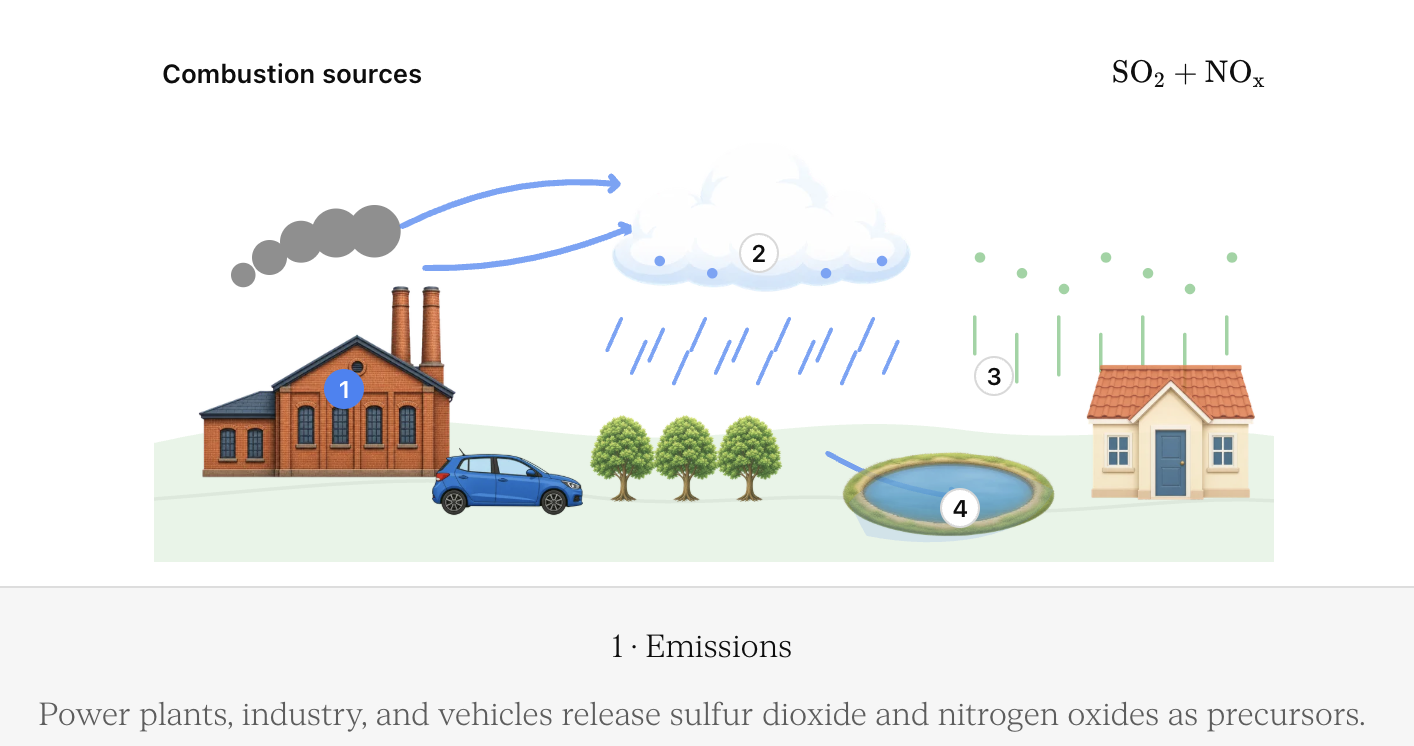
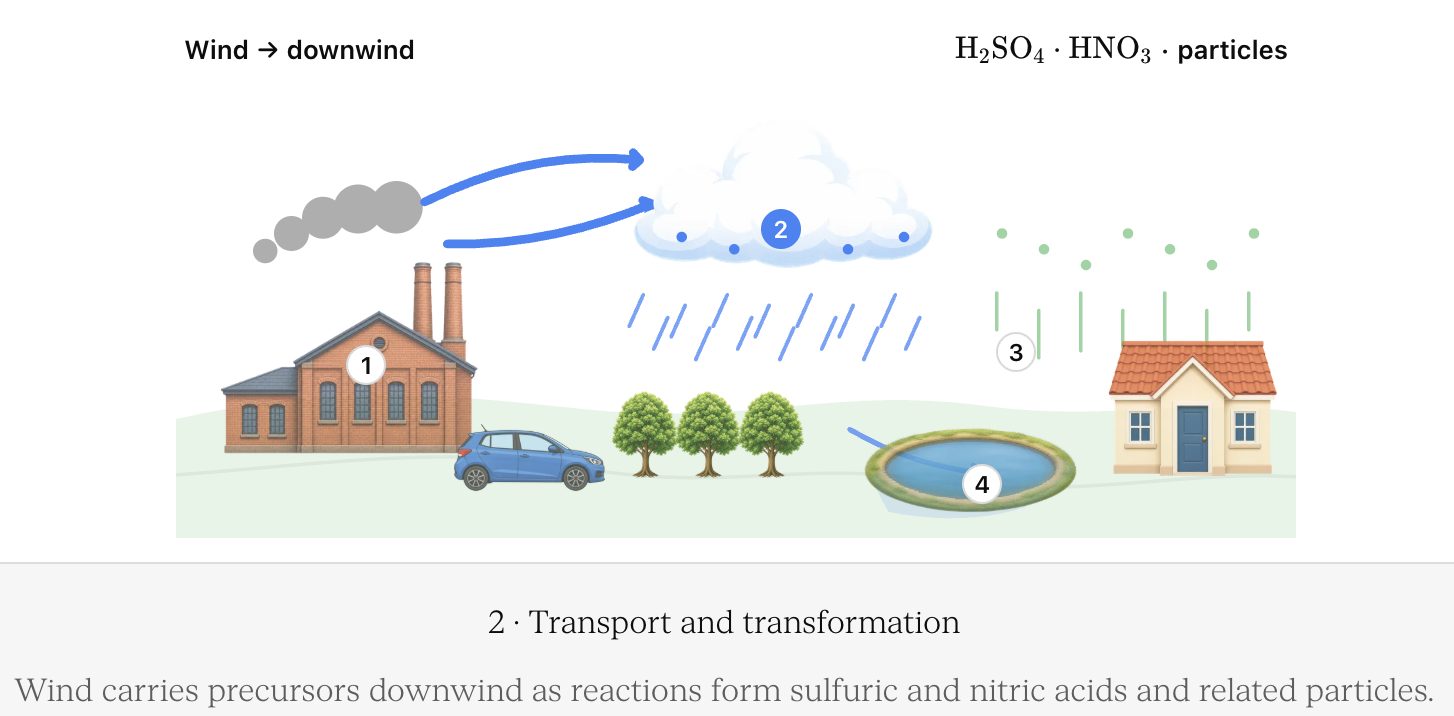
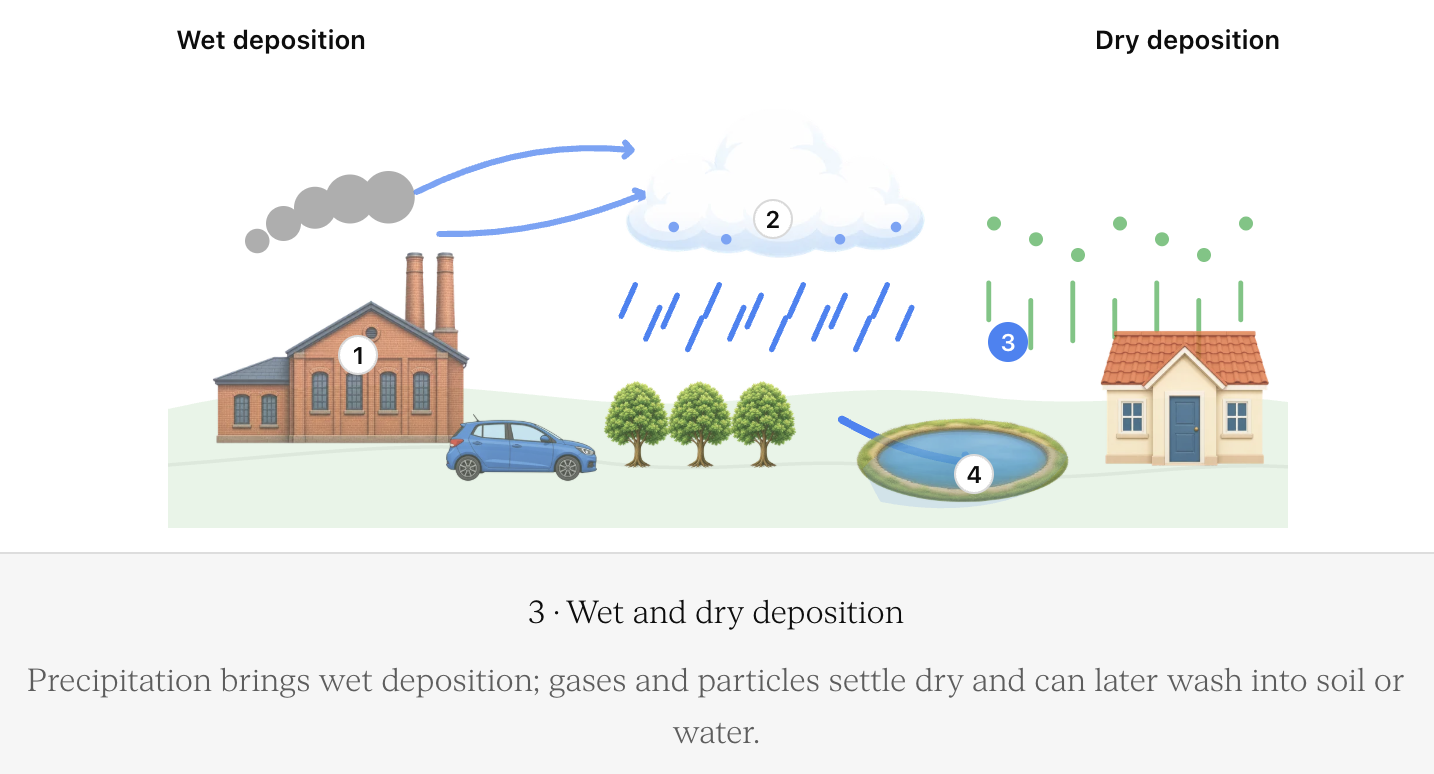
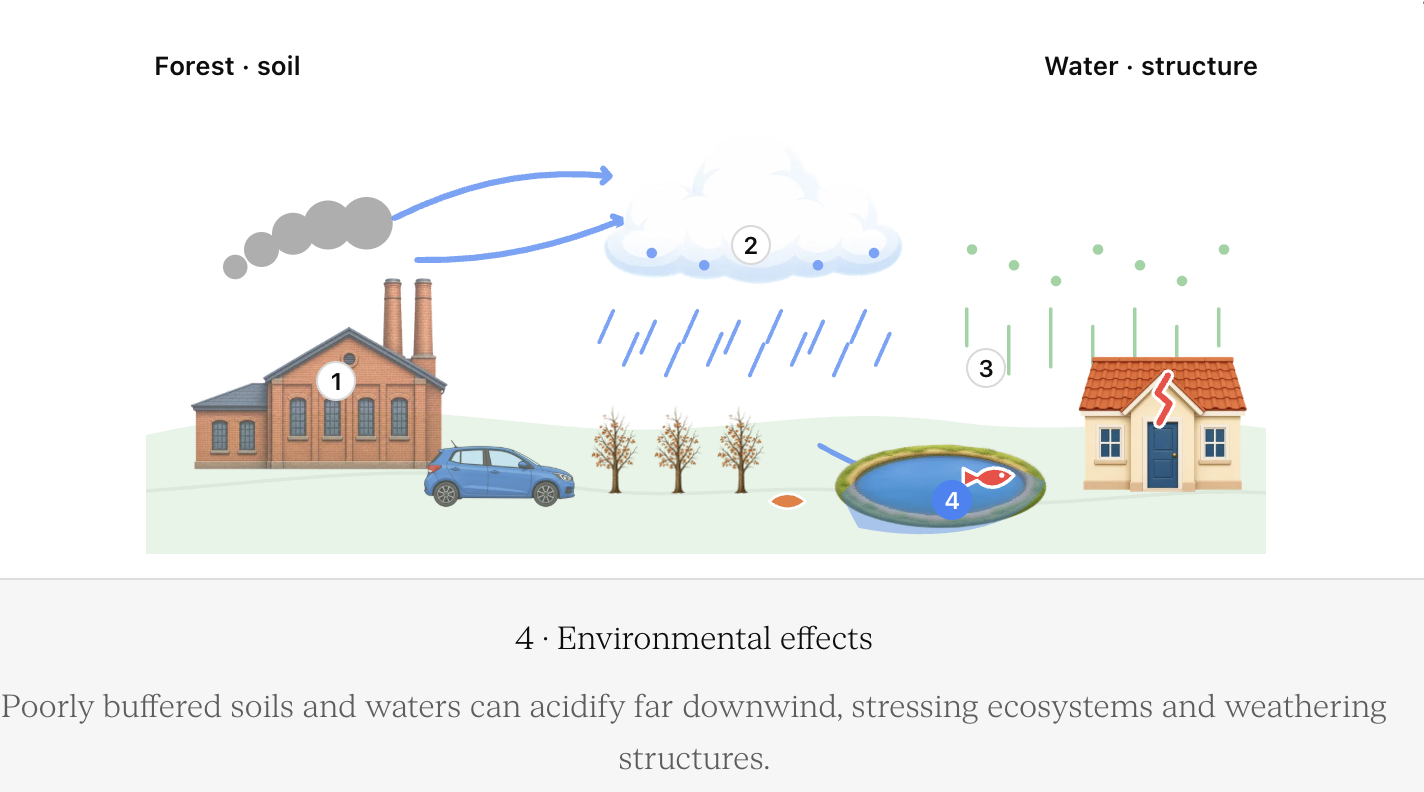
Acid Deposition
The term acid deposition is broader and more accurate than simply "acid rain."
Acidic substances can reach Earth's surface through:
Wet Deposition
Acidic material carried by:
- rain
- snow
- fog
- cloud water
Dry Deposition
Acidic gases and particles settle directly onto:
- plants
- soil
- water
- buildings
- other surfaces
Therefore:
acid rain is one form of acid deposition.
Acid Rain Can Travel Long Distances
Air pollutants do not necessarily remain near their source.
Wind can transport sulfur dioxide, nitrogen oxides, and their reaction products over long distances.
This means:
pollution produced in one region can contribute to environmental damage somewhere else.
Acid deposition can therefore become a regional or international environmental issue.
Effects on Lakes and Rivers
Acid deposition can lower the pH of freshwater ecosystems.
Many aquatic organisms survive only within particular pH ranges.
Increasing acidity can affect:
- fish
- amphibians
- aquatic insects
- plankton
- microorganisms
- aquatic plants
Different organisms have different levels of tolerance.


Effects on Fish
Increasing acidity can interfere with:
- egg development
- reproduction
- growth
- gill function
- ion balance
Young organisms may be especially sensitive.
As sensitive species disappear, food webs can also change.
Therefore, acidification can affect an entire ecosystem rather than only one species.
Aluminium and Acidified Water
Acidic conditions can increase the mobility of aluminium in some soils.
Aluminium can then move into streams and lakes.
Higher concentrations of dissolved aluminium can be harmful to aquatic organisms, particularly fish.
Therefore, acid deposition can damage freshwater systems in two related ways:
lower pH + increased metal mobility
Effects on Soil
Acid deposition can alter soil chemistry.
Possible effects include:
- lower soil pH
- leaching of important nutrients
- increased mobility of aluminium
- changes in microorganism communities
- changes in nutrient availability
Important nutrient ions such as calcium and magnesium may be washed deeper into the soil or lost from the system.
Nutrient Leaching
Leaching occurs when dissolved substances are carried through soil by water.
Acidic conditions can increase the loss of some nutrient ions.
This can reduce soil fertility.
Plants may then have greater difficulty obtaining the minerals required for healthy growth.
Effects on Forests
Acid deposition can place stress on trees and other vegetation.
Damage may occur through:
- altered soil chemistry
- nutrient loss
- aluminium toxicity
- damage to leaves or needles
- reduced root function
Acid deposition does not necessarily kill trees directly.
Instead, it may weaken them and make them more vulnerable to additional stresses such as:
- drought
- cold
- pests
- disease


Effects on Buildings and Monuments
Acid deposition can also damage human-made structures.
Materials containing calcium carbonate are particularly vulnerable.
Examples include:
- limestone
- marble
Calcium carbonate reacts with acids.
A simplified reaction is:
CaCO₃ + 2H⁺ → Ca²⁺ + H₂O + CO₂
Over long periods, this can contribute to surface erosion.
Damage to Cultural Heritage
Historic buildings, statues, and monuments may contain limestone or marble.
Repeated exposure to acidic conditions can:
- roughen surfaces
- remove fine details
- weaken material
- increase restoration costs
Acid deposition is therefore both an environmental and cultural problem.


Corrosion of Metals
Acidic conditions can also contribute to corrosion.
Structures that may be affected include:
- bridges
- vehicles
- roofs
- pipes
- outdoor equipment
Environmental chemistry therefore has economic consequences as well as ecological ones.
Reducing Sulfur Dioxide Emissions
One way to reduce acid deposition is to prevent sulfur dioxide from entering the atmosphere.
Strategies include:
- using fuels with lower sulfur content
- reducing coal combustion
- switching to cleaner energy sources
- removing sulfur from fuels
- treating exhaust gases
A particularly important industrial technique is flue-gas desulfurization.
Flue-Gas Desulfurization
Power stations and industrial facilities can treat exhaust gases before they enter the atmosphere.
Some systems use limestone or lime to react with sulfur dioxide.
For example, calcium carbonate can participate in reactions that remove sulfur compounds from the gas stream.
The important principle is:
acidic pollutant + alkaline material → less harmful products that can be collected
This is a large-scale environmental application of acid-base chemistry.
Scrubbers
Equipment used to remove pollutants from exhaust gases is often called a scrubber.
Scrubbers can bring polluted gases into contact with materials capable of removing specific pollutants.
For sulfur dioxide:
alkaline substances can help remove acidic sulfur compounds
This prevents some SO₂ from reaching the atmosphere.
Reducing Nitrogen Oxide Emissions
Nitrogen oxide emissions can also be reduced.
Strategies include:
- improving combustion technology
- reducing unnecessary fuel use
- using cleaner energy sources
- controlling industrial emissions
- using catalytic converters in vehicles
These approaches reduce the pollutants available to contribute to nitric acid formation.
Catalytic Converters
Vehicle exhaust can contain pollutants including:
- nitrogen oxides
- carbon monoxide
- unburned hydrocarbons
Catalytic converters encourage reactions that convert pollutants into less harmful substances.
For nitrogen oxides, the goal includes converting nitrogen-containing pollutants toward:
N₂
rather than releasing large quantities of NOₓ.
Catalytic converters therefore help reduce one important source of acid-deposition precursors.
Renewable Energy and Acid Deposition
Solar, wind, hydroelectric, and other low-combustion energy technologies can reduce dependence on fossil-fuel combustion.
Reducing combustion can decrease emissions of:
- sulfur dioxide
- nitrogen oxides
This addresses acid deposition at its source rather than treating pollution after it has already been produced.
Treating Acidified Lakes
In some situations, alkaline materials can be added to acidified lakes.
A common material is:
calcium carbonate, CaCO₃
This process is called liming.
The carbonate reacts with acidity and can increase water pH.
A simplified reaction is:
CaCO₃ + 2H⁺ → Ca²⁺ + H₂O + CO₂


Advantages of Liming Lakes
Liming can:
- raise pH
- reduce acidity
- improve conditions for aquatic organisms
- reduce some effects of toxic metals
However, it does not eliminate the original source of pollution.
If acid deposition continues, treatment may need to be repeated.
Treating Acidic Soil
Limestone can also be applied to acidic soils.
Agricultural lime commonly contains calcium carbonate.
The same general neutralization principle applies:
acidic soil + carbonate → reduced acidity
Benefits can include:
- increased soil pH
- improved nutrient availability
- reduced aluminium toxicity
- improved plant growth
Environmental Management with Bases
Bases and alkaline compounds are widely used to neutralize acidic environmental materials.
Examples include:
- treating acidic wastewater
- treating acidic mine drainage
- adjusting soil pH
- treating acidified lakes
- removing acidic gases from industrial emissions
Common materials may include:
- calcium carbonate
- calcium hydroxide
- sodium hydroxide
The appropriate substance depends on the application.
Acid Mine Drainage
Mining can expose sulfur-containing minerals to air and water.
Chemical reactions can produce acidic drainage.
This acidic water may dissolve metals from surrounding rock.
The resulting water can contain:
high acidity + dissolved metals
and can damage streams and aquatic ecosystems.
Treating Acid Mine Drainage
One treatment strategy is to add alkaline material.
For example:
limestone → neutralizes some acidity
As pH rises, some dissolved metals can also become less soluble and form solid precipitates.
These solids can then potentially be separated.
This combines two important chemical ideas:
neutralization + precipitation
Bases in Wastewater Treatment
Industrial wastewater may sometimes be too acidic.
A base can be added to increase its pH.
For example:
H⁺ + OH⁻ → H₂O
However, reaching an acceptable pH does not mean the water is automatically safe.
It may still contain:
- toxic metals
- organic pollutants
- nutrients
- suspended solids
- microorganisms
Environmental treatment usually involves several stages.
Acids in Environmental Management
Acids can also be useful.
For example, some industrial wastewater may be too alkaline.
Carefully controlled addition of acid can lower the pH.
Acids may also be used in:
- water-treatment processes
- equipment cleaning
- chemical regeneration systems
- controlling alkaline industrial waste
The objective is not always to make a system exactly pH 7.
The goal is to achieve conditions appropriate for the environment or treatment process.
Neutralization
Neutralization is one of the most important acid-base reactions in environmental management.
A simplified ionic equation is:
H⁺ + OH⁻ → H₂O
Neutralization can help control:
- wastewater pH
- soil acidity
- lake acidity
- industrial waste
- some mining pollution
However, the products of the reaction must also be considered.
Neutralization Does Not Make Pollution Disappear
This is an important environmental principle.
Suppose acidic wastewater contains dissolved heavy metals.
Adding a base may correct the pH.
But the metals do not simply vanish.
They may:
- remain dissolved
- precipitate as solids
- accumulate in treatment sludge
The resulting materials still require appropriate management.
Therefore:
neutralizing acidity ≠ removing every pollutant
Buffering Capacity of Natural Systems
Some ecosystems resist changes in pH better than others.
This ability is called buffering capacity.
Areas containing limestone often have relatively high buffering capacity because carbonate minerals can neutralize acids.
For example:
CaCO₃ + 2H⁺ → Ca²⁺ + H₂O + CO₂
Why Some Lakes Are More Vulnerable
Two lakes receiving similar acid deposition may respond very differently.
Lake A
Surrounded by carbonate-rich rocks.
Result:
high buffering capacity
Lake B
Surrounded by rocks that provide little neutralizing capacity.
Result:
low buffering capacity
Lake B may experience a much larger decrease in pH.
Therefore, environmental impact depends on both:
pollution exposure + ecosystem chemistry
Natural and Human Sources of Acidity
Not all environmental acidity is caused by humans.
Natural processes can also produce acidic substances.
Examples include:
- volcanic emissions
- decomposition
- natural soil processes
- lightning-related nitrogen chemistry
- naturally occurring organic acids
However, human activities can substantially increase emissions of sulfur dioxide and nitrogen oxides.
Monitoring Acid Deposition
Scientists monitor environmental conditions using measurements such as:
- precipitation pH
- sulfate concentration
- nitrate concentration
- lake pH
- soil pH
- metal concentrations
- species populations
Long-term monitoring is particularly important.
One measurement provides a snapshot.
Many measurements over time reveal:
trends
Biological Indicators
Scientists can also examine organisms.
Changes in populations of sensitive species may provide evidence of environmental stress.
Possible indicators include changes in:
- fish populations
- aquatic insects
- algae
- soil organisms
- forest health
Chemical measurements and biological evidence together provide a stronger understanding of ecosystem health.
Preventing Pollution Versus Treating Damage
Environmental solutions can be divided into two broad approaches.
Prevention
Stop or reduce pollution before it enters the environment.
Examples:
- reduce SO₂ emissions
- reduce NOₓ emissions
- use cleaner energy
- improve industrial processes
Treatment
Repair or reduce damage after pollution has occurred.
Examples:
- lime an acidified lake
- neutralize acidic wastewater
- treat mine drainage
Prevention is often preferable because it addresses the cause rather than repeatedly treating the symptoms.
Comparing Environmental Solutions
| Strategy | Main Purpose | Advantage | Limitation |
|---|---|---|---|
| Low-sulfur fuels | Reduce SO₂ formation | Prevents pollution | May require fuel changes |
| Flue-gas scrubbers | Remove SO₂ | Reduces industrial emissions | Equipment and treatment costs |
| Catalytic converters | Reduce vehicle pollutants | Reduces NOₓ emissions | Requires effective operation |
| Renewable energy | Reduce combustion emissions | Addresses pollution at source | Infrastructure required |
| Lake liming | Neutralize acidic water | Can improve ecosystem conditions | May require repeated treatment |
| Soil liming | Reduce soil acidity | Can improve soil conditions | Excessive application can cause problems |
| Wastewater neutralization | Control discharge pH | Protects receiving waters | Other pollutants may remain |
| Mine-water treatment | Reduce acidity and metals | Can protect streams | Treatment may be long-term |
Evaluating Chemical Solutions
A successful environmental treatment should not simply solve one problem while creating another.
Scientists must consider:
- effectiveness
- cost
- energy use
- waste generation
- environmental side effects
- long-term sustainability
- maintenance requirements
- impacts on organisms
- practicality at large scale
For example, limestone may neutralize acidic water effectively, but transporting and repeatedly applying large quantities also requires resources.
Worked Example: Acidified Lake
A lake has become increasingly acidic.
Measurements show:
pH 4.7
Fish populations are declining.
One short-term strategy could be:
add carefully calculated quantities of limestone
The limestone consumes H⁺:
CaCO₃ + 2H⁺ → Ca²⁺ + H₂O + CO₂
This could raise the pH.
However, a long-term solution should also reduce the emissions responsible for continuing acid deposition.
Worked Example: Factory Emissions
A power station burns sulfur-containing fuel.
Sulfur dioxide is produced.
Two possible approaches are:
Approach A
Install a scrubber to remove SO₂ from exhaust gases.
Approach B
Replace the fuel or energy technology with one producing much less SO₂.
Approach A:
treats the pollution before release
Approach B:
reduces formation of the pollutant
Both can be effective, but their costs and environmental impacts differ.
Worked Example: Acidic Wastewater
A factory produces wastewater with:
pH 3
Releasing it directly could damage aquatic organisms.
A suitable base can be added under controlled conditions.
As H⁺ is neutralized:
pH rises
However, the water must also be tested for other contaminants before discharge.
Worked Example: Choosing the Better Solution
Suppose an acidified lake requires limestone treatment every few years.
Option 1:
continue repeated liming
Option 2:
reduce the regional SO₂ and NOₓ emissions causing the acidification
Liming may provide relatively rapid local improvement.
Emission reduction addresses the underlying cause and can protect many ecosystems simultaneously.
A strong environmental strategy may use treatment in the short term while prioritizing pollution prevention for the long term.
Environmental Chemistry and Evidence
Environmental decisions should be based on evidence.
Scientists may ask:
- Has lake pH changed?
- Have SO₂ emissions decreased?
- Are fish populations recovering?
- Are soil nutrient concentrations improving?
- Is treatment producing harmful by-products?
- How much does the intervention cost?
- Will the solution remain effective over decades?
This means environmental chemistry involves more than performing reactions.
It involves:
measurement + chemistry + ecology + engineering + evaluation
Common Mistakes
Thinking Normal Rain Has a pH of Exactly 7
Normal rain is naturally slightly acidic because atmospheric CO₂ can form carbonic acid.
Thinking Acid Rain Is Caused Mainly by CO₂
Carbon dioxide contributes to the natural slight acidity of rain.
Acid deposition associated with pollution is mainly linked to:
SO₂ and NOₓ
Thinking Acid Rain Falls Only Near Factories
Pollutants can travel long distances through the atmosphere.
Thinking Acid Rain Only Affects Lakes
It can affect:
- lakes
- streams
- soils
- forests
- buildings
- monuments
Thinking Acid Rain Directly Burns Trees
Environmental effects are more complex.
Acid deposition can alter soil chemistry, remove nutrients, mobilize aluminium, and increase plant stress.
Thinking Liming Permanently Solves Acid Deposition
Liming treats acidity but does not remove the pollution source.
Thinking Neutralization Removes Every Pollutant
Neutralization adjusts acidity.
Other contaminants may still require treatment.
Thinking Every Ecosystem Responds the Same Way
Buffering capacity differs between soils, lakes, and geological regions.
Assuming Chemical Treatment Is Always the Best Solution
Chemical treatments can be useful, but preventing pollution at its source may provide greater long-term benefits.
Check Your Understanding
- What is acid rain?
- Why is normal rain naturally slightly acidic?
- Name the two major groups of pollutants associated with acid deposition.
- Give three important sources of sulfur dioxide.
- How are nitrogen oxides produced during combustion?
- Name two acids associated with acid deposition.
- Explain the difference between wet and dry deposition.
- Why can acid deposition affect regions far from pollution sources?
- Describe three effects of acidification on freshwater ecosystems.
- Why can aluminium become more harmful in acidified environments?
- Explain how acid deposition can reduce soil fertility.
- Describe two ways acid deposition can affect forests.
- Why are limestone and marble vulnerable to acid deposition?
- Write the simplified reaction between CaCO₃ and H⁺.
- What is flue-gas desulfurization?
- How can alkaline materials help remove sulfur dioxide from industrial emissions?
- How do catalytic converters help reduce acid-deposition precursors?
- Explain how renewable energy can help reduce acid deposition.
- What is lake liming?
- Why is calcium carbonate useful for treating acidified lakes?
- Explain one limitation of lake liming.
- What is acid mine drainage?
- How can bases help treat acidic mine drainage?
- Why doesn't neutralizing wastewater necessarily make it safe?
- What is buffering capacity?
- Why are some lakes more vulnerable to acidification than others?
- Explain the difference between pollution prevention and pollution treatment.
- Give two measurements scientists could use to monitor acid deposition.
- Compare one short-term and one long-term strategy for dealing with an acidified lake.
- Evaluate the statement: "The best solution to acid rain is simply to add bases to affected ecosystems."
Key Terms
Acid rain — Rain or other precipitation made more acidic mainly by atmospheric pollutants such as sulfur and nitrogen compounds.
Acid deposition — Transfer of acidic substances from the atmosphere to Earth's surface through wet or dry processes.
Wet deposition — Removal of acidic substances from the atmosphere through rain, snow, fog, or cloud water.
Dry deposition — Deposition of acidic gases and particles directly onto surfaces.
Sulfur dioxide (SO₂) — Air pollutant produced by sources including combustion of sulfur-containing fuels and some industrial processes.
Nitrogen oxides (NOₓ) — Group of nitrogen-oxygen compounds produced particularly during high-temperature combustion.
Sulfuric acid (H₂SO₄) — Strong acid that can form from sulfur-containing atmospheric pollutants.
Nitric acid (HNO₃) — Strong acid that can form from nitrogen oxide pollution.
Leaching — Movement of dissolved substances through soil by water.
Buffering capacity — Ability of a system to resist changes in pH.
Liming — Addition of alkaline materials such as calcium carbonate to reduce acidity.
Flue-gas desulfurization — Industrial treatment used to remove sulfur compounds, particularly SO₂, from exhaust gases.
Scrubber — Pollution-control equipment designed to remove substances from industrial exhaust gases.
Catalytic converter — Vehicle pollution-control device that converts several harmful exhaust pollutants into less harmful substances.
Acid mine drainage — Acidic, often metal-containing water produced when certain exposed minerals react with air and water.
Neutralization — Reaction in which an acid and a base reduce one another's acidic and alkaline properties.
Environmental monitoring — Systematic measurement of environmental conditions over time.
Pollution prevention — Reducing or eliminating pollutant production before environmental release.
Environmental remediation — Actions taken to reduce, remove, or manage existing environmental contamination.
Key Takeaways
- Acid-base chemistry has important applications in environmental protection and pollution control.
- Normal rain is naturally slightly acidic because CO₂ can form carbonic acid.
- Pollution-related acid deposition is mainly associated with sulfur dioxide and nitrogen oxides.
- SO₂ can originate from sulfur-containing fuel combustion and industrial processes.
- NOₓ is commonly produced during high-temperature combustion.
- Atmospheric reactions can produce sulfuric and nitric acids.
- Acidic substances reach Earth's surface through wet and dry deposition.
- Pollutants can travel long distances before being deposited.
- Acid deposition can lower the pH of lakes and streams.
- Acidification can harm fish, amphibians, microorganisms, and other aquatic organisms.
- Acidic conditions can increase aluminium mobility and toxicity.
- Acid deposition can remove important nutrients from soils through leaching.
- Forests can be weakened by altered soil chemistry, nutrient loss, and other stresses.
- Acid deposition can damage limestone, marble, metals, buildings, and monuments.
- SO₂ emissions can be reduced using low-sulfur fuels and flue-gas scrubbers.
- NOₓ emissions can be reduced using improved combustion systems and catalytic converters.
- Reducing fossil-fuel combustion can address acid deposition at its source.
- Calcium carbonate can neutralize acidity in lakes and soils.
- Liming can provide useful short-term environmental remediation.
- Acidic mine drainage can be treated using alkaline substances and precipitation methods.
- Neutralizing water does not automatically remove every pollutant.
- Natural ecosystems differ in their buffering capacity.
- Environmental monitoring is necessary to determine whether treatments are working.
- Pollution prevention generally provides a stronger long-term solution than repeatedly treating environmental damage.
- Chemical solutions must themselves be evaluated for cost, waste, energy use, side effects, and sustainability.
The central environmental strategy is:
identify the pollution source
↓
understand the chemistry
↓
reduce pollutant formation where possible
↓
control emissions
↓
treat existing damage when necessary
↓
monitor recovery
The most effective environmental chemistry therefore combines prevention, treatment, monitoring, and long-term management.
5. Everyday Products and Safety
Learning outcomes
- I can identify common products that contain acids, bases, or salts.
- I can explain safety precautions when handling chemicals.
- I can interpret hazard symbols and warning labels.
- I can describe safe storage and disposal practices.
- I can apply chemical safety knowledge to everyday situations.
Everyday Products and Chemical Safety
Acids, bases, and salts are not found only in chemistry laboratories. They are present in many products used every day for cleaning, cooking, personal care, gardening, vehicle maintenance, and household repairs.
Examples include:
- vinegar
- citrus juice
- baking soda
- toothpaste
- soap
- detergents
- drain cleaners
- bleach
- fertilizers
- antacids
- batteries
- swimming-pool chemicals
The presence of a chemical does not automatically make a product dangerous. Risk depends on the substance, its concentration, the amount involved, and how it is used.


Acids in Everyday Products
Many familiar products contain acids.
| Product | Acid | Common Purpose |
|---|---|---|
| Vinegar | Acetic acid | Cooking and cleaning |
| Citrus fruits | Citric acid | Food |
| Soft drinks | Carbonic acid and/or other food acids | Food and beverages |
| Some toilet cleaners | Hydrochloric or other acids | Removing mineral deposits |
| Car batteries | Sulfuric acid | Electrolyte |
| Some descaling products | Citric, sulfamic, or other acids | Removing mineral deposits |
The properties and hazards vary greatly.
For example, vinegar is a dilute acidic solution used in food, while battery acid is much more hazardous.
Bases in Everyday Products
Bases are also common.
| Product | Base or Alkaline Substance | Common Purpose |
|---|---|---|
| Baking soda | Sodium bicarbonate | Baking, cleaning |
| Some antacids | Magnesium hydroxide | Neutralizing stomach acid |
| Some antacids | Calcium carbonate | Neutralizing stomach acid |
| Soap | Alkaline compounds/products | Cleaning |
| Some drain cleaners | Sodium hydroxide | Breaking down blockages |
| Some oven cleaners | Sodium hydroxide | Removing grease |
| Some household cleaners | Ammonia solutions | Cleaning |
Strong bases can be highly corrosive.
Sodium hydroxide has the formula:
NaOH
It can cause serious chemical burns.
Salts in Everyday Products
A salt is an ionic compound formed from positive and negative ions.
Common examples include:
Sodium chloride, NaCl
Found in:
- table salt
- food products
- saline solutions
Sodium bicarbonate, NaHCO₃
Found in:
- baking soda
- some antacids
- cleaning products
Calcium carbonate, CaCO₃
Found in:
- some antacids
- chalk
- limestone
- some toothpaste products
Sodium fluoride, NaF
Used in some dental products.
Ammonium and potassium salts
Found in many fertilizers.
A Salt Is Not Necessarily Table Salt
In everyday language, "salt" usually means:
sodium chloride, NaCl
In chemistry, however, there are thousands of different salts.
Examples include:
- NaCl
- KNO₃
- CuSO₄
- CaCO₃
- NH₄Cl
These substances can have very different properties and hazards.
Therefore:
chemical salt ≠ automatically edible salt
Concentration Matters
The same chemical can have very different effects at different concentrations.
For example, acidic substances can range from relatively mild food products to highly corrosive industrial or household chemicals.
Similarly, a weakly alkaline solution and a concentrated strong base present very different hazards.
When evaluating safety, ask:
- What chemical is present?
- What is its concentration?
- How much is present?
- How could someone be exposed?
- How long could exposure last?
Hazard and Risk
Hazard and risk have different meanings.
A hazard is something with the potential to cause harm.
Risk considers the likelihood and severity of that harm under particular conditions.
For example, a corrosive cleaner has an inherent chemical hazard.
If it is:
- correctly labelled
- stored securely
- used according to instructions
- handled with suitable protection
the risk can be reduced.
The hazard still exists.
Chemical Labels
Chemical labels provide important safety information.
Depending on the product and regulatory system, a label may identify:
- product name
- ingredients
- hazard pictograms
- signal words
- hazard statements
- precautionary statements
- first-aid information
- storage instructions
- disposal instructions
Always read the label before using an unfamiliar chemical product.


Hazard Pictograms
Many chemical products use standardized GHS hazard pictograms.
GHS stands for the Globally Harmonized System of Classification and Labelling of Chemicals.
The pictograms provide rapid visual information about important hazards.
Corrosive
The corrosion pictogram shows liquid damaging a hand and a metal surface.
It can indicate hazards such as:
- severe skin burns
- serious eye damage
- corrosion of metals
Strong acids and strong bases may be corrosive.
Examples can include concentrated:
- hydrochloric acid
- sulfuric acid
- sodium hydroxide
If a product is corrosive, avoid direct skin and eye contact and follow its safety instructions carefully.
Flammable
The flame symbol indicates a fire hazard.
Flammable substances can ignite relatively easily under specified conditions.
Examples may include products containing:
- ethanol
- solvents
- fuels
Safety precautions include keeping them away from:
- flames
- sparks
- hot surfaces
- other ignition sources
Acute Toxicity
The skull-and-crossbones pictogram indicates serious acute toxicity.
Exposure to relatively small amounts of certain substances may cause severe poisoning.
Possible exposure routes include:
- swallowing
- inhalation
- skin contact
Such substances require strict handling and storage precautions.
Irritant or Harmful
The exclamation-mark pictogram can indicate several hazards, depending on classification.
These may include:
- skin irritation
- eye irritation
- harmful effects
- respiratory irritation
It should not be interpreted as meaning "only slightly dangerous."
The accompanying label information explains the specific hazard.
Serious Health Hazard
The health-hazard pictogram shows a human silhouette with a star-like shape on the chest.
It can indicate serious or long-term health hazards, depending on the substance.
Examples of hazard classes associated with this pictogram can include:
- carcinogenicity
- respiratory sensitization
- reproductive toxicity
- specific target-organ toxicity
- aspiration hazard
The exact hazard must be determined from the label.
Oxidizing
The flame-over-circle symbol indicates an oxidizing substance.
Oxidizers can cause or intensify fires by supporting combustion.
They should be kept away from incompatible combustible materials.
Explosive
The exploding-bomb pictogram indicates certain explosive or highly reactive hazards.
Such materials require specialized handling and storage.
Gas Under Pressure
The gas-cylinder pictogram indicates gas stored under pressure.
Hazards may include:
- cylinder rupture if heated
- rapid gas release
- cold burns from refrigerated gases
Gas cylinders must be handled and stored appropriately.
Environmental Hazard
The environmental pictogram shows a dead tree and fish.
It indicates substances that can be hazardous to aquatic environments.
Such chemicals should not simply be poured into:
- drains
- rivers
- lakes
- soil
Disposal instructions should be followed.
Signal Words
Chemical labels may include signal words such as:
DANGER
or:
WARNING
These help indicate the severity of the hazard.
Generally:
DANGER is used for more severe hazard categories.
WARNING is used for less severe categories where specified.
The signal word should always be considered together with the pictograms and hazard statements.
Hazard Statements
A hazard statement describes the type of hazard.
Examples of the kinds of information they communicate include:
- causes serious eye damage
- causes skin irritation
- harmful if swallowed
- highly flammable liquid and vapour
- toxic to aquatic life
Do not rely on the pictogram alone.
Read the accompanying text.
Precautionary Statements
Precautionary statements explain actions that can reduce risk.
They may tell users to:
- wear eye protection
- wear protective gloves
- avoid breathing vapours
- keep away from heat
- wash hands after handling
- store in a well-ventilated area
- keep out of reach of children
- dispose of contents appropriately
These instructions are part of the product's safety information.
Personal Protective Equipment
Personal protective equipment (PPE) provides a barrier between a person and a hazard.
Depending on the chemical and task, PPE can include:
- safety goggles
- suitable gloves
- laboratory coat
- protective clothing
- face protection
The correct PPE depends on the chemical and the type of exposure that could occur.


Eye Protection
Eyes are particularly vulnerable to chemical splashes.
Safety goggles should be used when there is a significant risk of chemicals splashing into the eyes.
Ordinary prescription glasses generally do not provide the same protection as proper chemical splash goggles.
Gloves
Gloves can reduce skin exposure, but not every glove protects against every chemical.
Suitable gloves should be selected for the substances being handled.
Contaminated gloves should also not be used to touch:
- phones
- door handles
- faces
- notebooks
because this can spread contamination.
Ventilation
Some products release:
- vapours
- gases
- aerosols
These can create inhalation hazards.
Chemical products should be used with the ventilation specified by the manufacturer.
Some laboratory operations require a fume hood.
Never intentionally smell an unknown chemical directly.
Never Taste Laboratory Chemicals
Laboratory chemicals should never be tasted.
Even if a substance has the same name as a food ingredient, a laboratory chemical may:
- have different purity standards
- contain contaminants
- have a different concentration
- not be intended for consumption
A label saying sodium chloride does not mean the substance should be eaten.
Never Mix Household Cleaners Randomly
This is one of the most important household chemical safety rules.
Do not mix cleaning products unless the manufacturer specifically says the combination is safe.
Different cleaners may contain reactive substances.
Mixing them can produce:
- heat
- corrosive mixtures
- hazardous gases
Bleach and Acids
Household bleach commonly contains sodium hypochlorite.
Mixing hypochlorite bleach with acidic cleaners can release chlorine gas.
Chlorine gas is toxic and can seriously damage the respiratory system.
Therefore:
never mix bleach with acidic cleaners.
Bleach and Ammonia
Bleach should also not be mixed with ammonia-containing cleaners.
The reaction can produce hazardous chloramine-containing gases and other harmful products.
Therefore:
never mix bleach with ammonia-based cleaners.
More Cleaner Is Not Necessarily Better
Using more chemical than recommended can:
- increase exposure
- damage surfaces
- produce stronger fumes
- create more waste
- increase environmental contamination
Follow the manufacturer's instructions for:
- quantity
- dilution
- contact time
- ventilation
Diluting Chemicals
Some concentrated products must be diluted before use.
Follow the product instructions exactly.
In laboratory situations involving concentrated acids, an important general principle is:
add acid carefully to water rather than adding water to concentrated acid.
Mixing concentrated acid and water can release significant heat.
Improper mixing can cause boiling or splashing.
Safe Chemical Storage
Chemicals should be stored:
- in appropriate containers
- with labels intact
- according to manufacturer instructions
- away from incompatible substances
- away from excessive heat when required
- securely where children or unauthorized users cannot access them
Never assume that two chemicals can be safely stored together simply because both are household products.
Keep Chemicals in Their Original Containers
Whenever practical, household chemicals should remain in their original containers.
The original container provides:
- product identification
- hazard information
- instructions
- first-aid information
- appropriate packaging
Transferring chemicals into unlabelled containers creates unnecessary risk.
Never Store Chemicals in Food Containers
A dangerous practice is putting chemicals into:
- drinking bottles
- cups
- food jars
- beverage containers
Someone may mistake the chemical for food or drink.
Therefore:
never store chemicals in containers that could be mistaken for food or beverages.
Labels Must Remain Readable
If a chemical container loses its label, important information is lost.
A user may no longer know:
- what the substance is
- its concentration
- its hazards
- appropriate PPE
- correct disposal method
Chemical identification is an essential part of safe storage.
Incompatible Chemicals
Some chemicals react dangerously when stored or mixed together.
Examples of incompatibility can include:
- acids and certain bases
- oxidizers and combustible materials
- bleach and acids
- bleach and ammonia-containing products
Professional chemical storage systems separate incompatible substances.
Safe Disposal
Chemical disposal depends on:
- chemical identity
- concentration
- quantity
- local regulations
Some materials can enter ordinary waste streams under specified conditions.
Others require:
- hazardous-waste collection
- recycling
- specialist disposal
- treatment
Never assume a chemical is safe to pour down a drain.
Follow the product label and local disposal requirements.
Batteries
Batteries contain chemicals that allow chemical energy to be converted into electrical energy.
Different battery types contain different materials.
Some may contain:
- corrosive electrolytes
- reactive chemicals
- metals that should be recovered
Used batteries may require dedicated collection or recycling.


Medicines
Medicines are also chemical products.
They should be:
- used according to instructions
- stored securely
- kept in appropriate packaging
- kept away from young children
- disposed of according to local guidance
Unused medicines should not automatically be poured into drains or flushed away.
Garden Chemicals
Gardening products can include:
- fertilizers
- pesticides
- herbicides
- fungicides
- soil treatments
These products may contain chemicals that can affect:
- humans
- pets
- beneficial organisms
- soil
- waterways
Correct quantities and disposal procedures are important.
Chemical Spills
The correct response to a spill depends on the substance.
General principles include:
- keep people away from the spill
- identify the substance if this can be done safely
- read the label or safety instructions
- notify the responsible adult or supervisor
- use appropriate spill procedures
- avoid touching unknown substances
In a school laboratory:
report spills to the teacher immediately.
Do not attempt to clean an unfamiliar chemical spill without appropriate instructions.
Chemical Exposure
If a chemical contacts the body, appropriate first aid depends on the chemical.
The product label or safety information should be followed.
For many laboratory chemical splashes on skin or eyes, immediate flushing with plenty of water is an important first response, followed by appropriate assistance.
Serious exposures require professional medical guidance.
Safety Data Sheets
Workplaces and laboratories often use Safety Data Sheets (SDS).
An SDS provides detailed information about a chemical, including:
- identification
- hazards
- composition
- first-aid measures
- firefighting measures
- spill procedures
- handling
- storage
- exposure controls
- physical properties
- stability and reactivity
- disposal considerations
An SDS provides more detailed information than the container label alone.
Everyday Situation: Cleaning a Bathroom
Suppose someone has:
- bleach
- toilet cleaner
- glass cleaner
It would be unsafe to simply combine them to make a "stronger cleaner."
Instead:
- Read each label.
- Use products only as directed.
- Keep different cleaners separate.
- Provide appropriate ventilation.
- Use recommended PPE.
- Store products securely afterward.
The safest chemical reaction is often the one you prevent from happening.
Everyday Situation: An Unlabelled Bottle
You find a bottle of clear liquid in a storage cupboard.
You do not know what it contains.
It would be unsafe to:
- smell it closely
- taste it
- touch it
- mix it with another substance
The correct approach is to treat an unidentified chemical as potentially hazardous and have it handled according to appropriate procedures.
Appearance alone cannot identify a chemical.
Everyday Situation: Drain Cleaner
A blocked drain is treated with a sodium-hydroxide-based cleaner.
Because NaOH is strongly alkaline and potentially corrosive:
- follow the product instructions
- avoid skin and eye contact
- use required protection
- do not mix it with another drain cleaner
- store it securely after use
Its usefulness does not remove its hazard.
Everyday Situation: Vinegar and Baking Soda
Vinegar contains acetic acid.
Baking soda contains sodium bicarbonate.
They react and produce carbon dioxide gas.
A simplified equation is:
CH₃COOH + NaHCO₃ → CH₃COONa + H₂O + CO₂
The bubbling comes from:
CO₂
Although this familiar reaction is relatively low-risk under ordinary small-scale conditions, gas-producing reactions should never be sealed in a rigid container because pressure can build.
Everyday Situation: Battery Leakage
A leaking battery should not simply be handled with bare hands.
The battery type and manufacturer's guidance should be considered because different batteries contain different chemicals.
Damaged batteries should be:
- kept away from children
- handled according to appropriate guidance
- disposed of through suitable battery collection systems where available
Evaluating Chemical Risk
A useful approach is:
Identify the hazard → consider the exposure → reduce the risk
For example:
Hazard
Corrosive drain cleaner.
Possible Exposure
Splashing into eyes.
Risk Reduction
- follow instructions
- use appropriate eye protection
- pour carefully
- keep the container stable
- keep other people away
This approach can be applied to many chemical situations.
A Simple Safety Checklist
Before using a chemical product, ask:
- What is it?
- What hazards does the label identify?
- What protection is required?
- Could it react with another product?
- How should it be used?
- How should it be stored?
- How should it be disposed of?
- What should I do if exposure occurs?
If you cannot answer these questions, obtain the necessary safety information before using the product.
Common Mistakes
Thinking "Household" Means Safe
Household products can still be:
- corrosive
- flammable
- toxic
- irritating
- environmentally hazardous
Thinking Natural Products Are Automatically Safe
Whether something is natural or synthetic does not determine its safety.
Risk depends on its chemical properties, concentration, dose, and exposure.
Thinking All Acids Are Extremely Dangerous
Some dilute acids occur naturally in foods.
Other acids are highly corrosive.
The chemical and concentration matter.
Thinking All Bases Are Mild
Strong bases such as sodium hydroxide can cause severe chemical burns.
Assuming a Salt Is Safe Because Table Salt Is Safe
Different salts have very different chemical and biological properties.
Mixing Cleaners to Make Them Stronger
This can produce dangerous reactions.
Never mix cleaning products unless specifically instructed to do so.
Ignoring the Label Because You Have Used the Product Before
Formulations and instructions can differ between products.
Read the label.
Removing Chemicals from Their Original Containers
This can eliminate essential identification and safety information.
Assuming Clear Liquids Are Harmless
Many dangerous chemicals are colourless liquids.
Appearance is not a reliable measure of safety.
Pouring Leftover Chemicals Down the Drain
Some chemicals can:
- damage plumbing
- interfere with wastewater treatment
- contaminate waterways
- react with other substances
Use appropriate disposal procedures.
Check Your Understanding
- Give three examples of everyday products containing acids.
- Give three examples containing bases or alkaline substances.
- Give three examples of salts used in everyday products.
- Explain why a chemical salt is not necessarily safe to eat.
- Why does concentration affect chemical safety?
- Explain the difference between hazard and risk.
- What information might appear on a chemical label?
- What does the corrosive pictogram indicate?
- What does the flame pictogram indicate?
- What does the skull-and-crossbones pictogram indicate?
- What does the environmental-hazard pictogram indicate?
- Explain the difference between the signal words Danger and Warning.
- What is PPE?
- Give four examples of PPE.
- Why is eye protection particularly important when handling corrosive liquids?
- Why should laboratory chemicals never be tasted?
- Why should household cleaning products not be mixed randomly?
- Why is mixing bleach with acidic cleaners dangerous?
- Why should bleach not be mixed with ammonia-containing cleaners?
- Why should chemicals generally remain in their original containers?
- Why should chemicals never be stored in drink bottles?
- What are incompatible chemicals?
- Why should you not automatically pour leftover chemicals down a drain?
- What is an SDS?
- What information can an SDS provide?
- What should a student do after discovering a chemical spill in a laboratory?
- Why is an unlabelled bottle of clear liquid potentially dangerous?
- Explain why vinegar and baking soda produce bubbles when mixed.
- Why should a gas-producing reaction not be performed in a sealed rigid container?
- Use the hazard → exposure → risk reduction approach to explain how you would safely use a corrosive household cleaner.
Key Terms
Acid — Substance that increases H⁺ concentration in aqueous solution according to the introductory acid model.
Base — Substance capable of accepting H⁺ or producing OH⁻ in aqueous conditions, depending on the acid-base model being used.
Salt — Ionic compound consisting of positive and negative ions.
Hazard — Property or situation with the potential to cause harm.
Risk — Likelihood and severity of harm occurring under particular conditions.
Concentration — Amount of a substance present in a given quantity of solution or mixture.
Corrosive — Capable of causing serious damage to materials or biological tissue through chemical action.
Flammable — Capable of catching fire relatively easily under specified conditions.
Toxic — Capable of causing harmful biological effects through chemical exposure.
Irritant — Substance capable of causing inflammation or irritation following exposure.
Oxidizer — Substance that can cause or intensify combustion.
GHS — Globally Harmonized System of Classification and Labelling of Chemicals.
Hazard pictogram — Standardized symbol used to communicate a particular type of chemical hazard.
Signal word — Word such as Danger or Warning used on chemical labels to indicate hazard severity.
Hazard statement — Standardized statement describing the nature and sometimes severity of a chemical hazard.
Precautionary statement — Safety instruction describing measures for reducing chemical risk.
PPE — Personal protective equipment used to reduce exposure to hazards.
SDS — Safety Data Sheet containing detailed safety information about a chemical.
Chemical incompatibility — Situation in which substances can react dangerously if mixed or stored together.
Safe disposal — Management of unwanted chemicals in a way that reduces risks to people and the environment.
Key Takeaways
- Acids, bases, and salts are present in many everyday products.
- Familiar products can still contain hazardous chemicals.
- The safety of a substance depends partly on its identity, concentration, amount, and route of exposure.
- Hazard and risk are related but are not the same thing.
- A hazard has the potential to cause harm; risk considers the likelihood and severity of that harm.
- Chemical labels provide essential information about hazards, precautions, storage, and disposal.
- GHS pictograms provide standardized visual warnings.
- Important pictograms include corrosive, flammable, toxic, oxidizing, compressed gas, health hazard, irritant, explosive, and environmental hazard.
- PPE may include goggles, gloves, laboratory coats, and other protective equipment.
- Chemicals should normally remain in properly labelled containers.
- Household chemicals should never be stored in food or beverage containers.
- Unknown chemicals should not be touched, tasted, smelled closely, or mixed.
- Cleaning products should never be mixed unless the manufacturer specifically states that doing so is safe.
- Bleach should not be mixed with acidic cleaners.
- Bleach should not be mixed with ammonia-containing cleaners.
- Chemical products should be used only in the recommended quantities and concentrations.
- Appropriate ventilation is important when products release vapours or gases.
- Chemical storage must consider incompatible substances.
- Disposal requirements depend on the chemical and local regulations.
- Batteries, medicines, garden chemicals, and some cleaners may require special disposal or recycling.
- Safety Data Sheets provide detailed information about chemical hazards and safe handling.
- In a school laboratory, spills and accidents should be reported immediately.
- Neutralizing or diluting a chemical does not automatically make every resulting material safe.
- Chemical safety involves understanding the chemistry before an accident occurs.
A useful rule for everyday chemical safety is:
identify → read → protect → use correctly → store safely → dispose responsibly
And one of the most important rules is simple:
If you do not know what a chemical is or whether two products can be safely combined, do not mix them.