Salts and Salt Preparation
4. Preparing Insoluble Salts
Learning outcomes
- I can describe precipitation reactions.
- I can explain how insoluble salts are prepared.
- I can identify evidence of precipitate formation.
- I can separate precipitates using filtration.
- I can explain why some salts are insoluble.
Preparing Insoluble Salts
An insoluble salt is a salt that does not dissolve, or dissolves only to a very small extent, in water.
Unlike soluble salts, insoluble salts cannot usually be prepared by making a solution and then crystallizing it. Instead, they are commonly prepared using a precipitation reaction.
A precipitation reaction occurs when:
two soluble ionic solutions are mixed → an insoluble solid forms
The insoluble solid is called a precipitate.
For example:
silver nitrate + sodium chloride → silver chloride + sodium nitrate
AgNO₃(aq) + NaCl(aq) → AgCl(s) + NaNO₃(aq)
Silver chloride is insoluble, so it appears as a solid precipitate.


What Is a Precipitate?
A precipitate is an insoluble solid that forms when substances dissolved in solution react.
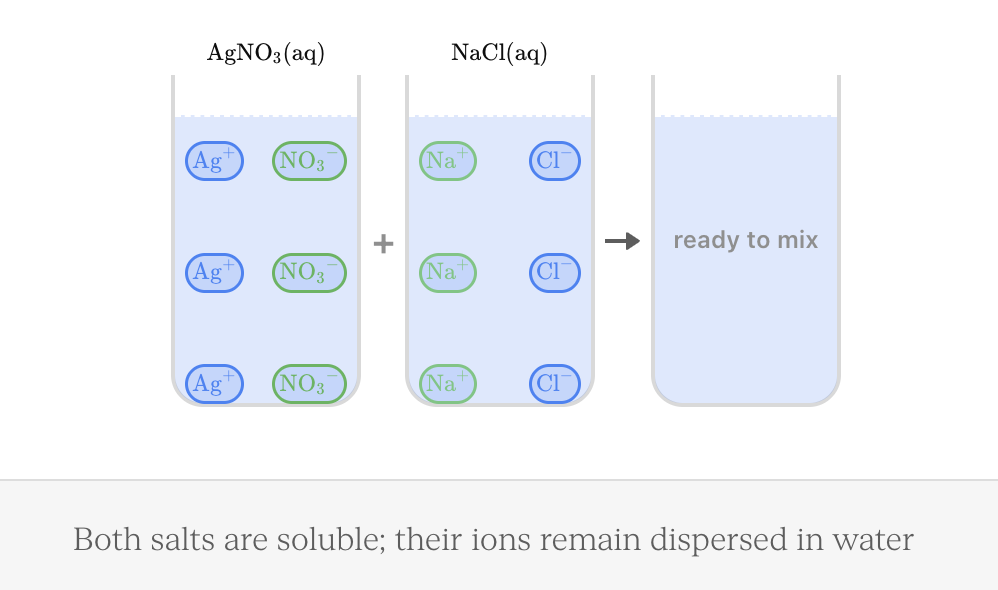
Before the reaction, the ions are dissolved and distributed throughout the solutions.
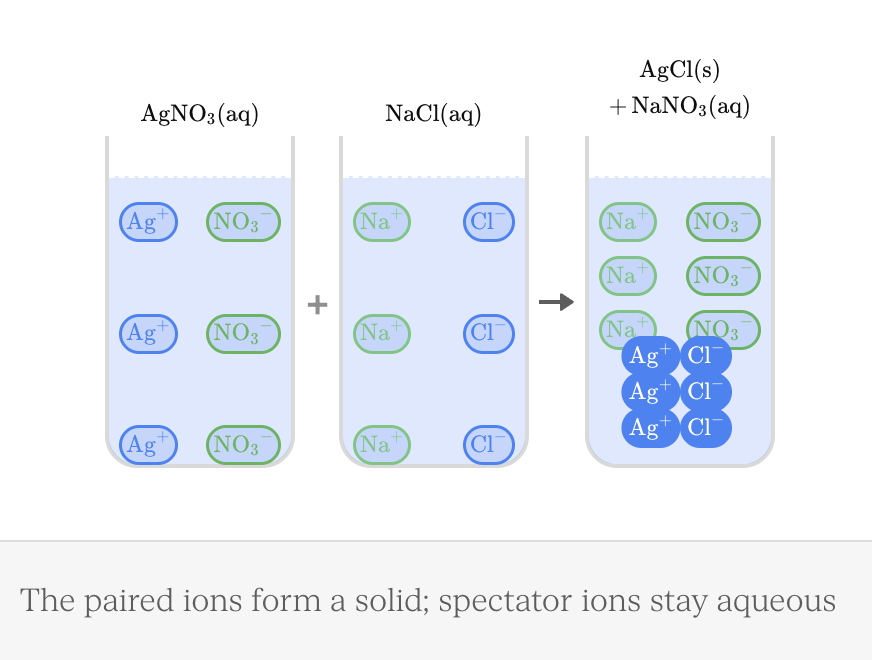
When the solutions are mixed, some ions combine to form a compound that is not sufficiently soluble in water.
The compound separates from the solution as a solid.
For example:
Ag⁺(aq) + Cl⁻(aq) → AgCl(s)
The symbol:
(aq) means dissolved in water.
The symbol:
(s) means solid.
Therefore:
AgCl(s) is the precipitate.
Here you can explore what happens to the ions when the two solutions are mixed:
Evidence of Precipitate Formation
A precipitation reaction usually produces an obvious change.
Evidence may include:
- the mixture becomes cloudy
- a solid suddenly appears
- particles become suspended in the liquid
- the solid settles to the bottom
- a colour change occurs because the precipitate has a characteristic colour
For example, mixing two clear, colourless solutions may produce a cloudy white solid.
That is strong evidence that a new insoluble substance has formed.
Aqueous Solutions
The reactants used in precipitation reactions are normally aqueous solutions.
Aqueous means:
dissolved in water
For example:
AgNO₃(aq)
means silver nitrate dissolved in water.
In the solution, the silver nitrate exists mainly as separated ions:
Ag⁺(aq) and NO₃⁻(aq)
Similarly:
NaCl(aq)
contains:
Na⁺(aq) and Cl⁻(aq)
What Happens When the Solutions Mix?
When silver nitrate solution and sodium chloride solution are mixed, all four ions are initially present:
- Ag⁺
- NO₃⁻
- Na⁺
- Cl⁻
The Ag⁺ and Cl⁻ ions combine.
Because silver chloride is insoluble:
Ag⁺(aq) + Cl⁻(aq) → AgCl(s)
The Na⁺ and NO₃⁻ ions remain dissolved.
Spectator Ions
Ions that remain dissolved without taking part in the main chemical change are called spectator ions.
For:
AgNO₃ + NaCl → AgCl + NaNO₃
the spectator ions are:
Na⁺
and:
NO₃⁻
The ions actually forming the precipitate are:
Ag⁺
and:
Cl⁻
Complete Ionic Equation
The reaction can be represented in several ways.
Word Equation
silver nitrate + sodium chloride → silver chloride + sodium nitrate
Chemical Equation
AgNO₃(aq) + NaCl(aq) → AgCl(s) + NaNO₃(aq)
Complete Ionic Equation
Ag⁺(aq) + NO₃⁻(aq) + Na⁺(aq) + Cl⁻(aq) → AgCl(s) + Na⁺(aq) + NO₃⁻(aq)
Notice that Na⁺ and NO₃⁻ appear unchanged on both sides.
Net Ionic Equation
The spectator ions can be removed from the equation.
This leaves:
Ag⁺(aq) + Cl⁻(aq) → AgCl(s)
This is the net ionic equation.
It shows the essential chemical change occurring during the precipitation reaction.
Preparing an Insoluble Salt
The basic laboratory procedure is:
prepare two soluble solutions
↓
mix the solutions
↓
form the precipitate
↓
filter
↓
wash the precipitate
↓
dry the precipitate
Unlike the preparation of soluble salts, crystallization is not required.
The salt has already formed as a solid.
Choosing the Reactants
To prepare an insoluble salt, chemists need two soluble compounds that supply the required ions.
Suppose we want:
silver chloride, AgCl
We need:
Ag⁺ ions
and:
Cl⁻ ions
A soluble source of Ag⁺ is:
silver nitrate, AgNO₃
A soluble source of Cl⁻ is:
sodium chloride, NaCl
Therefore:
AgNO₃(aq) + NaCl(aq) → AgCl(s) + NaNO₃(aq)
Why Use Soluble Reactants?
The ions must be able to move freely and mix.
When an ionic substance dissolves:
ionic solid → separated aqueous ions
These mobile ions can then encounter ions from the other solution.
If the required combination is insoluble, the ions join together and leave the solution as a solid.
Step 1: Prepare the Solutions
Prepare solutions containing the required ions.
For example:
- silver nitrate solution
- sodium chloride solution
The solutions should contain dissolved ions capable of forming the desired insoluble salt.
Step 2: Mix the Solutions
Add one solution to the other.
The ions mix.
In the silver chloride example:
Ag⁺ encounters Cl⁻
and forms:
AgCl(s)
The mixture becomes cloudy as the precipitate forms.
Step 3: Allow the Precipitate to Form
Stir the mixture gently.
This helps the ions mix thoroughly and allows the precipitation reaction to occur throughout the solution.
The solid may begin settling toward the bottom of the container.
Step 4: Filter the Mixture
The mixture now contains:
- insoluble precipitate
- water
- soluble spectator ions
Filtration separates the insoluble salt from the liquid.
The mixture is poured through filter paper in a filter funnel.
This time:
the residue is the product we want
The precipitate remains on the filter paper.
The dissolved spectator ions pass through with the filtrate.


An Important Difference
When preparing a soluble salt from an excess insoluble base, the filtrate contains the product.
When preparing an insoluble salt by precipitation, the residue contains the product.
Compare:
| Method | Desired Product |
|---|---|
| Preparing soluble salt | Filtrate |
| Preparing insoluble salt | Residue |
This is a very important practical distinction.
Residue
The residue is the solid left on the filter paper.
During precipitation:
residue = insoluble salt
For example:
residue = AgCl
This is the product we want to collect.
Filtrate
The filtrate is the liquid passing through the filter paper.
It contains:
- water
- soluble ions
- other dissolved substances
In the silver chloride reaction, the filtrate contains mainly dissolved sodium and nitrate ions.
Step 5: Wash the Precipitate
The precipitate should be washed with a small amount of distilled or deionized water.
Why?
Some soluble substances may remain trapped around the solid.
Washing removes:
- spectator ions
- soluble impurities
- remaining solution
The insoluble precipitate remains on the filter paper.
Why Use Distilled or Deionized Water?
Tap water contains dissolved ions.
These ions could contaminate the product or potentially react with it.
Distilled or deionized water contains far fewer dissolved ions and is therefore more suitable for washing a chemical product.
Step 6: Dry the Precipitate
After washing, the precipitate contains water.
The solid must be dried.
Depending on the substance and laboratory procedure, it may be:
- left to air dry
- gently dried in a suitable warm location
- dried between filter papers
- placed in appropriate drying equipment
The final product is the dry insoluble salt.
Complete Silver Chloride Preparation
To prepare silver chloride:
Mix
Silver nitrate solution with sodium chloride solution.
AgNO₃(aq) + NaCl(aq) → AgCl(s) + NaNO₃(aq)
Observe
A white precipitate forms.
Filter
The AgCl remains on the filter paper.
Wash
Wash the residue with distilled or deionized water.
Dry
Dry the solid.
Final product:
silver chloride
Another Example: Barium Sulfate
Barium sulfate is another insoluble salt.
To prepare it, soluble compounds supplying:
Ba²⁺
and:
SO₄²⁻
can be mixed.
For example:
barium nitrate + sodium sulfate → barium sulfate + sodium nitrate
Equation:
Ba(NO₃)₂(aq) + Na₂SO₄(aq) → BaSO₄(s) + 2NaNO₃(aq)
The barium sulfate forms as a precipitate.


Ionic Equation for Barium Sulfate
The ions forming the precipitate are:
Ba²⁺
and:
SO₄²⁻
Therefore:
Ba²⁺(aq) + SO₄²⁻(aq) → BaSO₄(s)
The sodium and nitrate ions remain in solution.
They are spectator ions.
Lead Iodide
Some precipitates have distinctive colours.
Lead iodide is a well-known example of a yellow precipitate.
A precipitation reaction can be represented as:
Pb(NO₃)₂(aq) + 2KI(aq) → PbI₂(s) + 2KNO₃(aq)
The precipitate is:
PbI₂
Net ionic equation:
Pb²⁺(aq) + 2I⁻(aq) → PbI₂(s)
Because lead compounds are toxic, they require strict laboratory handling and disposal procedures.
Copper Hydroxide
Precipitation reactions can also produce insoluble hydroxides.
For example:
CuSO₄(aq) + 2NaOH(aq) → Cu(OH)₂(s) + Na₂SO₄(aq)
Copper hydroxide forms a blue precipitate.
Net ionic equation:
Cu²⁺(aq) + 2OH⁻(aq) → Cu(OH)₂(s)
These reactions can also be useful for identifying metal ions.
Why Are Some Salts Insoluble?
When an ionic compound is placed in water, two competing processes are important.
Water molecules attract the ions and tend to pull them away from the ionic lattice.
At the same time, oppositely charged ions strongly attract each other within the crystal.
If interactions with water are sufficiently favourable, significant amounts of the compound dissolve.
If the ionic solid is strongly stabilized relative to the dissolved ions, very little dissolves.
Therefore, different ionic compounds have different solubilities.
Solubility
Solubility describes how much of a substance can dissolve in a particular solvent under specified conditions.
A salt described as soluble dissolves to a significant extent.
A salt described as insoluble dissolves only to a very small extent.
Importantly:
"insoluble" does not usually mean absolutely zero dissolves.
It means the amount that dissolves is very small.
Useful Solubility Rules
Solubility rules allow us to predict whether a precipitate is likely to form.
For introductory chemistry, some useful patterns are:
Nitrates
Most nitrate salts are soluble.
Examples:
- NaNO₃
- KNO₃
- AgNO₃
- Ca(NO₃)₂
This is why nitrates are often useful for supplying metal ions during precipitation experiments.
Sodium, Potassium, and Ammonium Salts
Salts containing:
Na⁺
K⁺
or:
NH₄⁺
are generally soluble.
This makes sodium, potassium, and ammonium compounds useful sources of negative ions.
Chlorides
Many chlorides are soluble.
Important exceptions include salts such as:
AgCl
Silver chloride is insoluble enough to form a visible precipitate.
Sulfates
Many sulfates are soluble.
However, some are poorly soluble or insoluble.
A particularly important example is:
BaSO₄
Barium sulfate forms a white precipitate.
Carbonates
Most carbonates are insoluble, except those containing ions such as:
- sodium
- potassium
- ammonium
For example:
CaCO₃
is poorly soluble in water.
This is why calcium carbonate can exist as limestone and chalk rather than simply dissolving away rapidly in water.
Solubility Rules Summary
| Type of Salt | General Pattern |
|---|---|
| Nitrates | Soluble |
| Sodium salts | Soluble |
| Potassium salts | Soluble |
| Ammonium salts | Soluble |
| Most chlorides | Soluble, with important exceptions such as AgCl |
| Many sulfates | Soluble, with important exceptions such as BaSO₄ |
| Most carbonates | Insoluble, except sodium, potassium, and ammonium salts |
These are useful rules rather than explanations of why every individual compound behaves as it does.
Predicting a Precipitation Reaction
Suppose these solutions are mixed:
AgNO₃(aq)
and:
NaCl(aq)
Possible products:
AgCl
and:
NaNO₃
Apply the solubility rules:
AgCl → insoluble
NaNO₃ → soluble
Therefore:
AgCl forms a precipitate.
What If Everything Is Soluble?
Mixing two ionic solutions does not guarantee that a precipitate will form.
Suppose:
NaNO₃(aq)
and:
KCl(aq)
are mixed.
Possible exchanged combinations are:
NaCl
and:
KNO₃
Both remain soluble.
Therefore, no insoluble solid forms.
There is no precipitation reaction.
Double-Displacement Reactions
Many precipitation reactions can be viewed as double-displacement reactions.
A simplified pattern is:
AB + CD → AD + CB
The ions effectively exchange partners.
However, a meaningful precipitation reaction occurs when one of the new combinations forms an insoluble substance.
For example:
AgNO₃ + NaCl → AgCl + NaNO₃
The driving observation is the formation of:
AgCl(s)
Worked Example: Predict the Precipitate
Solutions of calcium chloride and sodium carbonate are mixed.
Ions present:
Ca²⁺
Cl⁻
Na⁺
CO₃²⁻
Possible products:
CaCO₃
and:
NaCl
Most carbonates are insoluble except sodium, potassium, and ammonium carbonates.
Therefore:
CaCO₃ forms a precipitate.
Equation:
CaCl₂(aq) + Na₂CO₃(aq) → CaCO₃(s) + 2NaCl(aq)
Net ionic equation:
Ca²⁺(aq) + CO₃²⁻(aq) → CaCO₃(s)
Worked Example: Preparing Calcium Carbonate
Suppose you need to prepare calcium carbonate.
Choose soluble substances containing:
Ca²⁺
and:
CO₃²⁻
Possible choices:
calcium chloride solution
and:
sodium carbonate solution
Mix:
CaCl₂(aq) + Na₂CO₃(aq)
A calcium carbonate precipitate forms:
CaCO₃(s)
Then:
filter → wash → dry
The final product is calcium carbonate.
Worked Example: Identify the Spectator Ions
Consider:
Ba(NO₃)₂(aq) + Na₂SO₄(aq) → BaSO₄(s) + 2NaNO₃(aq)
Ions forming the precipitate:
Ba²⁺ + SO₄²⁻
Spectator ions:
Na⁺
and:
NO₃⁻
Net ionic equation:
Ba²⁺(aq) + SO₄²⁻(aq) → BaSO₄(s)
Worked Example: Is There a Precipitate?
Mix:
KNO₃(aq)
and:
NaCl(aq)
Possible products:
KCl
and:
NaNO₃
Potassium salts are soluble.
Sodium salts are soluble.
Nitrates are soluble.
Therefore:
no precipitate forms
All major ions remain dissolved.
Separating the Precipitate
Once an insoluble salt forms, filtration is used because the solid particles are too large to pass through the pores of the filter paper while the liquid and dissolved ions pass through.
For this experiment:
mixture → filter → solid residue + liquid filtrate
The insoluble salt is collected as the residue.
Washing the Precipitate
Filtration alone does not necessarily produce a pure solid.
Some solution remains between and around the particles.
That solution may contain spectator ions.
For example, freshly filtered AgCl may still have solution containing:
Na⁺
and:
NO₃⁻
Washing the precipitate removes much of this contamination.
Therefore:
filtering separates the solid
while:
washing improves its purity
Why Use Only a Small Amount of Wash Water?
Even substances described as insoluble may dissolve slightly.
Using unnecessarily large amounts of wash water could therefore cause some product to be lost.
A small appropriate amount removes soluble impurities while minimizing product loss.
Drying and Measuring the Product
If the precipitate is required for quantitative analysis, it must be dried before its mass is measured.
Otherwise, retained water increases the measured mass.
The measured value would then represent:
precipitate + water
rather than just:
precipitate
This would produce an experimental error.
Precipitation in Chemical Analysis
Precipitation reactions are useful for more than preparing salts.
They can also help identify ions.
For example, the formation of a particular precipitate after adding a test reagent may provide evidence that a certain ion is present.
Chemists can consider:
- whether a precipitate forms
- its colour
- its solubility in other reagents
This is part of qualitative chemical analysis.
Precipitation in Water Treatment
Precipitation can also be useful on a larger scale.
Dissolved substances can sometimes be converted into insoluble compounds.
The solid can then be removed through processes such as:
- settling
- filtration
- clarification
The basic principle is:
dissolved contaminant → insoluble solid → physical removal
Precipitation in Natural Systems
Precipitation of minerals also occurs naturally.
Changes in:
- ion concentration
- temperature
- pH
- evaporation
- chemical conditions
can cause dissolved substances to form solid minerals.
Mineral deposits, scale, and some sedimentary processes involve similar chemical principles.
Comparing Soluble and Insoluble Salt Preparation
| Preparing Soluble Salts | Preparing Insoluble Salts |
|---|---|
| Salt remains dissolved initially | Salt forms directly as solid |
| May use acid + insoluble base | Usually mixes two soluble solutions |
| Excess solid may be used | Precipitation reaction used |
| Filter removes unwanted excess reactant | Filter collects desired product |
| Product initially in filtrate | Product is the residue |
| Concentrate solution | Wash precipitate |
| Crystallize salt | Dry precipitate |
This difference is worth remembering:
soluble salt → often collect the filtrate
insoluble salt → collect the residue
Safety
Precipitation experiments require normal laboratory precautions.
Important practices include:
- wear safety goggles
- avoid skin contact with chemical solutions
- use clean glassware
- avoid contamination between solutions
- wash hands after practical work
- dispose of chemical waste as instructed
- never pour chemicals into a sink unless instructed
Some metal salts can be toxic or environmentally harmful, so correct disposal is particularly important.
Common Mistakes
Thinking a Precipitate Is a Gas
A precipitate is a:
solid
Gas formation may produce bubbles, but precipitation produces solid particles.
Thinking All Cloudiness Means a Gas Is Forming
A cloudy mixture may indicate tiny suspended solid particles.
Look for evidence of precipitate formation.
Keeping the Filtrate Instead of the Residue
When preparing an insoluble salt:
the residue is the desired product
Forgetting to Wash the Precipitate
Filtering separates the solid but may leave soluble impurities on its surface.
Washing improves purity.
Forgetting to Dry the Precipitate
A wet precipitate contains water and cannot give an accurate product mass.
Trying to Crystallize an Insoluble Salt from Water
An insoluble salt cannot usually be prepared by making a concentrated aqueous solution and cooling it because very little dissolves in the first place.
Use precipitation instead.
Assuming Every Pair of Solutions Produces a Precipitate
A precipitate forms only if an insoluble product is produced.
If all possible products remain soluble, no precipitate forms.
Confusing Spectator Ions with Reacting Ions
Spectator ions remain dissolved.
The ions forming the insoluble solid are the ones shown in the net ionic equation.
Assuming Insoluble Means Absolutely Nothing Dissolves
In chemistry, insoluble generally means that only a very small amount dissolves under the stated conditions.
Check Your Understanding
- Define an insoluble salt.
- Define a precipitation reaction.
- What is a precipitate?
- Give three observations that could indicate precipitate formation.
- What does the symbol (aq) mean?
- What does the symbol (s) mean?
- Complete:
AgNO₃(aq) + NaCl(aq) → ______ + ______
- Which product in this reaction is the precipitate?
- Write the net ionic equation for silver chloride formation.
- What are spectator ions?
- Identify the spectator ions in the reaction between silver nitrate and sodium chloride.
- Why are soluble reactants normally used to prepare an insoluble salt?
- Describe the basic steps for preparing an insoluble salt.
- What happens to the precipitate during filtration?
- Is the desired product the residue or filtrate?
- Why is the precipitate washed?
- Why should distilled or deionized water be used for washing?
- Why should the precipitate be dried?
- What error would result from weighing a wet precipitate?
- Write the equation for the precipitation of barium sulfate from barium nitrate and sodium sulfate.
- Write the net ionic equation for barium sulfate formation.
- What happens when calcium chloride and sodium carbonate solutions are mixed?
- Write the net ionic equation for calcium carbonate formation.
- Why do sodium nitrate and potassium chloride solutions not produce a precipitate when mixed?
- State the general solubility rule for nitrate salts.
- State the general solubility rule for sodium, potassium, and ammonium salts.
- Are most carbonates soluble or insoluble?
- Explain why some ionic compounds dissolve readily while others dissolve only slightly.
- Compare the preparation of soluble and insoluble salts.
- Describe how you would prepare a pure, dry sample of calcium carbonate from two suitable soluble compounds.
Key Terms
Insoluble salt — Salt that dissolves only to a very small extent in water.
Solubility — Amount of a substance that can dissolve in a particular solvent under specified conditions.
Precipitation reaction — Reaction in which dissolved ions combine to form an insoluble solid.
Precipitate — Insoluble solid formed from a solution during a chemical reaction.
Aqueous — Dissolved in water, represented by (aq).
Spectator ion — Ion present in solution that does not participate in the main chemical change.
Complete ionic equation — Equation showing soluble ionic substances as their individual aqueous ions.
Net ionic equation — Equation showing only the particles directly involved in the chemical change.
Filtration — Separation of an insoluble solid from a liquid using a filter.
Residue — Solid remaining on the filter paper.
Filtrate — Liquid that passes through the filter paper.
Double-displacement reaction — Reaction in which ions from two compounds exchange partners.
Distilled water — Water purified to remove most dissolved substances.
Deionized water — Water treated to remove most dissolved ions.
Qualitative analysis — Identification of substances or ions using observations and chemical tests.
Key Takeaways
- Insoluble salts dissolve only very slightly in water.
- Insoluble salts are commonly prepared using precipitation reactions.
- A precipitation reaction occurs when dissolved ions combine to form an insoluble solid.
- The solid formed is called a precipitate.
- Precipitate formation may cause a solution to become cloudy or produce a visible solid.
- Two soluble ionic compounds are usually selected to provide the ions required for the insoluble salt.
- Silver nitrate and sodium chloride produce silver chloride precipitate.
- The net ionic equation is Ag⁺(aq) + Cl⁻(aq) → AgCl(s).
- Barium ions and sulfate ions can form insoluble barium sulfate.
- Calcium ions and carbonate ions can form insoluble calcium carbonate.
- Ions that remain dissolved without participating directly are called spectator ions.
- Not every combination of ionic solutions produces a precipitate.
- Solubility rules can help predict whether an insoluble product will form.
- Nitrate salts are generally soluble.
- Sodium, potassium, and ammonium salts are generally soluble.
- Most carbonates are insoluble except important salts such as those of sodium, potassium, and ammonium.
- Filtration separates the precipitate from the solution.
- When preparing an insoluble salt, the desired product is the residue.
- The precipitate should be washed to remove soluble impurities.
- The precipitate should be dried before it is stored or weighed.
- Insolubility results from the balance between attractions within the ionic solid and interactions between the ions and water.
- Precipitation reactions are useful in salt preparation, chemical analysis, environmental chemistry, and water treatment.
The practical method to remember is:
mix two soluble solutions
↓
form the precipitate
↓
filter
↓
wash
↓
dry
Or, even more simply:
precipitate → filter → wash → dry.