Salts and Salt Preparation
| Safle: | Young Education |
| Cwrs: | Acids, Bases, Salts |
| Llyfrau: | Salts and Salt Preparation |
| Argraffwyd gan: | Invitado |
| Dyddiad: | Dydd Mawrth, 24 Tachwedd 2026, 12:42 AM |
1. What Are Salts?
Learning outcomes
- I can define a salt.
- I can identify salts formed during neutralization reactions.
- I can explain how salts are named.
- I can recognize common salts and their uses.
- I can distinguish salts from acids and bases.
What Are Salts?
A salt is an ionic compound formed when the hydrogen ion, H⁺, of an acid is replaced by a positive ion such as a metal ion or ammonium ion.
Salts are extremely common. They are found in:
- food
- rocks and minerals
- fertilizers
- medicines
- cleaning products
- construction materials
- biological systems
The word salt in chemistry does not mean only table salt. Sodium chloride is just one example of a very large group of compounds called salts.


Salts Are Ionic Compounds
Salts consist of positive ions and negative ions.
For example, sodium chloride contains:
- Na⁺ ions
- Cl⁻ ions
Its formula is:
NaCl
The positive and negative ions are held together by strong electrostatic attractions called ionic bonds.
In solid sodium chloride, these ions form a repeating three-dimensional structure called a giant ionic lattice.
Some Common Salts
| Salt | Formula | Common Use or Occurrence |
|---|---|---|
| Sodium chloride | NaCl | Food, saline solutions |
| Calcium carbonate | CaCO₃ | Limestone, chalk, antacids |
| Copper sulfate | CuSO₄ | Laboratory chemical, agriculture |
| Potassium nitrate | KNO₃ | Fertilizers |
| Sodium carbonate | Na₂CO₃ | Glass manufacture, cleaning |
| Magnesium sulfate | MgSO₄ | Agriculture, bath salts |
| Ammonium nitrate | NH₄NO₃ | Fertilizers |
| Calcium sulfate | CaSO₄ | Plaster and construction |
These compounds have very different properties even though they are all salts.
Salts and Neutralization
One important way salts are formed is through neutralization.
A neutralization reaction occurs when an acid reacts with a base.
The general reaction is:
acid + base → salt + water
For example:
hydrochloric acid + sodium hydroxide → sodium chloride + water
Chemical equation:
HCl + NaOH → NaCl + H₂O
The salt produced is sodium chloride.
What Happens During Neutralization?
Hydrochloric acid provides H⁺ ions.
Sodium hydroxide provides OH⁻ ions.
These react:
H⁺ + OH⁻ → H₂O
The remaining ions are:
Na⁺ and Cl⁻
These form sodium chloride:
NaCl
The H⁺ and OH⁻ ions have therefore been neutralized to form water.
Another Neutralization Example
Sulfuric acid reacts with potassium hydroxide:
H₂SO₄ + 2KOH → K₂SO₄ + 2H₂O
The products are:
potassium sulfate + water
The salt is:
K₂SO₄
Notice that the name of the salt tells us which ions are present.
How Salts Are Named
The name of a salt usually has two parts:
positive ion name + negative ion name
For example:
sodium chloride
contains:
sodium ion + chloride ion
Na⁺ + Cl⁻ → NaCl
Another example:
magnesium sulfate
contains:
magnesium ion + sulfate ion
Mg²⁺ + SO₄²⁻ → MgSO₄
The Positive Part of a Salt Name
The first part of the salt name normally comes from:
- a metal
- the ammonium ion
Examples include:
- sodium
- potassium
- calcium
- magnesium
- copper
- iron
- zinc
- ammonium
Examples:
sodium chloride
calcium nitrate
copper sulfate
ammonium chloride
The Negative Part of a Salt Name
The second part usually comes from the acid used to produce the salt.
This gives us a useful pattern.
| Acid | Salt Type |
|---|---|
| Hydrochloric acid | Chloride |
| Sulfuric acid | Sulfate |
| Nitric acid | Nitrate |
So:
hydrochloric acid → chloride salts
sulfuric acid → sulfate salts
nitric acid → nitrate salts
This pattern is extremely useful for predicting the names of salts.
Hydrochloric Acid Produces Chlorides
Hydrochloric acid contains chloride ions.
Therefore, reactions involving hydrochloric acid commonly produce chloride salts.
Example:
hydrochloric acid + magnesium oxide → magnesium chloride + water
2HCl + MgO → MgCl₂ + H₂O
The salt is:
magnesium chloride
Sulfuric Acid Produces Sulfates
Sulfuric acid contains sulfate ions.
Therefore, reactions involving sulfuric acid commonly produce sulfate salts.
Example:
sulfuric acid + copper oxide → copper sulfate + water
H₂SO₄ + CuO → CuSO₄ + H₂O
The salt is:
copper sulfate


Nitric Acid Produces Nitrates
Nitric acid produces nitrate salts.
Example:
nitric acid + sodium hydroxide → sodium nitrate + water
HNO₃ + NaOH → NaNO₃ + H₂O
The salt is:
sodium nitrate
Predicting Salt Names
A simple method is to ask two questions.
Which positive ion is present?
This gives the first part of the salt name.
Which acid is used?
This usually determines the second part.
For example:
magnesium + sulfuric acid
Magnesium gives:
magnesium
Sulfuric acid gives:
sulfate
Therefore the salt is:
magnesium sulfate
Example: Predict the Salt
Suppose calcium hydroxide reacts with hydrochloric acid.
Positive ion:
Ca²⁺ → calcium
Acid:
hydrochloric acid → chloride
Salt:
calcium chloride
Equation:
2HCl + Ca(OH)₂ → CaCl₂ + 2H₂O
Example: Predict the Salt
Potassium hydroxide reacts with nitric acid.
Positive ion:
K⁺ → potassium
Acid:
nitric acid → nitrate
Salt:
potassium nitrate
Equation:
HNO₃ + KOH → KNO₃ + H₂O
Writing Salt Formulae
The total positive charge and total negative charge in a salt must balance.
Consider sodium chloride.
Na⁺ has charge:
+1
Cl⁻ has charge:
−1
One of each balances the charges:
NaCl
Magnesium Chloride
Magnesium ion:
Mg²⁺
Chloride ion:
Cl⁻
One Mg²⁺ requires two Cl⁻ ions.
Therefore:
MgCl₂
Check the charges:
+2 + 2(−1) = 0
Calcium Nitrate
Calcium:
Ca²⁺
Nitrate:
NO₃⁻
Two nitrate ions are required:
Ca(NO₃)₂
Check:
+2 + 2(−1) = 0
Aluminium Sulfate
Aluminium:
Al³⁺
Sulfate:
SO₄²⁻
The smallest balanced combination is:
2 Al³⁺ = +6
and:
3 SO₄²⁻ = −6
Therefore:
Al₂(SO₄)₃
Neutralization Does Not Always Mean pH 7
Students often assume that neutralization always means the final solution has a pH of exactly 7.
The important chemical idea is that an acid and a base react with each other.
The exact final pH depends on:
- which acid is used
- which base is used
- their concentrations
- their amounts
- their strengths
If the reactants are not present in the correct proportions, one may remain in excess.
Salts from Acids and Metal Oxides
Metal oxides are generally basic.
They can react with acids:
acid + metal oxide → salt + water
Example:
2HCl + MgO → MgCl₂ + H₂O
Products:
- magnesium chloride
- water
The salt is magnesium chloride.
Salts from Acids and Metal Hydroxides
Metal hydroxides are bases.
General reaction:
acid + metal hydroxide → salt + water
Example:
H₂SO₄ + 2NaOH → Na₂SO₄ + 2H₂O
Salt:
sodium sulfate
Salts from Acids and Carbonates
Acids also react with carbonates.
General reaction:
acid + carbonate → salt + water + carbon dioxide
Example:
2HCl + CaCO₃ → CaCl₂ + H₂O + CO₂
Products:
- calcium chloride
- water
- carbon dioxide
The salt is calcium chloride.
Salts from Acids and Metals
Some metals react with dilute acids.
General reaction:
acid + metal → salt + hydrogen
Example:
2HCl + Mg → MgCl₂ + H₂
Products:
- magnesium chloride
- hydrogen
The salt is magnesium chloride.
Four Useful Acid Reaction Patterns
These patterns are worth remembering.
acid + hydroxide → salt + water
acid + metal oxide → salt + water
acid + carbonate → salt + water + carbon dioxide
acid + suitable metal → salt + hydrogen
In each case, the acid helps determine the type of salt produced.
Recognizing Acids, Bases, and Salts
Students should be able to distinguish these three groups.
Acids
Acids produce H⁺ ions in aqueous solution.
Examples:
- HCl
- H₂SO₄
- HNO₃
Bases
Bases neutralize acids.
Examples:
- NaOH
- KOH
- Ca(OH)₂
- CuO
Salts
Salts are ionic compounds containing positive ions and negative ions derived from acids.
Examples:
- NaCl
- KNO₃
- CuSO₄
- CaCO₃
Comparing Acids, Bases, and Salts
| Substance | Type |
|---|---|
| HCl | Acid |
| H₂SO₄ | Acid |
| HNO₃ | Acid |
| NaOH | Base |
| Ca(OH)₂ | Base |
| MgO | Base |
| NaCl | Salt |
| CuSO₄ | Salt |
| KNO₃ | Salt |
| CaCO₃ | Salt |
Are Salts Always Neutral?
No.
The word salt describes a type of compound. It does not mean that every salt solution must have pH 7.
Different salts can produce solutions that are:
- acidic
- approximately neutral
- alkaline
depending on the ions present and how they interact with water.
For introductory chemistry, the most important point is:
salt does not automatically mean neutral solution
Properties of Salts
Because salts are ionic compounds, many have typical ionic properties.
Many salts:
- are crystalline solids
- have relatively high melting points
- contain positive and negative ions
- conduct electricity when molten
- conduct electricity when dissolved in water if soluble
- do not conduct electricity as solids
However, properties vary significantly between different salts.
Why Solid Salts Do Not Conduct Electricity
A solid salt contains charged ions.
However, those ions are held in fixed positions within the ionic lattice.
They cannot move freely.
Therefore, the solid cannot carry an electric current through moving ions.
When a soluble salt dissolves:
ionic lattice → separated mobile ions
The ions can move through the solution, allowing electrical conduction.
Soluble and Insoluble Salts
Some salts dissolve readily in water.
Others dissolve only slightly.
Examples of commonly soluble salts include many:
- sodium salts
- potassium salts
- ammonium salts
- nitrate salts
Some salts, such as calcium carbonate, have low solubility in water.
This difference becomes important when chemists choose methods for preparing salts.
Sodium Chloride
Sodium chloride (NaCl) is probably the most familiar salt.
It is used in:
- food
- food preservation
- saline solutions
- chemical manufacturing
- de-icing in cold climates
Sodium and chloride ions are also important in biological systems.


Calcium Carbonate
Calcium carbonate (CaCO₃) occurs naturally in:
- limestone
- chalk
- marble
- shells
It is used in:
- construction
- cement production
- agriculture
- some antacid products
Calcium carbonate reacts with acids and releases carbon dioxide.
Copper Sulfate
Copper sulfate (CuSO₄) is well known for the bright blue crystals of its common hydrated form.
It is used in:
- laboratories
- agriculture
- chemical processes
- electrochemistry
Its distinctive appearance makes it a common substance in school chemistry experiments.
Potassium Nitrate
Potassium nitrate (KNO₃) contains:
- K⁺
- NO₃⁻
Plants require potassium and nitrogen compounds for healthy growth.
Potassium nitrate can therefore be used in fertilizers.
Ammonium Salts
Salts do not always contain metal ions.
The ammonium ion is:
NH₄⁺
It can form salts such as:
NH₄Cl — ammonium chloride
NH₄NO₃ — ammonium nitrate
(NH₄)₂SO₄ — ammonium sulfate
This is an important exception to the idea that salts always contain metals.
Salts in Fertilizers
Many fertilizers contain salts because plants require mineral ions.
Important plant nutrients include compounds containing:
- nitrogen
- phosphorus
- potassium
Examples include:
- ammonium nitrate
- potassium nitrate
- ammonium sulfate
- potassium salts
These dissolve in soil water, allowing ions to become available to plant roots.
Salts in Medicine
Some salts have medical uses.
Examples include compounds containing:
- sodium
- potassium
- calcium
- magnesium
Saline solutions contain dissolved sodium chloride.
Some antacids contain carbonate salts that react with excess stomach acid.
However, salts have different biological effects, so they must be used appropriately.
Salts in Everyday Life
Salts are present in many familiar materials.
Examples include:
NaCl — table salt
CaCO₃ — limestone and chalk
Na₂CO₃ — washing soda
MgSO₄ — Epsom salts
KNO₃ — fertilizer applications
The chemical meaning of salt is therefore much broader than the everyday meaning.
Worked Example: Naming a Salt
A compound contains:
Ca²⁺ and Cl⁻
Positive ion:
calcium
Negative ion:
chloride
Name:
calcium chloride
Formula:
CaCl₂
Worked Example: Identifying the Salt
Consider:
H₂SO₄ + MgO → MgSO₄ + H₂O
Identify the substances:
H₂SO₄ = sulfuric acid
MgO = magnesium oxide
MgSO₄ = magnesium sulfate
H₂O = water
Therefore:
acid + metal oxide → salt + water
The salt is:
magnesium sulfate
Worked Example: Predicting a Product
Predict the salt formed when sodium hydroxide reacts with nitric acid.
Sodium hydroxide supplies:
Na⁺
Nitric acid supplies:
NO₃⁻
Therefore:
Na⁺ + NO₃⁻ → NaNO₃
The salt is:
sodium nitrate
Complete reaction:
HNO₃ + NaOH → NaNO₃ + H₂O
Worked Example: Acid and Carbonate
Predict the salt formed when calcium carbonate reacts with hydrochloric acid.
Calcium carbonate supplies:
Ca²⁺
Hydrochloric acid supplies:
Cl⁻
Therefore the salt is:
CaCl₂
Equation:
CaCO₃ + 2HCl → CaCl₂ + H₂O + CO₂
Common Mistakes
Thinking "Salt" Means Only Sodium Chloride
NaCl is one salt among thousands of possible salts.
Assuming Every Salt Contains Sodium
Many salts contain other positive ions.
Examples:
CuSO₄
CaCO₃
KNO₃
Assuming Every Salt Contains a Metal
Ammonium salts contain:
NH₄⁺
rather than a metal ion.
Calling Sodium Hydroxide a Salt
NaOH is a base, not a salt.
Calling Hydrochloric Acid a Salt
HCl in aqueous solution is an acid.
Forgetting the Acid Naming Pattern
Remember:
hydrochloric acid → chlorides
sulfuric acid → sulfates
nitric acid → nitrates
Forgetting to Balance Ionic Charges
Mg²⁺ and Cl⁻ do not form MgCl.
They form:
MgCl₂
because the total charge must equal zero.
Assuming Neutralization Always Gives Exactly pH 7
Neutralization describes the reaction between an acid and a base. The final pH depends on the substances and quantities involved.
Assuming Every Salt Solution Is Neutral
Some salt solutions can be acidic or alkaline.
Check Your Understanding
- Define a salt.
- Why is sodium chloride not the only substance described as a salt?
- What type of compound is a salt?
- What particles are present in salts?
- State the general equation for an acid reacting with a base.
- Identify the salt in:
HCl + NaOH → NaCl + H₂O
- What type of salts does hydrochloric acid normally form?
- What type of salts does sulfuric acid normally form?
- What type of salts does nitric acid normally form?
- Name the salt formed when potassium hydroxide reacts with hydrochloric acid.
- Name the salt formed when magnesium oxide reacts with sulfuric acid.
- Name the salt formed when calcium hydroxide reacts with nitric acid.
- Write the formula for sodium chloride.
- Write the formula for magnesium chloride.
- Write the formula for calcium nitrate.
- Explain why Mg²⁺ requires two Cl⁻ ions.
- State the products when an acid reacts with a carbonate.
- State the products when a suitable metal reacts with an acid.
- Identify the salt in:
2HCl + Mg → MgCl₂ + H₂
- Identify the salt in:
H₂SO₄ + CuO → CuSO₄ + H₂O
- Is NaOH an acid, base, or salt?
- Is KNO₃ an acid, base, or salt?
- Is HNO₃ an acid, base, or salt?
- Explain why solid sodium chloride does not conduct electricity.
- Explain why sodium chloride solution can conduct electricity.
- Give three common uses of salts.
- Why are some salts useful in fertilizers?
- What is unusual about ammonium salts compared with many other salts?
- Explain why the statement "all salts have pH 7" is incorrect.
- Predict the salt produced when calcium carbonate reacts with hydrochloric acid.
Key Terms
Salt — Ionic compound formed when the hydrogen ion of an acid is replaced by another positive ion such as a metal or ammonium ion.
Ionic compound — Compound consisting of positively and negatively charged ions.
Ion — Atom or group of atoms carrying an electrical charge.
Cation — Positively charged ion.
Anion — Negatively charged ion.
Neutralization — Reaction in which an acid reacts with a base.
Acid — Substance that produces H⁺ ions in aqueous solution.
Base — Substance that neutralizes an acid.
Alkali — Soluble base that produces OH⁻ ions in aqueous solution.
Chloride — Salt containing Cl⁻ ions.
Sulfate — Salt containing SO₄²⁻ ions.
Nitrate — Salt containing NO₃⁻ ions.
Carbonate — Salt containing CO₃²⁻ ions.
Ammonium ion — NH₄⁺, a positive polyatomic ion capable of forming salts.
Ionic lattice — Regular repeating arrangement of ions in an ionic solid.
Soluble — Able to dissolve significantly in a solvent.
Insoluble — Dissolves only slightly or effectively not at all in a particular solvent.
Key Takeaways
- A salt is an ionic compound.
- Sodium chloride is only one example of a salt.
- Salts consist of positive and negative ions.
- Many salts can be formed through reactions involving acids.
- A common neutralization pattern is acid + base → salt + water.
- Hydrochloric acid produces chloride salts.
- Sulfuric acid produces sulfate salts.
- Nitric acid produces nitrate salts.
- The positive ion normally provides the first part of the salt's name.
- The negative ion provides the second part.
- Ionic charges must balance when writing salt formulae.
- Na⁺ and Cl⁻ form NaCl.
- Mg²⁺ and Cl⁻ form MgCl₂.
- Ca²⁺ and NO₃⁻ form Ca(NO₃)₂.
- Acids can react with hydroxides to form salt + water.
- Acids can react with metal oxides to form salt + water.
- Acids can react with carbonates to form salt + water + carbon dioxide.
- Acids can react with suitable metals to form salt + hydrogen.
- Salts can contain metal ions or the ammonium ion, NH₄⁺.
- Salts are found in foods, fertilizers, medicines, rocks, cleaning products, and construction materials.
- Salt solutions are not necessarily neutral.
- Many salts conduct electricity when molten or dissolved because their ions can move.
- Solid salts generally do not conduct because their ions are held in fixed positions.
The most useful naming pattern to remember is:
metal/ammonium name + acid-derived ion name = salt name
For the three major acids:
hydrochloric acid → chloride
sulfuric acid → sulfate
nitric acid → nitrate
2. Naming Salts
Learning outcomes
- I can identify the ions present in salts.
- I can determine salt names from reactants.
- I can explain the naming conventions for salts.
- I can classify salts according to their acid source.
- I can correctly name common salts.
Naming Salts
Salts are ionic compounds, so their names are based on the ions they contain.
The basic naming pattern is:
positive ion name + negative ion name
For example:
NaCl → sodium chloride
Na⁺ is the sodium ion and Cl⁻ is the chloride ion.
Another example:
MgSO₄ → magnesium sulfate
Mg²⁺ is the magnesium ion and SO₄²⁻ is the sulfate ion.
Learning to name salts therefore requires being able to identify both the cation and the anion.


Positive and Negative Ions
A salt contains:
- a positive ion, called a cation
- a negative ion, called an anion
The positive ion is written first in the chemical formula and named first.
For example:
CaCl₂
contains:
Ca²⁺ = calcium ion
Cl⁻ = chloride ion
Therefore:
CaCl₂ = calcium chloride
Common Positive Ions
These ions appear frequently in salts.
| Ion | Name |
|---|---|
| Na⁺ | sodium |
| K⁺ | potassium |
| Li⁺ | lithium |
| Mg²⁺ | magnesium |
| Ca²⁺ | calcium |
| Ba²⁺ | barium |
| Zn²⁺ | zinc |
| Al³⁺ | aluminium |
| Ag⁺ | silver |
| NH₄⁺ | ammonium |
The ammonium ion is particularly important because it allows salts to form without a metal ion.
For example:
NH₄Cl = ammonium chloride
Common Negative Ions
| Ion | Name |
|---|---|
| Cl⁻ | chloride |
| Br⁻ | bromide |
| I⁻ | iodide |
| NO₃⁻ | nitrate |
| SO₄²⁻ | sulfate |
| CO₃²⁻ | carbonate |
| PO₄³⁻ | phosphate |
These negative ions often determine which family a salt belongs to.
For example:
NaNO₃ = nitrate salt
K₂SO₄ = sulfate salt
CaCO₃ = carbonate salt
The Basic Naming Rule
To name most salts:
Step 1: Identify the positive ion.
Step 2: Identify the negative ion.
Step 3: Name the positive ion first.
Step 4: Name the negative ion second.
Example:
KNO₃
K⁺ = potassium
NO₃⁻ = nitrate
Therefore:
potassium nitrate
Example: MgCl₂
Identify the ions:
Mg²⁺
and:
Cl⁻
Names:
magnesium
and:
chloride
Therefore:
MgCl₂ = magnesium chloride
Notice that we do not say:
magnesium dichloride
The subscript 2 is necessary to balance the charges, but it normally does not appear as a prefix in the name of an ionic compound.
Example: CaCO₃
Ions:
Ca²⁺ = calcium
CO₃²⁻ = carbonate
Name:
calcium carbonate
This compound occurs naturally in:
- limestone
- chalk
- marble
- shells
Example: (NH₄)₂SO₄
Identify the ions:
NH₄⁺ = ammonium
SO₄²⁻ = sulfate
Therefore:
(NH₄)₂SO₄ = ammonium sulfate
The subscript 2 tells us there are two ammonium ions for every sulfate ion.
It does not change the name.
Salt Names and Acids
One of the most useful ways to predict the name of a salt is to identify the acid used to produce it.
Three important patterns are:
| Acid | Formula | Salt Produced |
|---|---|---|
| Hydrochloric acid | HCl | Chloride |
| Sulfuric acid | H₂SO₄ | Sulfate |
| Nitric acid | HNO₃ | Nitrate |
Therefore:
hydrochloric acid → chlorides
sulfuric acid → sulfates
nitric acid → nitrates
This allows us to predict salt names directly from reactions.
Hydrochloric Acid Produces Chlorides
Hydrochloric acid contains chloride ions.
Therefore, salts produced from hydrochloric acid are normally chlorides.
Example:
hydrochloric acid + sodium hydroxide → sodium chloride + water
HCl + NaOH → NaCl + H₂O
The sodium comes from sodium hydroxide.
The chloride comes from hydrochloric acid.
Salt:
sodium chloride
Another Chloride Example
Hydrochloric acid reacts with magnesium oxide:
2HCl + MgO → MgCl₂ + H₂O
Positive ion:
Mg²⁺ → magnesium
Acid:
hydrochloric acid → chloride
Therefore:
MgCl₂ = magnesium chloride
Sulfuric Acid Produces Sulfates
Sulfuric acid produces sulfate salts.
Example:
sulfuric acid + copper oxide → copper sulfate + water
H₂SO₄ + CuO → CuSO₄ + H₂O
Positive ion:
Cu²⁺ → copper
Negative ion:
SO₄²⁻ → sulfate
Salt:
copper sulfate


Another Sulfate Example
Sulfuric acid reacts with magnesium:
H₂SO₄ + Mg → MgSO₄ + H₂
Positive ion:
Mg²⁺ → magnesium
Acid:
sulfuric acid → sulfate
Salt:
magnesium sulfate
Nitric Acid Produces Nitrates
Nitric acid produces nitrate salts.
Example:
nitric acid + potassium hydroxide → potassium nitrate + water
HNO₃ + KOH → KNO₃ + H₂O
Positive ion:
K⁺ → potassium
Negative ion:
NO₃⁻ → nitrate
Salt:
potassium nitrate
Predicting a Salt Name from Reactants
Suppose you are given:
hydrochloric acid + calcium hydroxide
First identify the positive ion.
Calcium hydroxide contains:
Ca²⁺
Therefore the first part is:
calcium
Next identify the acid.
Hydrochloric acid produces:
chloride
Therefore the salt is:
calcium chloride
Equation:
2HCl + Ca(OH)₂ → CaCl₂ + 2H₂O
Another Example
Predict the salt produced by:
sulfuric acid + sodium hydroxide
Positive ion:
Na⁺ → sodium
Sulfuric acid produces:
sulfate
Therefore:
sodium sulfate
Formula:
Na₂SO₄
Equation:
H₂SO₄ + 2NaOH → Na₂SO₄ + 2H₂O
Another Example
Predict the salt produced by:
nitric acid + magnesium oxide
Positive ion:
Mg²⁺ → magnesium
Nitric acid produces:
nitrate
Therefore:
magnesium nitrate
Formula:
Mg(NO₃)₂
Equation:
2HNO₃ + MgO → Mg(NO₃)₂ + H₂O
Classifying Salts by Their Acid Source
Salts can therefore be classified according to the acid from which their negative ion is derived.
Chloride Salts
Associated with hydrochloric acid.
Examples:
- NaCl — sodium chloride
- KCl — potassium chloride
- CaCl₂ — calcium chloride
- MgCl₂ — magnesium chloride
Sulfate Salts
Associated with sulfuric acid.
Examples:
- Na₂SO₄ — sodium sulfate
- K₂SO₄ — potassium sulfate
- MgSO₄ — magnesium sulfate
- CuSO₄ — copper sulfate
Nitrate Salts
Associated with nitric acid.
Examples:
- NaNO₃ — sodium nitrate
- KNO₃ — potassium nitrate
- Ca(NO₃)₂ — calcium nitrate
- NH₄NO₃ — ammonium nitrate
Carbonate Salts
Carbonates contain:
CO₃²⁻
Examples include:
Na₂CO₃ = sodium carbonate
CaCO₃ = calcium carbonate
MgCO₃ = magnesium carbonate
Carbonate salts can be related to carbonic acid, H₂CO₃, although in school chemistry they are often encountered through reactions involving metal carbonates rather than by preparing them directly from carbonic acid.
Phosphate Salts
Phosphates contain:
PO₄³⁻
Examples include:
Na₃PO₄ = sodium phosphate
Ca₃(PO₄)₂ = calcium phosphate
Phosphate compounds are important in:
- fertilizers
- biological systems
- minerals
- bones and teeth
Binary Salts and the "-ide" Ending
When a salt contains a metal and a single-element negative ion, the negative ion usually ends in -ide.
Examples:
NaCl → sodium chloride
KBr → potassium bromide
MgI₂ → magnesium iodide
The negative ion name changes from the element name.
chlorine → chloride
bromine → bromide
iodine → iodide
Polyatomic Ions
Some negative ions contain several atoms bonded together.
These are called polyatomic ions.
Examples include:
NO₃⁻ = nitrate
SO₄²⁻ = sulfate
CO₃²⁻ = carbonate
PO₄³⁻ = phosphate
These ions behave as a single charged unit when forming salts.
For example:
Ca(NO₃)₂
contains:
- one Ca²⁺ ion
- two NO₃⁻ ions
Why Parentheses Appear in Some Formulae
Consider:
Ca(NO₃)₂
The brackets show that the entire nitrate ion occurs twice.
It means:
2 × NO₃⁻
It does not mean two nitrogen atoms without the oxygen atoms.
Similarly:
Al₂(SO₄)₃
contains:
- two Al³⁺ ions
- three SO₄²⁻ ions
The sulfate ion remains together as a unit.
Writing Formulae from Salt Names
Naming and writing formulae are closely connected.
Suppose we need the formula for:
magnesium chloride
Identify the ions:
Mg²⁺
Cl⁻
The charges must balance.
One Mg²⁺ requires two Cl⁻:
MgCl₂
Writing Calcium Nitrate
Ions:
Ca²⁺
NO₃⁻
Two nitrate ions are needed to balance one calcium ion:
Ca(NO₃)₂
Check:
+2 + 2(−1) = 0
Writing Aluminium Sulfate
Ions:
Al³⁺
SO₄²⁻
We need the smallest combination producing equal positive and negative charges.
Two aluminium ions:
2 × +3 = +6
Three sulfate ions:
3 × −2 = −6
Therefore:
Al₂(SO₄)₃
Transition Metals
Some metals can form more than one type of positive ion.
Iron, for example, can form:
Fe²⁺
or:
Fe³⁺
Copper can form different ions as well, although Cu²⁺ is especially common in school chemistry.
When a metal can form ions with different charges, the charge may be shown using a Roman numeral.
Iron Salts
Consider:
FeCl₂
Each chloride has charge −1.
Two chloride ions give:
−2
Therefore iron must be:
Fe²⁺
The compound is:
iron(II) chloride
Now consider:
FeCl₃
Three chloride ions give:
−3
Therefore iron must be:
Fe³⁺
The compound is:
iron(III) chloride
The Roman numeral tells us the charge on the metal ion.
Copper Salts
For example:
CuSO₄
Sulfate has charge:
SO₄²⁻
Therefore copper must have charge:
Cu²⁺
The systematic name is:
copper(II) sulfate
In many introductory contexts, this is simply called copper sulfate.
Roman Numerals Are Not Subscripts
This is an important distinction.
In:
iron(III) chloride
the III means:
Fe³⁺
It does not mean there are three iron atoms.
Similarly:
copper(II) sulfate
means the copper ion has a charge of:
Cu²⁺
Common Salt Names to Recognize
| Formula | Name |
|---|---|
| NaCl | Sodium chloride |
| KCl | Potassium chloride |
| MgCl₂ | Magnesium chloride |
| CaCl₂ | Calcium chloride |
| NaNO₃ | Sodium nitrate |
| KNO₃ | Potassium nitrate |
| Ca(NO₃)₂ | Calcium nitrate |
| NH₄NO₃ | Ammonium nitrate |
| Na₂SO₄ | Sodium sulfate |
| MgSO₄ | Magnesium sulfate |
| CuSO₄ | Copper sulfate |
| (NH₄)₂SO₄ | Ammonium sulfate |
| Na₂CO₃ | Sodium carbonate |
| CaCO₃ | Calcium carbonate |
| Ca₃(PO₄)₂ | Calcium phosphate |
Salts in Everyday Life
Salt names appear frequently outside the chemistry laboratory.


Sodium Chloride
NaCl
Used in food and saline solutions.
Calcium Carbonate
CaCO₃
Found in limestone, chalk, marble, and shells.
Magnesium Sulfate
MgSO₄
Used in agriculture and found in products commonly called Epsom salts.
Potassium Nitrate
KNO₃
Used as a source of nitrogen and potassium in some fertilizers.
Worked Example: Name Na₂SO₄
Identify the positive ion:
Na⁺ = sodium
Identify the negative ion:
SO₄²⁻ = sulfate
Therefore:
Na₂SO₄ = sodium sulfate
The subscript 2 is required because two Na⁺ ions balance one SO₄²⁻ ion.
It does not change the name.
Worked Example: Name Ca(NO₃)₂
Positive ion:
Ca²⁺ = calcium
Negative ion:
NO₃⁻ = nitrate
Therefore:
Ca(NO₃)₂ = calcium nitrate
Worked Example: Name Al₂(SO₄)₃
Positive ion:
Al³⁺ = aluminium
Negative ion:
SO₄²⁻ = sulfate
Therefore:
Al₂(SO₄)₃ = aluminium sulfate
Worked Example: Predict the Salt from Reactants
Predict the salt formed by:
nitric acid + calcium hydroxide
Step 1: Calcium hydroxide provides:
Ca²⁺
Step 2: Nitric acid provides:
NO₃⁻
Step 3: Name the salt:
calcium nitrate
Step 4: Balance the ion charges:
Ca²⁺ + 2NO₃⁻ → Ca(NO₃)₂
Therefore:
2HNO₃ + Ca(OH)₂ → Ca(NO₃)₂ + 2H₂O
Worked Example: Determine the Acid Source
A salt is named:
potassium sulfate
The negative ion is:
SO₄²⁻
Sulfate salts are associated with:
sulfuric acid
Therefore, the acid source is sulfuric acid.
Worked Example: Determine the Metal Ion Charge
Name:
Fe₂(SO₄)₃
Each sulfate ion has charge:
−2
There are three sulfate ions:
3 × −2 = −6
There are two iron ions.
Together they must provide:
+6
Each iron ion therefore has charge:
+3
So:
Fe³⁺
Name:
iron(III) sulfate
A Quick Salt-Naming Strategy
When you see a salt formula, ask:
1. What is the positive ion?
2. What is the negative ion?
Then write:
cation name + anion name
When predicting a salt from a reaction, ask:
1. Which metal or ammonium ion is present?
2. Which acid is reacting?
Then remember:
HCl → chloride
H₂SO₄ → sulfate
HNO₃ → nitrate
Common Mistakes
Using Prefixes for Ionic Compounds
Do not name MgCl₂:
magnesium dichloride
Correct:
magnesium chloride
Prefixes such as mono-, di-, and tri- are generally associated with naming molecular compounds, not simple ionic salts.
Including Subscripts in the Name
Na₂SO₄ is not:
disodium sulfate
For ordinary ionic naming:
Na₂SO₄ = sodium sulfate
Confusing Sulfate and Sulfide
These are different ions.
SO₄²⁻ = sulfate
S²⁻ = sulfide
Therefore:
Na₂SO₄ = sodium sulfate
while:
Na₂S = sodium sulfide
Confusing Nitrate and Nitride
NO₃⁻ = nitrate
N³⁻ = nitride
They are completely different ions.
Confusing Carbonate and Carbon
CO₃²⁻ = carbonate
Carbonate is a polyatomic ion containing carbon and oxygen.
Forgetting Parentheses
Calcium nitrate is:
Ca(NO₃)₂
not:
CaNO₃₂
The parentheses show that the entire nitrate ion occurs twice.
Changing the Polyatomic Ion
When balancing charges, keep polyatomic ions together.
SO₄²⁻ remains:
SO₄
NO₃⁻ remains:
NO₃
CO₃²⁻ remains:
CO₃
Confusing Roman Numerals with Subscripts
In iron(III) chloride, III indicates the charge:
Fe³⁺
It does not indicate three iron atoms.
Forgetting the Acid-Salt Relationship
Remember:
hydrochloric acid → chloride
sulfuric acid → sulfate
nitric acid → nitrate
Check Your Understanding
- What two types of ions are found in a salt?
- Which ion is named first?
- Name NaCl.
- Name MgCl₂.
- Name KNO₃.
- Name CaCO₃.
- Name Na₂SO₄.
- Name Ca(NO₃)₂.
- Name (NH₄)₂SO₄.
- Name Al₂(SO₄)₃.
- Which type of salt is normally produced from hydrochloric acid?
- Which type of salt is normally produced from sulfuric acid?
- Which type of salt is normally produced from nitric acid?
- Predict the salt formed from hydrochloric acid and potassium hydroxide.
- Predict the salt formed from sulfuric acid and magnesium oxide.
- Predict the salt formed from nitric acid and calcium hydroxide.
- Which ions are present in magnesium sulfate?
- Which ions are present in potassium nitrate?
- Which ions are present in calcium chloride?
- Which ions are present in ammonium nitrate?
- Write the formula for sodium chloride.
- Write the formula for magnesium chloride.
- Write the formula for calcium nitrate.
- Write the formula for aluminium sulfate.
- Why are parentheses needed in Ca(NO₃)₂?
- Explain the difference between sulfate and sulfide.
- What does the III mean in iron(III) chloride?
- Name FeCl₂.
- Name FeCl₃.
- Explain how you could predict the name of a salt when given the acid and base that react to form it.
Key Terms
Salt — Ionic compound containing positive and negative ions, commonly formed when the H⁺ of an acid is replaced by a metal or ammonium ion.
Cation — Positively charged ion.
Anion — Negatively charged ion.
Ionic compound — Compound composed of oppositely charged ions.
Chloride — Cl⁻ ion; chloride salts are commonly associated with hydrochloric acid.
Sulfate — SO₄²⁻ ion; sulfate salts are commonly associated with sulfuric acid.
Nitrate — NO₃⁻ ion; nitrate salts are commonly associated with nitric acid.
Carbonate — CO₃²⁻ polyatomic ion.
Phosphate — PO₄³⁻ polyatomic ion.
Ammonium — NH₄⁺ polyatomic positive ion.
Polyatomic ion — Charged group of two or more covalently bonded atoms behaving as a single ion.
Binary salt — Ionic compound containing two elements, such as NaCl.
Roman numeral — Number used in some ionic names to identify the charge of a metal ion, such as iron(III).
Charge balance — Requirement that the total positive and negative charges in an ionic compound equal zero.
Key Takeaways
- Salt names are based on the ions they contain.
- The positive ion is named first.
- The negative ion is named second.
- NaCl is sodium chloride.
- MgSO₄ is magnesium sulfate.
- KNO₃ is potassium nitrate.
- CaCO₃ is calcium carbonate.
- Hydrochloric acid generally produces chloride salts.
- Sulfuric acid generally produces sulfate salts.
- Nitric acid generally produces nitrate salts.
- Salts can therefore often be classified according to their acid source.
- Chloride, bromide, and iodide are examples of single-element negative ions.
- Nitrate, sulfate, carbonate, and phosphate are polyatomic ions.
- Polyatomic ions remain together when writing ionic formulae.
- Ionic charges must balance so that the overall compound is electrically neutral.
- Mg²⁺ and Cl⁻ form MgCl₂.
- Ca²⁺ and NO₃⁻ form Ca(NO₃)₂.
- Al³⁺ and SO₄²⁻ form Al₂(SO₄)₃.
- Subscripts normally do not produce prefixes in salt names.
- MgCl₂ is magnesium chloride, not magnesium dichloride.
- Some metals can form more than one ion.
- Roman numerals identify the charge of these metal ions.
- FeCl₂ is iron(II) chloride.
- FeCl₃ is iron(III) chloride.
- Correctly naming salts becomes much easier when you first identify the cation and anion.
A useful pattern to remember is:
identify the positive ion + identify the negative ion → name the salt
And when the acid source is given:
HCl → chloride
H₂SO₄ → sulfate
HNO₃ → nitrate
3. Preparing Soluble Salts
Learning outcomes
- I can describe methods used to prepare soluble salts.
- I can explain the role of neutralization in salt preparation.
- I can follow procedures for preparing soluble salts safely.
- I can identify the equipment used during preparation.
- I can explain why excess reactants are sometimes used.
Preparing Soluble Salts
A soluble salt is an ionic compound that dissolves in water to form an aqueous solution containing mobile ions.
Chemists can prepare soluble salts by reacting an acid with another substance and then separating and crystallizing the salt.
The method used depends on the reactants, particularly whether the substance reacting with the acid is soluble or insoluble.
Two important laboratory methods are:
- reacting an acid with an excess insoluble solid
- using titration when both reactants are soluble
The overall goal is usually:
reaction → salt solution → concentrated solution → crystals
Soluble Salts and Neutralization
Many soluble salts can be prepared using a neutralization reaction.
The general reaction is:
acid + base → salt + water
For example:
sulfuric acid + copper oxide → copper sulfate + water
H₂SO₄ + CuO → CuSO₄ + H₂O
Copper oxide acts as a base.
The copper sulfate produced is soluble in water, so it forms a copper sulfate solution.
Choosing the Acid
The acid determines the negative ion in the salt.
| Acid | Salt Type |
|---|---|
| Hydrochloric acid, HCl | Chloride |
| Sulfuric acid, H₂SO₄ | Sulfate |
| Nitric acid, HNO₃ | Nitrate |
Therefore:
hydrochloric acid → chloride
sulfuric acid → sulfate
nitric acid → nitrate
For example, to prepare magnesium sulfate, sulfuric acid could be used.
To prepare magnesium chloride, hydrochloric acid could be used.
To prepare magnesium nitrate, nitric acid could be used.
Choosing the Positive Ion
The other reactant usually provides the positive ion.
For example:
copper oxide + sulfuric acid → copper sulfate + water
Copper oxide supplies:
Cu²⁺
Sulfuric acid supplies:
SO₄²⁻
Therefore the salt is:
CuSO₄
Acid + Metal Oxide
A common method for preparing soluble salts is:
acid + metal oxide → salt + water
Example:
H₂SO₄ + CuO → CuSO₄ + H₂O
This is particularly useful because many metal oxides are insoluble.
That allows excess metal oxide to be removed by filtration after the reaction.
Preparing Copper Sulfate
Copper sulfate is a classic example of preparing a soluble salt from an insoluble base.
Reactants:
- dilute sulfuric acid
- copper oxide
Reaction:
sulfuric acid + copper oxide → copper sulfate + water
Equation:
H₂SO₄ + CuO → CuSO₄ + H₂O
The procedure involves several important stages.

Step 1: Warm the Acid
Place dilute sulfuric acid in a suitable container such as a beaker.
Warm the acid gently.
Warming increases the rate of reaction.
The acid should not be boiled.
A water bath or controlled heating method may be used depending on the laboratory procedure.
Step 2: Add the Insoluble Base
Add a small amount of copper oxide to the warm sulfuric acid.
Stir the mixture.
The copper oxide reacts with the acid:
CuO + H₂SO₄ → CuSO₄ + H₂O
As copper sulfate forms, the solution develops its characteristic blue colour.
Step 3: Continue Adding Copper Oxide
Continue adding small portions of copper oxide while stirring.
Eventually, some copper oxide will remain unreacted.
This tells us that all the acid has reacted.
At this stage:
copper oxide is in excess
Why Use Excess Copper Oxide?
The purpose of using excess copper oxide is to make sure all of the sulfuric acid has been neutralized.
If too little copper oxide were used, some sulfuric acid could remain in the solution.
That would contaminate the final copper sulfate crystals.
Adding excess solid ensures:
all acid reacts
Any extra copper oxide can then be removed because it is insoluble.
This is an important principle:
Use an excess of an insoluble reactant to ensure that all of the acid has reacted.
How Do We Know There Is Excess?
When additional copper oxide no longer disappears, some remains as a solid.
This indicates that the acid has been used up.
The mixture now contains:
- copper sulfate solution
- water
- excess solid copper oxide
The unwanted copper oxide must now be removed.
Step 4: Filtration
The mixture is filtered.
Filtration separates:
insoluble solid from liquid
The excess copper oxide remains on the filter paper as the residue.
The copper sulfate solution passes through the filter paper as the filtrate.


Residue and Filtrate
These two terms are important.
Residue — solid remaining on the filter paper.
Filtrate — liquid that passes through the filter paper.
For copper sulfate preparation:
residue = excess copper oxide
filtrate = copper sulfate solution
We want the filtrate.
Step 5: Concentrate the Solution
The copper sulfate solution contains water.
Some of the water must be removed.
The solution can be heated gently in an evaporating basin.
As water evaporates:
solution becomes more concentrated
Do not normally evaporate all the water.
Instead, heat until the solution is sufficiently concentrated for crystals to form during cooling.
Step 6: Allow the Solution to Cool
The concentrated solution is allowed to cool.
As the temperature decreases, the solubility of many salts decreases.
The solution can no longer hold as much dissolved salt.
Copper sulfate begins to form crystals.
This process is called crystallization.
Step 7: Collect the Crystals
The crystals can be separated from the remaining solution.
They may be collected using filtration.
The liquid remaining after crystallization is sometimes called the mother liquor.
Step 8: Dry the Crystals
The crystals should be dried.
They can be gently pressed between sheets of filter paper.
The final product is:
copper sulfate crystals
The Complete Method
The whole process can be summarized as:
warm acid
↓
add insoluble base
↓
continue adding until solid remains
↓
filter
↓
collect salt solution
↓
gently evaporate some water
↓
allow to cool
↓
crystallize
↓
filter and dry crystals
This sequence is extremely important in practical chemistry.
Why Not Evaporate All the Water?
Heating the solution until completely dry is often undesirable.
Some salts may:
- decompose when strongly heated
- lose water of crystallization
- produce poorer crystals
Instead:
partially evaporate → cool → crystallize
Slow crystallization often produces better crystals.
Preparing Other Salts with Insoluble Bases
The same method can be used with other appropriate insoluble:
- metal oxides
- metal hydroxides
- carbonates
The exact reactants depend on the salt required.
Acid + Metal Hydroxide
General reaction:
acid + metal hydroxide → salt + water
For an insoluble hydroxide, excess solid can be added and later filtered.
Example:
2HCl + Mg(OH)₂ → MgCl₂ + 2H₂O
Products:
- magnesium chloride
- water
The soluble magnesium chloride can then be crystallized.
Acid + Carbonate
Another method uses carbonates.
General reaction:
acid + carbonate → salt + water + carbon dioxide
Example:
2HCl + CaCO₃ → CaCl₂ + H₂O + CO₂
The salt produced is:
calcium chloride
One sign of the reaction is effervescence caused by carbon dioxide gas.
Using Excess Carbonate
If an insoluble carbonate is used, it can be added until no further reaction occurs and some solid remains.
This helps ensure that the acid has been completely reacted.
The excess carbonate can then be removed by filtration.
Acid + Metal
Some soluble salts can also be produced using suitable metals.
General reaction:
acid + metal → salt + hydrogen
Example:
H₂SO₄ + Mg → MgSO₄ + H₂
The salt is:
magnesium sulfate
Hydrogen gas is released.
Because hydrogen is highly flammable, appropriate safety precautions are necessary.
Why Not Use Every Metal?
Not every metal is suitable for reacting directly with dilute acids.
Some metals:
- react too vigorously
- react very slowly
- may not react under ordinary conditions
The choice of metal therefore depends on its reactivity.
In school laboratory salt preparation, an appropriate moderately reactive metal may be selected.
When Both Reactants Are Soluble
The excess-solid method works well when one reactant is an insoluble solid.
But consider:
hydrochloric acid + sodium hydroxide → sodium chloride + water
Both hydrochloric acid and sodium hydroxide are soluble.
If excess sodium hydroxide were added, it would remain dissolved.
It could not simply be removed using filtration.
A different method is required.
That method is titration.
Preparing Salts by Titration
Titration allows accurately measured amounts of an acid and alkali to react.
For example:
HCl + NaOH → NaCl + H₂O
The objective is to determine the volumes required for complete neutralization without leaving excess acid or alkali.


Typical Titration Equipment
Equipment may include:
- burette
- pipette
- pipette filler
- conical flask
- clamp and stand
- funnel
- indicator
- white tile
- evaporating basin
- beaker
Each item has a particular role.
Burette
A burette measures and delivers accurate variable volumes of solution.
It allows one reactant to be added gradually.
The volume delivered is calculated from:
final burette reading − initial burette reading
Pipette
A volumetric pipette transfers a fixed, accurate volume of solution.
A pipette filler should be used.
Never pipette laboratory chemicals by mouth.
Conical Flask
The reaction usually occurs in a conical flask.
Its shape allows the solution to be swirled without spilling easily.
Indicator
An indicator helps identify when neutralization has occurred during a titration.
A small amount is added to the flask.
The indicator changes colour near the endpoint.
Only a small amount should be used.
Basic Titration Procedure
A simplified procedure is:
- Measure a known volume of alkali using a pipette.
- Transfer it to a conical flask.
- Add a few drops of suitable indicator.
- Fill the burette with acid.
- Record the initial burette reading.
- Add acid while swirling the flask.
- Near the endpoint, add the acid slowly, drop by drop.
- Stop when the indicator shows the endpoint.
- Record the final burette reading.
- Calculate the volume of acid used.
The experiment may be repeated until consistent results are obtained.
Why Repeat the Titration?
The first titration is often used to find the approximate endpoint.
Further titrations allow more precise measurements.
Results that are very close together are called concordant results.
Using concordant results improves the reliability of the calculated volume.
Making the Salt After Titration
There is an important problem.
The indicator used during the titration can contaminate the salt crystals.
Therefore, after determining the correct volumes:
- repeat the reaction using the measured volumes
- do not add indicator
- obtain the pure salt solution
- gently evaporate some water
- cool the concentrated solution
- allow crystals to form
- collect and dry the crystals
This produces a purer salt.
Why Can't Excess Alkali Simply Be Filtered?
Suppose excess sodium hydroxide is added to hydrochloric acid.
NaOH is soluble.
Therefore:
excess NaOH remains dissolved
Filter paper cannot remove dissolved ions.
Filtration separates insoluble solids, not dissolved substances.
That is why titration is needed when preparing salts from soluble acids and soluble alkalis.
Choosing the Correct Method
A useful decision rule is:
Is one reactant an insoluble solid?
If yes:
use excess solid + filtration
Are both reactants soluble?
If yes:
use titration
This distinction is one of the most important ideas in soluble-salt preparation.
Comparing the Two Methods
| Insoluble Solid Method | Titration Method |
|---|---|
| One reactant is insoluble | Both reactants are soluble |
| Add excess solid | Measure exact volumes |
| Excess can be filtered | Excess cannot be filtered |
| Filtration removes unreacted solid | Titration prevents excess reactant |
| Crystallize the filtrate | Crystallize the neutral solution |
Equipment for the Excess-Solid Method
Typical equipment includes:
- beaker
- measuring cylinder
- spatula
- stirring rod
- heat source or water bath
- filter funnel
- filter paper
- conical flask or beaker
- evaporating basin
- crystallizing dish
The exact equipment depends on the experiment.
Measuring Cylinder
A measuring cylinder can measure liquid volumes.
It is suitable when extremely high precision is not required.
A pipette or burette provides greater accuracy when precise volumes are needed.
Spatula
A spatula is used to transfer small quantities of solid chemicals.
For example, copper oxide can be added to sulfuric acid using a spatula.
Glass Stirring Rod
A glass rod can be used to:
- stir the mixture
- help solids react with the acid
- assist with careful pouring
Filter Funnel and Filter Paper
These are used to separate an insoluble solid from a liquid.
For example:
excess CuO → residue
CuSO₄ solution → filtrate
Evaporating Basin
An evaporating basin allows water to evaporate from a solution.
This concentrates the salt solution before crystallization.
Crystallizing Dish
A crystallizing dish provides a relatively large surface area and can be used to allow a concentrated solution to cool and slowly form crystals.
Worked Example: Preparing Copper Sulfate
Question:
Describe how you would prepare pure copper sulfate crystals using copper oxide and sulfuric acid.
Step 1
Warm dilute sulfuric acid gently.
Step 2
Add copper oxide in small portions while stirring.
Step 3
Continue adding copper oxide until some remains unreacted.
This ensures all the acid has reacted.
Step 4
Filter the mixture.
The excess copper oxide remains as the residue.
Step 5
Collect the blue copper sulfate solution as the filtrate.
Step 6
Gently heat the filtrate to evaporate some water.
Step 7
Allow the concentrated solution to cool.
Step 8
Collect the crystals and dry them.
Worked Example: Preparing Sodium Chloride
Question:
How could sodium chloride be prepared from hydrochloric acid and sodium hydroxide?
Reaction:
HCl + NaOH → NaCl + H₂O
Both reactants are soluble.
Therefore, the excess-solid method cannot be used.
Instead:
use titration
First determine the exact neutralizing volumes.
Then repeat using those volumes without indicator.
Finally:
concentrate → cool → crystallize → dry
Worked Example: Predicting the Salt
Sulfuric acid reacts with magnesium oxide.
Acid:
H₂SO₄ → sulfate
Positive ion:
Mg²⁺ → magnesium
Salt:
magnesium sulfate
Equation:
H₂SO₄ + MgO → MgSO₄ + H₂O
Because magnesium oxide is an insoluble solid, an excess-solid method may be suitable.
Worked Example: Why Use Excess?
Suppose a student wants to prepare copper sulfate crystals.
They add exactly the amount of copper oxide they think is required.
What is the problem?
If their measurement is slightly too low, sulfuric acid remains.
The crystals may then be contaminated with acid.
Instead, adding excess copper oxide ensures the acid is completely consumed.
The extra CuO can easily be removed by filtration because it is insoluble.
Crystallization
Crystallization separates a dissolved solid from its solution by forming solid crystals.
A typical process is:
dilute salt solution
↓
evaporate some water
↓
concentrated solution
↓
cool
↓
crystals form
Crystallization is useful because it can produce relatively pure solid salts.
Saturated Solutions
A saturated solution contains the maximum amount of dissolved solute that can remain dissolved under particular conditions.
As a hot concentrated solution cools, its ability to keep some salts dissolved decreases.
Excess dissolved salt then forms crystals.
Crystal Size
The rate of cooling can affect crystal formation.
In general:
slower cooling → fewer, larger crystals
faster cooling → many smaller crystals
This occurs because slower crystallization gives particles more time to arrange into growing crystal structures.
Hydrated Salts
Some salts form crystals containing water molecules incorporated into their crystal structure.
These are called hydrated salts.
For example, the familiar blue form of copper sulfate is hydrated copper sulfate.
This water is called water of crystallization.
Strong heating may remove this water or affect the salt, which is another reason not to simply heat every salt solution completely dry.
Safety During Salt Preparation
Salt preparation often involves acids, alkalis, heating, and glassware.
Important precautions include:
- wear safety goggles
- follow laboratory instructions
- handle acids and alkalis carefully
- use a pipette filler
- never pipette by mouth
- heat solutions gently
- keep flammable materials away from flames
- take care with hot glassware
- wash spills according to laboratory procedures
- wash hands after the experiment
Heating Safely
When concentrating a salt solution:
- use gentle heating
- avoid vigorous boiling
- avoid heating to complete dryness unless specifically instructed
- handle the evaporating basin carefully
Hot glassware can look identical to cold glassware.
Acid Safety
Even dilute acids can irritate or damage:
- skin
- eyes
- clothing
If a spill occurs, follow the laboratory's established safety procedure immediately.
Safety goggles should be worn whenever acids are being handled.
Hydrogen Safety
If a metal reacts with an acid:
acid + metal → salt + hydrogen
Hydrogen is highly flammable.
Therefore, flames and ignition sources must be controlled appropriately.
Improving Experimental Reliability
A good salt-preparation procedure should:
- measure liquids carefully
- add solids gradually
- stir thoroughly
- avoid unnecessary transfer losses
- filter correctly
- avoid excessive heating
- allow sufficient crystallization time
- repeat titrations when appropriate
Careful technique improves both yield and purity.
Purity and Yield
Two important considerations in salt preparation are:
purity — how much of the desired substance is present without contaminants
yield — how much desired product is obtained
A procedure may produce a large amount of product but with poor purity.
Alternatively, a very careful purification process may improve purity but reduce the amount recovered.
Chemists often need to balance both considerations.
Sources of Product Loss
Some salt may be lost because:
- solution remains on glassware
- crystals remain dissolved
- solution spills during transfer
- crystals stick to filter paper
- excessive heating causes decomposition
- material is lost during filtration
Therefore, the actual yield is usually less than the theoretical maximum.
Common Mistakes
Adding Only the Exact Amount of Insoluble Base
When using an insoluble base, it is usually better to add excess.
This ensures all the acid reacts.
Forgetting to Filter
Excess insoluble reactant must be removed before crystallization.
Otherwise, the crystals will be contaminated.
Keeping the Residue Instead of the Filtrate
During the initial filtration:
residue = unwanted excess solid
filtrate = desired salt solution
The filtrate is what we need.
Evaporating All the Water
The goal is normally to concentrate the solution and then allow crystals to form during cooling.
Using Filtration to Remove a Dissolved Substance
Filtration cannot remove dissolved ions.
This is why excess soluble alkali cannot simply be filtered away.
Using Excess Alkali
If the alkali is soluble, excess alkali remains dissolved and contaminates the salt.
Use titration instead.
Leaving Indicator in the Final Salt
Indicator can contaminate the product.
Use titration to determine the required volumes, then repeat without indicator.
Boiling the Acid
Gentle warming is sufficient.
Strong heating increases safety risks and may cause splashing.
Forgetting the Acid Determines the Salt Type
Remember:
HCl → chloride
H₂SO₄ → sulfate
HNO₃ → nitrate
Check Your Understanding
- Define a soluble salt.
- What is neutralization?
- Complete:
acid + base → ______ + ______
- What type of salt does hydrochloric acid produce?
- What type of salt does sulfuric acid produce?
- What type of salt does nitric acid produce?
- Name the salt produced from copper oxide and sulfuric acid.
- Write the equation for the reaction between copper oxide and sulfuric acid.
- Why is the acid gently warmed during preparation?
- Why is copper oxide added in small portions?
- Why is excess copper oxide eventually added?
- How can you tell when copper oxide is in excess?
- Why can the excess copper oxide be removed by filtration?
- What is the residue during this filtration?
- What is the filtrate?
- Why is the copper sulfate solution heated after filtration?
- Why should all the water not normally be evaporated?
- What happens when the concentrated solution cools?
- Define crystallization.
- How are the crystals finally collected and dried?
- Why is titration used when an acid reacts with a soluble alkali?
- Why can't excess sodium hydroxide simply be filtered from a solution?
- What piece of equipment delivers accurate variable volumes during a titration?
- What piece of equipment transfers a fixed accurate volume?
- Why is an indicator used during the first titration?
- Why should the final salt preparation be repeated without indicator?
- Write the general reaction between an acid and a carbonate.
- Write the general reaction between an acid and a suitable metal.
- Explain why using an excess insoluble reactant can improve the purity of the final salt.
- Describe a complete method for preparing pure copper sulfate crystals from copper oxide and dilute sulfuric acid.
Key Terms
Soluble salt — Salt capable of dissolving significantly in water.
Neutralization — Reaction in which an acid reacts with a base.
Base — Substance that neutralizes an acid.
Alkali — Soluble base producing OH⁻ ions in aqueous solution.
Excess reactant — Reactant present in a greater quantity than required to completely react with the other reactant.
Filtration — Separation technique used to remove an insoluble solid from a liquid.
Residue — Solid remaining on the filter paper.
Filtrate — Liquid passing through the filter paper.
Evaporation — Removal of solvent as a vapour.
Crystallization — Formation of solid crystals from a solution.
Saturated solution — Solution containing the maximum amount of dissolved solute under particular conditions.
Titration — Technique used to determine the volume of one solution required to react with a measured amount of another solution.
Burette — Apparatus used to accurately deliver variable volumes of solution.
Pipette — Apparatus used to accurately transfer a fixed volume of solution.
Indicator — Substance that changes colour depending on chemical conditions and can help identify a titration endpoint.
Endpoint — Point during a titration at which the indicator shows that the required reaction has occurred.
Concordant results — Titration results that closely agree.
Hydrated salt — Salt containing water molecules within its crystal structure.
Water of crystallization — Water incorporated into the crystal structure of a hydrated salt.
Purity — Measure of how free a substance is from unwanted materials.
Yield — Amount of desired product obtained from a reaction.
Key Takeaways
- Soluble salts can often be prepared by reacting an acid with a suitable substance.
- Neutralization commonly follows acid + base → salt + water.
- Hydrochloric acid produces chlorides.
- Sulfuric acid produces sulfates.
- Nitric acid produces nitrates.
- When an insoluble base is used, it can be added in excess.
- Excess insoluble reactant ensures that all the acid has reacted.
- The excess solid can then be removed by filtration.
- During filtration, the unwanted solid is the residue.
- The desired salt solution is the filtrate.
- The filtrate is gently heated to remove some water.
- The concentrated solution is then cooled to produce crystals.
- The crystals are collected and dried.
- Do not normally evaporate the solution completely to dryness.
- Acid + metal oxide produces salt + water.
- Acid + hydroxide produces salt + water.
- Acid + carbonate produces salt + water + carbon dioxide.
- Acid + suitable metal produces salt + hydrogen.
- When both reactants are soluble, an excess reactant cannot easily be removed by filtration.
- Titration is therefore used when preparing salts from soluble acids and alkalis.
- A burette accurately delivers variable volumes.
- A pipette accurately transfers a fixed volume.
- An indicator helps determine the titration endpoint.
- The final salt preparation should normally be repeated without indicator to avoid contamination.
- Safe procedures are essential when handling acids, alkalis, hot solutions, and glassware.
- The method chosen depends on the solubility and chemical properties of the reactants.
The most important decision rule is:
Insoluble reactant → use excess, then filter
Both reactants soluble → use titration
And for crystallization:
prepare salt solution → concentrate → cool → crystallize → collect → dry
4. Preparing Insoluble Salts
Learning outcomes
- I can describe precipitation reactions.
- I can explain how insoluble salts are prepared.
- I can identify evidence of precipitate formation.
- I can separate precipitates using filtration.
- I can explain why some salts are insoluble.
Preparing Insoluble Salts
An insoluble salt is a salt that does not dissolve, or dissolves only to a very small extent, in water.
Unlike soluble salts, insoluble salts cannot usually be prepared by making a solution and then crystallizing it. Instead, they are commonly prepared using a precipitation reaction.
A precipitation reaction occurs when:
two soluble ionic solutions are mixed → an insoluble solid forms
The insoluble solid is called a precipitate.
For example:
silver nitrate + sodium chloride → silver chloride + sodium nitrate
AgNO₃(aq) + NaCl(aq) → AgCl(s) + NaNO₃(aq)
Silver chloride is insoluble, so it appears as a solid precipitate.


What Is a Precipitate?
A precipitate is an insoluble solid that forms when substances dissolved in solution react.
Before the reaction, the ions are dissolved and distributed throughout the solutions.
When the solutions are mixed, some ions combine to form a compound that is not sufficiently soluble in water.
The compound separates from the solution as a solid.
For example:
Ag⁺(aq) + Cl⁻(aq) → AgCl(s)
The symbol:
(aq) means dissolved in water.
The symbol:
(s) means solid.
Therefore:
AgCl(s) is the precipitate.
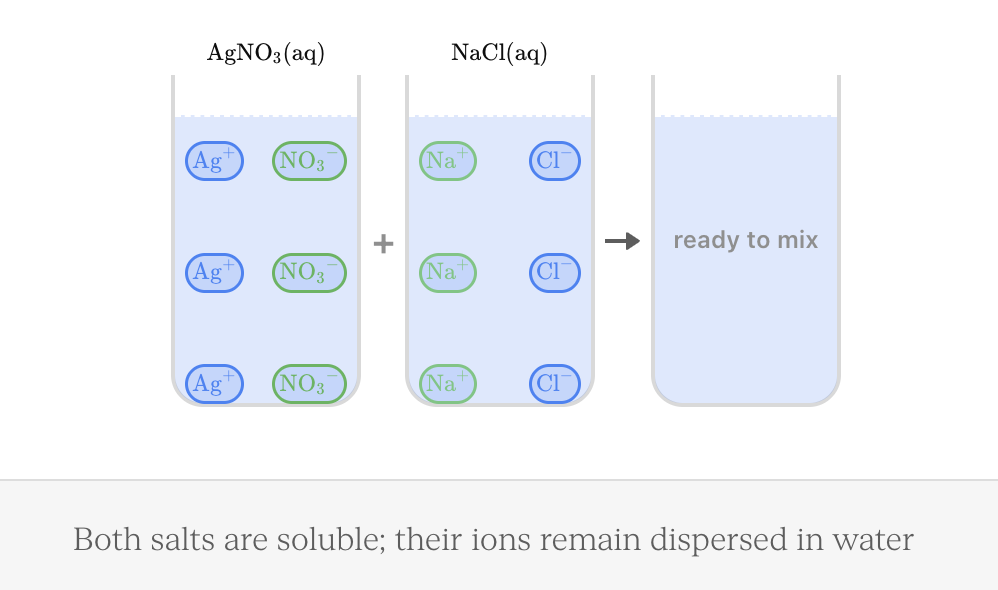
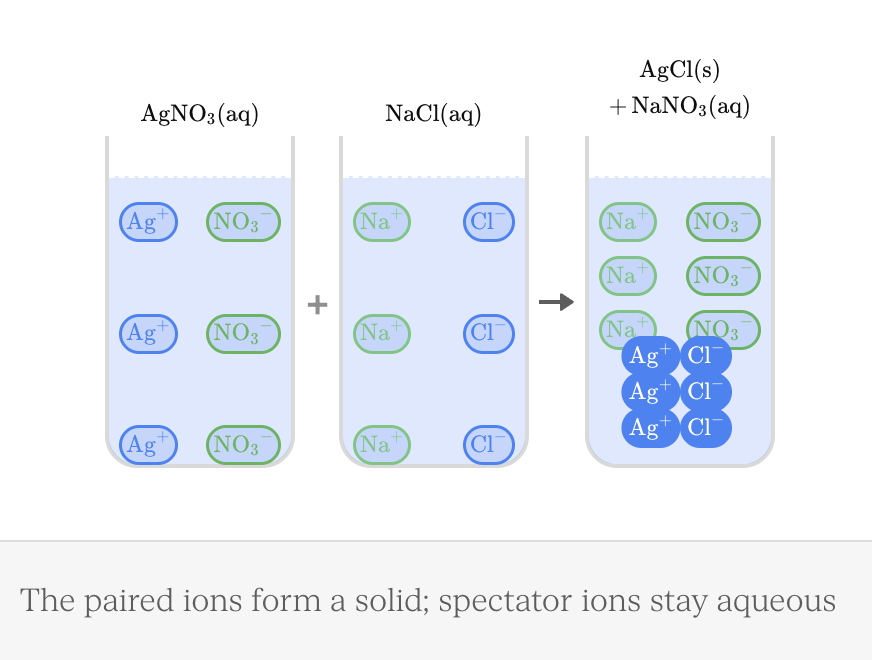
Here you can explore what happens to the ions when the two solutions are mixed:
Evidence of Precipitate Formation
A precipitation reaction usually produces an obvious change.
Evidence may include:
- the mixture becomes cloudy
- a solid suddenly appears
- particles become suspended in the liquid
- the solid settles to the bottom
- a colour change occurs because the precipitate has a characteristic colour
For example, mixing two clear, colourless solutions may produce a cloudy white solid.
That is strong evidence that a new insoluble substance has formed.
Aqueous Solutions
The reactants used in precipitation reactions are normally aqueous solutions.
Aqueous means:
dissolved in water
For example:
AgNO₃(aq)
means silver nitrate dissolved in water.
In the solution, the silver nitrate exists mainly as separated ions:
Ag⁺(aq) and NO₃⁻(aq)
Similarly:
NaCl(aq)
contains:
Na⁺(aq) and Cl⁻(aq)
What Happens When the Solutions Mix?
When silver nitrate solution and sodium chloride solution are mixed, all four ions are initially present:
- Ag⁺
- NO₃⁻
- Na⁺
- Cl⁻
The Ag⁺ and Cl⁻ ions combine.
Because silver chloride is insoluble:
Ag⁺(aq) + Cl⁻(aq) → AgCl(s)
The Na⁺ and NO₃⁻ ions remain dissolved.
Spectator Ions
Ions that remain dissolved without taking part in the main chemical change are called spectator ions.
For:
AgNO₃ + NaCl → AgCl + NaNO₃
the spectator ions are:
Na⁺
and:
NO₃⁻
The ions actually forming the precipitate are:
Ag⁺
and:
Cl⁻
Complete Ionic Equation
The reaction can be represented in several ways.
Word Equation
silver nitrate + sodium chloride → silver chloride + sodium nitrate
Chemical Equation
AgNO₃(aq) + NaCl(aq) → AgCl(s) + NaNO₃(aq)
Complete Ionic Equation
Ag⁺(aq) + NO₃⁻(aq) + Na⁺(aq) + Cl⁻(aq) → AgCl(s) + Na⁺(aq) + NO₃⁻(aq)
Notice that Na⁺ and NO₃⁻ appear unchanged on both sides.
Net Ionic Equation
The spectator ions can be removed from the equation.
This leaves:
Ag⁺(aq) + Cl⁻(aq) → AgCl(s)
This is the net ionic equation.
It shows the essential chemical change occurring during the precipitation reaction.
Preparing an Insoluble Salt
The basic laboratory procedure is:
prepare two soluble solutions
↓
mix the solutions
↓
form the precipitate
↓
filter
↓
wash the precipitate
↓
dry the precipitate
Unlike the preparation of soluble salts, crystallization is not required.
The salt has already formed as a solid.
Choosing the Reactants
To prepare an insoluble salt, chemists need two soluble compounds that supply the required ions.
Suppose we want:
silver chloride, AgCl
We need:
Ag⁺ ions
and:
Cl⁻ ions
A soluble source of Ag⁺ is:
silver nitrate, AgNO₃
A soluble source of Cl⁻ is:
sodium chloride, NaCl
Therefore:
AgNO₃(aq) + NaCl(aq) → AgCl(s) + NaNO₃(aq)
Why Use Soluble Reactants?
The ions must be able to move freely and mix.
When an ionic substance dissolves:
ionic solid → separated aqueous ions
These mobile ions can then encounter ions from the other solution.
If the required combination is insoluble, the ions join together and leave the solution as a solid.
Step 1: Prepare the Solutions
Prepare solutions containing the required ions.
For example:
- silver nitrate solution
- sodium chloride solution
The solutions should contain dissolved ions capable of forming the desired insoluble salt.
Step 2: Mix the Solutions
Add one solution to the other.
The ions mix.
In the silver chloride example:
Ag⁺ encounters Cl⁻
and forms:
AgCl(s)
The mixture becomes cloudy as the precipitate forms.
Step 3: Allow the Precipitate to Form
Stir the mixture gently.
This helps the ions mix thoroughly and allows the precipitation reaction to occur throughout the solution.
The solid may begin settling toward the bottom of the container.
Step 4: Filter the Mixture
The mixture now contains:
- insoluble precipitate
- water
- soluble spectator ions
Filtration separates the insoluble salt from the liquid.
The mixture is poured through filter paper in a filter funnel.
This time:
the residue is the product we want
The precipitate remains on the filter paper.
The dissolved spectator ions pass through with the filtrate.


An Important Difference
When preparing a soluble salt from an excess insoluble base, the filtrate contains the product.
When preparing an insoluble salt by precipitation, the residue contains the product.
Compare:
| Method | Desired Product |
|---|---|
| Preparing soluble salt | Filtrate |
| Preparing insoluble salt | Residue |
This is a very important practical distinction.
Residue
The residue is the solid left on the filter paper.
During precipitation:
residue = insoluble salt
For example:
residue = AgCl
This is the product we want to collect.
Filtrate
The filtrate is the liquid passing through the filter paper.
It contains:
- water
- soluble ions
- other dissolved substances
In the silver chloride reaction, the filtrate contains mainly dissolved sodium and nitrate ions.
Step 5: Wash the Precipitate
The precipitate should be washed with a small amount of distilled or deionized water.
Why?
Some soluble substances may remain trapped around the solid.
Washing removes:
- spectator ions
- soluble impurities
- remaining solution
The insoluble precipitate remains on the filter paper.
Why Use Distilled or Deionized Water?
Tap water contains dissolved ions.
These ions could contaminate the product or potentially react with it.
Distilled or deionized water contains far fewer dissolved ions and is therefore more suitable for washing a chemical product.
Step 6: Dry the Precipitate
After washing, the precipitate contains water.
The solid must be dried.
Depending on the substance and laboratory procedure, it may be:
- left to air dry
- gently dried in a suitable warm location
- dried between filter papers
- placed in appropriate drying equipment
The final product is the dry insoluble salt.
Complete Silver Chloride Preparation
To prepare silver chloride:
Mix
Silver nitrate solution with sodium chloride solution.
AgNO₃(aq) + NaCl(aq) → AgCl(s) + NaNO₃(aq)
Observe
A white precipitate forms.
Filter
The AgCl remains on the filter paper.
Wash
Wash the residue with distilled or deionized water.
Dry
Dry the solid.
Final product:
silver chloride
Another Example: Barium Sulfate
Barium sulfate is another insoluble salt.
To prepare it, soluble compounds supplying:
Ba²⁺
and:
SO₄²⁻
can be mixed.
For example:
barium nitrate + sodium sulfate → barium sulfate + sodium nitrate
Equation:
Ba(NO₃)₂(aq) + Na₂SO₄(aq) → BaSO₄(s) + 2NaNO₃(aq)
The barium sulfate forms as a precipitate.


Ionic Equation for Barium Sulfate
The ions forming the precipitate are:
Ba²⁺
and:
SO₄²⁻
Therefore:
Ba²⁺(aq) + SO₄²⁻(aq) → BaSO₄(s)
The sodium and nitrate ions remain in solution.
They are spectator ions.
Lead Iodide
Some precipitates have distinctive colours.
Lead iodide is a well-known example of a yellow precipitate.
A precipitation reaction can be represented as:
Pb(NO₃)₂(aq) + 2KI(aq) → PbI₂(s) + 2KNO₃(aq)
The precipitate is:
PbI₂
Net ionic equation:
Pb²⁺(aq) + 2I⁻(aq) → PbI₂(s)
Because lead compounds are toxic, they require strict laboratory handling and disposal procedures.
Copper Hydroxide
Precipitation reactions can also produce insoluble hydroxides.
For example:
CuSO₄(aq) + 2NaOH(aq) → Cu(OH)₂(s) + Na₂SO₄(aq)
Copper hydroxide forms a blue precipitate.
Net ionic equation:
Cu²⁺(aq) + 2OH⁻(aq) → Cu(OH)₂(s)
These reactions can also be useful for identifying metal ions.
Why Are Some Salts Insoluble?
When an ionic compound is placed in water, two competing processes are important.
Water molecules attract the ions and tend to pull them away from the ionic lattice.
At the same time, oppositely charged ions strongly attract each other within the crystal.
If interactions with water are sufficiently favourable, significant amounts of the compound dissolve.
If the ionic solid is strongly stabilized relative to the dissolved ions, very little dissolves.
Therefore, different ionic compounds have different solubilities.
Solubility
Solubility describes how much of a substance can dissolve in a particular solvent under specified conditions.
A salt described as soluble dissolves to a significant extent.
A salt described as insoluble dissolves only to a very small extent.
Importantly:
"insoluble" does not usually mean absolutely zero dissolves.
It means the amount that dissolves is very small.
Useful Solubility Rules
Solubility rules allow us to predict whether a precipitate is likely to form.
For introductory chemistry, some useful patterns are:
Nitrates
Most nitrate salts are soluble.
Examples:
- NaNO₃
- KNO₃
- AgNO₃
- Ca(NO₃)₂
This is why nitrates are often useful for supplying metal ions during precipitation experiments.
Sodium, Potassium, and Ammonium Salts
Salts containing:
Na⁺
K⁺
or:
NH₄⁺
are generally soluble.
This makes sodium, potassium, and ammonium compounds useful sources of negative ions.
Chlorides
Many chlorides are soluble.
Important exceptions include salts such as:
AgCl
Silver chloride is insoluble enough to form a visible precipitate.
Sulfates
Many sulfates are soluble.
However, some are poorly soluble or insoluble.
A particularly important example is:
BaSO₄
Barium sulfate forms a white precipitate.
Carbonates
Most carbonates are insoluble, except those containing ions such as:
- sodium
- potassium
- ammonium
For example:
CaCO₃
is poorly soluble in water.
This is why calcium carbonate can exist as limestone and chalk rather than simply dissolving away rapidly in water.
Solubility Rules Summary
| Type of Salt | General Pattern |
|---|---|
| Nitrates | Soluble |
| Sodium salts | Soluble |
| Potassium salts | Soluble |
| Ammonium salts | Soluble |
| Most chlorides | Soluble, with important exceptions such as AgCl |
| Many sulfates | Soluble, with important exceptions such as BaSO₄ |
| Most carbonates | Insoluble, except sodium, potassium, and ammonium salts |
These are useful rules rather than explanations of why every individual compound behaves as it does.
Predicting a Precipitation Reaction
Suppose these solutions are mixed:
AgNO₃(aq)
and:
NaCl(aq)
Possible products:
AgCl
and:
NaNO₃
Apply the solubility rules:
AgCl → insoluble
NaNO₃ → soluble
Therefore:
AgCl forms a precipitate.
What If Everything Is Soluble?
Mixing two ionic solutions does not guarantee that a precipitate will form.
Suppose:
NaNO₃(aq)
and:
KCl(aq)
are mixed.
Possible exchanged combinations are:
NaCl
and:
KNO₃
Both remain soluble.
Therefore, no insoluble solid forms.
There is no precipitation reaction.
Double-Displacement Reactions
Many precipitation reactions can be viewed as double-displacement reactions.
A simplified pattern is:
AB + CD → AD + CB
The ions effectively exchange partners.
However, a meaningful precipitation reaction occurs when one of the new combinations forms an insoluble substance.
For example:
AgNO₃ + NaCl → AgCl + NaNO₃
The driving observation is the formation of:
AgCl(s)
Worked Example: Predict the Precipitate
Solutions of calcium chloride and sodium carbonate are mixed.
Ions present:
Ca²⁺
Cl⁻
Na⁺
CO₃²⁻
Possible products:
CaCO₃
and:
NaCl
Most carbonates are insoluble except sodium, potassium, and ammonium carbonates.
Therefore:
CaCO₃ forms a precipitate.
Equation:
CaCl₂(aq) + Na₂CO₃(aq) → CaCO₃(s) + 2NaCl(aq)
Net ionic equation:
Ca²⁺(aq) + CO₃²⁻(aq) → CaCO₃(s)
Worked Example: Preparing Calcium Carbonate
Suppose you need to prepare calcium carbonate.
Choose soluble substances containing:
Ca²⁺
and:
CO₃²⁻
Possible choices:
calcium chloride solution
and:
sodium carbonate solution
Mix:
CaCl₂(aq) + Na₂CO₃(aq)
A calcium carbonate precipitate forms:
CaCO₃(s)
Then:
filter → wash → dry
The final product is calcium carbonate.
Worked Example: Identify the Spectator Ions
Consider:
Ba(NO₃)₂(aq) + Na₂SO₄(aq) → BaSO₄(s) + 2NaNO₃(aq)
Ions forming the precipitate:
Ba²⁺ + SO₄²⁻
Spectator ions:
Na⁺
and:
NO₃⁻
Net ionic equation:
Ba²⁺(aq) + SO₄²⁻(aq) → BaSO₄(s)
Worked Example: Is There a Precipitate?
Mix:
KNO₃(aq)
and:
NaCl(aq)
Possible products:
KCl
and:
NaNO₃
Potassium salts are soluble.
Sodium salts are soluble.
Nitrates are soluble.
Therefore:
no precipitate forms
All major ions remain dissolved.
Separating the Precipitate
Once an insoluble salt forms, filtration is used because the solid particles are too large to pass through the pores of the filter paper while the liquid and dissolved ions pass through.
For this experiment:
mixture → filter → solid residue + liquid filtrate
The insoluble salt is collected as the residue.
Washing the Precipitate
Filtration alone does not necessarily produce a pure solid.
Some solution remains between and around the particles.
That solution may contain spectator ions.
For example, freshly filtered AgCl may still have solution containing:
Na⁺
and:
NO₃⁻
Washing the precipitate removes much of this contamination.
Therefore:
filtering separates the solid
while:
washing improves its purity
Why Use Only a Small Amount of Wash Water?
Even substances described as insoluble may dissolve slightly.
Using unnecessarily large amounts of wash water could therefore cause some product to be lost.
A small appropriate amount removes soluble impurities while minimizing product loss.
Drying and Measuring the Product
If the precipitate is required for quantitative analysis, it must be dried before its mass is measured.
Otherwise, retained water increases the measured mass.
The measured value would then represent:
precipitate + water
rather than just:
precipitate
This would produce an experimental error.
Precipitation in Chemical Analysis
Precipitation reactions are useful for more than preparing salts.
They can also help identify ions.
For example, the formation of a particular precipitate after adding a test reagent may provide evidence that a certain ion is present.
Chemists can consider:
- whether a precipitate forms
- its colour
- its solubility in other reagents
This is part of qualitative chemical analysis.
Precipitation in Water Treatment
Precipitation can also be useful on a larger scale.
Dissolved substances can sometimes be converted into insoluble compounds.
The solid can then be removed through processes such as:
- settling
- filtration
- clarification
The basic principle is:
dissolved contaminant → insoluble solid → physical removal
Precipitation in Natural Systems
Precipitation of minerals also occurs naturally.
Changes in:
- ion concentration
- temperature
- pH
- evaporation
- chemical conditions
can cause dissolved substances to form solid minerals.
Mineral deposits, scale, and some sedimentary processes involve similar chemical principles.
Comparing Soluble and Insoluble Salt Preparation
| Preparing Soluble Salts | Preparing Insoluble Salts |
|---|---|
| Salt remains dissolved initially | Salt forms directly as solid |
| May use acid + insoluble base | Usually mixes two soluble solutions |
| Excess solid may be used | Precipitation reaction used |
| Filter removes unwanted excess reactant | Filter collects desired product |
| Product initially in filtrate | Product is the residue |
| Concentrate solution | Wash precipitate |
| Crystallize salt | Dry precipitate |
This difference is worth remembering:
soluble salt → often collect the filtrate
insoluble salt → collect the residue
Safety
Precipitation experiments require normal laboratory precautions.
Important practices include:
- wear safety goggles
- avoid skin contact with chemical solutions
- use clean glassware
- avoid contamination between solutions
- wash hands after practical work
- dispose of chemical waste as instructed
- never pour chemicals into a sink unless instructed
Some metal salts can be toxic or environmentally harmful, so correct disposal is particularly important.
Common Mistakes
Thinking a Precipitate Is a Gas
A precipitate is a:
solid
Gas formation may produce bubbles, but precipitation produces solid particles.
Thinking All Cloudiness Means a Gas Is Forming
A cloudy mixture may indicate tiny suspended solid particles.
Look for evidence of precipitate formation.
Keeping the Filtrate Instead of the Residue
When preparing an insoluble salt:
the residue is the desired product
Forgetting to Wash the Precipitate
Filtering separates the solid but may leave soluble impurities on its surface.
Washing improves purity.
Forgetting to Dry the Precipitate
A wet precipitate contains water and cannot give an accurate product mass.
Trying to Crystallize an Insoluble Salt from Water
An insoluble salt cannot usually be prepared by making a concentrated aqueous solution and cooling it because very little dissolves in the first place.
Use precipitation instead.
Assuming Every Pair of Solutions Produces a Precipitate
A precipitate forms only if an insoluble product is produced.
If all possible products remain soluble, no precipitate forms.
Confusing Spectator Ions with Reacting Ions
Spectator ions remain dissolved.
The ions forming the insoluble solid are the ones shown in the net ionic equation.
Assuming Insoluble Means Absolutely Nothing Dissolves
In chemistry, insoluble generally means that only a very small amount dissolves under the stated conditions.
Check Your Understanding
- Define an insoluble salt.
- Define a precipitation reaction.
- What is a precipitate?
- Give three observations that could indicate precipitate formation.
- What does the symbol (aq) mean?
- What does the symbol (s) mean?
- Complete:
AgNO₃(aq) + NaCl(aq) → ______ + ______
- Which product in this reaction is the precipitate?
- Write the net ionic equation for silver chloride formation.
- What are spectator ions?
- Identify the spectator ions in the reaction between silver nitrate and sodium chloride.
- Why are soluble reactants normally used to prepare an insoluble salt?
- Describe the basic steps for preparing an insoluble salt.
- What happens to the precipitate during filtration?
- Is the desired product the residue or filtrate?
- Why is the precipitate washed?
- Why should distilled or deionized water be used for washing?
- Why should the precipitate be dried?
- What error would result from weighing a wet precipitate?
- Write the equation for the precipitation of barium sulfate from barium nitrate and sodium sulfate.
- Write the net ionic equation for barium sulfate formation.
- What happens when calcium chloride and sodium carbonate solutions are mixed?
- Write the net ionic equation for calcium carbonate formation.
- Why do sodium nitrate and potassium chloride solutions not produce a precipitate when mixed?
- State the general solubility rule for nitrate salts.
- State the general solubility rule for sodium, potassium, and ammonium salts.
- Are most carbonates soluble or insoluble?
- Explain why some ionic compounds dissolve readily while others dissolve only slightly.
- Compare the preparation of soluble and insoluble salts.
- Describe how you would prepare a pure, dry sample of calcium carbonate from two suitable soluble compounds.
Key Terms
Insoluble salt — Salt that dissolves only to a very small extent in water.
Solubility — Amount of a substance that can dissolve in a particular solvent under specified conditions.
Precipitation reaction — Reaction in which dissolved ions combine to form an insoluble solid.
Precipitate — Insoluble solid formed from a solution during a chemical reaction.
Aqueous — Dissolved in water, represented by (aq).
Spectator ion — Ion present in solution that does not participate in the main chemical change.
Complete ionic equation — Equation showing soluble ionic substances as their individual aqueous ions.
Net ionic equation — Equation showing only the particles directly involved in the chemical change.
Filtration — Separation of an insoluble solid from a liquid using a filter.
Residue — Solid remaining on the filter paper.
Filtrate — Liquid that passes through the filter paper.
Double-displacement reaction — Reaction in which ions from two compounds exchange partners.
Distilled water — Water purified to remove most dissolved substances.
Deionized water — Water treated to remove most dissolved ions.
Qualitative analysis — Identification of substances or ions using observations and chemical tests.
Key Takeaways
- Insoluble salts dissolve only very slightly in water.
- Insoluble salts are commonly prepared using precipitation reactions.
- A precipitation reaction occurs when dissolved ions combine to form an insoluble solid.
- The solid formed is called a precipitate.
- Precipitate formation may cause a solution to become cloudy or produce a visible solid.
- Two soluble ionic compounds are usually selected to provide the ions required for the insoluble salt.
- Silver nitrate and sodium chloride produce silver chloride precipitate.
- The net ionic equation is Ag⁺(aq) + Cl⁻(aq) → AgCl(s).
- Barium ions and sulfate ions can form insoluble barium sulfate.
- Calcium ions and carbonate ions can form insoluble calcium carbonate.
- Ions that remain dissolved without participating directly are called spectator ions.
- Not every combination of ionic solutions produces a precipitate.
- Solubility rules can help predict whether an insoluble product will form.
- Nitrate salts are generally soluble.
- Sodium, potassium, and ammonium salts are generally soluble.
- Most carbonates are insoluble except important salts such as those of sodium, potassium, and ammonium.
- Filtration separates the precipitate from the solution.
- When preparing an insoluble salt, the desired product is the residue.
- The precipitate should be washed to remove soluble impurities.
- The precipitate should be dried before it is stored or weighed.
- Insolubility results from the balance between attractions within the ionic solid and interactions between the ions and water.
- Precipitation reactions are useful in salt preparation, chemical analysis, environmental chemistry, and water treatment.
The practical method to remember is:
mix two soluble solutions
↓
form the precipitate
↓
filter
↓
wash
↓
dry
Or, even more simply:
precipitate → filter → wash → dry.
5. Crystallization and Purification
Learning outcomes
- I can explain the process of crystallization.
- I can describe how crystals are formed from solutions.
- I can separate crystals from solutions safely.
- I can explain how purification improves product quality.
- I can evaluate factors affecting crystal formation.
Crystallization and Purification
Crystallization is a separation and purification technique used to obtain a dissolved solid from a solution as solid crystals.
The basic process is:
solution → concentrate → cool → crystals form → separate → dry
Crystallization is particularly useful when a substance is more soluble in hot solvent than in cold solvent.
Instead of evaporating all the solvent, some solvent is removed and the concentrated solution is allowed to cool. As it cools, the solution can no longer hold as much dissolved solute, so the excess solute forms crystals.


Solutions and Dissolved Solutes
A solution forms when a solute dissolves in a solvent.
For example:
copper sulfate + water → copper sulfate solution
The copper sulfate is the:
solute
The water is the:
solvent
The resulting mixture is the:
solution
Although the copper sulfate is no longer visible as solid crystals, its ions remain dispersed throughout the water.
Solubility
Solubility describes how much solute can dissolve in a given amount of solvent under particular conditions.
For many solid substances:
higher temperature → greater solubility
and:
lower temperature → lower solubility
This temperature dependence makes crystallization possible.
Suppose 50 g of a substance can dissolve in hot water, but only 20 g can remain dissolved when the solution cools.
The difference is:
50 − 20 = 30 g
Up to 30 g can potentially crystallize as the solution cools.
Saturated Solutions
A saturated solution contains the maximum amount of dissolved solute that can remain dissolved under the given conditions.
If additional solute is added to a saturated solution, it will generally remain undissolved.
Saturation depends on:
- temperature
- solvent
- solute
- pressure in some systems
For most solid-solute crystallization experiments, temperature is especially important.
How Crystals Form
Particles in a solution are moving randomly.
When conditions become suitable, dissolved particles begin arranging themselves into an ordered solid structure.
This initial formation of a tiny stable crystal is called nucleation.
Once a crystal nucleus forms, more particles can attach to it.
The crystal grows.
Therefore:
nucleation → crystal growth


Crystal Structure
Crystals have highly ordered arrangements of particles.
In an ionic crystal, positive and negative ions occupy repeating positions within a crystal lattice.
The visible shape of a crystal results partly from this regular microscopic structure.
Different substances therefore produce crystals with different characteristic shapes.
Preparing Crystals from a Solution
Suppose a soluble salt has been prepared as an aqueous solution.
The salt can be recovered using the following procedure:
- Obtain the salt solution.
- Remove insoluble impurities if necessary.
- Gently heat the solution.
- Evaporate some of the water.
- Stop heating when the solution is sufficiently concentrated.
- Allow the solution to cool.
- Leave the solution undisturbed while crystals form.
- Separate the crystals from the remaining solution.
- Wash the crystals if appropriate.
- Dry the crystals.
Step 1: Obtain the Solution
The starting material must contain the desired substance dissolved in a suitable solvent.
For example:
CuSO₄(aq)
contains dissolved copper sulfate in water.
The objective is to recover:
CuSO₄ crystals
from this solution.
Step 2: Remove Insoluble Impurities
If the solution contains insoluble material, it should first be filtered.
For example, when copper sulfate is prepared using excess copper oxide:
H₂SO₄ + CuO → CuSO₄ + H₂O
excess CuO remains as an insoluble solid.
Filtration removes it.
The:
CuO = residue
while the:
copper sulfate solution = filtrate
The filtrate is then used for crystallization.
Step 3: Concentrate the Solution
The solution is gently heated in an evaporating basin.
Water evaporates:
liquid water → water vapour
As water leaves, the amount of solvent decreases while the amount of dissolved salt initially remains approximately the same.
Therefore, the solution becomes increasingly concentrated.


Why Concentrate the Solution?
Imagine a solution containing only a small amount of salt in a large volume of water.
Cooling it might not produce crystals because the solution is still far below saturation.
Removing some water brings the solution closer to saturation.
Then, when the solution cools and solubility decreases, crystals can form.
When Should Heating Stop?
The objective is not normally to evaporate all the water.
Heating should stop when the solution is sufficiently concentrated.
In some laboratory procedures, a small sample or drop may be tested to see whether crystals begin appearing as it cools.
The concentrated solution is then allowed to cool naturally.
Why Not Evaporate to Dryness?
It may seem easier to remove all the water.
However, strong heating can cause problems.
The substance may:
- decompose
- lose water of crystallization
- become contaminated
- form a powder instead of well-developed crystals
- undergo unwanted chemical changes
Crystallization is usually a gentler way of recovering and purifying a solid.
Step 4: Cooling the Solution
The concentrated solution is allowed to cool.
For many solids:
temperature decreases → solubility decreases
The solution eventually contains more dissolved material than can remain dissolved under the new conditions.
The excess solute begins to crystallize.
Step 5: Crystal Growth
Once nuclei form, dissolved particles move toward the crystal surfaces and join the growing lattice.
Crystal growth continues while sufficient solute remains available.
The solution should generally be left undisturbed.
Movement can encourage additional nucleation and may produce many smaller crystals instead of fewer larger ones.
Slow Cooling and Crystal Size
The rate of cooling can affect crystal size.
Slow Cooling
Generally provides more time for particles to join existing crystals.
This tends to produce:
fewer, larger crystals
Rapid Cooling
Can produce many nucleation sites quickly.
This tends to produce:
more numerous, smaller crystals
Therefore, if large well-formed crystals are desired:
slow cooling is usually preferable.
Mother Liquor
After crystals form, some liquid normally remains.
This remaining solution is called the mother liquor.
The mother liquor still contains:
- solvent
- some dissolved product
- soluble impurities
Not all of the desired substance crystallizes.
Some remains dissolved.
Step 6: Separating the Crystals
The crystals must now be separated from the mother liquor.
Filtration can be used.
The crystals remain as the:
residue
The mother liquor passes through as the:
filtrate
Notice that this differs from the earlier stage of preparing a soluble salt, when the salt was still dissolved and the filtrate was the desired material.
Now that crystallization has occurred:
the crystals are the desired residue.
Step 7: Washing the Crystals
Small amounts of mother liquor may remain on the surface of the crystals.
This liquid may contain dissolved impurities.
The crystals can therefore be washed with a small amount of cold suitable solvent.
For an aqueous crystallization, cold water may be appropriate depending on the salt.
Why cold?
Because the desired crystals are generally less soluble in cold solvent.
Using warm water could dissolve more of the product.
Why Use Only a Small Amount?
Even cold solvent can dissolve some product.
Too much wash solvent can therefore reduce the amount of crystals recovered.
The aim is:
remove impurities while minimizing product loss
This is an important balance in purification.
Step 8: Drying the Crystals
The crystals should be dried after separation.
Possible methods include:
- placing them between filter papers
- leaving them to air dry
- using suitable controlled drying equipment
The exact method depends on the substance.
If crystals are weighed while wet, their apparent mass will be too high because the measured mass includes water.
Copper Sulfate Crystals
Copper sulfate provides a useful example of crystallization.
A copper sulfate solution is concentrated and then allowed to cool.
Blue crystals of hydrated copper sulfate can form.

The general process is:
copper sulfate solution
↓
gentle evaporation
↓
concentrated solution
↓
cooling
↓
crystallization
↓
filter
↓
dry
Hydrated Crystals
Some crystalline salts contain water molecules as part of their crystal structure.
These are called hydrated salts.
The water incorporated into the structure is called water of crystallization.
Hydrated copper sulfate is a familiar example.
Strong heating can sometimes remove this water and alter the appearance and properties of the substance.
This provides another reason to avoid unnecessarily strong heating during crystallization.
Crystallization as Purification
Crystallization does more than recover a solid.
It can also purify it.
Suppose a solution contains:
- desired compound
- soluble impurities
When the desired compound crystallizes, its particles arrange into a specific ordered lattice.
Many impurities do not fit easily into that structure.
They therefore tend to remain dissolved in the mother liquor.
The crystals can then be separated.
Before and After Purification
Suppose an impure sample contains:
desired substance + soluble impurity
After dissolution and crystallization:
desired substance → crystals
while much of the:
soluble impurity → remains in mother liquor
Filtering separates the purified crystals from the impurity-containing solution.
Recrystallization
When crystallization is specifically used to purify an existing solid, the process is often called recrystallization.
A simplified procedure is:
impure solid
↓
dissolve in hot solvent
↓
remove insoluble impurities if necessary
↓
cool solution
↓
pure crystals form
↓
filter, wash, and dry
Recrystallization is widely used in chemistry laboratories.
Choosing a Good Solvent for Recrystallization
An ideal solvent should:
- dissolve a large amount of the desired substance when hot
- dissolve much less of it when cold
- not chemically react with the desired substance
- allow impurities to be separated effectively
If the compound is highly soluble at both high and low temperatures, very little may crystallize during cooling.
If it is almost insoluble even when hot, it will be difficult to dissolve in the first place.
Solubility and Temperature
Consider a hypothetical substance.
At 80°C:
60 g dissolves in 100 g water
At 20°C:
20 g dissolves in 100 g water
If 60 g is dissolved at 80°C and the solution cools to 20°C, approximately:
60 − 20 = 40 g
could crystallize.
Approximately 20 g remains dissolved.
This demonstrates why a large change in solubility with temperature is useful for crystallization.
Worked Example: Crystal Mass
A saturated hot solution contains 75 g of dissolved salt.
After cooling, 25 g remains dissolved.
Maximum mass that can crystallize:
75 − 25 = 50 g
Therefore:
50 g of crystals
could theoretically form.
Worked Example: Percentage Recovery
Suppose 40 g of a substance was originally dissolved.
After crystallization, 32 g of dry crystals are collected.
Percentage recovery:
percentage recovery = recovered mass / original mass × 100
= 32 / 40 × 100
= 80%
The remaining material may:
- remain dissolved in the mother liquor
- be lost during transfer
- remain on equipment
- be lost during washing
Purity Versus Recovery
There is often a trade-off between purity and recovery.
Using more wash solvent may remove more impurities.
However, it may also dissolve more product.
Similarly, allowing extensive crystallization may increase recovery but could sometimes trap more impurities.
Chemists therefore optimize the procedure to obtain:
high purity + acceptable yield
rather than simply maximizing one measurement.
Factors Affecting Crystal Formation
Several factors influence crystallization.
Temperature
Temperature affects solubility.
Cooling can reduce solubility and encourage crystallization.
Cooling Rate
Slow cooling generally favours larger crystals.
Rapid cooling often produces smaller crystals.
Concentration
A solution must be sufficiently concentrated for significant crystallization to occur.
A very dilute solution may produce few or no crystals.
Evaporation
Removing solvent increases concentration.
However, excessive evaporation can produce poor crystals or cause decomposition.
Disturbance
Frequent shaking or stirring during crystal growth may encourage additional nucleation.
This can produce many smaller crystals.
Impurities
Impurities can interfere with crystal growth.
They may:
- disrupt the crystal lattice
- change crystal shape
- become trapped inside crystals
- create additional nucleation sites
Surface and Nucleation Sites
Crystals need nucleation sites to begin forming.
Sometimes crystallization can be encouraged by:
- scratching the inside of the container
- adding a tiny crystal of the desired substance
The small crystal is called a seed crystal.
Seed Crystals
A seed crystal provides an existing surface onto which dissolved particles can attach.
This can encourage crystallization when a concentrated solution does not begin forming crystals easily.
The process is called seeding.
It is also useful when growing large crystals.
Supersaturated Solutions
Sometimes a solution can temporarily contain more dissolved solute than would normally be expected at that temperature.
This is called a supersaturated solution.
Such solutions are unstable.
A small disturbance or seed crystal can trigger rapid crystallization.
Growing Large Crystals
If the goal is to produce large, attractive crystals rather than maximize recovery quickly, the procedure can be adjusted.
Useful conditions include:
- a clean solution
- slow cooling
- slow evaporation
- minimal disturbance
- relatively few nucleation sites
- sufficient time
This gives particles more opportunity to join existing crystals.
Producing Many Small Crystals
If rapid production is more important than crystal size:
- cool more rapidly
- encourage nucleation
- provide more nucleation sites
This tends to produce many smaller crystals.
Crystal Size Does Not Automatically Mean Purity
A large crystal is not necessarily perfectly pure.
Impurities can sometimes become:
- trapped between growing layers
- enclosed within the crystal
- attached to its surface
Proper purification therefore depends on the entire procedure, not simply crystal size.
Filtration During Recrystallization
Filtration may be used at two different stages.
Before Crystallization
Used to remove insoluble impurities.
Desired substance:
remains dissolved in the filtrate
After Crystallization
Used to collect desired crystals.
Desired substance:
becomes the residue
This distinction is important.
Purification Example
Suppose an impure salt contains:
- soluble desired salt
- insoluble sand
- soluble contaminant
A possible purification process is:
dissolve the salt
↓
filter out sand
↓
concentrate the filtrate
↓
cool
↓
desired salt crystallizes
↓
soluble contaminant remains mainly in mother liquor
↓
filter crystals
↓
wash
↓
dry
Different impurities are therefore removed at different stages.
Evaluating Purity
Chemists can evaluate purity using several methods depending on the substance.
One common approach for suitable solids is measuring the melting point.
A pure crystalline substance often has a relatively sharp characteristic melting point.
Impurities can:
- lower the melting point
- broaden the melting range
Other purity methods include chemical analysis and instrumental techniques.
Yield and Crystal Formation
Not all dissolved material will necessarily crystallize.
Product may be lost because:
- some remains in the mother liquor
- some dissolves during washing
- some sticks to glassware
- some is lost during transfer
- some passes through the filter
- some decomposes during excessive heating
Therefore:
actual recovered mass < theoretical maximum
is common.
Improving Crystal Recovery
Recovery may be improved by:
- concentrating the solution sufficiently
- allowing adequate cooling time
- cooling further when appropriate
- minimizing transfers
- using only a small amount of wash solvent
- allowing complete crystal formation
However, attempts to maximize recovery should not seriously reduce purity.
Improving Crystal Purity
Purity may be improved by:
- using clean equipment
- filtering insoluble impurities
- allowing controlled crystallization
- washing crystals
- using appropriate solvent
- avoiding excessive evaporation
- carrying out recrystallization again if necessary
Repeated recrystallization can improve purity but usually reduces overall recovery.
Industrial Crystallization
Crystallization is also used on a large scale.
Industries use crystallization to produce or purify substances such as:
- sugar
- salts
- fertilizers
- pharmaceuticals
- food ingredients
- industrial chemicals


Industrial systems carefully control:
- temperature
- concentration
- cooling rate
- mixing
- nucleation
- crystal size
Crystal size can affect how a product is filtered, transported, dissolved, packaged, or used.
Crystallization in Pharmaceuticals
Purity is especially important in pharmaceutical manufacturing.
Crystallization can affect:
- purity
- crystal size
- stability
- dissolution rate
- ease of manufacturing
The arrangement of molecules within crystals can sometimes affect the physical properties of a pharmaceutical substance.
This makes crystallization an important part of chemical manufacturing.
Crystallization Versus Evaporation to Dryness
These techniques should not be confused.
Evaporation to Dryness
Remove essentially all solvent.
Useful in some situations, but may expose the product to prolonged or strong heating.
Crystallization
Remove only enough solvent to produce a concentrated solution.
Then:
cool → form crystals
Crystallization is often preferable when a purified crystalline product is desired.
Crystallization Versus Precipitation
These processes both produce solids but occur differently.
Crystallization
A dissolved substance forms crystals as conditions such as temperature or concentration change.
Example:
CuSO₄(aq) → CuSO₄ crystals
Precipitation
Two dissolved substances react to produce a new insoluble substance.
Example:
Ag⁺(aq) + Cl⁻(aq) → AgCl(s)
Therefore:
crystallization = dissolved substance comes out of its solution
while:
precipitation = chemical reaction produces an insoluble substance
Safe Crystallization
Important laboratory precautions include:
- wear safety goggles
- heat solutions gently
- avoid vigorous boiling
- do not heat unknown substances to dryness
- handle hot glassware carefully
- use appropriate equipment for heating
- keep the working area clear
- avoid touching crystals unless instructed
- dispose of remaining solutions appropriately
- wash hands after practical work
Remember:
hot glassware may look exactly like cold glassware.
Common Mistakes
Evaporating All the Solvent
Crystallization usually requires:
partial evaporation followed by cooling
not complete evaporation.
Cooling a Very Dilute Solution
If the solution is too dilute, it may remain unsaturated after cooling.
Few or no crystals will form.
Filtering Before Crystals Have Formed
If the desired substance is still dissolved, it will pass through the filter paper.
Allow crystallization first.
Throwing Away the Wrong Part
Before crystallization, the desired soluble substance may be in the filtrate.
After crystallization, the desired crystals are the residue.
Washing with Large Amounts of Warm Water
Warm water can dissolve significant amounts of product.
Use a small amount of appropriate cold solvent when washing is required.
Weighing Wet Crystals
Water adds extra mass and produces an inaccurate measurement.
Dry the crystals first.
Assuming Faster Cooling Always Gives Better Crystals
Rapid cooling often produces many small crystals.
Slow cooling generally produces larger, better-developed crystals.
Assuming All Product Crystallizes
Some product normally remains dissolved in the mother liquor.
Assuming Large Crystals Must Be Pure
Crystal size and purity are different properties.
Confusing Crystallization with Precipitation
Crystallization usually involves a dissolved substance becoming less soluble.
Precipitation involves a chemical reaction producing an insoluble compound.
Check Your Understanding
- Define crystallization.
- What is a solute?
- What is a solvent?
- Define solubility.
- What is a saturated solution?
- Explain why many solids crystallize when a hot saturated solution cools.
- What is nucleation?
- What happens during crystal growth?
- Why is a solution concentrated before crystallization?
- Why should a solution not normally be evaporated completely to dryness?
- What happens to solubility for many solids as temperature decreases?
- Describe the basic procedure for producing crystals from a salt solution.
- What is mother liquor?
- After crystallization, are the desired crystals the residue or filtrate?
- Why are crystals sometimes washed?
- Why should a small amount of cold solvent be used for washing?
- Why must crystals be dried before weighing?
- Explain how slow cooling affects crystal size.
- Explain how rapid cooling affects crystal size.
- What is a seed crystal?
- What is a supersaturated solution?
- Explain how crystallization can purify a substance.
- Why do many soluble impurities remain in the mother liquor?
- What is recrystallization?
- Describe the properties of a good recrystallization solvent.
- Explain the difference between crystallization and precipitation.
- A hot solution contains 80 g of dissolved salt. After cooling, 30 g can remain dissolved. Calculate the maximum mass of crystals that could form.
- A student begins with 50 g of dissolved substance and recovers 42 g of dry crystals. Calculate the percentage recovery.
- Give four factors that can affect crystal formation.
- Explain how you would produce a pure, dry sample of crystals from an impure soluble salt.
Key Terms
Crystallization — Process in which dissolved particles form an ordered solid crystal.
Crystal — Solid with particles arranged in a regular repeating structure.
Solute — Substance dissolved in a solvent.
Solvent — Substance that dissolves a solute.
Solution — Homogeneous mixture of solute and solvent.
Solubility — Amount of solute that can dissolve under specified conditions.
Saturated solution — Solution containing the maximum amount of dissolved solute possible under the given conditions.
Supersaturated solution — Unstable solution temporarily containing more dissolved solute than would normally remain dissolved under those conditions.
Nucleation — Initial formation of small stable regions from which crystals can grow.
Crystal growth — Addition of particles to an existing crystal structure.
Seed crystal — Small crystal introduced to encourage crystal growth.
Mother liquor — Solution remaining after crystals have formed.
Recrystallization — Technique in which an impure solid is dissolved and crystallized again to improve purity.
Water of crystallization — Water molecules incorporated into the structure of certain crystalline salts.
Hydrated salt — Crystalline salt containing water as part of its crystal structure.
Purity — Proportion of a sample consisting of the desired substance.
Percentage recovery — Percentage of the starting material recovered after a separation or purification procedure.
Key Takeaways
- Crystallization is used to obtain dissolved solids as crystals.
- It can also be used to purify substances.
- The usual sequence is concentrate → cool → crystallize → filter → wash → dry.
- Many solids become less soluble as temperature decreases.
- A solution must be sufficiently concentrated for effective crystallization.
- A saturated solution contains the maximum amount of dissolved solute under particular conditions.
- Crystallization begins through nucleation.
- Dissolved particles then join growing crystal structures.
- Slow cooling generally produces fewer, larger crystals.
- Rapid cooling generally produces more numerous, smaller crystals.
- The liquid remaining after crystals form is called the mother liquor.
- Some desired product normally remains dissolved in the mother liquor.
- After crystallization, the crystals are collected as the residue during filtration.
- Washing removes solution and soluble impurities from crystal surfaces.
- A small amount of cold solvent minimizes product loss during washing.
- Crystals must be dried before accurate mass measurements are made.
- Recrystallization can improve the purity of an impure solid.
- Impurities often remain dissolved in the mother liquor instead of entering the growing crystal lattice.
- A good recrystallization solvent dissolves much more product when hot than when cold.
- Crystal formation depends on temperature, concentration, cooling rate, evaporation, impurities, nucleation, and disturbance.
- Seed crystals can encourage crystallization.
- Excessive heating can damage some substances or hydrated crystals.
- Crystallization differs from precipitation: crystallization recovers a dissolved substance, while precipitation produces an insoluble substance through a chemical reaction.
- Purification often involves a balance between high purity and high recovery.
- Crystallization is important in laboratory chemistry and industries including pharmaceuticals, food production, fertilizers, and chemical manufacturing.
The core practical sequence to remember is:
prepare or obtain solution
↓
remove insoluble impurities
↓
concentrate gently
↓
cool slowly
↓
allow crystals to form
↓
filter
↓
wash with a little cold solvent
↓
dry the crystals