pH and Indicators
1. The pH Scale
Learning outcomes
- I can describe the pH scale.
- I can identify acidic, neutral, and basic substances using pH values.
- I can explain what different pH values represent.
- I can compare the acidity of different substances.
- I can interpret pH data correctly.
The pH Scale
The pH scale is used to describe how acidic or alkaline (basic) an aqueous solution is. It allows scientists to compare substances using a numerical scale rather than simply describing them as acids or bases.
The commonly used classroom pH scale runs from 0 to 14, with pH 7 representing neutral conditions at about room temperature.
Understanding the pH Scale
The pH scale can be divided into three main regions:
| pH | Classification | Examples |
|---|---|---|
| 0–6 | Acidic | Lemon juice, vinegar |
| 7 | Neutral | Pure water |
| 8–14 | Alkaline/basic | Baking soda solution, soap solution |
A simple rule is:
pH < 7 → acidic
pH = 7 → neutral
pH > 7 → alkaline


What Does pH Measure?
pH is related to the concentration of hydrogen ions (H⁺) in a solution. More precisely in water, chemists often describe these as hydronium ions (H₃O⁺).
A solution with a high concentration of H⁺ ions has a low pH and is acidic.
A solution with a low concentration of H⁺ ions has a higher pH.
For example:
- pH 2 is strongly acidic
- pH 5 is weakly acidic
- pH 7 is neutral
- pH 9 is mildly alkaline
- pH 13 is strongly alkaline
The pH Scale Is Logarithmic
One of the most important features of the pH scale is that it is logarithmic.
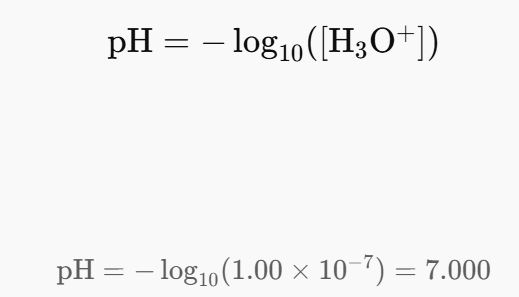
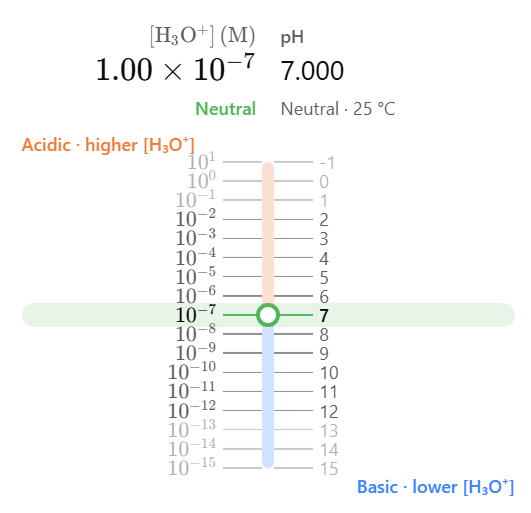
This means that a change of one pH unit represents a tenfold change in hydrogen-ion concentration.
For example, compare two solutions:
Solution A: pH 3
Solution B: pH 4
Solution A has 10 times the H⁺ concentration of Solution B.
Now compare:
Solution A: pH 2
Solution B: pH 5
There is a difference of three pH units:
10 × 10 × 10 = 1000
The pH 2 solution therefore has 1000 times the H⁺ concentration of the pH 5 solution.
Comparing the Acidity of Substances
When comparing two acidic solutions, the one with the lower pH is more acidic.
For example:
| Substance | pH |
|---|---|
| Lemon juice | 2 |
| Orange juice | 4 |
| Black coffee | 5 |
| Pure water | 7 |
From this data:
- lemon juice is more acidic than orange juice
- orange juice is more acidic than coffee
- coffee is acidic, but less acidic than the fruit juices
- pure water is neutral
Because the scale is logarithmic, lemon juice at pH 2 has about 100 times the H⁺ concentration of orange juice at pH 4.
Comparing Alkaline Substances
For alkaline solutions, the pattern is reversed.
A higher pH indicates a more alkaline solution.
For example:
| Substance | Approximate pH |
|---|---|
| Baking soda solution | 8–9 |
| Soap solution | 9–10 |
| Household ammonia | 11–12 |
| Some strong alkaline cleaners | 13–14 |
Therefore, a solution at pH 13 is more alkaline than a solution at pH 9.
Strongly alkaline substances can be just as hazardous as strongly acidic substances.
pH and Universal Indicator
One way to estimate pH is using universal indicator.
Universal indicator contains several different indicators that produce a range of colours.
Typical colours include:
| Approximate pH | Colour |
|---|---|
| 1–2 | Red |
| 3–4 | Orange |
| 5–6 | Yellow |
| 7 | Green |
| 8–10 | Blue-green to blue |
| 11–14 | Dark blue to purple |
The colour of the indicator is compared with a reference chart to estimate the pH.


Universal indicator gives an approximate pH, rather than a highly precise measurement.
Measuring pH More Accurately
Scientists can also use a pH meter.
A pH meter contains a probe that is placed into a solution. The instrument produces a numerical pH reading.
For example:
pH paper result: approximately pH 5
pH meter result: pH 5.23
A pH meter therefore allows scientists to collect more precise quantitative data.


Interpreting pH Data
Suppose a student tests four unknown solutions.
| Solution | pH |
|---|---|
| A | 3 |
| B | 11 |
| C | 7 |
| D | 5 |
We can interpret the results:
Solution A is acidic.
Solution B is alkaline.
Solution C is neutral.
Solution D is acidic.
We can also compare the acidic solutions.
Solution A has a lower pH than Solution D, so A is more acidic than D.
Because they differ by two pH units, Solution A has approximately:
10² = 100 times
the H⁺ concentration of Solution D.
pH and Acid Strength
Be careful when interpreting pH.
A low pH does not automatically tell us that an acid is classified as a strong acid.
pH depends on factors including:
- acid strength
- concentration
- temperature
For example, a concentrated weak acid may sometimes have a lower pH than a very dilute strong acid.
Therefore:
pH describes the acidity of a particular solution.
Acid strength describes how completely an acid ionises in water.
These are related concepts, but they are not the same thing.
Why Is pH Important?
Monitoring pH is important in many areas of science and everyday life.
Human Body
Different parts of the body require particular pH conditions. For example, the stomach is strongly acidic, while blood must remain within a narrow pH range.
Agriculture
Soil pH affects the availability of nutrients to plants. Farmers may test soil and adjust its pH to improve growing conditions.
Aquatic Ecosystems
Fish and other aquatic organisms can be sensitive to changes in water pH. Scientists therefore monitor lakes, rivers, aquariums, and other aquatic environments.
Swimming Pools
Pool water must be maintained within an appropriate pH range for effective treatment and swimmer comfort.
Food Production
pH affects food preservation, flavour, fermentation, and the growth of microorganisms.
Did You Know?
Although pH 0–14 is the scale most commonly encountered in school, these are not absolute limits.
Under some conditions, very concentrated solutions can have a pH below 0 or above 14.
The familiar 0–14 range comes from the behaviour of dilute aqueous solutions under typical conditions.
Key Terms
pH: A numerical measure related to the concentration of hydrogen ions in an aqueous solution.
Acidic: Having a pH below 7 under typical classroom conditions.
Neutral: Approximately pH 7 at room temperature.
Alkaline/basic: Having a pH above 7 under typical classroom conditions.
Universal indicator: A mixture of indicators used to estimate pH from colour.
pH meter: An instrument used to measure pH more precisely.
Logarithmic scale: A scale in which each step represents multiplication by a particular factor.
Key Takeaways
- The pH scale describes how acidic or alkaline an aqueous solution is.
- In the familiar classroom scale, below 7 is acidic, 7 is neutral, and above 7 is alkaline.
- Lower pH values indicate greater acidity.
- Higher pH values indicate greater alkalinity.
- The pH scale is logarithmic.
- A difference of 1 pH unit corresponds to a tenfold difference in H⁺ concentration.
- Universal indicator can be used to estimate pH.
- A pH meter provides a more precise measurement.
- pH data can be used to classify and compare solutions.
- pH and acid strength are not exactly the same concept.