Rates of Reaction
4. Factors Affecting Reaction Rate
Learning outcomes
- I can describe how temperature affects reaction rate.
- I can explain the effect of concentration on reaction rate.
- I can explain how surface area influences reaction rate.
- I can describe the effect of pressure on gaseous reactions.
- I can predict how changing conditions affects reaction rate.
What Affects the Rate of a Reaction?
Chemical reactions can happen at very different speeds.
Some occur almost instantly, while others take minutes, hours, days, or much longer.
For a particular reaction, changing the conditions can often make the reaction:
faster
or:
slower
The main factors we will examine are:
- temperature
- concentration
- surface area
- pressure of gases
Catalysts also affect reaction rate and will be examined separately.
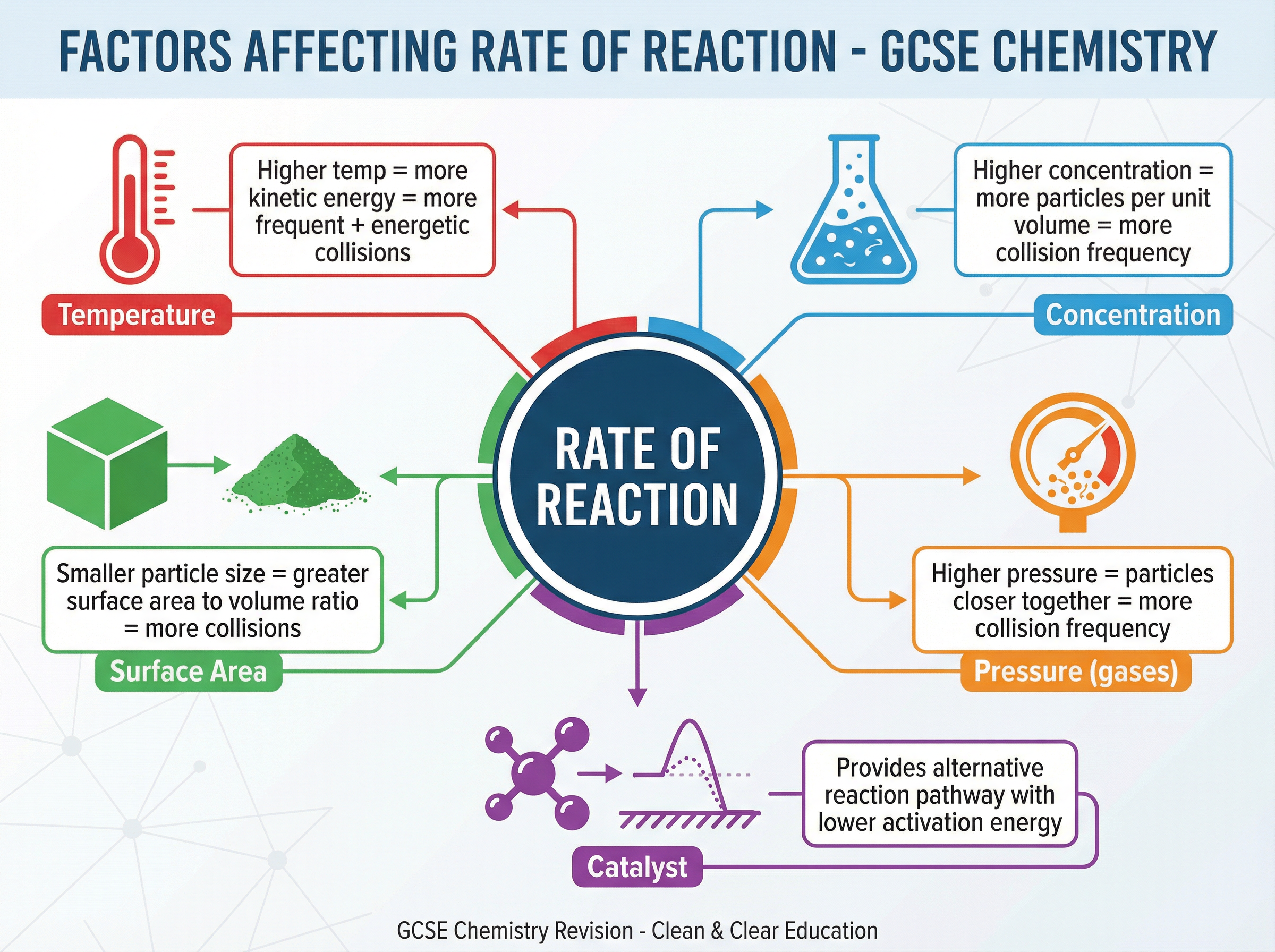
Collision theory helps explain why these factors matter. A reaction generally becomes faster when the number of successful collisions per unit time increases.
The Collision-Theory Connection
For reactant particles to react, they generally need to:
- collide
- collide with sufficient energy
- collide in an appropriate orientation
Changing reaction conditions can affect:
how often particles collide
and/or:
how many collisions have enough energy to react
This gives us a useful general relationship:
more successful collisions per second → faster reaction
Factor 1: Temperature
Temperature has a major effect on reaction rate.
In general:
higher temperature → faster reaction
and:
lower temperature → slower reaction
Why?
Temperature affects the kinetic energy of the particles.
At a higher temperature, particles have greater average kinetic energy.
They move more rapidly.
This produces more energetic collisions and usually somewhat more frequent collisions. More importantly, a larger fraction of collisions has enough energy to overcome the activation-energy barrier.
Temperature and Kinetic Energy
At low temperature:
particles move more slowly on average.
At high temperature:
particles move faster on average.
Therefore:
increase temperature
→ increase average kinetic energy
→ increase number of sufficiently energetic collisions
→ increase successful collisions per second
→ increase reaction rate
This is one of the most important cause-and-effect chains in chemical kinetics.
Temperature and Reaction Graphs
A higher-temperature reaction usually produces a steeper reaction curve.
The 50°C reaction has the steepest initial gradient.
The 30°C reaction has the shallowest.
Therefore:
50°C reaction = fastest
30°C reaction = slowest
If each experiment begins with the same amount of limiting reactant, the curves may eventually reach the same final amount of product.
The difference is how quickly they get there.
Why Does Temperature Have Such a Large Effect?
Heating does more than make particles move slightly faster.
Particles in a sample have a range of kinetic energies.
Only some of them have enough energy to overcome the activation energy, Eₐ.
When temperature rises:
the proportion of particles with energy ≥ Eₐ increases
This can produce a large increase in successful collisions.
Therefore, a strong explanation of temperature should mention:
kinetic energy
and:
activation energy
not merely "more collisions."
Temperature Does Not Normally Lower Activation Energy
A common mistake is:
"Higher temperature lowers the activation energy."
That is incorrect.
For the same reaction pathway:
Eₐ remains essentially the same
Higher temperature gives more particles enough energy to overcome that barrier.
A catalyst is what provides an alternative pathway with lower Eₐ.
Example: Sodium Thiosulfate Experiment
Suppose sodium thiosulfate reacts with hydrochloric acid.
At:
20°C → cross disappears in 90 s
40°C → cross disappears in 42 s
60°C → cross disappears in 19 s
The reaction is fastest at:
60°C
because the shortest time is required to reach the same visual endpoint.
Collision theory explains the observation:
At 60°C, particles have greater kinetic energy and a larger fraction of collisions exceeds the activation-energy requirement.
Predicting a Temperature Change
Suppose a reaction is running at:
25°C
and the temperature is increased to:
45°C
Prediction:
reaction rate increases
Reason:
particles have greater average kinetic energy and a greater fraction of collisions has enough energy to overcome Eₐ.
Now suppose the temperature is lowered.
Prediction:
reaction rate decreases
because fewer collisions have sufficient energy.
Everyday Example: Refrigeration
Many chemical and biochemical reactions involved in food spoilage occur more slowly at lower temperatures.
In a refrigerator:
lower temperature
→ lower average kinetic energy
→ fewer sufficiently energetic collisions
→ slower reactions
This is one reason refrigeration helps food remain usable for longer.
Everyday Example: Cooking
Cooking often relies on increased reaction rates.
Heating food increases particle kinetic energy.
More collisions can overcome activation-energy barriers.
As a result, processes such as:
- browning
- protein changes
- starch transformations
- flavour-forming reactions
occur much more quickly at cooking temperatures than at room temperature.
Factor 2: Concentration
Concentration describes how much dissolved substance is present in a given volume.
For many solution reactions:
higher concentration → faster reaction
Why?
A more concentrated solution contains:
more reactant particles in the same volume
Therefore, particles encounter one another more frequently.
The higher-concentration sample contains more particles in the same amount of space.
Concentration and Collision Frequency
Suppose two beakers have the same volume.
Beaker A contains:
20 reacting particles
Beaker B contains:
80 reacting particles
Particles in Beaker B have many more opportunities to collide.
Therefore:
higher concentration
→ more particles per unit volume
→ greater collision frequency
→ more successful collisions per second
→ faster reaction
Increasing concentration usually changes collision frequency rather than the kinetic energy of individual particles.
Example: Magnesium and Hydrochloric Acid
Consider:
Mg + 2HCl → MgCl₂ + H₂
Experiment A uses:
0.5 mol dm⁻³ HCl
Experiment B uses:
2.0 mol dm⁻³ HCl
The 2.0 mol dm⁻³ acid contains more reacting acid particles per unit volume.
Therefore, acid particles collide with the magnesium surface more frequently.
Prediction:
Experiment B will react faster.
What Would You Observe?
With more concentrated acid, you might observe:
- more rapid bubbling
- hydrogen produced more quickly
- a steeper gas-volume graph
- magnesium disappearing sooner
If the same amount of magnesium remains the limiting reactant in both experiments, both may eventually produce the same final amount of hydrogen.
Again:
faster does not necessarily mean more product.
Concentration and Reaction Curves
Suppose two experiments eventually produce 60 cm³ of gas.
The concentrated solution reaches 60 cm³ after:
30 s
The dilute solution reaches it after:
75 s
The concentrated reaction is faster because:
its graph has the steeper gradient
and:
it reaches the plateau sooner
The same plateau height indicates that the same total amount of gas was ultimately produced.
Predicting a Concentration Change
If concentration increases:
rate usually increases
If concentration decreases:
rate usually decreases
For example:
1.0 mol dm⁻³ → 2.0 mol dm⁻³
Prediction:
faster reaction
Reason:
more particles per unit volume produce more frequent collisions.
Concentration Does Not Mean "Stronger Particles"
Another common misconception is:
"Higher concentration gives particles more energy."
Incorrect.
Increasing concentration does not normally change the kinetic energy of individual particles.
Instead:
there are simply more particles available per unit volume
so collisions become more frequent.
This is different from increasing temperature.
Factor 3: Surface Area
Surface area is especially important when one reactant is a solid.
A reaction between a solid and a liquid or gas occurs mainly at the solid's exposed surface.
Therefore:
greater surface area → faster reaction
Smaller pieces provide more exposed surface than one large piece of the same total mass.
The diagram shows the difference between a large solid piece and a powder.
Why Does Crushing a Solid Increase Reaction Rate?
Imagine a solid cube.
Only particles on the outside surface can directly collide with particles from the other reactant.
Many particles inside the cube are inaccessible.
Now crush the cube into many smaller particles.
A much larger amount of the solid is exposed.
Therefore:
smaller particle size
→ larger total surface area
→ more exposed solid particles
→ more collisions per second
→ more successful collisions per second
→ faster reaction
Same Mass, Different Surface Area
Suppose we have:
10 g of calcium carbonate
We can use it as:
- one large lump
- several chips
- fine powder
The mass is still:
10 g
But the exposed surface area is very different.
The powder has the greatest surface area.
Therefore:
powder reacts fastest
and:
large lump reacts slowest
Example: Calcium Carbonate and Hydrochloric Acid
Consider:
CaCO₃ + 2HCl → CaCl₂ + H₂O + CO₂
Experiment A:
5 g large marble chips
Experiment B:
5 g small marble chips
Experiment C:
5 g powdered calcium carbonate
All other variables are controlled.
Prediction:
C fastest
then:
B
then:
A slowest
Reason:
Powder has the largest exposed surface area, producing the greatest number of acid–calcium carbonate collisions each second.
Surface Area and Gas-Volume Graphs
Suppose all three experiments contain the same amount of limiting calcium carbonate.
The powder experiment might show:
steepest curve
The large-chip experiment might show:
shallowest curve
But all curves could eventually reach the same final volume of CO₂.
This tells us:
surface area affects reaction rate
but does not necessarily change:
the total amount of product formed.
Surface Area-to-Volume Ratio
As objects become smaller:
surface area-to-volume ratio generally increases
This is why powders can react so much faster than large chunks.
A large block contains many particles hidden inside.
A collection of tiny particles exposes much more material.
This concept matters in:
- chemical industry
- combustion
- digestion
- dissolving
- mining and processing
An Important Safety Connection
Powders can sometimes be much more reactive than the same substance in large pieces.
For example, finely divided combustible materials may burn extremely rapidly because so much material is exposed to oxygen at once.
This helps explain why dust control is important in some industrial settings.
The chemistry is the same:
greater surface area → more collisions → faster reaction
Surface Area Does Not Increase Particle Energy
Another common misconception is:
"Crushing makes the particles move faster."
No.
Crushing mainly changes:
how much surface is exposed
It does not significantly increase particle kinetic energy.
Temperature changes kinetic energy.
Surface area changes access to collision sites.
Factor 4: Pressure of Gases
Pressure is especially important for reactions involving gaseous reactants.
Increasing gas pressure usually pushes the particles into a smaller volume.
The particles become closer together.
Therefore:
collision frequency increases
and:
reaction rate increases.

At higher pressure, gaseous reactant particles are packed more closely together.
Pressure and Particle Spacing
Imagine 100 gas particles.
At low pressure, they occupy a large container.
They are relatively far apart.
At higher pressure, the same particles occupy a smaller volume.
They encounter one another more frequently.
Therefore:
higher gas pressure
→ particles closer together
→ more frequent collisions
→ more successful collisions per second
→ higher reaction rate
Pressure and Concentration Are Related Ideas
For gases, increasing pressure by reducing volume effectively increases the number of particles per unit volume.
So pressure affects gaseous reactions in a similar way to concentration affecting solutions.
Higher solution concentration
More particles per unit volume.
Higher gas pressure
More gas particles per unit volume.
Both increase:
collision frequency
Example: Gas Reaction
Imagine:
A(g) + B(g) → AB(g)
At low pressure:
A and B particles are relatively spread out.
At higher pressure:
A and B are packed closer together.
Prediction:
the higher-pressure reaction will usually be faster
because the particles collide more frequently.
Pressure Matters Mainly for Gases
Solids and liquids are difficult to compress significantly under ordinary conditions.
Therefore changing pressure generally has a much smaller effect on particle spacing in:
- solids
- liquids
than it does in gases.
For school-level rate problems:
pressure is mainly considered for gaseous reactants.
Comparing the Four Factors
| Change | Particle-Level Effect | Expected Rate |
|---|---|---|
| Increase temperature | More particles exceed Eₐ | Faster |
| Decrease temperature | Fewer particles exceed Eₐ | Slower |
| Increase concentration | More collisions per second | Faster |
| Decrease concentration | Fewer collisions per second | Slower |
| Increase surface area | More exposed particles | Faster |
| Decrease surface area | Fewer exposed particles | Slower |
| Increase gas pressure | More frequent gas collisions | Faster |
| Decrease gas pressure | Less frequent gas collisions | Slower |
These factors all influence reaction rate, but they do not all work in exactly the same way.
Temperature vs Concentration
It is important to distinguish these explanations.
Increase temperature
Particles have:
greater average kinetic energy
and:
more collisions exceed Eₐ
Increase concentration
There are:
more particles per unit volume
so:
collision frequency increases
Concentration does not normally change particle kinetic energy.
Temperature vs Surface Area
Higher temperature
Changes particle energy.
Greater surface area
Changes how much solid is exposed.
Both increase reaction rate, but by different mechanisms.
Concentration vs Pressure
These are closely related.
Concentration
Usually discussed for solutions.
More dissolved particles per unit volume.
Pressure
Usually discussed for gases.
Compresses particles into a smaller volume.
Both typically increase:
collision frequency
Predicting Experimental Results
Suppose magnesium reacts with hydrochloric acid.
Experiment A:
- 1.0 mol dm⁻³ HCl
- 20°C
Experiment B:
- 2.0 mol dm⁻³ HCl
- 20°C
Prediction:
B is faster
because concentration is higher.
Prediction Example 2
Experiment A:
- 2.0 mol dm⁻³ HCl
- 20°C
Experiment B:
- 2.0 mol dm⁻³ HCl
- 50°C
Prediction:
B is faster
because temperature is higher.
The stronger explanation is:
At 50°C, particles have greater average kinetic energy and more collisions have sufficient energy to overcome Eₐ.
Prediction Example 3
Experiment A:
5 g large marble chips
Experiment B:
5 g powdered marble
Everything else is identical.
Prediction:
B reacts faster
because powder has greater surface area.
Prediction Example 4
A gaseous reaction is performed at:
Experiment A:
1 atm
Experiment B:
4 atm
at the same temperature.
Prediction:
B is usually faster
because gas particles are closer together and collide more frequently.
What If More Than One Condition Changes?
Suppose:
Experiment A:
- low concentration
- low temperature
- large chunks
Experiment B:
- high concentration
- high temperature
- powder
Prediction:
B should be much faster
because all three changes increase the frequency of successful collisions.
However, if some conditions increase rate while others decrease it, qualitative prediction may become difficult.
For example:
Experiment A:
- high concentration
- low temperature
Experiment B:
- low concentration
- high temperature
Without experimental data or a quantitative rate law, we may not be able to state confidently which reaction is faster.
This is an important scientific limitation.
Predicting Graph Shape
If a reaction becomes faster:
the product-time graph should usually become:
steeper
and:
reach its plateau sooner
If the initial amount of limiting reactant is unchanged:
plateau height may remain the same.
Changing rate does not necessarily change the amount of product ultimately formed.
Rate vs Final Amount
Suppose:
Reaction A reaches 80 cm³ of gas in 20 s.
Reaction B reaches 80 cm³ in 60 s.
Reaction A is faster.
But both produce:
80 cm³
Therefore:
same final product amount
but:
different reaction rates
This distinction appears frequently in reaction-rate graphs.
Why Do Reactions Slow Down?
Even when temperature, pressure and surface area are kept constant, a reaction may slow as it proceeds.
Why?
Reactants are being used up.
Their concentrations decrease.
Therefore:
fewer reactant particles remain
→ collision frequency decreases
→ successful collisions per second decrease
→ reaction rate decreases
This is why many product-time curves gradually become flatter.
Experimental Example: Temperature
Suppose gas production is measured at three temperatures.
50°C has the steepest curve.
40°C is intermediate.
30°C has the shallowest curve.
The graph provides experimental evidence that:
higher temperature increases reaction rate.
Experimental Example: Surface Area
Suppose equal masses of a solid react with acid.
Powder reaches the final gas volume in:
20 s
Small chips:
45 s
Large chunks:
90 s
Ranking:
Powder > Small chips > Large chunks
in reaction rate.
The explanation is not that the powder contains more material.
The masses are equal.
The difference is:
surface area.
Using Evidence to Support Predictions
A strong scientific prediction should not simply state:
"It will be faster."
Instead:
"Increasing the concentration should increase the reaction rate because there will be more reactant particles per unit volume. This increases collision frequency and therefore the number of successful collisions per second."
Or:
"Increasing temperature should increase the rate because particles have greater average kinetic energy and a larger fraction of collisions can overcome the activation-energy barrier."
Always connect the condition to collision theory.
A Useful Reasoning Pattern
For most questions, use:
Condition changes
↓
Particle behaviour changes
↓
Collision behaviour changes
↓
Successful collision frequency changes
↓
Reaction rate changes
For example:
Increase pressure
↓
particles closer together
↓
more collisions
↓
more successful collisions per second
↓
faster reaction
Common Misconception: Higher Concentration Means Higher Energy
Incorrect.
Higher concentration means:
more particles in a given volume
It primarily increases collision frequency.
Temperature changes particle kinetic energy.
Common Misconception: Pressure Speeds Up Every Reaction
Not necessarily.
Pressure has its most significant effect when the reacting substances are gases.
Changing pressure usually has much smaller effects on liquids and solids.
Common Misconception: Smaller Pieces Mean Less Reactant
Not if the mass remains the same.
For example:
10 g large chips
and:
10 g powder
contain the same total mass.
The powder simply has:
greater exposed surface area
and therefore reacts faster.
Common Misconception: Faster Reaction Means More Product
Incorrect.
A faster reaction can simply reach the same final product amount sooner.
Reaction rate and reaction yield are different concepts.
Common Misconception: Temperature Only Increases Collision Frequency
This explanation is incomplete.
Higher temperature does increase particle speeds and collision frequency somewhat.
But its major effect is that:
a larger fraction of collisions has sufficient energy to overcome Eₐ.
A complete temperature explanation should mention activation energy.
Real-World Connection: Medicines
Chemical decomposition can affect the shelf life of medicines.
Storing some medicines at lower temperatures can slow unwanted chemical reactions.
This is another application of:
lower temperature → fewer sufficiently energetic collisions → slower reaction
Real-World Connection: Industry
Industrial chemists often want reactions to occur quickly enough to produce large quantities of product efficiently.
They may adjust:
- temperature
- reactant concentration
- gas pressure
- particle size
- catalysts
However, the fastest possible conditions are not always the best.
Very high temperatures and pressures can require:
- more energy
- more expensive equipment
- stronger reaction vessels
- additional safety controls
Reaction conditions therefore involve a balance between:
rate, cost, safety and efficiency.
Real-World Connection: Powdered Fuels
Smaller fuel particles have much greater surface area than large chunks.
This allows oxygen to contact more fuel particles at once.
Therefore combustion can occur much more rapidly.
The same collision-theory principle applies:
greater surface area → more collisions at the fuel surface → faster reaction
Did You Know?
The effect of changing conditions can be dramatic.
A solid that reacts slowly as a large lump may react extremely rapidly when finely powdered.
A reaction that is barely noticeable at low temperature may become rapid after heating.
A gas reaction may speed up substantially when gases are compressed.
Yet all these observations can be explained using the same basic model:
the conditions affect how frequently particles undergo successful collisions.
Predicting Rate: Quick Guide
If you see:
Higher temperature
Predict:
faster
Reason:
greater kinetic energy and more collisions exceeding Eₐ
If you see:
Higher concentration
Predict:
faster
Reason:
more particles per unit volume and greater collision frequency
If you see:
Smaller solid particles
Predict:
faster
Reason:
greater surface area and more exposed particles
If you see:
Higher gas pressure
Predict:
faster
Reason:
gas particles are closer together and collide more frequently
If you see the opposite change:
usually predict:
slower
Key Terms
Reaction rate – How quickly reactants are converted into products.
Collision theory – A model explaining reaction rates in terms of particle collisions.
Successful collision – A collision that results in chemical reaction.
Temperature – A measure related to the average kinetic energy of particles.
Kinetic energy – Energy associated with particle motion.
Activation energy, Eₐ – The minimum energy barrier associated with a reaction pathway.
Concentration – Amount of substance present in a given volume.
Surface area – Amount of exposed surface available for reaction.
Pressure – Force per unit area; for gases it is related to particle collisions with container walls and particle density.
Collision frequency – How often particles collide.
Key Takeaways
- Reaction rate can be changed by altering reaction conditions.
- Four major factors are temperature, concentration, surface area and gas pressure.
- Collision theory explains the effects of these factors.
- Higher temperature usually increases reaction rate.
- Higher temperature increases average particle kinetic energy.
- A larger fraction of collisions can then overcome the activation-energy barrier.
- Higher concentration places more particles in the same volume.
- This produces more frequent collisions and a faster reaction.
- Greater surface area exposes more solid particles to collisions.
- Powders therefore usually react faster than large pieces of the same substance.
- Higher pressure speeds many gaseous reactions because gas particles are pushed closer together.
- Increased gas pressure results in more frequent collisions.
- Temperature, concentration, surface area and pressure do not increase rate through exactly the same mechanism.
- Reaction-rate graphs become steeper when reactions are faster.
- A faster reaction does not necessarily produce more final product.
- If several conditions change in opposite directions, experimental evidence may be required to determine which reaction is faster.
- Strong explanations should follow:
condition change → particle effect → collision effect → reaction-rate effect.