Bond Energies and Energy Calculations
5. Predicting Energy Changes
Learning outcomes
- I can predict whether a reaction is exothermic or endothermic.
- I can use bond energy data to support predictions.
- I can compare reactions based on their energy changes.
- I can explain why some reactions release more energy than others.
- I can evaluate reaction energetics using evidence.
Predicting the Energy Change of a Reaction
Before performing a detailed calculation, chemists can often predict whether a reaction is likely to be exothermic or endothermic by considering the bonds that are broken and the bonds that form.
The fundamental rule is:
Breaking bonds requires energy.
Forming bonds releases energy.
The overall energy change depends on which of these energy transfers is larger.
The Two Possible Outcomes
If formation of the product bonds releases more energy than is required to break the reactant bonds:
Energy released > Energy absorbed
The reaction is:
EXOTHERMIC
and:
ΔH < 0
If breaking the reactant bonds requires more energy than is released when the product bonds form:
Energy absorbed > Energy released
The reaction is:
ENDOTHERMIC
and:
ΔH > 0

The position of the products relative to the reactants on an energy profile immediately reveals the sign of ΔH.
Exothermic Reactions
In an exothermic reaction, the chemical system transfers energy to its surroundings.
The products finish at a lower energy than the reactants.
Therefore:
Hproducts < Hreactants
and:
ΔH is negative
Typical examples include:
- combustion
- many oxidation reactions
- many acid-base neutralisation reactions
- some displacement reactions

A negative enthalpy change means that the chemical system has lost energy to the surroundings.
Endothermic Reactions
In an endothermic reaction, the chemical system absorbs energy from its surroundings.
The products finish at a higher energy than the reactants.
Therefore:
Hproducts > Hreactants
and:
ΔH is positive
Examples include:
- many thermal decomposition reactions
- some dissolving processes
- photosynthesis overall
- some reactions used in instant cold packs

Endothermic reactions have positive ΔH values because the system gains energy overall.
Making a Prediction from Bond Strength
One way to make an initial prediction is to compare the general strengths of the bonds being broken with those being formed.
Suppose a reaction:
- breaks relatively weak bonds
- forms much stronger bonds
It is likely that:
less energy is required for bond breaking
while:
more energy is released during bond formation
Therefore, the reaction is likely to be:
exothermic
The opposite situation can lead to an endothermic reaction.
A stronger bond corresponds to a deeper potential-energy well and requires more energy to break.
Using Bond Energy Data
Predictions become much stronger when they are supported by bond energy data.
Consider some approximate average bond energies:
| Bond | Average Bond Energy (kJ mol⁻¹) |
|---|---|
| H–H | 436 |
| Cl–Cl | 243 |
| H–Cl | 431 |
| C–H | 413 |
| C–C | 347 |
| C=C | 614 |
| C≡C | 839 |
| C–O | 358 |
| C=O | 745 |
| O–H | 463 |
| O=O | 498 |
| N–H | 391 |
| N≡N | 945 |
A higher number generally means a stronger bond.
Bond energy tables therefore provide evidence rather than relying only on qualitative guesses.
The Calculation Behind the Prediction
The key equation is:
ΔH ≈ ΣE(bonds broken) − ΣE(bonds formed)
Therefore:
If:
bonds broken < bonds formed
then:
ΔH < 0
and the reaction is exothermic.
If:
bonds broken > bonds formed
then:
ΔH > 0
and the reaction is endothermic.
Prediction Example 1
Suppose a reaction requires:
650 kJ mol⁻¹
to break its reactant bonds.
The new bonds formed have a total bond energy of:
900 kJ mol⁻¹
Before calculating, we can already predict:
More energy will be released than absorbed.
Therefore:
Prediction: exothermic
Now calculate:
ΔH = 650 − 900
ΔH = −250 kJ mol⁻¹
The calculation supports the prediction.
Prediction Example 2
Suppose:
Energy needed for bond breaking = 1050 kJ mol⁻¹
Energy released by bond formation = 780 kJ mol⁻¹
Prediction:
More energy is required than released.
Therefore:
endothermic
Calculate:
ΔH = 1050 − 780
ΔH = +270 kJ mol⁻¹
The positive result confirms the prediction.
Using Structural Formulae to Make Predictions
Sometimes the molecular equation does not clearly show which bonds change.
Consider:
H₂ + Cl₂ → 2HCl
Write the structures:
H–H + Cl–Cl → 2H–Cl
Now the changes are obvious.
Broken:
- 1 H–H
- 1 Cl–Cl
Formed:
- 2 H–Cl
This allows us to make a prediction using bond energy data.
Worked Prediction: Hydrogen and Chlorine
Bond energies:
H–H = 436 kJ mol⁻¹
Cl–Cl = 243 kJ mol⁻¹
H–Cl = 431 kJ mol⁻¹
Energy required:
436 + 243 = 679 kJ mol⁻¹
Energy released:
2 × 431 = 862 kJ mol⁻¹
Compare:
679 required
862 released
Therefore, before even subtracting, we know:
the reaction must be exothermic
Now calculate:
ΔH ≈ 679 − 862
ΔH ≈ −183 kJ mol⁻¹
The bond-energy evidence strongly supports the prediction.
Predictions Do Not Need to Be Guesses
There is an important difference between:
"I think this reaction is exothermic."
and:
"I predict this reaction is exothermic because the product bonds release approximately 862 kJ mol⁻¹ when formed, while only 679 kJ mol⁻¹ is required to break the reactant bonds."
The second statement is an evidence-based prediction.
This is how scientific explanations should be constructed.
Formation of Water
Consider:
2H₂ + O₂ → 2H₂O
The reaction can be represented as:
2(H–H) + O=O → 4 O–H bonds in 2H₂O
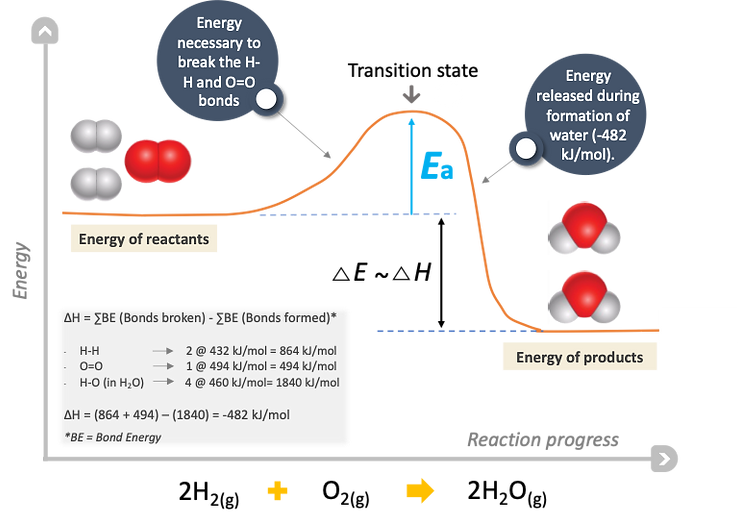
We can predict that the reaction will release substantial energy because strong O–H bonds form in the products.
Water Formation: Using Evidence
Bond energies:
H–H = 436 kJ mol⁻¹
O=O = 498 kJ mol⁻¹
O–H = 463 kJ mol⁻¹
Energy Required
2 H–H:
2 × 436 = 872
1 O=O:
498
Total:
1370 kJ mol⁻¹
Energy Released
4 O–H:
4 × 463 = 1852 kJ mol⁻¹
Since:
1852 > 1370
we predict:
exothermic
Calculate:
ΔH ≈ 1370 − 1852
ΔH ≈ −482 kJ mol⁻¹
This is a strongly exothermic reaction.
Why Does One Reaction Release More Energy Than Another?
Two exothermic reactions can release very different amounts of energy.
For example:
Reaction A:
ΔH = −50 kJ mol⁻¹
Reaction B:
ΔH = −400 kJ mol⁻¹
Both are exothermic.
However:
Reaction B releases eight times as much energy per reaction amount as written.
A larger negative ΔH means a larger net transfer of energy to the surroundings.
Comparing Exothermic Reactions
Suppose:
Reaction X:
Bond breaking = 1200 kJ mol⁻¹
Bond formation = 1500 kJ mol⁻¹
Therefore:
ΔH = −300 kJ mol⁻¹
Reaction Y:
Bond breaking = 1200 kJ mol⁻¹
Bond formation = 1900 kJ mol⁻¹
Therefore:
ΔH = −700 kJ mol⁻¹
Why does Reaction Y release more energy?
Because its product bond formation releases much more energy.
This often means the products contain a more energetically favourable set of bonds.
Strong Product Bonds Can Increase Energy Release
One reason a reaction may be strongly exothermic is the formation of very strong product bonds.
Examples of relatively strong common bonds include:
- N≡N
- C≡N
- C=O
- O–H
For the same pair of atoms, multiple bonds are generally stronger than corresponding single bonds.
However, overall reaction energetics always depend on all the bonds broken and formed, not just one bond.
Combustion Reactions
Combustion reactions are useful examples of predicting energy changes.
Consider methane:
CH₄ + 2O₂ → CO₂ + 2H₂O
Reactant bonds:
- 4 C–H
- 2 O=O
Product bonds:
- 2 C=O
- 4 O–H
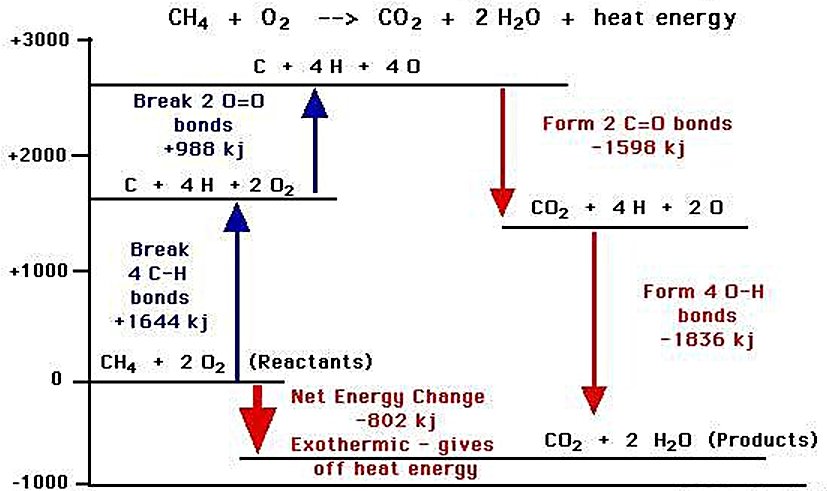
Strong C=O and O–H bonds form in the products.
Their formation releases a large amount of energy.
Why Methane Combustion Releases Energy
Using approximate values:
C–H = 413 kJ mol⁻¹
O=O = 498 kJ mol⁻¹
C=O in CO₂ ≈ 805 kJ mol⁻¹
O–H = 463 kJ mol⁻¹
Bonds Broken
4 C–H:
4 × 413 = 1652
2 O=O:
2 × 498 = 996
Total:
2648 kJ mol⁻¹
Bonds Formed
2 C=O:
2 × 805 = 1610
4 O–H:
4 × 463 = 1852
Total:
3462 kJ mol⁻¹
Therefore:
ΔH ≈ 2648 − 3462
ΔH ≈ −814 kJ mol⁻¹
The reaction is strongly exothermic.
Comparing Fuels
Suppose Fuel A releases:
−500 kJ mol⁻¹
while Fuel B releases:
−900 kJ mol⁻¹
Per mole of reaction as written, Fuel B releases more energy.
However, this does not automatically mean Fuel B is always the "better fuel."
Other comparisons might include:
- energy released per gram
- availability
- cost
- ease of storage
- combustion products
- carbon dioxide production
- safety
- environmental impact
Energy change is important evidence, but scientific evaluation often considers several types of evidence.
Energy per Mole vs Energy per Gram
Imagine:
Fuel A:
−1000 kJ mol⁻¹
Molar mass = 100 g mol⁻¹
Fuel B:
−700 kJ mol⁻¹
Molar mass = 50 g mol⁻¹
Per mole, Fuel A releases more.
But per gram:
Fuel A:
1000 ÷ 100 = 10 kJ g⁻¹
Fuel B:
700 ÷ 50 = 14 kJ g⁻¹
Therefore:
Fuel B releases more energy per gram.
This demonstrates why the basis of comparison matters.
Predicting the Energy Change of Hydrogenation
Consider:
C₂H₄ + H₂ → C₂H₆
Structurally:
H₂C=CH₂ + H–H → H₃C–CH₃
During the reaction:
- H–H is broken
- the C=C bonding arrangement changes
- a C–C bond remains
- two additional C–H bonds form
This reaction can be predicted to be exothermic using bond energies.
Evidence for Hydrogenation
Using:
C=C = 614
H–H = 436
C–C = 347
C–H = 413
Energy associated with bonds broken/replaced:
614 + 436 = 1050 kJ mol⁻¹
Energy associated with new bonds:
347 + 2(413)
= 1173 kJ mol⁻¹
Therefore:
ΔH ≈ 1050 − 1173
ΔH ≈ −123 kJ mol⁻¹
The negative value supports the prediction that hydrogenation is exothermic.
Predicting Energy Change from an Energy Profile
Sometimes no bond-energy data are provided.
Instead, you may be given a reaction profile.
To predict the energy change:
Products below reactants
Exothermic
ΔH < 0
Products above reactants
Endothermic
ΔH > 0
You do not need bond-energy calculations if the relative reactant and product energy levels are already shown.
Using Numerical Energy Levels
Suppose an energy profile shows:
Reactants = 180 kJ mol⁻¹
Products = 90 kJ mol⁻¹
Then:
ΔH = Hproducts − Hreactants
ΔH = 90 − 180
ΔH = −90 kJ mol⁻¹
Prediction:
exothermic
The reaction releases:
90 kJ mol⁻¹
Another Energy Profile Example
Suppose:
Reactants = 70 kJ mol⁻¹
Products = 150 kJ mol⁻¹
Then:
ΔH = 150 − 70
ΔH = +80 kJ mol⁻¹
Therefore:
endothermic
The system absorbs:
80 kJ mol⁻¹
Do Not Use Activation Energy to Predict Exothermic or Endothermic
Consider this reaction profile:
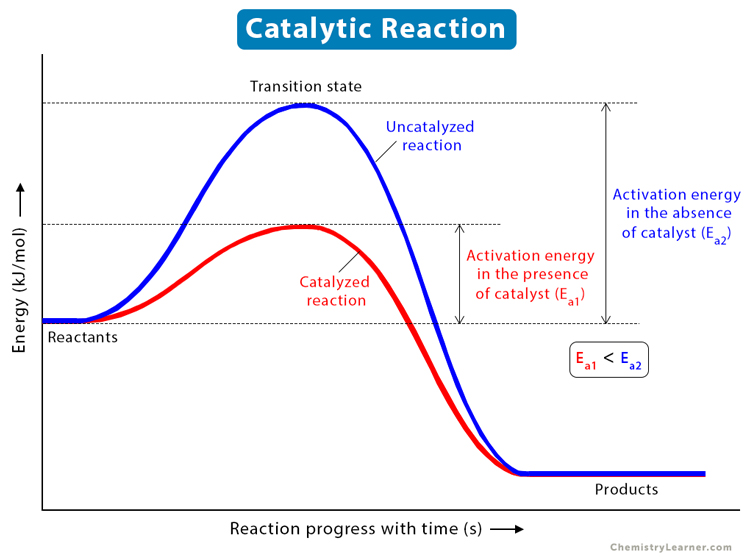
The height of the peak represents activation energy.
The difference between the reactant and product energy levels represents ΔH.
These are not the same thing.
A reaction could have:
- high activation energy and be exothermic
- low activation energy and be exothermic
- high activation energy and be endothermic
- low activation energy and be endothermic
The activation barrier does not determine whether the overall reaction releases or absorbs energy.
Catalyst vs Overall Energy Change
A catalyst lowers activation energy by providing an alternative reaction pathway.
However, it does not change:
- reactants
- products
- reactant energy
- product energy
- ΔH
- whether the reaction is exothermic or endothermic
Therefore:
a catalyst can change reaction rate without changing the overall energy change.
Energy Change Does Not Tell Us Reaction Rate
Consider:
Reaction A:
ΔH = −500 kJ mol⁻¹
Reaction B:
ΔH = −100 kJ mol⁻¹
We know Reaction A releases more energy.
But we cannot conclude that Reaction A is faster.
Reaction speed depends on kinetic factors such as:
- activation energy
- temperature
- concentration
- pressure
- surface area
- catalysts
- reaction mechanism
An energetically favourable reaction can still occur extremely slowly.
The N≡N Bond: An Important Example
Nitrogen gas contains a very strong:
N≡N triple bond
with an average bond energy of approximately:
945 kJ mol⁻¹
Breaking this bond requires a very large amount of energy.
This helps explain why N₂ is relatively unreactive under ordinary conditions.
Predicting the Energy Change of Ammonia Formation
The Haber reaction is:
N₂ + 3H₂ ⇌ 2NH₃
Reactant bonds:
- 1 N≡N
- 3 H–H
Product bonds:
- 6 N–H
Because the N≡N bond is extremely strong, a great deal of energy is needed initially to disrupt nitrogen.
But six N–H bonds are formed.
Bond-Energy Evidence for Ammonia Formation
Use:
N≡N = 945 kJ mol⁻¹
H–H = 436 kJ mol⁻¹
N–H = 391 kJ mol⁻¹
Energy Required
945 + 3(436)
= 945 + 1308
= 2253 kJ mol⁻¹
Energy Released
6(391)
= 2346 kJ mol⁻¹
Therefore:
ΔH ≈ 2253 − 2346
ΔH ≈ −93 kJ mol⁻¹
Prediction:
exothermic
The calculation supports that prediction.
Evidence Can Come from Temperature Changes
Bond-energy calculations are not the only evidence we can use.
Suppose a reaction starts at:
22°C
and the surroundings rise to:
37°C
This temperature increase suggests energy has been transferred from the chemical system to the surroundings.
Therefore, the reaction is likely:
exothermic
If the surroundings cool instead, the reaction may be:
endothermic
However, careful experimental controls are needed before drawing firm conclusions.
Calorimetry
Chemists can measure energy changes experimentally using calorimetry.
A simple calorimetry experiment often measures the temperature change of water or a solution.
The thermal energy transferred can be estimated using:
q = mcΔT
where:
q = thermal energy transferred
m = mass
c = specific heat capacity
ΔT = temperature change
This gives experimental evidence that can be compared with predictions based on bond energies.
Predictions vs Experimental Evidence
Suppose a bond-energy calculation predicts:
ΔH ≈ −210 kJ mol⁻¹
An experiment measures:
ΔH = −195 kJ mol⁻¹
The values are not identical, but both provide the same energetic conclusion:
the reaction is exothermic
The difference may arise because average bond energies are approximate.
Why Average Bond Energies Limit Predictions
Bond-energy values are often averages.
For example, a C–H bond in one molecule does not necessarily have exactly the same energy as a C–H bond in another molecule.
The exact bond strength depends partly on the surrounding molecular environment.
Therefore, bond-energy calculations give:
estimated ΔH
rather than an exact experimental value.
Phase Changes Can Also Matter
Average bond energies generally refer to gaseous molecules.
Real reactions may involve:
- liquids
- gases
- solids
- aqueous solutions
Intermolecular forces and phase changes also involve energy.
Therefore, predictions based only on average covalent bond energies may differ from experimental values.
This does not make the calculation useless.
It means the result should be interpreted as an estimate.
Evaluating Evidence
Suppose three pieces of evidence are available:
Bond-energy prediction: ΔH ≈ −185 kJ mol⁻¹
Measured calorimetry value: ΔH ≈ −170 kJ mol⁻¹
Observed temperature: surroundings warm noticeably
All three pieces of evidence support the conclusion:
the reaction is exothermic
Strong scientific conclusions usually come from multiple forms of consistent evidence.
What If the Evidence Disagrees?
Suppose:
Bond-energy prediction:
ΔH ≈ −10 kJ mol⁻¹
Experiment:
ΔH = +5 kJ mol⁻¹
These values are both close to zero.
Because average bond energies are approximate, this difference may not be surprising.
The prediction should therefore be treated cautiously.
A calculated ΔH of:
−500 kJ mol⁻¹
provides much stronger evidence for a strongly exothermic reaction than a calculated value of:
−2 kJ mol⁻¹
when average data are being used.
Comparing Reactions Using ΔH
Suppose:
Reaction A:
ΔH = +140 kJ mol⁻¹
Reaction B:
ΔH = −80 kJ mol⁻¹
Reaction C:
ΔH = −350 kJ mol⁻¹
We can conclude:
Reaction A is:
endothermic
Reaction B is:
exothermic
Reaction C is:
exothermic
Of the exothermic reactions:
Reaction C releases more energy per mole of reaction as written.
Ranking Reactions by Energy Release
Suppose:
A = −40 kJ mol⁻¹
B = −320 kJ mol⁻¹
C = −125 kJ mol⁻¹
Rank from greatest energy release to least:
B > C > A
Be careful:
−320 is numerically smaller than −40 on a number line, but its magnitude is larger.
Therefore, it represents a greater energy release.
Predicting Without Exact Calculations
Sometimes a qualitative prediction is enough.
Suppose Reaction A breaks:
weak bonds
and forms:
very strong bonds
Prediction:
likely strongly exothermic
Suppose Reaction B breaks:
very strong bonds
and forms:
weaker bonds
Prediction:
likely endothermic
However, quantitative bond-energy data provide stronger evidence.
Worked Example: Evidence-Based Prediction
A hypothetical reaction breaks:
2 A–A bonds at 250 kJ mol⁻¹
and forms:
2 A–B bonds at 450 kJ mol⁻¹
Breaking
2 × 250 = 500 kJ mol⁻¹
Forming
2 × 450 = 900 kJ mol⁻¹
Therefore:
ΔH = 500 − 900
ΔH = −400 kJ mol⁻¹
Conclusion:
The reaction is predicted to be strongly exothermic because formation of the product bonds releases 400 kJ mol⁻¹ more energy than is required to break the reactant bonds.
This is a much stronger answer than simply stating "exothermic."
Worked Example: Endothermic Prediction
Suppose:
3 X–X bonds are broken at:
300 kJ mol⁻¹ each
and:
2 X–Y bonds form at:
350 kJ mol⁻¹ each
Energy required:
3 × 300 = 900 kJ mol⁻¹
Energy released:
2 × 350 = 700 kJ mol⁻¹
Therefore:
ΔH = 900 − 700
ΔH = +200 kJ mol⁻¹
Conclusion:
The reaction is endothermic because 200 kJ mol⁻¹ more energy is required for bond breaking than is released through bond formation.
Reaction Energetics and Stability
Energy changes can also tell us something about the relative energies of reactants and products.
For an exothermic reaction:
products are lower in energy
than:
reactants
For an endothermic reaction:
products are higher in energy
than:
reactants
In this energetic sense, lower-energy chemical arrangements are generally more stable relative to the specified higher-energy arrangement.
Exothermic Does Not Mean Spontaneous
A reaction being exothermic does not guarantee that it will immediately occur.
For example, hydrogen and oxygen can coexist without instantly reacting.
The reaction is strongly exothermic, but an activation-energy barrier must first be overcome.
This is why an ignition source may be necessary even for a reaction that eventually releases a large amount of energy.
Energy Change Is Not the Whole Story
When evaluating a reaction, chemists may consider:
Thermodynamics
What is the energy change?
Kinetics
How quickly does the reaction occur?
Practical factors
What temperature and pressure are required?
Environmental factors
What products and waste are produced?
Economic factors
What energy, equipment and materials are required?
A large negative ΔH may be useful, but it is not the only factor determining whether a reaction is practical.
Real-World Example: Fuels
When comparing fuels, energy change is extremely important.
A useful fuel should release significant energy when it reacts with oxygen.
Hydrocarbon fuels generally form:
CO₂
and:
H₂O
during complete combustion.
The strong bonds formed in these products help make many combustion reactions strongly exothermic.
However, environmental impacts such as carbon dioxide production also need to be considered.
Real-World Example: Cold Packs
Some instant cold packs use processes that absorb energy from their surroundings.
As the process occurs:
energy enters the chemical system
The surroundings lose thermal energy and cool.
Therefore:
ΔH > 0
The process is endothermic.
The observed temperature decrease provides experimental evidence supporting the energetic prediction.
Real-World Example: Hand Warmers
Many disposable hand warmers rely on an oxidation reaction.
Energy is transferred from the chemical system to the surroundings.
The surroundings become warmer.
Therefore:
ΔH < 0
The reaction is exothermic.
Again, temperature change provides observable evidence about the direction of energy transfer.
Four Ways to Predict Energy Change
You may encounter four main types of evidence.
1. Bond energies
Calculate:
broken − formed
2. Reaction profiles
Compare product and reactant energy levels.
3. ΔH data
Negative = exothermic.
Positive = endothermic.
4. Experimental temperature change
Surroundings warm → often exothermic.
Surroundings cool → often endothermic.
Using several forms of evidence gives greater confidence in a conclusion.
A Prediction Checklist
Before deciding whether a reaction is exothermic or endothermic, ask:
What bonds are broken?
How much energy is required?
What bonds form?
How much energy is released?
Which total is greater?
What sign should ΔH have?
Does the energy profile support the prediction?
Does experimental evidence support the prediction?
This produces a complete, evidence-based energetic analysis.
Common Misconceptions
"If strong bonds are broken, lots of energy is released."
Incorrect.
Strong bonds require more energy to break.
"A reaction containing strong bonds must be exothermic."
Incorrect.
We must compare the complete set of bonds broken and bonds formed.
"A more exothermic reaction must be faster."
Incorrect.
Reaction rate depends on activation energy and other kinetic factors.
"A high activation energy means the reaction is endothermic."
Incorrect.
Activation energy and ΔH measure different things.
"A catalyst makes a reaction more exothermic."
Incorrect.
A catalyst lowers activation energy but does not change ΔH.
"If products contain more bonds, the reaction must release more energy."
Not necessarily.
The types and strengths of the bonds matter, not just the number.
"Bond-energy predictions are exact."
Incorrect.
Average bond energies normally provide estimates.
Did You Know?
An exothermic reaction can have an enormous energy release and still require energy to start.
Hydrogen combustion is a good example:
2H₂ + O₂ → 2H₂O
The reaction releases a large amount of energy overall, yet hydrogen and oxygen do not necessarily react rapidly at room temperature without an ignition source.
The initial energy is needed to overcome the activation-energy barrier.
Once the reaction proceeds, forming strong O–H bonds releases substantially more energy than was required overall for bond breaking.
This illustrates the difference between:
whether a reaction releases energy
and:
how easily a reaction begins.
Key Terms
Exothermic reaction – A reaction that transfers energy from the system to the surroundings.
Endothermic reaction – A reaction that absorbs energy from the surroundings.
Bond energy – Energy required to break one mole of a particular type of bond in gaseous molecules.
Enthalpy change, ΔH – The overall energy change associated with a reaction at constant pressure.
Energy profile – A diagram showing how the energy of a chemical system changes along a reaction pathway.
Activation energy – The energy barrier that must be overcome for a reaction to proceed.
Prediction – A statement about an expected result based on scientific reasoning or evidence.
Evidence – Information or data used to support a scientific conclusion.
Average bond energy – An average energy required to break a particular type of bond across different molecular environments.
Key Takeaways
- Reactions can be predicted to be exothermic or endothermic by comparing bond-breaking and bond-forming energies.
- Breaking bonds requires energy.
- Forming bonds releases energy.
- Use:
ΔH ≈ ΣE(bonds broken) − ΣE(bonds formed)
- If bond formation releases more energy than bond breaking requires:
ΔH < 0 → exothermic
- If bond breaking requires more energy than bond formation releases:
ΔH > 0 → endothermic
- A larger negative ΔH represents a greater net energy release per reaction amount as written.
- Strong product bonds can contribute to a large energy release.
- The complete set of reactant and product bonds must be considered.
- Energy profiles can also be used to predict energy changes.
- Products below reactants indicate an exothermic reaction.
- Products above reactants indicate an endothermic reaction.
- Activation energy does not determine whether a reaction is exothermic or endothermic.
- A catalyst changes activation energy but not ΔH.
- A more exothermic reaction is not necessarily a faster reaction.
- Average bond energies provide useful but approximate predictions.
- Experimental evidence such as calorimetry and temperature changes can be used to test predictions.
- Strong scientific conclusions should be supported with numerical data, diagrams, calculations or experimental observations, rather than simply stating that a reaction "looks exothermic" or "looks endothermic."