Bond Energies and Energy Calculations
| Сайт: | Young Education |
| Курс: | Chemical Energetics |
| Книга: | Bond Energies and Energy Calculations |
| Надруковано: | ゲストユーザ |
| Дата: | понеділок 5 жовтня 2026 03:04 AM |
1. Breaking Chemical Bonds
Learning Outcomes
- I can explain why breaking chemical bonds requires energy.
- I can describe bond breaking as an endothermic process.
- I can interpret bond energy values.
- I can compare the strengths of different chemical bonds.
- I can explain the role of bond breaking in chemical reactions.
What Is a Chemical Bond?
A chemical bond is an attractive interaction that holds atoms or ions together.
In a covalent bond, electrons are shared between atoms. The positively charged nuclei are attracted to the shared electrons, helping hold the atoms together.
Because bonded atoms attract one another, separating them requires energy.
The central idea for this topic is:
Breaking bonds requires energy.
Therefore:
bond breaking = endothermic
This is one of the most important rules in chemical energetics.
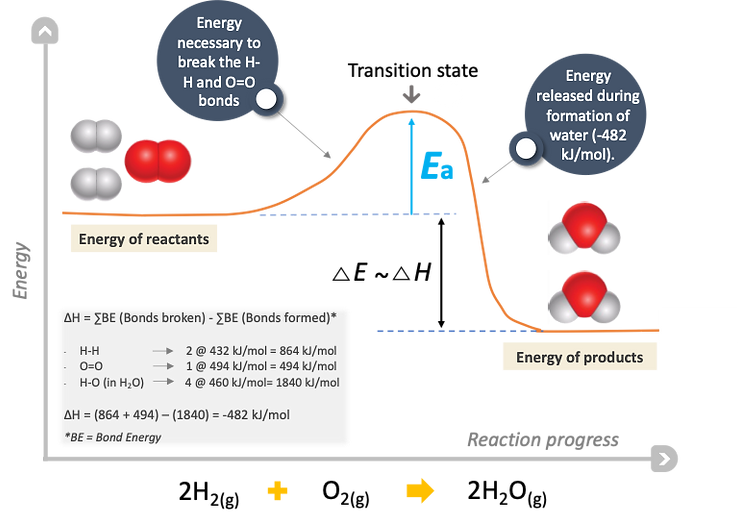
If the image above does not load from the source, the potential-energy diagram below shows the same principle particularly clearly.
Why Does Breaking a Bond Require Energy?
Imagine two atoms joined by a chemical bond.
At the normal bond distance, attractive interactions hold the atoms together. To separate the atoms, we must work against these attractions.
That requires an input of energy.
As the atoms move farther apart, the potential energy of the system increases until the atoms are effectively separated.
Therefore:
bonded atoms + energy → separated atoms
The chemical system has gained energy.
That is why bond breaking is an endothermic process.
Notice the upward arrow labelled energy absorbed when bond breaks. Moving upward out of the potential-energy well requires energy.
The Potential-Energy Well
A useful way of understanding a chemical bond is to imagine the bonded atoms sitting in an energy well.
At the bottom of the well, the atoms are at their most stable separation.
To separate them completely, energy must be supplied to move the system out of the well.
For the H–H bond, the minimum occurs at a bond length of approximately 74 pm.
The vertical distance from the minimum to the separated-atoms energy level represents the bond dissociation energy. For H₂, this is about 436 kJ mol⁻¹.
A useful general rule is:
deeper energy well → more energy required to escape → stronger bond
Bond Breaking Is Endothermic
An endothermic process absorbs energy from its surroundings.
Breaking a chemical bond requires exactly this kind of energy input.
For example:
H₂(g) → 2H(g)
requires approximately:
+436 kJ mol⁻¹
The positive value indicates that energy has entered the chemical system.
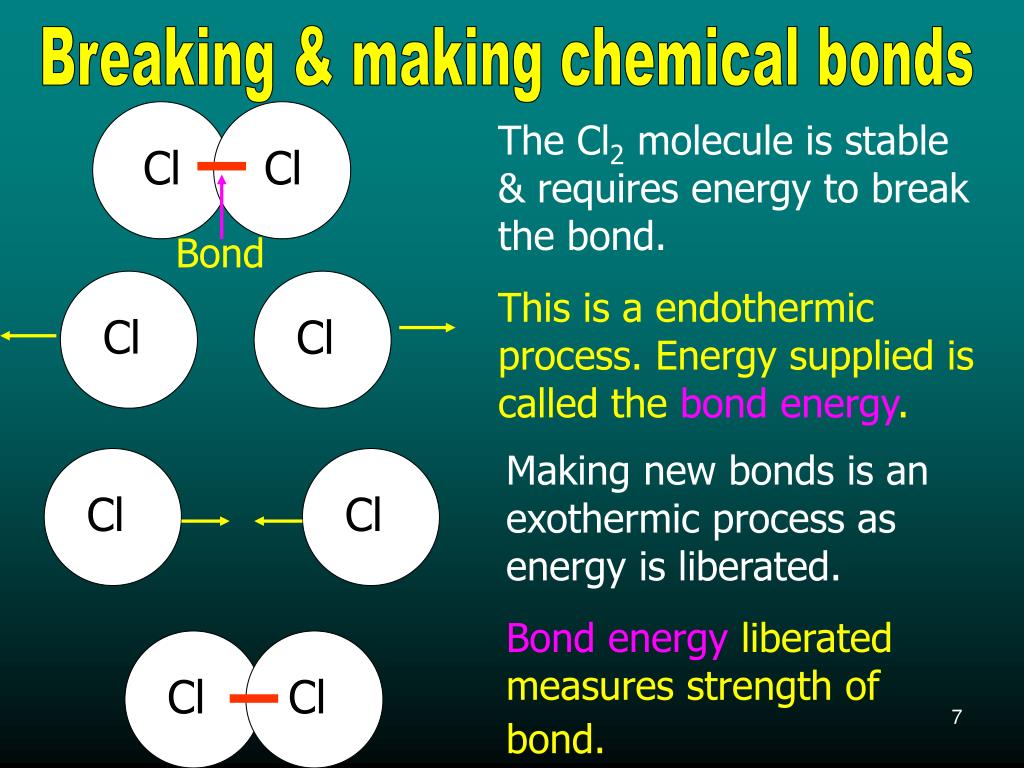
The same principle applies to every covalent bond:
A–B + energy → A + B
Bond breaking always requires energy.
Bond Breaking and Bond Formation Are Opposites
Now imagine the reverse process.
Instead of separating bonded atoms, two separated atoms move together and form a bond.
When the bond forms, the system moves into a lower-energy, more stable arrangement.
Energy is released to the surroundings.
Therefore:
Breaking bonds → energy absorbed
Forming bonds → energy released
For hydrogen:
H₂ → 2H
requires approximately:
+436 kJ mol⁻¹
The reverse process:
2H → H₂
releases approximately:
−436 kJ mol⁻¹
Bond breaking and bond formation are opposite processes.
A Very Important Misconception
One of the most common mistakes in chemical energetics is saying:
"Breaking bonds releases energy."
It does not.
Breaking bonds always requires energy.
Students sometimes develop this misconception because reactions such as combustion release large amounts of energy.
But the energy released by combustion does not come from breaking the reactant bonds.
During a reaction:
Energy IN → break reactant bonds
Energy OUT → form product bonds
If more energy is released during bond formation than was required for bond breaking, the overall reaction is exothermic.
This distinction becomes extremely important when we begin calculating reaction energies.
What Is Bond Energy?
The strength of a covalent bond can be described using its bond energy.
Bond energy is the energy required to break one mole of a particular type of covalent bond in gaseous molecules.
Bond energies are usually expressed in:
kJ mol⁻¹
For example:
H–H = 436 kJ mol⁻¹
This means approximately 436 kJ of energy must be supplied to break one mole of H–H bonds.
The stronger the bond, the more energy is required to break it.
Therefore:
large bond energy → strong bond
small bond energy → weaker bond
Interpreting Bond Energy Values
Consider some approximate average bond energies:
| Bond | Average Bond Energy (kJ mol⁻¹) |
|---|---|
| Cl–Cl | 243 |
| C–C | 345 |
| C–H | 413 |
| H–Cl | 431 |
| H–H | 436 |
| O–H | 463 |
| O=O | 498 |
| C=C | 611 |
| C≡C | 837 |
| N≡N | 945 |
Bond-energy values allow us to compare the strengths of different bonds.
For example:
N≡N = 945 kJ mol⁻¹
while:
Cl–Cl = 243 kJ mol⁻¹
Much more energy is required to break the N≡N bond.
Therefore:
N≡N is much stronger than Cl–Cl.
What Does 436 kJ mol⁻¹ Actually Mean?
Consider hydrogen gas.
Each H₂ molecule contains one H–H bond.
H–H bond energy ≈ 436 kJ mol⁻¹
Therefore:
H₂(g) → 2H(g)
requires:
436 kJ for every mole of H–H bonds broken
The bond-energy value is positive when describing bond breaking because energy must be supplied.
Average Bond Energies
Many bond-energy tables actually contain average bond energies.
A particular bond type does not have exactly the same strength in every molecule.
For example, the energy required to break a C–H bond depends somewhat on the other atoms surrounding that bond.
Chemists therefore use average values obtained from many compounds.
This is why calculations using average bond energies usually provide an estimate of the reaction enthalpy rather than a perfectly exact value.
Comparing Single, Double and Triple Bonds
Bond order affects bond strength.
Consider carbon-carbon bonds:
C–C ≈ 345 kJ mol⁻¹
C=C ≈ 611 kJ mol⁻¹
C≡C ≈ 837 kJ mol⁻¹
Therefore:
C≡C > C=C > C–C
in bond strength.
In general, for bonds between the same pair of elements:
single bond → weaker
double bond → stronger
triple bond → strongest
However, a double bond is not exactly twice as strong as a single bond, and a triple bond is not exactly three times as strong.
Bond Strength and Bond Length
Bond strength is also related to bond length.
For carbon-carbon bonds, approximate values are:
| Bond | Bond Length | Bond Energy |
|---|---|---|
| C–C | 1.54 Å | 345 kJ mol⁻¹ |
| C=C | 1.34 Å | 611 kJ mol⁻¹ |
| C≡C | 1.20 Å | 837 kJ mol⁻¹ |
As bond order increases:
bond length decreases
and:
bond strength increases.
So the overall trend is:
C–C → longest and weakest
C=C → shorter and stronger
C≡C → shortest and strongest
The bond length corresponds to the stable separation of the two nuclei near the bottom of the energy well.
Why Is the N≡N Bond So Strong?
Nitrogen gas consists of two nitrogen atoms joined by a triple covalent bond:
N≡N
Its bond energy is approximately:
945 kJ mol⁻¹
This is one of the strongest common covalent bonds.
A large amount of energy must therefore be supplied to separate the nitrogen atoms.
The strength of this bond helps explain why atmospheric nitrogen is relatively unreactive under ordinary conditions.
Strong Bonds Require More Energy to Break
Imagine two bonds:
Bond A = 250 kJ mol⁻¹
Bond B = 700 kJ mol⁻¹
Bond B requires much more energy to break.
Therefore:
Bond B is stronger.
The difference is:
700 − 250 = 450 kJ mol⁻¹
So breaking one mole of Bond B requires 450 kJ more energy than breaking one mole of Bond A.
This gives us a simple way of interpreting bond-energy tables:
higher number = stronger bond
Worked Example 1: Breaking Hydrogen Bonds
Consider:
H₂ → 2H
One H–H bond must be broken.
H–H bond energy:
436 kJ mol⁻¹
Therefore:
Energy required = 436 kJ mol⁻¹
Because energy enters the system:
ΔH = +436 kJ mol⁻¹
The process is:
endothermic
Worked Example 2: Breaking Chlorine Bonds
Consider:
Cl₂ → 2Cl
Cl–Cl bond energy:
243 kJ mol⁻¹
Therefore:
Energy required = 243 kJ mol⁻¹
So:
ΔH = +243 kJ mol⁻¹
Again:
bond breaking is endothermic
Comparing H–H and Cl–Cl
H–H:
436 kJ mol⁻¹
Cl–Cl:
243 kJ mol⁻¹
Which bond is stronger?
H–H
Which requires more energy to break?
H–H
Difference:
436 − 243 = 193 kJ mol⁻¹
Therefore, approximately 193 kJ mol⁻¹ more energy is required to break H–H bonds than Cl–Cl bonds.
Breaking Several Bonds
Chemical reactions often require many bonds to be broken.
If several bonds must be broken, their energies can be added.
Suppose we need to break:
2 C–H bonds
and:
1 C–C bond
Using:
C–H = 413 kJ mol⁻¹
C–C = 345 kJ mol⁻¹
Energy required:
2(413) + 345
= 826 + 345
= 1171 kJ mol⁻¹
Because these bonds are being broken, this represents an energy input.
Bond Breaking During Chemical Reactions
Chemical reactions rearrange atoms.
Existing bonds in the reactants are disrupted, and new bonds form to produce the products.
A simplified reaction might be represented as:
AB + CD → AC + BD
First:
A–B and C–D bonds are broken
Energy is required.
Then:
A–C and B–D bonds form
Energy is released.
The overall energy change depends on the balance between these two processes.
The Energy Balance of a Reaction
The overall reaction energy can be estimated using:
ΔH ≈ ΣE(bonds broken) − ΣE(bonds formed)
In words:
reaction energy = energy required to break bonds − energy released when bonds form
If breaking bonds requires more energy than bond formation releases:
ΔH > 0
The reaction is:
endothermic
If forming bonds releases more energy than was required for bond breaking:
ΔH < 0
The reaction is:
exothermic
Example: Combustion of Methane
Consider the combustion of methane:
CH₄ + 2O₂ → CO₂ + 2H₂O
This reaction involves both breaking and forming bonds.
Before the products can form, bonds in the reactants must be disrupted.
These include:
C–H bonds in CH₄
and:
O=O bonds in O₂
Breaking these bonds requires energy.
Then new bonds form:
C=O bonds in CO₂
and:
O–H bonds in H₂O
Forming these bonds releases energy.
More energy is released when the product bonds form than is required overall to break the reactant bonds.
Therefore methane combustion is exothermic.
But notice:
breaking the bonds was still endothermic.
The overall reaction becomes exothermic because of the energy released during bond formation.
Where Does the Energy of Combustion Come From?
It is tempting to say that fuels contain bonds that "release energy when broken."
That explanation is misleading.
Breaking the C–H bonds in methane requires energy.
Breaking O=O bonds also requires energy.
The large energy release occurs because the products contain a very stable set of bonds, particularly strong C=O and O–H bonds.
Formation of these product bonds releases a large amount of energy.
So:
energy absorbed breaking reactant bonds
is smaller than:
energy released forming product bonds
The difference is transferred to the surroundings.
Bond Breaking and Activation Energy
Bond breaking also helps us understand activation energy.
At the beginning of many reactions, existing bonds must stretch, distort or partially break as the reacting particles move toward the transition state.
This requires energy.
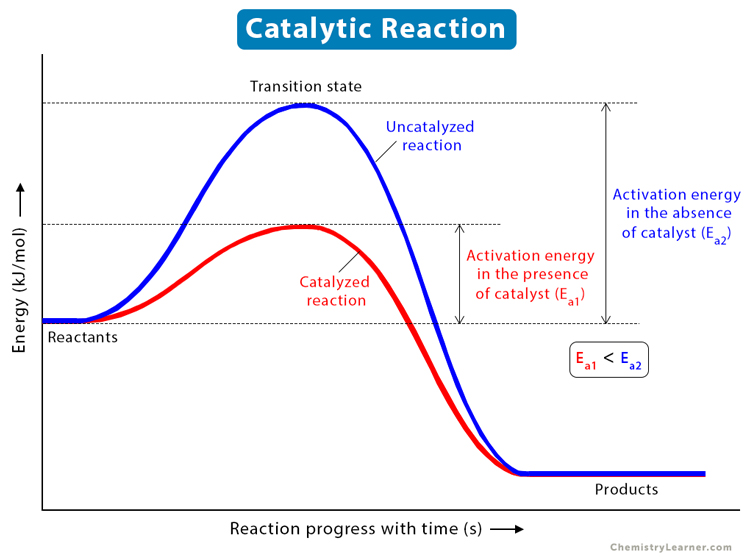
The reaction profile therefore initially rises toward the transition state.
However, there is an important distinction:
Activation energy is not simply the energy required to completely break every bond in the reactants.
Activation energy is the energy barrier required to reach the transition state.
Some bonds may only be partially broken at this point while new interactions may already be developing.
Bonds and Molecular Stability
Strong bonds generally require large amounts of energy to break.
This can contribute to the stability of molecules.
For example, the very strong N≡N bond helps make nitrogen gas relatively unreactive.
However, we should not judge the reactivity of an entire substance from just one bond.
Reactivity also depends on:
- all the bonds involved
- molecular structure
- possible products
- temperature
- reaction mechanism
- catalysts
- activation energy
Bond energy is therefore one important part of understanding chemical reactions.
Energy Is Conserved
Energy is not created or destroyed during a chemical reaction.
Instead, energy is transferred and transformed.
During bond breaking:
energy enters the chemical system
During bond formation:
energy leaves the chemical system
The overall reaction energy depends on the difference between these transfers.
This is an application of the law of conservation of energy.
Did You Know?
The N≡N bond in nitrogen gas has an average bond energy of about:
945 kJ mol⁻¹
That enormous bond strength creates an interesting biological problem.
Earth's atmosphere contains a huge amount of nitrogen gas, but most organisms cannot directly use N₂ because breaking and rearranging the N≡N bond is difficult.
Special processes called nitrogen fixation convert atmospheric nitrogen into compounds that living organisms can use.
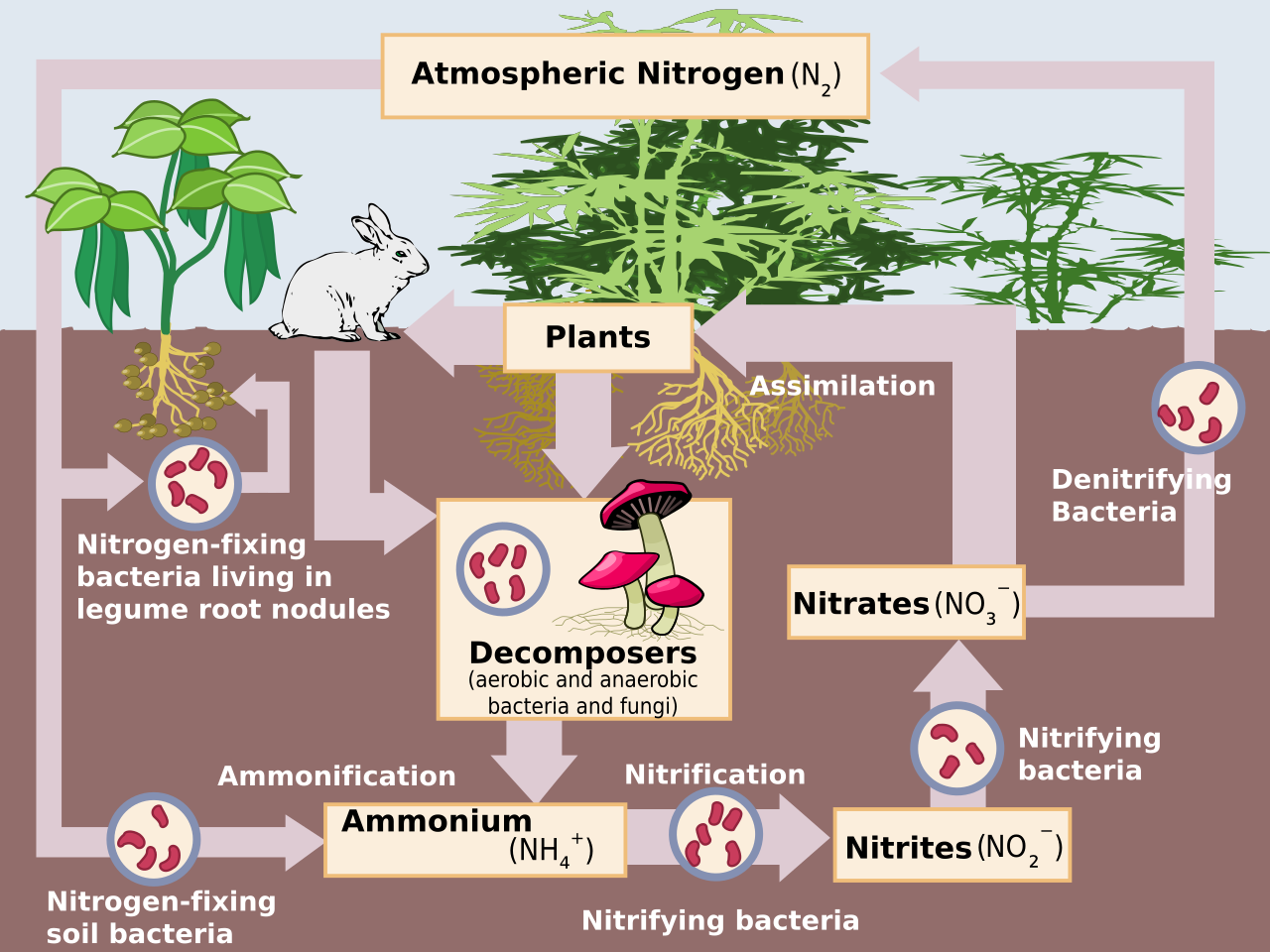
This is why nitrogen-fixing bacteria are so important in ecosystems and agriculture.
Common Misconceptions
"Breaking bonds releases energy."
Incorrect. Breaking bonds requires energy.
"Strong bonds contain more energy, so they release more energy when broken."
Incorrect. Strong bonds require more energy to break.
"A double bond requires exactly twice the energy of a single bond."
Incorrect. Bond energies do not increase in simple whole-number ratios.
"Bond energy is identical in every molecule."
Not usually. Many tabulated values are average bond energies because the molecular environment affects bond strength.
"If a reaction releases energy, breaking the reactant bonds must have released it."
Incorrect. Bond breaking absorbs energy. Energy is released when new bonds form.
"Activation energy is the energy needed to completely break every bond in the reactants."
Incorrect. Activation energy is the barrier to reaching the transition state.
Key Terms
Chemical bond – An attractive interaction that holds atoms or ions together.
Bond breaking – Separation of bonded atoms, requiring an input of energy.
Endothermic process – A process in which the system absorbs energy.
Bond energy – Energy required to break one mole of a particular type of covalent bond in gaseous molecules.
Average bond energy – An average energy required to break a particular bond type across different molecular environments.
Bond strength – A measure of how strongly two atoms are held together.
Bond length – The equilibrium distance between the nuclei of two bonded atoms.
Bond order – The number of bonding interactions between two atoms, such as single, double or triple.
Activation energy – The energy barrier that must be overcome for a reaction to proceed.
Transition state – A temporary high-energy arrangement of atoms along a reaction pathway.
Key Takeaways
- Breaking chemical bonds requires energy.
- Bond breaking is an endothermic process.
- Energy must be supplied to overcome the attractive interactions holding bonded atoms together.
- Bond formation releases energy.
- Bond energy is usually measured in kJ mol⁻¹.
- A larger bond energy generally indicates a stronger bond.
- Stronger bonds require more energy to break.
- Average bond energies are approximations because bond strength depends somewhat on molecular environment.
- For the same pair of atoms, triple bonds are generally stronger and shorter than double bonds, which are generally stronger and shorter than single bonds.
- Chemical reactions involve both breaking reactant bonds and forming product bonds.
- The overall energy change can be estimated using:
ΔH ≈ ΣE(bonds broken) − ΣE(bonds formed)
- Exothermic reactions do not release energy because bonds are broken.
- They release energy overall when forming the new bonds releases more energy than breaking the original bonds requires.
- Bond breaking and bond distortion contribute to the energy requirements involved in reaching a reaction's transition state.
2. Forming Chemical Bonds
Learning outcomes
- I can explain why bond formation releases energy.
- I can describe bond formation as an exothermic process.
- I can compare energy released by different bonds.
- I can explain the role of bond formation in reactions.
- I can relate bond formation to overall energy changes.
What Happens When a Chemical Bond Forms?
A chemical bond forms when atoms or ions become attracted strongly enough to create a more stable arrangement.
When two atoms that can bond move toward one another, attractive interactions between their nuclei and electrons lower the potential energy of the system.
The atoms move from a:
higher-energy, less stable arrangement
to a:
lower-energy, more stable arrangement
The difference in energy is transferred to the surroundings.
Therefore:
forming bonds releases energy
and:
bond formation is exothermic.
Why Does Bond Formation Release Energy?
Consider two atoms that are initially far apart.
When they are far apart, there is little attractive interaction between them.
As they approach one another, attractive forces develop between:
- each positively charged nucleus
- the electrons associated with the other atom
If the atoms are at an appropriate distance, these attractions lower the potential energy of the system.
The atoms become more stable.
The decrease in potential energy must appear somewhere else.
It is released to the surroundings, often as thermal energy.
Therefore:
separated atoms → bonded atoms + energy
or more generally:
A + B → A–B + energy
The bottom of the energy well represents the most stable bond distance. Moving into that lower-energy state releases energy.
Bond Formation Is Exothermic
An exothermic process transfers energy from the chemical system to its surroundings.
Because bond formation lowers the potential energy of the atoms, energy leaves the system.
Therefore:
bond formation → exothermic
The enthalpy change associated with forming a bond is negative.
For example:
2H(g) → H₂(g)
releases approximately:
436 kJ mol⁻¹
We can express the energy change as approximately:
ΔH = −436 kJ mol⁻¹
The negative sign indicates that energy has been released from the chemical system.
Bond Breaking and Bond Formation Are Opposites
The two processes can be compared directly.
Bond breaking:
A–B + energy → A + B
Energy absorbed
Endothermic
Bond formation:
A + B → A–B + energy
Energy released
Exothermic
The amount of energy required to break a particular bond is approximately equal in magnitude to the energy released when that same bond forms under corresponding conditions.
For example:
H₂ → 2H
requires approximately:
+436 kJ mol⁻¹
while:
2H → H₂
releases approximately:
−436 kJ mol⁻¹.
Why Is the Bonded State More Stable?
In chemistry, a system tends to be more stable when it has lower potential energy.
Consider a ball rolling downhill.
At the top of a hill, it has relatively high gravitational potential energy.
At the bottom, it has lower potential energy and is more stable.
Bond formation is similar.
Separated atoms begin at a higher potential energy.
As a stable bond forms, the system moves to a lower potential energy.
The energy difference is transferred to the surroundings.
This is why we can summarize bond formation as:
higher energy → lower energy + released energy
Bond Energy and Bond Formation
A bond energy is commonly defined as the energy required to break one mole of a particular type of bond in gaseous molecules.
Bond energy can also tell us approximately how much energy is released when that bond forms.
For example:
H–H bond energy ≈ 436 kJ mol⁻¹
Breaking H–H:
+436 kJ mol⁻¹
Forming H–H:
−436 kJ mol⁻¹
The magnitudes are approximately the same, but the direction of energy transfer is opposite.
Stronger Bonds Release More Energy When They Form
A stronger bond has a greater bond energy.
Therefore, forming a stronger bond generally releases more energy than forming a weaker comparable bond.
Consider these approximate average bond energies:
| Bond | Average Bond Energy (kJ mol⁻¹) |
|---|---|
| Cl–Cl | 243 |
| C–C | 345 |
| C–H | 413 |
| H–H | 436 |
| O–H | 463 |
| O=O | 498 |
| C=C | 611 |
| C≡C | 837 |
| N≡N | 945 |
If one mole of N≡N bonds forms from separated nitrogen atoms, a very large amount of energy is released because the N≡N bond is extremely strong.
If one mole of Cl–Cl bonds forms, less energy is released.
Therefore:
stronger bond → larger energy release when formed
and:
weaker bond → smaller energy release when formed
Single, Double and Triple Bonds
For bonds between the same kinds of atoms, bond order usually affects bond strength.
Consider carbon-carbon bonds:
C–C ≈ 345 kJ mol⁻¹
C=C ≈ 611 kJ mol⁻¹
C≡C ≈ 837 kJ mol⁻¹
So:
C≡C > C=C > C–C
in bond strength.
Because stronger bonds correspond to a greater lowering of potential energy when formed, forming stronger bonds generally releases more energy.
However, a double bond is not simply twice as strong as a single bond, and a triple bond is not exactly three times as strong.
Bond Strength and Bond Length
Bond strength is also related to bond length.
For carbon-carbon bonds:
| Bond | Approximate Bond Length | Average Bond Energy |
|---|---|---|
| C–C | 154 pm | 345 kJ mol⁻¹ |
| C=C | 134 pm | 611 kJ mol⁻¹ |
| C≡C | 120 pm | 837 kJ mol⁻¹ |
For the same pair of atoms:
shorter bonds are generally stronger
and:
stronger bonds release more energy when they form
Worked Example 1: Forming Hydrogen
Two separated hydrogen atoms combine:
H(g) + H(g) → H₂(g)
The H–H bond energy is approximately:
436 kJ mol⁻¹
Therefore, forming one mole of H–H bonds releases approximately:
436 kJ
The energy change can be written as:
ΔH ≈ −436 kJ mol⁻¹
The negative sign indicates an exothermic process.
Worked Example 2: Comparing Bond Formation
Suppose Bond A has a bond energy of:
250 kJ mol⁻¹
and Bond B has a bond energy of:
600 kJ mol⁻¹
Which bond releases more energy when formed?
Bond B
Approximately:
600 − 250 = 350 kJ mol⁻¹
more energy would be released when one mole of Bond B forms compared with one mole of Bond A.
Bond B is also the stronger bond.
Bond Formation During a Chemical Reaction
Chemical reactions involve rearranging atoms.
Existing bonds in the reactants are disrupted, while new bonds form in the products.
A simplified reaction might be:
AB + CD → AC + BD
During the first part:
A–B and C–D are broken
Energy is absorbed.
During the second part:
A–C and B–D are formed
Energy is released.
The overall reaction energy depends on the balance between these two energy changes.
The Overall Energy Change
The enthalpy change of a reaction can be estimated from bond energies using:
ΔH ≈ ΣE(bonds broken) − ΣE(bonds formed)
Remember:
Breaking bonds → energy IN
Forming bonds → energy OUT
Suppose:
Energy required to break reactant bonds = 700 kJ mol⁻¹
Energy released forming product bonds = 900 kJ mol⁻¹
Then:
ΔH = 700 − 900
ΔH = −200 kJ mol⁻¹
The reaction is exothermic.
Why?
Because forming the product bonds released more energy than was required to break the reactant bonds.
Exothermic Reactions and Bond Formation
An exothermic reaction occurs when:
energy released forming bonds > energy absorbed breaking bonds
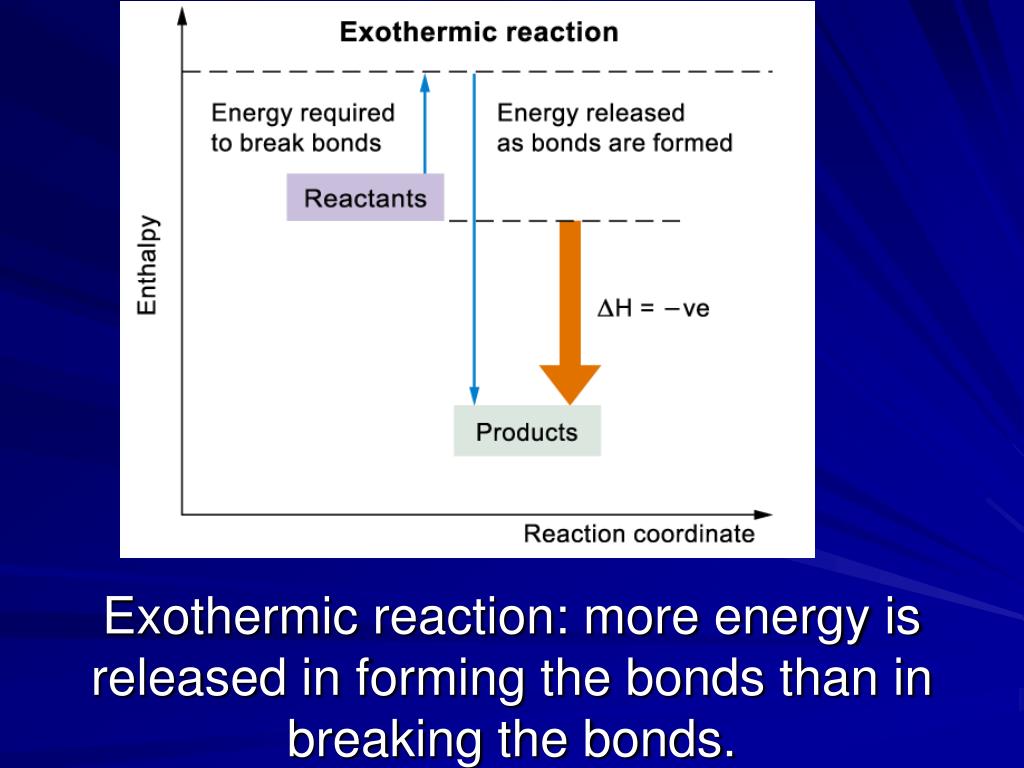
In the diagram, energy must first be supplied to disrupt the reactant bonds.
A larger amount of energy is then released when the product bonds form.
The products finish at a lower energy than the reactants.
Therefore:
ΔH < 0
This is the energetic basis of many exothermic reactions.
Endothermic Reactions and Bond Formation
Bond formation always releases energy, even during an overall endothermic reaction.
The difference is that an endothermic reaction requires more energy to break the reactant bonds than is released when product bonds form.
For example:
Energy required for bond breaking:
900 kJ mol⁻¹
Energy released during bond formation:
650 kJ mol⁻¹
Therefore:
ΔH = 900 − 650
ΔH = +250 kJ mol⁻¹
The reaction is endothermic.
Notice:
bond formation still released 650 kJ mol⁻¹.
It simply did not release enough energy to compensate for the energy required to break the original bonds.
A Crucial Rule
Do not say:
"Bond formation is exothermic only in exothermic reactions."
Bond formation itself is always energy-releasing.
Similarly:
Bond breaking itself is always energy-requiring.
The overall reaction may be either exothermic or endothermic depending on the balance between the two.
Formation of Water
Consider:
2H₂ + O₂ → 2H₂O
To begin the reaction, bonds in the reactants must be disrupted:
- H–H bonds
- O=O bonds
This requires energy.
The atoms then rearrange and form O–H bonds in water.
Formation of the O–H bonds releases energy.
The newly formed O–H bonds are sufficiently strong that their formation releases more energy than was required overall to break the H–H and O=O bonds.
Therefore, the formation of water from hydrogen and oxygen is strongly exothermic.
Worked Example 3: Formation of HCl
Consider:
H₂ + Cl₂ → 2HCl
Approximate bond energies:
H–H = 436 kJ mol⁻¹
Cl–Cl = 243 kJ mol⁻¹
H–Cl = 431 kJ mol⁻¹
Step 1: Energy needed to break bonds
Break one H–H bond:
436 kJ mol⁻¹
Break one Cl–Cl bond:
243 kJ mol⁻¹
Total:
436 + 243 = 679 kJ mol⁻¹
Step 2: Energy released forming bonds
Two H–Cl bonds form:
2 × 431 = 862 kJ mol⁻¹
Step 3: Calculate ΔH
ΔH ≈ 679 − 862
ΔH ≈ −183 kJ mol⁻¹
So the reaction is exothermic.
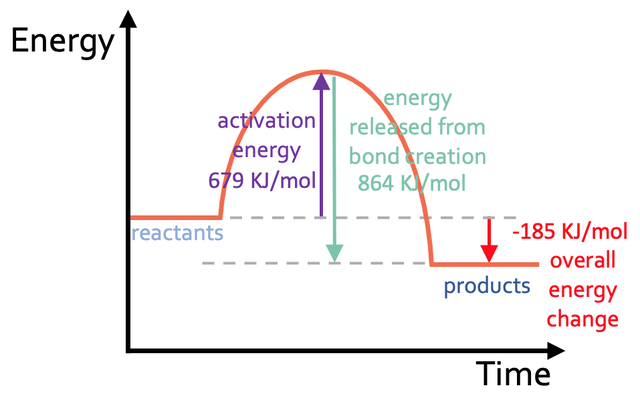
The key reason is:
forming the H–Cl bonds releases more energy than breaking H–H and Cl–Cl requires.
Combustion and Bond Formation
Consider the combustion of methane:
CH₄ + 2O₂ → CO₂ + 2H₂O
Reactant bonds include:
- C–H
- O=O
Product bonds include:
- C=O
- O–H
The C–H and O=O bonds must first be disrupted.
That requires energy.
Then strong C=O and O–H bonds form.
That releases a large amount of energy.
The formation of the product bonds releases more energy than is required to break the reactant bonds.
Therefore:
methane combustion is exothermic
This is why combustion reactions can transfer large amounts of energy to the surroundings.
Does Energy Come From "Breaking Fuel Bonds"?
A common explanation says:
"Fuel releases energy because its bonds are broken."
That is incorrect.
Breaking bonds in the fuel requires energy.
Breaking O=O bonds in oxygen also requires energy.
Energy is released when new, more stable product bonds form.
In methane combustion, much of the energy release is associated with forming strong:
C=O bonds
and:
O–H bonds
So the more accurate explanation is:
Combustion releases energy because the new product bonds are energetically more favourable than the original set of reactant bonds.
Strong Product Bonds and Exothermic Reactions
Suppose two hypothetical reactions require the same amount of bond-breaking energy.
Reaction A forms relatively weak product bonds.
Reaction B forms much stronger product bonds.
Reaction B will release more energy during bond formation.
It may therefore have a more negative ΔH.
This leads to an important connection:
strong product bonds can contribute to a strongly exothermic reaction
But remember that the overall energy change always depends on both sides of the calculation:
- energy required to break reactant bonds
- energy released forming product bonds
Bond Formation and Reaction Profiles
On an energy profile diagram, the system initially climbs toward the transition state.
As products form and new bonds become established, the energy of the system decreases.
For an exothermic reaction, the new bonding arrangement in the products has a lower energy than the original reactants.
The difference is transferred to the surroundings.
For an endothermic reaction, bond formation still lowers energy from the high-energy transition-state region, but the final products remain above the original reactants.
Bond Formation and Catalysts
A catalyst changes the pathway of a reaction.
It can make it easier for bonds to reorganize by providing a pathway with a lower activation energy.
However, a catalyst does not change:
- which reactants begin the reaction
- which products are formed
- their initial and final energy levels
- the overall ΔH
Therefore, it does not change the overall energy released through the difference between reactant and product bonding.
Bond Formation and Stability
Stronger bonding arrangements usually correspond to lower potential energy and greater stability.
This is why reactions that produce particularly stable molecules can release substantial amounts of energy.
For example, nitrogen contains an extremely strong N≡N bond.
The N≡N bond has an average bond energy of approximately:
945 kJ mol⁻¹
Forming such a strong bond from separated nitrogen atoms would produce a very large decrease in potential energy and therefore a large release of energy.
Energy Is Conserved
When bonds form, energy does not disappear.
The decrease in the chemical potential energy of the atoms is transferred into other forms.
It may appear as:
- thermal energy
- light
- kinetic energy of surrounding particles
The total energy remains conserved.
So when we say:
"bond formation releases energy"
we mean that energy is transferred from the chemical system to the surroundings.
Worked Example 4: Comparing Energy Released
Suppose three bonds form:
Bond A = 250 kJ mol⁻¹
Bond B = 460 kJ mol⁻¹
Bond C = 800 kJ mol⁻¹
Which releases the most energy per mole when formed?
Bond C
Approximate energy released:
800 kJ mol⁻¹
Which releases the least?
Bond A
Approximate energy released:
250 kJ mol⁻¹
Which is strongest?
Bond C
Therefore:
greater bond energy → stronger bond → greater energy release when that bond forms
Worked Example 5: Several Bonds Forming
Suppose a reaction forms:
2 O–H bonds
Average O–H bond energy:
463 kJ mol⁻¹
Energy released:
2 × 463
= 926 kJ mol⁻¹
Because this is bond formation, the energy change associated with that step is approximately:
−926 kJ mol⁻¹
If four O–H bonds form:
4 × 463 = 1852 kJ mol⁻¹
Approximately 1852 kJ mol⁻¹ would be released during formation of those bonds.
Worked Example 6: Is the Overall Reaction Exothermic?
Suppose:
Energy absorbed breaking bonds = 1250 kJ mol⁻¹
Energy released forming bonds = 1620 kJ mol⁻¹
Calculate:
ΔH = 1250 − 1620
ΔH = −370 kJ mol⁻¹
Therefore:
370 kJ mol⁻¹ is released overall
and the reaction is:
exothermic
Why?
Because:
bond formation released 370 kJ mol⁻¹ more than bond breaking required.
Worked Example 7: Is the Overall Reaction Endothermic?
Suppose:
Energy absorbed breaking bonds = 980 kJ mol⁻¹
Energy released forming bonds = 720 kJ mol⁻¹
Then:
ΔH = 980 − 720
ΔH = +260 kJ mol⁻¹
The reaction absorbs:
260 kJ mol⁻¹ overall
and is:
endothermic
However, the bond-formation stage was still exothermic.
It released:
720 kJ mol⁻¹
The reaction is endothermic only because even more energy was needed for bond breaking.
Did You Know?
The enormous energy released by some explosions is not caused by chemical bonds "containing explosive energy" that escapes when they break.
In fact, breaking the original bonds requires energy.
The rapid energy release occurs when atoms rearrange and form a new collection of strongly bonded, stable products.
For many explosive reactions, stable gaseous molecules such as:
N₂
CO₂
and:
H₂O
can be produced very rapidly.
The combination of energy release and rapid gas production produces the dramatic expansion associated with an explosion.
Common Misconceptions
"Forming bonds requires energy."
Incorrect. Stable bond formation releases energy.
"Breaking a strong bond releases lots of energy."
Incorrect. Breaking a strong bond requires a large amount of energy.
"Only exothermic reactions contain bond formation."
Incorrect. Both exothermic and endothermic chemical reactions normally involve bond formation.
"Bond formation in an endothermic reaction absorbs energy."
Incorrect. Bond formation is still exothermic. The overall reaction is endothermic because bond breaking requires more energy than bond formation releases.
"Bond energy only tells us how difficult a bond is to break."
Bond energy is defined using bond breaking, but it also tells us approximately how much energy is released when the same bond forms under corresponding conditions.
"If strong bonds are present in a fuel, breaking them releases energy."
Incorrect. Energy must be supplied to break them. The overall release depends on forming an even more favourable set of product bonds.
Key Terms
Bond formation – The process in which atoms or ions become joined through attractive interactions.
Exothermic process – A process that transfers energy from the system to the surroundings.
Bond energy – The energy required to break one mole of a particular bond in gaseous molecules.
Bond strength – A measure of how strongly bonded atoms are held together.
Potential energy – Energy associated with the arrangement and interactions of particles.
Bond length – The equilibrium distance between the nuclei of two bonded atoms.
Bond order – The number of bonding interactions between two atoms.
Enthalpy change, ΔH – The overall energy change of a reaction under constant-pressure conditions.
Reactant bonds – Bonds present before a chemical reaction.
Product bonds – New bonds present after the reaction.
Key Takeaways
- Forming chemical bonds releases energy.
- Bond formation is an exothermic process.
- Bond formation lowers the potential energy of the chemical system.
- The bonded arrangement is generally more stable than the separated atoms.
- The decrease in chemical potential energy is transferred to the surroundings.
- Stronger bonds generally release more energy when they form.
- A bond's energy can be used to estimate both the energy required to break it and the energy released when it forms.
- Bond breaking absorbs energy.
- Bond formation releases energy.
- Both processes occur during chemical reactions.
- An exothermic reaction occurs when more energy is released forming product bonds than is required to break reactant bonds.
- An endothermic reaction occurs when more energy is required to break reactant bonds than is released during bond formation.
- Bond formation remains exothermic even when the overall reaction is endothermic.
- The overall reaction energy can be estimated using:
ΔH ≈ ΣE(bonds broken) − ΣE(bonds formed)
- Energy released in reactions does not come from breaking bonds. It results from the overall change to a more energetically favourable bonding arrangement.
3. Bond Energy Data Tables
Learning outcomes
- I can interpret bond energy tables.
- I can identify bond energy values for common bonds.
- I can compare bond strengths using data tables.
- I can use bond energy tables in calculations.
- I can explain limitations of average bond energy data.
What Is a Bond Energy Table?
A bond energy table is a reference table containing the average amount of energy required to break different types of covalent bonds.
Bond energies are normally given in:
kilojoules per mole, kJ mol⁻¹
For example:
H–H = 436 kJ mol⁻¹
This means approximately 436 kJ of energy is required to break one mole of H–H bonds in gaseous molecules.
Because breaking bonds requires energy:
bond energy values are listed as positive numbers.
The depth of the energy well represents the energy needed to separate the bonded atoms. A deeper well corresponds to a stronger bond.
A Typical Bond Energy Table
The following values are useful approximate average bond energies.
| Bond | Average Bond Energy (kJ mol⁻¹) |
|---|---|
| H–H | 436 |
| H–F | 567 |
| H–Cl | 431 |
| H–Br | 366 |
| H–I | 299 |
| C–H | 415 |
| C–C | 345 |
| C=C | 611 |
| C≡C | 837 |
| C–N | 290 |
| C=N | 615 |
| C≡N | 891 |
| C–O | 350 |
| C=O | 741 |
| C≡O | 1080 |
| O–H | 463 |
| O=O | 498 |
| N–H | 390 |
| N≡N | 945 |
| F–F | 160 |
| Cl–Cl | 243 |
| Br–Br | 190 |
| I–I | 150 |
These are average values, not exact values for every molecule containing that bond.
How to Read a Bond Energy Table
Suppose you are asked:
What is the bond energy of an O–H bond?
Find:
O–H
Then read across:
463 kJ mol⁻¹
This means approximately 463 kJ of energy is required to break one mole of O–H bonds.
Likewise:
C=C = 611 kJ mol⁻¹
means approximately:
611 kJ is required to break one mole of C=C bonds.
The larger the value, the stronger the bond.
Bond Energy and Bond Strength
Bond energy provides a useful measure of bond strength.
A large bond energy means that a large amount of energy must be supplied to separate the atoms.
Therefore:
high bond energy → strong bond
low bond energy → weaker bond
Consider:
Cl–Cl = 243 kJ mol⁻¹
O=O = 498 kJ mol⁻¹
N≡N = 945 kJ mol⁻¹
The strongest of these is:
N≡N
The weakest is:
Cl–Cl
A stronger bond generally corresponds to a deeper potential-energy well.
Comparing Bonds in a Data Table
Suppose a table gives:
| Bond | Bond Energy |
|---|---|
| C–C | 345 kJ mol⁻¹ |
| C=C | 611 kJ mol⁻¹ |
| C≡C | 837 kJ mol⁻¹ |
The ranking from strongest to weakest is:
C≡C > C=C > C–C
This illustrates an important trend:
For the same pair of atoms:
triple bonds are generally stronger than double bonds
and:
double bonds are generally stronger than single bonds.
Bond Strength and Bond Length
Bond energy tables are sometimes combined with bond length data.
For carbon-carbon bonds:
| Bond | Bond Length | Bond Energy |
|---|---|---|
| C–C | 154 pm | 345 kJ mol⁻¹ |
| C=C | 134 pm | 611 kJ mol⁻¹ |
| C≡C | 120 pm | 837 kJ mol⁻¹ |
Notice the pattern:
As bond strength increases:
bond length decreases
So:
C–C → longest and weakest
C=C → shorter and stronger
C≡C → shortest and strongest
This general relationship is especially useful when comparing bonds between the same two elements.
Worked Example 1: Identifying the Strongest Bond
Consider:
H–H = 436 kJ mol⁻¹
O=O = 498 kJ mol⁻¹
N≡N = 945 kJ mol⁻¹
Which bond is strongest?
Look for the largest bond-energy value.
N≡N = 945 kJ mol⁻¹
Therefore:
N≡N is the strongest bond.
Which requires the least energy to break?
H–H, because 436 kJ mol⁻¹ is the smallest value in this particular set.
Worked Example 2: Comparing Bond Strength
Compare:
C–H = 415 kJ mol⁻¹
C–C = 345 kJ mol⁻¹
Difference:
415 − 345 = 70 kJ mol⁻¹
Therefore, approximately:
70 kJ mol⁻¹ more energy
is required to break a C–H bond than a C–C bond.
The C–H bond is therefore stronger according to these average values.
Do Not Confuse Bond Energy with Total Molecular Energy
Bond energy refers to one mole of a particular type of bond.
A molecule can contain many bonds.
For example, methane:
CH₄
contains:
4 C–H bonds
If all four C–H bonds are considered using an average value of 415 kJ mol⁻¹:
4 × 415 = 1660 kJ mol⁻¹
This does not mean a single C–H bond has an energy of 1660 kJ mol⁻¹.
Each bond is approximately:
415 kJ mol⁻¹
There are simply four of them.
Using Bond Energy Tables in Calculations
Bond-energy tables become especially useful when estimating the overall energy change of a reaction.
The key equation is:
ΔH ≈ ΣE(bonds broken) − ΣE(bonds formed)
where:
Σ means "sum of"
and:
E represents bond energy.
Remember:
Bonds broken → energy absorbed
Bonds formed → energy released
Bond-energy calculations provide an approximate reaction enthalpy because the values in most tables are averages.
Step-by-Step Bond Energy Calculations
A useful method is:
Step 1: Draw or identify all bonds in the reactants
Determine which bonds must be broken.
Step 2: Use the table
Find the bond energy of each bond.
Step 3: Add the bond-breaking energies
This is the energy input.
Step 4: Identify all bonds formed in the products
Find their bond energies.
Step 5: Add the bond-forming energies
This represents the magnitude of energy released.
Step 6: Calculate
ΔH ≈ bonds broken − bonds formed
Worked Example 3: H₂ + Cl₂ → 2HCl
Consider:
H₂ + Cl₂ → 2HCl
Bond energies:
H–H = 436 kJ mol⁻¹
Cl–Cl = 243 kJ mol⁻¹
H–Cl = 431 kJ mol⁻¹
Bonds Broken
One H–H:
436 kJ mol⁻¹
One Cl–Cl:
243 kJ mol⁻¹
Total energy required:
436 + 243 = 679 kJ mol⁻¹
Bonds Formed
Two H–Cl bonds:
2 × 431 = 862 kJ mol⁻¹
Overall Energy Change
ΔH ≈ 679 − 862
ΔH ≈ −183 kJ mol⁻¹
The negative value indicates an:
exothermic reaction
Why Do We Count Every Bond?
A common error in bond-energy calculations is to identify the types of bonds but forget how many of each bond are present.
For example:
2H₂O
contains four O–H bonds in total.
Each H₂O molecule contains:
2 O–H bonds
Therefore:
2 × 2 = 4 O–H bonds
If O–H = 463 kJ mol⁻¹, the energy associated with four such bonds is:
4 × 463 = 1852 kJ mol⁻¹
Always count the bonds before performing the calculation.
Worked Example 4: Forming Water
Consider:
2H₂ + O₂ → 2H₂O
Average bond energies:
H–H = 436 kJ mol⁻¹
O=O = 498 kJ mol⁻¹
O–H = 463 kJ mol⁻¹
Bonds Broken
2 H–H bonds:
2 × 436 = 872 kJ mol⁻¹
1 O=O bond:
498 kJ mol⁻¹
Total:
872 + 498 = 1370 kJ mol⁻¹
Bonds Formed
Two H₂O molecules contain four O–H bonds:
4 × 463 = 1852 kJ mol⁻¹
Calculate ΔH
ΔH ≈ 1370 − 1852
ΔH ≈ −482 kJ mol⁻¹
The reaction is:
exothermic
because forming the O–H bonds releases more energy than is required to break the H–H and O=O bonds.
Using Structural Formulae
Sometimes a chemical equation alone does not make all the bonds obvious.
For example:
C₂H₄ + H₂ → C₂H₆
It is useful to draw the structures:
H₂C=CH₂ + H–H → H₃C–CH₃
Now we can identify what actually changes.
The reaction:
- breaks an H–H bond
- changes C=C to C–C
- forms two new C–H bonds
Drawing the molecules makes it much easier to use the bond-energy table correctly.
A Useful Shortcut: Count Only Bonds That Change
In many reactions, some bonds appear unchanged in both reactants and products.
Because identical unchanged bonds would appear on both sides of the calculation, they effectively cancel.
For simple reactions, we can sometimes calculate ΔH using only bonds that are broken, formed or changed.
However, this shortcut should be used carefully.
When first learning bond-energy calculations, it is often safer to:
draw all structures → count all relevant bonds → check your work
Worked Example 5: Hydrogenation of Ethene
Consider:
C₂H₄ + H₂ → C₂H₆
Relevant average bond energies:
C=C = 611 kJ mol⁻¹
H–H = 436 kJ mol⁻¹
C–C = 345 kJ mol⁻¹
C–H = 415 kJ mol⁻¹
Bonds effectively broken or replaced
1 C=C:
611
1 H–H:
436
Total:
1047 kJ mol⁻¹
Bonds formed
1 C–C:
345
2 additional C–H:
2 × 415 = 830
Total:
1175 kJ mol⁻¹
Calculate
ΔH ≈ 1047 − 1175
ΔH ≈ −128 kJ mol⁻¹
The reaction is approximately:
exothermic
Bond Energy Tables and Combustion
Bond-energy data are particularly useful for understanding combustion reactions.
Consider methane combustion:
CH₄ + 2O₂ → CO₂ + 2H₂O
We must consider:
Reactant bonds:
- 4 C–H
- 2 O=O
Product bonds:
- 2 C=O in CO₂
- 4 O–H
Bond-energy calculations allow us to estimate why the reaction is strongly exothermic: forming the strong product bonds releases more energy than breaking the reactant bonds requires.
Average Bond Energies Are Not Exact
The word average is extremely important.
A C–H bond does not have exactly the same bond energy in every molecule.
For example, the chemical surroundings of a C–H bond in methane differ from those of a C–H bond in another organic compound.
The surrounding atoms affect electron distribution and therefore bond strength.
The value listed in a table is therefore usually an average measured across many molecular environments. OpenStax notes, for example, that the listed C–H value is an average and individual C–H bond dissociation energies can differ significantly.
Why Can Two Tables Give Slightly Different Values?
You may notice that different textbooks give slightly different numbers.
One table might give:
C–H = 413 kJ mol⁻¹
while another gives:
C–H = 415 kJ mol⁻¹
Likewise, one source may list:
C–C = 347 kJ mol⁻¹
while another uses:
345 kJ mol⁻¹
This is not necessarily an error.
Differences can arise because:
- bond energies are averages
- different sets of compounds were used
- values may be rounded differently
- different reference data may be used
For calculations, use the values supplied in the question or the table being used in your course.
Bond Dissociation Energy vs Average Bond Energy
These two terms are related but are not always identical.
A bond dissociation energy refers to the energy required to break a particular bond in a particular molecule.
An average bond energy is an average value for a bond type across several molecules.
For example, different C–H bonds can have slightly different dissociation energies.
A bond-energy table simplifies this by giving one useful average value.
This makes calculations easier but reduces precision.
Why Bond Energy Calculations Are Estimates
Suppose a bond-energy calculation gives:
ΔH ≈ −125 kJ mol⁻¹
An experimentally measured value might be somewhat different.
This does not necessarily mean the calculation is wrong.
The difference may occur because average bond energies were used instead of the exact energies of the bonds in those specific molecules. Bond-energy calculations are therefore typically estimates rather than exact reaction enthalpies.
Gas-Phase Values
Average bond energies are normally defined for gaseous molecules.
That matters because real chemical reactions may involve:
- solids
- liquids
- dissolved substances
- gases
Changes of state and intermolecular interactions can also involve energy.
A simple bond-energy calculation may therefore not capture every energy contribution present in a real experimental reaction.
This is another reason calculated values can differ from measured enthalpy changes.
Comparing Bond Strengths from a Table
Suppose you are given:
| Bond | Energy |
|---|---|
| C–O | 350 |
| C=O | 741 |
| C≡O | 1080 |
Which is strongest?
C≡O
Which is weakest?
C–O
How much more energy is required to break C=O than C–O?
741 − 350 = 391 kJ mol⁻¹
How much more energy is required to break C≡O than C–O?
1080 − 350 = 730 kJ mol⁻¹
The table therefore provides both qualitative and quantitative information about bond strength.
A Pattern Down a Group
Bond-energy tables can also reveal trends.
Consider:
H–F = 567 kJ mol⁻¹
H–Cl = 431 kJ mol⁻¹
H–Br = 366 kJ mol⁻¹
H–I = 299 kJ mol⁻¹
The bond strength decreases:
H–F > H–Cl > H–Br > H–I
As the halogen atom becomes larger, the bond generally becomes longer and weaker.
Bond-energy data can therefore reveal patterns that connect chemical structure with chemical properties.
Another Interesting Pattern
Compare:
F–F = 160 kJ mol⁻¹
Cl–Cl = 243 kJ mol⁻¹
Br–Br = 190 kJ mol⁻¹
I–I = 150 kJ mol⁻¹
You might expect F–F to be the strongest simply because fluorine atoms are small.
But the F–F bond is unusually weak because the small fluorine atoms bring several lone pairs very close together, increasing electron-electron repulsion.
This reminds us that chemical trends often have interesting exceptions.
Bond Energy and Reaction Profiles
Bond-energy calculations and reaction-profile diagrams describe related ideas, but they are not identical.
Bond energies help us estimate:
overall reaction energy, ΔH
Reaction profiles show:
- reactant energy
- activation energy
- transition state
- product energy
A bond-energy table cannot by itself tell you the activation energy of the reaction.
This is an important distinction.
What Bond Energy Tables Can Tell Us
A bond-energy table can help us:
- identify approximate bond strengths
- compare different bonds
- estimate energy required for bond breaking
- estimate energy released by bond formation
- calculate approximate ΔH values
- predict whether a reaction is likely to be exothermic or endothermic
What Bond Energy Tables Cannot Tell Us
A bond-energy table alone does not directly tell us:
- how fast a reaction occurs
- the activation energy
- the reaction mechanism
- whether a catalyst is present
- the exact enthalpy of a real reaction
- the exact strength of a bond in every molecular environment
Bond energies are powerful tools, but they provide only part of the energetic picture.
Worked Example 6: Reading a Table Carefully
Suppose a table contains:
C–N = 290 kJ mol⁻¹
C=N = 615 kJ mol⁻¹
C≡N = 891 kJ mol⁻¹
Question 1: Which bond is easiest to break?
C–N
Question 2: Which is strongest?
C≡N
Question 3: How much more energy is required to break C≡N than C–N?
891 − 290
= 601 kJ mol⁻¹
Question 4: Which bond is probably shortest?
C≡N
Worked Example 7: Using Several Table Values
Suppose a reaction requires breaking:
- 2 C–H bonds
- 1 O=O bond
Using:
C–H = 415 kJ mol⁻¹
O=O = 498 kJ mol⁻¹
Energy required:
2(415) + 498
= 830 + 498
= 1328 kJ mol⁻¹
If the reaction then forms bonds whose total bond energy is:
1540 kJ mol⁻¹
then:
ΔH ≈ 1328 − 1540
ΔH ≈ −212 kJ mol⁻¹
Therefore the reaction is approximately:
exothermic
A Reliable Calculation Strategy
When using a bond-energy table, ask four questions:
1. What bonds are broken?
Count them carefully.
2. What bonds are formed?
Count those carefully too.
3. What are their bond energies?
Read the correct values from the table.
4. Which total is larger?
Then calculate:
ΔH ≈ bonds broken − bonds formed
This simple routine prevents most errors.
Did You Know?
The N≡N bond in nitrogen is one of the strongest common bonds, with an average bond energy of about:
945 kJ mol⁻¹
That large value helps explain why nitrogen gas is relatively unreactive.
Yet nitrogen is essential for amino acids, proteins and DNA.
Nature solves this problem through processes such as nitrogen fixation, while industry uses catalysts and carefully controlled conditions in processes such as the Haber process.
Common Mistakes
"A larger bond-energy value means the bond contains more energy to release when broken."
Incorrect. A larger bond-energy value means more energy must be supplied to break the bond.
"Bond energy tables give exact values."
Usually incorrect. Most tables contain average bond energies.
"I only need to identify the bond type."
Not enough. You must also count how many of each bond are involved.
"Double bonds have twice the energy of single bonds."
Incorrect. For example, C=C is stronger than C–C, but it is not exactly twice as strong.
"Bond-energy calculations give activation energy."
Incorrect. They estimate the overall energy change, not the activation barrier.
"Different tables must agree exactly."
Not necessarily. Slight differences are normal because average values and rounding can differ.
Key Terms
Bond energy – Energy required to break one mole of a particular covalent bond in gaseous molecules.
Average bond energy – An average energy value for a particular bond type across different molecules.
Bond dissociation energy – Energy required to break a specified bond in a particular molecule.
Bond strength – A measure of how strongly two bonded atoms are held together.
Bond length – The equilibrium distance between the nuclei of bonded atoms.
Bond order – The number of bonding interactions between two atoms.
Enthalpy change, ΔH – The overall energy change of a reaction at constant pressure.
Exothermic – Describes a process that transfers energy to the surroundings.
Endothermic – Describes a process that absorbs energy from the surroundings.
Key Takeaways
- Bond-energy tables list energies in kJ mol⁻¹.
- A bond-energy value tells us approximately how much energy is required to break one mole of that bond.
- Higher bond energy generally means a stronger bond.
- Bond-energy tables can be used to compare bond strengths.
- Triple bonds are generally stronger than corresponding double bonds, which are generally stronger than corresponding single bonds.
- Stronger bonds between the same elements are generally shorter.
- Bond energies can be used to estimate reaction enthalpy:
ΔH ≈ ΣE(bonds broken) − ΣE(bonds formed)
- Bonds must be counted carefully before calculations are performed.
- Most tabulated bond energies are average values.
- The exact strength of a bond depends on its molecular environment.
- Different reference tables may give slightly different values.
- Bond-energy calculations therefore produce estimates rather than exact reaction enthalpies.
- Bond-energy data do not directly tell us reaction rate or activation energy.
- When solving problems, use the bond-energy values provided in the question whenever possible.
4. Calculating Reaction Energies
Learning outcomes
- I can calculate energy required to break bonds.
- I can calculate energy released when bonds form.
- I can determine overall reaction energy changes.
- I can apply bond energy calculations to chemical reactions.
- I can interpret the results of energy calculations.
Energy Changes During Chemical Reactions
Every chemical reaction involves a rearrangement of atoms.
During this rearrangement:
existing bonds are broken
and:
new bonds are formed
These two processes have opposite energy effects:
Breaking bonds → requires energy → endothermic
Forming bonds → releases energy → exothermic
The overall energy change of a reaction depends on the balance between these two processes.
The Central Idea
Think of a reaction as having two energy calculations.
Energy IN
Energy must be supplied to break bonds in the reactants.
Energy OUT
Energy is released when bonds form in the products.
We compare these two quantities to determine the overall reaction energy.
The Bond Energy Equation
The main equation for this topic is:
ΔH ≈ ΣE(bonds broken) − ΣE(bonds formed)
In simpler language:
overall energy change = energy required to break bonds − energy released when bonds form
The symbol Σ means "the sum of."
Average bond energies are used, so the calculated ΔH is normally an estimate of the actual reaction enthalpy.
Understanding the Signs
The sign of ΔH tells us whether the overall reaction releases or absorbs energy.
If:
ΔH < 0
the reaction is:
exothermic
Energy is released overall.
If:
ΔH > 0
the reaction is:
endothermic
Energy is absorbed overall.

In an exothermic reaction, the products finish at a lower energy than the reactants.

In an endothermic reaction, the products finish at a higher energy than the reactants.
A Useful Bond Energy Table
The exact table supplied in a problem should always be used, because average bond-energy values can differ slightly between sources.
Here are some useful approximate values:
| Bond | Average Bond Energy (kJ mol⁻¹) |
|---|---|
| H–H | 436 |
| H–Cl | 431 |
| H–Br | 366 |
| C–H | 413 |
| C–C | 347 |
| C=C | 614 |
| C≡C | 839 |
| C–O | 358 |
| C=O | 745 |
| C=O in CO₂ | about 805 |
| O–H | 463 |
| O=O | 498 |
| N–H | 391 |
| N≡N | 945 |
| Cl–Cl | 243 |
| Br–Br | 193 |
Remember:
larger bond energy → stronger bond → more energy required to break it
Step 1: Start With a Balanced Equation
Before doing any bond-energy calculation, make sure the chemical equation is balanced.
For example:
H₂ + Cl₂ → 2HCl
The coefficients tell us how many molecules — and therefore how many bonds — are involved.
This matters because bond energies must be multiplied by the number of bonds.
Step 2: Draw the Bonds
It is often much easier to calculate bond energies if you draw the displayed or structural formulae.
For:
H₂ + Cl₂ → 2HCl
we can write:
H–H + Cl–Cl → H–Cl + H–Cl
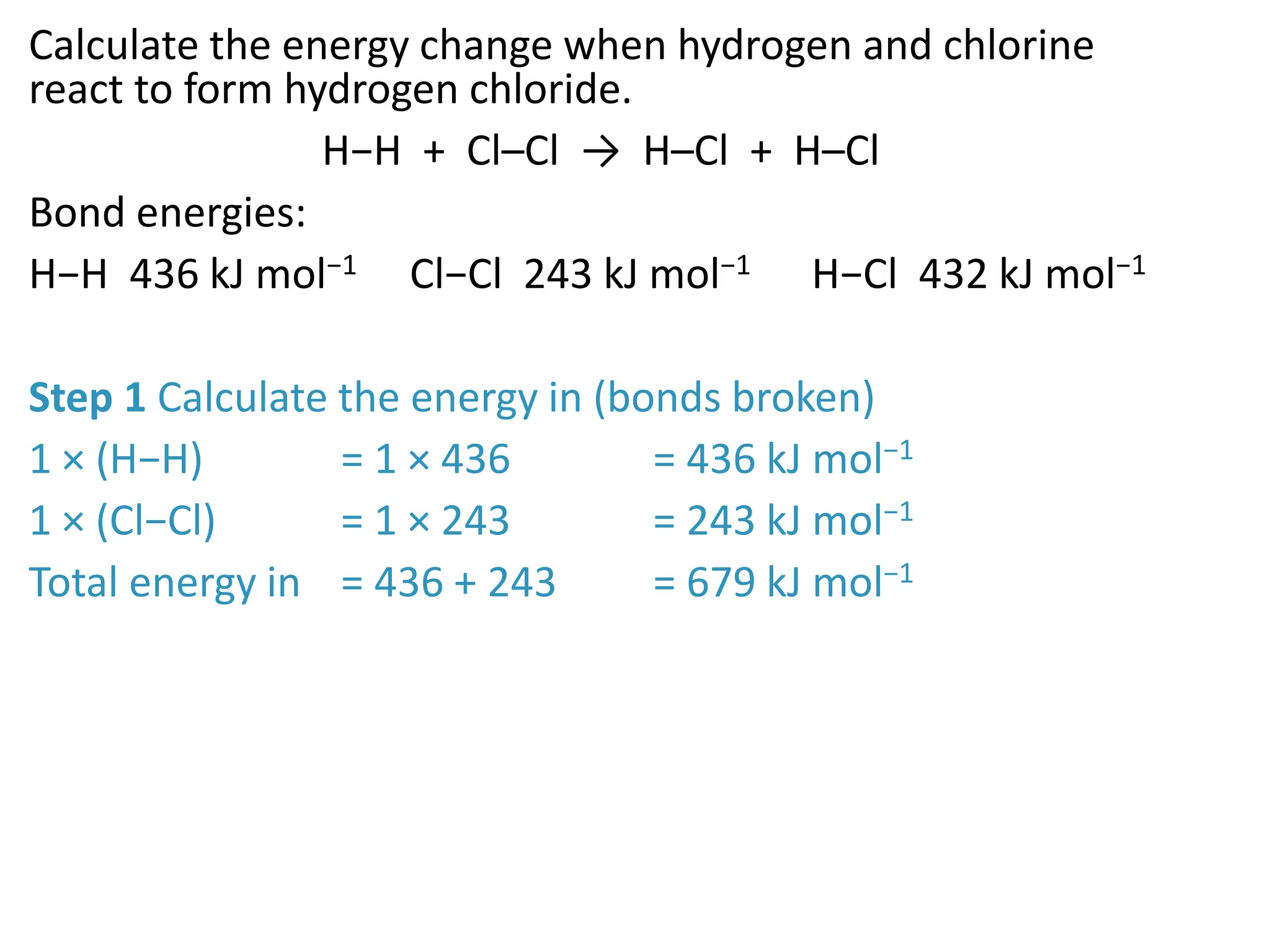
Now we can clearly see:
Bonds broken:
1 H–H
1 Cl–Cl
Bonds formed:
2 H–Cl
Drawing the bonds is one of the best ways to prevent counting errors.
Step 3: Calculate Energy Required to Break Bonds
Bond breaking requires energy.
Suppose:
H–H = 436 kJ mol⁻¹
Cl–Cl = 243 kJ mol⁻¹
We break:
1 H–H bond:
1 × 436 = 436 kJ mol⁻¹
and:
1 Cl–Cl bond:
1 × 243 = 243 kJ mol⁻¹
Total energy required:
436 + 243 = 679 kJ mol⁻¹
So:
Energy IN = 679 kJ mol⁻¹
Step 4: Calculate Energy Released When Bonds Form
The products contain two H–Cl bonds.
H–Cl bond energy:
431 kJ mol⁻¹
Two bonds form:
2 × 431 = 862 kJ mol⁻¹
Therefore:
Energy OUT = 862 kJ mol⁻¹
Approximately 862 kJ mol⁻¹ is released when these bonds form.
Step 5: Calculate the Overall Energy Change
Now use:
ΔH ≈ bonds broken − bonds formed
Therefore:
ΔH ≈ 679 − 862
ΔH ≈ −183 kJ mol⁻¹
Because the answer is negative:
the reaction is exothermic
This calculation is a standard example of determining reaction enthalpy from bond energies.
Visualizing the H₂ + Cl₂ Calculation
We can think of the reaction as:
H–H + Cl–Cl
Energy must first enter:
+679 kJ mol⁻¹
The atoms can then rearrange.
When two H–Cl bonds form:
862 kJ mol⁻¹ is released
Therefore:
679 IN
versus:
862 OUT
Difference:
183 kJ mol⁻¹ OUT
So:
ΔH ≈ −183 kJ mol⁻¹
A Reliable Calculation Method
For almost every basic bond-energy problem, use this sequence:
1. Balance the equation.
2. Draw the structures.
3. Count bonds broken.
4. Multiply each by its bond energy.
5. Add to find total energy absorbed.
6. Count bonds formed.
7. Multiply each by its bond energy.
8. Add to find total energy released.
9. Calculate:
ΔH ≈ broken − formed
10. Interpret the sign.
This method works for both exothermic and endothermic reactions.
Worked Example 1: Formation of Water
Consider:
2H₂ + O₂ → 2H₂O
The structures can be represented as:
2(H–H) + O=O → 2(H–O–H)
Bonds broken:
- 2 H–H
- 1 O=O
Bonds formed:
- 4 O–H
This is an excellent example because it makes bond counting especially important.
Step 1: Calculate Bonds Broken
H–H = 436 kJ mol⁻¹
O=O = 498 kJ mol⁻¹
Two H–H bonds:
2 × 436 = 872 kJ mol⁻¹
One O=O bond:
1 × 498 = 498 kJ mol⁻¹
Total:
872 + 498 = 1370 kJ mol⁻¹
Therefore:
Energy required = 1370 kJ mol⁻¹
Step 2: Calculate Bonds Formed
Each water molecule contains:
2 O–H bonds
There are two water molecules.
Therefore:
4 O–H bonds form
O–H = 463 kJ mol⁻¹
So:
4 × 463 = 1852 kJ mol⁻¹
Therefore:
Energy released = 1852 kJ mol⁻¹
Step 3: Calculate ΔH
ΔH ≈ 1370 − 1852
ΔH ≈ −482 kJ mol⁻¹
Therefore:
the reaction is exothermic
A worked calculation using these values gives the same approximate result.
The key energy comparison is:
1370 kJ required
versus:
1852 kJ released
More energy is released than absorbed.
Why Is Water Formation Exothermic?
The answer is not simply:
"because bonds form."
Both bond breaking and bond formation occur.
The better explanation is:
The formation of the O–H bonds releases more energy than is required to break the H–H and O=O bonds.
Therefore, energy is released overall.
This distinction is essential when explaining reaction energetics.
Worked Example 2: An Endothermic Reaction
Suppose a reaction has:
Energy required to break bonds:
1250 kJ mol⁻¹
Energy released when bonds form:
980 kJ mol⁻¹
Calculate:
ΔH = 1250 − 980
ΔH = +270 kJ mol⁻¹
Because ΔH is positive:
the reaction is endothermic
The reaction absorbs:
270 kJ mol⁻¹ overall
In this case:
energy IN > energy OUT
Worked Example 3: Another Exothermic Reaction
Suppose:
Bonds broken = 1600 kJ mol⁻¹
Bonds formed = 2050 kJ mol⁻¹
Then:
ΔH = 1600 − 2050
ΔH = −450 kJ mol⁻¹
Therefore:
450 kJ mol⁻¹ is released overall
and the reaction is:
exothermic
The products have less energy than the reactants because the system has transferred energy to the surroundings.
Calculating the Energy Needed to Break Several Bonds
Suppose a molecule contains:
4 C–H bonds
and we want to calculate the approximate energy required to break all four.
C–H = 413 kJ mol⁻¹
Therefore:
4 × 413
= 1652 kJ mol⁻¹
Approximately:
1652 kJ mol⁻¹
must be supplied.
The most common mistake here is forgetting to multiply by the number of bonds.
Calculating Energy Released When Several Bonds Form
Suppose four O–H bonds form.
O–H = 463 kJ mol⁻¹
Energy released:
4 × 463
= 1852 kJ mol⁻¹
Therefore:
1852 kJ mol⁻¹ is released
during bond formation.
When using the main equation, we normally use the magnitude 1852 and subtract it:
ΔH = broken − formed
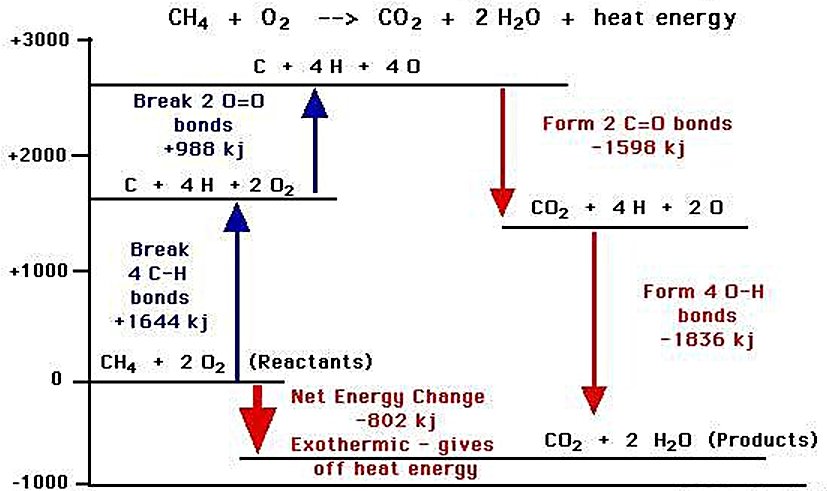
Worked Example 4: Combustion of Methane
Consider:
CH₄ + 2O₂ → CO₂ + 2H₂O
This is a more substantial bond-energy calculation.
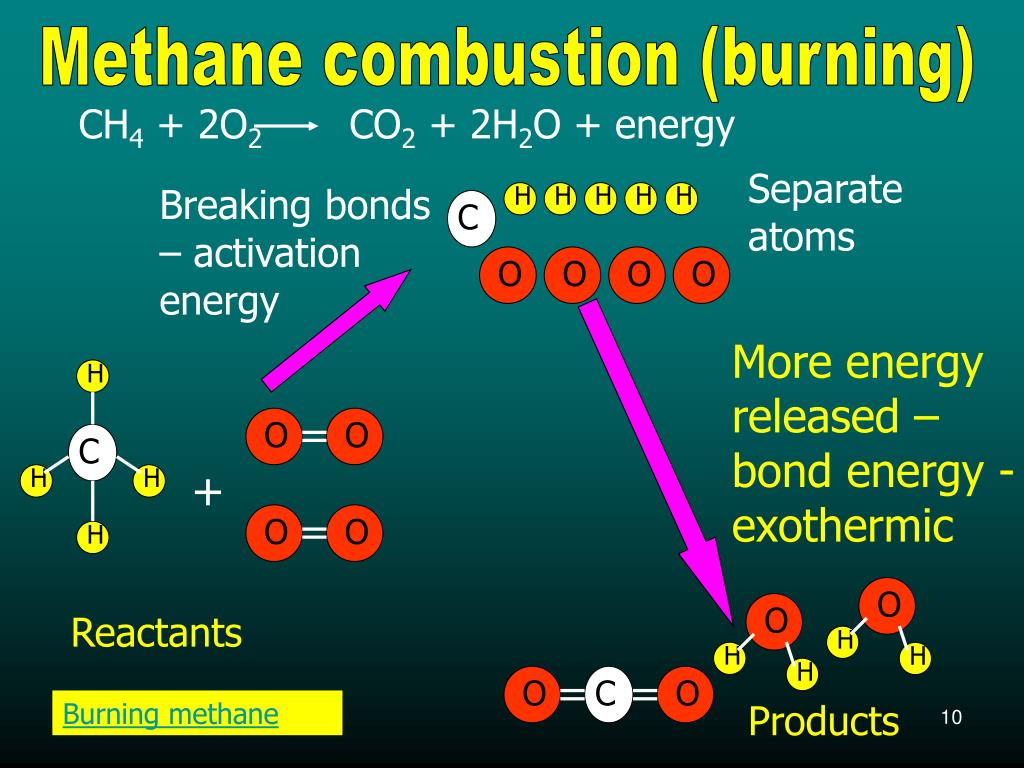
First identify the bonds.
Reactants
CH₄ contains:
4 C–H bonds
2O₂ contains:
2 O=O bonds
Products
CO₂ contains:
2 C=O bonds
2H₂O contains:
4 O–H bonds
This type of diagram is particularly useful because it shows that both the number and type of bonds must be considered.
Methane Combustion: Bonds Broken
Using:
C–H = 413 kJ mol⁻¹
O=O = 498 kJ mol⁻¹
Four C–H bonds:
4 × 413 = 1652 kJ mol⁻¹
Two O=O bonds:
2 × 498 = 996 kJ mol⁻¹
Total:
1652 + 996
= 2648 kJ mol⁻¹
Therefore:
Energy required = 2648 kJ mol⁻¹
Methane Combustion: Bonds Formed
For this calculation, use:
C=O in CO₂ ≈ 805 kJ mol⁻¹
O–H = 463 kJ mol⁻¹
Two C=O bonds:
2 × 805 = 1610 kJ mol⁻¹
Four O–H bonds:
4 × 463 = 1852 kJ mol⁻¹
Total:
1610 + 1852
= 3462 kJ mol⁻¹
Therefore:
Energy released = 3462 kJ mol⁻¹
Methane Combustion: Overall ΔH
Calculate:
ΔH ≈ 2648 − 3462
ΔH ≈ −814 kJ mol⁻¹
The precise estimate changes slightly depending on which average bond-energy table is used. For example, a source using C–H = 412 kJ mol⁻¹ obtains approximately −818 kJ mol⁻¹.
The important conclusion is:
ΔH is negative
Therefore:
methane combustion is exothermic
Where Does the Energy from Combustion Come From?
This calculation helps correct a major misconception.
Methane does not release energy because its C–H bonds are broken.
Breaking those C–H bonds required:
1652 kJ mol⁻¹
Breaking the O=O bonds required even more energy.
The reaction releases energy overall because formation of the strong:
C=O
and:
O–H
bonds releases a greater amount of energy.
So:
energy released forming products > energy required breaking reactants
This is why the reaction is exothermic.
Worked Example 5: Formation of Ammonia
Consider the Haber reaction:
N₂ + 3H₂ → 2NH₃
Now identify the bonds.
Reactants:
1 N≡N bond
3 H–H bonds
Products:
Each NH₃ contains 3 N–H bonds.
Therefore 2NH₃ contains:
6 N–H bonds
Ammonia: Bonds Broken
Use:
N≡N = 945 kJ mol⁻¹
H–H = 436 kJ mol⁻¹
One N≡N:
1 × 945 = 945
Three H–H:
3 × 436 = 1308
Total:
945 + 1308
= 2253 kJ mol⁻¹
Energy required:
2253 kJ mol⁻¹
Ammonia: Bonds Formed
N–H = 391 kJ mol⁻¹
Six N–H bonds form:
6 × 391
= 2346 kJ mol⁻¹
Energy released:
2346 kJ mol⁻¹
Ammonia: Overall Energy Change
ΔH ≈ 2253 − 2346
ΔH ≈ −93 kJ mol⁻¹
Therefore:
the reaction is exothermic
This approximate bond-energy calculation gives an energy release of about 93 kJ for the reaction as written.
Notice how much energy is required to break the:
N≡N triple bond
Its very high bond energy makes nitrogen particularly difficult to react.
Worked Example 6: Hydrogenation of Ethene
Consider:
C₂H₄ + H₂ → C₂H₆
Structurally:
H₂C=CH₂ + H–H → H₃C–CH₃
During this reaction:
- the C=C bonding arrangement changes to C–C
- H–H is broken
- two new C–H bonds form
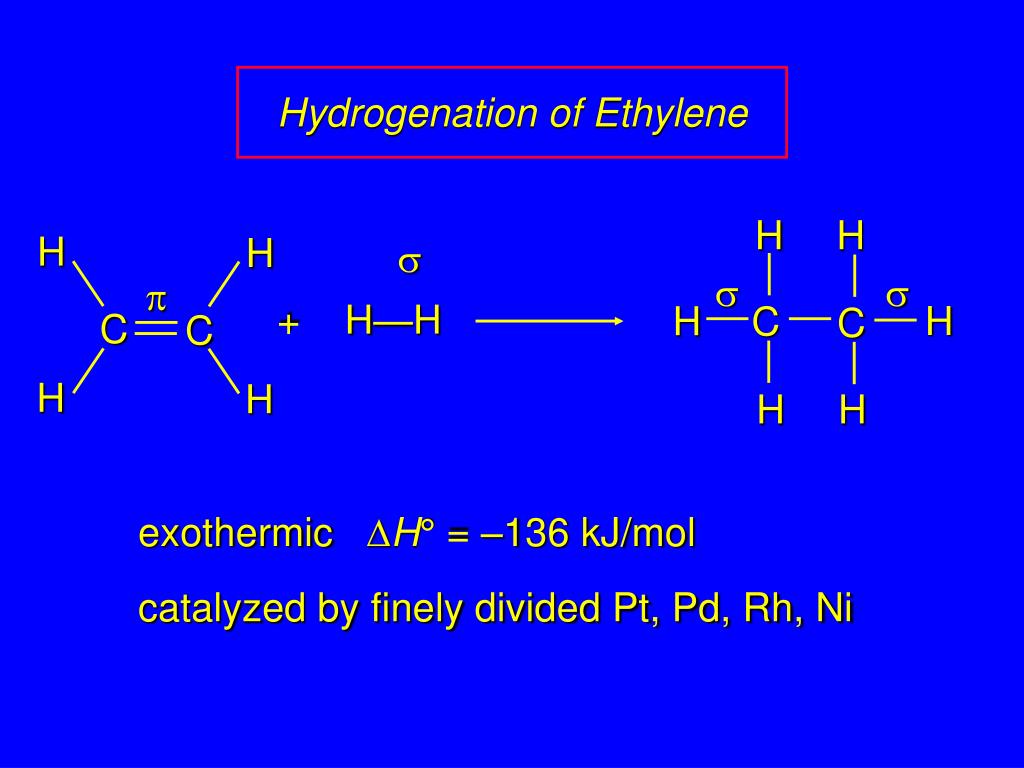
This reaction provides a good example of using structural formulae to determine which bonds have changed.
Hydrogenation Calculation
Use:
C=C = 614 kJ mol⁻¹
H–H = 436 kJ mol⁻¹
C–C = 347 kJ mol⁻¹
C–H = 413 kJ mol⁻¹
Energy associated with bonds broken/replaced:
614 + 436 = 1050 kJ mol⁻¹
Energy associated with bonds formed:
347 + 2(413)
= 347 + 826
= 1173 kJ mol⁻¹
Therefore:
ΔH ≈ 1050 − 1173
ΔH ≈ −123 kJ mol⁻¹
So the reaction is:
exothermic
Again, the exact estimate depends somewhat on the average bond-energy values used.
Why Structural Formulae Matter
Consider:
C₂H₄ + H₂ → C₂H₆
If you look only at the molecular formulae, it is difficult to see which bonds change.
But drawing:
H₂C=CH₂ + H–H → H₃C–CH₃
makes the changes visible.
For more complicated molecules:
Always draw the structure before counting bonds.
Be Careful With Double and Triple Bonds
A double bond counts as a double bond type, not as two single bonds.
For example:
O=O
should use the O=O bond-energy value.
Do not calculate:
2 × O–O
Similarly:
N≡N
uses the N≡N bond-energy value.
It should not be treated as:
3 × N–N
Single, double and triple bonds have their own characteristic average bond energies.
A Shortcut: Count Only Bonds That Change
Sometimes many bonds remain unchanged during a reaction.
Because identical unchanged bonds appear on both sides of the calculation, their contributions cancel.
For example:
C₂H₄ + H₂ → C₂H₆
Four of the original C–H bonds remain present.
Rather than including those identical bonds on both sides, we can focus on the bonding changes.
This can make calculations much faster.
However, when learning the method, it is often safer to:
draw everything → count everything → check which bonds cancel
before using the shortcut.
Interpreting a Negative Answer
Suppose:
ΔH = −250 kJ mol⁻¹
The negative sign means:
the chemical system loses energy
and:
the surroundings gain energy
Therefore:
250 kJ mol⁻¹ is released overall
and the reaction is:
exothermic
Do not say:
"The reaction releases −250 kJ."
It is clearer to say:
ΔH = −250 kJ mol⁻¹
or:
250 kJ mol⁻¹ is released.
Interpreting a Positive Answer
Suppose:
ΔH = +175 kJ mol⁻¹
The positive sign means:
the chemical system gains energy
Energy has been absorbed from the surroundings.
Therefore:
175 kJ mol⁻¹ is absorbed overall
and the reaction is:
endothermic
What If ΔH Is Close to Zero?
Suppose:
Energy required to break bonds:
1520 kJ mol⁻¹
Energy released forming bonds:
1510 kJ mol⁻¹
Then:
ΔH ≈ 1520 − 1510
ΔH ≈ +10 kJ mol⁻¹
The reaction is predicted to be slightly endothermic.
However, because average bond energies are approximate, a result very close to zero should be interpreted cautiously.
Small differences can be sensitive to the particular average bond-energy values used.
Why Are Bond Energy Calculations Approximate?
Most tables contain average bond energies.
For example, a C–H bond does not have exactly the same bond strength in every molecule.
Its exact energy depends on its molecular environment.
Therefore:
ΔH from average bond energies ≈ estimated ΔH
not necessarily the exact experimental value.
Bond-energy values also conventionally refer to gaseous species, so phase changes and intermolecular interactions can contribute to differences between an estimate and an experimentally measured reaction enthalpy.
Bond Energy Calculations vs Reaction Profiles
Bond-energy calculations tell us about:
overall reaction energy, ΔH
Reaction profiles show additional information such as:
activation energy
and:
transition state
A bond-energy calculation does not directly tell us the activation energy.
For example:
ΔH = −300 kJ mol⁻¹
does not mean:
Eₐ = 300 kJ mol⁻¹
These are different quantities.
Does a More Negative ΔH Mean a Faster Reaction?
No.
Suppose:
Reaction A:
ΔH = −500 kJ mol⁻¹
Reaction B:
ΔH = −100 kJ mol⁻¹
Reaction A releases more energy.
But that does not automatically mean Reaction A occurs faster.
Reaction rate depends strongly on factors including:
- activation energy
- temperature
- concentration
- pressure
- surface area
- catalysts
- reaction mechanism
Energy change and reaction rate describe different aspects of a reaction.
Worked Example 7: Find the Missing Energy
Suppose a reaction has:
ΔH = −180 kJ mol⁻¹
and:
Energy required to break bonds = 720 kJ mol⁻¹
We know:
ΔH = broken − formed
Therefore:
−180 = 720 − formed
Rearrange:
formed = 720 + 180
formed = 900 kJ mol⁻¹
Therefore:
900 kJ mol⁻¹ is released during bond formation.
Worked Example 8: Find the Bond-Breaking Energy
Suppose:
ΔH = +120 kJ mol⁻¹
and:
Energy released forming bonds = 650 kJ mol⁻¹
Use:
ΔH = broken − formed
Therefore:
120 = broken − 650
So:
broken = 770 kJ mol⁻¹
Therefore:
770 kJ mol⁻¹ is required to break the reactant bonds.
Worked Example 9: Comparing Two Reactions
Reaction A:
Bonds broken = 800 kJ mol⁻¹
Bonds formed = 1100 kJ mol⁻¹
Reaction B:
Bonds broken = 1200 kJ mol⁻¹
Bonds formed = 1350 kJ mol⁻¹
For Reaction A:
ΔH = 800 − 1100
ΔH = −300 kJ mol⁻¹
For Reaction B:
ΔH = 1200 − 1350
ΔH = −150 kJ mol⁻¹
Both reactions are:
exothermic
But Reaction A releases more energy overall.
Reaction A releases:
300 kJ mol⁻¹
Reaction B releases:
150 kJ mol⁻¹
A Quick Visual Way to Think About the Calculation
Imagine the bond-breaking and bond-forming energies as two competing totals.
Exothermic
Bond breaking: 600 kJ IN
Bond forming: 900 kJ OUT
Net:
300 kJ OUT
ΔH = −300 kJ mol⁻¹
Endothermic
Bond breaking: 900 kJ IN
Bond forming: 600 kJ OUT
Net:
300 kJ IN
ΔH = +300 kJ mol⁻¹
This is often the simplest conceptual way to check whether your mathematical answer makes sense.
Checking Your Answer
After every bond-energy calculation, ask:
Does the sign make sense?
If bond formation released more energy than bond breaking required:
Your answer should be:
negative
If bond breaking required more energy than bond formation released:
Your answer should be:
positive
This quick check catches many arithmetic and sign errors.
Common Mistake 1: Adding Instead of Subtracting
Suppose:
Broken = 700 kJ mol⁻¹
Formed = 900 kJ mol⁻¹
Incorrect:
700 + 900 = 1600
Correct:
700 − 900 = −200 kJ mol⁻¹
Remember:
broken − formed
Common Mistake 2: Forgetting Coefficients
Consider:
2H₂ + O₂ → 2H₂O
There are:
2 H–H bonds
not one.
There are:
4 O–H bonds
not two.
The coefficients in the balanced equation affect the total number of bonds.
Common Mistake 3: Counting Atoms Instead of Bonds
Consider CH₄.
It contains:
1 carbon atom
4 hydrogen atoms
but:
4 C–H bonds
Bond-energy calculations require us to count bonds, not simply atoms.
Common Mistake 4: Using the Wrong Bond Type
Do not confuse:
C–C
with:
C=C
or:
C≡C
Their bond energies are very different.
The same applies to:
C–O
versus:
C=O
Always examine the structural formula carefully.
Common Mistake 5: Reversing the Equation
The correct equation is:
ΔH ≈ bonds broken − bonds formed
Not:
formed − broken
A useful memory aid is:
Break – Make
B − M
Common Mistake 6: Saying Bonds "Contain Energy That Is Released When Broken"
Breaking a bond requires energy.
Energy release during an exothermic reaction occurs because the formation of product bonds releases more energy than is required to break the reactant bonds.
This distinction is fundamental to chemical energetics.
Did You Know?
Bond-energy calculations can explain why two fuels may release different amounts of energy even if both undergo combustion.
The important question is not simply:
"How many bonds does the fuel contain?"
Instead, chemists compare:
the complete set of reactant bonds that must be broken
with:
the complete set of product bonds that form
The difference between these totals determines the approximate energy released by the reaction.
Calculation Summary
For any bond-energy calculation:
Balanced equation
↓
Draw structures
↓
Count bonds broken
↓
Calculate total energy required
↓
Count bonds formed
↓
Calculate total energy released
↓
ΔH ≈ broken − formed
↓
If ΔH < 0 → exothermic
If ΔH > 0 → endothermic
Key Terms
Bond energy – Energy required to break one mole of a particular type of covalent bond in gaseous molecules.
Bond breaking – An endothermic process requiring an input of energy.
Bond formation – An exothermic process that releases energy.
Enthalpy change, ΔH – The overall energy change associated with a reaction at constant pressure.
Exothermic reaction – A reaction that releases energy overall to the surroundings.
Endothermic reaction – A reaction that absorbs energy overall from the surroundings.
Average bond energy – An average value for a particular bond type across different molecular environments.
Structural formula – A representation showing how atoms are bonded within a molecule.
Key Takeaways
- Chemical reactions involve breaking bonds and forming bonds.
- Breaking bonds requires energy.
- Forming bonds releases energy.
- The energy required to break several bonds is calculated by multiplying each bond energy by the number of those bonds.
- The energy released when several bonds form is calculated in the same way.
- Overall reaction energy can be estimated using:
ΔH ≈ ΣE(bonds broken) − ΣE(bonds formed)
- If ΔH is negative, the reaction is exothermic.
- If ΔH is positive, the reaction is endothermic.
- A negative ΔH means energy is released overall.
- A positive ΔH means energy is absorbed overall.
- Structural formulae help identify and count the bonds involved.
- Double and triple bonds must use their own bond-energy values.
- Average bond energies make these calculations estimates, not perfectly exact experimental values.
- Bond-energy calculations determine approximate overall energy change; they do not directly determine activation energy or reaction rate.
- Exothermic reactions release energy because forming the product bonds releases more energy than breaking the reactant bonds requires.
- Always finish a calculation by interpreting the sign and explaining what it means chemically.
5. Predicting Energy Changes
Learning outcomes
- I can predict whether a reaction is exothermic or endothermic.
- I can use bond energy data to support predictions.
- I can compare reactions based on their energy changes.
- I can explain why some reactions release more energy than others.
- I can evaluate reaction energetics using evidence.