Bond Energies and Energy Calculations
4. Calculating Reaction Energies
Learning outcomes
- I can calculate energy required to break bonds.
- I can calculate energy released when bonds form.
- I can determine overall reaction energy changes.
- I can apply bond energy calculations to chemical reactions.
- I can interpret the results of energy calculations.
Energy Changes During Chemical Reactions
Every chemical reaction involves a rearrangement of atoms.
During this rearrangement:
existing bonds are broken
and:
new bonds are formed
These two processes have opposite energy effects:
Breaking bonds → requires energy → endothermic
Forming bonds → releases energy → exothermic
The overall energy change of a reaction depends on the balance between these two processes.
The Central Idea
Think of a reaction as having two energy calculations.
Energy IN
Energy must be supplied to break bonds in the reactants.
Energy OUT
Energy is released when bonds form in the products.
We compare these two quantities to determine the overall reaction energy.
The Bond Energy Equation
The main equation for this topic is:
ΔH ≈ ΣE(bonds broken) − ΣE(bonds formed)
In simpler language:
overall energy change = energy required to break bonds − energy released when bonds form
The symbol Σ means "the sum of."
Average bond energies are used, so the calculated ΔH is normally an estimate of the actual reaction enthalpy.
Understanding the Signs
The sign of ΔH tells us whether the overall reaction releases or absorbs energy.
If:
ΔH < 0
the reaction is:
exothermic
Energy is released overall.
If:
ΔH > 0
the reaction is:
endothermic
Energy is absorbed overall.

In an exothermic reaction, the products finish at a lower energy than the reactants.

In an endothermic reaction, the products finish at a higher energy than the reactants.
A Useful Bond Energy Table
The exact table supplied in a problem should always be used, because average bond-energy values can differ slightly between sources.
Here are some useful approximate values:
| Bond | Average Bond Energy (kJ mol⁻¹) |
|---|---|
| H–H | 436 |
| H–Cl | 431 |
| H–Br | 366 |
| C–H | 413 |
| C–C | 347 |
| C=C | 614 |
| C≡C | 839 |
| C–O | 358 |
| C=O | 745 |
| C=O in CO₂ | about 805 |
| O–H | 463 |
| O=O | 498 |
| N–H | 391 |
| N≡N | 945 |
| Cl–Cl | 243 |
| Br–Br | 193 |
Remember:
larger bond energy → stronger bond → more energy required to break it
Step 1: Start With a Balanced Equation
Before doing any bond-energy calculation, make sure the chemical equation is balanced.
For example:
H₂ + Cl₂ → 2HCl
The coefficients tell us how many molecules — and therefore how many bonds — are involved.
This matters because bond energies must be multiplied by the number of bonds.
Step 2: Draw the Bonds
It is often much easier to calculate bond energies if you draw the displayed or structural formulae.
For:
H₂ + Cl₂ → 2HCl
we can write:
H–H + Cl–Cl → H–Cl + H–Cl
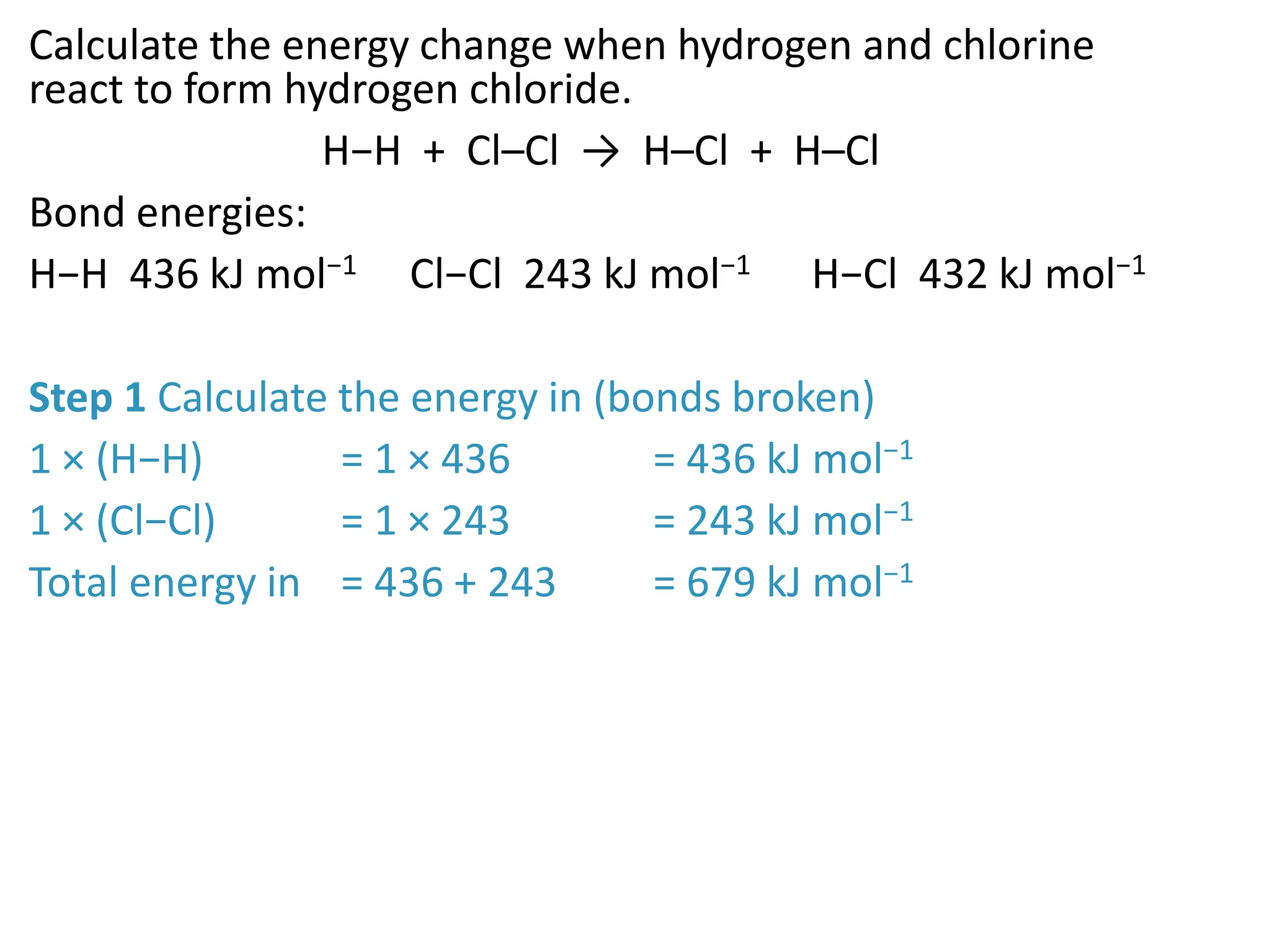
Now we can clearly see:
Bonds broken:
1 H–H
1 Cl–Cl
Bonds formed:
2 H–Cl
Drawing the bonds is one of the best ways to prevent counting errors.
Step 3: Calculate Energy Required to Break Bonds
Bond breaking requires energy.
Suppose:
H–H = 436 kJ mol⁻¹
Cl–Cl = 243 kJ mol⁻¹
We break:
1 H–H bond:
1 × 436 = 436 kJ mol⁻¹
and:
1 Cl–Cl bond:
1 × 243 = 243 kJ mol⁻¹
Total energy required:
436 + 243 = 679 kJ mol⁻¹
So:
Energy IN = 679 kJ mol⁻¹
Step 4: Calculate Energy Released When Bonds Form
The products contain two H–Cl bonds.
H–Cl bond energy:
431 kJ mol⁻¹
Two bonds form:
2 × 431 = 862 kJ mol⁻¹
Therefore:
Energy OUT = 862 kJ mol⁻¹
Approximately 862 kJ mol⁻¹ is released when these bonds form.
Step 5: Calculate the Overall Energy Change
Now use:
ΔH ≈ bonds broken − bonds formed
Therefore:
ΔH ≈ 679 − 862
ΔH ≈ −183 kJ mol⁻¹
Because the answer is negative:
the reaction is exothermic
This calculation is a standard example of determining reaction enthalpy from bond energies.
Visualizing the H₂ + Cl₂ Calculation
We can think of the reaction as:
H–H + Cl–Cl
Energy must first enter:
+679 kJ mol⁻¹
The atoms can then rearrange.
When two H–Cl bonds form:
862 kJ mol⁻¹ is released
Therefore:
679 IN
versus:
862 OUT
Difference:
183 kJ mol⁻¹ OUT
So:
ΔH ≈ −183 kJ mol⁻¹
A Reliable Calculation Method
For almost every basic bond-energy problem, use this sequence:
1. Balance the equation.
2. Draw the structures.
3. Count bonds broken.
4. Multiply each by its bond energy.
5. Add to find total energy absorbed.
6. Count bonds formed.
7. Multiply each by its bond energy.
8. Add to find total energy released.
9. Calculate:
ΔH ≈ broken − formed
10. Interpret the sign.
This method works for both exothermic and endothermic reactions.
Worked Example 1: Formation of Water
Consider:
2H₂ + O₂ → 2H₂O
The structures can be represented as:
2(H–H) + O=O → 2(H–O–H)
Bonds broken:
- 2 H–H
- 1 O=O
Bonds formed:
- 4 O–H
This is an excellent example because it makes bond counting especially important.
Step 1: Calculate Bonds Broken
H–H = 436 kJ mol⁻¹
O=O = 498 kJ mol⁻¹
Two H–H bonds:
2 × 436 = 872 kJ mol⁻¹
One O=O bond:
1 × 498 = 498 kJ mol⁻¹
Total:
872 + 498 = 1370 kJ mol⁻¹
Therefore:
Energy required = 1370 kJ mol⁻¹
Step 2: Calculate Bonds Formed
Each water molecule contains:
2 O–H bonds
There are two water molecules.
Therefore:
4 O–H bonds form
O–H = 463 kJ mol⁻¹
So:
4 × 463 = 1852 kJ mol⁻¹
Therefore:
Energy released = 1852 kJ mol⁻¹
Step 3: Calculate ΔH
ΔH ≈ 1370 − 1852
ΔH ≈ −482 kJ mol⁻¹
Therefore:
the reaction is exothermic
A worked calculation using these values gives the same approximate result.
The key energy comparison is:
1370 kJ required
versus:
1852 kJ released
More energy is released than absorbed.
Why Is Water Formation Exothermic?
The answer is not simply:
"because bonds form."
Both bond breaking and bond formation occur.
The better explanation is:
The formation of the O–H bonds releases more energy than is required to break the H–H and O=O bonds.
Therefore, energy is released overall.
This distinction is essential when explaining reaction energetics.
Worked Example 2: An Endothermic Reaction
Suppose a reaction has:
Energy required to break bonds:
1250 kJ mol⁻¹
Energy released when bonds form:
980 kJ mol⁻¹
Calculate:
ΔH = 1250 − 980
ΔH = +270 kJ mol⁻¹
Because ΔH is positive:
the reaction is endothermic
The reaction absorbs:
270 kJ mol⁻¹ overall
In this case:
energy IN > energy OUT
Worked Example 3: Another Exothermic Reaction
Suppose:
Bonds broken = 1600 kJ mol⁻¹
Bonds formed = 2050 kJ mol⁻¹
Then:
ΔH = 1600 − 2050
ΔH = −450 kJ mol⁻¹
Therefore:
450 kJ mol⁻¹ is released overall
and the reaction is:
exothermic
The products have less energy than the reactants because the system has transferred energy to the surroundings.
Calculating the Energy Needed to Break Several Bonds
Suppose a molecule contains:
4 C–H bonds
and we want to calculate the approximate energy required to break all four.
C–H = 413 kJ mol⁻¹
Therefore:
4 × 413
= 1652 kJ mol⁻¹
Approximately:
1652 kJ mol⁻¹
must be supplied.
The most common mistake here is forgetting to multiply by the number of bonds.
Calculating Energy Released When Several Bonds Form
Suppose four O–H bonds form.
O–H = 463 kJ mol⁻¹
Energy released:
4 × 463
= 1852 kJ mol⁻¹
Therefore:
1852 kJ mol⁻¹ is released
during bond formation.
When using the main equation, we normally use the magnitude 1852 and subtract it:
ΔH = broken − formed
Worked Example 4: Combustion of Methane
Consider:
CH₄ + 2O₂ → CO₂ + 2H₂O
This is a more substantial bond-energy calculation.
First identify the bonds.
Reactants
CH₄ contains:
4 C–H bonds
2O₂ contains:
2 O=O bonds
Products
CO₂ contains:
2 C=O bonds
2H₂O contains:
4 O–H bonds
This type of diagram is particularly useful because it shows that both the number and type of bonds must be considered.
Methane Combustion: Bonds Broken
Using:
C–H = 413 kJ mol⁻¹
O=O = 498 kJ mol⁻¹
Four C–H bonds:
4 × 413 = 1652 kJ mol⁻¹
Two O=O bonds:
2 × 498 = 996 kJ mol⁻¹
Total:
1652 + 996
= 2648 kJ mol⁻¹
Therefore:
Energy required = 2648 kJ mol⁻¹
Methane Combustion: Bonds Formed
For this calculation, use:
C=O in CO₂ ≈ 805 kJ mol⁻¹
O–H = 463 kJ mol⁻¹
Two C=O bonds:
2 × 805 = 1610 kJ mol⁻¹
Four O–H bonds:
4 × 463 = 1852 kJ mol⁻¹
Total:
1610 + 1852
= 3462 kJ mol⁻¹
Therefore:
Energy released = 3462 kJ mol⁻¹
Methane Combustion: Overall ΔH
Calculate:
ΔH ≈ 2648 − 3462
ΔH ≈ −814 kJ mol⁻¹
The precise estimate changes slightly depending on which average bond-energy table is used. For example, a source using C–H = 412 kJ mol⁻¹ obtains approximately −818 kJ mol⁻¹.
The important conclusion is:
ΔH is negative
Therefore:
methane combustion is exothermic
Where Does the Energy from Combustion Come From?
This calculation helps correct a major misconception.
Methane does not release energy because its C–H bonds are broken.
Breaking those C–H bonds required:
1652 kJ mol⁻¹
Breaking the O=O bonds required even more energy.
The reaction releases energy overall because formation of the strong:
C=O
and:
O–H
bonds releases a greater amount of energy.
So:
energy released forming products > energy required breaking reactants
This is why the reaction is exothermic.
Worked Example 5: Formation of Ammonia
Consider the Haber reaction:
N₂ + 3H₂ → 2NH₃
Now identify the bonds.
Reactants:
1 N≡N bond
3 H–H bonds
Products:
Each NH₃ contains 3 N–H bonds.
Therefore 2NH₃ contains:
6 N–H bonds
Ammonia: Bonds Broken
Use:
N≡N = 945 kJ mol⁻¹
H–H = 436 kJ mol⁻¹
One N≡N:
1 × 945 = 945
Three H–H:
3 × 436 = 1308
Total:
945 + 1308
= 2253 kJ mol⁻¹
Energy required:
2253 kJ mol⁻¹
Ammonia: Bonds Formed
N–H = 391 kJ mol⁻¹
Six N–H bonds form:
6 × 391
= 2346 kJ mol⁻¹
Energy released:
2346 kJ mol⁻¹
Ammonia: Overall Energy Change
ΔH ≈ 2253 − 2346
ΔH ≈ −93 kJ mol⁻¹
Therefore:
the reaction is exothermic
This approximate bond-energy calculation gives an energy release of about 93 kJ for the reaction as written.
Notice how much energy is required to break the:
N≡N triple bond
Its very high bond energy makes nitrogen particularly difficult to react.
Worked Example 6: Hydrogenation of Ethene
Consider:
C₂H₄ + H₂ → C₂H₆
Structurally:
H₂C=CH₂ + H–H → H₃C–CH₃
During this reaction:
- the C=C bonding arrangement changes to C–C
- H–H is broken
- two new C–H bonds form
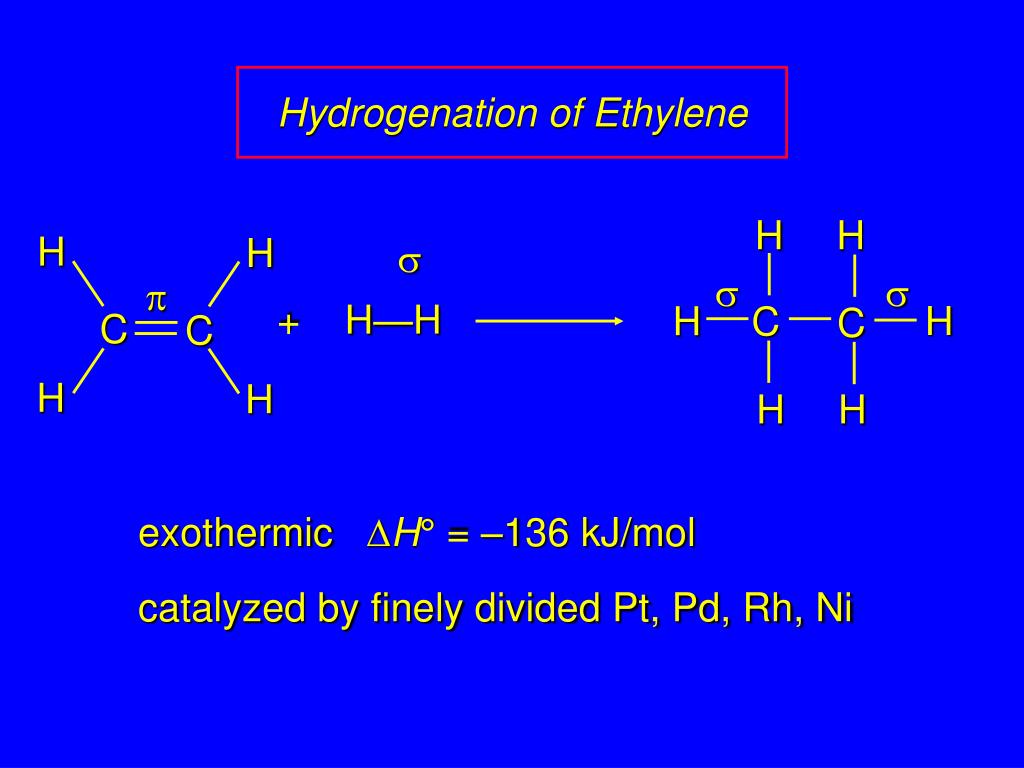
This reaction provides a good example of using structural formulae to determine which bonds have changed.
Hydrogenation Calculation
Use:
C=C = 614 kJ mol⁻¹
H–H = 436 kJ mol⁻¹
C–C = 347 kJ mol⁻¹
C–H = 413 kJ mol⁻¹
Energy associated with bonds broken/replaced:
614 + 436 = 1050 kJ mol⁻¹
Energy associated with bonds formed:
347 + 2(413)
= 347 + 826
= 1173 kJ mol⁻¹
Therefore:
ΔH ≈ 1050 − 1173
ΔH ≈ −123 kJ mol⁻¹
So the reaction is:
exothermic
Again, the exact estimate depends somewhat on the average bond-energy values used.
Why Structural Formulae Matter
Consider:
C₂H₄ + H₂ → C₂H₆
If you look only at the molecular formulae, it is difficult to see which bonds change.
But drawing:
H₂C=CH₂ + H–H → H₃C–CH₃
makes the changes visible.
For more complicated molecules:
Always draw the structure before counting bonds.
Be Careful With Double and Triple Bonds
A double bond counts as a double bond type, not as two single bonds.
For example:
O=O
should use the O=O bond-energy value.
Do not calculate:
2 × O–O
Similarly:
N≡N
uses the N≡N bond-energy value.
It should not be treated as:
3 × N–N
Single, double and triple bonds have their own characteristic average bond energies.
A Shortcut: Count Only Bonds That Change
Sometimes many bonds remain unchanged during a reaction.
Because identical unchanged bonds appear on both sides of the calculation, their contributions cancel.
For example:
C₂H₄ + H₂ → C₂H₆
Four of the original C–H bonds remain present.
Rather than including those identical bonds on both sides, we can focus on the bonding changes.
This can make calculations much faster.
However, when learning the method, it is often safer to:
draw everything → count everything → check which bonds cancel
before using the shortcut.
Interpreting a Negative Answer
Suppose:
ΔH = −250 kJ mol⁻¹
The negative sign means:
the chemical system loses energy
and:
the surroundings gain energy
Therefore:
250 kJ mol⁻¹ is released overall
and the reaction is:
exothermic
Do not say:
"The reaction releases −250 kJ."
It is clearer to say:
ΔH = −250 kJ mol⁻¹
or:
250 kJ mol⁻¹ is released.
Interpreting a Positive Answer
Suppose:
ΔH = +175 kJ mol⁻¹
The positive sign means:
the chemical system gains energy
Energy has been absorbed from the surroundings.
Therefore:
175 kJ mol⁻¹ is absorbed overall
and the reaction is:
endothermic
What If ΔH Is Close to Zero?
Suppose:
Energy required to break bonds:
1520 kJ mol⁻¹
Energy released forming bonds:
1510 kJ mol⁻¹
Then:
ΔH ≈ 1520 − 1510
ΔH ≈ +10 kJ mol⁻¹
The reaction is predicted to be slightly endothermic.
However, because average bond energies are approximate, a result very close to zero should be interpreted cautiously.
Small differences can be sensitive to the particular average bond-energy values used.
Why Are Bond Energy Calculations Approximate?
Most tables contain average bond energies.
For example, a C–H bond does not have exactly the same bond strength in every molecule.
Its exact energy depends on its molecular environment.
Therefore:
ΔH from average bond energies ≈ estimated ΔH
not necessarily the exact experimental value.
Bond-energy values also conventionally refer to gaseous species, so phase changes and intermolecular interactions can contribute to differences between an estimate and an experimentally measured reaction enthalpy.
Bond Energy Calculations vs Reaction Profiles
Bond-energy calculations tell us about:
overall reaction energy, ΔH
Reaction profiles show additional information such as:
activation energy
and:
transition state
A bond-energy calculation does not directly tell us the activation energy.
For example:
ΔH = −300 kJ mol⁻¹
does not mean:
Eₐ = 300 kJ mol⁻¹
These are different quantities.
Does a More Negative ΔH Mean a Faster Reaction?
No.
Suppose:
Reaction A:
ΔH = −500 kJ mol⁻¹
Reaction B:
ΔH = −100 kJ mol⁻¹
Reaction A releases more energy.
But that does not automatically mean Reaction A occurs faster.
Reaction rate depends strongly on factors including:
- activation energy
- temperature
- concentration
- pressure
- surface area
- catalysts
- reaction mechanism
Energy change and reaction rate describe different aspects of a reaction.
Worked Example 7: Find the Missing Energy
Suppose a reaction has:
ΔH = −180 kJ mol⁻¹
and:
Energy required to break bonds = 720 kJ mol⁻¹
We know:
ΔH = broken − formed
Therefore:
−180 = 720 − formed
Rearrange:
formed = 720 + 180
formed = 900 kJ mol⁻¹
Therefore:
900 kJ mol⁻¹ is released during bond formation.
Worked Example 8: Find the Bond-Breaking Energy
Suppose:
ΔH = +120 kJ mol⁻¹
and:
Energy released forming bonds = 650 kJ mol⁻¹
Use:
ΔH = broken − formed
Therefore:
120 = broken − 650
So:
broken = 770 kJ mol⁻¹
Therefore:
770 kJ mol⁻¹ is required to break the reactant bonds.
Worked Example 9: Comparing Two Reactions
Reaction A:
Bonds broken = 800 kJ mol⁻¹
Bonds formed = 1100 kJ mol⁻¹
Reaction B:
Bonds broken = 1200 kJ mol⁻¹
Bonds formed = 1350 kJ mol⁻¹
For Reaction A:
ΔH = 800 − 1100
ΔH = −300 kJ mol⁻¹
For Reaction B:
ΔH = 1200 − 1350
ΔH = −150 kJ mol⁻¹
Both reactions are:
exothermic
But Reaction A releases more energy overall.
Reaction A releases:
300 kJ mol⁻¹
Reaction B releases:
150 kJ mol⁻¹
A Quick Visual Way to Think About the Calculation
Imagine the bond-breaking and bond-forming energies as two competing totals.
Exothermic
Bond breaking: 600 kJ IN
Bond forming: 900 kJ OUT
Net:
300 kJ OUT
ΔH = −300 kJ mol⁻¹
Endothermic
Bond breaking: 900 kJ IN
Bond forming: 600 kJ OUT
Net:
300 kJ IN
ΔH = +300 kJ mol⁻¹
This is often the simplest conceptual way to check whether your mathematical answer makes sense.
Checking Your Answer
After every bond-energy calculation, ask:
Does the sign make sense?
If bond formation released more energy than bond breaking required:
Your answer should be:
negative
If bond breaking required more energy than bond formation released:
Your answer should be:
positive
This quick check catches many arithmetic and sign errors.
Common Mistake 1: Adding Instead of Subtracting
Suppose:
Broken = 700 kJ mol⁻¹
Formed = 900 kJ mol⁻¹
Incorrect:
700 + 900 = 1600
Correct:
700 − 900 = −200 kJ mol⁻¹
Remember:
broken − formed
Common Mistake 2: Forgetting Coefficients
Consider:
2H₂ + O₂ → 2H₂O
There are:
2 H–H bonds
not one.
There are:
4 O–H bonds
not two.
The coefficients in the balanced equation affect the total number of bonds.
Common Mistake 3: Counting Atoms Instead of Bonds
Consider CH₄.
It contains:
1 carbon atom
4 hydrogen atoms
but:
4 C–H bonds
Bond-energy calculations require us to count bonds, not simply atoms.
Common Mistake 4: Using the Wrong Bond Type
Do not confuse:
C–C
with:
C=C
or:
C≡C
Their bond energies are very different.
The same applies to:
C–O
versus:
C=O
Always examine the structural formula carefully.
Common Mistake 5: Reversing the Equation
The correct equation is:
ΔH ≈ bonds broken − bonds formed
Not:
formed − broken
A useful memory aid is:
Break – Make
B − M
Common Mistake 6: Saying Bonds "Contain Energy That Is Released When Broken"
Breaking a bond requires energy.
Energy release during an exothermic reaction occurs because the formation of product bonds releases more energy than is required to break the reactant bonds.
This distinction is fundamental to chemical energetics.
Did You Know?
Bond-energy calculations can explain why two fuels may release different amounts of energy even if both undergo combustion.
The important question is not simply:
"How many bonds does the fuel contain?"
Instead, chemists compare:
the complete set of reactant bonds that must be broken
with:
the complete set of product bonds that form
The difference between these totals determines the approximate energy released by the reaction.
Calculation Summary
For any bond-energy calculation:
Balanced equation
↓
Draw structures
↓
Count bonds broken
↓
Calculate total energy required
↓
Count bonds formed
↓
Calculate total energy released
↓
ΔH ≈ broken − formed
↓
If ΔH < 0 → exothermic
If ΔH > 0 → endothermic
Key Terms
Bond energy – Energy required to break one mole of a particular type of covalent bond in gaseous molecules.
Bond breaking – An endothermic process requiring an input of energy.
Bond formation – An exothermic process that releases energy.
Enthalpy change, ΔH – The overall energy change associated with a reaction at constant pressure.
Exothermic reaction – A reaction that releases energy overall to the surroundings.
Endothermic reaction – A reaction that absorbs energy overall from the surroundings.
Average bond energy – An average value for a particular bond type across different molecular environments.
Structural formula – A representation showing how atoms are bonded within a molecule.
Key Takeaways
- Chemical reactions involve breaking bonds and forming bonds.
- Breaking bonds requires energy.
- Forming bonds releases energy.
- The energy required to break several bonds is calculated by multiplying each bond energy by the number of those bonds.
- The energy released when several bonds form is calculated in the same way.
- Overall reaction energy can be estimated using:
ΔH ≈ ΣE(bonds broken) − ΣE(bonds formed)
- If ΔH is negative, the reaction is exothermic.
- If ΔH is positive, the reaction is endothermic.
- A negative ΔH means energy is released overall.
- A positive ΔH means energy is absorbed overall.
- Structural formulae help identify and count the bonds involved.
- Double and triple bonds must use their own bond-energy values.
- Average bond energies make these calculations estimates, not perfectly exact experimental values.
- Bond-energy calculations determine approximate overall energy change; they do not directly determine activation energy or reaction rate.
- Exothermic reactions release energy because forming the product bonds releases more energy than breaking the reactant bonds requires.
- Always finish a calculation by interpreting the sign and explaining what it means chemically.