Mass Relationships in Reactions
5. Percentage Yield
Learning outcomes
- I can define percentage yield.
- I can calculate percentage yield from theoretical and actual yields.
- I can explain factors that reduce percentage yield.
- I can interpret percentage yield values in experiments.
- I can solve problems involving percentage yield.
Percentage Yield
In a chemical reaction, the amount of product actually obtained is often less than the maximum amount predicted by stoichiometry.
Percentage yield compares the amount of product actually obtained with the amount that should theoretically have been produced.
It tells us how successful a reaction or experimental process was at producing the desired product.
The equation is:
percentage yield = (actual yield / theoretical yield) × 100%
where:
- actual yield = amount of product actually obtained
- theoretical yield = maximum amount of product predicted by stoichiometry
- percentage yield = actual yield expressed as a percentage of the theoretical maximum


Understanding Percentage Yield
Suppose a reaction has a theoretical yield of:
20.0 g
but only:
16.0 g
of product is actually collected.
Percentage yield:
percentage yield = (16.0 / 20.0) × 100%
= 80.0%
This means the experiment produced:
80% of the maximum predicted amount
The remaining 20% does not necessarily represent one single type of loss. Several different factors may have reduced the amount of product collected.
The Three Types of Yield
It is important to distinguish between three related ideas.
Theoretical Yield
The maximum amount of product predicted by stoichiometry.
Example:
theoretical yield = 50 g
Actual Yield
The amount of product actually obtained during the experiment.
Example:
actual yield = 42 g
Percentage Yield
A comparison between the actual and theoretical yields.
percentage yield = (42 / 50) × 100%
= 84%
So:
theoretical yield → predicted
actual yield → measured
percentage yield → compares the two
Why Use a Percentage?
Suppose two experiments produce:
Experiment A:
- theoretical yield = 10 g
- actual yield = 8 g
Experiment B:
- theoretical yield = 100 g
- actual yield = 80 g
Experiment B produces much more product, but both reactions have:
80% yield
Percentage yield allows us to compare reactions performed on different scales.
Interpreting Percentage Yield
A percentage yield close to:
100%
means the amount collected was close to the theoretical maximum.
A lower percentage indicates that less of the expected product was successfully obtained.
For example:
| Actual Yield | Theoretical Yield | Percentage Yield |
|---|---|---|
| 10 g | 10 g | 100% |
| 9 g | 10 g | 90% |
| 8 g | 10 g | 80% |
| 5 g | 10 g | 50% |
| 2 g | 10 g | 20% |
A higher percentage yield generally means a greater proportion of the theoretically possible product was obtained.
Worked Example: Basic Percentage Yield
A reaction has:
theoretical yield = 25.0 g
actual yield = 21.0 g
Calculate the percentage yield.
Use:
percentage yield = (actual yield / theoretical yield) × 100%
Substitute:
percentage yield = (21.0 / 25.0) × 100%
= 84.0%
Answer
Percentage yield = 84.0%
Worked Example: Magnesium Oxide
Consider:
2Mg + O₂ → 2MgO
Suppose stoichiometry predicts:
20.15 g MgO
but an experiment produces:
18.0 g MgO
Calculate the percentage yield.
percentage yield = (18.0 / 20.15) × 100%
≈ 89.3%
Answer
Percentage yield ≈ 89.3%
This means approximately 89% of the theoretically possible magnesium oxide was obtained.
Calculating the Theoretical Yield First
Sometimes the theoretical yield is not provided.
You must calculate it using stoichiometry before calculating percentage yield.
The complete pathway becomes:
reactant amount
↓
moles of reactant
↓
moles of product
↓
theoretical yield
↓
compare with actual yield
↓
percentage yield
Worked Example: Calculate Theoretical Yield and Percentage Yield
Consider:
2Mg + O₂ → 2MgO
Suppose:
24.3 g Mg
reacts with excess oxygen.
The experiment produces:
35.0 g MgO
Calculate the percentage yield.
Use:
M(Mg) = 24.3 g/mol
M(MgO) = 40.3 g/mol
Convert Mg to moles
24.3 ÷ 24.3 = 1.00 mol Mg
Use the mole ratio
Mg : MgO = 2 : 2
Therefore:
1.00 mol Mg → 1.00 mol MgO
Calculate theoretical yield
1.00 × 40.3 = 40.3 g MgO
Therefore:
theoretical yield = 40.3 g
Calculate percentage yield
Actual yield:
35.0 g
Therefore:
percentage yield = (35.0 / 40.3) × 100%
≈ 86.8%
Answer
Percentage yield ≈ 86.8%
Percentage Yield with a Limiting Reactant
If amounts of two reactants are provided, you must first identify the limiting reactant.
The limiting reactant determines the theoretical yield.
The pathway is:
reactant quantities
↓
convert to moles
↓
identify limiting reactant
↓
calculate theoretical yield
↓
compare with actual yield
↓
calculate percentage yield
Worked Example: Hydrogen and Oxygen
Consider:
2H₂ + O₂ → 2H₂O
Suppose:
10 g H₂
react with:
64 g O₂
and the experiment produces:
63 g H₂O
Use:
M(H₂) = 2 g/mol
M(O₂) = 32 g/mol
M(H₂O) = 18 g/mol
Convert reactants to moles
H₂:
10 ÷ 2 = 5 mol H₂
O₂:
64 ÷ 32 = 2 mol O₂
The reaction requires:
2 mol H₂ : 1 mol O₂
Two moles O₂ require:
4 mol H₂
We have 5 mol H₂.
Therefore:
O₂ is the limiting reactant.
Calculate the Theoretical Yield
From:
2H₂ + O₂ → 2H₂O
2 mol O₂ → 4 mol H₂O
Mass:
4 × 18 = 72 g H₂O
Therefore:
theoretical yield = 72 g
Actual yield:
63 g
Percentage yield:
(63 / 72) × 100%
= 87.5%
Answer
Percentage yield = 87.5%
Why Percentage Yield Is Often Less Than 100%
Real chemical experiments are not perfectly efficient.
There are many reasons why the actual yield may be lower than the theoretical yield.


Incomplete Reactions
Some reactions do not proceed until all of the limiting reactant has been converted into product.
If some reactant remains unreacted, less product forms.
For example, stoichiometry might predict:
10.0 g product
but incomplete reaction might result in only:
8.5 g product
This lowers the percentage yield.
Reversible Reactions
Some reactions can proceed in both directions.
Instead of completely converting reactants into products, the reaction may reach equilibrium.
At equilibrium:
- reactants remain
- products are present
- forward and reverse reactions continue
Because not all reactants become products, the yield may be lower than the theoretical maximum.
Side Reactions
Reactants may sometimes undergo unwanted reactions.
Instead of producing only the desired product:
reactants → desired product
some reactants may form other substances:
reactants → unwanted products
This reduces the amount of desired product.
Product Lost During Transfer
Some product may remain:
- inside a beaker
- on a stirring rod
- inside a flask
- in a funnel
- on filter paper
Every transfer creates an opportunity to lose a small amount of material.
For example, pouring a solid from one container into another may leave some material behind.
Product Lost During Filtration
When collecting a precipitate:
- small particles may pass through the filter
- some product may remain dissolved
- some may stick to the glassware
- some may be spilled
This lowers the actual yield.
Product Lost During Purification
Chemical products often need to be purified.
Processes such as:
- filtration
- recrystallization
- washing
- extraction
- distillation
can cause some desired product to be lost.
A highly pure product may therefore have a lower recovered mass.
Gas Loss
If the desired product is a gas, some may escape from the apparatus.
For example:
CaCO₃ → CaO + CO₂
If CO₂ is being collected, leaks in the apparatus can reduce the amount measured.
Impure Reactants
Suppose a sample is labelled:
10.0 g
but contains only:
8.0 g of the actual reactant
If the theoretical yield calculation incorrectly assumes all 10.0 g are pure reactant, it will predict too much product.
This can make the calculated percentage yield appear unusually low.
Product Decomposition
Sometimes the desired product can decompose during:
- heating
- drying
- storage
- purification
If some product breaks down after it forms, the final measured amount will be lower.
Mechanical Losses
Some losses have nothing to do with the chemistry itself.
Examples include:
- spilling material
- losing crystals during transfer
- leaving product on equipment
- breaking or damaging a sample
- losing fine particles
These are sometimes called mechanical losses.
Can Percentage Yield Equal 100%?
Yes.
A percentage yield of:
100%
means:
actual yield = theoretical yield
For example:
Theoretical:
15.0 g
Actual:
15.0 g
Percentage:
(15.0 / 15.0) × 100% = 100%
This represents perfect agreement between the measured and theoretical quantities.
In real laboratory work, exactly 100% is possible but should still be interpreted in light of measurement uncertainty and experimental conditions.
Can Percentage Yield Be Greater Than 100%?
A calculated percentage yield can sometimes be greater than 100%.
For example:
Theoretical yield:
10.0 g
Measured actual yield:
10.8 g
Percentage yield:
(10.8 / 10.0) × 100%
= 108%
This does not normally mean the reaction somehow produced more pure desired product than was theoretically possible.
Instead, something should be investigated.
Why Might Percentage Yield Exceed 100%?
The Product Is Wet
Suppose a solid product contains water.
The balance measures:
product + water
The measured mass is therefore too high.
The Product Contains Impurities
Other substances may be mixed with the product.
The measured mass then includes:
desired product + impurities
Unreacted Reactants Remain
The sample may contain some reactant that was not removed.
The measured material is therefore not pure product.
Incomplete Drying
This is particularly common when precipitates or crystals are collected.
Water or solvent remaining on the product increases its apparent mass.
Measurement Error
An incorrect balance reading or another measurement problem can produce an inaccurate actual yield.
Calculation Error
The theoretical yield may have been calculated incorrectly.
Possible mistakes include:
- incorrect molar mass
- unbalanced equation
- incorrect mole ratio
- wrong limiting reactant
- arithmetic error
Interpreting a Yield Greater Than 100%
Suppose:
percentage yield = 112%
A useful scientific conclusion is not:
The reaction was 112% efficient.
Instead:
The measured product mass exceeds the theoretical maximum, suggesting contamination, incomplete drying, measurement error, or an error in the theoretical-yield calculation.
Percentage yield should be interpreted scientifically rather than accepted without question.
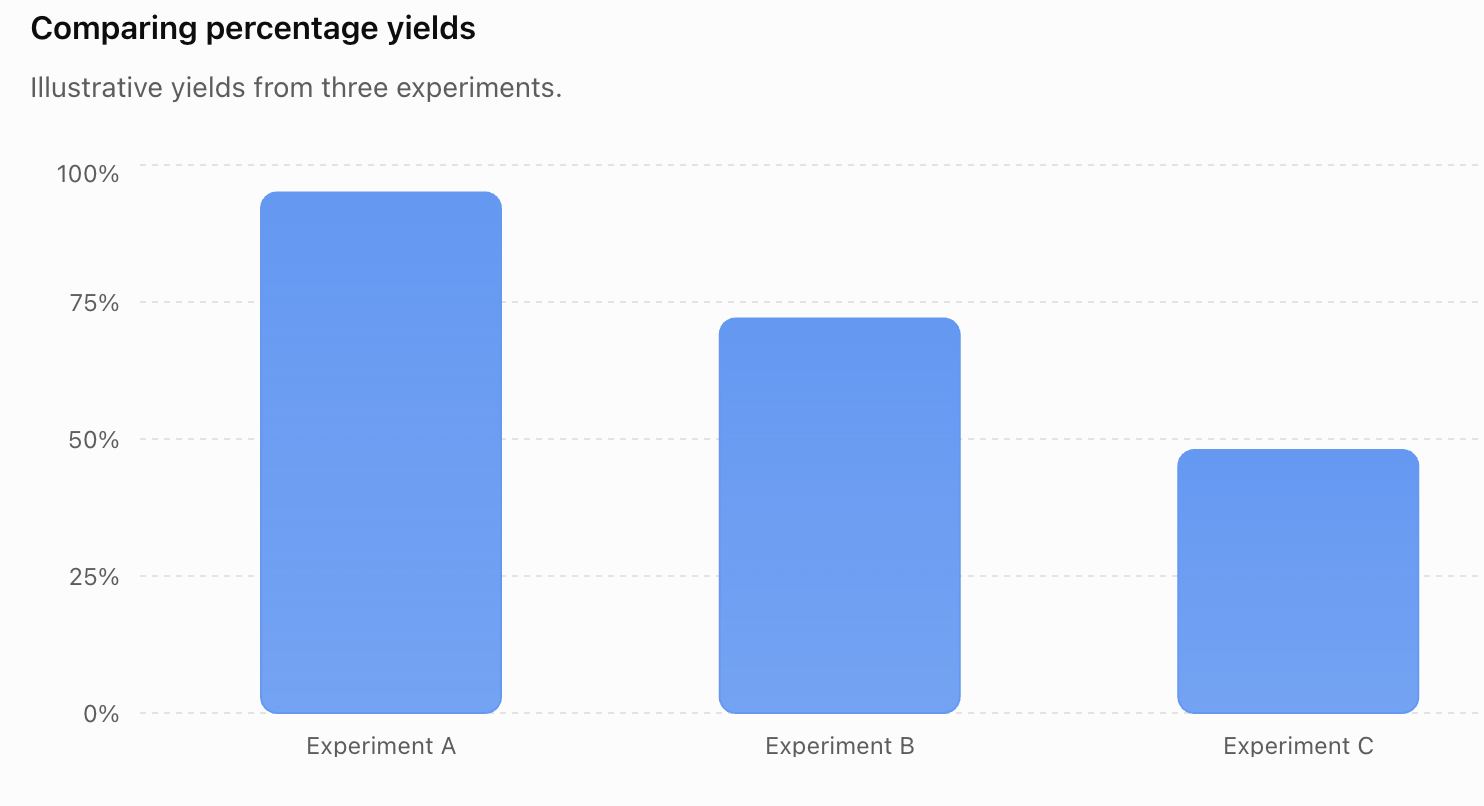
Comparing Percentage Yields
Consider three experiments: