Mass Relationships in Reactions
| サイト: | Young Education |
| コース: | Chemical Reactions and Stoichiometry |
| ブック: | Mass Relationships in Reactions |
| 印刷者: | ゲストユーザ |
| 日付: | 2026年 10月 5日(月曜日) 03:04 |
1. Mass-Mass Calculations
Learning outcomes
- I can convert between mass and moles in chemical calculations.
- I can use stoichiometry to determine masses of products and reactants.
- I can solve mass-mass calculation problems.
- I can explain the relationship between mass conservation and stoichiometry.
- I can apply mass-mass calculations to practical chemical situations.


2. Limiting Reactants
Learning outcomes
- I can explain the concept of a limiting reactant.
- I can identify the limiting reactant in a chemical reaction.
- I can calculate which reactant will be used up first.
- I can determine how the limiting reactant affects product formation.
- I can solve problems involving limiting reactants.
Limiting Reactants
In many chemical reactions, the reactants are not present in exactly the proportions required by the balanced equation.
One reactant will usually be used up first.
This substance is called the limiting reactant.
The limiting reactant is important because it determines the maximum amount of product that can form.
Once the limiting reactant has been completely consumed, the reaction cannot continue—even if some of the other reactant remains.


A Simple Example
Consider:
2H₂ + O₂ → 2H₂O
The balanced equation tells us that:
2 mol H₂ react with 1 mol O₂
Suppose we have:
4 mol H₂ and 1 mol O₂
The 1 mol O₂ requires only:
2 mol H₂
But we have 4 mol H₂.
Therefore:
- all 1 mol O₂ is consumed
- only 2 mol H₂ is consumed
- 2 mol H₂ remain
- 2 mol H₂O form
In this situation:
O₂ is the limiting reactant.
H₂ is the excess reactant.
The limiting reactant controls the amount of water that can form.
Here you can explore exactly how changing the starting amounts changes which reactant limits the reaction:
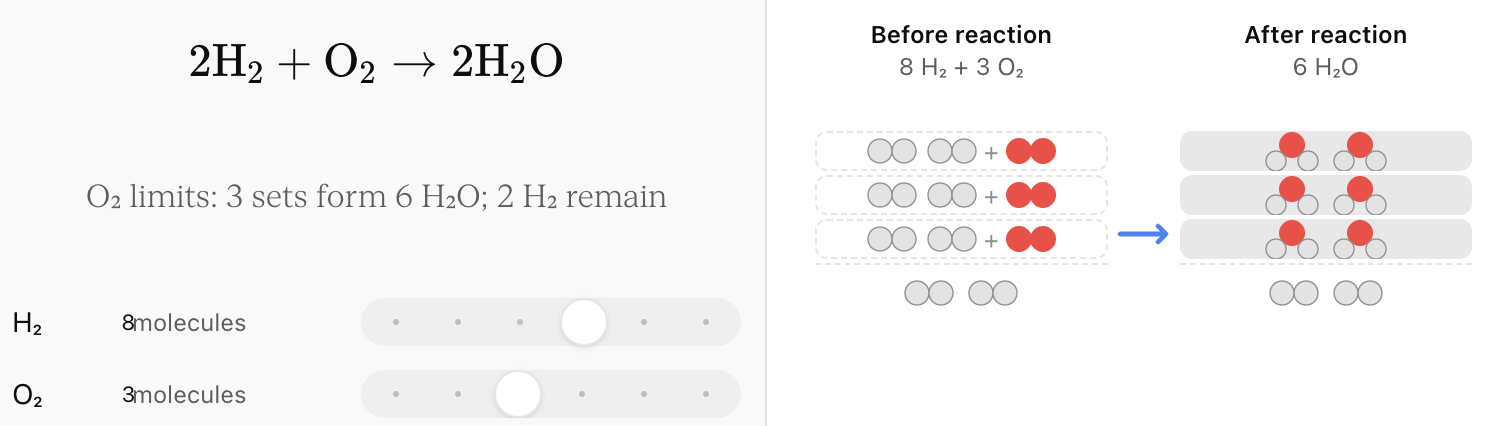
Limiting and Excess Reactants
There are two important terms to distinguish.
Limiting Reactant
The limiting reactant is the reactant that is completely consumed first.
It determines the maximum amount of product that can form.
Excess Reactant
An excess reactant is present in a greater amount than required.
Some of it remains after the limiting reactant has been consumed.
Think of the limiting reactant as the ingredient that runs out first.
A Sandwich Analogy
Suppose one sandwich requires:
2 slices of bread + 1 slice of cheese → 1 sandwich
You have:
10 slices of bread
and:
3 slices of cheese
The bread could make:
10 ÷ 2 = 5 sandwiches
The cheese could make:
3 ÷ 1 = 3 sandwiches
You can therefore make only:
3 sandwiches
Cheese is the limiting ingredient.
Bread is in excess.
After making 3 sandwiches:
6 slices of bread are used
so:
4 slices of bread remain
Chemical reactions work in much the same way.
Why the Limiting Reactant Matters
Consider:
N₂ + 3H₂ → 2NH₃
Suppose we have:
2 mol N₂
and:
3 mol H₂
Two moles of nitrogen would require:
6 mol H₂
But only 3 mol H₂ are available.
Therefore, there is not enough hydrogen to react with all the nitrogen.
H₂ is the limiting reactant.
Once the hydrogen has been consumed, ammonia production stops.
The Limiting Reactant Determines Product Amount
Using:
N₂ + 3H₂ → 2NH₃
Suppose:
2 mol N₂
and:
3 mol H₂
are available.
Because H₂ is limiting, calculate the product from H₂.
The mole ratio is:
3 mol H₂ : 2 mol NH₃
Therefore:
3 mol H₂ → 2 mol NH₃
The maximum amount of ammonia is:
2 mol NH₃
Even though some nitrogen remains, no more ammonia can form because there is no hydrogen left.
Identifying the Limiting Reactant
There are several methods.
One of the most reliable methods is:
Calculate how much product each reactant could produce.
The reactant that produces the smaller amount of product is the limiting reactant.
This method works for both mole and mass problems.
Method: Compare Product Amounts
Consider:
2H₂ + O₂ → 2H₂O
Suppose we have:
8 mol H₂
and:
3 mol O₂
Product possible from H₂
Ratio:
2 mol H₂ : 2 mol H₂O
Therefore:
8 mol H₂ → 8 mol H₂O
Product possible from O₂
Ratio:
1 mol O₂ : 2 mol H₂O
Therefore:
3 mol O₂ → 6 mol H₂O
Compare:
H₂ could produce 8 mol H₂O
O₂ could produce 6 mol H₂O
The smaller amount is:
6 mol H₂O
Therefore:
O₂ is the limiting reactant.
The maximum product is:
6 mol H₂O
Never Add the Product Predictions
In the previous example:
H₂ predicts:
8 mol H₂O
O₂ predicts:
6 mol H₂O
We do not calculate:
8 + 6 = 14 mol H₂O
Both calculations describe the same reaction from different reactants.
The smaller prediction determines what can actually form.
Therefore:
maximum H₂O = 6 mol
Method: Compare Required Amounts
Another method is to determine how much of one reactant is required to react with the other.
Consider:
2H₂ + O₂ → 2H₂O
Suppose:
8 mol H₂
and:
3 mol O₂
are available.
Eight moles of H₂ require:
8 × (1 mol O₂ / 2 mol H₂)
= 4 mol O₂
But only:
3 mol O₂
are available.
Therefore, there is not enough O₂.
O₂ is limiting.
This gives the same answer as the product-comparison method.
Method: Divide by the Coefficient
When all reactant quantities are already in moles, there is a useful shortcut.
Divide each available mole amount by its coefficient.
For:
2H₂ + O₂ → 2H₂O
Suppose:
8 mol H₂
and:
3 mol O₂
Calculate:
H₂:
8 ÷ 2 = 4
O₂:
3 ÷ 1 = 3
The smaller value identifies the limiting reactant.
Therefore:
O₂ is limiting.
This works because it compares how many complete reaction "sets" each reactant can supply.
Important Warning About the Shortcut
Do not simply compare the number of moles.
For:
N₂ + 3H₂ → 2NH₃
suppose we have:
2 mol N₂
and:
3 mol H₂
It might seem that N₂ is limiting because there are fewer moles of it.
But divide by the coefficients:
N₂:
2 ÷ 1 = 2
H₂:
3 ÷ 3 = 1
The smaller value is for H₂.
Therefore:
H₂ is limiting.
The reactant with fewer moles is not necessarily the limiting reactant.
Stoichiometric Proportions
Sometimes reactants are present in exactly the required ratio.
For:
2H₂ + O₂ → 2H₂O
suppose we have:
6 mol H₂
and:
3 mol O₂
The required ratio is:
2 : 1
The available ratio is also:
6 : 3 = 2 : 1
Therefore, both reactants are consumed completely.
Neither reactant is present in excess.
The quantities are in stoichiometric proportions.
Worked Example: Ammonia
Consider:
N₂ + 3H₂ → 2NH₃
Suppose we have:
5 mol N₂
and:
12 mol H₂
Which reactant is limiting?
Calculate product from N₂
5 mol N₂ × (2 mol NH₃ / 1 mol N₂)
= 10 mol NH₃
Calculate product from H₂
12 mol H₂ × (2 mol NH₃ / 3 mol H₂)
= 8 mol NH₃
Compare:
N₂ could produce 10 mol NH₃
H₂ could produce 8 mol NH₃
Therefore:
H₂ is the limiting reactant.
Maximum product:
8 mol NH₃
Calculating Excess Reactant Remaining
We can also calculate how much excess reactant remains.
Using:
N₂ + 3H₂ → 2NH₃
Initial amounts:
5 mol N₂
12 mol H₂
We found:
H₂ is limiting.
How much N₂ reacts?
Ratio:
3 mol H₂ : 1 mol N₂
Therefore:
12 mol H₂ × (1 mol N₂ / 3 mol H₂)
= 4 mol N₂
Initially:
5 mol N₂
Used:
4 mol N₂
Remaining:
5 − 4 = 1 mol N₂
Therefore:
1 mol N₂ remains in excess.
A Useful Three-Part Strategy
For most limiting-reactant problems:
Identify the limiting reactant
Determine which reactant can produce less product.
Calculate the product
Use the limiting reactant to calculate the maximum amount of product.
Calculate excess remaining
Determine how much excess reactant was consumed, then subtract:
excess remaining = excess initial − excess consumed
Limiting Reactants with Masses
Many problems provide masses rather than moles.
In this case, first convert each reactant to moles.
The pathway becomes:
mass reactant A → mol reactant A
mass reactant B → mol reactant B
Then compare the reactants using the balanced equation.


Worked Example: Hydrogen and Oxygen by Mass
Consider:
2H₂ + O₂ → 2H₂O
Suppose:
10 g H₂
and:
64 g O₂
are available.
Use:
M(H₂) = 2 g/mol
M(O₂) = 32 g/mol
Convert H₂ to moles
10 ÷ 2 = 5 mol H₂
Convert O₂ to moles
64 ÷ 32 = 2 mol O₂
Now compare.
The reaction requires:
2 mol H₂ for every 1 mol O₂
Two moles O₂ require:
4 mol H₂
We have:
5 mol H₂
Therefore, there is more H₂ than required.
O₂ is the limiting reactant.
Calculate the Product
Using:
2H₂ + O₂ → 2H₂O
We have:
2 mol O₂
Ratio:
1 mol O₂ : 2 mol H₂O
Therefore:
2 mol O₂ → 4 mol H₂O
Use:
M(H₂O) = 18 g/mol
Mass:
4 × 18 = 72 g
Maximum product
72 g H₂O
Calculate the Excess Remaining
Two moles O₂ require:
4 mol H₂
But initially we had:
5 mol H₂
Therefore:
5 − 4 = 1 mol H₂ remains
Mass:
1 × 2 = 2 g H₂
So after the reaction:
- O₂ remaining = 0 g
- H₂ remaining = 2 g
- H₂O formed = 72 g
Check conservation of mass:
Initial mass:
10 + 64 = 74 g
Final mass:
72 + 2 = 74 g
Mass is conserved.
Worked Example: Magnesium and Oxygen
Consider:
2Mg + O₂ → 2MgO
Suppose we react:
36.45 g Mg
with:
16.0 g O₂
Use:
M(Mg) = 24.3 g/mol
M(O₂) = 32.0 g/mol
Convert Mg to moles
36.45 ÷ 24.3 = 1.50 mol Mg
Convert O₂ to moles
16.0 ÷ 32.0 = 0.500 mol O₂
The required ratio is:
2 mol Mg : 1 mol O₂
For 0.500 mol O₂, we need:
1.00 mol Mg
We have:
1.50 mol Mg
Therefore:
O₂ is limiting.
Mg is in excess.
Calculate Magnesium Oxide Produced
Equation:
2Mg + O₂ → 2MgO
From:
0.500 mol O₂
we obtain:
1.00 mol MgO
Use:
M(MgO) = 40.3 g/mol
Therefore:
mass MgO = 1.00 × 40.3
= 40.3 g
Calculate Magnesium Remaining
The 0.500 mol O₂ consumes:
1.00 mol Mg
Initial Mg:
1.50 mol
Remaining:
1.50 − 1.00 = 0.50 mol Mg
Mass:
0.50 × 24.3 = 12.15 g
Check:
Initial mass:
36.45 + 16.0 = 52.45 g
Final mass:
40.3 + 12.15 = 52.45 g
Again, conservation of mass is satisfied.
Worked Example: Aluminum and Chlorine
Consider:
2Al + 3Cl₂ → 2AlCl₃
Suppose:
27.0 g Al
react with:
71.0 g Cl₂
Use:
M(Al) = 27.0 g/mol
M(Cl₂) = 71.0 g/mol
Convert to moles
Al:
27.0 ÷ 27.0 = 1.00 mol Al
Cl₂:
71.0 ÷ 71.0 = 1.00 mol Cl₂
Notice something important:
We have equal numbers of moles, but that does not mean the reactants are present in the correct ratio.
The equation requires:
2 mol Al : 3 mol Cl₂
Identify the Limiting Reactant
Use the coefficient method.
Al:
1.00 ÷ 2 = 0.500
Cl₂:
1.00 ÷ 3 = 0.333
The smaller value is:
0.333
Therefore:
Cl₂ is the limiting reactant.
This is a good example of why simply comparing the number of moles does not work.
Calculate Product Mass
Using:
2Al + 3Cl₂ → 2AlCl₃
From:
1.00 mol Cl₂
Product:
1.00 × (2/3) = 0.667 mol AlCl₃
Use:
M(AlCl₃) = 133.5 g/mol
Mass:
0.667 × 133.5 ≈ 89.0 g
Maximum product
Approximately:
89.0 g AlCl₃
Worked Example: Iron Oxide
Consider:
4Fe + 3O₂ → 2Fe₂O₃
Suppose:
112 g Fe
and:
64 g O₂
are available.
Use:
M(Fe) = 56 g/mol
M(O₂) = 32 g/mol
Convert to moles
Fe:
112 ÷ 56 = 2 mol
O₂:
64 ÷ 32 = 2 mol
Compare using coefficients
Fe:
2 ÷ 4 = 0.50
O₂:
2 ÷ 3 ≈ 0.67
The smaller value is for Fe.
Therefore:
Fe is the limiting reactant.
Calculate Fe₂O₃ Produced
Ratio:
4 mol Fe : 2 mol Fe₂O₃
Therefore:
2 mol Fe × (2 mol Fe₂O₃ / 4 mol Fe)
= 1 mol Fe₂O₃
Use:
M(Fe₂O₃) = 160 g/mol
Therefore:
160 g Fe₂O₃
can theoretically form.
Calculate Oxygen Remaining
Two moles Fe require:
2 × (3/4) = 1.5 mol O₂
Initially:
2 mol O₂
Remaining:
2 − 1.5 = 0.5 mol O₂
Mass remaining:
0.5 × 32 = 16 g O₂
Check:
Initial:
112 + 64 = 176 g
Final:
160 + 16 = 176 g
Mass is conserved.
A General Procedure for Limiting Reactant Problems
When masses are given:
1. Balance the chemical equation.
2. Convert each reactant mass to moles.
3. Compare the mole quantities using the coefficients.
4. Identify the limiting reactant.
5. Use the limiting reactant to calculate the product.
6. If required, calculate how much excess reactant was consumed.
7. Subtract to find the amount remaining.
8. Check whether the answer is reasonable.
A useful roadmap is:
grams → moles → identify limiting reactant → product moles → product mass
Product-Comparison Method
Another reliable strategy is to calculate how much product each reactant could theoretically produce.
Suppose:
A + 2B → 3C
Reactant A could produce:
12 mol C
Reactant B could produce:
9 mol C
The actual reaction cannot produce 12 mol because B runs out first.
Therefore:
B is limiting
and:
maximum product = 9 mol C
The rule is:
The reactant that predicts the smaller amount of product is limiting.
Why the Limiting Reactant Controls the Reaction
Imagine a factory assembling bicycles.
Each bicycle requires:
- 1 frame
- 2 wheels
Suppose the factory has:
- 100 frames
- 160 wheels
The frames could make:
100 bicycles
The wheels could make:
160 ÷ 2 = 80 bicycles
Only:
80 bicycles
can be completed.
After that, there are still:
20 frames
but no wheels.
The wheels limit production.
Chemical reactions behave similarly.


Why Reactions Often Use Excess Reactants
In laboratory and industrial chemistry, one reactant may deliberately be supplied in excess.
Why?
An excess reactant can help ensure that the more important or expensive reactant reacts as completely as possible.
For example, if reactant A is expensive but reactant B is inexpensive, a manufacturer might use extra B.
This helps maximize the use of A.
The excess material may sometimes be:
- recovered
- recycled
- separated
- reused
Limiting Reactants in Industrial Chemistry
Large-scale chemical production depends heavily on limiting-reactant calculations.
Chemists and engineers need to know:
- which reactant controls production
- how much product can theoretically form
- how much excess reactant remains
- how much raw material is required
- whether excess material can be recycled
- how much waste may be generated
Poor control of reactant quantities can increase both cost and waste.
Limiting Reactants and Theoretical Yield
The theoretical yield is determined by the limiting reactant.
Suppose:
Reactant A could produce:
50 g product
Reactant B could produce:
72 g product
The reaction cannot produce 72 g because reactant A runs out first.
Therefore:
theoretical yield = 50 g
and:
A is the limiting reactant
The excess reactant cannot create additional product without more limiting reactant.
Limiting Reactants and Conservation of Mass
Limiting-reactant calculations also demonstrate conservation of mass.
Remember that excess reactant does not disappear.
For example:
Initial reactants:
40 g A + 30 g B = 70 g
Suppose B is limiting and 10 g A remains.
If there is only one product:
product mass = 60 g
because:
60 g product + 10 g excess A = 70 g
All matter must still be accounted for.
A More Challenging Example
Consider:
N₂ + 3H₂ → 2NH₃
Suppose:
56 g N₂
and:
12 g H₂
are available.
Use:
M(N₂) = 28 g/mol
M(H₂) = 2 g/mol
M(NH₃) = 17 g/mol
Convert to moles
N₂:
56 ÷ 28 = 2 mol N₂
H₂:
12 ÷ 2 = 6 mol H₂
Required ratio:
1 N₂ : 3 H₂
Available ratio:
2 : 6
which simplifies to:
1 : 3
Therefore, the reactants are present in exactly the required stoichiometric ratio.
Both are completely consumed.
Neither is in excess.
Calculate the Product
From:
2 mol N₂
the equation predicts:
4 mol NH₃
Mass:
4 × 17 = 68 g NH₃
Initial mass:
56 + 12 = 68 g
Product mass:
68 g
Again:
mass is conserved
When There Is No Excess Reactant
It is possible for reactants to be present in exactly the stoichiometric ratio.
For:
2H₂ + O₂ → 2H₂O
examples include:
2 mol H₂ + 1 mol O₂
4 mol H₂ + 2 mol O₂
10 mol H₂ + 5 mol O₂
In each case, both reactants are completely consumed.
There is no excess reactant.
Common Mistakes
Choosing the Reactant with the Smaller Mass
The reactant with the smaller mass is not automatically limiting.
Different substances have different molar masses.
Convert masses to moles first.
Choosing the Reactant with Fewer Moles
The reactant with fewer moles is also not automatically limiting.
The balanced equation may require different numbers of moles.
Always compare using the coefficients.
Ignoring the Balanced Equation
Limiting-reactant calculations depend on stoichiometric ratios.
An unbalanced equation gives incorrect ratios.
Always balance first.
Calculating Product from the Excess Reactant
Once you identify the limiting reactant, use it to calculate the maximum product.
Using the excess reactant without accounting for the limit will overestimate the product.
Adding Two Product Predictions
If reactant A predicts 10 g product and reactant B predicts 15 g product, the answer is not:
25 g
The smaller prediction determines the theoretical yield.
Comparing Grams Directly
Suppose you have:
10 g A
and:
20 g B
You cannot determine which is limiting simply because A has the smaller mass.
You need:
mass → moles → mole ratio
Forgetting About Excess Reactant
When the limiting reactant is consumed, some excess reactant may remain.
It has not disappeared.
It must be included when checking conservation of mass.
Subtracting Different Units
Do not subtract:
grams − moles
Convert quantities to the same unit first.
Using the Wrong Mole Ratio
For:
N₂ + 3H₂ → 2NH₃
the ratio H₂ : NH₃ is:
3 : 2
not:
1 : 2
Use coefficients carefully.
Rounding Too Early
Limiting-reactant problems often contain several calculation steps.
Keep extra digits until the final answer.
Key Terms
Limiting reactant — The reactant that is completely consumed first and determines the maximum amount of product.
Limiting reagent — Another name for the limiting reactant.
Excess reactant — A reactant present in more than the amount required to react completely with the limiting reactant.
Stoichiometric ratio — The quantitative relationship between substances given by the coefficients in a balanced equation.
Stoichiometric proportions — Reactant quantities present in exactly the ratio required by the balanced equation.
Mole ratio — A ratio between substances based on coefficients in a balanced chemical equation.
Theoretical yield — The maximum amount of product predicted from the limiting reactant.
Reactant — A starting substance in a chemical reaction.
Product — A substance formed during a chemical reaction.
Molar mass — The mass of one mole of a substance, usually expressed in g/mol.
Excess remaining — The amount of excess reactant left after the limiting reactant has been consumed.
Excess consumed — The amount of the excess reactant that actually participates in the reaction.
Stoichiometry — The quantitative study of relationships between reactants and products.
Conservation of mass — The principle that total mass is conserved during an ordinary chemical reaction.
Key Takeaways
- The limiting reactant is the reactant that runs out first.
- The limiting reactant determines the maximum amount of product that can form.
- An excess reactant remains after the limiting reactant is consumed.
- The reactant with the smallest mass is not necessarily limiting.
- The reactant with the fewest moles is not necessarily limiting.
- Reactant amounts must be compared using the coefficients in the balanced equation.
- When masses are given, convert them to moles before comparing reactants.
- One reliable method is to calculate how much product each reactant could produce.
- The reactant producing the smaller amount of product is limiting.
- When quantities are already in moles, dividing each amount by its coefficient provides a useful shortcut.
- Product calculations must be based on the limiting reactant.
- Excess reactant remaining can be calculated using:
amount remaining = initial amount − amount consumed
- Reactants may occasionally be present in exactly the stoichiometric proportions, leaving no excess.
- The theoretical yield is determined by the limiting reactant.
- Excess reactants are often deliberately used in laboratories and industry.
- Limiting-reactant calculations are essential for predicting production, reducing waste, controlling costs, and planning chemical processes.
- Conservation of mass still applies: any unused excess reactant must be included when accounting for the final mass.
The main pathway to remember is:
BALANCE → CONVERT TO MOLES → COMPARE REACTANTS → IDENTIFY LIMITING REACTANT → CALCULATE PRODUCT → FIND EXCESS REMAINING
Check Your Understanding
Use:
2H₂ + O₂ → 2H₂O
1. If 4 mol H₂ react with 1 mol O₂, identify the limiting reactant.
2. How many moles of H₂O can form?
3. How many moles of excess reactant remain?
4. If 6 mol H₂ react with 4 mol O₂, identify the limiting reactant.
5. Calculate the maximum amount of H₂O that can form.
6. Calculate the amount of excess reactant remaining.
7. If 10 mol H₂ react with 5 mol O₂, is either reactant in excess? Explain.
Use:
N₂ + 3H₂ → 2NH₃
8. If 4 mol N₂ react with 6 mol H₂, identify the limiting reactant.
9. Calculate the maximum number of moles of NH₃.
10. Calculate the amount of excess reactant remaining.
11. If 5 mol N₂ react with 18 mol H₂, identify the limiting reactant.
12. Calculate the maximum amount of NH₃.
13. Calculate the amount of excess reactant remaining.
14. Explain why simply comparing the number of moles of N₂ and H₂ does not reliably identify the limiting reactant.
Mass Problems
Use:
2Mg + O₂ → 2MgO
with:
M(Mg) = 24.3 g/mol
M(O₂) = 32.0 g/mol
M(MgO) = 40.3 g/mol
15. If 24.3 g Mg react with 32.0 g O₂, identify the limiting reactant.
16. Calculate the maximum mass of MgO.
17. Calculate the mass of excess reactant remaining.
18. If 48.6 g Mg react with 16.0 g O₂, identify the limiting reactant.
19. Calculate the maximum mass of MgO.
20. Calculate the mass of excess reactant remaining.
Use:
4Fe + 3O₂ → 2Fe₂O₃
with:
M(Fe) = 56 g/mol
M(O₂) = 32 g/mol
M(Fe₂O₃) = 160 g/mol
21. If 112 g Fe react with 96 g O₂, identify the limiting reactant.
22. Calculate the maximum mass of Fe₂O₃.
23. Calculate the mass of excess reactant remaining.
24. If 224 g Fe react with 96 g O₂, determine whether either reactant is in excess.
25. Calculate the mass of Fe₂O₃ produced.
Challenge Problems
Use:
2Al + 3Cl₂ → 2AlCl₃
with:
M(Al) = 27.0 g/mol
M(Cl₂) = 71.0 g/mol
M(AlCl₃) = 133.5 g/mol
26. If 54.0 g Al react with 142 g Cl₂, identify the limiting reactant.
27. Calculate the maximum mass of AlCl₃.
28. Calculate the mass of excess reactant remaining.
29. If 27.0 g Al react with 106.5 g Cl₂, determine whether either reactant is in excess.
30. Calculate the mass of product.
Reasoning and Application
31. Define a limiting reactant in your own words.
32. Explain the difference between a limiting reactant and an excess reactant.
33. Explain why the limiting reactant determines the theoretical yield.
34. Why can't the reactant with the smaller mass automatically be identified as limiting?
35. Why can't the reactant with fewer moles automatically be identified as limiting?
36. Describe the product-comparison method for identifying a limiting reactant.
37. Explain why an industrial chemical process might deliberately use one reactant in excess.
38. A reaction begins with 100 g of total reactants. After the reaction, 15 g of an excess reactant remains. If there is only one product, what mass of product should be present?
39. Explain how your answer to Question 38 demonstrates conservation of mass.
40. Describe the complete procedure you would use to solve a limiting-reactant problem when the masses of two reactants are given.
3. Excess Reactants
Learning outcomes
- I can explain the concept of an excess reactant.
- I can identify excess reactants in chemical reactions.
- I can calculate the amount of reactant remaining after a reaction.
- I can relate excess reactants to limiting reactants.
- I can solve problems involving leftover reactants.
Excess Reactants
In many chemical reactions, the reactants are not mixed in exactly the proportions required by the balanced chemical equation.
One reactant is used up first. This is the limiting reactant.
Another reactant may be present in a larger amount than is needed. This is the excess reactant.
When the reaction stops:
- the limiting reactant has been consumed
- some of the excess reactant remains
- the amount of product is determined by the limiting reactant
An excess reactant is therefore a reactant that is present in more than the stoichiometric amount required.


A Simple Example
Consider the reaction:
2H₂ + O₂ → 2H₂O
The equation requires:
2 mol H₂ for every 1 mol O₂
Suppose we begin with:
6 mol H₂
and:
2 mol O₂
Two moles of O₂ require:
4 mol H₂
But we have:
6 mol H₂
Therefore:
- O₂ is the limiting reactant
- H₂ is the excess reactant
The reaction consumes:
4 mol H₂
from the original:
6 mol H₂
Therefore:
6 − 4 = 2 mol H₂
remain after the reaction.
So:
excess H₂ remaining = 2 mol
This relationship between limiting and excess reactants can be explored visually here:
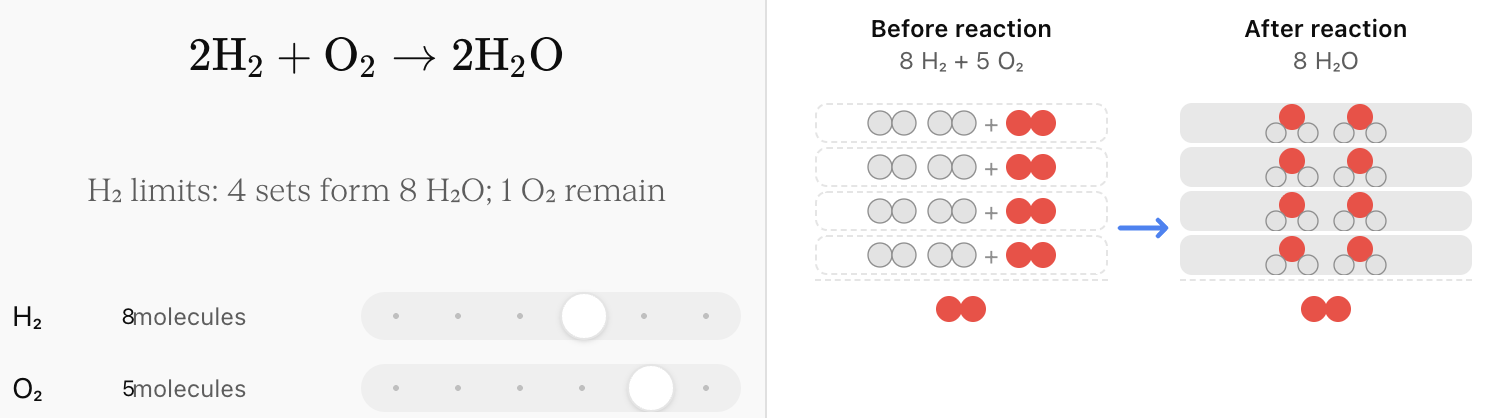


4. Theoretical Yield
Learning outcomes
- I can define theoretical yield.
- I can calculate the maximum amount of product obtainable from a reaction.
- I can determine theoretical yield using stoichiometry.
- I can explain why theoretical yield is often not achieved in practice.
- I can solve theoretical yield problems.


5. Percentage Yield
Learning outcomes
- I can define percentage yield.
- I can calculate percentage yield from theoretical and actual yields.
- I can explain factors that reduce percentage yield.
- I can interpret percentage yield values in experiments.
- I can solve problems involving percentage yield.
Percentage Yield
In a chemical reaction, the amount of product actually obtained is often less than the maximum amount predicted by stoichiometry.
Percentage yield compares the amount of product actually obtained with the amount that should theoretically have been produced.
It tells us how successful a reaction or experimental process was at producing the desired product.
The equation is:
percentage yield = (actual yield / theoretical yield) × 100%
where:
- actual yield = amount of product actually obtained
- theoretical yield = maximum amount of product predicted by stoichiometry
- percentage yield = actual yield expressed as a percentage of the theoretical maximum


Understanding Percentage Yield
Suppose a reaction has a theoretical yield of:
20.0 g
but only:
16.0 g
of product is actually collected.
Percentage yield:
percentage yield = (16.0 / 20.0) × 100%
= 80.0%
This means the experiment produced:
80% of the maximum predicted amount
The remaining 20% does not necessarily represent one single type of loss. Several different factors may have reduced the amount of product collected.
The Three Types of Yield
It is important to distinguish between three related ideas.
Theoretical Yield
The maximum amount of product predicted by stoichiometry.
Example:
theoretical yield = 50 g
Actual Yield
The amount of product actually obtained during the experiment.
Example:
actual yield = 42 g
Percentage Yield
A comparison between the actual and theoretical yields.
percentage yield = (42 / 50) × 100%
= 84%
So:
theoretical yield → predicted
actual yield → measured
percentage yield → compares the two
Why Use a Percentage?
Suppose two experiments produce:
Experiment A:
- theoretical yield = 10 g
- actual yield = 8 g
Experiment B:
- theoretical yield = 100 g
- actual yield = 80 g
Experiment B produces much more product, but both reactions have:
80% yield
Percentage yield allows us to compare reactions performed on different scales.
Interpreting Percentage Yield
A percentage yield close to:
100%
means the amount collected was close to the theoretical maximum.
A lower percentage indicates that less of the expected product was successfully obtained.
For example:
| Actual Yield | Theoretical Yield | Percentage Yield |
|---|---|---|
| 10 g | 10 g | 100% |
| 9 g | 10 g | 90% |
| 8 g | 10 g | 80% |
| 5 g | 10 g | 50% |
| 2 g | 10 g | 20% |
A higher percentage yield generally means a greater proportion of the theoretically possible product was obtained.
Worked Example: Basic Percentage Yield
A reaction has:
theoretical yield = 25.0 g
actual yield = 21.0 g
Calculate the percentage yield.
Use:
percentage yield = (actual yield / theoretical yield) × 100%
Substitute:
percentage yield = (21.0 / 25.0) × 100%
= 84.0%
Answer
Percentage yield = 84.0%
Worked Example: Magnesium Oxide
Consider:
2Mg + O₂ → 2MgO
Suppose stoichiometry predicts:
20.15 g MgO
but an experiment produces:
18.0 g MgO
Calculate the percentage yield.
percentage yield = (18.0 / 20.15) × 100%
≈ 89.3%
Answer
Percentage yield ≈ 89.3%
This means approximately 89% of the theoretically possible magnesium oxide was obtained.
Calculating the Theoretical Yield First
Sometimes the theoretical yield is not provided.
You must calculate it using stoichiometry before calculating percentage yield.
The complete pathway becomes:
reactant amount
↓
moles of reactant
↓
moles of product
↓
theoretical yield
↓
compare with actual yield
↓
percentage yield
Worked Example: Calculate Theoretical Yield and Percentage Yield
Consider:
2Mg + O₂ → 2MgO
Suppose:
24.3 g Mg
reacts with excess oxygen.
The experiment produces:
35.0 g MgO
Calculate the percentage yield.
Use:
M(Mg) = 24.3 g/mol
M(MgO) = 40.3 g/mol
Convert Mg to moles
24.3 ÷ 24.3 = 1.00 mol Mg
Use the mole ratio
Mg : MgO = 2 : 2
Therefore:
1.00 mol Mg → 1.00 mol MgO
Calculate theoretical yield
1.00 × 40.3 = 40.3 g MgO
Therefore:
theoretical yield = 40.3 g
Calculate percentage yield
Actual yield:
35.0 g
Therefore:
percentage yield = (35.0 / 40.3) × 100%
≈ 86.8%
Answer
Percentage yield ≈ 86.8%
Percentage Yield with a Limiting Reactant
If amounts of two reactants are provided, you must first identify the limiting reactant.
The limiting reactant determines the theoretical yield.
The pathway is:
reactant quantities
↓
convert to moles
↓
identify limiting reactant
↓
calculate theoretical yield
↓
compare with actual yield
↓
calculate percentage yield
Worked Example: Hydrogen and Oxygen
Consider:
2H₂ + O₂ → 2H₂O
Suppose:
10 g H₂
react with:
64 g O₂
and the experiment produces:
63 g H₂O
Use:
M(H₂) = 2 g/mol
M(O₂) = 32 g/mol
M(H₂O) = 18 g/mol
Convert reactants to moles
H₂:
10 ÷ 2 = 5 mol H₂
O₂:
64 ÷ 32 = 2 mol O₂
The reaction requires:
2 mol H₂ : 1 mol O₂
Two moles O₂ require:
4 mol H₂
We have 5 mol H₂.
Therefore:
O₂ is the limiting reactant.
Calculate the Theoretical Yield
From:
2H₂ + O₂ → 2H₂O
2 mol O₂ → 4 mol H₂O
Mass:
4 × 18 = 72 g H₂O
Therefore:
theoretical yield = 72 g
Actual yield:
63 g
Percentage yield:
(63 / 72) × 100%
= 87.5%
Answer
Percentage yield = 87.5%
Why Percentage Yield Is Often Less Than 100%
Real chemical experiments are not perfectly efficient.
There are many reasons why the actual yield may be lower than the theoretical yield.


Incomplete Reactions
Some reactions do not proceed until all of the limiting reactant has been converted into product.
If some reactant remains unreacted, less product forms.
For example, stoichiometry might predict:
10.0 g product
but incomplete reaction might result in only:
8.5 g product
This lowers the percentage yield.
Reversible Reactions
Some reactions can proceed in both directions.
Instead of completely converting reactants into products, the reaction may reach equilibrium.
At equilibrium:
- reactants remain
- products are present
- forward and reverse reactions continue
Because not all reactants become products, the yield may be lower than the theoretical maximum.
Side Reactions
Reactants may sometimes undergo unwanted reactions.
Instead of producing only the desired product:
reactants → desired product
some reactants may form other substances:
reactants → unwanted products
This reduces the amount of desired product.
Product Lost During Transfer
Some product may remain:
- inside a beaker
- on a stirring rod
- inside a flask
- in a funnel
- on filter paper
Every transfer creates an opportunity to lose a small amount of material.
For example, pouring a solid from one container into another may leave some material behind.
Product Lost During Filtration
When collecting a precipitate:
- small particles may pass through the filter
- some product may remain dissolved
- some may stick to the glassware
- some may be spilled
This lowers the actual yield.
Product Lost During Purification
Chemical products often need to be purified.
Processes such as:
- filtration
- recrystallization
- washing
- extraction
- distillation
can cause some desired product to be lost.
A highly pure product may therefore have a lower recovered mass.
Gas Loss
If the desired product is a gas, some may escape from the apparatus.
For example:
CaCO₃ → CaO + CO₂
If CO₂ is being collected, leaks in the apparatus can reduce the amount measured.
Impure Reactants
Suppose a sample is labelled:
10.0 g
but contains only:
8.0 g of the actual reactant
If the theoretical yield calculation incorrectly assumes all 10.0 g are pure reactant, it will predict too much product.
This can make the calculated percentage yield appear unusually low.
Product Decomposition
Sometimes the desired product can decompose during:
- heating
- drying
- storage
- purification
If some product breaks down after it forms, the final measured amount will be lower.
Mechanical Losses
Some losses have nothing to do with the chemistry itself.
Examples include:
- spilling material
- losing crystals during transfer
- leaving product on equipment
- breaking or damaging a sample
- losing fine particles
These are sometimes called mechanical losses.
Can Percentage Yield Equal 100%?
Yes.
A percentage yield of:
100%
means:
actual yield = theoretical yield
For example:
Theoretical:
15.0 g
Actual:
15.0 g
Percentage:
(15.0 / 15.0) × 100% = 100%
This represents perfect agreement between the measured and theoretical quantities.
In real laboratory work, exactly 100% is possible but should still be interpreted in light of measurement uncertainty and experimental conditions.
Can Percentage Yield Be Greater Than 100%?
A calculated percentage yield can sometimes be greater than 100%.
For example:
Theoretical yield:
10.0 g
Measured actual yield:
10.8 g
Percentage yield:
(10.8 / 10.0) × 100%
= 108%
This does not normally mean the reaction somehow produced more pure desired product than was theoretically possible.
Instead, something should be investigated.
Why Might Percentage Yield Exceed 100%?
The Product Is Wet
Suppose a solid product contains water.
The balance measures:
product + water
The measured mass is therefore too high.
The Product Contains Impurities
Other substances may be mixed with the product.
The measured mass then includes:
desired product + impurities
Unreacted Reactants Remain
The sample may contain some reactant that was not removed.
The measured material is therefore not pure product.
Incomplete Drying
This is particularly common when precipitates or crystals are collected.
Water or solvent remaining on the product increases its apparent mass.
Measurement Error
An incorrect balance reading or another measurement problem can produce an inaccurate actual yield.
Calculation Error
The theoretical yield may have been calculated incorrectly.
Possible mistakes include:
- incorrect molar mass
- unbalanced equation
- incorrect mole ratio
- wrong limiting reactant
- arithmetic error
Interpreting a Yield Greater Than 100%
Suppose:
percentage yield = 112%
A useful scientific conclusion is not:
The reaction was 112% efficient.
Instead:
The measured product mass exceeds the theoretical maximum, suggesting contamination, incomplete drying, measurement error, or an error in the theoretical-yield calculation.
Percentage yield should be interpreted scientifically rather than accepted without question.
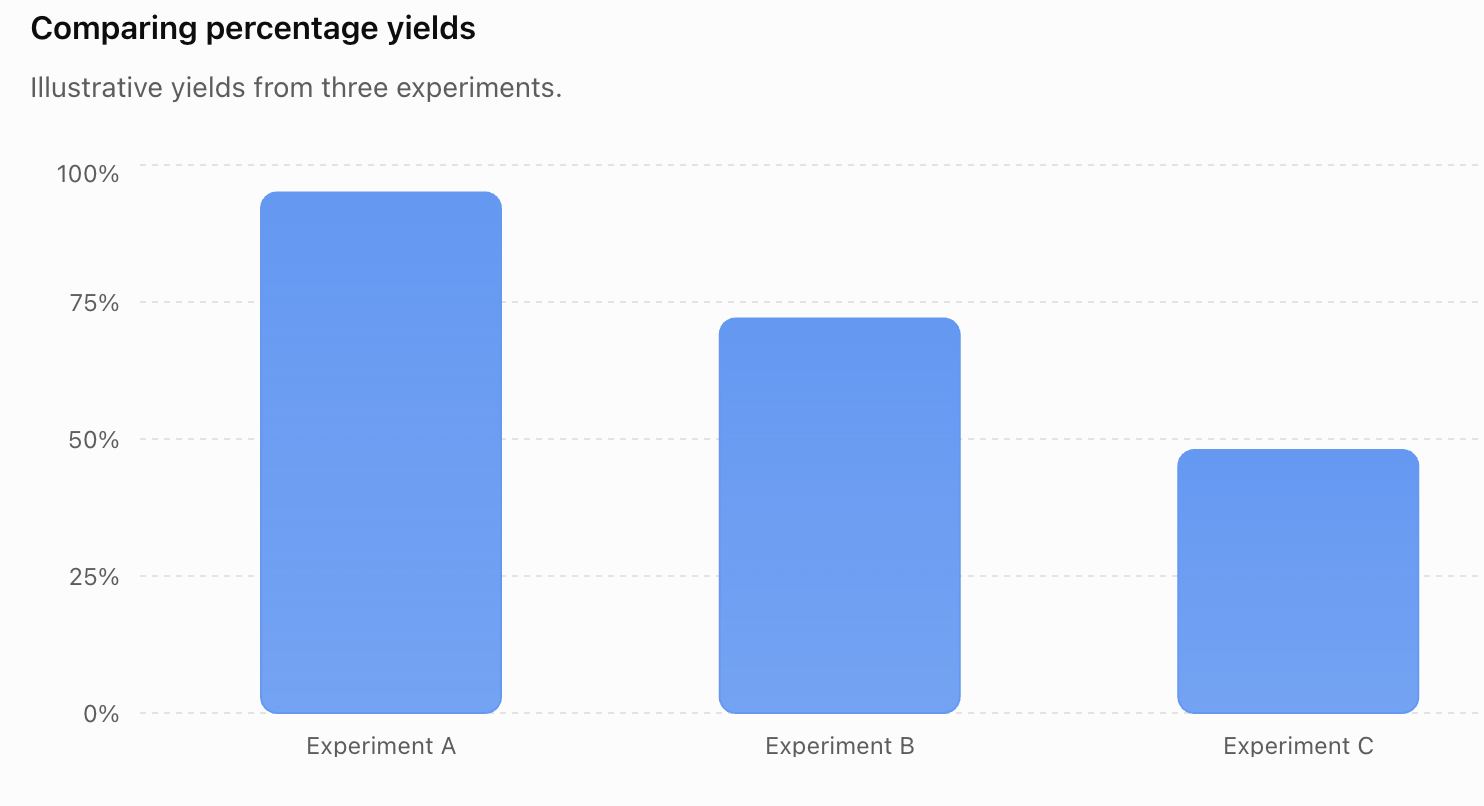
Comparing Percentage Yields
Consider three experiments: