Periodic Trends
3. Reactivity Trends
Learning outcomes
- I can describe how reactivity changes within major groups of the periodic table.
- I can explain why Group 1 metals become more reactive down the group.
- I can explain why Group 17 halogens become less reactive down the group.
- I can relate reactivity trends to electron arrangements and ion formation.
- I can use periodic trends to predict the relative reactivity of unfamiliar elements.


What Is Reactivity?
Reactivity describes how readily a substance undergoes a chemical reaction.
Some elements react extremely easily, while others are much less reactive.
An element's reactivity is strongly connected to its electron arrangement, especially the electrons in its outer shell.
Atoms tend to react in ways that produce a more stable electron arrangement. For many main-group elements, this means gaining, losing, or sharing electrons to obtain a full outer shell.
The periodic table helps us predict these behaviours because elements in the same group have similar outer-shell electron arrangements.
Groups and Reactivity
A group is a vertical column of the periodic table.
Elements in the same group have similar chemical properties because they have the same number of valence electrons.


Two groups show particularly clear reactivity trends:
Group 1 – Alkali metals
Reactivity increases down the group.
Group 17 – Halogens
Reactivity decreases down the group.
These trends appear opposite because Group 1 and Group 17 elements react in different ways.
Group 1: The Alkali Metals
Group 1 contains the alkali metals.
Important examples include:
- lithium (Li)
- sodium (Na)
- potassium (K)
- rubidium (Rb)
- caesium (Cs)


All Group 1 elements have one electron in their outer shell.
For example:
Lithium: 2,1
Sodium: 2,8,1
Potassium: 2,8,8,1
This similarity explains why these elements undergo similar types of chemical reactions.
Group 1 Elements Lose an Electron
Group 1 atoms become stable by losing their single outer electron.
For example:
Na → Na⁺ + e⁻
A sodium atom loses one electron and forms a:
Na⁺ ion
Similarly:
Li → Li⁺ + e⁻
K → K⁺ + e⁻
Therefore, Group 1 metals usually form ions with a:
+1 charge


The easier this electron is to remove, the more reactive the metal is.
Reactivity Increases Down Group 1
The trend in Group 1 is:
Li < Na < K < Rb < Cs
Reactivity increases as we move down the group.
Lithium is less reactive than sodium.
Sodium is less reactive than potassium.
Potassium is less reactive than rubidium.
The trend continues down the group.


But why?
The answer comes from atomic structure.
More Electron Shells Down Group 1
As we move down Group 1, atoms contain more occupied electron shells.
Lithium: 2,1
Sodium: 2,8,1
Potassium: 2,8,8,1
The outer electron therefore becomes progressively farther from the nucleus.


This greater distance is one reason the outer electron becomes easier to remove.
Nuclear Attraction
The nucleus contains positively charged protons.
Electrons have negative charge.
Therefore, the nucleus attracts electrons through electrostatic attraction.
The closer an electron is to the nucleus, the stronger this attraction tends to be.
As we move down Group 1:
- the number of electron shells increases
- the atomic radius increases
- the outer electron becomes farther from the nucleus
Therefore, the attraction between the nucleus and the outer electron becomes less effective.
Electron Shielding
Distance is not the only factor.
Inner electrons also produce an effect called shielding.


Inner electron shells lie between the nucleus and the outer electron.
These inner electrons reduce the effective attraction experienced by the outer electron.
As we move down Group 1:
more shells → more shielding
Therefore, the outer electron becomes easier to remove.
The Complete Explanation for Group 1
Moving down Group 1:
More electron shells
↓
Greater atomic radius
↓
More electron shielding
↓
Weaker effective attraction between the nucleus and the outer electron
↓
Outer electron is easier to remove
↓
Positive ion forms more easily
↓
Reactivity increases
This chain of reasoning is the key explanation for the Group 1 trend.
Periodic Trends Behind the Pattern
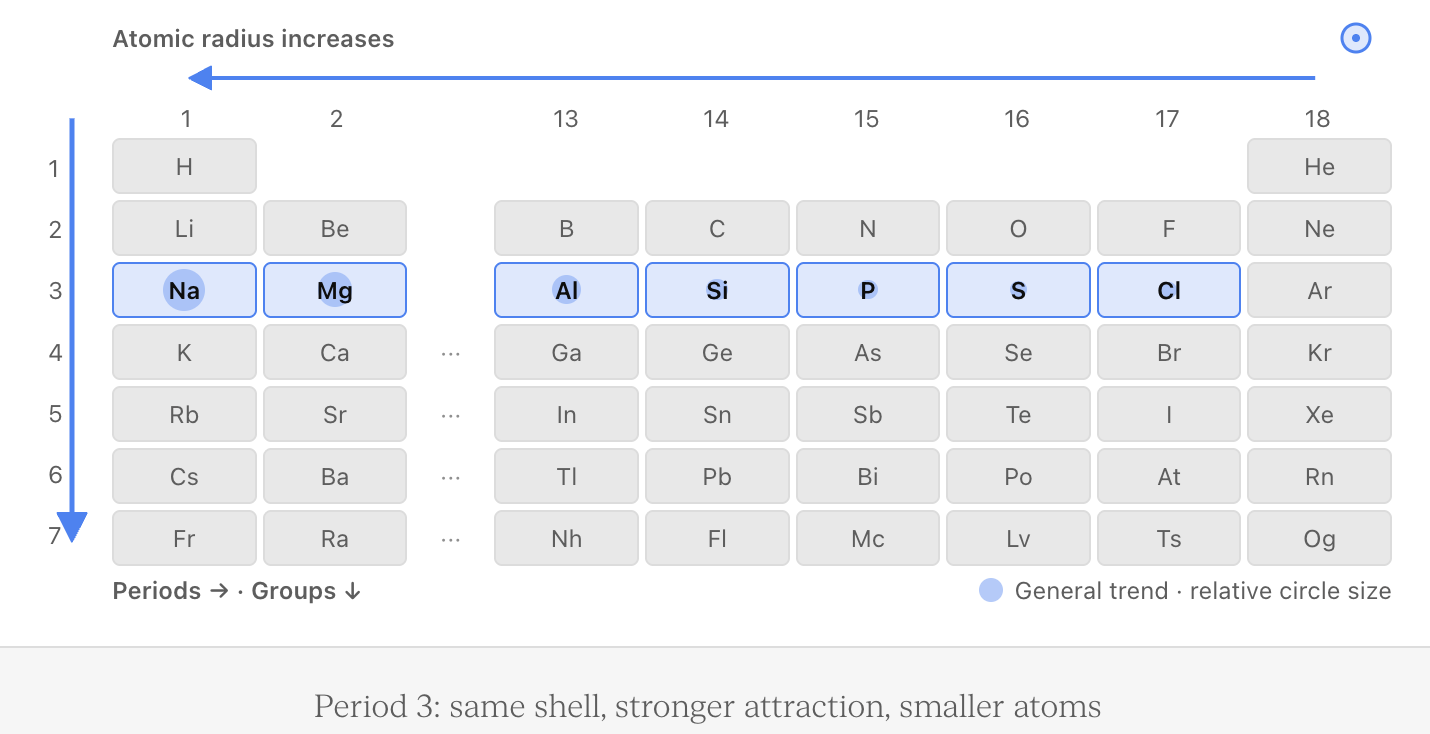
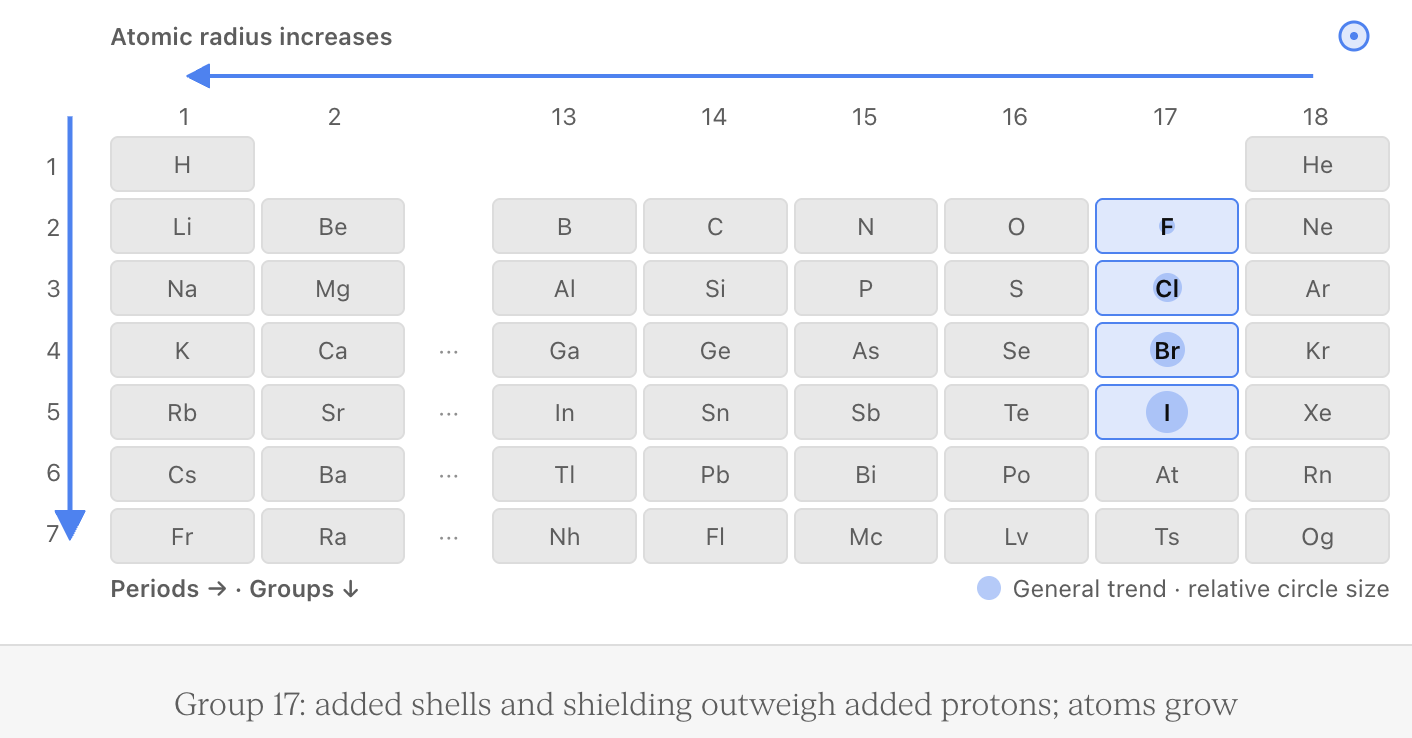
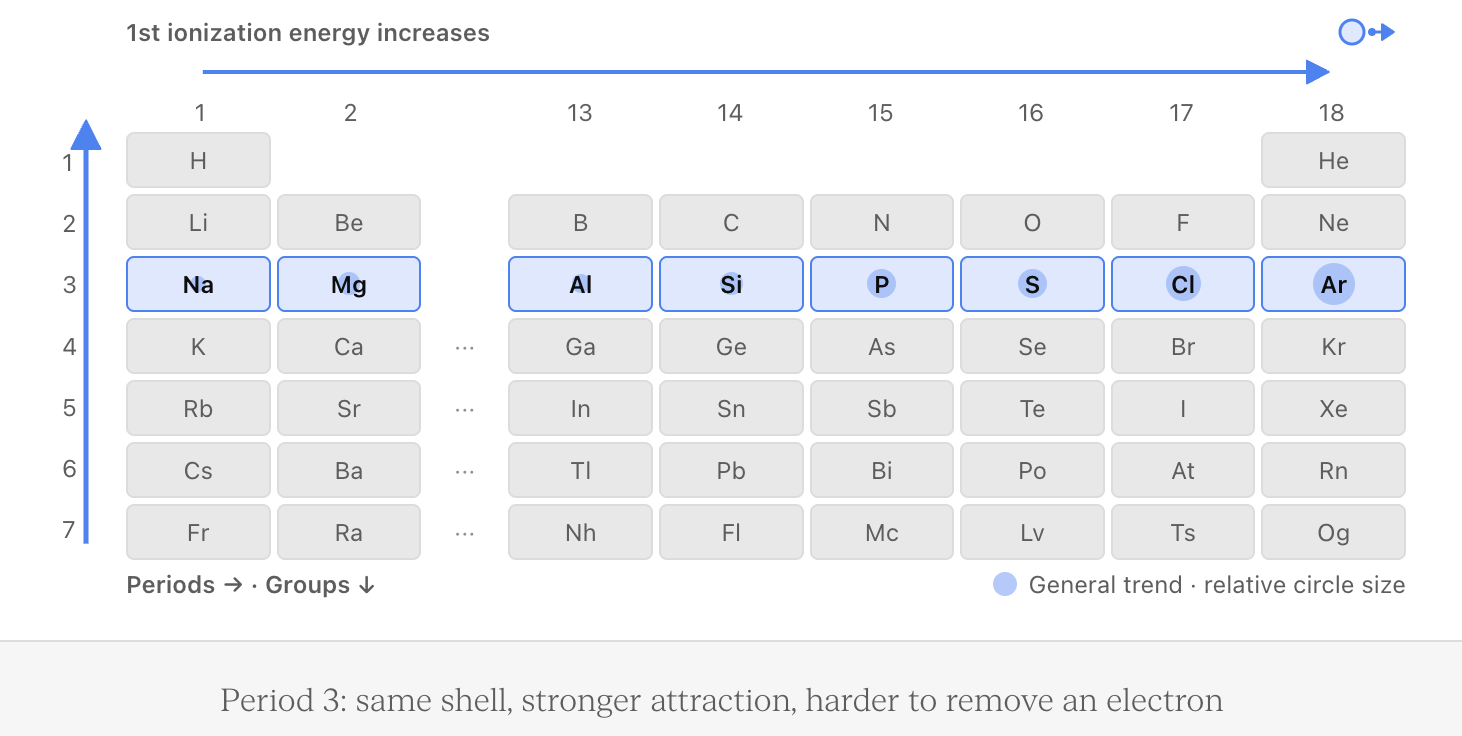
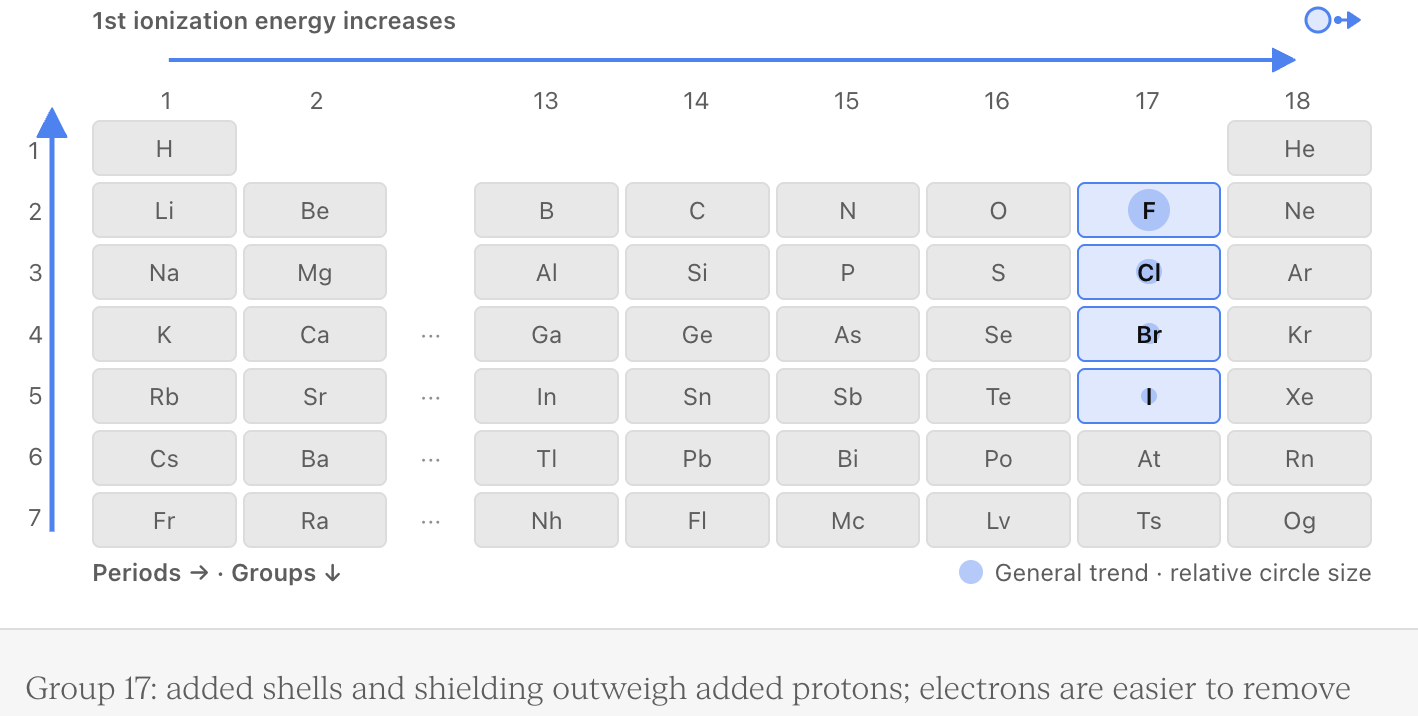
Atomic radius and first ionization energy help explain why Group 1 metals become more reactive down the group.