Periodic Trends
| Сайт: | Young Education |
| Курс: | The Periodic Table |
| Книга: | Periodic Trends |
| Надруковано: | ゲストユーザ |
| Дата: | понеділок 5 жовтня 2026 03:04 AM |
1. Atomic Radius
Learning outcomes
- I can define atomic radius as a measure of atomic size.
- I can describe how atomic radius changes across a period and down a group.
- I can explain periodic trends in atomic radius using electron shells and nuclear charge.
- I can compare the relative sizes of atoms using their positions on the periodic table.
- I can use periodic trends to predict the relative sizes of unfamiliar atoms.
What Is Atomic Radius?
Atoms are extremely small, but they are not all the same size. Some atoms have electron clouds that extend farther from the nucleus than others.
Atomic radius is a measure of the size of an atom.
Because an atom does not have a sharp outer edge, its radius cannot be measured in exactly the same way as the radius of a solid ball. In practice, atomic radius is often determined from the distance between the nuclei of two bonded atoms.
A useful simplified model is:
Larger atomic radius → larger atom
Smaller atomic radius → smaller atom
Atomic radii are commonly measured in picometres (pm).


Atomic Radius and the Periodic Table
Atomic radius follows a predictable pattern on the periodic table. This is called a periodic trend.
The two main patterns are:
Across a period
Moving from left to right across a period:
Atomic radius generally decreases.
Down a group
Moving from top to bottom down a group:
Atomic radius generally increases.
A useful way to remember the overall trend is:
Atoms generally become larger toward the bottom-left of the periodic table and smaller toward the top-right.
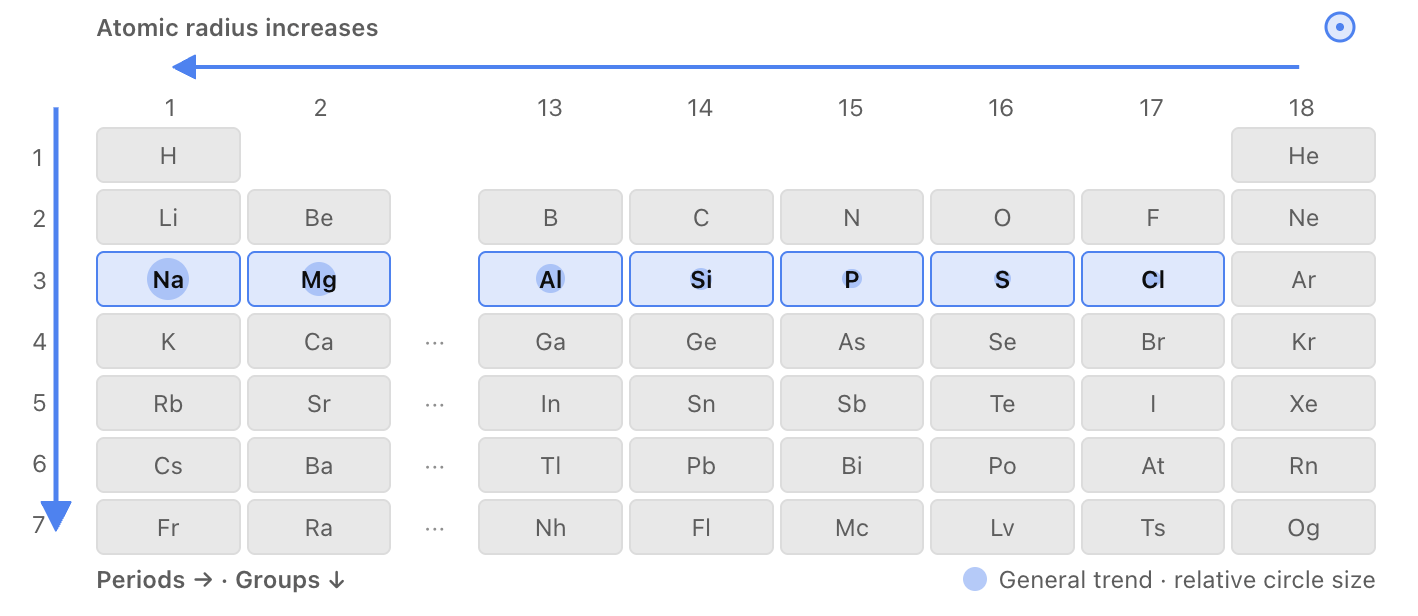
Atomic Radius Across a Period
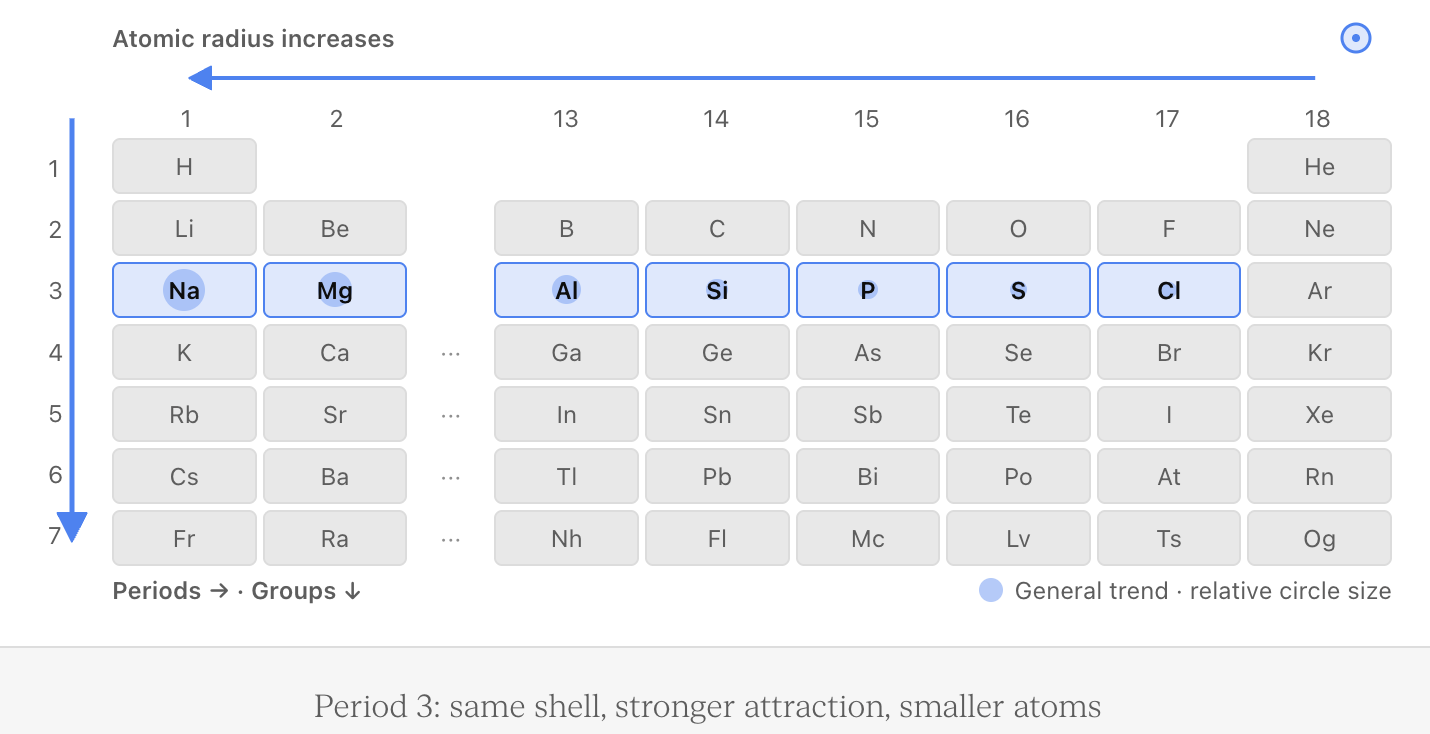
Consider Period 3:
Na → Mg → Al → Si → P → S → Cl
As we move from sodium toward chlorine, the atoms generally become smaller.
Why?
Two important things are happening:
- The number of protons in the nucleus increases.
- The additional electrons are being added to the same main electron shell.
For example:
| Element | Atomic number | Electron arrangement |
|---|---|---|
| Na | 11 | 2,8,1 |
| Mg | 12 | 2,8,2 |
| Al | 13 | 2,8,3 |
| Si | 14 | 2,8,4 |
| P | 15 | 2,8,5 |
| S | 16 | 2,8,6 |
| Cl | 17 | 2,8,7 |
Notice that all of these elements have three occupied electron shells.
However, the number of protons increases from 11 in sodium to 17 in chlorine.
More protons produce a stronger nuclear attraction for the electrons.
The electron cloud is therefore pulled closer to the nucleus.
Increasing nuclear charge → stronger attraction → smaller atomic radius


Nuclear Charge
The nucleus contains positively charged protons, while electrons have a negative charge.
The nucleus therefore attracts electrons through electrostatic attraction.
As the atomic number increases:
more protons → greater nuclear charge
Across a period, this increasing nuclear charge is particularly important because the electrons are being added to the same main energy level.
The attraction between the nucleus and the outer electrons becomes stronger.
As a result:
Atomic radius decreases across a period
Atomic Radius Down a Group
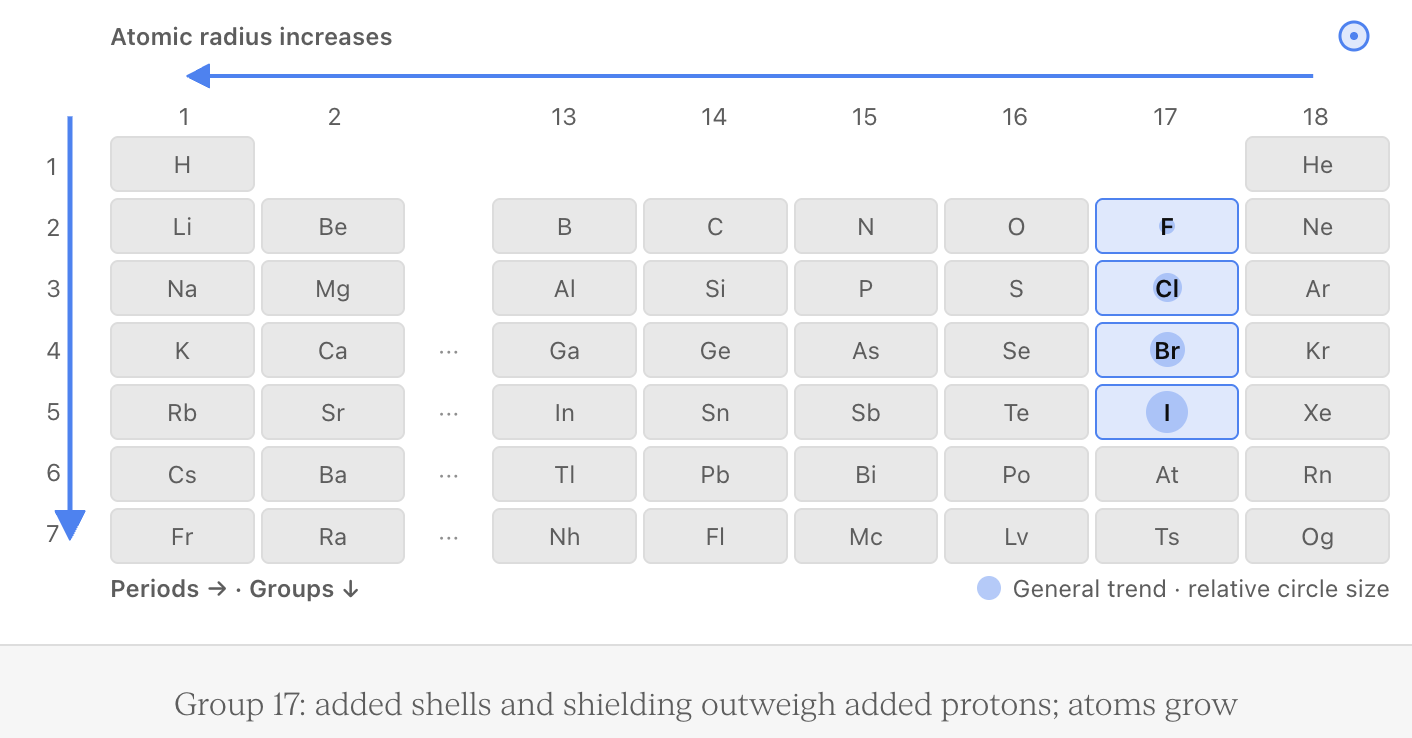
Now consider Group 1:
Li → Na → K → Rb → Cs
Moving down the group, atomic radius increases.
The main reason is that each new period adds another occupied electron shell.
For example:
| Element | Electron arrangement | Occupied shells |
|---|---|---|
| Li | 2,1 | 2 |
| Na | 2,8,1 | 3 |
| K | 2,8,8,1 | 4 |
Potassium therefore has an additional occupied electron shell compared with sodium.
Its outermost electron is farther from the nucleus.
More electron shells → outer electrons farther from nucleus → larger atomic radius


But Doesn't Nuclear Charge Also Increase?
Yes.
Moving down a group, atoms contain more protons, so their nuclear charge increases.
You might therefore expect the stronger nucleus to pull the electrons closer.
However, another effect becomes more important.
Electron Shielding
Inner electrons reduce the attraction experienced by the outer electrons. This effect is called shielding.
As we move down a group:
- more electron shells are added
- outer electrons become farther from the nucleus
- more inner electrons lie between the nucleus and the outer electrons
- shielding increases
The increased distance and shielding outweigh the increase in nuclear charge.
Therefore:
Atomic radius increases down a group
Comparing Atomic Sizes
Once we know the periodic trend, we can compare atoms without knowing their exact atomic radii.
Remember:
Across → atomic radius decreases
Down ↓ atomic radius increases
Example 1: Sodium or Chlorine?
Na and Cl are both in Period 3.
Na is farther to the left.
Therefore:
Na is larger than Cl
Example 2: Lithium or Potassium?
Li and K are both in Group 1.
K is farther down the group.
Therefore:
K is larger than Li
Example 3: Magnesium or Calcium?
Mg and Ca are both in Group 2.
Ca is below Mg.
Therefore:
Ca is larger than Mg
Predicting the Size of Unfamiliar Atoms
You do not need to memorise the radius of every atom.
Instead, use an element's position on the periodic table.
Suppose you are asked:
Which atom is larger: Rb or Sr?
Both are in Period 5.
Rb is farther to the left.
Atomic radius decreases from left to right.
Therefore:
Rb is larger than Sr
Now consider:
Which is larger: F or Br?
F and Br are in the same group.
Br is farther down the group.
Therefore:
Br is larger than F
This reasoning allows you to make predictions even when you have never studied the individual atomic radii.
When the Elements Are in Different Groups and Periods
Sometimes the comparison is less obvious.
For example:
Which is larger: Na or K?
Easy — they are in the same group, so K is larger.
But what about:
Na or Ca?
Ca is:
- farther right, which tends to make atoms smaller
- farther down, which tends to make atoms larger
The two trends are working in opposite directions.
In introductory chemistry, questions are usually chosen so that one trend clearly determines the answer. For elements in very different positions, actual atomic-radius data may sometimes be needed for a confident comparison.
Understanding the Trend
The entire trend can be explained using three main ideas.
1. Number of Electron Shells
More occupied shells generally produce a larger atom.
This explains the increase in atomic radius down a group.
2. Nuclear Charge
More protons create a stronger positive nuclear charge.
A stronger nuclear attraction can pull electrons closer to the nucleus.
This helps explain the decrease in atomic radius across a period.
3. Shielding
Inner electrons shield outer electrons from some of the attraction of the nucleus.
More inner electron shells produce greater shielding.
This helps explain why atomic radius increases down a group.
A Simple Summary
| Direction | Atomic radius. | Main reason |
|---|---|---|
| Across a period → | Decreases | Nuclear charge increases while electrons enter the same main shell |
| Down a group ↓. | Increases | Additional electron shells and greater shielding |
So, on a simplified periodic table:
Largest atoms: bottom-left
Smallest atoms: top-right
Worked Example
Arrange these atoms from smallest to largest:
Li, Na, K
All three elements are in Group 1.
Atomic radius increases down a group.
Their positions are:
Li
↓
Na
↓
K
Therefore:
Li < Na < K
Another Example
Arrange these Period 3 atoms from largest to smallest:
Na, Mg, Si, Cl
Atomic radius decreases from left to right.
Their order on the periodic table is:
Na → Mg → Si → Cl
Therefore:
Na > Mg > Si > Cl
Did You Know?
The atoms near the bottom-left of the periodic table are among the largest atoms, while those near the top-right are among the smallest.
This same underlying competition between nuclear attraction, electron shells and shielding helps explain several other periodic trends, including ionisation energy and electronegativity.
Key Terms
- Atomic radius – a measure of the size of an atom.
- Periodic trend – a predictable pattern in properties across the periodic table.
- Nuclear charge – the positive charge of the nucleus produced by its protons.
- Electron shell – a main energy level occupied by electrons around the nucleus.
- Shielding – the reduction in nuclear attraction experienced by outer electrons because of inner electrons.
- Period – a horizontal row of the periodic table.
- Group – a vertical column of the periodic table.
Key Takeaways
- Atomic radius is a measure of atomic size.
- Atomic radius generally decreases from left to right across a period.
- Across a period, nuclear charge increases while electrons are added to the same main shell, pulling the electron cloud closer to the nucleus.
- Atomic radius generally increases down a group.
- Down a group, atoms gain additional electron shells and experience greater shielding.
- Atoms generally become larger toward the bottom-left of the periodic table.
- Atoms generally become smaller toward the top-right.
- Periodic trends allow us to compare and predict atomic sizes without memorising individual atomic radii.
2. Ion Formation
Learning outcomes
- I can explain why atoms gain or lose electrons to form ions.
- I can predict the ions formed by elements in different groups.
- I can relate ion formation to electron arrangements and valence electrons.
- I can explain the difference between cations and anions.
- I can use periodic table information to predict the charges of common ions.


3. Reactivity Trends
Learning outcomes
- I can describe how reactivity changes within major groups of the periodic table.
- I can explain why Group 1 metals become more reactive down the group.
- I can explain why Group 17 halogens become less reactive down the group.
- I can relate reactivity trends to electron arrangements and ion formation.
- I can use periodic trends to predict the relative reactivity of unfamiliar elements.


What Is Reactivity?
Reactivity describes how readily a substance undergoes a chemical reaction.
Some elements react extremely easily, while others are much less reactive.
An element's reactivity is strongly connected to its electron arrangement, especially the electrons in its outer shell.
Atoms tend to react in ways that produce a more stable electron arrangement. For many main-group elements, this means gaining, losing, or sharing electrons to obtain a full outer shell.
The periodic table helps us predict these behaviours because elements in the same group have similar outer-shell electron arrangements.
Groups and Reactivity
A group is a vertical column of the periodic table.
Elements in the same group have similar chemical properties because they have the same number of valence electrons.


Two groups show particularly clear reactivity trends:
Group 1 – Alkali metals
Reactivity increases down the group.
Group 17 – Halogens
Reactivity decreases down the group.
These trends appear opposite because Group 1 and Group 17 elements react in different ways.
Group 1: The Alkali Metals
Group 1 contains the alkali metals.
Important examples include:
- lithium (Li)
- sodium (Na)
- potassium (K)
- rubidium (Rb)
- caesium (Cs)


All Group 1 elements have one electron in their outer shell.
For example:
Lithium: 2,1
Sodium: 2,8,1
Potassium: 2,8,8,1
This similarity explains why these elements undergo similar types of chemical reactions.
Group 1 Elements Lose an Electron
Group 1 atoms become stable by losing their single outer electron.
For example:
Na → Na⁺ + e⁻
A sodium atom loses one electron and forms a:
Na⁺ ion
Similarly:
Li → Li⁺ + e⁻
K → K⁺ + e⁻
Therefore, Group 1 metals usually form ions with a:
+1 charge


The easier this electron is to remove, the more reactive the metal is.
Reactivity Increases Down Group 1
The trend in Group 1 is:
Li < Na < K < Rb < Cs
Reactivity increases as we move down the group.
Lithium is less reactive than sodium.
Sodium is less reactive than potassium.
Potassium is less reactive than rubidium.
The trend continues down the group.


But why?
The answer comes from atomic structure.
More Electron Shells Down Group 1
As we move down Group 1, atoms contain more occupied electron shells.
Lithium: 2,1
Sodium: 2,8,1
Potassium: 2,8,8,1
The outer electron therefore becomes progressively farther from the nucleus.


This greater distance is one reason the outer electron becomes easier to remove.
Nuclear Attraction
The nucleus contains positively charged protons.
Electrons have negative charge.
Therefore, the nucleus attracts electrons through electrostatic attraction.
The closer an electron is to the nucleus, the stronger this attraction tends to be.
As we move down Group 1:
- the number of electron shells increases
- the atomic radius increases
- the outer electron becomes farther from the nucleus
Therefore, the attraction between the nucleus and the outer electron becomes less effective.
Electron Shielding
Distance is not the only factor.
Inner electrons also produce an effect called shielding.


Inner electron shells lie between the nucleus and the outer electron.
These inner electrons reduce the effective attraction experienced by the outer electron.
As we move down Group 1:
more shells → more shielding
Therefore, the outer electron becomes easier to remove.
The Complete Explanation for Group 1
Moving down Group 1:
More electron shells
↓
Greater atomic radius
↓
More electron shielding
↓
Weaker effective attraction between the nucleus and the outer electron
↓
Outer electron is easier to remove
↓
Positive ion forms more easily
↓
Reactivity increases
This chain of reasoning is the key explanation for the Group 1 trend.
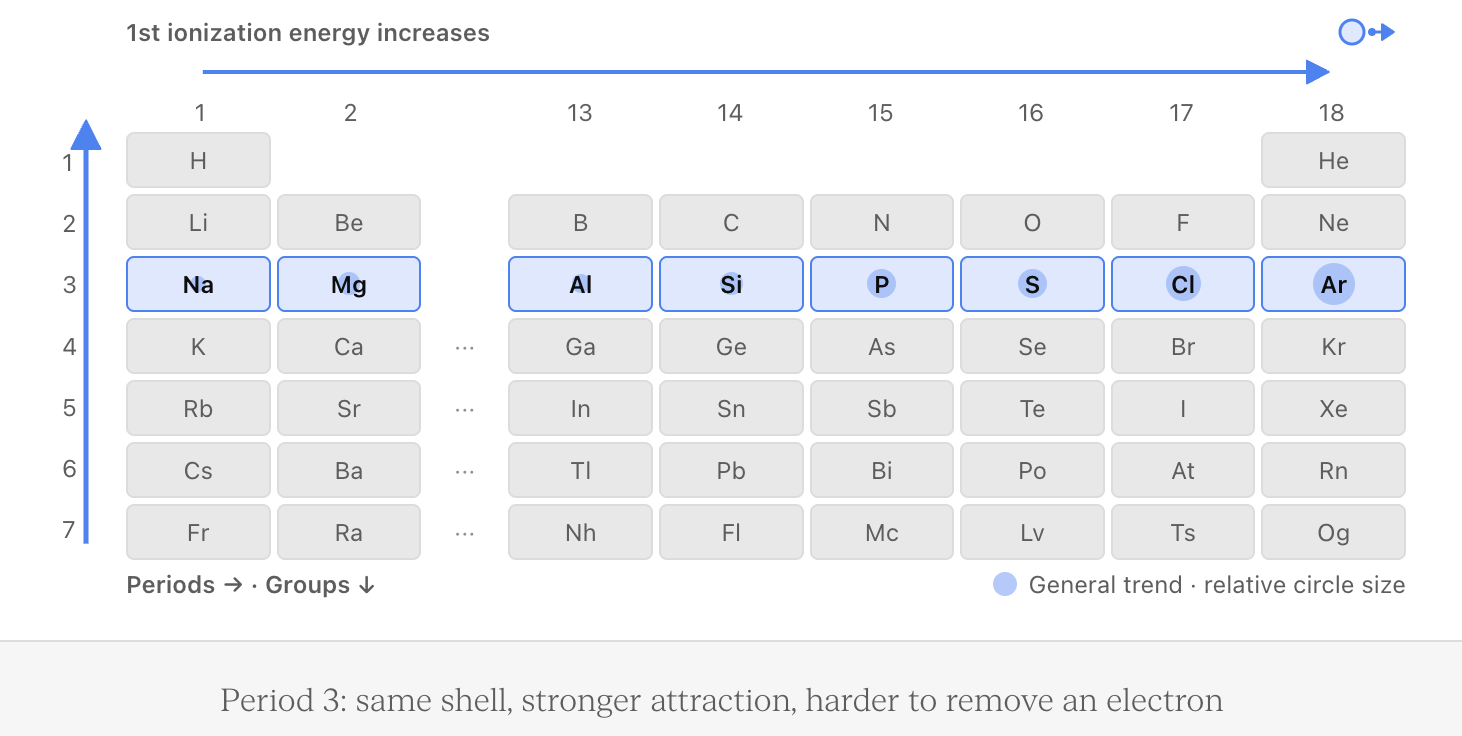
Periodic Trends Behind the Pattern
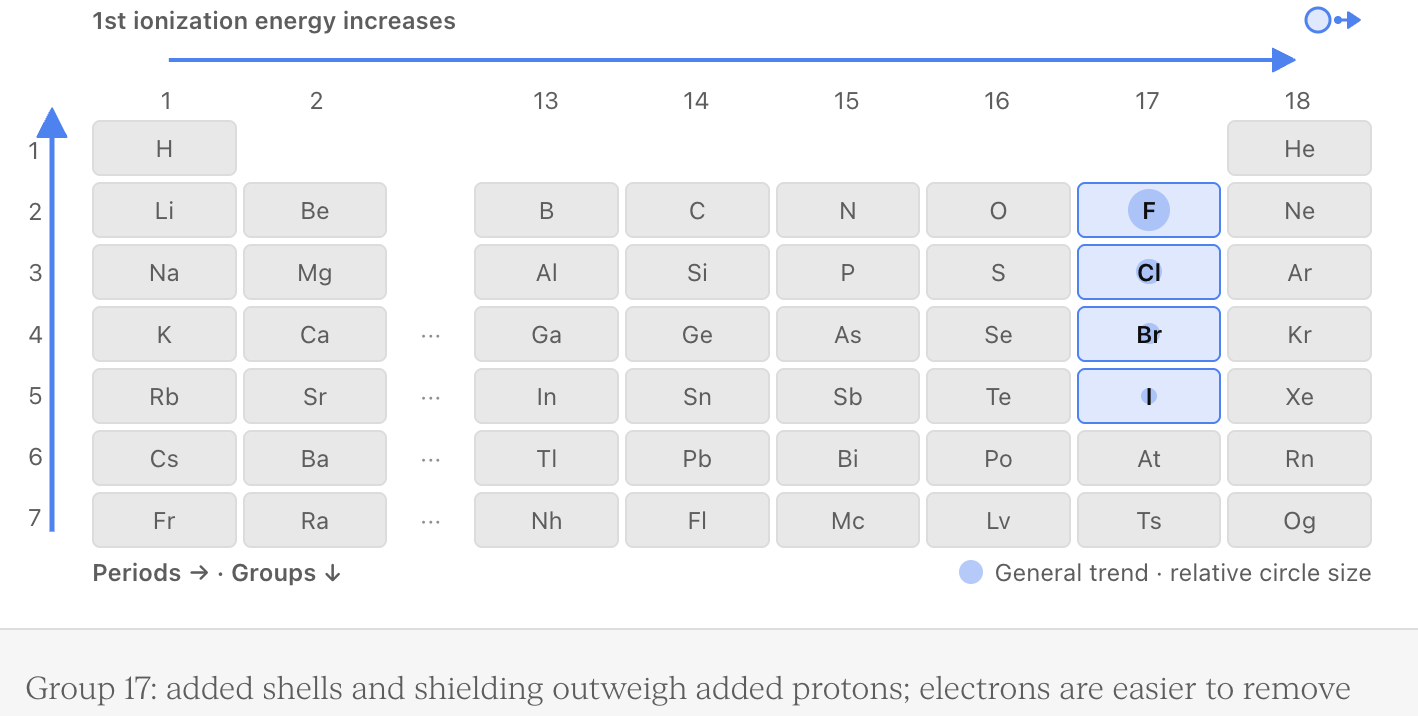
Atomic radius and first ionization energy help explain why Group 1 metals become more reactive down the group.


4. Metallic Character
Learning outcomes
- I can describe the characteristics of metallic behavior.
- I can explain how metallic character changes across periods and down groups.
- I can distinguish between metallic and non-metallic properties.
- I can relate metallic character to electron loss and ion formation.
- I can use periodic table trends to predict whether an element is likely to behave as a metal or non-metal.


What Is Metallic Character?
Metallic character describes how strongly an element shows the typical chemical and physical properties of a metal.
Elements with strong metallic character tend to:
- lose electrons relatively easily
- form positive ions
- conduct electricity and heat
- have a shiny appearance when freshly exposed
- be malleable or ductile when solid
- form metallic bonds in their elemental form
Metallic character is not identical for every metal. Some elements show stronger metallic behaviour than others.
The periodic table allows us to predict these differences.
Where Are Metals Found?
Most elements in the periodic table are metals.
They are found mainly on the left side and in the centre of the periodic table.
Non-metals are concentrated toward the upper-right side.


Between the metals and non-metals is a region containing elements called metalloids.
Metalloids have some properties associated with metals and some associated with non-metals.
Physical Properties of Metals
Metals share several characteristic physical properties.
Many metals are:
Good electrical conductors
Electric current can pass through them relatively easily.
Good thermal conductors
They transfer heat efficiently.
Malleable
They can often be hammered or pressed into sheets.
Ductile
They can often be drawn into wires.
Lustrous
Freshly exposed metal surfaces often appear shiny.


These properties result from the structure and bonding found in metals.
Metallic Bonding
In a metal, atoms are arranged in a large structure containing positive metal ions surrounded by delocalized electrons.


The outer electrons are not permanently attached to one particular atom.
Instead, they can move throughout the metallic structure.
This helps explain several metallic properties.
For example, mobile electrons allow metals to conduct electricity.
Why Metals Conduct Electricity
Electrical current involves the movement of charged particles.
In metals, the delocalized electrons can move through the structure.
When a potential difference is applied, these electrons have a net drift through the metal and carry electrical charge.


This is why metals such as copper and aluminium are widely used as electrical conductors.
Why Metals Are Malleable
Metals can often be hammered into different shapes without shattering.
This property is called malleability.
In metallic structures, layers of ions can shift relative to one another while the attraction between the positive ions and delocalized electrons continues to hold the structure together.


This is very different from many brittle ionic solids, which can fracture when layers are displaced.
Chemical Behaviour of Metals
Metallic character is not only about physical appearance.
Chemically, metals tend to lose electrons.
For example:
Na → Na⁺ + e⁻
Sodium loses one electron and forms a positive ion.
Magnesium loses two:
Mg → Mg²⁺ + 2e⁻


The tendency to lose electrons and form positive ions is a central feature of metallic character.
Metals Form Cations
A positively charged ion is called a cation.
Metal atoms commonly become cations because they lose negatively charged electrons.
For example:
Sodium:
Na → Na⁺ + e⁻
Magnesium:
Mg → Mg²⁺ + 2e⁻
Aluminium:
Al → Al³⁺ + 3e⁻
After electrons are removed, the atom has more protons than electrons and therefore has a positive charge.
Metallic Character and Electron Loss
The easier it is for an atom to lose its outer electrons, the stronger its metallic character generally is.
This connects metallic character to several periodic properties, including:
- atomic radius
- shielding
- effective nuclear attraction
- ionization energy


Atoms with low first ionization energies generally lose electrons more easily and tend to show stronger metallic behaviour.
Metallic Character Across a Period
A period is a horizontal row of the periodic table.
As we move from left to right across a period:
metallic character generally decreases.


Elements on the left tend to be strongly metallic.
Moving toward the right, elements become less metallic.
Eventually, we reach non-metals.
Example: Period 3
Period 3 provides a useful example.
It contains:
Na, Mg, Al, Si, P, S, Cl, Ar
Moving from left to right:
Na → Mg → Al → Si → P → S → Cl → Ar


Sodium, magnesium, and aluminium are metals.
Silicon has intermediate properties and is classified as a metalloid.
Phosphorus, sulfur, chlorine, and argon are non-metals.
This illustrates the decrease in metallic character across a period.
Why Metallic Character Decreases Across a Period
Across a period:
- proton number increases
- electrons are added to the same main energy level
- shielding does not increase as dramatically as it does down a group
- effective nuclear attraction generally increases
- atomic radius generally decreases
- first ionization energy generally tends to increase
As a result, outer electrons become more difficult to remove.
Therefore:
electron loss becomes less favourable
and:
metallic character decreases.
Periodic Trends Behind Metallic Character
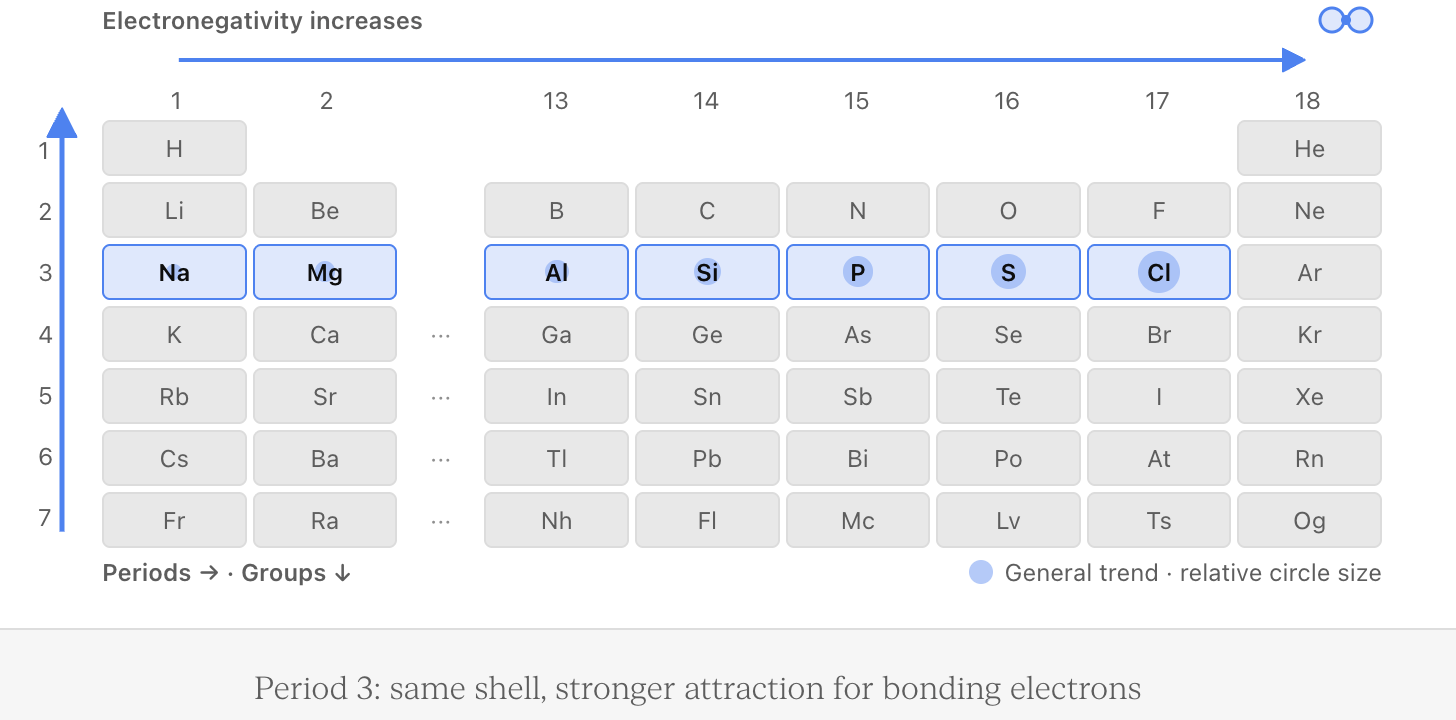
Atomic radius and first ionization energy help us understand the trend.


5. Electronegativity and Periodicity
Learning outcomes
- I can define electronegativity as an atom's tendency to attract bonding electrons.
- I can describe how electronegativity changes across periods and down groups.
- I can explain periodic trends in electronegativity using atomic structure.
- I can compare the relative electronegativities of different elements.
- I can use electronegativity trends to predict the nature of chemical bonds.


What Is Electronegativity?
Electronegativity is a measure of an atom's ability to attract bonding electrons toward itself when it is chemically bonded to another atom.
When two atoms form a covalent bond, they share a pair of electrons.
However, those electrons are not always shared equally.
If one atom has a greater electronegativity, it attracts the shared electrons more strongly.
For example, in an H–Cl bond, chlorine attracts the bonding electrons more strongly than hydrogen.
This produces an unequal distribution of charge.
Electronegativity Is About Bonding Electrons
Electronegativity describes how strongly an atom attracts electrons in a chemical bond.


Imagine two atoms connected by a rope, with the bonding electrons represented by the middle of the rope.
If both atoms pull equally strongly, the electrons remain approximately evenly shared.
If one atom pulls more strongly, the electrons spend more time closer to that atom.
The greater the difference in electronegativity, the more unequal the sharing can become.
The Electronegativity Scale
Electronegativity is commonly described using the Pauling scale.
Fluorine has the highest electronegativity:
F ≈ 3.98
Some commonly encountered approximate values are:
H = 2.20
C = 2.55
N = 3.04
O = 3.44
F = 3.98
Na = 0.93
Cl = 3.16
These values allow us to compare how strongly different atoms attract bonding electrons.
Fluorine Is the Most Electronegative Element
Fluorine is located near the upper-right corner of the periodic table.
It has:
- a relatively small atomic radius
- relatively little shielding
- a strong effective nuclear attraction for bonding electrons


As a result, fluorine attracts bonding electrons extremely strongly.
This makes fluorine the most electronegative element.
Electronegativity Across a Period
As we move from left to right across a period:
electronegativity generally increases.
For example, across Period 2:
Li → Be → B → C → N → O → F
the general electronegativity trend is upward.


Elements toward the right side of a period attract bonding electrons more strongly than elements toward the left.
Why Electronegativity Increases Across a Period
Moving across a period:
- proton number increases
- electrons are added to the same main energy level
- shielding does not increase greatly
- effective nuclear attraction increases
- atomic radius generally decreases
Therefore, the nucleus can attract bonding electrons more strongly.
The result is:
electronegativity increases across a period.
Effective Nuclear Attraction
The nucleus contains positively charged protons.
Electrons are negatively charged.
Therefore, the nucleus attracts electrons through electrostatic forces.


Across a period, the number of protons increases while electrons are added to the same main shell.
This generally increases the effective attraction experienced by electrons involved in bonding.
That stronger attraction contributes to higher electronegativity.
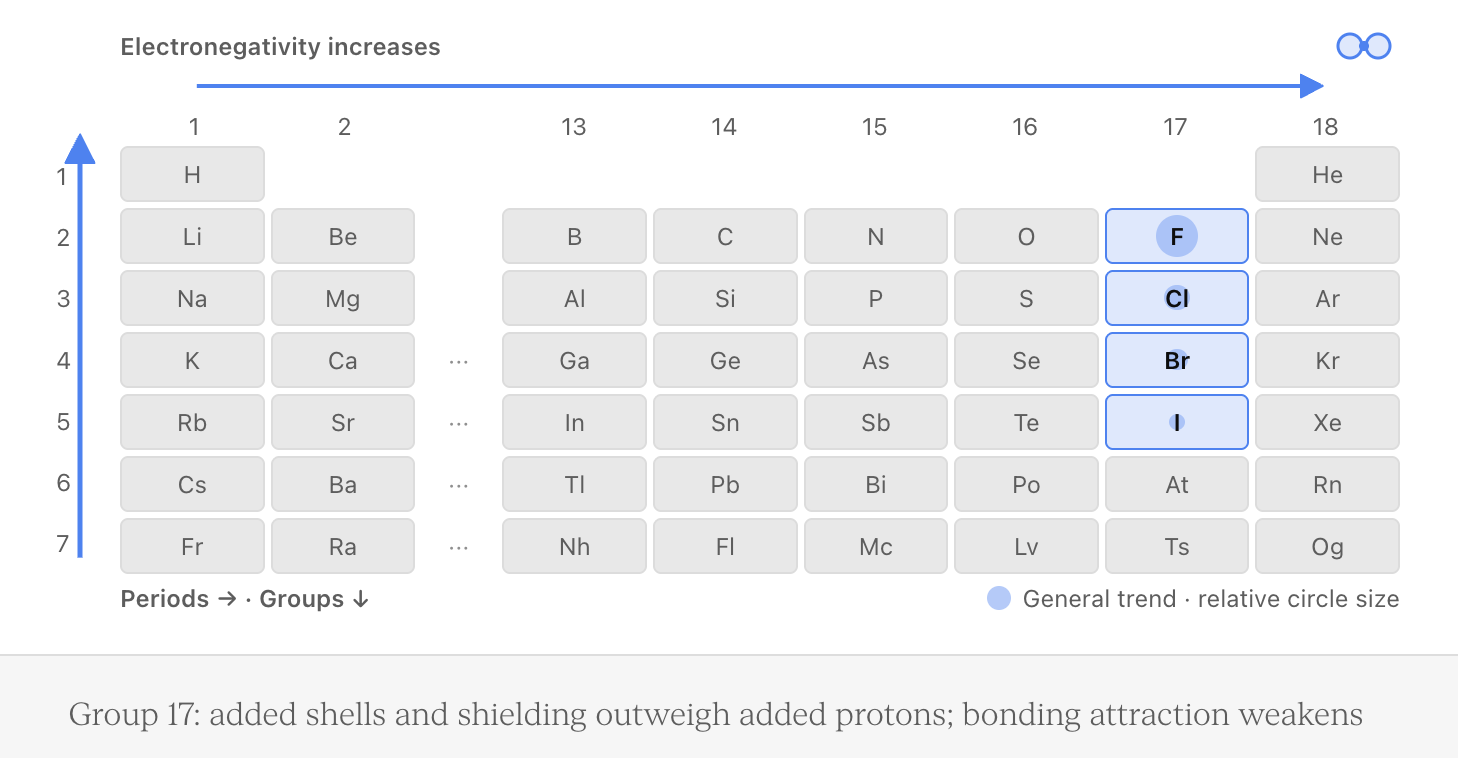
Electronegativity Down a Group
As we move down a group:
electronegativity generally decreases.
For example:
F > Cl > Br > I
Fluorine attracts bonding electrons more strongly than chlorine.
Chlorine attracts them more strongly than bromine.
Bromine attracts them more strongly than iodine.


Why Electronegativity Decreases Down a Group
Moving down a group:
- more occupied electron shells are added
- atomic radius increases
- shielding increases
- bonding electrons are generally farther from the nucleus
- effective nuclear attraction for bonding electrons decreases
Therefore:
electronegativity decreases down a group.
Electron Shielding
Inner electrons produce an effect called shielding.


The inner electrons partially reduce the attraction experienced by electrons farther from the nucleus.
Down a group, additional electron shells create greater shielding.
This is one reason atoms farther down a group attract bonding electrons less strongly.
Atomic Radius and Electronegativity
Atomic size is closely related to electronegativity.
Smaller atoms generally have bonding electrons closer to their nuclei.
This allows stronger attraction.
Larger atoms have bonding electrons farther from their nuclei and experience greater shielding.


Therefore, the broad relationship is:
smaller atomic radius → higher electronegativity
larger atomic radius → lower electronegativity
The Overall Electronegativity Trend
Combining the two trends:
Across a period → electronegativity increases
Down a group ↓ electronegativity decreases
Therefore, electronegativity generally increases toward the:
upper-right corner of the periodic table
with fluorine having the highest value.
This pattern allows us to compare elements without memorizing every electronegativity value.
Electronegativity and the Periodic Table
The general trend can be summarized as:
lower-left → lower electronegativity
upper-right → higher electronegativity

For example:
Potassium is toward the lower-left and has relatively low electronegativity.
Fluorine is toward the upper-right and has extremely high electronegativity.
What About Noble Gases?
Noble gases are located in Group 18.
They already have very stable outer electron arrangements and do not commonly form the same kinds of bonds as many other main-group elements.
Because electronegativity specifically concerns attraction for bonding electrons, electronegativity values for noble gases are often omitted in introductory periodic tables.
Some noble gases can form compounds under particular conditions, so the full chemistry is more complex than simply saying that noble gases have "no electronegativity."
Comparing Elements in the Same Period
Compare:
Na and Cl
Both are in Period 3.
Chlorine is farther to the right.
Electronegativity generally increases across a period.
Therefore:
Cl is more electronegative than Na.


Chlorine attracts bonding electrons much more strongly than sodium.
Comparing Elements in the Same Group
Compare:
F and Br
Both are in Group 17.
Fluorine is higher in the group.
Electronegativity decreases down a group.
Therefore:
F is more electronegative than Br.
Fluorine has fewer electron shells, less shielding, and a smaller atomic radius.
Comparing Elements in Different Groups and Periods
Suppose we compare:
Mg and O
Oxygen is:
- farther to the right
- higher in the periodic table
Both trends indicate that oxygen should have the greater electronegativity.
Therefore:
O is more electronegative than Mg.
This type of reasoning allows us to predict relative electronegativity without knowing exact numerical values.
Worked Example 1
Which is more electronegative?
C or O
Both are in Period 2.
Oxygen is farther to the right.
Therefore:
O > C
in electronegativity.
Worked Example 2
Which is more electronegative?
Cl or I
Both are in Group 17.
Chlorine is higher in the group.
Therefore:
Cl > I
in electronegativity.
Worked Example 3
Which is more electronegative?
K or Br
Bromine is farther right and higher than potassium.
Therefore:
Br is much more electronegative than K.
Ranking Electronegativity
Suppose we need to arrange:
Na, Mg, Si, Cl
from lowest to highest electronegativity.
All four are in Period 3.
Electronegativity generally increases from left to right.
Therefore:
Na < Mg < Si < Cl


Electronegativity and Chemical Bonds
Electronegativity becomes especially useful when predicting how atoms will behave when bonded.
If two atoms have similar electronegativities, they tend to share electrons relatively evenly.
If their electronegativities are different, the electrons are shared unequally.
If the difference is very large, electron transfer and ionic bonding may become a useful model.


This allows electronegativity to help us understand:
- non-polar covalent bonds
- polar covalent bonds
- ionic bonding
Electronegativity Difference
We can calculate the difference in electronegativity between two bonded atoms.
This is often written:
ΔEN = |EN₁ − EN₂|
The vertical bars mean that we take the positive difference.
For example:
Hydrogen ≈ 2.20
Chlorine ≈ 3.16
Therefore:
ΔEN = |3.16 − 2.20|
ΔEN = 0.96
This significant difference means the H–Cl bond is polar covalent.
Non-Polar Covalent Bonds
When two atoms have the same or very similar electronegativities, the bonding electrons are shared relatively equally.
This produces a non-polar covalent bond.
For example:
H–H
Both atoms are hydrogen.
They have exactly the same electronegativity.
Therefore:
ΔEN = 0


Neither atom pulls the bonding electrons more strongly than the other.
Polar Covalent Bonds
When two non-metal atoms have noticeably different electronegativities, the bonding electrons are shared unequally.
This produces a polar covalent bond.
Consider:
H–Cl
Chlorine is more electronegative.
Therefore, the bonding electrons spend more time closer to chlorine.


This creates partial charges:
Hδ⁺ — Clδ⁻
The symbol δ means "partial."
Hydrogen is slightly positive.
Chlorine is slightly negative.
Bond Dipoles
A difference in electronegativity produces a bond dipole.
The more electronegative atom attracts the bonding electrons more strongly and develops a partial negative charge.
The less electronegative atom develops a partial positive charge.


For example:
Hδ⁺ — Clδ⁻
The unequal electron distribution is called bond polarity.
Ionic Bonding
When the electronegativity difference between two elements is large, the bonding can have strong ionic character.
A common example is:
NaCl
Sodium has relatively low electronegativity.
Chlorine has much higher electronegativity.


Sodium loses an electron:
Na → Na⁺ + e⁻
Chlorine gains an electron:
Cl + e⁻ → Cl⁻
The oppositely charged ions then attract each other.
Electronegativity Difference and Bond Type
A common introductory guideline using Pauling electronegativity differences is:
ΔEN about 0–0.4
Mostly non-polar covalent
ΔEN about 0.5–1.7
Mostly polar covalent
ΔEN greater than about 1.7
Often described as having strong ionic character
These values are useful guidelines, not absolute boundaries.
Chemical bonding exists along a continuum rather than falling into perfectly separated categories.
Bonding Is a Continuum
It is useful to imagine bonding as a spectrum:
equal sharing → unequal sharing → strong ionic character

As the electronegativity difference increases:
electron sharing becomes increasingly unequal
and:
ionic character generally increases.
This is more accurate than imagining three completely separate types of bonds with sharp boundaries.
Example: H₂
Hydrogen bonded to hydrogen:
H–H
Both atoms have the same electronegativity.
Therefore:
ΔEN = 0
The bond is:
non-polar covalent
The electrons are shared equally.
Example: HCl
Approximate electronegativities:
H = 2.20
Cl = 3.16
Difference:
ΔEN = 0.96
Therefore, the bond is:
polar covalent
The bonding electrons are attracted more strongly toward chlorine.
Example: NaCl
Approximate electronegativities:
Na = 0.93
Cl = 3.16
Difference:
ΔEN = 2.23
This large difference is consistent with the strong ionic character of sodium chloride.
Sodium forms:
Na⁺
and chlorine forms:
Cl⁻
Example: C–H
Approximate electronegativities:
C = 2.55
H = 2.20
Difference:
ΔEN = 0.35
The electronegativity difference is relatively small.
The C–H bond is therefore commonly treated as essentially non-polar in introductory chemistry.
Electronegativity and Water
Water provides an important example of electronegativity affecting molecular properties.
Oxygen is more electronegative than hydrogen.
Therefore, each O–H bond is polar.


Oxygen attracts the bonding electrons more strongly.
This gives oxygen a partial negative charge:
Oδ⁻
and the hydrogen atoms partial positive charges:
Hδ⁺
Because of the bent shape of the water molecule, these bond dipoles do not cancel.
Water is therefore a polar molecule.
Bond Polarity Is Not the Same as Molecular Polarity
This distinction is important.
Electronegativity differences tell us about the polarity of individual bonds.
But the overall polarity of a molecule also depends on its shape.
For example, carbon dioxide contains polar C=O bonds.


However, CO₂ is linear:
O=C=O
The two bond dipoles point in opposite directions and cancel.
Therefore, CO₂ is overall non-polar, even though its individual C=O bonds are polar.
Electronegativity and Metallic Character
Electronegativity and metallic character show broadly opposite trends.
Metallic character generally increases toward the:
bottom-left
Electronegativity generally increases toward the:
top-right


Strongly metallic elements tend to lose electrons relatively easily.
Strongly electronegative non-metals tend to attract bonding electrons strongly.
This helps explain why metals and non-metals often react together to form ionic compounds.
Electronegativity and Reactivity
Electronegativity also helps explain some reactivity trends.
For Group 17:
F > Cl > Br > I
in electronegativity.
The same group also shows decreasing halogen reactivity down the group.
Fluorine's small atomic radius and strong attraction for electrons contribute to its very high reactivity.
However, electronegativity and reactivity are not the same property, and reactivity depends on the type of reaction being considered.
Predicting an Unfamiliar Element
Suppose element X is located immediately to the left of fluorine in the same period.
Even without knowing its exact electronegativity, we can predict that X should have:
- relatively high electronegativity
- lower electronegativity than fluorine
- strong non-metallic character
- a strong tendency to attract bonding electrons
This prediction comes directly from periodic position.
Worked Example: Predicting Bond Polarity
Consider a bond between carbon and oxygen.
Oxygen is farther right in the periodic table.
Therefore:
oxygen is more electronegative than carbon.
We predict that the bonding electrons will be pulled toward oxygen.
Therefore:
Cδ⁺ — Oδ⁻
The C–O bond is polar.


Worked Example: Comparing Three Elements
Arrange:
K, Br, F
from lowest to highest electronegativity.
Potassium is far toward the lower-left.
Bromine is toward the upper-right.
Fluorine is above bromine and is the most electronegative element.
Therefore:
K < Br < F
Worked Example: Across Period 3
Arrange:
Na, Al, S, Cl
from lowest to highest electronegativity.
All are in Period 3.
Moving left to right:
Na → Al → S → Cl
Electronegativity generally increases.
Therefore:
Na < Al < S < Cl
Using Periodic Position Instead of Memorization
You do not need to memorize every electronegativity value.
Instead, remember the broad trend:
Electronegativity increases →
and:
Electronegativity increases ↑
toward fluorine.
Then compare the locations of the elements.
For most introductory problems, periodic position provides enough information to predict relative electronegativity.
A Strategy for Predicting Bond Type
When given two elements:
Step 1: Locate both elements on the periodic table.
Step 2: Determine which is more electronegative.
Step 3: If numerical values are provided, calculate:
ΔEN = |EN₁ − EN₂|
Step 4: Consider the difference.
Very small difference:
mostly non-polar covalent
Moderate difference:
polar covalent
Large difference:
strong ionic character
Step 5: Remember that these categories form a continuum rather than having perfectly sharp boundaries.
A Strategy for Comparing Electronegativity
When comparing two elements:
Step 1: Look at their positions.
Step 2: Remember:
right → higher electronegativity
up → higher electronegativity
Step 3: Consider atomic radius.
Smaller atoms generally attract bonding electrons more strongly.
Step 4: Consider shielding.
More shielding generally reduces attraction for bonding electrons.
Step 5: Use these ideas to justify your comparison.
Common Mistakes
Mistake 1: Saying electronegativity measures electron loss
Electronegativity measures an atom's ability to attract bonding electrons.
Ionization energy is related to the energy required to remove an electron.
Mistake 2: Saying electronegativity decreases across a period
The general trend is:
electronegativity increases from left to right.
Mistake 3: Saying electronegativity increases down a group
Generally:
electronegativity decreases down a group.
Mistake 4: Forgetting shielding
Atoms lower in a group have more occupied electron shells.
This increases shielding and reduces the effective attraction for bonding electrons.
Mistake 5: Assuming all covalent bonds share electrons equally
Many covalent bonds involve unequal electron sharing because the bonded atoms have different electronegativities.
Mistake 6: Assuming a polar bond automatically makes a polar molecule
Molecular shape must also be considered.
Polar bonds can sometimes have dipoles that cancel.
Mistake 7: Treating bond-type boundaries as absolute
Electronegativity difference is a useful guide, but bonding exists on a continuum between covalent and ionic character.
Real-World Importance of Electronegativity
Electronegativity helps explain many properties of substances.


It helps chemists understand and predict:
- bond polarity
- molecular polarity
- solubility
- intermolecular attractions
- chemical reactivity
- molecular structure
- properties of materials
- behaviour of biological molecules
For example, the polarity of water strongly influences its ability to dissolve many ionic and polar substances.
Did You Know?
The electronegativity scale most commonly introduced in chemistry is associated with chemist Linus Pauling.
Pauling developed a way of comparing how strongly atoms attract electrons in chemical bonds.
Unlike measurements such as mass or length, electronegativity is a relative scale used to compare atoms.
Fluorine is assigned the highest value on the commonly used Pauling scale.
Key Terms
Electronegativity: An atom's tendency to attract bonding electrons.
Bonding electrons: Electrons involved in forming a chemical bond.
Period: A horizontal row of the periodic table.
Group: A vertical column of the periodic table.
Atomic radius: A measure of atomic size.
Shielding: Reduction in effective nuclear attraction caused by inner electrons.
Effective nuclear attraction: The net attraction experienced by electrons due to the nucleus after considering shielding.
Non-polar covalent bond: A covalent bond in which electrons are shared approximately equally.
Polar covalent bond: A covalent bond in which electrons are shared unequally.
Bond polarity: Unequal distribution of electron density across a bond.
Dipole: A separation of partial positive and negative charge.
Ionic character: The degree to which bonding resembles attraction between oppositely charged ions.
Key Trends
Across a period:
electronegativity generally increases →
because effective nuclear attraction increases and atomic radius generally decreases.
Down a group:
electronegativity generally decreases ↓
because atomic radius and shielding increase.
Overall:
Electronegativity increases toward the upper-right of the periodic table.
Fluorine is the most electronegative element.
Key Bonding Relationship
As the difference in electronegativity increases:
similar electronegativity
↓
approximately equal electron sharing
↓
non-polar covalent character
Then:
moderate electronegativity difference
↓
unequal electron sharing
↓
polar covalent character
And with a very large difference:
strong electron attraction difference
↓
greater ionic character

Key Takeaways
- Electronegativity describes an atom's ability to attract bonding electrons.
- Electronegativity generally increases from left to right across a period.
- Electronegativity generally decreases down a group.
- The highest electronegativities are found toward the upper-right of the periodic table.
- Fluorine is the most electronegative element.
- Across a period, increasing effective nuclear attraction and decreasing atomic radius generally increase electronegativity.
- Down a group, increasing atomic radius and shielding generally decrease electronegativity.
- Periodic position can be used to compare elements without memorizing every electronegativity value.
- A difference in electronegativity can cause bonding electrons to be shared unequally.
- Similar electronegativities generally produce greater non-polar covalent character.
- Moderate electronegativity differences can produce polar covalent bonds.
- Large electronegativity differences are often associated with strong ionic character.
- Bonding exists on a continuum rather than fitting into perfectly separated categories.
- The more electronegative atom in a polar bond develops a partial negative charge, while the less electronegative atom develops a partial positive charge.
- Bond polarity does not automatically determine molecular polarity; molecular shape must also be considered.
- Electronegativity connects atomic structure, periodic trends, bonding, polarity, and chemical properties, making it one of the most useful ideas for understanding patterns in chemistry.