Periodic Trends
1. Atomic Radius
Learning outcomes
- I can define atomic radius as a measure of atomic size.
- I can describe how atomic radius changes across a period and down a group.
- I can explain periodic trends in atomic radius using electron shells and nuclear charge.
- I can compare the relative sizes of atoms using their positions on the periodic table.
- I can use periodic trends to predict the relative sizes of unfamiliar atoms.
What Is Atomic Radius?
Atoms are extremely small, but they are not all the same size. Some atoms have electron clouds that extend farther from the nucleus than others.
Atomic radius is a measure of the size of an atom.
Because an atom does not have a sharp outer edge, its radius cannot be measured in exactly the same way as the radius of a solid ball. In practice, atomic radius is often determined from the distance between the nuclei of two bonded atoms.
A useful simplified model is:
Larger atomic radius → larger atom
Smaller atomic radius → smaller atom
Atomic radii are commonly measured in picometres (pm).


Atomic Radius and the Periodic Table
Atomic radius follows a predictable pattern on the periodic table. This is called a periodic trend.
The two main patterns are:
Across a period
Moving from left to right across a period:
Atomic radius generally decreases.
Down a group
Moving from top to bottom down a group:
Atomic radius generally increases.
A useful way to remember the overall trend is:
Atoms generally become larger toward the bottom-left of the periodic table and smaller toward the top-right.
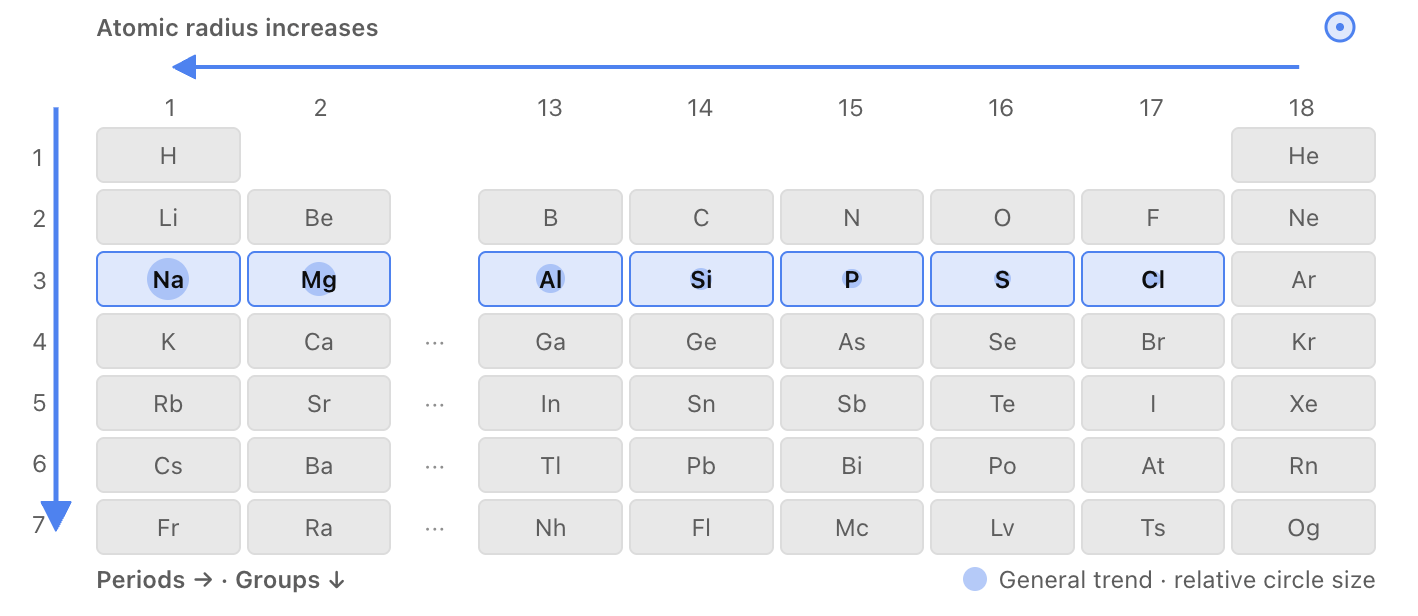
Atomic Radius Across a Period
Consider Period 3:
Na → Mg → Al → Si → P → S → Cl
As we move from sodium toward chlorine, the atoms generally become smaller.
Why?
Two important things are happening:
- The number of protons in the nucleus increases.
- The additional electrons are being added to the same main electron shell.
For example:
| Element | Atomic number | Electron arrangement |
|---|---|---|
| Na | 11 | 2,8,1 |
| Mg | 12 | 2,8,2 |
| Al | 13 | 2,8,3 |
| Si | 14 | 2,8,4 |
| P | 15 | 2,8,5 |
| S | 16 | 2,8,6 |
| Cl | 17 | 2,8,7 |
Notice that all of these elements have three occupied electron shells.
However, the number of protons increases from 11 in sodium to 17 in chlorine.
More protons produce a stronger nuclear attraction for the electrons.
The electron cloud is therefore pulled closer to the nucleus.
Increasing nuclear charge → stronger attraction → smaller atomic radius


Nuclear Charge
The nucleus contains positively charged protons, while electrons have a negative charge.
The nucleus therefore attracts electrons through electrostatic attraction.
As the atomic number increases:
more protons → greater nuclear charge
Across a period, this increasing nuclear charge is particularly important because the electrons are being added to the same main energy level.
The attraction between the nucleus and the outer electrons becomes stronger.
As a result:
Atomic radius decreases across a period
Atomic Radius Down a Group
Now consider Group 1:
Li → Na → K → Rb → Cs
Moving down the group, atomic radius increases.
The main reason is that each new period adds another occupied electron shell.
For example:
| Element | Electron arrangement | Occupied shells |
|---|---|---|
| Li | 2,1 | 2 |
| Na | 2,8,1 | 3 |
| K | 2,8,8,1 | 4 |
Potassium therefore has an additional occupied electron shell compared with sodium.
Its outermost electron is farther from the nucleus.
More electron shells → outer electrons farther from nucleus → larger atomic radius


But Doesn't Nuclear Charge Also Increase?
Yes.
Moving down a group, atoms contain more protons, so their nuclear charge increases.
You might therefore expect the stronger nucleus to pull the electrons closer.
However, another effect becomes more important.
Electron Shielding
Inner electrons reduce the attraction experienced by the outer electrons. This effect is called shielding.
As we move down a group:
- more electron shells are added
- outer electrons become farther from the nucleus
- more inner electrons lie between the nucleus and the outer electrons
- shielding increases
The increased distance and shielding outweigh the increase in nuclear charge.
Therefore:
Atomic radius increases down a group
Comparing Atomic Sizes
Once we know the periodic trend, we can compare atoms without knowing their exact atomic radii.
Remember:
Across → atomic radius decreases
Down ↓ atomic radius increases
Example 1: Sodium or Chlorine?
Na and Cl are both in Period 3.
Na is farther to the left.
Therefore:
Na is larger than Cl
Example 2: Lithium or Potassium?
Li and K are both in Group 1.
K is farther down the group.
Therefore:
K is larger than Li
Example 3: Magnesium or Calcium?
Mg and Ca are both in Group 2.
Ca is below Mg.
Therefore:
Ca is larger than Mg
Predicting the Size of Unfamiliar Atoms
You do not need to memorise the radius of every atom.
Instead, use an element's position on the periodic table.
Suppose you are asked:
Which atom is larger: Rb or Sr?
Both are in Period 5.
Rb is farther to the left.
Atomic radius decreases from left to right.
Therefore:
Rb is larger than Sr
Now consider:
Which is larger: F or Br?
F and Br are in the same group.
Br is farther down the group.
Therefore:
Br is larger than F
This reasoning allows you to make predictions even when you have never studied the individual atomic radii.
When the Elements Are in Different Groups and Periods
Sometimes the comparison is less obvious.
For example:
Which is larger: Na or K?
Easy — they are in the same group, so K is larger.
But what about:
Na or Ca?
Ca is:
- farther right, which tends to make atoms smaller
- farther down, which tends to make atoms larger
The two trends are working in opposite directions.
In introductory chemistry, questions are usually chosen so that one trend clearly determines the answer. For elements in very different positions, actual atomic-radius data may sometimes be needed for a confident comparison.
Understanding the Trend
The entire trend can be explained using three main ideas.
1. Number of Electron Shells
More occupied shells generally produce a larger atom.
This explains the increase in atomic radius down a group.
2. Nuclear Charge
More protons create a stronger positive nuclear charge.
A stronger nuclear attraction can pull electrons closer to the nucleus.
This helps explain the decrease in atomic radius across a period.
3. Shielding
Inner electrons shield outer electrons from some of the attraction of the nucleus.
More inner electron shells produce greater shielding.
This helps explain why atomic radius increases down a group.
A Simple Summary
| Direction | Atomic radius. | Main reason |
|---|---|---|
| Across a period → | Decreases | Nuclear charge increases while electrons enter the same main shell |
| Down a group ↓. | Increases | Additional electron shells and greater shielding |
So, on a simplified periodic table:
Largest atoms: bottom-left
Smallest atoms: top-right
Worked Example
Arrange these atoms from smallest to largest:
Li, Na, K
All three elements are in Group 1.
Atomic radius increases down a group.
Their positions are:
Li
↓
Na
↓
K
Therefore:
Li < Na < K
Another Example
Arrange these Period 3 atoms from largest to smallest:
Na, Mg, Si, Cl
Atomic radius decreases from left to right.
Their order on the periodic table is:
Na → Mg → Si → Cl
Therefore:
Na > Mg > Si > Cl
Did You Know?
The atoms near the bottom-left of the periodic table are among the largest atoms, while those near the top-right are among the smallest.
This same underlying competition between nuclear attraction, electron shells and shielding helps explain several other periodic trends, including ionisation energy and electronegativity.
Key Terms
- Atomic radius – a measure of the size of an atom.
- Periodic trend – a predictable pattern in properties across the periodic table.
- Nuclear charge – the positive charge of the nucleus produced by its protons.
- Electron shell – a main energy level occupied by electrons around the nucleus.
- Shielding – the reduction in nuclear attraction experienced by outer electrons because of inner electrons.
- Period – a horizontal row of the periodic table.
- Group – a vertical column of the periodic table.
Key Takeaways
- Atomic radius is a measure of atomic size.
- Atomic radius generally decreases from left to right across a period.
- Across a period, nuclear charge increases while electrons are added to the same main shell, pulling the electron cloud closer to the nucleus.
- Atomic radius generally increases down a group.
- Down a group, atoms gain additional electron shells and experience greater shielding.
- Atoms generally become larger toward the bottom-left of the periodic table.
- Atoms generally become smaller toward the top-right.
- Periodic trends allow us to compare and predict atomic sizes without memorising individual atomic radii.