Electric Charge and Basic Circuits
3. Voltage and Potential Difference
Learning outcomes
- I can define voltage as electrical potential difference.
- I can explain how batteries produce voltage.
- I can distinguish between voltage and current.
- I can predict how voltage affects current.
- I can measure voltage using a voltmeter.
What Is Voltage?
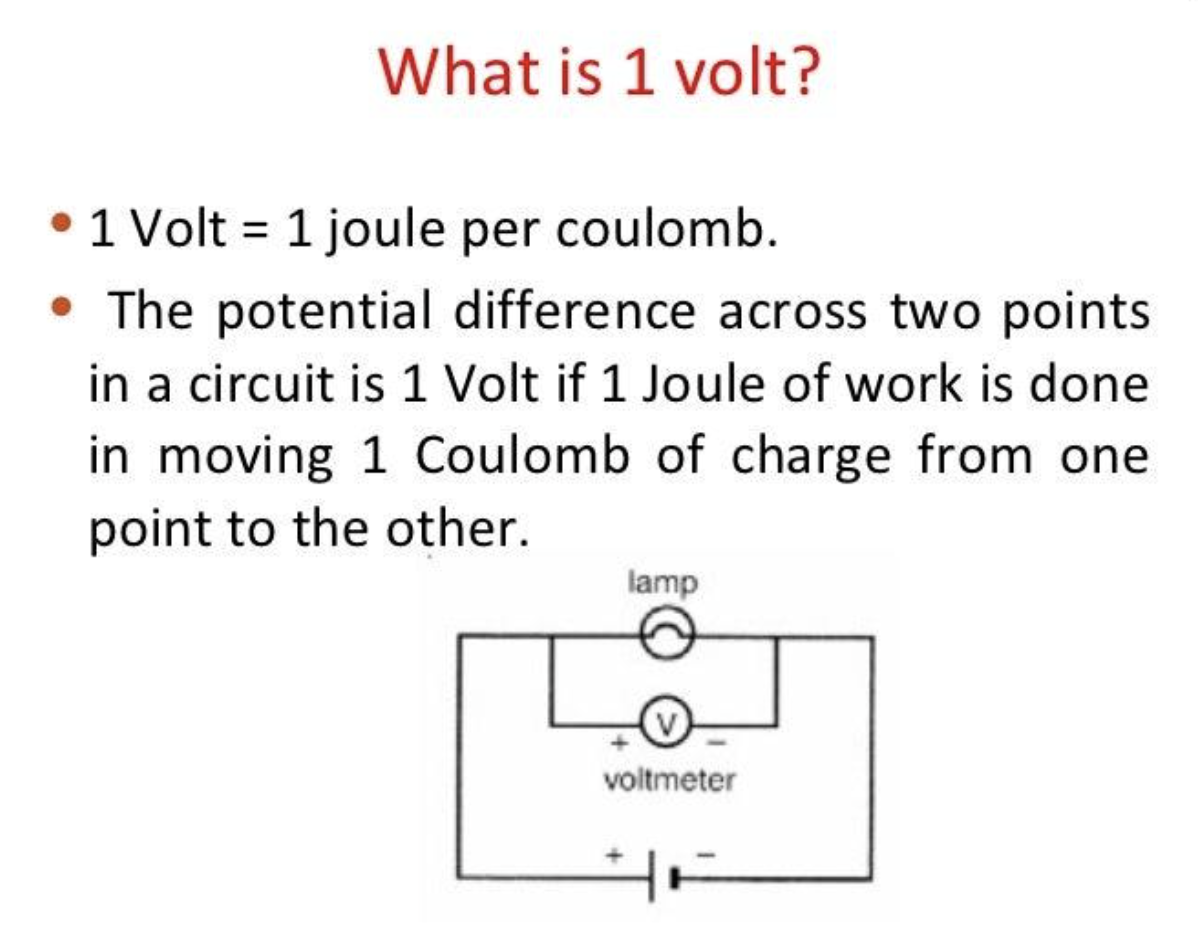
Voltage is another name for electrical potential difference.
It describes the difference in electrical potential energy between two points in a circuit.
A useful definition is:
Voltage is the energy transferred per unit charge.
The equation is:
\[ \boxed{V=\frac{E}{Q}} \]
where:
- \(V\) = voltage or potential difference
- \(E\) = energy transferred
- \(Q\) = electric charge
The SI unit of voltage is the volt (V).
One volt means that 1 joule of energy is transferred for every 1 coulomb of charge:
\[ \boxed{1\text{ V}=1\text{ J/C}} \]
Understanding Potential Difference
The term potential difference is important because voltage is always measured between two points.
Imagine two locations in a circuit.
If a charge has more electrical potential energy at one point than another, there is a potential difference between those points.
When charge moves between them, energy can be transferred.
This is why voltage is closely connected to what circuit components do.
For example:
- a battery increases the electrical potential energy of charge
- a lamp transfers electrical energy into light and thermal energy
- a motor transfers electrical energy into kinetic energy
Voltage therefore tells us something about the energy transferred by each coulomb of charge.
A Simple Analogy: Height
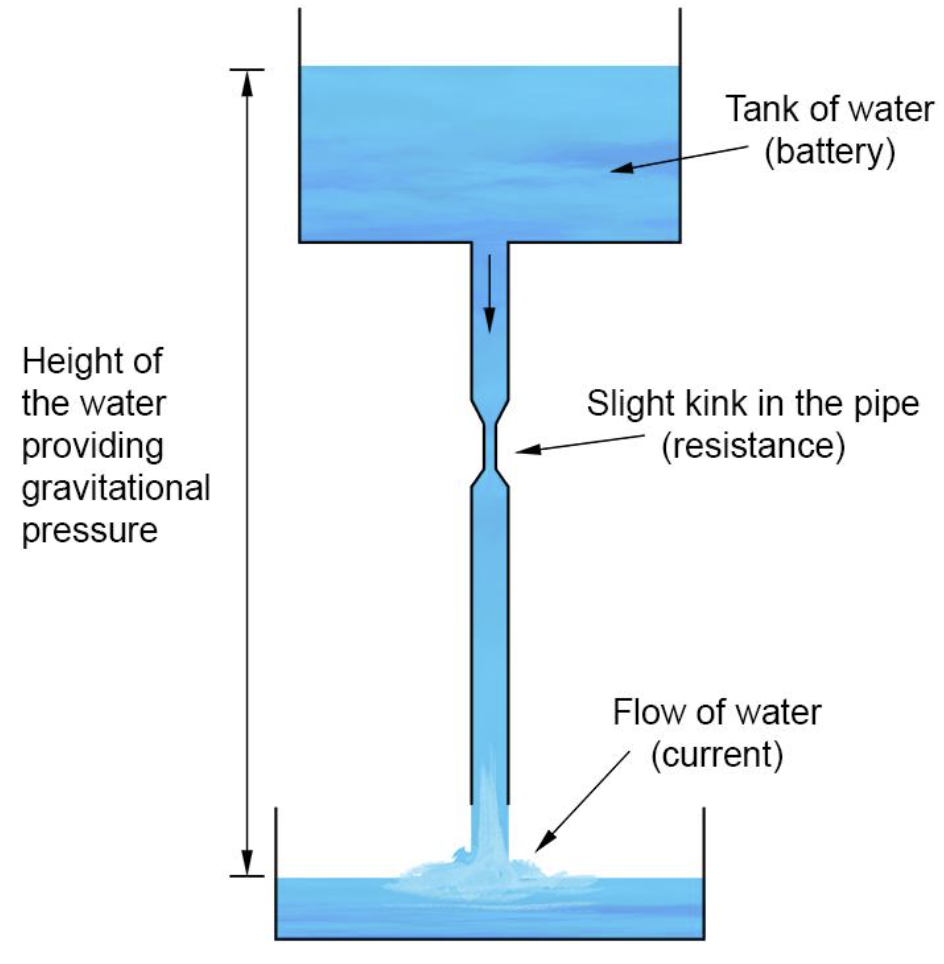
A useful comparison is gravitational potential energy.
Imagine water stored at the top of a hill.
The water has gravitational potential energy because of its height.
As the water moves downhill, its potential energy can be transferred into other forms.
Similarly, a battery creates a difference in electrical potential between its terminals.
This analogy is useful because:
greater height difference → greater gravitational potential difference
and similarly:
greater voltage → greater electrical potential difference
However, voltage is not literally height or water pressure. It is an electrical quantity measured in volts.
How Batteries Produce Voltage
A battery produces voltage using chemical reactions.
Inside a battery, chemical processes separate electric charge and maintain a difference in electric potential between the terminals.
One terminal becomes relatively:
negative
while the other becomes relatively:
positive
This separation creates an electric potential difference.
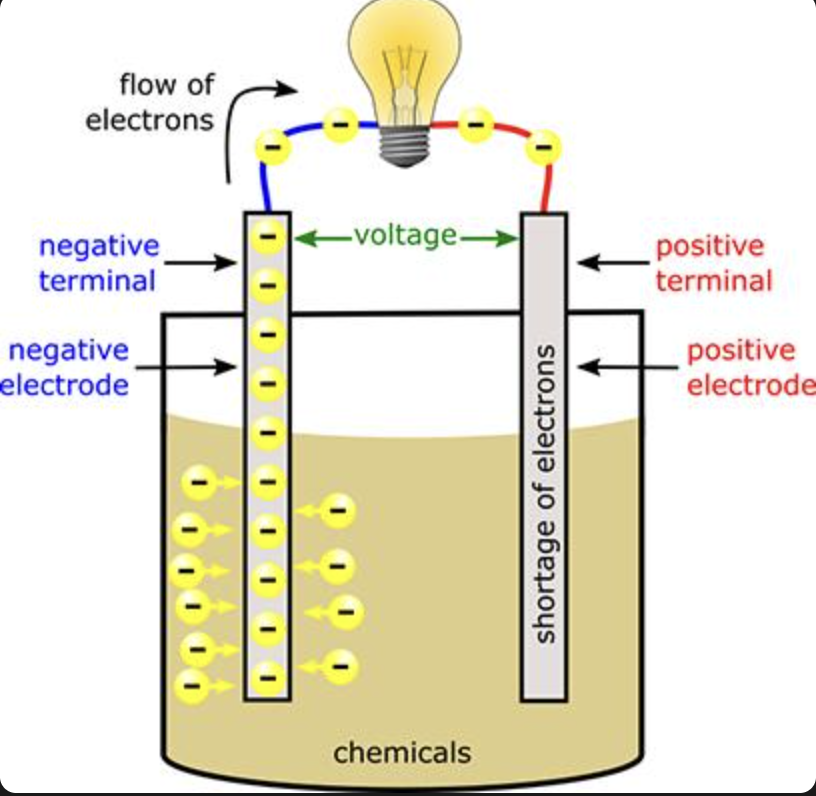
When the battery is connected into a complete circuit, the electric field established around the circuit causes charge carriers in the conductors to have a net movement.
The battery continuously converts:
chemical energy → electrical energy
as long as the relevant chemical reactions can continue.
Cells and Batteries
A single electrochemical source is often called a cell.
A battery technically consists of two or more cells connected together, although in everyday language we commonly call individual cells "batteries."
A typical cell might provide:
\[ 1.5\text{ V} \]
This means approximately:
\[ 1.5\text{ J} \]
of energy is transferred per coulomb of charge.
So:
\[ 1.5\text{ V}=1.5\text{ J/C} \]
Worked Example: Energy per Charge
A battery provides 12 J of electrical energy to 3 C of charge.
Calculate the voltage.
Use:
\[ V=\frac{E}{Q} \]
Substitute:
\[ V=\frac{12}{3} \]\[ \boxed{V=4\text{ V}} \]
The battery provides 4 joules of energy per coulomb of charge.
Rearranging the Voltage Equation
Starting with:
\[ V=\frac{E}{Q} \]
we can calculate energy using:
\[ \boxed{E=VQ} \]
and charge using:
\[ \boxed{Q=\frac{E}{V}} \]
So the three useful forms are:
\[ V=\frac{E}{Q} \]\[ E=VQ \]\[ Q=\frac{E}{V} \]
Worked Example: Calculating Energy
A charge of 5 C moves through a potential difference of 6 V.
How much energy is transferred?
Use:
\[ E=VQ \]\[ E=6\times5 \]\[ \boxed{E=30\text{ J}} \]
Therefore, 30 J of energy is transferred.
Voltage and Current Are Not the Same
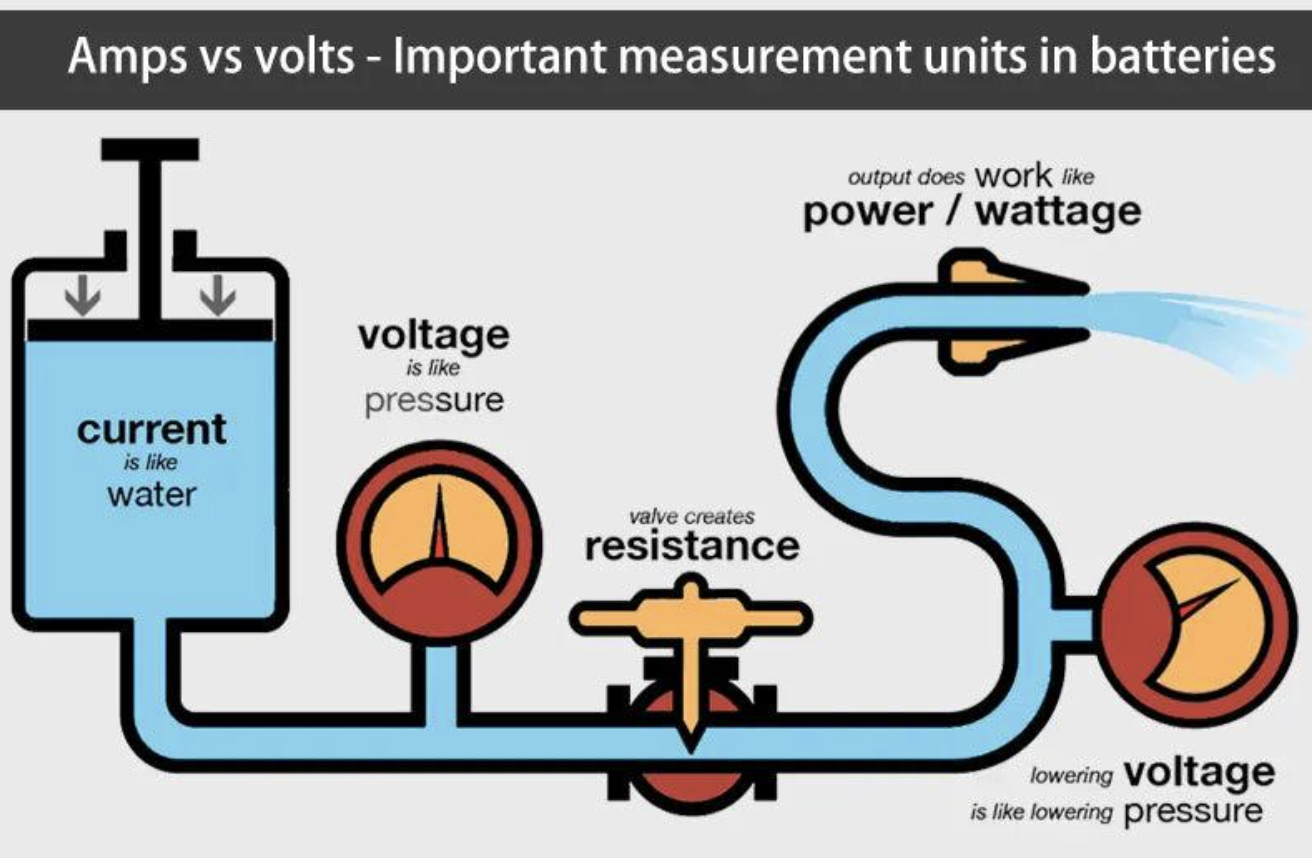
Voltage and current are closely related, but they describe different things.
Voltage
Voltage describes the energy transferred per unit charge.
Unit:
\[ \text{volt (V)} \]
Current
Current describes the rate at which charge flows.
Unit:
\[ \text{ampere (A)} \]
A useful comparison is:
Voltage → energy available per charge
Current → amount of charge flowing per second
These quantities should not be confused.
Voltage Does Not "Flow"
Students sometimes say that "voltage flows through the wire."
That is incorrect.
Charge flows.
The rate of charge flow is current.
Voltage is a difference in electric potential between two points.
So:
Current flows through a component.
Voltage exists across a component.
This distinction becomes very important when connecting meters.
How Voltage Affects Current
In many circuits, increasing voltage causes the current to increase.
Why?
A larger potential difference creates a stronger electric field in the conducting circuit, producing a greater net movement of charge carriers.
For a simple resistor at approximately constant temperature:
higher voltage → higher current
lower voltage → lower current
This relationship is described by Ohm's law.
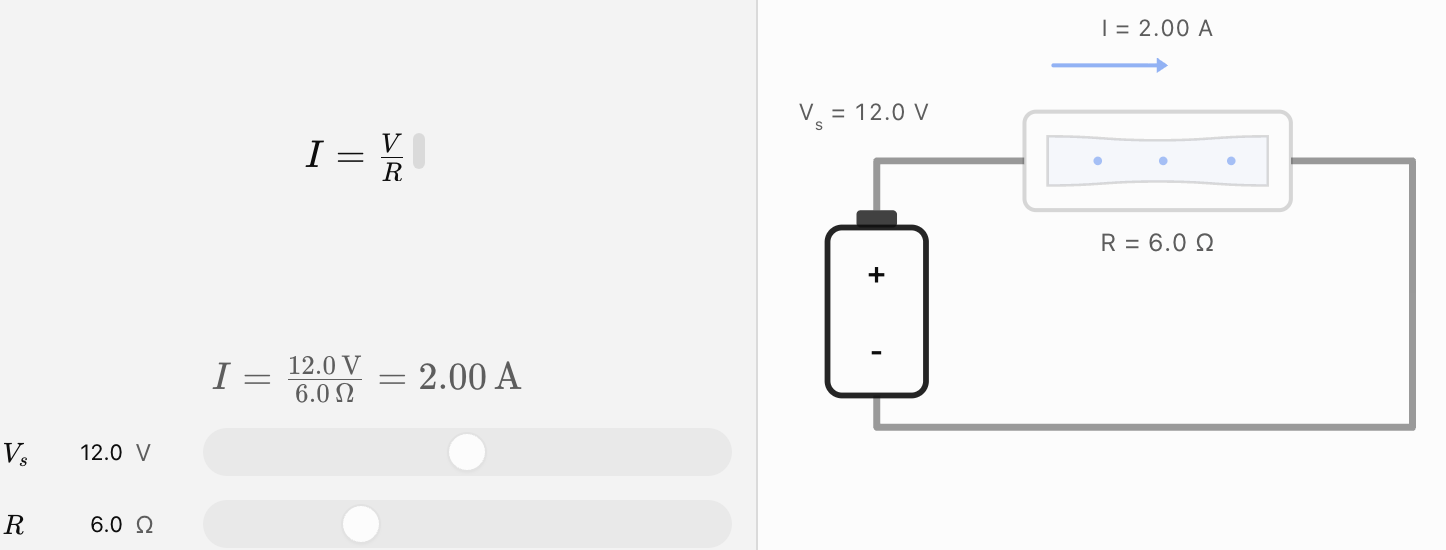
For example, if a resistor has a resistance of \(6\,\Omega\):
At:
\[ V=6\text{ V} \]
the current is:
\[ I=\frac{6}{6}=1\text{ A} \]
At:
\[ V=12\text{ V} \]
the current becomes:
\[ I=\frac{12}{6}=2\text{ A} \]
Doubling the voltage doubled the current because the resistance remained constant.
Voltage, Current, and Resistance
The effect of voltage on current also depends on resistance.
Resistance tells us how strongly a component opposes the flow of electric charge.
For a given resistance:
greater voltage generally produces greater current.
However, two circuits with the same voltage may have different currents if their resistances are different.
Example
Circuit A:
\[ V=6\text{ V} \]\[ R=3\,\Omega \]\[ I=2\text{ A} \]
Circuit B:
\[ V=6\text{ V} \]\[ R=12\,\Omega \]\[ I=0.5\text{ A} \]
Both circuits have the same voltage, but Circuit A has the larger current because it has less resistance.
Predicting the Effect of Changing Voltage
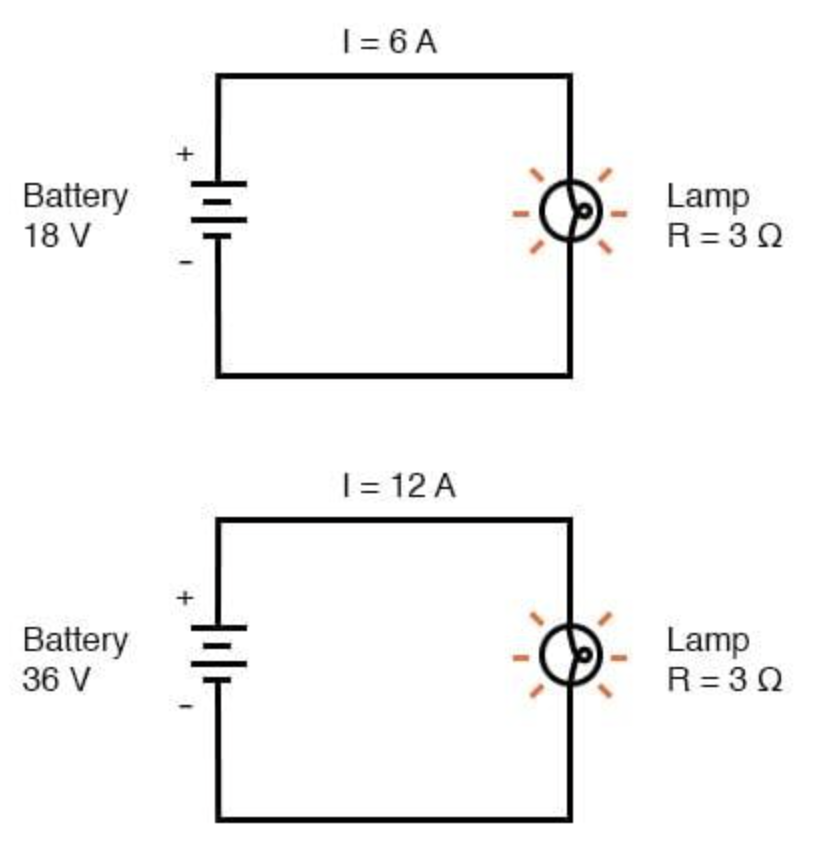
Suppose a lamp is connected to a variable power supply.
If we gradually increase the voltage, we would generally expect the current through the lamp to increase.
However, real components do not always behave perfectly.
For example, as a filament lamp gets hotter, its resistance increases.
This means that doubling the voltage may not exactly double the current.
Later, this can be studied using current–voltage graphs.
Measuring Voltage
Voltage is measured using an instrument called a voltmeter.
The circuit symbol for a voltmeter is:
\[ \boxed{\text{Ⓥ}} \]
A voltmeter measures the potential difference between two points.
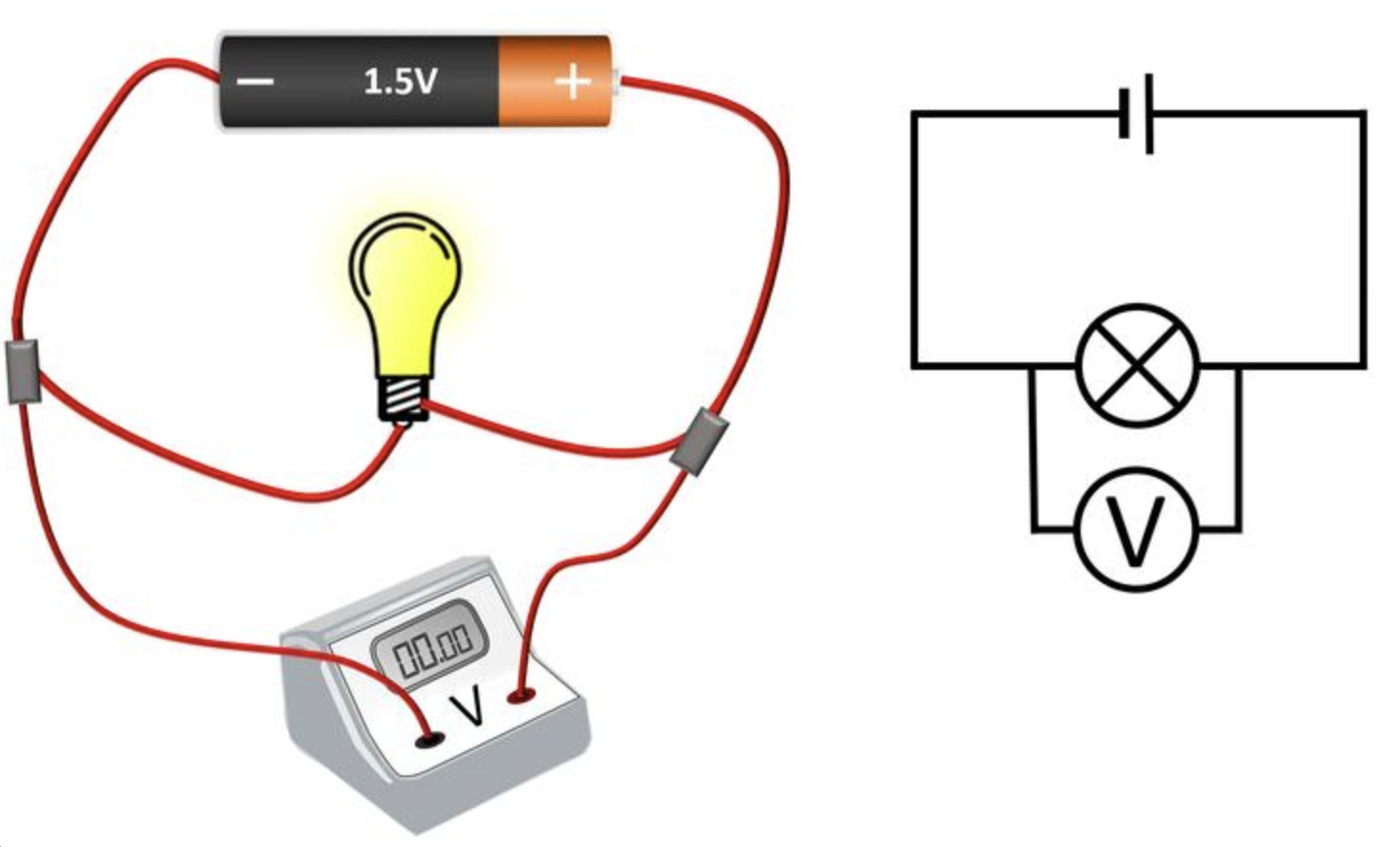
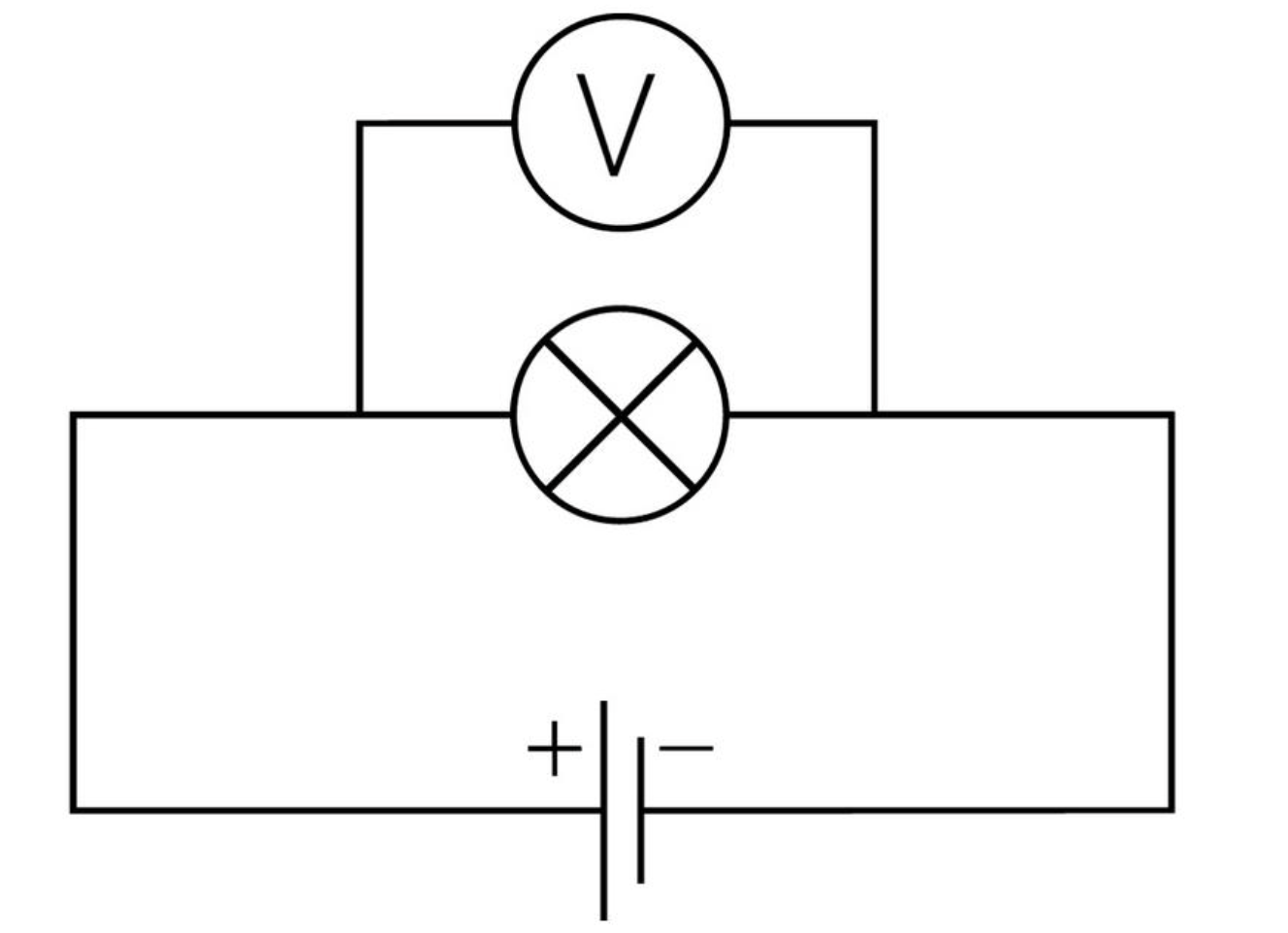
Because voltage is measured between two points, a voltmeter is connected across the component.
This is called a parallel connection.
Connecting a Voltmeter
Suppose we want to measure the voltage across a lamp.
The voltmeter must be connected with one lead on one side of the lamp and the other lead on the other side.
The voltmeter is therefore connected:
\[ \boxed{\text{in parallel with the lamp}} \]
The current does not need to pass through the voltmeter in the same way it passes through an ammeter.
Instead, the voltmeter compares the electrical potential at two points.
Ammeter vs. Voltmeter
It is important to distinguish the two meters.
| Ammeter | Voltmeter |
|---|---|
| Measures current | Measures voltage |
| Unit: ampere (A) | Unit: volt (V) |
| Connected in series | Connected in parallel |
| Current passes through it | Measures between two points |
A good memory rule is:
Ammeter → Along the circuit
Voltmeter → across the component
Why Is a Voltmeter Connected in Parallel?
Voltage is a comparison between two points.
Imagine a lamp.
To find the energy transferred per unit charge by the lamp, we need to compare:
electrical potential before the lamp
with:
electrical potential after the lamp
Therefore, the voltmeter must connect to both sides of the component.
This creates a parallel connection.
Using a Digital Multimeter
A digital multimeter can usually measure:
- voltage
- current
- resistance
When measuring voltage:
- select the appropriate voltage setting
- connect the leads to the correct meter terminals
- place the probes across the two points being compared
- read the voltage from the display
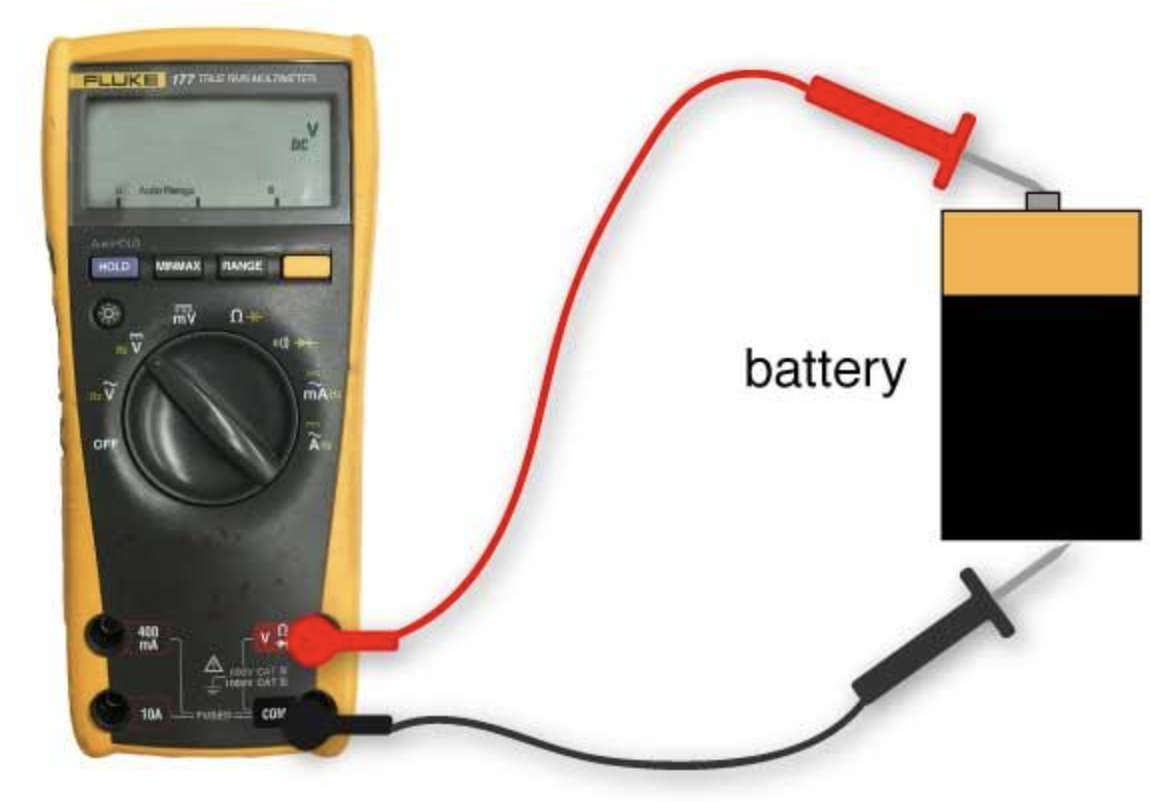
For a DC circuit, the polarity of the leads may affect whether the reading appears positive or negative.
Measuring the Voltage of a Cell
A voltmeter can be connected directly across the terminals of a cell.
If the meter reads:
\[ 1.5\text{ V} \]
the potential difference between the terminals is approximately 1.5 volts.
This means that the source can transfer approximately:
\[ 1.5\text{ J} \]
of electrical energy for every coulomb of charge passing through the source.
Voltage Across Circuit Components
Components transfer electrical energy into other forms.
For example, a lamp converts electrical energy mainly into:
- light energy
- thermal energy
If the voltage across a lamp is:
\[ 6\text{ V} \]
then each coulomb of charge transfers approximately:
\[ 6\text{ J} \]
of electrical energy as it passes through the lamp.
This connection between voltage and energy transfer is one of the most important concepts in circuit physics.
Batteries in Series
Cells can be connected so that their voltages combine.
For example, two 1.5 V cells connected appropriately in series can provide approximately:
\[ 1.5+1.5=3.0\text{ V} \]
Three such cells can provide:
\[ 1.5+1.5+1.5=4.5\text{ V} \]
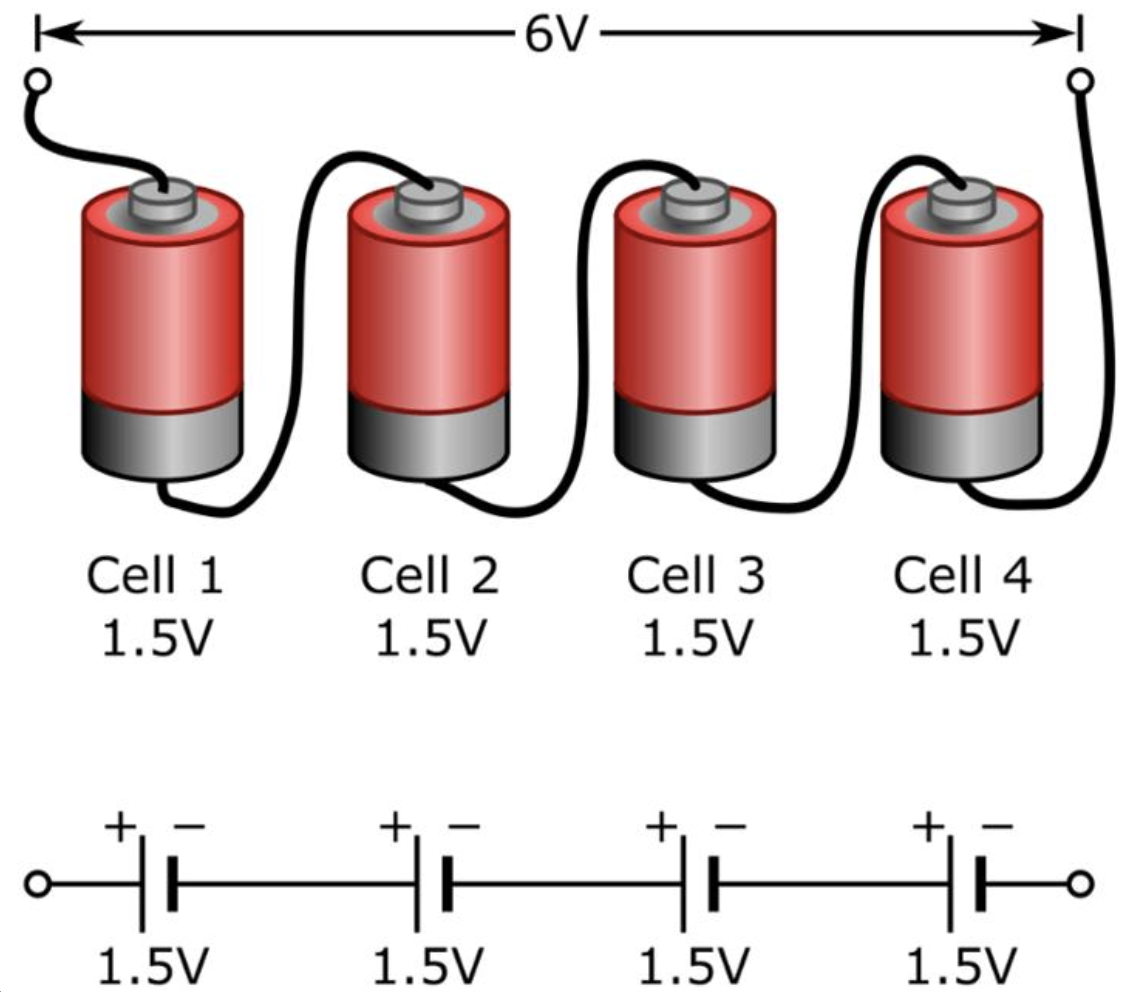
A larger total voltage can produce a larger current if the resistance of the circuit remains unchanged.
Worked Example: Comparing Batteries
Battery A provides:
\[ 3\text{ V} \]
Battery B provides:
\[ 9\text{ V} \]
If each sends 2 C of charge through a component, how much energy can each transfer?
Battery A
\[ E=VQ \]\[ E=3\times2 \]\[ E=6\text{ J} \]
Battery B
\[ E=9\times2 \]\[ E=18\text{ J} \]
Battery B transfers more energy to each amount of charge because it has the greater voltage.
Real-World Voltage Values
Different electrical systems operate at very different voltages.
Examples include:
- individual cells: often around a few volts
- USB-powered electronics: low-voltage DC systems
- vehicle electrical systems: typically higher than individual cells
- household electrical supplies: much higher voltage
- power transmission systems: extremely high voltage
The voltage chosen depends on the purpose of the electrical system.
Higher voltage can allow more energy to be transferred per coulomb of charge, but electrical safety becomes increasingly important as voltage rises.
Voltage and Electrical Safety
Voltage is one factor that affects electrical hazards.
A sufficiently large potential difference can drive harmful current through the human body.
The actual current depends on factors including:
- voltage
- resistance of the body
- skin condition
- path through the body
- duration of contact
For this reason, electrical systems use insulation, grounding, protective devices, and safe operating procedures.
Common Mistakes
Mistake 1: Voltage and current are the same thing
They are different quantities.
Voltage: energy transferred per unit charge.
Current: rate of flow of charge.
Mistake 2: Voltage flows through a wire
Voltage does not flow.
Charge flows, producing current.
Voltage is a potential difference between two points.
Mistake 3: A voltmeter is connected in series
A voltmeter is connected in parallel across the component.
Mistake 4: A battery contains voltage like a container contains water
A battery maintains a potential difference through chemical processes.
Voltage describes a difference between the terminals, not a substance stored inside the battery.
Mistake 5: Higher voltage always means exactly proportional current
For a fixed resistance, increasing voltage increases current proportionally.
However, the resistance of some components can change with temperature or operating conditions.
Mistake 6: Voltage measures the total amount of energy
Voltage measures energy transferred per unit charge, not simply total energy.
Check Your Understanding
1. Define voltage.
2. What is another name for voltage?
3. State the SI unit of voltage.
4. What does a potential difference of 1 V mean?
5. Write the equation relating voltage, energy, and charge.
6. A battery transfers 18 J of energy to 3 C of charge. Calculate the voltage.
7. A charge of 4 C moves through a potential difference of 5 V. Calculate the energy transferred.
8. Explain how a battery creates a potential difference.
9. State one important difference between voltage and current.
10. Which quantity is measured in amperes?
11. Which quantity is measured in volts?
12. Predict what normally happens to current if voltage increases while resistance remains constant.
13. What instrument is used to measure voltage?
14. How should a voltmeter be connected to a lamp?
15. Explain why a voltmeter must be connected across a component rather than simply placed somewhere in series.
16. Two 1.5 V cells are connected appropriately in series. What total voltage do they provide?
17. Explain why saying "voltage flows through the circuit" is scientifically incorrect.
18. Challenge: A resistor has a resistance of \(8\,\Omega\). Calculate the current when the voltage is 4 V and again when the voltage is 12 V. Describe the relationship you observe.
Key Terms
- Voltage – electrical potential difference; the energy transferred per unit charge.
- Potential difference – the difference in electrical potential between two points.
- Volt (V) – the SI unit of voltage.
- Charge (Q) – an electrical quantity measured in coulombs.
- Coulomb (C) – the SI unit of electric charge.
- Electrical energy – energy associated with electric charges and electric circuits.
- Cell – an electrochemical source of electrical potential difference.
- Battery – a source consisting of one or more electrochemical cells.
- Current – the rate of flow of electric charge.
- Resistance – opposition to the movement of electric charge.
- Voltmeter – an instrument used to measure potential difference.
- Parallel connection – a connection across the same two points of a circuit.
Key Takeaways
- Voltage is electrical potential difference.
- Voltage tells us how much energy is transferred per coulomb of charge.
- Voltage is measured in volts (V).
- One volt equals:
\[ \boxed{1\text{ V}=1\text{ J/C}} \]
- Voltage can be calculated using:
\[ \boxed{V=\frac{E}{Q}} \]
- Batteries create voltage through chemical reactions that separate charge and maintain a potential difference.
- Current and voltage are different: current is the rate of charge flow, while voltage is energy transferred per unit charge.
- For a fixed resistance, increasing voltage causes the current to increase.
- Voltage is measured using a voltmeter.
- A voltmeter is connected in parallel across a component.
- Voltage exists between two points; it does not "flow" through the circuit.
- Circuit components transfer electrical energy, and the voltage across them indicates the energy transferred per coulomb of charge.