Cell Division and Reproduction
5. Comparing Mitosis and Meiosis
Learning outcomes
-
I can compare the purposes of mitosis and meiosis.
- I can compare the number of divisions involved in each process.
- I can compare the chromosome numbers of the resulting cells.
- I can explain why meiosis produces variation while mitosis does not.
- I can identify situations in which mitosis or meiosis occurs.


Two Different Types of Cell Division
Living organisms use cell division for different:
purposes.
Two important forms of cell division are:
mitosis
and:
meiosis.
Although both processes begin with a cell containing chromosomes and both involve the movement of genetic material, their outcomes are very:
different.
The easiest way to remember their main purposes is:
Mitosis → growth, repair, replacement
Meiosis → production of cells for sexual reproduction
The Big Picture
Mitosis normally produces:
two genetically similar daughter cells.
Meiosis typically produces:
four genetically different haploid cells.
A simplified comparison is:
MITOSIS
One diploid cell
↓
One division
↓
Two diploid cells
MEIOSIS
One diploid cell
↓
Two divisions
↓
Four haploid cells
This difference is fundamental to the biological roles of the two:
processes.
Purpose of Mitosis
The main purposes of mitosis include:
- growth
- tissue repair
- replacement of damaged or worn-out cells
- development
- asexual reproduction in some organisms
Mitosis produces cells containing essentially the same genetic information as the:
parent cell.
This makes sense because a replacement skin cell should contain the same basic genetic instructions as the skin cell it:
replaces.
Purpose of Meiosis
The main purpose of meiosis is to produce haploid cells needed for:
sexual reproduction.
In animals, meiosis produces cells that develop into:
gametes.
Gametes include:
sperm cells and egg cells.
Meiosis also creates:
genetic variation.
This variation contributes to the genetic differences among sexually produced:
offspring.
Comparing the Processes Visually
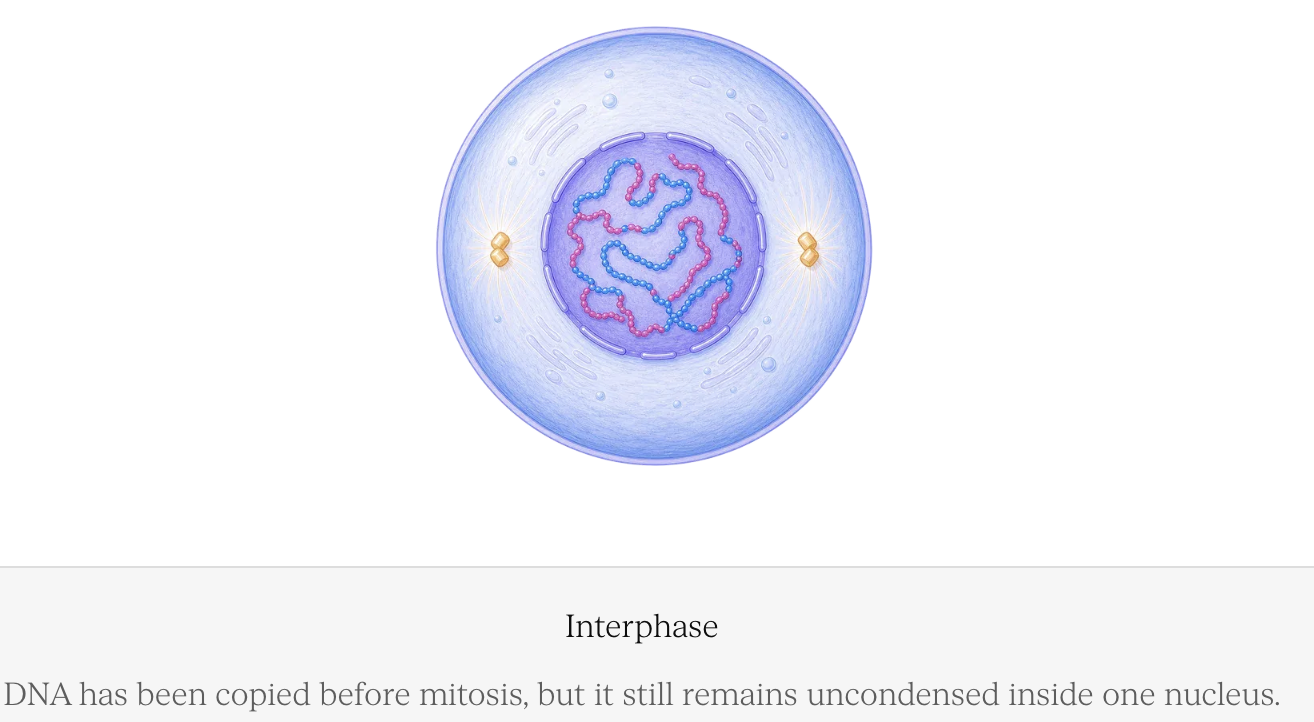
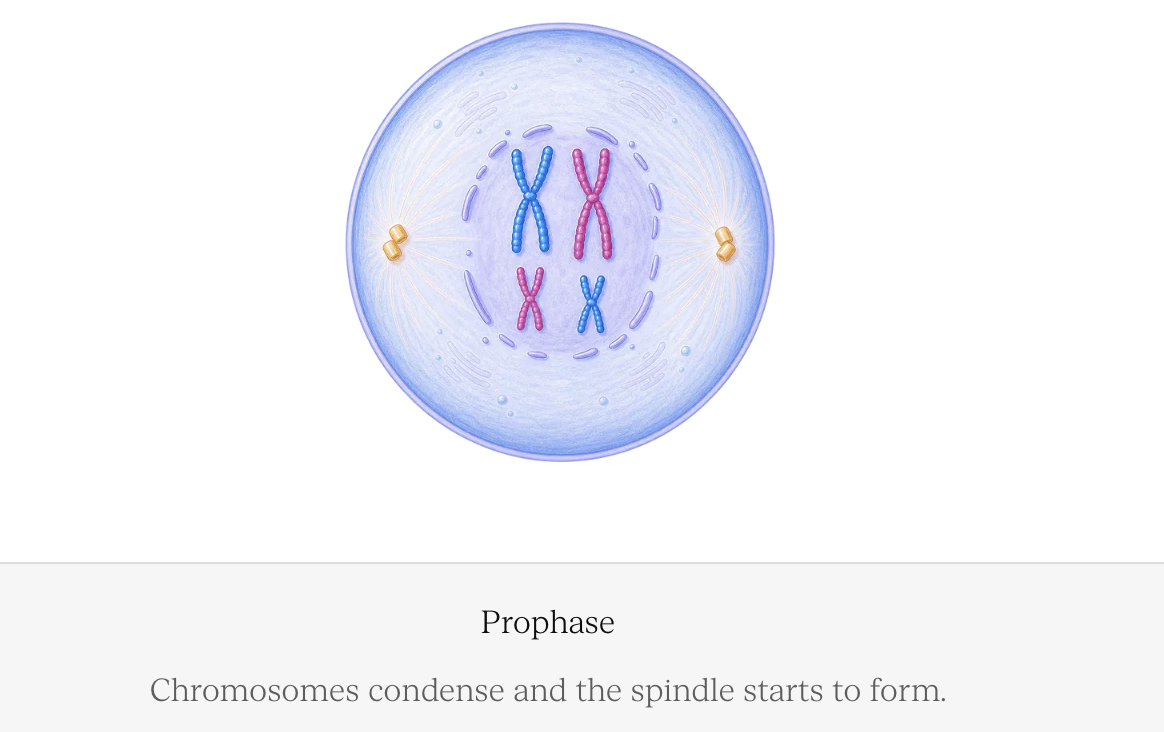
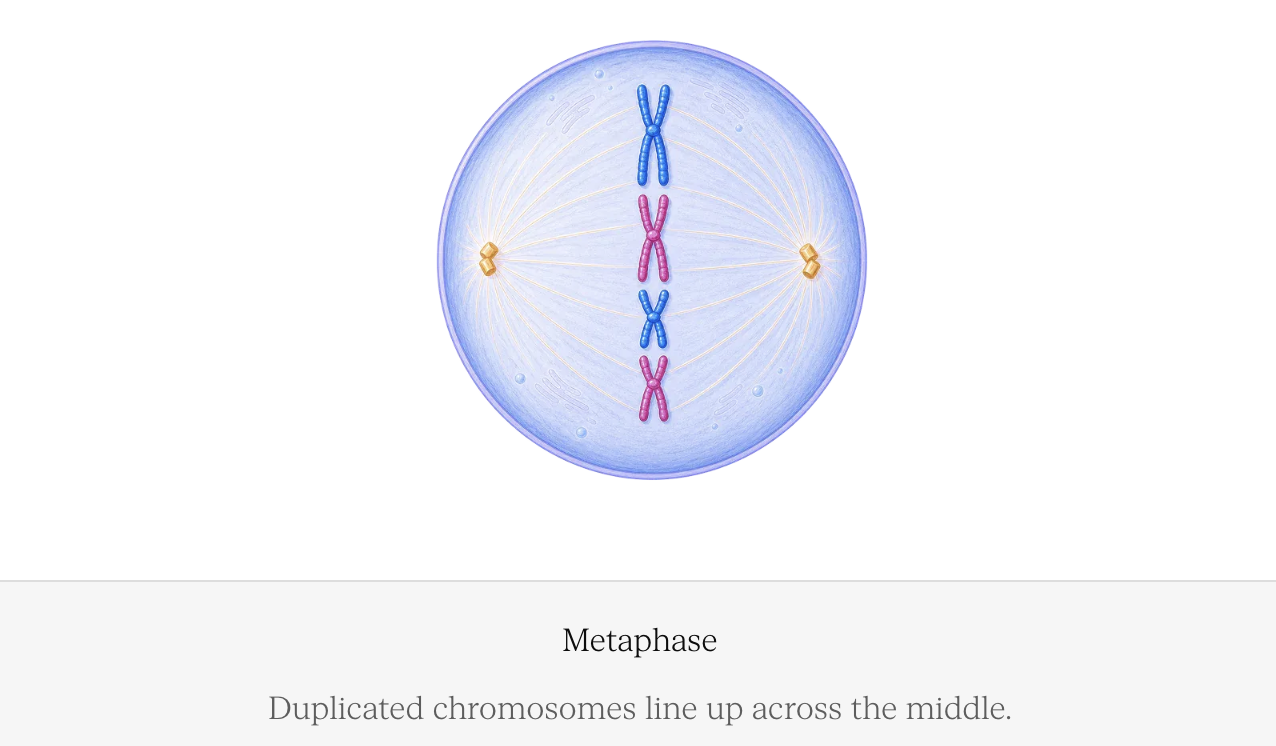
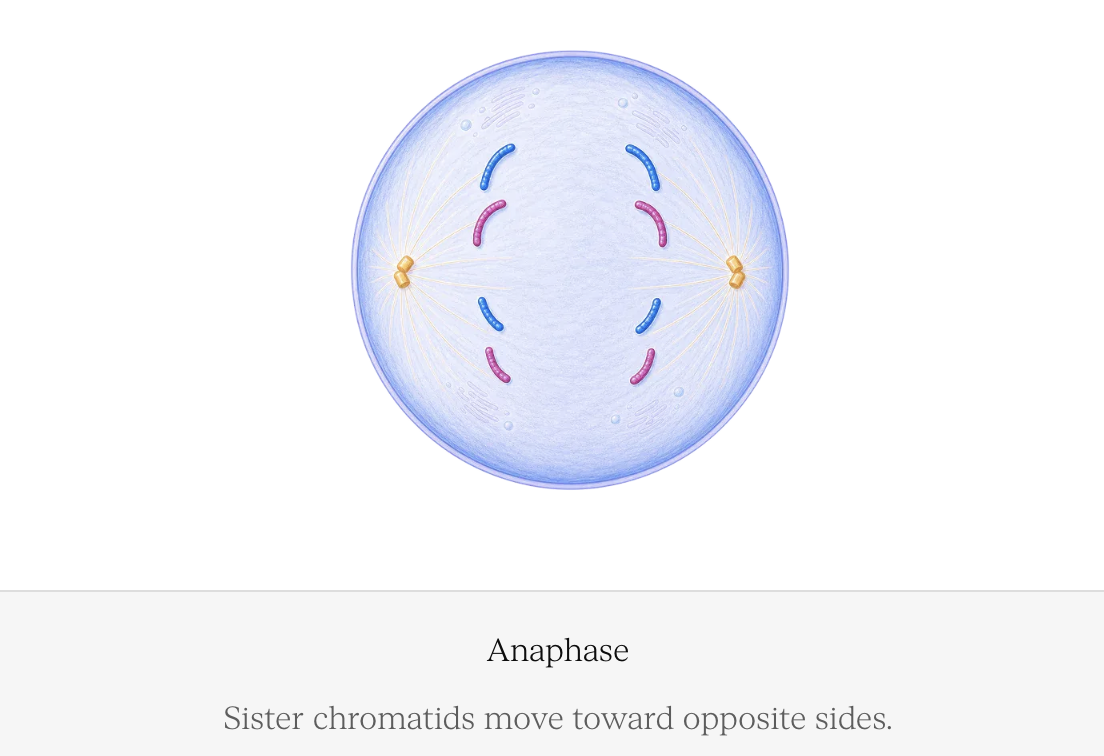
It helps to examine each process independently before comparing them.
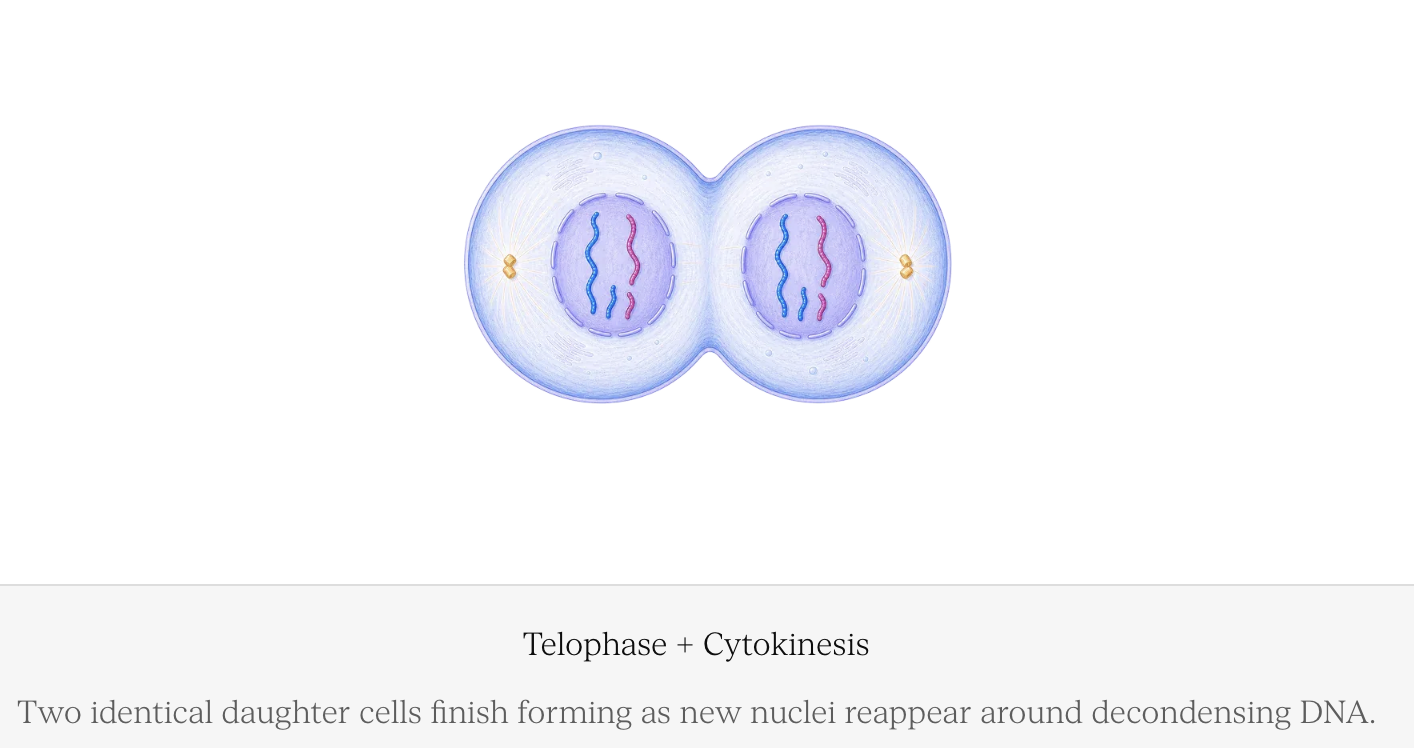
Mitosis
Meiosis
(See Meiosis Notes)
The major difference should be immediately visible:
Mitosis has one division.
Meiosis has two divisions.
DNA Replication
Both mitosis and meiosis begin after DNA has been:
replicated.
During the S phase of interphase, each chromosome is copied.
Each replicated chromosome consists of two:
sister chromatids.
An important similarity is therefore:
DNA replication occurs once before either process.
However, what happens after DNA replication is very:
different.


Number of Divisions
Mitosis involves:
one nuclear division.
Meiosis involves:
two nuclear divisions.
These are called:
Meiosis I
and:
Meiosis II.
Therefore:
Mitosis: 1 division
Meiosis: 2 divisions
Number of Cells Produced
Because mitosis has one division, one parent cell normally produces:
two daughter cells.
Because meiosis has two divisions, one parent cell typically produces:
four haploid cells.
So:
Mitosis: 1 → 2
Meiosis: 1 → 2 → 4
Comparing Chromosome Number
One of the most important differences concerns:
chromosome number.
Mitosis normally:
maintains chromosome number.
Meiosis:
halves chromosome number.
Using chromosome notation:
Mitosis: 2n → 2n
Meiosis: 2n → n
Human Example
Most human body cells contain:
46 chromosomes.
Therefore:
2n = 46
A human body cell dividing by mitosis normally produces:
46 → 46 and 46
A human diploid germ cell completing meiosis produces cells with:
46 → 23
Therefore:
Mitosis maintains 46.
Meiosis reduces 46 to 23.
Why Does Mitosis Maintain Chromosome Number?
Before mitosis, each chromosome is:
copied.
During mitosis, the sister chromatids are:
separated.
One copy is distributed to each daughter:
nucleus.
As a result, both daughter cells receive a complete chromosome:
set.
This allows chromosome number to remain:
constant.
Why Does Meiosis Halve Chromosome Number?
Meiosis separates homologous chromosomes during:
Meiosis I.
Each resulting cell receives only one chromosome from each homologous:
pair.
Therefore, the cells become:
haploid.
This reduction is essential because gametes will later combine during:
fertilization.
Meiosis and Fertilization Work Together
In humans:
Sperm = 23 chromosomes
Egg = 23 chromosomes
During fertilization:
23 + 23 = 46
The normal diploid chromosome number is:
restored.
Without meiosis, chromosome number would double every:
generation.


Homologous Chromosomes
A major difference between mitosis and meiosis involves:
homologous chromosomes.
Homologous chromosomes are chromosome pairs carrying the same types of genes at corresponding:
locations.
During mitosis, homologous chromosomes do not normally pair with one another.
During Prophase I of meiosis, homologous chromosomes:
pair together.
This pairing allows an important process called:
crossing over.
What Separates in Mitosis?
During anaphase of mitosis:
sister chromatids separate.
The chromatids move toward opposite poles.
The result is two nuclei containing essentially identical chromosome:
sets.
What Separates in Meiosis I?
During Anaphase I:
homologous chromosomes separate.
The sister chromatids remain:
together.
This is the division that reduces chromosome number from:
diploid to haploid.
What Separates in Meiosis II?
During Anaphase II:
sister chromatids separate.
This resembles what happens during anaphase of:
mitosis.
Therefore:
Mitosis → sister chromatids separate
Meiosis I → homologous chromosomes separate
Meiosis II → sister chromatids separate
Comparing the Stages
Mitosis has:
Prophase → Metaphase → Anaphase → Telophase
Meiosis has two rounds:
Prophase I → Metaphase I → Anaphase I → Telophase I
followed by:
Prophase II → Metaphase II → Anaphase II → Telophase II
This is why meiosis takes:
two divisions.
The Central Comparison
| Feature | Mitosis | Meiosis |
|---|---|---|
| Main purpose | Growth, repair and replacement | Sexual reproduction |
| DNA replication | Once before division | Once before Meiosis I |
| Number of divisions | 1 | 2 |
| Typical number of cells produced | 2 | 4 |
| Starting chromosome number | Usually 2n | Usually 2n |
| Final chromosome number | Usually 2n | n |
| Chromosome number | Maintained | Halved |
| Homologous chromosomes pair | No | Yes |
| Crossing over | Normally no | Yes, in Prophase I |
| Genetic similarity | Usually genetically similar | Genetically different |
| In humans | 46 → 46 | 46 → 23 |
Why Mitosis Produces Genetically Similar Cells
Before mitosis, DNA is copied.
During mitosis, sister chromatids are distributed accurately between the two:
daughter cells.
There is normally no pairing of homologous chromosomes and no crossing over as occurs during:
meiosis.
Therefore, daughter cells normally contain essentially the same genetic information as:
each other and the parent cell.
Are Mitotic Cells Always Perfectly Identical?
Mitosis is designed to produce genetically identical:
cells.
However, mutations can occasionally occur during DNA replication or later cell:
division.
Therefore, it is most accurate to say that mitosis normally produces:
genetically identical or nearly identical daughter cells.
Why Meiosis Produces Variation
Meiosis produces genetically different cells primarily because of:
crossing over
and:
independent assortment.
These processes create different combinations of:
alleles.
The gametes produced by one individual can therefore be genetically different from:
one another.


Crossing Over
During Prophase I, homologous chromosomes pair.
Non-sister chromatids can exchange corresponding sections of:
DNA.
This is called:
crossing over.
Crossing over produces chromosomes containing new combinations of:
alleles.
Mitosis does not normally include this process.
Independent Assortment
During Metaphase I, homologous chromosome pairs line up:
randomly.
The chromosome inherited from one parent could face either:
pole.
Each chromosome pair behaves independently of many of the:
others.
As a result, different gametes receive different combinations of:
chromosomes.
This is called:
independent assortment.
Random Fertilization Adds Even More Variation
Meiosis creates genetically different:
gametes.
During sexual reproduction, one gamete then combines with another during:
fertilization.
Which sperm fertilizes which egg is largely:
random.
Therefore, sexual reproduction produces even more genetic variation than meiosis:
alone.
Mitosis Creates Consistency
For growth and repair, genetic consistency is usually:
important.
Imagine replacing a damaged skin cell.
The new cell needs the genetic instructions required to function as a:
skin cell.
Mitosis maintains the genome and chromosome number so tissues can continue functioning:
normally.
Meiosis Creates Diversity
For sexual reproduction, genetic diversity can be:
advantageous.
Different offspring receive different combinations of:
alleles.
This produces variation within a:
population.
Variation provides the raw material upon which:
natural selection can act.
Where Does Mitosis Occur?
Mitosis occurs in many cells involved in:
growth and maintenance.
Examples include cells involved in:
- skin replacement
- growth of bones and tissues
- wound healing
- replacement of digestive tract cells
- development of an embryo
- plant growth
- some forms of asexual reproduction
If the purpose is generally to make more genetically similar body cells, the process is likely:
mitosis.


Example: Growing from a Zygote
A human begins development as a:
zygote.
The zygote contains:
46 chromosomes.
It divides through:
mitosis.
The new cells divide again and again.
This produces the enormous number of cells needed to build the:
body.
The cells maintain the normal chromosome number of:
46.
Example: Healing a Cut
A cut damages and destroys some:
skin cells.
Cells around the wound divide to replace the:
lost cells.
This requires:
mitosis.
The replacement cells need the same chromosome number and genetic information as other:
body cells.
Example: Plant Growth
Cells near the tips of roots and shoots divide rapidly.
These regions are called:
meristems.
Cells in meristems undergo:
mitosis.
This produces new cells and allows roots and shoots to:
grow.


Where Does Meiosis Occur?
In animals, meiosis occurs in specialized reproductive tissues involved in producing:
gametes.
In humans, this includes the:
testes
and:
ovaries.
Meiosis contributes to the production of:
sperm and eggs.
If the biological purpose is to produce haploid reproductive cells, the process is:
meiosis.
Example: Producing Sperm
A diploid germ cell contains:
46 chromosomes.
It undergoes meiosis.
The resulting haploid cells contain:
23 chromosomes.
These develop into:
sperm cells.
The chromosome number has been reduced by:
half.
Example: Producing Eggs
Cells involved in egg formation also undergo:
meiosis.
The chromosome number is reduced from:
46 to 23.
The functional egg is therefore:
haploid.
When fertilization occurs, the diploid number can be:
restored.
Mitosis in Asexual Reproduction
Mitosis can also be used during:
asexual reproduction.
For example, plants may reproduce through:
- runners
- tubers
- bulbs
- cuttings
Growth of the new plant involves repeated:
mitosis.
Because the new organism develops from cells of one parent, it is usually genetically very similar to that:
parent.
Meiosis in Sexual Reproduction
Meiosis is closely connected with:
sexual reproduction.
It produces haploid cells and genetic:
variation.
These cells ultimately participate in fertilization.
Therefore:
Meiosis → haploid reproductive cells
Fertilization → diploid zygote
Mitosis → growth of the zygote into an organism
All three processes are connected.
Following a Human Life Cycle
Consider the sequence:
Adult
↓
Meiosis
↓
Gametes with 23 chromosomes
↓
Fertilization
↓
Zygote with 46 chromosomes
↓
Mitosis
↓
Growth and development
↓
Adult
Meiosis and mitosis therefore perform different but complementary:
roles.
A Useful Decision Rule
When deciding whether a situation involves mitosis or meiosis, ask:
What is the cell trying to accomplish?
If the answer is:
growth, repair, replacement, or asexual reproduction
think:
MITOSIS.
If the answer is:
production of haploid reproductive cells for sexual reproduction
think:
MEIOSIS.
Scenario 1: A Child Growing Taller
A child's bones and other tissues need to produce more:
cells.
The cells must maintain the normal chromosome:
number.
The process is:
mitosis.
Scenario 2: Healing a Burn
Damaged cells must be:
replaced.
New cells need essentially the same genetic information as the cells they replace.
The process is:
mitosis.
Scenario 3: Producing Sperm
The chromosome number must be reduced from:
diploid to haploid.
The process is:
meiosis.
Scenario 4: Producing an Egg
The reproductive cell must contain half the normal chromosome:
number.
The process is:
meiosis.
Scenario 5: A Strawberry Runner Produces a New Plant
The new plant develops through repeated cell division without fertilization.
This involves:
mitosis.
It is an example of:
asexual reproduction.
Scenario 6: Creating Genetic Variation in Gametes
Homologous chromosomes pair, crossing over occurs, and chromosome pairs are independently assorted.
This describes:
meiosis.
Chromosome Example
Suppose an organism has:
2n = 16.
After mitosis:
Each daughter cell contains:
16 chromosomes.
After meiosis:
Each final cell contains:
8 chromosomes.
Therefore:
Mitosis: 16 → 16
Meiosis: 16 → 8
Another Chromosome Example
A species has:
24 chromosomes
in each body cell.
A cell undergoes mitosis.
Each daughter cell should contain:
24 chromosomes.
A diploid germ cell undergoes meiosis.
Each haploid cell should contain:
12 chromosomes.
Worked Comparison
A scientist observes a cell division that produces two cells.
The chromosome number remains unchanged.
The cells are genetically very similar.
The process is most likely:
mitosis.
Now suppose a scientist observes a process involving two divisions.
Four haploid cells are eventually produced.
The cells are genetically different.
The process is:
meiosis.
Why Doesn't Mitosis Produce the Same Variation as Meiosis?
Mitosis is designed to:
preserve genetic information.
Meiosis is designed both to reduce chromosome number and to:
reshuffle genetic information.
Mitosis normally lacks the homologous chromosome pairing and crossing over characteristic of:
Meiosis I.
Therefore, the two processes produce very different genetic:
outcomes.
Why Is the Difference Biologically Important?
Imagine meiosis produced diploid:
gametes.
Chromosome number would double during:
fertilization.
Now imagine mitosis routinely halved chromosome number.
Body tissues would quickly lose complete sets of:
genetic information.
Each process therefore has an outcome matched to its biological:
function.
Similarities Between Mitosis and Meiosis
Despite their differences, mitosis and meiosis share several:
features.
Both:
- are forms of nuclear division
- occur after DNA replication
- involve chromosomes
- use spindle structures
- move chromosomes within cells
- usually occur alongside cytokinesis
- distribute genetic information into new cells
They use related cellular machinery but produce very different:
results.
Differences at a Glance
Mitosis
- one division
- two daughter cells
- chromosome number maintained
- daughter cells normally genetically similar
- no normal homologous pairing
- no normal crossing over
- growth and repair
- replacement of cells
- asexual reproduction in some organisms
Meiosis
- two divisions
- typically four cells
- chromosome number halved
- cells genetically different
- homologous chromosomes pair
- crossing over occurs
- independent assortment occurs
- sexual reproduction
- produces or contributes to reproductive cells
A Memory Strategy
Think:
MITOSIS = Maintain
Mitosis:
maintains chromosome number
and largely:
maintains genetic information.
Think:
MEIOSIS = Mix and halve
Meiosis:
mixes genetic information
and:
halves chromosome number.
Common Mistake: Mitosis Produces Haploid Cells
Mitosis normally maintains the chromosome number of the:
parent cell.
A diploid cell dividing by mitosis produces:
diploid daughter cells.
Meiosis is the process that reduces chromosome number from:
diploid to haploid.
Common Mistake: Meiosis Has One Division
Meiosis has:
two divisions.
These are:
Meiosis I
and:
Meiosis II.
DNA, however, is replicated only:
once beforehand.
Common Mistake: Meiosis Produces Identical Cells
Meiosis normally produces genetically:
different cells.
Crossing over and independent assortment create new genetic:
combinations.
Mitosis normally produces genetically:
similar cells.
Common Mistake: Both Processes Produce Four Cells
Mitosis normally produces:
two cells.
Meiosis typically produces:
four haploid cells.
Remember:
Mitosis = 2
Meiosis = typically 4
Common Mistake: Meiosis Is Used for Growth
Growth requires more body:
cells.
That is primarily the role of:
mitosis.
Meiosis is associated with:
sexual reproduction.
Common Mistake: Mitosis and Meiosis Have Completely Different Mechanisms
The processes share many cellular mechanisms.
Both involve:
- chromosomes
- spindle structures
- chromosome movement
- nuclear division
The key differences concern:
what separates, how many divisions occur, chromosome number, genetic variation, and biological purpose.
Check Your Understanding
1. State the main purpose of mitosis.
2. State the main purpose of meiosis.
3. How many divisions occur during mitosis?
4. How many divisions occur during meiosis?
5. How many cells are normally produced by mitosis?
6. How many cells are typically produced by meiosis?
7. What happens to chromosome number during mitosis?
8. What happens to chromosome number during meiosis?
9. What does diploid mean?
10. What does haploid mean?
11. A human body cell contains 46 chromosomes. How many chromosomes should each daughter cell contain after mitosis?
12. How many chromosomes should a human gamete contain after meiosis?
13. What separates during anaphase of mitosis?
14. What separates during Anaphase I of meiosis?
15. What separates during Anaphase II?
16. Why are cells produced by mitosis normally genetically similar?
17. Explain crossing over.
18. Explain independent assortment.
19. Why are cells produced by meiosis genetically different?
20. Does DNA replicate once or twice before meiosis?
21. Explain why meiosis must halve chromosome number.
22. Explain how meiosis and fertilization work together.
23. Which process is involved in wound healing? Explain.
24. Which process is involved in producing sperm? Explain.
25. Which process is involved in producing eggs?
26. Which process allows a child to grow?
27. Which process is involved when a strawberry plant produces a new plant from a runner?
28. An organism has 2n = 20. How many chromosomes will a daughter cell have after mitosis?
29. The same organism has 2n = 20. How many chromosomes will a gamete have after meiosis?
30. Explain why mitosis and meiosis have different outcomes that suit their different biological purposes.
Key Terms
- Mitosis: Nuclear division that normally produces two genetically similar nuclei while maintaining chromosome number.
- Meiosis: Specialized cell division that halves chromosome number and produces genetic variation.
- Diploid: Having two sets of chromosomes.
- Haploid: Having one set of chromosomes.
- Chromosome: DNA-containing structure carrying genetic information.
- Homologous chromosomes: Pair of chromosomes carrying the same types of genes at corresponding locations.
- Sister chromatids: Copies of a chromosome produced during DNA replication.
- Gamete: Haploid reproductive cell.
- Fertilization: Fusion of gametes.
- Zygote: Diploid cell formed during fertilization.
- Crossing over: Exchange of DNA between non-sister chromatids of homologous chromosomes during meiosis.
- Independent assortment: Distribution of homologous chromosomes into different combinations during meiosis.
- Genetic variation: Genetic differences among individuals.
- Interphase: Period during which a cell grows and DNA is replicated before division.
- Cytokinesis: Division of the cytoplasm.
- Meiosis I: First meiotic division in which homologous chromosomes separate.
- Meiosis II: Second meiotic division in which sister chromatids separate.
- Asexual reproduction: Reproduction without fusion of gametes.
- Sexual reproduction: Reproduction involving fusion of gametes.
Key Takeaways
- Mitosis and meiosis are both forms of cell division, but they have different purposes.
- Mitosis is mainly used for growth, repair, replacement, development, and some forms of asexual reproduction.
- Meiosis is associated with sexual reproduction.
- DNA is replicated once before both processes.
- Mitosis involves one division.
- Meiosis involves two divisions.
- Mitosis normally produces two cells.
- Meiosis typically produces four haploid cells.
- Mitosis normally maintains chromosome number.
- Meiosis halves chromosome number.
- In humans, mitosis normally maintains 46 chromosomes.
- Human meiosis reduces chromosome number from 46 to 23.
- Mitosis normally produces genetically similar cells.
- Meiosis produces genetically different cells.
- Homologous chromosomes pair during Meiosis I but not during normal mitosis.
- Crossing over occurs during Prophase I and increases genetic variation.
- Independent assortment also increases variation.
- During mitosis, sister chromatids separate.
- During Meiosis I, homologous chromosomes separate.
- During Meiosis II, sister chromatids separate.
- Meiosis creates haploid cells so fertilization can restore the diploid chromosome number.
- Mitosis allows a zygote to grow into a multicellular organism.
- Mitosis is involved in wound healing and cell replacement.
- Meiosis is involved in the production of sperm and eggs in animals.
- Mitosis can support asexual reproduction.
- Meiosis supports sexual reproduction and genetic diversity.
- A useful memory aid is Mitosis = Maintain.
- Another useful memory aid is Meiosis = Mix and halve.
- The different outcomes of mitosis and meiosis are directly related to their different biological functions.