Cell Division and Reproduction
| サイト: | Young Education |
| コース: | Genetics and Inheritance |
| ブック: | Cell Division and Reproduction |
| 印刷者: | ゲストユーザ |
| 日付: | 2026年 10月 5日(月曜日) 03:04 |
1. Asexual Reproduction
Learning outcomes
- I can define asexual reproduction.
- I can describe how offspring are produced through asexual reproduction.
- I can compare asexual reproduction in plants, animals, and microorganisms.
- I can explain the advantages of asexual reproduction.
- I can explain the disadvantages of asexual reproduction.


What Is Asexual Reproduction?
Asexual reproduction is a form of reproduction involving:
one parent.
There is no fusion of male and female:
gametes.
Instead, a new organism develops from cells belonging to a:
single parent organism.
Because the offspring receive their genetic information from only one parent, they are usually genetically identical to that parent and to one another.
Genetically identical organisms are called:
clones.
The Main Idea
Asexual reproduction can be summarized as:
One parent → cell division → genetically identical offspring
Unlike sexual reproduction, asexual reproduction does not normally involve:
- sperm cells
- egg cells
- fertilization
- fusion of gametes
- two parents
This allows reproduction to occur:
quickly and efficiently.
Asexual Reproduction and DNA
Before a cell divides, its DNA must be:
copied.
The genetic information is then passed into the new cells.
In eukaryotic organisms, asexual reproduction usually involves:
mitosis.
Mitosis produces cells containing the same genetic information as the:
parent cell.
This is why asexual offspring are normally genetically very similar to their:
parent.


Are Asexual Offspring Completely Identical?
Asexual offspring are often described as:
genetically identical clones.
However, DNA copying is not always perfect.
Occasionally, a change in DNA called a:
mutation
can occur.
Mutations can introduce small amounts of genetic variation even in populations produced:
asexually.
The environment can also cause genetically identical organisms to develop somewhat different:
characteristics.
Different Types of Asexual Reproduction
Asexual reproduction occurs in many groups of organisms.
Different organisms use different methods, including:
- binary fission
- budding
- fragmentation
- vegetative propagation
- spore formation
- parthenogenesis
Although the methods differ, they share the same basic feature:
offspring are produced from a single parent without fertilization.
Binary Fission
Binary fission is a common method of asexual reproduction in:
bacteria and some other single-celled organisms.
During binary fission:
- The genetic material is copied.
- The cell grows.
- The copies of the genetic material separate.
- The cell divides.
- Two new cells are produced.
The resulting cells are usually genetically:
very similar or identical.


Binary Fission Can Be Very Fast
Under favourable conditions, some bacteria can reproduce:
very rapidly.
Imagine one bacterium repeatedly dividing:
1 → 2 → 4 → 8 → 16 → 32 → 64
The population can increase rapidly because each new cell can:
divide again.
This is one reason bacterial populations can grow quickly when they have sufficient:
- nutrients
- water
- suitable temperature
- appropriate environmental conditions
Budding
Budding occurs when a new organism grows from the body of its:
parent.
The new organism begins as a small:
bud.
The bud grows through cell division and may eventually separate from the parent.
One familiar example is:
yeast.


Budding in Yeast
During yeast budding:
- A small bulge develops on the parent cell.
- DNA is copied.
- The nucleus divides.
- One copy enters the growing bud.
- The bud increases in size.
- The bud may separate from the parent.
The new yeast cell contains essentially the same genetic information as the:
parent cell.
Budding in Animals
Some animals can also reproduce by:
budding.
A well-known example is the:
hydra.
A group of cells on the parent's body divides repeatedly.
A small hydra develops, eventually forming structures such as:
tentacles and a mouth.
When sufficiently developed, the young hydra can separate and live:
independently.


Fragmentation
Some organisms can reproduce when part of the parent organism:
breaks away.
The separated piece can grow or regenerate into a:
new individual.
This process is called:
fragmentation.
Fragmentation occurs in some:
- worms
- sea stars
- algae
- fungi
- plants
However, simply being able to repair an injury is not necessarily:
reproduction.
A new organism must actually be produced.
Asexual Reproduction in Plants
Plants have several highly effective methods of:
asexual reproduction.
A new plant may develop from:
- stems
- roots
- leaves
- underground structures
This is often called:
vegetative propagation.
Because the new plant develops from cells of the parent, it is usually genetically:
identical to the parent plant.


Runners
Some plants produce horizontal stems called:
runners or stolons.
These grow along the surface of the ground.
At certain points, the runner can produce:
roots and shoots.
A new plant then develops.
A common example is:
strawberry plants.
One parent strawberry plant can produce several genetically similar plants around:
itself.


Tubers
A tuber is a swollen underground plant structure that stores:
food.
A familiar example is a:
potato.
The small structures commonly called the "eyes" of a potato contain:
buds.
Under suitable conditions, these buds can develop into:
new shoots and plants.
Therefore, one potato tuber can be used to produce new plants:
asexually.


Bulbs
Some plants reproduce using:
bulbs.
Examples include:
- onions
- garlic
- tulips
- daffodils
A bulb contains a short stem surrounded by modified leaves that store:
food.
New bulbs can develop and eventually produce:
new plants.
Rhizomes
A rhizome is a horizontal underground stem.
Rhizomes can grow through the soil and produce new:
roots and shoots.
Examples include:
- ginger
- some grasses
- irises
This can allow a plant to spread across an area without producing:
seeds.
Plant Cuttings
Humans can also use a plant's natural ability to reproduce asexually.
A piece of stem or leaf can sometimes be removed and encouraged to develop:
roots.
This is called a:
cutting.
Once roots and shoots develop, the cutting can grow into an independent:
plant.


Why Use Cuttings?
Suppose a grower has a plant that produces:
excellent fruit.
Reproduction by seeds may produce offspring with different combinations of:
genes.
Using cuttings allows the grower to produce plants that retain the parent's desirable:
genetic characteristics.
This is useful in:
agriculture and horticulture.
Tissue Culture
Plants can also be cloned using a technique called:
tissue culture.
A small amount of plant tissue is collected and grown under carefully controlled:
conditions.
The cells divide and can develop into many new:
plants.
This allows large numbers of genetically similar plants to be produced from a relatively small amount of:
starting material.


Asexual Reproduction in Microorganisms
Microorganisms use several forms of asexual reproduction.
For example:
Bacteria → binary fission
Yeast → budding
Some fungi → asexual spores
Asexual reproduction can be especially effective for microorganisms because they can often reproduce rapidly when environmental conditions are:
favourable.
Asexual Spores
Some fungi produce reproductive cells called:
spores.
Asexual spores can be dispersed through the environment.
When a spore reaches suitable conditions, it may:
germinate and grow.
This can allow fungi to spread over:
large areas.


Asexual Reproduction in Animals
Asexual reproduction is less common in animals than in many microorganisms and plants, but it does:
occur.
Examples include:
Hydra → budding
Some flatworms → fragmentation and regeneration
Some insects and reptiles → parthenogenesis
Different animal groups have evolved different methods of producing offspring without:
fertilization.
Parthenogenesis
Parthenogenesis is a form of reproduction in which an embryo develops from an:
unfertilized egg.
It occurs naturally in some:
- insects
- crustaceans
- fish
- reptiles
The genetics of parthenogenesis can be more complicated than simple cloning, so the offspring are not always exact genetic copies of the:
parent.
This makes parthenogenesis somewhat different from simpler examples such as bacterial binary fission.
Comparing Asexual Reproduction
| Organism | Method | What Happens |
|---|---|---|
| Bacteria | Binary fission | One cell divides into two |
| Yeast | Budding | A new cell grows from the parent |
| Hydra | Budding | A new individual grows from the parent's body |
| Strawberry | Runners | Horizontal stems produce new plants |
| Potato | Tubers | Buds grow into new plants |
| Fungi | Asexual spores | Spores disperse and grow |
| Some animals | Fragmentation | A separated part develops into a new organism |
The mechanism varies, but the overall principle remains:
reproduction without fusion of gametes.
Advantages of Asexual Reproduction
Asexual reproduction has several important:
advantages.
Only one parent is required.
An organism does not need to:
find a mate.
This can be especially useful when organisms are:
isolated.
Asexual Reproduction Can Be Fast
Many forms of asexual reproduction occur:
quickly.
This allows organisms to produce many offspring over a relatively short:
time.
Rapid reproduction can be particularly useful when environmental conditions are:
favourable.
For example, bacteria with abundant food may increase their population very:
rapidly.
Less Energy May Be Required
Finding and competing for mates can require:
time and energy.
Asexual reproduction avoids many of these costs.
An organism can invest resources directly into:
producing offspring.
This can make asexual reproduction very:
efficient.
Successful Characteristics Are Preserved
If a parent organism is well adapted to its environment, producing genetically similar offspring can preserve those:
successful characteristics.
For example, a plant that grows particularly well in a stable environment can produce clones with similar:
genetic characteristics.
This can be advantageous while conditions remain:
similar.
Rapid Colonization
Asexual reproduction can allow organisms to colonize a new area:
quickly.
A single individual may sometimes establish an entire:
population.
It does not necessarily need another member of the same species nearby in order to:
reproduce.
Advantages in Agriculture
Humans often use asexual reproduction because it can preserve:
desirable characteristics.
For example, growers may want plants that consistently produce:
- large fruits
- attractive flowers
- high yields
- desirable flavours
- predictable growth patterns
Cloning successful plants allows these genetic characteristics to be:
maintained.
Disadvantages of Asexual Reproduction
The major disadvantage of many forms of asexual reproduction is:
low genetic variation.
Because offspring inherit nearly the same genetic information, a population may contain many individuals with:
similar characteristics.
This can create problems when the environment:
changes.
Environmental Change
Imagine a population of genetically similar plants adapted to:
warm, wet conditions.
If the climate suddenly becomes much:
drier,
many of the plants may struggle because they have similar genetic:
characteristics.
A population with greater genetic variation may contain some individuals better able to survive the:
new conditions.
Disease and Asexual Populations
Low genetic variation can also make a population vulnerable to:
disease.
If individuals are genetically very similar and one is susceptible to a pathogen, many others may also be:
susceptible.
A disease could therefore spread through the population and affect a large proportion of:
individuals.


Mutation and Asexual Reproduction
Asexual reproduction does not mean that genetic variation is completely:
absent.
Mutations can create:
new alleles and genetic differences.
Over many generations, mutations can introduce variation into an asexual:
population.
However, asexual reproduction does not generate the same genetic reshuffling associated with sexual reproduction.
Stable Environments
Asexual reproduction can be especially successful when the environment is:
stable.
If the parent is already well adapted to the conditions, producing similar offspring may be:
advantageous.
There may be little immediate benefit to creating many different combinations of:
genes.
Changing Environments
In rapidly changing environments, low genetic variation can become a:
disadvantage.
Different individuals may need different characteristics to survive changes such as:
- new diseases
- changing temperatures
- drought
- new predators
- changing food availability
Greater genetic variation increases the possibility that at least some individuals possess characteristics suited to:
new conditions.
Asexual vs Sexual Reproduction
| Feature | Asexual Reproduction | Sexual Reproduction |
|---|---|---|
| Number of parents | Usually one | Usually involves genetic material from two gametes |
| Gamete fusion | No | Yes |
| Fertilization | No | Yes |
| Genetic variation | Usually low | Usually higher |
| Speed | Often faster | Often slower |
| Mate required | No | Often yes |
| Offspring | Often genetically very similar | Genetically varied |
Neither method is automatically:
better.
Each has advantages under different:
conditions.
A Simple Example
Imagine a plant growing in an environment where:
- water is plentiful
- temperature is stable
- nutrients are abundant
- there are few diseases
The plant is already well adapted.
Producing many genetically similar offspring quickly could be:
very successful.
Now imagine a new disease arrives.
If all the plants are genetically similar and susceptible, the entire population could be:
at risk.
This demonstrates both a major advantage and disadvantage of:
asexual reproduction.
Asexual Reproduction and Population Growth
Suppose one microorganism divides into two every generation.
Generation 0:
1
Generation 1:
2
Generation 2:
4
Generation 3:
8
Generation 4:
16
Generation 5:
32
The population is repeatedly:
doubling.
This demonstrates why some asexually reproducing organisms can increase their populations extremely:
rapidly.
Real-World Application: Agriculture
A farmer discovers a potato plant with desirable:
characteristics.
Rather than relying only on sexual reproduction through seeds, potatoes can be propagated using:
tubers.
New plants produced from the tuber retain much of the same genetic information.
This allows desirable characteristics to be:
preserved.
However, growing large numbers of genetically similar plants may also increase vulnerability to certain:
diseases.
Real-World Application: Horticulture
Gardeners frequently propagate plants using:
cuttings.
A cutting taken from a desirable plant can be encouraged to develop:
roots.
The resulting plant is genetically very similar to the:
parent plant.
This allows gardeners to reproduce particular flower colours, growth forms, or other:
desirable traits.


Choosing Between Reproductive Strategies
Asexual reproduction is particularly effective when:
- conditions are favourable
- conditions are stable
- rapid population growth is useful
- mates are difficult to find
- successful genetic characteristics should be preserved
Its major limitation appears when:
genetic diversity becomes important for survival.
Common Mistake: Asexual Means No Cell Division
Asexual reproduction depends heavily on:
cell division.
Cells must divide to produce:
new cells and organisms.
In eukaryotes, this commonly involves:
mitosis.
In bacteria, reproduction occurs through:
binary fission, which is not mitosis.
Common Mistake: All Asexual Offspring Are Perfectly Identical
Asexual offspring are often called:
clones.
However, mutations can occur.
Therefore, it is more accurate to say that offspring are usually:
genetically identical or very similar to the parent, depending on the reproductive mechanism.
Environmental differences can also cause genetically similar organisms to develop different:
observable characteristics.
Common Mistake: Plants Only Reproduce Sexually
Flowers and seeds are associated with:
sexual reproduction.
However, many plants can also reproduce:
asexually.
Examples include:
runners, tubers, bulbs, rhizomes, and cuttings.
Some plants can reproduce using:
both sexual and asexual methods.
Common Mistake: Regeneration Always Means Reproduction
Regeneration means replacing or regrowing:
lost tissue.
If an animal repairs a damaged body part, this is not automatically:
reproduction.
For asexual reproduction to occur, the process must result in:
a new individual.
Check Your Understanding
1. Define asexual reproduction.
2. How many parents are usually required for asexual reproduction?
3. Are gametes fused during asexual reproduction?
4. What is a clone?
5. Why are many asexual offspring genetically similar to their parent?
6. What role does DNA copying play in asexual reproduction?
7. What is binary fission?
8. Name an organism that reproduces by binary fission.
9. Describe the main stages of binary fission.
10. What is budding?
11. Name a microorganism that reproduces by budding.
12. Name an animal that can reproduce by budding.
13. What is vegetative propagation?
14. Explain how strawberry plants reproduce using runners.
15. Explain how potatoes can reproduce using tubers.
16. What is a plant cutting?
17. Explain why growers may use cuttings instead of seeds.
18. What is tissue culture?
19. Describe one example of asexual reproduction in animals.
20. Compare binary fission and budding.
21. Give three advantages of asexual reproduction.
22. Why is not needing a mate an advantage?
23. Why can asexual reproduction lead to rapid population growth?
24. What is the main genetic disadvantage of asexual reproduction?
25. Explain why genetically similar organisms may be vulnerable to disease.
26. Explain why environmental change can be a problem for asexual populations.
27. How can mutations create variation in an asexual population?
28. Why might asexual reproduction be successful in a stable environment?
29. Compare genetic variation in sexual and asexual reproduction.
30. Explain why asexual reproduction can be useful in agriculture.
Key Terms
- Asexual reproduction: Production of offspring from a single parent without fusion of gametes.
- Clone: Organism genetically identical or extremely similar to another organism from which it was produced.
- Gamete: Reproductive cell such as an egg or sperm.
- Fertilization: Fusion of male and female gametes.
- Mitosis: Cell division producing genetically identical daughter cells.
- Binary fission: Asexual reproduction in which a cell divides into two new cells.
- Budding: Asexual reproduction in which a new organism grows from the parent.
- Fragmentation: Reproductive process in which part of an organism separates and develops into a new individual.
- Vegetative propagation: Asexual reproduction in plants using vegetative structures such as stems, roots, or leaves.
- Runner: Horizontal stem that can produce new plants.
- Tuber: Swollen plant structure that stores food and can produce new plants.
- Bulb: Underground storage structure capable of producing new growth.
- Rhizome: Horizontal underground stem that can produce new roots and shoots.
- Cutting: Piece of plant used to grow a new plant.
- Tissue culture: Technique for producing plants from small amounts of plant tissue under controlled conditions.
- Spore: Reproductive cell capable of developing into a new organism under suitable conditions.
- Parthenogenesis: Development of an organism from an unfertilized egg.
- Mutation: Change in DNA.
- Genetic variation: Differences in genetic information among individuals in a population.
- Genetic diversity: Variety of genetic characteristics within a population.
Key Takeaways
- Asexual reproduction usually requires only one parent.
- Asexual reproduction does not involve the fusion of male and female gametes.
- Many asexual offspring are genetically identical or very similar to their parent.
- Genetically identical organisms are called clones.
- DNA must be copied before genetic information can be passed to new cells.
- Eukaryotic asexual reproduction commonly involves mitosis.
- Bacteria reproduce asexually through binary fission, not mitosis.
- Yeast commonly reproduces through budding.
- Hydra is an animal that can reproduce through budding.
- Some organisms reproduce through fragmentation.
- Plants can reproduce asexually through vegetative propagation.
- Runners, tubers, bulbs, rhizomes, and cuttings can produce new plants.
- Tissue culture allows many plants to be produced from small amounts of plant tissue.
- Some fungi reproduce using asexual spores.
- Some animals can reproduce through parthenogenesis.
- Asexual reproduction can be fast and efficient.
- A mate is not required.
- A single organism may be able to establish a new population.
- Asexual reproduction can preserve successful genetic characteristics.
- Humans use asexual reproduction extensively in agriculture and horticulture.
- The major disadvantage is usually low genetic variation.
- Low genetic diversity can make populations vulnerable to disease or environmental change.
- Mutations can introduce genetic variation into asexual populations.
- Asexual reproduction can be particularly effective in stable, favourable environments.
- Sexual reproduction generally produces more genetic variation than asexual reproduction.
- Neither reproductive strategy is universally better; their advantages depend on the organism and environmental conditions.
2. Sexual Reproduction
Learning outcomes
-
I can define sexual reproduction.
- I can explain the role of gametes in sexual reproduction.
- I can describe how genetic information is inherited from two parents.
- I can compare sexual and asexual reproduction.
- I can explain how sexual reproduction increases genetic variation.


What Is Sexual Reproduction?
Sexual reproduction is a form of reproduction involving the fusion of:
male and female gametes.
A gamete is a reproductive cell.
In animals, the gametes are usually:
Sperm cell = male gamete
Egg cell = female gamete
When the two gametes join, their nuclei fuse in a process called:
fertilization.
Fertilization produces a new cell called a:
zygote.
The zygote contains genetic information from:
both parents.
The Main Idea
Sexual reproduction can be summarized as:
Male gamete + Female gamete → Fertilization → Zygote → New organism
Each gamete contributes genetic information to the:
offspring.
As a result, sexually produced offspring are genetically different from:
their parents and one another.
The Role of Gametes
Gametes are specialized cells that carry:
genetic information from one generation to the next.
In humans:
Sperm cells carry 23 chromosomes.
Egg cells carry 23 chromosomes.
During fertilization:
23 + 23 = 46 chromosomes
The resulting zygote has:
46 chromosomes.
It therefore receives approximately half of its nuclear genetic information from each:
parent.
Why Do Gametes Have Half the Chromosome Number?
Most body cells contain chromosomes in:
pairs.
These cells are described as:
diploid.
Gametes contain only one chromosome from each pair.
They are described as:
haploid.
This is important because fertilization combines:
two haploid gametes.
The normal diploid chromosome number is then:
restored.
Haploid and Diploid
We can represent the chromosome number using:
n and 2n.
Haploid = n
Diploid = 2n
Therefore:
n + n → 2n
For humans:
23 + 23 → 46
The sperm and egg are:
haploid.
The zygote is:
diploid.
Why Chromosome Number Must Be Reduced
Imagine if gametes contained the full number of chromosomes.
In humans:
46 + 46 = 92
The chromosome number would double every:
generation.
Instead, gametes contain half the normal chromosome number so that fertilization restores the correct:
diploid number.
How Are Gametes Produced?
Gametes are produced by a special type of cell division called:
meiosis.
Meiosis reduces the chromosome number from:
diploid to haploid.
It also produces genetic differences among:
gametes.
This is one of the reasons sexual reproduction creates:
genetic variation.


Mitosis vs Meiosis
Do not confuse:
mitosis
with:
meiosis.
Mitosis usually produces cells used for:
growth, repair, and asexual reproduction.
Meiosis produces:
gametes for sexual reproduction.
A simplified comparison is:
| Feature | Mitosis | Meiosis |
|---|---|---|
| Main role | Growth and repair | Gamete production |
| Chromosome number | Maintained | Halved |
| Genetic similarity | Usually very similar | Genetically varied |
| Sexual reproduction | Not directly | Yes |
Fertilization
Fertilization occurs when the nuclei of male and female gametes:
fuse.
The genetic material from the two gametes is:
combined.
This produces a:
zygote.
The zygote is the first cell of the new:
organism.
From Zygote to Organism
After fertilization, the zygote begins dividing by:
mitosis.
One cell becomes:
2 cells
then:
4 cells
then:
8 cells
and so on.
As development continues, cells become specialized and form:
tissues and organs.
Eventually, a complete organism develops.
Genetic Information from Two Parents
DNA contains the genetic instructions used in the development and functioning of an:
organism.
During sexual reproduction, offspring inherit DNA from:
two parents.
One set of chromosomes comes from the:
male gamete.
Another set comes from the:
female gamete.
Therefore, the offspring contains a unique combination of:
genetic information.
Chromosome Pairs
In humans, body cells normally contain:
23 pairs of chromosomes.
For each pair:
one chromosome was inherited from the biological mother
and:
one chromosome was inherited from the biological father.
This means that genes are commonly present in:
pairs of versions.
These different versions of genes are called:
alleles.
Genes and Alleles
A gene is a section of DNA that contributes to a particular biological characteristic or function.
Different versions of the same gene are called:
alleles.
An offspring may inherit:
one allele from one parent
and:
another allele from the other parent.
The combination contributes to the offspring's:
genotype and characteristics.
Why Siblings Are Different
Brothers and sisters with the same biological parents usually do not have exactly the same:
genetic information.
This is because meiosis produces genetically different:
gametes.
Also, which sperm fertilizes which egg is largely:
random.
Each fertilization therefore creates a different combination of:
alleles.
Genetic Variation
Genetic variation means differences in genetic information among individuals.
Sexual reproduction is an important source of genetic variation because it:
- combines DNA from two parents
- produces genetically different gametes
- involves random combinations of gametes during fertilization
The offspring therefore receive:
new combinations of alleles.


Meiosis Creates Variation
During meiosis, chromosomes are distributed into gametes in different:
combinations.
Chromosomes can also exchange sections of DNA through:
crossing over.
As a result, the gametes produced by one individual are not normally:
genetically identical.
This greatly increases the number of possible genetic combinations in:
offspring.
Independent Assortment
Chromosome pairs are distributed independently during:
meiosis.
This process is called:
independent assortment.
Different gametes therefore receive different combinations of:
maternal and paternal chromosomes.
Independent assortment is one important source of:
genetic variation.
Crossing Over
During meiosis, matching chromosome pairs can exchange sections of:
DNA.
This process is called:
crossing over.
Crossing over creates chromosomes containing new combinations of:
alleles.
This further increases variation among:
gametes.


Random Fertilization
Variation increases even further because fertilization is:
random.
One sperm out of many possible sperm fertilizes:
one particular egg.
Each sperm and egg may contain a different combination of:
alleles.
Therefore, fertilization creates an enormous number of possible:
genetic combinations.
Three Major Sources of Variation
Sexual reproduction generates genetic variation through:
1. Independent assortment during meiosis
Chromosomes are distributed into gametes in different combinations.
2. Crossing over during meiosis
Chromosomes exchange sections of DNA.
3. Random fertilization
Different combinations of sperm and egg can unite.
Together, these processes produce:
genetically unique offspring.
Sexual Reproduction in Animals
In animals, sexual reproduction usually involves:
sperm and egg cells.
Sperm cells are typically small and adapted for reaching the:
egg.
Egg cells are generally larger and contain resources that support early:
development.
Fertilization may occur:
inside or outside the body.
Internal Fertilization
In internal fertilization, sperm and egg unite inside the:
female reproductive system.
This occurs in many:
- mammals
- reptiles
- birds
- insects
Internal fertilization can help protect gametes and developing embryos from:
environmental conditions.
External Fertilization
In external fertilization, gametes are released into the:
environment.
Fertilization then occurs outside the parents' bodies.
This is common in some:
- fish
- amphibians
- aquatic invertebrates
Large numbers of gametes may be released because many will:
not successfully meet or survive.


Sexual Reproduction in Plants
Plants also reproduce:
sexually.
In flowering plants:
pollen contains the male gametes
and:
ovules contain the female gametes.
Pollination transfers pollen to the:
stigma.
A pollen tube can then grow toward the ovule.
Eventually, fertilization occurs when male and female gametes:
fuse.
Fertilization in Flowering Plants
A simplified sequence is:
Pollination
↓
Pollen lands on stigma
↓
Pollen tube grows
↓
Male gamete travels toward ovule
↓
Fertilization
↓
Zygote forms
↓
Seed develops
The seed contains an embryo produced through:
sexual reproduction.


Sexual Reproduction in Different Organisms
Sexual reproduction occurs in many:
animals, plants, fungi, and other eukaryotes.
The details vary greatly.
However, the central principle remains:
genetic material from different gametes is combined to produce offspring.
Sexual vs Asexual Reproduction
Sexual and asexual reproduction both produce:
new organisms.
However, they differ in important ways.
| Feature | Sexual Reproduction | Asexual Reproduction |
|---|---|---|
| Gametes | Involved | Usually not involved |
| Fertilization | Occurs | Does not occur |
| Genetic sources | Usually two gametes | Usually one parent |
| Genetic variation | High | Usually low |
| Speed | Often slower | Often faster |
| Mate required | Often | No |
| Offspring | Genetically varied | Usually genetically very similar |
Similarities Between Sexual and Asexual Reproduction
The two forms of reproduction also have important:
similarities.
Both:
- produce new organisms
- pass DNA to offspring
- involve cell division
- allow populations to continue
- transfer genetic information between generations
The major difference concerns:
how the genetic information is combined.
Advantages of Sexual Reproduction
The major advantage of sexual reproduction is:
genetic variation.
Individuals within a population have different combinations of:
alleles.
This variation can be especially important when environmental conditions:
change.
Variation and Environmental Change
Imagine a population experiencing a new:
disease.
If individuals are genetically different, some may have characteristics that make them more:
resistant.
These individuals may be more likely to survive and:
reproduce.
Genetic variation therefore provides the raw material for:
natural selection and evolution.
Variation Does Not Guarantee Survival
Genetic variation does not mean that every individual will:
survive.
It means that individuals differ genetically.
Some variations may be:
- beneficial
- neutral
- harmful
Their effects often depend on the:
environment.
Advantages in Changing Environments
Sexual reproduction can be particularly valuable when:
environmental conditions change.
Genetic variation means that individuals may respond differently to:
- disease
- temperature changes
- drought
- predators
- competition
- changes in food availability
A diverse population may therefore have a greater range of characteristics on which:
natural selection can act.
Disadvantages of Sexual Reproduction
Sexual reproduction also has:
costs.
In many species, individuals must:
find a mate.
This can require:
- time
- energy
- competition
- courtship
- travel
Reproduction may therefore be slower than:
asexual reproduction.
Fewer Offspring in the Same Time
Some asexually reproducing organisms can produce large numbers of offspring:
very quickly.
Sexual reproduction often requires more:
time and energy.
As a result, population growth may sometimes be:
slower.
Successful Gene Combinations Are Reshuffled
Asexual reproduction can preserve a successful genotype almost:
unchanged.
Sexual reproduction continually reshuffles:
alleles.
This produces variation, but it also means that a particularly successful combination of alleles is not necessarily passed to offspring:
unchanged.
When Might Sexual Reproduction Be Advantageous?
Sexual reproduction can be especially useful when:
- environmental conditions change
- diseases are present
- populations face new challenges
- genetic diversity improves the chance that some individuals survive
Its major strength is:
variation.
When Might Asexual Reproduction Be Advantageous?
Asexual reproduction can be especially useful when:
- conditions are stable
- rapid reproduction is beneficial
- mates are difficult to find
- an organism is already well adapted
- preserving a successful genotype is useful
Its major strengths are:
speed and efficiency.
Neither Method Is Always Better
Sexual and asexual reproduction are different:
reproductive strategies.
Asexual reproduction can be extremely successful under:
stable conditions.
Sexual reproduction can provide important advantages when environments:
change.
Some organisms can even use:
both methods.
Organisms That Use Both Strategies
Some organisms reproduce sexually under some conditions and asexually under:
others.
For example, some plants can reproduce through:
seeds
and through:
vegetative propagation.
This gives them access to advantages from:
both reproductive strategies.
Example: Strawberry Plants
Strawberry plants can reproduce asexually using:
runners.
This allows them to spread rapidly and produce:
genetically similar plants.
They can also reproduce sexually through:
flowers and seeds.
Sexual reproduction introduces new:
genetic combinations.
Example: Genetic Variation in a Family
Consider two biological parents with several children.
The children may share characteristics because they inherited genes from the:
same parents.
However, they are usually not genetically identical.
Each child receives a different combination of:
alleles.
This explains why siblings can resemble one another while still being:
different individuals.
Identical Twins: An Important Exception
Identical twins develop when one fertilized egg splits into:
two embryos.
Because both embryos developed from the same zygote, they have nearly identical:
genetic information.
They are an exception to the usual pattern of genetically different offspring from:
sexual reproduction.
Environmental influences and later mutations can still create some differences between them.
Sexual Reproduction and Evolution
Sexual reproduction contributes to evolution by generating:
genetic variation.
Natural selection acts on differences among:
individuals.
If certain inherited characteristics improve reproductive success in a particular environment, the alleles associated with those characteristics may become more common over:
generations.
Sexual reproduction therefore contributes to the genetic diversity upon which:
evolutionary processes operate.


Sexual Reproduction and Adaptation
An adaptation is an inherited characteristic that increases reproductive success in a particular:
environment.
Sexual reproduction does not deliberately produce organisms with the adaptations they:
need.
Instead, it generates:
variation.
Natural selection can then favour inherited variations that happen to be advantageous under particular:
conditions.
A Common Misconception
It is incorrect to say:
Organisms reproduce sexually because they need to create useful adaptations.
Sexual reproduction does not predict what characteristics will be:
useful.
Instead:
variation occurs first
and:
selection acts on that variation.
Worked Example: Chromosome Number
A species has:
20 chromosomes in its body cells.
What chromosome number should its gametes contain?
Body cells are:
diploid = 2n = 20
Therefore:
n = 10
Each gamete contains:
10 chromosomes.
At fertilization:
10 + 10 = 20
The diploid chromosome number is:
restored.
Worked Example: Identifying the Process
A cell contains half the chromosome number of ordinary body cells and is able to fuse with another reproductive cell.
This cell is a:
gamete.
When two gametes fuse, the process is:
fertilization.
The cell produced is called a:
zygote.
Worked Example: Comparing Reproduction
Population A reproduces rapidly from one parent and produces genetically similar offspring.
This is most likely:
asexual reproduction.
Population B produces offspring by combining genetic information from gametes.
This is:
sexual reproduction.
Population B is likely to show greater:
genetic variation.
The Sexual Reproduction Cycle
A simplified cycle is:
Diploid adult
↓
Meiosis
↓
Haploid gametes
↓
Fertilization
↓
Diploid zygote
↓
Mitosis and development
↓
Diploid adult
This cycle maintains the chromosome number from:
generation to generation.


Common Mistake: Sexual Reproduction Always Means Two Parents
The defining feature of sexual reproduction is the:
fusion of gametes.
In many familiar organisms those gametes come from two separate individuals.
However, some organisms can produce both types of gametes.
Therefore, the most precise definition focuses on:
gamete fusion and genetic recombination.
Common Mistake: Fertilization and Pollination Are the Same
In flowering plants:
pollination is the transfer of pollen to a stigma.
fertilization is the fusion of male and female gametes.
Pollination usually occurs:
before fertilization.
They are related but:
different processes.
Common Mistake: Gametes Are Produced by Mitosis
In animals and many other organisms, gametes are produced through:
meiosis.
Meiosis halves the chromosome number and contributes to:
genetic variation.
Mitosis maintains chromosome number and is primarily associated with:
growth and repair.
Common Mistake: Sexual Reproduction Creates Mutations
Sexual reproduction mainly increases variation by creating:
new combinations of existing alleles.
Mutations are changes in:
DNA.
Mutations create new genetic variants, while sexual reproduction:
reshuffles genetic information.
Both contribute to genetic diversity, but they are:
different processes.
Common Mistake: Variation Means Every Trait Is Different
Sexually produced offspring still inherit many genes from their:
parents.
They may strongly resemble parents and siblings.
Genetic variation means that their overall combinations of alleles are:
not identical.
Check Your Understanding
1. Define sexual reproduction.
2. What is a gamete?
3. Name the male and female gametes in humans.
4. What is fertilization?
5. What is a zygote?
6. What type of cell division produces gametes?
7. Why must gametes contain half the normal chromosome number?
8. Define haploid.
9. Define diploid.
10. How many chromosomes are found in a human sperm cell?
11. How many chromosomes are found in a human egg cell?
12. How many chromosomes are normally found in the resulting human zygote?
13. Explain how an offspring receives genetic information from two parents.
14. Why are siblings usually genetically different?
15. Explain how meiosis contributes to genetic variation.
16. What is independent assortment?
17. What is crossing over?
18. Explain how random fertilization increases genetic variation.
19. Give three differences between sexual and asexual reproduction.
20. Give two similarities between sexual and asexual reproduction.
21. Why does sexual reproduction generally produce greater genetic variation?
22. Explain why genetic variation may be advantageous when environmental conditions change.
23. Explain why variation may help a population respond to disease.
24. Give one disadvantage of sexual reproduction.
25. Why can sexual reproduction require more energy than asexual reproduction?
26. Explain the difference between pollination and fertilization.
27. Describe sexual reproduction in flowering plants.
28. A species has 32 chromosomes in its body cells. How many chromosomes should each gamete contain?
29. Explain how fertilization restores the diploid chromosome number.
30. Explain why sexual reproduction is important for genetic diversity and evolution.
Key Terms
- Sexual reproduction: Reproduction involving the fusion of gametes and the combination of genetic information.
- Gamete: Haploid reproductive cell.
- Sperm: Male gamete in animals.
- Egg: Female gamete in animals.
- Fertilization: Fusion of male and female gametes or their nuclei.
- Zygote: Diploid cell formed during fertilization.
- Meiosis: Cell division that produces haploid cells and contributes to genetic variation.
- Mitosis: Cell division producing genetically similar daughter cells while normally maintaining chromosome number.
- Haploid: Having one set of chromosomes.
- Diploid: Having two sets of chromosomes.
- Chromosome: DNA-containing structure carrying genes.
- Gene: Section of DNA containing genetic information.
- Allele: Alternative version of a gene.
- Genetic variation: Genetic differences among individuals.
- Independent assortment: Distribution of chromosome pairs into different combinations during meiosis.
- Crossing over: Exchange of DNA between homologous chromosomes during meiosis.
- Random fertilization: Random combination of male and female gametes.
- Genotype: Genetic makeup of an organism.
- Pollination: Transfer of pollen to the stigma of a flower.
- Adaptation: Inherited characteristic that increases reproductive success in a particular environment.
- Natural selection: Process in which inherited differences influence survival and reproductive success.
- Genetic diversity: Variety of genetic information within a population.
Key Takeaways
- Sexual reproduction involves the fusion of gametes.
- Gametes carry genetic information from one generation to the next.
- Sperm and egg cells are examples of gametes.
- Gametes are haploid, meaning they contain one set of chromosomes.
- The zygote formed during fertilization is diploid.
- Human gametes normally contain 23 chromosomes, while a human zygote normally contains 46.
- Gametes are produced through meiosis.
- Meiosis halves the chromosome number.
- Fertilization restores the diploid chromosome number.
- Offspring inherit genetic information through chromosomes contributed by the gametes.
- Sexual reproduction creates new combinations of alleles.
- Meiosis produces genetically different gametes.
- Independent assortment contributes to genetic variation.
- Crossing over creates new combinations of alleles.
- Random fertilization further increases genetic variation.
- Sexually produced siblings are usually genetically different from one another.
- Sexual reproduction generally produces more genetic variation than asexual reproduction.
- Asexual reproduction usually produces genetically similar offspring more rapidly.
- Sexual reproduction may require more time and energy and often requires finding a mate.
- Genetic variation can be particularly important when environments change.
- Variation can mean that individuals respond differently to disease and other environmental pressures.
- Genetic variation provides material on which natural selection can act.
- Sexual reproduction does not deliberately create useful adaptations.
- Mutations create new genetic variants, while sexual reproduction primarily reshuffles existing genetic information.
- Plants as well as animals reproduce sexually.
- Pollination and fertilization are different processes.
- Some organisms can reproduce both sexually and asexually.
- Neither reproductive strategy is universally superior; each has advantages under different environmental conditions.
- The central sequence is: meiosis → gametes → fertilization → zygote → growth and development.
3. Mitosis
Learning outcomes
-
I can describe the purpose of mitosis.
- I can identify the major stages of mitosis.
- I can explain how mitosis produces genetically identical cells.
- I can describe the role of mitosis in growth and repair.
- I can explain the importance of maintaining chromosome number during mitosis.


What Is Mitosis?
Mitosis is a type of nuclear division that produces two nuclei containing the same chromosome number and, normally, the same genetic information as the original nucleus.
It is essential for:
- growth
- repair of damaged tissues
- replacement of worn-out cells
- asexual reproduction in some organisms
Mitosis allows organisms to make new cells while maintaining their:
genetic information.
A simple summary is:
One parent cell → DNA copied → chromosomes separated → two genetically identical daughter cells
Why Do Cells Divide?
Multicellular organisms begin life as:
a single cell.
For example, a human begins as a fertilized egg called a:
zygote.
The zygote divides repeatedly.
One cell becomes:
2 → 4 → 8 → 16 → 32 → many more cells
Eventually, these cells form the tissues and organs of the:
body.
Mitosis makes this growth possible.
The Cell Cycle
Mitosis is actually one part of a larger process called the:
cell cycle.
The cell cycle includes:
Interphase → Mitosis → Cytokinesis
During interphase, the cell grows, carries out its normal functions, and prepares for division.
Most importantly, before mitosis begins:
the DNA is replicated.
This ensures that each new cell can receive a complete set of:
genetic information.
Important: DNA Replication Happens Before Mitosis
A common misconception is that DNA is copied during:
mitosis.
DNA replication actually occurs during the S phase of interphase, before mitosis begins.
Each chromosome is copied to form two identical:
sister chromatids.
The sister chromatids remain joined at a region called the:
centromere.


Chromosomes During Mitosis
DNA in a non-dividing cell is generally spread out as:
chromatin.
As the cell prepares to divide, the DNA becomes tightly coiled into visible:
chromosomes.
After DNA replication, each chromosome consists of:
two sister chromatids.
The sister chromatids contain essentially identical copies of the chromosome's:
DNA.
During mitosis, these chromatids are separated so that each new nucleus receives:
one copy.
The Major Stages of Mitosis
The major stages are:
Prophase
Metaphase
Anaphase
Telophase
These are commonly remembered as:
PMAT
After mitosis, cytokinesis divides the rest of the cell.
The complete sequence can therefore be represented as:
Interphase → Prophase → Metaphase → Anaphase → Telophase → Cytokinesis
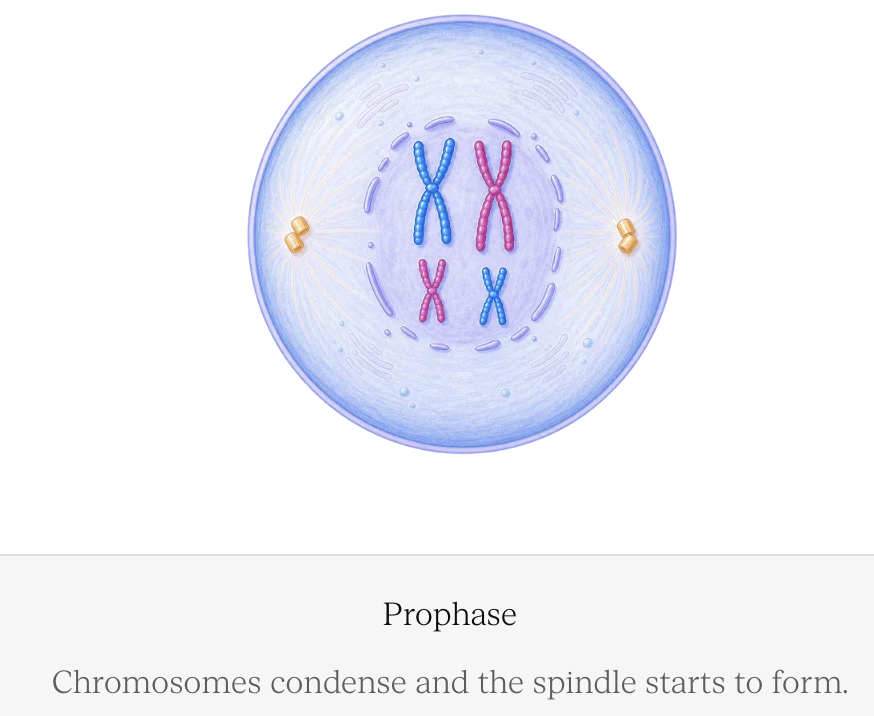
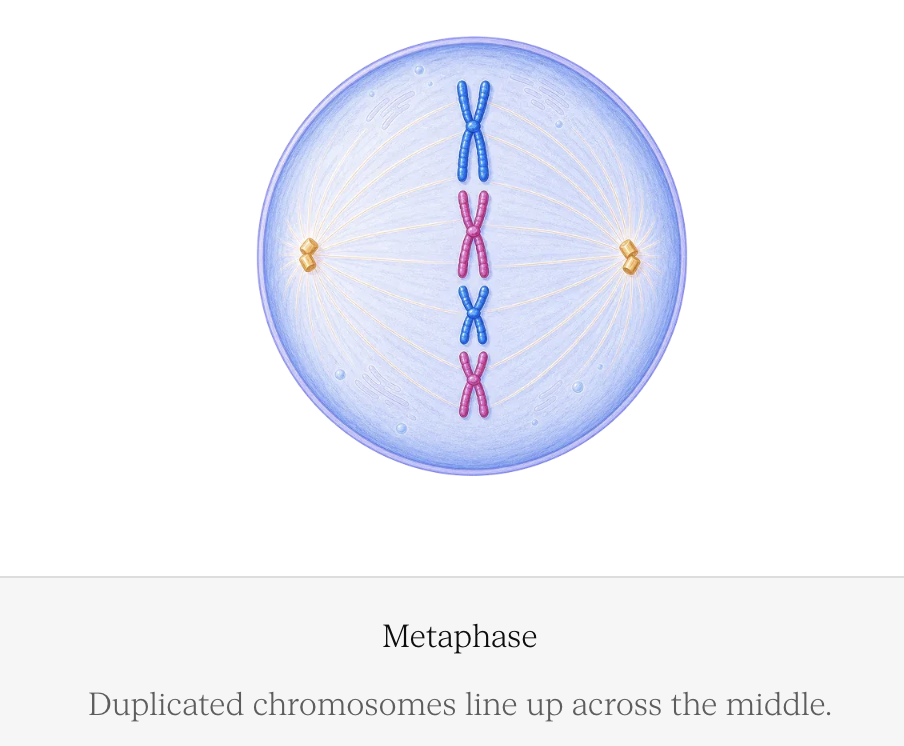
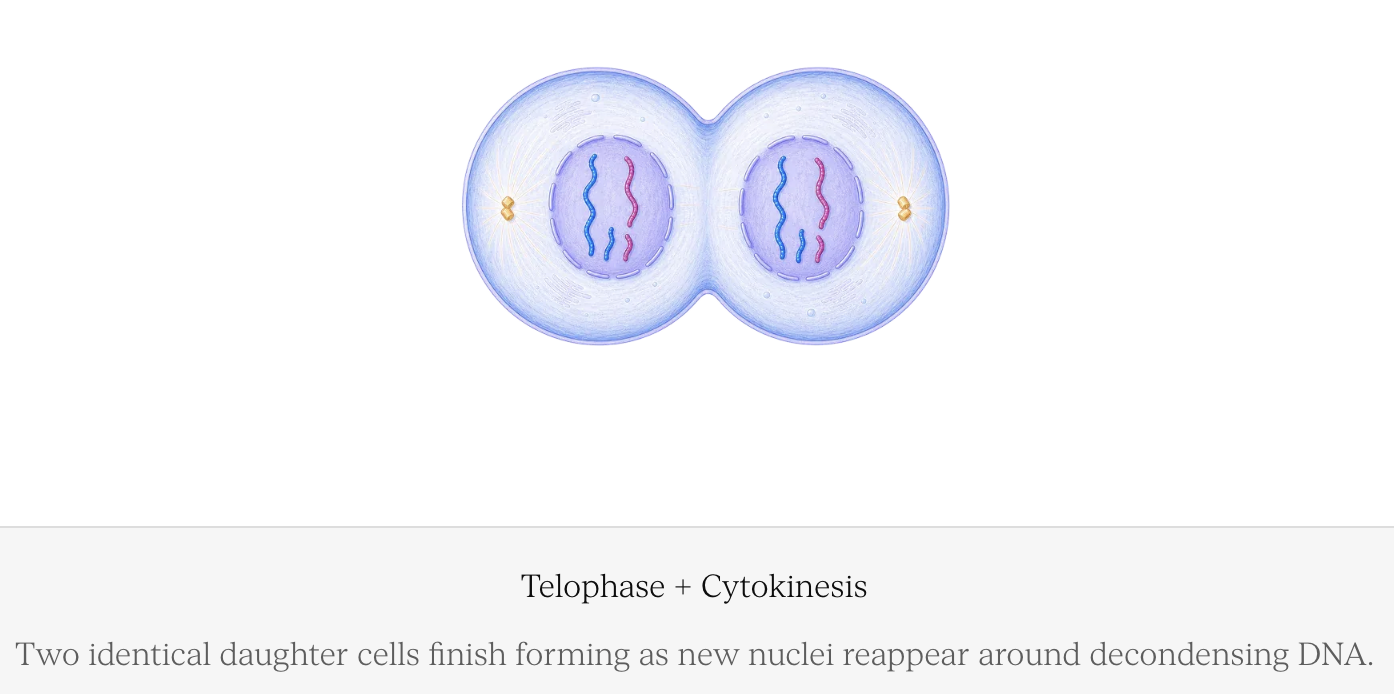
Here is an interactive view of the process:
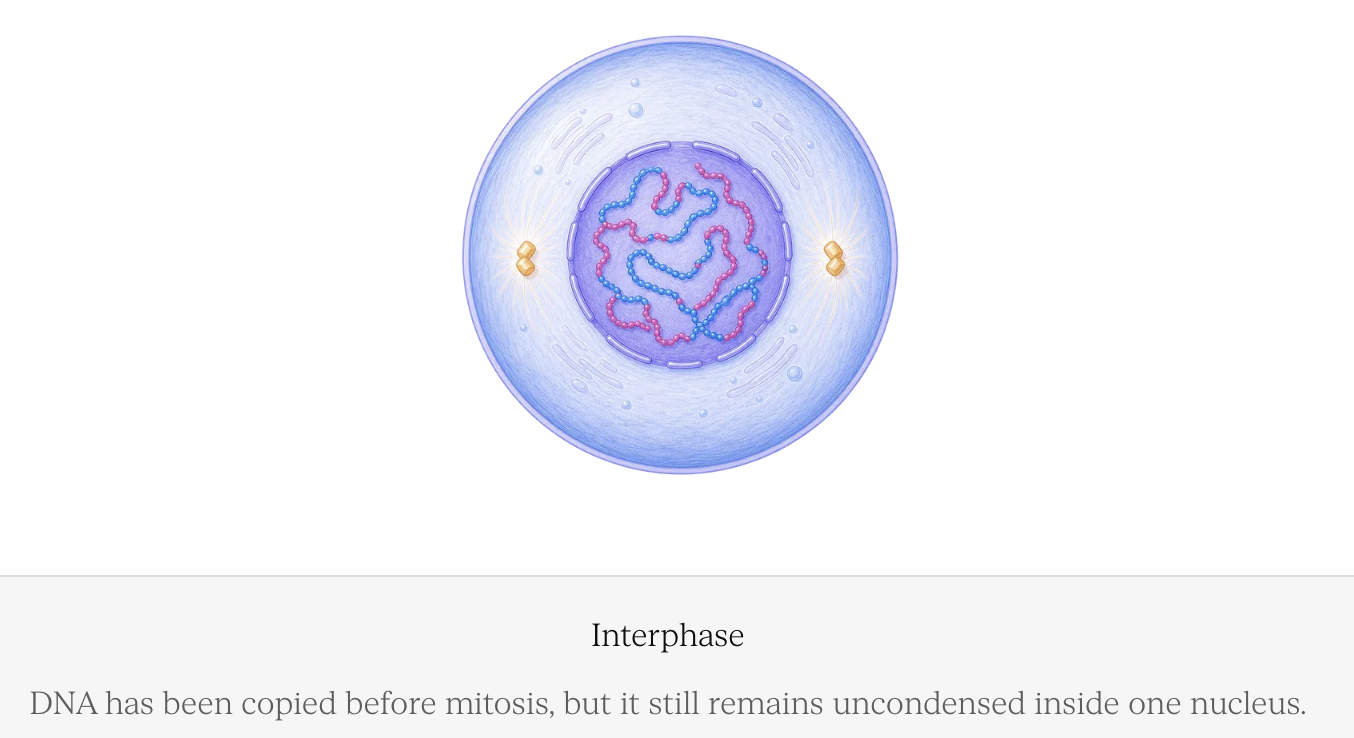
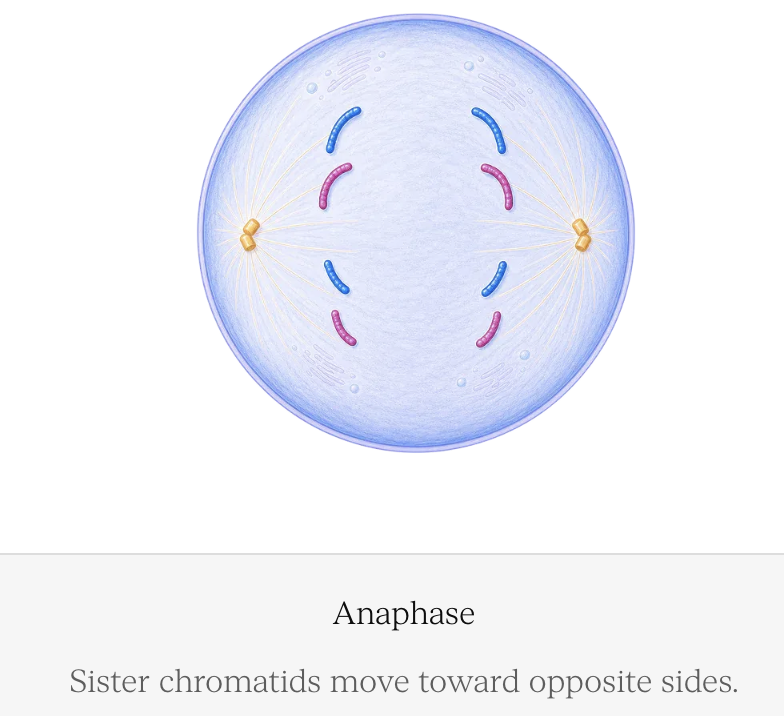
Interphase: Preparation
Interphase is not technically a stage of mitosis, but it is essential preparation for:
cell division.
During interphase:
- the cell grows
- normal cell activities occur
- organelles may be produced
- DNA is replicated
- the cell prepares for division
At the end of DNA replication, each chromosome has been:
copied.
The cell is now prepared to distribute the genetic material between:
two daughter cells.
Prophase
During prophase, the cell begins preparing the chromosomes for:
separation.
Several important changes occur:
- chromosomes condense and become visible
- each chromosome consists of two sister chromatids
- the nucleolus disappears
- the nuclear envelope breaks down
- spindle structures begin to form
The condensed chromosomes can now be moved more easily within the:
cell.


Why Do Chromosomes Condense?
A cell contains extremely long molecules of:
DNA.
If the DNA remained loosely arranged while the cell divided, it would be difficult to move and separate accurately.
Condensing the DNA into chromosomes helps the cell:
organize and move its genetic material.
Think of it like carefully packing long cables before:
moving them.
Metaphase
During metaphase, chromosomes move toward the:
middle of the cell.
They line up along an imaginary central region often called the:
metaphase plate.
Spindle fibres are attached to chromosome structures called:
kinetochores, located at the centromere region.
The arrangement helps ensure that sister chromatids can be separated to:
opposite sides of the cell.


Why Is Metaphase Important?
Imagine chromosomes were separated without first being correctly attached and:
organized.
One daughter cell might receive too many chromosomes while another might receive:
too few.
The metaphase arrangement and cell-cycle checkpoints help ensure chromosomes are properly connected to the spindle before:
separation occurs.
Anaphase
During anaphase, the sister chromatids:
separate.
The connection between the sister chromatids is released.
The separated chromatids are moved toward:
opposite poles of the cell.
Once separated, each chromatid is considered an individual:
chromosome.


Why Is Anaphase So Important?
Anaphase is the stage in which the copied genetic material is physically:
separated.
One complete set moves toward:
one side of the cell.
The other complete set moves toward:
the opposite side.
This is essential for producing two nuclei with the same:
chromosome number.
Telophase
During telophase, the separated chromosomes have reached opposite ends of the:
cell.
Several changes occur:
- chromosomes begin to uncoil
- new nuclear envelopes form
- spindle structures disappear
- nucleoli reappear
- two nuclei are formed
The cell now contains:
two genetically equivalent nuclei.


Cytokinesis
After nuclear division, the cell itself usually divides through:
cytokinesis.
Cytokinesis divides the:
cytoplasm.
The result is:
two daughter cells.
Each daughter cell normally contains:
- one nucleus
- a complete chromosome set
- essentially the same genetic information
- the same chromosome number as the original parent cell
Cytokinesis in Animal Cells
In animal cells, the cell membrane begins to pinch inward.
This forms a:
cleavage furrow.
The membrane continues moving inward until the cytoplasm separates into:
two cells.


Cytokinesis in Plant Cells
Plant cells cannot simply pinch inward because they have a rigid:
cell wall.
Instead, a structure called a:
cell plate
forms between the two new nuclei.
The cell plate develops into new membranes and a new cell wall separating the:
daughter cells.


The Whole Process
The sequence can be summarized as:
Interphase
DNA is copied.
↓
Prophase
Chromosomes condense and the spindle forms.
↓
Metaphase
Chromosomes line up near the middle of the cell.
↓
Anaphase
Sister chromatids separate.
↓
Telophase
Two nuclei form.
↓
Cytokinesis
The cytoplasm divides.
↓
Two daughter cells
Remember PMAT
A useful memory aid for the stages of mitosis is:
P – Prophase
M – Metaphase
A – Anaphase
T – Telophase
One simple mnemonic is:
Please Make Another Two
The important thing is not only remembering the order, but understanding what happens to the:
chromosomes.
Following One Chromosome
Suppose a cell contains a particular chromosome.
Before DNA replication:
one chromosome
After DNA replication:
one duplicated chromosome consisting of two sister chromatids
During metaphase:
the duplicated chromosome lines up
During anaphase:
the sister chromatids separate
After mitosis:
each daughter nucleus receives one copy
This is how genetic information is distributed:
accurately.
Why Are Daughter Cells Genetically Identical?
Before mitosis, DNA is:
replicated.
Each chromosome produces an essentially identical:
copy.
During mitosis, the copies are carefully separated.
One copy goes into:
each daughter nucleus.
Therefore, under normal circumstances:
Parent cell → two genetically identical daughter cells
Are Daughter Cells Always Perfectly Identical?
Mitosis is designed to produce genetically identical:
daughter cells.
However, DNA replication is not absolutely perfect.
Occasionally, changes called:
mutations
can occur.
Therefore, cells produced by mitosis are normally genetically identical, but mutations can introduce:
differences.
Maintaining Chromosome Number
One of the most important features of mitosis is that chromosome number is:
maintained.
If a parent cell contains:
2n chromosomes
each daughter cell also contains:
2n chromosomes.
Mitosis can therefore be represented as:
2n → 2n + 2n
The daughter cells have the same chromosome number as the:
parent cell.
Human Example
Most human body cells contain:
46 chromosomes.
Before mitosis, the DNA is replicated.
The copied chromosomes are then separated.
The result is:
Parent cell: 46 chromosomes
↓
Mitosis
↓
Daughter cell 1: 46 chromosomes
Daughter cell 2: 46 chromosomes
The chromosome number remains:
46.
A Common Chromosome-Counting Problem
After DNA replication, a human cell still has:
46 chromosomes,
but each chromosome consists of two sister chromatids.
Therefore, it contains:
46 duplicated chromosomes
and:
92 chromatids.
After the chromatids separate and cell division is complete, each daughter cell contains:
46 chromosomes.
This distinction between chromosomes and chromatids is:
important.
Why Must Chromosome Number Be Maintained?
Body cells need a complete set of genetic instructions to function:
properly.
If chromosome number changed every time a cell divided, tissues would quickly contain cells with incorrect amounts of:
genetic information.
Mitosis ensures that new body cells normally receive the same chromosome number as:
existing body cells.
Mitosis and Growth
Growth in multicellular organisms occurs largely by increasing the:
number of cells.
A baby grows into an adult because cells repeatedly undergo:
mitosis.
The body does not simply make each original cell enormously larger.
Instead, it produces:
more cells.


Mitosis and Development
After fertilization, the zygote begins dividing through:
mitosis.
Repeated mitosis produces increasing numbers of:
cells.
These cells eventually become specialized through a process called:
differentiation.
Different cell types then form:
- tissues
- organs
- organ systems
Mitosis therefore plays a central role in:
development.
Mitosis and Repair
Body tissues can become damaged by:
- cuts
- burns
- physical injury
- normal wear
- environmental damage
Damaged or lost cells may need to be:
replaced.
Nearby cells can divide by mitosis to produce:
new cells.
This contributes to tissue:
repair and healing.


Example: Healing a Cut
Suppose you cut your skin.
Some cells near the wound are:
damaged or destroyed.
Cells surrounding the wound divide by:
mitosis.
The new cells help replace those that were:
lost.
Over time, the tissue closes and:
repairs itself.
Mitosis and Cell Replacement
Even when you are not injured, cells are constantly being:
lost and replaced.
For example, cells in the lining of the digestive system experience significant:
wear.
Skin cells are also continually:
shed.
Mitosis produces replacement cells that help maintain:
healthy tissues.
Different Cells Divide at Different Rates
Not every cell in the body divides at the:
same rate.
Some cells divide frequently.
Others divide rarely.
The rate depends on the tissue and its:
function.
For example, tissues exposed to frequent wear often require more regular:
cell replacement.
Mitosis and Asexual Reproduction
Mitosis can also contribute to:
asexual reproduction.
In many single-celled eukaryotes, cell division can produce a new:
organism.
Plants can also use mitosis during:
vegetative propagation.
For example, new strawberry plants growing from runners require repeated:
mitotic cell divisions.
Mitosis and Clones
Because mitosis produces genetically similar cells, asexual reproduction based on mitosis can produce:
clones.
A clone has essentially the same genetic information as the organism from which it:
originated.
This explains why vegetative propagation can preserve desirable plant:
characteristics.
Mitosis vs Meiosis
Mitosis and meiosis are both forms of:
cell division.
However, they serve very different purposes.
| Feature | Mitosis | Meiosis |
|---|---|---|
| Main purpose | Growth and repair | Gamete production |
| Number of divisions | One | Two |
| Daughter cells | Two | Usually four |
| Chromosome number | Maintained | Halved |
| Genetic similarity | Usually identical | Genetically varied |
| Human example | 46 → 46 | 46 → 23 |
Mitosis maintains chromosome number.
Meiosis:
reduces chromosome number.
Why Mitosis and Meiosis Must Be Different
Body cells need the normal:
diploid chromosome number.
Therefore, mitosis maintains:
2n → 2n.
Gametes need half the normal chromosome number so that fertilization does not double chromosome number every:
generation.
Therefore, meiosis produces:
2n → n.
The two processes have different biological:
purposes.
Cell-Cycle Control
Cells do not normally divide whenever they:
want.
The cell cycle contains regulatory systems called:
checkpoints.
These help determine whether the cell is ready to proceed through:
division.
For example, cells can check whether DNA has been correctly replicated and whether chromosomes are properly attached to the spindle.
This regulation helps maintain:
genetic stability.
What Happens When Cell Division Is Not Controlled?
If mutations affect genes that regulate the cell cycle, cells may begin dividing:
uncontrollably.
A mass of abnormal cells may form a:
tumour.
Some tumours remain localized, while others may become:
cancerous.
Cancer therefore involves problems with the normal control of:
cell division.


Mitosis Under a Microscope
Scientists can observe mitosis particularly clearly in tissues where cells divide:
rapidly.
A common example is an:
onion root tip.
Root tips contain regions of actively dividing cells because roots are:
growing.
Different cells in a microscope image may therefore show different stages of:
mitosis.


Identifying Mitosis from Images
When looking at microscope images, focus on the position and appearance of the:
chromosomes.
Prophase: chromosomes become condensed and visible.
Metaphase: chromosomes are lined up near the centre.
Anaphase: chromatids are separating toward opposite sides.
Telophase: two groups of chromosomes are at opposite ends and new nuclei are forming.
Recognizing these patterns is more useful than simply memorizing:
stage names.
Worked Example: Identifying a Stage
A cell has chromosomes arranged across the middle of the cell.
Which stage is it?
Chromosomes align near the centre during:
metaphase.
Therefore, the cell is in:
metaphase.
Worked Example: Identifying Anaphase
A microscope image shows two groups of chromosomes moving away from one another toward opposite ends of the cell.
This indicates:
anaphase.
The key evidence is that the:
sister chromatids have separated.
Worked Example: Chromosome Number
A species has:
18 chromosomes
in each body cell.
A body cell divides through mitosis.
How many chromosomes will each daughter cell contain?
Mitosis maintains chromosome number.
Therefore:
Parent cell = 18 chromosomes
Daughter cell 1 = 18 chromosomes
Daughter cell 2 = 18 chromosomes
Worked Example: Growth
A single cell divides through mitosis.
After one division:
2 cells
After two rounds:
4 cells
After three rounds:
8 cells
After four rounds:
16 cells
If every cell continues dividing, cell number can increase:
rapidly.
This demonstrates how repeated mitosis contributes to:
growth.
Mitosis in Everyday Life
Mitosis is occurring throughout your body as you:
live and grow.
It contributes to:
- growth during childhood
- replacement of skin cells
- renewal of some blood-forming cells
- maintenance of the digestive lining
- healing of wounds
- growth of hair-producing tissues
Without mitosis, multicellular organisms could not effectively:
grow, maintain, or repair their bodies.
Common Mistake: Mitosis Produces Four Cells
Mitosis normally produces:
two daughter cells.
Meiosis typically produces:
four haploid cells.
Remember:
Mitosis → 2
Meiosis → usually 4
Common Mistake: Mitosis Halves Chromosome Number
Mitosis does:
not halve chromosome number.
If the parent cell contains:
2n
the daughter cells normally contain:
2n.
Meiosis is the process that reduces chromosome number from:
2n to n.
Common Mistake: DNA Is Copied During Mitosis
DNA replication occurs:
before mitosis,
during the S phase of:
interphase.
Mitosis then separates the copied chromosomes between:
two nuclei.
Common Mistake: Interphase Is a Stage of Mitosis
Interphase is part of the:
cell cycle.
It occurs before mitosis.
The major stages of mitosis itself are:
prophase, metaphase, anaphase, and telophase.
Common Mistake: Cytokinesis and Mitosis Are Exactly the Same
Mitosis refers specifically to division of the:
nucleus.
Cytokinesis refers to division of the:
cytoplasm and cell.
The two processes usually occur closely together, but they are:
not identical.
Check Your Understanding
1. Define mitosis.
2. State four important purposes of mitosis.
3. Name the four major stages of mitosis in order.
4. What happens during interphase before mitosis?
5. When is DNA replicated?
6. What are sister chromatids?
7. What connects sister chromatids?
8. Describe what happens during prophase.
9. Why do chromosomes condense during prophase?
10. Describe what happens during metaphase.
11. Why is chromosome alignment important?
12. Describe what happens during anaphase.
13. What happens to sister chromatids during anaphase?
14. Describe what happens during telophase.
15. What is cytokinesis?
16. How does cytokinesis differ between animal and plant cells?
17. Explain why daughter cells produced by mitosis are normally genetically identical.
18. Explain why DNA must be replicated before mitosis.
19. A human body cell contains 46 chromosomes. How many chromosomes will each daughter cell normally contain?
20. A plant cell contains 24 chromosomes. How many chromosomes will each daughter cell contain after mitosis?
21. Explain how mitosis contributes to growth.
22. Explain how mitosis contributes to tissue repair.
23. Give two examples of tissues that require regular cell replacement.
24. Explain how mitosis can contribute to asexual reproduction.
25. Why is maintaining chromosome number important?
26. Compare chromosome number in mitosis and meiosis.
27. Explain the difference between mitosis and cytokinesis.
28. Why are onion root tips useful for observing mitosis?
29. What can happen when control of cell division is disrupted?
30. Explain why mitosis is essential for multicellular organisms.
Key Terms
- Mitosis: Nuclear division producing two genetically equivalent nuclei with the same chromosome number as the original nucleus.
- Cell cycle: Sequence of growth, DNA replication and cell division experienced by a cell.
- Interphase: Period when a cell grows, performs normal functions and replicates its DNA before division.
- DNA replication: Process of copying DNA.
- Chromosome: DNA-containing structure carrying genetic information.
- Chromatin: Less-condensed form of DNA and associated proteins in the nucleus.
- Sister chromatids: Essentially identical copies of a chromosome produced during DNA replication.
- Centromere: Chromosomal region joining sister chromatids and associated with kinetochore formation.
- Spindle: Cellular structure involved in moving chromosomes during cell division.
- Prophase: Stage when chromosomes condense and the mitotic spindle begins forming.
- Metaphase: Stage when chromosomes align near the middle of the cell.
- Anaphase: Stage when sister chromatids separate and move toward opposite poles.
- Telophase: Stage when new nuclei form around the separated chromosome sets.
- Cytokinesis: Division of the cytoplasm into daughter cells.
- Cleavage furrow: Indentation that forms as an animal cell undergoes cytokinesis.
- Cell plate: Structure that develops between daughter cells during plant cytokinesis.
- Daughter cell: Cell produced by cell division.
- Diploid: Having two sets of chromosomes.
- Mutation: Change in DNA sequence.
- Differentiation: Process through which cells become specialized.
- Cell-cycle checkpoint: Regulatory mechanism controlling progression through the cell cycle.
- Tumour: Abnormal mass of cells resulting from excessive cell division.
Key Takeaways
- Mitosis produces two genetically equivalent daughter nuclei.
- Mitosis is important for growth, repair, replacement, and some forms of asexual reproduction.
- DNA is replicated before mitosis during interphase.
- A replicated chromosome contains two sister chromatids.
- The major stages of mitosis are prophase, metaphase, anaphase, and telophase.
- PMAT is a useful way to remember their order.
- During prophase, chromosomes condense and the spindle develops.
- During metaphase, chromosomes align near the middle of the cell.
- During anaphase, sister chromatids separate.
- During telophase, new nuclei form.
- Cytokinesis divides the cytoplasm and usually produces two separate cells.
- Animal cells form a cleavage furrow during cytokinesis.
- Plant cells form a cell plate.
- Mitosis maintains the chromosome number.
- A diploid parent cell normally produces diploid daughter cells.
- A human body cell with 46 chromosomes normally produces daughter cells that each have 46 chromosomes.
- Daughter cells are normally genetically identical because DNA is copied and the copies are carefully separated.
- Mutations can occasionally introduce genetic differences.
- Repeated mitosis increases cell number and allows organisms to grow.
- Mitosis replaces damaged and worn-out cells.
- Mitosis contributes to wound healing and tissue maintenance.
- Mitosis can support asexual reproduction and the production of clones.
- Mitosis and meiosis are different: mitosis maintains chromosome number, while meiosis halves it.
- Interphase is part of the cell cycle but is not a stage of mitosis.
- Mitosis divides the nucleus; cytokinesis divides the cytoplasm.
- Proper control of mitosis is essential because uncontrolled cell division can contribute to tumour formation and cancer.
- Accurate chromosome separation allows new cells to receive a complete set of genetic instructions.
4. Meiosis
Learning outcomes
-
I can describe the purpose of meiosis.
- I can explain how meiosis produces gametes.
- I can compare chromosome numbers before and after meiosis.
- I can explain how meiosis contributes to genetic variation.
- I can describe the importance of meiosis in sexual reproduction.


What Is Meiosis?
Meiosis is a specialized type of cell division used to produce cells for:
sexual reproduction.
In animals, meiosis produces reproductive cells called:
gametes.
Examples of gametes include:
sperm cells
and:
egg cells.
The most important result of meiosis is that it reduces the chromosome number by:
half.
A diploid cell containing two sets of chromosomes produces haploid cells containing:
one set of chromosomes.
The Main Purpose of Meiosis
Meiosis has two major purposes:
1. Reduce chromosome number
Gametes must contain half the chromosome number of ordinary body cells.
2. Produce genetic variation
The gametes produced by meiosis are genetically different from one another.
Both are essential to:
sexual reproduction.
The Basic Pattern
Meiosis begins with:
one diploid cell.
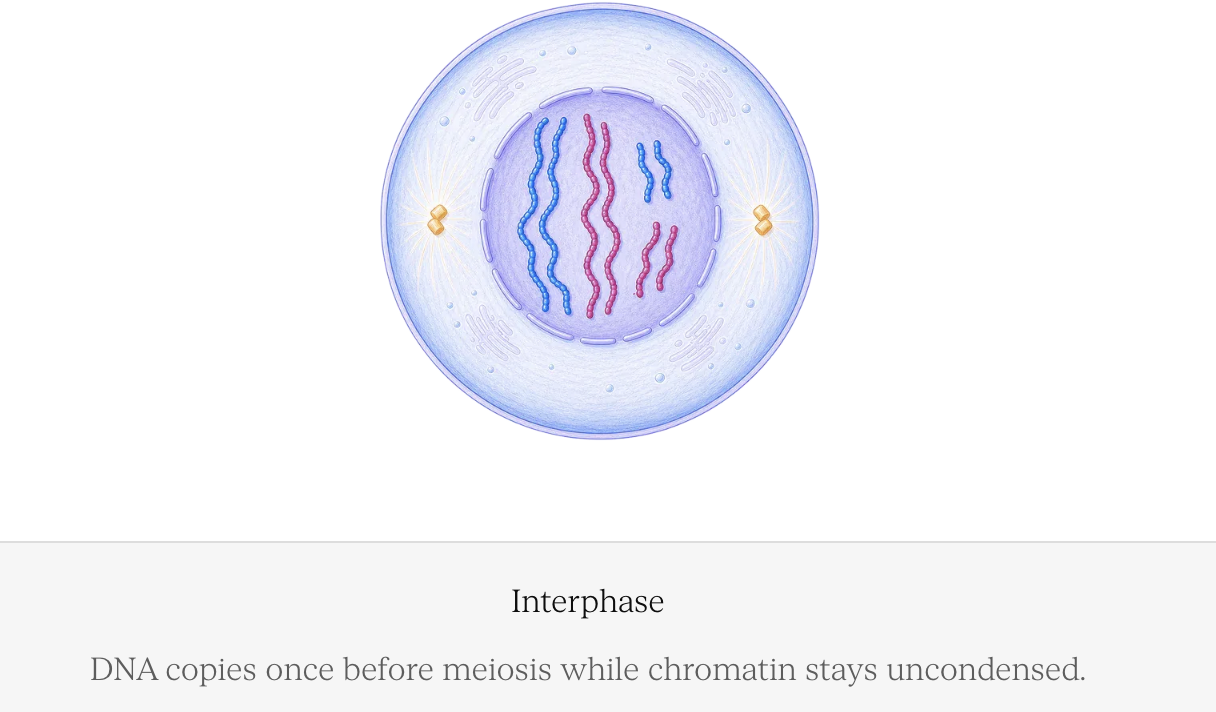
DNA is copied once.
The cell then undergoes:
two divisions.
These are called:
Meiosis I
and:
Meiosis II.
The typical result is:
One diploid cell → four haploid cells
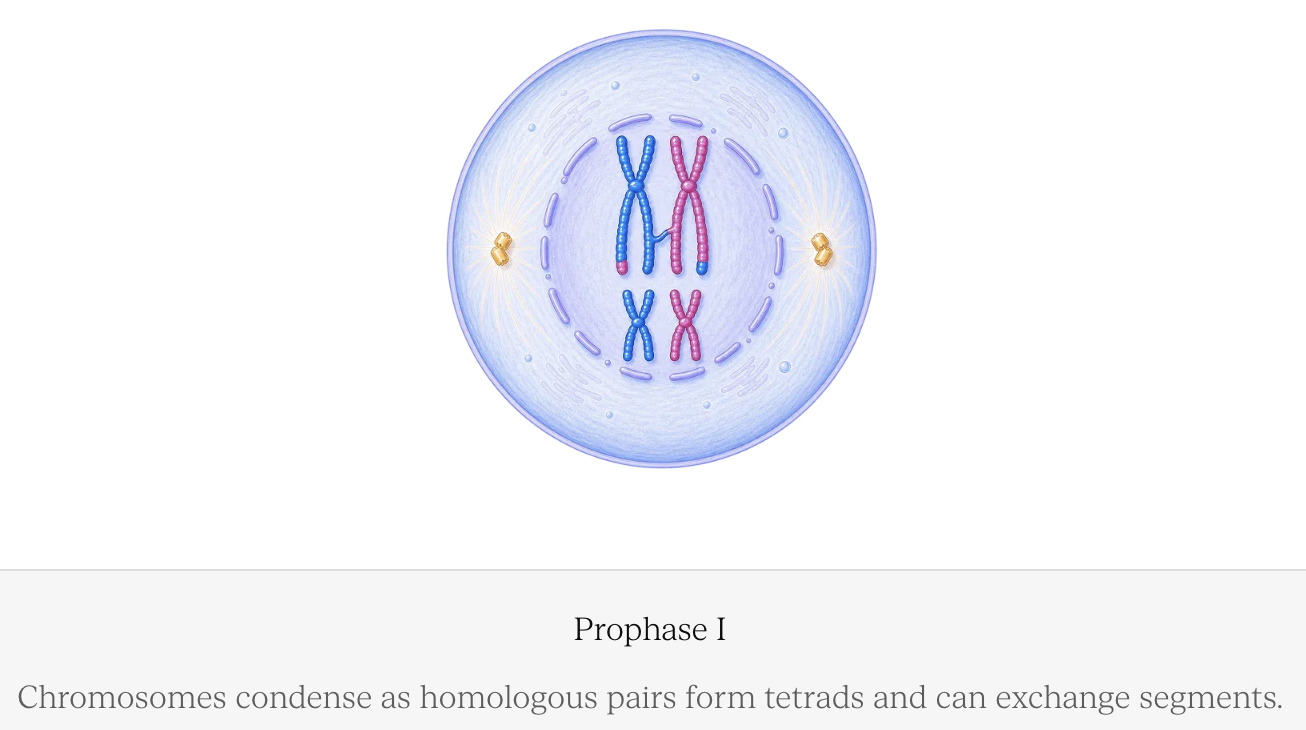
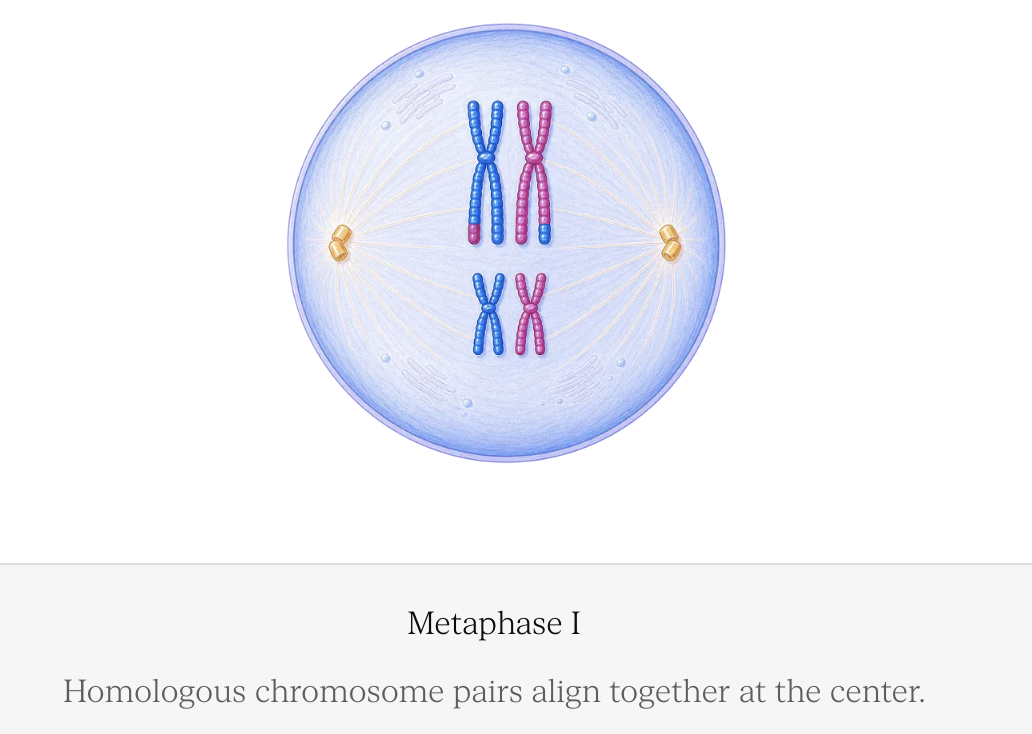
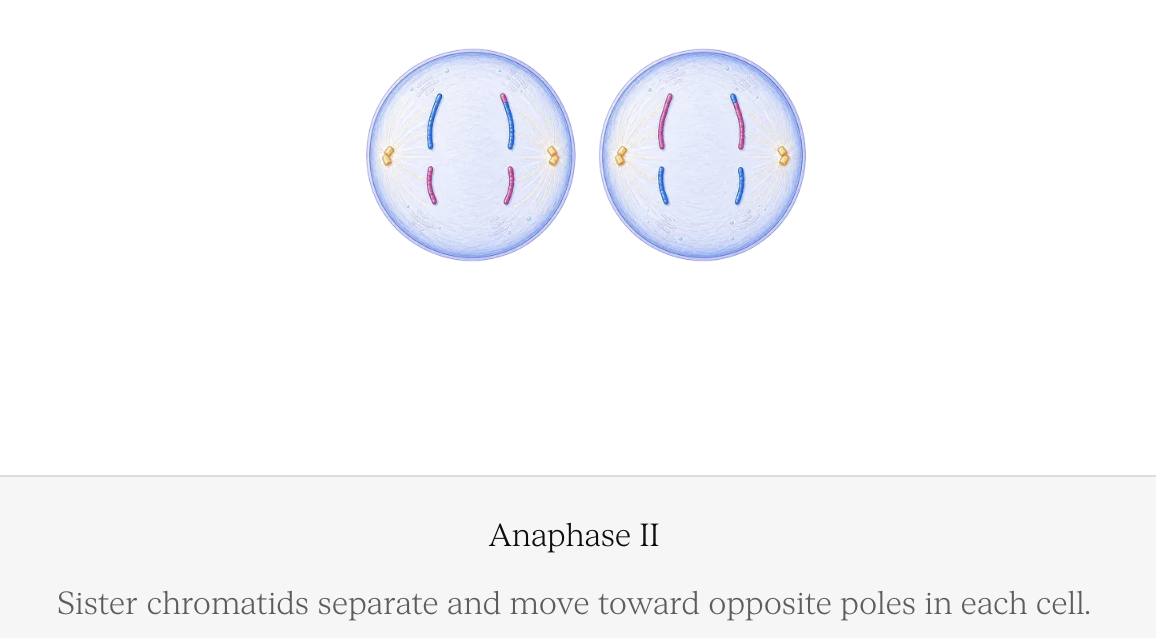
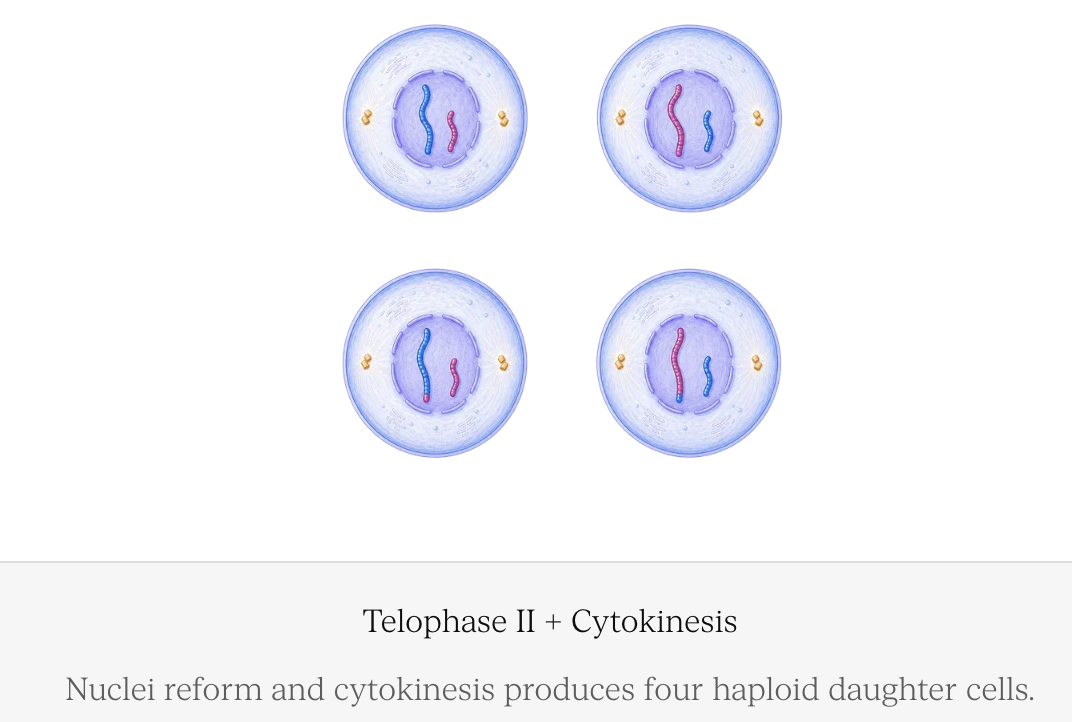
Here is an interactive visualization of the complete process:
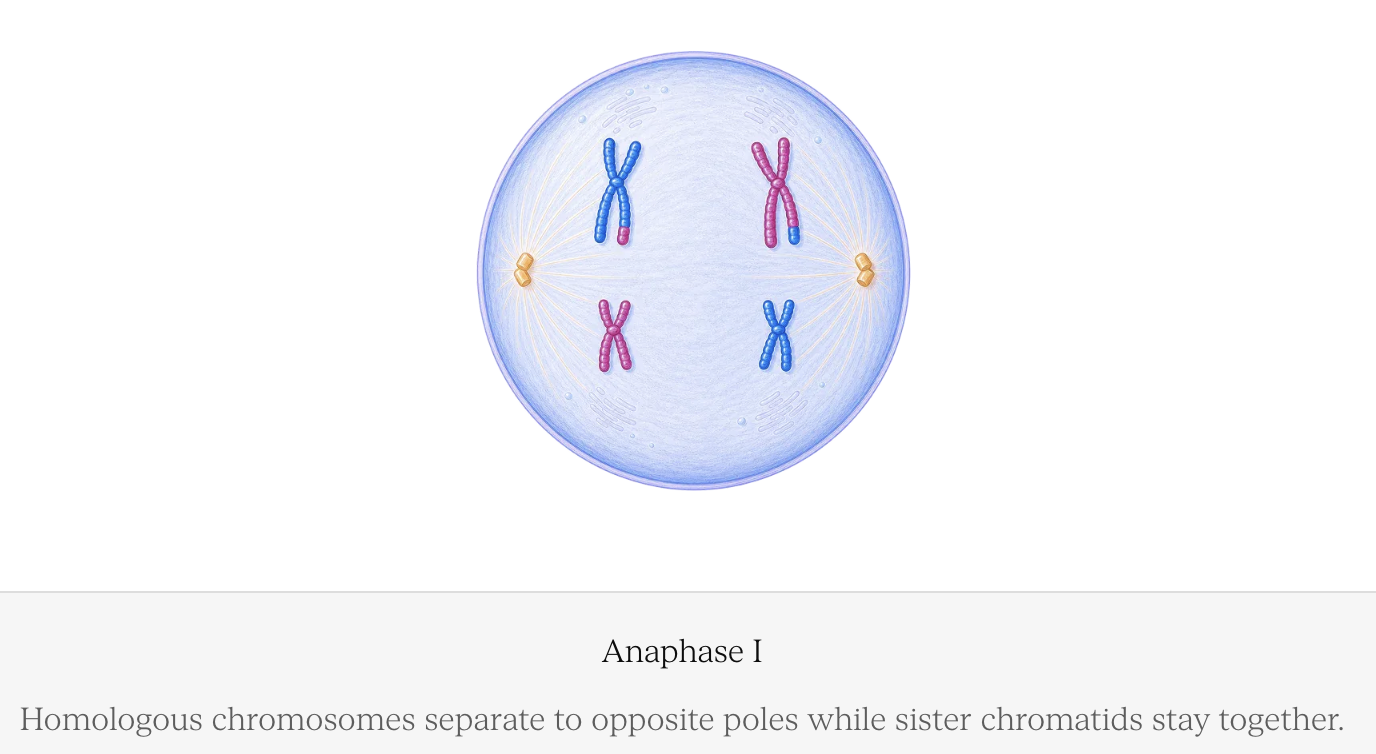
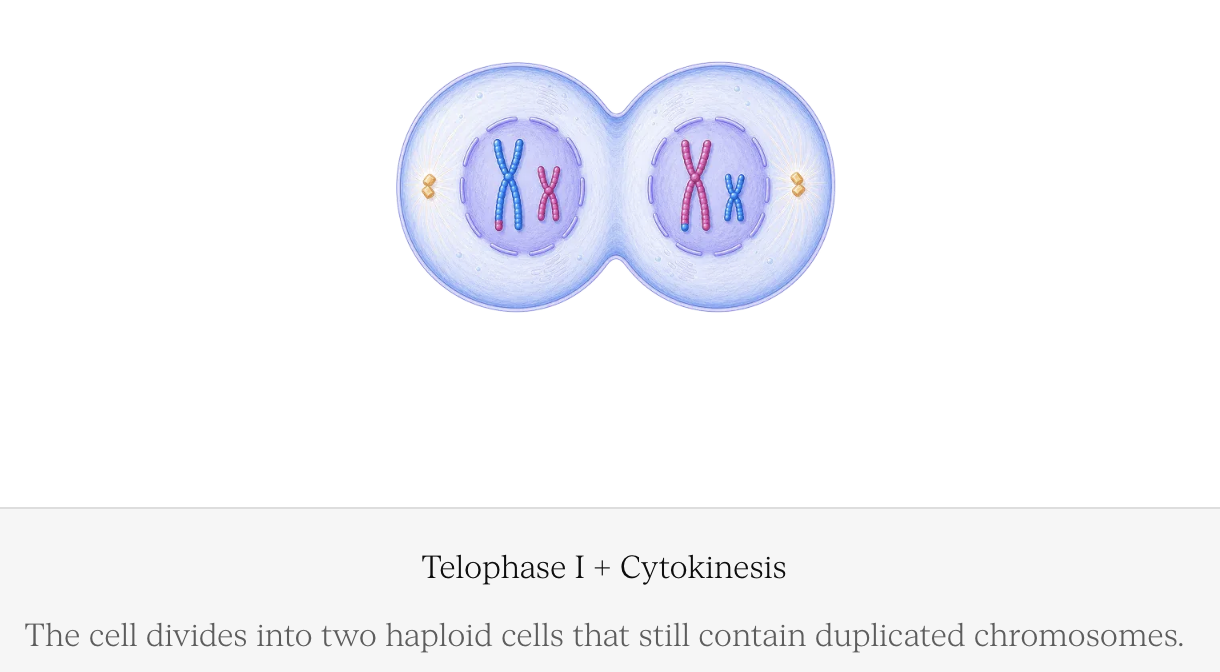
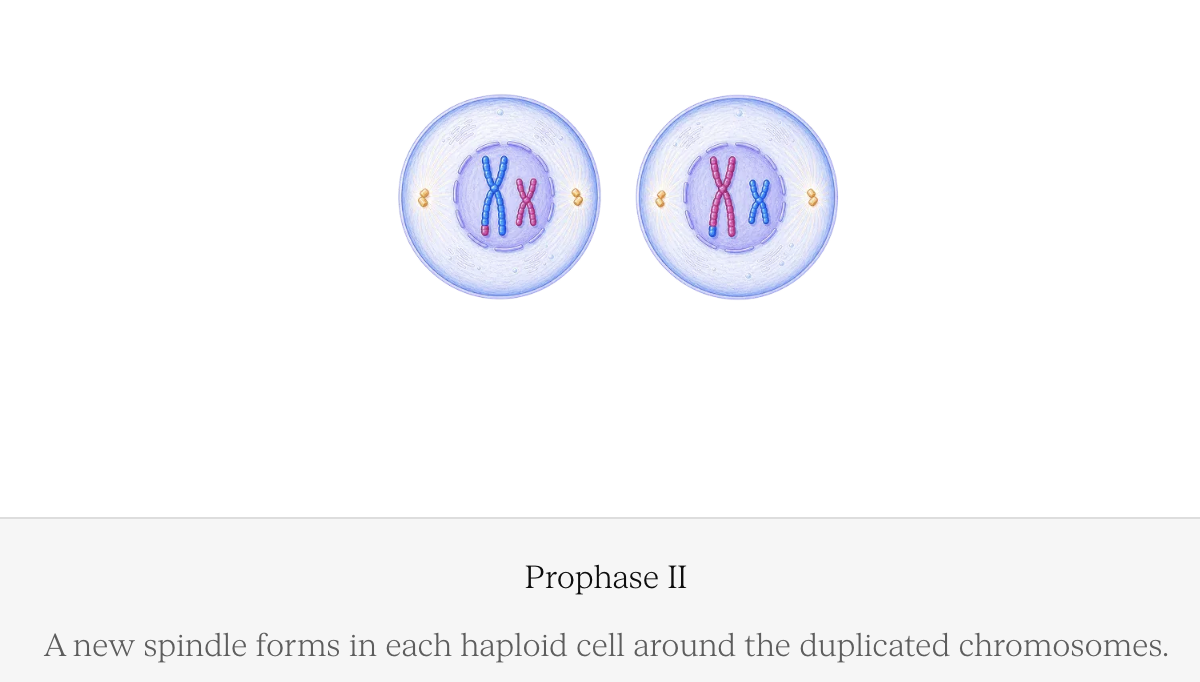
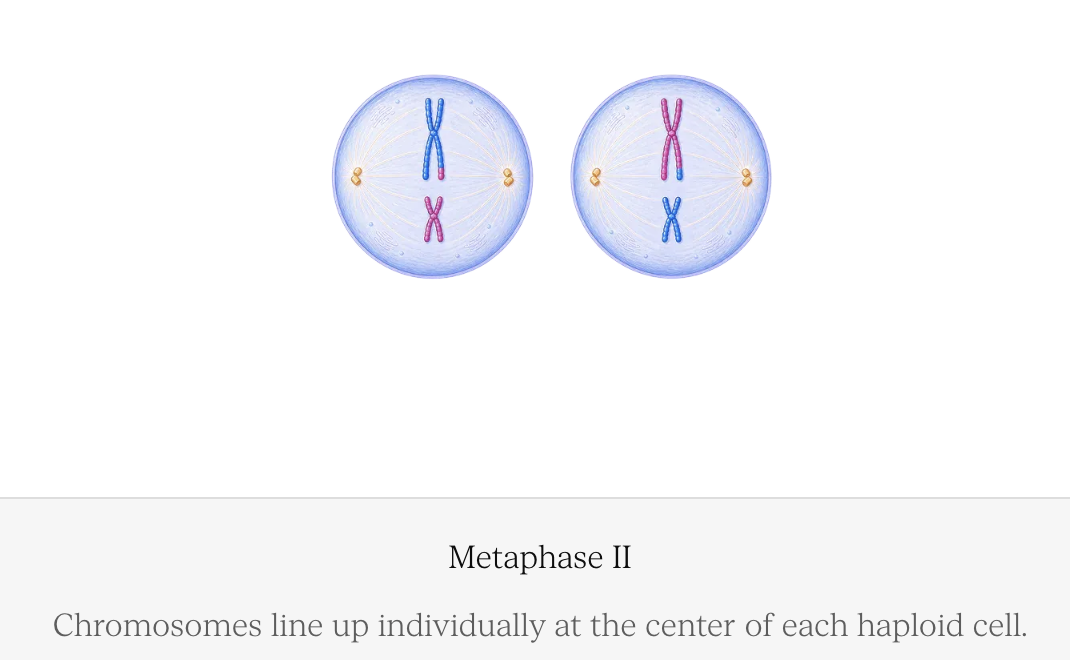
Diploid and Haploid Cells
To understand meiosis, we need to understand:
diploid and haploid.
A diploid cell contains two sets of chromosomes.
We represent this as:
2n.
A haploid cell contains one set of chromosomes.
We represent this as:
n.
Therefore, meiosis changes:
2n → n
The chromosome number is:
halved.
Human Chromosome Numbers
Most human body cells contain:
46 chromosomes.
These chromosomes are arranged in:
23 pairs.
Therefore, human body cells are:
diploid.
We can write:
2n = 46
Human gametes contain:
23 chromosomes.
Therefore:
n = 23.
Before and After Meiosis
For humans:
Starting cell: 46 chromosomes
↓
Meiosis
↓
Gametes: 23 chromosomes each
The chromosome number has been reduced from:
46 to 23.
This reduction is essential for:
sexual reproduction.
Why Must Chromosome Number Be Halved?
During fertilization:
one sperm cell joins with one egg cell.
Each human gamete contains:
23 chromosomes.
Therefore:
23 + 23 = 46
The normal diploid chromosome number is:
restored.
What If Meiosis Did Not Halve Chromosome Number?
Imagine that sperm and egg cells each contained:
46 chromosomes.
During fertilization:
46 + 46 = 92
The offspring would have:
92 chromosomes.
If this continued, chromosome number would double with every:
generation.
Meiosis prevents this by producing:
haploid gametes.
Chromosome Pairs
Diploid cells contain chromosomes in:
homologous pairs.
A homologous pair contains chromosomes with the same types of genes at corresponding:
locations.
In humans, one chromosome of each homologous pair was originally inherited from the biological:
mother.
The other was inherited from the biological:
father.
The chromosomes are similar but are not necessarily genetically:
identical.
Homologous Chromosomes
Homologous chromosomes carry genes for the same general:
characteristics.
However, they may carry different versions of those genes.
Different versions of a gene are called:
alleles.
For example, one homologous chromosome might carry one allele while its partner carries:
another allele.
This becomes important when meiosis creates:
genetic variation.


DNA Is Replicated Before Meiosis
Before meiosis begins, the cell goes through:
interphase.
During the S phase of interphase, DNA is:
replicated.
Each chromosome is copied.
The duplicated chromosome consists of two:
sister chromatids.
The sister chromatids are joined at the:
centromere.
An Important Rule
DNA is replicated:
once.
The cell then divides:
twice.
This is a key feature of meiosis.
We can summarize it as:
One DNA replication → two cell divisions
The two divisions are:
Meiosis I and Meiosis II.
Meiosis I
The first division is called:
Meiosis I.
Its major purpose is to separate:
homologous chromosomes.
This is the division in which chromosome number is:
reduced.
A diploid cell becomes cells that have one chromosome from each homologous:
pair.
For this reason, Meiosis I is sometimes called the:
reduction division.
Prophase I
During Prophase I, chromosomes condense and homologous chromosomes pair:
together.
This pairing is an important difference between meiosis and:
mitosis.
Homologous chromosomes can exchange sections of DNA in a process called:
crossing over.
Crossing over creates new combinations of:
alleles.


Crossing Over
During crossing over, homologous chromosomes lie close together.
Sections of DNA can be exchanged between:
non-sister chromatids.
After the exchange, chromosomes contain combinations of genetic information that differ from those originally inherited from either:
parent.
This process is also called:
genetic recombination.
Why Crossing Over Matters
Imagine two homologous chromosomes carrying different:
alleles.
Before crossing over, each chromosome has its original combination of:
alleles.
After crossing over, sections have been exchanged.
This produces:
new combinations of alleles.
As a result, the gametes produced later can be genetically different from:
one another.
Metaphase I
During Metaphase I, homologous chromosome pairs line up near the:
middle of the cell.
The orientation of each pair is:
random.
For example, the chromosome originally inherited from the mother could face either:
side of the cell.
The same is true for the chromosome originally inherited from the father.
This random arrangement contributes to:
genetic variation.


Independent Assortment
The random orientation and separation of homologous chromosome pairs produces different combinations of chromosomes in:
gametes.
This is called:
independent assortment.
For humans, independent assortment alone can produce more than:
8 million possible chromosome combinations.
That is before considering:
crossing over.
Anaphase I
During Anaphase I, homologous chromosomes are pulled toward:
opposite poles of the cell.
Importantly:
sister chromatids remain together.
This is very different from mitosis.
In mitosis, sister chromatids separate during:
anaphase.
In Meiosis I, it is the:
homologous chromosomes
that separate.
Telophase I and Cytokinesis
By the end of Meiosis I, the homologous chromosomes have been:
separated.
The cell usually divides through:
cytokinesis.
The result is:
two haploid cells.
However, each chromosome still consists of:
two sister chromatids.
Therefore, another division is required.
After Meiosis I
We now have:
two cells.
Each cell contains:
one chromosome from each homologous pair.
The cells are therefore:
haploid.
But the chromosomes are still:
duplicated.
This leads to:
Meiosis II.
Meiosis II
Meiosis II resembles:
mitosis.
Its main purpose is to separate:
sister chromatids.
Importantly, there is no second round of DNA replication between:
Meiosis I and Meiosis II.
The DNA has already been copied.
Prophase II
During Prophase II:
- chromosomes condense if necessary
- spindle structures form
- nuclear envelopes, if present, break down
Each cell contains a:
haploid chromosome set.
Each chromosome still consists of:
two sister chromatids.
Metaphase II
During Metaphase II, chromosomes line up individually near the:
middle of each cell.
Unlike Metaphase I, homologous pairs are no longer lined up:
together.
The chromosomes are positioned so that sister chromatids can be separated during:
Anaphase II.


Anaphase II
During Anaphase II, sister chromatids:
separate.
They move toward opposite ends of:
each cell.
Once separated, each chromatid is considered an individual:
chromosome.
This is similar to what happens during:
anaphase of mitosis.
Telophase II and Cytokinesis
During Telophase II, chromosomes reach opposite ends of the cells.
New nuclei may form.
Cytokinesis then divides the:
cells.
The typical result is:
four haploid cells.
These cells are genetically:
different from one another.
The Complete Sequence
The overall process can be summarized as:
Diploid parent cell
↓
DNA replication
↓
Meiosis I
Homologous chromosomes separate
↓
Two haploid cells
↓
Meiosis II
Sister chromatids separate
↓
Four haploid cells
What Happens to Chromosome Number?
Suppose a species has:
2n = 8.
The starting cell contains:
8 chromosomes.
After meiosis, each resulting cell contains:
4 chromosomes.
Therefore:
2n = 8 → n = 4
The chromosome number has been:
halved.
Another Example
Suppose a species has:
30 chromosomes
in its body cells.
Its gametes should contain:
15 chromosomes.
Why?
Because:
30 ÷ 2 = 15
At fertilization:
15 + 15 = 30
The diploid chromosome number is:
restored.
Meiosis Produces Gametes
In animals, meiosis is used to produce:
gametes.
Male gametes are:
sperm cells.
Female gametes are:
egg cells.
These cells contain half the chromosome number of ordinary:
body cells.
Sperm Production
In males, meiosis occurs during:
sperm production.
A diploid germ cell eventually undergoes meiosis to produce haploid:
cells.
These cells develop into:
sperm.
Each sperm contains one set of:
chromosomes.
Egg Production
In females, meiosis contributes to the production of:
egg cells.
The process is somewhat different from sperm production.
Cell division is unequal, so typically only one large functional egg is produced from a meiotic sequence, while smaller cells called:
polar bodies
are also formed.
The functional egg is:
haploid.
Meiosis in Plants
Plants also use meiosis as part of:
sexual reproduction.
However, plant life cycles are somewhat more complex.
In flowering plants, meiosis produces haploid:
spores,
which then divide and develop into structures that ultimately produce the:
gametes.
Therefore, it is more accurate to say that meiosis produces gametes directly in animals but contributes to gamete production in plants.


How Meiosis Creates Genetic Variation
Meiosis does more than simply reduce chromosome number.
It also produces:
genetically different cells.
Two major processes are especially important:
crossing over
and:
independent assortment.
Together, they create many possible genetic combinations.
Source of Variation 1: Crossing Over
During Prophase I, homologous chromosomes can exchange:
DNA segments.
This creates chromosomes with new combinations of:
alleles.
Therefore, chromosomes passed into gametes may differ from the chromosomes originally inherited by the:
parent.
Source of Variation 2: Independent Assortment
During Metaphase I, homologous chromosome pairs arrange themselves:
randomly.
When the chromosomes separate, each cell receives a different combination of:
maternal and paternal chromosomes.
This produces additional:
genetic variation.
Meiosis Plus Random Fertilization
Meiosis produces many genetically different:
gametes.
Sexual reproduction creates even more variation because fertilization is also:
random.
Any one sperm may potentially combine with any one:
egg.
Therefore:
Meiosis creates varied gametes
and:
random fertilization combines them in new ways.
Why Genetic Variation Matters
Genetic variation means that individuals in a population have different combinations of:
alleles.
This variation is important because environments can:
change.
Individuals may differ in their ability to survive challenges such as:
- disease
- drought
- temperature change
- predators
- competition
- changing food supplies
Genetic variation provides the raw material upon which:
natural selection can act.
Meiosis and Sexual Reproduction
Meiosis and fertilization work together.
Meiosis:
halves chromosome number.
Fertilization:
restores chromosome number.
We can represent the cycle as:
Diploid adult (2n)
↓
Meiosis
↓
Haploid gametes
↓
Fertilization
↓
Diploid zygote (2n)
↓
Mitosis and development
↓
Diploid adult (2n)
This cycle keeps chromosome number stable from:
generation to generation.
Why Meiosis Is Essential
Without meiosis, sexual reproduction would create a major chromosome-number:
problem.
Gametes would contain the full diploid chromosome number.
Fertilization would then double chromosome number every:
generation.
Meiosis solves this problem by reducing chromosome number:
before fertilization.
Meiosis vs Mitosis
Mitosis and meiosis are both forms of cell division, but their purposes and outcomes are very:
different.
| Feature | Mitosis | Meiosis |
|---|---|---|
| Main purpose | Growth and repair | Sexual reproduction |
| DNA replication | Once | Once |
| Number of divisions | One | Two |
| Typical cells produced | Two | Four |
| Chromosome number | Maintained | Halved |
| Genetic similarity | Usually identical | Genetically different |
| Homologous pairing | No | Yes, in Prophase I |
| Crossing over | Normally no | Yes |
| Human starting number | 46 | 46 |
| Human final number | 46 | 23 |
Mitosis Maintains Chromosome Number
In mitosis:
2n → 2n + 2n
For humans:
46 → 46 + 46
Each daughter cell maintains the:
diploid chromosome number.
Meiosis Halves Chromosome Number
In meiosis:
2n → n + n + n + n
For humans:
46 → 23 + 23 + 23 + 23
The cells produced are:
haploid.
Mitosis Produces Similarity
Mitosis normally produces cells with essentially the same genetic information as the:
parent cell.
This is useful for:
growth and repair.
If you are replacing damaged skin cells, you generally want new skin cells containing the same genetic instructions as:
existing skin cells.
Meiosis Produces Variation
Meiosis deliberately reshuffles genetic information through:
crossing over and independent assortment.
The resulting cells are genetically:
different.
This is useful for sexual reproduction because it increases:
genetic diversity.
A Crucial Difference: Meiosis I
The biggest difference between mitosis and meiosis occurs during:
Meiosis I.
In Meiosis I:
homologous chromosomes pair and then separate.
In mitosis:
homologous chromosomes do not pair in this way.
Instead, sister chromatids are separated during the single:
division.
A Useful Comparison
Think of a diploid cell as having chromosome pairs:
A/a, B/b, C/c
Mitosis makes cells that retain:
A/a, B/b, C/c
Meiosis separates homologous chromosomes so each gamete receives only:
one member of each pair.
A gamete might receive:
A, b, C
while another might receive:
a, B, c.
Different combinations create:
variation.
Counting Chromosomes vs Chromatids
Chromosome counting during meiosis can sometimes be:
confusing.
After DNA replication, each chromosome consists of:
two chromatids.
However, it is still counted as:
one chromosome
as long as the sister chromatids remain connected at the centromere.
Therefore, DNA replication doubles the amount of DNA but does not immediately double the:
chromosome number.
Human Example
Before DNA replication:
46 chromosomes
After DNA replication:
46 duplicated chromosomes
and:
92 chromatids.
After Meiosis I:
each cell has:
23 duplicated chromosomes.
After Meiosis II:
each cell has:
23 unduplicated chromosomes.
This distinction is important when analyzing:
meiosis diagrams.
Errors During Meiosis
Meiosis is highly controlled, but errors can sometimes:
occur.
One example is:
nondisjunction.
Nondisjunction occurs when chromosomes fail to separate:
correctly.
This can produce gametes containing too many or too few:
chromosomes.
Nondisjunction
Nondisjunction can occur during:
Meiosis I
or:
Meiosis II.
If such a gamete participates in fertilization, the resulting zygote may have an abnormal:
chromosome number.
This demonstrates why accurate chromosome separation during meiosis is:
important.
Example: Down Syndrome
One well-known example involving chromosome number is:
Down syndrome.
Most cases result from the presence of an extra copy of:
chromosome 21.
This is called:
trisomy 21.
It usually results from a chromosome-separation error during the formation of a:
gamete.
Meiosis and Evolution
Meiosis contributes to genetic diversity within:
populations.
Because offspring inherit different combinations of alleles, individuals differ in their:
characteristics.
Natural selection can act on inherited variation.
Over many generations, this can contribute to:
evolutionary change.
Meiosis Does Not Create Needed Traits
Meiosis does not intentionally create traits that an organism:
needs.
Instead, meiosis creates:
genetic variation.
Environmental conditions then influence which inherited characteristics are associated with greater survival and:
reproductive success.
Variation occurs first.
Selection acts:
afterward.
Worked Example: Human Chromosome Number
A human germ cell begins meiosis with:
46 chromosomes.
How many chromosomes should each final cell contain?
Meiosis halves chromosome number.
Therefore:
46 ÷ 2 = 23
Each final haploid cell contains:
23 chromosomes.
Worked Example: Another Species
A species has:
2n = 24.
How many chromosomes will its gametes contain?
24 ÷ 2 = 12
Therefore:
n = 12.
At fertilization:
12 + 12 = 24.
Worked Example: Identifying Meiosis I
A diagram shows homologous chromosomes moving toward opposite poles while sister chromatids remain attached.
Which stage is occurring?
This happens during:
Anaphase I.
The key evidence is that:
homologous chromosomes are separating.
Worked Example: Identifying Meiosis II
A diagram shows sister chromatids separating in two haploid cells.
This occurs during:
Anaphase II.
Meiosis II separates:
sister chromatids.
Worked Example: Genetic Variation
Two gametes produced by the same individual contain different combinations of chromosomes.
What process helps explain this?
One important explanation is:
independent assortment.
If chromosomes also contain exchanged DNA sections, another explanation is:
crossing over.
Both occur as part of:
meiosis.
Why Four Cells?
Meiosis involves:
two divisions.
Starting with one cell:
After Meiosis I:
1 → 2 cells
After Meiosis II:
2 → 4 cells
Therefore, the typical final result is:
four haploid cells.
In egg formation, however, unequal division means only one usually develops into a large functional:
egg cell.
Common Mistake: Meiosis Is Used for Growth
Growth and tissue repair mainly use:
mitosis.
Meiosis is associated with:
sexual reproduction.
Its main role is producing haploid reproductive cells or cells that lead to:
gametes.
Common Mistake: Meiosis Produces Identical Cells
Meiosis normally produces genetically:
different cells.
Variation is generated through processes including:
crossing over and independent assortment.
Mitosis, by contrast, normally produces genetically:
similar daughter cells.
Common Mistake: DNA Is Copied Twice
Meiosis contains:
two divisions,
but DNA is normally replicated only:
once.
There is no complete round of DNA replication between:
Meiosis I and Meiosis II.
Common Mistake: Sister Chromatids Separate in Meiosis I
During Meiosis I:
homologous chromosomes separate.
During Meiosis II:
sister chromatids separate.
Remember:
Meiosis I → homologues
Meiosis II → sister chromatids
Common Mistake: Fertilization Is Part of Meiosis
Meiosis produces:
haploid reproductive cells.
Fertilization occurs afterward when two gametes:
fuse.
They are separate but closely connected parts of:
sexual reproduction.
Common Mistake: Meiosis Creates New Alleles
Meiosis mainly produces new:
combinations of alleles.
New alleles ultimately arise through:
mutation.
Crossing over and independent assortment reshuffle existing genetic:
variation.
Check Your Understanding
1. Define meiosis.
2. State the two major purposes of meiosis.
3. What type of cells does meiosis produce in animals?
4. Define diploid.
5. Define haploid.
6. What does 2n represent?
7. What does n represent?
8. How many chromosomes are found in most human body cells?
9. How many chromosomes are found in a human gamete?
10. Why must gametes contain half the normal chromosome number?
11. How many times is DNA replicated before meiosis?
12. How many cell divisions occur during meiosis?
13. What separates during Meiosis I?
14. What separates during Meiosis II?
15. What is a homologous chromosome pair?
16. What happens during Prophase I?
17. Define crossing over.
18. Explain how crossing over increases genetic variation.
19. What happens during Metaphase I?
20. Explain independent assortment.
21. How does independent assortment increase genetic variation?
22. How many cells are typically produced at the end of meiosis?
23. Are the cells produced by meiosis diploid or haploid?
24. A species has 36 chromosomes in its body cells. How many chromosomes should its gametes contain?
25. Compare chromosome number before and after meiosis.
26. Give three differences between mitosis and meiosis.
27. Explain how meiosis and fertilization work together to maintain chromosome number.
28. Why are gametes produced by meiosis genetically different?
29. What is nondisjunction?
30. Explain why meiosis is essential for sexual reproduction.
Key Terms
- Meiosis: Specialized cell division that reduces chromosome number and contributes to genetic variation.
- Gamete: Haploid reproductive cell.
- Diploid: Having two sets of chromosomes.
- Haploid: Having one set of chromosomes.
- Chromosome: DNA-containing structure carrying genes.
- Homologous chromosomes: Chromosome pair carrying the same types of genes at corresponding locations.
- Sister chromatids: Copies of a chromosome produced during DNA replication.
- Centromere: Chromosomal region joining sister chromatids.
- Meiosis I: First meiotic division in which homologous chromosomes separate.
- Meiosis II: Second meiotic division in which sister chromatids separate.
- Prophase I: Stage in which homologous chromosomes pair and crossing over can occur.
- Crossing over: Exchange of DNA between non-sister chromatids of homologous chromosomes.
- Genetic recombination: Production of new combinations of genetic material.
- Independent assortment: Random distribution of homologous chromosomes into cells during meiosis.
- Genetic variation: Genetic differences among individuals.
- Fertilization: Fusion of haploid gametes.
- Zygote: Diploid cell produced by fertilization.
- Nondisjunction: Failure of chromosomes to separate correctly during cell division.
- Trisomy: Presence of three copies of a particular chromosome.
- Mutation: Change in DNA that can produce new genetic variants.
Key Takeaways
- Meiosis is essential for sexual reproduction.
- Its two major purposes are to halve chromosome number and produce genetic variation.
- Meiosis begins with a diploid cell.
- DNA is replicated once before meiosis.
- Meiosis contains two cell divisions.
- Meiosis I separates homologous chromosomes.
- Meiosis II separates sister chromatids.
- One diploid cell typically produces four haploid cells.
- Diploid cells contain two chromosome sets and are represented as 2n.
- Haploid cells contain one chromosome set and are represented as n.
- In humans, most body cells contain 46 chromosomes.
- Human gametes contain 23 chromosomes.
- Meiosis reduces chromosome number from 46 to 23 in humans.
- Fertilization combines two haploid gametes and restores the diploid number.
- This prevents chromosome number from doubling every generation.
- Homologous chromosomes carry the same types of genes but may contain different alleles.
- Homologous chromosomes pair during Prophase I.
- Crossing over exchanges DNA between homologous chromosomes.
- Crossing over produces new combinations of alleles.
- Independent assortment creates different combinations of maternal and paternal chromosomes in gametes.
- Meiosis therefore produces genetically different reproductive cells.
- Random fertilization creates even more genetic variation.
- Genetic variation provides material for natural selection and evolution.
- Mitosis maintains chromosome number; meiosis halves it.
- Mitosis normally produces two genetically similar cells; meiosis typically produces four genetically different haploid cells.
- DNA is copied once even though meiosis involves two divisions.
- Chromosome number and DNA amount are not the same thing.
- Errors in chromosome separation during meiosis are called nondisjunction.
- Accurate meiosis is important for maintaining the correct chromosome number.
- In animals, meiosis directly produces cells that develop as gametes; in plants, meiosis produces spores that ultimately give rise to gametes.
- The central relationship is: diploid organism → meiosis → haploid reproductive cells → fertilization → diploid zygote.
5. Comparing Mitosis and Meiosis
Learning outcomes
-
I can compare the purposes of mitosis and meiosis.
- I can compare the number of divisions involved in each process.
- I can compare the chromosome numbers of the resulting cells.
- I can explain why meiosis produces variation while mitosis does not.
- I can identify situations in which mitosis or meiosis occurs.


Two Different Types of Cell Division
Living organisms use cell division for different:
purposes.
Two important forms of cell division are:
mitosis
and:
meiosis.
Although both processes begin with a cell containing chromosomes and both involve the movement of genetic material, their outcomes are very:
different.
The easiest way to remember their main purposes is:
Mitosis → growth, repair, replacement
Meiosis → production of cells for sexual reproduction
The Big Picture
Mitosis normally produces:
two genetically similar daughter cells.
Meiosis typically produces:
four genetically different haploid cells.
A simplified comparison is:
MITOSIS
One diploid cell
↓
One division
↓
Two diploid cells
MEIOSIS
One diploid cell
↓
Two divisions
↓
Four haploid cells
This difference is fundamental to the biological roles of the two:
processes.
Purpose of Mitosis
The main purposes of mitosis include:
- growth
- tissue repair
- replacement of damaged or worn-out cells
- development
- asexual reproduction in some organisms
Mitosis produces cells containing essentially the same genetic information as the:
parent cell.
This makes sense because a replacement skin cell should contain the same basic genetic instructions as the skin cell it:
replaces.
Purpose of Meiosis
The main purpose of meiosis is to produce haploid cells needed for:
sexual reproduction.
In animals, meiosis produces cells that develop into:
gametes.
Gametes include:
sperm cells and egg cells.
Meiosis also creates:
genetic variation.
This variation contributes to the genetic differences among sexually produced:
offspring.
Comparing the Processes Visually
It helps to examine each process independently before comparing them.
Mitosis
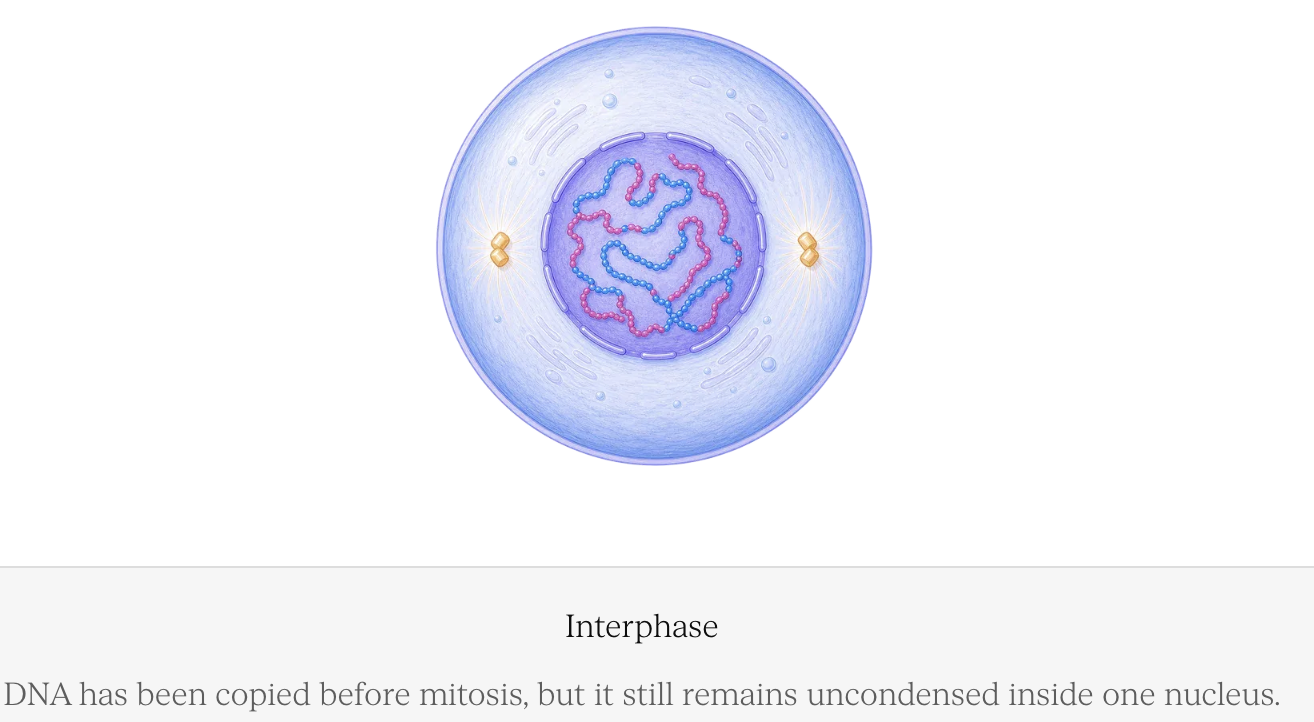
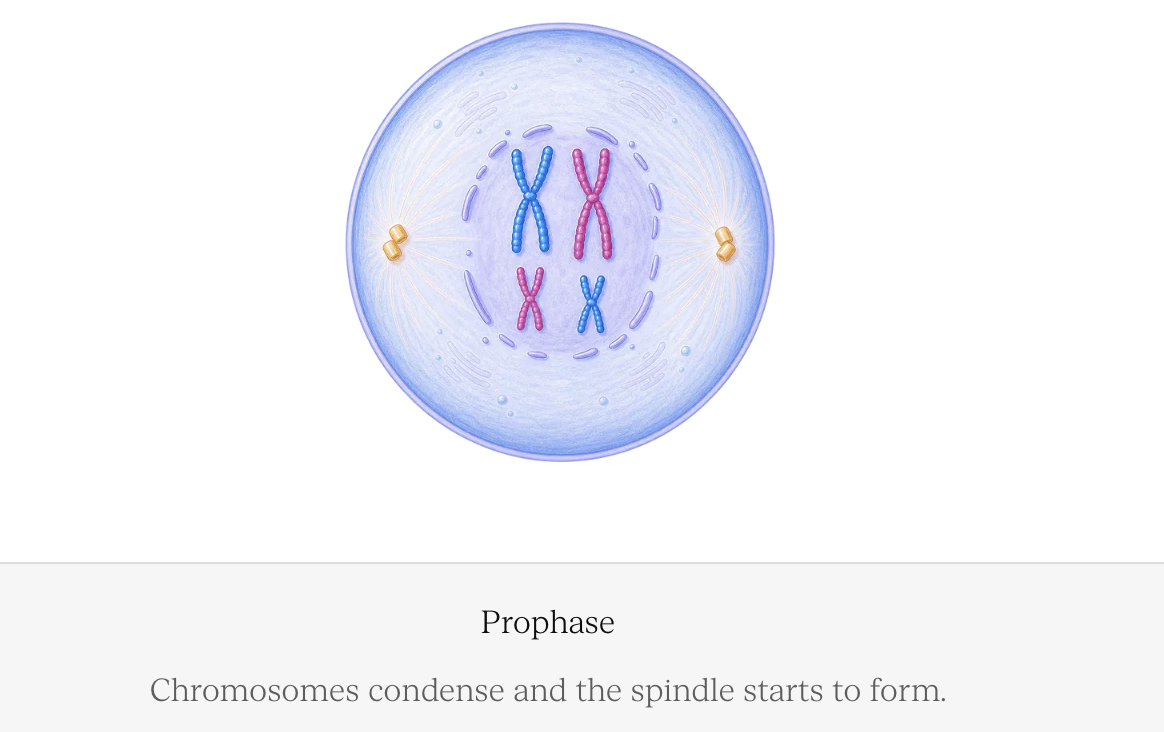
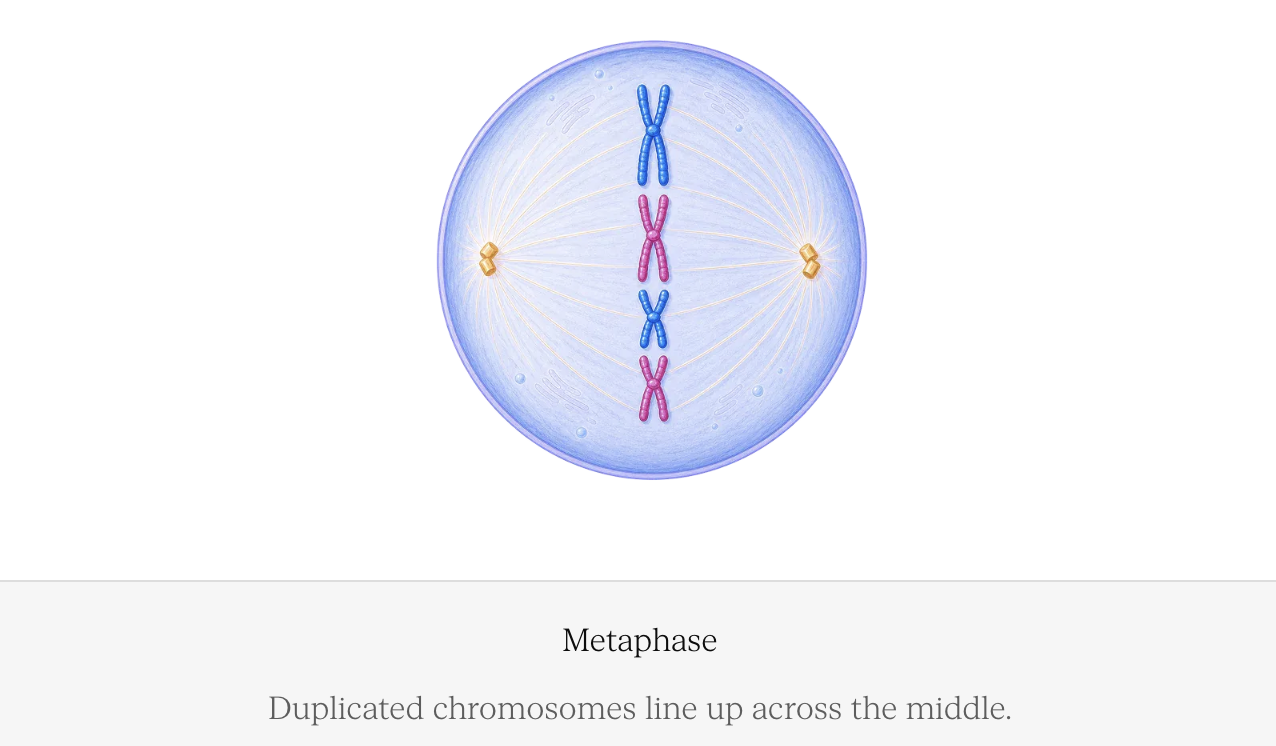
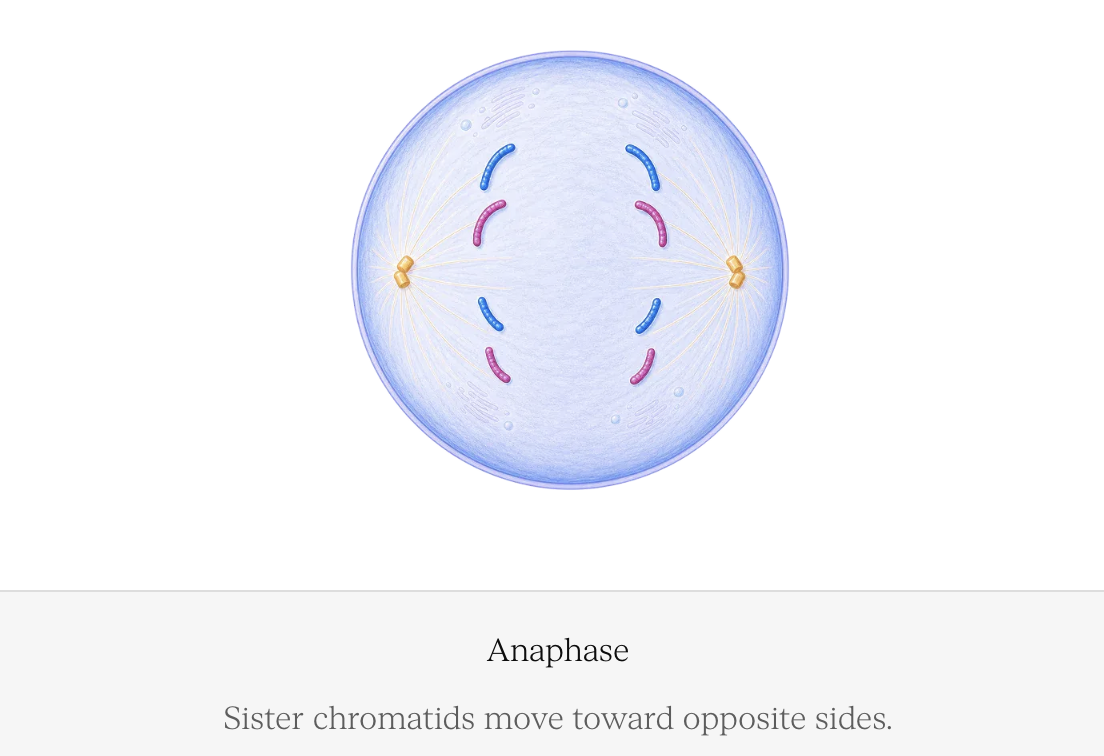
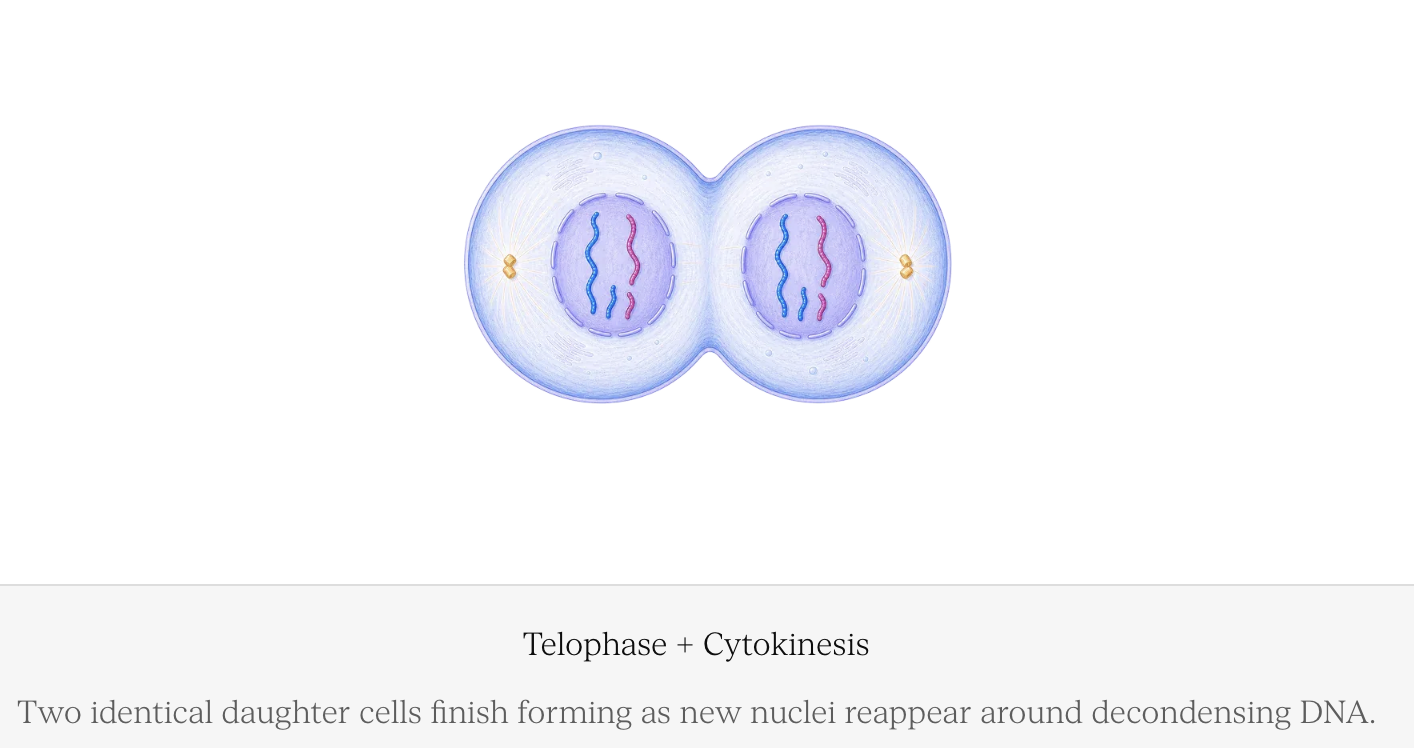
Meiosis
(See Meiosis Notes)
The major difference should be immediately visible:
Mitosis has one division.
Meiosis has two divisions.
DNA Replication
Both mitosis and meiosis begin after DNA has been:
replicated.
During the S phase of interphase, each chromosome is copied.
Each replicated chromosome consists of two:
sister chromatids.
An important similarity is therefore:
DNA replication occurs once before either process.
However, what happens after DNA replication is very:
different.


Number of Divisions
Mitosis involves:
one nuclear division.
Meiosis involves:
two nuclear divisions.
These are called:
Meiosis I
and:
Meiosis II.
Therefore:
Mitosis: 1 division
Meiosis: 2 divisions
Number of Cells Produced
Because mitosis has one division, one parent cell normally produces:
two daughter cells.
Because meiosis has two divisions, one parent cell typically produces:
four haploid cells.
So:
Mitosis: 1 → 2
Meiosis: 1 → 2 → 4
Comparing Chromosome Number
One of the most important differences concerns:
chromosome number.
Mitosis normally:
maintains chromosome number.
Meiosis:
halves chromosome number.
Using chromosome notation:
Mitosis: 2n → 2n
Meiosis: 2n → n
Human Example
Most human body cells contain:
46 chromosomes.
Therefore:
2n = 46
A human body cell dividing by mitosis normally produces:
46 → 46 and 46
A human diploid germ cell completing meiosis produces cells with:
46 → 23
Therefore:
Mitosis maintains 46.
Meiosis reduces 46 to 23.
Why Does Mitosis Maintain Chromosome Number?
Before mitosis, each chromosome is:
copied.
During mitosis, the sister chromatids are:
separated.
One copy is distributed to each daughter:
nucleus.
As a result, both daughter cells receive a complete chromosome:
set.
This allows chromosome number to remain:
constant.
Why Does Meiosis Halve Chromosome Number?
Meiosis separates homologous chromosomes during:
Meiosis I.
Each resulting cell receives only one chromosome from each homologous:
pair.
Therefore, the cells become:
haploid.
This reduction is essential because gametes will later combine during:
fertilization.
Meiosis and Fertilization Work Together
In humans:
Sperm = 23 chromosomes
Egg = 23 chromosomes
During fertilization:
23 + 23 = 46
The normal diploid chromosome number is:
restored.
Without meiosis, chromosome number would double every:
generation.


Homologous Chromosomes
A major difference between mitosis and meiosis involves:
homologous chromosomes.
Homologous chromosomes are chromosome pairs carrying the same types of genes at corresponding:
locations.
During mitosis, homologous chromosomes do not normally pair with one another.
During Prophase I of meiosis, homologous chromosomes:
pair together.
This pairing allows an important process called:
crossing over.
What Separates in Mitosis?
During anaphase of mitosis:
sister chromatids separate.
The chromatids move toward opposite poles.
The result is two nuclei containing essentially identical chromosome:
sets.
What Separates in Meiosis I?
During Anaphase I:
homologous chromosomes separate.
The sister chromatids remain:
together.
This is the division that reduces chromosome number from:
diploid to haploid.
What Separates in Meiosis II?
During Anaphase II:
sister chromatids separate.
This resembles what happens during anaphase of:
mitosis.
Therefore:
Mitosis → sister chromatids separate
Meiosis I → homologous chromosomes separate
Meiosis II → sister chromatids separate
Comparing the Stages
Mitosis has:
Prophase → Metaphase → Anaphase → Telophase
Meiosis has two rounds:
Prophase I → Metaphase I → Anaphase I → Telophase I
followed by:
Prophase II → Metaphase II → Anaphase II → Telophase II
This is why meiosis takes:
two divisions.
The Central Comparison
| Feature | Mitosis | Meiosis |
|---|---|---|
| Main purpose | Growth, repair and replacement | Sexual reproduction |
| DNA replication | Once before division | Once before Meiosis I |
| Number of divisions | 1 | 2 |
| Typical number of cells produced | 2 | 4 |
| Starting chromosome number | Usually 2n | Usually 2n |
| Final chromosome number | Usually 2n | n |
| Chromosome number | Maintained | Halved |
| Homologous chromosomes pair | No | Yes |
| Crossing over | Normally no | Yes, in Prophase I |
| Genetic similarity | Usually genetically similar | Genetically different |
| In humans | 46 → 46 | 46 → 23 |
Why Mitosis Produces Genetically Similar Cells
Before mitosis, DNA is copied.
During mitosis, sister chromatids are distributed accurately between the two:
daughter cells.
There is normally no pairing of homologous chromosomes and no crossing over as occurs during:
meiosis.
Therefore, daughter cells normally contain essentially the same genetic information as:
each other and the parent cell.
Are Mitotic Cells Always Perfectly Identical?
Mitosis is designed to produce genetically identical:
cells.
However, mutations can occasionally occur during DNA replication or later cell:
division.
Therefore, it is most accurate to say that mitosis normally produces:
genetically identical or nearly identical daughter cells.
Why Meiosis Produces Variation
Meiosis produces genetically different cells primarily because of:
crossing over
and:
independent assortment.
These processes create different combinations of:
alleles.
The gametes produced by one individual can therefore be genetically different from:
one another.

Crossing Over
During Prophase I, homologous chromosomes pair.
Non-sister chromatids can exchange corresponding sections of:
DNA.
This is called:
crossing over.
Crossing over produces chromosomes containing new combinations of:
alleles.
Mitosis does not normally include this process.
Independent Assortment
During Metaphase I, homologous chromosome pairs line up:
randomly.
The chromosome inherited from one parent could face either:
pole.
Each chromosome pair behaves independently of many of the:
others.
As a result, different gametes receive different combinations of:
chromosomes.
This is called:
independent assortment.
Random Fertilization Adds Even More Variation
Meiosis creates genetically different:
gametes.
During sexual reproduction, one gamete then combines with another during:
fertilization.
Which sperm fertilizes which egg is largely:
random.
Therefore, sexual reproduction produces even more genetic variation than meiosis:
alone.
Mitosis Creates Consistency
For growth and repair, genetic consistency is usually:
important.
Imagine replacing a damaged skin cell.
The new cell needs the genetic instructions required to function as a:
skin cell.
Mitosis maintains the genome and chromosome number so tissues can continue functioning:
normally.
Meiosis Creates Diversity
For sexual reproduction, genetic diversity can be:
advantageous.
Different offspring receive different combinations of:
alleles.
This produces variation within a:
population.
Variation provides the raw material upon which:
natural selection can act.
Where Does Mitosis Occur?
Mitosis occurs in many cells involved in:
growth and maintenance.
Examples include cells involved in:
- skin replacement
- growth of bones and tissues
- wound healing
- replacement of digestive tract cells
- development of an embryo
- plant growth
- some forms of asexual reproduction
If the purpose is generally to make more genetically similar body cells, the process is likely:
mitosis.


Example: Growing from a Zygote
A human begins development as a:
zygote.
The zygote contains:
46 chromosomes.
It divides through:
mitosis.
The new cells divide again and again.
This produces the enormous number of cells needed to build the:
body.
The cells maintain the normal chromosome number of:
46.
Example: Healing a Cut
A cut damages and destroys some:
skin cells.
Cells around the wound divide to replace the:
lost cells.
This requires:
mitosis.
The replacement cells need the same chromosome number and genetic information as other:
body cells.
Example: Plant Growth
Cells near the tips of roots and shoots divide rapidly.
These regions are called:
meristems.
Cells in meristems undergo:
mitosis.
This produces new cells and allows roots and shoots to:
grow.


Where Does Meiosis Occur?
In animals, meiosis occurs in specialized reproductive tissues involved in producing:
gametes.
In humans, this includes the:
testes
and:
ovaries.
Meiosis contributes to the production of:
sperm and eggs.
If the biological purpose is to produce haploid reproductive cells, the process is:
meiosis.
Example: Producing Sperm
A diploid germ cell contains:
46 chromosomes.
It undergoes meiosis.
The resulting haploid cells contain:
23 chromosomes.
These develop into:
sperm cells.
The chromosome number has been reduced by:
half.
Example: Producing Eggs
Cells involved in egg formation also undergo:
meiosis.
The chromosome number is reduced from:
46 to 23.
The functional egg is therefore:
haploid.
When fertilization occurs, the diploid number can be:
restored.
Mitosis in Asexual Reproduction
Mitosis can also be used during:
asexual reproduction.
For example, plants may reproduce through:
- runners
- tubers
- bulbs
- cuttings
Growth of the new plant involves repeated:
mitosis.
Because the new organism develops from cells of one parent, it is usually genetically very similar to that:
parent.
Meiosis in Sexual Reproduction
Meiosis is closely connected with:
sexual reproduction.
It produces haploid cells and genetic:
variation.
These cells ultimately participate in fertilization.
Therefore:
Meiosis → haploid reproductive cells
Fertilization → diploid zygote
Mitosis → growth of the zygote into an organism
All three processes are connected.
Following a Human Life Cycle
Consider the sequence:
Adult
↓
Meiosis
↓
Gametes with 23 chromosomes
↓
Fertilization
↓
Zygote with 46 chromosomes
↓
Mitosis
↓
Growth and development
↓
Adult
Meiosis and mitosis therefore perform different but complementary:
roles.
A Useful Decision Rule
When deciding whether a situation involves mitosis or meiosis, ask:
What is the cell trying to accomplish?
If the answer is:
growth, repair, replacement, or asexual reproduction
think:
MITOSIS.
If the answer is:
production of haploid reproductive cells for sexual reproduction
think:
MEIOSIS.
Scenario 1: A Child Growing Taller
A child's bones and other tissues need to produce more:
cells.
The cells must maintain the normal chromosome:
number.
The process is:
mitosis.
Scenario 2: Healing a Burn
Damaged cells must be:
replaced.
New cells need essentially the same genetic information as the cells they replace.
The process is:
mitosis.
Scenario 3: Producing Sperm
The chromosome number must be reduced from:
diploid to haploid.
The process is:
meiosis.
Scenario 4: Producing an Egg
The reproductive cell must contain half the normal chromosome:
number.
The process is:
meiosis.
Scenario 5: A Strawberry Runner Produces a New Plant
The new plant develops through repeated cell division without fertilization.
This involves:
mitosis.
It is an example of:
asexual reproduction.
Scenario 6: Creating Genetic Variation in Gametes
Homologous chromosomes pair, crossing over occurs, and chromosome pairs are independently assorted.
This describes:
meiosis.
Chromosome Example
Suppose an organism has:
2n = 16.
After mitosis:
Each daughter cell contains:
16 chromosomes.
After meiosis:
Each final cell contains:
8 chromosomes.
Therefore:
Mitosis: 16 → 16
Meiosis: 16 → 8
Another Chromosome Example
A species has:
24 chromosomes
in each body cell.
A cell undergoes mitosis.
Each daughter cell should contain:
24 chromosomes.
A diploid germ cell undergoes meiosis.
Each haploid cell should contain:
12 chromosomes.
Worked Comparison
A scientist observes a cell division that produces two cells.
The chromosome number remains unchanged.
The cells are genetically very similar.
The process is most likely:
mitosis.
Now suppose a scientist observes a process involving two divisions.
Four haploid cells are eventually produced.
The cells are genetically different.
The process is:
meiosis.
Why Doesn't Mitosis Produce the Same Variation as Meiosis?
Mitosis is designed to:
preserve genetic information.
Meiosis is designed both to reduce chromosome number and to:
reshuffle genetic information.
Mitosis normally lacks the homologous chromosome pairing and crossing over characteristic of:
Meiosis I.
Therefore, the two processes produce very different genetic:
outcomes.
Why Is the Difference Biologically Important?
Imagine meiosis produced diploid:
gametes.
Chromosome number would double during:
fertilization.
Now imagine mitosis routinely halved chromosome number.
Body tissues would quickly lose complete sets of:
genetic information.
Each process therefore has an outcome matched to its biological:
function.
Similarities Between Mitosis and Meiosis
Despite their differences, mitosis and meiosis share several:
features.
Both:
- are forms of nuclear division
- occur after DNA replication
- involve chromosomes
- use spindle structures
- move chromosomes within cells
- usually occur alongside cytokinesis
- distribute genetic information into new cells
They use related cellular machinery but produce very different:
results.
Differences at a Glance
Mitosis
- one division
- two daughter cells
- chromosome number maintained
- daughter cells normally genetically similar
- no normal homologous pairing
- no normal crossing over
- growth and repair
- replacement of cells
- asexual reproduction in some organisms
Meiosis
- two divisions
- typically four cells
- chromosome number halved
- cells genetically different
- homologous chromosomes pair
- crossing over occurs
- independent assortment occurs
- sexual reproduction
- produces or contributes to reproductive cells
A Memory Strategy
Think:
MITOSIS = Maintain
Mitosis:
maintains chromosome number
and largely:
maintains genetic information.
Think:
MEIOSIS = Mix and halve
Meiosis:
mixes genetic information
and:
halves chromosome number.
Common Mistake: Mitosis Produces Haploid Cells
Mitosis normally maintains the chromosome number of the:
parent cell.
A diploid cell dividing by mitosis produces:
diploid daughter cells.
Meiosis is the process that reduces chromosome number from:
diploid to haploid.
Common Mistake: Meiosis Has One Division
Meiosis has:
two divisions.
These are:
Meiosis I
and:
Meiosis II.
DNA, however, is replicated only:
once beforehand.
Common Mistake: Meiosis Produces Identical Cells
Meiosis normally produces genetically:
different cells.
Crossing over and independent assortment create new genetic:
combinations.
Mitosis normally produces genetically:
similar cells.
Common Mistake: Both Processes Produce Four Cells
Mitosis normally produces:
two cells.
Meiosis typically produces:
four haploid cells.
Remember:
Mitosis = 2
Meiosis = typically 4
Common Mistake: Meiosis Is Used for Growth
Growth requires more body:
cells.
That is primarily the role of:
mitosis.
Meiosis is associated with:
sexual reproduction.
Common Mistake: Mitosis and Meiosis Have Completely Different Mechanisms
The processes share many cellular mechanisms.
Both involve:
- chromosomes
- spindle structures
- chromosome movement
- nuclear division
The key differences concern:
what separates, how many divisions occur, chromosome number, genetic variation, and biological purpose.
Check Your Understanding
1. State the main purpose of mitosis.
2. State the main purpose of meiosis.
3. How many divisions occur during mitosis?
4. How many divisions occur during meiosis?
5. How many cells are normally produced by mitosis?
6. How many cells are typically produced by meiosis?
7. What happens to chromosome number during mitosis?
8. What happens to chromosome number during meiosis?
9. What does diploid mean?
10. What does haploid mean?
11. A human body cell contains 46 chromosomes. How many chromosomes should each daughter cell contain after mitosis?
12. How many chromosomes should a human gamete contain after meiosis?
13. What separates during anaphase of mitosis?
14. What separates during Anaphase I of meiosis?
15. What separates during Anaphase II?
16. Why are cells produced by mitosis normally genetically similar?
17. Explain crossing over.
18. Explain independent assortment.
19. Why are cells produced by meiosis genetically different?
20. Does DNA replicate once or twice before meiosis?
21. Explain why meiosis must halve chromosome number.
22. Explain how meiosis and fertilization work together.
23. Which process is involved in wound healing? Explain.
24. Which process is involved in producing sperm? Explain.
25. Which process is involved in producing eggs?
26. Which process allows a child to grow?
27. Which process is involved when a strawberry plant produces a new plant from a runner?
28. An organism has 2n = 20. How many chromosomes will a daughter cell have after mitosis?
29. The same organism has 2n = 20. How many chromosomes will a gamete have after meiosis?
30. Explain why mitosis and meiosis have different outcomes that suit their different biological purposes.
Key Terms
- Mitosis: Nuclear division that normally produces two genetically similar nuclei while maintaining chromosome number.
- Meiosis: Specialized cell division that halves chromosome number and produces genetic variation.
- Diploid: Having two sets of chromosomes.
- Haploid: Having one set of chromosomes.
- Chromosome: DNA-containing structure carrying genetic information.
- Homologous chromosomes: Pair of chromosomes carrying the same types of genes at corresponding locations.
- Sister chromatids: Copies of a chromosome produced during DNA replication.
- Gamete: Haploid reproductive cell.
- Fertilization: Fusion of gametes.
- Zygote: Diploid cell formed during fertilization.
- Crossing over: Exchange of DNA between non-sister chromatids of homologous chromosomes during meiosis.
- Independent assortment: Distribution of homologous chromosomes into different combinations during meiosis.
- Genetic variation: Genetic differences among individuals.
- Interphase: Period during which a cell grows and DNA is replicated before division.
- Cytokinesis: Division of the cytoplasm.
- Meiosis I: First meiotic division in which homologous chromosomes separate.
- Meiosis II: Second meiotic division in which sister chromatids separate.
- Asexual reproduction: Reproduction without fusion of gametes.
- Sexual reproduction: Reproduction involving fusion of gametes.
Key Takeaways
- Mitosis and meiosis are both forms of cell division, but they have different purposes.
- Mitosis is mainly used for growth, repair, replacement, development, and some forms of asexual reproduction.
- Meiosis is associated with sexual reproduction.
- DNA is replicated once before both processes.
- Mitosis involves one division.
- Meiosis involves two divisions.
- Mitosis normally produces two cells.
- Meiosis typically produces four haploid cells.
- Mitosis normally maintains chromosome number.
- Meiosis halves chromosome number.
- In humans, mitosis normally maintains 46 chromosomes.
- Human meiosis reduces chromosome number from 46 to 23.
- Mitosis normally produces genetically similar cells.
- Meiosis produces genetically different cells.
- Homologous chromosomes pair during Meiosis I but not during normal mitosis.
- Crossing over occurs during Prophase I and increases genetic variation.
- Independent assortment also increases variation.
- During mitosis, sister chromatids separate.
- During Meiosis I, homologous chromosomes separate.
- During Meiosis II, sister chromatids separate.
- Meiosis creates haploid cells so fertilization can restore the diploid chromosome number.
- Mitosis allows a zygote to grow into a multicellular organism.
- Mitosis is involved in wound healing and cell replacement.
- Meiosis is involved in the production of sperm and eggs in animals.
- Mitosis can support asexual reproduction.
- Meiosis supports sexual reproduction and genetic diversity.
- A useful memory aid is Mitosis = Maintain.
- Another useful memory aid is Meiosis = Mix and halve.
- The different outcomes of mitosis and meiosis are directly related to their different biological functions.