Simple Harmonic Motion
5. Energy in Oscillatory Systems
Learning Outcomes
- I can explain how energy changes during SHM.
- I can identify positions of maximum kinetic and potential energy.
- I can describe conservation of mechanical energy in oscillating systems.
- I can calculate energy in spring and pendulum systems.
- I can analyze energy transformations occurring during oscillations.
Energy in Oscillatory Systems
An oscillating system continually transfers energy between different energy stores. In an ideal system, the total mechanical energy remains constant even though the amount stored as kinetic or potential energy changes throughout each oscillation.
Two important examples are:
- A mass attached to a spring
- A simple pendulum
Understanding these energy transfers helps explain why oscillating objects speed up, slow down, stop momentarily, and reverse direction.


Mechanical Energy in Oscillations
The mechanical energy of an oscillating system is the combination of its kinetic and potential energy.
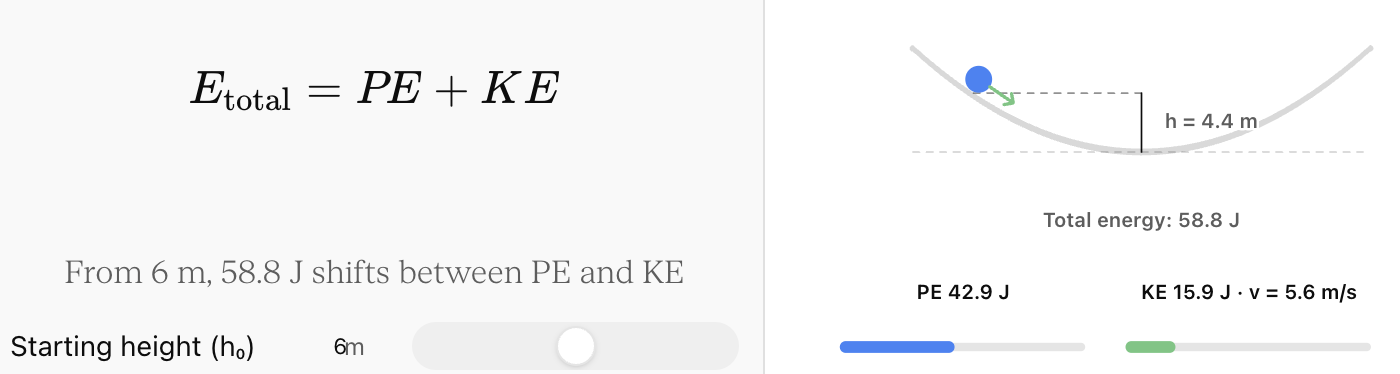
During ideal oscillation, energy continuously transfers between these stores.
The important idea is:
Potential energy decreases → Kinetic energy increases
and later:
Kinetic energy decreases → Potential energy increases
In an ideal system, no mechanical energy is lost.
Energy and Position
Consider a mass oscillating horizontally on a spring.
There are three particularly important positions:
- Maximum extension
- Equilibrium
- Maximum compression


The energy distribution is different at each position.
Maximum Extension
At maximum extension:
x = +A
where A is the amplitude.
The mass momentarily stops before changing direction.
Therefore:
v = 0
and:
Kinetic energy = 0
The spring is stretched by its maximum amount.
Therefore:
Elastic potential energy = maximum
Moving Toward Equilibrium
As the spring pulls the mass toward equilibrium:
- Displacement decreases.
- Elastic potential energy decreases.
- Speed increases.
- Kinetic energy increases.
Energy is transferred from the spring's elastic potential energy store to the mass's kinetic energy store.
At Equilibrium
At equilibrium:
x = 0
The spring is at its equilibrium position.
The mass has its greatest speed.
Therefore:
Kinetic energy = maximum
and, for a horizontal spring measured relative to equilibrium:
Elastic potential energy = minimum

The mass does not stop at equilibrium because it has kinetic energy.
It continues past equilibrium and begins compressing the spring.
Maximum Compression
As the spring compresses:
- Speed decreases.
- Kinetic energy decreases.
- Elastic potential energy increases.
At maximum compression:
x = −A
and:
v = 0
Therefore:
Kinetic energy = 0
and:
Elastic potential energy = maximum
The mass then reverses direction and the process repeats.
Energy During One Complete Oscillation
Starting at maximum extension:
Maximum extension
Elastic PE = maximum
KE = 0
↓
Moving toward equilibrium
Elastic PE decreases
KE increases
↓
Equilibrium
Elastic PE = minimum
KE = maximum
↓
Moving toward maximum compression
Elastic PE increases
KE decreases
↓
Maximum compression
Elastic PE = maximum
KE = 0
The process then occurs in reverse.

Elastic Potential Energy
The energy stored in a stretched or compressed spring is:
Elastic PE = ½kx²
where:
k = spring constant in N/m
x = displacement from equilibrium in m
Elastic potential energy depends on the square of displacement.
This means that both:
x = +A
and:
x = −A
produce the same maximum elastic potential energy.
Worked Example — Energy Stored in a Spring
A spring has:
k = 200 N/m
and is stretched:
x = 0.10 m
Calculate its elastic potential energy.
Elastic PE = ½kx²
Elastic PE = ½(200)(0.10²)
Elastic PE = 100(0.010)
Elastic PE = 1.0 J
Therefore:
Elastic potential energy = 1.0 J
Maximum Energy in a Spring Oscillator
At maximum displacement:
x = A
Therefore, the total mechanical energy of an ideal horizontal spring-mass oscillator is:
Total energy = ½kA²
This energy remains constant throughout the oscillation.
At maximum displacement, it is all elastic potential energy.
At equilibrium, it is all kinetic energy.
Worked Example — Total Mechanical Energy
A spring has:
k = 80 N/m
and the oscillation amplitude is:
A = 0.25 m
Calculate the total mechanical energy.
E = ½kA²
E = ½(80)(0.25²)
E = 40(0.0625)
E = 2.5 J
Therefore:
Total mechanical energy = 2.5 J
At every point in the ideal oscillation, the total mechanical energy remains:
2.5 J
Kinetic Energy
The kinetic energy of the moving mass is:
KE = ½mv²
where:
m = mass in kg
v = velocity in m/s
At equilibrium, speed is maximum.
Therefore:
KE is maximum at equilibrium.
At maximum displacement:
v = 0
so:
KE = 0
Worked Example — Maximum Speed from Energy
A:
0.50 kg
mass oscillates on a spring.
The total mechanical energy is:
4.0 J
At equilibrium, all of this energy is kinetic.
Therefore:
KE = ½mv²
4.0 = ½(0.50)v²
4.0 = 0.25v²
v² = 16
v = 4.0 m/s
Therefore:
Maximum speed = 4.0 m/s
Energy at an Intermediate Position
Between maximum displacement and equilibrium, the system has both:
Elastic potential energy
and:
Kinetic energy
For an ideal horizontal spring:
Total energy = Elastic PE + KE
Therefore:
½kA² = ½kx² + ½mv²
This equation can be used to calculate the speed at any position.


Worked Example — Energy at a Particular Position
A spring has:
k = 100 N/m
and amplitude:
A = 0.20 m
Calculate the total mechanical energy.
E = ½kA²
E = ½(100)(0.20²)
E = 2.0 J
Now suppose the mass is at:
x = 0.10 m
Elastic potential energy is:
Elastic PE = ½kx²
Elastic PE = ½(100)(0.10²)
Elastic PE = 0.50 J
Therefore:
KE = Total energy − Elastic PE
KE = 2.0 − 0.50
KE = 1.50 J
At this position:
Elastic PE = 0.50 J
KE = 1.50 J
Total = 2.0 J
Energy Graphs for SHM
Energy can also be plotted against displacement.
Elastic potential energy is:
PE = ½kx²
so its graph is a curved parabola.
Kinetic energy is:
KE = Etotal − ½kx²
so it is greatest at:
x = 0
and falls to zero at:
x = ±A


The total mechanical energy appears as a horizontal line because it remains constant in an ideal system.
An Important Energy Pattern
At:
x = −A
PE = maximum
KE = 0
At:
x = 0
PE = minimum
KE = maximum
At:
x = +A
PE = maximum
KE = 0
Notice that energy depends on x², so the energy distribution is the same at +x and −x.
Where Are KE and PE Equal?
For a spring oscillator:
Total energy = ½kA²
Potential energy at displacement x is:
PE = ½kx²
KE and PE are equal when each contains half the total energy.
Therefore:
½kx² = ¼kA²
This gives:
x² = A²/2
and therefore:
|x| = A/√2
So kinetic and potential energy are equal when the oscillator is approximately:
0.707A
from equilibrium.
Worked Example — Equal Energy Position
Suppose:
A = 0.20 m
Then:
|x| = A/√2
|x| = 0.20/1.414
|x| ≈ 0.141 m
Therefore, kinetic and elastic potential energy are equal at approximately:
x = +0.141 m
and:
x = −0.141 m
Energy in a Pendulum
Energy transformations also occur in a simple pendulum.
The important energy stores are:
- Gravitational potential energy
- Kinetic energy


At the highest points:
GPE = maximum
KE = minimum
At the lowest point:
GPE = minimum
KE = maximum
Pendulum at Maximum Displacement
At either extreme of the swing:
v = 0
Therefore:
KE = 0
The bob is at its greatest height relative to the lowest point.
Therefore:
GPE = maximum
Gravity then accelerates the bob toward equilibrium.
Pendulum Moving Downward
As the bob moves toward its lowest position:
Height decreases
so:
GPE decreases
At the same time:
Speed increases
so:
KE increases
Therefore:
Gravitational PE → Kinetic energy
Pendulum at Equilibrium
At the lowest point:
Speed = maximum
Therefore:
KE = maximum
If the lowest position is chosen as the zero-height reference:
GPE = minimum
The bob continues through equilibrium because of its kinetic energy.


Pendulum Moving Upward
As the bob climbs the opposite side:
Speed decreases
so:
KE decreases
At the same time:
Height increases
so:
GPE increases
Therefore:
Kinetic energy → Gravitational PE
At maximum height, the bob momentarily stops and reverses direction.
Gravitational Potential Energy
Near Earth's surface:
GPE = mgh
where:
m = mass in kg
g = gravitational field strength in m/s²
h = height above the chosen reference level in m