Simple Harmonic Motion
| Сайт: | Young Education |
| Курс: | Oscillations and Resonance |
| Книга: | Simple Harmonic Motion |
| Надруковано: | ゲストユーザ |
| Дата: | пʼятниця 25 вересня 2026 01:01 AM |
1. Characteristics of SHM
Learning Outcomes
- I can define simple harmonic motion (SHM).
- I can identify systems that undergo SHM.
- I can explain the role of restoring forces in SHM.
- I can distinguish SHM from other forms of oscillatory motion.
- I can describe the motion of oscillating systems using scientific terminology.
- Periodic motion vs. SHM.
- Restoring force proportional to displacement: .
What Is Oscillatory Motion?
Oscillatory motion is repeated movement back and forth around a central position.
Many systems in physics can oscillate.
Examples include:
- A mass attached to a spring
- A swinging pendulum
- A vibrating guitar string
- A diving board moving up and down
- A tuning fork after it is struck
The central position around which the object oscillates is called the equilibrium position.
When an oscillating object reaches one side of its motion, it reverses direction and moves back toward equilibrium.


What Is Simple Harmonic Motion?
Simple harmonic motion, or SHM, is a special type of oscillatory motion.
In SHM, the restoring force acting on an object is:
- Directed toward the equilibrium position.
- Directly proportional to the object's displacement from equilibrium.
Mathematically:
where:
- F = restoring force
- x = displacement from equilibrium
- The negative sign indicates that the force acts in the opposite direction to the displacement
This relationship is the defining characteristic of simple harmonic motion.
The Equilibrium Position
The equilibrium position is the position where the system would naturally remain if it were not disturbed.
At equilibrium:
For a horizontal mass-spring system, this is the position where the mass rests when no net force is acting on it.
If the mass is pulled away from equilibrium and released, it begins to oscillate.
The object repeatedly moves:
and the pattern repeats.
Displacement in SHM
Displacement describes the object's position relative to equilibrium.
We normally represent displacement using:
x
At equilibrium:
On one side:
On the opposite side:
The sign tells us which side of equilibrium the object is on.
What Is a Restoring Force?
A restoring force is a force that acts to return an object toward its equilibrium position.
Imagine pulling a mass attached to a spring to the right.
The spring pulls the mass back toward the centre.
If the mass moves to the left of equilibrium, the spring pushes or pulls it toward the centre again.
Therefore, the restoring force always acts opposite to the displacement.
Displacement right→Force left Displacement left→Force right
This constant tendency to return toward equilibrium produces the oscillation.
Restoring Force and Displacement
For SHM, the magnitude of the restoring force increases as the object moves farther from equilibrium.
If the displacement doubles, the restoring force doubles.
If the displacement triples, the restoring force triples.
Therefore:
in magnitude.
Including the direction gives:
This means the restoring force is both:
proportional to displacement and opposite in direction.
Hooke's Law and SHM
A mass attached to an ideal spring provides an important example of SHM.
For a spring:
where:
- F = restoring force
- k = spring constant
- x = displacement
- The negative sign indicates the restoring direction
This is Hooke's law.
If the spring obeys Hooke's law, the restoring force is proportional to displacement.
Therefore, an ideal mass-spring system can undergo simple harmonic motion.
Example: A Mass on a Spring
Imagine a mass attached to a horizontal spring.
Position A: Maximum Displacement
The mass is pulled to the right.
Its displacement is maximum.
The restoring force is also maximum and acts toward the left.
The mass is momentarily stationary before reversing direction.
Position B: Equilibrium
The mass passes through the centre.
Its displacement is:
The restoring force is zero.
However, the mass is moving at its maximum speed.
Position C: Opposite Maximum Displacement
The mass reaches the other side.
Its displacement is again maximum in magnitude.
Its speed is zero for an instant.
The restoring force is maximum and points back toward equilibrium.
The cycle then repeats.
Amplitude
The amplitude is the maximum displacement of an oscillating object from its equilibrium position.
It is usually represented by:
A
If an object moves between:
and:
then its amplitude is:
A = 5 cm
The total distance between the two extreme positions is 10 cm, but the amplitude is only 5 cm.
Amplitude is always measured from equilibrium to an extreme position.
One Complete Oscillation
One complete oscillation occurs when an object returns to the same position while moving in the same direction.
For example:
is one complete oscillation.
The object has moved from one extreme to the other and back again.
Period
The period is the time required for one complete oscillation.
It is represented by:
T
and measured in:
seconds (s)
For example, if a pendulum completes one full oscillation in 2.0 seconds:
T = 2.0 s
Frequency
The frequency is the number of complete oscillations occurring each second.
It is represented by:
f
and measured in:
hertz (Hz)
One hertz means:
1 oscillation per second
For example:
means that the system completes:
5 oscillations every second
Period and frequency are closely related:
and:
SHM as a Graph
If displacement is plotted against time, ideal SHM produces a repeating wave-shaped pattern.


The graph allows us to identify:
- Maximum positive displacement
- Maximum negative displacement
- Equilibrium position
- Amplitude
- Period
- Repeated oscillations
The repeating shape shows that the motion is periodic.
Speed During SHM
The speed of an object undergoing SHM constantly changes.
At the extreme positions:
the speed is:
v = 0
At equilibrium:
the speed is:
maximum
This happens because the object accelerates toward equilibrium and slows down as it moves away from equilibrium.
Acceleration During SHM
Since:
and the restoring force in SHM satisfies:
the acceleration must also satisfy:
In fact:
where ω is the angular frequency.
This is another mathematical definition of SHM.
The acceleration always points toward equilibrium.
At equilibrium:
At maximum displacement:
Position, Speed, and Acceleration
The behaviour of an object during SHM can be summarized as follows:
| Position | Displacement | Speed | Restoring Force | Acceleration |
|---|---|---|---|---|
| Positive extreme | +A | Zero | Maximum | Maximum |
| Equilibrium | 0 | Maximum | Zero | Zero |
| Negative extreme | −A | Zero | Maximum | Maximum |
At both extreme positions, the force and acceleration point toward equilibrium.
Pendulums and SHM
A swinging pendulum can also approximately undergo SHM.


When the pendulum is displaced from its equilibrium position, gravity produces a restoring effect that pulls it back toward the centre.
However, a pendulum behaves like ideal SHM only when the oscillations are relatively small.
For larger angles, the relationship between restoring force and displacement is no longer sufficiently proportional.
Therefore:
A simple pendulum approximately undergoes SHM for small oscillations.
Examples of Systems That Can Undergo SHM
Common examples include:
Mass-Spring System
A mass attached to an ideal spring oscillates around equilibrium.
Simple Pendulum
For small angles, a pendulum approximately undergoes SHM.
Vibrating Tuning Fork
The prongs move rapidly back and forth around equilibrium.
Vibrating String
Small sections of a stretched string can oscillate approximately harmonically.
Suspended Mass
A mass hanging vertically from a spring can oscillate vertically around its equilibrium position.
Many more complicated vibrating systems can also be approximated using SHM.
Is Every Oscillation SHM?
No.
All SHM is oscillatory motion, but not all oscillatory motion is simple harmonic motion.
For motion to be SHM, the restoring force must satisfy:
An object may move repeatedly back and forth without satisfying this condition.
For example:
- A pendulum swinging through very large angles
- A bouncing ball
- A strongly driven mechanical system
- Oscillations involving complicated or non-linear forces
These may be oscillatory, but they are not necessarily simple harmonic.
SHM vs. General Oscillatory Motion
| Simple Harmonic Motion | General Oscillatory Motion |
|---|---|
| Repeats around equilibrium | Repeats around a position |
| Has a restoring force | May have a restoring force |
| Restoring force is proportional to displacement | Force may have a more complicated relationship |
| Force points toward equilibrium | Motion may not satisfy this condition |
| Produces a sinusoidal displacement-time pattern | Pattern may have a different shape |
The defining feature of SHM is therefore not simply that the object moves back and forth.
It is the relationship between restoring force and displacement.
Describing Oscillations Scientifically
Instead of saying:
The object moves back and forth.
we can describe the motion more precisely:
The object oscillates periodically about its equilibrium position with an amplitude of 4 cm and a period of 2 s.
This statement uses scientific terminology to describe:
- The type of motion
- The equilibrium position
- The amplitude
- The period
Scientific vocabulary allows oscillations to be described clearly and quantitatively.
A Complete Example
A mass attached to a spring oscillates between:
and:
It completes 10 oscillations in 5.0 seconds.
Amplitude
A = 0.08 m
Period
T = 0.50 s
Frequency
f = 2.0 Hz
The system completes two full oscillations every second.
Did You Know?
Simple harmonic motion appears throughout physics because many systems behave approximately like SHM when they are displaced only a small distance from a stable equilibrium position.
This makes SHM useful for studying:
- Mechanical vibrations
- Sound
- Waves
- Molecular vibrations
- Electrical oscillations
- Seismic motion
Even complicated oscillating systems can often be understood by first studying the much simpler model of simple harmonic motion.
Key Vocabulary
Oscillation – Repeated motion back and forth around an equilibrium position.
Simple harmonic motion (SHM) – Oscillatory motion in which the restoring force is proportional to displacement and directed toward equilibrium.
Equilibrium position – The central position where the net restoring force is zero.
Displacement – The distance and direction of an object from equilibrium.
Restoring force – A force that acts toward the equilibrium position.
Amplitude – The maximum displacement from equilibrium.
Period – The time required for one complete oscillation.
Frequency – The number of complete oscillations per second.
Hertz (Hz) – The unit of frequency, equal to one oscillation per second.
Periodic motion – Motion that repeats after equal intervals of time.
Key Takeaways
- Oscillatory motion is repeated movement around an equilibrium position.
- Simple harmonic motion is a special type of oscillation.
- In SHM, the restoring force is proportional to displacement and acts in the opposite direction:
- A mass attached to an ideal spring is a standard example of SHM.
- A simple pendulum approximately undergoes SHM when its oscillations are small.
- Amplitude is the maximum displacement from equilibrium.
- Period is the time for one complete oscillation.
- Frequency is the number of oscillations completed each second.
- At maximum displacement, speed is zero while restoring force and acceleration are greatest.
- At equilibrium, speed is greatest while restoring force and acceleration are zero.
- Not every oscillation is SHM.
- The defining feature of SHM is the relationship between restoring force and displacement.
2. Springs and Hooke’s Law
Learning Outcomes
- I can state and apply Hooke’s Law.
- I can calculate restoring forces using spring constants.
- I can interpret force-extension graphs.
- I can explain the relationship between force and displacement in SHM.
- I can analyze oscillations of spring-mass systems.
- Hooke’s Law: .
- Restoring force and its role in SHM.
- Period of a mass-spring system: .
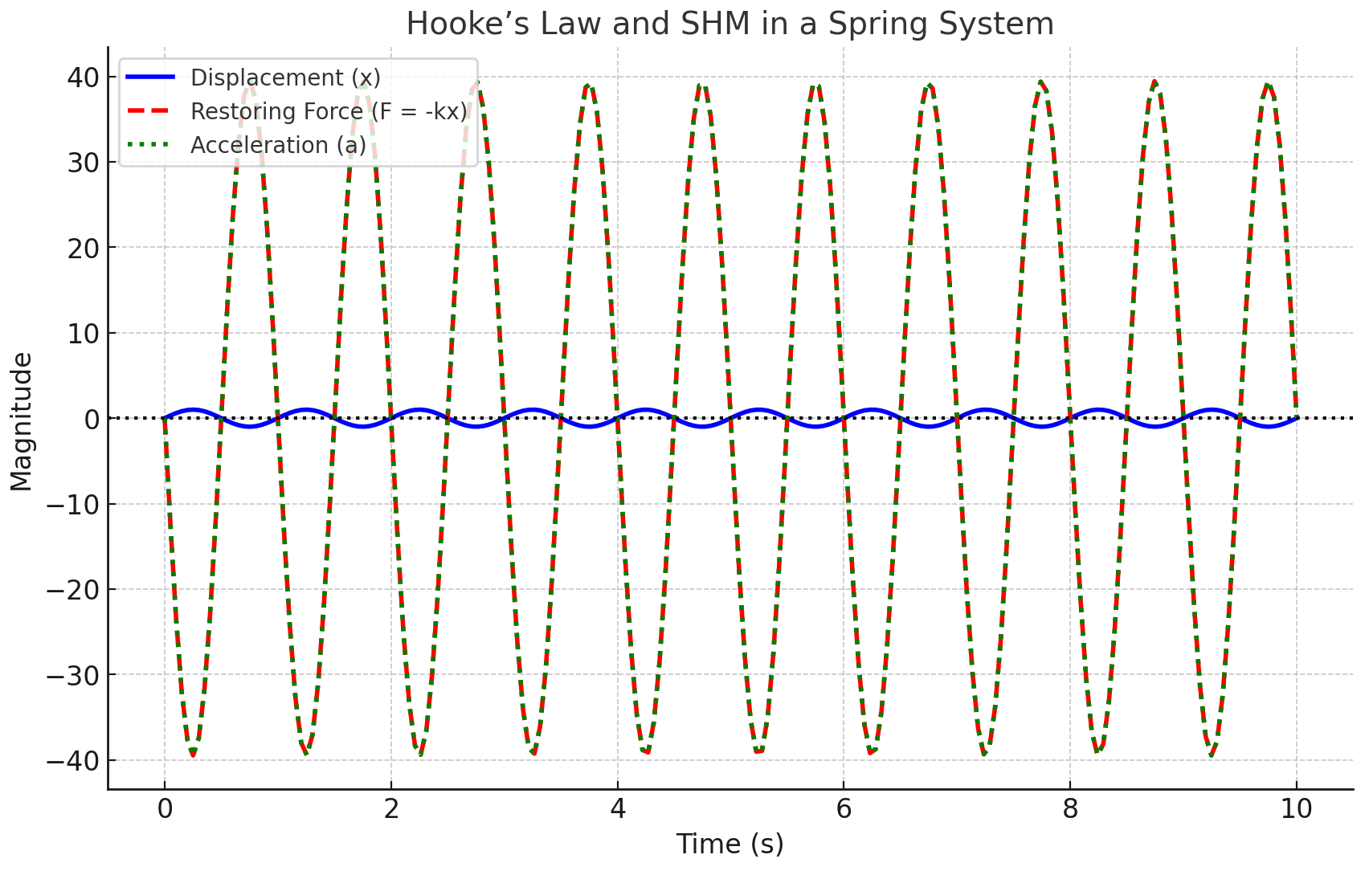
Hooke’s Law and SHM in a Spring System 🔄⚖️
This graph illustrates the relationship between Hooke’s Law and Simple Harmonic Motion (SHM) in a spring-mass system, showing displacement, restoring force, and acceleration over time.
🔹 1. Hooke’s Law and SHM Relationship
Hooke’s Law states that the force exerted by a spring is proportional to its displacement:
where:
- = restoring force (N)
- = spring constant (N/m)
- = displacement from equilibrium (m)
Since force follows Newton’s Second Law (
), we can rewrite Hooke’s Law as:
which simplifies to the SHM equation:
Since
, we get:
✅ Key Insight: The acceleration is proportional to displacement but always acts opposite to it, causing oscillatory motion.
🔹 2. Understanding the Graph 📊
✅ Displacement (
, blue curve) – Follows a sinusoidal pattern, representing the oscillatory motion of the mass.
✅ Restoring Force (
, red dashed curve) – Always directed opposite to displacement, obeying Hooke’s Law.
✅ Acceleration (
, green dotted curve) – Has the same shape as force, confirming that force causes acceleration.
🔹 Key Observations:
- When (equilibrium position), and (object moves fastest).
- When (max displacement), and are max (restoring force pulls back hardest).
- Force and acceleration are always 180° out of phase with displacement.
🔹 3. Real-World Applications of Hooke’s Law & SHM 🌍
✅ Shock Absorbers & Car Suspensions 🚗 – Use springs to dampen road impacts.
✅ Spring Scales ⚖️ – Measure weight using Hooke’s Law.
✅ Seismometers 🌍 – Detect earthquakes by measuring SHM.
✅ Oscillating Systems in Engineering 🔧 – Used in bridges, circuits, and mechanical devices.
🔹 Summary 📝
✅ Hooke’s Law (
) provides the restoring force needed for SHM.
✅ Acceleration is proportional to displacement but in the opposite direction.
✅ Graphical analysis shows force and acceleration are 180° out of phase with displacement.
✅ Applications range from engineering and vehicles to scientific measurement tools.
Activities:
- Experiment: Measure the period of a mass-spring system for different spring constants.
- Solve problems to calculate spring force, displacement, and period.
Assessment: Lab report on Hooke’s Law and spring oscillations.
Mass-Spring
Calculating the time period of a mass-spring system involves unraveling the equilibrium forces, restoring forces, and dynamic interactions that govern the oscillations and periodicity of the system's motion through the realms of kinetic wonders and potential energies.
Let us embark on a spring-filled journey through the oscillatory realms of a mass-spring system, where the equilibrium positions and restoring forces of the spring unveil the rhythmic nature and periodicity of the system's vibrations with mathematical finesse and scientific precision:
-
Equilibrium Position and Restoring Force:
- In a mass-spring system, the equilibrium position is the point where the spring force balances the gravitational force acting on the mass, resulting in a stable configuration. When the mass is displaced from this position, the spring exerts a restoring force that brings the mass back towards equilibrium.
-
Hooke's Law and Spring Constant:
- Hooke's Law states that the force exerted by a spring is directly proportional to the displacement of the mass from equilibrium. The spring constant, denoted by k, quantifies the stiffness of the spring and determines the strength of the restoring force acting on the mass.
-
Time Period Calculation:
- The time period of a mass-spring system, denoted by T, is the time taken for the system to complete one full oscillation. It is calculated using the formula:
- is the time period,
- is the mathematical constant pi (approximately 3.14159),
- is the mass of the object attached to the spring, and
- is the spring constant.
-
Oscillatory Motion and Periodicity:
- By understanding the equilibrium forces, restoring forces, and dynamic interactions within the mass-spring system, one can determine the time period of the system's oscillations and unravel the rhythmic dance of vibrations that characterize the periodic nature of the system's motion.
Simple Pendulum
Determining the time period of a simple pendulum involves unraveling the gravitational forces, pendulum length, and angular displacement that govern the rhythmic oscillations and timeless wonders of the pendulum's motion through the spatial realms of harmonic resonance and gravitational embrace.
Let us embark on a pendulum-filled journey through the celestial realms, where the gravitational forces and angular displacements of a simple pendulum unveil the rhythmic nature and periodicity of its swings with mathematical finesse and scientific precision:
-
Gravitational Force and Angular Displacement:
- In a simple pendulum, the gravitational force acts as the restoring force that brings the pendulum back towards its equilibrium position. The angular displacement, denoted by theta (θ), measures the angle between the pendulum's resting position and its maximum swing.
-
Pendulum Length and Acceleration Due to Gravity:
- The length of the pendulum, denoted by L, plays a crucial role in determining the time period of the pendulum's oscillations. The acceleration due to gravity, denoted by g, influences the gravitational force acting on the pendulum mass.
-
Time Period Calculation:
- The time period of a simple pendulum, denoted by T, is the time taken for the pendulum to complete one full swing. It is calculated using the formula:
- is the time period,
- is the mathematical constant pi (approximately 3.14159),
- is the length of the pendulum, and
- is the acceleration due to gravity.
-
Oscillatory Motion and Periodicity:
- By understanding the gravitational forces, pendulum length, and angular displacements within a simple pendulum, one can determine the time period of its swings and unravel the rhythmic dance of oscillations that define the periodic nature of the pendulum's motion.
3. Pendulums
Learning Outcomes
- I can describe the motion of a simple pendulum.
- I can explain why small-angle pendulums approximate SHM.
- I can identify factors affecting pendulum period.
- I can compare pendulum motion with spring oscillations.
- I can solve problems involving pendulum motion.
- Restoring force: .
- Period of a pendulum: .
- Assumptions for SHM (small-angle approximation).
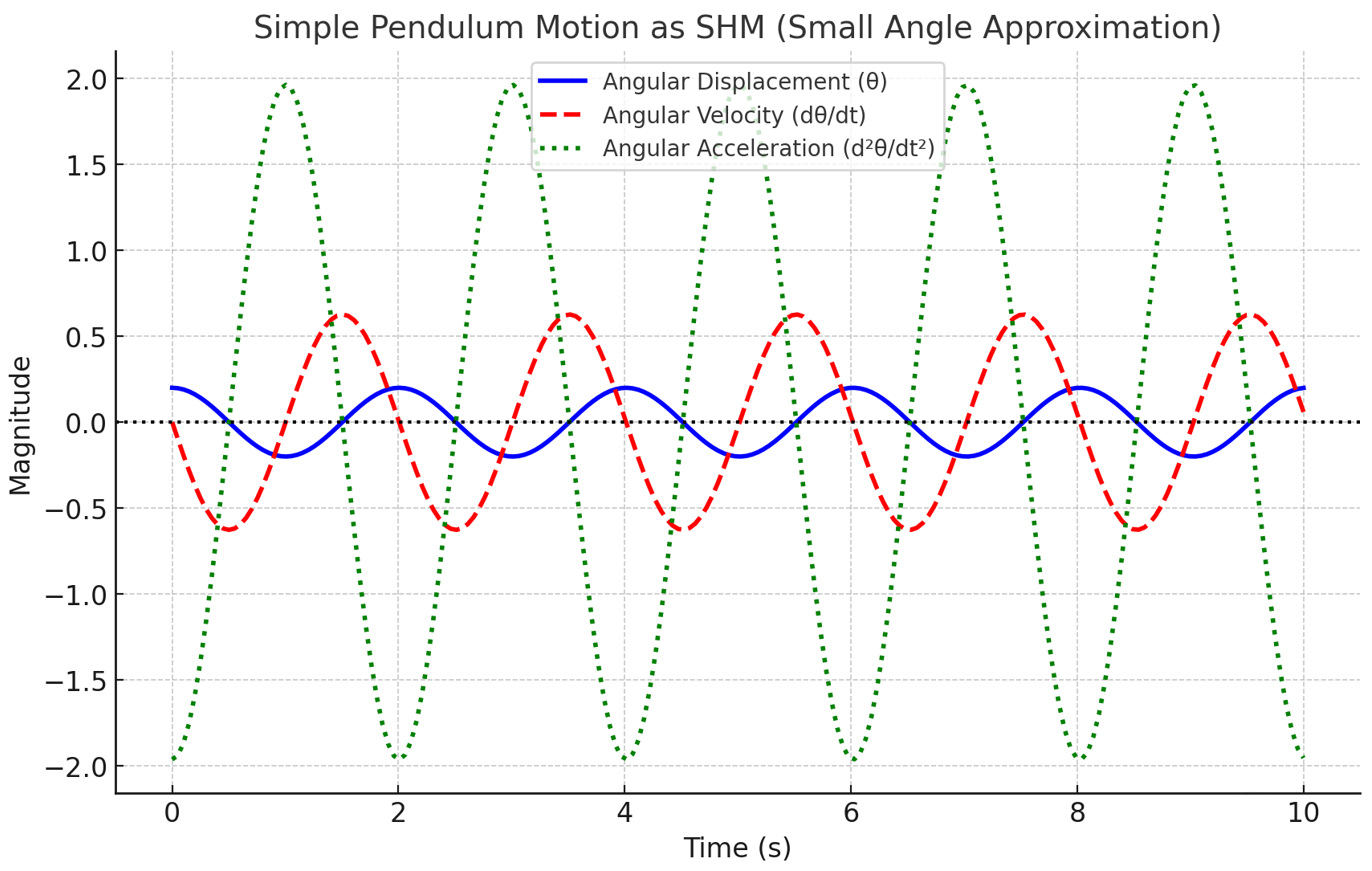
Simple Pendulum Motion as SHM (Small Angle Approximation) ⏳📊
This graph illustrates angular displacement, velocity, and acceleration in a simple pendulum, showing how its motion follows SHM under small angles.
🔹 1. Derivation of SHM for a Simple Pendulum
A simple pendulum consists of a mass (
) suspended by a string of length (
). The restoring force is given by:
Using Newton’s Second Law:
Dividing by
:
Small Angle Approximation (
)
For small angles (
), we approximate:
This simplifies the equation to:
which is the equation of SHM, with angular frequency:
✅ Solution for Angular Displacement:
where:
- = maximum angular displacement (amplitude)
- = angular frequency
✅ Velocity and Acceleration:
🔹 2. Understanding the Graph 📊
✅ Angular displacement (
, blue curve) – Follows a cosine wave, characteristic of SHM.
✅ Angular velocity (
, red dashed curve) – Leads displacement by 90° (π/2 radians).
✅ Angular acceleration (
, green dotted curve) – 180° out of phase with displacement, confirming SHM.
🔹 Key Observations:
- When displacement is max, acceleration is max in the opposite direction.
- When displacement is zero, velocity is max.
🔹 3. Real-World Applications of Pendulum SHM 🌍
✅ Pendulum Clocks ⏰ – Use SHM to regulate timekeeping.
✅ Seismometers 🌍 – Detect ground motion using pendulum-like oscillations.
✅ Vibrational Analysis in Engineering 🏗️ – Bridges, buildings, and oscillating systems.
🔹 Summary 📝
✅ For small angles, the simple pendulum follows SHM.
✅ Angular displacement, velocity, and acceleration follow sinusoidal patterns.
✅ Real-world applications include timekeeping, seismology, and engineering systems.
Activities:
- Experiment: Measure the period of a pendulum for different lengths.
- Solve problems on pendulum motion and period.
Assessment: Worksheet on pendulum calculations.
Explaining qualitatively the energy changes during one cycle of an oscillation unveils a tale of dynamic interplay between potential and kinetic energies, where the pendulum swings and vibrational wonders of the system's motion reveal the harmonious balance and energy exchange that shape the cyclic nature of oscillations with mathematical finesse and scientific elegance.
Let us embark on an energy-filled journey through the oscillatory realms, where the potential and kinetic energies of a system intermingle in a symphony of conservation and transformation, painting the energetic landscapes with vibrational resonance and dynamic beauty:
-
Starting Point - Maximum Potential Energy:
- At the starting point of the oscillation cycle, the system possesses maximum potential energy as the pendulum reaches its highest point. The gravitational potential energy is at its peak, storing energy that will be gradually converted into kinetic energy as the pendulum swings downwards.
-
Midpoint - Maximum Kinetic Energy:
- As the pendulum passes through the equilibrium position, the potential energy decreases while the kinetic energy increases. At the midpoint of the oscillation cycle, the system reaches its maximum kinetic energy, with the pendulum moving at its maximum speed.
-
Turning Points - Interconversion of Energy:
- During the transition from potential energy to kinetic energy and vice versa at the turning points of the oscillation cycle, there is a continuous interconversion of energy. The potential energy decreases as the pendulum descends, while the kinetic energy increases, reaching a balance point at the equilibrium position.
-
End Point - Maximum Potential Energy (Again):
- As the pendulum swings back towards the starting point, the kinetic energy decreases while the potential energy increases. At the end of the oscillation cycle, the system once again possesses maximum potential energy, ready to begin the next cycle of oscillatory motion.
4. SHM Graphs and Equations
Learning Outcomes
- I can interpret displacement-time graphs for SHM.
- I can interpret velocity-time and acceleration-time graphs for SHM.
- I can determine amplitude, period, and frequency from graphs.
- I can relate graphical representations to physical motion.
- I can apply mathematical models of SHM to solve problems.
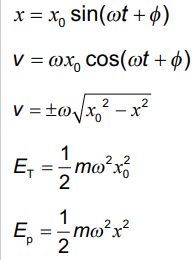
- Kinetic and potential energy in SHM.
- Total mechanical energy conservation.
5. Energy in Oscillatory Systems
Learning Outcomes
- I can explain how energy changes during SHM.
- I can identify positions of maximum kinetic and potential energy.
- I can describe conservation of mechanical energy in oscillating systems.
- I can calculate energy in spring and pendulum systems.
- I can analyze energy transformations occurring during oscillations.
- Types of damping: Light, critical, and heavy damping.
- Energy loss and amplitude reduction over time.