Simple Harmonic Motion
3. Pendulums
Learning Outcomes
- I can describe the motion of a simple pendulum.
- I can explain why small-angle pendulums approximate SHM.
- I can identify factors affecting pendulum period.
- I can compare pendulum motion with spring oscillations.
- I can solve problems involving pendulum motion.
Pendulums
A simple pendulum consists of a small mass called a bob suspended from a fixed point by a light string or rod.
When the bob is displaced from its equilibrium position and released, gravity causes it to swing back and forth.
For relatively small angles, this repeated motion closely approximates simple harmonic motion (SHM).
Pendulums provide an important connection between:
- Forces
- Oscillations
- Energy
- Period and frequency
- Simple harmonic motion


Learning Targets
- I can describe the motion of a simple pendulum.
- I can explain why small-angle pendulums approximate SHM.
- I can identify factors affecting pendulum period.
- I can compare pendulum motion with spring oscillations.
- I can solve problems involving pendulum motion.
The Simple Pendulum
An ideal simple pendulum consists of:
- A point-like mass called the bob
- A light, inextensible string
- A fixed pivot
- Negligible air resistance and friction
The distance from the pivot to the centre of the bob is the pendulum length, L.
The lowest position is the equilibrium position.


Real pendulums do not perfectly satisfy these assumptions, but the simple-pendulum model provides a very useful approximation.
Motion of a Pendulum
Imagine pulling a pendulum bob to one side and releasing it.
The bob moves:
Maximum displacement → Equilibrium → Maximum displacement on opposite side → Equilibrium → Starting position
This represents:
one complete oscillation
The motion then repeats.
The maximum displacement from equilibrium is called the:
amplitude
Important Positions During the Swing
Consider three important positions:
A — Maximum displacement to the left
B — Equilibrium position
C — Maximum displacement to the right
At A:
Speed = 0
At B:
Speed = maximum
At C:
Speed = 0


The bob continually speeds up and slows down as it oscillates.
Forces Acting on the Pendulum
Two main forces act on the bob:
Weight (mg) acting vertically downward.
Tension (T) acting along the string toward the pivot.
The weight can be resolved into components.
One component acts along the string.
Another component acts tangentially to the bob's path.
The tangential component of gravity acts as the restoring force.


The Restoring Force
When the bob is displaced from equilibrium, gravity produces a force component that pulls it back toward equilibrium.
The tangential restoring force is:
F = −mg sin θ
where:
m = mass of the bob
g = gravitational field strength
θ = angular displacement
The negative sign indicates that the force acts opposite to the displacement.
This is similar to the restoring force produced by a spring.
Why Pendulums Can Approximate SHM
For an object to undergo simple harmonic motion, the restoring force must be:
proportional to displacement
and:
opposite to displacement
For a pendulum:
F = −mg sin θ
Normally:
sin θ ≠ θ
so the relationship is not perfectly proportional.
However, for small angles measured in radians:
sin θ ≈ θ
Therefore:
F ≈ −mgθ
The restoring force becomes approximately proportional to angular displacement.
This is why a pendulum at small angles approximates SHM.
The Small-Angle Approximation
The approximation:
sin θ ≈ θ
works best when θ is small and measured in radians.
For example:
5° ≈ 0.087 rad
and:
sin 5° ≈ 0.087
These values are extremely close.
At larger angles, the difference becomes more significant.


For introductory pendulum calculations, angles below approximately 10–15° are commonly treated as small enough for the SHM approximation.
Period of a Pendulum
The period, T, is the time required for one complete oscillation.
For a simple pendulum undergoing small oscillations, explore how length and release angle affect its motion here:
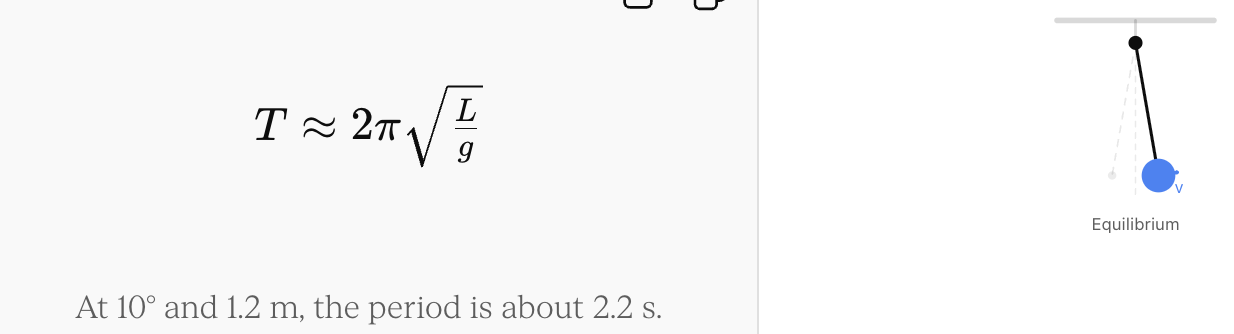
where:
T = period in seconds (s)
L = pendulum length in metres (m)
g = gravitational field strength in m/s²
Notice something interesting:
Mass does not appear in the equation.
Pendulum Length
The period depends on the pendulum's length.
A longer pendulum has a:
longer period
A shorter pendulum has a:
shorter period
Therefore:
Long pendulum → Slower oscillation
Short pendulum → Faster oscillation


The relationship is not directly proportional.
Instead:
T ∝ √L
What Happens if Length Is Doubled?
Suppose:
L → 2L
Since:
T ∝ √L
the new period becomes:
Tnew = √2 × Told
Since:
√2 ≈ 1.41
doubling the length increases the period by a factor of approximately:
1.41
It does not double the period.
What Happens if Length Is Quadrupled?
Suppose the length becomes:
4L
Then:
√4 = 2
Therefore:
Tnew = 2Told
So:
Quadrupling the length doubles the period.
This square-root relationship is important when analyzing pendulum systems.
Worked Example — Calculating Period
A pendulum has length:
L = 1.0 m
Use:
g = 9.8 m/s²
Calculate the period.
T = 2π√(L/g)
T = 2π√(1.0/9.8)
T = 2π√0.102
T ≈ 2π(0.319)
T ≈ 2.01 s
Therefore:
Period ≈ 2.0 s
The pendulum takes approximately two seconds to complete one full oscillation.
Worked Example — A Shorter Pendulum
Calculate the period of a:
0.25 m
pendulum.
Use:
g = 9.8 m/s²
T = 2π√(0.25/9.8)
T ≈ 2π(0.160)
T ≈ 1.00 s
Therefore:
Period ≈ 1.0 s
Notice that reducing the length from 1.0 m to 0.25 m reduces the period from approximately 2.0 s to 1.0 s.
The length was divided by 4, so the period was divided by 2.
Gravitational Field Strength
The period also depends on gravitational field strength.
Since:
T ∝ 1/√g
stronger gravity produces a:
shorter period
Weaker gravity produces a:
longer period


A pendulum would therefore swing more slowly on the Moon than on Earth because the Moon has a weaker gravitational field.
Worked Example — Pendulum on the Moon
Suppose:
L = 1.0 m
On the Moon:
g ≈ 1.62 m/s²
Calculate the period.
T = 2π√(1.0/1.62)
T ≈ 2π(0.786)
T ≈ 4.94 s
So a 1.0 m pendulum would have a period of approximately:
4.9 s
on the Moon.
On Earth, the same pendulum has a period of approximately:
2.0 s
Does Mass Affect the Period?
Suppose one pendulum has a:
50 g bob
and another identical pendulum has a:
500 g bob
If they have the same length and experience the same gravitational field, the ideal small-angle model predicts:
the same period
Mass does not appear in the period equation.


This is an important and sometimes surprising result.
Does Amplitude Affect the Period?
For small angles, the period is approximately independent of amplitude.
A pendulum released from:
5°
and one released from:
10°
will have very similar periods if their lengths are equal.
However, at larger amplitudes, the simple equation becomes less accurate.
The period becomes slightly longer as the starting angle becomes large.
Therefore:
Small amplitude → SHM approximation works well
Large amplitude → Motion deviates from ideal SHM
Frequency of a Pendulum
The frequency, f, is the number of complete oscillations per second.
Frequency and period are related by:
f = 1/T
If:
T = 2.0 s
then:
f = 1/2.0
f = 0.50 Hz
The pendulum completes:
0.50 oscillations each second
or one oscillation every two seconds.
Worked Example — Frequency
A pendulum completes one oscillation every:
1.25 s
Therefore:
T = 1.25 s
Calculate frequency.
f = 1/T
f = 1/1.25
f = 0.80 Hz
Therefore:
Frequency = 0.80 Hz
Energy in Pendulum Motion
A pendulum continually transfers energy between:
gravitational potential energy
and:
kinetic energy
At maximum displacement:
GPE = maximum
KE = minimum
Speed = 0
As the bob falls toward equilibrium:
GPE decreases
KE increases
At equilibrium:
GPE = minimum
KE = maximum
Speed = maximum


As the bob rises on the opposite side, kinetic energy is transferred back into gravitational potential energy.
Energy During One Oscillation
Starting at maximum displacement:
Maximum GPE, zero KE
↓
Moving toward equilibrium:
GPE → KE
↓
At equilibrium:
Maximum KE, minimum GPE
↓
Moving upward:
KE → GPE
↓
At opposite maximum displacement:
Maximum GPE, zero KE
In an ideal system:
Total mechanical energy remains constant.
Speed and Acceleration
At maximum displacement:
Speed = 0
but:
Restoring acceleration magnitude = maximum
At equilibrium:
Speed = maximum
but:
Tangential restoring acceleration = 0
This is the same basic pattern observed in a spring-mass oscillator.
Pendulum Displacement-Time Graph
For small oscillations, pendulum displacement varies approximately sinusoidally with time.
The displacement-time graph therefore resembles a sine or cosine wave.


Important features include:
Amplitude → maximum displacement
Period → time for one complete cycle
Equilibrium → displacement = 0
Comparing Pendulums and Springs
Pendulums and spring-mass systems can both approximate simple harmonic motion.
For a spring:
Restoring force ∝ −displacement
For a small-angle pendulum:
Restoring force ≈ proportional to −displacement
Both systems:
- Oscillate around an equilibrium position.
- Have maximum speed at equilibrium.
- Have zero speed at maximum displacement.
- Have maximum restoring acceleration at maximum displacement.
- Transfer energy between potential and kinetic energy.
- Can produce approximately sinusoidal displacement-time graphs.


Important Difference Between Springs and Pendulums
The period of a spring-mass system is:
T = 2π√(m/k)
Therefore, it depends on:
- Mass
- Spring constant
The period of a simple pendulum is:
T = 2π√(L/g)
Therefore, it depends on:
- Pendulum length
- Gravitational field strength
So the factors controlling their periods are different.
Worked Comparison
Consider two systems.
Spring
m = 1.0 kg
k = 100 N/m
The period depends on m and k.
Pendulum
L = 1.0 m
g = 9.8 m/s²
The period depends on L and g.
Changing the mass affects the spring oscillator's period.
Changing the pendulum bob's mass does not affect the ideal pendulum period.
Finding Pendulum Length from Period
The period equation can be rearranged.
Start with:
T = 2π√(L/g)
Divide by 2π:
T/(2π) = √(L/g)
Square both sides:
T²/(4π²) = L/g
Therefore:
L = gT²/(4π²)
This allows us to calculate the length required for a particular period.
Worked Example — Finding Length
A pendulum has:
T = 1.5 s
Use:
g = 9.8 m/s²
Calculate its length.
L = gT²/(4π²)
L = (9.8)(1.5²)/(4π²)
L = (9.8)(2.25)/(39.48)
L ≈ 0.56 m
Therefore:
Pendulum length ≈ 0.56 m
Measuring g with a Pendulum
The pendulum equation can also be rearranged to estimate gravitational field strength:
g = 4π²L/T²
Therefore, if we accurately measure:
- Pendulum length
- Pendulum period
we can experimentally estimate g.


This is a classic physics experiment.
Measuring the Period Experimentally
Timing only one oscillation can produce a large percentage uncertainty because human reaction time is significant.
A better method is to time several oscillations.
For example, measure the time for:
10 oscillations
Suppose:
10 oscillations = 18.4 s
Then:
T = 18.4/10
T = 1.84 s
This reduces the effect of reaction-time uncertainty.
Investigating Length and Period
A useful experiment is to investigate:
How does pendulum length affect period?
Change the pendulum length while keeping other variables controlled.
For each length:
- Use a small release angle.
- Release without pushing.
- Time 10 or 20 oscillations.
- Calculate the period.
- Repeat measurements.
- Calculate an average.


Variables in a Pendulum Experiment
If investigating the effect of length:
Independent variable → pendulum length
Dependent variable → period
Important control variables include:
- Same bob
- Same release angle
- Same gravitational field
- Same release technique
The angle should remain relatively small so that the SHM approximation remains valid.
Plotting Pendulum Data
Because:
T = 2π√(L/g)
T is not directly proportional to L.
A graph of:
T against L
will therefore be curved.
However, squaring the equation gives:
T² = (4π²/g)L
Therefore:
T² ∝ L
A graph of:
T² against L
should be a straight line through approximately the origin.


This provides a useful experimental test of the pendulum model.
Real Pendulums and Damping
A real pendulum eventually stops swinging.
This happens because mechanical energy is transferred to the surroundings through:
- Air resistance
- Friction at the pivot
- Sound
- Heating
The amplitude gradually decreases.
This is called:
damping


An ideal pendulum model assumes these energy losses are negligible.
Pendulum Clocks
Pendulums became extremely important in accurate mechanical clocks because their periods can be highly regular.


The period can be controlled mainly by adjusting the pendulum length.
A longer pendulum swings more slowly.
A shorter pendulum swings more quickly.
This allowed pendulums to provide a regular timing mechanism.
Common Mistakes
Mistake: Measuring Pendulum Length Incorrectly
Pendulum length should normally be measured from:
the pivot to the centre of the bob
not merely the length of the visible string.
Mistake: Thinking a Heavier Bob Has a Longer Period
For an ideal simple pendulum:
Period does not depend on bob mass.
Mistake: Assuming Period Is Directly Proportional to Length
The relationship is:
T ∝ √L
not:
T ∝ L
Mistake: Using the Small-Angle Equation at Very Large Angles
The standard period equation is an approximation for relatively small oscillations.
Mistake: Timing Only One Oscillation
Reaction-time uncertainty becomes significant.
Time several oscillations and divide by the number of oscillations.
Mistake: Confusing Half an Oscillation with a Full Oscillation
Moving from one extreme to the opposite extreme is:
half an oscillation
Returning to the original extreme completes:
one full oscillation
Mistake: Thinking Speed Is Greatest at Maximum Displacement
At maximum displacement:
speed = 0
Speed is greatest at:
equilibrium
Key Terms
Pendulum – mass suspended from a pivot that can swing back and forth.
Bob – mass at the end of a pendulum.
Pivot – fixed point from which the pendulum is suspended.
Equilibrium position – lowest central position of the pendulum.
Amplitude – maximum displacement from equilibrium.
Oscillation – one complete repeated cycle of motion.
Period – time required for one complete oscillation.
Frequency – number of complete oscillations per second.
Restoring force – force acting toward equilibrium.
Small-angle approximation – approximation that sin θ ≈ θ when θ is small and measured in radians.
Simple harmonic motion – oscillatory motion in which restoring force or acceleration is proportional and opposite to displacement.
Damping – gradual decrease in amplitude due to energy transfer to the surroundings.
Check Your Understanding
1. Describe one complete oscillation of a pendulum.
2. Where is the speed of a pendulum bob greatest?
3. Where is its speed zero?
4. What provides the restoring force for a pendulum?
5. Explain why a small-angle pendulum approximates simple harmonic motion.
6. A pendulum has a length of 0.80 m. Calculate its period using g = 9.8 m/s².
7. What happens to the period if the pendulum length increases?
8. If the pendulum length is quadrupled, what happens to its period?
9. Does increasing the mass of the bob change the ideal pendulum period?
10. Explain why a pendulum swings more slowly on the Moon than on Earth.
11. A pendulum has a period of 2.5 s. Calculate its frequency.
12. A pendulum has a period of 2.0 s. Approximately how long will 20 complete oscillations take?
13. Describe the energy changes as the bob moves from maximum displacement toward equilibrium.
14. Give two similarities between a pendulum and a spring-mass oscillator.
15. Give one important difference between the factors controlling the periods of pendulums and spring-mass oscillators.
Key Takeaways
- A simple pendulum consists of a bob suspended from a fixed pivot.
- The bob oscillates around an equilibrium position.
- Gravity provides the restoring effect.
- For small angles, the restoring force is approximately proportional and opposite to displacement.
- Therefore, a small-angle pendulum approximates simple harmonic motion.
- The period depends mainly on pendulum length and gravitational field strength.
- Increasing pendulum length increases the period.
- Increasing gravitational field strength decreases the period.
- Bob mass does not affect the period of an ideal simple pendulum.
- For small oscillations, amplitude has very little effect on period.
- Speed is greatest at equilibrium.
- Speed is zero at maximum displacement.
- Gravitational potential energy and kinetic energy continually transfer between each other.
- Pendulums and spring-mass systems can both approximate SHM.
- Pendulum period depends on L and g, while spring period depends on m and k.
- Timing several oscillations improves experimental measurements.
- A graph of T² against L should be approximately linear.
- Real pendulums experience damping because energy is transferred to the surroundings.
Did You Know?
Pendulums can actually be used to measure gravity. Because their period depends on gravitational field strength, scientists can measure the length and period of a carefully controlled pendulum and calculate the local value of g. Small variations in gravitational field strength from one location to another can even provide information about differences in the density of rocks beneath Earth's surface.