Simple Harmonic Motion
3. Pendulums
Learning Outcomes
- I can describe the motion of a simple pendulum.
- I can explain why small-angle pendulums approximate SHM.
- I can identify factors affecting pendulum period.
- I can compare pendulum motion with spring oscillations.
- I can solve problems involving pendulum motion.
- Restoring force: .
- Period of a pendulum: .
- Assumptions for SHM (small-angle approximation).
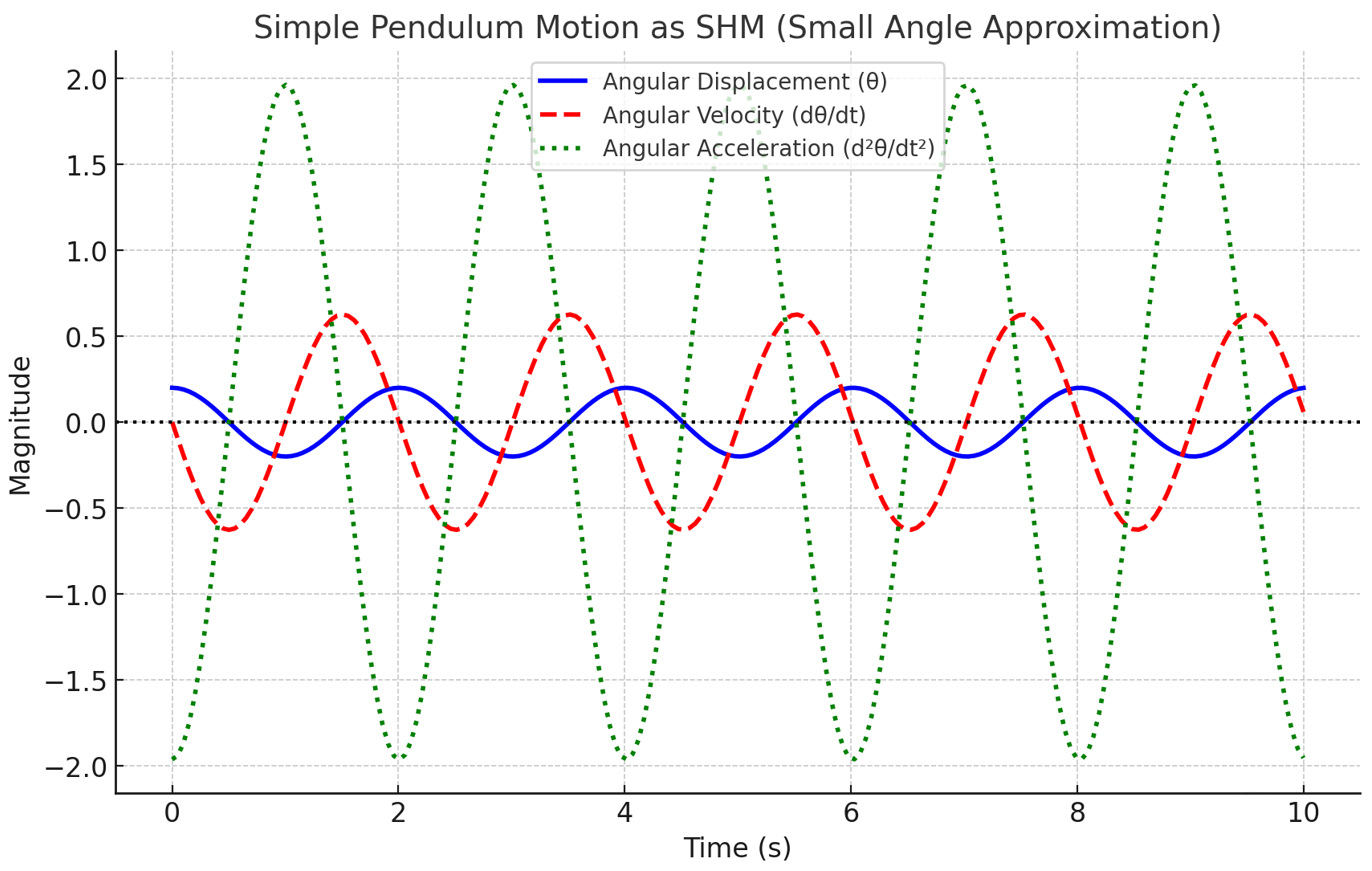
Simple Pendulum Motion as SHM (Small Angle Approximation) ⏳📊
This graph illustrates angular displacement, velocity, and acceleration in a simple pendulum, showing how its motion follows SHM under small angles.
🔹 1. Derivation of SHM for a Simple Pendulum
A simple pendulum consists of a mass (
) suspended by a string of length (
). The restoring force is given by:
Using Newton’s Second Law:
Dividing by
:
Small Angle Approximation (
)
For small angles (
), we approximate:
This simplifies the equation to:
which is the equation of SHM, with angular frequency:
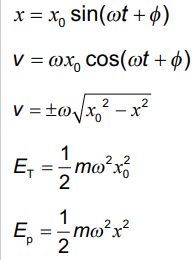
✅ Solution for Angular Displacement:
where:
- = maximum angular displacement (amplitude)
- = angular frequency
✅ Velocity and Acceleration:
🔹 2. Understanding the Graph 📊
✅ Angular displacement (
, blue curve) – Follows a cosine wave, characteristic of SHM.
✅ Angular velocity (
, red dashed curve) – Leads displacement by 90° (π/2 radians).
✅ Angular acceleration (
, green dotted curve) – 180° out of phase with displacement, confirming SHM.
🔹 Key Observations:
- When displacement is max, acceleration is max in the opposite direction.
- When displacement is zero, velocity is max.
🔹 3. Real-World Applications of Pendulum SHM 🌍
✅ Pendulum Clocks ⏰ – Use SHM to regulate timekeeping.
✅ Seismometers 🌍 – Detect ground motion using pendulum-like oscillations.
✅ Vibrational Analysis in Engineering 🏗️ – Bridges, buildings, and oscillating systems.
🔹 Summary 📝
✅ For small angles, the simple pendulum follows SHM.
✅ Angular displacement, velocity, and acceleration follow sinusoidal patterns.
✅ Real-world applications include timekeeping, seismology, and engineering systems.
Activities:
- Experiment: Measure the period of a pendulum for different lengths.
- Solve problems on pendulum motion and period.
Assessment: Worksheet on pendulum calculations.
Explaining qualitatively the energy changes during one cycle of an oscillation unveils a tale of dynamic interplay between potential and kinetic energies, where the pendulum swings and vibrational wonders of the system's motion reveal the harmonious balance and energy exchange that shape the cyclic nature of oscillations with mathematical finesse and scientific elegance.
Let us embark on an energy-filled journey through the oscillatory realms, where the potential and kinetic energies of a system intermingle in a symphony of conservation and transformation, painting the energetic landscapes with vibrational resonance and dynamic beauty:
-
Starting Point - Maximum Potential Energy:
- At the starting point of the oscillation cycle, the system possesses maximum potential energy as the pendulum reaches its highest point. The gravitational potential energy is at its peak, storing energy that will be gradually converted into kinetic energy as the pendulum swings downwards.
-
Midpoint - Maximum Kinetic Energy:
- As the pendulum passes through the equilibrium position, the potential energy decreases while the kinetic energy increases. At the midpoint of the oscillation cycle, the system reaches its maximum kinetic energy, with the pendulum moving at its maximum speed.
-
Turning Points - Interconversion of Energy:
- During the transition from potential energy to kinetic energy and vice versa at the turning points of the oscillation cycle, there is a continuous interconversion of energy. The potential energy decreases as the pendulum descends, while the kinetic energy increases, reaching a balance point at the equilibrium position.
-
End Point - Maximum Potential Energy (Again):
- As the pendulum swings back towards the starting point, the kinetic energy decreases while the potential energy increases. At the end of the oscillation cycle, the system once again possesses maximum potential energy, ready to begin the next cycle of oscillatory motion.