Simple Harmonic Motion
2. Springs and Hooke’s Law
Learning Outcomes
- I can state and apply Hooke’s Law.
- I can calculate restoring forces using spring constants.
- I can interpret force-extension graphs.
- I can explain the relationship between force and displacement in SHM.
- I can analyze oscillations of spring-mass systems.
- Hooke’s Law: .
- Restoring force and its role in SHM.
- Period of a mass-spring system: .
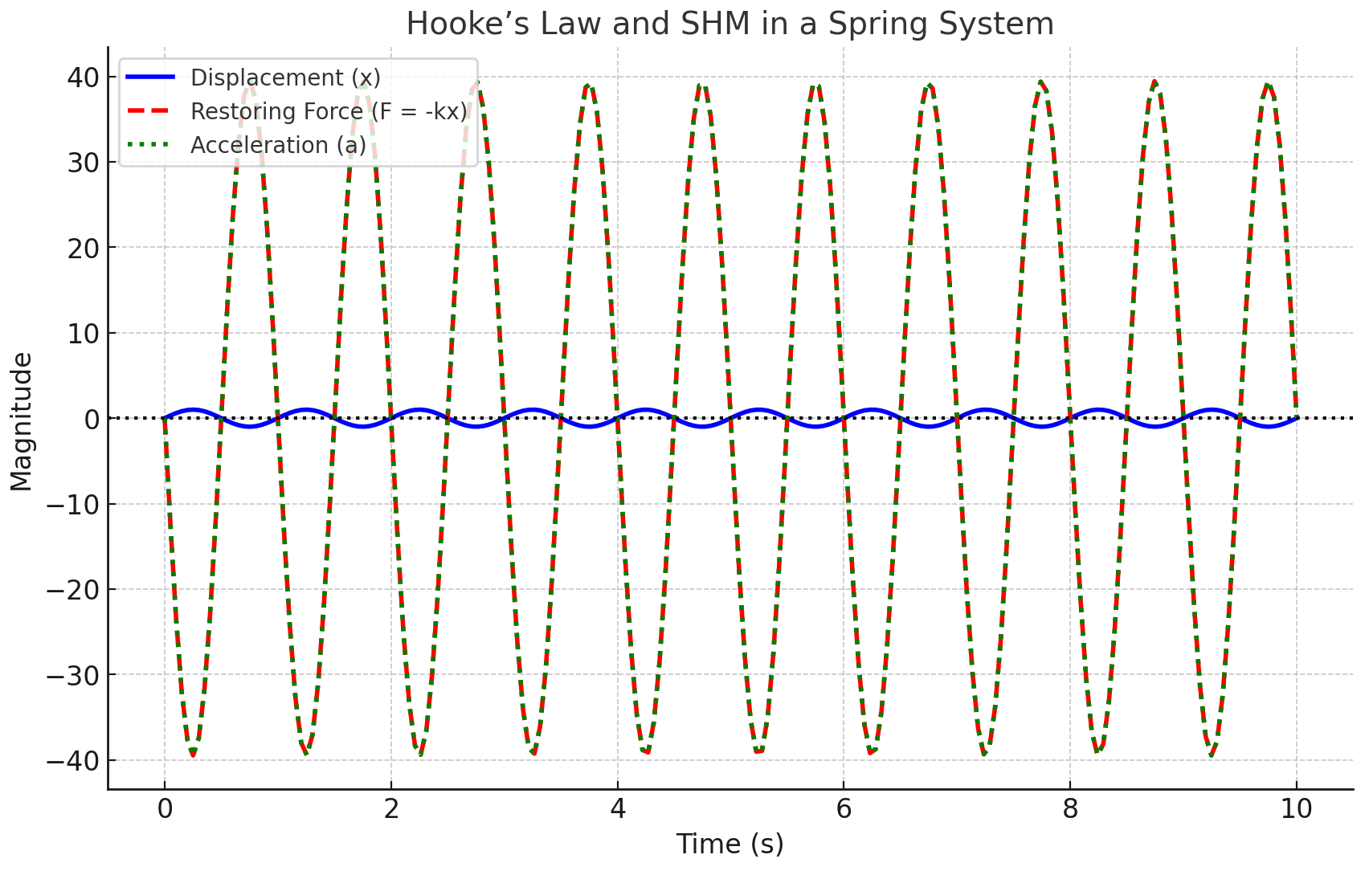
Hooke’s Law and SHM in a Spring System 🔄⚖️
This graph illustrates the relationship between Hooke’s Law and Simple Harmonic Motion (SHM) in a spring-mass system, showing displacement, restoring force, and acceleration over time.
🔹 1. Hooke’s Law and SHM Relationship
Hooke’s Law states that the force exerted by a spring is proportional to its displacement:
where:
- = restoring force (N)
- = spring constant (N/m)
- = displacement from equilibrium (m)
Since force follows Newton’s Second Law (
), we can rewrite Hooke’s Law as:
which simplifies to the SHM equation:
Since
, we get:
✅ Key Insight: The acceleration is proportional to displacement but always acts opposite to it, causing oscillatory motion.
🔹 2. Understanding the Graph 📊
✅ Displacement (
, blue curve) – Follows a sinusoidal pattern, representing the oscillatory motion of the mass.
✅ Restoring Force (
, red dashed curve) – Always directed opposite to displacement, obeying Hooke’s Law.
✅ Acceleration (
, green dotted curve) – Has the same shape as force, confirming that force causes acceleration.
🔹 Key Observations:
- When (equilibrium position), and (object moves fastest).
- When (max displacement), and are max (restoring force pulls back hardest).
- Force and acceleration are always 180° out of phase with displacement.
🔹 3. Real-World Applications of Hooke’s Law & SHM 🌍
✅ Shock Absorbers & Car Suspensions 🚗 – Use springs to dampen road impacts.
✅ Spring Scales ⚖️ – Measure weight using Hooke’s Law.
✅ Seismometers 🌍 – Detect earthquakes by measuring SHM.
✅ Oscillating Systems in Engineering 🔧 – Used in bridges, circuits, and mechanical devices.
🔹 Summary 📝
✅ Hooke’s Law (
) provides the restoring force needed for SHM.
✅ Acceleration is proportional to displacement but in the opposite direction.
✅ Graphical analysis shows force and acceleration are 180° out of phase with displacement.
✅ Applications range from engineering and vehicles to scientific measurement tools.
Activities:
- Experiment: Measure the period of a mass-spring system for different spring constants.
- Solve problems to calculate spring force, displacement, and period.
Assessment: Lab report on Hooke’s Law and spring oscillations.
Mass-Spring
Calculating the time period of a mass-spring system involves unraveling the equilibrium forces, restoring forces, and dynamic interactions that govern the oscillations and periodicity of the system's motion through the realms of kinetic wonders and potential energies.
Let us embark on a spring-filled journey through the oscillatory realms of a mass-spring system, where the equilibrium positions and restoring forces of the spring unveil the rhythmic nature and periodicity of the system's vibrations with mathematical finesse and scientific precision:
-
Equilibrium Position and Restoring Force:
- In a mass-spring system, the equilibrium position is the point where the spring force balances the gravitational force acting on the mass, resulting in a stable configuration. When the mass is displaced from this position, the spring exerts a restoring force that brings the mass back towards equilibrium.
-
Hooke's Law and Spring Constant:
- Hooke's Law states that the force exerted by a spring is directly proportional to the displacement of the mass from equilibrium. The spring constant, denoted by k, quantifies the stiffness of the spring and determines the strength of the restoring force acting on the mass.
-
Time Period Calculation:
- The time period of a mass-spring system, denoted by T, is the time taken for the system to complete one full oscillation. It is calculated using the formula:
- is the time period,
- is the mathematical constant pi (approximately 3.14159),
- is the mass of the object attached to the spring, and
- is the spring constant.
-
Oscillatory Motion and Periodicity:
- By understanding the equilibrium forces, restoring forces, and dynamic interactions within the mass-spring system, one can determine the time period of the system's oscillations and unravel the rhythmic dance of vibrations that characterize the periodic nature of the system's motion.
Simple Pendulum
Determining the time period of a simple pendulum involves unraveling the gravitational forces, pendulum length, and angular displacement that govern the rhythmic oscillations and timeless wonders of the pendulum's motion through the spatial realms of harmonic resonance and gravitational embrace.
Let us embark on a pendulum-filled journey through the celestial realms, where the gravitational forces and angular displacements of a simple pendulum unveil the rhythmic nature and periodicity of its swings with mathematical finesse and scientific precision:
-
Gravitational Force and Angular Displacement:
- In a simple pendulum, the gravitational force acts as the restoring force that brings the pendulum back towards its equilibrium position. The angular displacement, denoted by theta (θ), measures the angle between the pendulum's resting position and its maximum swing.
-
Pendulum Length and Acceleration Due to Gravity:
- The length of the pendulum, denoted by L, plays a crucial role in determining the time period of the pendulum's oscillations. The acceleration due to gravity, denoted by g, influences the gravitational force acting on the pendulum mass.
-
Time Period Calculation:
- The time period of a simple pendulum, denoted by T, is the time taken for the pendulum to complete one full swing. It is calculated using the formula:
- is the time period,
- is the mathematical constant pi (approximately 3.14159),
- is the length of the pendulum, and
- is the acceleration due to gravity.
-
Oscillatory Motion and Periodicity:
- By understanding the gravitational forces, pendulum length, and angular displacements within a simple pendulum, one can determine the time period of its swings and unravel the rhythmic dance of oscillations that define the periodic nature of the pendulum's motion.