Bond Energies and Energy Calculations
2. Forming Chemical Bonds
Learning outcomes
- I can explain why bond formation releases energy.
- I can describe bond formation as an exothermic process.
- I can compare energy released by different bonds.
- I can explain the role of bond formation in reactions.
- I can relate bond formation to overall energy changes.
What Happens When a Chemical Bond Forms?
A chemical bond forms when atoms or ions become attracted strongly enough to create a more stable arrangement.
When two atoms that can bond move toward one another, attractive interactions between their nuclei and electrons lower the potential energy of the system.
The atoms move from a:
higher-energy, less stable arrangement
to a:
lower-energy, more stable arrangement
The difference in energy is transferred to the surroundings.
Therefore:
forming bonds releases energy
and:
bond formation is exothermic.
Why Does Bond Formation Release Energy?
Consider two atoms that are initially far apart.
When they are far apart, there is little attractive interaction between them.
As they approach one another, attractive forces develop between:
- each positively charged nucleus
- the electrons associated with the other atom
If the atoms are at an appropriate distance, these attractions lower the potential energy of the system.
The atoms become more stable.
The decrease in potential energy must appear somewhere else.
It is released to the surroundings, often as thermal energy.
Therefore:
separated atoms → bonded atoms + energy
or more generally:
A + B → A–B + energy
The bottom of the energy well represents the most stable bond distance. Moving into that lower-energy state releases energy.
Bond Formation Is Exothermic
An exothermic process transfers energy from the chemical system to its surroundings.
Because bond formation lowers the potential energy of the atoms, energy leaves the system.
Therefore:
bond formation → exothermic
The enthalpy change associated with forming a bond is negative.
For example:
2H(g) → H₂(g)
releases approximately:
436 kJ mol⁻¹
We can express the energy change as approximately:
ΔH = −436 kJ mol⁻¹
The negative sign indicates that energy has been released from the chemical system.
Bond Breaking and Bond Formation Are Opposites
The two processes can be compared directly.
Bond breaking:
A–B + energy → A + B
Energy absorbed
Endothermic
Bond formation:
A + B → A–B + energy
Energy released
Exothermic
The amount of energy required to break a particular bond is approximately equal in magnitude to the energy released when that same bond forms under corresponding conditions.
For example:
H₂ → 2H
requires approximately:
+436 kJ mol⁻¹
while:
2H → H₂
releases approximately:
−436 kJ mol⁻¹.
Why Is the Bonded State More Stable?
In chemistry, a system tends to be more stable when it has lower potential energy.
Consider a ball rolling downhill.
At the top of a hill, it has relatively high gravitational potential energy.
At the bottom, it has lower potential energy and is more stable.
Bond formation is similar.
Separated atoms begin at a higher potential energy.
As a stable bond forms, the system moves to a lower potential energy.
The energy difference is transferred to the surroundings.
This is why we can summarize bond formation as:
higher energy → lower energy + released energy
Bond Energy and Bond Formation
A bond energy is commonly defined as the energy required to break one mole of a particular type of bond in gaseous molecules.
Bond energy can also tell us approximately how much energy is released when that bond forms.
For example:
H–H bond energy ≈ 436 kJ mol⁻¹
Breaking H–H:
+436 kJ mol⁻¹
Forming H–H:
−436 kJ mol⁻¹
The magnitudes are approximately the same, but the direction of energy transfer is opposite.
Stronger Bonds Release More Energy When They Form
A stronger bond has a greater bond energy.
Therefore, forming a stronger bond generally releases more energy than forming a weaker comparable bond.
Consider these approximate average bond energies:
| Bond | Average Bond Energy (kJ mol⁻¹) |
|---|---|
| Cl–Cl | 243 |
| C–C | 345 |
| C–H | 413 |
| H–H | 436 |
| O–H | 463 |
| O=O | 498 |
| C=C | 611 |
| C≡C | 837 |
| N≡N | 945 |
If one mole of N≡N bonds forms from separated nitrogen atoms, a very large amount of energy is released because the N≡N bond is extremely strong.
If one mole of Cl–Cl bonds forms, less energy is released.
Therefore:
stronger bond → larger energy release when formed
and:
weaker bond → smaller energy release when formed
Single, Double and Triple Bonds
For bonds between the same kinds of atoms, bond order usually affects bond strength.
Consider carbon-carbon bonds:
C–C ≈ 345 kJ mol⁻¹
C=C ≈ 611 kJ mol⁻¹
C≡C ≈ 837 kJ mol⁻¹
So:
C≡C > C=C > C–C
in bond strength.
Because stronger bonds correspond to a greater lowering of potential energy when formed, forming stronger bonds generally releases more energy.
However, a double bond is not simply twice as strong as a single bond, and a triple bond is not exactly three times as strong.
Bond Strength and Bond Length
Bond strength is also related to bond length.
For carbon-carbon bonds:
| Bond | Approximate Bond Length | Average Bond Energy |
|---|---|---|
| C–C | 154 pm | 345 kJ mol⁻¹ |
| C=C | 134 pm | 611 kJ mol⁻¹ |
| C≡C | 120 pm | 837 kJ mol⁻¹ |
For the same pair of atoms:
shorter bonds are generally stronger
and:
stronger bonds release more energy when they form
Worked Example 1: Forming Hydrogen
Two separated hydrogen atoms combine:
H(g) + H(g) → H₂(g)
The H–H bond energy is approximately:
436 kJ mol⁻¹
Therefore, forming one mole of H–H bonds releases approximately:
436 kJ
The energy change can be written as:
ΔH ≈ −436 kJ mol⁻¹
The negative sign indicates an exothermic process.
Worked Example 2: Comparing Bond Formation
Suppose Bond A has a bond energy of:
250 kJ mol⁻¹
and Bond B has a bond energy of:
600 kJ mol⁻¹
Which bond releases more energy when formed?
Bond B
Approximately:
600 − 250 = 350 kJ mol⁻¹
more energy would be released when one mole of Bond B forms compared with one mole of Bond A.
Bond B is also the stronger bond.
Bond Formation During a Chemical Reaction
Chemical reactions involve rearranging atoms.
Existing bonds in the reactants are disrupted, while new bonds form in the products.
A simplified reaction might be:
AB + CD → AC + BD
During the first part:
A–B and C–D are broken
Energy is absorbed.
During the second part:
A–C and B–D are formed
Energy is released.
The overall reaction energy depends on the balance between these two energy changes.
The Overall Energy Change
The enthalpy change of a reaction can be estimated from bond energies using:
ΔH ≈ ΣE(bonds broken) − ΣE(bonds formed)
Remember:
Breaking bonds → energy IN
Forming bonds → energy OUT
Suppose:
Energy required to break reactant bonds = 700 kJ mol⁻¹
Energy released forming product bonds = 900 kJ mol⁻¹
Then:
ΔH = 700 − 900
ΔH = −200 kJ mol⁻¹
The reaction is exothermic.
Why?
Because forming the product bonds released more energy than was required to break the reactant bonds.
Exothermic Reactions and Bond Formation
An exothermic reaction occurs when:
energy released forming bonds > energy absorbed breaking bonds
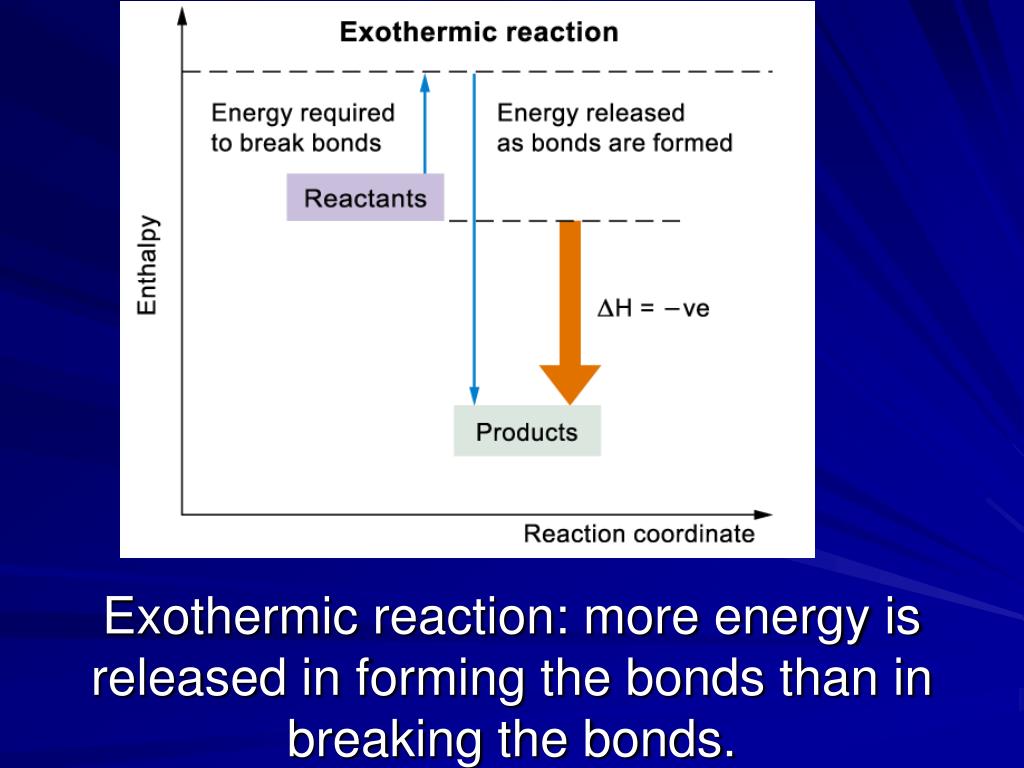
In the diagram, energy must first be supplied to disrupt the reactant bonds.
A larger amount of energy is then released when the product bonds form.
The products finish at a lower energy than the reactants.
Therefore:
ΔH < 0
This is the energetic basis of many exothermic reactions.
Endothermic Reactions and Bond Formation
Bond formation always releases energy, even during an overall endothermic reaction.
The difference is that an endothermic reaction requires more energy to break the reactant bonds than is released when product bonds form.
For example:
Energy required for bond breaking:
900 kJ mol⁻¹
Energy released during bond formation:
650 kJ mol⁻¹
Therefore:
ΔH = 900 − 650
ΔH = +250 kJ mol⁻¹
The reaction is endothermic.
Notice:
bond formation still released 650 kJ mol⁻¹.
It simply did not release enough energy to compensate for the energy required to break the original bonds.
A Crucial Rule
Do not say:
"Bond formation is exothermic only in exothermic reactions."
Bond formation itself is always energy-releasing.
Similarly:
Bond breaking itself is always energy-requiring.
The overall reaction may be either exothermic or endothermic depending on the balance between the two.
Formation of Water
Consider:
2H₂ + O₂ → 2H₂O
To begin the reaction, bonds in the reactants must be disrupted:
- H–H bonds
- O=O bonds
This requires energy.
The atoms then rearrange and form O–H bonds in water.
Formation of the O–H bonds releases energy.
The newly formed O–H bonds are sufficiently strong that their formation releases more energy than was required overall to break the H–H and O=O bonds.
Therefore, the formation of water from hydrogen and oxygen is strongly exothermic.
Worked Example 3: Formation of HCl
Consider:
H₂ + Cl₂ → 2HCl
Approximate bond energies:
H–H = 436 kJ mol⁻¹
Cl–Cl = 243 kJ mol⁻¹
H–Cl = 431 kJ mol⁻¹
Step 1: Energy needed to break bonds
Break one H–H bond:
436 kJ mol⁻¹
Break one Cl–Cl bond:
243 kJ mol⁻¹
Total:
436 + 243 = 679 kJ mol⁻¹
Step 2: Energy released forming bonds
Two H–Cl bonds form:
2 × 431 = 862 kJ mol⁻¹
Step 3: Calculate ΔH
ΔH ≈ 679 − 862
ΔH ≈ −183 kJ mol⁻¹
So the reaction is exothermic.
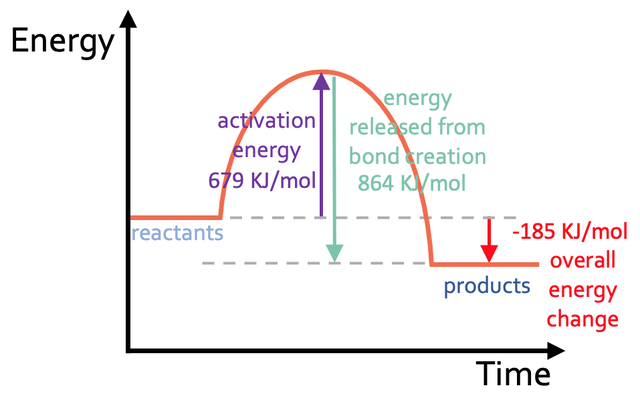
The key reason is:
forming the H–Cl bonds releases more energy than breaking H–H and Cl–Cl requires.
Combustion and Bond Formation
Consider the combustion of methane:
CH₄ + 2O₂ → CO₂ + 2H₂O
Reactant bonds include:
- C–H
- O=O
Product bonds include:
- C=O
- O–H
The C–H and O=O bonds must first be disrupted.
That requires energy.
Then strong C=O and O–H bonds form.
That releases a large amount of energy.
The formation of the product bonds releases more energy than is required to break the reactant bonds.
Therefore:
methane combustion is exothermic
This is why combustion reactions can transfer large amounts of energy to the surroundings.
Does Energy Come From "Breaking Fuel Bonds"?
A common explanation says:
"Fuel releases energy because its bonds are broken."
That is incorrect.
Breaking bonds in the fuel requires energy.
Breaking O=O bonds in oxygen also requires energy.
Energy is released when new, more stable product bonds form.
In methane combustion, much of the energy release is associated with forming strong:
C=O bonds
and:
O–H bonds
So the more accurate explanation is:
Combustion releases energy because the new product bonds are energetically more favourable than the original set of reactant bonds.
Strong Product Bonds and Exothermic Reactions
Suppose two hypothetical reactions require the same amount of bond-breaking energy.
Reaction A forms relatively weak product bonds.
Reaction B forms much stronger product bonds.
Reaction B will release more energy during bond formation.
It may therefore have a more negative ΔH.
This leads to an important connection:
strong product bonds can contribute to a strongly exothermic reaction
But remember that the overall energy change always depends on both sides of the calculation:
- energy required to break reactant bonds
- energy released forming product bonds
Bond Formation and Reaction Profiles
On an energy profile diagram, the system initially climbs toward the transition state.
As products form and new bonds become established, the energy of the system decreases.
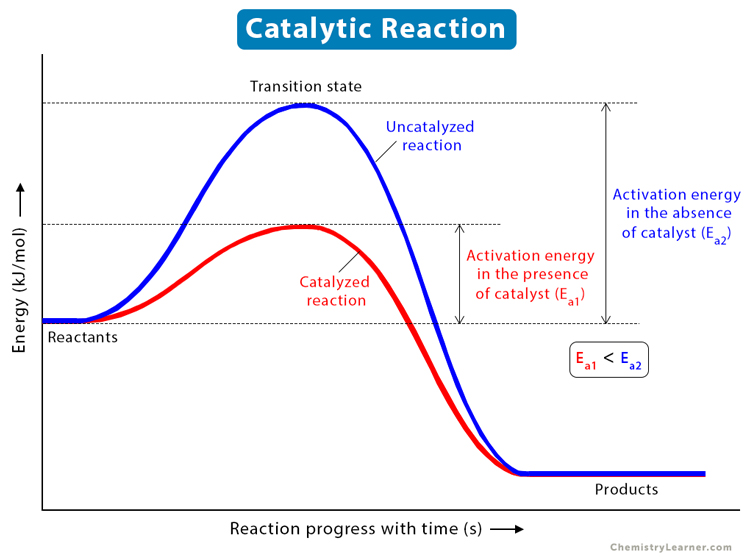
For an exothermic reaction, the new bonding arrangement in the products has a lower energy than the original reactants.
The difference is transferred to the surroundings.
For an endothermic reaction, bond formation still lowers energy from the high-energy transition-state region, but the final products remain above the original reactants.
Bond Formation and Catalysts
A catalyst changes the pathway of a reaction.
It can make it easier for bonds to reorganize by providing a pathway with a lower activation energy.
However, a catalyst does not change:
- which reactants begin the reaction
- which products are formed
- their initial and final energy levels
- the overall ΔH
Therefore, it does not change the overall energy released through the difference between reactant and product bonding.
Bond Formation and Stability
Stronger bonding arrangements usually correspond to lower potential energy and greater stability.
This is why reactions that produce particularly stable molecules can release substantial amounts of energy.
For example, nitrogen contains an extremely strong N≡N bond.
The N≡N bond has an average bond energy of approximately:
945 kJ mol⁻¹
Forming such a strong bond from separated nitrogen atoms would produce a very large decrease in potential energy and therefore a large release of energy.
Energy Is Conserved
When bonds form, energy does not disappear.
The decrease in the chemical potential energy of the atoms is transferred into other forms.
It may appear as:
- thermal energy
- light
- kinetic energy of surrounding particles
The total energy remains conserved.
So when we say:
"bond formation releases energy"
we mean that energy is transferred from the chemical system to the surroundings.
Worked Example 4: Comparing Energy Released
Suppose three bonds form:
Bond A = 250 kJ mol⁻¹
Bond B = 460 kJ mol⁻¹
Bond C = 800 kJ mol⁻¹
Which releases the most energy per mole when formed?
Bond C
Approximate energy released:
800 kJ mol⁻¹
Which releases the least?
Bond A
Approximate energy released:
250 kJ mol⁻¹
Which is strongest?
Bond C
Therefore:
greater bond energy → stronger bond → greater energy release when that bond forms
Worked Example 5: Several Bonds Forming
Suppose a reaction forms:
2 O–H bonds
Average O–H bond energy:
463 kJ mol⁻¹
Energy released:
2 × 463
= 926 kJ mol⁻¹
Because this is bond formation, the energy change associated with that step is approximately:
−926 kJ mol⁻¹
If four O–H bonds form:
4 × 463 = 1852 kJ mol⁻¹
Approximately 1852 kJ mol⁻¹ would be released during formation of those bonds.
Worked Example 6: Is the Overall Reaction Exothermic?
Suppose:
Energy absorbed breaking bonds = 1250 kJ mol⁻¹
Energy released forming bonds = 1620 kJ mol⁻¹
Calculate:
ΔH = 1250 − 1620
ΔH = −370 kJ mol⁻¹
Therefore:
370 kJ mol⁻¹ is released overall
and the reaction is:
exothermic
Why?
Because:
bond formation released 370 kJ mol⁻¹ more than bond breaking required.
Worked Example 7: Is the Overall Reaction Endothermic?
Suppose:
Energy absorbed breaking bonds = 980 kJ mol⁻¹
Energy released forming bonds = 720 kJ mol⁻¹
Then:
ΔH = 980 − 720
ΔH = +260 kJ mol⁻¹
The reaction absorbs:
260 kJ mol⁻¹ overall
and is:
endothermic
However, the bond-formation stage was still exothermic.
It released:
720 kJ mol⁻¹
The reaction is endothermic only because even more energy was needed for bond breaking.
Did You Know?
The enormous energy released by some explosions is not caused by chemical bonds "containing explosive energy" that escapes when they break.
In fact, breaking the original bonds requires energy.
The rapid energy release occurs when atoms rearrange and form a new collection of strongly bonded, stable products.
For many explosive reactions, stable gaseous molecules such as:
N₂
CO₂
and:
H₂O
can be produced very rapidly.
The combination of energy release and rapid gas production produces the dramatic expansion associated with an explosion.
Common Misconceptions
"Forming bonds requires energy."
Incorrect. Stable bond formation releases energy.
"Breaking a strong bond releases lots of energy."
Incorrect. Breaking a strong bond requires a large amount of energy.
"Only exothermic reactions contain bond formation."
Incorrect. Both exothermic and endothermic chemical reactions normally involve bond formation.
"Bond formation in an endothermic reaction absorbs energy."
Incorrect. Bond formation is still exothermic. The overall reaction is endothermic because bond breaking requires more energy than bond formation releases.
"Bond energy only tells us how difficult a bond is to break."
Bond energy is defined using bond breaking, but it also tells us approximately how much energy is released when the same bond forms under corresponding conditions.
"If strong bonds are present in a fuel, breaking them releases energy."
Incorrect. Energy must be supplied to break them. The overall release depends on forming an even more favourable set of product bonds.
Key Terms
Bond formation – The process in which atoms or ions become joined through attractive interactions.
Exothermic process – A process that transfers energy from the system to the surroundings.
Bond energy – The energy required to break one mole of a particular bond in gaseous molecules.
Bond strength – A measure of how strongly bonded atoms are held together.
Potential energy – Energy associated with the arrangement and interactions of particles.
Bond length – The equilibrium distance between the nuclei of two bonded atoms.
Bond order – The number of bonding interactions between two atoms.
Enthalpy change, ΔH – The overall energy change of a reaction under constant-pressure conditions.
Reactant bonds – Bonds present before a chemical reaction.
Product bonds – New bonds present after the reaction.
Key Takeaways
- Forming chemical bonds releases energy.
- Bond formation is an exothermic process.
- Bond formation lowers the potential energy of the chemical system.
- The bonded arrangement is generally more stable than the separated atoms.
- The decrease in chemical potential energy is transferred to the surroundings.
- Stronger bonds generally release more energy when they form.
- A bond's energy can be used to estimate both the energy required to break it and the energy released when it forms.
- Bond breaking absorbs energy.
- Bond formation releases energy.
- Both processes occur during chemical reactions.
- An exothermic reaction occurs when more energy is released forming product bonds than is required to break reactant bonds.
- An endothermic reaction occurs when more energy is required to break reactant bonds than is released during bond formation.
- Bond formation remains exothermic even when the overall reaction is endothermic.
- The overall reaction energy can be estimated using:
ΔH ≈ ΣE(bonds broken) − ΣE(bonds formed)
- Energy released in reactions does not come from breaking bonds. It results from the overall change to a more energetically favourable bonding arrangement.