Oxidation and Reduction
4. Redox Reactions
Learning outcomes
- I can explain why oxidation and reduction occur together.
- I can identify oxidation and reduction processes within a reaction.
- I can analyze electron transfer in redox reactions.
- I can balance simple redox equations.
- I can relate redox reactions to everyday examples.
Redox Reactions
Many chemical reactions involve the transfer of electrons from one substance to another.
These reactions are called redox reactions.
The name comes from two processes that always occur together:
REDuction + OXidation = REDOX
- Oxidation is the loss of electrons.
- Reduction is the gain of electrons.
They must occur together because electrons cannot simply disappear. If one substance loses electrons, another substance must gain them.


Oxidation and Reduction
The simplest way to understand redox reactions is through electron transfer.
Oxidation
Oxidation occurs when a particle loses electrons.
For example:
\( Na \rightarrow Na^+ + e^- \)
The sodium atom loses one electron.
Therefore: Sodium is oxidised
Reduction
Reduction occurs when a particle gains electrons.
For example:
\( Cl + e^- \rightarrow Cl^- \)
The chlorine atom gains an electron.
Therefore: Chlorine is reduced
A useful memory aid is:
OIL RIG
Oxidation Is Loss
Reduction Is Gain
Why Must Oxidation and Reduction Occur Together?
Consider an electron being transferred from one atom to another.
If atom A loses an electron:
\( A \rightarrow A^+ + e^- \)
that electron must go somewhere.
If atom B receives it:
\( B + e^- \rightarrow B^- \)
Therefore:
A loses electron → Oxidation
B gains electron → Reduction
The two processes are linked by the transferred electron.
This is why we do not have oxidation occurring by itself in an overall chemical reaction.
Electron Transfer in Redox Reactions
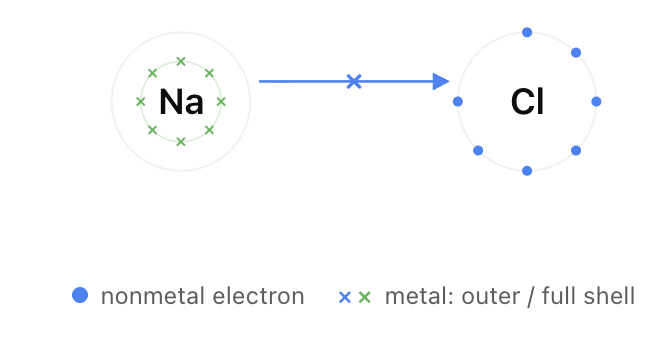
A useful example is the reaction between sodium and chlorine.
Sodium atoms lose electrons:
\( Na \rightarrow Na^+ + e^- \)
Chlorine atoms gain electrons.
Because chlorine occurs naturally as Cl2 :
\( Cl_2 + 2e^- \rightarrow 2Cl^- \)
To provide two electrons, two sodium atoms must be oxidised:
\( 2Na \rightarrow 2Na^+ + 2e^- \)
The electrons lost by sodium equal the electrons gained by chlorine.
The overall reaction is:
\( 2Na + Cl_2 \rightarrow 2NaCl \)
The electron transfer also results in oppositely charged ions that attract one another.
Identifying What Is Oxidised and Reduced
Consider:
\( Mg + Cu^{2+} \rightarrow Mg^{2+} + Cu \)
We can separate this into two processes.
Magnesium
\( Mg \rightarrow Mg^{2+} + 2e^- \)
Magnesium loses two electrons.
Therefore: Mg is oxidised
Copper Ion
\( Cu^{2+} + 2e^- \rightarrow Cu \)
Copper ions gain two electrons.
Therefore: Cu2+ is reduced


Half-Equations
A half-equation shows either the oxidation or reduction part of a redox reaction.
For example:
\( Zn + Cu^{2+} \rightarrow Zn^{2+} + Cu \)
can be separated into:
Oxidation
\( Zn \rightarrow Zn^{2+} + 2e^- \)
Reduction
\( Cu^{2+} + 2e^- \rightarrow Cu \)
When the half-equations are combined, the electrons cancel:
\( Zn + Cu^{2+} \rightarrow Zn^{2+} + Cu \)
Half-equations make the electron transfer much easier to see.
Oxidation States
Redox reactions can also be identified using oxidation states.
A useful rule is:
Oxidation → Oxidation state increases
Reduction → Oxidation state decreases
Consider:
\( Mg + Cu^{2+} \rightarrow Mg^{2+} + Cu \)
Magnesium changes: 0 → +2
Its oxidation state increases.
Therefore magnesium is oxidised.
Copper changes: +2 → 0
Its oxidation state decreases.
Therefore copper is reduced.
Three Ways to Recognise Redox
You can often identify oxidation and reduction using these relationships:
| Oxidation | Reduction |
|---|---|
| Loses electrons | Gains electrons |
| Oxidation state increases | Oxidation state decreases |
| Often gains oxygen | Often loses oxygen |
For most modern chemistry problems, electron transfer and oxidation states are the most reliable definitions.
Oxidation Involving Oxygen
Historically, oxidation was described as the gain of oxygen.
For example: 2Mg + O2 → 2MgO
Magnesium gains oxygen.
Therefore magnesium is oxidised.
At the electron level:
\( Mg \rightarrow Mg^{2+} + 2e^- \)
Magnesium loses electrons.
Oxygen gains those electrons.
Therefore:
Magnesium is oxidised.
Oxygen is reduced.


Oxidising and Reducing Agents
In redox reactions, we can also identify oxidising agents and reducing agents.
Oxidising Agent
An oxidising agent causes another substance to become oxidised.
It does this by accepting electrons.
Therefore, the oxidising agent is itself reduced.
Reducing Agent
A reducing agent causes another substance to become reduced.
It does this by donating electrons.
Therefore, the reducing agent is itself oxidised.
This can initially seem backwards, so remember:
Oxidising agent → gets reduced
Reducing agent → gets oxidised
Example: Identifying the Agents
Consider again:
\( Zn + Cu^{2+} \rightarrow Zn^{2+} + Cu \)
Zinc loses electrons:
\( Zn \rightarrow Zn^{2+} + 2e^- \)
Therefore zinc:
- is oxidised
- provides electrons
- is the reducing agent
Copper ions gain electrons:
\( Cu^{2+} + 2e^- \rightarrow Cu \)
Therefore copper ions:
- are reduced
- accept electrons
- are the oxidising agent
Balancing Simple Redox Equations
When balancing a redox reaction, the number of electrons lost must equal the number of electrons gained.
Consider:
\( Al + Cu^{2+} \rightarrow Al^{3+} + Cu \)
Start with the half-equations.
Oxidation
\( Al \rightarrow Al^{3+} + 3e^- \)
Reduction
\( Cu^{2+} + 2e^- \rightarrow Cu \)
We have a problem:
Aluminium loses 3 electrons, but copper gains 2 electrons.
We need the same number of electrons.
The lowest common multiple of 3 and 2 is: 6
Multiply the aluminium equation by 2:
\( 2Al \rightarrow 2Al^{3+} + 6e^- \)
Multiply the copper equation by 3:
\( 3Cu^{2+} + 6e^- \rightarrow 3Cu \)
Now add them:
\( 2Al + 3Cu^{2+} \rightarrow 2Al^{3+} + 3Cu \)
The six electrons cancel.
A Redox Balancing Strategy
For simple electron-transfer equations:
Step 1
Identify which substance is oxidised.
Step 2
Identify which substance is reduced.
Step 3
Write the two half-equations.
Step 4
Balance the electrons.
Step 5
Add the half-equations together.
Step 6
Cancel electrons appearing on both sides.
Step 7
Check that both atoms and overall charge are balanced.
Worked Example
Balance:
\( Fe^{3+} + Sn^{2+} \rightarrow Fe^{2+} + Sn^{4+} \)
Reduction
Iron changes:
\( Fe^{3+} \rightarrow Fe^{2+} \)
It gains one electron:
\( Fe^{3+} + e^- \rightarrow Fe^{2+} \)
Oxidation
Tin changes:
\( Sn^{2+} \rightarrow Sn^{4+} \)
It loses two electrons:
\( Sn^{2+} \rightarrow Sn^{4+} + 2e^- \)
We need two iron ions to accept the two electrons:
\( 2Fe^{3+} + 2e^- \rightarrow 2Fe^{2+} \)
Now combine:
\( 2Fe^{3+} + Sn^{2+} \rightarrow 2Fe^{2+} + Sn^{4+} \)
Check the charges:
Left: 2(+3) + (+2) = +8
Right: 2(+2) + (+4) = +8
Both atoms and charge are balanced.
Redox Reactions in Batteries
Batteries operate using redox reactions.
At one electrode, oxidation occurs and electrons are released.
At another electrode, reduction occurs and electrons are accepted.
The electrons travel through an external circuit.
This movement of electrons produces an electric current that can power electrical devices.


So batteries convert:
Chemical energy → Electrical energy
through controlled redox reactions.
Rusting
Rusting is another familiar redox process.
Iron reacts with oxygen in the presence of water.
During the process:
Iron is oxidised.
Iron atoms lose electrons and eventually form iron compounds that make up rust.
Oxygen is reduced during the overall corrosion process.


Rusting can cause major problems for:
- bridges
- cars
- ships
- pipelines
- buildings
- machinery
Understanding redox chemistry therefore helps engineers develop methods to prevent corrosion.
Combustion
Combustion reactions are also redox reactions.
Consider methane burning: \( CH_4 + 2O_2 \rightarrow CO_2 + 2H_2O \)
During this reaction:
- carbon in methane is oxidised
- oxygen is reduced
Energy is released, making combustion an exothermic redox reaction.


Respiration
Cellular respiration also involves redox reactions.
The overall equation is: \( C_6H_{12}O_6 + 6O_2 \rightarrow 6H_2O + 6CO_2 + energy \)
During respiration:
- glucose is ultimately oxidised
- oxygen is reduced
Electrons are transferred through a series of biochemical reactions rather than directly in one step.
This controlled electron transfer allows cells to capture energy for biological processes.
Photosynthesis
Photosynthesis also involves redox chemistry.
The overall equation is:
\( 6CO_2 + 6H_2O + energy \leftarrow C_6H_{12}O_6 + 6O_2 \)
During the overall process:
- carbon dioxide is reduced as carbon becomes incorporated into carbohydrate
- water is oxidised, producing oxygen
Light energy drives these redox processes.


This means two of the most important biological processes on Earth—photosynthesis and respiration—depend heavily on redox chemistry.
Bleaching and Disinfection
Many bleaching and disinfecting chemicals work through oxidation-reduction reactions.
Strong oxidising substances can react with:
- coloured molecules
- microorganisms
- organic compounds
Changing the chemical structures of these substances can remove colours or damage microorganisms.
Redox chemistry therefore has important applications in:
- water treatment
- cleaning
- bleaching
- sanitation
Redox in Everyday Life
Redox reactions occur in many familiar situations.
| Example | Redox Process |
|---|---|
| Rusting | Iron is oxidised |
| Burning fuel | Fuel is oxidised |
| Batteries | Controlled electron transfer |
| Respiration | Glucose is oxidised |
| Photosynthesis | Water is oxidised and carbon dioxide is reduced |
| Bleaching | Oxidising agents react with coloured substances |
| Metal extraction. | Metal ions may be reduced to metals |
| Corrosion | Metals lose electrons |
Redox chemistry is therefore important in biology, technology, industry, energy, and the environment.
Identifying Redox from Oxidation States
Consider:
\( Zn + 2HCl \rightarrow ZnCl_2 + H_2 \)
Focus on the substances whose oxidation states change.
Zinc
Zn: 0 → +2
The oxidation state increases.
Therefore: Zn is oxidised
Hydrogen
Hydrogen in HCl: +1
Hydrogen in H2 : 0
So: +1 → 0
The oxidation state decreases.
Therefore: H+ is reduced
Chloride does not change oxidation state and is a spectator ion in the electron-transfer process.
Is Every Chemical Reaction Redox?
No.
A reaction is redox only when oxidation states change, meaning electrons have effectively been transferred between species.
For example, many acid-base neutralisation reactions do not involve changes in oxidation states.
Therefore:
Chemical reaction ≠ automatically redox reaction
To decide, check whether any elements change their oxidation states.
Common Misconceptions
Oxidation does not always require oxygen.
The modern definition is: Oxidation = loss of electrons
Reduction does not mean that something becomes smaller.
It means: Reduction = gain of electrons
LEO the lion says GER
Loss of Electrons Oxidation
Gain of Electrons Reduction
Electrons are not destroyed during redox reactions.
The number of electrons lost during oxidation must equal the number gained during reduction.
Oxidation and reduction cannot occur independently in an overall reaction.
One substance must accept the electrons released by another.
Did You Know?
The green colour that develops on copper roofs and statues is also connected to redox chemistry.
Copper slowly reacts with substances in the environment, producing a protective surface layer called a patina.


Unlike rust on iron, which can continue damaging the metal, copper's patina can help protect the underlying copper from further corrosion.
Key Terms
Redox reaction – A reaction involving oxidation and reduction.
Oxidation – Loss of electrons.
Reduction – Gain of electrons.
Electron transfer – Movement of electrons from one substance to another.
Oxidation state – A number representing the apparent charge of an atom within a substance.
Half-equation – An equation showing either the oxidation or reduction part of a redox reaction.
Oxidising agent – A substance that causes oxidation by accepting electrons and is itself reduced.
Reducing agent – A substance that causes reduction by donating electrons and is itself oxidised.
Corrosion – Chemical deterioration of a material, often involving redox reactions.
Key Takeaways
- Redox stands for reduction and oxidation.
- Oxidation and reduction always occur together.
- Oxidation is loss of electrons.
- Reduction is gain of electrons.
- Remember OIL RIG: Oxidation Is Loss, Reduction Is Gain.
- Electrons lost by one substance must be gained by another.
- Oxidation causes an increase in oxidation state.
- Reduction causes a decrease in oxidation state.
- Half-equations can be used to show electron transfer clearly.
- When balancing simple redox equations, the number of electrons lost must equal the number gained.
- An oxidising agent accepts electrons and is reduced.
- A reducing agent donates electrons and is oxidised.
- Not every chemical reaction is a redox reaction.
- Redox reactions occur in batteries, rusting, combustion, respiration, photosynthesis, bleaching, metal extraction, and many industrial processes.
- Redox chemistry is fundamentally about the transfer of electrons and conservation of charge.