Oxidation and Reduction

サイト: Young Education
コース: Electrochemistry
ブック: Oxidation and Reduction
印刷者: Guest user
日付: 2026年 10月 5日(月曜日) 03:03

1. Oxidation States

Learning outcomes
  • I can define oxidation state (oxidation number).
  • I can determine the oxidation states of elements in compounds and ions.
  • I can identify changes in oxidation state during reactions.
  • I can use oxidation states to track electron transfer.
  • I can apply oxidation-state rules to chemical equations.

What Is an Oxidation State?

An oxidation state, also called an oxidation number, is a number assigned to an atom that helps us keep track of electrons in compounds and chemical reactions.

Oxidation states are particularly useful when studying redox reactions—reactions in which electrons are transferred.

Oxidation states are written using a sign and a number:

+1, +2, +3, −1, −2

An oxidation state of zero is written:

0

For example, in sodium chloride, NaCl:

These oxidation states help us describe how electrons are distributed and how this distribution changes during chemical reactions.

https://images.openai.com/static-rsc-4/mGFUq5MnzsKjTOcyDPFqNtardeiQKAZHrFlmt77REo9uZ1iQU2YUpqczCK4kgD-0-QXOPZYoJlYM_JVx1c5E9s0_ioZmqfHXwuHuZ1jzyL-NJQASBUV1uydMotxFCxBK9dI-NazYNZ3Fh1cc0AGthdUef-dp3k8zRzdYPuE-CLhDz7MC0A1NdfHQUdH8RZvV?purpose=fullsize
 
https://images.openai.com/static-rsc-4/5yCF_IEhNURO9nHu8uaNRibw4Zhd_jOxyRvCtdsfFUaP-iHTGsfGEwQM-nFjSZCwyZsQnl_WZDy-RWtUSzq4MarilaE0SjVxOm6GO7EvMKnEAhV5Ev4Fs23hl0RM1uLeX-b8gJNHsR8XKzuhM6fBbTp-YyFh0yCv9wHqyVdVk-Y91dOVX6DUZ79ImfTSG8O_?purpose=fullsize
 
https://images.openai.com/static-rsc-4/X4I0we6aNZafYirNfciaghr-JcLy9NelXUFyQ6a8ex0BzwuDa0TRNyX3rhDWTPHIKVhhG6FCvFDdh61JXXKMqZKY3DFo-3DpGJcnUyPMMklhu_646JY20Yoex1ObukBZReNA4gBgvH2kNqAS5lHsqAUW50hwQx1HCTwpeBKbcZuDcr42CwC374kSuYFLU3Wx?purpose=fullsize
4

Oxidation State and Electron Transfer

Oxidation states are closely related to the movement of electrons.

When an atom loses electrons, its oxidation state becomes more positive.

When an atom gains electrons, its oxidation state becomes more negative.

For example:

Na → Na+ + e−

Sodium changes from:

Its oxidation state has increased.

Now consider chlorine:

Cl2 ​+ 2e− → 2Cl−

Chlorine changes from:

Its oxidation state has decreased.

This gives us an extremely important rule:

Oxidation = increase in oxidation state

Reduction = decrease in oxidation state

​


Rules for Assigning Oxidation States

We can determine oxidation states by following a small number of important rules.

Rule 1: Elements Have an Oxidation State of 0

An element that is not combined with another element has an oxidation state of zero.

Examples:

Even when an element exists as a molecule, such as O2​ or Cl2​, its oxidation state is still zero.


Rule 2: Monatomic Ions Have the Same Oxidation State as Their Charge

For an ion containing only one atom, the oxidation state equals its ionic charge.

For example:


Rule 3: The Oxidation States in a Neutral Compound Add to Zero

A neutral compound has no overall electrical charge.

Therefore:

Sum of oxidation states = 0​

Consider sodium chloride:

NaCl

Sodium is +1, so chlorine must be −1:


Rule 4: The Oxidation States in an Ion Add to the Ion's Charge

For a polyatomic ion, the oxidation states must add to the overall charge of the ion.

For example:

SO42−​

The oxidation states must add to:

−2​

This allows us to calculate oxidation states that are not immediately obvious.

https://images.openai.com/static-rsc-4/YP0jvUOm7o76ArPwhZtYC6J6Hg9uTyXyP_0dSyHaPO6xZw3b3Rg52M0Hh2j_aowCWAbH5BJlp2yp542JkOz2eAYlTsmn5ZPXgxcDQIx9ZSbIx_e0Akr3S2Jh4rMPhcHFt-JLpiYsSukCMRm1B9-v3zJvtekLvoLMVRQN1MMe8ktmTZABcmuWdfoTp9Qo4mjt?purpose=fullsize
 
https://images.openai.com/static-rsc-4/o8eaRUQ6vG-qzOTavvXzubLG43mVHOc8QexoZZpsC9PiRAbYOL8BwCHUNPsNrE3pqFmWaPbFSh3diVbV1MLaNh4sqyrtNRHr9h20QHNw_8USAOgnsAKAU72Mgyib8xaNT9k4FO4mvJv0SDnttaCFjrlrvVPSgfekw2f0VT_sPGZ_3feGUpAeZa78p5D1Q7nt?purpose=fullsize
 
https://images.openai.com/static-rsc-4/jZQGpuIujOuUYCLNAoM0NMmAmJ_phXd6wAnGsGPBVbpU_h3jKrI5OCRvOnJOjT_bJSGXGGKSXmYgEsoNgXLqCRLP1fdonN2ohZNneFU4ZeKbVrzsSoh96vBbPOSwypjjiq2ZPYqRymLb7MrxG5eC0OHs3bS5NspMq36Tur7ALP4y9noKmD8j3FZnUBgnQwqI?purpose=fullsize
5

Some Common Oxidation States

Certain elements usually have predictable oxidation states in compounds.

Element or Group   Common Oxidation State
Group 1 metals +1
Group 2 metals +2
Aluminium +3
Fluorine −1
Oxygen Usually −2
Hydrogen Usually +1
Chlorine Usually −1

These rules work for many common compounds.

There are some exceptions—for example, oxygen does not always have an oxidation state of −2 — but these can be studied once the basic rules are understood.


Finding an Unknown Oxidation State

Suppose we want to find the oxidation state of sulfur in:

SO2

​

We know oxygen usually has an oxidation state of −2.

There are two oxygen atoms:

The compound is neutral, so the total oxidation state must equal zero.

Let sulfur's oxidation state be x:

Therefore:

x = +4​

Sulfur has an oxidation state of +4 in SO2​.


Worked Example: Carbon Dioxide

Determine the oxidation state of carbon in:

CO2​

Oxygen is usually:

−2

There are two oxygen atoms:

Let the oxidation state of carbon be x:

Therefore:

x = +4​

Carbon has an oxidation state of +4 in carbon dioxide.


Worked Example: Water

Determine the oxidation states in:

H2​O

Hydrogen is usually: +1

Oxygen is usually: −2

There are two hydrogen atoms:

Therefore:

H = +1​

and

O = −2​

The oxidation states add to zero because water is a neutral compound.


Worked Example: Magnesium Chloride

Consider:

MgCl2​

Magnesium is a Group 2 metal, so:

Chlorine is usually:

There are two chlorine atoms:

Therefore, the oxidation states correctly add to zero.

This also connects oxidation states to electron transfer during ionic bonding.

Oxidation States in Polyatomic Ions

We use the same method for ions, but the oxidation states must add to the charge of the ion rather than zero.

Consider the sulfate ion:

SO42−​

Oxygen is usually −2.

Four oxygen atoms contribute:

Let sulfur's oxidation state be x.

The total must equal −2:

Therefore:

x = +6​

Sulfur has an oxidation state of +6 in the sulfate ion.


Oxidation States and Redox Reactions

Oxidation states are especially useful for identifying oxidation and reduction.

Consider the reaction:

2Mg + O2 ​→ 2MgO

Before the reaction:

After the reaction:


Magnesium

Magnesium changes from:

Its oxidation state increases.

Therefore:

Magnesium is oxidised​


Oxygen

Oxygen changes from:

Its oxidation state decreases.

Therefore:

Oxygen is reduced
​
https://images.openai.com/static-rsc-4/iM94hJv8VVaGFf1fB_JnY8XVygu1hhZVMgDKGPdVSo9jV3RnREQbGCSZgw-ISoGBn1GIP_8nBbAMCIfnStnaBmYAge0KIL9XgMDcwTGgusA449AUuQxch6CCI6g7jo0jrL_QTXzYd7mMRVTjZdeVyDXuO1ydjk-RCICD9chXbdMl79g0fipAPxqTOMGk5lLn?purpose=fullsize
 
https://images.openai.com/static-rsc-4/D6tm-IRQRQNWDANEwrGq_IYIfCUe7DKYZV5PS65I6REo5ogBipbQIl7ADBYazm2GXpAZN5nh4PBEipZK9ZaXCv3T5cMaq-85sFJz4sF8-WUeKgcU_1k3bVameV5ua8Tf-RaksPdLzHDgAGNnImNOCqr_58NUhkqNu7CdruX0NPpD8t3MUrFdR1YNiVExjohM?purpose=fullsize
 
https://images.openai.com/static-rsc-4/gAtTItrpvXexIQdQLkWC6gwoHWGWYdJBJLv2NeZ85i0P6I-Pr7I-XBDmeeoH0zcny7gmVikXewMjaBoRyiv9LvOTHbbWpOiOBTTOxnZRaakuapkLCBLWvnrr5RJt5YjtZobuBFxEStoJOeG6NpHPOVFuDOtKVmV-Uz1XAZ1W81IpNYTxoLV1At9yxBzwofAz?purpose=fullsize

5

Remember OIL RIG

A useful memory aid is:

OIL RIG​

OIL:

Oxidation Is Loss of electrons.

RIG:

Reduction Is Gain of electrons.

This agrees with changes in oxidation state:

Oxidation: oxidation state increases​ Reduction: oxidation state decreases​

Another useful way to remember the relationship is:

Process Electrons  Oxidation State
Oxidation Lost Increases
Reduction.  Gained Decreases
https://images.openai.com/static-rsc-4/3fS4lxcuLDxpmTIciOIlw3Dn7ngFV_Df8YyBNCU17MWaSYACKD4C15rGhujeXzl1ZU8yr9XBLRLCDezg6WOW1T2izDcw8i1O-WpaR7qRudOoVkk1EbZaeCxGa9VPv8ZoolkOwac4YnQ0lujn-4oF-nm3Thj6V1_v-IX3_RmzMUbzxUDMPOLXzwzVhI24jrY2?purpose=fullsize
 
https://images.openai.com/static-rsc-4/CfuuObGmjwPBsw7ING18sZZ1bRqqktkubtBnyUwfZXs4VmNzd4NA0tv1D2lE8OcJPegotSPyV5S3cIYIRazefJdCcRTo85klAfizvaUXteXAF5JAoB0rAyPGzhyWCttwUDLJi_Zs6SOrHzlIltsMAljtUbxafbTt-wLlhXsMHh5fJFm1fJAM6AIOiparSCoA?purpose=fullsize
 
https://images.openai.com/static-rsc-4/rKnLWUsFL_q55V89gQwlWSukc4zfLIhsGS5Z5Ryh-e0kOld1v-P5C6cA_d9a0uNGXI-tjR6XE6aX2RtrCNVuPkwgLLIIUap0IPB-a1gCpsygQa2iwrN6LyAJubHz747kKeQsWnk5Cfcl-NC6nt-aDq8DuHN9DyA-tKrndzenAVWSM1gbITDZ_rp5sKo-Vwin?purpose=fullsize
4

Tracking Electron Transfer

Consider the reaction:

Zn + Cu2+ → Zn2+ + Cu

Look first at zinc.

Zinc

Zinc's oxidation state increases because it loses two electrons:

Zn → Zn2+ + 2e−

Zinc is therefore oxidised.

Copper

Copper changes from:


Cu2+ + 2e− → Cu

Copper is therefore reduced.

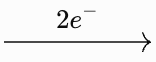
Overall, electrons are transferred:

Zn  ​Cu2+​

Oxidation states therefore allow us to track electron transfer even when electrons are not shown in the overall chemical equation.

https://images.openai.com/static-rsc-4/6dh4cBWYHOCt39GFG5kKh5Z2ClDBGkbpoFvnTWALI8xy4TE3V2n6EYGEO_8It5qQHiAp1eU22do9in42vOCnUhTNVytF9dWa2EaOv-g6GjEhwpEXE6S3sUazJr3XfKFnKoelwuFcoZNpszMc6KRi-NcKwPA7_thXM7KcDqprMQ-CTqFBGtX_GWYDiWkOXKd_?purpose=fullsize
 
https://images.openai.com/static-rsc-4/LPw0mCwyF15eYGFfI5p7R_HVSL8EdvJuKpK98DcI-9RgZEkfbCoWHs5V_qbyDQqmDfnPgsMsWCevNwpgEYPEezVeBMxqw-1fs4FxnBbKT06h93wQfu1eDcARvRuEybGRRe1r28_gTzLRiiINLXfn1Pm_6V5B3BLdgawnz6ZAXLXDPan7E-Jje0UMhCxwdZql?purpose=fullsize
 
https://images.openai.com/static-rsc-4/-C_fomSqDwHzi9ALldFENsJpTdeHDCmmLv8odRNSLE5rA58wOq6DS-T2-h4QyTCHRGsaxEyaROvdAPvkjs5_aNhxbxZgBpJaIZ0JFoUMncK6sZQ0V71IKuqzp3lL1JQDHcmZFh6hxpuURbAw3xiEMYpLpaF9NDA_nikqyb6wuFA0GSXIAHd77U6hSBOD5d9_?purpose=fullsize
5

Applying Oxidation States to Chemical Equations

Consider:

2Na + Cl2 ​→ 2NaCl

We can systematically analyse the reaction.

Step 1: Assign Oxidation States to the Reactants

Because sodium and chlorine are elements:


Step 2: Assign Oxidation States to the Products

In sodium chloride:


Step 3: Identify the Changes

For sodium:

The oxidation state increases.

Therefore, sodium is oxidised.

For chlorine:

The oxidation state decreases.

Therefore, chlorine is reduced.


A Useful Problem-Solving Method

When finding oxidation states in compounds or chemical equations, use the following process.

Step 1: Write Down Known Oxidation States

Start with elements whose oxidation states are easy to identify, such as:

  • Oxygen
  • Hydrogen
  • Group 1 metals
  • Group 2 metals

Step 2: Multiply by the Number of Atoms

For example, three oxygen atoms at −2:


Step 3: Use the Overall Charge

For a neutral compound:

Total = 0​

For an ion:

Total = ion charge​


Step 4: Solve for the Unknown

Use simple algebra to calculate the missing oxidation state.

Step 5: Compare Before and After

For a chemical reaction:


Worked Example: Iron Oxide

Determine the oxidation state of iron in:

Fe2​O3​

Oxygen is usually −2.

There are three oxygen atoms:

The compound is neutral, so the two iron atoms must contribute +6.

Let the oxidation state of each iron atom be x:

x = +3​

Therefore, iron has an oxidation state of +3 in Fe2​O3​.


Common Mistakes

Mistake 1: Ignoring the Number of Atoms

In:

CO2
​

there are two oxygen atoms.

Therefore:

not simply −2.

Mistake 2: Making Every Formula Add to Zero

Neutral compounds add to zero, but ions do not.

For:

SO42−​

the oxidation states must add to: −2​


Mistake 3: Mixing Up Oxidation and Reduction

Remember:

is an increase, so it is oxidation.

However:

is a decrease, so it is reduction.

Mistake 4: Forgetting That Elements Have Oxidation State Zero

In:

O2​

oxygen has an oxidation state of 0, not −2.

The −2 rule normally applies when oxygen is combined with other elements.


Key Vocabulary

Oxidation state – A number assigned to an atom that helps track electrons in compounds and reactions.

Oxidation number – Another name for oxidation state.

Oxidation – Loss of electrons and an increase in oxidation state.

Reduction – Gain of electrons and a decrease in oxidation state.

Redox reaction – A reaction in which oxidation and reduction occur together.

Electron transfer – The movement of electrons from one species to another.

Polyatomic ion – A charged group containing two or more atoms bonded together.


Key Takeaways

  • Oxidation state and oxidation number mean the same thing.
  • An element by itself normally has an oxidation state of 0.
  • The oxidation state of a monatomic ion equals its charge.
  • Oxidation states in a neutral compound add to zero.
  • Oxidation states in a polyatomic ion add to the overall charge of the ion.
  • Oxygen is usually −2, while hydrogen is usually +1.
  • An increase in oxidation state means oxidation.
  • A decrease in oxidation state means reduction.
  • Oxidation states allow us to track electron transfer in redox reactions.
  • Remember OIL RIG: Oxidation Is Loss — Reduction Is Gain​


2. Oxidation Reactions

Learning outcomes
  • I can define oxidation as the loss of electrons.
  • I can identify substances undergoing oxidation in a reaction.
  • I can explain oxidation using electron-transfer diagrams.
  • I can recognise oxidation through increases in oxidation state.
  • I can apply oxidation concepts to real chemical reactions.

What Is Oxidation?

Oxidation is a chemical process in which a substance loses electrons.

The simplest definition is:

Oxidation = loss of electrons​

For example, when a sodium atom loses an electron:

Na → Na+ + e−

The sodium atom has lost one electron, so sodium has been oxidised.

Similarly, magnesium can lose two electrons:

Mg → Mg2+ + 2e−

Because magnesium loses electrons, it has also been oxidised.

https://images.openai.com/static-rsc-4/CfuuObGmjwPBsw7ING18sZZ1bRqqktkubtBnyUwfZXs4VmNzd4NA0tv1D2lE8OcJPegotSPyV5S3cIYIRazefJdCcRTo85klAfizvaUXteXAF5JAoB0rAyPGzhyWCttwUDLJi_Zs6SOrHzlIltsMAljtUbxafbTt-wLlhXsMHh5fJFm1fJAM6AIOiparSCoA?purpose=fullsize
 
https://images.openai.com/static-rsc-4/QO5UtM2qB1gYTm3UdPSg9RyQC0_2eWp_QqvAnxGO-uKyF3oXZI1SibS5jHphnce5egQxtyoWPkSwwZ04EXfwfDQSPCojfhX5BvG4G_aUOWIlHDVuBoKb_3QVceGP6Cbe5PstYnAeO8TKocuG2jD_NTNLn6BYZk4LhqvCnuQs8Yo4VbZN8nRfBZTOdKyqAUiJ?purpose=fullsize
 
https://images.openai.com/static-rsc-4/muAQFvBEGdRufPJnSfWUx_YpY4cY5h0eP5dAG7qrGcyWLXFBoaDILv6BYW7QL-u6fFaCTAn2oEDu06yljmzgAEZkJdLIriqSXTghEPykmoSkBOzcIaNDYtCK8JYguxNfkLu2D2VbO415yHkuRW_So5MBjieJgVctKz58e84re6zwcpXLg3pLUFj2p2GKJ9gW?purpose=fullsize
5

Remember OIL RIG

A useful way to remember oxidation and reduction is:

OIL RIG​

OIL means: Oxidation Is Loss​

RIG means: Reduction Is Gain​

The words loss and gain refer to electrons.

Therefore:

Process Electron Change
Oxidation Electrons are lost
Reduction.  Electrons are gained

Oxidation and reduction occur together because electrons lost by one substance must be gained by another.

A reaction involving both processes is called a redox reaction.


Oxidation and Electron Transfer

Oxidation can be represented using a half-equation.

A half-equation shows what happens to one substance during a redox reaction.

Consider magnesium:

Mg → Mg2+ + 2e−

The electrons appear on the right-hand side because magnesium has lost them.

This tells us immediately that magnesium is being oxidised.

Another example is aluminium:

Al → Al3+ + 3e−

Aluminium loses three electrons.

Therefore:

Aluminium is oxidised​


Electron-Transfer Diagrams

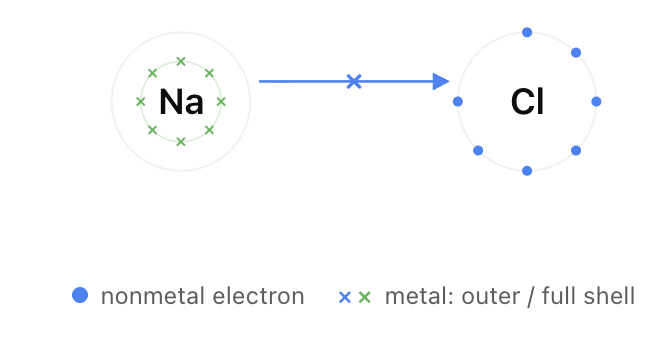
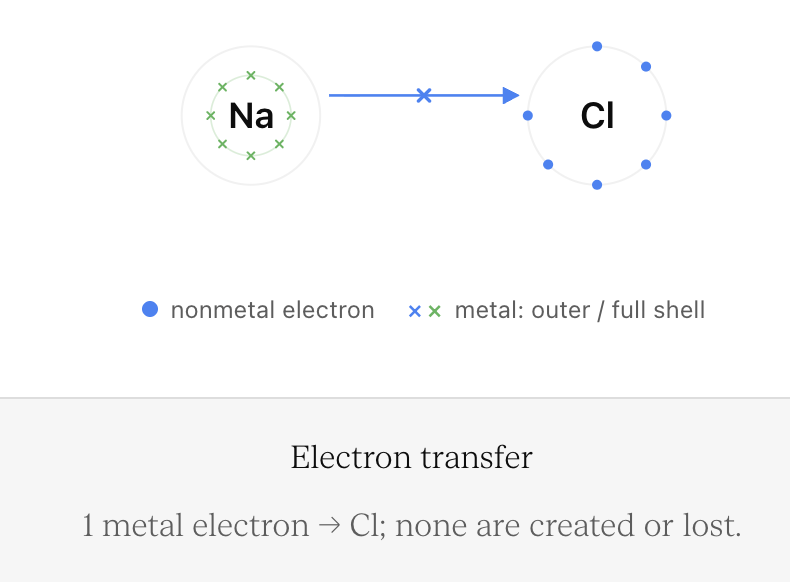
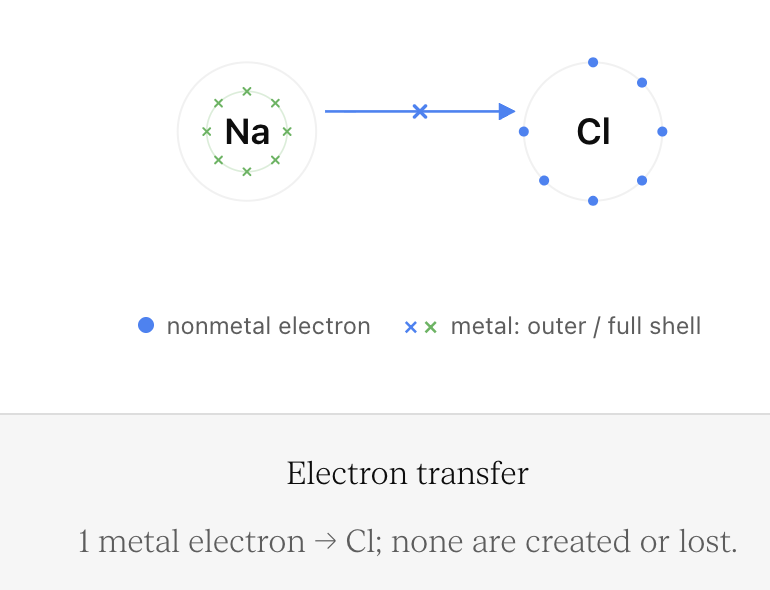
Electron-transfer diagrams help us visualise what happens during oxidation.

Consider sodium reacting with chlorine.

Each sodium atom loses one electron:

Na → Na+ + e−

A chlorine atom gains that electron:

Cl + e− → Cl−

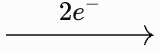
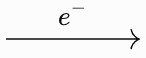
We can represent the transfer as:

Na Cl​

Sodium is oxidised because it loses the electron.

Chlorine is reduced because it gains the electron.

This illustrates an important idea: oxidation never occurs alone in an electron-transfer reaction. The electrons lost by one species are accepted by another.


Oxidation and Oxidation States

Oxidation can also be identified by looking at oxidation states.

During oxidation:

Oxidation state increases​

For example:

Mg → Mg2+ + 2e−

Magnesium changes from:

Its oxidation state has increased.

Therefore, magnesium has been oxidised.


Why Does Losing Electrons Increase the Oxidation State?

Electrons have a negative charge.

If an atom loses negative electrons, it becomes more positive.

For example:

Fe2+ → Fe3+ + e−

Iron changes from:

The oxidation state has increased.

Therefore:

Fe2+ has been oxidised​

Identifying Oxidation in a Reaction

Consider:

Zn + Cu2+ → Zn2+ + Cu

We can compare the oxidation states before and after the reaction.

Zinc

Before:

After:

Therefore:

The oxidation state increases.

Zinc has been oxidised.

Its oxidation half-equation is:

Zn → Zn2+ + 2e−​


Copper

Copper changes from:

Its oxidation state decreases, so copper has been reduced.

https://images.openai.com/static-rsc-4/6dh4cBWYHOCt39GFG5kKh5Z2ClDBGkbpoFvnTWALI8xy4TE3V2n6EYGEO_8It5qQHiAp1eU22do9in42vOCnUhTNVytF9dWa2EaOv-g6GjEhwpEXE6S3sUazJr3XfKFnKoelwuFcoZNpszMc6KRi-NcKwPA7_thXM7KcDqprMQ-CTqFBGtX_GWYDiWkOXKd_?purpose=fullsize
 
https://images.openai.com/static-rsc-4/hRCdoM5dAABZlHMVnMyAn2G5HwjyANSkU34jeuzbbvGsnZ1DT5z5_fh49zaSJCB3wN0AfNwKhdy17RTxd3KbTCsKhA3wYSNqXgK91YwLYsEX4aIt_OHk0S2PUXPcjkWyxcQox1Y0Jp2IxbQ3RuKryl2H_wu6TGfa-3IlXj2f_c4iwIPiW5ykHaXmsDv53CQJ?purpose=fullsize
 
https://images.openai.com/static-rsc-4/LR4sZqhkknKAtgICo5-NMA1_ZEfAyYVDCy6Oo3Iohkx5tgvKMP8Hm1Px3c4D8UDtO3-MvyUQ0U4F2V7BPegINS5bJZ1V_VCntucpWWg6NHVXnkblwbO00UxJPIsOVambxwK4SOzK9YbLPotVJm_w7It6rRlwQTPRkq5ifhURFsX1-QIvckMnEM2SXDevnJjE?purpose=fullsize
5

A Method for Identifying Oxidation

When examining a chemical reaction, use the following method.

Step 1: Identify the Elements or Ions

Determine which substances are changing during the reaction.

Step 2: Assign Oxidation States

Find the oxidation state of each important element before and after the reaction.

Step 3: Compare the Oxidation States

Look for an increase.

For example:

All of these represent increases in oxidation state.

Step 4: Identify the Oxidised Substance

The substance whose oxidation state increases has been oxidised.


Example: Sodium and Chlorine

Consider:

2Na + Cl2 ​→ 2NaCl

Before the reaction, sodium is an element:

In sodium chloride:

Therefore:

Sodium's oxidation state increases.

Therefore:

Sodium is oxidised​

Each sodium atom loses one electron:

Na → Na+ + e−

Example: Magnesium and Oxygen

Magnesium burns brightly when heated in oxygen.

The reaction is:

2Mg + O2 ​→ 2MgO
 
https://images.openai.com/static-rsc-4/vvc7lVvTokOi_x3-iYz1nsYqvojM2m47dC85zmKLLr1AdXpeb8M1qktRJX5yH6PZXa0ocAAdcEYXK91uvkb6imR3Dy2UI_znqaXjQ0cTgLevs-H_i5rUMEjtNRtvdbMFO7z1N8VEI_8bPcLWpxbr4ZcxR5g7o_3ppuqKAechZHXRAKl2P0-SyKy2QUCzlMvU?purpose=fullsize
 
https://images.openai.com/static-rsc-4/uUVcrl2hKitrgBtLkd6zbf1gG_hSiPiytRVAXYF7jLeE-yrTHrYRpLl5UD8MxqHrUYL8-5akbEZ2coOWJGEaJnXtrqnMScqF3gAPUDAhOn0MfP-aMsSwg6JH19osTEe24F5kkWBcMuHiH03TFLek7cHzttHPkIIIHdZ0gfcHY0tvyOF2Ve7dxglfdpPEPbAQ?purpose=fullsize


https://images.openai.com/static-rsc-4/PZyFZrad1R5yoSeDdYW90sG0-DS-c1BAO1XaAWkLs1JXP9IktwDVGT-meVlm-pkWZH1cc_VRw5tugkhdfCwbR5F_1Hpi8bmc7wXcPo43KoJTjNvT-Qh3EXZ7Uf0aQZieXeWSCVrQxAqkQuUHTCPQZqR1iLS_iNyw0JfozUVr3mFD8UXXd3Qv8HzWur9kj2d8?purpose=fullsize
4

Before the reaction:

In magnesium oxide:

Therefore:

Magnesium has been oxidised.

The half-equation is:

Mg → Mg2+ + 2e−

Oxygen gains the electrons, so oxygen is reduced.


Oxidation Does Not Always Mean Adding Oxygen

Historically, oxidation was described as a reaction in which a substance gained oxygen.

For example:

2Mg + O2 ​→ 2MgO

Magnesium gains oxygen, so this can be described as oxidation.

However, the modern definition is more general:

Oxidation = loss of electrons​

A substance can therefore be oxidised even when oxygen is not involved.

For example:

Zn + Cu2+ → Zn2+ + Cu

Zinc is oxidised even though it does not react with oxygen.

It loses electrons:

Zn → Zn2+ + 2e−

Oxidation of Iron

One familiar example of oxidation is rusting.

Iron reacts with oxygen in the presence of water to eventually form hydrated iron(III) oxide, which we commonly call rust.

During the process, iron atoms lose electrons:

Fe → Fe2+ + 2e−

The iron is therefore oxidised.

Further reactions eventually produce the compounds found in rust.

 
https://images.openai.com/static-rsc-4/FITD1IR_r2ad9nQHxW7YQN1cwA36x14JCa57tFRaIbGs_GvnrPFwohDabeYNjQeKBVphk6Qz82HHhz9T_FJ6dtjegV4p4u9heOb2pgaTVoG-77pF_4shmvf5WDYaK_FdhCDReaHq5sRjtRFy-amV-TXsReSe3g1JpMw3Gi03CfnX4I3-qhfYDrFmgHJ_vUB-?purpose=fullsize
 
https://images.openai.com/static-rsc-4/uKxLLwg45S4nT5057XmikSP9Z5ahsHFSy2Mu6_iHoosj8lutOiiokabnDtEeWPGV3EObQmpJJ4SREwV4aJ_CmtjE-s7GyQNQugrYyXJNrq3-TeLU6eDy9atPv8NseQ34ESlZcyz1I9nOyIzSK1b-m0Vg7S1Pr1GR_x5tDtrMixUVi2oYccCPMcBeGQ-b4VmO?purpose=fullsize
 
https://images.openai.com/static-rsc-4/uuh-kwqXzkkWAxZP1Jb6Yh6saIyxCfNSZNQLguWb1-SGIEBaDogY89pXWPFB0Gtkxp3ahvzV4IyXwXUHpbrgxWnqVyV5z6kokJMnpqBJ1FDzBlSjBgydW_LR1dnnLOMjW1Br6jAleUQSqv8KRDWq0WJEmb_yWYny-RsQZbknSYrReOTuDpxLvxGCTLcTbpTQ?purpose=fullsize
5

Rusting is important because it can weaken:

  • Cars
  • Bridges
  • Ships
  • Buildings
  • Pipelines
  • Tools

Understanding oxidation therefore has major practical importance.


Oxidation in Combustion

Combustion reactions often involve oxidation.

For example, carbon burns in oxygen:

C + O2 ​→ CO2​

Carbon begins with an oxidation state of:

0

In carbon dioxide, carbon has an oxidation state of:

+4

Therefore:

Carbon has been oxidised.

Oxygen changes from:

so oxygen has been reduced.


Oxidation in Everyday Life

Oxidation reactions occur in many familiar situations.

Examples include:

  • Burning fuels
  • Rusting iron
  • Cellular respiration
  • Batteries producing electrical energy
  • Browning of some cut fruits
  • Corrosion of metals
https://images.openai.com/static-rsc-4/prlKMyR51cFNtD1OSLe3jW3trRN7bi1nsdZlgeMXJRC8doey3ZjZEe-oyUcXDpaOAkf9Qe6vayNltzLkr0PmzJfRa8YDWsfVz2KcrPuxCd-NwSfo0eGwtEJHgNdhSM81JhcbkWsA6YZHUB-4tdsq2dxuOa2RtMghSZV-2ybN9ChxZGQ4czAH5PdmX8I-DqZV?purpose=fullsize
 
https://images.openai.com/static-rsc-4/mbCtL2qCVS1z1uuY25xjGBwGwikotXPB4WYVH0xrKf2YePHgx1twEi66DDt45CgrqdU1I4NFAXyU2zdnNVM630yeaBqn64_ronUqJVnRuNQBLqBJYvjfCtatQbPbjF283lbaVK3G1ERaOhtaCeODyLvvGdK4hwhJkXkKVhSUxWhmrf2DgXkHZD53w9reP9_n?purpose=fullsize
 
https://images.openai.com/static-rsc-4/zba_y-lUXoUNq6vDPRlcAJOBvtdWxOowdd_ebvQmy0cvzBHKLdQrAaTbCoS_Y0A-G2XH4EPwcvQPAvdSTVFyMj91OpTnduQtnaP1Jm7v_43uaagi62HZjUUyu8t4Jtn_4GJ5wReToH-8jXDxuNl_BZrt6o9Ku0tMvN4Rr7yJ9BaMK-jOXmJEqRSJkCd-9R0O?purpose=fullsize
4

Some oxidation reactions are useful, while others are unwanted.

For example, oxidation reactions in batteries can help produce electrical energy, while oxidation involved in corrosion can damage structures.


Oxidation and Reduction Always Occur Together

Suppose zinc loses two electrons:

Zn → Zn2+ + 2e−

Those electrons cannot simply disappear.

Another substance must gain them.

For example:

Cu2+ + 2e− → Cu

Combining the two half-equations gives:

Zn + Cu2+ → Zn2+ + Cu

Therefore:

Oxidation and reduction occur together​

This is why these reactions are called redox reactions:

REDuction + OXidation = REDOX​

Worked Example

Consider the reaction:

Fe + 2Ag+ → Fe2+ + 2Ag

Which substance is oxidised?

Step 1: Examine Iron

Iron begins as an element:

After the reaction:

Therefore:

The oxidation state increases.

Step 2: Write the Half-Equation

Fe → Fe2+ + 2e−

Iron loses two electrons.

Therefore:

Iron is oxidised​

Silver ions gain those electrons and are reduced.


Common Mistakes

Mistake 1: Thinking Oxidation Always Requires Oxygen

Oxidation can involve oxygen, but the modern definition is:

Oxidation = loss of electrons​

Mistake 2: Thinking a More Positive Oxidation State Means Reduction

It is the opposite.

If the oxidation state increases:

the substance has been oxidised.


Mistake 3: Putting Electrons on the Wrong Side

For an oxidation half-equation:

Zn → Zn2+ + 2e−

the electrons appear on the product side because they have been lost.


Key Vocabulary

Oxidation – The loss of electrons by a substance.

Oxidation state – A number used to track electrons in compounds and reactions.

Electron transfer – Movement of electrons from one species to another.

Half-equation – An equation showing either the oxidation or reduction part of a redox reaction.

Reduction – The gain of electrons.

Redox reaction – A reaction in which oxidation and reduction occur together.

Corrosion – The gradual destruction of a material through chemical reactions with its environment.


Key Takeaways

  • Oxidation is the loss of electrons.
  • Remember OIL: Oxidation Is Loss.
  • Electrons appear on the right side of an oxidation half-equation.
  • Oxidation causes an increase in oxidation state.
  • For example: Mg: 0 → + 2 shows oxidation.
  • Oxidation does not always require oxygen.
  • Oxidation and reduction always occur together in redox reactions.
  • Oxidation occurs in important real-world processes including combustion, corrosion, respiration, and batteries.
 

3. Reduction Reactions

Learning outcomes
  • I can define reduction as the gain of electrons.
  • I can identify substances undergoing reduction in a reaction.
  • I can explain reduction using electron-transfer diagrams.
  • I can recognize reduction through decreases in oxidation state.
  • I can apply reduction concepts to chemical processes.


4. Redox Reactions

Learning outcomes
  • I can explain why oxidation and reduction occur together.
  • I can identify oxidation and reduction processes within a reaction.
  • I can analyze electron transfer in redox reactions.
  • I can balance simple redox equations.
  • I can relate redox reactions to everyday examples.


5. Oxidizing and Reducing Agents

Learning outcomes
  • I can define oxidizing and reducing agents.
  • I can identify oxidizing and reducing agents in reactions.
  • I can explain how these agents cause electron transfer.
  • I can compare the strengths of different oxidizing and reducing agents.
  • I can apply these concepts to predict reaction outcomes.


Why are oxidizing and reducing agents important?

When a metal rusts, fuel burns, or a battery powers a device, chemical reactions involve changes in how electrons are distributed between substances. These are examples of oxidation–reduction reactions, usually shortened to redox reactions.

Every redox reaction involves two connected processes: one substance loses electrons while another gains them. The substances responsible for these changes are called reducing agents and oxidizing agents.

Understanding these agents helps us explain chemical changes and predict whether certain reactions will occur.

https://images.openai.com/static-rsc-4/6tcOifkyX7_LMTrp3hF2aAvEe0VPlOGeLUguEnEvCclQ2Sbczmt4xmJg7Jo1XfdYS-O2fQBWSwApk-DmqCwtD-tbwxoDOXR7Dc0hMUBsySWYIqxLpXdGBQNQUFMlPwCFmFo1C8IFtTz6pHi69IYld9AiN0vdcFsJpdI-J8CTJaUO-gXx7hLlzZe5tUtc5ULA?purpose=fullsize
 
https://images.openai.com/static-rsc-4/vvc7lVvTokOi_x3-iYz1nsYqvojM2m47dC85zmKLLr1AdXpeb8M1qktRJX5yH6PZXa0ocAAdcEYXK91uvkb6imR3Dy2UI_znqaXjQ0cTgLevs-H_i5rUMEjtNRtvdbMFO7z1N8VEI_8bPcLWpxbr4ZcxR5g7o_3ppuqKAechZHXRAKl2P0-SyKy2QUCzlMvU?purpose=fullsize
 
https://images.openai.com/static-rsc-4/oCojWoer4LxdU8f2bsoH1MeM4NkWOYX5HdX2gF2eItpym7zYHlx0UP2iBVuWWFBHmM7yGP923sAOwfxoPvvUyN-TiYxQBckfIWZCT5Wx0ZXQd9Hz6N006je9kGNixRH9mRVAVLWWeA_3zDlIQQbjKb6stjV2ix6r6BElXXy4YIgYOUE_6hIZruvpS50Q95xj?purpose=fullsize
 
5

Rusting iron and burning magnesium both involve oxidation. Burning magnesium is rapid, while rusting usually happens slowly. Redox reactions can occur at very different rates.

Oxidation and reduction: following the electrons

The most useful definitions of oxidation and reduction are based on electrons:

  • Oxidation is the loss of electrons.
  • Reduction is the gain of electrons.

Remember OIL RIG: Oxidation Is Loss; Reduction Is Gain.

For example, a magnesium atom can lose two electrons:

Mg → Mg²⁺ + 2e⁻

The magnesium atom becomes a positively charged magnesium ion. It has been oxidized because it has lost electrons.

A copper(II) ion can gain two electrons:

Cu²⁺ + 2e⁻ → Cu

The copper(II) ion becomes a neutral copper atom. It has been reduced because it has gained electrons.

These equations are called half-equations. Each shows one half of a redox reaction.

Electrons are not created or destroyed during an ordinary chemical reaction. Therefore, the total number of electrons lost must equal the total number gained.

What is an oxidizing agent?

An oxidizing agent is a substance that causes another substance to be oxidized by accepting electrons from it.

Because it accepts electrons, the oxidizing agent is itself reduced.

For example:

Cu²⁺ + 2e⁻ → Cu

Copper(II) ions accept electrons. When they react with a suitable metal, they cause that metal to lose electrons and become oxidized. Therefore, Cu²⁺ ions act as the oxidizing agent.

The relationship is:

  • The oxidizing agent accepts electrons.
  • Another substance loses those electrons and is oxidized.
  • The oxidizing agent is reduced.

Examples of oxidizing agents include oxygen, chlorine and, in suitable reactions, hydrogen peroxide.

Despite the name, an oxidizing agent does not have to contain oxygen. Chlorine acts as an oxidizing agent by accepting electrons:

Cl₂ + 2e⁻ → 2Cl⁻

What is a reducing agent?

A reducing agent is a substance that causes another substance to be reduced by donating electrons to it.

Because it donates electrons, the reducing agent is itself oxidized.

For example:

Zn → Zn²⁺ + 2e⁻

Zinc atoms donate electrons. These electrons can be accepted by another substance, causing that substance to be reduced. Therefore, zinc acts as the reducing agent.

The relationship is:

  • The reducing agent donates electrons.
  • Another substance gains those electrons and is reduced.
  • The reducing agent is oxidized.

Examples of reducing agents include reactive metals, hydrogen, carbon and carbon monoxide.

Feature Oxidizing agent Reducing agent
Role in electron transfer Accepts electrons Donates electrons
Effect on the other substance Causes oxidation Causes reduction
Change experienced by the agent.    Is reduced Is oxidized
Change in oxidation number Decreases for the atom being reduced.   Increases for the atom being oxidized

An agent is named after the change it causes in another substance, rather than the change it experiences itself.

Worked example: zinc and copper(II) sulfate

When zinc is placed in copper(II) sulfate solution, zinc displaces copper:

Zn(s) + CuSO₄(aq) → ZnSO₄(aq) + Cu(s)

The state symbols show whether a substance is solid, (s), or dissolved in water, (aq).

https://images.openai.com/static-rsc-4/LPw0mCwyF15eYGFfI5p7R_HVSL8EdvJuKpK98DcI-9RgZEkfbCoWHs5V_qbyDQqmDfnPgsMsWCevNwpgEYPEezVeBMxqw-1fs4FxnBbKT06h93wQfu1eDcARvRuEybGRRe1r28_gTzLRiiINLXfn1Pm_6V5B3BLdgawnz6ZAXLXDPan7E-Jje0UMhCxwdZql?purpose=fullsize
 
https://images.openai.com/static-rsc-4/SxXNm14FH_YiCEvVGzqgcvnnJJBP4ozoWtMI4UlYXGLHFJC7xUTm4d1R2As258e42Q2EYAWmqPYdulCPTuubKtbDm9AQ0QFjfvaWs9XGKTR-F0_CP1mmuKDulKcUcaVmzwV1kbKm5BmgzldgNtLo1nC1Btv1CS1C8wM9IYTlMjfASjlm5MaJVMr3tzQNLchA?purpose=fullsize
 
https://images.openai.com/static-rsc-4/hRCdoM5dAABZlHMVnMyAn2G5HwjyANSkU34jeuzbbvGsnZ1DT5z5_fh49zaSJCB3wN0AfNwKhdy17RTxd3KbTCsKhA3wYSNqXgK91YwLYsEX4aIt_OHk0S2PUXPcjkWyxcQox1Y0Jp2IxbQ3RuKryl2H_wu6TGfa-3IlXj2f_c4iwIPiW5ykHaXmsDv53CQJ?purpose=fullsize
 
5

During this reaction, a reddish-brown copper deposit forms on the zinc. Zinc dissolves, and the solution’s blue colour becomes paler as copper(II) ions are used up.

Step 1: Focus on the particles that change.

The net ionic equation is:

Zn(s) + Cu²⁺(aq) → Zn²⁺(aq) + Cu(s)

Sulfate ions remain dissolved and unchanged. They are spectator ions.

Step 2: Identify oxidation.

Zn → Zn²⁺ + 2e⁻

Zinc loses electrons and is oxidized. It supplies the electrons that reduce copper(II) ions.

Therefore, Zn is the reducing agent.

Step 3: Identify reduction.

Cu²⁺ + 2e⁻ → Cu

Copper(II) ions gain electrons and are reduced. They cause zinc to lose electrons.

Therefore, Cu²⁺ is the oxidizing agent.

Step 4: Check the electron balance.

Each zinc atom loses two electrons, and each copper(II) ion gains two electrons. The numbers match.

Notice that the oxidizing agent is Cu²⁺, not the copper metal produced by the reaction. Always identify the agent among the reactants.

Using oxidation numbers to identify agents

In some reactions, electron transfer is less obvious from the chemical equation. Oxidation numbers provide a way to track oxidation and reduction.

  • An increase in oxidation number indicates oxidation.
  • A decrease in oxidation number indicates reduction.

Useful rules for the examples in these notes are:

  • An uncombined element has an oxidation number of 0.
  • A monatomic ion has an oxidation number equal to its charge.
  • Oxygen usually has an oxidation number of −2 in compounds.
  • The oxidation numbers in a neutral compound add up to 0.

Oxidation numbers are a bookkeeping system. They do not always represent actual ionic charges, especially in covalent substances.

Worked example: magnesium burning in oxygen

2Mg + O₂ → 2MgO

Element  Before the reaction   In MgO  Interpretation
Magnesium 0 +2 Oxidation number increases: oxidized
Oxygen 0 −2 Oxidation number decreases: reduced

Therefore:

  • Magnesium is the reducing agent because it is oxidized.
  • Oxygen is the oxidizing agent because it is reduced.

The corresponding half-equations are:

2Mg → 2Mg²⁺ + 4e⁻

O₂ + 4e⁻ → 2O²⁻

Four electrons are lost by magnesium and gained by oxygen.

Comparing the strengths of reducing agents

A stronger reducing agent has a greater tendency to donate electrons under the conditions being compared.

For common metal displacement reactions, the metal reactivity series provides a useful guide. More reactive metals generally lose electrons more readily.

Consider this order:

Magnesium > Zinc > Iron > Copper

For these metals, reducing strength generally decreases from left to right.

Magnesium is a stronger reducing agent than zinc. It can donate electrons to zinc ions:

Mg + Zn²⁺ → Mg²⁺ + Zn

Copper is a weaker reducing agent than zinc. Copper metal does not normally displace zinc from zinc sulfate solution.

A useful prediction rule: A more reactive metal can generally displace a less reactive metal from a solution containing its ions.

This rule applies to suitable reactions and conditions. Very reactive metals can react with the water itself, while protective surface layers can slow or prevent an observable reaction.

Also, a metal and its ions are different chemical species. Magnesium metal is a strong reducing agent, but Mg²⁺ ions are not: they have already lost the two electrons involved in these reactions.

Comparing the strengths of oxidizing agents

A stronger oxidizing agent has a greater tendency to accept electrons under the conditions being compared.

The halogens provide a clear example. Their oxidizing strength decreases down Group 17, also called Group VII:

Chlorine > Bromine > Iodine

Chlorine is a stronger oxidizing agent than bromine. Bromine is a stronger oxidizing agent than iodine.

A halogen molecule gains electrons when it forms halide ions:

X₂ + 2e⁻ → 2X⁻

Down the group, increased atomic size and electron shielding help explain the decreasing tendency to accept electrons.

A stronger halogen oxidizing agent can oxidize the halide ions of a weaker one.

Halogen added  Chloride ions, Cl⁻   Bromide ions, Br⁻  Iodide ions, I⁻
Chlorine, Cl₂ No displacement Bromine forms Iodine forms
Bromine, Br₂ No displacement No displacement Iodine forms
Iodine, I₂ No displacement No displacement No displacement

These predictions describe the usual classroom displacement reactions.

Worked example: chlorine and bromide ions

Chlorine reacts with potassium bromide solution:

Cl₂ + 2KBr → 2KCl + Br₂

Potassium ions are spectators, so the net ionic equation is:

Cl₂ + 2Br⁻ → 2Cl⁻ + Br₂

Reduction:

Cl₂ + 2e⁻ → 2Cl⁻

Chlorine accepts electrons, so Cl₂ is the oxidizing agent.

Oxidation:

2Br⁻ → Br₂ + 2e⁻

Bromide ions donate electrons, so Br⁻ is the reducing agent.

The reaction occurs because chlorine is a stronger oxidizing agent than bromine. Bromine forms, giving the aqueous solution an orange colour.

The reverse displacement does not normally occur: bromine is not a strong enough oxidizing agent to oxidize chloride ions.

A method for predicting reaction outcomes

Use the following sequence when solving a redox prediction problem:

  1. Identify the reactants precisely. Distinguish neutral elements from their ions.
  2. Decide which substance could donate electrons. This is the potential reducing agent.
  3. Decide which substance could accept electrons. This is the potential oxidizing agent.
  4. Compare their tendencies to react. Use the metal reactivity series, halogen trends or supplied data.
  5. Write the predicted products and balance the equation. Check atoms, charge and electrons.

Worked example: iron in copper(II) sulfate

Iron is above copper in the reactivity series. It is a stronger reducing agent than copper, so the predicted reaction is:

Fe + Cu²⁺ → Fe²⁺ + Cu

  • Iron loses two electrons and is the reducing agent.
  • Copper(II) ions gain two electrons and are the oxidizing agent.
  • Copper metal forms and iron dissolves.

Worked example: iodine added to potassium bromide

Iodine is a weaker oxidizing agent than bromine. It cannot normally remove electrons from bromide ions.

Prediction: No halogen displacement reaction occurs.

11. Strength, concentration and speed are different

These ideas should not be confused:

Property Meaning
Agent strength  Tendency to accept or donate electrons
Concentration Amount of a dissolved substance per unit volume
Reaction rate How quickly reactants change into products

A strong oxidizing agent can be present in a dilute solution. A reaction that is energetically favourable can still be slow because of an activation energy barrier or a protective surface layer.

More advanced predictions use standard electrode potentials. A more positive standard reduction potential indicates a greater tendency for the species in that reduction half-equation to accept electrons under standard conditions. Actual outcomes can also depend on concentration, temperature and pH.

Redox agents in everyday life and industry

Metal extraction

Carbon monoxide acts as a reducing agent in the extraction of iron:

Fe₂O₃ + 3CO → 2Fe + 3CO₂

Iron changes from oxidation number +3 to 0, so it is reduced. Carbon changes from +2 in CO to +4 in CO₂, so it is oxidized.

  • Reducing agent: Carbon monoxide.
  • Oxidizing agent: Iron(III) oxide.

Here, the older oxygen-based definitions also work: iron(III) oxide loses oxygen, while carbon monoxide gains oxygen.

Batteries

During battery discharge, oxidation releases electrons at one electrode. The electrons travel through an external circuit to the other electrode, where reduction occurs. This flow of electrons can power a device.

https://images.openai.com/static-rsc-4/-Hz3qDqgDq0ZS0Kjpck5WD8kXHrZ8z8RDtAvoCcJ2E_k8QVRbmeAqB5ELx-vb749LyV4gV4vO_V3nnlfX6VnZ00oa0idHZNLIQbcyFnYf5kwvn8k7N-yFepPaKcHo7UK4uvR6Dm0QEYmto79ct939J4YIM8bwm4gbr48HmBeUKvFRXDrpn3cRfQME8AX3v21?purpose=fullsize
 
https://images.openai.com/static-rsc-4/8gzzoVfpT7iQ8fYrJyuvCtZMHxJxTY5YYYsikpqg8PSjWKnjP-opmQ5YT4dZFZA3vj_7w3deR4EBvl_LBWjVzyRsK5b-wTyMIvk8MC6ZTC33eVq1BCLXKpEzDSC0Rn9jGvG0yzCebT8H1Bnvz2tJsGcsdv5E_ujmwE5srOdC_yzfiPH5FypZUJvQfL9dEYpf?purpose=fullsize
 
https://images.openai.com/static-rsc-4/wlpz3WxsO6NI2jM72YFUenHvHkliLBtdXlz6nTki1EYTEE-OJ8pI99w3xJ-L01T2yd88X3dWTQZp1w0F6peb9LOycKQlXSSQIGLH0i0KnSNqCXj8o2lULaSsAfZVZlvQjVThJ0hxkaRl5h7Co_47S0Kqc3IzXwAJowwVFRMtPO0idjQBMUIpFVNKeiXMvcqU?purpose=fullsize
 
6

A zinc–copper electrochemical cell separates the oxidation and reduction processes so that electrons travel through a wire. Zinc is the reducing agent, and copper(II) ions are the oxidizing agent.

Bleaching

Oxidizing bleaches react with the chemical structures responsible for colour. The altered substances absorb visible light differently, so the colour fades or disappears.

Preventing corrosion

A more reactive metal, such as zinc, can protect iron by being oxidized preferentially. This is called sacrificial protection: the zinc supplies electrons and is gradually used up.

Did you know?

Some substances can act as either an oxidizing agent or a reducing agent, depending on their reaction partner.

Hydrogen peroxide is one example. When it decomposes:

2H₂O₂ → 2H₂O + O₂

Oxygen starts with an oxidation number of −1 in hydrogen peroxide. Some oxygen is reduced to −2 in water, while some is oxidized to 0 in oxygen gas.

A reaction in which the same element is both oxidized and reduced is called disproportionation.

Common misconceptions

  • “The oxidizing agent is oxidized.” It is reduced because it accepts electrons.
  • “Every oxidizing agent contains oxygen.” Oxidizing agents are defined by electron acceptance.
  • “Copper and copper(II) ions have the same role.” Cu and Cu²⁺ are different species with different electron-transfer behaviour.
  • “A stronger agent always reacts faster.” Strength describes a tendency to react; rate describes speed.
  • “Every chemical reaction is redox.” A redox reaction requires changes in oxidation number. Many precipitation and acid–base reactions have no such changes.

Key terms

  • Oxidation: Loss of electrons.
  • Reduction: Gain of electrons.
  • Oxidizing agent: An electron acceptor that causes another substance to be oxidized.
  • Reducing agent: An electron donor that causes another substance to be reduced.
  • Half-equation: An equation showing oxidation or reduction, including electrons.
  • Oxidation number: An assigned value used to track oxidation and reduction.
  • Spectator ion: An ion that remains unchanged during a reaction.
  • Displacement reaction: A reaction in which one element replaces another in a compound.

Key takeaways

  • Oxidation and reduction occur together.
  • The reducing agent donates electrons and is oxidized.
  • The oxidizing agent accepts electrons and is reduced.
  • Balanced redox reactions have equal numbers of electrons lost and gained.
  • Metal reactivity and halogen trends help compare agent strengths and predict displacement reactions.
  • Predictions must distinguish between elements and their ions and account for the reaction conditions.