Oxidation and Reduction
2. Oxidation Reactions
Learning outcomes
- I can define oxidation as the loss of electrons.
- I can identify substances undergoing oxidation in a reaction.
- I can explain oxidation using electron-transfer diagrams.
- I can recognise oxidation through increases in oxidation state.
- I can apply oxidation concepts to real chemical reactions.
What Is Oxidation?
Oxidation is a chemical process in which a substance loses electrons.
The simplest definition is:
Oxidation = loss of electrons
For example, when a sodium atom loses an electron:
Na → Na+ + e−
The sodium atom has lost one electron, so sodium has been oxidised.
Similarly, magnesium can lose two electrons:
Mg → Mg2+ + 2e−
Because magnesium loses electrons, it has also been oxidised.


Remember OIL RIG
A useful way to remember oxidation and reduction is:
OIL RIG
OIL means: Oxidation Is Loss
RIG means: Reduction Is Gain
The words loss and gain refer to electrons.
Therefore:
| Process | Electron Change |
|---|---|
| Oxidation | Electrons are lost |
| Reduction. | Electrons are gained |
Oxidation and reduction occur together because electrons lost by one substance must be gained by another.
A reaction involving both processes is called a redox reaction.
Oxidation and Electron Transfer
Oxidation can be represented using a half-equation.
A half-equation shows what happens to one substance during a redox reaction.
Consider magnesium:
Mg → Mg2+ + 2e−
The electrons appear on the right-hand side because magnesium has lost them.
This tells us immediately that magnesium is being oxidised.
Another example is aluminium:
Al → Al3+ + 3e−
Aluminium loses three electrons.
Therefore:
Aluminium is oxidised
Electron-Transfer Diagrams
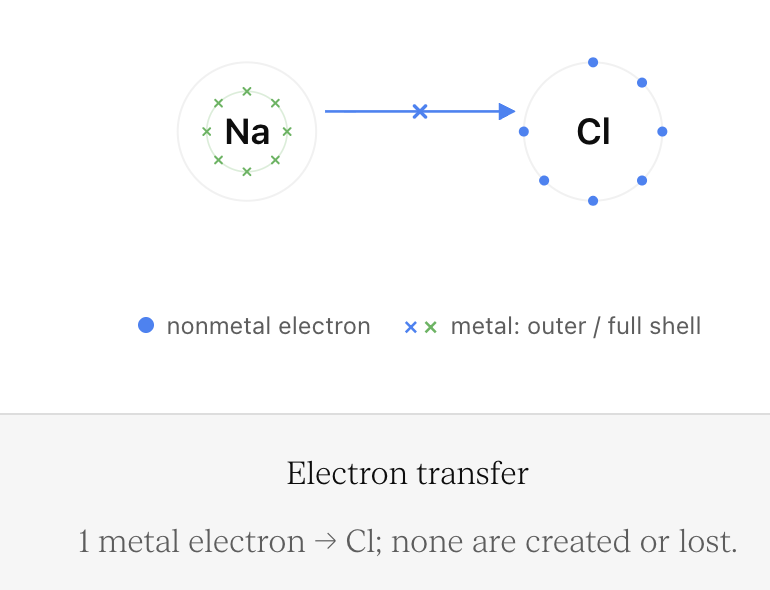
Electron-transfer diagrams help us visualise what happens during oxidation.
Consider sodium reacting with chlorine.
Each sodium atom loses one electron:
Na → Na+ + e−
A chlorine atom gains that electron:
Cl + e− → Cl−
We can represent the transfer as:
Na  Cl
Cl
Sodium is oxidised because it loses the electron.
Chlorine is reduced because it gains the electron.