Forces in Two Dimensions
4. Atwood Machines
Learning outcomes
- I can draw free-body diagrams for Atwood machines.
- I can identify tension and weight forces in pulley systems.
- I can apply Newton's Second Law to connected objects.
- I can calculate acceleration in Atwood systems.
- I can determine tension forces in pulley problems.


What Is an Atwood Machine?
An Atwood machine is a simple pulley system consisting of two masses connected by a string or rope that passes over a pulley.
The basic system contains:
- two masses, usually called m₁ and m₂
- a light string connecting the masses
- a pulley that allows the string to change direction
If the two masses are different, the heavier mass tends to move downward while the lighter mass moves upward.
Atwood machines are useful because they allow us to study the relationship between force, mass, tension, and acceleration.
The Basic Atwood Machine
Suppose:
m₂ > m₁
Then:
m₂ moves downward
and:
m₁ moves upward


Because the masses are connected by the same taut string, they move together.
In an ideal Atwood machine, both masses have the same magnitude of acceleration.
If m₂ accelerates downward at 2.0 m/s², then m₁ accelerates upward at 2.0 m/s².
Their directions are opposite, but the magnitudes are equal.
Assumptions for an Ideal Atwood Machine
Introductory Atwood-machine problems usually assume an ideal system.
This means:
- the string has negligible mass
- the string does not stretch
- the pulley has negligible mass
- the pulley has negligible friction
- the string does not slip on the pulley
Under these assumptions, the tension is the same throughout the string.
Therefore:
T₁ = T₂ = T
Real pulley systems may behave differently, but the ideal model allows us to understand the basic physics clearly.
Forces Acting on Each Mass
Each hanging mass experiences two main forces.
Weight acts downward:
Fg = mg
Tension acts upward:
T


For m₁:
↑ T
● m₁
↓ m₁g
For m₂:
↑ T
● m₂
↓ m₂g
The forces may look similar, but if the masses are different, their weights are different.
Drawing Free-Body Diagrams
It is usually best to draw a separate free-body diagram for each mass.
Suppose:
m₂ > m₁
For m₁, which accelerates upward:
↑ T
●
↓ m₁g
Because the acceleration is upward:
T > m₁g
For m₂, which accelerates downward:
↑ T
●
↓ m₂g
Because the acceleration is downward:
m₂g > T

 o7I?purpose=inline" alt="
This gives us an important relationship:
m₂g > T > m₁g
when m₂ is the heavier accelerating mass.
Applying Newton's Second Law
Newton's Second Law states:
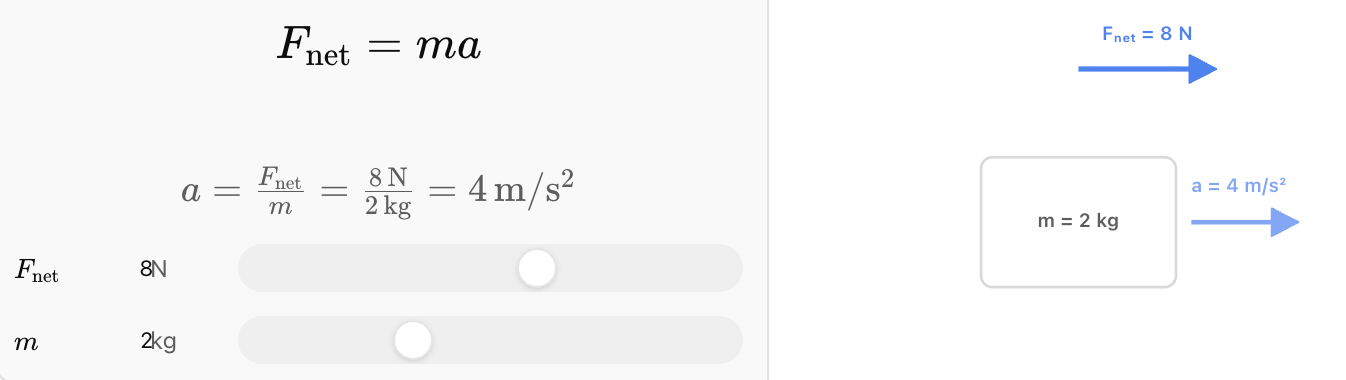
Fnet = ma