4. Atwood Machines

Learning outcomes
  • I can draw free-body diagrams for Atwood machines.
  • I can identify tension and weight forces in pulley systems.
  • I can apply Newton's Second Law to connected objects.
  • I can calculate acceleration in Atwood systems.
  • I can determine tension forces in pulley problems.

https://images.openai.com/static-rsc-4/RMxgVO9kPs5MCTS_OGGxUrfGvxEfqpW4ONkiBGQ4o_0GDCe4QYXr-DL7P7pH3xEkcEe38nPs_ikNDPJJJfMufZbLoRP5-WQS7Huooe32CiKMdFqRXLYLWL3He72e3GFyd0mXuI4WJNU-bfIcBxOuWenGiIZcmkiTdc0NCLBfvr0XnQ0kxI50x6Ff8ioILa72?purpose=fullsize
 
https://images.openai.com/static-rsc-4/byoURhJDonx6Q9kWDK0cHIOcJljKZ1skHsi-e4BN0MnSavhr7s8IOvPwhPiKJ1VAttSzi1M2vlMDSQZtKeG8184tVc1_8xlGUdaTBHW83cmfKScWhRr1E2I3JWn9D3CW8_nwNLTdjhxTXTn2EvndFEOCsT-Ta6gWYJEdKDVsmcuPa4bb02DstbH7w0oN1AV7?purpose=fullsize
 
https://images.openai.com/static-rsc-4/ReRftCECWJb7RwpPRa0dWd7stJzgNZsoFOaxMKGyb34qd46-pcswfNCV0BF9vYhurqZU9Cph9qhOJnmO-tiwbiwN6VnnSnnTb8_FqcK6A0vVSGHkVDg0Ilq-hj03tPSxI_OCXYUeJx9kj1F7lr_Xib-Ejt5mvM6HJmQywdeRD9ZWAYxQ_ucy1eLWn6QNiAi7?purpose=fullsize
 
5

What Is an Atwood Machine?

An Atwood machine is a simple pulley system consisting of two masses connected by a string or rope that passes over a pulley.

The basic system contains:

  • two masses, usually called m₁ and m₂
  • a light string connecting the masses
  • a pulley that allows the string to change direction

If the two masses are different, the heavier mass tends to move downward while the lighter mass moves upward.

Atwood machines are useful because they allow us to study the relationship between force, mass, tension, and acceleration.


The Basic Atwood Machine

Suppose:

m₂ > m₁

Then:

m₂ moves downward

and:

m₁ moves upward

https://images.openai.com/static-rsc-4/_ifpXlNh_WkfO_PayiGfcnJNV-1PUWn4WEmjaaK7qLTXAQJmM4lii58iNtWMON_0Ph2yOdwlOZwHQ96tf_4gaUvohbw0wakgr9E4Hw7XwNvUChbk-0EyaOSx5FPbjMEV_zBMYaa8aIMtyo_iuLgzUxCDATQz-b6MtzpELGmEUdnuVhIHH_trfg-27uAQQtEI?purpose=fullsize
 
https://images.openai.com/static-rsc-4/qc2OhDpu9vhV0GXNRLgDou0t-zxH2p1-wmxehSozbi5I-GwGN36dG2UWGfTtL-Uk0o3X-lnTfn02P_tFPcdFZYBtRCWoY23WitbvCrtWfCdgpQpnj-v6SrcgQPqChWw5kXqDFYLpKNL-mOg0c4jBVXFIBBMDPqqpx0oH-O7uWVuCEkLKS5RQI1CkmGgJJ0Aa?purpose=fullsize
 
https://images.openai.com/static-rsc-4/kjV_NjtpBzZBOHLZESnIuUUQD9wgde-6tUuxijQhwGOZ6iaZE1ikXMD32rBGE7GX3hDuRUz_Y9MWAh583Wn2MQ6fGUF9Sq2Xcdk9ii5Tzi6IVj6BOO7jCrh2IBKfwYajwrzUf6A3RnMwCZBP5gPy0Y2wdN-QRXXcqEHOMah3SJDk34swwm48rvww3B19fp7h?purpose=fullsize
 
5

Because the masses are connected by the same taut string, they move together.

In an ideal Atwood machine, both masses have the same magnitude of acceleration.

If m₂ accelerates downward at 2.0 m/s², then m₁ accelerates upward at 2.0 m/s².

Their directions are opposite, but the magnitudes are equal.


Assumptions for an Ideal Atwood Machine

Introductory Atwood-machine problems usually assume an ideal system.

This means:

  • the string has negligible mass
  • the string does not stretch
  • the pulley has negligible mass
  • the pulley has negligible friction
  • the string does not slip on the pulley

Under these assumptions, the tension is the same throughout the string.

Therefore:

T₁ = T₂ = T

Real pulley systems may behave differently, but the ideal model allows us to understand the basic physics clearly.


Forces Acting on Each Mass

Each hanging mass experiences two main forces.

Weight acts downward:

Fg = mg

Tension acts upward:

T

https://images.openai.com/static-rsc-4/byoURhJDonx6Q9kWDK0cHIOcJljKZ1skHsi-e4BN0MnSavhr7s8IOvPwhPiKJ1VAttSzi1M2vlMDSQZtKeG8184tVc1_8xlGUdaTBHW83cmfKScWhRr1E2I3JWn9D3CW8_nwNLTdjhxTXTn2EvndFEOCsT-Ta6gWYJEdKDVsmcuPa4bb02DstbH7w0oN1AV7?purpose=fullsize
 
https://images.openai.com/static-rsc-4/JWjPGrUUAkzjbz57h6XUHHl52Tz4PkOgrZHqRIqUXoLHvUsK6vmVRLZWkl83WmzhvxjcMXpQiTAHLH5IMe1X_PElRFscjUiAa8iVaHrVk2CQOl4M97PbF8zp0o2kiF-5S0MzOv1tycd0jZBlENxqn4HLRnJ9t7HR0mf-HdObpnCVojx6AMOsLLbJMjbyfaKf?purpose=fullsize
 
https://images.openai.com/static-rsc-4/AjEOsqyFbkD189qxvh648qI_nnGsessn2aaSk-WXpnmzMrYdp0tRDOKOTAkNOMqq0m3_9656rF9RmrsjqZHJ8crLjs-Oy6jcv5hodqSNn1HlWpSrJXn_Ru5Ci88M9MBCzBFP4FdyDVzIuAQBZ5O-D6WoS5UFQPjn07cTLBbm5hkL3qYxe8T31AHdftyA9qIu?purpose=fullsize
 
6

For m₁:

↑ T

● m₁

↓ m₁g

For m₂:

↑ T

● m₂

↓ m₂g

The forces may look similar, but if the masses are different, their weights are different.


Drawing Free-Body Diagrams

It is usually best to draw a separate free-body diagram for each mass.

Suppose:

m₂ > m₁

For m₁, which accelerates upward:

↑ T

●

↓ m₁g

Because the acceleration is upward:

T > m₁g

For m₂, which accelerates downward:

↑ T

●

↓ m₂g

Because the acceleration is downward:

m₂g > T

This gives us an important relationship:

m₂g > T > m₁g

when m₂ is the heavier accelerating mass.


Applying Newton's Second Law

Newton's Second Law states:

Fnet = ma
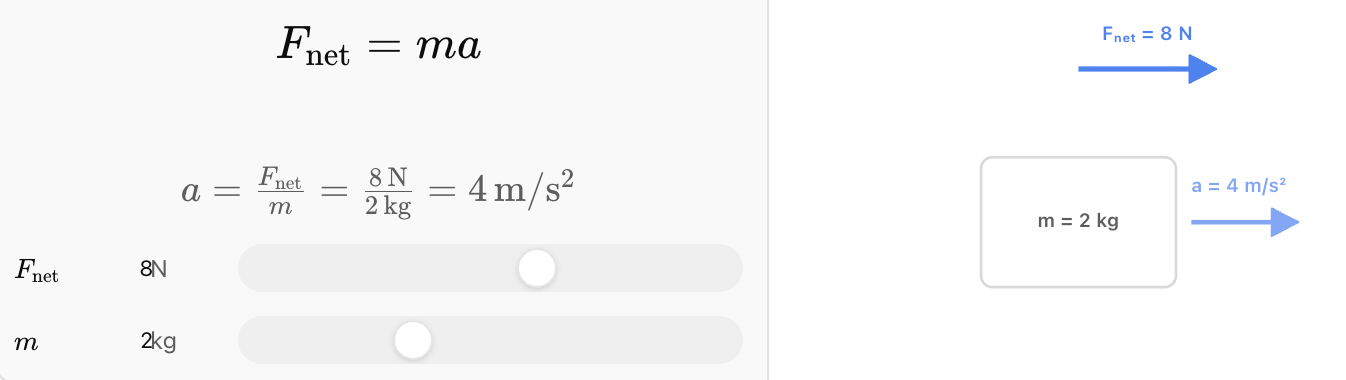
We apply this law separately to each mass.

Because the masses accelerate in opposite directions, it is helpful to choose the direction of motion as positive for each mass.


Equation for the Lighter Mass

Suppose m₁ moves upward.

For m₁:

↑ T

↓ m₁g

The net force upward is:

Fnet = T − m₁g

Using Newton's Second Law:

T − m₁g = m₁a

This is our first equation.


Equation for the Heavier Mass

Now consider m₂, which moves downward.

The forces are:

↓ m₂g

↑ T

The net force downward is:

Fnet = m₂g − T

Therefore:

m₂g − T = m₂a

This is our second equation.

So the two equations are:

T − m₁g = m₁a

m₂g − T = m₂a

These equations describe the motion of the entire ideal Atwood machine.


Finding the Acceleration

We can add the two equations:

T − m₁g = m₁a

m₂g − T = m₂a

Adding gives:

m₂g − m₁g = m₁a + m₂a

The tension forces cancel.

Factor:

(m₂ − m₁)g = (m₁ + m₂)a

Therefore:

a = ((m₂ − m₁)g) / (m₁ + m₂)

This is the acceleration equation for an ideal Atwood machine when:

m₂ > m₁


Understanding the Acceleration Equation

The numerator:

(m₂ − m₁)g

represents the difference between the two weights.

This difference provides the driving force for the system.

The denominator:

m₁ + m₂

represents the total mass that must be accelerated.

Therefore:

Acceleration = driving force ÷ total mass

This is simply another application of:

Fnet = ma


Treating the Two Masses as One System

There is another useful way to understand the Atwood machine.

Instead of analyzing each mass separately, imagine treating both masses as a single connected system.

https://images.openai.com/static-rsc-4/qc2OhDpu9vhV0GXNRLgDou0t-zxH2p1-wmxehSozbi5I-GwGN36dG2UWGfTtL-Uk0o3X-lnTfn02P_tFPcdFZYBtRCWoY23WitbvCrtWfCdgpQpnj-v6SrcgQPqChWw5kXqDFYLpKNL-mOg0c4jBVXFIBBMDPqqpx0oH-O7uWVuCEkLKS5RQI1CkmGgJJ0Aa?purpose=fullsize
 
https://images.openai.com/static-rsc-4/XafPRUorOqkENNAp8qsI9BPqgzI2I4BINFoSwq7IHfuwKBO-TB962U9UYGM8cgIzy7qmOBqR4vNAYM3Sxdx9PK8pFEmehIsgSx72jQGzp0G_Cu7DckEGirDxhOHiNXp8wS3bU-xdTVEZJ-J3saH2rtnS5TzCmdi_1jnU2FcN7GjGOkpdo9rzpxzoHpPjC_ht?purpose=fullsize
 
https://images.openai.com/static-rsc-4/DbEG04GButCI3FASdyWlfv5p1YDaQ8EuHHatl5S6vnXJ9XMOignUdlAxmkjPTwxprRNPCis-QpnCMopPjyvHdyF03nkJXpeWlFDzKRo3qx4oRThC3dEs9rlYma0N8_IdcF_WikT4Z1G2im-eG5Fve8Qs4IvNkxMo82jIas_aMLur4ap9ZX76sCBGeOMqmO4t?purpose=fullsize
 
5

The tension is an internal force within the combined system.

Therefore, it does not appear in the net external force for the entire system.

The driving force is:

Fnet = m₂g − m₁g

or:

Fnet = (m₂ − m₁)g

The total mass is:

mtotal = m₁ + m₂

Using:

Fnet = mtotal a

gives:

(m₂ − m₁)g = (m₁ + m₂)a

which produces the same acceleration equation.


Worked Example 1: Finding Acceleration

An Atwood machine has:

m₁ = 3.0 kg

m₂ = 5.0 kg

Calculate the acceleration.

Because:

m₂ > m₁

the 5.0 kg mass moves downward.

Use:

a = ((m₂ − m₁)g) / (m₁ + m₂)

Substitute:

a = ((5.0 − 3.0) × 9.8) / (3.0 + 5.0)

a = 19.6 / 8.0

a = 2.45 m/s²

Therefore:

Acceleration = 2.45 m/s²

The 5.0 kg mass accelerates downward and the 3.0 kg mass accelerates upward.


Finding the Tension

Once acceleration is known, tension can be calculated using the equation for either mass.

For the lighter mass:

T − m₁g = m₁a

Therefore:

T = m₁g + m₁a

or:

T = m₁(g + a)

For the heavier mass:

m₂g − T = m₂a

Therefore:

T = m₂g − m₂a

or:

T = m₂(g − a)

Both methods should give the same result.


Worked Example 2: Finding Tension

Using the previous system:

m₁ = 3.0 kg

m₂ = 5.0 kg

a = 2.45 m/s²

Use the lighter mass:

T = m₁(g + a)

T = 3.0(9.8 + 2.45)

T = 3.0(12.25)

T = 36.75 N

Therefore:

T ≈ 36.8 N

We can check using the heavier mass:

T = m₂(g − a)

T = 5.0(9.8 − 2.45)

T = 5.0(7.35)

T = 36.75 N

The answers agree.


Why Isn't Tension Equal to Weight?

For a stationary hanging object:

T = mg

But the masses in an Atwood machine are usually accelerating.

Therefore, tension does not equal either object's weight.

For the lighter mass moving upward:

T > m₁g

For the heavier mass moving downward:

T < m₂g

https://images.openai.com/static-rsc-4/RMxgVO9kPs5MCTS_OGGxUrfGvxEfqpW4ONkiBGQ4o_0GDCe4QYXr-DL7P7pH3xEkcEe38nPs_ikNDPJJJfMufZbLoRP5-WQS7Huooe32CiKMdFqRXLYLWL3He72e3GFyd0mXuI4WJNU-bfIcBxOuWenGiIZcmkiTdc0NCLBfvr0XnQ0kxI50x6Ff8ioILa72?purpose=fullsize
 
https://images.openai.com/static-rsc-4/9lH6--wYGIkWsE7Jwn1dKPRZ4cYr9GCbzecdrLeB-SAzqfgLO1xm6OjsZ7EJW2fUmrBGPZF7AI_DZYwDK1ViYhBu33_p4RkgbqX1Nv-acUxJmnKtiCfOQg4o2wab04ujP8V0fn5lBsOnEOD1emLSQgRimJG8bpeoAV7XNseUWDIERxxGthFnm9Un4DwXu1y0?purpose=fullsize
 
https://images.openai.com/static-rsc-4/qc2OhDpu9vhV0GXNRLgDou0t-zxH2p1-wmxehSozbi5I-GwGN36dG2UWGfTtL-Uk0o3X-lnTfn02P_tFPcdFZYBtRCWoY23WitbvCrtWfCdgpQpnj-v6SrcgQPqChWw5kXqDFYLpKNL-mOg0c4jBVXFIBBMDPqqpx0oH-O7uWVuCEkLKS5RQI1CkmGgJJ0Aa?purpose=fullsize
 
5

In our example:

Weight of m₁:

m₁g = 3 × 9.8

m₁g = 29.4 N

Tension:

T = 36.8 N

Weight of m₂:

m₂g = 5 × 9.8

m₂g = 49.0 N

Therefore:

29.4 N < 36.8 N < 49.0 N

which is exactly what we expect.


What Happens When the Masses Are Equal?

Suppose:

m₁ = m₂

Then the acceleration equation becomes:

a = ((m₂ − m₁)g) / (m₁ + m₂)

The numerator becomes zero.

Therefore:

a = 0

https://images.openai.com/static-rsc-4/gpjOEYUwd5fNSiIl9B0H8jMrHa5u2znjjmQnbT82ou4_nImkciKXI9dOqW3FgJZtqykdfEczqxNSe8l2A-VvgI-qPNygeXGY-uDPYSuGMiPpBh7Xkt7l8TiSQxpwQjkJXaYiOeBTKIlPIE_7DCrNJczxDqJyjhJBDUwU0NSJd343KxplLVXSjsjdE0fG9TkJ?purpose=fullsize
 
https://images.openai.com/static-rsc-4/tfh1iePS4NYkWFQ5siUTnxE5TUit-oR6nYGx1_8uxW5tm80-mj2GadhFDiqH96tPYE_LEUi0DVYDKmXQnx_n2Q2bNKLg3Kl6ITfM2htN2kyAThzrrIJSR4ZfBevkX9QWUBYXCd6fYN58QoqpQooQgFVFcFuVq0LdNQIemB5E64ycS4_Ax7o9v5r-68C0-F3-?purpose=fullsize
 
https://images.openai.com/static-rsc-4/BXuiGF_Y4EGzk5xXw-PxoAnoFYHiSr3ayf6PXPZE6MbMSZyrl0cgMPfwP40XRWZl77N5bZLNaJWXznfDIwBj0ceTbH-ir62hly2-9I4tDTC3ha5Hugu0NyvLYmXeq-_kCA23wZwbA3upzQ7fyhYe1Znx6LY3LOityDv8STaEmQMcPh5esmRgWzLc-U9aOAiF?purpose=fullsize
 

If the system begins at rest, it remains at rest.

If it is already moving ideally, it can continue at constant velocity.

The system is in translational equilibrium because there is no resultant force causing acceleration.


What Happens When the Difference in Mass Increases?

Suppose the total mass remains similar but the difference between the masses becomes larger.

The driving force:

(m₂ − m₁)g

becomes larger.

Therefore, the acceleration increases.

For example:

A system with 5 kg and 4 kg has a small mass difference.

A system with 8 kg and 1 kg has a much larger mass difference.

The second system experiences a much larger acceleration.


What Happens When Both Masses Become Large?

Suppose the difference between the masses stays the same, but both masses become larger.

Compare:

2 kg and 3 kg

with:

20 kg and 21 kg

Both systems have a mass difference of 1 kg.

However, the second system has much more total mass to accelerate.

Therefore, its acceleration is smaller.

This illustrates the basic idea:

Acceleration depends on both the driving force and the total inertia of the system.


Worked Example 3: Larger Masses

An Atwood machine has:

m₁ = 8 kg

m₂ = 12 kg

Calculate the acceleration.

Use:

a = ((m₂ − m₁)g) / (m₁ + m₂)

a = ((12 − 8) × 9.8) / (8 + 12)

a = 39.2 / 20

a = 1.96 m/s²

Now calculate tension using m₁:

T = m₁(g + a)

T = 8(9.8 + 1.96)

T = 8(11.76)

T = 94.08 N

Therefore:

Acceleration ≈ 1.96 m/s²

Tension ≈ 94.1 N


Acceleration Is Less Than g

For a normal Atwood machine with two positive masses:

a < g

Why?

The heavier mass does not fall freely.

The lighter mass and the tension in the string resist its downward motion.

https://images.openai.com/static-rsc-4/lWuoNlP9WSIzJ2VJDDd1JrDT_AtVlwVm7qbRPJBlaqcxuXcE76nidkF2SAlJyplqIhfR6lP1F4gaoT9Qa2FUoCvUjaP3AiaST1leJXFCGGYI0srbZ0lttum3atujXbzFTfRZwIorN05qJ8tgdkTkHKql_uBQD7aI1797GX2vkadsh_EAVMDrtAHsRhTUPavz?purpose=fullsize
 
https://images.openai.com/static-rsc-4/JjOcpWPj3R-LLEH1ejnZQYVrmjdQq9odcUXWK7rgPpW6ccPowksHifMVAwQnI_5snPqSdYSGNgUe52W9yEIQQ6MjSlEW7oL4BCdmJkhGVra3V9KM5z9bjyoIiCJ7NkG1TZNdProx82-jBtjEtde52NLZikPG9TOC8frJxDvzmCMop7jzyOrBiLpOhUCbBwvg?purpose=fullsize
 
https://images.openai.com/static-rsc-4/2ZDZ3NbywBbWNXnxENKWLzNdf5ws3BzZP_P-jCs_LUOWcBdzktckXWuGn6ayPuIBfuvj7caPRkRUTjc2Wzxg8FJVVxFNf09vciqoWIsPozAUMmo-xuEUjarCTOjLAvRuqAH-T3Cy2ZnACU-ELPtExh_xFuiKK8dxsyOdWkPdry-rrhzK8v0F7cbT9Sm31HAl?purpose=fullsize
 
4

A freely falling object has:

a = g

But an Atwood machine has:

a = ((m₂ − m₁)/(m₁ + m₂))g

The fraction:

(m₂ − m₁)/(m₁ + m₂)

is less than 1.

Therefore:

a < g


Atwood Machines and Kinematics

Once the acceleration has been calculated, the system can also be analyzed using constant-acceleration equations.

For example:

vf = vi + at

and:

Δx = vit + ½at²

This allows us to determine:

  • velocity after a certain time
  • distance traveled
  • time required to move a certain distance

The Atwood-machine force calculation provides a, and the kinematics equations describe the resulting motion.


Worked Example 4: Velocity After a Time

An Atwood machine accelerates at:

a = 2.0 m/s²

The system starts from rest.

Calculate its speed after 3.0 s.

Use:

vf = vi + at

vf = 0 + (2.0)(3.0)

vf = 6.0 m/s

Both masses have a speed of:

6.0 m/s

but they move in opposite directions.


Worked Example 5: Distance Traveled

The same Atwood machine starts from rest and accelerates at:

2.0 m/s²

How far does each mass move in 3.0 s?

Use:

Δx = vit + ½at²

Since:

vi = 0

Δx = ½(2.0)(3.0²)

Δx = 1 × 9

Δx = 9.0 m

Each mass moves 9.0 m in opposite directions, provided the physical system allows that much movement.


A Mass on a Table Connected to a Hanging Mass

A related pulley system has one mass on a horizontal surface and another hanging over the edge.

https://images.openai.com/static-rsc-4/RKZEW_WiQTYJvwK7EwMW0HqQbLixymCefBEL-i_OeGT5JW-gVFR2FV_BJeCMfmIAlq5mP7PoBWoMXpc8zPY3rOoDR3Fecy5f03RbANH9901qtl-PCHnPodjFW8CneFNuF7Xrd_nR_j7DwfdowAgolt5M0M5Z100Gmf5oDNzsrKSHM2TYjSvb7u5agznPKO-7?purpose=fullsize
 
https://images.openai.com/static-rsc-4/4KoLPzolq-bmyVkOvtAz3cK60FU2b_6td7MyiTU5guYWq8TcY8fIhLAJwwsglIJP-pUazlFLWDrTVfc0zW4EauvjUstgbN8qTmtBrwlE2QiKjdARNSOMrEbwx0-QIFExpy1iXv_NI8DrFwI5btpG0ip0ijjq8IE_hOasdqZNHU7nZPrPBwD-o0hySV0iQZKh?purpose=fullsize
 
https://images.openai.com/static-rsc-4/bqV903r1UaL64KzEc4t43OyuzK9LzArdcFVOh7ISvB5pKPBTb1EKcu-i9ByOx73AWXmnmE5mnd9zGVa1lSMhLPnUex-LqeHC8a4S9kGVq6JhnKQebQ-XpdDi7_Ke3-HePlQ4I6Xo-8J2XJtQHGK2-U_93TGYGcI5cPhREv9ZNrPwQa2n-lG8PZEYqoMQds18?purpose=fullsize
 
5

Suppose:

m₁ is on the table.

m₂ hangs vertically.

For m₁ on a frictionless table:

T = m₁a

For m₂:

m₂g − T = m₂a

Adding the equations gives:

m₂g = (m₁ + m₂)a

Therefore:

a = m₂g / (m₁ + m₂)

This is not technically the basic two-hanging-mass Atwood machine, but it uses the same connected-object reasoning.


Adding Friction to the Table

If the horizontal surface has friction:

Ff = μN

For the mass on the table:

N = m₁g

so:

Ff = μm₁g

https://images.openai.com/static-rsc-4/RKZEW_WiQTYJvwK7EwMW0HqQbLixymCefBEL-i_OeGT5JW-gVFR2FV_BJeCMfmIAlq5mP7PoBWoMXpc8zPY3rOoDR3Fecy5f03RbANH9901qtl-PCHnPodjFW8CneFNuF7Xrd_nR_j7DwfdowAgolt5M0M5Z100Gmf5oDNzsrKSHM2TYjSvb7u5agznPKO-7?purpose=fullsize
 
https://images.openai.com/static-rsc-4/4KoLPzolq-bmyVkOvtAz3cK60FU2b_6td7MyiTU5guYWq8TcY8fIhLAJwwsglIJP-pUazlFLWDrTVfc0zW4EauvjUstgbN8qTmtBrwlE2QiKjdARNSOMrEbwx0-QIFExpy1iXv_NI8DrFwI5btpG0ip0ijjq8IE_hOasdqZNHU7nZPrPBwD-o0hySV0iQZKh?purpose=fullsize
 
https://images.openai.com/static-rsc-4/9Jp5TwtLc2laUtVDzsSTuqiMTuSxeeBbe0XvuMEEPcgtnyIwCggIv0NKo6FFY1MpjPymA5xSBCMLv7Xjsa1AZbOtPNw35LHoJB_Ic2uQYPdKzFJyHvy5Vnq0O3Umw1mgGoKpeUivp5kM9gXn_G5M2iaIxb4adhNAnMPOaRUhgNJVqXK0PsQFQMjsPekgy4oR?purpose=fullsize
 

If m₂ moves downward, the net driving force for the system becomes:

Fnet = m₂g − Ff

Therefore:

m₂g − Ff = (m₁ + m₂)a

and:

a = (m₂g − Ff)/(m₁ + m₂)

This combines ideas from:

  • tension
  • friction
  • Newton's Second Law
  • connected objects

Worked Example 6: Pulley with Friction

A 6 kg block rests on a horizontal table and is connected to a 4 kg hanging mass.

The friction force acting on the block is 10 N.

Calculate the acceleration.

Driving force from the hanging mass:

m₂g = 4 × 9.8

m₂g = 39.2 N

Subtract friction:

Fnet = 39.2 − 10

Fnet = 29.2 N

Total mass:

mtotal = 6 + 4

mtotal = 10 kg

Therefore:

a = Fnet / mtotal

a = 29.2 / 10

a = 2.92 m/s²

The hanging mass accelerates downward while the block accelerates horizontally toward the pulley.


Atwood Machines with Real Pulleys

Real pulleys are not perfectly ideal.

A real pulley may:

  • have mass
  • experience friction at its axle
  • rotate with significant rotational inertia
  • have a rope with non-negligible mass
https://images.openai.com/static-rsc-4/eYCYEf6rk2jPRMQRVvlCQQdwGCeVt4T4KndReY4u3hq_pHkNkc7oU_xOnxjP0RouvGkAdORbwVjG503mrxxm1D4FXtvmPvIU9HPHjiZKD-ig4Bnm554jQ3CiHwB_PaDIbQLLMz4Wq1Olu1YmJRbGrvoFVOrtu1cU-Tu4Kd65TJ26cXn4RsqQc-IxHcQsLro-?purpose=fullsize
 
https://images.openai.com/static-rsc-4/tZa5a_4f8Vmp8Fq-Jo_pDewfGxaVMaZXgqNvs20gOA_sz2kNmn-CfvdKKlRfvDcHl-C8d_P1s3T2pCZB4aCg-GaxRrUWL3RJPYHNRh_FmSqEiszynynqgBaK5yCQwSX4_pP_J7XwHChiD_RD65VMh5PFT0adyUf5pMiHi_WiD61B_VxoSgXRhaZF6-gZ0CXM?purpose=fullsize
 
https://images.openai.com/static-rsc-4/lNqn-jmZv5dM1cpFu8PIfgZEaXextaqk1Fo-IEYH6amOuPw9dJWMlaUR4hHzx6NJQTB0HrIyXvV0f2xrWIaaFpPlJgGsIsmDdApn6AiLCjaodvtB56eF7zfOlVb_3enzld-3_HsxdEi_dBPZ4Bz9NYS-OK2rBZl9dXBm8Df3YYyqfMv6k1I4IfltoKuA6OiE?purpose=fullsize
 
6

In these situations, the tension on one side of the pulley may not equal the tension on the other side.

Some of the net force is needed to produce the angular acceleration of the pulley.

More advanced models therefore include rotational dynamics.

For introductory problems, however, the pulley and string are usually assumed to be ideal.


Experimental Atwood Machines

Atwood machines are commonly used in physics laboratories.

https://images.openai.com/static-rsc-4/tZa5a_4f8Vmp8Fq-Jo_pDewfGxaVMaZXgqNvs20gOA_sz2kNmn-CfvdKKlRfvDcHl-C8d_P1s3T2pCZB4aCg-GaxRrUWL3RJPYHNRh_FmSqEiszynynqgBaK5yCQwSX4_pP_J7XwHChiD_RD65VMh5PFT0adyUf5pMiHi_WiD61B_VxoSgXRhaZF6-gZ0CXM?purpose=fullsize
 
https://images.openai.com/static-rsc-4/0tf2-4Amd3jGmZDcP06HzDmdLtGgufJSyc9Wc9hy-geRQFYLQDnUMiD5m9fWY4f4k2SEQ8LZGOfjcAVaK9rwSUaNxOjMOnu3yHb663y-YVWIEnER6FfNmDHMoGx_u-FjKYABUdjSJIZ0Yx_l14MewKPRVcM8umfX1ThGQOJnjDtSXppc_ySn9bLJ1akIIuJZ?purpose=fullsize
 
https://images.openai.com/static-rsc-4/eYCYEf6rk2jPRMQRVvlCQQdwGCeVt4T4KndReY4u3hq_pHkNkc7oU_xOnxjP0RouvGkAdORbwVjG503mrxxm1D4FXtvmPvIU9HPHjiZKD-ig4Bnm554jQ3CiHwB_PaDIbQLLMz4Wq1Olu1YmJRbGrvoFVOrtu1cU-Tu4Kd65TJ26cXn4RsqQc-IxHcQsLro-?purpose=fullsize
 
6

Students can vary:

  • m₁
  • m₂
  • total mass
  • difference in mass

and measure the resulting acceleration.

This allows Newton's Second Law to be tested experimentally.

For example, students can investigate whether:

greater net force → greater acceleration

and whether:

greater total mass → smaller acceleration for the same net force


Atwood Machines in Elevators and Lifting Systems

The basic principles of Atwood machines appear in real mechanical systems.

https://images.openai.com/static-rsc-4/cW3S87N0Fh0j1pBoywX8wakAETIf1hPbxnKmINFpr6lur1l-NAawf6E-bHWRRx742AcIRpLFb_l3FAFsObguD4vDHU6JK86VWV26rEjEU4xjtnjxAXQlUE9A1FD94iquV9B8QnFmYJ_0KsRDeMGqW3fRqESfVmVSmTmebTZqUpBSjHMRIWut6nG9Ax7xnusA?purpose=fullsize
 
https://images.openai.com/static-rsc-4/0S8pnS4qmMAuhm6om4TaYq5kklqpYFfgCCUjwuNQW8YnCSeqiSsQEW5rgCYeT9meqtP-5gSVzM0D2W-NTvZP6icXq_Faq8jXyM2GRANoiUa0Em6rt3K0z0-Y4NKDaQJZp_vfEVwvFHJrTIcpZZBsyWPgYbBuKxPl6DuvrJjWTg2ovn2JM4ird6cICeQsnUb5?purpose=fullsize
 
https://images.openai.com/static-rsc-4/hPFADy2epZQVo_NjynQIZPFb_h1x20Ocw6p9aJK1rgow-CfJlzMCGyChulUWZ43u0mMMbdfRcfzbRZJDTPJh02uNKGF_yV5fX8_iLAgSvgaNO6jC6R5uhwnA2NL8ORi8qFMoRrwVrb-v3KKpT9ZroPyMZHpFiRAk0V-RNtapQf_kgEQZzZYUfoR-R-Ya0aFC?purpose=fullsize
 
4

Elevators often use a counterweight.

The elevator car and counterweight are connected by cables passing over a pulley system.

The counterweight reduces the amount of force the motor must provide to move the elevator.

Although real elevators are much more complicated than ideal Atwood machines, the basic idea of connected masses and tension is similar.


Counterweights

Counterweights are also used in:

  • cranes
  • drawbridges
  • stage equipment
  • lifting systems
  • industrial machinery
https://images.openai.com/static-rsc-4/T7DSgqZTgQ3crtrZ1ipkbfaWeLq29QMPqT4XA-RDQWsUBjy2ljz752KmsVdlypmRv0UTDkz24HIg6UEdz3XvrbscmGA0wrnIVpHc2UupU5XZC86YwejXyCQQlK3mo_ZO_xosHg5vYe_-nLxTrjjtWe-2nkBginpUF5urpT7wERCfZwjvF1xG-rajoPRL3abo?purpose=fullsize
 
https://images.openai.com/static-rsc-4/uau2lJ7cMZSYqVra2-bhnf0dgtL1zh2KZJg1Yl_DTmzupWM4YSL-bPAdGKzJYf4nC8cR8TrlkRlYTGTk_SsQ1CfFEW_CgLsCSwNibbphYaTJzBZczbXD7GQdOCweggJATpZ0cEMtFgyW4PTDmrHjokf7kktT0tfjohU3cV4g_Bzxyp7CB7-feLzqW0_844PE?purpose=fullsize
 
https://images.openai.com/static-rsc-4/6YlMbM2MhhYen6zMREG0K3EiqjEsgsw7lqCnE2samAV3MIBOkPLD13wQfKmcjbT5BZbIdys0SKjpj9109wxJpagZQEu7_-1EeVlgLBM0O_gS1tVOd5hfoTFxRzhy9MAhVMtzdgJNHnU5_E8jwya_N93kMleECN6QjHlr34kv_utzA8yKwwhX66qadzpZ7QxU?purpose=fullsize
 
7

A counterweight helps balance another load.

This reduces the net force required from motors or people and can make lifting systems more efficient and controllable.


Did You Know?

The Atwood machine was introduced by English mathematician and physicist George Atwood in the eighteenth century.

https://images.openai.com/static-rsc-4/RTtojT0gmYhakZL13LxeyNjyGRHqRdPObwRT25QW_RgHCAAq18Bmjt66wYNY7Fa5__gN3t0KwL4Kz3fkH-_VjVo9u4NvvkBKVONwc0QB2VsAxKRMrCn6rXARSeTbxrw1imhye8XTaOlnzj5j-iPgSeuCQDWqPh5XQ98jYrOiaSpFkUu5Yl7e-rqTM-oQSclG?purpose=fullsize
 
https://images.openai.com/static-rsc-4/G0hNtWAQPP3jAza2ueP2-CahX9iAxWkCuFu0p3hd-9vn33gGWWS6cuKF0p0uNZf_djmX0MT-4rUffcrb_HGvn82wkOvNVdNMn9VmhYIvs2FtYlw7Dof_jNyVc_5rQ35h8QeC3DBGM7hdDZePdANh9iytaeunKj34U4l20v8b2Z3M0mjE3lPS3XCMkP4lB0Aw?purpose=fullsize
 
https://images.openai.com/static-rsc-4/NoHORY0HYyQiXADa3wz7SLtPI0El6e4s8y_HYX_jPKMoRuDlxM1GocZdjAkbQ5X9b8Nyj7bwsSsD83tPFHMg2yfFvv2hy2CXorl7QzJiPzXWPDO3qEvI-_Wipgsas3Unvr3ePmRA80r7hZYrDgD_BCN6NgEq1D7z8_yWPosuUUbIpwGBLMEvClsoHQGgM9ko?purpose=fullsize
 
5

The machine allowed scientists to study uniformly accelerated motion using accelerations much smaller than gravitational acceleration.

Instead of trying to measure an object falling freely at approximately 9.8 m/s², researchers could choose two similar masses and create a much smaller, easier-to-measure acceleration.


Common Mistakes

Mistake 1: Assuming tension equals weight

The masses are accelerating, so tension is generally not equal to either mass's weight.

Mistake 2: Giving the masses different acceleration magnitudes

For an ideal taut, non-stretching string:

|a₁| = |a₂|

Mistake 3: Using only the difference in masses as the total mass

The driving force depends on the mass difference, but both masses must be accelerated.

Therefore:

Driving force = (m₂ − m₁)g

while:

Total mass = m₁ + m₂

Mistake 4: Adding tension when analyzing the whole system

For the combined two-mass system, tension is internal and cancels.

Mistake 5: Forgetting direction

The heavier mass accelerates downward while the lighter mass accelerates upward.

Mistake 6: Using different tension values in an ideal system

With an ideal massless string and frictionless, massless pulley, the tension is the same throughout the string.


A Strategy for Solving Atwood-Machine Problems

A reliable method is:

  1. Identify the two masses.
  2. Determine which mass is heavier.
  3. Predict the direction of acceleration.
  4. Draw a separate free-body diagram for each mass.
  5. Label tension upward and weight downward.
  6. Apply Newton's Second Law to each object.
  7. Write one equation for each mass.
  8. Add the equations to eliminate tension.
  9. Solve for acceleration.
  10. Substitute the acceleration into either object's equation.
  11. Solve for tension.
  12. Check whether the result makes physical sense.

For m₂ > m₁, you should normally find:

m₁g < T < m₂g

and:

0 < a < g


Key Terms

Atwood machine: A system of two masses connected by a string passing over a pulley.

Tension: A pulling force transmitted through a string, rope, or cable.

Weight: The gravitational force acting on an object.

Pulley: A wheel that allows a rope or cable to change direction.

Connected objects: Objects whose motions are linked by a string, rope, cable, or other connection.

Driving force: The unbalanced external force causing a system to accelerate.

Ideal pulley: A pulley assumed to have negligible mass and friction.

Ideal string: A string assumed to have negligible mass and no stretching.


Key Equations

Weight:

Fg = mg

Newton's Second Law:

Fnet = ma

For the lighter mass moving upward:

T − m₁g = m₁a

For the heavier mass moving downward:

m₂g − T = m₂a

Ideal Atwood-machine acceleration:

a = ((m₂ − m₁)g)/(m₁ + m₂)

Tension using the lighter mass:

T = m₁(g + a)

Tension using the heavier mass:

T = m₂(g − a)

For equal masses:

a = 0


Key Takeaways

  • An Atwood machine consists of two masses connected by a string passing over a pulley.
  • Each hanging mass experiences weight downward and tension upward.
  • Separate free-body diagrams should normally be drawn for each mass.
  • In an ideal system, the tension is the same throughout the string.
  • Connected masses have the same magnitude of acceleration but move in opposite directions.
  • The heavier mass moves downward while the lighter mass moves upward.
  • Newton's Second Law can be applied separately to each mass.
  • When the two masses are treated as one system, tension is an internal force and cancels.
  • The difference between the weights provides the driving force.
  • The total mass of both objects must be accelerated.
  • For an ideal Atwood machine, a = ((m₂ − m₁)g)/(m₁ + m₂).
  • The acceleration is smaller than gravitational acceleration.
  • Once acceleration is known, either mass can be used to calculate tension.
  • If the masses are equal, the system has zero acceleration.
  • Atwood-machine principles apply to pulley systems, counterweights, elevators, cranes, and other lifting systems.