Forces in Two Dimensions
3. Inclined Planes
Learning outcomes
- I can identify forces acting on an object on an incline.
- I can resolve weight into parallel and perpendicular components.
- I can calculate net force on an inclined plane.
- I can analyze motion on slopes with and without friction.
- I can solve problems involving inclined planes.


What Is an Inclined Plane?
An inclined plane is a flat surface that is tilted at an angle to the horizontal.
Common examples include:
- ramps
- hills
- roads on slopes
- playground slides
- loading ramps
- roofs
- ski slopes
When an object is placed on an incline, gravity still acts vertically downward. However, part of the gravitational force tends to pull the object down the slope.
This makes inclined planes an important application of force components.
Forces Acting on an Inclined Plane
Consider a box resting on a slope.
Several forces may act on the box:
- weight (Fg) acting vertically downward
- normal force (N) acting perpendicular to the surface
- friction (Ff) acting along the surface when appropriate
- tension or applied forces if the object is being pulled or pushed


A common mistake is to draw the normal force vertically upward.
On an incline, the normal force is not vertical.
The normal force always acts:
perpendicular to the surface
Choosing Axes on an Incline
For horizontal surfaces, we normally use horizontal and vertical axes.
For inclined planes, a more useful coordinate system is:
x-axis: parallel to the slope
y-axis: perpendicular to the slope


This makes calculations much easier because the normal force and friction already lie along these axes.
Gravity is then the force that must be resolved into components.
Resolving Weight on an Incline
The gravitational force is:
Fg = mg
and always acts vertically downward.
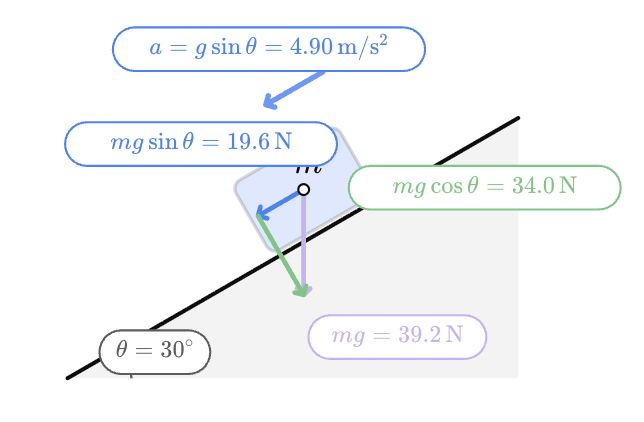
On an incline, we resolve weight into two components:
Fg∥ = component parallel to the slope
Fg⊥ = component perpendicular to the slope


For a slope at angle θ:
Parallel component:
Fg∥ = mg sin θ
Perpendicular component:
Fg⊥ = mg cos θ
The parallel component pulls the object down the slope.
The perpendicular component pushes the object into the surface.
Why Is It mg sin θ Down the Slope?
The geometry of the force triangle shows that the component parallel to the slope is opposite the angle θ.
Therefore:
sin θ = Fg∥ / mg
Rearranging:
Fg∥ = mg sin θ
The perpendicular component is adjacent to θ:
cos θ = Fg⊥ / mg
Therefore:
Fg⊥ = mg cos θ


These two equations are central to solving inclined-plane problems.
The Normal Force on an Incline
If there are no other forces acting perpendicular to the slope and the object does not accelerate away from the surface:
N = Fg⊥
Therefore:
N = mg cos θ
Notice:
N ≠ mg
except when the surface is horizontal.
As the incline becomes steeper, the normal force becomes smaller.


At:
θ = 0°
cos 0° = 1
so:
N = mg
On a very steep incline, the normal force becomes much smaller.
Worked Example 1: Resolving Weight
A 10 kg box rests on a 30° incline.
Calculate the components of its weight.
First calculate weight:
Fg = mg
Fg = 10 × 9.8
Fg = 98 N
Parallel component:
Fg∥ = mg sin θ
Fg∥ = 98 sin 30°
Fg∥ = 49 N
Perpendicular component:
Fg⊥ = mg cos θ
Fg⊥ = 98 cos 30°
Fg⊥ ≈ 84.9 N
Therefore:
Force down the slope = 49 N
Force into the slope ≈ 84.9 N
If there are no other perpendicular forces:
N ≈ 84.9 N
A Frictionless Inclined Plane
First consider a perfectly smooth incline with no friction.
The forces are:
- weight
- normal force
The normal force balances the perpendicular component of weight.
Therefore:
N = mg cos θ
But there is nothing to balance the parallel component:
Fnet = mg sin θ
The object therefore accelerates down the slope.
This relationship is especially clear in the interactive inclined-plane model:
a = gsinθ