Momentum and Collisions
2. Impulse
Learning outcomes
- I can define impulse.
- I can relate impulse to momentum change.
- I can calculate impulse.
- I can interpret force-time graphs.
- I can explain applications of impulse in safety systems.


What Is Impulse?
When a force acts on an object for a period of time, the object's momentum can change.
The quantity that describes the combined effect of the force and the time for which it acts is called impulse.
Impulse is represented by the symbol:
J
For a constant force:
J = FΔt
where:
- J = impulse
- F = force
- Δt = time interval
A large force acting for a short time can produce the same impulse as a smaller force acting for a longer time.
This simple idea has major applications in collisions, sports, vehicle safety, protective equipment, and engineering.
Units of Impulse
Force is measured in:
newtons (N)
Time is measured in:
seconds (s)
Therefore, impulse is measured in:
newton-seconds (N·s)
So:
Impulse unit = N·s
For example:
J = 50 N·s
However, impulse can also be expressed in:
kg·m/s
This is because impulse is equal to a change in momentum.
Impulse and Momentum
The most important relationship is the impulse-momentum theorem:
Impulse = change in momentum
Therefore:
J = Δp
Since:
p = mv
then:
J = mvf − mvi
For an object of constant mass:
J = m(vf − vi)
Combining this with:
J = FΔt
gives:
FΔt = Δp
or:
FΔt = m(vf − vi)


This means that applying an impulse to an object changes its momentum.
Why Does Impulse Change Momentum?
Newton's Second Law can be written in terms of momentum:
F = Δp / Δt
Rearrange:
FΔt = Δp
But:
FΔt = J
Therefore:
J = Δp
Impulse is not a completely separate idea from force and momentum. It describes how a force acting over time changes an object's momentum.
Impulse Is a Vector
Impulse is a vector quantity because momentum is a vector.
Therefore, impulse has:
- magnitude
- direction
The direction of the impulse is the same as the direction of the net force causing the momentum change.


For one-dimensional problems, we can represent opposite directions using positive and negative signs.
For example:
Right = positive
Left = negative
A negative impulse therefore represents an impulse directed to the left.
Calculating Impulse from Force and Time
For a constant force:
J = FΔt
Suppose a force of 40 N acts for 3.0 s.
J = 40 × 3.0
J = 120 N·s
The object receives an impulse of:
120 N·s
in the direction of the force.
Worked Example 1: Pushing a Cart
A student pushes a cart with a constant net force of 25 N for 4.0 s.
Calculate the impulse.
Use:
J = FΔt
J = 25 × 4.0
J = 100 N·s
Therefore:
Impulse = 100 N·s
The cart's momentum changes by:
100 kg·m/s
in the direction of the net force.
Calculating Impulse from Momentum Change
Impulse can also be calculated using:
J = Δp
or:
J = pf − pi
Suppose an object's momentum changes from:
20 kg·m/s
to:
70 kg·m/s
Then:
J = 70 − 20
J = 50 kg·m/s
Since:
1 N·s = 1 kg·m/s
we can also write:
J = 50 N·s
Worked Example 2: Accelerating a Ball
A 2.0 kg ball increases its velocity from 3.0 m/s to 8.0 m/s in the same direction.
Calculate the impulse.
Initial momentum:
pi = mvi
pi = 2.0 × 3.0
pi = 6.0 kg·m/s
Final momentum:
pf = mvf
pf = 2.0 × 8.0
pf = 16 kg·m/s
Therefore:
J = pf − pi
J = 16 − 6
J = 10 N·s
Impulse Can Change Speed
If impulse acts in the same direction as an object's motion, its momentum can increase.


For an object of constant mass, an increase in momentum means an increase in velocity.
For example, when a football player kicks a stationary ball:
- the foot exerts a force
- the force acts for a short time
- the ball receives an impulse
- the ball's momentum increases
- the ball accelerates away
Impulse Can Reduce Speed
Impulse can also act opposite to an object's motion.
Suppose a moving object has momentum to the right.
If a force acts toward the left, the object receives a leftward impulse.
Its rightward momentum decreases.
This occurs when:
- brakes slow a vehicle
- a goalkeeper catches a ball
- friction slows an object
- a collision brings an object to rest


Impulse Can Reverse Direction
A particularly large momentum change occurs when an object reverses direction.
Suppose:
m = 0.50 kg
Initial velocity:
vi = +10 m/s
Final velocity:
vf = −10 m/s
Initial momentum:
pi = 0.50(+10)
pi = +5 kg·m/s
Final momentum:
pf = 0.50(−10)
pf = −5 kg·m/s
Therefore:
Δp = pf − pi
Δp = −5 − (+5)
Δp = −10 kg·m/s
So:
J = −10 N·s
The impulse has magnitude:
10 N·s
and acts in the negative direction.
Worked Example 3: A Bouncing Ball
A 0.20 kg ball travels toward a wall at 15 m/s and rebounds in the opposite direction at 10 m/s.
Take motion toward the wall as positive.
Initial velocity:
vi = +15 m/s
Final velocity:
vf = −10 m/s
Use:
J = m(vf − vi)
J = 0.20(−10 − 15)
J = 0.20(−25)
J = −5.0 N·s
The negative sign shows that the impulse acts away from the wall.


Notice that the velocity change is:
−25 m/s
not 5 m/s.
Direction matters.
Average Force
Collision forces often change rapidly.
Instead of using one constant force, we can sometimes work with the average force.
The impulse relationship becomes:
J = FavgΔt
Therefore:
Favg = J / Δt
Since:
J = Δp
we can also write:
Favg = Δp / Δt
This relationship is extremely important in safety systems.
Worked Example 4: Average Force
A 0.15 kg baseball changes velocity from 40 m/s to 0 m/s in 0.010 s.
Calculate the magnitude of the average force.
Momentum change magnitude:
|Δp| = m|vf − vi|
|Δp| = 0.15 × 40
|Δp| = 6.0 kg·m/s
Now:
Favg = |Δp| / Δt
Favg = 6.0 / 0.010
Favg = 600 N
A very short stopping time can therefore produce a very large force.
Force-Time Graphs
Impulse can also be determined from a force-time graph.


A force-time graph has:
Force on the vertical axis
and:
Time on the horizontal axis
The impulse is equal to the area under the force-time graph.
Therefore:
Impulse = area under F-t graph
This works because:
area = force × time
and:
J = FΔt
Rectangular Force-Time Graph
Suppose a constant force of 50 N acts for 4.0 s.
The force-time graph forms a rectangle.
Area:
A = base × height
A = 4.0 × 50
A = 200 N·s
Therefore:
J = 200 N·s
The object's momentum changes by:
200 kg·m/s
Worked Example 5: Force-Time Graph
A force-time graph shows a constant force of 80 N acting from 0 s to 3.0 s.
Impulse:
J = area
J = base × height
J = 3.0 × 80
J = 240 N·s
Therefore:
Δp = 240 kg·m/s
Triangular Force-Time Graphs
Collision forces often rise to a maximum and then fall again.
The force-time graph may be approximated as a triangle.


For a triangle:
Area = ½ × base × height
Therefore:
J = ½ × Δt × Fmax
For example, suppose a collision force rises to 1000 N and returns to zero over 0.20 s.
J = ½ × 0.20 × 1000
J = 100 N·s
Worked Example 6: Triangular Collision Force
During a collision, force increases from zero to 6000 N and then decreases back to zero over a total time of 0.10 s.
Approximate the graph as a triangle.
Impulse:
J = ½ × base × height
J = ½ × 0.10 × 6000
J = 300 N·s
Therefore:
Change in momentum = 300 kg·m/s
Irregular Force-Time Graphs
Real collisions rarely produce perfect rectangles or triangles.


For an irregular graph, impulse is still:
the total area under the curve
The area may be estimated by:
- dividing the graph into rectangles
- dividing it into triangles
- using trapezoids
- using numerical or digital methods
The basic idea remains unchanged:
Area under F-t graph = impulse = change in momentum
Positive and Negative Areas
A force-time graph can include forces in opposite directions.
If positive force is plotted above the time axis and negative force below it:
- area above the axis gives positive impulse
- area below the axis gives negative impulse
The net impulse is the signed total area.
For example:
Positive area = +80 N·s
Negative area = −30 N·s
Net impulse:
Jnet = +50 N·s
Same Impulse, Different Forces
Consider two ways of stopping the same moving object.
Situation A:
Large force × short time
Situation B:
Smaller force × longer time
Both can produce the same momentum change.


For the same impulse:
FΔt = constant
Therefore, increasing the stopping time decreases the average force.
This principle is one of the most important applications of impulse in safety engineering.
Why Increasing Collision Time Reduces Force
Suppose a passenger's momentum must change from:
600 kg·m/s
to:
0 kg·m/s
The required impulse magnitude is:
600 N·s
If the passenger stops in:
0.10 s
then:
Favg = 600 / 0.10
Favg = 6000 N
If the stopping time increases to:
0.30 s
then:
Favg = 600 / 0.30
Favg = 2000 N
The same momentum change occurs, but the average force is much smaller.
This is the principle behind many safety systems.
Seat Belts and Impulse
Seat belts increase the time over which a passenger's momentum changes during a collision.


During a crash, the passenger must go from moving with the vehicle to approximately zero velocity.
The momentum change cannot simply be avoided.
However, the stopping time can be increased.
Because:
Favg = Δp / Δt
a longer stopping time produces a smaller average force.
Seat belts also distribute forces over stronger parts of the body.
Airbags and Impulse
Airbags work using the same basic principle.


During a collision, an airbag:
- cushions the passenger
- increases stopping time
- reduces average force
- spreads the force over a larger area
- helps prevent contact with hard surfaces
The passenger still experiences approximately the same overall change in momentum, but the force is reduced by increasing the time over which the change occurs.
Crumple Zones
Modern vehicles are designed with crumple zones.


During a collision, parts of the vehicle deform.
This deformation increases the time required for the vehicle to stop.
For approximately the same momentum change:
longer stopping time → smaller average force
Crumple zones also absorb and redistribute energy during the collision.
They are deliberately designed to deform while helping protect the passenger compartment.
Helmets
Helmets use impulse principles to reduce forces on the head.


A helmet contains materials that compress during an impact.
Compression increases the stopping time of the head.
Therefore:
Δt increases
and:
Favg decreases
Helmets also help distribute forces over a larger area and manage impact energy.
Crash Mats and Padding
Gymnasts, high jumpers, and stunt performers often land on thick mats.


The mat compresses during landing.
This increases the time required to bring the athlete to rest.
Compared with landing on a rigid floor:
longer stopping time → smaller average force
The athlete's momentum still changes to zero, but the force experienced during the stopping process is reduced.
Catching a Ball Safely
When catching a fast-moving ball, athletes often move their hands backward as they catch it.


The ball must still undergo the same momentum change:
moving → stopped
But moving the hands backward increases the stopping time.
Therefore:
Favg = Δp / Δt
becomes smaller.
This reduces the force on both the hands and the ball.
Following Through in Sports
Sometimes athletes want the opposite effect: they want to produce a large change in momentum.
A longer contact time can help.


Examples include:
- golf swings
- tennis strokes
- hockey shots
- kicking a football
- striking a ball with a bat
A force acting for a longer time can provide a greater impulse:
J = FΔt
which produces a greater change in momentum.
Impulse in Boxing
Boxers move with punches partly to reduce the forces they experience.


Boxing gloves also contain padding that deforms during impact.
The padding can increase impact time and spread the force over a larger area.
Again, the impulse relationship helps explain why increasing the collision time can reduce the peak and average forces experienced.
Impulse in Packaging
Fragile objects are often packed using:
- foam
- bubble wrap
- cardboard structures
- air cushions
- other deformable materials


If a package is dropped, the protective material compresses when it hits the ground.
This increases the stopping time of the object.
Therefore, the average impact force is reduced.
Impulse principles are therefore important in packaging design and shipping.
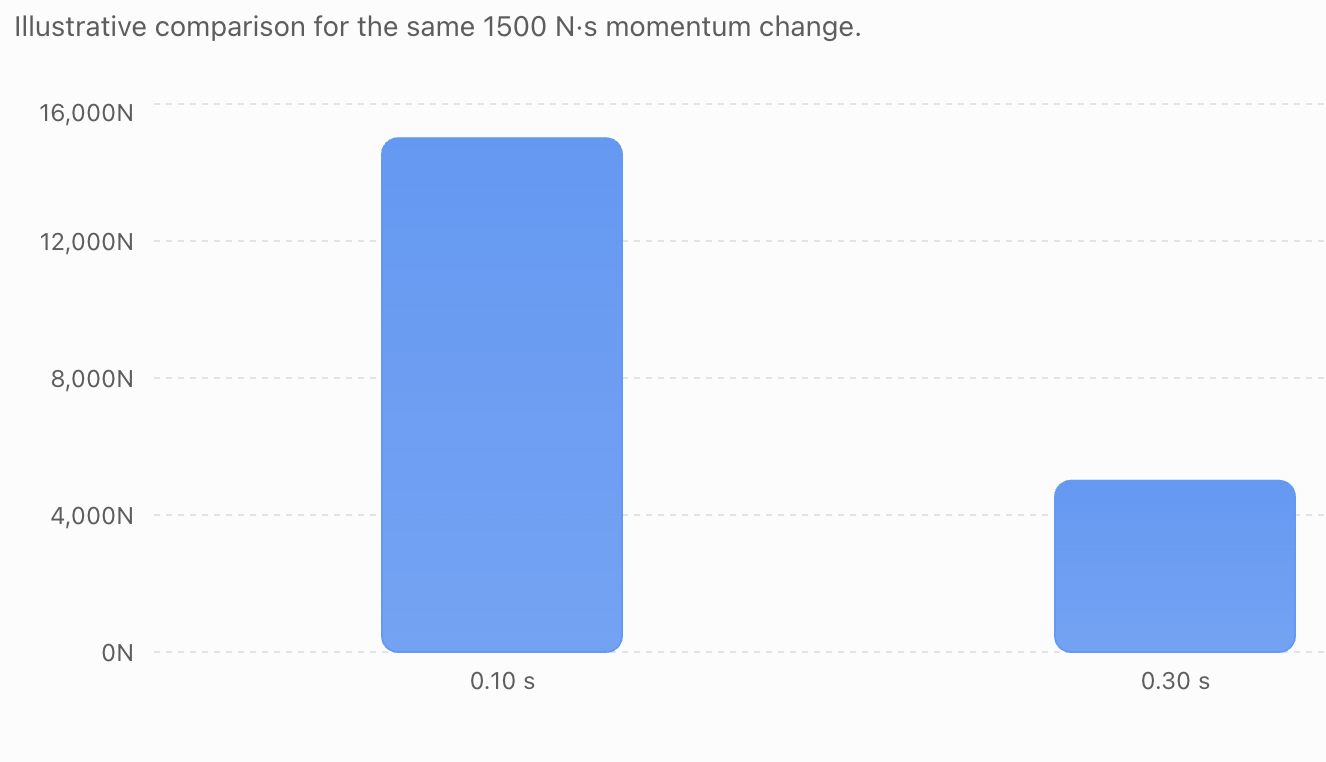
Worked Example 7: Safety System
A 75 kg passenger travels at 20 m/s before a collision and comes to rest.
Calculate the average force magnitude if the passenger stops in 0.10 s.
Initial momentum:
pi = mv
pi = 75 × 20
pi = 1500 kg·m/s
Final momentum:
pf = 0
Momentum change magnitude:
|Δp| = 1500 kg·m/s
Therefore:
Favg = |Δp| / Δt
Favg = 1500 / 0.10
Favg = 15,000 N
Now suppose a safety system increases the stopping time to 0.30 s.
Favg = 1500 / 0.30
Favg = 5000 N
The stopping time has tripled, so the average force has fallen to one-third of its original value.
Comparing the Force-Time Graphs
The previous example can be represented visually.
Same impulse, different stopping times