Momentum and Collisions
| Site: | Young Education |
| Cursus: | Forces |
| Boek: | Momentum and Collisions |
| Afgedrukt door: | ゲストユーザ |
| Datum: | vrijdag, 25 september 2026, 02:37 |
1. Momentum
Learning Outcomes
- I can define momentum as a vector quantity.
- I can calculate momentum.
- I can compare momentum and velocity.
- I can explain factors affecting momentum.
- I can analyze momentum in physical situations.


What Is Momentum?
A moving object has a quantity called momentum.
Momentum describes the motion of an object by combining two important properties:
- its mass
- its velocity
An object with a large mass can have a large momentum.
An object moving at a high velocity can also have a large momentum.
Momentum is represented by the symbol:
p
The relationship between momentum, mass, and velocity is:
p = mv
In equation form:
p = mv
where:
- p = momentum
- m = mass
- v = velocity
Units of Momentum
Mass is measured in:
kilograms (kg)
Velocity is measured in:
metres per second (m/s)
Therefore:
momentum = kg × m/s
The SI unit of momentum is:
kg·m/s
For example:
p = 30 kg·m/s
Because momentum is a vector, its direction should also be stated when appropriate:
p = 30 kg·m/s east
Momentum Is a Vector
Momentum is a vector quantity.
This means it has:
- magnitude
- direction


The direction of an object's momentum is always the same as the direction of its velocity.
If a car travels east:
velocity → east
therefore:
momentum → east
If the car reverses direction:
velocity → west
therefore:
momentum → west
This directional property becomes extremely important when analyzing collisions and conservation of momentum.
Calculating Momentum
The basic momentum equation is:
p = mv
Suppose a 5.0 kg object moves at 4.0 m/s.
p = mv
p = 5.0 × 4.0
p = 20 kg·m/s
If the object moves east:
p = 20 kg·m/s east
Worked Example 1: A Moving Ball
A 0.50 kg ball travels to the right at 12 m/s.
Calculate its momentum.
p = mv
p = 0.50 × 12
p = 6.0 kg·m/s
Therefore:
Momentum = 6.0 kg·m/s to the right


Worked Example 2: A Moving Car
A 1200 kg car travels at 20 m/s.
Calculate its momentum.
p = mv
p = 1200 × 20
p = 24,000 kg·m/s
The car has much greater momentum than the ball in the previous example because its mass is much larger.
What Factors Affect Momentum?
From:
p = mv
we can see that momentum depends on two factors:
1. Mass
2. Velocity
Increasing either one increases the magnitude of momentum.


For example:
A massive truck moving slowly may have more momentum than a small car moving quickly.
A lightweight object moving extremely fast may also have significant momentum.
Both mass and velocity must be considered.
Effect of Mass on Momentum
Suppose two objects move at the same velocity.
Object A:
m = 2 kg
v = 5 m/s
p = 2 × 5
p = 10 kg·m/s
Object B:
m = 6 kg
v = 5 m/s
p = 6 × 5
p = 30 kg·m/s
The second object has three times the mass and therefore three times the momentum.
If velocity remains constant:
momentum is directly proportional to mass
Effect of Velocity on Momentum
Now suppose two identical objects move at different velocities.
Object A:
m = 4 kg
v = 3 m/s
p = 12 kg·m/s
Object B:
m = 4 kg
v = 9 m/s
p = 36 kg·m/s
The second object moves three times faster and has three times the momentum.
If mass remains constant:
momentum is directly proportional to velocity


Doubling Mass or Velocity
Because:
p = mv
if mass doubles while velocity remains constant:
momentum doubles
If velocity doubles while mass remains constant:
momentum doubles
If both mass and velocity double:
momentum becomes four times larger
For example:
Original:
p = mv
Double both:
pnew = (2m)(2v)
pnew = 4mv
Therefore:
pnew = 4p
Momentum vs Velocity
Momentum and velocity are related, but they are not the same quantity.
| Momentum | Velocity |
|---|---|
| Symbol p | Symbol v |
| Depends on mass and velocity | Does not depend on mass |
| Unit kg·m/s | Unit m/s |
| Vector quantity | Vector quantity |
| p = mv | v = displacement/time |
Two objects can have the same velocity but different momenta if their masses are different.
Two objects can also have the same momentum but different velocities if their masses are different.
Same Velocity, Different Momentum
Consider a car and a truck traveling side by side at 20 m/s.

Car:
m = 1000 kg
v = 20 m/s
p = 20,000 kg·m/s
Truck:
m = 8000 kg
v = 20 m/s
p = 160,000 kg·m/s
Both vehicles have the same velocity.
However, the truck has much greater momentum because it has much greater mass.
Same Momentum, Different Velocities
Suppose two objects both have momentum:
p = 100 kg·m/s
Object A has a mass of 10 kg.
Using:
v = p/m
v = 100 / 10
v = 10 m/s
Object B has a mass of 2 kg.
v = 100 / 2
v = 50 m/s
The lighter object must travel much faster to have the same momentum.
Rearranging the Momentum Equation
Starting with:
p = mv
To calculate mass:
m = p/v
To calculate velocity:
v = p/m
These forms allow us to solve a variety of momentum problems.
Worked Example 3: Finding Velocity
An object has:
momentum = 150 kg·m/s
mass = 30 kg
Calculate its velocity.
Use:
v = p/m
v = 150 / 30
v = 5.0 m/s
If the momentum is east:
velocity = 5.0 m/s east
Worked Example 4: Finding Mass
A moving object has momentum of 240 kg·m/s and velocity of 12 m/s.
Calculate its mass.
Use:
m = p/v
m = 240 / 12
m = 20 kg
Stationary Objects
A stationary object has:
v = 0
Therefore:
p = mv
p = m(0)
p = 0
So any stationary object has zero momentum, regardless of its mass.


A parked truck may have a huge mass, but if it is not moving:
p = 0
Direction and Positive/Negative Momentum
Because momentum is a vector, we can use positive and negative signs to represent direction.
Suppose:
Right = positive
Left = negative
A 2 kg object moving right at 5 m/s has:
p = 2(+5)
p = +10 kg·m/s
A 2 kg object moving left at 5 m/s has:
p = 2(−5)
p = −10 kg·m/s


The negative sign does not mean the object has "less" momentum.
It indicates that the momentum points in the negative direction.
Total Momentum of More Than One Object
When several objects are part of a system, their momenta can be added.
Because momentum is a vector, direction must be included.
Suppose:
Object A:
pA = +20 kg·m/s
Object B:
pB = −12 kg·m/s
Total momentum:
ptotal = pA + pB
ptotal = 20 − 12
ptotal = +8 kg·m/s
The system has a net momentum of:
8 kg·m/s to the right
Worked Example 5: Objects Moving in Opposite Directions
A 4 kg cart moves right at 6 m/s.
A 3 kg cart moves left at 5 m/s.
Take right as positive.
Cart 1:
p₁ = 4(+6)
p₁ = +24 kg·m/s
Cart 2:
p₂ = 3(−5)
p₂ = −15 kg·m/s
Total:
ptotal = 24 − 15
ptotal = +9 kg·m/s
Therefore:
Total momentum = 9 kg·m/s to the right
Zero Total Momentum
A system can have moving objects but still have zero total momentum.
Suppose two identical objects move at equal speeds in opposite directions.


Object A:
p = +20 kg·m/s
Object B:
p = −20 kg·m/s
Total:
ptotal = +20 − 20
ptotal = 0
The objects individually have momentum, but the momentum of the entire system is zero.
Momentum and Newton's Laws
Momentum is closely connected to Newton's Laws.
A force can change an object's momentum.
If a force:
- speeds an object up
- slows an object down
- changes its direction
then its momentum changes.
This idea leads to an important relationship:
Force is related to the rate at which momentum changes.
For constant mass:
F = ma
and since:
p = mv
a change in velocity produces a change in momentum.
This connection becomes especially important when studying impulse.
Momentum and Stopping Objects
An object with large momentum generally requires a larger force, a longer time, or a longer distance to stop than a similar object with less momentum.


For example, a loaded truck traveling at highway speed has enormous momentum.
Stopping it requires a large change in momentum.
This is one reason heavy vehicles require greater stopping distances than smaller vehicles under comparable conditions.
Momentum in Sports
Momentum plays an important role in many sports.


Examples include:
- a football player making a tackle
- a soccer player kicking a ball
- a hockey player colliding with another player
- a baseball being struck by a bat
- a tennis ball changing direction after hitting a racket
Mass and velocity determine the momentum of the moving athlete or object.
Changing that momentum requires an interaction involving force.
Momentum in Vehicle Collisions
Momentum is especially important when analyzing collisions.


Before a collision, each vehicle has momentum determined by its mass and velocity.
During the collision, the vehicles exert forces on each other and their individual momenta change.
However, under suitable conditions, the total momentum of the system remains constant.
This principle is called conservation of momentum and is one of the most important ideas in collision physics.
Momentum in Space
Momentum is also important in spacecraft motion.


A rocket expels exhaust gases backward at high velocity.
The gases carry momentum backward.
The rocket gains momentum in the opposite direction.
This is closely connected to both:
- Newton's Third Law
- conservation of momentum
Momentum therefore helps explain how rockets can accelerate even in the vacuum of space.
Momentum and Large Objects
Large objects do not necessarily have large momentum.
Mass alone is not enough.
For example:
A 20,000 kg truck parked at the side of a road:
v = 0
so:
p = 0
A 0.15 kg baseball traveling at 40 m/s:
p = 0.15 × 40
p = 6 kg·m/s
The baseball has momentum while the much more massive stationary truck does not.
Momentum and Fast Objects
Likewise, high speed alone does not tell us the momentum.

A very small object can travel extremely quickly while still having less momentum than a much larger, slower-moving object.
To compare momentum properly, always consider:
both mass and velocity
Graphing Momentum and Velocity
For an object of constant mass:
p = mv
Therefore, momentum is directly proportional to velocity.
A graph of momentum against velocity is a straight line passing through the origin.
The gradient represents the object's mass:
gradient = Δp / Δv = m


A steeper graph represents a larger mass.
This gives another way to compare the momentum of objects.
Did You Know?
A large ship moving relatively slowly can have an enormous momentum because of its huge mass.


This is one reason large ships cannot stop or change direction quickly.
Even at moderate speeds, their enormous mass gives them very large momentum.
Ships must therefore begin slowing or turning well before reaching an obstacle or destination.
Common Mistakes
Mistake 1: Confusing momentum with velocity
Velocity describes how quickly and in what direction an object moves.
Momentum depends on both mass and velocity.
Mistake 2: Forgetting direction
Momentum is a vector quantity.
Direction must be included when combining momenta.
Mistake 3: Using speed instead of signed velocity
For simple one-dimensional problems, opposite directions should usually be represented using positive and negative velocities.
Mistake 4: Using grams instead of kilograms
Mass should normally be converted to kilograms before calculating momentum.
Mistake 5: Using km/h instead of m/s
SI momentum calculations normally use velocity in m/s.
Mistake 6: Thinking a massive stationary object has momentum
If:
v = 0
then:
p = 0
regardless of mass.
A Strategy for Solving Momentum Problems
- Identify the object's mass.
- Convert mass to kilograms if necessary.
- Identify its velocity.
- Convert velocity to m/s if necessary.
- Choose a positive direction if more than one direction is involved.
- Use:
p = mv
- Include the correct unit:
kg·m/s
- Include direction when required.
- For several objects, calculate each momentum separately.
- Add the momenta using their positive and negative signs.
Always check whether the magnitude and direction of the final answer make physical sense.
Key Terms
Momentum: A vector quantity equal to mass multiplied by velocity.
Mass: A measure of an object's inertia, measured in kilograms.
Velocity: Speed in a particular direction.
Vector: A quantity with both magnitude and direction.
Magnitude: The size of a quantity.
Total momentum: The vector sum of the momenta of all objects in a system.
System: A group of objects considered together when analyzing a physical situation.
Key Equations
Momentum:
p = mv
Mass:
m = p/v
Velocity:
v = p/m
Total momentum:
ptotal = p₁ + p₂ + p₃ + ...
For one-dimensional motion, use positive and negative signs to represent opposite directions.
Key Takeaways
- Momentum describes the motion of an object using both mass and velocity.
- Momentum is calculated using p = mv.
- The SI unit of momentum is kg·m/s.
- Momentum is a vector quantity, so it has both magnitude and direction.
- Momentum always points in the same direction as velocity.
- Increasing mass increases momentum when velocity remains constant.
- Increasing velocity increases momentum when mass remains constant.
- A stationary object has zero momentum.
- Two objects can have the same velocity but different momenta.
- Two objects can have the same momentum but different velocities.
- Opposite directions can be represented using positive and negative momentum.
- A system can have zero total momentum even when individual objects are moving.
- Forces change momentum by changing an object's velocity.
- Momentum is important in sports, vehicle safety, collisions, rockets, transportation, and many other physical situations.
- Understanding momentum provides the foundation for studying impulse and conservation of momentum.
2. Impulse
Learning outcomes
- I can define impulse.
- I can relate impulse to momentum change.
- I can calculate impulse.
- I can interpret force-time graphs.
- I can explain applications of impulse in safety systems.


What Is Impulse?
When a force acts on an object for a period of time, the object's momentum can change.
The quantity that describes the combined effect of the force and the time for which it acts is called impulse.
Impulse is represented by the symbol:
J
For a constant force:
J = FΔt
where:
- J = impulse
- F = force
- Δt = time interval
A large force acting for a short time can produce the same impulse as a smaller force acting for a longer time.
This simple idea has major applications in collisions, sports, vehicle safety, protective equipment, and engineering.
Units of Impulse
Force is measured in:
newtons (N)
Time is measured in:
seconds (s)
Therefore, impulse is measured in:
newton-seconds (N·s)
So:
Impulse unit = N·s
For example:
J = 50 N·s
However, impulse can also be expressed in:
kg·m/s
This is because impulse is equal to a change in momentum.
Impulse and Momentum
The most important relationship is the impulse-momentum theorem:
Impulse = change in momentum
Therefore:
J = Δp
Since:
p = mv
then:
J = mvf − mvi
For an object of constant mass:
J = m(vf − vi)
Combining this with:
J = FΔt
gives:
FΔt = Δp
or:
FΔt = m(vf − vi)


This means that applying an impulse to an object changes its momentum.
Why Does Impulse Change Momentum?
Newton's Second Law can be written in terms of momentum:
F = Δp / Δt
Rearrange:
FΔt = Δp
But:
FΔt = J
Therefore:
J = Δp
Impulse is not a completely separate idea from force and momentum. It describes how a force acting over time changes an object's momentum.
Impulse Is a Vector
Impulse is a vector quantity because momentum is a vector.
Therefore, impulse has:
- magnitude
- direction
The direction of the impulse is the same as the direction of the net force causing the momentum change.


For one-dimensional problems, we can represent opposite directions using positive and negative signs.
For example:
Right = positive
Left = negative
A negative impulse therefore represents an impulse directed to the left.
Calculating Impulse from Force and Time
For a constant force:
J = FΔt
Suppose a force of 40 N acts for 3.0 s.
J = 40 × 3.0
J = 120 N·s
The object receives an impulse of:
120 N·s
in the direction of the force.
Worked Example 1: Pushing a Cart
A student pushes a cart with a constant net force of 25 N for 4.0 s.
Calculate the impulse.
Use:
J = FΔt
J = 25 × 4.0
J = 100 N·s
Therefore:
Impulse = 100 N·s
The cart's momentum changes by:
100 kg·m/s
in the direction of the net force.
Calculating Impulse from Momentum Change
Impulse can also be calculated using:
J = Δp
or:
J = pf − pi
Suppose an object's momentum changes from:
20 kg·m/s
to:
70 kg·m/s
Then:
J = 70 − 20
J = 50 kg·m/s
Since:
1 N·s = 1 kg·m/s
we can also write:
J = 50 N·s
Worked Example 2: Accelerating a Ball
A 2.0 kg ball increases its velocity from 3.0 m/s to 8.0 m/s in the same direction.
Calculate the impulse.
Initial momentum:
pi = mvi
pi = 2.0 × 3.0
pi = 6.0 kg·m/s
Final momentum:
pf = mvf
pf = 2.0 × 8.0
pf = 16 kg·m/s
Therefore:
J = pf − pi
J = 16 − 6
J = 10 N·s
Impulse Can Change Speed
If impulse acts in the same direction as an object's motion, its momentum can increase.


For an object of constant mass, an increase in momentum means an increase in velocity.
For example, when a football player kicks a stationary ball:
- the foot exerts a force
- the force acts for a short time
- the ball receives an impulse
- the ball's momentum increases
- the ball accelerates away
Impulse Can Reduce Speed
Impulse can also act opposite to an object's motion.
Suppose a moving object has momentum to the right.
If a force acts toward the left, the object receives a leftward impulse.
Its rightward momentum decreases.
This occurs when:
- brakes slow a vehicle
- a goalkeeper catches a ball
- friction slows an object
- a collision brings an object to rest


Impulse Can Reverse Direction
A particularly large momentum change occurs when an object reverses direction.
Suppose:
m = 0.50 kg
Initial velocity:
vi = +10 m/s
Final velocity:
vf = −10 m/s
Initial momentum:
pi = 0.50(+10)
pi = +5 kg·m/s
Final momentum:
pf = 0.50(−10)
pf = −5 kg·m/s
Therefore:
Δp = pf − pi
Δp = −5 − (+5)
Δp = −10 kg·m/s
So:
J = −10 N·s
The impulse has magnitude:
10 N·s
and acts in the negative direction.
Worked Example 3: A Bouncing Ball
A 0.20 kg ball travels toward a wall at 15 m/s and rebounds in the opposite direction at 10 m/s.
Take motion toward the wall as positive.
Initial velocity:
vi = +15 m/s
Final velocity:
vf = −10 m/s
Use:
J = m(vf − vi)
J = 0.20(−10 − 15)
J = 0.20(−25)
J = −5.0 N·s
The negative sign shows that the impulse acts away from the wall.


Notice that the velocity change is:
−25 m/s
not 5 m/s.
Direction matters.
Average Force
Collision forces often change rapidly.
Instead of using one constant force, we can sometimes work with the average force.
The impulse relationship becomes:
J = FavgΔt
Therefore:
Favg = J / Δt
Since:
J = Δp
we can also write:
Favg = Δp / Δt
This relationship is extremely important in safety systems.
Worked Example 4: Average Force
A 0.15 kg baseball changes velocity from 40 m/s to 0 m/s in 0.010 s.
Calculate the magnitude of the average force.
Momentum change magnitude:
|Δp| = m|vf − vi|
|Δp| = 0.15 × 40
|Δp| = 6.0 kg·m/s
Now:
Favg = |Δp| / Δt
Favg = 6.0 / 0.010
Favg = 600 N
A very short stopping time can therefore produce a very large force.
Force-Time Graphs
Impulse can also be determined from a force-time graph.


A force-time graph has:
Force on the vertical axis
and:
Time on the horizontal axis
The impulse is equal to the area under the force-time graph.
Therefore:
Impulse = area under F-t graph
This works because:
area = force × time
and:
J = FΔt
Rectangular Force-Time Graph
Suppose a constant force of 50 N acts for 4.0 s.
The force-time graph forms a rectangle.
Area:
A = base × height
A = 4.0 × 50
A = 200 N·s
Therefore:
J = 200 N·s
The object's momentum changes by:
200 kg·m/s
Worked Example 5: Force-Time Graph
A force-time graph shows a constant force of 80 N acting from 0 s to 3.0 s.
Impulse:
J = area
J = base × height
J = 3.0 × 80
J = 240 N·s
Therefore:
Δp = 240 kg·m/s
Triangular Force-Time Graphs
Collision forces often rise to a maximum and then fall again.
The force-time graph may be approximated as a triangle.


For a triangle:
Area = ½ × base × height
Therefore:
J = ½ × Δt × Fmax
For example, suppose a collision force rises to 1000 N and returns to zero over 0.20 s.
J = ½ × 0.20 × 1000
J = 100 N·s
Worked Example 6: Triangular Collision Force
During a collision, force increases from zero to 6000 N and then decreases back to zero over a total time of 0.10 s.
Approximate the graph as a triangle.
Impulse:
J = ½ × base × height
J = ½ × 0.10 × 6000
J = 300 N·s
Therefore:
Change in momentum = 300 kg·m/s
Irregular Force-Time Graphs
Real collisions rarely produce perfect rectangles or triangles.


For an irregular graph, impulse is still:
the total area under the curve
The area may be estimated by:
- dividing the graph into rectangles
- dividing it into triangles
- using trapezoids
- using numerical or digital methods
The basic idea remains unchanged:
Area under F-t graph = impulse = change in momentum
Positive and Negative Areas
A force-time graph can include forces in opposite directions.
If positive force is plotted above the time axis and negative force below it:
- area above the axis gives positive impulse
- area below the axis gives negative impulse
The net impulse is the signed total area.
For example:
Positive area = +80 N·s
Negative area = −30 N·s
Net impulse:
Jnet = +50 N·s
Same Impulse, Different Forces
Consider two ways of stopping the same moving object.
Situation A:
Large force × short time
Situation B:
Smaller force × longer time
Both can produce the same momentum change.


For the same impulse:
FΔt = constant
Therefore, increasing the stopping time decreases the average force.
This principle is one of the most important applications of impulse in safety engineering.
Why Increasing Collision Time Reduces Force
Suppose a passenger's momentum must change from:
600 kg·m/s
to:
0 kg·m/s
The required impulse magnitude is:
600 N·s
If the passenger stops in:
0.10 s
then:
Favg = 600 / 0.10
Favg = 6000 N
If the stopping time increases to:
0.30 s
then:
Favg = 600 / 0.30
Favg = 2000 N
The same momentum change occurs, but the average force is much smaller.
This is the principle behind many safety systems.
Seat Belts and Impulse
Seat belts increase the time over which a passenger's momentum changes during a collision.


During a crash, the passenger must go from moving with the vehicle to approximately zero velocity.
The momentum change cannot simply be avoided.
However, the stopping time can be increased.
Because:
Favg = Δp / Δt
a longer stopping time produces a smaller average force.
Seat belts also distribute forces over stronger parts of the body.
Airbags and Impulse
Airbags work using the same basic principle.


During a collision, an airbag:
- cushions the passenger
- increases stopping time
- reduces average force
- spreads the force over a larger area
- helps prevent contact with hard surfaces
The passenger still experiences approximately the same overall change in momentum, but the force is reduced by increasing the time over which the change occurs.
Crumple Zones
Modern vehicles are designed with crumple zones.


During a collision, parts of the vehicle deform.
This deformation increases the time required for the vehicle to stop.
For approximately the same momentum change:
longer stopping time → smaller average force
Crumple zones also absorb and redistribute energy during the collision.
They are deliberately designed to deform while helping protect the passenger compartment.
Helmets
Helmets use impulse principles to reduce forces on the head.


A helmet contains materials that compress during an impact.
Compression increases the stopping time of the head.
Therefore:
Δt increases
and:
Favg decreases
Helmets also help distribute forces over a larger area and manage impact energy.
Crash Mats and Padding
Gymnasts, high jumpers, and stunt performers often land on thick mats.


The mat compresses during landing.
This increases the time required to bring the athlete to rest.
Compared with landing on a rigid floor:
longer stopping time → smaller average force
The athlete's momentum still changes to zero, but the force experienced during the stopping process is reduced.
Catching a Ball Safely
When catching a fast-moving ball, athletes often move their hands backward as they catch it.


The ball must still undergo the same momentum change:
moving → stopped
But moving the hands backward increases the stopping time.
Therefore:
Favg = Δp / Δt
becomes smaller.
This reduces the force on both the hands and the ball.
Following Through in Sports
Sometimes athletes want the opposite effect: they want to produce a large change in momentum.
A longer contact time can help.


Examples include:
- golf swings
- tennis strokes
- hockey shots
- kicking a football
- striking a ball with a bat
A force acting for a longer time can provide a greater impulse:
J = FΔt
which produces a greater change in momentum.
Impulse in Boxing
Boxers move with punches partly to reduce the forces they experience.


Boxing gloves also contain padding that deforms during impact.
The padding can increase impact time and spread the force over a larger area.
Again, the impulse relationship helps explain why increasing the collision time can reduce the peak and average forces experienced.
Impulse in Packaging
Fragile objects are often packed using:
- foam
- bubble wrap
- cardboard structures
- air cushions
- other deformable materials


If a package is dropped, the protective material compresses when it hits the ground.
This increases the stopping time of the object.
Therefore, the average impact force is reduced.
Impulse principles are therefore important in packaging design and shipping.
Worked Example 7: Safety System
A 75 kg passenger travels at 20 m/s before a collision and comes to rest.
Calculate the average force magnitude if the passenger stops in 0.10 s.
Initial momentum:
pi = mv
pi = 75 × 20
pi = 1500 kg·m/s
Final momentum:
pf = 0
Momentum change magnitude:
|Δp| = 1500 kg·m/s
Therefore:
Favg = |Δp| / Δt
Favg = 1500 / 0.10
Favg = 15,000 N
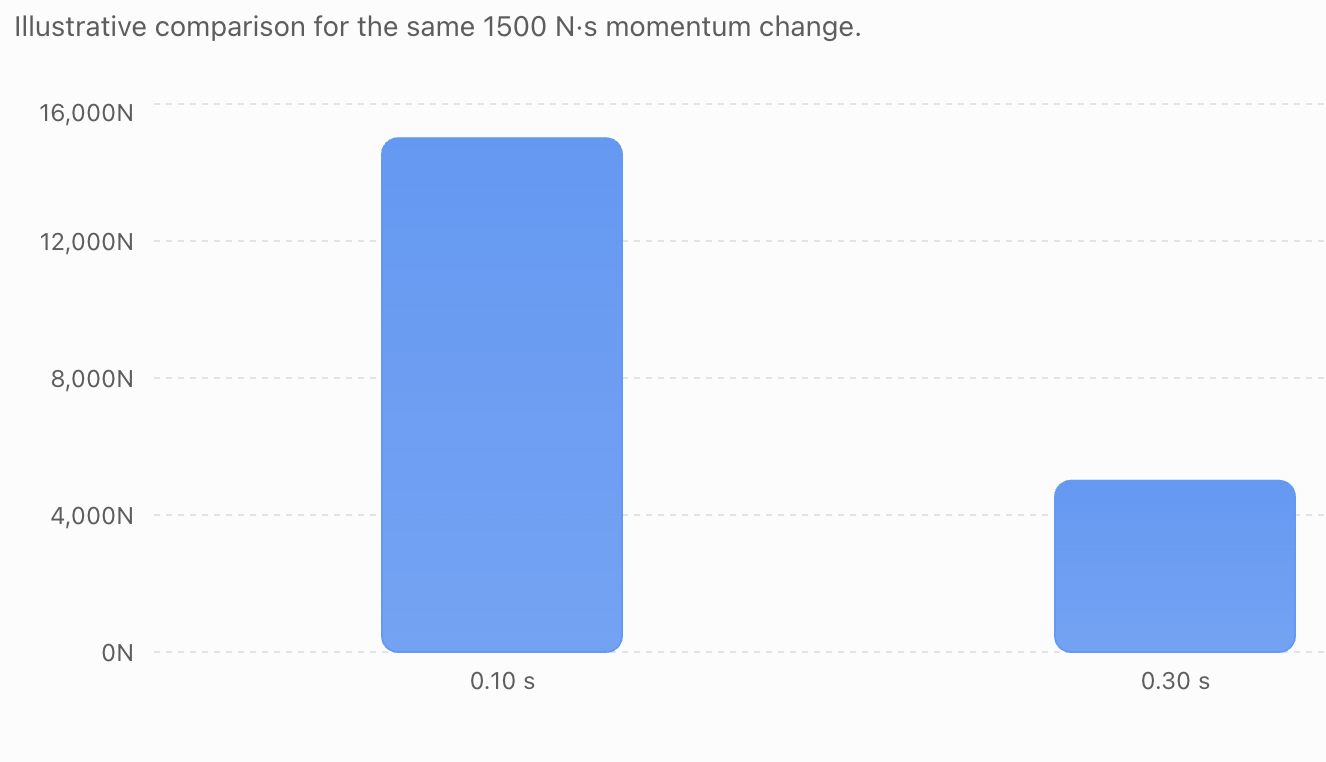
Now suppose a safety system increases the stopping time to 0.30 s.
Favg = 1500 / 0.30
Favg = 5000 N
The stopping time has tripled, so the average force has fallen to one-third of its original value.
Comparing the Force-Time Graphs
The previous example can be represented visually.
Same impulse, different stopping times


3. Conservation of Momentum
Learning outcomes
- I can state the law of conservation of momentum.
- I can identify isolated systems.
- I can apply momentum conservation to simple situations.
- I can calculate unknown momenta after interactions.
- I can explain momentum transfer between objects.


What Is Conservation of Momentum?
Momentum describes the motion of an object and depends on both its mass and velocity.
For a single object:
p = mv
where:
- p = momentum in kg·m/s
- m = mass in kg
- v = velocity in m/s
Momentum is a vector quantity, so direction matters.
During interactions such as collisions and explosions, momentum can move from one object to another. However, under the correct conditions, the total momentum of the system remains constant.
This principle is called the law of conservation of momentum.
The Law of Conservation of Momentum
The law of conservation of momentum states:
The total momentum of an isolated system remains constant.
In other words:
total momentum before an interaction = total momentum after the interaction
We can write this as:
Σp(before) = Σp(after)


The symbol Σ means "the sum of."
So we add the momentum of every object in the system.
What Is a System?
A system is the object or group of objects that we choose to study.
For example, imagine two carts colliding on a track.
We could define our system as:
cart A + cart B
During the collision, the carts exert forces on each other.
These are internal forces because they occur between objects inside our chosen system.
What Is an Isolated System?
An isolated system is a system in which there is no significant net external force or external impulse acting during the interaction being analyzed.


Examples that can often be approximated as isolated during a short interaction include:
- two carts colliding on a low-friction track
- two ice skaters pushing apart
- billiard balls colliding
- objects separating after an explosion
- two spacecraft interacting far from significant external influences
Real systems are rarely perfectly isolated, but external effects can sometimes be small enough to ignore during a short interaction.
Internal and External Forces
It is important to distinguish between internal and external forces.
Internal forces act between objects within the system.
For two colliding carts:
- cart A pushes cart B
- cart B pushes cart A
These forces transfer momentum between the carts.
External forces are exerted by objects outside the system.
Examples might include:
- friction from the floor
- air resistance
- a person pushing one of the carts
- an external motor
- gravity, when its impulse in the direction being studied is significant
Momentum conservation applies directly when the net external impulse is zero or negligible.
Why Internal Forces Do Not Change Total Momentum
During a collision, object A exerts a force on object B.
At the same time, object B exerts an equal and opposite force on object A.
This is Newton's Third Law.


Because the forces are equal and opposite and act over the same interaction time, the impulses are equal and opposite.
One object gains momentum while the other loses an equal amount.
Therefore:
momentum can be transferred within the system without changing the total momentum of the system.
Momentum Before and After an Interaction
For two objects:
Before:
total momentum = p₁ + p₂
After:
total momentum = p₁' + p₂'
Therefore:
p₁ + p₂ = p₁' + p₂'
Using p = mv:
m₁v₁ + m₂v₂ = m₁v₁' + m₂v₂'
The primes simply indicate the velocities after the interaction.
Direction Matters
Because momentum is a vector, we must choose a positive direction.
For example:
right = positive
left = negative


An object moving:
5 m/s right → +5 m/s
5 m/s left → −5 m/s
The signs must be included when calculating total momentum.
Example 1: One Moving Cart Hits a Stationary Cart
A 2 kg cart moves right at 4 m/s.
A 2 kg cart is stationary.
Before the collision:
Cart A:
p = mv
p = 2 × 4 = 8 kg·m/s
Cart B:
p = 2 × 0 = 0 kg·m/s
Total:
8 kg·m/s
Suppose after the collision cart A stops and cart B moves right.
Conservation of momentum requires:
total momentum after = 8 kg·m/s
Therefore:
2v = 8
v = 4 m/s
Cart B moves right at:
4 m/s

In this idealized example, momentum has effectively transferred from cart A to cart B.
Momentum Transfer
It is useful to think about momentum as being transferred between interacting objects.
Suppose:
Object A initially has:
+20 kg·m/s
Object B initially has:
0 kg·m/s
After the interaction:
Object A has:
+8 kg·m/s
Because the system's total momentum remains +20 kg·m/s, object B must have:
+12 kg·m/s
Object A lost:
12 kg·m/s
Object B gained:
12 kg·m/s
Total momentum remains unchanged.
Momentum Is Not Used Up
Momentum is not "used up" during a collision.
Instead, it can be:
- transferred between objects
- redistributed among several objects
- divided between different directions
As long as the system is isolated:
total momentum remains constant.
Example 2: Two Objects Moving in the Same Direction
A 3 kg cart moves right at 5 m/s.
A 2 kg cart moves right at 2 m/s.
Initial momentum:
Cart 1:
p₁ = 3 × 5 = 15 kg·m/s
Cart 2:
p₂ = 2 × 2 = 4 kg·m/s
Total:
p(total) = 15 + 4 = 19 kg·m/s
Suppose they collide and stick together.
Combined mass:
3 + 2 = 5 kg
Therefore:
5v = 19
v = 3.8 m/s
The combined carts move right at:
3.8 m/s
Objects That Stick Together
When two objects collide and stick together, they have the same final velocity.


The momentum equation becomes:
m₁v₁ + m₂v₂ = (m₁ + m₂)v
This type of collision is called a perfectly inelastic collision.
Momentum is conserved in an isolated system, but kinetic energy is not necessarily conserved.
Momentum and Kinetic Energy Are Different
This distinction is extremely important.
In an isolated collision:
total momentum is conserved.
But:
total kinetic energy may or may not be conserved.
Some kinetic energy can be transformed into:
- thermal energy
- sound
- deformation
- vibration


Therefore:
momentum conservation does not mean kinetic energy conservation.
Elastic Collisions
An elastic collision is one in which both:
- total momentum is conserved
- total kinetic energy is conserved
Ideal elastic collisions are useful models in physics.
Collisions between certain particles and approximately elastic collisions between objects such as billiard balls can illustrate this behaviour.
Inelastic Collisions
In an inelastic collision:
- momentum is conserved for an isolated system
- kinetic energy is not conserved as kinetic energy
Some kinetic energy is transformed into other forms.
If the objects stick together, the collision is perfectly inelastic.
Example 3: Opposite Directions
A 4 kg cart moves right at 3 m/s.
A 2 kg cart moves left at 5 m/s.
Choose:
right = positive
Therefore:
v₁ = +3 m/s
v₂ = −5 m/s
Momentum of cart 1:
p₁ = 4(+3) = +12 kg·m/s
Momentum of cart 2:
p₂ = 2(−5) = −10 kg·m/s
Total:
p(total) = +12 − 10
p(total) = +2 kg·m/s
The system therefore has a small net momentum to the right.
If the Carts Stick Together
The total mass becomes:
4 + 2 = 6 kg
Conservation of momentum:
6v = +2
Therefore:
v = +0.33 m/s
The positive answer means the combined carts move:
to the right
at approximately:
0.33 m/s
Why Signs Are Essential
If we ignored direction and simply added:
12 + 10 = 22 kg·m/s
we would obtain the wrong answer.

Momentum has both:
magnitude and direction
so vector signs must be included.
Example 4: Finding an Unknown Momentum
Two objects have a total initial momentum of:
+30 kg·m/s
After the collision, object A has:
+18 kg·m/s
What is object B's momentum?
Conservation of momentum:
30 = 18 + pB
Therefore:
pB = 12 kg·m/s
The positive sign indicates that object B's momentum is in the positive direction.
Example 5: Finding an Unknown Velocity
A 4 kg cart moves right at 6 m/s and collides with a stationary 2 kg cart.
After the collision, the 4 kg cart moves right at 3 m/s.
Find the velocity of the 2 kg cart.
Initial momentum:
p(initial) = (4)(6) + (2)(0)
p(initial) = 24 kg·m/s
Final momentum:
p(final) = (4)(3) + (2)v
Therefore:
24 = 12 + 2v
12 = 2v
v = 6 m/s
The second cart moves right at:
6 m/s
A Momentum Table Can Help
For complicated problems, organize the information before calculating.
For example:
Object A:
Mass = 4 kg
Initial velocity = +6 m/s
Final velocity = +3 m/s
Object B:
Mass = 2 kg
Initial velocity = 0 m/s
Final velocity = unknown
Then calculate the momentum of each object and apply:
Σp(before) = Σp(after)
This reduces sign and substitution errors.
Example 6: Collision and Rebound
A 1 kg ball moves right at 8 m/s.
After hitting another object, it rebounds left at 3 m/s.
Initial momentum:
pᵢ = 1(+8) = +8 kg·m/s
Final momentum:
p_f = 1(−3) = −3 kg·m/s
Change in momentum:
Δp = p_f − pᵢ
Δp = −3 − 8
Δp = −11 kg·m/s
The ball has experienced a large momentum change because its direction changed.

The other object or the wider environment receives an equal and opposite momentum change when the complete isolated system is considered.
Conservation of Momentum and Impulse
Impulse is related to momentum change:
J = Δp
During an interaction:
Object A experiences an impulse from object B.
Object B experiences an equal and opposite impulse from object A.
Therefore:
ΔpA = −ΔpB
This is another way of expressing momentum transfer.
Why Momentum Is Conserved
Newton's Third Law tells us that interacting objects exert equal and opposite forces.
If the interaction lasts for the same time Δt:
FAΔt = −FBΔt
Since impulse equals change in momentum:
ΔpA = −ΔpB
Therefore:
ΔpA + ΔpB = 0
The total momentum does not change.
This provides a connection between:
Newton's Third Law → impulse → conservation of momentum
Explosions and Separation
Momentum conservation also applies when objects move apart.
Imagine two carts initially connected by a compressed spring.
Initially both are stationary.
Total momentum:
0 kg·m/s
When released, the spring pushes the carts apart.


If the system is isolated:
total momentum after must also equal zero.
Therefore:
p₁ + p₂ = 0
or:
p₁ = −p₂
The carts have equal-magnitude but opposite momenta.
Example 7: Two Skaters Push Apart
Two ice skaters are initially stationary.
Skater A has mass:
60 kg
Skater B has mass:
40 kg
After pushing apart, the 60 kg skater moves left at 2 m/s.
Choose right as positive.
Therefore:
vA = −2 m/s
Initial total momentum:
0
After:
0 = (60)(−2) + (40)vB
0 = −120 + 40vB
40vB = 120
vB = +3 m/s
The 40 kg skater moves right at:
3 m/s


Notice that the lighter skater moves faster.
Equal Momentum Does Not Mean Equal Velocity
In the skater example:
60 kg × 2 m/s = 120 kg·m/s
40 kg × 3 m/s = 120 kg·m/s
Their momentum magnitudes are equal.
But their speeds are different.
Because:
p = mv
a smaller mass requires a larger speed to have the same momentum magnitude.
Example 8: Explosion from Rest
A 10 kg object initially at rest breaks into two pieces.
One piece has mass:
6 kg
and moves right at:
4 m/s
Its momentum is:
p = 6 × 4 = +24 kg·m/s
The original total momentum was zero.
Therefore, the other piece must have:
−24 kg·m/s
If its mass is 4 kg:
4v = −24
v = −6 m/s
Therefore, the second piece moves left at:
6 m/s
Recoil
Recoil is another application of momentum conservation.
When one part of a system is accelerated in one direction, another part can gain momentum in the opposite direction.


A useful non-weapon example is a balloon releasing air.
Air moves backward.
The balloon moves forward.
The momenta are in opposite directions.
Rockets and Momentum
Rockets also demonstrate momentum conservation.
A rocket expels exhaust gases backward at high velocity.
The gases gain backward momentum.
The rocket gains forward momentum.
This allows a rocket to accelerate even in space.
It does not need to push against the air.
Instead, momentum is exchanged between:
rocket + exhaust gases
Collisions Between Vehicles
Momentum conservation is useful when analyzing vehicle collisions.

If external impulses during the short collision are small compared with the collision forces, investigators can relate:
- vehicle masses
- directions
- velocities before collision
- velocities after collision
using conservation of momentum.
Real accident reconstruction is more complicated because investigators must also consider braking, friction, rotation, deformation, measurement uncertainty, and other evidence.
Billiards and Momentum
Billiard balls provide a familiar example.
When a moving ball strikes another ball, momentum can be transferred between them.

For a straight-line collision between equal masses, one ball may transfer a large fraction of its momentum to the other.
In two dimensions, momentum must be conserved separately in each direction:
Σpₓ(before) = Σpₓ(after)
Σpᵧ(before) = Σpᵧ(after)
Newton's Cradle
A Newton's cradle provides a striking demonstration of momentum transfer.


When one ball strikes the others, interactions transmit momentum through the system and a ball at the opposite end moves.
The real motion involves both momentum and energy transfer, and real cradles lose some mechanical energy through sound, deformation, and other processes.
When Is Momentum Not Conserved for the Chosen System?
Momentum conservation depends on how the system boundary is chosen.
Suppose a ball hits a wall.
If the system is only:
the ball
its momentum changes because the wall exerts an external force on it.
So the ball alone is not an isolated system.
But if we expand the system to include:
ball + wall + Earth
the momentum transferred to the wall and Earth becomes part of the system.
Total momentum is still conserved.
This demonstrates why defining the system is essential.
External Impulse
A more general relationship is:
Δp(system) = J_external
Therefore:
If:
J_external = 0
then:
Δp(system) = 0
and:
p_initial = p_final
This is the deeper condition behind momentum conservation.
Approximate Isolation
Many classroom situations are not perfectly isolated.
For example, a cart may experience some friction.
However, if:
- the collision happens very quickly
- friction is relatively small
- collision forces are much larger than external forces
then the external impulse during the collision may be negligible.
We can then treat the system as approximately isolated.
This is common in real physics.
A Reliable Problem-Solving Strategy
When solving conservation-of-momentum problems:
Step 1: Define the system.
Which objects are included?
Step 2: Decide whether momentum conservation is appropriate.
Is the net external impulse negligible?
Step 3: Choose a positive direction.
For example:
right = positive.
Step 4: Record masses and velocities.
Include negative signs for motion in the opposite direction.
Step 5: Calculate initial momentum.
Use:
p = mv
Step 6: Write the conservation equation.
Σp(before) = Σp(after)
Step 7: Substitute known values.
Step 8: Solve for the unknown.
Step 9: Interpret the sign.
Positive or negative tells you the direction.
Step 10: Check the answer.
Verify that total momentum before equals total momentum after.
Worked Example 9
A 5 kg cart moving right at 4 m/s collides with a stationary 3 kg cart.
Afterward, the 5 kg cart moves right at 1 m/s.
Find the second cart's velocity.
Initial momentum:
pᵢ = (5)(4) + (3)(0)
pᵢ = 20 kg·m/s
Final momentum:
p_f = (5)(1) + 3v
Conservation:
20 = 5 + 3v
15 = 3v
v = 5 m/s
Therefore, the second cart moves:
5 m/s to the right
Check:
Before:
20 kg·m/s
After:
5 + 15 = 20 kg·m/s
Momentum is conserved.
Worked Example 10
A 2 kg cart moving right at 6 m/s collides and sticks to a 4 kg cart moving left at 2 m/s.
Take right as positive.
Initial momentum:
pᵢ = (2)(+6) + (4)(−2)
pᵢ = 12 − 8
pᵢ = +4 kg·m/s
Combined mass:
6 kg
Therefore:
6v = 4
v = +0.67 m/s
The carts move together at approximately:
0.67 m/s to the right
Worked Example 11
Two objects initially at rest push apart.
Object A:
mass = 3 kg
velocity = +8 m/s
Object B:
mass = 6 kg
velocity = unknown
Initial momentum:
0
After:
0 = (3)(8) + 6v
0 = 24 + 6v
v = −4 m/s
Object B moves:
4 m/s in the opposite direction.
Worked Example 12: Unknown Mass
Two objects initially at rest separate.
A 2 kg object moves left at 6 m/s.
The second object moves right at 3 m/s.
Find its mass.
Take right as positive.
Initial momentum:
0
After:
0 = (2)(−6) + m(3)
0 = −12 + 3m
3m = 12
m = 4 kg
Momentum Conservation in Graphical Form
Momentum can also be represented with arrows.
The length of an arrow can represent the magnitude of momentum.


Before an interaction, the momentum vectors add to a total vector.
After the interaction, the individual vectors may change.
But for an isolated system:
the total vector must remain the same.
This becomes especially important in two-dimensional collisions.
Momentum Transfer and Newton's Third Law
Suppose object A loses:
6 kg·m/s
of momentum during a collision.
Then object B must gain:
6 kg·m/s
in the corresponding opposite-change sense for the two-object isolated system.
We can express this as:
ΔpA = −ΔpB
This is why momentum transfer between objects does not change the system's total momentum.
Did You Know?
Conservation of momentum applies far beyond collisions between everyday objects.


Particle physicists use momentum conservation when studying collisions between subatomic particles.
If the measured momentum after an interaction appears not to match the visible particles, scientists can investigate whether additional particles carried away momentum.
Conservation laws are therefore powerful tools for studying things that cannot always be observed directly.
Common Mistakes
Mistake 1: Conserving the momentum of each object separately
Individual objects can gain or lose momentum.
It is the total momentum of the isolated system that remains constant.
Mistake 2: Ignoring direction
Momentum is a vector.
Opposite directions must have opposite signs.
Mistake 3: Assuming stationary objects have no mass
A stationary object still has mass.
Its momentum is zero because:
v = 0
Mistake 4: Forgetting to add the masses when objects stick
If objects stick together:
final mass = m₁ + m₂
Mistake 5: Assuming kinetic energy is always conserved
Momentum is conserved in an isolated system.
Kinetic energy is conserved only in elastic collisions.
Mistake 6: Assuming momentum disappears in a collision
Momentum is transferred and redistributed.
It is not destroyed.
Mistake 7: Forgetting to define the system
Whether a force is internal or external depends on the chosen system boundary.
Mistake 8: Assuming every real system is perfectly isolated
Real systems may experience friction, air resistance, or other external forces.
Momentum conservation can still be a useful approximation when the external impulse is negligible.
Key Terms
Momentum: A vector quantity equal to mass multiplied by velocity.
Conservation of momentum: The principle that total momentum remains constant in an isolated system.
System: The object or collection of objects being studied.
Isolated system: A system experiencing no significant net external impulse during the interaction.
Internal force: A force between objects within the system.
External force: A force exerted on the system by something outside it.
External impulse: The impulse produced by external forces acting on a system.
Collision: An interaction in which objects exert forces on each other over a short time.
Elastic collision: A collision in which both momentum and kinetic energy are conserved.
Inelastic collision: A collision in which momentum is conserved but kinetic energy is not conserved as kinetic energy.
Perfectly inelastic collision: A collision in which objects stick together.
Recoil: Motion in one direction resulting from momentum being carried in the opposite direction.
Momentum transfer: The change in momentum of interacting objects caused by forces between them.
Key Equations
Momentum:
p = mv
Conservation of momentum:
Σp(before) = Σp(after)
For two objects:
m₁v₁ + m₂v₂ = m₁v₁' + m₂v₂'
If two objects stick together:
m₁v₁ + m₂v₂ = (m₁ + m₂)v
For an explosion initially at rest:
0 = m₁v₁ + m₂v₂
Momentum transfer between two objects in an isolated system:
Δp₁ = −Δp₂
Impulse and system momentum:
J_external = Δp_system
Key Takeaways
- Momentum is calculated using p = mv.
- Momentum is a vector, so direction matters.
- The law of conservation of momentum states that the total momentum of an isolated system remains constant.
- Therefore, total momentum before an interaction equals total momentum after it.
- A system is the group of objects chosen for analysis.
- Momentum conservation requires the net external impulse on the system to be zero or negligible.
- Forces between objects within the system are internal forces.
- Internal forces can transfer momentum between objects without changing the system's total momentum.
- When one object loses momentum, another part of the isolated system gains an equal amount of momentum in the appropriate vector direction.
- Objects moving in opposite directions must be assigned opposite velocity signs.
- Objects that stick together have the same final velocity.
- Momentum is conserved in both elastic and inelastic collisions when the system is isolated.
- Kinetic energy is conserved only in elastic collisions.
- Objects initially at rest can move apart while maintaining a total momentum of zero.
- Lighter objects often move faster than heavier objects when they separate with equal and opposite momenta.
- Recoil, rockets, collisions, billiards, skaters, and particle interactions can all be analyzed using conservation of momentum.
- Real systems can often be treated as approximately isolated when external impulses are very small during the interaction.
- A reliable momentum-conservation solution follows:
define the system → choose a positive direction → calculate momentum before → calculate momentum after → set totals equal → solve → interpret direction → check conservation.
4. Collisions
Learning outcomes
- I can distinguish between elastic and inelastic collisions.
- I can analyze momentum before and after collisions.
- I can apply conservation of momentum to collisions.
- I can explain energy changes during collisions.
- I can solve one-dimensional collision problems.

What Is a Collision?
A collision is an interaction in which two or more objects exert forces on each other for a relatively short period of time.
Collisions occur in many situations:
- billiard balls striking each other
- carts colliding on a track
- vehicles colliding
- sports balls striking bats or rackets
- atoms and molecules colliding
- subatomic particles interacting
During a collision, momentum can be transferred from one object to another.
If the system is isolated, the total momentum remains constant.
Momentum During a Collision
Momentum is calculated using:
p = mv
where:
- p = momentum in kg·m/s
- m = mass in kg
- v = velocity in m/s
Because velocity is a vector, momentum is also a vector.
Direction therefore matters.


For one-dimensional problems, we normally choose:
right = positive
left = negative
Conservation of Momentum
For an isolated system:
total momentum before = total momentum after
For two objects:
m₁v₁ᵢ + m₂v₂ᵢ = m₁v₁f + m₂v₂f
where:
- m₁ and m₂ are the masses
- v₁ᵢ and v₂ᵢ are the initial velocities
- v₁f and v₂f are the final velocities
This equation is the foundation of collision calculations.


5. Explosions and Recoil
Learning outcomes
- I can explain recoil using momentum conservation.
- I can analyze explosions as momentum interactions.
- I can calculate velocities after explosions.
- I can explain propulsion systems using momentum principles.
- I can apply momentum conservation to real-world examples.


What Are Explosions and Recoil?
In physics, an explosion does not necessarily mean fire or a destructive event.
An explosion is any interaction in which parts of a system that were initially together move apart because stored energy is released.
Examples include:
- two carts pushed apart by a compressed spring
- two people on skateboards pushing away from each other
- a balloon releasing air
- a rocket ejecting exhaust gases
- fragments separating after an object breaks apart
The objects exert forces on each other and move in different directions.
If external forces are negligible during the interaction, the total momentum of the system is conserved.
Review: Momentum
Momentum depends on mass and velocity.
Momentum is measured in:
kg·m/s
Because velocity has direction, momentum is a vector quantity.
This means that direction is extremely important when analyzing explosions and recoil.
Conservation of Momentum
For an isolated system:
total momentum before = total momentum after
or:
Σp(before) = Σp(after)
For two objects:
m₁v₁ᵢ + m₂v₂ᵢ = m₁v₁f + m₂v₂f
This equation works for:
- collisions
- explosions
- recoil
- objects pushing apart
- many propulsion situations
The same conservation law applies even though the objects may behave very differently.
Explosions from Rest
Many introductory explosion problems begin with an object or system that is stationary.
If the system is initially at rest:
initial momentum = 0
Therefore:
final total momentum must also equal 0
For two objects moving apart:
m₁v₁ + m₂v₂ = 0
Therefore:
m₁v₁ = −m₂v₂


The negative sign tells us that the two momenta point in opposite directions.
Equal and Opposite Momentum
Suppose an object initially has zero momentum.
It separates into two pieces.
If one piece gains:
+20 kg·m/s
of momentum, the other must have:
−20 kg·m/s
of momentum.
Therefore:
total momentum = +20 + (−20) = 0
The two objects do not necessarily have equal velocities.
They have equal momentum magnitudes in this simple two-object case.
Why the Velocities Can Be Different
Remember:
p = mv
If two objects have equal momentum magnitudes but different masses, their velocities must be different.
For example:
Object A:
mass = 2 kg
momentum = +12 kg·m/s
v = 12 ÷ 2 = +6 m/s
Object B:
mass = 6 kg
momentum = −12 kg·m/s
v = −12 ÷ 6 = −2 m/s
The lighter object moves faster.

This gives us an important relationship:
smaller mass → larger speed
when the momentum magnitudes are equal.
Example 1: Two Carts Push Apart
Two carts are initially stationary.
A compressed spring between them is released.
Cart A:
mass = 3 kg
velocity = +4 m/s
Cart B:
mass = 6 kg
velocity = unknown
Initial momentum:
0 kg·m/s
After release:
0 = (3)(+4) + (6)v
0 = 12 + 6v
6v = −12
v = −2 m/s
Therefore, Cart B moves:
2 m/s in the opposite direction.
What Caused the Carts to Move?
Before release, energy was stored in the compressed spring as elastic potential energy.
When the spring was released:
elastic potential energy → kinetic energy
The spring exerted forces on both carts.

The carts gained opposite momenta.
The system's total momentum remained zero, but its total kinetic energy increased.
This is possible because momentum and energy are different conserved quantities.
Where Does the Kinetic Energy Come From?
An explosion can increase the kinetic energy of the objects.
This does not violate conservation of energy.
The kinetic energy comes from another form of stored energy.
Possible sources include:
- elastic potential energy
- chemical energy
- electrical energy
- pressure energy
- nuclear energy
For a compressed spring:
elastic potential energy → kinetic energy
For a rocket:
chemical energy → thermal energy + kinetic energy + other forms
Momentum vs Kinetic Energy
Suppose two carts initially sit at rest.
Initial momentum:
0
Initial kinetic energy:
0
After a spring pushes them apart:
Total momentum:
still 0
But total kinetic energy:
greater than 0
Where did the energy come from?
The spring's stored potential energy.
This illustrates why:
conservation of momentum does not mean kinetic energy must remain constant.
What Is Recoil?
Recoil is the motion of one part of a system in response to another part gaining momentum in the opposite direction.


The basic idea is:
one part moves one way → another part gains momentum the other way
If the system initially has zero momentum:
p₁ = −p₂
Recoil is therefore a direct consequence of momentum conservation.
Newton's Third Law and Recoil
Recoil can also be explained using Newton's Third Law.
During the interaction:
Object A exerts a force on Object B.
Object B exerts an equal and opposite force on Object A.
These forces act for the same time interval.
Therefore, the impulses are equal and opposite:
J₁ = −J₂
Since:
J = Δp
the momentum changes are also equal and opposite:
Δp₁ = −Δp₂


So Newton's Third Law and conservation of momentum describe the same interaction from complementary perspectives.
Example 2: Two Skaters Push Apart
Two skaters are initially stationary.
Skater A:
mass = 50 kg
Skater B:
mass = 75 kg
After pushing apart, Skater A moves left at 3 m/s.
Choose:
right = positive
Therefore:
vA = −3 m/s
Initial momentum:
0
Final momentum:
0 = (50)(−3) + (75)vB
0 = −150 + 75vB
75vB = 150
vB = +2 m/s
Skater B moves:
2 m/s to the right.

The lighter skater moves faster.
Example 3: Finding an Unknown Mass
Two carts initially at rest push apart.
Cart A:
mass = 4 kg
velocity = +6 m/s
Cart B:
velocity = −3 m/s
Find Cart B's mass.
Initial momentum:
0
Therefore:
0 = (4)(6) + m(−3)
0 = 24 − 3m
3m = 24
m = 8 kg
The slower cart has the greater mass.
Example 4: An Object Breaks into Two Pieces
A stationary 12 kg object separates into two pieces.
Piece A:
mass = 4 kg
velocity = +9 m/s
Piece B:
mass = 8 kg
velocity = unknown
Initial momentum:
0
Therefore:
0 = (4)(9) + (8)v
0 = 36 + 8v
8v = −36
v = −4.5 m/s
Piece B moves:
4.5 m/s in the opposite direction.
Checking the Momentum
Piece A:
pA = (4)(+9) = +36 kg·m/s
Piece B:
pB = (8)(−4.5) = −36 kg·m/s
Total:
+36 − 36 = 0
The original object was stationary, so the result satisfies conservation of momentum.
Explosions with Initial Motion
Not every explosion begins from rest.
Suppose an object is already moving when it separates.
Then:
initial momentum is not zero.


The correct relationship is still:
total momentum before = total momentum after
but we must calculate the original momentum first.
Example 5: Moving Object Separates
A 10 kg object moves right at 5 m/s.
It separates into two pieces.
Piece A:
mass = 4 kg
velocity = +8 m/s
Piece B:
mass = 6 kg
velocity = unknown
Initial momentum:
pᵢ = (10)(5)
pᵢ = +50 kg·m/s
After:
50 = (4)(8) + (6)v
50 = 32 + 6v
18 = 6v
v = +3 m/s
Piece B continues moving:
3 m/s to the right.
Notice that both pieces can move in the same direction.
Momentum conservation does not require explosion fragments to move in opposite directions.
Why Both Pieces Can Move Forward
Before the explosion, the original object already had forward momentum.
The explosion redistributes that momentum.
One piece might speed up while another slows down.
As long as:
total momentum after = total momentum before
momentum is conserved.
This is why it is essential to calculate the initial momentum rather than automatically setting it equal to zero.
More Than Two Fragments
An explosion can produce more than two moving objects.
The same rule applies:
Σp(before) = Σp(after)
For three fragments:
pᵢ = p₁ + p₂ + p₃
If the original object was stationary:
0 = p₁ + p₂ + p₃
Example 6: Three Fragments
A stationary object separates into three pieces along one line.
Piece A momentum:
+20 kg·m/s
Piece B momentum:
−8 kg·m/s
Find the momentum of Piece C.
Initial momentum:
0
Therefore:
0 = 20 − 8 + pC
0 = 12 + pC
pC = −12 kg·m/s
Piece C must carry:
12 kg·m/s to the left.
Momentum Vectors in Explosions
In more complex explosions, fragments may move in different directions.


Momentum must then be conserved separately in each dimension.
For two dimensions:
Σpₓ(before) = Σpₓ(after)
and:
Σpᵧ(before) = Σpᵧ(after)
For the current topic, however, most calculations can be handled as one-dimensional interactions.
Balloon Propulsion
A balloon provides a simple demonstration of recoil and propulsion.
Inflate a balloon and release it without tying the opening.
Air rushes backward out of the opening.
The balloon moves forward.

The system can be considered:
balloon + escaping air
The air gains momentum in one direction.
The balloon gains momentum in the opposite direction.
This is recoil.
Does the Balloon Push Against the Air?
No.
The balloon's motion is not fundamentally caused by pushing against the surrounding atmosphere.
The balloon pushes air out of itself.
The expelled air carries momentum backward.
The balloon gains forward momentum.
This becomes especially important when understanding rockets.
Rocket Propulsion
A rocket operates using the same fundamental principle.

Inside the rocket, chemical reactions produce hot, high-pressure gases.
The gases are expelled from the rocket at high velocity.
The exhaust gains momentum:
backward
The rocket gains momentum:
forward
Total momentum is conserved for the appropriately defined system.
Rockets Do Not Need Air
A common misconception is:
"Rockets push against the air."
They do not.
A rocket can operate in a vacuum.

The rocket interacts with its own expelled propellant.
The relevant system includes:
rocket + exhaust
Momentum carried backward by the exhaust is accompanied by forward momentum of the rocket.
This is why rockets work in space.
Momentum in Rocket Propulsion
A simplified picture is:
Before:
rocket + propellant moving together.
After some propellant is expelled:
exhaust → backward momentum
rocket → forward momentum
The momentum changes balance when the complete isolated system is considered.
In real rockets, the situation is more complicated because the rocket continuously loses mass as propellant is expelled.
This leads to more advanced equations of rocket motion.
Why Exhaust Speed Matters
Suppose a propulsion system expels a certain mass of gas.
Momentum is:
p = mv
Increasing the exhaust velocity increases the magnitude of momentum carried by the exhaust.
That produces a corresponding momentum change of the vehicle.

This is one reason high exhaust velocity is important in propulsion-system design.
Thrust and Momentum
Thrust is the force that accelerates a rocket or other propulsion system.
A simplified momentum idea is:
force = rate of change of momentum
or:
F = Δp/Δt
If exhaust carries momentum away rapidly, the rocket experiences a corresponding force.
For a steady idealized exhaust stream, thrust is closely related to:
mass flow rate × exhaust velocity
This provides the connection between momentum conservation and rocket thrust.
Jet Engines and Momentum
Jet engines also use momentum principles.


A jet engine takes in air and accelerates gases backward.
The backward-moving gases gain momentum.
The aircraft experiences forward thrust.
Unlike rockets, jet engines use oxygen from the atmosphere for combustion, so conventional jet engines cannot operate in the vacuum of space.
Propellers and Momentum
Propellers also create thrust by changing the momentum of a fluid.
An aircraft propeller accelerates air backward.
The aircraft gains forward momentum.
A boat propeller accelerates water backward.
The boat gains forward momentum.


The general pattern is:
fluid momentum backward → vehicle momentum forward
Water-Jet Propulsion
Some boats use water jets.
Water is drawn into the system and accelerated backward.
The expelled water carries backward momentum.
The boat gains forward momentum.
Again:
momentum transfer produces propulsion.
Squid and Octopus Propulsion
Momentum-based propulsion also appears in nature.


Squid and some other cephalopods can take water into their bodies and force it out through a narrow opening.
Water moves one way.
The animal accelerates the other way.
This is biological jet propulsion based on the same momentum principle.
Recoil in Everyday Situations
Recoil can be observed without any explosion.
Examples include:
- jumping from a stationary skateboard
- two people pushing apart on roller skates
- releasing an inflated balloon
- stepping from a small floating boat
- throwing an object while standing on low-friction wheels


In each case, momentum is transferred between parts of the system.
Example 7: Throwing a Ball from a Skateboard
A 60 kg person standing on a skateboard is initially stationary.
They throw a 2 kg ball right at 12 m/s.
Ignore the skateboard's mass for simplicity.
Initial momentum:
0
Ball momentum:
p = (2)(12)
p = +24 kg·m/s
Therefore, the person's momentum must be:
−24 kg·m/s
So:
60v = −24
v = −0.40 m/s
The person moves:
0.40 m/s to the left.
Why the Person Moves Slowly
The ball and person have equal-magnitude opposite momenta.
Ball:
24 kg·m/s
Person:
24 kg·m/s
But their masses are very different.
Because:
v = p/m
the large mass of the person means a much smaller recoil speed.
Example 8: Jumping from a Boat
A person and a small boat are initially stationary.
Person:
mass = 60 kg
Boat:
mass = 120 kg
The person jumps right at 3 m/s relative to the shore.
Ignoring external horizontal forces:
0 = (60)(3) + (120)v
0 = 180 + 120v
v = −1.5 m/s
The boat moves:
1.5 m/s left.


This is another example of recoil without a conventional explosion.
Relative Velocity Caution
In some advanced recoil problems, a velocity may be given relative to another moving object rather than relative to the ground.
For example:
"the person jumps at 3 m/s relative to the boat"
is not necessarily the same as:
"the person moves at 3 m/s relative to the shore."
Always identify the reference frame before using a velocity in the momentum equation.
Example 9: Moving System and Recoil
A 100 kg cart carrying a 5 kg package moves right at 4 m/s.
The package is launched forward at 10 m/s relative to the ground.
Afterward, find the cart's velocity.
Initial total mass:
105 kg
Initial momentum:
pᵢ = (105)(4)
pᵢ = 420 kg·m/s
After:
Package momentum:
(5)(10) = 50 kg·m/s
Cart momentum:
100v
Therefore:
420 = 50 + 100v
370 = 100v
v = 3.7 m/s
The cart continues moving right but slows from:
4.0 m/s to 3.7 m/s
because some forward momentum has been transferred to the package.
Energy in Explosions
Explosions involve both momentum and energy.
Momentum tells us how the motion of the fragments must balance.
Energy tells us where the kinetic energy came from.

For example:
Compressed spring:
elastic potential → kinetic
Rocket:
chemical → thermal + kinetic + other forms
The conservation laws work together but describe different aspects of the interaction.
Momentum Can Be Zero While Kinetic Energy Is Large
Suppose two equal masses move apart at equal speeds.
Object A:
momentum = +50 kg·m/s
Object B:
momentum = −50 kg·m/s
Total momentum:
0
Yet both objects are moving, so both have kinetic energy.
Therefore:
zero total momentum does not mean zero kinetic energy.
This is especially important when analyzing explosions from rest.
Example 10: Energy After an Explosion
A 2 kg cart and a 4 kg cart are initially stationary.
After a spring is released:
2 kg cart → +6 m/s
Momentum:
+12 kg·m/s
Therefore the 4 kg cart must have:
−12 kg·m/s
Its velocity is:
v = −12/4
v = −3 m/s
Now calculate kinetic energy.
2 kg cart:
KE = ½(2)(6²) = 36 J
4 kg cart:
KE = ½(4)(3²) = 18 J
Total kinetic energy:
54 J
That energy must have come from stored energy in the system.
Recoil and Impulse
Recoil can also be analyzed using impulse.
Impulse:
J = Δp
If two parts of a system interact:
Δp₁ = −Δp₂
Therefore:
J₁ = −J₂
The impulses are equal in magnitude and opposite in direction.
This is why the momentum changes balance.
Force and Recoil
Because:
F = Δp/Δt
a large momentum transfer over a short time produces a large force.
If the same momentum transfer occurs over a longer time, the average force is smaller.
This links recoil problems with the earlier topic of impulse.
Real-World Application: Spacecraft Maneuvering
Spacecraft need to change their velocity and orientation while in space.


Small thrusters can expel gas in one direction.
The spacecraft gains momentum in the opposite direction.
Different thrusters can be used to:
- accelerate
- decelerate
- rotate
- adjust orientation
- modify an orbit
Momentum conservation remains central to the process.
Reaction Wheels
Some spacecraft also use reaction wheels to change orientation without continuously expelling propellant.
An electric motor speeds up a wheel inside the spacecraft.
The wheel gains angular momentum in one direction.
The spacecraft rotates in the opposite direction.
This involves conservation of angular momentum, which is related to but different from the linear momentum studied here.
Real-World Application: Rocket Staging
Many launch vehicles use multiple stages.


As fuel is consumed and empty stages are released, the vehicle's mass decreases.
Reducing unnecessary mass allows the remaining propulsion system to accelerate the useful payload more effectively.
Real rocket calculations require variable-mass mechanics, but the underlying idea of momentum exchange between vehicle and exhaust remains fundamental.
Real-World Application: Water Rockets
A water rocket provides a useful classroom example of momentum-based propulsion.


Compressed air forces water downward out of the bottle.
The water gains downward momentum.
The rocket gains upward momentum.
Energy initially stored in the compressed air is converted into kinetic energy of the water and rocket.
This demonstrates:
- momentum conservation
- Newton's Third Law
- pressure
- energy transfer
- propulsion
in one system.
A Reliable Explosion and Recoil Strategy
Use the following method.
Step 1: Define the system.
Identify all relevant objects.
Step 2: Determine the initial momentum.
Was the system stationary or moving?
Step 3: Choose a positive direction.
For example:
right = positive.
Step 4: Write the momentum of each object.
Use:
p = mv
Step 5: Apply conservation of momentum.
Σp(before) = Σp(after)
Step 6: Include signs carefully.
Opposite directions require opposite signs.
Step 7: Solve for the unknown.
This may be:
- velocity
- momentum
- mass
Step 8: Interpret the sign.
A negative velocity means motion opposite to your chosen positive direction.
Step 9: Check total momentum.
Momentum before should equal momentum after.
Step 10: Consider energy.
If the objects gained kinetic energy, identify the likely energy source.
Worked Problem 1
A stationary 15 kg object separates into two pieces.
Piece A:
mass = 5 kg
velocity = +8 m/s
Piece B:
mass = 10 kg
velocity = unknown
Initial momentum:
0
After:
0 = (5)(8) + 10v
0 = 40 + 10v
v = −4 m/s
Therefore:
Piece B moves:
4 m/s in the opposite direction.
Worked Problem 2
Two carts initially at rest push apart.
Cart A:
mass = 2 kg
velocity = −10 m/s
Cart B:
mass = 5 kg
velocity = unknown
0 = (2)(−10) + 5v
0 = −20 + 5v
v = +4 m/s
Cart B moves:
4 m/s in the opposite direction.
Worked Problem 3
A stationary 80 kg person on a wheeled platform throws a 4 kg object right at 10 m/s.
Ignoring the platform mass:
Object momentum:
p = 4 × 10 = +40 kg·m/s
Person:
80v = −40
v = −0.5 m/s
The person recoils:
0.5 m/s left.
Worked Problem 4
A 20 kg moving object travels right at 6 m/s and separates into two 10 kg pieces.
One piece moves right at 9 m/s.
Find the other piece's velocity.
Initial momentum:
pᵢ = (20)(6)
pᵢ = 120 kg·m/s
After:
120 = (10)(9) + (10)v
120 = 90 + 10v
30 = 10v
v = 3 m/s
Both fragments move right.
This is possible because the system had forward momentum before separation.
Worked Problem 5
A stationary object separates into three fragments.
Fragment A:
+30 kg·m/s
Fragment B:
−18 kg·m/s
Fragment C:
unknown
Initial momentum:
0
Therefore:
0 = 30 − 18 + pC
pC = −12 kg·m/s
Worked Problem 6: Rocket Principle
A simplified propulsion system expels 2 kg of gas backward at 50 m/s relative to the chosen reference frame.
Gas momentum:
p = (2)(−50)
p = −100 kg·m/s
If the system initially had zero total momentum, the remaining vehicle must gain:
+100 kg·m/s
of momentum.
If the vehicle mass is 25 kg:
25v = 100
v = 4 m/s
This is a simplified model; real rocket motion involves continuously changing mass.
Worked Problem 7: Check the Prediction
Two carts start at rest.
Cart A:
mass = 3 kg
Cart B:
mass = 9 kg
Which cart should move faster after they push apart?
Because their momentum magnitudes must be equal:
3vA = 9vB
Therefore:
vA = 3vB
The 3 kg cart moves three times as fast as the 9 kg cart.
This can be predicted before any numerical velocities are known.
Common Mistakes
Mistake 1: Assuming explosions destroy momentum
Momentum is conserved in an isolated system.
An explosion redistributes momentum.
Mistake 2: Giving both objects positive velocities
If an initially stationary two-object system separates in opposite directions, one velocity must be positive and the other negative.
Mistake 3: Assuming equal momentum means equal velocity
Equal momentum magnitudes only produce equal speeds if the masses are equal.
Mistake 4: Assuming the heavier object recoils faster
For equal momentum magnitude:
v = p/m
The heavier object moves more slowly.
Mistake 5: Setting initial momentum to zero in every explosion
Only do this when the original system was stationary in the chosen reference frame.
Mistake 6: Thinking kinetic energy must remain zero because momentum is zero
Two objects can have equal and opposite momentum while both possess kinetic energy.
Mistake 7: Saying rockets push against air
Rockets expel propellant and gain momentum in the opposite direction.
They work in a vacuum.
Mistake 8: Confusing force with momentum
Force causes a change in momentum.
Momentum itself is:
p = mv
Mistake 9: Forgetting the energy source
When objects accelerate apart, their kinetic energy comes from stored energy such as elastic, chemical, electrical, pressure, or nuclear energy.
Mistake 10: Ignoring the reference frame
Velocities must be measured relative to the same reference frame before they are substituted into a momentum equation.
Did You Know?
One of the clearest demonstrations of momentum conservation can happen in almost complete silence in space.


A spacecraft can fire a thruster and accelerate even though there is essentially no surrounding air.
The spacecraft does not need anything outside itself to "push against."
Instead, it expels propellant.
The propellant carries momentum one way while the spacecraft gains momentum in the opposite direction.
The same principle can be demonstrated in a classroom with a balloon.
The scale changes enormously.
The physics does not.
Key Terms
Explosion: An interaction in which parts of a system move apart as stored energy is released.
Recoil: Motion of one part of a system caused by another part gaining momentum in the opposite direction.
Momentum: A vector quantity determined by mass and velocity.
Conservation of momentum: The principle that total momentum remains constant in an isolated system.
Isolated system: A system experiencing negligible net external impulse during the interaction.
Propulsion: Producing motion by transferring momentum to another mass.
Exhaust: Material expelled from a propulsion system.
Thrust: The force produced by a propulsion system.
Impulse: Change in momentum caused by a force acting over time.
Propellant: Material carried by a propulsion system and expelled to produce thrust.
Reference frame: The coordinate system relative to which motion is measured.
Key Equations
Momentum:
p = mv
Conservation of momentum:
Σp(before) = Σp(after)
Two-object system:
m₁v₁ᵢ + m₂v₂ᵢ = m₁v₁f + m₂v₂f
Explosion from rest:
0 = m₁v₁ + m₂v₂
Therefore:
m₁v₁ = −m₂v₂
Recoil velocity:
v₂ = −m₁v₁ / m₂
Impulse:
J = Δp
Average force:
F = Δp / Δt
Key Takeaways
- Explosions and recoil are applications of conservation of momentum.
- In physics, an explosion means that parts of a system move apart because stored energy is released.
- If an isolated system begins at rest, its total momentum is initially zero.
- Therefore, its total momentum must remain zero after the objects separate.
- In a simple two-object explosion from rest, the objects have equal-magnitude and opposite momenta.
- Equal momentum does not mean equal velocity.
- The lighter object moves faster when two objects have equal momentum magnitudes.
- Recoil occurs when one part of a system gains momentum in response to another part gaining momentum in the opposite direction.
- Newton's Third Law explains the equal and opposite forces that produce the momentum changes.
- Impulse provides another way to describe recoil because J = Δp.
- Explosions can increase kinetic energy because stored energy is transformed into kinetic energy.
- Zero total momentum does not mean zero kinetic energy.
- An explosion does not have to begin from rest.
- If the original system is moving, calculate its initial momentum before applying conservation.
- Fragments do not necessarily move in opposite directions if the original system was already moving.
- Momentum conservation also applies to systems containing more than two fragments.
- Balloon propulsion demonstrates recoil by expelling air backward.
- Rockets accelerate by expelling propellant backward.
- Rockets do not need atmospheric air to produce thrust and can operate in a vacuum.
- Jet engines, propellers, water jets, spacecraft thrusters, and biological jet propulsion all involve changes in fluid momentum.
- Real rocket calculations are more complex because rocket mass changes continuously as propellant is expelled.
- Velocities in a momentum calculation must be measured in the same reference frame.
- A reliable method for explosion and recoil problems is:
define the system → choose a direction → calculate initial momentum → write final momenta → apply conservation → solve → interpret the sign → check total momentum → identify the energy source.