Gravitational Potential and Potential Energy
5. Energy in Gravitational Systems
Learning Outcomes
- I can describe kinetic and potential energy in gravitational systems.
- I can explain energy transformations in orbital motion.
- I can apply conservation of mechanical energy.
- I can calculate total energy in simple gravitational systems.
- I can interpret energy diagrams for gravitational interactions.
- Energy in orbits
- Escape energy
Energy in Gravitational Systems
Gravitational systems involve a continuous relationship between kinetic energy, gravitational potential energy, and total mechanical energy.
When gravity causes an object to move, energy can transfer between kinetic and gravitational potential energy. If no energy is transferred out of the mechanical system by friction, air resistance, engines, or other interactions, the total mechanical energy remains constant:
E_total = Eₖ + Eₚ
This principle can be used to analyze falling objects, projectiles, planets, moons, satellites, and spacecraft.


Kinetic Energy
Kinetic energy is the energy associated with motion.
It is calculated using:
Eₖ = 1/2 mv²
where:
- Eₖ = kinetic energy in J
- m = mass in kg
- v = speed in m/s
Kinetic energy depends strongly on speed because speed is squared.
If speed doubles:
Eₖ becomes four times as large.
Gravitational Potential Energy
Gravitational potential energy is associated with the positions of masses in a gravitational field.
Near Earth's surface:
ΔEₚ = mgΔh
For large distances in a radial gravitational field:
Eₚ = −GMm/r
where:
- G = gravitational constant
- M = source mass
- m = object in the field
- r = distance between the centres of the masses
For isolated gravitational systems, the conventional zero is:
Eₚ = 0 at infinity
Therefore, gravitational potential energy is negative at finite distances.
Mechanical Energy
The total mechanical energy of a simple gravitational system is:
E_total = Eₖ + Eₚ
If gravity is the only force doing work:
E_total remains constant.
Kinetic and potential energy may change dramatically, but one increases as the other decreases.
This is the conservation of mechanical energy.
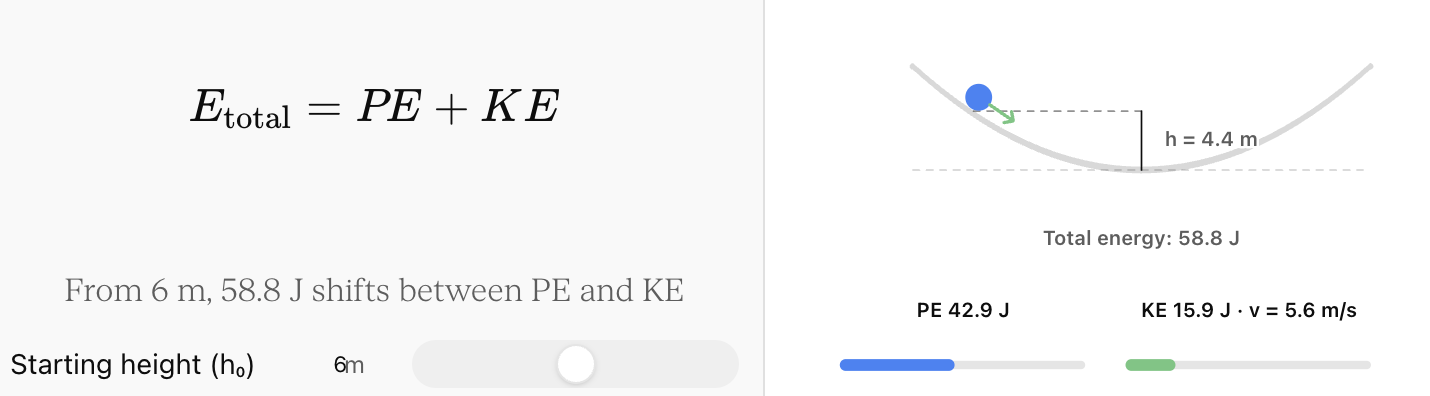
Energy Transformations During Falling
Consider an object falling toward Earth.
As it falls:
- height decreases
- gravitational potential energy decreases
- speed increases
- kinetic energy increases
Ignoring air resistance:
decrease in Eₚ = increase in Eₖ
The energy is not created as the object speeds up. It is transferred from gravitational potential energy into kinetic energy.
Worked Example: Falling Ball
A 3.0 kg ball is dropped from a height of 10 m.
Use:
g = 9.8 N/kg
Initial GPE relative to the ground:
Eₚ = mgh
= 3.0 × 9.8 × 10
= 294 J
Initially:
Eₖ = 0
So:
E_total = 294 J
Immediately before reaching the ground, ignoring air resistance:
Eₚ ≈ 0
Therefore:
Eₖ ≈ 294 J
The total mechanical energy has remained constant.
Finding Speed from Energy
For the falling ball:
mgh = 1/2 mv²
Mass cancels:
gh = 1/2 v²
Therefore:
v = √(2gh)
For h = 10 m:
v = √(2 × 9.8 × 10)
≈ 14.0 m/s
Energy conservation allows us to determine the final speed without directly calculating acceleration and time.
Energy During Upward Motion
If an object is thrown upward:
- kinetic energy decreases
- gravitational potential energy increases
- speed decreases
At the maximum height:
- vertical velocity is momentarily zero
- vertical kinetic energy is zero
- gravitational potential energy has increased
During the downward journey, the transformation reverses.


Worked Example: Maximum Height
A ball is launched vertically upward at:
20 m/s
Ignore air resistance.
Initial kinetic energy per kilogram:
Eₖ/m = 1/2 v²
= 1/2 × 20²
= 200 J/kg
At maximum height, this has become additional gravitational potential energy per kilogram:
gΔh = 200
9.8Δh = 200
Δh ≈ 20.4 m
The ball rises approximately 20.4 m above its launch position.
Energy Conservation Does Not Mean Each Energy Is Constant
A common misunderstanding is that conservation of energy means kinetic and potential energy remain unchanged.
They do not.
Instead:
their total remains constant when no energy leaves or enters the mechanical system.
For example:
| Position | GPE | KE | Total |
|---|---|---|---|
| Top | 100 J | 0 J | 100 J |
| Partway down | 70 J | 30 J | 100 J |
| Lower | 30 J | 70 J | 100 J |
| Bottom | 0 J | 100 J | 100 J |
Energy changes form while the total remains constant.
Real Systems
In real situations, some mechanical energy may be transferred to other energy stores.
For example, air resistance can transfer mechanical energy into:
- thermal energy of the air
- thermal energy of the moving object
- sound
Then:
Eₖ + Eₚ
may decrease.
However, the total energy of the complete system remains conserved.
Energy in Radial Gravitational Fields
For satellites and spacecraft, gravitational field strength changes significantly with distance.
We therefore use:
Eₚ = −GMm/r
rather than the near-surface approximation mgh.
Total mechanical energy becomes:
E_total = 1/2 mv² − GMm/r
This equation can describe many gravitational motions.
Worked Example: Total Mechanical Energy
A spacecraft has:
m = 1000 kg
v = 5000 m/s
At its position:
Eₚ = −2.0 × 10¹⁰ J
Calculate its kinetic energy:
Eₖ = 1/2 mv²
= 1/2 × 1000 × 5000²
= 1.25 × 10¹⁰ J
Therefore:
E_total = Eₖ + Eₚ
= 1.25 × 10¹⁰ − 2.0 × 10¹⁰
= −7.5 × 10⁹ J
The negative total energy indicates that the spacecraft is gravitationally bound in this simplified system.
What Total Energy Tells Us
When the zero of gravitational potential energy is chosen at infinity, total mechanical energy provides useful information about gravitational motion.
E_total < 0
The object is gravitationally bound.
It does not have enough mechanical energy to escape to infinity.
E_total = 0
The object is at the minimum-energy escape condition.
It could theoretically reach infinity with its speed approaching zero.
E_total > 0
The object has enough mechanical energy to escape with kinetic energy remaining at very large distance.
This is a powerful way to classify gravitational trajectories.
Circular Orbits
A satellite in a circular orbit moves at constant speed while gravity continually changes the direction of its velocity.
Gravity provides the centripetal acceleration.
For a circular orbit:
GMm/r² = mv²/r
Cancel m:
GM/r² = v²/r
Therefore:
v² = GM/r
and:
v = √(GM/r)
Kinetic Energy in a Circular Orbit
Since:
Eₖ = 1/2 mv²
and:
v² = GM/r
then:
Eₖ = 1/2 m(GM/r)
Therefore:
Eₖ = GMm/(2r)
The kinetic energy of a satellite in a circular orbit is positive.
Potential Energy in a Circular Orbit
The gravitational potential energy is:
Eₚ = −GMm/r
Compare this with kinetic energy:
Eₖ = GMm/(2r)
Therefore:
Eₚ = −2Eₖ
or:
Eₖ = −Eₚ/2
This is an important relationship for circular gravitational orbits.

Total Energy of a Circular Orbit
Total mechanical energy is:
E_total = Eₖ + Eₚ
Substitute:
E_total = GMm/(2r) − GMm/r
Therefore:
E_total = −GMm/(2r)
This means:
E_total = Eₚ/2
and:
E_total = −Eₖ
So for a circular orbit:
Eₚ = −2Eₖ
E_total = −Eₖ
E_total = Eₚ/2
These relationships are useful shortcuts.
Example of Orbital Energies
Suppose a satellite in a circular orbit has:
Eₖ = 4.0 × 10⁹ J
Then:
Eₚ = −2Eₖ
= −8.0 × 10⁹ J
Total energy:
E_total = Eₖ + Eₚ
= 4.0 × 10⁹ − 8.0 × 10⁹
= −4.0 × 10⁹ J
The satellite is gravitationally bound.
Why Circular-Orbit Energy Is Negative
A satellite has positive kinetic energy but larger-magnitude negative potential energy.
For example:
Eₖ = +5 units
Eₚ = −10 units
Therefore:
E_total = −5 units
Energy must be supplied to increase the total energy to zero before the satellite can completely escape the planet's gravitational influence.
Higher Circular Orbits
Consider moving a satellite from a lower circular orbit to a higher circular orbit.
At larger r:
Eₚ = −GMm/r
becomes less negative.
So:
potential energy increases.
But:
Eₖ = GMm/(2r)
decreases.
Therefore, a satellite in a higher circular orbit moves more slowly.
The Surprising Result
Moving a satellite into a higher circular orbit requires energy even though the satellite ends up moving more slowly.
Why?
Because the increase in gravitational potential energy is larger than the decrease in kinetic energy.
Therefore:
total mechanical energy increases.
The final total energy is less negative.
Comparing Two Circular Orbits
Suppose Satellite A orbits at radius r.
Satellite B orbits at radius 2r.
For Satellite A:
Eₖ,A = GMm/(2r)
Eₚ,A = −GMm/r
E_total,A = −GMm/(2r)
At 2r:
Eₖ,B = GMm/(4r)
Eₚ,B = −GMm/(2r)
E_total,B = −GMm/(4r)
Therefore, compared with the lower orbit:
- KE is halved
- magnitude of GPE is halved
- magnitude of total energy is halved
- total energy has increased because it is less negative
Energy Changes During Orbital Transfers
A spacecraft cannot normally move from one circular orbit to another simply by "lifting" vertically.
Engines are used to change its velocity and therefore its orbital energy.
During an orbital transfer:
- engines can add kinetic energy
- the spacecraft moves into a different orbit
- gravitational potential energy changes
- kinetic energy may change as the spacecraft moves
- another engine burn may be needed to establish the final orbit


The detailed trajectory can be complex, but conservation of energy remains central to understanding the motion between engine burns.
Elliptical Orbits
Not all orbits are circular.
In an elliptical orbit, the distance from the central mass changes continuously.
Therefore:
- gravitational potential energy changes
- kinetic energy changes
- speed changes
- total mechanical energy remains constant if no external work is done
Periapsis and Apoapsis
The point closest to the central body is called periapsis.
The farthest point is called apoapsis.
At periapsis:
- r is smallest
- GPE is most negative
- speed is greatest
- KE is greatest
At apoapsis:
- r is largest
- GPE is less negative
- speed is smallest
- KE is smallest

Throughout the ideal orbit:
E_total remains constant.
Energy Transformations in an Elliptical Orbit
As a satellite falls from apoapsis toward periapsis:
Eₚ decreases → Eₖ increases
The satellite speeds up.
As it moves from periapsis toward apoapsis:
Eₖ decreases → Eₚ increases
The satellite slows down.
This is an orbital version of the same energy transformation seen when an object falls near Earth's surface.
Worked Example: Energy Change in an Elliptical Orbit
Suppose a spacecraft's GPE changes from:
−4.0 × 10¹⁰ J
at apoapsis to:
−7.0 × 10¹⁰ J
at periapsis.
Change in GPE:
ΔEₚ = −7.0 × 10¹⁰ − (−4.0 × 10¹⁰)
= −3.0 × 10¹⁰ J
If mechanical energy is conserved:
ΔEₖ = +3.0 × 10¹⁰ J
The spacecraft gains 3.0 × 10¹⁰ J of kinetic energy as it approaches periapsis.
Energy Diagrams
Energy diagrams provide a visual way to represent gravitational interactions.
A simple diagram may show:
- kinetic energy
- gravitational potential energy
- total mechanical energy
For an ideal system:
E_total remains constant
while Eₖ and Eₚ change.
Interpreting Negative Potential Energy
Because:
Eₚ = 0 at infinity
gravitational potential energy is negative at finite distances.
Suppose:
Eₚ = −100 J
and later:
Eₚ = −40 J
The potential energy has increased by 60 J.
Although both values are negative:
−40 J > −100 J
Moving upward on an energy diagram corresponds to increasing energy.
Potential Energy Curve
For two gravitationally interacting masses:
Eₚ = −GMm/r
The Eₚ-r graph:
- is strongly negative at small r
- rises as r increases
- approaches zero at infinity
- never reaches positive values in the simple Newtonian model with zero at infinity
The curve becomes flatter as r increases because the gravitational force becomes weaker.
Force and the Energy Curve
The gravitational force is related to the gradient of the potential-energy graph:
F_r = −dEₚ/dr
Therefore:
- steep Eₚ curve → strong force
- shallow Eₚ curve → weak force
The negative sign indicates that gravity acts toward decreasing potential energy.
Total Energy on an Energy Diagram
Suppose a horizontal line represents:
E_total = −20 J
At a particular position:
Eₚ = −50 J
Then:
Eₖ = E_total − Eₚ
= −20 − (−50)
= 30 J
Since kinetic energy must satisfy:
Eₖ ≥ 0
an object can only occupy positions where:
E_total ≥ Eₚ
This makes energy diagrams useful for identifying allowed and forbidden regions of motion.
Turning Points
At a turning point:
v = 0
Therefore:
Eₖ = 0
So:
E_total = Eₚ
On an energy diagram, turning points occur where the total-energy line intersects the potential-energy curve.
At that position, the object momentarily stops moving radially before reversing direction.
Bound Motion on an Energy Diagram
If:
E_total < 0
the object is generally gravitationally bound in a simple isolated two-body system.
It cannot reach infinity because at infinity:
Eₚ → 0
But if total energy is negative, reaching infinity would require negative kinetic energy:
Eₖ = E_total − 0
which is impossible.
Therefore, the object must remain bound.
Escape on an Energy Diagram
If:
E_total = 0
the object has exactly enough energy to escape and reach infinity with:
v → 0
If:
E_total > 0
the object can reach infinity with kinetic energy remaining.
This provides an energy-based explanation of escape velocity.
Escape Velocity
At the minimum escape condition:
E_total = 0
At the surface of a planet:
1/2 mv² − GMm/R = 0
Therefore:
v_escape = √(2GM/R)
The mass of the escaping object cancels.
Escape speed therefore depends on:
- mass of the planet
- radius of the planet
but not on the mass of the escaping object.
Worked Escape Example
Suppose a planet has:
M = 6.0 × 10²⁴ kg
R = 6.4 × 10⁶ m
Using:
G = 6.67 × 10⁻¹¹ N·m²/kg²
v_escape = √(2GM/R)
≈ √[2(6.67 × 10⁻¹¹)(6.0 × 10²⁴)/(6.4 × 10⁶)]
≈ 1.12 × 10⁴ m/s
or approximately:
11.2 km/s
This is close to Earth's escape speed.
Energy Per Unit Mass
For spacecraft and astronomical systems, it is often useful to divide all energies by the object's mass.
Specific kinetic energy:
Eₖ/m = 1/2 v²
Gravitational potential:
Eₚ/m = V = −GM/r
Specific total mechanical energy:
E_total/m = 1/2 v² − GM/r
The unit is:
J/kg
Using energy per kilogram often simplifies gravitational calculations because the spacecraft's mass cancels.
Worked Example Using Energy per Kilogram
At one location, a spacecraft has:
V = −5.0 × 10⁷ J/kg
and:
v = 6000 m/s
Kinetic energy per kilogram:
Eₖ/m = 1/2 × 6000²
= 1.8 × 10⁷ J/kg
Total energy per kilogram:
E_total/m = 1.8 × 10⁷ − 5.0 × 10⁷
= −3.2 × 10⁷ J/kg
Because the result is negative, the spacecraft is gravitationally bound in this simplified system.
Energy and Planetary Orbits
The same principles apply to planets orbiting stars.
As a planet moves through an elliptical orbit:
- GPE decreases as it approaches the star
- KE increases
- speed increases
As it moves away:
- GPE increases
- KE decreases
- speed decreases
This explains why planets move faster when closer to the Sun and slower when farther away.
Energy in Binary Systems
Two stars orbiting one another also exchange kinetic and gravitational potential energy as their separation changes.
The gravitational potential energy of the pair can be described approximately by:
Eₚ = −GM₁M₂/r
where r is the separation between their centres.
The energy belongs to the gravitational system, not exclusively to either star.
Gravitational Collapse
Energy transformations in gravitational systems are also important during star formation.
A large cloud of gas can contract under gravity.
As the cloud collapses:
- gravitational potential energy decreases
- particles accelerate
- kinetic energy increases
- collisions convert some kinetic energy into thermal energy
- the gas becomes hotter


Gravitational potential energy is therefore an important source of heating during the early stages of star formation.
Accretion and Gravitational Energy
Matter falling toward:
- stars
- neutron stars
- black holes
can lose enormous amounts of gravitational potential energy.
Some of this energy becomes kinetic energy and thermal energy.
Hot accreting matter can then emit large amounts of electromagnetic radiation.
Gravity is not creating energy; the radiation ultimately comes from changes in the energy of the gravitational system.
Conservation of Energy with Engines
If a spacecraft fires its engines, mechanical energy is not necessarily constant.
Chemical, nuclear, or electrical energy may be transferred into the spacecraft's mechanical energy.
For example, an engine burn may increase:
Eₖ
which can then allow the spacecraft to reach a region with greater:
Eₚ
Therefore, when engines operate:
Eₖ + Eₚ
for the spacecraft-planet mechanical system does not necessarily remain constant.
Energy conservation still holds when all relevant energy stores are included.
Conservation of Energy with Atmospheric Drag
Suppose a spacecraft enters an atmosphere.
Drag transfers mechanical energy into:
- thermal energy of the atmosphere
- thermal energy of the spacecraft
- sound
- deformation or other processes
Therefore:
Eₖ + Eₚ decreases
even though total energy is still conserved.
This is why spacecraft require heat shields during atmospheric entry.
Worked Example with Energy Loss
A falling object loses:
5000 J
of gravitational potential energy.
Its kinetic energy increases by:
4200 J
The difference is:
5000 − 4200
= 800 J
Approximately 800 J has been transferred into other forms such as thermal energy and sound.
Total energy remains conserved.
Choosing the Correct Energy Model
For motion close to Earth's surface:
ΔEₚ = mgΔh
is usually sufficient.
For large changes in distance:
Eₚ = −GMm/r
should be used.
For speed:
Eₖ = 1/2 mv²
For an isolated mechanical system:
E_total = Eₖ + Eₚ
For circular orbits:
Eₖ = GMm/(2r)
Eₚ = −GMm/r
E_total = −GMm/(2r)
Choosing the appropriate model is an important part of solving gravitational problems.
A General Problem-Solving Strategy
When solving an energy problem, first identify the initial state and final state.
Write the relevant energies at each position:
Initial:
Eₖ₁ + Eₚ₁
Final:
Eₖ₂ + Eₚ₂
If mechanical energy is conserved:
Eₖ₁ + Eₚ₁ = Eₖ₂ + Eₚ₂
Then substitute the appropriate expressions.
For near-surface problems, use height differences.
For large-scale gravitational problems, use distance from the centre of the source mass.
Finally, check whether the signs and physical interpretation make sense.
Common Mistakes
Thinking negative potential energy means negative total energy in every situation
A system can have negative Eₚ but enough positive kinetic energy to make E_total positive.
Thinking conservation means KE and GPE stay constant
They can change while their total remains constant.
Using mgh for satellite-scale distances
The field varies significantly, so use Eₚ = −GMm/r.
Forgetting that gravitational potential energy is negative in the radial-field convention
Zero is chosen at infinity.
Thinking −20 J is less energy than −100 J by magnitude alone
Numerically:
−20 J > −100 J
so −20 J represents greater energy.
Thinking a higher circular orbit has greater orbital speed
Higher circular orbits have lower orbital speeds.
Thinking a higher orbit requires no energy because the final speed is lower
The increase in GPE is larger than the decrease in KE, so total energy increases.
Assuming astronauts in orbit have no gravitational potential energy
Orbiting objects possess both GPE and KE.
Forgetting the factor of 1/2 in circular-orbit kinetic energy
For a circular orbit:
Eₖ = GMm/(2r)
not GMm/r.
Confusing total orbital energy with potential energy
For a circular orbit:
E_total = −GMm/(2r)
while:
Eₚ = −GMm/r
Key Terms
Kinetic energy (Eₖ) — energy associated with motion.
Gravitational potential energy (Eₚ) — energy associated with the configuration of masses in a gravitational field.
Mechanical energy — the sum of kinetic and gravitational potential energy.
Conservation of mechanical energy — constancy of Eₖ + Eₚ when no non-conservative interaction transfers energy into or out of the mechanical system.
Circular orbit — orbit in which an object remains at constant distance from the central mass.
Elliptical orbit — orbit in which distance from the central mass varies.
Periapsis — closest point in an orbit to the central body.
Apoapsis — farthest point in an orbit from the central body.
Bound system — gravitational system with negative total mechanical energy under the usual zero-at-infinity convention.
Escape velocity — minimum idealized initial speed needed to escape to infinity with no remaining speed.
Potential-energy curve — graph showing how potential energy varies with position.
Turning point — position where kinetic energy becomes zero and motion reverses in the relevant direction.
Specific energy — energy per unit mass, usually measured in J/kg.
Orbital energy — mechanical energy associated with an orbiting object's motion and gravitational interaction.
Gravitational collapse — contraction of matter under gravitational attraction, often accompanied by conversion of GPE into kinetic and thermal energy.
Key Takeaways
- Gravitational systems involve both kinetic energy and gravitational potential energy.
- Kinetic energy is calculated using Eₖ = 1/2 mv².
- Near Earth's surface, GPE changes can be approximated using ΔEₚ = mgΔh.
- In radial gravitational fields, Eₚ = −GMm/r.
- Total mechanical energy is E_total = Eₖ + Eₚ.
- When gravity is the only force doing work, total mechanical energy remains constant.
- Falling objects lose GPE and gain KE.
- Objects moving away from a gravitational source generally gain GPE and lose KE if no external energy is supplied.
- In circular orbit, Eₚ = −2Eₖ.
- The total energy of a circular orbit is E_total = −GMm/(2r).
- A higher circular orbit has greater GPE but lower KE.
- Moving a satellite to a higher circular orbit requires an increase in total mechanical energy.
- In elliptical orbits, KE and GPE continually transform into one another while total mechanical energy remains constant.
- Objects move fastest near periapsis and slowest near apoapsis.
- Negative total energy represents a gravitationally bound system under the usual convention.
- Zero total energy corresponds to the minimum idealized escape condition.
- Positive total energy allows an object to escape with kinetic energy remaining.
- Energy diagrams can identify kinetic energy, turning points, bound motion, and escape conditions.
- Energy methods provide a powerful way to analyze satellites, spacecraft, planets, stars, and other gravitational systems.
Check Your Understanding
- Define kinetic energy, gravitational potential energy, and total mechanical energy.
- A 4 kg object is dropped from a height of 15 m. Calculate its initial GPE using g = 9.8 N/kg.
- Ignoring air resistance, calculate the kinetic energy of the object in Question 2 immediately before it reaches the ground.
- Use conservation of energy to calculate its speed immediately before reaching the ground.
- Explain how kinetic and gravitational potential energy change as an object is thrown vertically upward.
- A spacecraft has Eₖ = 3.0 × 10⁹ J and Eₚ = −8.0 × 10⁹ J. Calculate its total mechanical energy and state whether it is gravitationally bound in the simple isolated model.
- A satellite in a circular orbit has kinetic energy 5.0 × 10⁸ J. Determine its gravitational potential energy and total mechanical energy.
- Explain why a satellite in a higher circular orbit moves more slowly but has greater total mechanical energy.
- A spacecraft's GPE changes from −3.0 × 10¹⁰ J to −7.0 × 10¹⁰ J as it moves through an elliptical orbit. If total mechanical energy is conserved, calculate the change in kinetic energy.
- Describe the changes in KE, GPE, and speed as a satellite moves from apoapsis toward periapsis.
- Explain why negative total mechanical energy indicates a bound gravitational system.
- An energy diagram shows E_total = −30 J and Eₚ = −70 J at a particular position. Calculate the object's kinetic energy.
- Explain how a turning point can be identified on a potential-energy diagram.
- Describe what happens to mechanical energy when a spacecraft experiences significant atmospheric drag. Explain why this does not violate conservation of energy.
- Explain how the conversion of gravitational potential energy can contribute to the heating of a collapsing gas cloud during star formation.