Gravitational Potential and Potential Energy
| 站点: | Young Education |
| 课程: | Gravitational Fields |
| 图书: | Gravitational Potential and Potential Energy |
| 打印: | Guest user |
| 日期: | 2026年11月9日 星期一 16:39 |
1. Gravitational Potential Energy
Learning Outcomes
- I can define gravitational potential energy.
- I can explain how gravitational potential energy depends on position.
- I can calculate gravitational potential energy in gravitational fields.
- I can describe energy changes during motion in a field.
- I can apply conservation of energy to gravitational systems.
- Potential energy formula: \( U = -\frac{GMm}{r} \)
Gravitational Potential Energy
Gravitational potential energy (GPE) is energy associated with the position of objects in a gravitational field.
When an object is lifted, energy is transferred into the gravitational interaction between the object and the body producing the field. When the object falls, gravitational potential energy can be transferred into kinetic energy.
Near Earth's surface, changes in gravitational potential energy are commonly calculated using:
ΔEₚ = mgΔh
For larger distances, such as satellites and spacecraft, gravitational field strength changes significantly with distance. In those situations, we need a more general description of gravitational potential energy.


What Is Gravitational Potential Energy?
Gravitational potential energy is energy associated with the relative positions of masses in a gravitational field.
It is useful to think of gravitational potential energy as belonging to the system of interacting masses, rather than being stored inside one object alone.
For example, consider a book and Earth.
If the book is lifted:
- its distance from Earth's centre increases
- work must be done against gravity
- the gravitational potential energy of the Earth-book system increases
If the book falls:
- its distance from Earth's centre decreases
- gravitational potential energy decreases
- kinetic energy usually increases
Gravity therefore provides a mechanism for transferring energy between potential and kinetic forms.
Position Matters
Gravitational potential energy depends on position within a gravitational field.
An object's mass may remain unchanged, but moving it to a different position can change its gravitational potential energy.
Near Earth's surface:
greater height → greater gravitational potential energy
provided the same reference level is used.
For example, a book on a shelf has more gravitational potential energy relative to the floor than the same book lying on the floor.


Choosing a Reference Level
Near Earth's surface, we often choose a convenient position where:
Eₚ = 0
This is called the reference level.
Possible reference levels include:
- the floor
- the ground
- the bottom of a hill
- the bottom of a ramp
- the lowest point of a pendulum
The choice of zero level is often arbitrary.
What usually matters physically is the change in gravitational potential energy, not its absolute value relative to an arbitrarily chosen near-surface reference.
Example of Different Reference Levels
Suppose a 2 kg object is 5 m above the ground.
If the ground is chosen as:
h = 0
then its GPE is positive relative to the ground.
But if the top of a 10 m building is chosen as:
h = 0
the same object is at:
h = −5 m
Its numerical GPE relative to that reference is different.
The physics has not changed.
Energy changes between two positions remain consistent when the same reference system is used throughout the calculation.
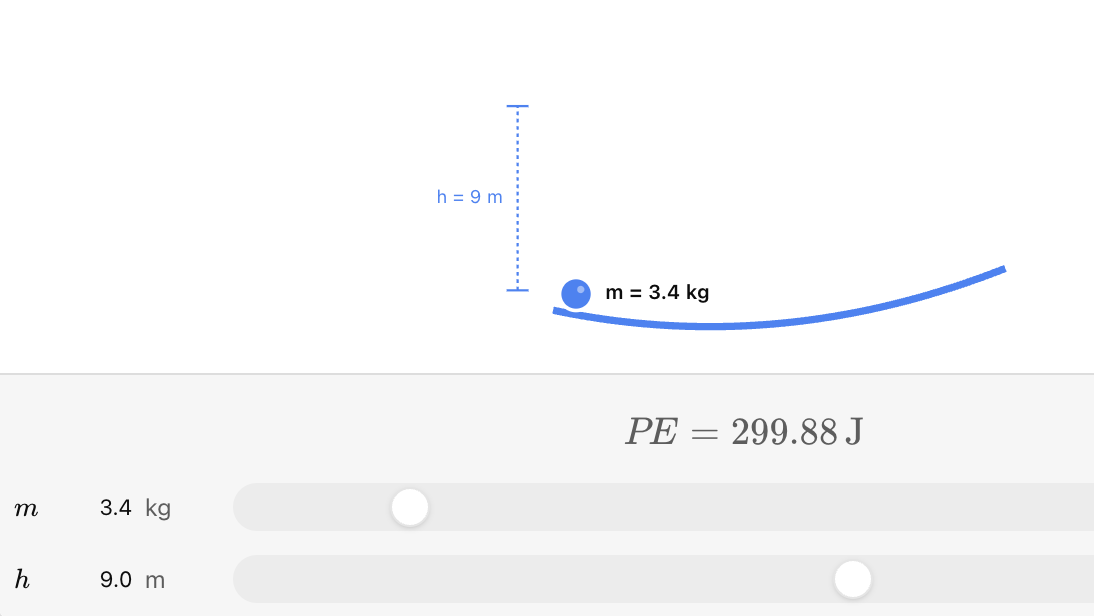
GPE Near Earth's Surface
Over relatively small changes in height near Earth's surface, gravitational field strength is approximately constant.
The change in gravitational potential energy is:
ΔEₚ = mgΔh
where:
- ΔEₚ = change in gravitational potential energy in J
- m = mass in kg
- g = gravitational field strength in N/kg
- Δh = change in vertical height in m
Since:
1 N·m = 1 J
the result is measured in joules (J).
Why the Equation Works
Suppose an object is lifted vertically at constant speed.
The upward force required is approximately equal to its weight:
F = mg
Work done is:
W = Fd
For a vertical displacement Δh:
W = mgΔh
The work done against gravity increases the gravitational potential energy:
ΔEₚ = mgΔh
This connects:
- force
- work
- gravitational field strength
- gravitational potential energy
Worked Example: Lifting an Object
A 5 kg box is lifted vertically by 3 m.
Use:
g = 9.8 N/kg
ΔEₚ = mgΔh
= 5 × 9.8 × 3
= 147 J
The gravitational potential energy of the Earth-box system increases by:
147 J
Worked Example: A Student Climbing Stairs
A student has mass:
60 kg
The student climbs a vertical height of:
4.0 m
Using:
g = 9.8 N/kg
ΔEₚ = 60 × 9.8 × 4.0
= 2352 J
The student's gravitational potential energy increases by approximately:
2.35 kJ
Vertical Height Is What Matters
In:
ΔEₚ = mgΔh
Δh is the vertical change in height.
It is not necessarily the total distance travelled.
Suppose two hikers reach the same point on a hill.
One takes a steep 1 km path.
The other takes a winding 3 km path.
If both start and finish at the same elevations, and other effects are ignored, their changes in gravitational potential energy are the same if their masses are equal.


Gravity is a conservative force, so the gravitational potential-energy change depends on initial and final positions, not on the path taken between them.
Increasing Mass
Near Earth's surface:
ΔEₚ = mgΔh
Therefore:
ΔEₚ ∝ m
If mass doubles while g and Δh remain unchanged:
the change in GPE doubles.
For example:
A 2 kg object raised 5 m gains twice as much gravitational potential energy as a 1 kg object raised through the same height.
Increasing Height
Similarly:
ΔEₚ ∝ Δh
If the vertical height change doubles:
the change in GPE doubles
provided m and g remain constant.
A 4 kg object lifted 6 m gains twice as much GPE as the same object lifted 3 m.
Gravitational Field Strength Matters
GPE changes also depend on gravitational field strength.
Suppose the same 10 kg object is lifted 2 m.
On Earth:
g = 9.8 N/kg
ΔEₚ = 10 × 9.8 × 2
= 196 J
On the Moon:
g ≈ 1.62 N/kg
ΔEₚ = 10 × 1.62 × 2
= 32.4 J
Much less energy is required to raise the object through the same height on the Moon because the gravitational field is weaker.
GPE and Falling Objects
When an object falls, its gravitational potential energy decreases.
If air resistance is negligible, this energy is transferred mainly into kinetic energy.
So:
decrease in GPE = increase in KE
or:
−ΔEₚ = ΔEₖ
where:
Eₖ = 1/2 mv²

Conservation of Mechanical Energy
If only gravity does work and energy losses are negligible:
total mechanical energy remains constant
Therefore:
Eₖ + Eₚ = constant
As an object falls:
- Eₚ decreases
- Eₖ increases
As an object rises:
- Eₖ decreases
- Eₚ increases
Energy is transferred rather than destroyed.
Worked Example: Falling from Rest
A 2 kg ball is dropped from a height of 5 m.
Ignore air resistance.
Initial GPE relative to the ground:
Eₚ = mgh
= 2 × 9.8 × 5
= 98 J
Initially, the ball is at rest:
Eₖ = 0 J
Therefore, total mechanical energy is:
98 J
Just before reaching the ground:
Eₚ ≈ 0
So:
Eₖ ≈ 98 J
Finding Speed Using Conservation of Energy
For the falling ball:
Initial GPE = final KE
Therefore:
mgh = 1/2 mv²
Mass appears on both sides and cancels:
gh = 1/2 v²
Therefore:
v = √(2gh)
For:
h = 5 m
v = √(2 × 9.8 × 5)
= √98
≈ 9.9 m/s
Notice that mass does not appear in the final equation.
Ignoring air resistance, objects falling through the same vertical distance in the same uniform field reach the same speed if they begin with the same initial speed.
Throwing an Object Upward
When an object is thrown upward:
- it begins with kinetic energy
- its speed decreases
- kinetic energy decreases
- gravitational potential energy increases
At the highest point:
vertical velocity = 0
so the vertical kinetic energy associated with that motion is temporarily zero.
The energy has been transferred into gravitational potential energy.
As the object falls again, the transfer reverses.
Worked Example: Finding Maximum Height
A 1.5 kg ball is launched vertically upward at:
14 m/s
Ignore air resistance.
Initial kinetic energy:
Eₖ = 1/2 mv²
= 1/2 × 1.5 × 14²
= 147 J
At maximum height, this has been converted into additional GPE:
mgΔh = 147
1.5 × 9.8 × Δh = 147
Δh = 147/14.7
= 10 m
The ball rises approximately:
10 m
above its launch point.
Pendulums and Energy
A swinging pendulum provides a clear example of energy changing between gravitational potential energy and kinetic energy.
At the highest points:
- GPE is greatest
- speed is momentarily zero
- KE is least
At the lowest point:
- GPE is least
- speed is greatest
- KE is greatest


In an ideal pendulum:
Eₖ + Eₚ = constant
In a real pendulum, some mechanical energy is transferred to thermal energy and sound because of air resistance and friction.
Roller Coasters
Roller coasters also demonstrate gravitational energy transfers.
At the top of a large hill:
- GPE is high
- speed may be relatively low
During the descent:
- GPE decreases
- KE increases
- speed increases
During the next climb:
- KE decreases
- GPE increases


Real roller coasters also transfer some mechanical energy into:
- thermal energy
- sound
because of friction and air resistance.
Hydroelectric Power
Water stored behind a dam has gravitational potential energy because of its elevated position.
As water moves downward:
gravitational potential energy → kinetic energy → turbine motion → electrical energy
The energy available depends partly on:
- mass of water
- gravitational field strength
- vertical height difference
A greater height difference generally means more gravitational potential energy is available per kilogram of water.
Why mgh Is an Approximation
The equation:
ΔEₚ = mgΔh
assumes that gravitational field strength is approximately constant.
Near Earth's surface over modest height changes, this is an excellent approximation.
However, for:
- satellites
- spacecraft
- large changes in altitude
- motion between planets
g may change significantly.
We then need a more general expression.
GPE in a Radial Gravitational Field
For two spherical masses, gravitational potential energy is:
Eₚ = −GMm/r
where:
- Eₚ = gravitational potential energy in J
- G = gravitational constant
- M = mass producing the field
- m = mass moving in the field
- r = distance between the centres of the masses
The zero of gravitational potential energy is conventionally chosen at:
r → ∞
This is different from the arbitrary reference level often used with mgh near Earth's surface.


Why Gravitational Potential Energy Is Negative
For an isolated gravitational system, we conventionally define:
Eₚ = 0 at infinite separation
At any finite distance:
Eₚ = −GMm/r
so gravitational potential energy is negative.
The negative sign represents the fact that the masses form a bound gravitational system.
Energy must be supplied to separate them completely to infinity.
Understanding Negative GPE
Suppose:
Eₚ = −1000 J
This does not mean the system somehow contains an impossible amount of energy.
It means the system is:
1000 J below the chosen zero level at infinity.
To reach:
Eₚ = 0
at infinite separation, at least 1000 J would need to be supplied in the appropriate idealized case.
How GPE Changes with Distance
Using:
Eₚ = −GMm/r
consider what happens as r increases.
Close to the planet:
Eₚ is strongly negative.
Farther away:
Eₚ becomes less negative.
At extremely large distance:
Eₚ approaches zero.
Therefore, moving an object away from a planet:
increases its gravitational potential energy.
Moving it toward the planet:
decreases its gravitational potential energy.
Example of Negative Energy
Suppose a spacecraft has:
Eₚ = −8 × 10⁹ J
at one location.
Farther from the planet it has:
Eₚ = −3 × 10⁹ J
The change is:
ΔEₚ = Eₚ,final − Eₚ,initial
= (−3 × 10⁹) − (−8 × 10⁹)
= +5 × 10⁹ J
The spacecraft's gravitational potential energy has increased by 5 × 10⁹ J.
Change in GPE in a Radial Field
Between two distances:
r₁ and r₂
the change in gravitational potential energy is:
ΔEₚ = Eₚ₂ − Eₚ₁
Therefore:
ΔEₚ = −GMm/r₂ + GMm/r₁
or:
ΔEₚ = GMm(1/r₁ − 1/r₂)
If the object moves outward:
r₂ > r₁
and:
ΔEₚ > 0
Energy must be transferred into the gravitational system.
Worked Example: Moving Away from a Planet
Suppose:
M = 6.0 × 10²⁴ kg
m = 1000 kg
r₁ = 7.0 × 10⁶ m
r₂ = 1.4 × 10⁷ m
Use:
G = 6.67 × 10⁻¹¹ N·m²/kg²
Initial GPE:
Eₚ₁ = −GMm/r₁
≈ −5.72 × 10¹⁰ J
Final GPE:
Eₚ₂ = −GMm/r₂
≈ −2.86 × 10¹⁰ J
Therefore:
ΔEₚ = Eₚ₂ − Eₚ₁
≈ +2.86 × 10¹⁰ J
The spacecraft gains gravitational potential energy as it moves farther from the planet.
Connecting mgh and −GMm/r
The equations:
ΔEₚ = mgΔh
and:
Eₚ = −GMm/r
do not describe different types of gravity.
They describe the same gravitational interaction under different conditions.
Use:
ΔEₚ = mgΔh
when:
- the change in height is small compared with planetary radius
- g can be treated as constant
Use:
Eₚ = −GMm/r
when:
- distances are large
- g changes significantly
- radial gravitational fields must be considered
Near a planet's surface, the general radial-field equation leads approximately to the familiar mgΔh result.
Gravitational Potential Energy and Orbits
Satellites possess both:
- kinetic energy
- gravitational potential energy
For a satellite orbiting a planet:
Eₚ = −GMm/r
The satellite's kinetic energy depends on its orbital speed.
For a circular orbit:
Eₖ = GMm/(2r)
Therefore, total orbital mechanical energy is:
E_total = Eₖ + Eₚ
which gives:
E_total = −GMm/(2r)
The negative total energy indicates that the satellite is gravitationally bound to the planet.


Moving a Satellite to a Higher Orbit
A satellite in a higher circular orbit has:
- greater gravitational potential energy
- less negative GPE
- lower circular orbital speed
- lower kinetic energy
- greater total mechanical energy
This can initially seem surprising.
To move a satellite to a higher circular orbit, energy must be supplied even though its final orbital speed is lower.
The additional energy increases the satellite's total orbital energy.
Escape from a Gravitational Field
An object can escape a planet if it has enough mechanical energy to reach an indefinitely large distance without returning.
At infinity:
Eₚ → 0
For the minimum idealized escape condition:
E_total = 0
At the planet:
Eₖ + Eₚ = 0
1/2 mv² − GMm/R = 0
Solving gives:
v_escape = √(2GM/R)
Escape velocity is therefore directly connected to gravitational potential energy.
Conservation of Energy in Space
Consider a spacecraft moving away from a planet with its engines off.
If other effects are negligible:
Eₖ + Eₚ = constant
As the spacecraft moves outward:
- Eₚ increases
- Eₖ decreases
- speed decreases
If it lacks enough initial energy, it eventually stops moving outward and begins falling back.
If it has sufficient energy, it can escape.
Falling Toward a Planet
A spacecraft falling toward a planet undergoes the opposite energy transformation.
As r decreases:
Eₚ becomes more negative.
The decrease in gravitational potential energy produces an increase in kinetic energy.
Therefore:
speed increases.
This is why objects accelerate as they fall deeper into a gravitational field.
Energy and Field Strength Are Related but Different
Gravitational field strength describes:
force per unit mass at a location.
Gravitational potential energy describes:
energy associated with the configuration of masses.
A field can exert a force that changes an object's motion, while potential energy allows us to track the energy transfers associated with that motion.
Both are useful descriptions of gravitational systems.
Energy Diagrams
Energy diagrams can help show how energy changes during motion.
For an object falling near Earth's surface:
Top: high GPE, low KE
Middle: lower GPE, greater KE
Bottom: low GPE, high KE
If energy losses are negligible:
total mechanical energy remains constant.


Real Systems and Energy Losses
Mechanical energy is not always conserved by itself.
Suppose an object falls through air.
Some gravitational potential energy is transferred into:
- kinetic energy of the object
- thermal energy of the air
- thermal energy of the object
- sound
The total energy of the larger system remains conserved, but:
Eₖ + Eₚ
for the object-Earth mechanical system may decrease because energy has been transferred to other stores.
Example with Efficiency
A 100 kg load is lowered through:
20 m
Its decrease in gravitational potential energy is:
ΔEₚ = 100 × 9.8 × 20
= 19,600 J
Suppose a generator captures:
75%
of this energy as useful electrical energy.
Useful energy:
= 0.75 × 19,600
= 14,700 J
The remaining energy is transferred into other forms, mainly thermal energy.
GPE in Everyday Life
Gravitational potential energy appears in many familiar situations:
- lifting objects
- climbing stairs
- jumping
- skiing downhill
- roller coasters
- pendulums
- water stored behind dams
- falling objects
- cranes lifting loads
- elevated storage systems
In each case, position within a gravitational field affects the energy available for transfer.
GPE in Astronomy
Gravitational potential energy is fundamental to astronomy.
It helps explain:
- satellite orbits
- planetary motion
- spacecraft trajectories
- escape from planets
- star formation
- collapsing gas clouds
- binary star systems
- accretion around compact objects


Star Formation and GPE
A large cloud of gas can collapse under gravity.
As the particles move closer together:
- gravitational potential energy decreases
- kinetic and thermal energy increase
- the cloud becomes hotter
Eventually, the central region may become hot and dense enough for nuclear fusion to begin.
Gravitational potential energy therefore plays a major role in the formation of stars.
Accretion and Gravitational Energy
Matter falling toward a compact astronomical object can lose enormous amounts of gravitational potential energy.
That energy can be transformed into:
- kinetic energy
- thermal energy
- electromagnetic radiation
This is why matter falling toward objects such as neutron stars and black holes can become extremely hot and luminous.
The energy is not created by gravity; it comes from the decrease in gravitational potential energy of the system.
Solving GPE Problems
A useful approach is:
Identify the gravitational model.
Small height change near a planetary surface?
Use:
ΔEₚ = mgΔh
Large radial distance change?
Use:
Eₚ = −GMm/r
Identify initial and final positions.
Energy problems usually involve a change between two states.
Choose a reference level carefully.
For near-surface problems, the zero level can often be chosen conveniently.
For radial-field calculations, the conventional zero is at infinity.
Apply conservation of energy if appropriate.
If energy losses are negligible:
Eₖ₁ + Eₚ₁ = Eₖ₂ + Eₚ₂
Check the sign.
Moving upward or outward increases GPE.
Moving downward or inward decreases GPE.
Common Mistakes
Confusing gravitational potential energy with gravitational field strength
GPE is measured in joules.
Field strength is measured in N/kg.
Using mgh for enormous distances
The equation mgΔh assumes approximately constant g.
Thinking GPE belongs only to the smaller object
Gravitational potential energy is associated with the configuration of the interacting masses.
Using distance travelled instead of vertical height
Near Earth's surface, use the change in vertical height.
Thinking negative GPE means negative energy cannot exist
The sign depends on the chosen zero. In radial gravitational systems, zero is conventionally chosen at infinity.
Thinking −5 J is less gravitationally bound than −2 J
−5 J is farther below zero and represents a more strongly bound state.
Forgetting that potential energy increases when moving away from a planet
It becomes less negative, which means it has increased.
Assuming mechanical energy is always conserved
Mechanical energy is conserved only when energy is not transferred to other forms by effects such as friction or air resistance.
Confusing zero velocity with zero acceleration
At the highest point of a thrown object, velocity may momentarily be zero while gravitational acceleration is still present.
Key Terms
Gravitational potential energy (GPE) — energy associated with the relative positions of masses in a gravitational field.
Potential energy — energy associated with the configuration or position of a system.
Reference level — a position chosen to represent zero potential energy in a particular near-surface problem.
Joule (J) — the SI unit of energy.
Kinetic energy — energy associated with motion, calculated using Eₖ = 1/2 mv².
Mechanical energy — the sum of kinetic and potential energy in a mechanical system.
Conservation of energy — the principle that energy cannot be created or destroyed, although it can be transferred between stores and systems.
Conservative force — a force for which the work done between two positions does not depend on the path taken.
Radial gravitational field — a gravitational field directed toward a central mass and varying with distance.
Bound system — a system whose objects do not have enough total mechanical energy to separate indefinitely under the conditions considered.
Escape velocity — the minimum initial speed in an idealized model needed to escape a gravitational field without further propulsion.
Orbital energy — the combined kinetic and gravitational potential energy of an orbiting object.
Infinity reference — the conventional choice Eₚ = 0 when gravitationally interacting masses are infinitely separated.
Energy transfer — movement of energy between stores or systems.
Key Takeaways
- Gravitational potential energy is associated with the positions of masses in a gravitational field.
- Moving an object upward or farther from a gravitational source increases its gravitational potential energy.
- Moving an object downward or toward a gravitational source decreases its gravitational potential energy.
- Near Earth's surface, changes in GPE can usually be calculated using ΔEₚ = mgΔh.
- GPE depends on mass, gravitational field strength, and change in vertical height in the uniform-field approximation.
- Gravity is a conservative force, so GPE changes depend on initial and final positions rather than the path taken.
- During free fall, gravitational potential energy is transferred into kinetic energy.
- When an object rises, kinetic energy can be transferred into gravitational potential energy.
- If energy losses are negligible, Eₖ + Eₚ remains constant.
- For large distances in radial gravitational fields, Eₚ = −GMm/r.
- In the radial-field model, gravitational potential energy is conventionally zero at infinity.
- GPE is negative at finite distances under this convention because gravitational systems are bound.
- Moving away from a planet makes GPE less negative and therefore increases it.
- Satellites possess both gravitational potential energy and kinetic energy.
- Energy must be supplied to move a satellite into a higher orbit.
- Gravitational potential energy is essential for understanding falling objects, hydroelectric systems, spacecraft, orbits, escape, and star formation.
Check Your Understanding
- Define gravitational potential energy.
- Explain why gravitational potential energy is better described as energy associated with a system of interacting masses rather than energy stored only inside one object.
- A 4 kg object is lifted vertically by 6 m near Earth's surface. Calculate its increase in GPE using g = 9.8 N/kg.
- A 70 kg student climbs a staircase with a vertical height of 5 m. Calculate the increase in gravitational potential energy.
- Two identical objects reach the top of the same hill by different paths. One path is twice as long as the other. Compare their changes in gravitational potential energy and explain your answer.
- A 3 kg ball falls 8 m from rest. Ignoring air resistance, calculate the decrease in GPE.
- For the ball in Question 6, determine its kinetic energy just before reaching the bottom if it began from rest.
- Explain how gravitational potential energy and kinetic energy change as a ball is thrown vertically upward.
- A pendulum swings from its highest position to its lowest position. Describe the energy transformations that occur.
- Explain why ΔEₚ = mgΔh is suitable near Earth's surface but becomes inaccurate for a spacecraft travelling a very large distance from Earth.
- Gravitational potential energy changes from −9 × 10⁸ J to −4 × 10⁸ J. Calculate the change in GPE and state whether the object moved generally closer to or farther from the gravitational source.
- Explain why gravitational potential energy is negative when zero is defined at infinite separation.
- A satellite is moved from a lower circular orbit to a higher circular orbit. Describe what happens to its gravitational potential energy, orbital speed, kinetic energy, and total mechanical energy.
- A spacecraft travels away from a planet with its engines switched off. Explain how conservation of energy can be used to describe the changes in its speed and gravitational potential energy.
- Explain how the conversion of gravitational potential energy helps account for the heating of gas during the formation of a star.
2. Gravitational Potential
Learning Outcomes
- I can define gravitational potential.
- I can distinguish between gravitational potential and gravitational potential energy.
- I can calculate gravitational potential at a point in a field.
- I can explain why gravitational potential is negative.
- I can relate gravitational potential to work done.
- \( V = - \frac{GM}{r} \)
- Relationship between V and U
Gravitational Potential
Gravitational potential describes the gravitational environment at a particular point in space in terms of energy per unit mass.
It is defined as:
the gravitational potential energy per unit mass of a small test mass placed at that point.
Gravitational potential is represented by:
V
and:
V = Eₚ/m
where:
- V = gravitational potential in J/kg
- Eₚ = gravitational potential energy in J
- m = test mass in kg
Unlike gravitational field strength, gravitational potential is a scalar quantity. It has magnitude but no direction.


Potential Versus Potential Energy
Gravitational potential and gravitational potential energy are closely related, but they are not the same quantity.
Gravitational potential, V, describes the field at a particular location.
Gravitational potential energy, Eₚ, describes the energy associated with a particular mass placed at that location.
They are related by:
Eₚ = mV
or:
V = Eₚ/m
This distinction is similar to the difference between gravitational field strength and gravitational force.
| Field Property | Property of an Object in the Field |
|---|---|
| Gravitational field strength, g | Gravitational force, F |
| Gravitational potential, V | Gravitational potential energy, Eₚ |
| N/kg | N |
| J/kg | J |
| Independent of test mass | Depends on test mass |
Gravitational Potential Is a Property of Position
Suppose a point in space has gravitational potential:
V = −2.0 × 10⁷ J/kg
This value is the same regardless of which small test mass is placed there.
A 1 kg mass would have:
Eₚ = mV
= 1 × (−2.0 × 10⁷)
= −2.0 × 10⁷ J
A 5 kg mass would have:
Eₚ = 5 × (−2.0 × 10⁷)
= −1.0 × 10⁸ J
The potential is unchanged.
The potential energy changes because the test mass is different.
Calculating Gravitational Potential
Outside a spherical mass:
V = −GM/r
where:
- V = gravitational potential in J/kg
- G = gravitational constant = 6.67 × 10⁻¹¹ N·m²/kg²
- M = mass producing the gravitational field in kg
- r = distance from the centre of the mass in m
Notice that the mass of the test object does not appear in this equation.
This is because gravitational potential describes the field itself, not a particular test mass.


Deriving the Potential Equation
Gravitational potential energy in a radial gravitational field is:
Eₚ = −GMm/r
Gravitational potential is:
V = Eₚ/m
Substitute:
V = (−GMm/r)/m
The test mass cancels:
V = −GM/r
This demonstrates why gravitational potential does not depend on the mass used to measure it.
Worked Example: Potential Near a Planet
A planet has mass:
M = 6.0 × 10²⁴ kg
Find the gravitational potential at:
r = 8.0 × 10⁶ m
Use:
V = −GM/r
V = −(6.67 × 10⁻¹¹)(6.0 × 10²⁴)/(8.0 × 10⁶)
V ≈ −5.0 × 10⁷ J/kg
This means that every kilogram placed at that location has approximately:
−5.0 × 10⁷ J
of gravitational potential energy relative to the conventional zero at infinity.
Gravitational Potential at Earth's Surface
Using approximate values:
Earth's mass:
M = 5.97 × 10²⁴ kg
Earth's radius:
R = 6.37 × 10⁶ m
At Earth's surface:
V = −GM/R
V = −(6.67 × 10⁻¹¹)(5.97 × 10²⁴)/(6.37 × 10⁶)
V ≈ −6.25 × 10⁷ J/kg
Therefore, Earth's surface gravitational potential is approximately:
−62.5 MJ/kg
What Does −62.5 MJ/kg Mean?
It means that a 1 kg mass at Earth's surface has gravitational potential energy of approximately:
−62.5 MJ
relative to the conventional zero at infinite separation.
To move that kilogram infinitely far from Earth, at least approximately:
62.5 MJ
of energy must be supplied in the idealized Earth-only model.
This gives gravitational potential a useful physical interpretation.
Why Is Gravitational Potential Negative?
For isolated gravitational systems, we conventionally choose:
V = 0 at infinity
At any finite distance from an attractive mass:
V < 0
because energy must be supplied to move a test mass from that location all the way to infinity.
The negative sign does not mean gravitational potential is somehow physically impossible or that energy has been destroyed.
It tells us that the point lies below the chosen zero-potential level.
Thinking of a Gravitational Potential Well
A useful conceptual model is a potential well.
Imagine infinity as:
V = 0
Moving toward a planet takes us deeper into the gravitational potential well.
Far from the planet:
V is close to zero.
Closer to the planet:
V becomes more negative.
A more massive or more compact object can produce a deeper gravitational potential well.
This idea is especially useful in astronomy.
Potential Changes with Distance
For a spherical mass:
V = −GM/r
As r increases:
- V becomes less negative
- V approaches zero
As r decreases:
- V becomes more negative
Therefore:
moving away from a planet increases gravitational potential
while:
moving toward a planet decreases gravitational potential.
Comparing Two Distances
Suppose the potential at distance r is:
V = −40 MJ/kg
At distance 2r:
V₂ = −GM/(2r)
Therefore:
V₂ = −20 MJ/kg
At 4r:
V₄ = −10 MJ/kg
Notice that potential follows:
V ∝ −1/r
This is different from gravitational field strength:
g ∝ 1/r²
Potential and Field Strength Change Differently
This distinction is important.
For a spherical mass:
g = GM/r²
but:
V = −GM/r
Therefore, if distance doubles:
field strength becomes:
g/4
while the magnitude of potential becomes:
|V|/2
| Distance | Field Strength | Potential Magnitude |
|---|---|---|
| r | g | |V| |
| 2r | g/4 | |V|/2 |
| 3r | g/9 | |V|/3 |
| 4r | g/16 | |V|/4 |
Field strength decreases faster with distance than the magnitude of potential.
Potential Is Scalar
Gravitational field strength is a vector.
It has:
- magnitude
- direction
Gravitational potential is a scalar.
It has:
- magnitude/value
- no direction
Therefore, gravitational potentials can be added algebraically without resolving them into directions.
This becomes particularly useful when several masses are present.
Potential Due to Several Masses
Suppose several masses produce gravitational potentials at point P.
The total potential is:
V_total = V₁ + V₂ + V₃ + ...
For point masses:
V_total = −G(M₁/r₁ + M₂/r₂ + M₃/r₃ + ...)
Because potential is scalar, we simply add the numerical values.
No vector components are required.
Worked Example: Two Masses
At point P:
Mass A produces:
V₁ = −3.0 × 10⁶ J/kg
Mass B produces:
V₂ = −2.0 × 10⁶ J/kg
Then:
V_total = V₁ + V₂
= −3.0 × 10⁶ − 2.0 × 10⁶
= −5.0 × 10⁶ J/kg
Notice that there is no concept of "left potential" or "right potential."
Potential has no direction.
Zero Field Does Not Mean Zero Potential
This is a very important distinction.
Consider two identical masses with a point exactly halfway between them.
At the midpoint:
- the gravitational field from one mass points left
- the gravitational field from the other points right
- the field strengths are equal
Therefore:
g_net = 0
But each mass produces a negative gravitational potential.
The potentials add:
V_total = V₁ + V₂
Therefore:
V_total < 0

So:
zero gravitational field does not necessarily mean zero gravitational potential.
Worked Example: Zero Field but Non-Zero Potential
Two identical masses each produce a potential of:
−4 MJ/kg
at their midpoint.
Because potential is scalar:
V_total = −4 + (−4)
= −8 MJ/kg
However, their gravitational fields point in opposite directions and cancel.
Therefore:
g_net = 0
but:
V_total = −8 MJ/kg
Potential Difference
The difference in gravitational potential between two locations is:
ΔV = V₂ − V₁
Potential difference tells us how much gravitational potential energy changes per kilogram when moving between the locations.
Its unit is:
J/kg
Potential Difference and Energy
Because:
Eₚ = mV
the change in gravitational potential energy is:
ΔEₚ = mΔV
Therefore:
ΔEₚ = m(V₂ − V₁)
This equation is useful when moving objects through gravitational fields.
Worked Example: Potential Difference
A spacecraft moves from a location where:
V₁ = −50 MJ/kg
to:
V₂ = −20 MJ/kg
Then:
ΔV = V₂ − V₁
= −20 − (−50)
= +30 MJ/kg
The gravitational potential has increased by:
30 MJ/kg
If the spacecraft has mass:
1000 kg
then:
ΔEₚ = mΔV
= 1000 × 30 × 10⁶
= 3.0 × 10¹⁰ J
Its gravitational potential energy has increased by:
3.0 × 10¹⁰ J
Gravitational Potential and Work Done
Potential difference is directly related to the work required to move a mass through a gravitational field.
If an external force slowly moves a mass without changing its kinetic energy:
work done by the external force = increase in gravitational potential energy
Therefore:
W_external = mΔV
or:
ΔV = W_external/m
This gives another definition of gravitational potential difference:
the work done per unit mass in moving a small test mass between two points without changing its kinetic energy.
Work Done by Gravity
If gravity itself moves an object:
W_gravity = −ΔEₚ
Since:
ΔEₚ = mΔV
then:
W_gravity = −mΔV
This negative relationship is important.
When gravitational potential decreases, gravity does positive work.
When gravitational potential increases, gravity does negative work.
Example: Falling Toward a Planet
Suppose a 2 kg object moves from:
V₁ = −3 MJ/kg
to:
V₂ = −7 MJ/kg
Potential difference:
ΔV = −7 − (−3)
= −4 MJ/kg
Therefore:
ΔEₚ = mΔV
= 2 × (−4 MJ/kg)
= −8 MJ
The system loses 8 MJ of gravitational potential energy.
Gravity does:
+8 MJ
of work.
If no other energy transfers occur, this energy appears as increased kinetic energy.
Moving Away from a Planet
Now suppose a spacecraft moves outward.
Its potential changes from:
−8 MJ/kg
to:
−3 MJ/kg
Then:
ΔV = −3 − (−8)
= +5 MJ/kg
Potential increases.
Therefore, gravitational potential energy also increases.
An external energy source, such as a spacecraft engine, may provide the required energy.
Relationship to Conservation of Energy
If gravity is the only force doing work:
Eₖ + Eₚ = constant
Since:
Eₚ = mV
we can write:
Eₖ + mV = constant
As an object falls:
- V decreases
- Eₚ decreases
- Eₖ increases
As an object moves outward:
- V increases
- Eₚ increases
- Eₖ decreases
This provides an energy-based way of analyzing motion in gravitational fields.
Worked Example: Speed from Potential Difference
A spacecraft begins from rest at a location where:
V₁ = −8.0 × 10⁷ J/kg
It falls to a location where:
V₂ = −9.8 × 10⁷ J/kg
Ignore other forces.
Potential change per kilogram:
ΔV = −9.8 × 10⁷ − (−8.0 × 10⁷)
= −1.8 × 10⁷ J/kg
The decrease in gravitational potential becomes kinetic energy per kilogram:
Eₖ/m = 1.8 × 10⁷ J/kg
Since:
Eₖ/m = 1/2 v²
then:
1/2 v² = 1.8 × 10⁷
v² = 3.6 × 10⁷
v = 6000 m/s
Notice that the spacecraft's mass cancels.
Potential Near Earth's Surface
Near Earth's surface, g is approximately constant.
For a small vertical change:
ΔV ≈ gΔh
This is the potential-per-unit-mass version of:
ΔEₚ = mgΔh
Since:
ΔEₚ = mΔV
and:
ΔEₚ = mgΔh
we get:
ΔV = gΔh
Worked Example Near Earth's Surface
A student climbs:
12 m
vertically.
Using:
g = 9.8 N/kg
the increase in gravitational potential is:
ΔV = gΔh
= 9.8 × 12
= 117.6 J/kg
Every kilogram of the student gains:
117.6 J
of gravitational potential energy.
If the student has mass 60 kg:
ΔEₚ = 60 × 117.6
= 7056 J
Equipotential Surfaces
An equipotential surface is a surface on which gravitational potential is the same everywhere.
Around an isolated spherical mass, equipotential surfaces are spherical.
In a two-dimensional diagram, they appear as concentric circles.


Moving along an equipotential surface does not change gravitational potential.
Therefore:
ΔV = 0
and:
ΔEₚ = 0
for movement along that surface.
Field Lines and Equipotentials
Gravitational field lines cross equipotential surfaces at:
90°
The gravitational field points in the direction in which potential decreases most rapidly.
Around a planet:
- field lines point inward
- gravitational potential becomes more negative inward
- equipotential surfaces surround the planet
This relationship provides a useful connection between field diagrams and energy diagrams.
Closely Spaced Equipotentials
If equipotential surfaces representing equal potential differences are very close together, the gravitational field is strong.
If they are farther apart, the gravitational field is weaker.
Conceptually:
large change in V over small distance → strong field
small change in V over large distance → weak field
This links gravitational potential directly to gravitational field strength.
Potential and Field Strength
In one radial dimension, gravitational field strength is related to the rate at which potential changes with distance.
Conceptually:
g = rate of decrease of V with distance in the field direction
For a radial coordinate measured outward from a spherical mass:
g_r = −dV/dr
The minus sign indicates that the gravitational field points toward decreasing potential.
At a more introductory level, the key idea is:
the steeper the potential changes with position, the stronger the gravitational field.
Gravitational Potential Graph
For a spherical mass:
V = −GM/r
A graph of V against r has several important features:
- V is negative
- V becomes very negative close to the mass
- V increases as r increases
- V approaches zero as r approaches infinity
- the curve becomes flatter at large distances

A steep potential graph corresponds to a strong gravitational field.
A flatter potential graph corresponds to a weaker field.
Comparing Potential and GPE Graphs
For a fixed test mass:
Eₚ = mV
Therefore, gravitational potential and gravitational potential energy have the same general shape when plotted against distance.
However:
- V is measured in J/kg
- Eₚ is measured in J
- V does not depend on the test mass
- Eₚ does depend on the test mass
For a larger test mass, the GPE graph is scaled by m.
The potential graph remains unchanged.
Potential Around Different Planets
At the surface of a spherical planet:
V = −GM/R
Therefore, surface gravitational potential depends on:
- planetary mass
- planetary radius
A planet with large mass and small radius can have a very negative surface potential.
This means a large amount of energy per kilogram is required to escape its gravitational influence.
Comparing Two Planets
Suppose Planet B has:
4 times the mass of Planet A
and:
2 times the radius.
For Planet A:
VA = −GMA/RA
For Planet B:
VB = −G(4MA)/(2RA)
VB = 2VA
Because both values are negative, Planet B's surface potential is:
twice as negative
as Planet A's.
Notice that their surface field strengths would actually be equal:
gB/gA = 4/2²
= 1
So two planets can have the same surface gravitational field strength but different gravitational potentials.
This is an important distinction.
Same g Does Not Mean Same V
This result may initially seem surprising.
Field strength depends on:
g ∝ M/R²
Potential depends on:
V ∝ −M/R
Therefore, two planets can have:
the same surface g
but:
different surface V
Field strength describes the local force per kilogram.
Potential describes the energy per kilogram relative to infinity.
They answer different physical questions.
Gravitational Potential and Escape
Suppose an object is at a location with gravitational potential:
V
Its gravitational potential energy per kilogram is V.
To reach infinity with zero final speed:
final total energy per kilogram = 0
Therefore, the required kinetic energy per kilogram must compensate for the negative potential.
This connects gravitational potential directly to escape speed.
Escape Speed from Potential
Per kilogram:
initial kinetic energy + initial potential = 0
So:
1/2 v_escape² + V = 0
Therefore:
v_escape = √(−2V)
Since V is negative, −2V is positive.
For Earth's surface:
V ≈ −6.25 × 10⁷ J/kg
v_escape = √(1.25 × 10⁸)
≈ 1.12 × 10⁴ m/s
≈ 11.2 km/s
This agrees with Earth's familiar idealized escape speed.
Potential in Multi-Body Systems
Because potential is scalar, multi-body gravitational systems are often easier to analyze using potential than using field vectors.
For several masses:
V = −G(M₁/r₁ + M₂/r₂ + M₃/r₃ + ...)
Every positive source mass contributes a negative potential when zero is chosen at infinity.
The contributions simply add.


Example: Potential Between Two Masses
Suppose point P is:
- 4 m from Mass A
- 6 m from Mass B
where:
MA = 3.0 × 10¹¹ kg
MB = 5.0 × 10¹¹ kg
Then:
V = −G(MA/rA + MB/rB)
V = −6.67 × 10⁻¹¹[(3.0 × 10¹¹/4) + (5.0 × 10¹¹/6)]
V ≈ −10.6 J/kg
No directions need to be assigned because potential is scalar.
Potential at a Neutral Field Point
A neutral field point is where:
g_net = 0
But the gravitational potential there will generally still be negative.
This is because:
- fields are vectors and may cancel
- potentials are scalars and add
Therefore:
g = 0 does not imply V = 0
This is one of the most important conceptual differences between gravitational field strength and gravitational potential.
Potential and Work: A Useful Interpretation
Suppose:
V = −20 MJ/kg
at one point and:
V = −5 MJ/kg
at another.
Moving 1 kg slowly from the first point to the second requires an increase in gravitational potential energy of:
15 MJ
Therefore, an external agent must do:
15 MJ of work per kilogram
in the idealized case.
This is why gravitational potential can be interpreted as an energy-per-unit-mass landscape.
Common Mistakes
Confusing potential with potential energy
Potential is measured in J/kg.
Potential energy is measured in J.
Thinking potential depends on the test mass
Gravitational potential is a property of position in the field.
Forgetting the negative sign
For an isolated spherical mass with zero potential at infinity:
V = −GM/r
Thinking more negative means greater potential
−20 MJ/kg is a lower potential than −5 MJ/kg.
Thinking potential becomes more negative when moving away
Moving away makes potential less negative, so potential increases.
Confusing the distance relationships
Potential:
V ∝ −1/r
Field strength:
g ∝ 1/r²
Thinking zero field means zero potential
Fields can cancel vectorially while potentials remain negative.
Adding gravitational potentials as vectors
Potential is scalar. Simply add the numerical contributions.
Using altitude instead of distance from the centre
In:
V = −GM/r
r is measured from the centre of the source mass.
Thinking negative potential means negative mass
The negative sign results from the chosen zero at infinity and the attractive nature of gravity.
Key Terms
Gravitational potential (V) — gravitational potential energy per unit mass at a point in a gravitational field.
Gravitational potential energy (Eₚ) — energy associated with the configuration of interacting masses.
Potential difference (ΔV) — difference in gravitational potential between two locations.
Joule per kilogram (J/kg) — the SI unit of gravitational potential.
Scalar — a quantity with magnitude but no direction.
Test mass — a small mass used conceptually to investigate a gravitational field.
Reference level — the chosen position at which potential is defined to have a particular value.
Infinity reference — the conventional choice V = 0 at infinite distance from an isolated gravitational source.
Equipotential surface — a surface on which gravitational potential has the same value everywhere.
Potential well — a representation of a region of negative gravitational potential around an attractive mass.
Work done — energy transferred when a force acts through a displacement.
Neutral field point — a point where the net gravitational field is zero.
Escape speed — the minimum idealized initial speed required to reach infinity with zero remaining speed.
Potential gradient — the rate at which gravitational potential changes with position, related to gravitational field strength.
Key Takeaways
- Gravitational potential is gravitational potential energy per unit mass.
- It is represented by V and measured in J/kg.
- Gravitational potential is a property of a location in a gravitational field.
- Gravitational potential energy depends on the mass placed at that location.
- The quantities are related by Eₚ = mV.
- Outside a spherical mass, V = −GM/r.
- Gravitational potential is a scalar, while gravitational field strength is a vector.
- Potential contributions from several masses can therefore be added directly.
- Zero potential is conventionally chosen at infinity for isolated gravitational systems.
- Potential is negative at finite distances because energy must be supplied to move a mass completely away from an attractive gravitational source.
- Moving toward a planet decreases gravitational potential.
- Moving away from a planet increases gravitational potential.
- Potential varies as −1/r, while field strength varies as 1/r² in magnitude.
- Potential difference represents a change in gravitational energy per unit mass.
- ΔEₚ = mΔV connects potential difference with energy.
- Work done by an external force in slowly moving a mass is W_external = mΔV.
- Work done by gravity is W_gravity = −mΔV.
- Equipotential surfaces have constant gravitational potential.
- Gravitational field lines are perpendicular to equipotential surfaces.
- A point can have zero net gravitational field while still having a non-zero gravitational potential.
- Gravitational potential provides a powerful energy-based way of analyzing planets, satellites, spacecraft, and multi-body gravitational systems.
Check Your Understanding
- Define gravitational potential and state its SI unit.
- Explain the difference between gravitational potential and gravitational potential energy.
- A 4 kg object has gravitational potential energy of −2.4 × 10⁸ J. Calculate the gravitational potential at its location.
- A point has gravitational potential −3.0 × 10⁷ J/kg. Calculate the gravitational potential energy of a 6 kg mass placed there.
- Calculate the gravitational potential at a distance of 8.0 × 10⁶ m from the centre of a planet of mass 5.0 × 10²⁴ kg. Use G = 6.67 × 10⁻¹¹ N·m²/kg².
- Explain why gravitational potential is negative when zero potential is defined at infinity.
- The gravitational potential at distance r from a planet is −24 MJ/kg. What is the potential at 2r? What about 4r?
- Explain why gravitational field strength decreases with 1/r² while gravitational potential varies with −1/r.
- A spacecraft moves from a point where V = −60 MJ/kg to a point where V = −20 MJ/kg. Calculate the change in gravitational potential.
- If the spacecraft in Question 9 has a mass of 1500 kg, calculate its change in gravitational potential energy.
- Explain the relationship between gravitational potential difference and the work required to move a mass slowly through a gravitational field.
- Two identical masses produce equal and opposite gravitational fields at their midpoint. Explain why the net gravitational field is zero there but the gravitational potential is not zero.
- Explain what is meant by an equipotential surface and describe its relationship to gravitational field lines.
- Planet B has four times the mass and twice the radius of Planet A. Compare their surface gravitational field strengths and their surface gravitational potentials.
- A spacecraft falls from a region of higher gravitational potential to a region of lower gravitational potential. Explain how its gravitational potential energy, kinetic energy, and speed change if no other forces transfer energy.
3. Equipotential Surfaces
Learning Outcomes
- I can define an equipotential surface.
- I can explain why no work is done moving along an equipotential.
- I can identify equipotential surfaces around masses.
- I can interpret equipotential diagrams.
- I can relate equipotential surfaces to gravitational fields.
- Characteristics of equipotential surfaces
- Practical examples
Equipotential Surfaces
An equipotential surface is a surface on which the gravitational potential has the same value at every point.
If two points, A and B, lie on the same equipotential surface:
VA = VB
Therefore:
ΔV = 0
Since the change in gravitational potential energy is:
ΔEₚ = mΔV
moving a mass from A to B along the equipotential gives:
ΔEₚ = 0
This means that gravity does no net work on an object moving along an equipotential surface.

Understanding Equipotential Surfaces
The word equipotential can be broken into:
- equi = equal
- potential = gravitational potential
Every point on one equipotential surface therefore has the same gravitational potential.
For example, imagine a spherical equipotential around a planet where:
V = −40 MJ/kg
Any point on that surface has:
V = −40 MJ/kg
Another equipotential farther away might have:
V = −30 MJ/kg
and another:
V = −20 MJ/kg
Each surface represents a different value of gravitational potential.
Surfaces Versus Lines
Gravitational equipotentials are actually three-dimensional surfaces.
Around an isolated spherical mass, they are spherical shells surrounding the mass.
However, textbooks usually show a two-dimensional cross-section.
A spherical equipotential then appears as a circle.
So when you see concentric circles around a mass in a two-dimensional diagram, imagine them as cross-sections through spherical surfaces.
Equipotentials Around a Spherical Mass
For an isolated spherical mass:
V = −GM/r
Potential depends only on:
r, the distance from the centre.
Every point the same distance r from the centre therefore has the same potential.
This produces spherical equipotential surfaces.
For example:
At radius r:
V = −GM/r
Every point on that sphere has exactly the same gravitational potential.
Why Equipotentials Are Spherical
Imagine a planet that can be approximated as a sphere.
At a particular distance r from its centre:
- M is constant
- G is constant
- r is constant
Therefore:
V = −GM/r
has the same value everywhere on that spherical surface.
Changing direction around the planet does not change V.
Changing distance from the centre does.
Equipotential Surfaces and Field Lines
Gravitational field lines and equipotential surfaces have a very important geometric relationship:
Gravitational field lines always cross equipotential surfaces at 90°.
In other words, they are perpendicular.
Around a spherical mass:
- gravitational field lines point radially inward
- equipotential surfaces form concentric spheres
- the field lines cross those surfaces at right angles


Why Are They Perpendicular?
The gravitational field points in the direction in which gravitational potential decreases most rapidly.
If you move along an equipotential:
potential does not change.
Therefore, the gravitational field cannot have a component along the equipotential surface.
If it did, gravity would do work and the potential would change.
The field must therefore point perpendicular to the surface.
No Work Along an Equipotential
Suppose a mass m moves from point A to point B along the same equipotential.
Then:
VA = VB
Therefore:
ΔV = VB − VA
= 0
Since:
ΔEₚ = mΔV
then:
ΔEₚ = m(0)
= 0
The work done by gravity is:
W_gravity = −ΔEₚ
Therefore:
W_gravity = 0
Another Explanation Using Force and Displacement
Work can also be described by:
W = Fd cos θ
When an object moves along an equipotential surface:
- gravitational force points perpendicular to the surface
- displacement is along the surface
- the angle between force and displacement is 90°
Since:
cos 90° = 0
then:
W = 0
So gravity does no work during motion exactly along an equipotential.
Example: Moving Around a Planet
Imagine a spacecraft moving sideways along a spherical surface at a constant distance from the centre of a planet.
If:
r remains constant
then:
V = −GM/r
also remains constant.
Therefore:
ΔV = 0
and:
ΔEₚ = 0
Gravity does no work for an infinitesimal displacement exactly tangent to that equipotential.
This idea is closely related to circular orbital motion.
Circular Orbits and Equipotentials
In a perfectly circular orbit:
- the satellite remains at constant r
- gravitational potential remains constant
- gravitational potential energy remains constant
- gravitational force points toward the centre
- instantaneous velocity is tangent to the orbit
Therefore, gravitational force is perpendicular to the instantaneous displacement.
Gravity changes the direction of the satellite's velocity but not its speed in the ideal circular-orbit case.


Moving Between Equipotentials
Now suppose an object moves from one equipotential surface to another.
Then:
V changes
so:
ΔV ≠ 0
Therefore:
ΔEₚ = mΔV
is also non-zero.
Gravity can now do work on the object.
Moving Toward a Mass
Suppose a spacecraft moves toward a planet.
As r decreases:
V = −GM/r
becomes more negative.
Therefore:
gravitational potential decreases.
Its gravitational potential energy also decreases:
ΔEₚ < 0
Gravity does positive work:
W_gravity > 0
If other energy transfers are negligible, kinetic energy increases.
The spacecraft speeds up.
Moving Away from a Mass
If a spacecraft moves away from a planet:
- r increases
- V becomes less negative
- gravitational potential increases
- gravitational potential energy increases
Gravity does negative work.
If the spacecraft's engines are off and other influences are negligible, its kinetic energy decreases.
The spacecraft slows down.
Worked Example: Moving Between Equipotentials
A 5 kg object moves from:
V₁ = −8.0 × 10⁶ J/kg
to:
V₂ = −5.0 × 10⁶ J/kg
Potential difference:
ΔV = V₂ − V₁
= −5.0 × 10⁶ − (−8.0 × 10⁶)
= +3.0 × 10⁶ J/kg
Change in GPE:
ΔEₚ = mΔV
= 5 × 3.0 × 10⁶
= 1.5 × 10⁷ J
The gravitational potential energy increases by:
15 MJ
The object has moved to a higher gravitational potential.
Worked Example: Motion Along an Equipotential
A 10 kg spacecraft moves from A to B.
At A:
VA = −4.5 × 10⁷ J/kg
At B:
VB = −4.5 × 10⁷ J/kg
Then:
ΔV = 0
Therefore:
ΔEₚ = 10 × 0
= 0 J
The gravitational field does:
0 J
of work associated with this displacement.
Equipotential Diagrams
An equipotential diagram usually contains several lines, each representing a particular potential.
For example:
−60 MJ/kg
−50 MJ/kg
−40 MJ/kg
−30 MJ/kg
The diagram allows us to determine:
- where potential is high or low
- the direction of the gravitational field
- where the field is strongest
- how much energy changes when a mass moves between points
Reading Potential Values
Remember that gravitational potential around an isolated mass is normally negative.
Suppose:
Point A:
V = −80 MJ/kg
Point B:
V = −40 MJ/kg
Point B has the higher gravitational potential.
This is because:
−40 > −80
It is less negative.
An object moving from A to B therefore moves to a higher gravitational potential.
Determining Field Direction from Equipotentials
The gravitational field points:
from higher potential toward lower potential
and crosses equipotential surfaces at right angles.
For example:
Outer equipotential:
−20 MJ/kg
Inner equipotential:
−40 MJ/kg
Still farther inward:
−60 MJ/kg
The gravitational field points inward:
−20 → −40 → −60 MJ/kg
because potential decreases in that direction.
A Useful Rule
When reading an equipotential diagram:
Field direction = perpendicular to equipotentials, toward decreasing V
This rule allows the direction of a gravitational field to be determined even if no field arrows are shown.
Equipotential Spacing and Field Strength
The spacing between equipotential surfaces tells us something about gravitational field strength.
If equal changes in potential occur over a short distance, the gravitational field is strong.
If the same changes occur over a large distance, the field is weaker.
Conceptually:
closely spaced equipotentials → strong field
widely spaced equipotentials → weak field

Why Spacing Indicates Field Strength
Gravitational field strength is related to how rapidly potential changes with distance.
For motion perpendicular to closely spaced equipotentials:
a large potential change occurs over a small distance.
This means the potential gradient is large.
A large potential gradient corresponds to a strong gravitational field.
Potential Gradient
For a one-dimensional change:
g ≈ −ΔV/Δr
when the interval is sufficiently small and the displacement is along the radial direction.
More generally:
gravitational field = negative gradient of gravitational potential
The negative sign tells us that the field points toward decreasing potential.
Worked Example: Estimating Field Strength
Two nearby equipotential surfaces have values:
−40 J/kg
and:
−50 J/kg
They are separated by:
2.0 m
The magnitude of the potential change is:
|ΔV| = 10 J/kg
Therefore:
g ≈ |ΔV|/Δr
= 10/2.0
= 5 N/kg
So the gravitational field strength in that region is approximately:
5 N/kg
Why the Units Work
Potential gradient has units:
(J/kg)/m
Since:
1 J = 1 N·m
then:
(J/kg)/m = (N·m/kg)/m
= N/kg
which is exactly the unit of gravitational field strength.
Uniform Gravitational Fields
In a uniform gravitational field:
- field strength is constant
- field direction is constant
- field lines are parallel
- equally spaced equipotential surfaces are parallel
Near Earth's surface, the gravitational field can often be approximated as uniform.
If equal potential differences are shown, the equipotential lines will be equally spaced.
Equipotentials Near Earth's Surface
Near Earth's surface:
ΔV ≈ gΔh
If g is approximately constant, equal changes in height produce equal changes in potential.
For example, using:
g = 9.8 N/kg
a vertical rise of:
10 m
produces approximately:
ΔV = 9.8 × 10
= 98 J/kg
So every kilogram gains approximately 98 J of gravitational potential energy.
Worked Example Near Earth
Two horizontal equipotential surfaces are separated vertically by:
5.0 m
Take:
g = 9.8 N/kg
Then:
ΔV = gΔh
= 9.8 × 5.0
= 49 J/kg
For a 3 kg object:
ΔEₚ = mΔV
= 3 × 49
= 147 J
Radial Gravitational Fields
Around an isolated spherical mass:
- field lines are radial
- field lines point inward
- equipotential surfaces are concentric spheres
Because:
V = −GM/r
potential changes non-linearly with distance.
The equipotentials representing equal potential differences are therefore not equally spaced.
Equipotential Spacing Around a Planet
Near the planet:
- the field is strong
- potential changes rapidly
- equal-potential intervals occur over shorter distances
Farther away:
- the field is weaker
- potential changes more slowly
- equal-potential intervals occur over larger distances
This produces increasingly spaced equipotential surfaces as distance increases.
Field Lines and Equipotential Lines Never Run Parallel
A gravitational field line cannot run along an equipotential.
If it did, gravity would point along a direction where potential was not changing.
Instead:
field lines intersect equipotential surfaces perpendicularly.
This gives a useful check when interpreting or drawing diagrams.
Equipotentials Cannot Cross
Two equipotential surfaces representing different potentials cannot cross.
Suppose:
one surface represents:
V = −20 J/kg
and another represents:
V = −30 J/kg
If they crossed, the intersection would have to possess both potentials simultaneously.
That is impossible.
Therefore:
equipotential surfaces never intersect one another.
Multiple Masses
Equipotential surfaces become more complicated when several masses are present.
Each mass contributes to the gravitational potential.
Because potential is scalar:
V_total = V₁ + V₂ + V₃ + ...
The resulting equipotential surfaces represent the combined gravitational potential.
Instead of simple circles, the contours may become distorted and curved.
Two Equal Masses
Consider two identical masses.
Far from both masses, their combined equipotentials may approximately surround the pair.
Closer to the masses, the surfaces become distorted by the contribution from each individual mass.
At the midpoint:
g_net = 0
because the two gravitational fields cancel.
However:
V_total ≠ 0
because the two negative gravitational potentials add.
This is an important distinction.
Zero Field and Equipotential Diagrams
At a point where:
g = 0
the potential does not necessarily equal zero.
Instead, the potential gradient is zero at that point.
In other words, the potential is locally not changing in the direction of the net field because there is no net field at that exact point.
This is why field strength and potential must not be treated as the same quantity.
Equipotential Maps Are Like Contour Maps
Equipotential diagrams are similar to geographical contour maps.
On a topographic map:
- each contour represents equal elevation
- close contours indicate steep terrain
- widely spaced contours indicate gentle terrain
On a gravitational equipotential map:
- each contour represents equal gravitational potential
- close contours indicate a strong field
- widely spaced contours indicate a weaker field
This analogy can make equipotential diagrams much easier to interpret.

A Potential Landscape
Another useful way to imagine gravitational potential is as a landscape.
Moving along a contour line:
potential stays constant.
Moving across contour lines:
potential changes.
Moving toward lower potential is analogous to moving downhill.
The gravitational field points in the direction of the steepest decrease in potential.
This analogy is not a literal picture of curved space, but it is useful for interpreting potential maps.
Determining Work from an Equipotential Diagram
Suppose a 4 kg object moves from:
VA = −100 J/kg
to:
VB = −70 J/kg
Potential difference:
ΔV = VB − VA
= −70 − (−100)
= +30 J/kg
Change in gravitational potential energy:
ΔEₚ = mΔV
= 4 × 30
= 120 J
Therefore, gravity does:
W_gravity = −120 J
of work during the movement.
An external agent moving the object slowly would need to do approximately:
+120 J
of work.
Same Start and Finish, Different Paths
Suppose an object moves from A to B through a gravitational field.
Path 1 is short.
Path 2 curves around before reaching B.
If both paths begin at the same potential and finish at the same potential:
ΔEₚ is identical for both paths.
Therefore, the work done by gravity is identical.
Gravity is a conservative force.
The energy change depends on the endpoints, not the path.
Moving Along and Across Equipotentials
Imagine a spacecraft following three possible motions.
Motion A: along an equipotential
ΔV = 0
No change in GPE.
Motion B: toward lower potential
ΔV < 0
GPE decreases.
Gravity can increase the spacecraft's kinetic energy.
Motion C: toward higher potential
ΔV > 0
GPE increases.
Energy must come from kinetic energy or another source.
Using Equipotential Diagrams to Predict Motion
If an object is released from rest in a gravitational field, it initially accelerates:
- perpendicular to the local equipotential
- toward lower gravitational potential
As it moves:
- gravitational potential decreases
- gravitational potential energy decreases
- kinetic energy increases
Thus an equipotential diagram can provide information about both force direction and energy changes.
Field Strength from a Potential Map
Suppose an equipotential map has contours differing by:
20 J/kg
Region A:
contours are 2 m apart.
Region B:
contours are 10 m apart.
Approximate field strength in A:
gA ≈ 20/2
= 10 N/kg
Approximate field strength in B:
gB ≈ 20/10
= 2 N/kg
Therefore:
Region A has the stronger gravitational field.
Interpreting an Equipotential Diagram Step by Step
When given an equipotential diagram, first examine the numbers.
Determine which regions have higher and lower potential.
Then examine the spacing.
Closer spacing indicates a larger potential gradient and therefore a stronger field.
Next determine the field direction.
The gravitational field points:
perpendicular to the equipotentials toward decreasing potential.
Finally, consider any motion between points.
Use:
ΔV = V₂ − V₁
and, if necessary:
ΔEₚ = mΔV
Drawing Equipotential Surfaces
When drawing equipotentials, remember:
- each line represents one value of V
- equipotentials never cross
- field lines cross equipotentials at 90°
- close spacing represents stronger fields when the potential intervals are equal
- around a spherical isolated mass, equipotentials are concentric
- in a uniform field, equipotentials are parallel
- around multiple masses, equipotentials become distorted
Equipotentials in Astronomy
Equipotential surfaces are useful for analyzing complex gravitational systems such as:
- planets and moons
- binary stars
- star clusters
- spacecraft trajectories
- rotating gravitational systems
They provide an energy-based picture of gravitational interactions.
Instead of examining forces at every point, scientists can study the shape of the gravitational potential landscape.
Earth and Moon
The Earth-Moon system creates a combined gravitational potential.
Near Earth, Earth's contribution dominates.
Near the Moon, the Moon's contribution becomes increasingly important.
Between them, the potential landscape reflects contributions from both bodies.


In more advanced orbital mechanics, effective potential in a rotating reference frame becomes important when studying locations such as Lagrange points. That model includes effects beyond the simple gravitational equipotentials discussed here.
Equipotential Surfaces and Energy Efficiency
Suppose a spacecraft moves sideways along an equipotential.
Gravity does no work during that displacement.
However, this does not mean a real spacecraft necessarily requires no fuel.
Fuel may still be required to:
- change direction
- overcome drag
- maintain a non-natural trajectory
- correct its orbit
The statement specifically means:
gravity does no work for displacement along an equipotential.
Common Mistakes
Thinking an equipotential is a field line
Field lines show the direction of gravitational force.
Equipotentials show locations of equal gravitational potential.
Drawing field lines parallel to equipotentials
They must intersect at 90°.
Thinking no work means no force
Gravity can still exert a force while doing zero work if force is perpendicular to displacement.
Thinking potential is zero along every equipotential
An equipotential has constant potential, not necessarily zero potential.
Assuming equally drawn spacing automatically means equal potential intervals
Always check the numerical labels on the diagram.
Thinking close equipotentials mean weak gravity
For equal potential intervals, close spacing indicates a stronger field.
Thinking potential increases toward a planet
With zero at infinity, potential becomes more negative and therefore decreases toward the planet.
Confusing gravitational potential with GPE
Potential is measured in J/kg.
GPE is measured in J.
Thinking zero net field means zero potential
Fields are vectors and can cancel. Potentials are scalars and generally add.
Thinking equipotential surfaces can intersect
A point cannot simultaneously have two different gravitational potentials.
Key Terms
Equipotential surface — a surface on which gravitational potential has the same value at every point.
Gravitational potential (V) — gravitational potential energy per unit mass, measured in J/kg.
Potential difference (ΔV) — the difference in gravitational potential between two locations.
Gravitational potential energy (Eₚ) — energy associated with the relative positions of masses in a gravitational field.
Gravitational field strength (g) — gravitational force per unit mass at a location, measured in N/kg.
Field line — a line showing the direction of the gravitational field.
Potential gradient — the rate at which gravitational potential changes with position.
Conservative force — a force for which work done between two points depends only on the endpoints and not on the path.
Radial field — a field directed toward or away from a central point; gravitational radial fields point inward.
Uniform field — a field with constant magnitude and direction.
Contour — a line connecting points having the same value of a quantity.
Work done by gravity — energy transferred by gravitational force as an object moves through a field.
Neutral point — a point where the net gravitational field is zero.
Key Takeaways
- An equipotential surface contains points with the same gravitational potential.
- Around an isolated spherical mass, equipotentials are concentric spherical surfaces.
- In two-dimensional diagrams, these surfaces appear as concentric circles.
- Moving along an equipotential gives ΔV = 0.
- Therefore, gravitational potential energy does not change when moving along an equipotential.
- Gravity does zero work for displacement exactly along an equipotential.
- This occurs because gravitational force is perpendicular to displacement.
- Gravitational field lines cross equipotential surfaces at 90°.
- The gravitational field points toward decreasing gravitational potential.
- Moving toward a mass normally means moving to more negative gravitational potential.
- Moving away means moving to less negative, higher gravitational potential.
- Closely spaced equipotentials indicate a strong gravitational field when the potential intervals are equal.
- Widely spaced equipotentials indicate a weaker field.
- Field strength is related to the gradient of gravitational potential.
- Equipotential surfaces never cross.
- In a uniform gravitational field, equipotentials are parallel and equally spaced for equal potential differences.
- Around multiple masses, equipotential surfaces become distorted.
- Zero gravitational field does not necessarily mean zero gravitational potential.
- Equipotential diagrams can be used to determine field direction, compare field strength, calculate energy changes, and predict motion.
Check Your Understanding
- Define an equipotential surface.
- Explain why gravitational potential does not change when an object moves along an equipotential.
- Use ΔEₚ = mΔV to explain why gravity does no work when a mass moves along an equipotential.
- Explain why gravitational field lines cross equipotential surfaces at 90°.
- Describe the shape of the equipotential surfaces surrounding an isolated spherical planet.
- An object moves from a point where V = −30 J/kg to another point on the same equipotential. Calculate ΔV and the change in GPE of a 5 kg object.
- A 4 kg object moves from −80 J/kg to −50 J/kg. Calculate its change in gravitational potential energy.
- Two equipotential surfaces differ by 24 J/kg and are separated by 3.0 m. Estimate the gravitational field strength between them.
- Another region has the same 24 J/kg potential difference, but the surfaces are 12 m apart. Compare the field strength with that in Question 8.
- An equipotential diagram is labelled −20, −40, −60 and −80 J/kg moving inward toward a planet. State the direction of the gravitational field and explain your reasoning.
- Explain why equipotential surfaces cannot cross one another.
- Describe the equipotential surfaces expected in a uniform gravitational field and compare them with those around a spherical planet.
- Two identical masses produce zero net gravitational field at their midpoint. Explain why the gravitational potential at that point is still negative.
- A spacecraft moves from one equipotential to another with a lower potential while its engines are off. Describe the changes in its gravitational potential energy and kinetic energy.
- A diagram shows equipotential contours that become progressively closer together toward a massive object. Explain what this tells you about the magnitude and direction of the gravitational field.
4. Potential Energy and Field Strength
Learning Outcomes
- I can explain the relationship between potential energy and field strength.
- I can relate field strength to the gradient of gravitational potential.
- I can describe how energy changes in varying fields.
- I can analyze graphs of potential and field strength.
- I can apply energy concepts to gravitational problems.
- \( g = - \frac{dV}{dr} \)
- Potential gradients
Potential Energy and Field Strength
Gravitational potential energy, gravitational potential, and gravitational field strength are three closely related ways of describing gravity.
They answer different questions:
- Gravitational field strength, g: How strongly would gravity accelerate or pull on each kilogram at this position?
- Gravitational potential, V: How much gravitational potential energy would each kilogram have at this position?
- Gravitational potential energy, Eₚ: How much energy is associated with a particular mass at this position?
The basic relationships are:
Eₚ = mV
g = gravitational force per unit mass
and the gravitational field is related to how rapidly gravitational potential changes with position.
This relationship allows us to move between force-based and energy-based descriptions of gravitational fields.

Three Related Gravitational Quantities
It is important to distinguish the three quantities.
| Quantity | Symbol | Meaning | Unit |
|---|---|---|---|
| Gravitational field strength | g | Force per unit mass | N/kg |
| Gravitational potential | V | Potential energy per unit mass | J/kg |
| Gravitational potential energy | Eₚ | Energy associated with a particular mass | J |
Potential and potential energy are related by:
Eₚ = mV
Field strength and potential are related through the potential gradient.
Gravitational Potential Energy
Gravitational potential energy describes energy associated with the positions of interacting masses.
For a mass m in the gravitational field of a spherical mass M:
Eₚ = −GMm/r
where:
- G = gravitational constant
- M = source mass
- m = object in the field
- r = distance between their centres
The conventional zero is:
Eₚ = 0 at r → ∞
Therefore, Eₚ is negative at finite distances from an isolated attractive mass.
Gravitational Potential
Gravitational potential is potential energy per unit mass:
V = Eₚ/m
For a spherical mass:
V = −GM/r
Notice that m has disappeared.
Potential is therefore a property of the location in the gravitational field, rather than of the particular test mass placed there.
Gravitational Field Strength
Outside a spherical mass:
g = GM/r²
where g represents the magnitude of the field strength.
The gravitational field points toward the source mass.
As distance increases:
g decreases according to 1/r²
while gravitational potential varies according to:
−1/r
This difference becomes important when interpreting graphs.


Potential Gradient
A gradient tells us how quickly a quantity changes with position.
For gravitational potential, the potential gradient describes how quickly V changes as we move through the field.
The gravitational field is related to the negative gradient of gravitational potential:
g = −dV/dr
when g is treated as the signed radial component and r increases outward.
More generally, the gravitational field vector points in the direction of the steepest decrease in gravitational potential.
Understanding the Negative Sign
Consider a planet.
As we move outward:
- r increases
- V becomes less negative
- V increases
Therefore:
dV/dr > 0
But gravity points inward, opposite to increasing r.
So the radial gravitational field component is negative:
g_r = −dV/dr
The negative sign tells us that the gravitational field points toward decreasing potential.
Field Direction and Potential
A useful rule is:
Gravity points from higher gravitational potential toward lower gravitational potential.
For example:
Farther from a planet:
V = −10 MJ/kg
Closer to the planet:
V = −30 MJ/kg
Gravity points:
−10 MJ/kg → −30 MJ/kg
because −30 MJ/kg is the lower potential.
Deriving Field Strength from Potential
For a spherical mass:
V = −GM/r
The rate at which this changes with r is:
dV/dr = GM/r²
Therefore:
g_r = −GM/r²
The magnitude is:
g = GM/r²
This demonstrates that the familiar gravitational field equation can be obtained directly from the gravitational potential.
A Useful Visual Interpretation
Imagine gravitational potential as a landscape.
A steep slope represents a rapidly changing potential.
A shallow slope represents a slowly changing potential.
Therefore:
steep potential gradient → strong gravitational field
shallow potential gradient → weak gravitational field
Gravity points "downhill" in this potential landscape.


Field Strength from Potential Difference
If the field is approximately uniform over a small region:
g ≈ −ΔV/Δr
when Δr is measured in a chosen direction.
For field magnitude:
g ≈ |ΔV|/Δr
This provides a practical way to estimate field strength from potential data.
Worked Example: Potential Gradient
Suppose gravitational potential changes from:
−120 J/kg
to:
−80 J/kg
over an outward distance of:
5.0 m
Then:
ΔV = −80 − (−120)
= +40 J/kg
Therefore:
g_r ≈ −40/5.0
= −8.0 N/kg
The negative sign indicates that the field points opposite the outward direction.
Its magnitude is:
8.0 N/kg
Why the Units Work
Potential gradient has units:
(J/kg)/m
Since:
1 J = 1 N·m
then:
(J/kg)/m = (N·m/kg)/m
= N/kg
So the potential gradient naturally gives the units of gravitational field strength.
Equipotential Spacing and Field Strength
Equipotential diagrams provide a visual representation of the potential gradient.
For equal potential intervals:
closely spaced equipotentials → large gradient → strong field
widely spaced equipotentials → small gradient → weak field
This allows field strength to be compared even without calculating exact values.
Worked Example: Comparing Two Regions
Suppose neighbouring equipotentials differ by:
20 J/kg
In Region A, they are:
2 m apart
In Region B, they are:
10 m apart
Region A:
g ≈ 20/2
= 10 N/kg
Region B:
g ≈ 20/10
= 2 N/kg
Therefore:
Region A has five times the field strength of Region B.
Potential Energy Gradient
Potential energy also changes with position.
Since:
Eₚ = mV
we can relate gravitational force to the gradient of potential energy.
In one dimension:
F = −dEₚ/dr
This is the energy version of the gravitational force relationship.
The force points toward decreasing potential energy.
Connecting Force and Field Strength
Since:
F = mg
and:
Eₚ = mV
we have:
F = −dEₚ/dr
and:
g_r = −dV/dr
These are parallel relationships.
| Energy Quantity | Field/Force Relationship |
|---|---|
| Potential energy Eₚ | F = −dEₚ/dr |
| Potential V | g_r = −dV/dr |
Potential is essentially the potential energy per kilogram, while field strength is the force per kilogram.
Near Earth's Surface
Near Earth's surface, gravitational field strength can often be treated as constant.
For a small vertical height change:
ΔV = gΔh
and:
ΔEₚ = mgΔh
If upward is taken as positive, gravitational potential increases with height.
The gravitational field points downward.
Potential Versus Height in a Uniform Field
If g is constant:
V changes linearly with height.
For example, using:
g = 9.8 N/kg
| Height Increase (m) | Increase in V (J/kg) |
|---|---|
| 0 | 0 |
| 5 | 49 |
| 10 | 98 |
| 15 | 147 |
| 20 | 196 |
The gradient of a V-versus-height graph is:
9.8 J/kg per metre
which is equivalent in magnitude to:
9.8 N/kg
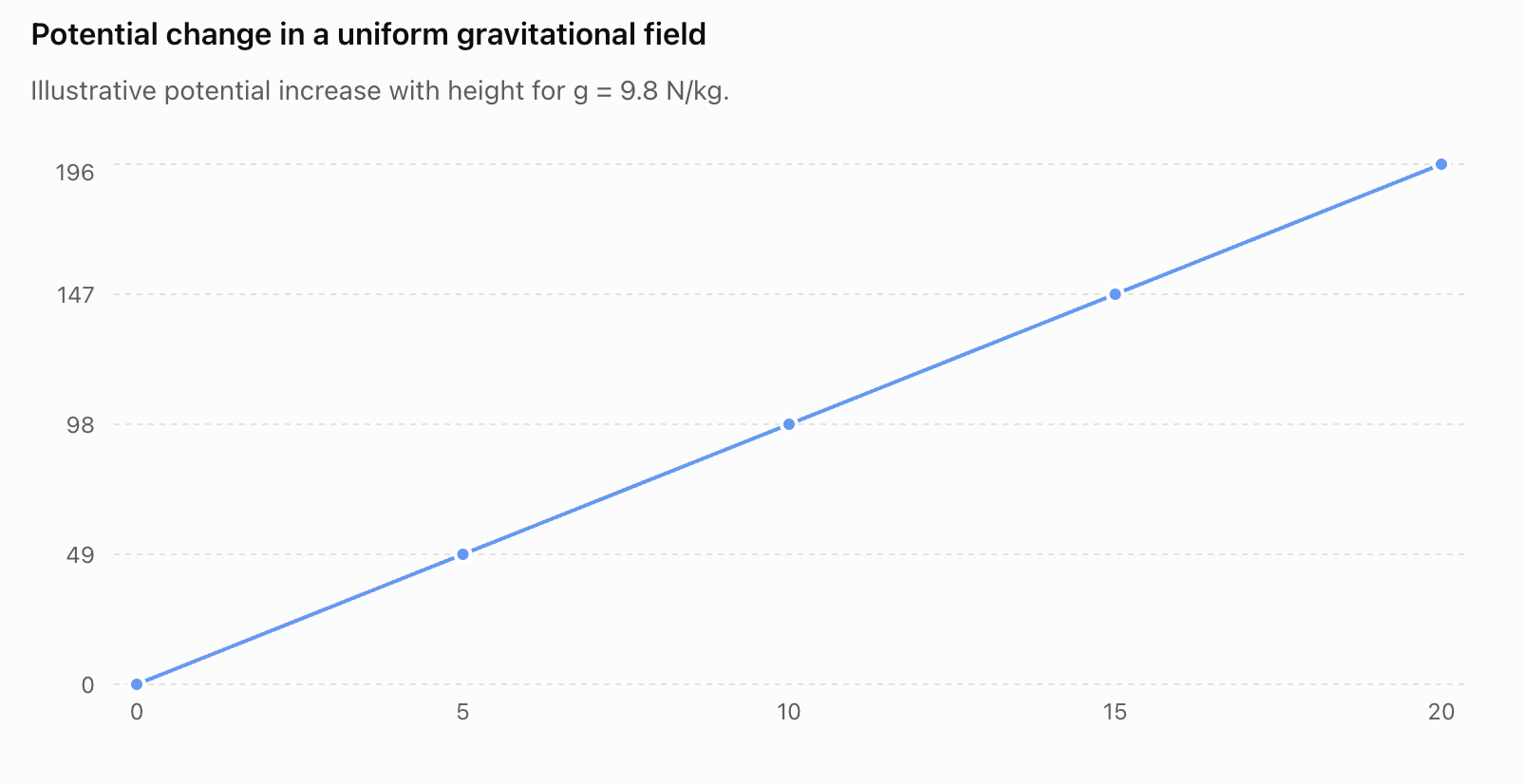
The straight-line graph indicates a constant gravitational field.
Potential Graph in a Radial Field
Around a spherical mass:
V = −GM/r
The V-r graph is curved rather than straight.
Close to the mass:
- the curve is steep
- potential changes rapidly with distance
- field strength is large
Far away:
- the curve becomes flatter
- potential changes slowly
- field strength is small

Reading Field Strength from a Potential Graph
Suppose we have a graph of V against r.
At a particular point:
- Draw a tangent to the curve.
- Determine the tangent's gradient.
- Apply the negative sign to obtain the signed radial field component.
So:
g_r = −gradient of V-r graph
The steeper the graph, the greater the magnitude of g.
Worked Graph Example
Suppose a tangent to a V-r graph passes approximately through:
Point 1:
r = 4.0 × 10⁶ m
V = −7.0 × 10⁷ J/kg
Point 2:
r = 6.0 × 10⁶ m
V = −5.0 × 10⁷ J/kg
Approximate gradient:
ΔV/Δr
= [−5.0 × 10⁷ − (−7.0 × 10⁷)] / [(6.0 × 10⁶) − (4.0 × 10⁶)]
= (2.0 × 10⁷)/(2.0 × 10⁶)
= 10 N/kg
Therefore:
g_r ≈ −10 N/kg
The field strength has magnitude:
10 N/kg
and points inward.
Potential Energy Graphs
For a particular test mass:
Eₚ = mV
Therefore, the Eₚ-r graph has the same general shape as the V-r graph.
However, its vertical scale depends on m.
For a spherical gravitational system:
Eₚ = −GMm/r
The graph:
- is negative
- increases toward zero as r increases
- becomes steep near the source
- becomes flatter far away
Force from an Energy Graph
Just as field strength comes from the gradient of a potential graph:
F = −dEₚ/dr
Therefore:
steep Eₚ-r graph → large force
flat Eₚ-r graph → small force
The sign tells us the direction of the force relative to the chosen coordinate direction.
Comparing V-r and g-r Graphs
For a spherical mass:
V = −GM/r
and:
g = GM/r² for the magnitude.
Their graphs have different shapes.
As r increases:
- V approaches zero from below
- g approaches zero from above
- g decreases more rapidly than |V|
For example:
| Distance | Potential | Field Strength |
|---|---|---|
| r | V | g |
| 2r | V/2 | g/4 |
| 3r | V/3 | g/9 |
| 4r | V/4 | g/16 |
Here V remains negative; writing V/2 means a value half as negative in magnitude.
Example with Numerical Values
Suppose at distance r:
V = −80 MJ/kg
and:
g = 16 N/kg
Then:
At 2r:
V = −40 MJ/kg
g = 4 N/kg
At 4r:
V = −20 MJ/kg
g = 1 N/kg
Potential and field strength both become weaker in magnitude with distance, but at different rates.
Field Strength Is Not the Same as Potential
A point can have:
g = 0
while:
V ≠ 0
For example, at the midpoint between two equal masses:
- gravitational fields point in opposite directions and cancel
- gravitational potentials are both negative and add
Therefore:
g_net = 0
but:
V_total < 0
This distinction is especially important when interpreting graphs of multi-mass systems.
What Does Zero Field Mean on a Potential Graph?
Since:
g = −potential gradient
if:
g = 0
then the potential graph has:
zero gradient
at that point.
This means the graph has a horizontal tangent.
It might be:
- a local maximum
- a local minimum
- another stationary point
The potential itself does not have to equal zero.
Energy Changes in a Varying Field
In a varying gravitational field, g is not constant.
Therefore, the simple near-surface expression:
ΔEₚ = mgΔh
cannot always be used.
Instead, calculate the potential at each position:
V = −GM/r
Then:
ΔEₚ = m(V₂ − V₁)
This automatically accounts for the changing gravitational field.
Worked Example: Moving Through a Varying Field
A 500 kg spacecraft moves from a location where:
V₁ = −6.0 × 10⁷ J/kg
to:
V₂ = −4.0 × 10⁷ J/kg
Potential change:
ΔV = −4.0 × 10⁷ − (−6.0 × 10⁷)
= +2.0 × 10⁷ J/kg
Therefore:
ΔEₚ = mΔV
= 500 × 2.0 × 10⁷
= 1.0 × 10¹⁰ J
The spacecraft's gravitational potential energy increases by:
10 billion joules.
Work Done and Potential Energy
Work done by gravity is related to the change in potential energy:
W_gravity = −ΔEₚ
Therefore:
W_gravity = −mΔV
If an object moves toward a planet:
- V decreases
- Eₚ decreases
- gravity does positive work
If an object moves away:
- V increases
- Eₚ increases
- gravity does negative work
Conservation of Energy
When gravity is the only force transferring energy:
Eₖ + Eₚ = constant
Since:
Eₚ = mV
we can also write:
Eₖ + mV = constant
This allows potential values to be used directly in energy calculations.
Worked Example: Falling Through a Varying Field
A spacecraft begins from rest at:
V₁ = −2.0 × 10⁷ J/kg
It falls to:
V₂ = −5.2 × 10⁷ J/kg
The change in potential is:
ΔV = −5.2 × 10⁷ − (−2.0 × 10⁷)
= −3.2 × 10⁷ J/kg
Potential energy per kilogram decreases by:
3.2 × 10⁷ J/kg
Therefore, kinetic energy per kilogram increases by the same amount:
Eₖ/m = 3.2 × 10⁷ J/kg
Using:
Eₖ/m = 1/2 v²
1/2 v² = 3.2 × 10⁷
v² = 6.4 × 10⁷
v = 8000 m/s
Notice that the spacecraft's mass is not needed.
Why Mass Cancels
Suppose an object falls through a gravitational potential difference ΔV.
Its change in gravitational potential energy is:
ΔEₚ = mΔV
Its kinetic energy is:
Eₖ = 1/2 mv²
When energy conservation is applied, m appears on both sides and cancels.
This is another way to understand why objects in the same gravitational field experience the same gravitational acceleration when other forces are negligible.
Falling Toward a Planet
As an object moves inward:
r decreases
Field strength:
g increases
Potential:
V becomes more negative
Potential energy:
Eₚ becomes more negative
Kinetic energy:
Eₖ increases
Speed:
increases
The object is moving into a stronger gravitational field and toward lower gravitational potential.
Moving Away from a Planet
As an object moves outward:
r increases
Field strength:
g decreases
Potential:
V becomes less negative
Potential energy:
Eₚ increases
If no external energy is supplied:
kinetic energy decreases
and:
speed decreases
Energy Transfer Does Not Require Constant Field Strength
Conservation of energy remains valid even when g changes significantly.
This is one major advantage of using gravitational potential.
Instead of trying to use one value of g across a huge distance, we can calculate the potential difference between the starting and finishing positions.
This is particularly useful for:
- satellites
- spacecraft
- planetary motion
- moons
- escape problems
Satellites and Potential Energy
A satellite orbiting a planet has:
- gravitational potential energy
- kinetic energy
For a circular orbit:
Eₚ = −GMm/r
and:
Eₖ = GMm/(2r)
Therefore:
E_total = −GMm/(2r)
The negative total mechanical energy indicates that the satellite is gravitationally bound.
Higher and Lower Circular Orbits
A satellite in a higher circular orbit has:
- weaker gravitational field strength
- higher gravitational potential
- less negative gravitational potential energy
- lower orbital speed
- lower kinetic energy
- higher total mechanical energy
A satellite in a lower circular orbit has:
- stronger field strength
- lower gravitational potential
- more negative potential energy
- higher orbital speed
- higher kinetic energy
- lower total mechanical energy
This combination is important in orbital mechanics.
Why a Higher Orbit Requires Energy
It may seem strange that a satellite moved to a higher circular orbit ends with a lower orbital speed.
However, its gravitational potential energy increases by more than its kinetic energy decreases.
Therefore:
total mechanical energy increases.
Energy must be supplied to move the satellite into the higher orbit.
Escape and Potential Energy
For an object to escape an isolated planet with zero speed remaining at infinity:
At infinity:
V = 0
and:
Eₖ = 0
Therefore, the minimum total mechanical energy required is:
E_total = 0
At the starting point:
1/2 mv² + mV = 0
Divide by m:
1/2 v² + V = 0
Therefore:
v_escape = √(−2V)
Gravitational potential directly tells us how much energy per kilogram is needed to escape.
Worked Escape Example
Suppose the gravitational potential at a planet's surface is:
V = −3.2 × 10⁷ J/kg
Then:
v_escape = √(−2V)
= √(6.4 × 10⁷)
= 8000 m/s
or:
8.0 km/s
The potential tells us immediately how deeply the object lies within the planet's gravitational potential well.
Comparing Two Planets
Suppose Planet A and Planet B have the same surface gravitational field strength.
This does not necessarily mean they have the same gravitational potential.
Field strength:
g = GM/R²
Potential:
V = −GM/R
The extra factor of R means that two planets can have identical surface g but very different gravitational potentials.
Worked Planet Comparison
Planet B has:
4 times the mass of Planet A
and:
2 times the radius.
Compare field strength:
gB/gA = 4/2²
= 1
So:
gB = gA
Now compare potential magnitude:
|VB|/|VA| = 4/2
= 2
Therefore:
VB is twice as negative as VA.
An object would experience the same surface gravitational field strength on both planets but would require more energy per kilogram to escape from Planet B.
Analyzing Potential Graphs
When given a graph of gravitational potential against position, ask:
Is V increasing or decreasing?
This helps determine field direction.
How steep is the graph?
Steeper means stronger field.
Where is the graph horizontal?
The net field is zero there.
Where does V approach zero?
For an isolated gravitational system, this usually corresponds to very large distance.
Is V negative?
For attractive gravity with zero at infinity, it normally is.
Analyzing Field Strength Graphs
When examining g against r for a spherical mass:
- g is greatest close to the mass
- g decreases rapidly with distance
- g approaches zero at large r
- magnitude follows 1/r²
If direction is included and outward is defined as positive, the radial field is:
g_r = −GM/r²
so the graph lies below the horizontal axis.
Always check whether the graph represents field magnitude or a signed field component.
Potential Graph Versus Field Graph
A useful comparison is:
V-r graph
- tells us energy per kilogram
- gradient gives field
- approaches zero as 1/r
- normally negative
g-r graph
- tells us force per kilogram
- decreases as 1/r² in magnitude
- provides local gravitational acceleration
- may be shown as positive magnitude or negative radial component
The two graphs contain related but different information.
Graph of Potential Energy
If a graph shows:
Eₚ against r
rather than V against r, then:
gradient = −F_r
rather than field strength directly.
Remember:
F_r = −dEₚ/dr
while:
g_r = −dV/dr
This distinction depends on whether the graph shows energy or energy per unit mass.
Example: Reading an Energy Graph
Suppose the gradient of an Eₚ-r graph at a point is:
+120 J/m
Since:
1 J/m = 1 N
the gravitational force is:
F_r = −120 N
The negative sign indicates that the force acts opposite to increasing r.
If the object has mass:
20 kg
then the field component is:
g_r = F_r/m
= −120/20
= −6 N/kg
The field magnitude is:
6 N/kg
From Field Strength to Potential Difference
The relationship can also be used in reverse.
If a uniform gravitational field has magnitude:
g = 8 N/kg
and an object moves:
5 m
directly opposite the field direction, then potential increases by:
ΔV = gΔh
= 8 × 5
= 40 J/kg
For a 3 kg object:
ΔEₚ = mΔV
= 3 × 40
= 120 J
A Complete Problem-Solving Strategy
For gravitational energy and field problems:
Identify what quantity is given.
Is it:
- g?
- V?
- Eₚ?
- mass?
- distance?
- a graph?
Identify whether the field is approximately uniform or varying.
Near a planetary surface:
ΔEₚ ≈ mgΔh
For large radial distances:
V = −GM/r
and:
Eₚ = mV
For graphs, examine the gradient.
Potential graph:
g = −potential gradient
Potential-energy graph:
F = −potential-energy gradient
For motion, consider energy conservation.
If gravity is the only relevant interaction:
Eₖ + Eₚ = constant
Finally, check signs, units, and physical meaning.
Common Mistakes
Confusing potential with potential energy
Potential is measured in J/kg.
Potential energy is measured in J.
Thinking field strength equals potential
Field strength depends on the gradient of potential, not simply its value.
Forgetting the negative sign in the gradient relationship
The gravitational field points toward decreasing potential.
Using the gradient of an Eₚ graph as g
The gradient of Eₚ gives force, not field strength.
Assuming a steep graph means high potential
Steepness indicates a strong field. The actual potential value may still be high or low.
Thinking g = 0 means V = 0
Zero field means zero potential gradient, not necessarily zero potential.
Using mgΔh across enormous distances
This assumes approximately constant g.
Thinking potential energy must increase when speed increases
For an object falling under gravity, kinetic energy usually increases while gravitational potential energy decreases.
Forgetting that negative values have an order
−10 MJ/kg is a higher potential than −50 MJ/kg.
Confusing field magnitude with a signed field component
The magnitude g is non-negative. A radial component may be negative because it points inward.
Key Terms
Gravitational field strength (g) — gravitational force per unit mass at a point.
Gravitational potential (V) — gravitational potential energy per unit mass.
Gravitational potential energy (Eₚ) — energy associated with the relative positions of masses in a gravitational field.
Potential gradient — rate of change of gravitational potential with position.
Energy gradient — rate of change of potential energy with position.
Equipotential surface — surface on which gravitational potential is constant.
Radial field — field directed toward a central mass and varying with distance.
Uniform field — field with constant magnitude and direction.
Conservative force — force for which work between two points depends only on the initial and final positions.
Mechanical energy — total kinetic and potential energy of a mechanical system.
Bound system — system with insufficient total mechanical energy to separate indefinitely.
Potential well — representation of a region of negative gravitational potential surrounding an attractive mass.
Gradient — change in one quantity divided by change in another; on a graph, its slope.
Escape speed — minimum idealized initial speed required to reach infinite distance with zero remaining speed.
Key Takeaways
- Gravitational potential energy, potential, and field strength describe different but closely related aspects of gravity.
- Eₚ = mV connects gravitational potential energy and gravitational potential.
- Gravitational field strength is related to the gradient of gravitational potential.
- In a radial coordinate, g_r = −dV/dr.
- Gravitational force is related to the gradient of potential energy: F_r = −dEₚ/dr.
- The negative sign means gravity acts toward decreasing gravitational potential.
- A steep potential gradient corresponds to a strong gravitational field.
- A shallow potential gradient corresponds to a weak field.
- Closely spaced equipotentials indicate a stronger field when the potential intervals are equal.
- In a uniform field, potential changes linearly with distance along the field direction.
- In a radial field, potential varies as −1/r while field magnitude varies as 1/r².
- A horizontal tangent on a potential-position graph corresponds to zero net gravitational field at that point.
- Zero gravitational field does not necessarily mean zero gravitational potential.
- In varying fields, potential differences provide a convenient way to calculate energy changes.
- ΔEₚ = mΔV applies even when g changes significantly between the two positions.
- As an object falls toward a planet, potential energy decreases and kinetic energy increases.
- As an object moves away without propulsion, potential energy increases and kinetic energy decreases.
- Potential graphs can be used to determine field strength, field direction, energy changes, and motion.
- Energy methods are especially useful for analyzing spacecraft, satellites, planetary motion, and escape from gravitational fields.
Check Your Understanding
- Explain the difference between gravitational field strength, gravitational potential, and gravitational potential energy.
- State the relationship between gravitational potential energy and gravitational potential.
- Explain what is meant by the gradient of gravitational potential.
- Why does the gravitational field point toward decreasing gravitational potential?
- Potential changes by 60 J/kg over a distance of 5.0 m. Estimate the magnitude of the gravitational field strength.
- Two regions have equal potential differences between neighbouring equipotentials. In Region A the equipotentials are much closer together than in Region B. Which region has the stronger gravitational field? Explain.
- Explain why a straight-line V-position graph represents a uniform gravitational field.
- A tangent to a V-r graph has a gradient of +7.5 N/kg. If outward is positive, determine the radial gravitational field component and state its direction.
- Explain why the V-r graph around a spherical planet becomes flatter as distance increases.
- At distance r from a planet, V = −60 MJ/kg and g = 12 N/kg. Determine V and g at 2r.
- A 400 kg spacecraft moves from V = −7.0 × 10⁷ J/kg to V = −4.0 × 10⁷ J/kg. Calculate its change in gravitational potential energy.
- A spacecraft begins from rest and falls through a gravitational potential difference of −2.0 × 10⁷ J/kg. Ignoring other forces, calculate its final speed.
- A potential-position graph has a horizontal tangent at a particular point. What does this tell you about the gravitational field there? Does it necessarily mean V = 0? Explain.
- Explain why the gradient of an Eₚ-r graph gives gravitational force while the gradient of a V-r graph gives gravitational field strength.
- Planet B has four times the mass and twice the radius of Planet A. Compare their surface gravitational field strengths and gravitational potentials, and explain why the results are different.
5. Energy in Gravitational Systems
Learning Outcomes
- I can describe kinetic and potential energy in gravitational systems.
- I can explain energy transformations in orbital motion.
- I can apply conservation of mechanical energy.
- I can calculate total energy in simple gravitational systems.
- I can interpret energy diagrams for gravitational interactions.
- Energy in orbits
- Escape energy
Energy in Gravitational Systems
Gravitational systems involve a continuous relationship between kinetic energy, gravitational potential energy, and total mechanical energy.
When gravity causes an object to move, energy can transfer between kinetic and gravitational potential energy. If no energy is transferred out of the mechanical system by friction, air resistance, engines, or other interactions, the total mechanical energy remains constant:
E_total = Eₖ + Eₚ
This principle can be used to analyze falling objects, projectiles, planets, moons, satellites, and spacecraft.
Kinetic Energy
Kinetic energy is the energy associated with motion.
It is calculated using:
Eₖ = 1/2 mv²
where:
- Eₖ = kinetic energy in J
- m = mass in kg
- v = speed in m/s
Kinetic energy depends strongly on speed because speed is squared.
If speed doubles:
Eₖ becomes four times as large.
Gravitational Potential Energy
Gravitational potential energy is associated with the positions of masses in a gravitational field.
Near Earth's surface:
ΔEₚ = mgΔh
For large distances in a radial gravitational field:
Eₚ = −GMm/r
where:
- G = gravitational constant
- M = source mass
- m = object in the field
- r = distance between the centres of the masses
For isolated gravitational systems, the conventional zero is:
Eₚ = 0 at infinity
Therefore, gravitational potential energy is negative at finite distances.
Mechanical Energy
The total mechanical energy of a simple gravitational system is:
E_total = Eₖ + Eₚ
If gravity is the only force doing work:
E_total remains constant.
Kinetic and potential energy may change dramatically, but one increases as the other decreases.
This is the conservation of mechanical energy.
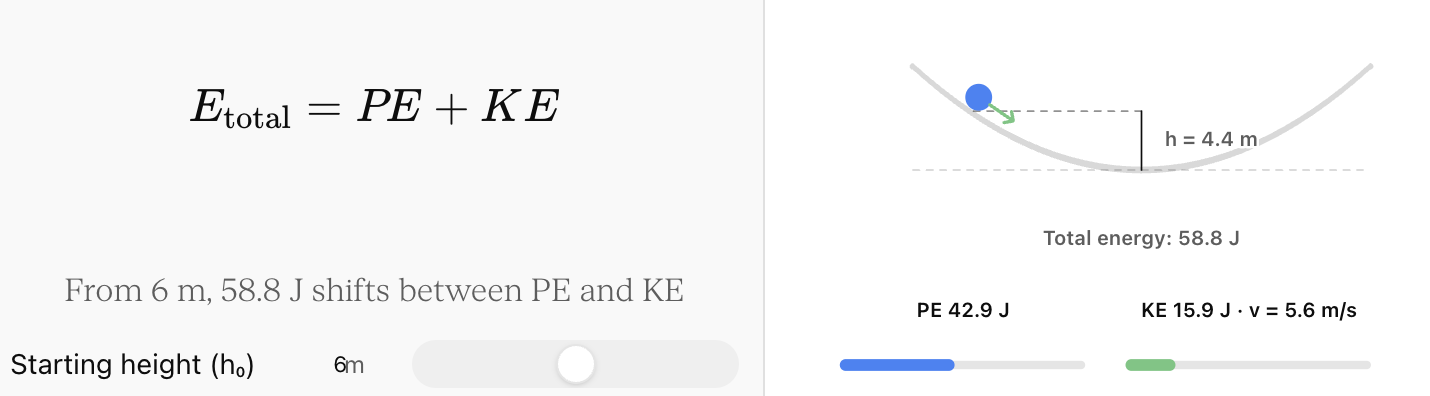
Energy Transformations During Falling
Consider an object falling toward Earth.
As it falls:
- height decreases
- gravitational potential energy decreases
- speed increases
- kinetic energy increases
Ignoring air resistance:
decrease in Eₚ = increase in Eₖ
The energy is not created as the object speeds up. It is transferred from gravitational potential energy into kinetic energy.
Worked Example: Falling Ball
A 3.0 kg ball is dropped from a height of 10 m.
Use:
g = 9.8 N/kg
Initial GPE relative to the ground:
Eₚ = mgh
= 3.0 × 9.8 × 10
= 294 J
Initially:
Eₖ = 0
So:
E_total = 294 J
Immediately before reaching the ground, ignoring air resistance:
Eₚ ≈ 0
Therefore:
Eₖ ≈ 294 J
The total mechanical energy has remained constant.
Finding Speed from Energy
For the falling ball:
mgh = 1/2 mv²
Mass cancels:
gh = 1/2 v²
Therefore:
v = √(2gh)
For h = 10 m:
v = √(2 × 9.8 × 10)
≈ 14.0 m/s
Energy conservation allows us to determine the final speed without directly calculating acceleration and time.
Energy During Upward Motion
If an object is thrown upward:
- kinetic energy decreases
- gravitational potential energy increases
- speed decreases
At the maximum height:
- vertical velocity is momentarily zero
- vertical kinetic energy is zero
- gravitational potential energy has increased
During the downward journey, the transformation reverses.


Worked Example: Maximum Height
A ball is launched vertically upward at:
20 m/s
Ignore air resistance.
Initial kinetic energy per kilogram:
Eₖ/m = 1/2 v²
= 1/2 × 20²
= 200 J/kg
At maximum height, this has become additional gravitational potential energy per kilogram:
gΔh = 200
9.8Δh = 200
Δh ≈ 20.4 m
The ball rises approximately 20.4 m above its launch position.
Energy Conservation Does Not Mean Each Energy Is Constant
A common misunderstanding is that conservation of energy means kinetic and potential energy remain unchanged.
They do not.
Instead:
their total remains constant when no energy leaves or enters the mechanical system.
For example:
| Position | GPE | KE | Total |
|---|---|---|---|
| Top | 100 J | 0 J | 100 J |
| Partway down | 70 J | 30 J | 100 J |
| Lower | 30 J | 70 J | 100 J |
| Bottom | 0 J | 100 J | 100 J |
Energy changes form while the total remains constant.
Real Systems
In real situations, some mechanical energy may be transferred to other energy stores.
For example, air resistance can transfer mechanical energy into:
- thermal energy of the air
- thermal energy of the moving object
- sound
Then:
Eₖ + Eₚ
may decrease.
However, the total energy of the complete system remains conserved.
Energy in Radial Gravitational Fields
For satellites and spacecraft, gravitational field strength changes significantly with distance.
We therefore use:
Eₚ = −GMm/r
rather than the near-surface approximation mgh.
Total mechanical energy becomes:
E_total = 1/2 mv² − GMm/r
This equation can describe many gravitational motions.
Worked Example: Total Mechanical Energy
A spacecraft has:
m = 1000 kg
v = 5000 m/s
At its position:
Eₚ = −2.0 × 10¹⁰ J
Calculate its kinetic energy:
Eₖ = 1/2 mv²
= 1/2 × 1000 × 5000²
= 1.25 × 10¹⁰ J
Therefore:
E_total = Eₖ + Eₚ
= 1.25 × 10¹⁰ − 2.0 × 10¹⁰
= −7.5 × 10⁹ J
The negative total energy indicates that the spacecraft is gravitationally bound in this simplified system.
What Total Energy Tells Us
When the zero of gravitational potential energy is chosen at infinity, total mechanical energy provides useful information about gravitational motion.
E_total < 0
The object is gravitationally bound.
It does not have enough mechanical energy to escape to infinity.
E_total = 0
The object is at the minimum-energy escape condition.
It could theoretically reach infinity with its speed approaching zero.
E_total > 0
The object has enough mechanical energy to escape with kinetic energy remaining at very large distance.
This is a powerful way to classify gravitational trajectories.
Circular Orbits
A satellite in a circular orbit moves at constant speed while gravity continually changes the direction of its velocity.
Gravity provides the centripetal acceleration.
For a circular orbit:
GMm/r² = mv²/r
Cancel m:
GM/r² = v²/r
Therefore:
v² = GM/r
and:
v = √(GM/r)
Kinetic Energy in a Circular Orbit
Since:
Eₖ = 1/2 mv²
and:
v² = GM/r
then:
Eₖ = 1/2 m(GM/r)
Therefore:
Eₖ = GMm/(2r)
The kinetic energy of a satellite in a circular orbit is positive.
Potential Energy in a Circular Orbit
The gravitational potential energy is:
Eₚ = −GMm/r
Compare this with kinetic energy:
Eₖ = GMm/(2r)
Therefore:
Eₚ = −2Eₖ
or:
Eₖ = −Eₚ/2
This is an important relationship for circular gravitational orbits.

Total Energy of a Circular Orbit
Total mechanical energy is:
E_total = Eₖ + Eₚ
Substitute:
E_total = GMm/(2r) − GMm/r
Therefore:
E_total = −GMm/(2r)
This means:
E_total = Eₚ/2
and:
E_total = −Eₖ
So for a circular orbit:
Eₚ = −2Eₖ
E_total = −Eₖ
E_total = Eₚ/2
These relationships are useful shortcuts.
Example of Orbital Energies
Suppose a satellite in a circular orbit has:
Eₖ = 4.0 × 10⁹ J
Then:
Eₚ = −2Eₖ
= −8.0 × 10⁹ J
Total energy:
E_total = Eₖ + Eₚ
= 4.0 × 10⁹ − 8.0 × 10⁹
= −4.0 × 10⁹ J
The satellite is gravitationally bound.
Why Circular-Orbit Energy Is Negative
A satellite has positive kinetic energy but larger-magnitude negative potential energy.
For example:
Eₖ = +5 units
Eₚ = −10 units
Therefore:
E_total = −5 units
Energy must be supplied to increase the total energy to zero before the satellite can completely escape the planet's gravitational influence.
Higher Circular Orbits
Consider moving a satellite from a lower circular orbit to a higher circular orbit.
At larger r:
Eₚ = −GMm/r
becomes less negative.
So:
potential energy increases.
But:
Eₖ = GMm/(2r)
decreases.
Therefore, a satellite in a higher circular orbit moves more slowly.
The Surprising Result
Moving a satellite into a higher circular orbit requires energy even though the satellite ends up moving more slowly.
Why?
Because the increase in gravitational potential energy is larger than the decrease in kinetic energy.
Therefore:
total mechanical energy increases.
The final total energy is less negative.
Comparing Two Circular Orbits
Suppose Satellite A orbits at radius r.
Satellite B orbits at radius 2r.
For Satellite A:
Eₖ,A = GMm/(2r)
Eₚ,A = −GMm/r
E_total,A = −GMm/(2r)
At 2r:
Eₖ,B = GMm/(4r)
Eₚ,B = −GMm/(2r)
E_total,B = −GMm/(4r)
Therefore, compared with the lower orbit:
- KE is halved
- magnitude of GPE is halved
- magnitude of total energy is halved
- total energy has increased because it is less negative
Energy Changes During Orbital Transfers
A spacecraft cannot normally move from one circular orbit to another simply by "lifting" vertically.
Engines are used to change its velocity and therefore its orbital energy.
During an orbital transfer:
- engines can add kinetic energy
- the spacecraft moves into a different orbit
- gravitational potential energy changes
- kinetic energy may change as the spacecraft moves
- another engine burn may be needed to establish the final orbit


The detailed trajectory can be complex, but conservation of energy remains central to understanding the motion between engine burns.
Elliptical Orbits
Not all orbits are circular.
In an elliptical orbit, the distance from the central mass changes continuously.
Therefore:
- gravitational potential energy changes
- kinetic energy changes
- speed changes
- total mechanical energy remains constant if no external work is done
Periapsis and Apoapsis
The point closest to the central body is called periapsis.
The farthest point is called apoapsis.
At periapsis:
- r is smallest
- GPE is most negative
- speed is greatest
- KE is greatest
At apoapsis:
- r is largest
- GPE is less negative
- speed is smallest
- KE is smallest

Throughout the ideal orbit:
E_total remains constant.
Energy Transformations in an Elliptical Orbit
As a satellite falls from apoapsis toward periapsis:
Eₚ decreases → Eₖ increases
The satellite speeds up.
As it moves from periapsis toward apoapsis:
Eₖ decreases → Eₚ increases
The satellite slows down.
This is an orbital version of the same energy transformation seen when an object falls near Earth's surface.
Worked Example: Energy Change in an Elliptical Orbit
Suppose a spacecraft's GPE changes from:
−4.0 × 10¹⁰ J
at apoapsis to:
−7.0 × 10¹⁰ J
at periapsis.
Change in GPE:
ΔEₚ = −7.0 × 10¹⁰ − (−4.0 × 10¹⁰)
= −3.0 × 10¹⁰ J
If mechanical energy is conserved:
ΔEₖ = +3.0 × 10¹⁰ J
The spacecraft gains 3.0 × 10¹⁰ J of kinetic energy as it approaches periapsis.
Energy Diagrams
Energy diagrams provide a visual way to represent gravitational interactions.
A simple diagram may show:
- kinetic energy
- gravitational potential energy
- total mechanical energy
For an ideal system:
E_total remains constant
while Eₖ and Eₚ change.
Interpreting Negative Potential Energy
Because:
Eₚ = 0 at infinity
gravitational potential energy is negative at finite distances.
Suppose:
Eₚ = −100 J
and later:
Eₚ = −40 J
The potential energy has increased by 60 J.
Although both values are negative:
−40 J > −100 J
Moving upward on an energy diagram corresponds to increasing energy.
Potential Energy Curve
For two gravitationally interacting masses:
Eₚ = −GMm/r
The Eₚ-r graph:
- is strongly negative at small r
- rises as r increases
- approaches zero at infinity
- never reaches positive values in the simple Newtonian model with zero at infinity
The curve becomes flatter as r increases because the gravitational force becomes weaker.
Force and the Energy Curve
The gravitational force is related to the gradient of the potential-energy graph:
F_r = −dEₚ/dr
Therefore:
- steep Eₚ curve → strong force
- shallow Eₚ curve → weak force
The negative sign indicates that gravity acts toward decreasing potential energy.
Total Energy on an Energy Diagram
Suppose a horizontal line represents:
E_total = −20 J
At a particular position:
Eₚ = −50 J
Then:
Eₖ = E_total − Eₚ
= −20 − (−50)
= 30 J
Since kinetic energy must satisfy:
Eₖ ≥ 0
an object can only occupy positions where:
E_total ≥ Eₚ
This makes energy diagrams useful for identifying allowed and forbidden regions of motion.
Turning Points
At a turning point:
v = 0
Therefore:
Eₖ = 0
So:
E_total = Eₚ
On an energy diagram, turning points occur where the total-energy line intersects the potential-energy curve.
At that position, the object momentarily stops moving radially before reversing direction.
Bound Motion on an Energy Diagram
If:
E_total < 0
the object is generally gravitationally bound in a simple isolated two-body system.
It cannot reach infinity because at infinity:
Eₚ → 0
But if total energy is negative, reaching infinity would require negative kinetic energy:
Eₖ = E_total − 0
which is impossible.
Therefore, the object must remain bound.
Escape on an Energy Diagram
If:
E_total = 0
the object has exactly enough energy to escape and reach infinity with:
v → 0
If:
E_total > 0
the object can reach infinity with kinetic energy remaining.
This provides an energy-based explanation of escape velocity.
Escape Velocity
At the minimum escape condition:
E_total = 0
At the surface of a planet:
1/2 mv² − GMm/R = 0
Therefore:
v_escape = √(2GM/R)
The mass of the escaping object cancels.
Escape speed therefore depends on:
- mass of the planet
- radius of the planet
but not on the mass of the escaping object.
Worked Escape Example
Suppose a planet has:
M = 6.0 × 10²⁴ kg
R = 6.4 × 10⁶ m
Using:
G = 6.67 × 10⁻¹¹ N·m²/kg²
v_escape = √(2GM/R)
≈ √[2(6.67 × 10⁻¹¹)(6.0 × 10²⁴)/(6.4 × 10⁶)]
≈ 1.12 × 10⁴ m/s
or approximately:
11.2 km/s
This is close to Earth's escape speed.
Energy Per Unit Mass
For spacecraft and astronomical systems, it is often useful to divide all energies by the object's mass.
Specific kinetic energy:
Eₖ/m = 1/2 v²
Gravitational potential:
Eₚ/m = V = −GM/r
Specific total mechanical energy:
E_total/m = 1/2 v² − GM/r
The unit is:
J/kg
Using energy per kilogram often simplifies gravitational calculations because the spacecraft's mass cancels.
Worked Example Using Energy per Kilogram
At one location, a spacecraft has:
V = −5.0 × 10⁷ J/kg
and:
v = 6000 m/s
Kinetic energy per kilogram:
Eₖ/m = 1/2 × 6000²
= 1.8 × 10⁷ J/kg
Total energy per kilogram:
E_total/m = 1.8 × 10⁷ − 5.0 × 10⁷
= −3.2 × 10⁷ J/kg
Because the result is negative, the spacecraft is gravitationally bound in this simplified system.
Energy and Planetary Orbits
The same principles apply to planets orbiting stars.
As a planet moves through an elliptical orbit:
- GPE decreases as it approaches the star
- KE increases
- speed increases
As it moves away:
- GPE increases
- KE decreases
- speed decreases
This explains why planets move faster when closer to the Sun and slower when farther away.
Energy in Binary Systems
Two stars orbiting one another also exchange kinetic and gravitational potential energy as their separation changes.
The gravitational potential energy of the pair can be described approximately by:
Eₚ = −GM₁M₂/r
where r is the separation between their centres.
The energy belongs to the gravitational system, not exclusively to either star.
Gravitational Collapse
Energy transformations in gravitational systems are also important during star formation.
A large cloud of gas can contract under gravity.
As the cloud collapses:
- gravitational potential energy decreases
- particles accelerate
- kinetic energy increases
- collisions convert some kinetic energy into thermal energy
- the gas becomes hotter


Gravitational potential energy is therefore an important source of heating during the early stages of star formation.
Accretion and Gravitational Energy
Matter falling toward:
- stars
- neutron stars
- black holes
can lose enormous amounts of gravitational potential energy.
Some of this energy becomes kinetic energy and thermal energy.
Hot accreting matter can then emit large amounts of electromagnetic radiation.
Gravity is not creating energy; the radiation ultimately comes from changes in the energy of the gravitational system.
Conservation of Energy with Engines
If a spacecraft fires its engines, mechanical energy is not necessarily constant.
Chemical, nuclear, or electrical energy may be transferred into the spacecraft's mechanical energy.
For example, an engine burn may increase:
Eₖ
which can then allow the spacecraft to reach a region with greater:
Eₚ
Therefore, when engines operate:
Eₖ + Eₚ
for the spacecraft-planet mechanical system does not necessarily remain constant.
Energy conservation still holds when all relevant energy stores are included.
Conservation of Energy with Atmospheric Drag
Suppose a spacecraft enters an atmosphere.
Drag transfers mechanical energy into:
- thermal energy of the atmosphere
- thermal energy of the spacecraft
- sound
- deformation or other processes
Therefore:
Eₖ + Eₚ decreases
even though total energy is still conserved.
This is why spacecraft require heat shields during atmospheric entry.
Worked Example with Energy Loss
A falling object loses:
5000 J
of gravitational potential energy.
Its kinetic energy increases by:
4200 J
The difference is:
5000 − 4200
= 800 J
Approximately 800 J has been transferred into other forms such as thermal energy and sound.
Total energy remains conserved.
Choosing the Correct Energy Model
For motion close to Earth's surface:
ΔEₚ = mgΔh
is usually sufficient.
For large changes in distance:
Eₚ = −GMm/r
should be used.
For speed:
Eₖ = 1/2 mv²
For an isolated mechanical system:
E_total = Eₖ + Eₚ
For circular orbits:
Eₖ = GMm/(2r)
Eₚ = −GMm/r
E_total = −GMm/(2r)
Choosing the appropriate model is an important part of solving gravitational problems.
A General Problem-Solving Strategy
When solving an energy problem, first identify the initial state and final state.
Write the relevant energies at each position:
Initial:
Eₖ₁ + Eₚ₁
Final:
Eₖ₂ + Eₚ₂
If mechanical energy is conserved:
Eₖ₁ + Eₚ₁ = Eₖ₂ + Eₚ₂
Then substitute the appropriate expressions.
For near-surface problems, use height differences.
For large-scale gravitational problems, use distance from the centre of the source mass.
Finally, check whether the signs and physical interpretation make sense.
Common Mistakes
Thinking negative potential energy means negative total energy in every situation
A system can have negative Eₚ but enough positive kinetic energy to make E_total positive.
Thinking conservation means KE and GPE stay constant
They can change while their total remains constant.
Using mgh for satellite-scale distances
The field varies significantly, so use Eₚ = −GMm/r.
Forgetting that gravitational potential energy is negative in the radial-field convention
Zero is chosen at infinity.
Thinking −20 J is less energy than −100 J by magnitude alone
Numerically:
−20 J > −100 J
so −20 J represents greater energy.
Thinking a higher circular orbit has greater orbital speed
Higher circular orbits have lower orbital speeds.
Thinking a higher orbit requires no energy because the final speed is lower
The increase in GPE is larger than the decrease in KE, so total energy increases.
Assuming astronauts in orbit have no gravitational potential energy
Orbiting objects possess both GPE and KE.
Forgetting the factor of 1/2 in circular-orbit kinetic energy
For a circular orbit:
Eₖ = GMm/(2r)
not GMm/r.
Confusing total orbital energy with potential energy
For a circular orbit:
E_total = −GMm/(2r)
while:
Eₚ = −GMm/r
Key Terms
Kinetic energy (Eₖ) — energy associated with motion.
Gravitational potential energy (Eₚ) — energy associated with the configuration of masses in a gravitational field.
Mechanical energy — the sum of kinetic and gravitational potential energy.
Conservation of mechanical energy — constancy of Eₖ + Eₚ when no non-conservative interaction transfers energy into or out of the mechanical system.
Circular orbit — orbit in which an object remains at constant distance from the central mass.
Elliptical orbit — orbit in which distance from the central mass varies.
Periapsis — closest point in an orbit to the central body.
Apoapsis — farthest point in an orbit from the central body.
Bound system — gravitational system with negative total mechanical energy under the usual zero-at-infinity convention.
Escape velocity — minimum idealized initial speed needed to escape to infinity with no remaining speed.
Potential-energy curve — graph showing how potential energy varies with position.
Turning point — position where kinetic energy becomes zero and motion reverses in the relevant direction.
Specific energy — energy per unit mass, usually measured in J/kg.
Orbital energy — mechanical energy associated with an orbiting object's motion and gravitational interaction.
Gravitational collapse — contraction of matter under gravitational attraction, often accompanied by conversion of GPE into kinetic and thermal energy.
Key Takeaways
- Gravitational systems involve both kinetic energy and gravitational potential energy.
- Kinetic energy is calculated using Eₖ = 1/2 mv².
- Near Earth's surface, GPE changes can be approximated using ΔEₚ = mgΔh.
- In radial gravitational fields, Eₚ = −GMm/r.
- Total mechanical energy is E_total = Eₖ + Eₚ.
- When gravity is the only force doing work, total mechanical energy remains constant.
- Falling objects lose GPE and gain KE.
- Objects moving away from a gravitational source generally gain GPE and lose KE if no external energy is supplied.
- In circular orbit, Eₚ = −2Eₖ.
- The total energy of a circular orbit is E_total = −GMm/(2r).
- A higher circular orbit has greater GPE but lower KE.
- Moving a satellite to a higher circular orbit requires an increase in total mechanical energy.
- In elliptical orbits, KE and GPE continually transform into one another while total mechanical energy remains constant.
- Objects move fastest near periapsis and slowest near apoapsis.
- Negative total energy represents a gravitationally bound system under the usual convention.
- Zero total energy corresponds to the minimum idealized escape condition.
- Positive total energy allows an object to escape with kinetic energy remaining.
- Energy diagrams can identify kinetic energy, turning points, bound motion, and escape conditions.
- Energy methods provide a powerful way to analyze satellites, spacecraft, planets, stars, and other gravitational systems.
Check Your Understanding
- Define kinetic energy, gravitational potential energy, and total mechanical energy.
- A 4 kg object is dropped from a height of 15 m. Calculate its initial GPE using g = 9.8 N/kg.
- Ignoring air resistance, calculate the kinetic energy of the object in Question 2 immediately before it reaches the ground.
- Use conservation of energy to calculate its speed immediately before reaching the ground.
- Explain how kinetic and gravitational potential energy change as an object is thrown vertically upward.
- A spacecraft has Eₖ = 3.0 × 10⁹ J and Eₚ = −8.0 × 10⁹ J. Calculate its total mechanical energy and state whether it is gravitationally bound in the simple isolated model.
- A satellite in a circular orbit has kinetic energy 5.0 × 10⁸ J. Determine its gravitational potential energy and total mechanical energy.
- Explain why a satellite in a higher circular orbit moves more slowly but has greater total mechanical energy.
- A spacecraft's GPE changes from −3.0 × 10¹⁰ J to −7.0 × 10¹⁰ J as it moves through an elliptical orbit. If total mechanical energy is conserved, calculate the change in kinetic energy.
- Describe the changes in KE, GPE, and speed as a satellite moves from apoapsis toward periapsis.
- Explain why negative total mechanical energy indicates a bound gravitational system.
- An energy diagram shows E_total = −30 J and Eₚ = −70 J at a particular position. Calculate the object's kinetic energy.
- Explain how a turning point can be identified on a potential-energy diagram.
- Describe what happens to mechanical energy when a spacecraft experiences significant atmospheric drag. Explain why this does not violate conservation of energy.
- Explain how the conversion of gravitational potential energy can contribute to the heating of a collapsing gas cloud during star formation.