4. Potential Energy and Field Strength

Learning Outcomes
  • I can explain the relationship between potential energy and field strength.
  • I can relate field strength to the gradient of gravitational potential.
  • I can describe how energy changes in varying fields.
  • I can analyze graphs of potential and field strength.
  • I can apply energy concepts to gravitational problems.

Key Topics:
  • \( g = - \frac{dV}{dr} \)
  • Potential gradients

Potential Energy and Field Strength

Gravitational potential energy, gravitational potential, and gravitational field strength are three closely related ways of describing gravity.

They answer different questions:

  • Gravitational field strength, g: How strongly would gravity accelerate or pull on each kilogram at this position?
  • Gravitational potential, V: How much gravitational potential energy would each kilogram have at this position?
  • Gravitational potential energy, Eₚ: How much energy is associated with a particular mass at this position?

The basic relationships are:

Eₚ = mV

g = gravitational force per unit mass

and the gravitational field is related to how rapidly gravitational potential changes with position.

This relationship allows us to move between force-based and energy-based descriptions of gravitational fields.

https://images.openai.com/static-rsc-4/RnPfU8e90Dhf-Q00iG7t7caLrNzDD12cjrQfn-YWpINXxQXKCx74hp3UxPylkA55t-UnS_KUXuoJZXjzcUEg56VEoGEMdl2rAyythO9nchisc9M-rUZrZhX_1nxirQMWCpVrDVBBN5RQ_Kg1C8dFJt0iHQ51HquoNY3PvC9Qzra1chEdGfGR15onhLNgNhrL?purpose=fullsize
 
https://images.openai.com/static-rsc-4/NBqOd93EGESnT2hk9yEcfw17XF-NagVJFT3MOvYH6DVNmLyyA_HRlPeEGo7d3bDrm52fd9MFXh97mlYl40gJzkAimQHH4pwlxA-B5Cp6l83WC_r-jcRlqr9iZL3gFqcSrD1YlUZwTtyKeR-tdBBbzPRFs5gx35M1GwvvqAkPIOBRqGCym-AkHl84mg-snaso?purpose=fullsize
 
https://images.openai.com/static-rsc-4/CgluEuyn0KdmX-qjR3KRCUVciqJ-NPb_fwgeE4qifkiNH1gCQnzr1w4jelwxmNEXkz6WsVBwmc9PTfGvcSuUOCHPOJp4yaiZ0m0gKsVUeVOxTG244ks7mz19Q0V6pBFa9jau9q93VV1kao59RQ1Z-ia6o1BEfvvoWlFHx0ugPnJrKoxv37m7gKAkinzWQ71J?purpose=fullsize
 
10

Three Related Gravitational Quantities

It is important to distinguish the three quantities.

Quantity Symbol Meaning Unit
Gravitational field strength g Force per unit mass N/kg
Gravitational potential V Potential energy per unit mass J/kg
Gravitational potential energy Eₚ Energy associated with a particular mass J

Potential and potential energy are related by:

Eₚ = mV

Field strength and potential are related through the potential gradient.


Gravitational Potential Energy

Gravitational potential energy describes energy associated with the positions of interacting masses.

For a mass m in the gravitational field of a spherical mass M:

Eₚ = −GMm/r

where:

  • G = gravitational constant
  • M = source mass
  • m = object in the field
  • r = distance between their centres

The conventional zero is:

Eₚ = 0 at r → ∞

Therefore, Eₚ is negative at finite distances from an isolated attractive mass.


Gravitational Potential

Gravitational potential is potential energy per unit mass:

V = Eₚ/m

For a spherical mass:

V = −GM/r

Notice that m has disappeared.

Potential is therefore a property of the location in the gravitational field, rather than of the particular test mass placed there.


Gravitational Field Strength

Outside a spherical mass:

g = GM/r²

where g represents the magnitude of the field strength.

The gravitational field points toward the source mass.

As distance increases:

g decreases according to 1/r²

while gravitational potential varies according to:

−1/r

This difference becomes important when interpreting graphs.

https://images.openai.com/static-rsc-4/ZFb6AwTPSSDo3MEbSHqPZVz_4Ra8rON26a3RMg4Gsdagpo-LxwreaFA_k91dURt2Icz1ZsDlSRJLUNOSXb4E4r0GQVL4Ka2gH-GPjXLWO_xSLRA4k12OzLIWfGQDpabDYh8fhAd5CEDqJQL0jwe9MklwLaYfDXCuVRIzKGD0v3jdI8ke1djs4Ose9BA0C5vB?purpose=fullsize
 
https://images.openai.com/static-rsc-4/NBqOd93EGESnT2hk9yEcfw17XF-NagVJFT3MOvYH6DVNmLyyA_HRlPeEGo7d3bDrm52fd9MFXh97mlYl40gJzkAimQHH4pwlxA-B5Cp6l83WC_r-jcRlqr9iZL3gFqcSrD1YlUZwTtyKeR-tdBBbzPRFs5gx35M1GwvvqAkPIOBRqGCym-AkHl84mg-snaso?purpose=fullsize
 
https://images.openai.com/static-rsc-4/O36tu-oyj4EYQjf3FjfCrUKeGWAWQVl0PpdAWB1QrKYiDuZ7Fu_-2qbKhKq8es_HV4fbMIzGku6xs2SpYf8YE0NKLsKsbDrDT1hRiaocfqxg_nKPA7ydtMv2GrNxC46d_50FWcNmsjy9Cb1fRzlta2cOVwE3fNMOnDf2xryYxWSGRe8CAwjXhtIsiJrakFNz?purpose=fullsize
 
6

Potential Gradient

A gradient tells us how quickly a quantity changes with position.

For gravitational potential, the potential gradient describes how quickly V changes as we move through the field.

The gravitational field is related to the negative gradient of gravitational potential:

g = −dV/dr

when g is treated as the signed radial component and r increases outward.

More generally, the gravitational field vector points in the direction of the steepest decrease in gravitational potential.


Understanding the Negative Sign

Consider a planet.

As we move outward:

  • r increases
  • V becomes less negative
  • V increases

Therefore:

dV/dr > 0

But gravity points inward, opposite to increasing r.

So the radial gravitational field component is negative:

g_r = −dV/dr

The negative sign tells us that the gravitational field points toward decreasing potential.


Field Direction and Potential

A useful rule is:

Gravity points from higher gravitational potential toward lower gravitational potential.

For example:

Farther from a planet:

V = −10 MJ/kg

Closer to the planet:

V = −30 MJ/kg

Gravity points:

−10 MJ/kg → −30 MJ/kg

because −30 MJ/kg is the lower potential.


Deriving Field Strength from Potential

For a spherical mass:

V = −GM/r

The rate at which this changes with r is:

dV/dr = GM/r²

Therefore:

g_r = −GM/r²

The magnitude is:

g = GM/r²

This demonstrates that the familiar gravitational field equation can be obtained directly from the gravitational potential.


A Useful Visual Interpretation

Imagine gravitational potential as a landscape.

A steep slope represents a rapidly changing potential.

A shallow slope represents a slowly changing potential.

Therefore:

steep potential gradient → strong gravitational field

shallow potential gradient → weak gravitational field

Gravity points "downhill" in this potential landscape.

https://images.openai.com/static-rsc-4/YwAABfXOkCGOBgkYeWq0A3KprkxaKoddyRTisU_d8QPAF89esTvu3Pj-yAKEjMH_HQmqV0CZskjXk6tu9KqLFlQucHXv0_QjNy8vSrJtRuvtNe7AlnKBW6P_kcPm2qoMDMBI-poP8mvPr_3lEbs-r2JsjVK0RuNRzq5Cgv9EseFEcjlkkTmentQF1RZgVcbd?purpose=fullsize
 
https://images.openai.com/static-rsc-4/RnPfU8e90Dhf-Q00iG7t7caLrNzDD12cjrQfn-YWpINXxQXKCx74hp3UxPylkA55t-UnS_KUXuoJZXjzcUEg56VEoGEMdl2rAyythO9nchisc9M-rUZrZhX_1nxirQMWCpVrDVBBN5RQ_Kg1C8dFJt0iHQ51HquoNY3PvC9Qzra1chEdGfGR15onhLNgNhrL?purpose=fullsize
 
https://images.openai.com/static-rsc-4/22uzxY2jsoLyc0Usu9TczfTZ9VBQB_mSg1bxTRYoPR4_AX0WcLVsqXBAmnHR5QU1JZ7YcfiFEa43jXqHYkCNZbuGndQmk01zh-0FmpZ6Epz_8-nGqyGsocwybWKE6LwP86nMAYIhyEDAwexN3xYMvK_1xpoviuxfrhr1BnGBFXiePAgDXPA-SbMZXB7u6jrf?purpose=fullsize
 
8

Field Strength from Potential Difference

If the field is approximately uniform over a small region:

g ≈ −ΔV/Δr

when Δr is measured in a chosen direction.

For field magnitude:

g ≈ |ΔV|/Δr

This provides a practical way to estimate field strength from potential data.


Worked Example: Potential Gradient

Suppose gravitational potential changes from:

−120 J/kg

to:

−80 J/kg

over an outward distance of:

5.0 m

Then:

ΔV = −80 − (−120)

= +40 J/kg

Therefore:

g_r ≈ −40/5.0

= −8.0 N/kg

The negative sign indicates that the field points opposite the outward direction.

Its magnitude is:

8.0 N/kg


Why the Units Work

Potential gradient has units:

(J/kg)/m

Since:

1 J = 1 N·m

then:

(J/kg)/m = (N·m/kg)/m

= N/kg

So the potential gradient naturally gives the units of gravitational field strength.


Equipotential Spacing and Field Strength

Equipotential diagrams provide a visual representation of the potential gradient.

For equal potential intervals:

closely spaced equipotentials → large gradient → strong field

widely spaced equipotentials → small gradient → weak field

https://images.openai.com/static-rsc-4/CgluEuyn0KdmX-qjR3KRCUVciqJ-NPb_fwgeE4qifkiNH1gCQnzr1w4jelwxmNEXkz6WsVBwmc9PTfGvcSuUOCHPOJp4yaiZ0m0gKsVUeVOxTG244ks7mz19Q0V6pBFa9jau9q93VV1kao59RQ1Z-ia6o1BEfvvoWlFHx0ugPnJrKoxv37m7gKAkinzWQ71J?purpose=fullsize
 
https://images.openai.com/static-rsc-4/qUMuZc6OfU82XSGSXsqU7MIsbUGvmWhwvIjnrkrDPoXTOnLOgnffoiQnUOulJVZKnLrQ_F6dzC2etfT1wMMRaa5gTLY2LF9TvL0nZc47uZ_WOzKBw2WPpBwDh_U26HXGkGZLozE0WEK3e_apYK_dSmXma6C9aAqZ-JZEkQiexCH1WtvYfEnSTyJ1A-WRoQOu?purpose=fullsize
 
https://images.openai.com/static-rsc-4/m7Huj_xv97Bi90jQjdG0AM6UsY3csZJIdHGF0qSM6-vxfkhk3ZKTsg7bdUKCXI9ZHY0sdO5F9wvH2uVHtmEybsQjIyKagp5jQO74hQZ2o-E3ouwXpcUMjdnLMkLhz5U6bZSS6nmEv_BKo2jH7E3u8VOU1iTIFs2-zKHNTQ9QeWHrrMXDKzChZOuRTVMcjavx?purpose=fullsize
 
7

This allows field strength to be compared even without calculating exact values.


Worked Example: Comparing Two Regions

Suppose neighbouring equipotentials differ by:

20 J/kg

In Region A, they are:

2 m apart

In Region B, they are:

10 m apart

Region A:

g ≈ 20/2

= 10 N/kg

Region B:

g ≈ 20/10

= 2 N/kg

Therefore:

Region A has five times the field strength of Region B.


Potential Energy Gradient

Potential energy also changes with position.

Since:

Eₚ = mV

we can relate gravitational force to the gradient of potential energy.

In one dimension:

F = −dEₚ/dr

This is the energy version of the gravitational force relationship.

The force points toward decreasing potential energy.


Connecting Force and Field Strength

Since:

F = mg

and:

Eₚ = mV

we have:

F = −dEₚ/dr

and:

g_r = −dV/dr

These are parallel relationships.

Energy Quantity Field/Force Relationship
Potential energy Eₚ F = −dEₚ/dr
Potential V g_r = −dV/dr

Potential is essentially the potential energy per kilogram, while field strength is the force per kilogram.


Near Earth's Surface

Near Earth's surface, gravitational field strength can often be treated as constant.

For a small vertical height change:

ΔV = gΔh

and:

ΔEₚ = mgΔh

If upward is taken as positive, gravitational potential increases with height.

The gravitational field points downward.


Potential Versus Height in a Uniform Field

If g is constant:

V changes linearly with height.

For example, using:

g = 9.8 N/kg

Height Increase (m) Increase in V (J/kg)
0 0
5 49
10 98
15 147
20 196

The gradient of a V-versus-height graph is:

9.8 J/kg per metre

which is equivalent in magnitude to:

9.8 N/kg
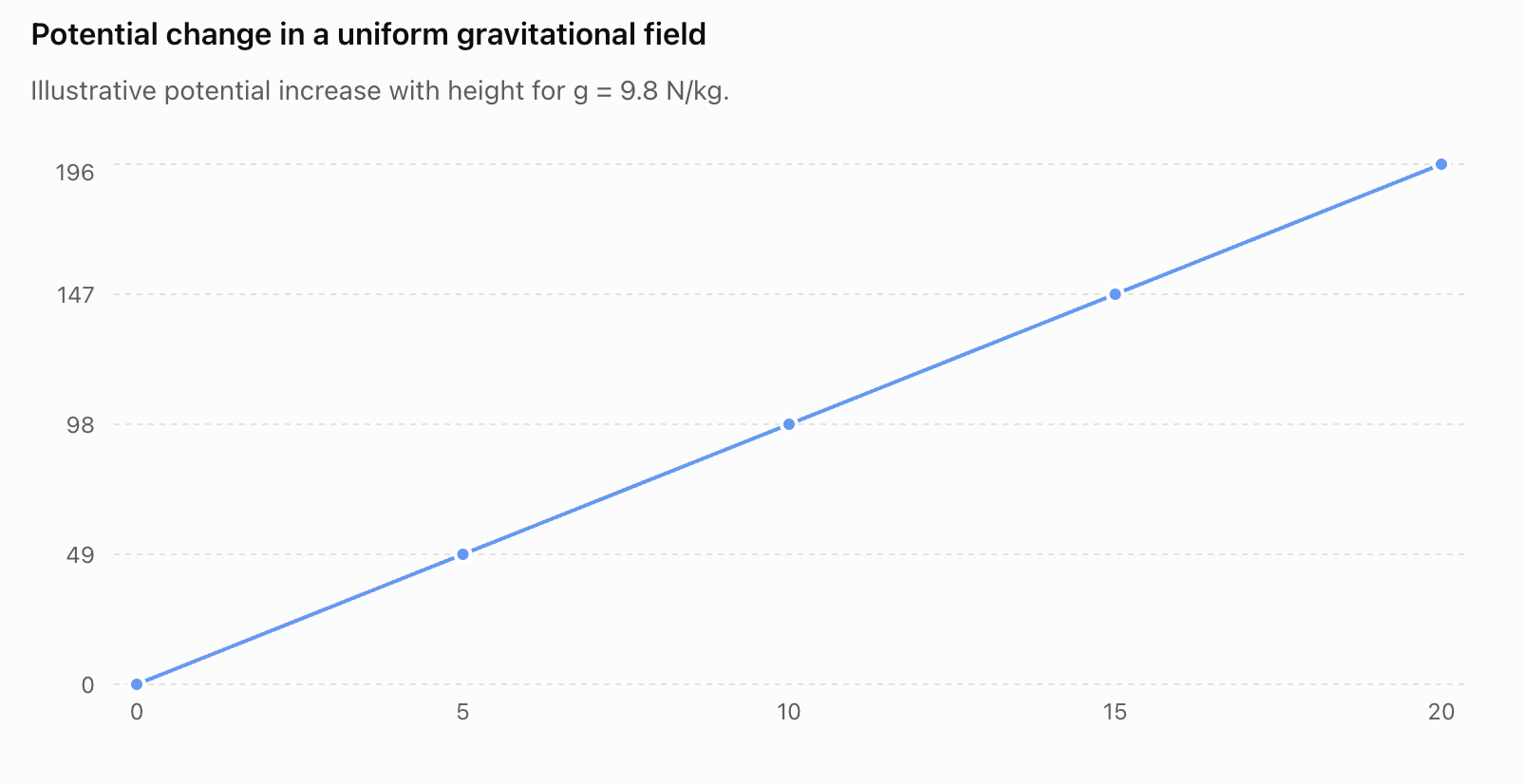
The straight-line graph indicates a constant gravitational field.


Potential Graph in a Radial Field

Around a spherical mass:

V = −GM/r

The V-r graph is curved rather than straight.

Close to the mass:

  • the curve is steep
  • potential changes rapidly with distance
  • field strength is large

Far away:

  • the curve becomes flatter
  • potential changes slowly
  • field strength is small
https://images.openai.com/static-rsc-4/tyDzawr05gE0iFDNb9byN36FqNLSrzWMV8Zwzx58xQeis5ApqfHU8wTIFDYq-sNuqg9IHmBuhtRzM3TT2arjfEX1FW9RHqNGLS3IP-Tvbq2456M1S87pmYWJKMNq9Xfr0ACJdmWjLtavBdbNUl5Y_XkK_00th9kkF8Hqz8_f8BFaDbRCaoUyfzhbvHxG65QX?purpose=fullsize
 
https://images.openai.com/static-rsc-4/RnPfU8e90Dhf-Q00iG7t7caLrNzDD12cjrQfn-YWpINXxQXKCx74hp3UxPylkA55t-UnS_KUXuoJZXjzcUEg56VEoGEMdl2rAyythO9nchisc9M-rUZrZhX_1nxirQMWCpVrDVBBN5RQ_Kg1C8dFJt0iHQ51HquoNY3PvC9Qzra1chEdGfGR15onhLNgNhrL?purpose=fullsize
 
https://images.openai.com/static-rsc-4/dQMg04OBImpu14wi61s2IBCDD38WmTIV3B2O_S_enFy-SmjG0-U_nezIO8189aun0nrspsC6Ffol2U0HBW-Q7rOVPbQe1BAFjJtVOV2UnZ0oZ1BXSRUV1eG7aSQ9YDjbD3X0Km9yRxY44wRNlUKPcXX2U-RIyyEsLl8Ng2wDuvL97QSZ8RKEsKCp_LHhyV8t?purpose=fullsize
 
8

Reading Field Strength from a Potential Graph

Suppose we have a graph of V against r.

At a particular point:

  1. Draw a tangent to the curve.
  2. Determine the tangent's gradient.
  3. Apply the negative sign to obtain the signed radial field component.

So:

g_r = −gradient of V-r graph

The steeper the graph, the greater the magnitude of g.


Worked Graph Example

Suppose a tangent to a V-r graph passes approximately through:

Point 1:

r = 4.0 × 10⁶ m
V = −7.0 × 10⁷ J/kg

Point 2:

r = 6.0 × 10⁶ m
V = −5.0 × 10⁷ J/kg

Approximate gradient:

ΔV/Δr

= [−5.0 × 10⁷ − (−7.0 × 10⁷)] / [(6.0 × 10⁶) − (4.0 × 10⁶)]

= (2.0 × 10⁷)/(2.0 × 10⁶)

= 10 N/kg

Therefore:

g_r ≈ −10 N/kg

The field strength has magnitude:

10 N/kg

and points inward.


Potential Energy Graphs

For a particular test mass:

Eₚ = mV

Therefore, the Eₚ-r graph has the same general shape as the V-r graph.

However, its vertical scale depends on m.

For a spherical gravitational system:

Eₚ = −GMm/r

The graph:

  • is negative
  • increases toward zero as r increases
  • becomes steep near the source
  • becomes flatter far away

Force from an Energy Graph

Just as field strength comes from the gradient of a potential graph:

F = −dEₚ/dr

Therefore:

steep Eₚ-r graph → large force

flat Eₚ-r graph → small force

The sign tells us the direction of the force relative to the chosen coordinate direction.


Comparing V-r and g-r Graphs

For a spherical mass:

V = −GM/r

and:

g = GM/r² for the magnitude.

Their graphs have different shapes.

As r increases:

  • V approaches zero from below
  • g approaches zero from above
  • g decreases more rapidly than |V|

For example:

Distance Potential Field Strength
r V g
2r V/2 g/4
3r V/3 g/9
4r V/4 g/16

Here V remains negative; writing V/2 means a value half as negative in magnitude.


Example with Numerical Values

Suppose at distance r:

V = −80 MJ/kg

and:

g = 16 N/kg

Then:

At 2r:

V = −40 MJ/kg

g = 4 N/kg

At 4r:

V = −20 MJ/kg

g = 1 N/kg

Potential and field strength both become weaker in magnitude with distance, but at different rates.


Field Strength Is Not the Same as Potential

A point can have:

g = 0

while:

V ≠ 0

For example, at the midpoint between two equal masses:

  • gravitational fields point in opposite directions and cancel
  • gravitational potentials are both negative and add

Therefore:

g_net = 0

but:

V_total < 0

https://images.openai.com/static-rsc-4/dE39JQMWJ2KbCiNoB1rMHXtegm6PxABIsAivvO-WVVx9xIuYZ_TaXFSAoL9tgekuc1h6LVdYzKhuOudZ_5dsbGq3BBLs9vcqX7wRVk3q2jhsVbMk0B-tdAI5KiVRDD_xrWImzb1UxuhJnIpg9kLzX-MpjyGdww4pTwA3eBs6FCfblUtdAk8pl78fjAe6mOm7?purpose=fullsize
 

This distinction is especially important when interpreting graphs of multi-mass systems.


What Does Zero Field Mean on a Potential Graph?

Since:

g = −potential gradient

if:

g = 0

then the potential graph has:

zero gradient

at that point.

This means the graph has a horizontal tangent.

It might be:

  • a local maximum
  • a local minimum
  • another stationary point

The potential itself does not have to equal zero.


Energy Changes in a Varying Field

In a varying gravitational field, g is not constant.

Therefore, the simple near-surface expression:

ΔEₚ = mgΔh

cannot always be used.

Instead, calculate the potential at each position:

V = −GM/r

Then:

ΔEₚ = m(V₂ − V₁)

This automatically accounts for the changing gravitational field.


Worked Example: Moving Through a Varying Field

A 500 kg spacecraft moves from a location where:

V₁ = −6.0 × 10⁷ J/kg

to:

V₂ = −4.0 × 10⁷ J/kg

Potential change:

ΔV = −4.0 × 10⁷ − (−6.0 × 10⁷)

= +2.0 × 10⁷ J/kg

Therefore:

ΔEₚ = mΔV

= 500 × 2.0 × 10⁷

= 1.0 × 10¹⁰ J

The spacecraft's gravitational potential energy increases by:

10 billion joules.


Work Done and Potential Energy

Work done by gravity is related to the change in potential energy:

W_gravity = −ΔEₚ

Therefore:

W_gravity = −mΔV

If an object moves toward a planet:

  • V decreases
  • Eₚ decreases
  • gravity does positive work

If an object moves away:

  • V increases
  • Eₚ increases
  • gravity does negative work

Conservation of Energy

When gravity is the only force transferring energy:

Eₖ + Eₚ = constant

Since:

Eₚ = mV

we can also write:

Eₖ + mV = constant

This allows potential values to be used directly in energy calculations.


Worked Example: Falling Through a Varying Field

A spacecraft begins from rest at:

V₁ = −2.0 × 10⁷ J/kg

It falls to:

V₂ = −5.2 × 10⁷ J/kg

The change in potential is:

ΔV = −5.2 × 10⁷ − (−2.0 × 10⁷)

= −3.2 × 10⁷ J/kg

Potential energy per kilogram decreases by:

3.2 × 10⁷ J/kg

Therefore, kinetic energy per kilogram increases by the same amount:

Eₖ/m = 3.2 × 10⁷ J/kg

Using:

Eₖ/m = 1/2 v²

1/2 v² = 3.2 × 10⁷

v² = 6.4 × 10⁷

v = 8000 m/s

Notice that the spacecraft's mass is not needed.


Why Mass Cancels

Suppose an object falls through a gravitational potential difference ΔV.

Its change in gravitational potential energy is:

ΔEₚ = mΔV

Its kinetic energy is:

Eₖ = 1/2 mv²

When energy conservation is applied, m appears on both sides and cancels.

This is another way to understand why objects in the same gravitational field experience the same gravitational acceleration when other forces are negligible.


Falling Toward a Planet

As an object moves inward:

r decreases

Field strength:

g increases

Potential:

V becomes more negative

Potential energy:

Eₚ becomes more negative

Kinetic energy:

Eₖ increases

Speed:

increases

The object is moving into a stronger gravitational field and toward lower gravitational potential.


Moving Away from a Planet

As an object moves outward:

r increases

Field strength:

g decreases

Potential:

V becomes less negative

Potential energy:

Eₚ increases

If no external energy is supplied:

kinetic energy decreases

and:

speed decreases


Energy Transfer Does Not Require Constant Field Strength

Conservation of energy remains valid even when g changes significantly.

This is one major advantage of using gravitational potential.

Instead of trying to use one value of g across a huge distance, we can calculate the potential difference between the starting and finishing positions.

This is particularly useful for:

  • satellites
  • spacecraft
  • planetary motion
  • moons
  • escape problems

Satellites and Potential Energy

A satellite orbiting a planet has:

  • gravitational potential energy
  • kinetic energy

For a circular orbit:

Eₚ = −GMm/r

and:

Eₖ = GMm/(2r)

Therefore:

E_total = −GMm/(2r)

The negative total mechanical energy indicates that the satellite is gravitationally bound.

https://images.openai.com/static-rsc-4/a6TlsrylaA5eEiy3gPg3wqgVQXURliaSZ7_b5a9UDMJpGvFwkwxobFlc6-3Q9dP03SgOGlhGlI_o9qeJk8WoBPqbeXcpzGAoZ8d8PfO-PWLUUpAOWCi4W8Yvahr9ZIQIj2FvLwuX5xeopcXSwyJfGerq-eHK0VVxH3W_lxJKvBry8ZQz_QO7A-M18rXx4FG8?purpose=fullsize
 
https://images.openai.com/static-rsc-4/s2W5jcKrE9Zz5OFC_6usxFziceETjWhiW8BUoiY2WDSBydX40UbDw8Iy3_njZ_FLiPsnC-Dmn-G08iD2gPaMrs1nieyyIMWH6UD5Y_CaCTumpgSFidLBODjNrkW6rTiCLNSKGNMSeWUXhY6F-BENRe10XmLexL46vhsFLFPt3XhWkpvnYYTo_OWSNqd98rFb?purpose=fullsize
 
https://images.openai.com/static-rsc-4/FiGBR6ikVDjsWYvVQzW_MQOA-Neo1vjTSzWq7i1v6pBjgKKwyJq_D6-y28vOKyH6HYnfPJFLksGDxvOkCdmTU1_0nQtVD6sZezG27LfV97_WL9baK9W-74E7nRPhySTYSGNimykxUvJvR4Mhgp9dqEaO_clE4lVHCTOsbJgzgyqXiUypOIQneT-iXDzfJPFs?purpose=fullsize
 
5

Higher and Lower Circular Orbits

A satellite in a higher circular orbit has:

  • weaker gravitational field strength
  • higher gravitational potential
  • less negative gravitational potential energy
  • lower orbital speed
  • lower kinetic energy
  • higher total mechanical energy

A satellite in a lower circular orbit has:

  • stronger field strength
  • lower gravitational potential
  • more negative potential energy
  • higher orbital speed
  • higher kinetic energy
  • lower total mechanical energy

This combination is important in orbital mechanics.


Why a Higher Orbit Requires Energy

It may seem strange that a satellite moved to a higher circular orbit ends with a lower orbital speed.

However, its gravitational potential energy increases by more than its kinetic energy decreases.

Therefore:

total mechanical energy increases.

Energy must be supplied to move the satellite into the higher orbit.


Escape and Potential Energy

For an object to escape an isolated planet with zero speed remaining at infinity:

At infinity:

V = 0

and:

Eₖ = 0

Therefore, the minimum total mechanical energy required is:

E_total = 0

At the starting point:

1/2 mv² + mV = 0

Divide by m:

1/2 v² + V = 0

Therefore:

v_escape = √(−2V)

Gravitational potential directly tells us how much energy per kilogram is needed to escape.


Worked Escape Example

Suppose the gravitational potential at a planet's surface is:

V = −3.2 × 10⁷ J/kg

Then:

v_escape = √(−2V)

= √(6.4 × 10⁷)

= 8000 m/s

or:

8.0 km/s

The potential tells us immediately how deeply the object lies within the planet's gravitational potential well.


Comparing Two Planets

Suppose Planet A and Planet B have the same surface gravitational field strength.

This does not necessarily mean they have the same gravitational potential.

Field strength:

g = GM/R²

Potential:

V = −GM/R

The extra factor of R means that two planets can have identical surface g but very different gravitational potentials.


Worked Planet Comparison

Planet B has:

4 times the mass of Planet A

and:

2 times the radius.

Compare field strength:

gB/gA = 4/2²

= 1

So:

gB = gA

Now compare potential magnitude:

|VB|/|VA| = 4/2

= 2

Therefore:

VB is twice as negative as VA.

An object would experience the same surface gravitational field strength on both planets but would require more energy per kilogram to escape from Planet B.


Analyzing Potential Graphs

When given a graph of gravitational potential against position, ask:

Is V increasing or decreasing?

This helps determine field direction.

How steep is the graph?

Steeper means stronger field.

Where is the graph horizontal?

The net field is zero there.

Where does V approach zero?

For an isolated gravitational system, this usually corresponds to very large distance.

Is V negative?

For attractive gravity with zero at infinity, it normally is.


Analyzing Field Strength Graphs

When examining g against r for a spherical mass:

  • g is greatest close to the mass
  • g decreases rapidly with distance
  • g approaches zero at large r
  • magnitude follows 1/r²

If direction is included and outward is defined as positive, the radial field is:

g_r = −GM/r²

so the graph lies below the horizontal axis.

Always check whether the graph represents field magnitude or a signed field component.


Potential Graph Versus Field Graph

A useful comparison is:

V-r graph

  • tells us energy per kilogram
  • gradient gives field
  • approaches zero as 1/r
  • normally negative

g-r graph

  • tells us force per kilogram
  • decreases as 1/r² in magnitude
  • provides local gravitational acceleration
  • may be shown as positive magnitude or negative radial component

The two graphs contain related but different information.


Graph of Potential Energy

If a graph shows:

Eₚ against r

rather than V against r, then:

gradient = −F_r

rather than field strength directly.

Remember:

F_r = −dEₚ/dr

while:

g_r = −dV/dr

This distinction depends on whether the graph shows energy or energy per unit mass.


Example: Reading an Energy Graph

Suppose the gradient of an Eₚ-r graph at a point is:

+120 J/m

Since:

1 J/m = 1 N

the gravitational force is:

F_r = −120 N

The negative sign indicates that the force acts opposite to increasing r.

If the object has mass:

20 kg

then the field component is:

g_r = F_r/m

= −120/20

= −6 N/kg

The field magnitude is:

6 N/kg


From Field Strength to Potential Difference

The relationship can also be used in reverse.

If a uniform gravitational field has magnitude:

g = 8 N/kg

and an object moves:

5 m

directly opposite the field direction, then potential increases by:

ΔV = gΔh

= 8 × 5

= 40 J/kg

For a 3 kg object:

ΔEₚ = mΔV

= 3 × 40

= 120 J


A Complete Problem-Solving Strategy

For gravitational energy and field problems:

Identify what quantity is given.

Is it:

  • g?
  • V?
  • Eₚ?
  • mass?
  • distance?
  • a graph?

Identify whether the field is approximately uniform or varying.

Near a planetary surface:

ΔEₚ ≈ mgΔh

For large radial distances:

V = −GM/r

and:

Eₚ = mV

For graphs, examine the gradient.

Potential graph:

g = −potential gradient

Potential-energy graph:

F = −potential-energy gradient

For motion, consider energy conservation.

If gravity is the only relevant interaction:

Eₖ + Eₚ = constant

Finally, check signs, units, and physical meaning.


Common Mistakes

Confusing potential with potential energy

Potential is measured in J/kg.

Potential energy is measured in J.

Thinking field strength equals potential

Field strength depends on the gradient of potential, not simply its value.

Forgetting the negative sign in the gradient relationship

The gravitational field points toward decreasing potential.

Using the gradient of an Eₚ graph as g

The gradient of Eₚ gives force, not field strength.

Assuming a steep graph means high potential

Steepness indicates a strong field. The actual potential value may still be high or low.

Thinking g = 0 means V = 0

Zero field means zero potential gradient, not necessarily zero potential.

Using mgΔh across enormous distances

This assumes approximately constant g.

Thinking potential energy must increase when speed increases

For an object falling under gravity, kinetic energy usually increases while gravitational potential energy decreases.

Forgetting that negative values have an order

−10 MJ/kg is a higher potential than −50 MJ/kg.

Confusing field magnitude with a signed field component

The magnitude g is non-negative. A radial component may be negative because it points inward.


Key Terms

Gravitational field strength (g) — gravitational force per unit mass at a point.

Gravitational potential (V) — gravitational potential energy per unit mass.

Gravitational potential energy (Eₚ) — energy associated with the relative positions of masses in a gravitational field.

Potential gradient — rate of change of gravitational potential with position.

Energy gradient — rate of change of potential energy with position.

Equipotential surface — surface on which gravitational potential is constant.

Radial field — field directed toward a central mass and varying with distance.

Uniform field — field with constant magnitude and direction.

Conservative force — force for which work between two points depends only on the initial and final positions.

Mechanical energy — total kinetic and potential energy of a mechanical system.

Bound system — system with insufficient total mechanical energy to separate indefinitely.

Potential well — representation of a region of negative gravitational potential surrounding an attractive mass.

Gradient — change in one quantity divided by change in another; on a graph, its slope.

Escape speed — minimum idealized initial speed required to reach infinite distance with zero remaining speed.


Key Takeaways

  • Gravitational potential energy, potential, and field strength describe different but closely related aspects of gravity.
  • Eₚ = mV connects gravitational potential energy and gravitational potential.
  • Gravitational field strength is related to the gradient of gravitational potential.
  • In a radial coordinate, g_r = −dV/dr.
  • Gravitational force is related to the gradient of potential energy: F_r = −dEₚ/dr.
  • The negative sign means gravity acts toward decreasing gravitational potential.
  • A steep potential gradient corresponds to a strong gravitational field.
  • A shallow potential gradient corresponds to a weak field.
  • Closely spaced equipotentials indicate a stronger field when the potential intervals are equal.
  • In a uniform field, potential changes linearly with distance along the field direction.
  • In a radial field, potential varies as −1/r while field magnitude varies as 1/r².
  • A horizontal tangent on a potential-position graph corresponds to zero net gravitational field at that point.
  • Zero gravitational field does not necessarily mean zero gravitational potential.
  • In varying fields, potential differences provide a convenient way to calculate energy changes.
  • ΔEₚ = mΔV applies even when g changes significantly between the two positions.
  • As an object falls toward a planet, potential energy decreases and kinetic energy increases.
  • As an object moves away without propulsion, potential energy increases and kinetic energy decreases.
  • Potential graphs can be used to determine field strength, field direction, energy changes, and motion.
  • Energy methods are especially useful for analyzing spacecraft, satellites, planetary motion, and escape from gravitational fields.

Check Your Understanding

  1. Explain the difference between gravitational field strength, gravitational potential, and gravitational potential energy.
  2. State the relationship between gravitational potential energy and gravitational potential.
  3. Explain what is meant by the gradient of gravitational potential.
  4. Why does the gravitational field point toward decreasing gravitational potential?
  5. Potential changes by 60 J/kg over a distance of 5.0 m. Estimate the magnitude of the gravitational field strength.
  6. Two regions have equal potential differences between neighbouring equipotentials. In Region A the equipotentials are much closer together than in Region B. Which region has the stronger gravitational field? Explain.
  7. Explain why a straight-line V-position graph represents a uniform gravitational field.
  8. A tangent to a V-r graph has a gradient of +7.5 N/kg. If outward is positive, determine the radial gravitational field component and state its direction.
  9. Explain why the V-r graph around a spherical planet becomes flatter as distance increases.
  10. At distance r from a planet, V = −60 MJ/kg and g = 12 N/kg. Determine V and g at 2r.
  11. A 400 kg spacecraft moves from V = −7.0 × 10⁷ J/kg to V = −4.0 × 10⁷ J/kg. Calculate its change in gravitational potential energy.
  12. A spacecraft begins from rest and falls through a gravitational potential difference of −2.0 × 10⁷ J/kg. Ignoring other forces, calculate its final speed.
  13. A potential-position graph has a horizontal tangent at a particular point. What does this tell you about the gravitational field there? Does it necessarily mean V = 0? Explain.
  14. Explain why the gradient of an Eₚ-r graph gives gravitational force while the gradient of a V-r graph gives gravitational field strength.
  15. Planet B has four times the mass and twice the radius of Planet A. Compare their surface gravitational field strengths and gravitational potentials, and explain why the results are different.