Gravitational Potential and Potential Energy
4. Potential Energy and Field Strength
Learning Outcomes
- I can explain the relationship between potential energy and field strength.
- I can relate field strength to the gradient of gravitational potential.
- I can describe how energy changes in varying fields.
- I can analyze graphs of potential and field strength.
- I can apply energy concepts to gravitational problems.
- \( g = - \frac{dV}{dr} \)
- Potential gradients
Potential Energy and Field Strength
Gravitational potential energy, gravitational potential, and gravitational field strength are three closely related ways of describing gravity.
They answer different questions:
- Gravitational field strength, g: How strongly would gravity accelerate or pull on each kilogram at this position?
- Gravitational potential, V: How much gravitational potential energy would each kilogram have at this position?
- Gravitational potential energy, Eₚ: How much energy is associated with a particular mass at this position?
The basic relationships are:
Eₚ = mV
g = gravitational force per unit mass
and the gravitational field is related to how rapidly gravitational potential changes with position.
This relationship allows us to move between force-based and energy-based descriptions of gravitational fields.


Three Related Gravitational Quantities
It is important to distinguish the three quantities.
| Quantity | Symbol | Meaning | Unit |
|---|---|---|---|
| Gravitational field strength | g | Force per unit mass | N/kg |
| Gravitational potential | V | Potential energy per unit mass | J/kg |
| Gravitational potential energy | Eₚ | Energy associated with a particular mass | J |
Potential and potential energy are related by:
Eₚ = mV
Field strength and potential are related through the potential gradient.
Gravitational Potential Energy
Gravitational potential energy describes energy associated with the positions of interacting masses.
For a mass m in the gravitational field of a spherical mass M:
Eₚ = −GMm/r
where:
- G = gravitational constant
- M = source mass
- m = object in the field
- r = distance between their centres
The conventional zero is:
Eₚ = 0 at r → ∞
Therefore, Eₚ is negative at finite distances from an isolated attractive mass.
Gravitational Potential
Gravitational potential is potential energy per unit mass:
V = Eₚ/m
For a spherical mass:
V = −GM/r
Notice that m has disappeared.
Potential is therefore a property of the location in the gravitational field, rather than of the particular test mass placed there.
Gravitational Field Strength
Outside a spherical mass:
g = GM/r²
where g represents the magnitude of the field strength.
The gravitational field points toward the source mass.
As distance increases:
g decreases according to 1/r²
while gravitational potential varies according to:
−1/r
This difference becomes important when interpreting graphs.


Potential Gradient
A gradient tells us how quickly a quantity changes with position.
For gravitational potential, the potential gradient describes how quickly V changes as we move through the field.
The gravitational field is related to the negative gradient of gravitational potential:
g = −dV/dr
when g is treated as the signed radial component and r increases outward.
More generally, the gravitational field vector points in the direction of the steepest decrease in gravitational potential.
Understanding the Negative Sign
Consider a planet.
As we move outward:
- r increases
- V becomes less negative
- V increases
Therefore:
dV/dr > 0
But gravity points inward, opposite to increasing r.
So the radial gravitational field component is negative:
g_r = −dV/dr
The negative sign tells us that the gravitational field points toward decreasing potential.
Field Direction and Potential
A useful rule is:
Gravity points from higher gravitational potential toward lower gravitational potential.
For example:
Farther from a planet:
V = −10 MJ/kg
Closer to the planet:
V = −30 MJ/kg
Gravity points:
−10 MJ/kg → −30 MJ/kg
because −30 MJ/kg is the lower potential.
Deriving Field Strength from Potential
For a spherical mass:
V = −GM/r
The rate at which this changes with r is:
dV/dr = GM/r²
Therefore:
g_r = −GM/r²
The magnitude is:
g = GM/r²
This demonstrates that the familiar gravitational field equation can be obtained directly from the gravitational potential.
A Useful Visual Interpretation
Imagine gravitational potential as a landscape.
A steep slope represents a rapidly changing potential.
A shallow slope represents a slowly changing potential.
Therefore:
steep potential gradient → strong gravitational field
shallow potential gradient → weak gravitational field
Gravity points "downhill" in this potential landscape.


Field Strength from Potential Difference
If the field is approximately uniform over a small region:
g ≈ −ΔV/Δr
when Δr is measured in a chosen direction.
For field magnitude:
g ≈ |ΔV|/Δr
This provides a practical way to estimate field strength from potential data.
Worked Example: Potential Gradient
Suppose gravitational potential changes from:
−120 J/kg
to:
−80 J/kg
over an outward distance of:
5.0 m
Then:
ΔV = −80 − (−120)
= +40 J/kg
Therefore:
g_r ≈ −40/5.0
= −8.0 N/kg
The negative sign indicates that the field points opposite the outward direction.
Its magnitude is:
8.0 N/kg
Why the Units Work
Potential gradient has units:
(J/kg)/m
Since:
1 J = 1 N·m
then:
(J/kg)/m = (N·m/kg)/m
= N/kg
So the potential gradient naturally gives the units of gravitational field strength.
Equipotential Spacing and Field Strength
Equipotential diagrams provide a visual representation of the potential gradient.
For equal potential intervals:
closely spaced equipotentials → large gradient → strong field
widely spaced equipotentials → small gradient → weak field


This allows field strength to be compared even without calculating exact values.
Worked Example: Comparing Two Regions
Suppose neighbouring equipotentials differ by:
20 J/kg
In Region A, they are:
2 m apart
In Region B, they are:
10 m apart
Region A:
g ≈ 20/2
= 10 N/kg
Region B:
g ≈ 20/10
= 2 N/kg
Therefore:
Region A has five times the field strength of Region B.
Potential Energy Gradient
Potential energy also changes with position.
Since:
Eₚ = mV
we can relate gravitational force to the gradient of potential energy.
In one dimension:
F = −dEₚ/dr
This is the energy version of the gravitational force relationship.
The force points toward decreasing potential energy.
Connecting Force and Field Strength
Since:
F = mg
and:
Eₚ = mV
we have:
F = −dEₚ/dr
and:
g_r = −dV/dr
These are parallel relationships.
| Energy Quantity | Field/Force Relationship |
|---|---|
| Potential energy Eₚ | F = −dEₚ/dr |
| Potential V | g_r = −dV/dr |
Potential is essentially the potential energy per kilogram, while field strength is the force per kilogram.
Near Earth's Surface
Near Earth's surface, gravitational field strength can often be treated as constant.
For a small vertical height change:
ΔV = gΔh
and:
ΔEₚ = mgΔh
If upward is taken as positive, gravitational potential increases with height.
The gravitational field points downward.
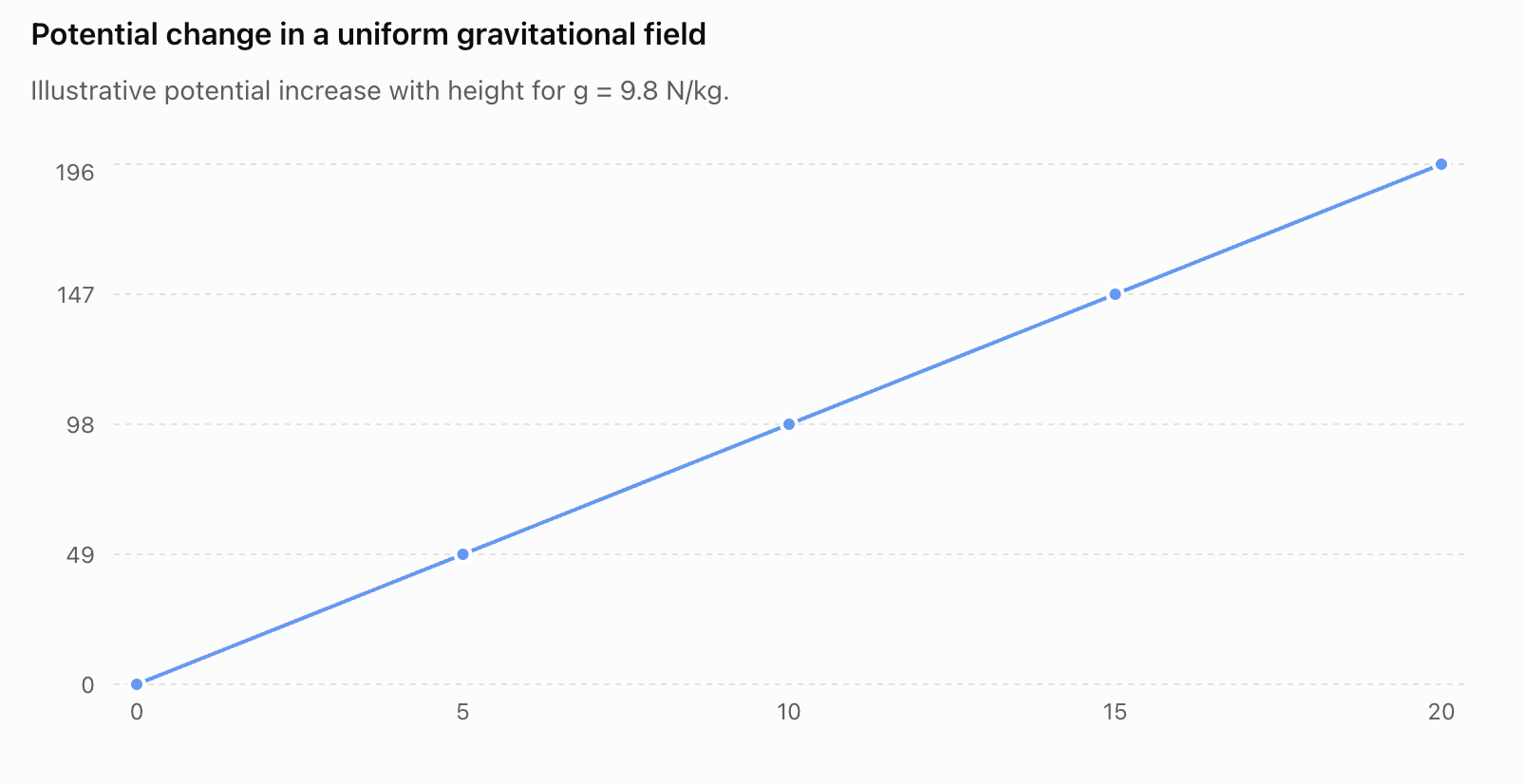
Potential Versus Height in a Uniform Field
If g is constant:
V changes linearly with height.
For example, using:
g = 9.8 N/kg
| Height Increase (m) | Increase in V (J/kg) |
|---|---|
| 0 | 0 |
| 5 | 49 |
| 10 | 98 |
| 15 | 147 |
| 20 | 196 |
The gradient of a V-versus-height graph is:
9.8 J/kg per metre
which is equivalent in magnitude to:
9.8 N/kg