Gravitational Potential and Potential Energy
1. Gravitational Potential Energy
Learning Outcomes
- I can define gravitational potential energy.
- I can explain how gravitational potential energy depends on position.
- I can calculate gravitational potential energy in gravitational fields.
- I can describe energy changes during motion in a field.
- I can apply conservation of energy to gravitational systems.
- Potential energy formula: \( U = -\frac{GMm}{r} \)
Gravitational Potential Energy
Gravitational potential energy (GPE) is energy associated with the position of objects in a gravitational field.
When an object is lifted, energy is transferred into the gravitational interaction between the object and the body producing the field. When the object falls, gravitational potential energy can be transferred into kinetic energy.
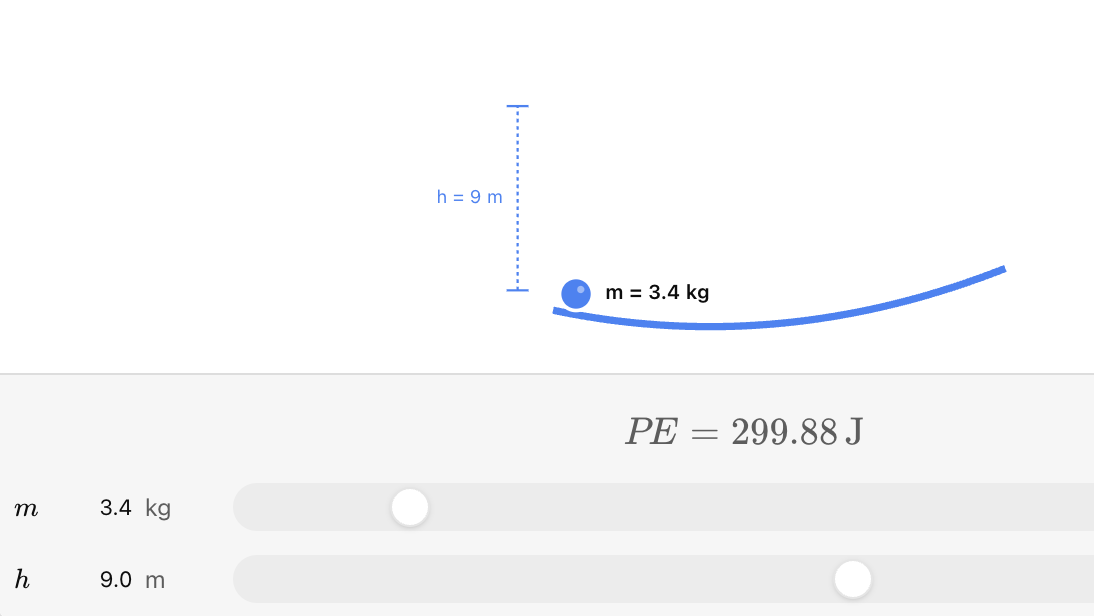
Near Earth's surface, changes in gravitational potential energy are commonly calculated using:
ΔEₚ = mgΔh
For larger distances, such as satellites and spacecraft, gravitational field strength changes significantly with distance. In those situations, we need a more general description of gravitational potential energy.


What Is Gravitational Potential Energy?
Gravitational potential energy is energy associated with the relative positions of masses in a gravitational field.
It is useful to think of gravitational potential energy as belonging to the system of interacting masses, rather than being stored inside one object alone.
For example, consider a book and Earth.
If the book is lifted:
- its distance from Earth's centre increases
- work must be done against gravity
- the gravitational potential energy of the Earth-book system increases
If the book falls:
- its distance from Earth's centre decreases
- gravitational potential energy decreases
- kinetic energy usually increases
Gravity therefore provides a mechanism for transferring energy between potential and kinetic forms.
Position Matters
Gravitational potential energy depends on position within a gravitational field.
An object's mass may remain unchanged, but moving it to a different position can change its gravitational potential energy.
Near Earth's surface:
greater height → greater gravitational potential energy
provided the same reference level is used.
For example, a book on a shelf has more gravitational potential energy relative to the floor than the same book lying on the floor.


Choosing a Reference Level
Near Earth's surface, we often choose a convenient position where:
Eₚ = 0
This is called the reference level.
Possible reference levels include:
- the floor
- the ground
- the bottom of a hill
- the bottom of a ramp
- the lowest point of a pendulum
The choice of zero level is often arbitrary.
What usually matters physically is the change in gravitational potential energy, not its absolute value relative to an arbitrarily chosen near-surface reference.
Example of Different Reference Levels
Suppose a 2 kg object is 5 m above the ground.
If the ground is chosen as:
h = 0
then its GPE is positive relative to the ground.
But if the top of a 10 m building is chosen as:
h = 0
the same object is at:
h = −5 m
Its numerical GPE relative to that reference is different.
The physics has not changed.
Energy changes between two positions remain consistent when the same reference system is used throughout the calculation.
GPE Near Earth's Surface
Over relatively small changes in height near Earth's surface, gravitational field strength is approximately constant.
The change in gravitational potential energy is:
ΔEₚ = mgΔh
where:
- ΔEₚ = change in gravitational potential energy in J
- m = mass in kg
- g = gravitational field strength in N/kg
- Δh = change in vertical height in m
Since:
1 N·m = 1 J
the result is measured in joules (J).