1. Gravitational Potential Energy

Learning Outcomes
  • I can define gravitational potential energy.
  • I can explain how gravitational potential energy depends on position.
  • I can calculate gravitational potential energy in gravitational fields.
  • I can describe energy changes during motion in a field.
  • I can apply conservation of energy to gravitational systems.

Key Topics:
  • Potential energy formula: \( U = -\frac{GMm}{r} \)

Gravitational Potential Energy

Gravitational potential energy (GPE) is energy associated with the position of objects in a gravitational field.

When an object is lifted, energy is transferred into the gravitational interaction between the object and the body producing the field. When the object falls, gravitational potential energy can be transferred into kinetic energy.

Near Earth's surface, changes in gravitational potential energy are commonly calculated using:

ΔEₚ = mgΔh

For larger distances, such as satellites and spacecraft, gravitational field strength changes significantly with distance. In those situations, we need a more general description of gravitational potential energy.

https://images.openai.com/static-rsc-4/Dl5AXu2TChp_qpm8khdsK8xsigc495US5_8AjhCIpbyXGrQ7_Zu7hpcPKm7HpOR8_k7O5ZpU5oX2-omTwI0cLo59uMT_nH4hdhVWvyRHIaPDvsQJG_xZOnWAHsJWgW2Gyy-8Z33MjkdVtQdKkYE4evYG43kAKxXi4Gj06yLkjCti2gfGun1bvobWSYUk2Oqj?purpose=fullsize
 
https://images.openai.com/static-rsc-4/Gmtm2kAGoiilGNzWQYqhVKbfs_EpZwNnpUTAY4rHwYW8JCGHeNPyib6rnWf3oF851QR3EsVfT0yLhr6sc9fxW9hpNg7c9VB45s-_y7eI_b3H0yGEJfFKoIGIZ0nb-ZWbme36H9RRRKlo-bYvoMzHPQ58l5Weno6wTPwpvBK3BKHN8DsNSocnvJwtw2XerUta?purpose=fullsize
 
https://images.openai.com/static-rsc-4/FiGBR6ikVDjsWYvVQzW_MQOA-Neo1vjTSzWq7i1v6pBjgKKwyJq_D6-y28vOKyH6HYnfPJFLksGDxvOkCdmTU1_0nQtVD6sZezG27LfV97_WL9baK9W-74E7nRPhySTYSGNimykxUvJvR4Mhgp9dqEaO_clE4lVHCTOsbJgzgyqXiUypOIQneT-iXDzfJPFs?purpose=fullsize
 
8

What Is Gravitational Potential Energy?

Gravitational potential energy is energy associated with the relative positions of masses in a gravitational field.

It is useful to think of gravitational potential energy as belonging to the system of interacting masses, rather than being stored inside one object alone.

For example, consider a book and Earth.

If the book is lifted:

  • its distance from Earth's centre increases
  • work must be done against gravity
  • the gravitational potential energy of the Earth-book system increases

If the book falls:

  • its distance from Earth's centre decreases
  • gravitational potential energy decreases
  • kinetic energy usually increases

Gravity therefore provides a mechanism for transferring energy between potential and kinetic forms.


Position Matters

Gravitational potential energy depends on position within a gravitational field.

An object's mass may remain unchanged, but moving it to a different position can change its gravitational potential energy.

Near Earth's surface:

greater height → greater gravitational potential energy

provided the same reference level is used.

For example, a book on a shelf has more gravitational potential energy relative to the floor than the same book lying on the floor.

https://images.openai.com/static-rsc-4/621OpyYMyLdvQd-NxR7fZ09ForArinZU7y518XxyTGVOxL1Lvjb-RgIJXBQHKoJhFNEquXuQSf0UvLUW_Qso6egdySA27M3MPfYEGTfJ6txQ-wZsxDRcLCCyWuuPZSTpgiwK8P4bv8oUirp3eTRSNJcfafZxB5U32CwwncpIx2r0NjIH7qxPZ--EXYWMMcWZ?purpose=fullsize
 
https://images.openai.com/static-rsc-4/SWxfvEs10YtnecWp8cYvk3m84rn2ZeqXOdND2JOD2wRbgNfAKkSquqJQ0puzYpFCVPx3DP3ClHL10jwgRJVZq_B5Uhq0cxqWEE8jCONedTJ06d3N2kBgQ9eyOzVKcBwV5OJoW9Z3pdrrObOhRlPx4XeEB-0Z2N9-njVQLnPVgZitvzIuIDmgueDZDoF2wkWQ?purpose=fullsize
 
https://images.openai.com/static-rsc-4/sUNX1i_3q4gR1NRNV2oEmvnMvvaPVKXsTCOGzUxKVDI3osxJFeSuXivhC9EOL_NEUgTfCbj8LEdSZrjl5fE3AKkwR8lRKyYSoVCYirVIn79TWAuYv28wsktJM6o0ymr2vkISCiWP2cY_Bf2pI3V4gDzHvIgQgUc_5rtfcB_kwduvE2Sl8gmuUFPZt03n8Ekc?purpose=fullsize
 
10

Choosing a Reference Level

Near Earth's surface, we often choose a convenient position where:

Eₚ = 0

This is called the reference level.

Possible reference levels include:

  • the floor
  • the ground
  • the bottom of a hill
  • the bottom of a ramp
  • the lowest point of a pendulum

The choice of zero level is often arbitrary.

What usually matters physically is the change in gravitational potential energy, not its absolute value relative to an arbitrarily chosen near-surface reference.


Example of Different Reference Levels

Suppose a 2 kg object is 5 m above the ground.

If the ground is chosen as:

h = 0

then its GPE is positive relative to the ground.

But if the top of a 10 m building is chosen as:

h = 0

the same object is at:

h = −5 m

Its numerical GPE relative to that reference is different.

The physics has not changed.

Energy changes between two positions remain consistent when the same reference system is used throughout the calculation.


GPE Near Earth's Surface

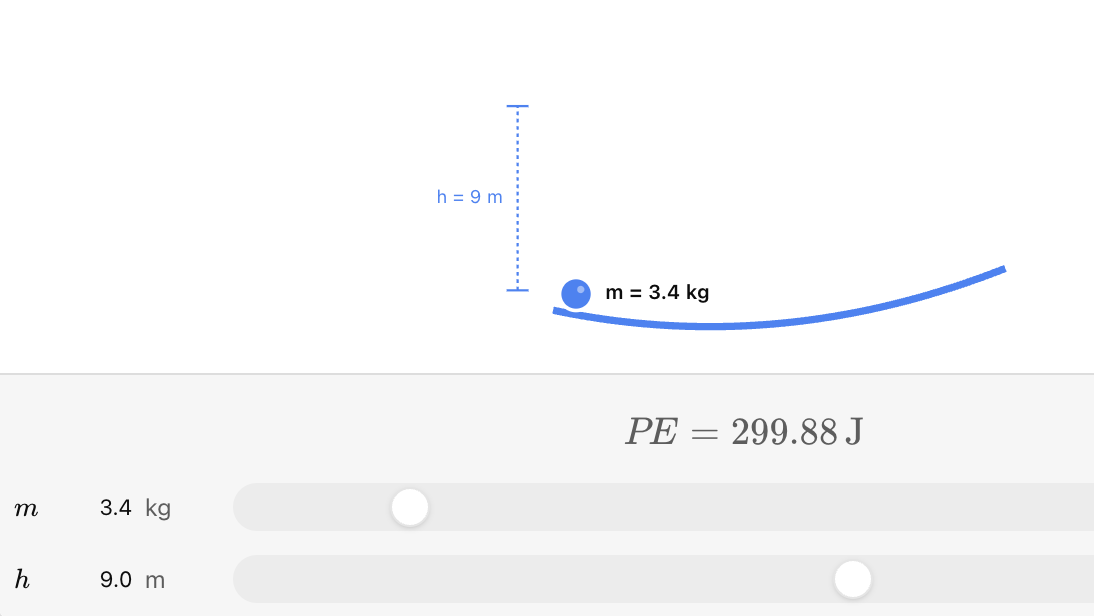
Over relatively small changes in height near Earth's surface, gravitational field strength is approximately constant.

The change in gravitational potential energy is:

ΔEₚ = mgΔh

where:

  • ΔEₚ = change in gravitational potential energy in J
  • m = mass in kg
  • g = gravitational field strength in N/kg
  • Δh = change in vertical height in m

Since:

1 N·m = 1 J

the result is measured in joules (J).
Why the Equation Works

Suppose an object is lifted vertically at constant speed.

The upward force required is approximately equal to its weight:

F = mg

Work done is:

W = Fd

For a vertical displacement Δh:

W = mgΔh

The work done against gravity increases the gravitational potential energy:

ΔEₚ = mgΔh

This connects:


Worked Example: Lifting an Object

A 5 kg box is lifted vertically by 3 m.

Use:

g = 9.8 N/kg

ΔEₚ = mgΔh

= 5 × 9.8 × 3

= 147 J

The gravitational potential energy of the Earth-box system increases by:

147 J


Worked Example: A Student Climbing Stairs

A student has mass:

60 kg

The student climbs a vertical height of:

4.0 m

Using:

g = 9.8 N/kg

ΔEₚ = 60 × 9.8 × 4.0

= 2352 J

The student's gravitational potential energy increases by approximately:

2.35 kJ


Vertical Height Is What Matters

In:

ΔEₚ = mgΔh

Δh is the vertical change in height.

It is not necessarily the total distance travelled.

Suppose two hikers reach the same point on a hill.

One takes a steep 1 km path.

The other takes a winding 3 km path.

If both start and finish at the same elevations, and other effects are ignored, their changes in gravitational potential energy are the same if their masses are equal.

https://images.openai.com/static-rsc-4/lYKaa24bZcyUtRQ3vhyZXONbcLb0GrgZMOdNEK2y2ofGwf9Tg7TxvWSpVtFqQepvC4SjRqnvi9lAgsD_ujCuHPBQpVbL5Yw_ae8JDJDf7IzeIaK1vRHuwAQCBwiQ0I2v00bk6mDbq56tXCHmMOPCErFmWiB4kK_BjmogU8EQkwpZMlEsxGQ-Zd_gB4lz2YAj?purpose=fullsize
 
https://images.openai.com/static-rsc-4/UYpshbDQqGP_RzV0-LGdp0kT0b4tLLFeA_YFr0HLlM2FUg7o6OIKM5gA5x4Ev-DWJC-xmFhGAyHg7Wlbt-10qwZCHnwKq8EIm59pod6-h-Mit5NeCBIolM8NP9kJ-PaKcRhGTvkv7OuJBzl0MusdQ-w9oZcNXbMf8qDMfhpH5e3BoHfEKlv9Z743YmTVOq6o?purpose=fullsize
 
https://images.openai.com/static-rsc-4/8c-OznAfoUVs5kmlCkci1uwyx2AuLoyyU2z6-_kk31b-lvZVK0cB4Op_K1uv87bzbnelAmDBxhEYaGfkk_ZagelLcjtmDR_r830g8AL06aJFBtwYIqEujgtyYsvVuBIGgVrHHNL__uf6GfPDu31vTQXEomQsz3jeJ0nYDzH33O7EQLHzBa7pXPOAXiHmsTZn?purpose=fullsize
 
8

Gravity is a conservative force, so the gravitational potential-energy change depends on initial and final positions, not on the path taken between them.


Increasing Mass

Near Earth's surface:

ΔEₚ = mgΔh

Therefore:

ΔEₚ ∝ m

If mass doubles while g and Δh remain unchanged:

the change in GPE doubles.

For example:

A 2 kg object raised 5 m gains twice as much gravitational potential energy as a 1 kg object raised through the same height.


Increasing Height

Similarly:

ΔEₚ ∝ Δh

If the vertical height change doubles:

the change in GPE doubles

provided m and g remain constant.

A 4 kg object lifted 6 m gains twice as much GPE as the same object lifted 3 m.


Gravitational Field Strength Matters

GPE changes also depend on gravitational field strength.

Suppose the same 10 kg object is lifted 2 m.

On Earth:

g = 9.8 N/kg

ΔEₚ = 10 × 9.8 × 2

= 196 J

On the Moon:

g ≈ 1.62 N/kg

ΔEₚ = 10 × 1.62 × 2

= 32.4 J

Much less energy is required to raise the object through the same height on the Moon because the gravitational field is weaker.


GPE and Falling Objects

When an object falls, its gravitational potential energy decreases.

If air resistance is negligible, this energy is transferred mainly into kinetic energy.

So:

decrease in GPE = increase in KE

or:

−ΔEₚ = ΔEₖ

where:

Eₖ = 1/2 mv²

https://images.openai.com/static-rsc-4/xvyYfXcHPTOCO-OesVPjT_G3RJen5I4mHi5oT9CfPGKHWSMImXNY5-SQxcTENVMNY6zesMY8s_T6KZhYOUvVuIRshr3S--7B-Q4I29folvQiMO3VP8lcn-Xx80mWpsY4Z8qxOYElR2VBm6k4JASrw8UF6j27530vV9W41Mq5Kutsk2HExFkAdRcpZvMp6SI2?purpose=fullsize
 

Conservation of Mechanical Energy

If only gravity does work and energy losses are negligible:

total mechanical energy remains constant

Therefore:

Eₖ + Eₚ = constant

As an object falls:

  • Eₚ decreases
  • Eₖ increases

As an object rises:

  • Eₖ decreases
  • Eₚ increases

Energy is transferred rather than destroyed.


Worked Example: Falling from Rest

A 2 kg ball is dropped from a height of 5 m.

Ignore air resistance.

Initial GPE relative to the ground:

Eₚ = mgh

= 2 × 9.8 × 5

= 98 J

Initially, the ball is at rest:

Eₖ = 0 J

Therefore, total mechanical energy is:

98 J

Just before reaching the ground:

Eₚ ≈ 0

So:

Eₖ ≈ 98 J


Finding Speed Using Conservation of Energy

For the falling ball:

Initial GPE = final KE

Therefore:

mgh = 1/2 mv²

Mass appears on both sides and cancels:

gh = 1/2 v²

Therefore:

v = √(2gh)

For:

h = 5 m

v = √(2 × 9.8 × 5)

= √98

≈ 9.9 m/s

Notice that mass does not appear in the final equation.

Ignoring air resistance, objects falling through the same vertical distance in the same uniform field reach the same speed if they begin with the same initial speed.


Throwing an Object Upward

When an object is thrown upward:

  • it begins with kinetic energy
  • its speed decreases
  • kinetic energy decreases
  • gravitational potential energy increases

At the highest point:

vertical velocity = 0

so the vertical kinetic energy associated with that motion is temporarily zero.

The energy has been transferred into gravitational potential energy.

As the object falls again, the transfer reverses.


Worked Example: Finding Maximum Height

A 1.5 kg ball is launched vertically upward at:

14 m/s

Ignore air resistance.

Initial kinetic energy:

Eₖ = 1/2 mv²

= 1/2 × 1.5 × 14²

= 147 J

At maximum height, this has been converted into additional GPE:

mgΔh = 147

1.5 × 9.8 × Δh = 147

Δh = 147/14.7

= 10 m

The ball rises approximately:

10 m

above its launch point.


Pendulums and Energy

A swinging pendulum provides a clear example of energy changing between gravitational potential energy and kinetic energy.

At the highest points:

  • GPE is greatest
  • speed is momentarily zero
  • KE is least

At the lowest point:

  • GPE is least
  • speed is greatest
  • KE is greatest
https://images.openai.com/static-rsc-4/RNi-NFEkTjZ_QGtHZODmpRKOUdwjdv8Xy0fu518DhX6EULcyDKrteyabNVdzyHJRTW8ZWkCj1pfyirYAlOjY-ja5wJeUBBY8JAKUAE8-DerGZUTDvYyK_t3EMBvL_0T0HIzS8QhFzFTKvsCSsH4eyeg8YQu81hwYO7SMbFYwJFQ215fTxaYt3_7vvIRUKDsz?purpose=fullsize
 
https://images.openai.com/static-rsc-4/mszGC2sUXuh1dZS-ClSDWBENWkV_dbmjpHfjBxtzIWIHdgOWaQPIRyREL4oxv2m-tzeQZ3sznYYiqkM2vQyhsk9d1J81PwBgtKRASZX4cKXYlAXj75QHOuGS1LZ0Tc0HSlKVo1Hq-waG2tOhlVQOx4oj2sYSL-JAgtAMftp94tSFess1wkazBWOHF20GXKI-?purpose=fullsize
 
https://images.openai.com/static-rsc-4/cdLrgHMPHzT7Bs-7hI4pViLpcpTvPVXokgH98OdZOZ4Nr0PNFmONx2wy7owf0_W88LblDsSdbi-ImkO0PT7HOClY1Gvw_zjGNJVYvOLpu_pPNDPPFYaz7CqZSY-bkxMIRom76PQ0o4cMls1J2gCic1yzQHIApAi3_HuCa5-aQIzeNO1wwGjlFYZP8ouxLVSp?purpose=fullsize
 
6

In an ideal pendulum:

Eₖ + Eₚ = constant

In a real pendulum, some mechanical energy is transferred to thermal energy and sound because of air resistance and friction.


Roller Coasters

Roller coasters also demonstrate gravitational energy transfers.

At the top of a large hill:

  • GPE is high
  • speed may be relatively low

During the descent:

  • GPE decreases
  • KE increases
  • speed increases

During the next climb:

  • KE decreases
  • GPE increases
https://images.openai.com/static-rsc-4/4WLFcBA98oRfLSKgCvH-kRNUriDTHO8jTGruWdFQfUDNURceGJwkO7VUToS_w9btCOMS6VZCslv1fvfhKqK-D3-x1H7xpsGrk0cjukLkWNKv3o8636GKcvzesUoZtAnjPH6lt122p0E5V7rYx3Arsk2eP3WFgvpazOLvmea5OvzYnRH6ATpaGmRjI-HKpxIZ?purpose=fullsize
 
https://images.openai.com/static-rsc-4/1PNNewnAHxcujErbvZyR4eLLkxAOfwfj8jo9n4b3ksp0M2noxupOHzoG37lBfUEA9eKhoYKhGTyPApHIThMerUrywVjz1UIqmwDbLJe_vy4kZsL9SLxKUwZUmNA0UkLyAZWDfKkbIuwVBIWHB0rIYlRyZrHxnwUcHGTbgsj_8V16zy_haPfGJyZgaDah9Rok?purpose=fullsize
 
https://images.openai.com/static-rsc-4/Sz7vw7YetbPCY5tVB2cgDePN6Onj2K6d_MUoFEJodNICW4HyFY11Y1K-iCQMnKFa2EnKYfrQ_Gp8QuSDI9HXk1mWnoQ64Wxa_FZqlDlknp-kMRJplrRedBG99LsYlWbUPL52WNKjiS1RH-CaG2cEgy0pjfH2Wqmc7ttOpyXbbW05yYs4kcUB2zP9bWyvCA4m?purpose=fullsize
 
6

Real roller coasters also transfer some mechanical energy into:

  • thermal energy
  • sound

because of friction and air resistance.


Hydroelectric Power

Water stored behind a dam has gravitational potential energy because of its elevated position.

As water moves downward:

gravitational potential energy → kinetic energy → turbine motion → electrical energy

The energy available depends partly on:

A greater height difference generally means more gravitational potential energy is available per kilogram of water.


Why mgh Is an Approximation

The equation:

ΔEₚ = mgΔh

assumes that gravitational field strength is approximately constant.

Near Earth's surface over modest height changes, this is an excellent approximation.

However, for:

  • satellites
  • spacecraft
  • large changes in altitude
  • motion between planets

g may change significantly.

We then need a more general expression.


GPE in a Radial Gravitational Field

For two spherical masses, gravitational potential energy is:

Eₚ = −GMm/r

where:

  • Eₚ = gravitational potential energy in J
  • G = gravitational constant
  • M = mass producing the field
  • m = mass moving in the field
  • r = distance between the centres of the masses

The zero of gravitational potential energy is conventionally chosen at:

r → ∞

This is different from the arbitrary reference level often used with mgh near Earth's surface.

https://images.openai.com/static-rsc-4/DybN-wko7D-E0yVVw1VDFuUp6okH-JnpiTCpGn3ruLSOHazfdCYk0sUVzGXYwquvIY-SQuoiVj6tLrY9Rqi3h01VVG5kXMVFSGiVl8a6gDQUFZeYIaw3Q2sedk9_QhsrOvzCFPLfhjeLAW1L-_2lSVyR5MgXVS8CrP-AVRDZNPp9LXpHiIVMCF8duLgWPS9V?purpose=fullsize
 
https://images.openai.com/static-rsc-4/1FBRyfveU-gGpZ5AuK-NLY-eWXwFCMoKdyAO1a1LH3bzBcMOB1o5VrAEzMyvsdm78Ptp7psHLHiM_FXXEcO6aBkA6C9vwGmmhLJmiybcow-aTS-vFdyKYdpH7VPblifpT4S4JrBCKiUgeBO13TbV5B4NNZ7UNNRW807N3yn6fPteGjorbo-Pydh7fO4mX36i?purpose=fullsize
 
https://images.openai.com/static-rsc-4/o3fAuiri1AnOKvegdYfSRpv6-g6_egdj6Yn5VzmFBydI4Deh4BmE3Bj1mlqF2jm16VT7GDtUu1-Ni2QxJF7G1zHgicYgkRYfTj9W-V_p1Su1gLAOpJdgaOogMgUkLCYlFrB02PKyD4In_W_Pnz8JT_Ad6JAlJIddOdWH1yf50qn2-bHY6ulVrfPavb9K7f89?purpose=fullsize
 
8

Why Gravitational Potential Energy Is Negative

For an isolated gravitational system, we conventionally define:

Eₚ = 0 at infinite separation

At any finite distance:

Eₚ = −GMm/r

so gravitational potential energy is negative.

The negative sign represents the fact that the masses form a bound gravitational system.

Energy must be supplied to separate them completely to infinity.


Understanding Negative GPE

Suppose:

Eₚ = −1000 J

This does not mean the system somehow contains an impossible amount of energy.

It means the system is:

1000 J below the chosen zero level at infinity.

To reach:

Eₚ = 0

at infinite separation, at least 1000 J would need to be supplied in the appropriate idealized case.


How GPE Changes with Distance

Using:

Eₚ = −GMm/r

consider what happens as r increases.

Close to the planet:

Eₚ is strongly negative.

Farther away:

Eₚ becomes less negative.

At extremely large distance:

Eₚ approaches zero.

Therefore, moving an object away from a planet:

increases its gravitational potential energy.

Moving it toward the planet:

decreases its gravitational potential energy.


Example of Negative Energy

Suppose a spacecraft has:

Eₚ = −8 × 10⁹ J

at one location.

Farther from the planet it has:

Eₚ = −3 × 10⁹ J

The change is:

ΔEₚ = Eₚ,final − Eₚ,initial

= (−3 × 10⁹) − (−8 × 10⁹)

= +5 × 10⁹ J

The spacecraft's gravitational potential energy has increased by 5 × 10⁹ J.


Change in GPE in a Radial Field

Between two distances:

r₁ and r₂

the change in gravitational potential energy is:

ΔEₚ = Eₚ₂ − Eₚ₁

Therefore:

ΔEₚ = −GMm/r₂ + GMm/r₁

or:

ΔEₚ = GMm(1/r₁ − 1/r₂)

If the object moves outward:

r₂ > r₁

and:

ΔEₚ > 0

Energy must be transferred into the gravitational system.


Worked Example: Moving Away from a Planet

Suppose:

M = 6.0 × 10²⁴ kg
m = 1000 kg
r₁ = 7.0 × 10⁶ m
r₂ = 1.4 × 10⁷ m

Use:

G = 6.67 × 10⁻¹¹ N·m²/kg²

Initial GPE:

Eₚ₁ = −GMm/r₁

≈ −5.72 × 10¹⁰ J

Final GPE:

Eₚ₂ = −GMm/r₂

≈ −2.86 × 10¹⁰ J

Therefore:

ΔEₚ = Eₚ₂ − Eₚ₁

≈ +2.86 × 10¹⁰ J

The spacecraft gains gravitational potential energy as it moves farther from the planet.


Connecting mgh and −GMm/r

The equations:

ΔEₚ = mgΔh

and:

Eₚ = −GMm/r

do not describe different types of gravity.

They describe the same gravitational interaction under different conditions.

Use:

ΔEₚ = mgΔh

when:

  • the change in height is small compared with planetary radius
  • g can be treated as constant

Use:

Eₚ = −GMm/r

when:

  • distances are large
  • g changes significantly
  • radial gravitational fields must be considered

Near a planet's surface, the general radial-field equation leads approximately to the familiar mgΔh result.


Gravitational Potential Energy and Orbits

Satellites possess both:

  • kinetic energy
  • gravitational potential energy

For a satellite orbiting a planet:

Eₚ = −GMm/r

The satellite's kinetic energy depends on its orbital speed.

For a circular orbit:

Eₖ = GMm/(2r)

Therefore, total orbital mechanical energy is:

E_total = Eₖ + Eₚ

which gives:

E_total = −GMm/(2r)

The negative total energy indicates that the satellite is gravitationally bound to the planet.

https://images.openai.com/static-rsc-4/s2W5jcKrE9Zz5OFC_6usxFziceETjWhiW8BUoiY2WDSBydX40UbDw8Iy3_njZ_FLiPsnC-Dmn-G08iD2gPaMrs1nieyyIMWH6UD5Y_CaCTumpgSFidLBODjNrkW6rTiCLNSKGNMSeWUXhY6F-BENRe10XmLexL46vhsFLFPt3XhWkpvnYYTo_OWSNqd98rFb?purpose=fullsize
 
https://images.openai.com/static-rsc-4/a6TlsrylaA5eEiy3gPg3wqgVQXURliaSZ7_b5a9UDMJpGvFwkwxobFlc6-3Q9dP03SgOGlhGlI_o9qeJk8WoBPqbeXcpzGAoZ8d8PfO-PWLUUpAOWCi4W8Yvahr9ZIQIj2FvLwuX5xeopcXSwyJfGerq-eHK0VVxH3W_lxJKvBry8ZQz_QO7A-M18rXx4FG8?purpose=fullsize
 
https://images.openai.com/static-rsc-4/FiGBR6ikVDjsWYvVQzW_MQOA-Neo1vjTSzWq7i1v6pBjgKKwyJq_D6-y28vOKyH6HYnfPJFLksGDxvOkCdmTU1_0nQtVD6sZezG27LfV97_WL9baK9W-74E7nRPhySTYSGNimykxUvJvR4Mhgp9dqEaO_clE4lVHCTOsbJgzgyqXiUypOIQneT-iXDzfJPFs?purpose=fullsize
 
8

Moving a Satellite to a Higher Orbit

A satellite in a higher circular orbit has:

  • greater gravitational potential energy
  • less negative GPE
  • lower circular orbital speed
  • lower kinetic energy
  • greater total mechanical energy

This can initially seem surprising.

To move a satellite to a higher circular orbit, energy must be supplied even though its final orbital speed is lower.

The additional energy increases the satellite's total orbital energy.


Escape from a Gravitational Field

An object can escape a planet if it has enough mechanical energy to reach an indefinitely large distance without returning.

At infinity:

Eₚ → 0

For the minimum idealized escape condition:

E_total = 0

At the planet:

Eₖ + Eₚ = 0

1/2 mv² − GMm/R = 0

Solving gives:

v_escape = √(2GM/R)

Escape velocity is therefore directly connected to gravitational potential energy.


Conservation of Energy in Space

Consider a spacecraft moving away from a planet with its engines off.

If other effects are negligible:

Eₖ + Eₚ = constant

As the spacecraft moves outward:

  • Eₚ increases
  • Eₖ decreases
  • speed decreases

If it lacks enough initial energy, it eventually stops moving outward and begins falling back.

If it has sufficient energy, it can escape.


Falling Toward a Planet

A spacecraft falling toward a planet undergoes the opposite energy transformation.

As r decreases:

Eₚ becomes more negative.

The decrease in gravitational potential energy produces an increase in kinetic energy.

Therefore:

speed increases.

This is why objects accelerate as they fall deeper into a gravitational field.


Energy and Field Strength Are Related but Different

Gravitational field strength describes:

force per unit mass at a location.

Gravitational potential energy describes:

energy associated with the configuration of masses.

A field can exert a force that changes an object's motion, while potential energy allows us to track the energy transfers associated with that motion.

Both are useful descriptions of gravitational systems.


Energy Diagrams

Energy diagrams can help show how energy changes during motion.

For an object falling near Earth's surface:

Top: high GPE, low KE

Middle: lower GPE, greater KE

Bottom: low GPE, high KE

If energy losses are negligible:

total mechanical energy remains constant.

https://images.openai.com/static-rsc-4/Wx4GVs4PjKUnZT0gvr9jqJ7uoMCgD6PuE6q8fooNdgDhDxjsORVayshQ9yyfZYKNOIZ5xP5YVuR-skK9RL5yNaqVml9fnr3UMkw_rkyA6E6NC7vTLn7z8SmWBjQPQC_ZFux9M2AHBJIwpLdplzdyi4W3fSBV4__tL4ETjDNK9IxI9OsVVMNpaDUcMjzpNLo4?purpose=fullsize
 
https://images.openai.com/static-rsc-4/fuW9Bst981BMvJ3zq708u7RoynVkkJR0LoS69Tu7ydlmQLpVdEDR9HP9inJzy32MS45AAsiot2LuvnONeybCfctN-lZd02JTNSWVdNSEhcnOnUvM5ej_wCt70Qs5LrIIbtE6tYxdiwjbaOFwS5wxtJF7LQXlTQ8sz1V08lizIejs-R5OV2H8asT0BKRoF_kR?purpose=fullsize
 
https://images.openai.com/static-rsc-4/qMrs4Z5BCFI_7F8bwAX6TeJhpRAv6qTTP0UjESS-0ajVyIMlhkDR2nu5l1VdYdYZxXGL9mjuTAhsfhsK8SeuzxaSd25F0mYf8oq7-E4SxhY51xG325Ht7ol2Q2tBvu8d1YcmwiZdpod6n1DR2t3wke-lyVN6oUc9_AqciInSdvfeqaQ5BZVnX61DL81ogaHC?purpose=fullsize
 
7

Real Systems and Energy Losses

Mechanical energy is not always conserved by itself.

Suppose an object falls through air.

Some gravitational potential energy is transferred into:

  • kinetic energy of the object
  • thermal energy of the air
  • thermal energy of the object
  • sound

The total energy of the larger system remains conserved, but:

Eₖ + Eₚ

for the object-Earth mechanical system may decrease because energy has been transferred to other stores.


Example with Efficiency

A 100 kg load is lowered through:

20 m

Its decrease in gravitational potential energy is:

ΔEₚ = 100 × 9.8 × 20

= 19,600 J

Suppose a generator captures:

75%

of this energy as useful electrical energy.

Useful energy:

= 0.75 × 19,600

= 14,700 J

The remaining energy is transferred into other forms, mainly thermal energy.


GPE in Everyday Life

Gravitational potential energy appears in many familiar situations:

  • lifting objects
  • climbing stairs
  • jumping
  • skiing downhill
  • roller coasters
  • pendulums
  • water stored behind dams
  • falling objects
  • cranes lifting loads
  • elevated storage systems

In each case, position within a gravitational field affects the energy available for transfer.


GPE in Astronomy

Gravitational potential energy is fundamental to astronomy.

It helps explain:

  • satellite orbits
  • planetary motion
  • spacecraft trajectories
  • escape from planets
  • star formation
  • collapsing gas clouds
  • binary star systems
  • accretion around compact objects
https://images.openai.com/static-rsc-4/9dE6s3gVwrQw_-VRWkotgu0z-yDOCMXNujTCJIIEqyeqnlB3q5mEoSZ-pzNh8A_O7MVAw-CRKGpQNxzV2x1ytW5xG-5mfaW9f2ImGXDBnowackiu9dqSG3E2aq1mLhP6a7rne7iKnemlJkXoFvbM6NbfmRpLYZRqXESAuPOTVV5tO4VzBQxFVFf6CAF1OSH2?purpose=fullsize
 
https://images.openai.com/static-rsc-4/ib6cDPgQfFj-dFlUMz-xrJE92bkiErKrZnw9QzuLLD82dI-f7sGD_k_WwQqdpcVB6MsvRBfZ6EroA1UbHGlNjJ-tXM_BRmfpp56dsnASOK0GOL5uQ8nAEEnkdDnhxaq8EYiG1suiMHCCnprZg6TovFS8VZe1cEUcgeNR8I2hHsbQsudoXw4lefYZdY3DtnvH?purpose=fullsize
 
https://images.openai.com/static-rsc-4/EByZl0YgJ31ai4xefyDMiZM4kSfIOg7UlMM7noSXYSz-BUkhE66V63C41t0nvVxdh45rogxz-VqJvEyxwpfoLDDh7u6vZRn9ITPttiDO_qxqNhQR78vyLjZq-qpOvlrDEFs_ORTGf1zCVF6lj-WiseW40oU47difhjCkfR9yiWRl3CrL-oZlHSsnlt3-Bl1s?purpose=fullsize
 
8

Star Formation and GPE

A large cloud of gas can collapse under gravity.

As the particles move closer together:

  • gravitational potential energy decreases
  • kinetic and thermal energy increase
  • the cloud becomes hotter

Eventually, the central region may become hot and dense enough for nuclear fusion to begin.

Gravitational potential energy therefore plays a major role in the formation of stars.


Accretion and Gravitational Energy

Matter falling toward a compact astronomical object can lose enormous amounts of gravitational potential energy.

That energy can be transformed into:

  • kinetic energy
  • thermal energy
  • electromagnetic radiation

This is why matter falling toward objects such as neutron stars and black holes can become extremely hot and luminous.

The energy is not created by gravity; it comes from the decrease in gravitational potential energy of the system.


Solving GPE Problems

A useful approach is:

Identify the gravitational model.

Small height change near a planetary surface?

Use:

ΔEₚ = mgΔh

Large radial distance change?

Use:

Eₚ = −GMm/r

Identify initial and final positions.

Energy problems usually involve a change between two states.

Choose a reference level carefully.

For near-surface problems, the zero level can often be chosen conveniently.

For radial-field calculations, the conventional zero is at infinity.

Apply conservation of energy if appropriate.

If energy losses are negligible:

Eₖ₁ + Eₚ₁ = Eₖ₂ + Eₚ₂

Check the sign.

Moving upward or outward increases GPE.

Moving downward or inward decreases GPE.


Common Mistakes

Confusing gravitational potential energy with gravitational field strength

GPE is measured in joules.

Field strength is measured in N/kg.

Using mgh for enormous distances

The equation mgΔh assumes approximately constant g.

Thinking GPE belongs only to the smaller object

Gravitational potential energy is associated with the configuration of the interacting masses.

Using distance travelled instead of vertical height

Near Earth's surface, use the change in vertical height.

Thinking negative GPE means negative energy cannot exist

The sign depends on the chosen zero. In radial gravitational systems, zero is conventionally chosen at infinity.

Thinking −5 J is less gravitationally bound than −2 J

−5 J is farther below zero and represents a more strongly bound state.

Forgetting that potential energy increases when moving away from a planet

It becomes less negative, which means it has increased.

Assuming mechanical energy is always conserved

Mechanical energy is conserved only when energy is not transferred to other forms by effects such as friction or air resistance.

Confusing zero velocity with zero acceleration

At the highest point of a thrown object, velocity may momentarily be zero while gravitational acceleration is still present.


Key Terms

Gravitational potential energy (GPE) — energy associated with the relative positions of masses in a gravitational field.

Potential energy — energy associated with the configuration or position of a system.

Reference level — a position chosen to represent zero potential energy in a particular near-surface problem.

Joule (J) — the SI unit of energy.

Kinetic energy — energy associated with motion, calculated using Eₖ = 1/2 mv².

Mechanical energy — the sum of kinetic and potential energy in a mechanical system.

Conservation of energy — the principle that energy cannot be created or destroyed, although it can be transferred between stores and systems.

Conservative force — a force for which the work done between two positions does not depend on the path taken.

Radial gravitational field — a gravitational field directed toward a central mass and varying with distance.

Bound system — a system whose objects do not have enough total mechanical energy to separate indefinitely under the conditions considered.

Escape velocity — the minimum initial speed in an idealized model needed to escape a gravitational field without further propulsion.

Orbital energy — the combined kinetic and gravitational potential energy of an orbiting object.

Infinity reference — the conventional choice Eₚ = 0 when gravitationally interacting masses are infinitely separated.

Energy transfer — movement of energy between stores or systems.


Key Takeaways

  • Gravitational potential energy is associated with the positions of masses in a gravitational field.
  • Moving an object upward or farther from a gravitational source increases its gravitational potential energy.
  • Moving an object downward or toward a gravitational source decreases its gravitational potential energy.
  • Near Earth's surface, changes in GPE can usually be calculated using ΔEₚ = mgΔh.
  • GPE depends on mass, gravitational field strength, and change in vertical height in the uniform-field approximation.
  • Gravity is a conservative force, so GPE changes depend on initial and final positions rather than the path taken.
  • During free fall, gravitational potential energy is transferred into kinetic energy.
  • When an object rises, kinetic energy can be transferred into gravitational potential energy.
  • If energy losses are negligible, Eₖ + Eₚ remains constant.
  • For large distances in radial gravitational fields, Eₚ = −GMm/r.
  • In the radial-field model, gravitational potential energy is conventionally zero at infinity.
  • GPE is negative at finite distances under this convention because gravitational systems are bound.
  • Moving away from a planet makes GPE less negative and therefore increases it.
  • Satellites possess both gravitational potential energy and kinetic energy.
  • Energy must be supplied to move a satellite into a higher orbit.
  • Gravitational potential energy is essential for understanding falling objects, hydroelectric systems, spacecraft, orbits, escape, and star formation.

Check Your Understanding

  1. Define gravitational potential energy.
  2. Explain why gravitational potential energy is better described as energy associated with a system of interacting masses rather than energy stored only inside one object.
  3. A 4 kg object is lifted vertically by 6 m near Earth's surface. Calculate its increase in GPE using g = 9.8 N/kg.
  4. A 70 kg student climbs a staircase with a vertical height of 5 m. Calculate the increase in gravitational potential energy.
  5. Two identical objects reach the top of the same hill by different paths. One path is twice as long as the other. Compare their changes in gravitational potential energy and explain your answer.
  6. A 3 kg ball falls 8 m from rest. Ignoring air resistance, calculate the decrease in GPE.
  7. For the ball in Question 6, determine its kinetic energy just before reaching the bottom if it began from rest.
  8. Explain how gravitational potential energy and kinetic energy change as a ball is thrown vertically upward.
  9. A pendulum swings from its highest position to its lowest position. Describe the energy transformations that occur.
  10. Explain why ΔEₚ = mgΔh is suitable near Earth's surface but becomes inaccurate for a spacecraft travelling a very large distance from Earth.
  11. Gravitational potential energy changes from −9 × 10⁸ J to −4 × 10⁸ J. Calculate the change in GPE and state whether the object moved generally closer to or farther from the gravitational source.
  12. Explain why gravitational potential energy is negative when zero is defined at infinite separation.
  13. A satellite is moved from a lower circular orbit to a higher circular orbit. Describe what happens to its gravitational potential energy, orbital speed, kinetic energy, and total mechanical energy.
  14. A spacecraft travels away from a planet with its engines switched off. Explain how conservation of energy can be used to describe the changes in its speed and gravitational potential energy.
  15. Explain how the conversion of gravitational potential energy helps account for the heating of gas during the formation of a star.