Gravitational Field Strength
4. Measuring Gravitational Fields
Learning Outcomes
- I can explain how gravitational field strength can be measured or calculated.
- I can relate gravitational field strength to acceleration due to gravity.
- I can calculate field strength near planets and moons.
- I can interpret data involving gravitational fields.
- I can compare field strengths in different locations.
- Simple pendulum experiment
- Measuring g on Earth and other planets
Measuring Gravitational Fields
A gravitational field cannot be seen directly, but its effects can be measured. Scientists determine gravitational field strength by observing how gravity affects masses, measuring the acceleration of falling objects, or calculating the field from the mass and size of an astronomical body.
Gravitational field strength is represented by:
g
and can be expressed in either:
N/kg
or equivalently:
m/s²
Near Earth's surface:
g ≈ 9.8 N/kg = 9.8 m/s²
This connection between force per unit mass and acceleration due to gravity is one of the most important ideas in gravitational physics.

Gravitational Field Strength
Gravitational field strength tells us the gravitational force acting on each kilogram of mass at a particular location.
It can be calculated from:
g = F/m
where:
- g = gravitational field strength in N/kg
- F = gravitational force in N
- m = mass placed in the field in kg
If a 2 kg object experiences a gravitational force of 19.6 N:
g = 19.6/2
= 9.8 N/kg
This tells us that every kilogram placed at that location experiences approximately 9.8 N of gravitational force.
Measuring g Using Force and Mass
One way to measure gravitational field strength is to measure the weight of a known mass.
Suppose a 5.0 kg mass is placed on a force meter.
The meter measures:
49 N
Then:
g = F/m
g = 49/5.0
g = 9.8 N/kg
A force meter or spring balance can therefore be used to estimate the local gravitational field strength.


Weight and Gravitational Field Strength
Weight is the gravitational force acting on an object.
Therefore:
F = mg
or:
weight = mass × gravitational field strength
If mass is known and weight is measured, we can rearrange:
g = F/m
For example, suppose a 0.50 kg mass has a measured weight of 4.9 N.
g = 4.9/0.50
= 9.8 N/kg
Why Different Masses Can Be Used
Suppose several masses are tested at the same location.
| Mass (kg) | Weight (N) | F/m (N/kg) |
|---|---|---|
| 0.5 | 4.9 | 9.8 |
| 1.0 | 9.8 | 9.8 |
| 2.0 | 19.6 | 9.8 |
| 5.0 | 49.0 | 9.8 |
The weight changes with mass.
However:
F/m remains constant.
This constant value represents the gravitational field strength at that location.
Measuring g from a Graph
The relationship:
F = mg
has the same general form as:
y = mx
If we plot:
weight F on the vertical axis
against:
mass m on the horizontal axis
then:
gradient = g
For example:
gradient = ΔF/Δm
If:
ΔF = 39.2 N
and:
Δm = 4.0 kg
then:
g = 39.2/4.0
= 9.8 N/kg
A weight-versus-mass graph therefore provides an experimental method for measuring gravitational field strength.
Gravitational Field Strength and Acceleration
Gravitational field strength is closely related to the acceleration of an object falling freely under gravity.
Start with Newton's second law:
F = ma
For gravitational force:
F = mg
Therefore:
ma = mg
Cancel the mass:
a = g
This means that when gravity is the only significant force:
acceleration = gravitational field strength
This is why the same symbol, g, is commonly used for both.
Why N/kg and m/s² Are Equivalent
From Newton's second law:
1 N = 1 kg·m/s²
Therefore:
1 N/kg = (1 kg·m/s²)/kg
The kilograms cancel:
1 N/kg = 1 m/s²
So:
9.8 N/kg = 9.8 m/s²
These units describe the same gravitational quantity from two different perspectives.
N/kg describes force per unit mass.
m/s² describes acceleration.
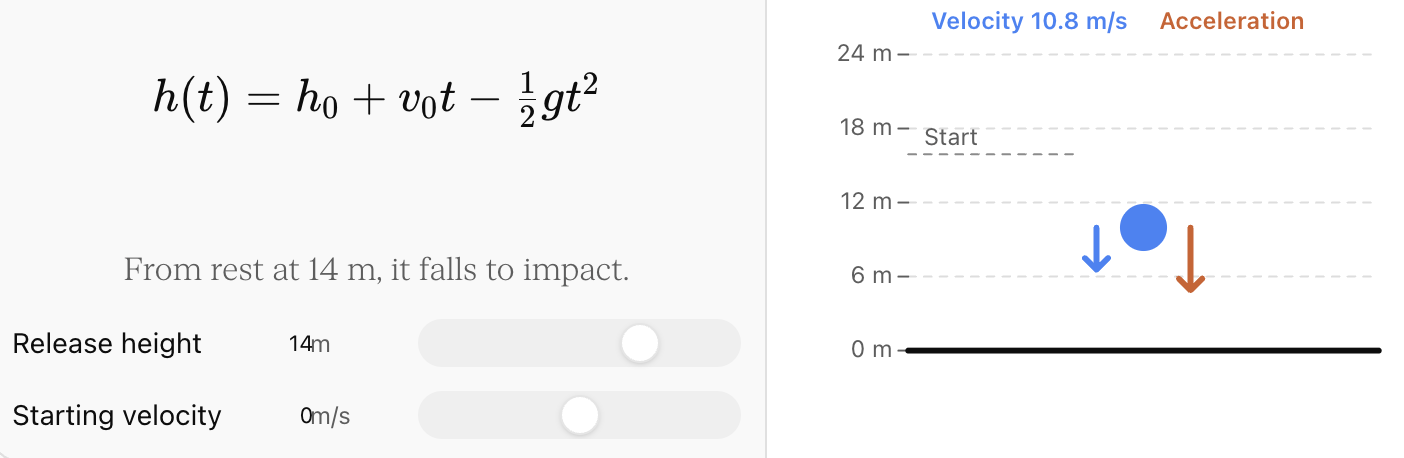
Free Fall
An object is in free fall when gravity is the only significant force acting on it.
Near Earth's surface, ignoring air resistance, a freely falling object accelerates downward at approximately:
9.8 m/s²