Gravitational Field Strength
| サイト: | Young Education |
| コース: | Gravitational Fields |
| ブック: | Gravitational Field Strength |
| 印刷者: | Guest user |
| 日付: | 2026年 09月 25日(金曜日) 03:22 |
1. Defining Gravitational Fields
Learning Outcomes
- I can define a gravitational field.
- I can explain the concept of gravitational field strength.
- I can distinguish between gravitational force and field strength.
- I can calculate gravitational field strength.
- I can interpret field diagrams around massive objects.
Key Topics:
- Field strength: \( g = \frac{F}{m} \)
- Gravitational fields of point masses
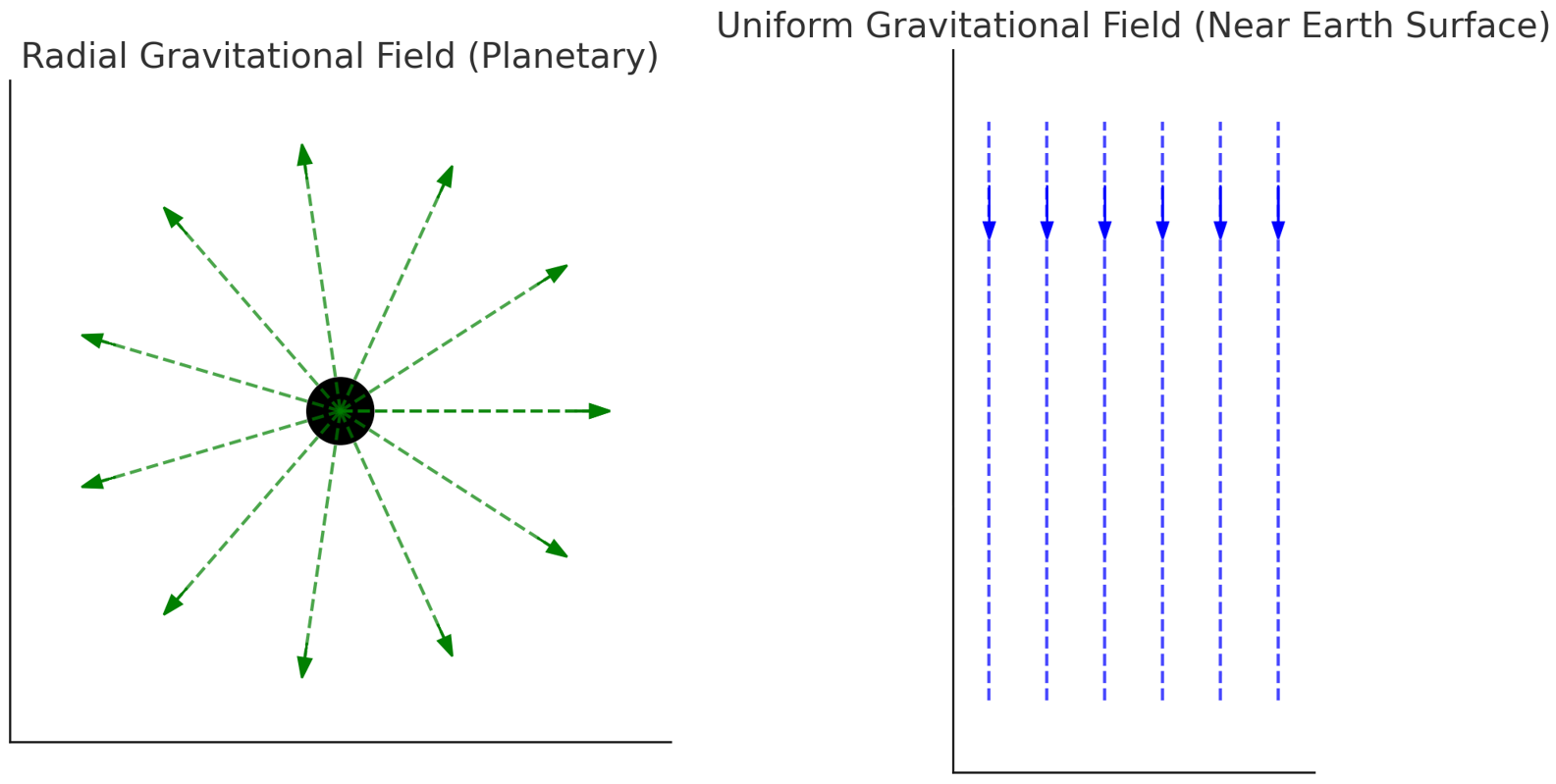
2. Radial and Uniform Fields
Learning Outcomes
- I can distinguish between radial and uniform gravitational fields.
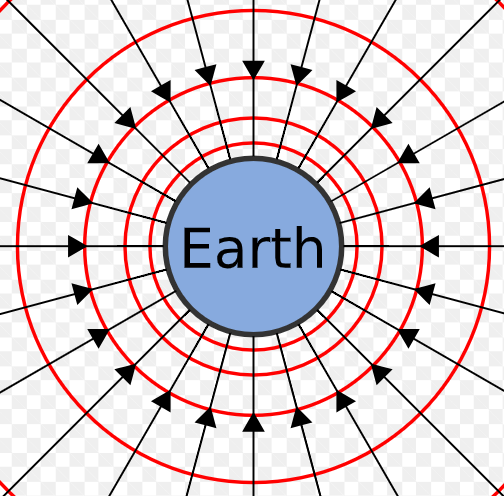
- I can describe the field around a planet as a radial field.
- I can identify situations that approximate uniform fields.
- I can compare field-line diagrams for different field types.
- I can explain how field strength changes in radial fields.
Key Topics:
- Field lines for spherical and planar masses
- Examples of uniform fields
Comparison Table: Radial vs. Uniform Fields
| Feature | Radial Field | Uniform Field |
|---|---|---|
| Field Strength () | Decreases with r (\( g = \frac{GM}{r^2} \)) | Constant (g = 9.81 m/s² near Earth) |
| Field Lines | Point toward the center of mass | Parallel and evenly spaced |
| Force on Objects | Weaker at greater distances | Constant everywhere |
| Typical Scale | Large-scale (planets, stars, galaxies) | Small-scale (Earth’s surface, near objects) |
| Equation Used | g ≈ 9.81 m/s² |
3. Field Superposition
Learning Outcomes
- I can explain the principle of superposition for gravitational fields.
- I can determine the net field due to multiple masses.
- I can identify points where gravitational fields balance.
- I can analyze field interactions between multiple objects.
- I can apply superposition to simple gravitational systems.
Key Topics:
- Principle of superposition
- Gravitational fields from multiple sources
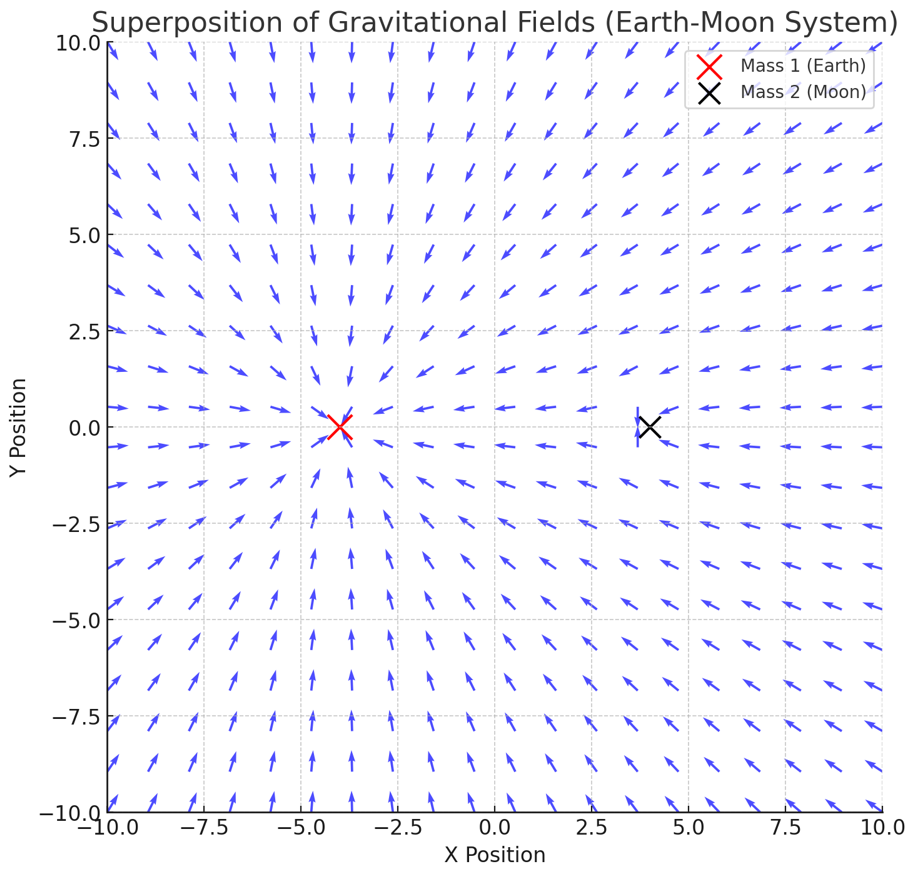
Superposition of Gravitational Fields (Earth-Moon System)
The diagram above illustrates the combined gravitational field of two massive bodies using the superposition principle.
Key Observations from the Visualization:
-
Field Lines Curve Between the Masses
- The combined gravitational field bends toward both masses, showing how their forces interact.
-
Stronger Pull Near Larger Mass (Earth)
- The red dot represents Earth, and its gravitational field dominates.
- The Moon (black dot) has a weaker pull, but still influences the overall field.
-
Equilibrium Points (Lagrange Points) ⚖️
- In some locations, the forces cancel out, forming neutral zones where gravitational forces balance.
Key Takeaway:
- Superposition of gravitational fields determines the motion of celestial objects.
- This explains stable orbits, Lagrange points, and interplanetary trajectories.
Activities:
- Group problem-solving on combined fields
- Simulations of multi-source fields
Assessment: Numerical problems on superposition
4. Measuring Gravitational Fields
Learning Outcomes
- I can explain how gravitational field strength can be measured or calculated.
- I can relate gravitational field strength to acceleration due to gravity.
- I can calculate field strength near planets and moons.
- I can interpret data involving gravitational fields.
- I can compare field strengths in different locations.
Key Topics:
- Simple pendulum experiment
- Measuring g on Earth and other planets
5. Applications of Field Strength
Learning Outcomes
- I can explain how gravitational field strength affects weight.
- I can compare weight on different planets and moons.
- I can analyze spacecraft motion using field concepts.
- I can apply field strength calculations to practical situations.
- I can evaluate the importance of gravitational fields in astronomy.
Key Topics:
- Free-fall motion
- Variations of g with altitude and latitude