Gravitational Field Strength
Requisitos de finalización
3. Field Superposition
Learning Outcomes
- I can explain the principle of superposition for gravitational fields.
- I can determine the net field due to multiple masses.
- I can identify points where gravitational fields balance.
- I can analyze field interactions between multiple objects.
- I can apply superposition to simple gravitational systems.
Key Topics:
- Principle of superposition
- Gravitational fields from multiple sources
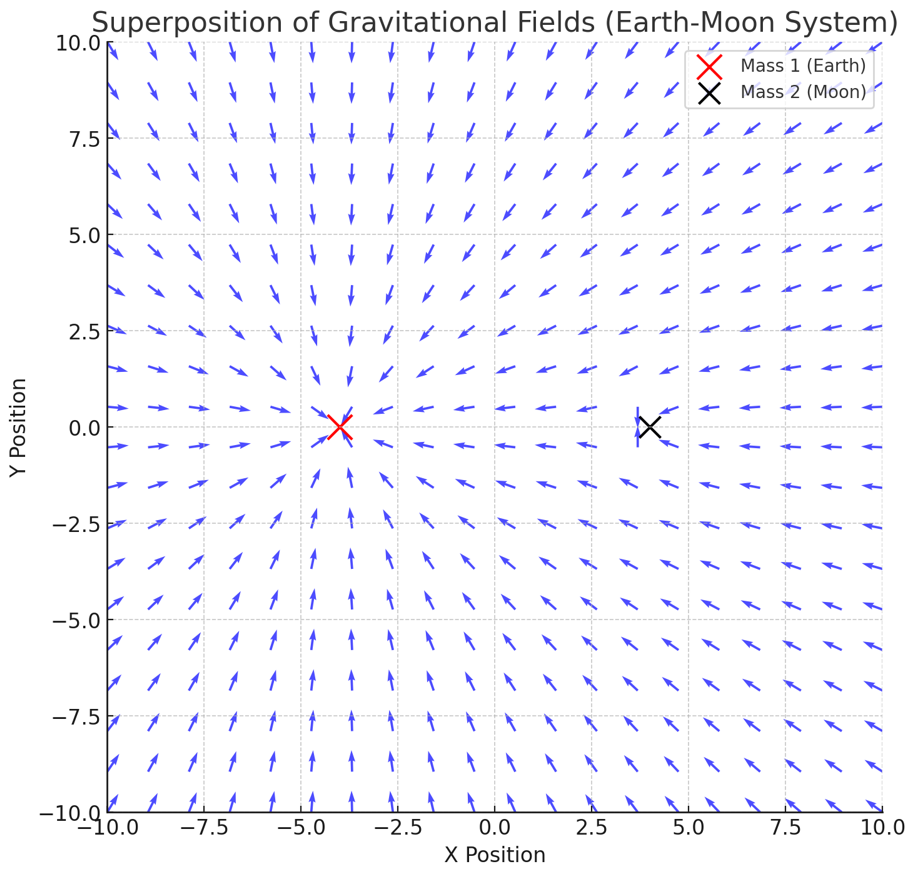
Superposition of Gravitational Fields (Earth-Moon System)
The diagram above illustrates the combined gravitational field of two massive bodies using the superposition principle.
Key Observations from the Visualization:
-
Field Lines Curve Between the Masses
- The combined gravitational field bends toward both masses, showing how their forces interact.
-
Stronger Pull Near Larger Mass (Earth)
- The red dot represents Earth, and its gravitational field dominates.
- The Moon (black dot) has a weaker pull, but still influences the overall field.
-
Equilibrium Points (Lagrange Points) ⚖️
- In some locations, the forces cancel out, forming neutral zones where gravitational forces balance.
Key Takeaway:
- Superposition of gravitational fields determines the motion of celestial objects.
- This explains stable orbits, Lagrange points, and interplanetary trajectories.
Activities:
- Group problem-solving on combined fields
- Simulations of multi-source fields
Assessment: Numerical problems on superposition